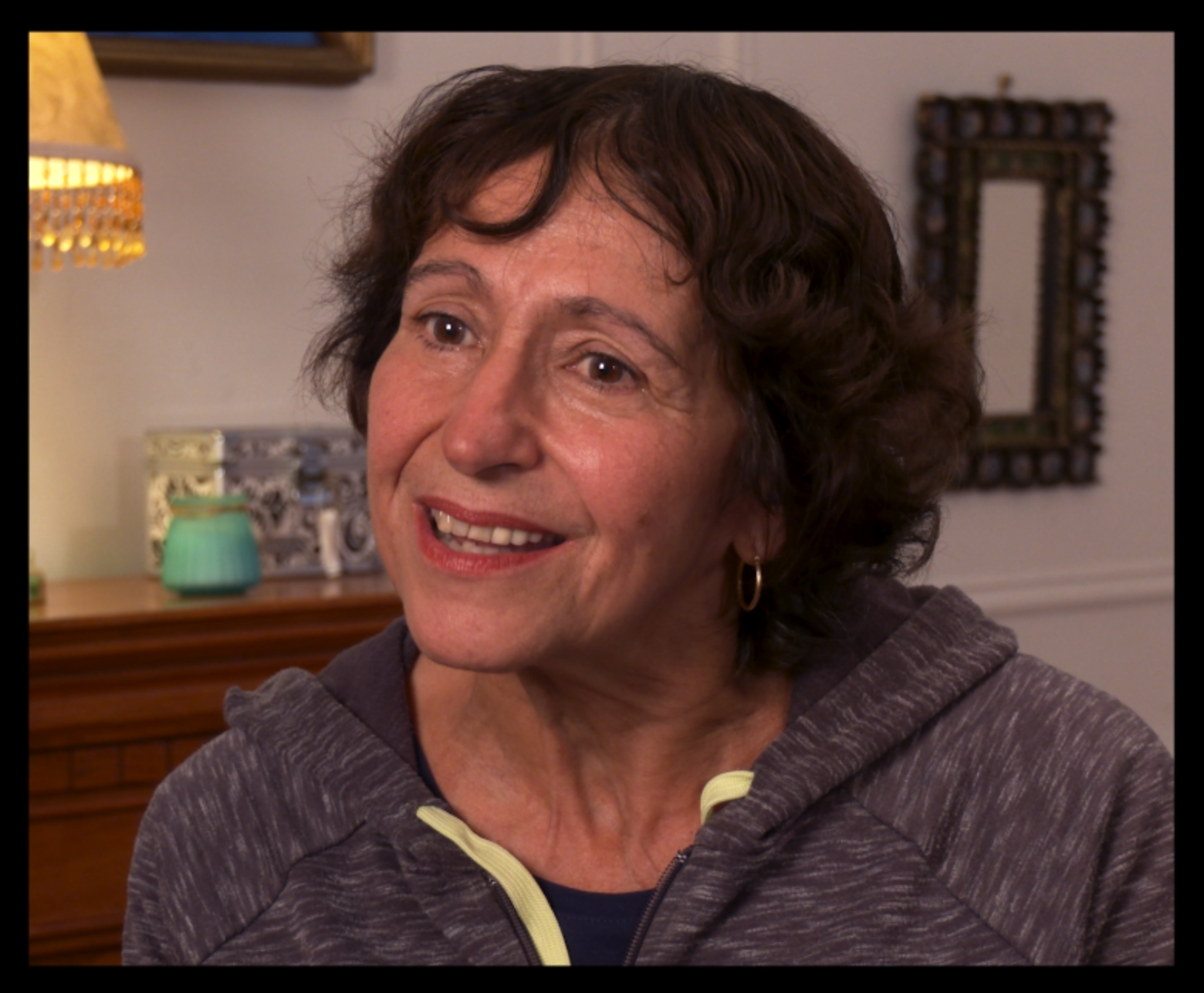
Oral History Interview with Esther Farmer
Item

CUNY
DIGITALHISTORYARCHIVE
A project produced by the Alliance for Puerto Rican Education and Empowerment, APREE.
Interview with Esther Farmer
Interviewed by Pam Sporn & Tami Gold
October 20, 2019
New York, NY
[Start of recorded material at 00:00]
Pam Sporn So what was happening in the world when you were growing up in junior high
high school...
Esther Farmer I was very connected, always I was very connected to the political environment in
the world., my parents were both activist. My father was a victim of McCarthy.
He was a Palestinian Jew who was born in Palestine. And he was very active in
progressive politics, the American Labor Party. And he petitioned in the
neighborhood to get to Congress people on the ballot. One was Pete [last name
spelling not known] and the other one's Vito Marcantonio. Somebody who's quite
famous in Puerto Rican community actually. And for that, he was called before
the House of Un-American Activities Committee, and he lost his job in the
Housing Authority was blacklisted for over 10 years, my mother went back to
work, so we really struggled financially, was very little money coming in. And we
were very scared. And we had the FBI coming to the door. We were told what to
say, and not to say on the phone. So it was kind of this environment of almost
terror. Where we were very frightened as kids, and you know, stories of the
Rosenbergs who had been electrocuted two years before, were all over the house.
And I'm not Puerto Rican, I'm a Palestinian Jew. And for us, it was the message
was if you were a progressive Jew at that time, this could happen to you, what
happened to the Rosenberg so we were scared growing up. And I was very proud
of my parents, because they were very principled and then I also wish that we
could be a little bit more normal. [(laughter) Like other kids and not be so out
there.
Pam Sporn
What drove your parents to their progressive politics? Just very briefly, but what
what was it about?
Esther Farmer Yeah, my father was a CUNY child. And he was he went to City College, he was
Pam Sporn
somewhat political before he went to City College. He was a fur worker, very
active in the Union struggles to unionize the fur industry. And he went to
Brooklyn, City College and got further politicize people used to call back the
Little Red Schoolhouse, City College at the time. And he worked in a sweatshop
and went to school and was very pro Palestinian regarded himself as a Palestinian
Jew. And so, and my mother was also very political, my mother was way beyond
her times in a lot of ways, this is a wonderful family story of, we had two FBI
agents come to the door, and one of them, the big guys, you know, one of them
put their foot in the door when she opened it. And my mother was like, I'm very
popular in this neighborhood, so I'm going to count to three, and on three, I'm
going to scream rape one, two, and then they left. So she was very out there I was,
I was quite proud of her. So they kind of taught us that history of standing up all
the time. So I was kind of in my blood in a way to be an activist. You know, I
often, I often feel like other people had to come to this, in some ways more
honestly than me because I was kind of always there.
So, how did you end up at City College?
Esther Farmer I mean, we couldn't afford any, you know, state school or whatever City College
Pam Sporn
was the place to go. I liked City College because actually at that time, Brooklyn
College was 95% White, Jewish, actually. And I wanted a school that was a little
more diverse. And so I went to City College and I got very active in the Open
Admissions struggle, which was very big at that time in 1969. And it was funny, it
was always referred to as the Open Admissions riots, who named them riots?
You traveled from all the way from Coney Island to Harlem, to go to City
College.
Esther Farmer Yeah, because I wanted that.
Pam Sporn
Describe like, what time did you get on the train or trying to do take up there?
Esther Farmer [04:51]
Yeah, it was difficult to commute from Coney Island, which is the last stop on the
New York City subway system, all the way to Harlem. It took like an hour and a
half. And I had an eight o'clock class, it was kind of difficult. I, in that time in my
life, there were two things that were most important to me, one was dance, I was a
dancer, in my other life in those years. And, and I was very political. So I did,
after two years, of being very active in the Open Admissions fight. I did transfer
to Brooklyn College, because the commute was just too much. And, you know,
my life at the time just didn't, couldn't sustain all that traveling, so I transferred to
Brooklyn.
Pam Sporn
So what was the Open Admissions fight? Yeah, tell me what that was. And why
were you so involved in?
Esther Farmer Yeah, I mean, Open Admissions was something that I feel very passionate about
Pam Sporn
to this day, because they told us, it was impossible. It was kind of an outrageous
demand that everybody should be able to go to college, everybody should be able
to go to the university, no matter what their academic standing was, and people
who wanted to go should go. So at the time, it seemed like it was an impossible
thing. And I find it so interesting that today, we're still, we're still being told that it
was impossible. Oh, Open Admissions, a free college education for everybody,
that's impossible. Well, it's not impossible, because we did it. And we created it.
Tell me who created it, who came up with, where did it come from?
Esther Farmer I think there was at that time, the demand from the students was that education did
Pam Sporn
not reflect what the city look like. And that was certainly true at Brooklyn
College. I mean, you know, I went to school with Hispanic black kids, everybody.
And then at Brooklyn College, there's not, nobody, you could see nobody but, but
White faces, but it was outrageous. City College, not so much. But Brooklyn
College, yes, and it was like, what kind of education is that, when not only are
people not reflected in the curriculum, but not reflected in who was going to
school. And so students got together and said, what's wrong with this? And even
though there was an acknowledgement that people got a pretty lousy education,
especially in minority, that term, communities, why should that stop people from
advancing? And so for me, the struggle was so important, because we took what
was told to us as impossible and created the possibility. And so it was, that was
very exciting, was an exciting moment, because we went from being objects of
study, all the books were about studying us as objects to protagonist in our own
story, that we can create history, we could create our own story. That was a very
exciting moment. And very important for students to be able to make that shift.
Did struggle for Open Admissions come from students who are already at CUNY,
you were already there.
Esther Farmer Yes, we were already at the school. And we started to look at the whole
environment. And it's interesting, because it wasn't only one thing going on, there
was Open Admissions, there was the struggle to change the curriculum to reflect
all of the people that went to school. One of the things that's so interesting about
the struggle for the Puerto Rican Studies Department at Brooklyn College was
that before that time, there was no scholarship in not just in Puerto Rican studies,
but even Judaic studies. There wasn't a Judaic Studies Department at Brooklyn
College before the implementation of Puerto Rican Studies departments, so it
spurred scholarship in all kinds of areas. That was new and exciting, Women's
Studies, Judaic Studies, all of that. And we didn’t know that we were going to
produce that we just said, something's wrong here. And we got to get to do
something about that.
Pam Sporn
Can you give me some of the nuts and bolts of that struggle for Open
Admissions?
Esther Farmer I remember of, taking over buildings. I remember sitting in at administrator's
Pam Sporn
offices. I remember sit down strikes. I remember every kind of protest tactic that
you can think of. We did and I think one of the things that I feel badly about when
everything started being taken away, like during the Reagan administration, was
that young people lost that sense of political education. We had to educate
ourselves because we didn't get a political education. I had some of that from my
parents, but a lot of people didn't. And so we began educating ourselves. Listen,
people were reading, a lot of people learned how to read by studying politics. So
that was also very exciting because we realized that we could do things that we
didn't think we could do.
[10:12]
So how did faculty, were faculty involved in the struggle for Open Admissions?
Were they in favor of it? Were they opposed to it? What involvement did the
community have?
Esther Farmer Some, some faculty were very supportive. And some faculty were not, as exists
Pam Sporn
today.
Some faculty were very supportive of the idea of Open Admissions.
Esther Farmer Some faculty were very supportive of the idea of Open Admissions, and were
very pro community. And some were not supportive. And we, we all know the
difference. We all know who was who. And so of course, there were lots of
alliances being made. And it was a struggle, it wasn't, you know, there were times
when it wasn't pretty. We were fighting people who were trying to stop us from
changing the whole environment in the campus. And I think ultimately, we
succeeded. You know, I walk around Brooklyn College today, I'm kind of
amazed, like the vibrancy and you know, the diversity of the campus, which was
not the case at 1969, I you two Puerto Rican students, you know, that you can see
them saying hello to each other because they didn't exist. So, we had lots of
faculty that were allies and, and there were a lot of remember, this was a time of
great social movements, so they were organizations like S.D.S., which was very
active, it was mainly White. S.D.S. means Students for a Democratic Society.
And they were, they were great allies, to the struggle for Open Admissions, and to
establish some of these ethnic studies departments. And it might seem odd for me,
I’m not Puerto Rican, that I was involved in this so much, but I didn't see myself
as an ally. I, I mean, I like the concept of allies, we need allies. But for me, this
was my struggle, because it meant the quality of education, it was about the
quality of education and quality of education was awful. There was no scholarship
in any of these things. And so that just seemed eminently unfair to me. So for me,
I felt very much a part of this. I didn't feel like now.
Pam Sporn
What did Open Admissions, what exactly was the demand of Open Admission?
Esther Farmer The demand was that everyone, the demand of Open Admissions was that every
Pam Sporn
student from high school who wanted to go to college could go regardless of their
academic standing, and it would be tuition free. And we accomplished that for
seven years, from 1970 to 1977, there was an Open Admissions policy, Brooklyn
College went from 17,000 students to 35,000 students, and the minority
population increased four times. So it changed the nature of the campus, and that
actually had an impact on the establishment of the Puerto Rican Studies
Department, as well as the African American Studies Department, because you
had all these new people around, who then kept pushing the administration for
those changes. So that was, the advent of Open Admission was a very major thing
and it's given short drift in the history books, which is why we produced the Not a
White Paper, to tell those stories and to take control back of our stories, because
we have to tell our own stories and not that somebody else tell those stories.
Now, what do you mean by, in what ways was the education not as good before
Open Admissions? And why do you say that it was better after the
establishment...
Esther Farmer Well, for one thing, diversity of the campus changed everything. There was also
when demand to change the curriculum in primary school and high school to
reflect the people who go to those schools. I mean, it was kind of an outrageous
thing that you know, okay, we all know who George Washington is, but no Puerto
Rican student knew who Albizu Campos was, doesn't make no sense. And so we
had demands to change the curriculum to reflect the people that went to school.
And there was that, there was also the whole issue of bilingual education. I think
there were 2 million Puerot Ricans at that time in New York City, and there was
no discussion of language. In fact, there was the environment where if you spoke
two languages, you were considered more stupid than if you spoke one language,
kind of an outrageous thing, that's changed since then and we helped to change
that.
[15:10]
But so that was the that, the quality of what was taught and then it was the people
who were being taught. So both of those things were very much. And in fact,
when the BC 19, the Brooklyn College 19, were first arrested during this initial
struggle around Open Admissions, one of the demands was that there needed to
be all kinds of, what would you call that, rehabilitation education. So that because
people that got a bad education in high school, could then make it in college,
because one of the arguments was, well, if people you know, they can't make it,
then they shouldn't go to school, well they can't make it because they didn't learn
anything. So we insisted that people get what they needed to be able to make it
through college, and that changed things as well.
Pam Sporn
So you've arrived at Brooklyn College, and it was a mostly White campus? How
did you come into contact with the students in the Puerto Rican Alliance?
Esther Farmer I had always gravitated towards, you know, I grew up in this very mixed
Pam Sporn
environment, and I have many friends and so I also thought politically, that this
was a really important struggle. So I inserted myself and made new friends, very
much got involved, met a lot of people, I put myself in that struggle, because I
thought that was the place to be, and wanted to be on the right side of history,
because I felt like people who were opposed to what we were demanding were on
the wrong side of history. So I had a friend, a very close friend who was involved
in the Puerto Rican Alliance and she introduced me to various people, a lot of
times these things happen through friendships, and relationships, very relational.
And so when you arrived at Brooklyn College and met people in the Puerto Rican
Alliance, what did you hear about the struggle that they were having?
Esther Farmer People were studying politics, we used to, we read Marx, we, we read, Che, you
Pam Sporn
know, some of it is embarrassing to think about now, we walked around with a
little red book (laughter)...there were a lot of Maoist at Brooklyn College and
they were a lot of polemics which I was very used to, in the family about who had
the right political position and things that right now, I'm not sure was so positive,
I think things have advanced since then. But at the time, there was a certain
dogmatism that existed in us reading these things and applying it in this very rigid
kind of way. But mostly, it wasn't, for me, as I was an artist, I was a dancer, it was
a creative activity. Because we were like, learning things we didn't know we were
self educating ourselves. And there was a certain spirit of community that that
created among students at the time that were struggling so hard for this impossible
thing, Open Admissions and the establishment of a Puerto Rican Studies
Department. I mean, who would have thought of that? Like, they were, you know,
the opposition was like, how dare you? Or you think you're so important that you
could insist on the Puerto Rican Studies Department? Or the Open Admissions?
Like, how dare you there was like, there was an outrageousness to that, that was
very exciting, that we could make the impossible possible.
And so what did you hear about what was going on with the Puerto Rican
Alliance? What, What did you learn about what their struggle was about?
Esther Farmer I mean, in the beginning, I think there wasn't even a notion of having a
department it was, you know, at the beginning, it was an institute. And then there
was an insistent, no, wait a minute, we needed to make this a permanent part of
education. So then there became that struggle for a department. And in that
struggle, we after Open Admissions started, which was 1970 and we got this huge
amount of different people in the college that took more steam, and that, you
know, it built and so more and more people started coming around. And, I mean,
we had demonstrations, we occupied Boylan Hall, the administration, you know,
it was, it was quite, it was quite a fight. And we didn't know whether we were
Pam Sporn
gonna win the fight or not. In some ways, I think some people were surprised that
we actually accomplished Open Admissions which is why I think it's so important
to tell this story today, because again, depends on who writes the you know, the
history is always written by the victors they say, but we created something that
wasn't there before and the history books don't reflect it. So it's it was a very, very
important fight. And the fact that we did this for seven years and changed the
nature of the campus at Brooklyn College, even though they've taken away some
they haven't taken away everything.
[20:26]
What do you mean, we did this for seven years?
Esther Farmer Well, we had Open Admissions lasted for seven years until it was taken away.
Pam Sporn
budget cuts, all of this has to do with political will. And not budget, you know,
depends on where you want to put your money. And at that time, during the
Reagan administration, and during the retrenchment of all the things that we won,
this is not a place where they wanted to put their money. So that was taken away.
But for seven years, we've had Open Admissions and the campus radically
transformed.
Did somebody say that Shirley Chisholm had a role?
Esther Farmer I think Shirley Chisholm was involved in, if I remember correctly, the BC 19.
Pam Sporn
When they were arrested, she raised money to bail them out. So at that time, the
Puerto Ricans in Brooklyn College were very connected to the community. So we
had a lot of, there was, you know, they call this the town gown relationship now,
but there was a lot of intermarriage between the community and the college at that
time, which hadn't existed before, which was another thing that was really
important.
In what ways did you see the, in what ways was that relationship between the
community and the students at Brooklyn College? What was the evidence? What
was an example?
Esther Farmer I think we did fundraisers, we did things in the community that had to do with
supporting the students at Brooklyn College and these demands, and the
community was really was responsive. For me, as a Palestinian Jew, I was always
very touched by the Puerto Rican movement support of Palestinian people. And
that was, that was important to me. And I was always quite touched by that even
in the Young Lords program, there was platforms that supported Palestinians in
those years, and we are talking about 1969, so 1970. So I think there were just lots
of ways that the community was very involved. I mean, also the context of the
times, you know, I think it was 1969, when they were the garbage, came out in the
Times recently, which the garbage strikes when they weren't picking up garbage
and people took, went to the Department of Sanitation and took brooms and stuff
and cleaned up the neighborhood and then bought back the brooms.
Pam Sporn
Esther Farmer
Pam Sporn
Esther Farmer
Tami Gold
Esther Farmer
Where weren't they picking up garbage?
In mostly Puerto Rican neighborhoods in Williamsburg, in East Harlem.
(background statement) They weren't picking, the Department of Sanitation
wasn't picking up garbage in Puerto Rican neighborhoods and it was a big fight
about that. So there was stuff going on in the college, but there was also stuff
going on in the streets. And they were very connected to each other because it was
the context of the times, it wasn't just this particular thing, it was all of it that was
kind of blown up. And it was very, in many ways, it was a very exciting, it was
just a very exciting time. I, I've missed those times, with a lot of ways.
You were talking about not seeing yourself as an ally, but that this struggle for
Open Admissions, the struggle for, to establish a Puerto Rican Institute or Puerto
Rican Studies Department, enriched your education. Could you tell me more
about that.
Well, I wanted to learn about the people that were around me, you know, my own
history and the history of my friends. And that just didn't exist. You know, you
learned, history was like learning Western kings and queens and their shenanigans
that was history. So it wasn't, it wasn't even a story. So it was just a bad, the
curriculum was bad. It was a bad education. And even though many of us weren't
educated as to what that education could be, we knew that it was not a good
education, and that we needed to include the people's struggles. It was interesting
because I remember reading this book, you know, Howard Zinn's People's History
of the United States and it was a radical book at the time because it wasn't written
by the victors it was written by people's struggles. It's about people's struggles.
And then it became a famous book that people started reading and it really
touched people. But at the time, that wasn't what was taught. You couldn’t get
that, that story from any any place. So it was it was about the quality of education
that was just so, was so negative, and it puts people working class people in this
category of object to be studied, which was just an awful place to be as a human
being, we're not just objects to be studied, we are human beings. And we have the
agency and the capacity to create history, not just be an object to be studied. And
that's the change that we made, which, looking back at it now, I was very proud to
be part of that. (background audio guidance).
[25:45]
...Do you feel proud about what you did?...
Looking back at that, I feel very proud that we were able to change that
environment from being an object to being a protagonist of our own history and
our own story. So yes, I was very proud of that. It's interesting, it's interesting,
because it was a, for me, it was a love hate relationship with politics. You know, I
both loved the sense of community, and the sense of being a part of something
that was bigger than ourselves, that would have a long lasting legacy that I could
Pam Sporn
feel proud of, which I do. And at the same time, there were these negative aspects
of politics that put people against each other and created a certain sectarianism
that was exploited by COINTELPRO, to keep people away from each other and to
destroy the movement, which in some ways, they, they destroyed some of it. And
so I've always had this kind of love hate relationship to that, to politics in that
way. The other thing that's important to me is that being a part of the Alliance for
Puerto Rican Education and Empowerment is that we've felt like we had
something to give with our activist history. And at the same time, we ourselves
are really learning from the young people today. That's very important to me. I
think that in those years in ‘69, when Stonewall happened, and the whole, what
we call Gay Rights movement blew up, right? Young people today have gone way
beyond where we were, then. And that is something you know, just talking to my
own granddaughter, you know, her attitudes are completely different than what
we thought about those years. And that's very exciting to see where people are at
and how people have evolved and the things that we have to learn from students
today, and what they're struggling with. So it goes both ways.
Can you tell me what the APREE stands for? (background guidance) Yes, I'd like
to know about APREE, what it stands for, when it was formed, who formed it?
Why? And you know, what its goal is and how it connects to the legacy of the
Puerto Rican and Latino Studies Department.
Esther Farmer So APREE is the Alliance for Puerto Rican Education and Empowerment. And it
Pam Sporn
was formed by a couple of generational activists, I love that term, an older activist
who went through this struggle in ‘69, in this “70s, and wanted to do something to
commemorate the 50th anniversary, we really originally got together to do that
commemoration. And what emerged was that we thought it was really important
to be able to tell this story because no one else has really told it. And no one else
knew what happened. Even students in the Puerto Rican Studies Department
didn't know how the Puerto Rican Studies Department happened. They thought
that it was just came from (inaudible), it didn't come from there, it had to be
struggled for we had to fight for that. And it was through our activism that that
happened. So we wanted to tell that story. And we wanted to do it in a storytelling
way, not just about the politics of it, but what, how it affected people personally,
and where their lives were before and after their, not just association with the
department but in creating the department itself and so that's what APREE
originally, we just came together to do, we wanted to give something back to
younger students and show how the history of activism affected the school for the
commemoration, and then it turned into something much bigger. So that's actually
how it started.
[30:20]
What is it turned into what is the big the bigger thing that it turned into?
Esther Farmer I think it has evolved..... So the Alliance for Puerto Rican Education and
Empowerment has evolved into a more activist organization itself, not just to
Tami Gold
commemorate the 50th anniversary, but to support the department, advocate for
the department, which we've done, I think we recently were effective in getting
another line for a professor which was promised and not delivered. Now it has
been delivered which great. And we are continuing that history of the support of
the community and the relationship between the community and the college and
in supporting students in their activism.
So when our 501 (c)(3) and the last three years, it has evolved into a much more
activist organization in terms of our relationships with younger people. And we
wanted to tell the stories, and we wanted to encourage young people to be able to
tell their stories, that their stories are important, and not to feel like they are not
important. And one of the things that concerned us in particular was we have a lot
of people who are using the arts for social change. And so we did a program in a
high school in Williamsburg, where the young people, in Williamsburg Brooklyn
didn't even know that there was a Brooklyn College. And that was astounding to
us. And so we created visits where we took these young people to Brooklyn
College and said you can do this, and you can go to this school, and the school is
available. And that was just amazing that in 2018 kids in high school don't even
know there’s a Brooklyn College and live in Brooklyn. What's wrong with that
picture? So that was important to us?
Where did that courageous sentiment come from?
Esther Farmer So the BC 19 were19 people that were very active in the struggle both for Open
Pam Sporn
Admissions and establish the department, and we had a list of 19 demands. Open
Admissions was one of the demands, changing the curriculum was another,
bilingual education was another. Making sure that young people coming into the
school, were ready for college to get the remedial help they needed was another.
You know, there were 19 demands, and they put themselves on the line for these
demands, people were arrested. And eventually I think the charges were dropped.
But that was quite a scary time.
Was there a victory?...Wasn't there a victory out of that?
Esther Farmer I mean, the victory was that a lot of these things were established and also in
terms of the creativity that was happening at the time, so we created the first
daycare center at Brooklyn College, that had never been done before, for working
mothers. So they were a lot of initiatives that were coming from the
grassroots...that were just vibrant, creative, new, that was what was so exciting
about that moment.
So while I feel very proud of what we accomplished at Brooklyn College, there
were things that happened, where I realize now, we could have been better at
taking care of the individual's needs. And so one of the things I learned was how
important it is to be kind, to every single person that we meet, and that I learned
the importance of building on what people say, rather than arguing on what I don't
Pam Sporn
like. And so I got very involved in theatrical work and used that, what we call Yes
and, to help people to learn how to build on what people say. And getting away
from this culture of critique, which I think we had a certain culture of critique, we
were constantly critiquing each other, rather than helping each other to build. And
that became very important in my life. And so I learned that both from some of
the things I didn't like in politics, and some of the things that I did love, which
was that spirit of community. So does that help?
[35:26]
How did that play out in terms of the work that you did in your jobs, and in your
other things that you care about?
Esther Farmer Well, a strange quirk of fate, the agency that my father was fired from, during
Pam Sporn
McCarthy, which was the New York City Housing Authority, I started working
for them. And I was quite a pain in the butt to them and sued them twice and won
both times. One for pregnancy disability and another for putting out a union
newsletter, talking about some of the corruption that was going on and so I
became an activist in the Housing Authority and eventually became a Housing
Manager where I managed housing projects, very difficult job, and use the
theatrical approach that actually became somewhat well known, it was written up
in the papers and I was proud of that. And I learned all of that over the years from
some of my activities in politics, as well as some of my differences with how
politics is done. So I have always thought very politically, this thing that
happened in Brooklyn College has helped me to think very politically, but also
much more personally. And getting that relationship correctly, has been the
struggle of my life.
You seem to have lifelong friends, relationships that you begin at Brooklyn
College, can you comment on that?
Esther Farmer I do. I have lifelong friends, some have become my partners in life and have
Pam Sporn
become family. Yeah, and some I lost touch with both. So this is a nice process
for me.
I remember the question that I had before, which was, what kind of leadership
role did women play in this struggle for Puerto Rican Studies Institute and the
department and Open Admissions?
Esther Farmer It’s a really important question. Women, we were dealing with sexism from the
very beginning. I mean, this was a real issue in the movement and so happens
today that my experience was that we women did most of the work and didn't get
a lot of the credit. So we were always behind the scenes, doing all kinds of things,
mimeographing flyers and being in the office and organizing and calling and
doing all the things you do as an activist. And we were somewhat behind the
scenes the people who were out front were generally not women, there were some
women that were out front, but most of the women were not. So sexism was an
issue and still is.
Pam Sporn Where there particular women who did step forward over the years? I mean, some
of the, seems like some of the key chair, people of the department, were women. I
see you and Gisely, an Milga organizing this, this process and APREE...
Esther Farmer [39:09]
I mean, Milga was a hero of mine still is. She's, you know, somebody who came
up through the department. She was an activist, she stayed at Brooklyn College up
until last year. She's just done so much for the whole community. She's really and
still is, does all the work behind the scenes and needs to get the credit. She
deserves the credit. She's been an amazing leader. I have much love and
admiration for Milga Morales.
[End of recorded material at 39:40]
DIGITALHISTORYARCHIVE
A project produced by the Alliance for Puerto Rican Education and Empowerment, APREE.
Interview with Esther Farmer
Interviewed by Pam Sporn & Tami Gold
October 20, 2019
New York, NY
[Start of recorded material at 00:00]
Pam Sporn So what was happening in the world when you were growing up in junior high
high school...
Esther Farmer I was very connected, always I was very connected to the political environment in
the world., my parents were both activist. My father was a victim of McCarthy.
He was a Palestinian Jew who was born in Palestine. And he was very active in
progressive politics, the American Labor Party. And he petitioned in the
neighborhood to get to Congress people on the ballot. One was Pete [last name
spelling not known] and the other one's Vito Marcantonio. Somebody who's quite
famous in Puerto Rican community actually. And for that, he was called before
the House of Un-American Activities Committee, and he lost his job in the
Housing Authority was blacklisted for over 10 years, my mother went back to
work, so we really struggled financially, was very little money coming in. And we
were very scared. And we had the FBI coming to the door. We were told what to
say, and not to say on the phone. So it was kind of this environment of almost
terror. Where we were very frightened as kids, and you know, stories of the
Rosenbergs who had been electrocuted two years before, were all over the house.
And I'm not Puerto Rican, I'm a Palestinian Jew. And for us, it was the message
was if you were a progressive Jew at that time, this could happen to you, what
happened to the Rosenberg so we were scared growing up. And I was very proud
of my parents, because they were very principled and then I also wish that we
could be a little bit more normal. [(laughter) Like other kids and not be so out
there.
Pam Sporn
What drove your parents to their progressive politics? Just very briefly, but what
what was it about?
Esther Farmer Yeah, my father was a CUNY child. And he was he went to City College, he was
Pam Sporn
somewhat political before he went to City College. He was a fur worker, very
active in the Union struggles to unionize the fur industry. And he went to
Brooklyn, City College and got further politicize people used to call back the
Little Red Schoolhouse, City College at the time. And he worked in a sweatshop
and went to school and was very pro Palestinian regarded himself as a Palestinian
Jew. And so, and my mother was also very political, my mother was way beyond
her times in a lot of ways, this is a wonderful family story of, we had two FBI
agents come to the door, and one of them, the big guys, you know, one of them
put their foot in the door when she opened it. And my mother was like, I'm very
popular in this neighborhood, so I'm going to count to three, and on three, I'm
going to scream rape one, two, and then they left. So she was very out there I was,
I was quite proud of her. So they kind of taught us that history of standing up all
the time. So I was kind of in my blood in a way to be an activist. You know, I
often, I often feel like other people had to come to this, in some ways more
honestly than me because I was kind of always there.
So, how did you end up at City College?
Esther Farmer I mean, we couldn't afford any, you know, state school or whatever City College
Pam Sporn
was the place to go. I liked City College because actually at that time, Brooklyn
College was 95% White, Jewish, actually. And I wanted a school that was a little
more diverse. And so I went to City College and I got very active in the Open
Admissions struggle, which was very big at that time in 1969. And it was funny, it
was always referred to as the Open Admissions riots, who named them riots?
You traveled from all the way from Coney Island to Harlem, to go to City
College.
Esther Farmer Yeah, because I wanted that.
Pam Sporn
Describe like, what time did you get on the train or trying to do take up there?
Esther Farmer [04:51]
Yeah, it was difficult to commute from Coney Island, which is the last stop on the
New York City subway system, all the way to Harlem. It took like an hour and a
half. And I had an eight o'clock class, it was kind of difficult. I, in that time in my
life, there were two things that were most important to me, one was dance, I was a
dancer, in my other life in those years. And, and I was very political. So I did,
after two years, of being very active in the Open Admissions fight. I did transfer
to Brooklyn College, because the commute was just too much. And, you know,
my life at the time just didn't, couldn't sustain all that traveling, so I transferred to
Brooklyn.
Pam Sporn
So what was the Open Admissions fight? Yeah, tell me what that was. And why
were you so involved in?
Esther Farmer Yeah, I mean, Open Admissions was something that I feel very passionate about
Pam Sporn
to this day, because they told us, it was impossible. It was kind of an outrageous
demand that everybody should be able to go to college, everybody should be able
to go to the university, no matter what their academic standing was, and people
who wanted to go should go. So at the time, it seemed like it was an impossible
thing. And I find it so interesting that today, we're still, we're still being told that it
was impossible. Oh, Open Admissions, a free college education for everybody,
that's impossible. Well, it's not impossible, because we did it. And we created it.
Tell me who created it, who came up with, where did it come from?
Esther Farmer I think there was at that time, the demand from the students was that education did
Pam Sporn
not reflect what the city look like. And that was certainly true at Brooklyn
College. I mean, you know, I went to school with Hispanic black kids, everybody.
And then at Brooklyn College, there's not, nobody, you could see nobody but, but
White faces, but it was outrageous. City College, not so much. But Brooklyn
College, yes, and it was like, what kind of education is that, when not only are
people not reflected in the curriculum, but not reflected in who was going to
school. And so students got together and said, what's wrong with this? And even
though there was an acknowledgement that people got a pretty lousy education,
especially in minority, that term, communities, why should that stop people from
advancing? And so for me, the struggle was so important, because we took what
was told to us as impossible and created the possibility. And so it was, that was
very exciting, was an exciting moment, because we went from being objects of
study, all the books were about studying us as objects to protagonist in our own
story, that we can create history, we could create our own story. That was a very
exciting moment. And very important for students to be able to make that shift.
Did struggle for Open Admissions come from students who are already at CUNY,
you were already there.
Esther Farmer Yes, we were already at the school. And we started to look at the whole
environment. And it's interesting, because it wasn't only one thing going on, there
was Open Admissions, there was the struggle to change the curriculum to reflect
all of the people that went to school. One of the things that's so interesting about
the struggle for the Puerto Rican Studies Department at Brooklyn College was
that before that time, there was no scholarship in not just in Puerto Rican studies,
but even Judaic studies. There wasn't a Judaic Studies Department at Brooklyn
College before the implementation of Puerto Rican Studies departments, so it
spurred scholarship in all kinds of areas. That was new and exciting, Women's
Studies, Judaic Studies, all of that. And we didn’t know that we were going to
produce that we just said, something's wrong here. And we got to get to do
something about that.
Pam Sporn
Can you give me some of the nuts and bolts of that struggle for Open
Admissions?
Esther Farmer I remember of, taking over buildings. I remember sitting in at administrator's
Pam Sporn
offices. I remember sit down strikes. I remember every kind of protest tactic that
you can think of. We did and I think one of the things that I feel badly about when
everything started being taken away, like during the Reagan administration, was
that young people lost that sense of political education. We had to educate
ourselves because we didn't get a political education. I had some of that from my
parents, but a lot of people didn't. And so we began educating ourselves. Listen,
people were reading, a lot of people learned how to read by studying politics. So
that was also very exciting because we realized that we could do things that we
didn't think we could do.
[10:12]
So how did faculty, were faculty involved in the struggle for Open Admissions?
Were they in favor of it? Were they opposed to it? What involvement did the
community have?
Esther Farmer Some, some faculty were very supportive. And some faculty were not, as exists
Pam Sporn
today.
Some faculty were very supportive of the idea of Open Admissions.
Esther Farmer Some faculty were very supportive of the idea of Open Admissions, and were
very pro community. And some were not supportive. And we, we all know the
difference. We all know who was who. And so of course, there were lots of
alliances being made. And it was a struggle, it wasn't, you know, there were times
when it wasn't pretty. We were fighting people who were trying to stop us from
changing the whole environment in the campus. And I think ultimately, we
succeeded. You know, I walk around Brooklyn College today, I'm kind of
amazed, like the vibrancy and you know, the diversity of the campus, which was
not the case at 1969, I you two Puerto Rican students, you know, that you can see
them saying hello to each other because they didn't exist. So, we had lots of
faculty that were allies and, and there were a lot of remember, this was a time of
great social movements, so they were organizations like S.D.S., which was very
active, it was mainly White. S.D.S. means Students for a Democratic Society.
And they were, they were great allies, to the struggle for Open Admissions, and to
establish some of these ethnic studies departments. And it might seem odd for me,
I’m not Puerto Rican, that I was involved in this so much, but I didn't see myself
as an ally. I, I mean, I like the concept of allies, we need allies. But for me, this
was my struggle, because it meant the quality of education, it was about the
quality of education and quality of education was awful. There was no scholarship
in any of these things. And so that just seemed eminently unfair to me. So for me,
I felt very much a part of this. I didn't feel like now.
Pam Sporn
What did Open Admissions, what exactly was the demand of Open Admission?
Esther Farmer The demand was that everyone, the demand of Open Admissions was that every
Pam Sporn
student from high school who wanted to go to college could go regardless of their
academic standing, and it would be tuition free. And we accomplished that for
seven years, from 1970 to 1977, there was an Open Admissions policy, Brooklyn
College went from 17,000 students to 35,000 students, and the minority
population increased four times. So it changed the nature of the campus, and that
actually had an impact on the establishment of the Puerto Rican Studies
Department, as well as the African American Studies Department, because you
had all these new people around, who then kept pushing the administration for
those changes. So that was, the advent of Open Admission was a very major thing
and it's given short drift in the history books, which is why we produced the Not a
White Paper, to tell those stories and to take control back of our stories, because
we have to tell our own stories and not that somebody else tell those stories.
Now, what do you mean by, in what ways was the education not as good before
Open Admissions? And why do you say that it was better after the
establishment...
Esther Farmer Well, for one thing, diversity of the campus changed everything. There was also
when demand to change the curriculum in primary school and high school to
reflect the people who go to those schools. I mean, it was kind of an outrageous
thing that you know, okay, we all know who George Washington is, but no Puerto
Rican student knew who Albizu Campos was, doesn't make no sense. And so we
had demands to change the curriculum to reflect the people that went to school.
And there was that, there was also the whole issue of bilingual education. I think
there were 2 million Puerot Ricans at that time in New York City, and there was
no discussion of language. In fact, there was the environment where if you spoke
two languages, you were considered more stupid than if you spoke one language,
kind of an outrageous thing, that's changed since then and we helped to change
that.
[15:10]
But so that was the that, the quality of what was taught and then it was the people
who were being taught. So both of those things were very much. And in fact,
when the BC 19, the Brooklyn College 19, were first arrested during this initial
struggle around Open Admissions, one of the demands was that there needed to
be all kinds of, what would you call that, rehabilitation education. So that because
people that got a bad education in high school, could then make it in college,
because one of the arguments was, well, if people you know, they can't make it,
then they shouldn't go to school, well they can't make it because they didn't learn
anything. So we insisted that people get what they needed to be able to make it
through college, and that changed things as well.
Pam Sporn
So you've arrived at Brooklyn College, and it was a mostly White campus? How
did you come into contact with the students in the Puerto Rican Alliance?
Esther Farmer I had always gravitated towards, you know, I grew up in this very mixed
Pam Sporn
environment, and I have many friends and so I also thought politically, that this
was a really important struggle. So I inserted myself and made new friends, very
much got involved, met a lot of people, I put myself in that struggle, because I
thought that was the place to be, and wanted to be on the right side of history,
because I felt like people who were opposed to what we were demanding were on
the wrong side of history. So I had a friend, a very close friend who was involved
in the Puerto Rican Alliance and she introduced me to various people, a lot of
times these things happen through friendships, and relationships, very relational.
And so when you arrived at Brooklyn College and met people in the Puerto Rican
Alliance, what did you hear about the struggle that they were having?
Esther Farmer People were studying politics, we used to, we read Marx, we, we read, Che, you
Pam Sporn
know, some of it is embarrassing to think about now, we walked around with a
little red book (laughter)...there were a lot of Maoist at Brooklyn College and
they were a lot of polemics which I was very used to, in the family about who had
the right political position and things that right now, I'm not sure was so positive,
I think things have advanced since then. But at the time, there was a certain
dogmatism that existed in us reading these things and applying it in this very rigid
kind of way. But mostly, it wasn't, for me, as I was an artist, I was a dancer, it was
a creative activity. Because we were like, learning things we didn't know we were
self educating ourselves. And there was a certain spirit of community that that
created among students at the time that were struggling so hard for this impossible
thing, Open Admissions and the establishment of a Puerto Rican Studies
Department. I mean, who would have thought of that? Like, they were, you know,
the opposition was like, how dare you? Or you think you're so important that you
could insist on the Puerto Rican Studies Department? Or the Open Admissions?
Like, how dare you there was like, there was an outrageousness to that, that was
very exciting, that we could make the impossible possible.
And so what did you hear about what was going on with the Puerto Rican
Alliance? What, What did you learn about what their struggle was about?
Esther Farmer I mean, in the beginning, I think there wasn't even a notion of having a
department it was, you know, at the beginning, it was an institute. And then there
was an insistent, no, wait a minute, we needed to make this a permanent part of
education. So then there became that struggle for a department. And in that
struggle, we after Open Admissions started, which was 1970 and we got this huge
amount of different people in the college that took more steam, and that, you
know, it built and so more and more people started coming around. And, I mean,
we had demonstrations, we occupied Boylan Hall, the administration, you know,
it was, it was quite, it was quite a fight. And we didn't know whether we were
Pam Sporn
gonna win the fight or not. In some ways, I think some people were surprised that
we actually accomplished Open Admissions which is why I think it's so important
to tell this story today, because again, depends on who writes the you know, the
history is always written by the victors they say, but we created something that
wasn't there before and the history books don't reflect it. So it's it was a very, very
important fight. And the fact that we did this for seven years and changed the
nature of the campus at Brooklyn College, even though they've taken away some
they haven't taken away everything.
[20:26]
What do you mean, we did this for seven years?
Esther Farmer Well, we had Open Admissions lasted for seven years until it was taken away.
Pam Sporn
budget cuts, all of this has to do with political will. And not budget, you know,
depends on where you want to put your money. And at that time, during the
Reagan administration, and during the retrenchment of all the things that we won,
this is not a place where they wanted to put their money. So that was taken away.
But for seven years, we've had Open Admissions and the campus radically
transformed.
Did somebody say that Shirley Chisholm had a role?
Esther Farmer I think Shirley Chisholm was involved in, if I remember correctly, the BC 19.
Pam Sporn
When they were arrested, she raised money to bail them out. So at that time, the
Puerto Ricans in Brooklyn College were very connected to the community. So we
had a lot of, there was, you know, they call this the town gown relationship now,
but there was a lot of intermarriage between the community and the college at that
time, which hadn't existed before, which was another thing that was really
important.
In what ways did you see the, in what ways was that relationship between the
community and the students at Brooklyn College? What was the evidence? What
was an example?
Esther Farmer I think we did fundraisers, we did things in the community that had to do with
supporting the students at Brooklyn College and these demands, and the
community was really was responsive. For me, as a Palestinian Jew, I was always
very touched by the Puerto Rican movement support of Palestinian people. And
that was, that was important to me. And I was always quite touched by that even
in the Young Lords program, there was platforms that supported Palestinians in
those years, and we are talking about 1969, so 1970. So I think there were just lots
of ways that the community was very involved. I mean, also the context of the
times, you know, I think it was 1969, when they were the garbage, came out in the
Times recently, which the garbage strikes when they weren't picking up garbage
and people took, went to the Department of Sanitation and took brooms and stuff
and cleaned up the neighborhood and then bought back the brooms.
Pam Sporn
Esther Farmer
Pam Sporn
Esther Farmer
Tami Gold
Esther Farmer
Where weren't they picking up garbage?
In mostly Puerto Rican neighborhoods in Williamsburg, in East Harlem.
(background statement) They weren't picking, the Department of Sanitation
wasn't picking up garbage in Puerto Rican neighborhoods and it was a big fight
about that. So there was stuff going on in the college, but there was also stuff
going on in the streets. And they were very connected to each other because it was
the context of the times, it wasn't just this particular thing, it was all of it that was
kind of blown up. And it was very, in many ways, it was a very exciting, it was
just a very exciting time. I, I've missed those times, with a lot of ways.
You were talking about not seeing yourself as an ally, but that this struggle for
Open Admissions, the struggle for, to establish a Puerto Rican Institute or Puerto
Rican Studies Department, enriched your education. Could you tell me more
about that.
Well, I wanted to learn about the people that were around me, you know, my own
history and the history of my friends. And that just didn't exist. You know, you
learned, history was like learning Western kings and queens and their shenanigans
that was history. So it wasn't, it wasn't even a story. So it was just a bad, the
curriculum was bad. It was a bad education. And even though many of us weren't
educated as to what that education could be, we knew that it was not a good
education, and that we needed to include the people's struggles. It was interesting
because I remember reading this book, you know, Howard Zinn's People's History
of the United States and it was a radical book at the time because it wasn't written
by the victors it was written by people's struggles. It's about people's struggles.
And then it became a famous book that people started reading and it really
touched people. But at the time, that wasn't what was taught. You couldn’t get
that, that story from any any place. So it was it was about the quality of education
that was just so, was so negative, and it puts people working class people in this
category of object to be studied, which was just an awful place to be as a human
being, we're not just objects to be studied, we are human beings. And we have the
agency and the capacity to create history, not just be an object to be studied. And
that's the change that we made, which, looking back at it now, I was very proud to
be part of that. (background audio guidance).
[25:45]
...Do you feel proud about what you did?...
Looking back at that, I feel very proud that we were able to change that
environment from being an object to being a protagonist of our own history and
our own story. So yes, I was very proud of that. It's interesting, it's interesting,
because it was a, for me, it was a love hate relationship with politics. You know, I
both loved the sense of community, and the sense of being a part of something
that was bigger than ourselves, that would have a long lasting legacy that I could
Pam Sporn
feel proud of, which I do. And at the same time, there were these negative aspects
of politics that put people against each other and created a certain sectarianism
that was exploited by COINTELPRO, to keep people away from each other and to
destroy the movement, which in some ways, they, they destroyed some of it. And
so I've always had this kind of love hate relationship to that, to politics in that
way. The other thing that's important to me is that being a part of the Alliance for
Puerto Rican Education and Empowerment is that we've felt like we had
something to give with our activist history. And at the same time, we ourselves
are really learning from the young people today. That's very important to me. I
think that in those years in ‘69, when Stonewall happened, and the whole, what
we call Gay Rights movement blew up, right? Young people today have gone way
beyond where we were, then. And that is something you know, just talking to my
own granddaughter, you know, her attitudes are completely different than what
we thought about those years. And that's very exciting to see where people are at
and how people have evolved and the things that we have to learn from students
today, and what they're struggling with. So it goes both ways.
Can you tell me what the APREE stands for? (background guidance) Yes, I'd like
to know about APREE, what it stands for, when it was formed, who formed it?
Why? And you know, what its goal is and how it connects to the legacy of the
Puerto Rican and Latino Studies Department.
Esther Farmer So APREE is the Alliance for Puerto Rican Education and Empowerment. And it
Pam Sporn
was formed by a couple of generational activists, I love that term, an older activist
who went through this struggle in ‘69, in this “70s, and wanted to do something to
commemorate the 50th anniversary, we really originally got together to do that
commemoration. And what emerged was that we thought it was really important
to be able to tell this story because no one else has really told it. And no one else
knew what happened. Even students in the Puerto Rican Studies Department
didn't know how the Puerto Rican Studies Department happened. They thought
that it was just came from (inaudible), it didn't come from there, it had to be
struggled for we had to fight for that. And it was through our activism that that
happened. So we wanted to tell that story. And we wanted to do it in a storytelling
way, not just about the politics of it, but what, how it affected people personally,
and where their lives were before and after their, not just association with the
department but in creating the department itself and so that's what APREE
originally, we just came together to do, we wanted to give something back to
younger students and show how the history of activism affected the school for the
commemoration, and then it turned into something much bigger. So that's actually
how it started.
[30:20]
What is it turned into what is the big the bigger thing that it turned into?
Esther Farmer I think it has evolved..... So the Alliance for Puerto Rican Education and
Empowerment has evolved into a more activist organization itself, not just to
Tami Gold
commemorate the 50th anniversary, but to support the department, advocate for
the department, which we've done, I think we recently were effective in getting
another line for a professor which was promised and not delivered. Now it has
been delivered which great. And we are continuing that history of the support of
the community and the relationship between the community and the college and
in supporting students in their activism.
So when our 501 (c)(3) and the last three years, it has evolved into a much more
activist organization in terms of our relationships with younger people. And we
wanted to tell the stories, and we wanted to encourage young people to be able to
tell their stories, that their stories are important, and not to feel like they are not
important. And one of the things that concerned us in particular was we have a lot
of people who are using the arts for social change. And so we did a program in a
high school in Williamsburg, where the young people, in Williamsburg Brooklyn
didn't even know that there was a Brooklyn College. And that was astounding to
us. And so we created visits where we took these young people to Brooklyn
College and said you can do this, and you can go to this school, and the school is
available. And that was just amazing that in 2018 kids in high school don't even
know there’s a Brooklyn College and live in Brooklyn. What's wrong with that
picture? So that was important to us?
Where did that courageous sentiment come from?
Esther Farmer So the BC 19 were19 people that were very active in the struggle both for Open
Pam Sporn
Admissions and establish the department, and we had a list of 19 demands. Open
Admissions was one of the demands, changing the curriculum was another,
bilingual education was another. Making sure that young people coming into the
school, were ready for college to get the remedial help they needed was another.
You know, there were 19 demands, and they put themselves on the line for these
demands, people were arrested. And eventually I think the charges were dropped.
But that was quite a scary time.
Was there a victory?...Wasn't there a victory out of that?
Esther Farmer I mean, the victory was that a lot of these things were established and also in
terms of the creativity that was happening at the time, so we created the first
daycare center at Brooklyn College, that had never been done before, for working
mothers. So they were a lot of initiatives that were coming from the
grassroots...that were just vibrant, creative, new, that was what was so exciting
about that moment.
So while I feel very proud of what we accomplished at Brooklyn College, there
were things that happened, where I realize now, we could have been better at
taking care of the individual's needs. And so one of the things I learned was how
important it is to be kind, to every single person that we meet, and that I learned
the importance of building on what people say, rather than arguing on what I don't
Pam Sporn
like. And so I got very involved in theatrical work and used that, what we call Yes
and, to help people to learn how to build on what people say. And getting away
from this culture of critique, which I think we had a certain culture of critique, we
were constantly critiquing each other, rather than helping each other to build. And
that became very important in my life. And so I learned that both from some of
the things I didn't like in politics, and some of the things that I did love, which
was that spirit of community. So does that help?
[35:26]
How did that play out in terms of the work that you did in your jobs, and in your
other things that you care about?
Esther Farmer Well, a strange quirk of fate, the agency that my father was fired from, during
Pam Sporn
McCarthy, which was the New York City Housing Authority, I started working
for them. And I was quite a pain in the butt to them and sued them twice and won
both times. One for pregnancy disability and another for putting out a union
newsletter, talking about some of the corruption that was going on and so I
became an activist in the Housing Authority and eventually became a Housing
Manager where I managed housing projects, very difficult job, and use the
theatrical approach that actually became somewhat well known, it was written up
in the papers and I was proud of that. And I learned all of that over the years from
some of my activities in politics, as well as some of my differences with how
politics is done. So I have always thought very politically, this thing that
happened in Brooklyn College has helped me to think very politically, but also
much more personally. And getting that relationship correctly, has been the
struggle of my life.
You seem to have lifelong friends, relationships that you begin at Brooklyn
College, can you comment on that?
Esther Farmer I do. I have lifelong friends, some have become my partners in life and have
Pam Sporn
become family. Yeah, and some I lost touch with both. So this is a nice process
for me.
I remember the question that I had before, which was, what kind of leadership
role did women play in this struggle for Puerto Rican Studies Institute and the
department and Open Admissions?
Esther Farmer It’s a really important question. Women, we were dealing with sexism from the
very beginning. I mean, this was a real issue in the movement and so happens
today that my experience was that we women did most of the work and didn't get
a lot of the credit. So we were always behind the scenes, doing all kinds of things,
mimeographing flyers and being in the office and organizing and calling and
doing all the things you do as an activist. And we were somewhat behind the
scenes the people who were out front were generally not women, there were some
women that were out front, but most of the women were not. So sexism was an
issue and still is.
Pam Sporn Where there particular women who did step forward over the years? I mean, some
of the, seems like some of the key chair, people of the department, were women. I
see you and Gisely, an Milga organizing this, this process and APREE...
Esther Farmer [39:09]
I mean, Milga was a hero of mine still is. She's, you know, somebody who came
up through the department. She was an activist, she stayed at Brooklyn College up
until last year. She's just done so much for the whole community. She's really and
still is, does all the work behind the scenes and needs to get the credit. She
deserves the credit. She's been an amazing leader. I have much love and
admiration for Milga Morales.
[End of recorded material at 39:40]
Title
Oral History Interview with Esther Farmer
Description
In this oral history with Esther Farmer, a self-identified Palestinian-Jew, dancer, and a daughter of activist parents, she recalled details of growing up within a politically engaged household which later informed her activism as a student at CUNY. As a student-activist at Brooklyn College (BC) during the late 1960s she was Involved in the Open Admissions struggle at the college. Farmer shared her perspective and the tactics employed by student activists demanding the immediate implementation of CUNY's Open Admissions policy in Fall 1970.
This item is part of the Puerto Rican Studies at Brooklyn College (PRSBC) Collection, which covers the largely Puerto Rican-led student movement at Brooklyn College (CUNY) during the late 1960s and early 1970s that fought for the creation of the Puerto Rican Studies Department at the college. The collection includes oral history interviews with pioneering student activists, photographs of participants and their struggles, and other archival materials on the fight to create the Puerto Rican Studies Department drawn from the Archives and Special Collections library at Brooklyn College.
This item is part of the Puerto Rican Studies at Brooklyn College (PRSBC) Collection, which covers the largely Puerto Rican-led student movement at Brooklyn College (CUNY) during the late 1960s and early 1970s that fought for the creation of the Puerto Rican Studies Department at the college. The collection includes oral history interviews with pioneering student activists, photographs of participants and their struggles, and other archival materials on the fight to create the Puerto Rican Studies Department drawn from the Archives and Special Collections library at Brooklyn College.
Contributor
Farmer, Esther
Creator
Sporn, Pam
Gold, Tami
Date
October 20, 2019
Language
English
Relation
14122
13952
Rights
Copyrighted
Source
Alliance for Puerto Rican Education and Empowerment
interviewer
Pam Sporn & Tami Gold
interviewee
Esther Farmer
Location
Brooklyn, NY
Transcription
A project of the Professional Staff Congress Archives Committee
Interview with Esther Farmer
Interviewed by Pam Sporn & Tami Gold
October 20, 2019
New York, NY
[Start of recorded material at 00:00]
Pam Sporn So what was happening in the world when you were growing up in junior high,
high school…
Esther Farmer I was very connected, always I was very connected to the political environment in
the world., my parents were both activist. My father was a victim of McCarthy.
He was a Palestinian Jew who was born in Palestine. And he was very active in
progressive politics, the American Labor Party. And he petitioned in the
neighborhood to get to Congress people on the ballot. One was Pete [last name
spelling not known] and the other one's Vito Marcantonio. Somebody who's quite
famous in Puerto Rican community actually. And for that, he was called before
the House of Un-American Activities Committee, and he lost his job in the
Housing Authority was blacklisted for over 10 years, my mother went back to
work, so we really struggled financially, was very little money coming in. And we
were very scared. And we had the FBI coming to the door. We were told what to
say, and not to say on the phone. So it was kind of this environment of almost
terror. Where we were very frightened as kids, and you know, stories of the
Rosenbergs who had been electrocuted two years before, were all over the house.
And I'm not Puerto Rican, I'm a Palestinian Jew. And for us, it was the message
was if you were a progressive Jew at that time, this could happen to you, what
happened to the Rosenberg so we were scared growing up. And I was very proud
of my parents, because they were very principled and then I also wish that we
could be a little bit more normal. [(laughter) Like other kids and not be so out
there.
Pam Sporn What drove your parents to their progressive politics? Just very briefly, but what
was it about?
Esther Farmer Yeah, my father was a CUNY child. And he was he went to City College, he was
somewhat political before he went to City College. He was a fur worker, very
active in the Union struggles to unionize the fur industry. And he went to
Brooklyn, City College and got further politicize people used to call back the
Little Red Schoolhouse, City College at the time. And he worked in a sweatshop
and went to school and was very pro Palestinian regarded himself as a Palestinian
Jew. And so, and my mother was also very political, my mother was way beyond
her times in a lot of ways, this is a wonderful family story of, we had two FBI
agents come to the door, and one of them, the big guys, you know, one of them
put their foot in the door when she opened it. And my mother was like, I'm very
popular in this neighborhood, so I'm going to count to three, and on three, I'm
going to scream rape one, two, and then they left. So she was very out there I was,
I was quite proud of her. So they kind of taught us that history of standing up all
the time. So I was kind of in my blood in a way to be an activist. You know, I
often, I often feel like other people had to come to this, in some ways more
honestly than me because I was kind of always there.
Pam Sporn So, how did you end up at City College?
Esther Farmer I mean, we couldn't afford any, you know, state school or whatever City College
was the place to go. I liked City College because actually at that time, Brooklyn
College was 95% White, Jewish, actually. And I wanted a school that was a little
more diverse. And so I went to City College and I got very active in the Open
Admissions struggle, which was very big at that time in 1969. And it was funny, it
was always referred to as the Open Admissions riots, who named them riots?
Pam Sporn You traveled from all the way from Coney Island to Harlem, to go to City
College.
Esther Farmer Yeah, because I wanted that.
Pam Sporn Describe like, what time did you get on the train or trying to do take up there?
Esther Farmer [04:51]
Yeah, it was difficult to commute from Coney Island, which is the last stop on the
New York City subway system, all the way to Harlem. It took like an hour and a
half. And I had an eight o'clock class, it was kind of difficult. I, in that time in my
life, there were two things that were most important to me, one was dance, I was a
dancer, in my other life in those years. And, and I was very political. So I did,
after two years, of being very active in the Open Admissions fight. I did transfer
to Brooklyn College, because the commute was just too much. And, you know,
my life at the time just didn't, couldn't sustain all that traveling, so I transferred to
Brooklyn.
Pam Sporn So what was the Open Admissions fight? Yeah, tell me what that was. And why
were you so involved in?
Esther Farmer Yeah, I mean, Open Admissions was something that I feel very passionate about
to this day, because they told us, it was impossible. It was kind of an outrageous
demand that everybody should be able to go to college, everybody should be able
to go to the university, no matter what their academic standing was, and people
who wanted to go should go. So at the time, it seemed like it was an impossible
thing. And I find it so interesting that today, we're still, we're still being told that it
was impossible. Oh, Open Admissions, a free college education for everybody,
that's impossible. Well, it's not impossible, because we did it. And we created it.
Pam Sporn Tell me who created it, who came up with, where did it come from?
Esther Farmer I think there was at that time, the demand from the students was that education did
not reflect what the city look like. And that was certainly true at Brooklyn
College. I mean, you know, I went to school with Hispanic black kids, everybody.
And then at Brooklyn College, there's not, nobody, you could see nobody but, but
White faces, but it was outrageous. City College, not so much. But Brooklyn
College, yes, and it was like, what kind of education is that, when not only are
people not reflected in the curriculum, but not reflected in who was going to
school. And so students got together and said, what's wrong with this? And even
though there was an acknowledgement that people got a pretty lousy education,
especially in minority, that term, communities, why should that stop people from
advancing? And so for me, the struggle was so important, because we took what
was told to us as impossible and created the possibility. And so it was, that was
very exciting, was an exciting moment, because we went from being objects of
study, all the books were about studying us as objects to protagonist in our own
story, that we can create history, we could create our own story. That was a very
exciting moment. And very important for students to be able to make that shift.
Pam Sporn Did struggle for Open Admissions come from students who are already at CUNY,
you were already there.
Esther Farmer Yes, we were already at the school. And we started to look at the whole
environment. And it's interesting, because it wasn't only one thing going on, there
was Open Admissions, there was the struggle to change the curriculum to reflect
all of the people that went to school. One of the things that's so interesting about
the struggle for the Puerto Rican Studies Department at Brooklyn College was
that before that time, there was no scholarship in not just in Puerto Rican studies,
but even Judaic studies. There wasn't a Judaic Studies Department at Brooklyn
College before the implementation of Puerto Rican Studies departments, so it
spurred scholarship in all kinds of areas. That was new and exciting, Women's
Studies, Judaic Studies, all of that. And we didn’t know that we were going to
produce that we just said, something's wrong here. And we got to get to do
something about that.
Pam Sporn Can you give me some of the nuts and bolts of that struggle for Open
Admissions?
Esther Farmer I remember of, taking over buildings. I remember sitting in at administrator's
offices. I remember sit down strikes. I remember every kind of protest tactic that
you can think of. We did and I think one of the things that I feel badly about when
everything started being taken away, like during the Reagan administration, was
that young people lost that sense of political education. We had to educate
ourselves because we didn't get a political education. I had some of that from my
parents, but a lot of people didn't. And so we began educating ourselves. Listen,
people were reading, a lot of people learned how to read by studying politics. So
that was also very exciting because we realized that we could do things that we
didn't think we could do.
Pam Sporn [10:12]
So how did faculty, were faculty involved in the struggle for Open Admissions?
Were they in favor of it? Were they opposed to it? What involvement did the
community have?
Esther Farmer Some, some faculty were very supportive. And some faculty were not, as exists
today.
Pam Sporn Some faculty were very supportive of the idea of Open Admissions.
Esther Farmer Some faculty were very supportive of the idea of Open Admissions, and were
very pro community. And some were not supportive. And we, we all know the
difference. We all know who was who. And so of course, there were lots of
alliances being made. And it was a struggle, it wasn't, you know, there were times
when it wasn't pretty. We were fighting people who were trying to stop us from
changing the whole environment in the campus. And I think ultimately, we
succeeded. You know, I walk around Brooklyn College today, I'm kind of
amazed, like the vibrancy and you know, the diversity of the campus, which was
not the case at 1969, I you two Puerto Rican students, you know, that you can see
them saying hello to each other because they didn't exist. So, we had lots of
faculty that were allies and, and there were a lot of remember, this was a time of
great social movements, so they were organizations like S.D.S., which was very
active, it was mainly White. S.D.S. means Students for a Democratic Society.
And they were, they were great allies, to the struggle for Open Admissions, and to
establish some of these ethnic studies departments. And it might seem odd for me,
I’m not Puerto Rican, that I was involved in this so much, but I didn't see myself
as an ally. I, I mean, I like the concept of allies, we need allies. But for me, this
was my struggle, because it meant the quality of education, it was about the
quality of education and quality of education was awful. There was no scholarship
in any of these things. And so that just seemed eminently unfair to me. So for me,
I felt very much a part of this. I didn't feel like now.
Pam Sporn What did Open Admissions, what exactly was the demand of Open Admission?
Esther Farmer The demand was that everyone, the demand of Open Admissions was that every
student from high school who wanted to go to college could go regardless of their
academic standing, and it would be tuition free. And we accomplished that for
seven years, from 1970 to 1977, there was an Open Admissions policy, Brooklyn
College went from 17,000 students to 35,000 students, and the minority
population increased four times. So it changed the nature of the campus, and that
actually had an impact on the establishment of the Puerto Rican Studies
Department, as well as the African American Studies Department, because you
had all these new people around, who then kept pushing the administration for
those changes. So that was, the advent of Open Admission was a very major thing
and it's given short drift in the history books, which is why we produced the Not a
White Paper, to tell those stories and to take control back of our stories, because
we have to tell our own stories and not that somebody else tell those stories.
Pam Sporn Now, what do you mean by, in what ways was the education not as good before
Open Admissions? And why do you say that it was better after the
establishment…
Esther Farmer Well, for one thing, diversity of the campus changed everything. There was also
when demand to change the curriculum in primary school and high school to
reflect the people who go to those schools. I mean, it was kind of an outrageous
thing that you know, okay, we all know who George Washington is, but no Puerto
Rican student knew who Albizu Campos was, doesn't make no sense. And so we
had demands to change the curriculum to reflect the people that went to school.
And there was that, there was also the whole issue of bilingual education. I think
there were 2 million Puerot Ricans at that time in New York City, and there was
no discussion of language. In fact, there was the environment where if you spoke
two languages, you were considered more stupid than if you spoke one language,
kind of an outrageous thing, that's changed since then and we helped to change
that.
[15:10]
But so that was the that, the quality of what was taught and then it was the people
who were being taught. So both of those things were very much. And in fact,
when the BC 19, the Brooklyn College 19, were first arrested during this initial
struggle around Open Admissions, one of the demands was that there needed to
be all kinds of, what would you call that, rehabilitation education. So that because
people that got a bad education in high school, could then make it in college,
because one of the arguments was, well, if people you know, they can't make it,
then they shouldn't go to school, well they can't make it because they didn't learn
anything. So we insisted that people get what they needed to be able to make it
through college, and that changed things as well.
Pam Sporn So you've arrived at Brooklyn College, and it was a mostly White campus? How
did you come into contact with the students in the Puerto Rican Alliance?
Esther Farmer I had always gravitated towards, you know, I grew up in this very mixed
environment, and I have many friends and so I also thought politically, that this
was a really important struggle. So I inserted myself and made new friends, very
much got involved, met a lot of people, I put myself in that struggle, because I
thought that was the place to be, and wanted to be on the right side of history,
because I felt like people who were opposed to what we were demanding were on
the wrong side of history. So I had a friend, a very close friend who was involved
in the Puerto Rican Alliance and she introduced me to various people, a lot of
times these things happen through friendships, and relationships, very relational.
Pam Sporn And so when you arrived at Brooklyn College and met people in the Puerto Rican
Alliance, what did you hear about the struggle that they were having?
Esther Farmer People were studying politics, we used to, we read Marx, we, we read, Che, you
know, some of it is embarrassing to think about now, we walked around with a
little red book (laughter)…there were a lot of Maoist at Brooklyn College and
they were a lot of polemics which I was very used to, in the family about who had
the right political position and things that right now, I'm not sure was so positive,
I think things have advanced since then. But at the time, there was a certain
dogmatism that existed in us reading these things and applying it in this very rigid
kind of way. But mostly, it wasn't, for me, as I was an artist, I was a dancer, it was
a creative activity. Because we were like, learning things we didn't know we were
self educating ourselves. And there was a certain spirit of community that that
created among students at the time that were struggling so hard for this impossible
thing, Open Admissions and the establishment of a Puerto Rican Studies
Department. I mean, who would have thought of that? Like, they were, you know,
the opposition was like, how dare you? Or you think you're so important that you
could insist on the Puerto Rican Studies Department? Or the Open Admissions?
Like, how dare you there was like, there was an outrageousness to that, that was
very exciting, that we could make the impossible possible.
Pam Sporn And so what did you hear about what was going on with the Puerto Rican
Alliance? What, What did you learn about what their struggle was about?
Esther Farmer I mean, in the beginning, I think there wasn't even a notion of having a
department it was, you know, at the beginning, it was an institute. And then there
was an insistent, no, wait a minute, we needed to make this a permanent part of
education. So then there became that struggle for a department. And in that
struggle, we after Open Admissions started, which was 1970 and we got this huge
amount of different people in the college that took more steam, and that, you
know, it built and so more and more people started coming around. And, I mean,
we had demonstrations, we occupied Boylan Hall, the administration, you know,
it was, it was quite, it was quite a fight. And we didn't know whether we were
gonna win the fight or not. In some ways, I think some people were surprised that
we actually accomplished Open Admissions which is why I think it's so important
to tell this story today, because again, depends on who writes the you know, the
history is always written by the victors they say, but we created something that
wasn't there before and the history books don't reflect it. So it's it was a very, very
important fight. And the fact that we did this for seven years and changed the
nature of the campus at Brooklyn College, even though they've taken away some
they haven't taken away everything.
Pam Sporn [20:26]
What do you mean, we did this for seven years?
Esther Farmer Well, we had Open Admissions lasted for seven years until it was taken away.
budget cuts, all of this has to do with political will. And not budget, you know,
depends on where you want to put your money. And at that time, during the
Reagan administration, and during the retrenchment of all the things that we won,
this is not a place where they wanted to put their money. So that was taken away.
But for seven years, we've had Open Admissions and the campus radically
transformed.
Pam Sporn Did somebody say that Shirley Chisholm had a role?
Esther Farmer I think Shirley Chisholm was involved in, if I remember correctly, the BC 19.
When they were arrested, she raised money to bail them out. So at that time, the
Puerto Ricans in Brooklyn College were very connected to the community. So we
had a lot of, there was, you know, they call this the town gown relationship now,
but there was a lot of intermarriage between the community and the college at that
time, which hadn't existed before, which was another thing that was really
important.
Pam Sporn In what ways did you see the, in what ways was that relationship between the
community and the students at Brooklyn College? What was the evidence? What
was an example?
Esther Farmer I think we did fundraisers, we did things in the community that had to do with
supporting the students at Brooklyn College and these demands, and the
community was really was responsive. For me, as a Palestinian Jew, I was always
very touched by the Puerto Rican movement support of Palestinian people. And
that was, that was important to me. And I was always quite touched by that even
in the Young Lords program, there was platforms that supported Palestinians in
those years, and we are talking about 1969, so 1970. So I think there were just lots
of ways that the community was very involved. I mean, also the context of the
times, you know, I think it was 1969, when they were the garbage, came out in the
Times recently, which the garbage strikes when they weren't picking up garbage
and people took, went to the Department of Sanitation and took brooms and stuff
and cleaned up the neighborhood and then bought back the brooms.
Pam Sporn Where weren't they picking up garbage?
Esther Farmer In mostly Puerto Rican neighborhoods in Williamsburg, in East Harlem.
(background statement) They weren't picking, the Department of Sanitation
wasn't picking up garbage in Puerto Rican neighborhoods and it was a big fight
about that. So there was stuff going on in the college, but there was also stuff
going on in the streets. And they were very connected to each other because it was
the context of the times, it wasn't just this particular thing, it was all of it that was
kind of blown up. And it was very, in many ways, it was a very exciting, it was
just a very exciting time. I, I've missed those times, with a lot of ways.
Pam Sporn You were talking about not seeing yourself as an ally, but that this struggle for
Open Admissions, the struggle for, to establish a Puerto Rican Institute or Puerto
Rican Studies Department, enriched your education. Could you tell me more
about that.
Esther Farmer Well, I wanted to learn about the people that were around me, you know, my own
history and the history of my friends. And that just didn't exist. You know, you
learned, history was like learning Western kings and queens and their shenanigans
that was history. So it wasn't, it wasn't even a story. So it was just a bad, the
curriculum was bad. It was a bad education. And even though many of us weren't
educated as to what that education could be, we knew that it was not a good
education, and that we needed to include the people's struggles. It was interesting
because I remember reading this book, you know, Howard Zinn's People's History
of the United States and it was a radical book at the time because it wasn't written
by the victors it was written by people's struggles. It's about people's struggles.
And then it became a famous book that people started reading and it really
touched people. But at the time, that wasn't what was taught. You couldn’t get
that, that story from any any place. So it was it was about the quality of education
that was just so, was so negative, and it puts people working class people in this
category of object to be studied, which was just an awful place to be as a human
being, we're not just objects to be studied, we are human beings. And we have the
agency and the capacity to create history, not just be an object to be studied. And
that's the change that we made, which, looking back at it now, I was very proud to
be part of that. (background audio guidance).
Tami Gold [25:45]
…Do you feel proud about what you did?...
Esther Farmer Looking back at that, I feel very proud that we were able to change that
environment from being an object to being a protagonist of our own history and
our own story. So yes, I was very proud of that. It's interesting, it's interesting,
because it was a, for me, it was a love hate relationship with politics. You know, I
both loved the sense of community, and the sense of being a part of something
that was bigger than ourselves, that would have a long lasting legacy that I could
feel proud of, which I do. And at the same time, there were these negative aspects
of politics that put people against each other and created a certain sectarianism
that was exploited by COINTELPRO, to keep people away from each other and to
destroy the movement, which in some ways, they, they destroyed some of it. And
so I've always had this kind of love hate relationship to that, to politics in that
way. The other thing that's important to me is that being a part of the Alliance for
Puerto Rican Education and Empowerment is that we've felt like we had
something to give with our activist history. And at the same time, we ourselves
are really learning from the young people today. That's very important to me. I
think that in those years in ‘69, when Stonewall happened, and the whole, what
we call Gay Rights movement blew up, right? Young people today have gone way
beyond where we were, then. And that is something you know, just talking to my
own granddaughter, you know, her attitudes are completely different than what
we thought about those years. And that's very exciting to see where people are at
and how people have evolved and the things that we have to learn from students
today, and what they're struggling with. So it goes both ways.
Pam Sporn Can you tell me what the APREE stands for? (background guidance) Yes, I'd like
to know about APREE, what it stands for, when it was formed, who formed it?
Why? And you know, what its goal is and how it connects to the legacy of the
Puerto Rican and Latino Studies Department.
Esther Farmer So APREE is the Alliance for Puerto Rican Education and Empowerment. And it
was formed by a couple of generational activists, I love that term, an older activist
who went through this struggle in ‘69, in this ‘70s, and wanted to do something to
commemorate the 50th anniversary, we really originally got together to do that
commemoration. And what emerged was that we thought it was really important
to be able to tell this story because no one else has really told it. And no one else
knew what happened. Even students in the Puerto Rican Studies Department
didn't know how the Puerto Rican Studies Department happened. They thought
that it was just came from (inaudible), it didn't come from there, it had to be
struggled for we had to fight for that. And it was through our activism that that
happened. So we wanted to tell that story. And we wanted to do it in a storytelling
way, not just about the politics of it, but what, how it affected people personally,
and where their lives were before and after their, not just association with the
department but in creating the department itself and so that's what APREE
originally, we just came together to do, we wanted to give something back to
younger students and show how the history of activism affected the school for the
commemoration, and then it turned into something much bigger. So that's actually
how it started.
Pam Sporn [30:20]
What is it turned into what is the big the bigger thing that it turned into?
Esther Farmer I think it has evolved….. So the Alliance for Puerto Rican Education and
Empowerment has evolved into a more activist organization itself, not just to
commemorate the 50th anniversary, but to support the department, advocate for
the department, which we've done, I think we recently were effective in getting
another line for a professor which was promised and not delivered. Now it has
been delivered which great. And we are continuing that history of the support of
the community and the relationship between the community and the college and
in supporting students in their activism.
So when our 501 (c)(3) and the last three years, it has evolved into a much more
activist organization in terms of our relationships with younger people. And we
wanted to tell the stories, and we wanted to encourage young people to be able to
tell their stories, that their stories are important, and not to feel like they are not
important. And one of the things that concerned us in particular was we have a lot
of people who are using the arts for social change. And so we did a program in a
high school in Williamsburg, where the young people, in Williamsburg Brooklyn
didn't even know that there was a Brooklyn College. And that was astounding to
us. And so we created visits where we took these young people to Brooklyn
College and said you can do this, and you can go to this school, and the school is
available. And that was just amazing that in 2018 kids in high school don't even
know there’s a Brooklyn College and live in Brooklyn. What's wrong with that
picture? So that was important to us?
Tami Gold Where did that courageous sentiment come from?
Esther Farmer So the BC 19 were19 people that were very active in the struggle both for Open
Admissions and establish the department, and we had a list of 19 demands. Open
Admissions was one of the demands, changing the curriculum was another,
bilingual education was another. Making sure that young people coming into the
school, were ready for college to get the remedial help they needed was another.
You know, there were 19 demands, and they put themselves on the line for these
demands, people were arrested. And eventually I think the charges were dropped.
But that was quite a scary time.
Pam Sporn Was there a victory?...Wasn't there a victory out of that?
Esther Farmer I mean, the victory was that a lot of these things were established and also in
terms of the creativity that was happening at the time, so we created the first
daycare center at Brooklyn College, that had never been done before, for working
mothers. So they were a lot of initiatives that were coming from the
grassroots…that were just vibrant, creative, new, that was what was so exciting
about that moment.
So while I feel very proud of what we accomplished at Brooklyn College, there
were things that happened, where I realize now, we could have been better at
taking care of the individual's needs. And so one of the things I learned was how
important it is to be kind, to every single person that we meet, and that I learned
the importance of building on what people say, rather than arguing on what I don't
like. And so I got very involved in theatrical work and used that, what we call Yes
and, to help people to learn how to build on what people say. And getting away
from this culture of critique, which I think we had a certain culture of critique, we
were constantly critiquing each other, rather than helping each other to build. And
that became very important in my life. And so I learned that both from some of
the things I didn't like in politics, and some of the things that I did love, which
was that spirit of community. So does that help?
Pam Sporn [35:26]
How did that play out in terms of the work that you did in your jobs, and in your
other things that you care about?
Esther Farmer Well, a strange quirk of fate, the agency that my father was fired from, during
McCarthy, which was the New York City Housing Authority, I started working
for them. And I was quite a pain in the butt to them and sued them twice and won
both times. One for pregnancy disability and another for putting out a union
newsletter, talking about some of the corruption that was going on and so I
became an activist in the Housing Authority and eventually became a Housing
Manager where I managed housing projects, very difficult job, and use the
theatrical approach that actually became somewhat well known, it was written up
in the papers and I was proud of that. And I learned all of that over the years from
some of my activities in politics, as well as some of my differences with how
politics is done. So I have always thought very politically, this thing that
happened in Brooklyn College has helped me to think very politically, but also
much more personally. And getting that relationship correctly, has been the
struggle of my life.
Pam Sporn You seem to have lifelong friends, relationships that you begin at Brooklyn
College, can you comment on that?
Esther Farmer I do. I have lifelong friends, some have become my partners in life and have
become family. Yeah, and some I lost touch with both. So this is a nice process
for me.
Pam Sporn I remember the question that I had before, which was, what kind of leadership
role did women play in this struggle for Puerto Rican Studies Institute and the
department and Open Admissions?
Esther Farmer It’s a really important question. Women, we were dealing with sexism from the
very beginning. I mean, this was a real issue in the movement and so happens
today that my experience was that we women did most of the work and didn't get
a lot of the credit. So we were always behind the scenes, doing all kinds of things,
mimeographing flyers and being in the office and organizing and calling and
doing all the things you do as an activist. And we were somewhat behind the
scenes the people who were out front were generally not women, there were some
women that were out front, but most of the women were not. So sexism was an
issue and still is.
Pam Sporn Where there particular women who did step forward over the years? I mean, some
of the, seems like some of the key chair, people of the department, were women. I
see you and Gisely, an Milga organizing this, this process and APREE…
Esther Farmer [39:09]
I mean, Milga was a hero of mine still is. She's, you know, somebody who came
up through the department. She was an activist, she stayed at Brooklyn College up
until last year. She's just done so much for the whole community. She's really and
still is, does all the work behind the scenes and needs to get the credit. She
deserves the credit. She's been an amazing leader. I have much love and
admiration for Milga Morales.
[End at 39:40]
Interview with Esther Farmer
Interviewed by Pam Sporn & Tami Gold
October 20, 2019
New York, NY
[Start of recorded material at 00:00]
Pam Sporn So what was happening in the world when you were growing up in junior high,
high school…
Esther Farmer I was very connected, always I was very connected to the political environment in
the world., my parents were both activist. My father was a victim of McCarthy.
He was a Palestinian Jew who was born in Palestine. And he was very active in
progressive politics, the American Labor Party. And he petitioned in the
neighborhood to get to Congress people on the ballot. One was Pete [last name
spelling not known] and the other one's Vito Marcantonio. Somebody who's quite
famous in Puerto Rican community actually. And for that, he was called before
the House of Un-American Activities Committee, and he lost his job in the
Housing Authority was blacklisted for over 10 years, my mother went back to
work, so we really struggled financially, was very little money coming in. And we
were very scared. And we had the FBI coming to the door. We were told what to
say, and not to say on the phone. So it was kind of this environment of almost
terror. Where we were very frightened as kids, and you know, stories of the
Rosenbergs who had been electrocuted two years before, were all over the house.
And I'm not Puerto Rican, I'm a Palestinian Jew. And for us, it was the message
was if you were a progressive Jew at that time, this could happen to you, what
happened to the Rosenberg so we were scared growing up. And I was very proud
of my parents, because they were very principled and then I also wish that we
could be a little bit more normal. [(laughter) Like other kids and not be so out
there.
Pam Sporn What drove your parents to their progressive politics? Just very briefly, but what
was it about?
Esther Farmer Yeah, my father was a CUNY child. And he was he went to City College, he was
somewhat political before he went to City College. He was a fur worker, very
active in the Union struggles to unionize the fur industry. And he went to
Brooklyn, City College and got further politicize people used to call back the
Little Red Schoolhouse, City College at the time. And he worked in a sweatshop
and went to school and was very pro Palestinian regarded himself as a Palestinian
Jew. And so, and my mother was also very political, my mother was way beyond
her times in a lot of ways, this is a wonderful family story of, we had two FBI
agents come to the door, and one of them, the big guys, you know, one of them
put their foot in the door when she opened it. And my mother was like, I'm very
popular in this neighborhood, so I'm going to count to three, and on three, I'm
going to scream rape one, two, and then they left. So she was very out there I was,
I was quite proud of her. So they kind of taught us that history of standing up all
the time. So I was kind of in my blood in a way to be an activist. You know, I
often, I often feel like other people had to come to this, in some ways more
honestly than me because I was kind of always there.
Pam Sporn So, how did you end up at City College?
Esther Farmer I mean, we couldn't afford any, you know, state school or whatever City College
was the place to go. I liked City College because actually at that time, Brooklyn
College was 95% White, Jewish, actually. And I wanted a school that was a little
more diverse. And so I went to City College and I got very active in the Open
Admissions struggle, which was very big at that time in 1969. And it was funny, it
was always referred to as the Open Admissions riots, who named them riots?
Pam Sporn You traveled from all the way from Coney Island to Harlem, to go to City
College.
Esther Farmer Yeah, because I wanted that.
Pam Sporn Describe like, what time did you get on the train or trying to do take up there?
Esther Farmer [04:51]
Yeah, it was difficult to commute from Coney Island, which is the last stop on the
New York City subway system, all the way to Harlem. It took like an hour and a
half. And I had an eight o'clock class, it was kind of difficult. I, in that time in my
life, there were two things that were most important to me, one was dance, I was a
dancer, in my other life in those years. And, and I was very political. So I did,
after two years, of being very active in the Open Admissions fight. I did transfer
to Brooklyn College, because the commute was just too much. And, you know,
my life at the time just didn't, couldn't sustain all that traveling, so I transferred to
Brooklyn.
Pam Sporn So what was the Open Admissions fight? Yeah, tell me what that was. And why
were you so involved in?
Esther Farmer Yeah, I mean, Open Admissions was something that I feel very passionate about
to this day, because they told us, it was impossible. It was kind of an outrageous
demand that everybody should be able to go to college, everybody should be able
to go to the university, no matter what their academic standing was, and people
who wanted to go should go. So at the time, it seemed like it was an impossible
thing. And I find it so interesting that today, we're still, we're still being told that it
was impossible. Oh, Open Admissions, a free college education for everybody,
that's impossible. Well, it's not impossible, because we did it. And we created it.
Pam Sporn Tell me who created it, who came up with, where did it come from?
Esther Farmer I think there was at that time, the demand from the students was that education did
not reflect what the city look like. And that was certainly true at Brooklyn
College. I mean, you know, I went to school with Hispanic black kids, everybody.
And then at Brooklyn College, there's not, nobody, you could see nobody but, but
White faces, but it was outrageous. City College, not so much. But Brooklyn
College, yes, and it was like, what kind of education is that, when not only are
people not reflected in the curriculum, but not reflected in who was going to
school. And so students got together and said, what's wrong with this? And even
though there was an acknowledgement that people got a pretty lousy education,
especially in minority, that term, communities, why should that stop people from
advancing? And so for me, the struggle was so important, because we took what
was told to us as impossible and created the possibility. And so it was, that was
very exciting, was an exciting moment, because we went from being objects of
study, all the books were about studying us as objects to protagonist in our own
story, that we can create history, we could create our own story. That was a very
exciting moment. And very important for students to be able to make that shift.
Pam Sporn Did struggle for Open Admissions come from students who are already at CUNY,
you were already there.
Esther Farmer Yes, we were already at the school. And we started to look at the whole
environment. And it's interesting, because it wasn't only one thing going on, there
was Open Admissions, there was the struggle to change the curriculum to reflect
all of the people that went to school. One of the things that's so interesting about
the struggle for the Puerto Rican Studies Department at Brooklyn College was
that before that time, there was no scholarship in not just in Puerto Rican studies,
but even Judaic studies. There wasn't a Judaic Studies Department at Brooklyn
College before the implementation of Puerto Rican Studies departments, so it
spurred scholarship in all kinds of areas. That was new and exciting, Women's
Studies, Judaic Studies, all of that. And we didn’t know that we were going to
produce that we just said, something's wrong here. And we got to get to do
something about that.
Pam Sporn Can you give me some of the nuts and bolts of that struggle for Open
Admissions?
Esther Farmer I remember of, taking over buildings. I remember sitting in at administrator's
offices. I remember sit down strikes. I remember every kind of protest tactic that
you can think of. We did and I think one of the things that I feel badly about when
everything started being taken away, like during the Reagan administration, was
that young people lost that sense of political education. We had to educate
ourselves because we didn't get a political education. I had some of that from my
parents, but a lot of people didn't. And so we began educating ourselves. Listen,
people were reading, a lot of people learned how to read by studying politics. So
that was also very exciting because we realized that we could do things that we
didn't think we could do.
Pam Sporn [10:12]
So how did faculty, were faculty involved in the struggle for Open Admissions?
Were they in favor of it? Were they opposed to it? What involvement did the
community have?
Esther Farmer Some, some faculty were very supportive. And some faculty were not, as exists
today.
Pam Sporn Some faculty were very supportive of the idea of Open Admissions.
Esther Farmer Some faculty were very supportive of the idea of Open Admissions, and were
very pro community. And some were not supportive. And we, we all know the
difference. We all know who was who. And so of course, there were lots of
alliances being made. And it was a struggle, it wasn't, you know, there were times
when it wasn't pretty. We were fighting people who were trying to stop us from
changing the whole environment in the campus. And I think ultimately, we
succeeded. You know, I walk around Brooklyn College today, I'm kind of
amazed, like the vibrancy and you know, the diversity of the campus, which was
not the case at 1969, I you two Puerto Rican students, you know, that you can see
them saying hello to each other because they didn't exist. So, we had lots of
faculty that were allies and, and there were a lot of remember, this was a time of
great social movements, so they were organizations like S.D.S., which was very
active, it was mainly White. S.D.S. means Students for a Democratic Society.
And they were, they were great allies, to the struggle for Open Admissions, and to
establish some of these ethnic studies departments. And it might seem odd for me,
I’m not Puerto Rican, that I was involved in this so much, but I didn't see myself
as an ally. I, I mean, I like the concept of allies, we need allies. But for me, this
was my struggle, because it meant the quality of education, it was about the
quality of education and quality of education was awful. There was no scholarship
in any of these things. And so that just seemed eminently unfair to me. So for me,
I felt very much a part of this. I didn't feel like now.
Pam Sporn What did Open Admissions, what exactly was the demand of Open Admission?
Esther Farmer The demand was that everyone, the demand of Open Admissions was that every
student from high school who wanted to go to college could go regardless of their
academic standing, and it would be tuition free. And we accomplished that for
seven years, from 1970 to 1977, there was an Open Admissions policy, Brooklyn
College went from 17,000 students to 35,000 students, and the minority
population increased four times. So it changed the nature of the campus, and that
actually had an impact on the establishment of the Puerto Rican Studies
Department, as well as the African American Studies Department, because you
had all these new people around, who then kept pushing the administration for
those changes. So that was, the advent of Open Admission was a very major thing
and it's given short drift in the history books, which is why we produced the Not a
White Paper, to tell those stories and to take control back of our stories, because
we have to tell our own stories and not that somebody else tell those stories.
Pam Sporn Now, what do you mean by, in what ways was the education not as good before
Open Admissions? And why do you say that it was better after the
establishment…
Esther Farmer Well, for one thing, diversity of the campus changed everything. There was also
when demand to change the curriculum in primary school and high school to
reflect the people who go to those schools. I mean, it was kind of an outrageous
thing that you know, okay, we all know who George Washington is, but no Puerto
Rican student knew who Albizu Campos was, doesn't make no sense. And so we
had demands to change the curriculum to reflect the people that went to school.
And there was that, there was also the whole issue of bilingual education. I think
there were 2 million Puerot Ricans at that time in New York City, and there was
no discussion of language. In fact, there was the environment where if you spoke
two languages, you were considered more stupid than if you spoke one language,
kind of an outrageous thing, that's changed since then and we helped to change
that.
[15:10]
But so that was the that, the quality of what was taught and then it was the people
who were being taught. So both of those things were very much. And in fact,
when the BC 19, the Brooklyn College 19, were first arrested during this initial
struggle around Open Admissions, one of the demands was that there needed to
be all kinds of, what would you call that, rehabilitation education. So that because
people that got a bad education in high school, could then make it in college,
because one of the arguments was, well, if people you know, they can't make it,
then they shouldn't go to school, well they can't make it because they didn't learn
anything. So we insisted that people get what they needed to be able to make it
through college, and that changed things as well.
Pam Sporn So you've arrived at Brooklyn College, and it was a mostly White campus? How
did you come into contact with the students in the Puerto Rican Alliance?
Esther Farmer I had always gravitated towards, you know, I grew up in this very mixed
environment, and I have many friends and so I also thought politically, that this
was a really important struggle. So I inserted myself and made new friends, very
much got involved, met a lot of people, I put myself in that struggle, because I
thought that was the place to be, and wanted to be on the right side of history,
because I felt like people who were opposed to what we were demanding were on
the wrong side of history. So I had a friend, a very close friend who was involved
in the Puerto Rican Alliance and she introduced me to various people, a lot of
times these things happen through friendships, and relationships, very relational.
Pam Sporn And so when you arrived at Brooklyn College and met people in the Puerto Rican
Alliance, what did you hear about the struggle that they were having?
Esther Farmer People were studying politics, we used to, we read Marx, we, we read, Che, you
know, some of it is embarrassing to think about now, we walked around with a
little red book (laughter)…there were a lot of Maoist at Brooklyn College and
they were a lot of polemics which I was very used to, in the family about who had
the right political position and things that right now, I'm not sure was so positive,
I think things have advanced since then. But at the time, there was a certain
dogmatism that existed in us reading these things and applying it in this very rigid
kind of way. But mostly, it wasn't, for me, as I was an artist, I was a dancer, it was
a creative activity. Because we were like, learning things we didn't know we were
self educating ourselves. And there was a certain spirit of community that that
created among students at the time that were struggling so hard for this impossible
thing, Open Admissions and the establishment of a Puerto Rican Studies
Department. I mean, who would have thought of that? Like, they were, you know,
the opposition was like, how dare you? Or you think you're so important that you
could insist on the Puerto Rican Studies Department? Or the Open Admissions?
Like, how dare you there was like, there was an outrageousness to that, that was
very exciting, that we could make the impossible possible.
Pam Sporn And so what did you hear about what was going on with the Puerto Rican
Alliance? What, What did you learn about what their struggle was about?
Esther Farmer I mean, in the beginning, I think there wasn't even a notion of having a
department it was, you know, at the beginning, it was an institute. And then there
was an insistent, no, wait a minute, we needed to make this a permanent part of
education. So then there became that struggle for a department. And in that
struggle, we after Open Admissions started, which was 1970 and we got this huge
amount of different people in the college that took more steam, and that, you
know, it built and so more and more people started coming around. And, I mean,
we had demonstrations, we occupied Boylan Hall, the administration, you know,
it was, it was quite, it was quite a fight. And we didn't know whether we were
gonna win the fight or not. In some ways, I think some people were surprised that
we actually accomplished Open Admissions which is why I think it's so important
to tell this story today, because again, depends on who writes the you know, the
history is always written by the victors they say, but we created something that
wasn't there before and the history books don't reflect it. So it's it was a very, very
important fight. And the fact that we did this for seven years and changed the
nature of the campus at Brooklyn College, even though they've taken away some
they haven't taken away everything.
Pam Sporn [20:26]
What do you mean, we did this for seven years?
Esther Farmer Well, we had Open Admissions lasted for seven years until it was taken away.
budget cuts, all of this has to do with political will. And not budget, you know,
depends on where you want to put your money. And at that time, during the
Reagan administration, and during the retrenchment of all the things that we won,
this is not a place where they wanted to put their money. So that was taken away.
But for seven years, we've had Open Admissions and the campus radically
transformed.
Pam Sporn Did somebody say that Shirley Chisholm had a role?
Esther Farmer I think Shirley Chisholm was involved in, if I remember correctly, the BC 19.
When they were arrested, she raised money to bail them out. So at that time, the
Puerto Ricans in Brooklyn College were very connected to the community. So we
had a lot of, there was, you know, they call this the town gown relationship now,
but there was a lot of intermarriage between the community and the college at that
time, which hadn't existed before, which was another thing that was really
important.
Pam Sporn In what ways did you see the, in what ways was that relationship between the
community and the students at Brooklyn College? What was the evidence? What
was an example?
Esther Farmer I think we did fundraisers, we did things in the community that had to do with
supporting the students at Brooklyn College and these demands, and the
community was really was responsive. For me, as a Palestinian Jew, I was always
very touched by the Puerto Rican movement support of Palestinian people. And
that was, that was important to me. And I was always quite touched by that even
in the Young Lords program, there was platforms that supported Palestinians in
those years, and we are talking about 1969, so 1970. So I think there were just lots
of ways that the community was very involved. I mean, also the context of the
times, you know, I think it was 1969, when they were the garbage, came out in the
Times recently, which the garbage strikes when they weren't picking up garbage
and people took, went to the Department of Sanitation and took brooms and stuff
and cleaned up the neighborhood and then bought back the brooms.
Pam Sporn Where weren't they picking up garbage?
Esther Farmer In mostly Puerto Rican neighborhoods in Williamsburg, in East Harlem.
(background statement) They weren't picking, the Department of Sanitation
wasn't picking up garbage in Puerto Rican neighborhoods and it was a big fight
about that. So there was stuff going on in the college, but there was also stuff
going on in the streets. And they were very connected to each other because it was
the context of the times, it wasn't just this particular thing, it was all of it that was
kind of blown up. And it was very, in many ways, it was a very exciting, it was
just a very exciting time. I, I've missed those times, with a lot of ways.
Pam Sporn You were talking about not seeing yourself as an ally, but that this struggle for
Open Admissions, the struggle for, to establish a Puerto Rican Institute or Puerto
Rican Studies Department, enriched your education. Could you tell me more
about that.
Esther Farmer Well, I wanted to learn about the people that were around me, you know, my own
history and the history of my friends. And that just didn't exist. You know, you
learned, history was like learning Western kings and queens and their shenanigans
that was history. So it wasn't, it wasn't even a story. So it was just a bad, the
curriculum was bad. It was a bad education. And even though many of us weren't
educated as to what that education could be, we knew that it was not a good
education, and that we needed to include the people's struggles. It was interesting
because I remember reading this book, you know, Howard Zinn's People's History
of the United States and it was a radical book at the time because it wasn't written
by the victors it was written by people's struggles. It's about people's struggles.
And then it became a famous book that people started reading and it really
touched people. But at the time, that wasn't what was taught. You couldn’t get
that, that story from any any place. So it was it was about the quality of education
that was just so, was so negative, and it puts people working class people in this
category of object to be studied, which was just an awful place to be as a human
being, we're not just objects to be studied, we are human beings. And we have the
agency and the capacity to create history, not just be an object to be studied. And
that's the change that we made, which, looking back at it now, I was very proud to
be part of that. (background audio guidance).
Tami Gold [25:45]
…Do you feel proud about what you did?...
Esther Farmer Looking back at that, I feel very proud that we were able to change that
environment from being an object to being a protagonist of our own history and
our own story. So yes, I was very proud of that. It's interesting, it's interesting,
because it was a, for me, it was a love hate relationship with politics. You know, I
both loved the sense of community, and the sense of being a part of something
that was bigger than ourselves, that would have a long lasting legacy that I could
feel proud of, which I do. And at the same time, there were these negative aspects
of politics that put people against each other and created a certain sectarianism
that was exploited by COINTELPRO, to keep people away from each other and to
destroy the movement, which in some ways, they, they destroyed some of it. And
so I've always had this kind of love hate relationship to that, to politics in that
way. The other thing that's important to me is that being a part of the Alliance for
Puerto Rican Education and Empowerment is that we've felt like we had
something to give with our activist history. And at the same time, we ourselves
are really learning from the young people today. That's very important to me. I
think that in those years in ‘69, when Stonewall happened, and the whole, what
we call Gay Rights movement blew up, right? Young people today have gone way
beyond where we were, then. And that is something you know, just talking to my
own granddaughter, you know, her attitudes are completely different than what
we thought about those years. And that's very exciting to see where people are at
and how people have evolved and the things that we have to learn from students
today, and what they're struggling with. So it goes both ways.
Pam Sporn Can you tell me what the APREE stands for? (background guidance) Yes, I'd like
to know about APREE, what it stands for, when it was formed, who formed it?
Why? And you know, what its goal is and how it connects to the legacy of the
Puerto Rican and Latino Studies Department.
Esther Farmer So APREE is the Alliance for Puerto Rican Education and Empowerment. And it
was formed by a couple of generational activists, I love that term, an older activist
who went through this struggle in ‘69, in this ‘70s, and wanted to do something to
commemorate the 50th anniversary, we really originally got together to do that
commemoration. And what emerged was that we thought it was really important
to be able to tell this story because no one else has really told it. And no one else
knew what happened. Even students in the Puerto Rican Studies Department
didn't know how the Puerto Rican Studies Department happened. They thought
that it was just came from (inaudible), it didn't come from there, it had to be
struggled for we had to fight for that. And it was through our activism that that
happened. So we wanted to tell that story. And we wanted to do it in a storytelling
way, not just about the politics of it, but what, how it affected people personally,
and where their lives were before and after their, not just association with the
department but in creating the department itself and so that's what APREE
originally, we just came together to do, we wanted to give something back to
younger students and show how the history of activism affected the school for the
commemoration, and then it turned into something much bigger. So that's actually
how it started.
Pam Sporn [30:20]
What is it turned into what is the big the bigger thing that it turned into?
Esther Farmer I think it has evolved….. So the Alliance for Puerto Rican Education and
Empowerment has evolved into a more activist organization itself, not just to
commemorate the 50th anniversary, but to support the department, advocate for
the department, which we've done, I think we recently were effective in getting
another line for a professor which was promised and not delivered. Now it has
been delivered which great. And we are continuing that history of the support of
the community and the relationship between the community and the college and
in supporting students in their activism.
So when our 501 (c)(3) and the last three years, it has evolved into a much more
activist organization in terms of our relationships with younger people. And we
wanted to tell the stories, and we wanted to encourage young people to be able to
tell their stories, that their stories are important, and not to feel like they are not
important. And one of the things that concerned us in particular was we have a lot
of people who are using the arts for social change. And so we did a program in a
high school in Williamsburg, where the young people, in Williamsburg Brooklyn
didn't even know that there was a Brooklyn College. And that was astounding to
us. And so we created visits where we took these young people to Brooklyn
College and said you can do this, and you can go to this school, and the school is
available. And that was just amazing that in 2018 kids in high school don't even
know there’s a Brooklyn College and live in Brooklyn. What's wrong with that
picture? So that was important to us?
Tami Gold Where did that courageous sentiment come from?
Esther Farmer So the BC 19 were19 people that were very active in the struggle both for Open
Admissions and establish the department, and we had a list of 19 demands. Open
Admissions was one of the demands, changing the curriculum was another,
bilingual education was another. Making sure that young people coming into the
school, were ready for college to get the remedial help they needed was another.
You know, there were 19 demands, and they put themselves on the line for these
demands, people were arrested. And eventually I think the charges were dropped.
But that was quite a scary time.
Pam Sporn Was there a victory?...Wasn't there a victory out of that?
Esther Farmer I mean, the victory was that a lot of these things were established and also in
terms of the creativity that was happening at the time, so we created the first
daycare center at Brooklyn College, that had never been done before, for working
mothers. So they were a lot of initiatives that were coming from the
grassroots…that were just vibrant, creative, new, that was what was so exciting
about that moment.
So while I feel very proud of what we accomplished at Brooklyn College, there
were things that happened, where I realize now, we could have been better at
taking care of the individual's needs. And so one of the things I learned was how
important it is to be kind, to every single person that we meet, and that I learned
the importance of building on what people say, rather than arguing on what I don't
like. And so I got very involved in theatrical work and used that, what we call Yes
and, to help people to learn how to build on what people say. And getting away
from this culture of critique, which I think we had a certain culture of critique, we
were constantly critiquing each other, rather than helping each other to build. And
that became very important in my life. And so I learned that both from some of
the things I didn't like in politics, and some of the things that I did love, which
was that spirit of community. So does that help?
Pam Sporn [35:26]
How did that play out in terms of the work that you did in your jobs, and in your
other things that you care about?
Esther Farmer Well, a strange quirk of fate, the agency that my father was fired from, during
McCarthy, which was the New York City Housing Authority, I started working
for them. And I was quite a pain in the butt to them and sued them twice and won
both times. One for pregnancy disability and another for putting out a union
newsletter, talking about some of the corruption that was going on and so I
became an activist in the Housing Authority and eventually became a Housing
Manager where I managed housing projects, very difficult job, and use the
theatrical approach that actually became somewhat well known, it was written up
in the papers and I was proud of that. And I learned all of that over the years from
some of my activities in politics, as well as some of my differences with how
politics is done. So I have always thought very politically, this thing that
happened in Brooklyn College has helped me to think very politically, but also
much more personally. And getting that relationship correctly, has been the
struggle of my life.
Pam Sporn You seem to have lifelong friends, relationships that you begin at Brooklyn
College, can you comment on that?
Esther Farmer I do. I have lifelong friends, some have become my partners in life and have
become family. Yeah, and some I lost touch with both. So this is a nice process
for me.
Pam Sporn I remember the question that I had before, which was, what kind of leadership
role did women play in this struggle for Puerto Rican Studies Institute and the
department and Open Admissions?
Esther Farmer It’s a really important question. Women, we were dealing with sexism from the
very beginning. I mean, this was a real issue in the movement and so happens
today that my experience was that we women did most of the work and didn't get
a lot of the credit. So we were always behind the scenes, doing all kinds of things,
mimeographing flyers and being in the office and organizing and calling and
doing all the things you do as an activist. And we were somewhat behind the
scenes the people who were out front were generally not women, there were some
women that were out front, but most of the women were not. So sexism was an
issue and still is.
Pam Sporn Where there particular women who did step forward over the years? I mean, some
of the, seems like some of the key chair, people of the department, were women. I
see you and Gisely, an Milga organizing this, this process and APREE…
Esther Farmer [39:09]
I mean, Milga was a hero of mine still is. She's, you know, somebody who came
up through the department. She was an activist, she stayed at Brooklyn College up
until last year. She's just done so much for the whole community. She's really and
still is, does all the work behind the scenes and needs to get the credit. She
deserves the credit. She's been an amazing leader. I have much love and
admiration for Milga Morales.
[End at 39:40]
Original Format
Digital
Duration
39:40
Sporn, Pam, and Gold, Tami. “Oral History Interview With Esther Farmer”. 14122, CUNY DIGITAL HISTORY ARCHIVE, accessed September 5, 2026, https://stephenz.tailc22a4b.ts.net/s/cdha/item/2139