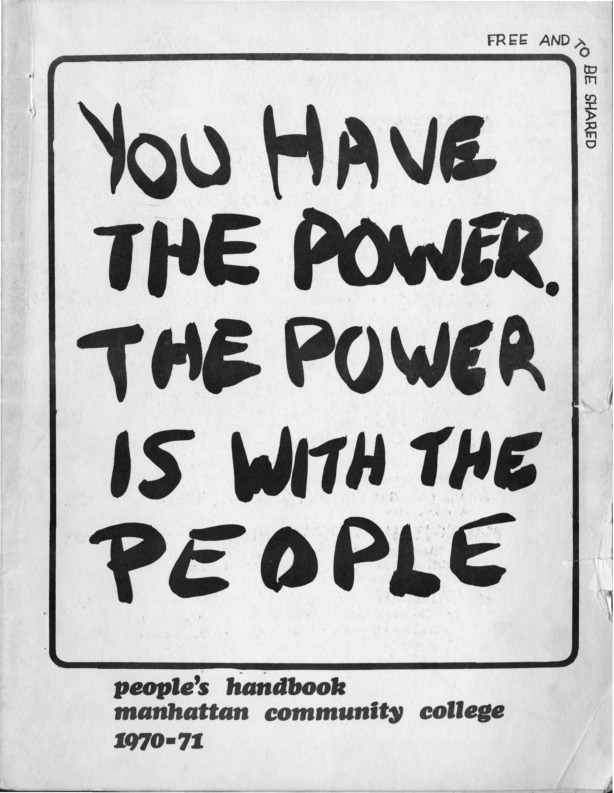
People's Handbook: Manhattan Community College, 1970-71
Item
CONTENTS
E - Sseeeaneee .
W LCOME BROTHERS AND aero i
WHOSE COLLEGE? WHOSE COMMUNITY?---2
Ne administration says that MCC belong to the
Hacdgsare ye igh community. We say
Pp
THE PEOPLE'S COLLEGE KIDS--------.---..7
comic strip history
TRACKING: - @eeeeneseaneeues: cetesesessseresfG
The Board of Higher Ed's slow train +o nowhere.
AN URGENT MESSAGE To WOMEN ::: ++ +++ +947
veruthi
Liberal Arts, Busitess,' ih eee ee.
ALESSON IN ADDITION: ::--- Oe ee a ey ay 7. |
Amerikan Education serves Capitalism _
Abriek acount the movement From 9bb te
SPAN 1970 and where we Qo From here.
DO CORRECT gral es eanare
<5 WEAS COME FROM? 32
MAKING IT IN MIDTOWN MANHATTAN - : «- J
a Sess ce 3
Aaquide to the area. So " (
rds detonate ne ae watery litte,
gupnit argo Sg and Woraries. f
6 | E Cl eetee ses eaeneanseees
Free health py Lea and abortion <
fips A nformahon free Legal Service, housing,
did liberation en iui ee
Welcome Brothers and Sisters 1
Welcome, brothers and sisters--welcome to Manhattan
Community College (MCC).
Starting college (or coming back to it) is certain-
ly not an easy thing. You come to school with various
hopes and aspirations for a better, more fulfilling job,
higher pay, more education--and if you are a man between
18 and 26, a chance to stay out of the army.
Knowing how confusing your first days here will be,
the administration has arranged an orientation period
to help you over the first few hardships and to let you
know how to succeed.
Knowing how self-serving and misleading the admin-
istration is, we--a coalition of students and faculty--
have prepared this booklet to tell you what is really
going on here.
The main point of our orientation pamphlet is sim-
ple: we want to destroy the myths about the school and
tell you what we have learned. We believe that learning
is something to be shared. The most important thing we
have discovered is that the people can and do have power
if they are organized and are willing to use it.
Because we joined together last spring in struggles
and strikes at nee and other Cit ee schools,
(I) you are paying much lower fees than the Board of
Higher Education originally planned; (2) the SEEK program
has not been cut back; (3) the dorms are available to the
students who need them at the Alamac (part of the SEEK
program); (4) night school students now elect their own
student government representatives; (5) tho MCC faculty
agreed that students who didn't complete their work be-
cause they participated in protests against the invasion
of Cambodia and the murders at Jackson and Kent State
would nevertheless receive passing grades.
Our past struggles have gained some benefits for
students and workers at MCC. (See the section on the
Student Movement for details about this.) Even more
important for the future, at MCC--unlike most other
schools--we have created a strong, unified coalition
of Blacks and Whites and Latins, men and women, fac-
ulty and students and campus workers. This kind of
unity in struggle is a force for change and a source
of real education for us all.
Welcome, brothers and sisters, to People's Com-
munity College!
--NEW UNIVERSITY CONFERENCE
--THIRD WORLD COALITION
--NIGHT STUDENTS ASSOCIATION
--WOMEN'S LIBERATION
WHOSE COLLEGE? WHOSE COMMUNITY?
"Keep in mind that you now attend
what is, in a very real sense, a 'com-
munity college.' This community is
situated in the heart of New York City--
a great business, industrial, entertain-
ment, and tourist area. By maintaining
the proper relationship with this commun-
ity and by helping to build its excellent
reputation, you will best serve your own
interests and ambitions as well as those
of your fellow students, the alumni who
graduated before you, and the students
who will come after you. It is to the
advantage of all to have neighbors and
passers-by look with pride and respect
upon all Manhattan Community College
‘students."
This is a passage from the section on "Student Re-
sponsibilities" in the 1969-70 Student Handbook put out
by the MCC administration. At first glance, it doesn't
seem too important: just another way of telling you to
behave yourself.
But a lot of what "official" MCC is about shows
through in those few sentences, the only sentences in
the pamphlet that speak about "community."
The Administration's Story
The administration tells MCC students that they
should identify their interests with the interests of
this "great business, industrial, entertainment, and
tourist area" where the MCC classrooms and offices are
located.
Never mind that you and your friends don't live
here, don't vote here, didn't go to high school here;
that parents of most of you don't work here; that
if you're Black or Puerto Rican you won't even see
f your brothers and sisters on the streets here.
is of all this, the midtown business district is ——
said to be your community.
ehow, by going to MCC, you now suddenly belong
ame world as the people who define the nature
ity of the area: the owners of fabulously
le midtown real estate, the owners and managers
orporations and banks with headquarters or of-
fices in the vicinity, the people who run the luxury
nd own the movie and restaurant chains, the
residents of luxury apartment buildings.
1 responsible to that community, says the MCC
vation, maintain a “proper relationship" to
filton, neighbor Rockefeller, neighbor Time-
you'll not only make it yourself, you'll
admi
neigi
life,
help ; fellow students too.
Tt sounds good and easy. It appeals to "your own
interes and ambitions," your hope of getting a better
job b se of your education. Maybe it even seems glam- ~
orous l exciting to think of yourself as part of the
business and industrial world.
Only it's jive. If you believe it, you've been sold
down the river. That familiar expression dates back to
slave days, when being sold down the river meant going
deeper South, further away from the possibility of a dec-
ent life and of liberation. (Not that these were actu-
ally possible in the North either, of course; it had its
own forms of oppression.) That idea, of moving away
from instead of toward your hopes, still applies even if
legal bondage no longer exists--and it applies to every-
body, White and Black and Latin, male and female.
The major tie you have with the interests dominant
in this area is the better job you expect to get by go-
ing to MCC. A few of you will increase your earning
power, certainly. But for most, the "better" jobs will
not really be good ones, in terms of income, or condi-
tions of work, or self-satisfaction. It's the function
of schools like MCC, however, to make you believe that
such jobs give you the same stake in the capitalist
system as the companies you'll be working for. As long
as you ink you belong to the same "community" as the
people at the top, you'll be manageable--socially, ec-
onomically, and politically.
They Profit, You Pay
The biggest price you pay for believing in this
false "harmony of interests" is not being allowed to
find your real allies in the struggle for a better
life. All the while you're training your eyes upward
at The Man, trying to see yourself in his place, you
are being prevented from noticing how many other peo-
ple like yourself are kept down.
bese i (Olt
=
Even if you do notice that your chances in lite
are poorer just because you come from the working
class, and/or are Black or Latin or a woman, you're
kept from realizing that the surest way to a secure
and meaningful life is by seeking basic change to-
gether with people like yourself, not by "maintain-
ing the proper relationship" to the controllers of
business and industry.. ;
People are not kept down individually but through
the process of class and caste oppression which char-
acterizes our society. Likewise, people don't achieve
well-being and freedom separately one by one, every man
for himself. Whatever you think about the way most
labor unions operate these days, for instance, the fact
is that if unions didn't exist, employers could still
force people to work 10 and 12 hours a day at a bare
subsistence wage. It's true, too, that those unions
which follow a "harmony of interest” policy with the
employers get only crumbs for their members. (The un-
ion to which most office and maintenance workers at
MCC belong is an example of this.)
Where We Are Now
We can't forget that even though the U.S. has grown
richer, the percentage of "have nots" in the population
is the same now as it has been for decades. If anything,
there is a tighter squeeze on low-income people now than
there has been in the last 20 years, because already in-
adequate social services like medical care, education,
and welfare have been cut back, while unemployment, taxes,
and inflation continue to rise. The structure of power
and wealth in the country has remained basically unchan-
ged, and that's the crucial point.
Like It Should Be
Under these conditions it becomes clearer than
ever that change, even for individuals, involves col-
lective struggle. The two-year colleges, like other
parts of the educational system, attempt to lead you
away from your sources of real strength in that strug-
gle. If a school like MCC actually had your interests
at heart instead of the interests of the capitalist
system which put you where you are, it would be telling
you:
"You're here to learn skills and gain
knowledge to take back to your home com-
munities, or to whatever other groups
you can fight with for structural changes.
Your road isn't up the shaky 'career lad-
der' one by one, each man's foot on anoth-
er man's hand. You have to think about
getting it together with other people in
same position as yourself. You have to
develop the strongest, most conscious
group you can muster, and then act to
knock down the walls of class and caste
privilege entirely."
If that was the way the administration thought and
spoke, MCC would be a community college in a real sense,
a place where education serves the life needs of a large
mass of people now and for the future.
No one should have any illusions about trying to
change MCC totally, in and of itself. It won't be trans-
formed until we fundamentally change the society in which
it exists. Yet, at the same time, we have to realize
that those basic social changes will never occur without
struggle in the places we're at. Therefore we have to
begin the process of making MCC a community college in
our sense now, and we don't need administration or Board
of Higher Education permission to do it.
We do it first of all by thinking about education
from a different perspective. Not Sees me as @ means
of individual advancement, but as a tool for social sur-
vival and human liberation. Nursing Program students,
for example, need to know more than how to take care of
sick people in the system's terms--because in low-income
areas, many sick people never even get to the hospital,
or are inadequately treated there. Real Estate students
need to know more than how to manage property in the
system's terms--because in our present society, living
anid working space is managed entirely for the benefit
of the rich.
Whatever program a student is in, he or she has
to ask: "What do I need to know to keep my future work
from oppressing myself and other people; what do I need
to know to use my work as a means of freeing both my-
self and others from exploitation?"
The gecond meJor way we begin to change the nature
of M s ctionin ogether here at school as a
community, a group of people with needs and interests
n common, but different from those of the people who
run the school and who are responsible to the Board
of Higher Ed and the business-industrial community.
Our on-campus community includes all the students,
the teachers who identify with the students' needs,
and the people who work at the school in non-admin-
istrative positions.
Power to the People!
Our common stake is creating a school and a society
that belongs to the people. Our means is collective
struggle .. . recognizing our solidarity . .. educating
ourselves and each other about our social and economic
reality . . . using what we know to enlarge other people's
capacity to fight .. . and taking action together to get
the changes we need,
s SKILLED
Ne ORKERS
VOCATIONAL H.C,
AREN
WHO SHALL
MAKE PRES 9 y
fyi.
SEE THEIR FACES?
2E TRE KI0S from HAgzem
iY
- (=
Bis 2 oy AKES THEM passive Y
Ss
VN
A
civil S
THEY GET RESTLESS
le ORIENT ET COME ooo HERE'S
2 WELCOME “f deodor a
doth wash prowl ced
: Hen. s
: TS
2966 =——7 12 69
SUT. T WANT
2 or
y Ne
Cs ACK eee MEAT FACTORY
Rae up, GET BACK in YOUR BOX)
Suet VE ENOUGH MARKETING,
STUDENTS
‘¥> = ed.
= minay
ys
re seer
K PEO
? LATIN POWER w
For Latin PEOPLE
. a Gi 2 48 ae” 2.2
THAT WAS THE PAST. THE ail TS Up TO
~
TRACKING: THE BOARD OF HIGHER ED'S
SLOW TRAIN TO NOWHERE
Getting Around Town
When you ride the subways you're bound up tight:
day in, day out, you travel the same old rails. But
you didn't lay them down and no one asked you whether
they went where you wanted them to go. When the train
does change direction, it's someone else who throws
the switch. The riders' needs are never consulted.
Getting Through School
The schools are no different from the subways.
Right from the jump, you're on tracks that someone
else chose for you. If you never had much money, if
you're a woman, if you're Black, if you're Latin, you
can't help but have a terrible time with a school
system geared for the male children of the White mid-
dle class. You find yourself placed with the "slow
learners," the "culturally deprived," or, in the pat-
ronizing words of community college administrators,
the "intellectually average." And that's where you
stay.
A True Story
You say you earned a 91% average in your major
subjects in the seventh grade? Your official teacher
gets a memo from an Assistant Principal which says:
No student who is two years behind in reading could
ossibly get over 80% in a major subject. Besides,
such a good record would be unfair to those students
in the more advanced seventh grade classes. You must
reduce this student's grades. * You're on the Dumb-
bell Express headed straight for Unemployment City,
or, if you luck out, Shitworktown.
*Memo from an Assistant Principal to a seventh grade
teacher in a Harlem junior high school, Spring 1970.
11
Changing Schools and Changing Trains
It used to be that there was only one small sta-
tion along the track--High School/College Junction--
where a few quiet, cooperative passengers could get
transfers to a different train, the Higher Ed &
Mobility Limited. Only it was misnamed. It kept
breaking down. And even when it ran, it kept drop-
ping most people off at the same old place: Shit-
worktown. You see, the four-year college cars on
that train often got mysteriously misrouted. And
most passengers were riding the two-year college
car which was never intended to go anywhere but
Shitworktown. =
How Did You Feel When They Said, "Sorry, No Ticket"?
And what: about the overwhelming majority of
you who never got a ticket? You were completely de-
railed. More and more of you got pissed off. You
began to wonder why your sweat, even your life, should
be used to oil the tracks for a tiny minority of oth-
ers. More and more of you began to entertain nasty
thoughts about messing over the guys who were throw-
ing the switches, or even about derailing the whole
train.
Open Admissions Special
That's when The Man game around to calm you
down. "Hold on," he said. "No need to get hot and
bothered. You can ride the new, streamlined Open
Admissions Special. No tickets needed. You can pick
your own seat in the car of your choice. Room enough
for all." Only as it turns out, there isn't enough
room, you can't pick your car, most of the good seats
are taken, and to top it off, The Man "forgot" to tell
a whole lot of people that the train was leaving. The
whole trip is a bummer.
12
Reality Trip
"What the hell is going on?" you wonder. "Can
things really be this jammed up?
wu don't know the half of it!
euiee, students will still be kept out of college
because they don't have enough money, and the ne
isn't going to provide it. Women with small childre
will have great difficulty going to school because
they have no one to take care of their children.
i11 find
Second, those who do manage to enroll wil
themselves in overcrowded classes, taught by an ot
worked faculty, in ugly, inconvenient buildings no
designed for education.
4 the
Third, the lack of facilities will reinforce
already overwhelming tendency to track students into
those programs that have space, as opposed to those
programs which the students themselves want.
urth, students are going to find out: that most
caswont portal lead almost nowhere: at best to ix:
paid, low-prestige jobs; at worst, to eerie tee) i-
fied unemployment. There is even evidence tha a
many cases time spent in going to school is not me e
up for by increased earnings later on. Often, going
to a two-year college actually reduces lifetime earn-
ings!
“By being unemployed we are saving ourselves
from a ruinous inflation.”
Cooling Out 135
If you don't like the kind of ride you're get-
ting, if you're beginning to think again about sab-
otaging the train, The Man comes back to quiet you
down. This time he's carrying a book of bedtime
stories. First he'll try to lull you to sleep but
if that doesn't work he'll try to brainwash you.
It's what we call "cooling out." The Man's object-
ive is to convince you that you really don't know
anything about yourself or the world around you, but
that The Man knows everything. He'll try to persuade
you that what you see with your own eyes, hear with
your own ears, and smell with your own nose just
isn't true. "Be like Carlos," he'll say.
After coming to New York from Puerto
Rico, Carlos, his father, and his
brothers lived under conditions of
hardship for a long time. Carlos'
mother was dead, and his father was
unable to work because of illness.
The whole family lived on public
assistance. When Carlos entered a
CUNY community college under the
College Discovery Program, his grades
were low and he came close to drop-
ping out. But he was ambitious and
‘stubborn." His grades improved,
and despite his bilingual background
he did especially well in English
and history. After receiving his
A.A.S. degree he entered military
aoa Se eet
service.
*Emphasis added.
Quoted from a CUNY.
public relations
pamphlet titled
"Community Colleges
of City University
of New York Under the
Program of State
University of
New York," p. 12.
14
Who Are They Kidding?
Why does City University consider this a suc-
cess story? Because what the system is trying to
teach you is that it's wrong to want anything more
than the system wants to give you. If you think,
and actually have the nerve to say, that Carlos got
screwed, The Man will call you a fool or worse.
"You want too much," he'll tell you. And he'll
give you things like this to read:
To lay plans for an abundant life
that embodies anything an ambitious
man or woman may want or demand is
apt and almost sure to end with dis-
enchantment. Most of us want more
than the world is going to hand us
and also demand more than our random
talents entitle us to want; to make
some blanket and wanton demand of
life is the usual sign of an ignor-
ant man,*
*Quoted from a typing exercise book used at MCC: Hoss-
field and Nelson, Faster Typing, 2nd ed., p. 4.
15
Pretty soon, you'll be repeating that in your sleep.
“You'll really believe that anyone who wants more than
he's got is an "ignorant man." You'll be all set--to be
a flunky, good only for obeying orders. The system
needs people, like. you!
Getting It Together
All of this means that the schools and colleges
have very little to do with education. But they have
a lot to do with pacification and socialization. And
they have a lot to do with meeting the demands of a
labor market geared for war, racism, and exploitation.
In our society, education does not mean acquisition
of the tools needed to solve urgent human problems,
but rather indoctrination into the attitudes useful
for preserving the status quo.
Calling a Halt
We've got to stop all this shit. We've got to
demand and fight for what we really need. That covers
a lot of ground. What's going on at MCC, or in high-
er education in general, is only a small part of the
total problem. But among our most pressing needs
are those that relate to our schooling. Students ar-
en't the revolutionary vanguard and colleges aren't
the barricades, but we've got to struggle wherever
we find ourselves.
Some Radical Proposals
Here are some serious demands that have emerged in
the past year, not only at MCC but throughout the City
University. They confront directly the kinds of prob-
lems we've been talking about.
1) All colleges must serve their communities and be
located in them. And by communities we mean people,
not business, government, or the military.
16
2) All colleges must be open to everyone regardless of
their diplomas, their degrees, their race, their age,
or their sex.
3) All colleges must offer all programs or guarantee
free transfers to those desiring a program not avail-
able where they are enrolled.
4) All colleges must have staff, facilities, and equip-
ment adequate to meet students’ needs.
5) All students mst be guaranteed a minimum stipend,
with stipends above the minimum available on the basis
of need.
6) All students, campus workers, and their families
must be guaranteed free medical care.
7) All students and campus workers must be guaranteed
free, client-controlled child care facilities.
8) All colleges must abolish grades, degrees, and
time limits. There must be an end to competition for
knowledge. It is not private property. It belongs
to all the people.
A Final Point
It will be expensive to implement these proposals.
It will also be complicated. But we have millions to
spend each day killing Asians, right? We know how to
make U-turns around the moon, right? This country is
rich enough and ingenious enough to meet everyone's
needs, provide hat the people take control of eir
d th 1th a : th roduce |
own lives an e Wea. a ey Pp
v
»
e
>
»
>
®
>
An Urgent Message to Women
Women are and have always been the largest ex-
ploited group in the world. They have been forced ei-
ther into marriage as their only means of support (that
is, they have been made into house slaves) or into "ser-
vice" jobs in which help, aid, assist men, rather than
becoming something themselves. They are tracked by
society into being nurses, not doctors; legal secretar-
ies, not lawyers; executive secretaries, not execut-
ives; stewardesses (waitresses in the sky), not pilots;
technicians, not scientists, etc., etc.
Fight to be what you want to be. Do not let any-
one tell you that your sex makes you unfit for any job.
Do not let anyone tell you that it is "unfeminine" to
be what you want to be, or that since your husband will
support (and therefore own) you, you only need a low-
paying, dead-end, service-to-men job. If you are hav-
ing troubles with conflicting feelings about the roles
set for you and the goals you yourself want to achieve,
talk to some of the people in the Women's Liberation
group on campus.
11
DRE RR oR MG
€
4
18
WARNING ABOUT CURRICULUM
What They Forgot To Tell You
The basic clue to reading the MCC catalog is --
don't take its promises and program descriptions at face
value. The catalog is written on the same principles
as commercial advertising: make what is offered seem
desirable, even if you have to deceive the customer or
withhold important facts from him. Examples:
--Some of the career programs in Business Technol-
ogy are said to train you for "management" or "junior
executive" positions. But a bank teller is not a jun-
ior executive, in terms of pay, status, or responsibil-
ity. <A $100-a-week office clerk punching in at 9 and
out at 5 is not a manager.
--The Social Service program trains you to assist
a social worker, not to be one. Since there are almost
no jobs at the assistant level, this program is useful
oO you only if you plan to transfer.
--The Nursing program is supposed to prepare you
"to render effective nursing care in health service
agencies and hospitals." This does not mean that you
are guaranteed to become a Registered Nurse; more like-
ly, a nurse's aide. Two years ago, 177 students began
the Nursing program at MCC. In this flunk-out progran,
55 students made it to their last semester, 23 actually
graduated, and of those, 11 passed the State Licensing
Exam for RN's. During last spring's strike (see the
section on the Student Movement), the Nursing program
textbooks, courses, and in-hospital training were sev-
erely criticized by the students.
--Data Processing students are often trained to
operate or program machines that are not widely used,
so that there are few jobs after graduation. In gen-
eral, there are more programmers being turned out in
NYC than there are job openings.
This sort of news is discouraging--but having
false illusions would be no help. You will only be
able to choose a good program for yourself if you know
what's happening.
A Few Tips
1. Make sure that the kinds of jobs you're train-
ing for actually exist, and will be open to you after
you've completed the program. Don't be afraid to ask
your counselors and teachers straight and specific ques-
tions.
2. The narrower the program you enroll in, the
fewer your options are later on. The Traffic and Ship-
ping program, for instance, puts certain limits on your
future job choices; so does Inhalation Therapy. This
is part of what tracking is all about.
Another aspect of tracking in career programs is
that transfer from one program to another, or to a
four-year college after graduation, is more difficult.
In the past, MCC career program graduates have lost an
average of 18 credits in transferring to four-year col-
leges.
If you are not sure what work you eventually want
to do, or if you think you might want to transfer, you
should start with a curriculum that doesn't box you in.
In this sense, Liberal Arts may be a good choice. But
you should realize that a two-year degree in Liberal
Arts is most practical for transfer purposes, and least
practical for getting a job, because it doesn't teach
any specific skills.
By contrast, the advantage of a career program is
that you can learn a skill for immediate use. Some
skills, like those in the health field, are badly need-
ed in home communities. However, keep this in mind:
the way society is now structured, you will need more
than two years of training to get a useful, interesting,
and decent-paying job in many fields.
il
H
5
up
These points pose a dilemma for many students: you
may want to keep your transfer option open--yet you don't
want to be left without usable skills. If your assigned
counselors and teachers can't help you resolve the dilem-
ma, request other advisers. And be sure to talk to other
students who've been at MCC for a while. and know the
ropes.
3. Within any single course or overall curriculun,
you have the right to demand the kind and quality of ed-
wication you need.
&. Remember that you have the right to get out of
any curriculum time you choose. Don't let anyone
stop or discourage you from doing so. It is in the sys-
tem's interest, but not necessarily in yours, to have
all the available spaces in the career programs filled
with students. That is "plant efficiency" and "rational
planning" from the administration's point of view. You
can and should resist being sorted according to the
plant's needs.
The administration will say they want you to choose
whatever curriculum you want; ey will say you can
switch when you want to. But they will make it extreme-
ly difficult for most students by delaying you semester
after semester, using the excuse of red tape. "We're
sorry but there are too many papers to fill out and
we're busy now. Come back next semester."
This attitude is very hard to counter. You have
to ask, demand, go to more than one person before you
get what you want. Be courageous. Hustle. Fight for
what you want. When the people control the schools,
things will be different!
M.C.C. ACCEPTS You FoR Daytime
matricwetion. you Reality wawreo
T0 GOTO CITY BUT WHAT THE HELL
THE H.S- GUIDANCE COUNSELOR
VELLS YOU TO GoTo COLLEGE
STEAD OF (NTO THE ARMY LIKE
’ |HE TOLD YOUR BROTHER
pwance J Space QD
YOURE ALIVE AND OUT OF
NAM. OFF TOA GREAT START.
YOU DISCOVER WED. FROM /2-2
V3 A FREE PERIOD FoR ALL
STUDENTS. 4/0 WONDER 0
MATH WAS SCHEDULED THEN... 77
TREAT YOURSELF TOA
25¢ Cup OF COFFEE
REGISTRATION
ALL THE COURSES YOU LU/ANT ARE CLOSED,
YouvE WA/TED ON LINE FOR.
HOURS, YOUR PROGRAM RUNS
FROM GAM -4 ee /N-F. ON
FRIDAY ¥4 HAVE 2, CLASSES,
AN F0cl0ck f A YOCLOK.
SPAGE /?
———
WHE TA
SURVIVAL
YOU NEED Al S/GNATURE. Ne
ONE WILL GIVE JT TO YOU 4N77.
you YELL f SCREAM. YOURE
GETING SVUEWHERE BUT
RUINING YouR FERSOKALTY,
RETREAT 2Spaces|| GAMLE *
ON SECOND THOUERT *® ONLY STUDENTS CAN PLAY woe AND ONLY
ADVANCE 2, SPACES|| save s7urenrs.-» AND /7'S Not AMATIER
OF CHOICE on SOMAY TOWIN I
FEOPLE ‘S§ MANK/UAL.
ADVANCE AS
—
YOU REAL/ZE YOU'RE
PLAYING A LO0&/MG GAME,
STAY RIGHT WHERE
You ARE A MINUTE
VOU D/SCOVER
YOU HAVE TO PAY
A FEE TO ATTEND
A "TREE CITY
N ONE OF /CLl.s UGLY
BUILDINGS ANb Ep UP WA
BROOM CLOSET 1. 0, WHIT,
/7S A classrooms
Vou READ THE PEOPLE'S MANUAL AND *: at ee
DEC/DE TO HIGHT FoR A NEW SOCIETY, ASA bot tts!
VERY SMALL START, YOU GOINTO AN EMPTY, pe
BATHROOM AND WRITE yy 4S Ger HIGH, certs: ~
on REVOLUTION” ov THE WALL, {POTS roves
Rous *
Fad ett
eee aD |
ay t} }
3 ,
od
Wye
‘
‘ ~<
oO
A LESSON IN ADDITION:
AMERTKAN EDUCATION SERVES CAPITALISM
, learned
If you had to sum up the lessons we've 1; ,
what vould you say? One thing for sure: we get very
little from the years we've spent in Beheady, pier ike s
ruling class gets a hell of a lot. How come?
Definition
t
italism is defined by the dictionary as "the ec-
oriindic cofesen in which the means of production ane ee
tribution are privately owned and operated for pro bie
The mines, the machines, the factories, the he hea
buildings we live in belong to a wae few. Excep Se
some personal possessions, which can't be used Rika s
duce anything, all we own is the strength in our “
and the quickness of our minds. And these we have to
sell in order to live. But live how?
The Life of Riley
Housing in New York is scarce, expensive, and run-
down. But that's just the landlord's cup of tea. So bad
housing gets worse, and all housing gets more scarce and
more expensive. Check it out.
The subways are inconvenient and increasingly danger-
ous, but the banks make money from subway bonds. ‘The
bankers' interest on those bonds comes before the people's
needs -- by law. Check it out.
Ma Bell gives less and less service and Con Ed gives
more and more pollution. But they both get rate increases.
Check it out.
The cost of health care keeps going up. The less
money you have, the less care you get. Good health is a
privilege of the rich. Check it out.
The list is endless. Just about everything runs
for the profit of a few at the expense of the many. What
makes us think the schools are any different?
es 50
aso S
ee WITHOUT
THEM ITIS
Who's to Blame--Us or Them?
inns or them?
All institutions in our society serve capitalism.
And the schools are among its most obedient servants.
What would happen if the schools didn't exist? Without
the brainwashing that goes on from kindergarten through
college, would we be so ready to accept the damage done
to us by the system: the bad jobs, the bad housing,
the bad air, the bad schools themselves? When we get
disgusted they tell us we have only ourselves to blame.
They tell us either that we're inferior, or that we
don't try hard enough. The idea even made the charts:
"It's not your neighborhood, you're the one!"
Would we swallow that shit without "education"?
26
Fingering the Ene
Of course, the system's not all that slick. Brain-
washed though we are, we're not deaf, dumb, and blind.
We know it can't all be our fault, so we start looking
around to figure out who or what is responsible. But
the schools keep working on us. lIife's a struggle, they
tell us. Competition makes the world go round. There's
always got to be someone on the bottom in society; you
can only get yours by hustling someone else. Pretty soon
we're convinced we can survive only by a struggle to the
death with everyone around us--everyone, that is, but the
corporations and banks that have got us dancing like pup-
pets on a string. Fight the niggers, fight the spics,
fight the commies! But fight capitalism? Oh, no. Cap-
italism's what made Amerika great!
Learning for The Man
Properly brainwashed, we're ready to be job-trained.
Industry needs manpower. - The schools train that manpower
for private profit at public expense. Vocational high
schools used to be enough. But as the economy got more
complex, the labor force needed more skill and more ed-
ucation. To meet that need the colleges have been great-
ly expanded--especially the community colleges. Whereas
a college degree used to be a stepping stone to a pro-
fessional job, that still holds only at the prestige
schools. Increasingly, the colleges turn out white-collar
flunkies, and semi-skilled or paraprofessional workers
whose only choice is to replace the unskilled who have
been automated out of jobs.
What Can We Do?
What we need is a revolution--and not the Madison
Avenue kind either. But it's easier to say the word
than to make it happen. Who's to make it? How? What's
to follow? We don't have any pat answers. But we've
been thinking about these problems and acting on these
thoughts--as the history of the Movement at MCC will
indicate.
27
ER
THE STUDENT MOVEMENT AT MCC
Beginnings
The student movement at MCC began around the issues
of equal rights for Third World students and opposition
to the Vietnam war. Students for a Democratic Society
(SDS) was mainly concerned with the war, while the Soc-
iety of Golden Drums, a Third World organization, tried
to raise cultural and political consciousness among
Black and Latin students. At the same time, SDS and
Drums led successful, militant actions on such school
issues as the right of students to use the elevators in
the A Building, and the need to abolish the ridiculous
student dress code--at one time men were required to
wear jackets and ties, and women were forbidden to wear
slacks. Unfortunately, school issues were seen as com-
pletely disconnected from poverty, racism, and the war.
were these as "external" questions. We were very
naive.
Black Power
In the spring of 1969, Black, Latin, and Asian stud-
ents joined forces to form the Third World Coalition for
the purpose of dealing with a whole range of issues, but
most urgently, the problem of racism at the college. The
B Building was seized in order to press demands for more
Third World staff and for a separate Third World depart-
ment. Many White students and some faculty, realizing
that racism was neither right nor in their own interest,
supported the struggle. The demands were agreed to by
the school administration, but most are still waiting
to be implemented.
Organizing
In the fall of 1969, women, recognizing their spe-
cial oppression, formed a Women's Liberation group.
Radical faculty formed a chapter of the New University
Conference (NUC). Radical and progressive students,
mostly Third World people, won overwhelming victory in
student government elections. But all these groups
were invariably frustrated when they tried to achieve
their objectives through "proper" channels.
Gro Consciousness -
In the spring of 1970, we--a coalition of hundreds
of active students: joined by some faculty and staff--
finally realized that the college was an integral part
of a society that served the rich and oppressed the
rest. In the classroom we were fed lies about oppressed
groups such as women, Blacks, Latins, and working people
generally, while the interests of the rich were upheld.
We discovered that Third World students were channeled
into low-paying technical jobs, that women were tracked
into terminal programs such as "secretarial science,"
and that Liberal Arts was a program of cultural brain-
washing. We began to see that the racism and male
supremacy taught and perpetuated in the schools were
tools to keep the masses of people divided and every-
one's salary low. We became aware we were being traine
for alienating jobs which exploited us and which did 4
not serve the working-class communities that most of
us came from. ‘
A School To Serve The People
When we realized these things, we, not the admini-
stration, decided to close down. the school for three days
in March 1970 for a conference that we called "A School
to Serve the People." From this conference we learned
several things:
--That it was CAPITALISM--the system run by the
owners of big business and their errand boys in govern-
ment, the system run for private profit without regard
for people's needs--and not just the Vietnam war or the
college which was the enemy.
--That we had to fight against capitalism by fight-
ing for things which improved the lives of the people
whem capitalism most oppressed: the working people.
--That we had to actively ally ourselves with work-
ing people in and out of school in order to transform
the society.
29
We therefore raised demands for better conditions for
campus workers, for a client-controlled child care center
for students and staff, for a non-profit cafeteria, for
a $3-per-hour minimum wage for student workers, ror
changes in the Nursing Department, and for a curriculum
that would better serve the community and the students.
Strike!
On April 30, 1970, we struck to protest proposed
fee increases at City University. The Cambodian inva-
sion, and the murders at Jackson and Kent the following
week, caused the strike to broaden. Together with
other colleges across the country we called for the
total withdrawal of the U.S. from Southeast Asia; we
called for the freedom of the Panthers, Los Siete, the
Soledad Brothers, and all other political prisoners;
and we demanded an end to the involvement of the col-
leges with the war machine. In addition, we pressed
the local demands raised at our March conference,
along with a demand for the elimination of all col-
lege fees; and the end of tuition, fees, and unequal
status for night students.
5O
Divide and Conquer?
The administration tried as usual to split us
along racial, student/faculty, man/woman, and student/
worker lines. They actively tried to sabotage the
student government elections and tried to play off
night students against the day people. As a desper-
ate last resort they brought in the police to arrest
58 students and faculty on phony charges of "criminal
trespass." They thought that they had nailed the
"leaders" and that therefore the strike would collapse.
But there were no leaders. We were all leaders. The
strike continued and the strike grew. The people, not
the administration, ran the school.
A Partial Victory
On M 2 1970, the faculty and the administra-
tion i Meee! Rae demands. But, as usual, almost
none of them has been implemented. Nevertheless, the
situation is far from hopeless. The custodians did re-
ceive a refrigerator and more help to lighten their
i
heavy work-load. Plans are being laid for a child care
center. Student government received duplicating equip-
ment and other means to carry on its work more effective-
ly. We kept the school open this past summer as "lib-
erated territory." Small victories? Yes. But our
awareness and commitment grew. And that was an import-
ant gain.
STP: Serve the People, Stop the Pig!
The administration failed to stop us. But they
haven't exhausted their bag of tricks. This coming
October they plan to shut school for two weeks in the
hope that we will get all wound up in phony election
campaigns, instead of organizing around the radical
issues that really concern us. They even let hard
drugs flow through the school to cool our militancy.
The administration's only reaction to drug use is
idiot questionnaires and calling the cops. The
cause of extensive drug usé is obvious: deep ali-
enation from the school and the society. But strug-
gle, not drugs, is the only way to escape oppression.
Dare to Struggle, Dare to Win
We have had some victories already. We know
that they will multiply in size and importance if we
join together with the poor ane oppressed who are
struggling throughout this country and throughout the
world. Only then can we replace capitalism with a
humane, workable social and economic system that will
serve the needs of all people,
a.
&:
2
=
2
=
MAKING IT IN MIDTOWN MANHATTAN:
FOR PEOPLE WITH VERY LITTLE BREAD
N.B. Manhattan is a center of capitalism: al11 prices "|
subject to increase without notice.
Restaurants
Cheap restaurants with great food don't exist. Bring your
lunch and eat it in the student lounge. If that's not con-
venient, the list below might help.
Remember: the faculty voted on May 2 1970, to support
the workers eman or @ non-pro caiteria for é
college. if we see to it that this demand becomes a reality,
better eating days lie ahead.
"Cc" for Convenience: the following are in or near MCC:
Vending Machines in: the student lounge: cheap, ter-
re e food, miserly portions.
Wolf's Delicatessen, 799 Broadway, 2 doors from B Build-
ing. Food and prices are not bad if you are careful:
coffee, tea each are a mere 15¢, a lunch of eggs and
any kind of bread or bagel starts at 85¢.
Donut Pub is right next door to A Building. The food
is lousy and prices higher than Wolf's, but they do
have "99¢ Specials": for example, hamburger, frenc.
fries, cole slaw, and coffee. Because of its con-
venience--and for no other reason--it is sometimes
a hangout for MCC students.
Abbey Victoria Coffee Shop, next door to B Building.
the food is slightly better, the prices slightly
higher than the Donut Pub's. Another offering of
"$1 Specials," again the kind tha!
trition: a sandwich with coffee or sou
Other restaurants close by:
Horn and Hardart's, 1725 Broadway (between 54th & 55+
roadway (at 47th). They serve 59¢ breakfas
specials--juice, eggs, and pancakes. Iunch prices
are considerably higher: not e&pecially recommended
after 11 A.M. unless you dig automats.
Horn and Hardart's Take-Out Store, in the IND subway
station at Oth Avenue (Avenue of the Americas) and
50th. You can't eat here, but can buy food and
take it upstairs to a Time-Life fountain, or the
student lounge. Prices aren't high, and some of the
food is reasonably healthy. Sandwiches are 50¢-75¢;
hardboiled eggs, 15¢; soda, 20¢; half pint of milk,
15¢; ice cream, 20¢--all_ some of the lowest prices
anywhere in this area. Large containers of potato
a cee ee
salad, 27¢; cole Slaw, 33¢. For people on diets:
yogurt, cottage cheese each 28¢.
Hero City U.S.A., 754 7th Avenue, offers discounts of
10% to MCC students who bring their I.D. cards.
The hero sandwiches vary in price, but several are
under $1. Hero City is famous for its Brooklyn
Renaissance decor: you can choose between the
Michaelangelo Room (downstairs) and the Leonardo
da Vinci Room (upstairs).
Haircuts and Sets for Women
——e ES Tor Womer
Wilfred Academy of Beaut >» 1657 Broadway, corner of
Dist; 3rd Toor, above the Steak and Brew. CO 5-
1122. A real bargain: haircut, 50¢, shampoo and
set, 85¢ (shampoo only 50¢, set only 60¢). (Prices
higher for long hair.) Academy students cut, sham-
poo, and set your hair, and do 36 other things
which exploit women, such as "eyebrow shaping" and
"wiglet coloring." They are required to have con-
siderable training, the manager says, before they
are allowed to tamper with your hair. "Postgrad-
uates" of the Academy will do your hair for a
higher price, e.g., $1.75 for wash and set. If
men want their hair done, they have to go in drag.
Clothes for Almost Nothing
Thrift shopping is a good way to avoid paying the exorbi-
tant prices charged by big department store owners who, in
league with manufacturers, change styles on purpose to force
men and women to spend huge sums of money on clothing every
year.
Council Thrift Shop, 842 9th Avenue, at 55th, run
by little old ladies with a sharp eye for people.
ripping off. If you can stand crowds and hunting
through piles of junk, this place is fantastic,
especially on their frequent bargain days. They
sell all kinds of old and new men's and women's
clothes, books, shoes, paintings, furniture, and
jewelry. The Council has new and old mini's in
excellent shape, sometimes a Dior midi from the
'50's, beaded evening bags, and hippy long velvet
coats and satin dresses. Ona half-price sale
day (a notice is posted on the door), these might
cost as little as $1-$5. And don't hesitate to
bargain! Point out a flaw or look woeful and
they'll probably knock off a dollar or two.
You have to make a special request if you want
to see second-hand fur coats, because they keep
JS
them locked up somewhere. They're often in per-
fect condition, but rather expensive for most of
US.
Ciean all the clothes before you wear them.
Other good thrift shops:
Everybody's Thrift Shop, 330 E. 59th (between 2nd
d Ist Avenues), et 5-9263.
an
Irvington House Thrift Shop, 1534 2nd Avenue (80th),
ortunity Sho >» 46 W. 47th; JU 2-3994.
€ ue Furs, 33 W. 8th, 473-0910. Fur coats,
ADF blankets, rugs, etc.--all second-hand
and cleaned. Ask for the address of the warehouse
on Great Jones St., where there's a much wider
selection.
Stuyvesant Square Thrift Shop, 1430 3rd Avenue (81st),
T9240.
Thrift House, 39 W. 57th, PL 3-8367.
Bookstores
's bookstore does not serve the people. Its managers
cual aetenaes are more interested in their shelf space
and budget than in the students! and teachers' needs. Con
sequently, there are no student discounts, and they don't al-
ways order books teachers have requested. So you may have
to look somewhere else for the textbooks you need for your
courses. (You can borrow many required books from libraries,
of course. See listings under "Libraries" below for more
ation.
a ee = first few weeks of the term you might find stud-
ents milling around the 5th floor of B Building selling second-
hand books. These are real bargains if you know precisely :
What books are needed for your courses. But don't buy the
Brooklyn Bridge! Be sure you're getting the book you need at
a good price. And don't buy ony books .for — courses until
your classes have met an ou Ow exac a ou need.
Bookstores near MCC:
Bookmasters, 175 W. 57th.(corner of 7th Avenue),
as a large selection of paperbacks.
The Drama Bookshop, 150 W. 52nd (around corner from
B Building), upstairs. An excellent selection--
but they have onl lays and books about the
theater. You Can't buy novels or math texts here
But this store is great if you're taking a drama
or theater course this term.
36
Around Columbia University, one of the best bookstore
areas in the city: Broadway, between an °
(Take IRT Uptown Local to 116th Street and Broadway. )
There are at least four very complete bookstores here,
which means that if one doesn't have the book you want,
it's only a short walking distance to another.
Columbia University Bookstore, 2960 Broadway (be-
ween ani . e best of the four
listed here. They offer small discounts--not
worth a subway trip on this score alone, but
OK if you're there anyway. Hardbacks and text-
books are upstairs; paperbacks--including large
sections on Black studies, and of novels and
short stories--are downstairs. This store has
a confusing layout, so ask if you can't find
= something.
os (Note: the Brooklyn College Bookstore also
fe gives discounts: TOR off oe 20% Off paper-
: backs. )
Paperback Forum, 2955 Broadway.
Satter's, 2043 Broadway. Good for college textbooks
and foreign language books.
Taylor's, 2915 Broadway. Paperbacks. Good selection
of radical periodicals, too (including the weekly
English edition of the Cuban newspaper Granma).
Greenwich Village area:
Barnes and Noble, 5th Avenue at 18th, is best for
students. ere's a large textbook section at the
back of the store, and many copies are used and
therefore cheaper. Th also bu
ey y some used books--
you might make a little Dread se ng em your
books at the end of the semester.
8th Street Booksho > 17 W. 8th. An excellent bookstore
in many ways. fgcaies is a good collection of
underground newspapers and comics.
Jefferson Book Shop, 100 E. 16th. A large selection
: of leftist literature.
Paperback Booksmith, 30 W. 8th.
= uden 00 xchange, 17 Waverly Place (Waverly is
| of 8th St., and the store is about
2 blocks east of 5th Avenue). Buys and sells new
and used texts. Their used books cost more than
t Barnes and Noble, but service is better.
Other important bookstores:
liberation Bookstore, 421 Lenox Avenue (132nd). Re-
commen: or ack and revolutionary literature.
Strand Book Store, 828 Broadway. Second-hand books.
ibraries
The MCC library may have the books or periodicals you’neea
for courses--on reserve, in the stacks, or in the paperback
section. If it doesn't, and you have time to wait for at least
a month, ask a librarian or your teacher to order the book for
e libr. .
i For Geoka and periodicals the MCC library doesn't have,
and for quiet places to study, try thé following. (Some of
these libraries are large and confusing: ask a librarian for
help. )
New York Public iabrery, 42nd Street and 5th Avenue,
e largest collection of books in the city,
but you must use all the books there. Students
suffer from all the red tape and long waits, and
some of the books you want may turn out to be
lost or at the binder's: strong men huve been
known to weep. But sometimes it's the only place
you can find the books you need for a special re-
search project.
Donnell Libr Center, 20 W. 53rd (between 6th and
5th oP near MCC, is a good place to study
in comparative quiet. Here are special art, film,
record, and foreign zenguage libraries, as well
as a reference collection.
.incoln Center Idbrary, 111 Ansterdam (65th), is a
eau place to study not too far from MCC.
They have only books on music and the performing
arts.
Schomburg Collection of Negro Literature and History,
. » has a good collecticn of reference
materials on Black men and women in the U.S. and
other countries. They have the original papers of
many famous Black writers, for example those of
Frederick Douglass and Marcus Garvey.
Most neighborhoods have branches of the New York Public
Library. You may be surprised at how many of the books you
need for courses are in these branch library. If they don't
nave a book, they will borrow it for you from another branch
although this may take quite a while.
37
SURVIVING IN THE CITY
To help you survive this year in New York City, People's
Community College is providing information on Free Health
Care, Free Abortion and Birth Control Information, Free Leg-
al Service, Housing, Jobs, Child Care, the Draft, and Cen-
ters of Liberation and Struggle in NYC.
The counselors in the Student Life Department at MCC have
information about many of the areas covered in this section
of the People's Manual. Some of the counselors are very
helpful. To see a counselor, go to room 320 in the A Build-
ing and ask a secretary or aide to direct you to the person
who can best help you with your problem.
Free Health Care and Information
MCC has a registered nurse in room A 211 who provides asp-
irin, a bed for sick people, and good common sense.
There isn't much free health care yet in NYC. We have to
demand excellent, free health care for all the people.
Call Health PAC, 267-8890, for general medical information
and to report complaints. They are mainly a research organ-
ization, but are very helpful about giving information.
Free Health Care for Lower East Side people:
St. Marks Clinic, 44 St. Marks Place, 533-9500,
* onday-Friday. =
St. Marks Dental Clinic, 70 St. Marks Place (for
elephone number and hours, call the St. Marks
Clinic number).
Nena Health Service, 290 E. 3rd, 677-5040, 9 A.M.-
: onday-Friday.
Other Free Health Care:
Judson Mobile Health Unit, 228-1920, 2-8 P.M., Mon-
ay-Saturday. a o find out where they are
located. They move to a new location every 3
months or so.
39
Chelsea Health Clinic, LA 4-2537, has the following
ree clinics: ental, Social Hygiene (VD), Glau-
coma, Diabetes Testing.
Free Health Care for El Barrio and parts of the Bronx:
Call the Young Lords, a GEA MEL TAA GGE
VD Information, 269- 5300.
Drug Rehabilitation: Phoenix House, 724-9922; Odyssey
Heawe 674-9100, or 427-7810.
For Medicaid Information: Student Life counselors have
Medicaid application forms. Or call NYC's Medicaid in-
formation number: 594-3050.
For help with psychological problems: go to room A 320
and ask for an appointment with a qualified counselor.
Free Birth Control and Abortion Counseling’ Information
For information about birth control, call:
Family Planning Service, 777-4504.
Planned Parenthood, 777.0015.
Margaret Sanger r Clinic, 929- 6200.
Abortion Information and Counseling:
A word of caution: abortion is not a method of birth
control. A woman cannot safely have as many abortions
as she wishes. She should use birth control devices
rather than rely on the new abortion law to get her
out of an unwanted pregnancy. Most NYC public hosp-
itals provide the same bad care for patients needing
abortions that they do for the rest of their patients--
maybe even worse, because they think so little of the
women they treat.
We believe it is the rier of oy woman to make up
her own mind about abortion. she wants one, she
should have all the information available and the
best possible care. Abortions should be not only
safe and easily available to everyone, but free.
Women in NY must demand this. 2 s
=
For abortion information, call the Women's Liberation
Center, 36 W. 22nd, 691-1860. ‘Their Women's Abortion
Project/Women's Health Project has an excellent coun-
seling serice, with files on all the city hospitals
and some private ones, on the best doctors, and on
inexpensive and quick abortions. Teéll them exactly
what you want. Often they do more than give inform-
ation: if you request it, they will try to send a
woman to the hospital with you, to help you all she
can. They have more information about abortion than
any group in the city.
If you think you might be pregnant, the following hosp-
itals and clinics give free pregnancy tests:
-Sydenham Hospital, 565 Manhattan Avenue (and W. 123rd)
= ° onnected with Harlem Welfare Mothers. }
Mt. Morris Park Health Center, Madison and 122nd,
Harlem Haspital, K Building, W. 136th between 5th and
nox, 3157, 621-3159, 286-3658.
Judson Mobile Health Unit, 228-1920, 2-8 P.M., Monday-
aturday.
St. Marks Clinic, 44 St. Marks Place, 533-9500,6-10
My nday-Friday.
Chelsea Health Clinic, LA 4-2537.
Complaints: Don't put up with poor health care! If you
have any complaints about hospitals, clinics, or medical peo-
ple, call: Abortion Advocates, 254-6314 (a ahereresats ero}
they will take complaints and put pressure on hospitals, etc.);
Wonen'a Liberation Center, 691-2063 or 691-3396; Health PAC,
Free Legal Service
Last year 58 students and teachers were arrested for--alleg-
edly--criminal trespassing. And because some cops harass stud-
ents in the area around the college, all during the year inno-
cent students were arrested for prostitution, shoplifting,
pushing drugs, and calling cops names.
All of these people needed lawyers. (So did quite a few
men with problems about the draft; for more about this, see
the section on the Draft, below.) The following organiza-
tions give some free legal service; they don't take every
case, but can give you the best information about where to
go with your problem. They are usually frank, and will tell
you if your case (which for example might involve the cop's
word against yours) has a chance.
Lawyers! Guild, 227-0385.
American Civil Liberties Union, OR 5-pa90
3
Emergency Civil liberties Committee, 683-8120.
Law ne 077-1552.
Housing
For housing complaints, call the NYC Department of Con-
sumer WTairs; SoI7777. (Don't expect too much real
help, however: the system's agencies serve the system,
not the people, and the housing laws, and the courts,
favor the landlords.)
The Metropolitan Council on Housing, 947-6027, on the
other fat is an organization of and for tenants.
(If you're interested in the squatters! movement, they
can give you information. )
For help in finding apartments, go to room A 331 at MCC,
or see the Student Tire counselor in charge of this
(MCC phone: 262-3568).
1
Alternate U. has been trying to establish an emergenc
‘crash-pad" service without much success, but you arent
Give them a call anyway: 989-0666.
Jobs
Try the Student Life Department at MCC, room A 320. Ask
the secretary to direct you to the right person. Or try
MCC's Co-Op Education Department.
There's. a lot of red tape and waiting around connected
with jobhunting through MCC. Students who've been here
awhile recommend: Be persistent; don't take no for an
answer; keep asking. If you still have trouble getting
a job, go to the Student Government office for advice.
Try also the New York State Department of Labor, Youth
Placement Service, 695-0750 or 594-9620. For other
numbers under NY State Department of Tabor, see the
telephone book. :
Child Care
We hope that as a result of our demand last spring, an
8 A.M.-10 P.M. client-controlled child care.center will be
established at MCC. We will work to see it created as soon
as possible. In the meantime the following may be helpful:
(
(
The City of New York Department of Social Services,
Bureau of Child Welfare, Division of Day Care, nas
a listing of So eat ee child care centers in all
boroughs. Call 433-2960, and ask for the child care
center nearest to you. However, be prepared for the
fact that vou will have to be interviewed by social
workers and go through other bureaucratic hassles
(because under our present system child care is a
privilege instead of a right). Furthermore, these
centers are not client-controlled. Charges are
$2.$25 weekly, depending on family income.
For people who live on the Lower East Side, there is
FREE child care available at the University Settle-
ment House, 184 Eldridge, 674-9120. This center has
a "drop-in" service with a maximum of 4 hours, except
for an emergency.
The child care collective of the Women's Liberation
Center, 691-1860, is working to establish centers
throughout NYC. Call them for current information.
How to Avoid the Draft
Draft Counseling Services:
Friends Service Committee, 777-4600 (most people think
s is the best).
War Resisters League, 228-0450.
American Civil Liberties Union (ACLU), OR 5--59990.
Metropolitan Board of Conscientious Objectors, 252-7413
(Brooklyn) or - 5 eens).
Washington Square Methodist Church, 533-5120. Tues-
day, 7-9 ti Thursday, 6-8 P.M., no appt. needed.
If you can't go during those hours, call between
2 and 6 P.M. for an appointment.
If you think you could get a medical deferment, ask one
of the draft counseling services to refer you to the
Medical Commission on Human Rights.
a ans EIS i USS oe es 2 eyes ae 2.
43
All these groups will try to answer your questions about
deferments, the lottery, Canada, going underground, etc.
Some groups are better than others. If one doesn't re-
spond satisfactorily, try another. (Don't talk too ‘
frankly over the phone: Big Brother might be, listening. )
Don't wait until you're about to be inducted before seek-
advice. If you're at the point where you think you need
immediate legal help, call one of the numbers listed
under Free Legal Service, above.
ters of Struggle and Liberation in Manhattan
ne following list is not complete. You can find out more
reading Movement publications regularly--for example, Rat,
rdian, Liberated Guardian.
Alternate U., 530 Sixth Avenue (14th), 691-2955.
A center for revolutionary education. For $25
you can take as many courses as you wish. Courses
range from "organic foods" and "carpentry work-
shop" to "Mao Tse-tung and the Chinese Revolution"
and "Workshop in Film and Revolution." Tuesday
night is reserved for women; Friday night for
Gay men and women. Your $25 enables you to help
run the school--all decisions are made at open
meetings. If you want to organize a class or
workshop, call them.
Black Panther Party, 2026 7th Avenue, 666-3603 or 864-
New University Conference: NY regional office, 866-5679.
Progressive Labor Party, 1 Union Square West, 924-8848.
ETD Peace Parade ©
ommittee, 17 E. 17th, 255-1075.
omens eration Center, W. 22nd, 691-1860.
Young Lords, 1678 Madison, 427-7754/7755.
Young Soci
Socialist Alliance, 41 Union Square West, 989-7570.
Young Workers Liberation League, 29 W. 15th, 924-8620.
ainst War and Fascism, he w
Youth Ls Inst W dF L - 2lst, 242-9225 or
Media Groups and Services:
American Documentary Films, 799-7440.
al-a-Demonstration, -6315 (for up-to-date
Information on demonstrations, rallies, etc.).
Free Theater Drama Workshop, JU 6+4800.
: eration News Service, 9-2200.
Movement speakers sureau, 228-8432.
wOwsreel, Doty 4) 50).
Radio Free People, 966-6729 (tapes).
: 4 dio, 826-0880,
Back in 1932, Nelson Rockefeller, a young man t
way up, was given e difficult job of promoting rentai
in the family's new Rockefeller Center, which ir those
Depression years was losing $4 million annually. .. .-
In a fit of expansiveness,
Nelson--already a trustee
of the Museum of Modern Art and the ifetropolitan isuseun=-
hired the noted Mexican Communist painter Diego kivera
to do a 17 x 63-foot fresco in the lobby of the Center's
main building. To Rockefeller's consternation, however,
Rivera placed the unmistakable figure of Lanin in the
middle of his work. Rockefeller fired off a note to the
artist, saying, "While I was in the building at Kockefeller
Center yesterday viewing the progress of your thrilling
mural, 1 noticed that in the most recent portion of the
painting you had included a portrait of Lenin. The piece
is beautifully painted but it seems to me that his portrait
might seriously offend a great many people . ». »« as much
as I dislike to do so, I am afraid we must ask you to sub-
situte the face of some unknown man where Lenin's face now
appears. Rivera refused,
and after much diplomatic maneuver-
ing, Rockefeller sent an agent to pay the artist off and
to fire him. Rivera left with a vulgar and contemptuous
gesture directed both at the Rockefeller man and the capital-
ist system in general. Rockefeller had the fresco destroyed.
A year later he was made treasurer of the fiuseum of Modern
Art, and in 1939, its president.
Not long ago Kockefeller
proclaimed to a Newsweek reporter: "Art is probably one of
the few areas left where there is absolute freedom."
I Paint What I See
A Ballad of Artistic Integrity
“What do you paint, when you paint a wall?”
Said John D.’s grandson Nelson.
“Do you paint just anything there at all?
“Will there be any doves, or a tree in fall?
“Or a hunting scene, like an English hall?”
“I paint what I see,” said Rivera.
“What are the colors you use when you paint?”
Said John D.’s grandson Nelson.
“Do you use any red in the beard of a saint?
“If you do, is it-terribly red, or faint?
“Do you use any blue? Is it Prussian?”
“I paint what I paint,” said Rivera.
“Whose is that head that I see on my wall?”
Said John D.’s grandson Nelson.
“Is it anyone’s head whom we know, at all?
“A Rensselaer, or a Saltonstall?
“Is it Franklin D.? Is it Mordaunt Hall?
“Or is it the head of a Russian?”
“T paint what I think,” said Rivera.
“I paint what I paint, I paint what I see,
“T paint what I think,” said Rivera,
“And the thing that is dearest in life to me
“In a bourgeois hall is Integrity;
“However...
“I'll take out a couple of people drinkin’
“And put ina picture of Abraham Lincoln,
“I could even give you McCormick’s reaper
“And still not make my art much cheaper.
“But the head of Lenin has got to stay
“Or my friends will give me the bird today
“The bird, the bird, forever.”
“It’s not good taste in a man like me,”
Said John D.’s grandson Nelson,
“To question an artist’s integrity
“Or mention a practical thing like a fee,
“But I know what I like to a large degree
“Though art I hate to hamper;
‘For twenty-one thousand conservative bucks
“You painted a radical. I say shucks,
“I never could rent the offices—
“The capitalistic offices.
“For this, as you know, is a public hall
“And people want doves, or a tree in fall,
“And though your art I dislike to hamper,
“T owe a little to God and Gramper,
“And after all,
“It's my wall...”
“We'll see if itis,” said Rivera.
—E. B. WHITE
VENGEREMQS
ANVQOCATING THE
OVERTHRAW OF
GOVERNMENT ISA
CRIME |
OVERTAROWING IT
Is SOMETHING ELSE
AwT Q GETH Ee jr Se
SOMETIMES IT IS ~
CALLED REVOLUTION
Title
People's Handbook: Manhattan Community College, 1970-71
Description
This handbook, a precursor to today's "disorientation" guides, offered incoming students a view of life at BMCC from the perspective of radicals in organizations that included the New University Conference, Third World Coalition, Night Students Association, and Women's Liberation. A self-published document imbued with the irreverent spirit of its time, the People's Handbook collected pointed critiques of BMCC and CUNY administration and included drawings, cartoons, and a list of resources for "surviving in the city." The book's cover reads "You have the power. The power is with the people," while the back cover declares: "Advocating the overthrow of the government is a crime. Overthrowing it is something else altogether—sometimes it is called a revolution."
Creator
Unknown
Date
1970 - 1971
Language
English
Publisher
Self-published
Rights
Creative Commons CDHA
Source
Friedheim, Bill
Original Format
Pamphlet / Petition
Unknown. Letter. “People’s Handbook: Manhattan Community College, 1970-71.”, CUNY DIGITAL HISTORY ARCHIVE, accessed September 5, 2026, https://stephenz.tailc22a4b.ts.net/s/cdha/item/229