" But I'm only an Adjunct "
Item
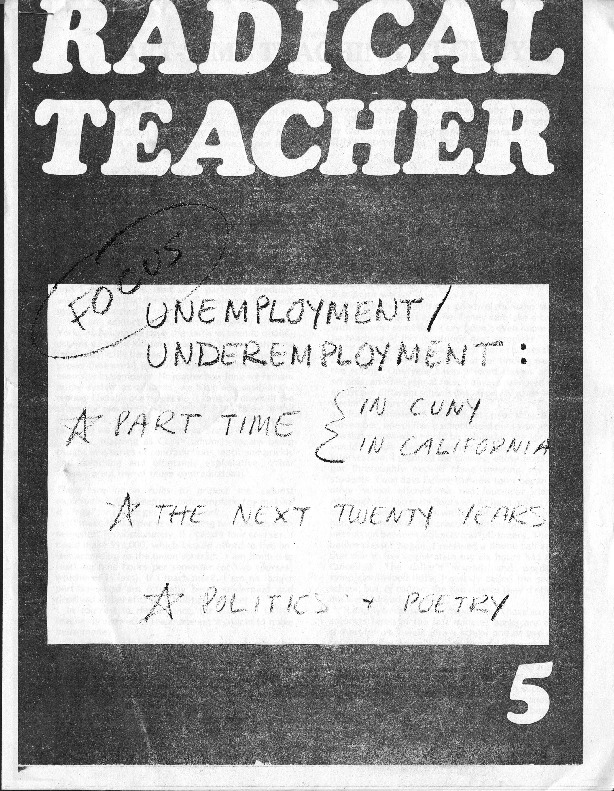
ONE EMPLOYMER Pf
“ UNDEREM PLOY M,
PART-TIME TEACHING AT CUNY
The following article was written by members of the
Committee of Untenured Faculty, a lower-rank
faculty organization at the City University of New
York. Part | is a collection of quotations taken from
Part I: Living at the bottom
by Susan Blank and Beth Greenberg
personal anecdotes of various adjunct lecturers at
CUNY. Part Il is one member’s account of the attempt
by the Committee to organize lower-rank faculty at
CUNY between June, 1976 and April, 1977.
ee Ra Mar a a aa A ew Me
Adjuncts must understand that adjuncting, not full-time work, is the job they have.
‘“‘When people ask me what | do, | say I teach
English at CUNY. And then | quickly add, ‘but I’m
only an adjunct.’ Sometimes they say, ‘What’s that2’,
and | answer, ‘Oh, sort of a part-time graduate
assistant.’ But that doesn’t really explain it. It’s much
more complicated. ’’
We are adjuncts at the City University of New
York. Although we have the same academic qualifi-
cations as many full-time teachers, we are part-time
(and technically limited by the rules of the university
to part-time work), paid by the hour, and hired or fired
semester by semester. No matter how long we remain
in the system as adjuncts, we have no possibility of
tenure. Usualfy our pay-scale is roughly one half the
salary for two thirds the work of a full-timer of the
lowest rank, and this discrepancy is widened by the -
fact that we have no benefits or Social Security.
To us, teaching as CUNY adjuncts means being
caught in a series of contradictions, each one prickly
and confining and ultimately exploitative. What
follows are a few of those contradictions:
There are union rules to protect me against
exploitation; they keep me underemployed by making
it illegal for me to get enough work.
‘‘| make $6,000 per year teaching two courses each
semester. Proportionately, if | taught four courses, |
could make $12,000, which | could afford to live on.
But according to the union contract, | am limited to
teaching nine hours per semester (or two courses,
whichever is less). If | teach more, | am no longer
part-time and am officially being underpaid and
deprived of benefits as a full-time teacher.’’
In contrast to the adjunct, the full-time CUNY
teacher is allowed to teach one extra course to make
more money:
‘‘Last week | began teaching one of my new
courses. | was very pleased to meet an old colleague
from another campus. At the same time, | couldn’t
help feeling a measure of resentment. This course is
one of the two that I’m allowed to teach Teaching the
same courses with the very same qualifications as |
have, he, as a full-timer, is making perhaps $17,000 a
year to my $6,000. | can only conclude that his course
should be offered to an adjunct as a third course
14
rather than provide extra income to someone already
making a full-time salary.’’
Teaching is a ‘‘profession, ‘’ but inmany ways I’m like
a migrant worker.
‘‘When I’ve built up a good relationship with a
class, and students ask me if they can take a course
with me next semester, | say | don’t even know if 1’Il
be teaching at this institution next semester.’’
“I’m always tempted to accept more courses than |
can handle in the fall, for fear of not finding work in
the spring. One year | was offered classes at five
schools, another year at four. | always accepted work
at just two different schools until recently when [-tried
working at three. Never again.’’
‘‘Fall semester | worked at two schools. In
November, one of those schools told me | was among
the lucky ones who would be rehired in the spring. |
would teach two three-hour classes. During
intersession, | planned the classes, chose texts, and
got throroughly excited about meeting my new
students. Four days before the new term began, the
other school offered me two four-hour classes.
Although the two extra hours would have meant more
money, | decided to stick with the first school, where |
had really enjoyed the creative atmosphere and the
interaction between adjuncts and full-timers. The day
before classes began, | received a phone call saying
that due to low registration my six hours had been
cancelled. The caller’s warmth and words. of
sympathy helped little. | quickly called the second
school, but, of course, the two classes they’d offered
me were already covered.’
‘‘Largely because many departments have so many
adjuncts hired at the last minute, books are often
chosen for us. | walk into a school one or two days
before classes begin and am handed several books
I’m unfamiliar with. The fact that | could function
more effectively with my own preferred texts makes
no difference. Each school has its particular philoso-
phy of teaching also. What I’ve done with success at
one school might be entirely inappropriate at another.
As soon as | know where I’m going to teach, | begin to
psyche out the department. Although I’m rarely told
that I’m expected to teach in a certain way, it usually
comes out in the observation report if | don’t. And that
makes it difficult to be rehired.’’
‘Although most of us are very dedicated, the fact is
that we are not usually able to perform all those duties
associated with college teaching. For example, if a
student can’t meet me right before or after class, it
‘may be impossible to schedule conferences, because
when the student is free, | may be traveling to, or
teaching at, another school. | feel fortunate when |
meet a student on the way to the train and have a little
while to talk. So many student problems spill forth
during these accidental:meetings, problems that are
often remedied as a result of our talk.’’
‘Because of the difficulty locating me, | give my
students my home telephone number. I’m not thrilled
with the idea, but many students have found it useful,
and so far no one has abused the privilege. Some of
my colleagues have been less lucky and have had to
discontinue the practice, leaving their students at
times stranded.’’
“When | was a full-time instructor, before I got
axed in the budget cuts, | would consider it my job to
see as many students for as many hours as possible.
Now that I’m an adjunct, | still hold conferences, but
basically, if the students can’t make it during the days
l’m out there, we just don’t meet. I’m part-time, not
full-time. Of course, they are exactly the same kind of
students with exactly the same needs for remediation
as the students | taught as a full-time instructor.
Students lose out with part-time teachers.’’
“but I’m only an adjunct”’
Teaching should mean working with other people, but
| feel alone.
‘‘Itis rare that | find time to talk to a colleague. One
of us is always rushing to another school at the other
end of the city, or in Westchester or New Jersey. Or
there’s something to straighten out with a secretary,
or to type and duplicate. Of course, with people
working part-time, schedules often don’t coincide at
ra
‘“‘Whenever a friendship manages to grow, it is
almost certain to be uprooted the next term. The
chances of being in the same school again and having
overlapping schedules are remote.”’
‘‘Last semester | was delighted to have an office,
rare for an adjunct. When | saw a notice on the wall
addressed to ‘‘Dear Fellow Wage Slaves,’’ | felt less
isolated than usual, more supported. | do enjoy the
conversations about shared inequities with the other
adjuncts in the office, but after a while, | have noticed
that the contact itself isn’t enough. Talking helps, but
| want change.’’
If | do a responsible teacher’s work, |’m working for
free.
At an English Department meeting at a CUNY
community college, the staff is rather small, informal
and young. Most significantly, well over half its
members are adjuncts. The full-time members are
The Radical Teacher July 1977
some with doctorates, some still in graduate school,
all of them committed teachers. The adjuncts can be
described in exactly the same terms. As far as one can
tell, the only difference between the two groups is
who happened to be in the right position at the right
time to get a full-time job.
‘I’m always tempted to accept more
courses than I can handle”’
The department chairperson is sensitive to the
situation. ‘‘We depend on our adjuncts,’’ she says
frequently. Unlike many other CUNY departments,
this one encourages adjunct participation on
committees, in curriculum decision making.
Nevertheless, in its second semester this department
did not rehire twenty of the adjuncts who worked
there in the first. This was in no way the fault of the
chairperson. The system dictates that she retain only
enough adjuncts to ‘’fill the sections.’’ Still, this
faculty meeting is over half-filled with teachers
uncertain if they will be working here six months
hence. And the chairperson isn’t sure either.
Now an adjunct raises a question. ‘’| keep hearing
about this grant and that committee. Couldn’t the
department inform adjuncts about these activities?’’
Several people nod and feelings of exclusion quietly
fill the room. The reply is swift and diplomatic.
Certainly, notices of Departmental activities will be
distributed to adjuncts. The tension in the room
releases.
‘The next day, however, several adjuncts tell each
other: ‘‘I’m not going to any more of the damn
meetings. Why should I care what the full-timers are
doing?’’ ‘’People just go because they figure it looks
good for getting rehired.’’
On the one hand, we are professional teachers and
feel slighted when excluded from professional duties.
On the other, we are hourly workers and feel exploited
when we are asked to perform these duties for no pay.
Similarly, the chairperson is caught—accused of
snobbishness when ignoring adjuncts and_ of
exploitation when involving them. Technically she
must disregard extra-class activities when rehiring,
but if she does, she ignores substantial effort. Of
course, when adjuncts sense that extra duties will be
considered, they feel constrained to volunteer.
Clearly good will and personal solutions will not
eliminate these traps.
| see myself as a potential assistant professor, but in
fact my apprenticeship may last forever.
There are very few—in CUNY, virtually
no—full-time jobs to be had. That’s the situation. But
no one is ever going to demand change until adjuncts
really understand that adjuncting, not full-time
work, is the job they have.
Almost all adjuncts see themselves as on the way to
someplace else. And there are elements of the system
which encourage this view. Possession of, or progress
towards, a doctorate is a consideration when an
adjunct is hired. Some schools even conduct a kind of
15
mini-oral during job interviews.
These standards, however, are the style and not the
substance of the adjunct’s reality. Rather than
apprentice scholars, adjuncts are often the drudges
who do more than their share of the menial work of
teaching.
Very infrequently (and less so in CUNY now that
the budget cuts have hit), a full-time position does
become available. What adjuncts are beginning to
understand is that such a full-time instructorship has
increasingly become a job for a double adjunct.’’
Instructors teach four to five courses—mainly
introductory. In English departments these are
usually all composition courses, an impossible paper
load: A much sought-after instructorship at Hunter
College this year demanded a course load of five
composition courses (read, comment, and grade 125
papers a week).
The positions of these instructors are almost as
tenuous as those of the adjuncts. Many were
retrenched in last August’s budget cuts, only to be
replaced by adjuncts; frequently instructors replaced
themselves as adjuncts.
Most adjuncts and even instructors know that
they are the menial workers of the university system.
But our vision is clouded by a double image. The
person who fills out an hourly time sheet and who may
be laid off tomorrow if registration dips, may also,
with a few lucky breaks, be an apprentice scholar on
the verge of security, tenure, and advanced courses.
Until we get a clear, single image of the reality of our
position, we will be immobilized by contradictions.
Students and teachers demonstrate against cutbacks at New York City Board of Higher Education, 12/75.
16
Part Il: Organizing from the bottom up
by Mary Vaughn
Almost every time | complain to someone outside
the City University about my life as an adjunct
lecturer, I’m asked, ‘’Why don’t you organize? Why
not bring in a union?’’ The answer, of course, is that
we already have a union of sorts—the Professional
Staff Congress (PSC)—but we are really not
organized at all. At one senior college recently, an
informal count at election time showed that only about
300 of the 500 full-time faculty were union members,
and only 135 of those voted in the election. Only 4
of over 100 part-time faculty were members.
This lack ot organization has tempted more than one
group totry to bring some unity to the faculty, and last
year, |, too, got involved in forming a group to
organize CUNY teachers.
It was, interestingly, at a union-sponsored
demonstration—called after Chancellor Kibbee had
locked all the students and faculty out of the
university to dramatize the need for an immediate
solution to the CUNY budget crisis—that | met the
people who would form the basis of our group. The
demonstration was well attended, but there was a
conspicuous absence of part-time faculty, because
most of us felt alienated from, and even hostile to,
anything connected to the PSC. Wasn’t it the PSC
which had stood by and allowed the number of
part-time faculty to grow until nearly 50% of the
faculty consisted of people exploited as cheap labor? ?
the position of instructors is almost as
tenuous as those of the adjuncts
IS TS SD ET, BE ES ST SEIS
And wasn’t it the PSC which had then bargained out
of the contract anything that might have afforded us
some dignity? Of course, it was the union leadership
which was at fault in the matter, and it was not they,
but anewly-formed committee of union activists, who
had planned the demonstration. Still, it was not
much easier to identify with those activists, because
they were mainly full-time faculty, and full-timers all
too often acted surprised when we told them about our
work situation, and then offered us a kind of pity that
was quite humiliating. As adjuncts, we felt rather out
of place.
But it was not simply part-time faculty who felt left
out of the demonstration. As we were to find out,
manv other lower-rank faculty also feel that the union
does not represent them, and that their working
conditions and chances for advancement are not
necessarily any better than an adjunct’s. While
adjuncts must take on unreal workloads in the fall,
knowing they may be unemployed in the spring,
instructors and uncertificated lecturers are forced
to do the same all year, knowing they will eventually
be terminated and have to seek work elsewhere, or in
the case of some, be rehired as adjuncts. Like
adjuncts, they are hired to teach courses that higher
rank faculty do not want—introductory courses, and
ww
The Radical Teacher July 1977
remedial courses created for students entering under
the Open Admissions policy. It is undoubtedly a
reflection of the attitude of the administration and the
union toward Open Admissions students, that they
are taught by underpaid and overworked teachers in
programs where there is a forced turnover of staff
semester by semester ana year by year. Perhaps the
only reason that full-time teachers are hired at all is
because they are needed to do the work that cannot be
required of hourly workers: registration, placement,
curriculum development, without which remedial
programs would be in total chaos.
The PSC demonstration, like others held around
that time, appeared to have little impact, probably in
part because everyone realized the union did not have
the full support of the faculty, and that most of the
faculty did not have the support of the union. But it
was Clear to us that more of the teachers would have to
get involved in the fight against the cuts before we
could force the union to take areal stand on the issues,
and that the union would never take a stand on our
particular issues unless we got organized ourselves.
Thus, four of us, two insturctors and two adjuncts,
left with the idea of forming a group of lower-rank
faculty, both full and part-time. We would organize
starting from the bottom, and work our way up as high
in the ranks as we could, knowing at some point we
would reach a level where faculty could not identify
with our problems and would not be interested in
joining. We also felt that if we were to mobilize any of
our co-workers, it would have to be done indepen-
dently of the union, because few of us belonged, and
most of us had very bad feelings about it. Since we felt
our biggest audience would consist of those with little
job security, we decided to call our group the
“‘Committee of Untenured Faculty.’’
most of us felt alienated from, even hos-
tile to, the PSC
After a lengthy phone campaign, we reached a
point where about twenty people, a few instructors
and a large number of adjuncts, were involved in
C.U.F. meetings and activities. Our initial
enthusiasm was great, in spite of the fact that we
lacked experience: less than half the members had
belonged to any political groups at all, and those of us
who had, felt totally baffled by the problems posed by
the City University, with its 18 individual campuses,
and the disorder and the demoralization brought
about by the budget crisis.
| felt particularly awkward about my abilities as an
organizer. Although | had worked with a number of
groups at the University of Michigan during the late
sixties and early seventies, | had rarely taken a
leadership role, and had always seemed to be
somewhere else when strategy was planned. Now |
found myself in a group in which | had more
experience than most. But | didn’t know exactly how
to bring that experience to bear on any of the workings
of the organization. Also, | was afraid of taking a
leadership role in the beginning because | was
intimidated by the fact that many of the teachers
involved had completed or nearly completed,
doctorates, while | had dropped out of graduate
school with a master’s degree and was now teaching
English as a second language, a ‘‘non-academic’”’
subject. | felt | might encounter the same elitism | had
noticed in many university professors, who gave me
the feeling that being allowed to teach at a university
without a doctorate was a privilege that demanded
some sacrifice: basically the sacrifice of full-time
work, decent wages, and job security.
But the real difficulty of working in the group was
that the problems we faced were entirely new to me. |
had organized tenants, and even university teaching
fellows. | had also had the exhilarating experience of
being one of the leaders in unionizing the hotel and
restaurant where | worked for a year as a waitress
after dropping out of graduate school. Yet none of that
could give me any insights about what direction we
should take at CUNY. Here it wasn’t as simple
question of persuading people to show they had the
guts to sign cards and make it clear where their
loyalties lay. That kind of organizing had been done
already. Now it was a question of doing something
about the union that had been instituted and the way
it had evolved. This was a much more complex
matter.
the problems we faced were entirely
new to me
But in spite of the complexities, it seemed to all of
us that the work had to begin somewhere, and that we
could no longer wait for someone more experienced to
lead us. We decided to begin with small projects,
involving a limited amount of strategy. We sent
letters of protest, distributed useful information for
lower-rank faculty, spoke at a Board of Regents
hearing, and generally tried to publicize our plight.
Most of this took place during the summer, when all of
us were either unemployed or underemployed, and
we were all aware that even small projects such as
these would be impossible if we were unable to find
more members before the semester began.
| wish | could begin at this point to explain in detail
how we went about recruiting members, how we’
integrated-them into our organization, and how we all
worked together to raise the level of political
consciousness of lower-rank faculty, for those were
our aims. | wish | could say that we set the
groundwork for a powerful organization in which
unity, not competition for a few full-time jobs, was the
major concern. Unfortunately, | cannot, because, as
we were to find out, in spite of the gravity of the crisis,
in spite of the fact that CUNY was fast becoming a
wasteland where education would be for a few, and in
which none of us would play any real role, it seemed
nearly impossible to convince anyone that now was
the time to join together in the struggle.
18
For one thing, it was hard to convince people to join
a group which was unable even to come up with a list
of short-term goals. Things were happening so
rapidly, and so insidiously, that we couldn’t grasp
what we were really up against. Should we fight for
the reinstitution of Open Admissions and free tuition,
or was it more important to concentrate on faculty
issues? Which issues were still alive? We hoped that
as we drew more people in, we would get a better
sense of the situation allover CUNY, and then be able
to develop realistic projects. But the people we drew
in came expecting to find answers, and were
discouraged just to find more questions.
we needed people willin;: to face the
complexities and be putient for the
answers
What we needed were people willing to face the
complexities and be patient for those answers. But
how to find them? Departments kept few records of
part-time faculty addresses. When we contacted
full-timers, they often knew of people they thought
might be interested, but they never had addresses or
phone numbers, especially not of adjuncts, and often
couldn’t even give us last names.
Another problem we encountered was that many of
those contacted simply felt they had no skills to
contribute to an organization like C.U.F. | heard
comments like: ‘‘I just can’t join, because | don’t
know how to talk to strangers on the phone,’’ and
“It’s all a really good idea, but I’m not a political
sort.’’ Some composition teachers were reluctant to
help write leaflets because it was a ‘’special sort of
style’ they weren’t sure they could handle.
Sometimes it was possible at the same meeting to
hear certain members demand that we plan a serious
job action, and others express fear of stuffing their
department mailboxes—‘‘what if someone sees me
and tells me to stop?’
Actually, we had been prepared from the beginning
for the possibility that we would have difficulty
finding members, but we had also imagined that the
impending disaster in the city would bring out great
crowds of people clamoring for action, and that we
could form coalitions with other groups that arose
from the budget crisis. Those groups disappeared one
by one—the PSC Mobilization Committee itself was
one of the first to go—and the issues seemed to
disappear with them.
Also disappearing were most of our potential
members. Phone campaigns and leafletting turned up
fewer and fewer people who were still working in the
university system. A recent CUNY fact sheet may
explain the problem: it appears that of 16,620
part-time staff in June, 1975, 13,387 had been
terminated by the next accounting in September,
1976.3 The statistics include all part-time staff, not
just teachers, and are possibly in error, since it seems
that no one bothers to keep accurate statistics on
part-time help. Nevertheless, this must be some
indication of what has happened to many of those we
had hoped to organize. In our own group of approxi-
a Meet
mately twenty active members, eight no longer have
any connection with CUNY. Many were fired and
some, like myself, simply quit. | left to take a nine-to-
five job in publishing, because | found that | was so
exhausted by a fifteen hour a week schedule divided
between CUNY and New York University that | could
not only do little effective organizing, | wasn’t even
able to fulfill my responsibilities to my students.
In view of the massive firings of adjuncts, the only
logical thing to do would have been to make sure we
involved instructors and lecturers in the group since
their situation was somewhat more stable. But the
great gap between full-time and part-time was never
bridged. Because we consisted mainly of adjuncts we
concentrated on adjunct problems, and many
members simply found it very difficult to imagine that
there was really any similarity between the problems
of adjuncts and other lower-rank faculty. Many
instructors and lecturers felt the same way. They
seemed to identify more strongly with those above
them than with those below. We simply hadn’t made
the case for unity among all lower-rank faculty.
But it must also be said that with the massive
firings and threats of more, people were beginning to
look out for themselves. If the crisis had no other
effect on them, it at least uprooted them from their
complacency. People who had had their graduate
education extended by political involvement in the
Vietnam era suddenly decided to work on
dissertations full steam and to devote any other free
time to the search for that one job. Others were
preparing for entirely new fields or searching for jobs
inindustry. Although I never heard voiced aloud, as |
had seven years before by teaching fellows at
Michigan, the idea that ‘‘professionals get ahead
through achievement, not organization,’’ | think it is
still strong somewhere in our minds. Even if the
prospects for finding jobs in academiaare slim, it still
must seem more worthwhile to give everything to the
search for a job than to commit oneself to collective
efforts in this time of political lethargy.
the great gap between full-time and
part-time was never bridged
2 RP SE TT
Finally, at a meeting in April, we decided that
C.U.F. had outlived its effectiveness, and that to
prolong its life would only discourage our members
from undertaking similar projects in the future. At the
last meeting we tried to evaluate what we had
accomplished, if anything, and to explain to ourselves
why it had been so terribly difficult even to build a
small activist organization. The consensus was that
we had simply picked the worst possible time for such
an undertaking and that even in the best of times,
working to organize such an unstable population as
adjuncts and instructors would be an extremely
difficult task.
| personally have come to the conclusion, along
with many others who were in C.U.F., that the only
rational way to go about organizing at this time is to
take a strong position on the union: that it is definitely
an elitist organization whose main concern is high
salaries for the higher ranks, but that the only way to
wrest the power from the union leadership is to
persuade lower-rank faculty to join the union and
build a power base from within. Union membership
may appear expensive to adjuncts (at $60 per year),
why had it been so terribly difficult to
build even a small activist organiza-
tion?
pee Re AREY SIL WE SET RT aT RIT ETS a eR:
some of whom go without health insurance, but in
most workplaces this is considered a normal cost of
collective bargaining. To add a somewhat optimistic
note, two of our members, one adjunct and one
instructor, ran for union representative against the
union slate in the election mentioned above. Although
they lost the election, one managed to get 57, and the
other 51 of the 139 votes cast.
Notes
1 This is according to a count made by two candidates, who
were given lists of current union members which they then
compared to the faculty directory. The number of adjuncts
mentioned here is a rough estimate. There is no official count
available of adjuncts at any branch of CUNY. An attempt was
made to get more complete statistics on union membership,
but the PSC would not release any of their figures unless a
special need for them could be demonstrated. One official
offered to release some statistics, but only if the article were
submitted to the official and if it corresponded to that official’s
views. There was insufficient time before the deadline for this
article to go through either procedure.
2 According to Chancellor Kibbee, there were about 9000 full-
time and 9000 part-time faculty at CUNY in 1975-76. ‘‘An
Interview with Kibbee,’’ New York Times, July 25, 1976.
3 Fact sheet included in Graduate School NewsReport, 1, No. 7
(April 1977), p.7 (unnumbered).
The next issue will contain an article analyzing the
implications of the Carnegie Commission Report on
Higher Education and The Management and
Financing of Colleges, a report done by the Commit-
tee for Economic Development.
The Radical Teacher July 1977 ee
“ UNDEREM PLOY M,
PART-TIME TEACHING AT CUNY
The following article was written by members of the
Committee of Untenured Faculty, a lower-rank
faculty organization at the City University of New
York. Part | is a collection of quotations taken from
Part I: Living at the bottom
by Susan Blank and Beth Greenberg
personal anecdotes of various adjunct lecturers at
CUNY. Part Il is one member’s account of the attempt
by the Committee to organize lower-rank faculty at
CUNY between June, 1976 and April, 1977.
ee Ra Mar a a aa A ew Me
Adjuncts must understand that adjuncting, not full-time work, is the job they have.
‘“‘When people ask me what | do, | say I teach
English at CUNY. And then | quickly add, ‘but I’m
only an adjunct.’ Sometimes they say, ‘What’s that2’,
and | answer, ‘Oh, sort of a part-time graduate
assistant.’ But that doesn’t really explain it. It’s much
more complicated. ’’
We are adjuncts at the City University of New
York. Although we have the same academic qualifi-
cations as many full-time teachers, we are part-time
(and technically limited by the rules of the university
to part-time work), paid by the hour, and hired or fired
semester by semester. No matter how long we remain
in the system as adjuncts, we have no possibility of
tenure. Usualfy our pay-scale is roughly one half the
salary for two thirds the work of a full-timer of the
lowest rank, and this discrepancy is widened by the -
fact that we have no benefits or Social Security.
To us, teaching as CUNY adjuncts means being
caught in a series of contradictions, each one prickly
and confining and ultimately exploitative. What
follows are a few of those contradictions:
There are union rules to protect me against
exploitation; they keep me underemployed by making
it illegal for me to get enough work.
‘‘| make $6,000 per year teaching two courses each
semester. Proportionately, if | taught four courses, |
could make $12,000, which | could afford to live on.
But according to the union contract, | am limited to
teaching nine hours per semester (or two courses,
whichever is less). If | teach more, | am no longer
part-time and am officially being underpaid and
deprived of benefits as a full-time teacher.’’
In contrast to the adjunct, the full-time CUNY
teacher is allowed to teach one extra course to make
more money:
‘‘Last week | began teaching one of my new
courses. | was very pleased to meet an old colleague
from another campus. At the same time, | couldn’t
help feeling a measure of resentment. This course is
one of the two that I’m allowed to teach Teaching the
same courses with the very same qualifications as |
have, he, as a full-timer, is making perhaps $17,000 a
year to my $6,000. | can only conclude that his course
should be offered to an adjunct as a third course
14
rather than provide extra income to someone already
making a full-time salary.’’
Teaching is a ‘‘profession, ‘’ but inmany ways I’m like
a migrant worker.
‘‘When I’ve built up a good relationship with a
class, and students ask me if they can take a course
with me next semester, | say | don’t even know if 1’Il
be teaching at this institution next semester.’’
“I’m always tempted to accept more courses than |
can handle in the fall, for fear of not finding work in
the spring. One year | was offered classes at five
schools, another year at four. | always accepted work
at just two different schools until recently when [-tried
working at three. Never again.’’
‘‘Fall semester | worked at two schools. In
November, one of those schools told me | was among
the lucky ones who would be rehired in the spring. |
would teach two three-hour classes. During
intersession, | planned the classes, chose texts, and
got throroughly excited about meeting my new
students. Four days before the new term began, the
other school offered me two four-hour classes.
Although the two extra hours would have meant more
money, | decided to stick with the first school, where |
had really enjoyed the creative atmosphere and the
interaction between adjuncts and full-timers. The day
before classes began, | received a phone call saying
that due to low registration my six hours had been
cancelled. The caller’s warmth and words. of
sympathy helped little. | quickly called the second
school, but, of course, the two classes they’d offered
me were already covered.’
‘‘Largely because many departments have so many
adjuncts hired at the last minute, books are often
chosen for us. | walk into a school one or two days
before classes begin and am handed several books
I’m unfamiliar with. The fact that | could function
more effectively with my own preferred texts makes
no difference. Each school has its particular philoso-
phy of teaching also. What I’ve done with success at
one school might be entirely inappropriate at another.
As soon as | know where I’m going to teach, | begin to
psyche out the department. Although I’m rarely told
that I’m expected to teach in a certain way, it usually
comes out in the observation report if | don’t. And that
makes it difficult to be rehired.’’
‘Although most of us are very dedicated, the fact is
that we are not usually able to perform all those duties
associated with college teaching. For example, if a
student can’t meet me right before or after class, it
‘may be impossible to schedule conferences, because
when the student is free, | may be traveling to, or
teaching at, another school. | feel fortunate when |
meet a student on the way to the train and have a little
while to talk. So many student problems spill forth
during these accidental:meetings, problems that are
often remedied as a result of our talk.’’
‘Because of the difficulty locating me, | give my
students my home telephone number. I’m not thrilled
with the idea, but many students have found it useful,
and so far no one has abused the privilege. Some of
my colleagues have been less lucky and have had to
discontinue the practice, leaving their students at
times stranded.’’
“When | was a full-time instructor, before I got
axed in the budget cuts, | would consider it my job to
see as many students for as many hours as possible.
Now that I’m an adjunct, | still hold conferences, but
basically, if the students can’t make it during the days
l’m out there, we just don’t meet. I’m part-time, not
full-time. Of course, they are exactly the same kind of
students with exactly the same needs for remediation
as the students | taught as a full-time instructor.
Students lose out with part-time teachers.’’
“but I’m only an adjunct”’
Teaching should mean working with other people, but
| feel alone.
‘‘Itis rare that | find time to talk to a colleague. One
of us is always rushing to another school at the other
end of the city, or in Westchester or New Jersey. Or
there’s something to straighten out with a secretary,
or to type and duplicate. Of course, with people
working part-time, schedules often don’t coincide at
ra
‘“‘Whenever a friendship manages to grow, it is
almost certain to be uprooted the next term. The
chances of being in the same school again and having
overlapping schedules are remote.”’
‘‘Last semester | was delighted to have an office,
rare for an adjunct. When | saw a notice on the wall
addressed to ‘‘Dear Fellow Wage Slaves,’’ | felt less
isolated than usual, more supported. | do enjoy the
conversations about shared inequities with the other
adjuncts in the office, but after a while, | have noticed
that the contact itself isn’t enough. Talking helps, but
| want change.’’
If | do a responsible teacher’s work, |’m working for
free.
At an English Department meeting at a CUNY
community college, the staff is rather small, informal
and young. Most significantly, well over half its
members are adjuncts. The full-time members are
The Radical Teacher July 1977
some with doctorates, some still in graduate school,
all of them committed teachers. The adjuncts can be
described in exactly the same terms. As far as one can
tell, the only difference between the two groups is
who happened to be in the right position at the right
time to get a full-time job.
‘I’m always tempted to accept more
courses than I can handle”’
The department chairperson is sensitive to the
situation. ‘‘We depend on our adjuncts,’’ she says
frequently. Unlike many other CUNY departments,
this one encourages adjunct participation on
committees, in curriculum decision making.
Nevertheless, in its second semester this department
did not rehire twenty of the adjuncts who worked
there in the first. This was in no way the fault of the
chairperson. The system dictates that she retain only
enough adjuncts to ‘’fill the sections.’’ Still, this
faculty meeting is over half-filled with teachers
uncertain if they will be working here six months
hence. And the chairperson isn’t sure either.
Now an adjunct raises a question. ‘’| keep hearing
about this grant and that committee. Couldn’t the
department inform adjuncts about these activities?’’
Several people nod and feelings of exclusion quietly
fill the room. The reply is swift and diplomatic.
Certainly, notices of Departmental activities will be
distributed to adjuncts. The tension in the room
releases.
‘The next day, however, several adjuncts tell each
other: ‘‘I’m not going to any more of the damn
meetings. Why should I care what the full-timers are
doing?’’ ‘’People just go because they figure it looks
good for getting rehired.’’
On the one hand, we are professional teachers and
feel slighted when excluded from professional duties.
On the other, we are hourly workers and feel exploited
when we are asked to perform these duties for no pay.
Similarly, the chairperson is caught—accused of
snobbishness when ignoring adjuncts and_ of
exploitation when involving them. Technically she
must disregard extra-class activities when rehiring,
but if she does, she ignores substantial effort. Of
course, when adjuncts sense that extra duties will be
considered, they feel constrained to volunteer.
Clearly good will and personal solutions will not
eliminate these traps.
| see myself as a potential assistant professor, but in
fact my apprenticeship may last forever.
There are very few—in CUNY, virtually
no—full-time jobs to be had. That’s the situation. But
no one is ever going to demand change until adjuncts
really understand that adjuncting, not full-time
work, is the job they have.
Almost all adjuncts see themselves as on the way to
someplace else. And there are elements of the system
which encourage this view. Possession of, or progress
towards, a doctorate is a consideration when an
adjunct is hired. Some schools even conduct a kind of
15
mini-oral during job interviews.
These standards, however, are the style and not the
substance of the adjunct’s reality. Rather than
apprentice scholars, adjuncts are often the drudges
who do more than their share of the menial work of
teaching.
Very infrequently (and less so in CUNY now that
the budget cuts have hit), a full-time position does
become available. What adjuncts are beginning to
understand is that such a full-time instructorship has
increasingly become a job for a double adjunct.’’
Instructors teach four to five courses—mainly
introductory. In English departments these are
usually all composition courses, an impossible paper
load: A much sought-after instructorship at Hunter
College this year demanded a course load of five
composition courses (read, comment, and grade 125
papers a week).
The positions of these instructors are almost as
tenuous as those of the adjuncts. Many were
retrenched in last August’s budget cuts, only to be
replaced by adjuncts; frequently instructors replaced
themselves as adjuncts.
Most adjuncts and even instructors know that
they are the menial workers of the university system.
But our vision is clouded by a double image. The
person who fills out an hourly time sheet and who may
be laid off tomorrow if registration dips, may also,
with a few lucky breaks, be an apprentice scholar on
the verge of security, tenure, and advanced courses.
Until we get a clear, single image of the reality of our
position, we will be immobilized by contradictions.
Students and teachers demonstrate against cutbacks at New York City Board of Higher Education, 12/75.
16
Part Il: Organizing from the bottom up
by Mary Vaughn
Almost every time | complain to someone outside
the City University about my life as an adjunct
lecturer, I’m asked, ‘’Why don’t you organize? Why
not bring in a union?’’ The answer, of course, is that
we already have a union of sorts—the Professional
Staff Congress (PSC)—but we are really not
organized at all. At one senior college recently, an
informal count at election time showed that only about
300 of the 500 full-time faculty were union members,
and only 135 of those voted in the election. Only 4
of over 100 part-time faculty were members.
This lack ot organization has tempted more than one
group totry to bring some unity to the faculty, and last
year, |, too, got involved in forming a group to
organize CUNY teachers.
It was, interestingly, at a union-sponsored
demonstration—called after Chancellor Kibbee had
locked all the students and faculty out of the
university to dramatize the need for an immediate
solution to the CUNY budget crisis—that | met the
people who would form the basis of our group. The
demonstration was well attended, but there was a
conspicuous absence of part-time faculty, because
most of us felt alienated from, and even hostile to,
anything connected to the PSC. Wasn’t it the PSC
which had stood by and allowed the number of
part-time faculty to grow until nearly 50% of the
faculty consisted of people exploited as cheap labor? ?
the position of instructors is almost as
tenuous as those of the adjuncts
IS TS SD ET, BE ES ST SEIS
And wasn’t it the PSC which had then bargained out
of the contract anything that might have afforded us
some dignity? Of course, it was the union leadership
which was at fault in the matter, and it was not they,
but anewly-formed committee of union activists, who
had planned the demonstration. Still, it was not
much easier to identify with those activists, because
they were mainly full-time faculty, and full-timers all
too often acted surprised when we told them about our
work situation, and then offered us a kind of pity that
was quite humiliating. As adjuncts, we felt rather out
of place.
But it was not simply part-time faculty who felt left
out of the demonstration. As we were to find out,
manv other lower-rank faculty also feel that the union
does not represent them, and that their working
conditions and chances for advancement are not
necessarily any better than an adjunct’s. While
adjuncts must take on unreal workloads in the fall,
knowing they may be unemployed in the spring,
instructors and uncertificated lecturers are forced
to do the same all year, knowing they will eventually
be terminated and have to seek work elsewhere, or in
the case of some, be rehired as adjuncts. Like
adjuncts, they are hired to teach courses that higher
rank faculty do not want—introductory courses, and
ww
The Radical Teacher July 1977
remedial courses created for students entering under
the Open Admissions policy. It is undoubtedly a
reflection of the attitude of the administration and the
union toward Open Admissions students, that they
are taught by underpaid and overworked teachers in
programs where there is a forced turnover of staff
semester by semester ana year by year. Perhaps the
only reason that full-time teachers are hired at all is
because they are needed to do the work that cannot be
required of hourly workers: registration, placement,
curriculum development, without which remedial
programs would be in total chaos.
The PSC demonstration, like others held around
that time, appeared to have little impact, probably in
part because everyone realized the union did not have
the full support of the faculty, and that most of the
faculty did not have the support of the union. But it
was Clear to us that more of the teachers would have to
get involved in the fight against the cuts before we
could force the union to take areal stand on the issues,
and that the union would never take a stand on our
particular issues unless we got organized ourselves.
Thus, four of us, two insturctors and two adjuncts,
left with the idea of forming a group of lower-rank
faculty, both full and part-time. We would organize
starting from the bottom, and work our way up as high
in the ranks as we could, knowing at some point we
would reach a level where faculty could not identify
with our problems and would not be interested in
joining. We also felt that if we were to mobilize any of
our co-workers, it would have to be done indepen-
dently of the union, because few of us belonged, and
most of us had very bad feelings about it. Since we felt
our biggest audience would consist of those with little
job security, we decided to call our group the
“‘Committee of Untenured Faculty.’’
most of us felt alienated from, even hos-
tile to, the PSC
After a lengthy phone campaign, we reached a
point where about twenty people, a few instructors
and a large number of adjuncts, were involved in
C.U.F. meetings and activities. Our initial
enthusiasm was great, in spite of the fact that we
lacked experience: less than half the members had
belonged to any political groups at all, and those of us
who had, felt totally baffled by the problems posed by
the City University, with its 18 individual campuses,
and the disorder and the demoralization brought
about by the budget crisis.
| felt particularly awkward about my abilities as an
organizer. Although | had worked with a number of
groups at the University of Michigan during the late
sixties and early seventies, | had rarely taken a
leadership role, and had always seemed to be
somewhere else when strategy was planned. Now |
found myself in a group in which | had more
experience than most. But | didn’t know exactly how
to bring that experience to bear on any of the workings
of the organization. Also, | was afraid of taking a
leadership role in the beginning because | was
intimidated by the fact that many of the teachers
involved had completed or nearly completed,
doctorates, while | had dropped out of graduate
school with a master’s degree and was now teaching
English as a second language, a ‘‘non-academic’”’
subject. | felt | might encounter the same elitism | had
noticed in many university professors, who gave me
the feeling that being allowed to teach at a university
without a doctorate was a privilege that demanded
some sacrifice: basically the sacrifice of full-time
work, decent wages, and job security.
But the real difficulty of working in the group was
that the problems we faced were entirely new to me. |
had organized tenants, and even university teaching
fellows. | had also had the exhilarating experience of
being one of the leaders in unionizing the hotel and
restaurant where | worked for a year as a waitress
after dropping out of graduate school. Yet none of that
could give me any insights about what direction we
should take at CUNY. Here it wasn’t as simple
question of persuading people to show they had the
guts to sign cards and make it clear where their
loyalties lay. That kind of organizing had been done
already. Now it was a question of doing something
about the union that had been instituted and the way
it had evolved. This was a much more complex
matter.
the problems we faced were entirely
new to me
But in spite of the complexities, it seemed to all of
us that the work had to begin somewhere, and that we
could no longer wait for someone more experienced to
lead us. We decided to begin with small projects,
involving a limited amount of strategy. We sent
letters of protest, distributed useful information for
lower-rank faculty, spoke at a Board of Regents
hearing, and generally tried to publicize our plight.
Most of this took place during the summer, when all of
us were either unemployed or underemployed, and
we were all aware that even small projects such as
these would be impossible if we were unable to find
more members before the semester began.
| wish | could begin at this point to explain in detail
how we went about recruiting members, how we’
integrated-them into our organization, and how we all
worked together to raise the level of political
consciousness of lower-rank faculty, for those were
our aims. | wish | could say that we set the
groundwork for a powerful organization in which
unity, not competition for a few full-time jobs, was the
major concern. Unfortunately, | cannot, because, as
we were to find out, in spite of the gravity of the crisis,
in spite of the fact that CUNY was fast becoming a
wasteland where education would be for a few, and in
which none of us would play any real role, it seemed
nearly impossible to convince anyone that now was
the time to join together in the struggle.
18
For one thing, it was hard to convince people to join
a group which was unable even to come up with a list
of short-term goals. Things were happening so
rapidly, and so insidiously, that we couldn’t grasp
what we were really up against. Should we fight for
the reinstitution of Open Admissions and free tuition,
or was it more important to concentrate on faculty
issues? Which issues were still alive? We hoped that
as we drew more people in, we would get a better
sense of the situation allover CUNY, and then be able
to develop realistic projects. But the people we drew
in came expecting to find answers, and were
discouraged just to find more questions.
we needed people willin;: to face the
complexities and be putient for the
answers
What we needed were people willing to face the
complexities and be patient for those answers. But
how to find them? Departments kept few records of
part-time faculty addresses. When we contacted
full-timers, they often knew of people they thought
might be interested, but they never had addresses or
phone numbers, especially not of adjuncts, and often
couldn’t even give us last names.
Another problem we encountered was that many of
those contacted simply felt they had no skills to
contribute to an organization like C.U.F. | heard
comments like: ‘‘I just can’t join, because | don’t
know how to talk to strangers on the phone,’’ and
“It’s all a really good idea, but I’m not a political
sort.’’ Some composition teachers were reluctant to
help write leaflets because it was a ‘’special sort of
style’ they weren’t sure they could handle.
Sometimes it was possible at the same meeting to
hear certain members demand that we plan a serious
job action, and others express fear of stuffing their
department mailboxes—‘‘what if someone sees me
and tells me to stop?’
Actually, we had been prepared from the beginning
for the possibility that we would have difficulty
finding members, but we had also imagined that the
impending disaster in the city would bring out great
crowds of people clamoring for action, and that we
could form coalitions with other groups that arose
from the budget crisis. Those groups disappeared one
by one—the PSC Mobilization Committee itself was
one of the first to go—and the issues seemed to
disappear with them.
Also disappearing were most of our potential
members. Phone campaigns and leafletting turned up
fewer and fewer people who were still working in the
university system. A recent CUNY fact sheet may
explain the problem: it appears that of 16,620
part-time staff in June, 1975, 13,387 had been
terminated by the next accounting in September,
1976.3 The statistics include all part-time staff, not
just teachers, and are possibly in error, since it seems
that no one bothers to keep accurate statistics on
part-time help. Nevertheless, this must be some
indication of what has happened to many of those we
had hoped to organize. In our own group of approxi-
a Meet
mately twenty active members, eight no longer have
any connection with CUNY. Many were fired and
some, like myself, simply quit. | left to take a nine-to-
five job in publishing, because | found that | was so
exhausted by a fifteen hour a week schedule divided
between CUNY and New York University that | could
not only do little effective organizing, | wasn’t even
able to fulfill my responsibilities to my students.
In view of the massive firings of adjuncts, the only
logical thing to do would have been to make sure we
involved instructors and lecturers in the group since
their situation was somewhat more stable. But the
great gap between full-time and part-time was never
bridged. Because we consisted mainly of adjuncts we
concentrated on adjunct problems, and many
members simply found it very difficult to imagine that
there was really any similarity between the problems
of adjuncts and other lower-rank faculty. Many
instructors and lecturers felt the same way. They
seemed to identify more strongly with those above
them than with those below. We simply hadn’t made
the case for unity among all lower-rank faculty.
But it must also be said that with the massive
firings and threats of more, people were beginning to
look out for themselves. If the crisis had no other
effect on them, it at least uprooted them from their
complacency. People who had had their graduate
education extended by political involvement in the
Vietnam era suddenly decided to work on
dissertations full steam and to devote any other free
time to the search for that one job. Others were
preparing for entirely new fields or searching for jobs
inindustry. Although I never heard voiced aloud, as |
had seven years before by teaching fellows at
Michigan, the idea that ‘‘professionals get ahead
through achievement, not organization,’’ | think it is
still strong somewhere in our minds. Even if the
prospects for finding jobs in academiaare slim, it still
must seem more worthwhile to give everything to the
search for a job than to commit oneself to collective
efforts in this time of political lethargy.
the great gap between full-time and
part-time was never bridged
2 RP SE TT
Finally, at a meeting in April, we decided that
C.U.F. had outlived its effectiveness, and that to
prolong its life would only discourage our members
from undertaking similar projects in the future. At the
last meeting we tried to evaluate what we had
accomplished, if anything, and to explain to ourselves
why it had been so terribly difficult even to build a
small activist organization. The consensus was that
we had simply picked the worst possible time for such
an undertaking and that even in the best of times,
working to organize such an unstable population as
adjuncts and instructors would be an extremely
difficult task.
| personally have come to the conclusion, along
with many others who were in C.U.F., that the only
rational way to go about organizing at this time is to
take a strong position on the union: that it is definitely
an elitist organization whose main concern is high
salaries for the higher ranks, but that the only way to
wrest the power from the union leadership is to
persuade lower-rank faculty to join the union and
build a power base from within. Union membership
may appear expensive to adjuncts (at $60 per year),
why had it been so terribly difficult to
build even a small activist organiza-
tion?
pee Re AREY SIL WE SET RT aT RIT ETS a eR:
some of whom go without health insurance, but in
most workplaces this is considered a normal cost of
collective bargaining. To add a somewhat optimistic
note, two of our members, one adjunct and one
instructor, ran for union representative against the
union slate in the election mentioned above. Although
they lost the election, one managed to get 57, and the
other 51 of the 139 votes cast.
Notes
1 This is according to a count made by two candidates, who
were given lists of current union members which they then
compared to the faculty directory. The number of adjuncts
mentioned here is a rough estimate. There is no official count
available of adjuncts at any branch of CUNY. An attempt was
made to get more complete statistics on union membership,
but the PSC would not release any of their figures unless a
special need for them could be demonstrated. One official
offered to release some statistics, but only if the article were
submitted to the official and if it corresponded to that official’s
views. There was insufficient time before the deadline for this
article to go through either procedure.
2 According to Chancellor Kibbee, there were about 9000 full-
time and 9000 part-time faculty at CUNY in 1975-76. ‘‘An
Interview with Kibbee,’’ New York Times, July 25, 1976.
3 Fact sheet included in Graduate School NewsReport, 1, No. 7
(April 1977), p.7 (unnumbered).
The next issue will contain an article analyzing the
implications of the Carnegie Commission Report on
Higher Education and The Management and
Financing of Colleges, a report done by the Commit-
tee for Economic Development.
The Radical Teacher July 1977 ee
Title
" But I'm only an Adjunct "
Description
"Part-Time Teaching at CUNY" was written by members of the Committee of Untenured Faculty (CUF) in 1976. Part I of the article included a collection of anecdotes culled from adjuncts' experiences of precarity and isolation across CUNY. Part II, called "Organizing from the Bottom-up," was an account of one member’s struggle to organize adjunct faculty at CUNY between 1976-77. The author concluded " that the only rational way to go about organizing at this time is to take a strong position on the union. . . ."
Contributor
Newfield, Marcia
Creator
Blank, Susan
Greenberg, Beth
Vaughn, Mary
Date
July 1977
Language
English
Publisher
Radical Teacher
Rights
Copyrighted
Source
Newfield, Marcia
Original Format
Newspaper / Magazine / Journal
Blank, Susan, Greenberg, Beth, and Vaughn, Mary. Letter. 1977. “‘ But I’m Only an Adjunct ’”, 1977, CUNY DIGITAL HISTORY ARCHIVE, accessed September 5, 2026, https://stephenz.tailc22a4b.ts.net/s/cdha/item/1392