"Faculty Members at City University Pick Single Bargaining Agent"
Item
he New Hork Cimes
“NEW / YORK, THURSDAY, JUNE 8,1972
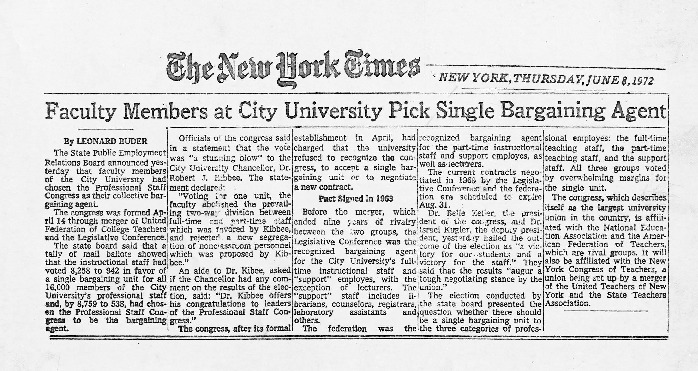
Faculty Members at t City University Pick Single Bargaining Agent
By LEONARD BUDER
The State Public Employment!
Relations Board announced yes-
terday that faculty members
of the City University had
chosen the Professional Staff
Congress as their collective bar-
gaining agent.
‘The congress was formed Ap-
ril 14 through merger of United
Federation of College Teachers
and the Legislative Conference.
The state board said that al
tally of mail ballots showed
that the instructional staff had|
voted 8,258 to 942 in favor of
a single bargaining unit for all
16,000 members of the city
University’s professional f
and, by 8,759 to 538, had chos-
en the Professional Staff Con-
gress to be the bargaining
agent.
Officials o* the congress said
in a statement that the vote
jwas “a stuns
City University Chancellor, Dr.
Robert J. E:bbee. The state-
ment declares: .
“Voting ior one unit, the
faculty abclished the prevail-
ing two-wa: division between
full-time nert-time staff
which was favored by Kibbee,
tion of nonciassruom personnel
which was proposed by ‘Kib-
bee.”
An aide to Dr. Kibee, asked
if the Chancellor had any com-
ment on the results of the elec-
tion, said: “Dr. Kibbee offers
his congratulations to leaders
of the Professional Staff Con-
gress.”
The congress, after its formal
ing plow” to thejrefused to recognize the con-
iid, rejected a new, segrega: jbetween the ‘wo groups, the
establishment in April, had}
charged that the university,
gress, to accent a single bar-
gaining unit or to negotiate),
@ new contract.
Pact Signed in 1969
Before the merger, which
ended nine jcars of rivalzy
Legislative Conference was the!
recognized bargaining agent
for the City University’s full-
time instructional staff and
“support” employes, with the
exception of lecturers. The
“support” staff includes li-
brarians, counselors, registrars,
laboratory assistants and
others.
The federation was the
re bargaining agent
for the part-time instructional
staff and support employes, as
well as:lecttrers.
The current contracts nego-
tiated in 1965 by the Legisla-
jtive Conference and the federa-
tion are scheduled to expire
Aug. 31.
Dr. Betie Zel'er, tte presi-
dent of tue co.gress, aud Dr.
Israei Kugler, the depucy presi-
jdent, yesterdty hailed the out-)*
‘come of the election as “a vic-!
tory for our--students and a
victory for the staff.” They
said that the results “augur a
tough negotiating stance by the
union.”
The election conducted by
the state board presented the
question whether there should
be a single bargaining unit to
the three categories of profes-
sional employes: the full-time
teaching staff, the part-time
by overwhelming margins for
the single unit.
itself as the largest university
union in the country, is affili-
ated with the National Educa-
tion Association and the Amer-
lican Federation of Teachers,
also be affiliated with the New
York Congress of Teachers, a
union being set up by a merger
of the United Teachers of New
York and the State Teachers
Association.
teaching staff, and the support)
staff. All three groups voted!
The congress, which describes}
|which are rival groups. It will!
“NEW / YORK, THURSDAY, JUNE 8,1972
Faculty Members at t City University Pick Single Bargaining Agent
By LEONARD BUDER
The State Public Employment!
Relations Board announced yes-
terday that faculty members
of the City University had
chosen the Professional Staff
Congress as their collective bar-
gaining agent.
‘The congress was formed Ap-
ril 14 through merger of United
Federation of College Teachers
and the Legislative Conference.
The state board said that al
tally of mail ballots showed
that the instructional staff had|
voted 8,258 to 942 in favor of
a single bargaining unit for all
16,000 members of the city
University’s professional f
and, by 8,759 to 538, had chos-
en the Professional Staff Con-
gress to be the bargaining
agent.
Officials o* the congress said
in a statement that the vote
jwas “a stuns
City University Chancellor, Dr.
Robert J. E:bbee. The state-
ment declares: .
“Voting ior one unit, the
faculty abclished the prevail-
ing two-wa: division between
full-time nert-time staff
which was favored by Kibbee,
tion of nonciassruom personnel
which was proposed by ‘Kib-
bee.”
An aide to Dr. Kibee, asked
if the Chancellor had any com-
ment on the results of the elec-
tion, said: “Dr. Kibbee offers
his congratulations to leaders
of the Professional Staff Con-
gress.”
The congress, after its formal
ing plow” to thejrefused to recognize the con-
iid, rejected a new, segrega: jbetween the ‘wo groups, the
establishment in April, had}
charged that the university,
gress, to accent a single bar-
gaining unit or to negotiate),
@ new contract.
Pact Signed in 1969
Before the merger, which
ended nine jcars of rivalzy
Legislative Conference was the!
recognized bargaining agent
for the City University’s full-
time instructional staff and
“support” employes, with the
exception of lecturers. The
“support” staff includes li-
brarians, counselors, registrars,
laboratory assistants and
others.
The federation was the
re bargaining agent
for the part-time instructional
staff and support employes, as
well as:lecttrers.
The current contracts nego-
tiated in 1965 by the Legisla-
jtive Conference and the federa-
tion are scheduled to expire
Aug. 31.
Dr. Betie Zel'er, tte presi-
dent of tue co.gress, aud Dr.
Israei Kugler, the depucy presi-
jdent, yesterdty hailed the out-)*
‘come of the election as “a vic-!
tory for our--students and a
victory for the staff.” They
said that the results “augur a
tough negotiating stance by the
union.”
The election conducted by
the state board presented the
question whether there should
be a single bargaining unit to
the three categories of profes-
sional employes: the full-time
teaching staff, the part-time
by overwhelming margins for
the single unit.
itself as the largest university
union in the country, is affili-
ated with the National Educa-
tion Association and the Amer-
lican Federation of Teachers,
also be affiliated with the New
York Congress of Teachers, a
union being set up by a merger
of the United Teachers of New
York and the State Teachers
Association.
teaching staff, and the support)
staff. All three groups voted!
The congress, which describes}
|which are rival groups. It will!
Title
"Faculty Members at City University Pick Single Bargaining Agent"
Description
This New York Times article reports the results of a June 1972 election among members of the CUNY instructional staff. Voters elected to form a single bargaining unit for CUNY, with an overwhelming number choosing the newly formed Professional Staff Congress (PSC) as the bargaining agent of choice. The election ended a dispute stretching back to 1968 over how many bargaining units there should be in CUNY and which organization would represent which unit. Previously, staff at CUNY were represented by either the Legislative Conference or the United Federation of College Teachers; despite popular support, their merging of the two was not a smooth process in the early years of the new union. Nevertheless, their unification allowed for the leaders from the two competing groups to redirect their focuses away from their rivalry towards better addressing the needs of faculty and staff at CUNY.
Creator
Buder, Leonard
Date
June 8, 1972
Language
English
Publisher
New York Times
Rights
Copyrighted
Source
Robert F. Wagner Labor Archives
Original Format
Article / Essay
Buder, Leonard. Letter. “‘Faculty Members at City University Pick Single Bargaining Agent’.”, CUNY DIGITAL HISTORY ARCHIVE, accessed September 5, 2026, https://stephenz.tailc22a4b.ts.net/s/cdha/item/438