Prometheus, January 26, 1972
Item
| PROMETHEUS |
VOL. Vi - NO. 1 > 15
MANHATTAN COMMUNITY COLLEGE e THE CITY UNIVERSITY OF NEW YORK
JANUARY 26, 1972
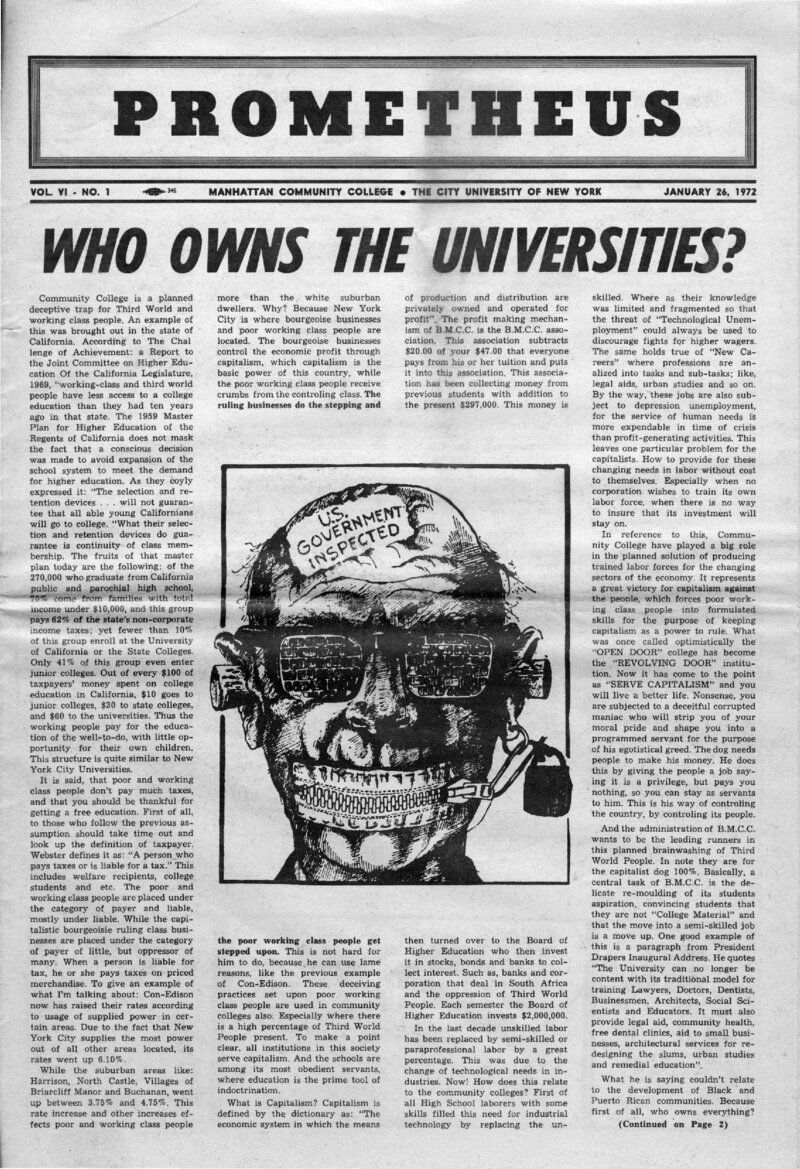
WHO OWNS THE UNIVERSITIES?
Community College is a planned
deceptive trap for Third World and
working class people. An example of
this was brought out in the state of
California. According to The Chal
lenge of Achievement: a Report to
the Joint Committee on Higher Edu-
eation Of the California Legislature,
1969, “working-class and third world
people have less access to a college
education than they had ten years
ago in that state. The 1959 Master
Plan for Higher Education of the
Regents of California does not mask
the fact that a conscious decision
was made to avoid expansion of the
school system to meet the demand
for higher education. As they coyly
expressed it: “The selection and re-
tention devices .. . will not guaran-
tee that all able young Californians
will go to college. ‘“‘What their selec-
tion and retention devices do gua-
rantee is continuity of class mem-
bership. The fruits of that master
plan today are the following: of the
270,000 who graduate from California
public and parochial high school,
—=—="'79%" Come from families with total
income under $10,000, and this group
pays 62% of the state’s non-corporate
income taxes; yet fewer than 10%
of this group enroll at the University
of California or the State Colleges.
Only 41% of this group even enter
junior colleges. Out of every $100 of
taxpayers’ money spent on college
education in California, $10 goes to
junior colleges, $30 to state colleges,
and $60 to the universities. Thus the
working people pay for the educa-
tion of the well+to-do, with little op-
portunity for their own children.
This structure is quite similar to New
York City Universities.
It is said, that poor and working
class people don’t pay much taxes,
and that you should be thankful for
getting a free education. First of all,
to those who follow the previous as-
sumption should take time out and
look up the definition of taxpayer.
Webster defines it as: “A person who
pays taxes or is liable for a tax.” This
includes welfare recipients, college
students and etc. The poor and
working class people are placed under
the category of payer and liable,
mostly under liable. While the capi-
talistic bourgeoisie ruling class busi-
nesses are placed under the category
of payer of little, but oppressor of
many. When a person is liable for
tax, he or she pays taxes on priced
merchandise. To give an example of
what I’m talking about: Con-Edison
now has raised their rates according
to usage of supplied power in cer-
tain areas. Due to the fact that New
York City supplies the most power
out of all other areas located, its
rates went up 6.10%.
While the suburban areas like:
Harrison, North Castle, Villages of
Briarcliff Manor and Buchanan, went
up between 3.75% and 4.75%. This
rate increase and other increases ef-
fects poor and working class people
more than the. white suburban
dwellers. Why? Because New York
City is where bourgeoise businesses
and poor working class people are
located. The bourgeoise businesses
control the economic profit through
capitalism, which capitalism is the
basic power of this country, while
the poor working class people receive
crumbs from the controling class. The
ruling businesses do the stepping and
the poor working class- people get
stepped upon. This is not hard for
him to do, because _he can use lame
reasons, like the previous example
of Con-Edison. These deceiving
practices set upon poor working
class people are used in community
colleges also. Especially where there
is a high percentage of Third World
People present. To make a point
clear, all institutions in this society
serve capitalism. And the schools are
among its most obedient servants,
where education is the prime tool of
indoctrination.
What is Capitalism? Capitalism is
defined by the dictionary as: “The
economic system in which the means
of production and distribution are
privately owned and operated for
profit”, The profit making mechan-
ism of B.M.C.C. is the B.M.C.C. asso-
ciation, This association subtracts
$20.00 of your $47.00 that everyone
pays from his or her tuition and puts
it into this association, This associa-
tion has been collecting money from
previous students with addition to
the present $297,000. This money is
then turned over to the Board of
Higher Education who then invest
it in stocks, bonds and banks to col-
lect interest. Such as, banks and cor-
poration that deal ‘in South Africa
and the oppression of Third World
People. Each semester the Board of
Higher Education invests $2,000,000.
In the last decade unskilled labor
has been replaced by semi-skilled or
paraprofessional labor by a great
percentage. This was due to the
change of technological needs in in-
dustries. Now! How does this relate
to the community colleges? First of
all High School laborers with some
skills filled this need for industrial
technology by replacing the un-
skilled. Where as their knowledge
was limited and fragmented so that
the threat of “Technological Unem-
ployment” could always be used to
discourage fights for higher wagers.
The same holds true of “New Ca-
reers” where professions are an-
alized into tasks and sub-tasks; like,
legal aids, urban studies and so on.
By the way, these jobs are also sub-
ject to depression unemployment,
for the service of human needs is
more expendable in time of crisis
than profit-generating activities. This
leaves one particular problem for the
capitalists. How to provide for these
changing needs in labor without cost
to themselves. Especially when no
corporation wishes to train its own
labor force, when there is no way
to insure that its investment will
stay on.
In reference to this, Commu-
nity College have played a big role
in the planned solution of producing
trained labor forces for the changing
sectors of the economy. It represents
a great victory for capitalism against
the peovle, which forces poor work-
ing class people into formulated
skills for the purpose of keeping
capitalism as a power to rule. What
was once called optimistically the
“OPEN DOOR” college has become
the “REVOLVING DOOR?” institu-
tion. Now it has come to the point
as “SERVE CAPITALISM” and you
will live a better life. Nonsense, you
are subjected to a deceitful corrupted
maniac who will strip you of your
moral pride and shape you into a
programmed servant for the purpose
of his egotistical greed. The dog needs
people to make his money. He does
this by giving the people a job say-
ing it is a privilege, but pays you
nothing, so you can stay as servants
to him. This is his way of controling
the country, by controling its people.
And the administration of B.M.C.C.
wants to be the leading runners in
this planned brainwashing of Third
World People. In note they are for
the capitalist dog 100%. Basically, a
central task of B.M.C.C. is the de-
licate re-moulding of its students
aspiration, convincing students that
they are not “College Material” and
that the move into a semi-skilled job
is a move up. One good example of
this is a paragraph from President
Drapers Inaugural Address. He quotes
“The University can no longer be
content with its traditional model for
training Lawyers, Doctors, Dentists,
Businessmen, Architects, Social Sci-
entists and Educators. It must also
provide legal aid, community health,
free dental clinics, aid to small busi-
nesses, architectural services for re-
designing the slums, urban studies
and remedial education”,
What he is saying couldn’t relate
to the development of Black and
Puerto Rican communities. Because
first of all, who owns everything?
(Continued on Page 2)
Page Ten
PROMETHEUS
January 26, 1972
The Political Economy of the
Wage-Price Freeze
The wage-price freeze, and the
series of economic crises which led
to it, is another reflection of a dying
society; and analysis of this prob-
lem can only be understood by see-
ing how the ruling class of the United
States intends to resolve two very
serious and evolving contradictions:
1) the contradiction between them-
selves and the other capitalist
powers — Japan, Germany, France,
ete., and 2) the one between them-
selves and the growing revolution-
ary movement of oppressed and
working people throughout the world.
What are economic crises? An
economic crisis is an interruption in
the “normal” productive process. In
past societies, plagues, floods,
droughts, earthquakes, and epidemics
were the main causes of economic
crises. Today, economic crises are the
product of a stagnating monopoly
economy, war and “defense” spend
ing, and the historical advances of
world socialism.
Always keep in mind that capitalist
production is production for “profit.”
In all capitalist countries, the mono-
poly capitalist is the supreme com-
mander of the state and the economy.
“Making money” is the only thing
capitalists live and die for. Because
capitalist production is planned and
organized only in the interest of the
capitalist, there are periodic crises
such as the one we are witnessing
today. Thousands of lives and mil-
lions of dollars in goods are destroyed
and wasted by this recurring process.
The vicious cycle is repeated over
and over, at a rate of about every
two or three years. Now we are at
the beginning of another serious
crisis which will prove to be the
most profound since 1929!
On August 15, 1971, Richard Nixon,
Chairman of the Executive Commit-
tee of the Ruling Class, invoked a
“wage-price freeze” that was design-
ed to deflect a four-way attack on
the Imperialist economy of the
United States: recession, inflation,
increasing foreign competition, and a
rising revolutionary military on the
part of the oppressed people and ad-
vance workers both within as well
as outside the American Empire. The
“wage-price freeze,” a tactical move
on Nixon’s part, is designed to give
the ruling classes, who are locked in
a desperate battle between a social
system that is dying out and one that
is coming into being, some time to
breathe.
To understand the present crisis,
we must discuss briefly the political
economy of American Imperialism,
how this crisis led to the “wage”-
price freeze,” and the impact of this
crisis on the social and political con-
ditions and formations of oppressed
and working people.
In the present stage of the crises
of American Imperialism, which is
the stage of the post World War II
era, government spending is an ab-
solute must to keep the system go-
ing. And there is only one form of
government spending that the im-
perialist like best. And that is spend-
ing for the war. The system in which
we all live at present means war; it
thrives on war. The American econ-
omy is predominately a war econo-
my. The purpose of this war econ-
omy is the world domination of
American monopoly capital.
The first world-crises of capitalism
in 1929, showed the imperialists that
capitalism was both an international
system as well as a very fragile one;
and World War II was fought so the
capitalists could decide who among
them would be the center of a new
imperialist system which would “save
capitalism economically as well as
wage a relentless war on the growing
revolutionary movement of the Third
World.
In addition to World War II, this
new “recovery” policy of American
Imperialism had three basic parts: 1)
increasing foreign exports and de-
creasing imports (export the problem
to another capitalist countries);
2) extending tax-benefits and sub-
sidies to monopolies and increasing
the taxes of oppressed and working
people (this includes money taxes as
well as a tax on physical labor —
“speed-up”); 3) increasing the ex-
ploitation of the most oppressed
groups — blacks and other third
world people, women and youth
(both within and outside the coun-
try.)
These new “recovery’’ policies,
adopted by the imperialists, led to the
creation of a permanent, ever —
growing war industry, which led to
the creation of a permanent, ever —
growing war industry, which led to
the creation of another permanent
contradiction — inflation!
From the Black Workers Congress
to be continued in next issue.
January 26, 1972
PROMETHEUS
Page Eleven
“Like It Is”
On December 5, 1971 at 2:30 p.m.
Sunday on Channel 7 I had the
unique, rare, and accidental experi-
ence of seeing a television show
called, “Like It Is.” There was
an actual transmission of positive
ideologies from, to, and about Black
folk.
I found this particular event ex-
tremely unique primarily because of
the four eminently distinguished and
controversial guests: Lucky Thomp-
son, Reggie Workman, Nikki Gio-
vanni, and Mrs. Fania Jordan.
This conglomeration of Black tal-
ent was not only informative but
also an entertaining exhibition of
ebonized art forms.
The intentions of each guest, it
appeared to me, was to inform Black
folk of the perpetual exploitation of
Black Art, especially Black Music, by
guess who?
First on the agenda was the in-
ternationally renounced saxaphonist
Lucky Thompson, who _incidently
was musically driven from this coun-
try because he refused to concede
to the degrading demands of the
money hungry “white bosses,” such
as playing his music the way they
wanted it played, where, when, and
with whom they wanted it played.
But Lucky would not comply and
because of his militant stand he was
given the thumb and was black-
listed, He didn’t work at all from
1949-1954.
The primary function of any artist
is creativity and the motivation for
creation is liberation.
Thus, Lucky went to Europe seek-
ing a full atmosphere for his genius
to function in. Unfortunately, he
found that although European au-
diences were more receptive, and ap-
preciative, those who controlled com-
munications were as economically
greedy as their American counter-
parts, for they too magnified their
profits through exploitation, for ex-
ample, Lucky explained, “I signed a
contract to do a concert, the contract
is claused so that its manipulators
can tape, video tape, and replay the
concert all day, every day, forever .
and not give me a dime.” This is the
standard procedure throughout Eu-
rope. Finally realizing that the fight
against this international conspiracy
has to be won at its home base,
Lucky returned to America to re-
sume his fight against the exploita-
tion of Black Music and musicians.
It was at this point that I under-
stood the title of the show, “Like It
Is,” and it was at this point that
Lucky gave us a musical interpreta-
tion of his militance.
On soprano sax he played “Green
Dolphin Street,” on clarinet he play-
ed “Body and Soul” and finally on
tenor he played an up-tempo Black
standard. The name of the tune has
elluded me.
The Lucky Thompson quartet fea-
tured the very underrated Hank
Jones on piano, and two young bro-
thers on bass and drums who dis-
played an excellent command of
their instruments. The normal pro-
cedure for introduction was elim-
inated because of a time hang up.
Second was Reggie Workman, a
brilliant young bassist, but he didn’t
do any playing on this show. Reggie
opened by promoting a new totally
Black magazine publication named
“Expansion,” that deals exclusively
with Black art forms. It will soon be
available on local newsstands, but
presently it is available only at par-
ticular Black establishments. The
125th Street Black Book Store is one
location.
Next Reggie attacked the mislabel-
ing of Black music. It is not jazz he
said, implying that jazz is as obsolete
as the word Negro, what we create
and play is “Afro American classical
music,” and he reminded us, through
its Black people, it is America’s only
real contribution to the arts. That
which is generally accepted as. clas-
sical music is European classical mu-
sic and it receives all the economic
support and dignified respect that
the Black music created right here
in America is denied.
Concert halls as recently estab-
lished as the Lincoln Center for the
Performing Arts, as well as Carnegie
Hall and Town Hall, etc., where
95% of the concerts performed are
European, have just enough Black
art to avoid being accused of hav-
ing none.
Reggie went on to say that the
amount of government subsidies and
private funds available to art forms
are unlimited, but when it comes
to Black art there is the ever-present
legal process and other red tape.
In short, in order for Black art
to get its due support, Black artists
have to be lawyers and economists
as well.
There is a new committee of Black
Artists who recently met with Max
Roach and they be about dealing
with this situation.
That time hang up forced Reggie
to cut his elaboration short.
Next came Nikki Giovanni, the
dynamic, young, gifted, and Black
poetess, who immediately went into
her now famous poem “Aretha” and
without pause did “I.Am Bad.”
She explained that “Aretha” was
not only a personal acknowledge-
ment, but it was symbolic of every
Black performer who is overworked
and underpaid, disrespected and ex-
ploited.
She was then asked what her polit-
ical views were. To this she quickly
responded that she is a Black Na-
tionalist, totally for Black people,
and added that she had no spare
time or energy for anything else.
Next she was asked if this was
not racism in reverse. She responded
to this with a laugh and said that
the term “reverse racism” is a big
joke. Racists are groups, or organiza-
tions that use their economic, gov-
ernmental and military powers to
oppress people. So that in order for
me to be a racist, I would first have
to have economic, governmental, and
military powers and “I ain’t got none
(pause) yet.”
I think that here the last line of
“Aretha” would be appropriate “why
don’t you think about it, think about
it, think about it, think about it...”
Last but not least was Mrs. Fania
Jordan who has the good fortune to
be the soulful sister of the incom-
parable Angela Davis.
Mrs. Jordan first discussed the fi-
nancial and moral success of her re-
cent tour of Europe. Although money
was not the purpose of the trip, she
stated, lavish contributions were con-
tinuously made to the Angela Davis
legal fund.
She said that everywhere she went
people thought it inconceivably in-
human that so many young, gifted
and Black leaders with so much to
contribute to the thirty million Black
people she was stolen from, could
be falsely accused of the three mur-
ders committed by the state of Cali-
fornia’s own law enforcement of-
ficers.
Then out of “sho nuff, stomp down,
honest to goodness racism,” she is
being held unconstitutionally with-
out bail.
Isn’t it just utterly ridiculous that
Mafia members, who control the im-
porting of drugs, and every other
phase of crime, are released on bails
that they carry in their pockets for
spending money. On the few occa-
sions when they are convicted they
are allowed to remain free until their
doctors decide that they are physi-
cally conditioned to do their time.
Now from the ridiculous to the
sublime: Lt. Calley who was con-
victed of 103 cold blooded murders,
by a jury of his peers, and I mean
they were his “sho nuff” peers too-
white officers on active duty in the
United States Army.
Not only were the people that he
murdered unarmed, captured and
searched; many of them were wom-
en, children and babies. With all this
evidence, reinforced by his own ad-
mission and the testimony of these
under his command, good old “fellow
American” still had the audacious
gall to use his executive power to
halt justice by taking the murderer
out of incarceration and confining
him to his home with his wife, etc.
Hey! and a seventeen year old
kid named George Jackson was sen-
tenced to life for a $40 robbery dur-
ing which no one was hurt. Eleven
years later, without having made
parole, he was murdered in a prison
yard.
His murder was pre-meditated on
the day of that unjust sentence.
Hey folks! that is “like it is.”
New Voters Conference
The deceit which has characterized
the U.S. political structure has again
come to the surface. On December
3rd in Chicago a New Voters Emer-
gency Conference was called, the
conference lasted three days in which
time the true nature of the confer-
ence was revealed, Supposedly the
function of the conference was to or-
ganize the 18 years old and young
voters around dumping Nixon in ’72
and dealing with pertinent issues
which effected the well being of all
people living in the U.S. The confer-
ence was also supposed to support an
alternative candidate with the stipu-
lation that the platform adopted and
approved by the conference popula-
tion be moved on by that candidate.
Not negating the urgency of an im-
mediate withdrawal of all U.S. troops
in South East Asia. I think that with-
out dealing with internal contradic-
tions, (racism) we can not deal with
its effects. The deep rooted insanity
of racism is a precept in the Amer-
ican way of life. The basis other than
economics of the war in Vietnam,
the effect instead of dealing with the
source is backward and completely
illogical and irrational. White people
in this country have to deal with
their own racism, before non-white
people can deal effectively with
them. The complete inability to deal
with racism as primary whether in-
tentional or not is reflective of the
conditioning process in america.
Incorrect Hypotheses
There were undoubtedly many in-
correct hypotheses involved in the
planning and actual implementation
of the conference which are very key
in an analysis of where the planning
committees’ head was and is at.
1. All young people would vote
alike, subsequently indicating
that all young people obviously
think alike.
2. All young people because of
their disillusion with the Nixon
Admin. were Democrats.
3. Because of the obvious lack of
participation on the part of
non-white people the assump-
tion was that all young people
were white.
4. All young people would turn
out at the polls in mass in sup-
port of the Democrats.
5. That Third World people would
except without question the de-
sign of the conference.
There were many falisies involved
in the new voters conference one of
the major falisies was that it was an
emergency conference, but in actual-
ity it was planned a long time be-
fore its actual taking place.
Actualities
We have seen the major proclaima-
tions and assumptions of the New
Voters Conference now we will deal
with its actualities.
1. The New Voters Conference
from its very beginning did not in-
clude a broad cross section of Third
World youth and we had nothing to
say in the planning of the conference.
Third World youth were not inform-
ed therefore a majority were not
invited to attend. The basic observa-
tion here is that a complete disregard
for non white people was also dis-
Played in the building of the con-
ference.
2. The demands submitted by the
Black Caucus Chicano and Puerto
Rican Caucuses were not dealt with
until the Third World delegation
walked out for the second time.
3. The Black people were placed
on the agenda as a minority (indicat-
ing how unimportant they felt we
were.
Evaluation
Making an opinion based on the
facts acquired by the experience of
attending the conference I would
give my opinion of the conference as
it was planned as an absolute failure,
this opinion is shared by the over-
whelming majority of Third World
people attending the conference, The
new voters in America are also ex-
actly like the old voters in terms of
their general attitude towards crucial
issues which effect more than white
middle class Americans. Americans
young population on the whole
(white) is not ready to face the
problem of racism and deal with it in
its proper prospective, as the nations
major error. In comparison to air
pollution, garbage pollution the
question of racism is not a priority
with most white people young and
old alike. There is a low level of
political consciousness among the
nations young people (in comparison
to New York). Most of the young
people attending the conference
(white) felt that the only way to
change conditions existing in this
country is to elect a liberal for Pres-
ident. An alternative of 2 evils as far
as Third World people are concerned
the policies would not really change
that much, not enough to change the
immediate material conditions of life.
(Continued on Page 12)
Page Twelve
PROMETHEUS
January 26, 1972
(Continued from Page 11)
So the choice is really not a choice
at all.
Need for Alliances
Through all the negative experi-
ences felt at the conference one very
positive thing came about, Black,
Puerto Rican, Chicano and all other
Third World people present saw the
need to form alliances, and so we
formed that alliance. We will be
building for a Third World Confer-
NEW VOTERS CONFERENCE
ence tentatively scheduled for Feb-
15, 1972. It took rejection and dis-
regard to bring us together, it. will
be the commonality of our oppression
that will forge nation wide strength
of Third World people. Through this
strength we will deal collectively and
effectively with the oppressor, Unity
breeds victory.
All Power To The People!!!
BILLY SAMUELS
We Must Throw Off
Our Shackles and —
Gain New Courage
To Deal With Our
Slavemasters
Don't Miss the Big
BOOK SALE
jan. 10—28
BEN DAVIS
BOOK CENTER
2529 8th Ave., Near 135th St.
All Proceeds Go To The
Harlem Marxist Center
Ever
Establishment
trembles a little.
pecesoesesessesesesen
Possess ses son neserennans
Because every week, a new issue of the Guardian appears.
It carries news of revolutionary developments in Asia,
Africa and Latin America; the movements for black and
women’s liberation; the antiwar movement; the struggles of
workers, prisoners and students; and critiques of contemp-
orary culture—all analysed for their implications and full
meaning.
The Guardian is a radical newspaper with an independent
political outlook. It cuts through
the smokescreen of most other
journals with their distortions,
omissions and lies. It gets to the
root of why the forces of liberation
are challenging the power of the
tuling class.
For example, Wilfred Burchett,
the Guardian’s Indochina cor-
respondent, filed reports . from
Southeast Asia which were seven
years ahead of the sensational (and
profitable) “Pentagon Papers”
disclosures.
If you want the real story, read
the Guardian.
8
‘
oI
mail to: Guardian, 32 W. 22nd St.
Enclosed is: New York, New York 10010
($10. for a regular one year sub. (for Ce snd Latn’ Airnarlea;
add $2. per sub; elsewhere
outside U.S., add $3.)
($5. for a one year student sub.
($1. for a ten-week trial sub.
$1. for a one year G.1. or Prisoner sub. 2218
State,
°
|
|
Ne
Page Two
Who Owns
The Universities?
(Continued from Page 1)
Bourgesoise capitalists. And his idea
about giving urban dwellers jobs, as
he puts it, should be the responsi-
bility of people who have concern
for their community, and I don’t
mean puppets. Especially some out-
sider whose aim is to profit off of
the people. Yes, we have poverty in
our community. But it will not be
solved by allowing some monkey in
whose trying to weigh oppression on
Black and Puerto Rican people. The
true fact is we do need Lawyers,
Doctors, Dentists, Educators, etc. So
we can take these skills and deal
with capitalistic dogs. We don’t need
legal aids, aids to small businesses
and remedial education as much as
we need the Lawyers and Doctors
with technical and professional skills
to give to the people. Because the
purpose for semi-skilled workers is
to serve and perpetuate capitalism,
and the administration is functioning
under these very same principles. It
is their job to carry out what is
placed upon them by the capitalist.
But what we as Third World People
need to do is keep this technology
within our community. And_ stop
chasing false dreams that the capi-
talist and his followers set upon us.
The only way any community can be
developed is through full participa-
tion of highly educated leaders with
a collective pattern of idealogies in
reference to the development of his
or her community.
In conclusion we must expose the
racist bourgeoise nature of the uni-
versities and implement a more
sound program for Third World Peo-
ple within the universities, whom are
a part of the working class. We
should not be deceived and misguided
by incompetent individuals who
blinds people with opportunistic
ideas. Making them think that they
are bettering themselves when all
the time they are helping their op-
pressors. The role of Third World
People as a taxpayer and a future
vanguard of our communities, should
unite; and stop sleeping in the beds
our enemies make for us. But start
becoming collective individuals and
take part in the struggle for our
people.
HOWARD VANLIEROP
PROMETHEUS
INEVITABLE
Time is of the essence, but for What:
I have to do this, I have to do that
— Why
I constantly waste time on trivial
things
Dress up to go out, trying to please
everyone else —
Man’s endless desire to accomplish
this or accomplish that
Always doing something, always
finding better ways of killing
time:
It’s always accomplish, succeed,
encounter, but for what
Death, the end of time is inevitable
— so why be plastic, why
Be what you’re not — death knows
not rich nor poor, it only
Knows that it is inevitable. Death
the great equalizer,
Is beautiful, for it knows not racism,
capitalism or
Whatever, all it knows is that it is
inevitable.
Inheritance
Oh nations so mighty on this
bountiful earth
What do you offer to a child at his
birth
You blood-stained glories and
banners of praise
Sown on the fields where the beast
once would graze
What do you leave for this child
to inherit,
Your sickened societies, your
decadent morals,
Tell me great nations, is this
what he merits,
Let this then be known to all pigs
of our times
The commitment is yours, the
inheritance is mine,
LARRY SOTO
DRAPER TRIES TO BLACKMAIL
The President’s displeasure with
an interview on athletes and their
attitudes towards drugs, given to the
New York Times last spring by bas-
ketball coach Howie Jones, has re-
sulted in a crude and vindictive cam-
paign of intimidation.
Dean Pittman attends almost every
home game and spends his time tak-
ing notes on the students’ and
coach’s behavior. Jones has still not
received a penny of the pay he has
earned as basketball coach, even
though the season is half over. Draper
has indicated that he has no inten-
tion of paying Jones unless Howie
resigns his position as a member and
a director of the BMCC Association,
a position to which he was elected
by the Faculty Council.
These forms of harrassment and
blackmail are apparently designed
to prove once and for all that you
can’t cross the President and get
away with it. Jones has freedom of
speech provided that what he says
to the press is cleared with the Pres-
ident first.
Draper, of course, denies that anger
and spite have anything to do with
the matter. He claims that he re-
fuses to pay Jones because the money
for his coaching salary comes from
the Association on which Jones sits.
Draper says this represents a con-
flict of interest which the by-laws
forbid. However, the Association,
which has the right to interpret its
GET YoU ANO NODNE
(S OUT To GeT You. THE
CHANCES ARE You ARE
JONES
own by-laws, says there is no con-
flict. The Association has also point-
ed out that Draper himself receives
money from the Association and that
he sits on it also. Yet he seems un-
concerned about the conflict of in-
terest involved in the funds he re-
ceives,
Jones accounts for his salary by
his work as coach which is out in
the open for everyone to see — and
to marvel at. Draper accounts to no
one for his slush fund — “The Presi-
dent’s Fund.”
In his vindicative campaign against
Coach Jones, Draper has put pres-
sure on Mayer Rasabi, Jones’ depart-
ment chairman, to use his’ influence
to force Howie’s resignation. On Jan-
uary 5, Draper tried unsuccessfully
to call a “quickie” meeting of the
Faculty Council, the purpose of
which was to present his side of the
case and get a vote recalling Jones
before the Association had a chance
to present its side. The move failed
when Draper couldn’t get a quorum.
Many of the members of the Fac-
ulty Council have expressed an-
noyance at Draper’s high-handed-
ness. The Legislative Conference has
filed a grievance in Jones’ behalf.
Students who have heard about these
going-on are furious. Student Gov-
ernment and Third World Coalition
have expressed their firm support of
Coach Jones and the position of the
Association,
January 26, 1972
Black Science
Students Meet
The National Black Science Stu-
dents Organization hosted their an-
nual conference on black students
in medicine and science on the
weekend of December 4th, 5th and
6th at the Hotel Commodore.
I attended the conference with a
Positive attitude but went away a
little disappointed. There were a few
things that I thought should have
been done to make the conference
better. The Hotel Commodore was
a poor place to have a Black science
students conference. Environment
has a lot of do with our peoples
learning experiences. It should have
been held in one of the Black com-
munities, which would have pro-
duced a more unified atmosphere
among the people. The registration
fee of ten dollars was much too high
for the average black person to pay.
Since there were no meals served
at the conference one would have to
eat in the hotel or midtown Manhat-
tan where the prices are very high.
The workshops were conducted in
a very professional way. In the work
shops we discussed lead poisoning;
sickle cell anemia, veneral disease,
population control, Black mental
health, engineering and architecture.
The theme of the conference was
very important in that it stressed
the need for Black students to enter
_
health and science fields: Fields that~—~
are very important to build a na-
tion,
In conclusion I would like to say
by presenting an analysis of the con-
ference, I’m in no way criticizing the
validity of the conference or the Na
tional Black Science Organization,
but the way the conference was pre-
sented. I would ‘hope that the Na-
tional Black Science Student Organ-
ization will correct these faults in
future conferences.
Minister Farrakan, who spoke at
the conference, as always spoke
the truth regarding the Black man’s
condition in Amerika.
OBA (Eugene Mercer)
January 26, 1972
PROMETHEUS
Page Three
Dealing With the
Drug Plague
Students, Faculty, and Adminis-
trators, we the members of the Drug
Committee would like to take this
opportunity to thank you for the
unanimous support you gave to your
local drug program.
Our services will now be avail-
able to every student in every build-
ing from 9:00 a.m. to 9:00 p.m., ef-
fective 12/20/71.
To those students in “L” building,
please bear with us for the remain-
ing few weeks of this semester by
using the “M” building.
Deans Weinberger and Makuen
have assured us that three more
small rooms will be available to us
on 12/14/71 giving us a total of four
rooms to work out of temporarily,
with a promise of ample space for
the coming semester. Our present
locations are A326, B227 and two
rooms in the “M” building to be
announced. Students in the “L” and
“M” building have only to contact
Claire Gulino in the Nursing Depart-
ment to find out exactly what room
we will be in.
Our primary concerns are drug
education, prevention and counsel-
ing, but we are prepared to deal
with any problem that any students
has, drug related or not.
Our intentions are to attack the
drug problem from every aspect. We
intend to provide ex- and active-ad-
dict speakers for Health Ed and So-
cial Science classes, we plan to or-
ganize trips to rehab centers, court
rooms and city prisons for those are
the eventual destinations of every-
one caught in the drug trap. We will
show films that deal in reality, so
that the films we see will be the
same things you see in your neigh-
borhoods every day. ;
Faculty-student weekends are on
the agenda, as are fashion shows,
dances, art contests, etc. We even
plan to have a Miss or Mrs. BMCC
contest next semester.
We have already set up an ex-
change student program with LOGOS
II, a Bronx rehab center located at
480 E. 185th Street. They will send
us two peer-group counselors and
we will send them two work-study
tutors. Aside from tutoring, both stu-
dents will be trained for peer-group
counseling. Other rehab centers are
standing by waiting to respond to
the tutor-counselor exchange. How
quickly we extend to other centers
depends on how successful we are
with this trial exchange. Incidently,
the tutoring department has been
really cooperative.
We have secured a committment
from Dean Pittman that no drug-re-
lated arrests will be made, without
contacting us giving us first shot at
dealing with the problem.
We plan to promote trips to Africa
and Mainland China. To Africa be-
cause our campus population is at
least 50% Black and there are no
scholarships available to any coun-
try in Africa, and yet there are
scholarships available throughout
Europe including Russia and Israel.
We think that is totally unfair.
We think a trip to mainland China
is necessary because they are the
largest populated country in the
world (800,000,000) which had the
biggest drug problem in the world.
With them it was not just a matter
of. corrupt customs agents, police
and politicians, for they can grow
their own drugs themselves. Yet they
have managed to deal with their
problem quietly and_ successfully.
They no longer have a drug problem
and they have very little drug abuse
or even usage. We would like the
population to know why, and of even
greater importance it should be
known how.
We would like to extend a special
“thank you” to the Student Govern-
ment without whose support, a budg-
et would not have been possible and
whose pledge of moral support will
be a great incentive.
Last, but not least, special thanks
to College Discovery, for without
their diligent work with us there
would have been. nothing to sup-
port.
Drugs and
Oppression
The Medical Committee for Hu-
man Rights (MCHR) sponsored a
conference whose purpose was to
bring students from all areas to-
gether.
There were several different work-
shops, including ones an open admis-
sions in health schools, unions, and
professional organizations, also com-
munity worker control in health, in
health institutions, free clinics, and
diseases of oppression.
Diseases of oppression is the work-
shop I attended. It was worthwhile
primarily because there were a few
professionals and community people
and organizations (spirit of logos
health revolutionary unity move-
ment that were dealing with health
seriously, and with alternatives for
the health care situation as it exists
today. The points that they stressed
were, the elimination of the high
amount of professionalism that is
perpetuated by most institutions.
Professionalism, meaning the gap
that is established between the doc-
tors and patients, it also relates to
the hierachy that is set up in hos-
pitals in terms of staff.
Professionalism is also used by
these institutions to rationalize the
wage gap that exists between the
different levels of staff. Often the
basis of what degree one has and not
necessarily the extent and quality of
the worker. This is especially true
amoung the nurses and attendants.
Another area of emphasis during the
conference was exposing the metho-
done program to doctors, nurses, and
social workers for what it really is
and what function and whose inter-
ests it really serves.
Spirit Of Logos discussed this and
pointed out the fact that the state
used these programs as _ another
method of keeping our people drug-
ged, emobile and dependant upon
them. It’s another way of leading us
around by the nose, but unlike heroin
which this society amplely supplies
for us, there is no high. Also The *
Methadone Detoxication Programs
builds a persons drug addiction level
up so high that it becomes harder to
kick methadone than heroin. The
state also requires in many instances
that methadone be taken almost for
ones entire life or even if one has
apparently been detoxified. The ra-
tional for this demand is that one is
a potential addict. Living under the
conditions that most Third World
People do who isn’t?
Both HRUM and Spirit Of Logos
expose the bourgeois programs that
have been set up throughout the
country, to supposedly deal with
drugs. Organizations such as Daytop
Pheonix House, Odyssey House, and
Logos, the organization which the
members of Spirit Of Logos broke
away from, organizations that are
not set up to deal with the reality
of the drug problem in this country.
If any of this is dealt with it must
come from the political awareness of
the patients because the staff does
not usually initiate this.
In some instances they will sur-
press any discussion which would
deal with the social, economic ahd
political necessity for drug addiction
to florish and help perpetuate the
power of the ruling class in this soc-
ciety. The therapy is limited instead
to psychological concepts. One is told
that they have character disorders,
identity problems, essentially that it
is the indivjdual’s own weaknesses
that makes him turn to drugs and
has absolutely nothing to do with
any other factor.
It was suprising that most of the
prospective “Professionals” had no
idea of these organizations “for the
people.” Most, were primarily white
and middle class, all having plans to
work in such programs. Most had
probably very romantic illusions of
their own ability to get some training
and go into the community to save
the world from drug addiction. It
was worked out and explained by
various people. Hopefully they will
internalize it. It is crucial that they
do, because these will unfortunately
be the people who will be treating
us in hospitals and health institu-
tions, in the future.
DENISE MANNS
Page Four
-VOL. VI
Venita Byers Michael Finley
Skeeter Bibb
Oba Babatunde
Frank Llanusa-Cestero
Cheryl Daste
Emily Carter
Denise Manns
Sylvia Curry
Jim Perslstein
Billy Samuels
Larry Soto
Richard Hoyen
Jose Padilla
PROMETHEUS
JANUARY 26, 1972
PUBLISHED BY THE
NEWSPAPER COLLECTIVE:
Howard Vanlierop
BMCC Boosters
PROMETHEUS
NO. 1
John Barlow
Bonnie Harrison
El Comite Pro-Estudios
Puertorriquenos
Club Ramon Emeterio
Betances
REGISTRATION?
OBLITERATION!
Due to the fact that registration
was: so bloched up last semester, the
administration has decided to insti-
tute a new registration process, in
which all registration will be done
by mail. President Draper requested
this and, an administrative com-
mittee worked it out. This committee
consisted of twelve people, who were
as follows:
1) Donald Makuen, Chairman of
the Committee and Dean of stu-
dents
2) Harold Hope, Associate Registrar
3) James Lum, Office of the reg-
istrar
4) Arthur Chisolm, Office of the
registrar
5) Beryl Hunt, Chairman of the
Math Dept.
6) Chuck Sutton, Instructor of Math
7) Maurice Purcell, Director of Ad-
ministration
8) Doris Jeanne Courevitch, Head
of Liberal Arts
9) Marvin Kushaner, Data Proces-
sing .
10) Lester Weinberger, Dean of Ad-
ministration
11) Irving Cohn, Instructional Re-
search
12) Mary Rios, “Student”
The process will be as follows,
starting Thursday and Friday, Dec.
16 & 17, registration materials will
be mailed out. On the following Mon-
day, Dec. 20, depending upon the
printers, the schedules of classes
will be available in the “A”, “B”,
“L”, and “M” buildings.
After students receive their ma-
terials they will begin making out
their schedule, and to this schedule
will be submitted an alternative
schedule. These filled schedules will
be either mailed or handed in to the
registrar’s office. Then the initial reg-
istration starts, then the computer
takes over. The computer selects the
first program and if classes are filled,
it then selects alternative classes.
Students with most credits have first
preference to classes.
If students alternative classes are
closed students will come in to ar-
range another class schedule with a
curriculum advisor. Students will be
blocked by their curriculum for ex-
ample: Nursing students and second
semester Liberal Arts students will
be uptown; third semester Liberal
Arts students and Data Processing
students will be downtown etc. Stu-
dents will be required to take all
classes in either the uptown or down-
town campuses. In order to have a
split program permission will have
to be received by an advisor. This
will take place in the “M” building.
The associate registrar is Harold
Hope who is an undergraduate of
St, John’s and a graduate of New
York University. He began working
with the government in the areas of
geophysics and radio astronomy.
Then he worked for New York Insti-
tute of Technology as a professor
from 1963-1969. He then was em-
ployed at the Continental Can Cor-
poration as the Supervisor of Tech-
nical Education for a year and a half
in Chicago. After this he returned to
the New York Institute of Technology
for six months. This is the history of
our REGISTRAR.
To conclude this report on “The
Registration System” which I think
will not work, let us refer back to
the committee: that created this sys-
tem. As you can see there is but one
student on this committee. This com-
mittee consists of eleven faculty and
administrators, who cannot in any
way represent students. We (stu-
dents) are again being toyed with,
split up and controlled.
VENITA BYERS,
(Assist. Editor)
Today’s Army
wants to
hook you
King sin
Beware my friend
My name is King Heroin.
Where I come from everybody knows.
1 come from the land where
the poppy seeds grow.
I entered this country without
a passport.
Ever since then I’ve been hunted
and ‘sort.
By junkies, addicts, and plainclothes
dicks,
But mostly by a sick junkie
who needs a quick fix.
My little white grains are nothing
but waste.
I’m soft and botter and deadly
to taste.
I’m worlds powerful all knows
it’s true,
Use me just once and’ you’ll
know it too!
I'll make a school boy to forget
about his books.
And I’ll cause a world beauty
to neglect her looks.
T’ll make a good husband cast
away his wife,
And send a greedy pusher to prison
for life.
I’m King of crime, Prince of
corruption,
I’ll capture your soul and cause
your destruction.
More precious than diamonds,
more treasured than gold.
Ahhh! The police have taken you
from under my wing.
They dare defy me, I who am King.
They have taken you from me
for a short rest.
But they cannot rule me,
for I am the best
You’ll curse my name and
down me in speech,
But you would pick me up again
if I were in reach.
At night while you’re sleeping
and planning your fate.
You know I'll be waiting just
beyond the gate.
I gave you warning, but you didn’t
heed.
So put your foot in my stirrup and
ride my steed.
When you ride me, you’ll ride me
well.
On the White Horse of Heroin,
you’ll ride to Hell.
LARRY SOTO
January 26, 1972
Panther
Boosters
Stand Up Manhattan:
Check out where the Boosters are
coming from!!
Last season, the Panthers( Man-
hattan’s basketball team) held the
first place spot in Region 15 and
went on to play in the J.C. Nationals.
That was last season.
This season Manhattan’s Panthers
have “Kansas Fever,” and the only
cure is VICTORY. The Boosters in-
tend to make it happen. The Pan-
thers started off by winning their
first game of the season against Es-
sex Community College by the score
of 113-77. With the help of the
Booster Club, Student Government,
and Mr. and Mrs. Jim Blake, Man-
hattan’s Panthers were accompanied
by a bus load of spectators to Wilm-
ington and Dover, Delaware. The
Panthers skinned the hides off of
Brandywine (102-66) and Wesley
College (96-95). Then the Panthers
came back home to win a game
against Duchess Community College
on Tuesday, December 7, (113-72);
and on Saturday, the Panthers beat
Post Junior College in Connecticut
(122-87).
As of this writing, the Panthers
have a five game winning streak.
They got the “fever” (Kansas), they
are hot, oh they can’t be stopped.
So where do the Boosters fit in?
_ First of all, they. are.a separate
part of Manhattan’s cheering squad.
The Cheerleaders start off with their
various cheering routines (which are
always smoking), and the Boosters
are working along with them to pro-
vide the Panthers with good moral
support.
How do the Boosters do this? Well,
the Boosters sponsor buses for the
away games so that spectators are
able to come. The Booster Club num-
bers 18 people; 14 females and the
Band. Incidentally, the Booster Band
is hellified.
The Booster Band creates a mood
of togetherness as the excitement of
a game builds up. A good example of
this was demonstrated in Delaware
when the Panthers played Wesley. It
was a tight game. We went into two
overtimes. As each basket and play
was made by our Panthers, the
Booster Band drummed out a rhythm
that brought the Booster, Cheer-
leaders, and spectators into a “fam-
ily affair,” type situation. That’s how
it should be at all games. The Band
was so good, in fact, that they re-
ceived a write-up in a Delaware
newspaper on their playing which
created a super-bad team support.
So the Boosters are behind the
Panthers to bring them ultra-team
spirit as we gather ourselves and
spectators to all of their games, Just
picture in your mind the coach,
Boosters, Cheerleaders, and specta-
tors, all cheering and supporting our
Panthers. It’s a nice feeling to know
you’re getting all of that moral sup-
port.
To conclude, if you haven’t been
to any of the Panthers basketball
games, come check them out. The
Panthers are super-bad and they
know it, so come and watch them
show it. The Boosters will be there,
so come and help us cheer.
January 26, 1972
PROMETHEUS
Page Five
APARTHEID
This article is the first in a series
of articles on the liberation struggles
of our people in Africa, and how
their battle for independence effects
us as Black people in Amerika. The
aim of these articles is to show the
exploitation of Africa by the Big
Western Powers and their allies, the
white “Supremist ‘government of
South Africa. These articles will
trace the origins of forces who op-
press Black and other Third World
people.
The clearest example of total op-
pression against African people is
the white fascist government in
South Africa with its policy of
apartheid. The history and meaning
of apartheid is very complex; there-
fore, this article will focus only on
the historical background of apar-
theid.
Apartheid is a political and eco-
nomic doctrine which has _institu-
tionalized white privilege and pros-
perity maintained through the subji-
gation and exploitation of the African
majority. This system developed as
a result of the colonization of South
Africa by the Dutch beginning in
1652. The white settlers called Boers
violently robbed the native Africans
of their land and subjected them to
a master-slave relationship. The peo-
ple presently in power of the South
African government are descendents
of the Boers.
From the very beginning the
Africans were terrorized by the
Dutch settlers who plundered prop-
erty, looted stock and then finally
dispossessed the indigenous people of
their land. Violence was continuously
used to maintain and perpetuate
white dominance and supremacy.
Despite this, the African people
showed bravery and heroism in this
battle and did not submit to the
Boers; however, the discovery of gold
and diamonds began the foundation
of intensifed exploitation.
In 1795 the British became inter-
ested in South Africa and planned
to make the rich land a British
colony. The Boers refused to coop-
erate with the British and the im-
perialist Boer War followed. This
war caused the Boers to submit to
British rule. This war did not effect
the freedom of the African people.
Now the Africans had two oppres-
sors! The British brought the Cape,
Natal & The Orange Free State to-
gether to form a British colony, The
Union of South Africa, The Boer
Afrikaaner racist attitudes were not
altered in any way.
The elements of apartheid ‘were in-
scribed in the constitution of the Old
Boer free states and they maintained
a majority which in 1924-38 pushed
through legislation that virtually
destroyed voting rights for all native
Africans even in the predominantly
Black Britist Cape Province. Even-
tually, the Afrikaaner Nationalist
Party became the strongest force in
South Africa opposing the British
rule and the freedom for the native
Africans, In 1948 the Afrikaaner Na-
tionalist Party under the leadership
of the extreme right wing came to
power and in 1961 they severed
colonial ties with the British and
became the self-proclaimed Republic
of South Africa.
The cutting of the Afrikaaners
colonial tie with Britain did not stop
British interests in South Africa.
South Africans territory contains
some of the richest mineral deposits
in the world. British direct invest-
ments and shareholding have in-
creased. Between 1964 and 1968, 500
million of British private direct in-
vestment went into South Africa.
With the support of Britain,
Amerikan, West Germany, Israel,
Italy and Belgium investments the
Afrikaaners proceeded to deny all po-
litical rights of the Black, and col-
ored Africans. To maintain this
cruel barbaric system the South
African government enacted laws to
continue their policy of discrimina-
tion. The abolition of political and
social rights for the indigenous peo-
ples of Africa (which is 70% of the
population,: all Black and colored
peoples). All Black South Africans
must carry identity cards on which
their racial designation is stamped,
Black people must also carry move-
ment control records. As many as
2,000 arrests per day have been oc-
curring under the pass laws. Convic-
tions add up to between one-third and
one-half of the Black population.
Marriage between white and Black
or colored is illegal. In 1950, an im-
morality act prohibited intercourse
between white and Black or colored.
Up to 1966 over 6,000 people have
been convicted under this act as a
result of invasions of privacy. Per-
haps most important, Africans are
denied the right to own land. In all
walks of life, segregation is upheld
by the law. There are separate
toilets, benches, waiting rooms, edu-
cational facilities and churches.
The suffering of the African peo-
ple effects us here since, verbally, the
U.S. opposes Apartheid, but when
we examine the large Amerikan
monopolies in South Africa, we see
that Amerika is profiting from this
system of .racial and human oppres-
sion. The investments of Amerikan
companies have increased. Direct
Amerikan investments in South
Africa stood at $288 million in 1956
and climbed to $692 million by 1968,
an. increase of 250% in less than ten
years. The Amerikan monopoly cor-
porations who are in Vietnam and
Latin America are also reaping ben-
efits from the system of Apartheid.
In the next issue, the specific cor-
porations in South Africa will be
presented. More information on the
United States. role in supporting
Apartheid will also be presented,
—Emily Carter
CORPORATE EXPLOITERS OF SOUTH AFRICA
This is a column which will con-
tain American corporate investments
in the Third World. It will be a con-
tinuous column and the first one will
be considering the investments in
South Africa.
The first 42 companies listed have
been judged priority targets because
of 1) their significance to South
Africa; 2) The size of the United
States parent company; 3) connec-
tions with United States Government.
1. ALLIS-CHALMERS
INTERNATIONAL,
Milwaukee, Wisc.
2. BERKSHIRE KNITTING
MILLS, Wyomissing, Pa.
3. CALTEX PETROLEUM CORP.,
380 Madison Ave., NYC 10017.
4. CHASE MANHATTAN BANK,
1 Chase Manhattan Plaza, NYC.
5. CHRYSLER INTERNATIONAL
CORP., Geneva, Switzerland.
6. CROWN ZELLERBACH CORP.,
1 Bush St., San Francisco, Cal.
CROWN CARLTON PAPER
MILLS (PTY) LTD.)
7. DEERE & CO., John Deere Rd.,
Moline, Ill.
(JOHN DEERE & CO. (PTY)
LTD., JOHN DEERE-BOBAAS
(PTY) LTD.)
8. DENVER EQUIPMENT CO.,
1400 17th St., Denver, Colorado.
9. EASTERN STAINLESS STEEL
CORP., Baltimore, Md.
(SOUTHERN CRESS STEEL
(PTY) LTD.)
10. ENGELHARD HANOVIA INC.,
100 Chestnut St., Newark, N.J.
(ENGELHARD HANOVIA OF
S.A.; PENTA CHEMICAL
INDUSTRIES)
11, ESSO STANDARD EASTERN,
15 W. 51 St., NYC 10019.
12. FARRELL LINES INC.,
Whitehall St., NYC 10004.
13. FIRESTONE TIRE AND
RUBBER CO., Akron, Ohio.
14. FIRST NATIONAL CITY BANK,
399 Park Avenue, NYC 10022.
15. FORD MOTOR CO., Dearborn,
Michigan.
16. GENERAL MOTORS OVERSEAS
OPERATIONS, 1775 Broadway,
NYC.
17. GENERAL TIRE AND RUBBER
CO., Akron, Ohio.
18. GOODYEAR TIRE AND
RUBBER CO., 1144 E. Market St.,
Akron, Ohio 44316.
19. HEINEMAN ELECTRIC CO.,
Trenton, New Jersey.
20. HEWITT-ROBINS INC.,
666 Glenbrook Rd. Stamford,
Connecticut
(ROBINS CONVEYORS (5.A.)
(PTY) LTD.)
21, INTERNATIONAL HARVESTER
CO., 180 No. Michigan Ave.,
Chicago, Ill.
22. THE JEFFREY CO.,
Columbus, Ohio
(JEFFREY MANUFACTURING
(PTY) LTD; JEFFREY-
(PTY) LTD.)
23. J. I. CASE CO., Racine, Wisc.
24, JOY-SULLIVAN MANUFAC-
TURING CO., HENRY OLIVER
BUILDING, PITTSBRGH, PA.
25. KAISER JEEP OVERSEAS &.A.,
Toledo, Ohio.
26. KELLOGS CO., Battle Creek,
Michigan.
27. LE TOURNEAU WESTING-
HOUSE CO., 2301 W. Adams St.,
Peoria, Ill.
28. LINK-BELT CO.,
Prudential Plaza, Chicago, Il.
29. MOBIL PETROLEUM CO. INC.
150 E. 42th St., NYC 10017
(SOCONY SOUTHERN AFRICA
(PTY) LTD; MOBIL REFINING
CO. (S.A.) (PTY) LTD.)
30. NEW MONT MINING CORP.,
300 Park Ave., NYC
(PALABORA MINING CO. LTD;
O’KEIP COPPER CO. LTD.
TSUMEB CORP. LTD.)
31. NORTON CO., Worcester, Mass.
(NORTON ABRASIVES, S.A.
(PTY) LTD.)
32. OWENS-CORNING FIBER-
GLASS CORP., Toledo, Ohio.
(FIBERGLASS S.A. (PTY)
LTD.)
33. PHILLIPS PETROLEUM CO.,
Bartlesville, Okla. (PHILLIPS)
CARBON BLACK CO.)
34. ROHM & HAAS CO.,
Washington So., Philadelphia, Pa.
(TRITON CHEMICALS (PTY)
LTD.)
35. ST. REGIS PAPER CO.,
150 E. 42th St., NYC.
(AMALGAMATED PACKAG.
ING INDUSTRIES (PTY) LTD.;
NATIONAL PCKAGING CO.,
LTD.)
36. STANDARD OIL OF NEW
JERSEY, 30 Rockefeller Plaza,
NYC 10020. (ESSO)
37. THOMPSON RAMCO WOOL-
RIDGE, INC., 23555 Euclid Ave.,
Cleveland, Ohio.
39. UNITED STATES STEEL,
71 Broadway, NYC 10016
(FERRALOYS LTD., AND
ZEERUST CHROME CORP.)
40. WARNER-LAMBERT PHAR-
MACEUTICAL CO.,
201 Tabor Rd. Morris Plains, NJ
(ADAMS BRANDS; CHAMBER-
LAIN’S; WARNER PHARM., &
RICHARD HUDNUT)
41. WEYERHAUSER CO.,
Tacoma, Washington.
(WEYERHAUSER S.A.;
BARLOW-WEYERHAUSER.)
42. INTERNATIONAL BUSINESS
MACHINES WORLD TRADE
CORP.
AMERICAN COMMITTEE
ON AFRICA
Page Six
The United States as well as every
capitalist-imperialist country of the
world is witnessing a political trans-
formation, that being the collapse of
capitalism. Daily, the people are be-
coming politically aware of the fact
thet th. “free enterprise” system
has deveioped into a monster which
continually exploits and destroys. A
society based on private property
and profit, laborers sweat, is one
which is devoid of humanity. The
benefactor of such a society are a
small group of people, usually less
than one percent, who own all means
of production.
What is a Political Prisoner?
In any oppressive society, there
are always a group of people who
continually struggle in opposition to
those forces which have repressed
the people living under capitalistic
slavery. Unintimidated by repressive
threats, they follow their conscience.
They may be a member of vanguard
revolutionary organizations (such as
Angela Davis) but this is not always
the case. They work actively to make
clear the contradictions of capitalism
and imperialism. According to the
oppressor, these persons have com-
mitted seditious, terrorist, and sub-
versive acts. Actually, the only
“crime” that these people have com-
mitted is that they can no longer
stand to see their people dehuman-
ized and exploited. These people
have come to be known as Political
Prisoners.
Unknown to most people, Puerto
Rico has had a great many brothers
and sisters who struggled against
North American colonization of our
island. In 1898, Puerto Rico was in-
vaded and colonized by North Amer-
ica. Soon after, our island suffered
an economic crisis which destroyed
its economic foundation. The economy
had forcefully been transformed from
an agricultural society into a de-
pendent colony. The people found
themselves unable to provide for
themselves on their small plots of
land due to the fact that the colon-
izers stole the most fertile land.
In 1920, a man by the name of
Pedro Albizu Campos began speak-
ing out against Puerto Rico’s colonial
situation. Don Albizu told the people
of Puerto Rico that its economic
problems were a direct result of
colonization. He warned that the peo-
ple and culture of Puerto Rico would
be genocided through assimilation if
they did not resort to armed strug-
gle to drive out the yankee.
In 1936 Albizu Campos was ac-
cused and convicted to 12 years im-
prisonment for attempting to ‘‘over-
throw” the North American colonial
government in Puerto Rico. In many
ways, Campos was Puerto Rico’s first
Political Prisoner. There were many
more to follow:
Osear Collazo and Griselio Tor-
resola.
“October 30, 1950 Nationalist re-
bellion in Puerto Rico .. . (a revolu-
tionary attempt takes place in
Jayuya, Puerto Rico against North
America).
Two Puerto Rican patriots .
made an agreement .. . in New York
PROMETHEUS
LOS PRISIONEROS POLITICOS
. in case of any incidents occur-
ring in Puerto Rico they would meet
... that night they met... they dis-
cussed the events occurring in Puerto
Rico that day. During the discussion
they agreed on the necessity of plac-
ing the events in Puerto Rico in in-
ternational terms. It was necessary
to show. that the occurrences in
Puerto Rico were not a “riot” or local
problem, that it was the confronta-
tion between the oppressed people of
a nation against the oppressor . . .
The two patriots decided that the
most effective way of doing so was
by taking the struggle to the presi-
dent of the oppressors government,
the residence of the president of the
United States. In no instance did they
think of killing the president, their
one objective was to use the symbol
of the presidential house as a step-
ping stone to an international forum.
Oscar Collazo and Griselio Torresola
understood that when it comes to
the life or death of their nation they
must also fight in terms of life or
death...
On October 31, 1950 Oscar and
Griselio leave for. Washington . ...
they reached the vicinity of Blair
House. So as not to call attention to
themselves they separated and ap-
proached Blair House from different
directions. When Collazo was near
the entrance rail he drew his pistol,
he waited until the agent onwduty
turned to face him and then he shot
. . . he wounded the agent in the
knee. Oscar Collazo did not want to
kill the man, he just wanted to put
him out of action. Meanwhile, pistol
in hand, Griselio Torresola was ap-
proaching from the west side of the
entrance — he began to fire. A po-
liceman fell mortally wounded, an-
other fell with lesser wounds. No
one knows who killed the policeman
. .. Griselio Torresola, dead, was ac-
cused of killing the policeman. Since
it is impossible to punish a dead
many, Oscar Collazo received all the
weight of repression. He was sen-
tenced to the electric chair . . . Once
Oscar was sentenced to die he was
placed in a cell for two years... .(at
anytime Oscar could call the presi-
dent and plead for mercy, knowing
it would be given). Oscar never
pleaded clemency, A person of prin-
ciples never pleads or kneels... .
The work of the Nationalist Party,
the pressure and reaction on an in-
ternational level forced the president
to grant a stay of execution. Oscar
was instead sentenced to life im-
prisonment.
On March, 1954 the Tenth Inter-
American Conference was to meet in
Caracas, Venezuela . . . The organi-
zation of American States (the U.S.
ministry of colonial affairs), was to
discuss the status and future of
colonies in the western hemisphere.
Puerto Rico, an American colony .. .
was to be one of the main points of
discussion during the conference .. .
The Puerto Rican delegation was
part of the American delegation since
Puerto Rico is not recognized inter-
nationally as a legal entity ...
In New York members of the Na-
tionalist Party felt the necessity and
the responsibility to demonstrate
their indignation . . . They knew that
the U.S. congress was the body re-
sponsible for the colonial status of
Puerto Rico ... . Four Nationalists
decided to carry out this demonstra-
tion. Their names: Lolita Lebron,
Andres Figueroa Cordero, Rafael
Cancel Miranda, and Irving Flores.
Lolita Lebron, our sister, and the
three compafieros realized that the
future of Puerto Rico demanded a
clear and strong demonstration.
Guided with the thought of Patria
O Muerte (country or death) the
demonstration was planned for March
1, 1954. On that day Lolita Lebrén,
Andres Figueroa Cordero, . Rafael
Cancel Miranda and Irving Flores
visited Washington, D. C., capital of
the yankee empire.
At about 2 o’clock in the afternoon
they tried to enter the senate but the
visitors gallery was full, Unable to
enter the senate they crossed the
corridors and went into the house
of representatives .. .
At 2:42 Lolita Lebron tries to take
her pistol and the flag (of Puerto
Rico) simultaneously out of her purse
seeing that it was impossible to do
both . . . she wrapped the flag in
her arms and holding the pistol in
both hands she cries “Viva Puerto
Rico Libre” and began to fire. The
cry. for Puerto Rican Independence
“was brought to the floor of congress
. . . When their bullets were spent,
Lolita Lebron, Rafael Cancel Miran-
da and Andres Cordero were arrest-
ed. Irving Flores . . . was later to be
arrested . . . In Lolita’s purse the
following letter was found: “This is
a cry for victory in our struggle for
independence .. .”
“I stated that the United States
of America is betraying the sacred
principles of mankind in their bar-
barous torture of our apostle of in-
dependende, Don Pedro Albizu Cam-
pos.” The “official press” called the
attack an “act of terrorism by a
Puerto Rican gang...”
The four patriots wanted to bring
Puerto Rico’s colonial status to the
eyes of the world...
The attack against the House of
Representatives was used by the U.S.
as an excuse to increase repression
against Puerto Ricans...
Don Pedro Albizu Campos was ar-
rested and condemned to 79 years in
prison . . . Lolita Lebrén was sen-
tenced to 50 years in prison and her
three compaferos received 75 years
each ... Lolita Lebrén, Rafael Can-
cel Miranda, Andres Cordero Fi-
’gueroa and Irving Flores today re-
main in yankee prisons. . .”
(quote from Unidad Latina)
More recently:
The list of Puerto. Rican Political
Prisoners continues, Eduardo Cruz
(Pancho) and Wilfredo Melendez
(Goody) are two compafieros who
were arrested by the tactical force
and charged with possession of ex-
plosive materials. Pancho was one
of the founders of Puerto Rican
Studies at City College, but neither
one of the brothers were members
of any political organizations. Dur-
ing his trial, Pancho denounced his
citizenship (American) and_ stated
January 26, 1972
that the only country he was citizen
of was Puerto Rico. He further stated
that he had not been given a fair
trial. The brothers were found guilty.
Pancho was sentenced to 7 years and
Goody to 5 years.
Carlos Feliciano was arrested in
May 1970 and charged with placing
bombs in 41 places in and around
New York. After 16 months in jail
and the 175,000 dollar ransom
lowered to $50,000, Carlos was re-
leased and his trial is pending.
William Tapia was arrested and
accused of placing a bomb on a post
office. In a farce trial, he was found
guilty and given a five year sentence.
He is presently out on a $40,000 bail.
On March 16, Humberto Pagan, a
student of the: University of Puerto
Rico was, arrested in his home in
Puerto Rico, He was accused of kill-
ing a police colonel named Mercado,
after Mercado and his tactical patrol
attacked the University of Puerto
Rico, on March 11, 1970. Humberto
was not even in the vicinity of the
University at the time of the oc-
curance. Knowing that he could
never be given a fair trial in a colo-
nial court. room, Huberto fled to
Canada. In Canada, Humberto was
arrested for improper identification
(illegal entrance) and was found
guilty for that. Presently the F.B.I.
is attempting to have Humberto ex-
tradited back to Puerto Rico. If Hum-
berto is extradited, he will either be
thrown into jail for the rest of his
life or killed. According to the colo-
nial press, Humberto has already
been found guilty, without a trial.
The colonial government of Puerto
Rico, led by capitalist-puppet gov-
ernor Ferrer, has escalated the re-
pression against the brothers and
sisters fighting for the liberation of
Puerto Rico. Yet, with every form
of repression, the people of Puerto
Rico ars becoming more aware of
the fact that the only way they will
be free is by struggling and follow-
ing in the footsteps of our sister
country, Cuba. The people of Puerto
Rico will reclaim what is rightfully
theirs and control their lives and
country. We, students, must be aware
and back all progressive revolution-
ary movements and defend all Polit-
ical Prisoners.
jiva Puerto Rico Libre y Socialista!
jLibertad para todos los Prisioneros
Politicos!
frank llanusa-cestero
‘ae Viva
Pp uerto Kico
Slike
4
Siete Asta
January 26, 1972
PROMETHEUS
Page Seven
Happy Birthday Angela!
It is now over a year that Angela
has been incarcerated. The victim of
a malicious frame up, aimed at silenc-
ing those who speak out for justice.
It is apparent from the start that
Angela was framed. Recently a po-
lice agent by the name of Tachwood
publicly admitted that the San Ra-
fael incident, for which Angela is
accused of murder and conspiracy,
was instigated by a police under-
cover agent. He also admitted that
the state of California is suppressing
evidence that would prove Angela
innocent. The defense has known all
along that such evidence is being
suppressed.
Convicted murderers like William
Calley are allowed to walk the
streets. The accused is innocent until
proven guilty says the constitution
yet Angela Davis has suffered the
most inhumane, racist, facistic treat-
ment at the hands of the state, since
-her incarceration. Lately Angela has
been removed from her cell in San
Marin to Palo Alto, Calif. where she
is awaiting trial. Angela, over the
year, has lost 20 pounds and is in-
fected with a visional illness. A skin
fungus has spread all over her body
and she is at present in dire need
of dental care, being in danger of
losing all of her remaining teeth;
more serious is the worsening con-
dition of her eyesight. Her physician
believes that she may have an early
“America is an insane society” has
become another one of the many
slogans of the revolutionary move-
ments in America, which are de-
dicated to the overthrow of capital-
ism and racism. They are also de-
dicated to the establishment of a
democratic society with equal justice
for Blacks, Puerto Ricans, Chicanos,
Indians and whites. How justified is
this statement?
According to Webster, an insane
person is one who is “deranged in
mind, not responsible for his ac-
tions”. Similarly an insane society is
one which is deranged, not respon-
sible for its actions. Such insanity
was an underlying feature in the At-
tica Massacre.
On September 14, 1971, Billionaire
Governor Rockefeller found it neces-
sary to murder 28 prison slaves and
9 prison-guards at Attica State Pri-
son. He apparently murdered prison-
slaves because they decided to rebel
against the white racist guard force,
the inhuman prison systems, and
the economic and political dictator-
ship held over their lives in this
country by the rich. Evidently prison-
slaves have no rights — not even the
right to live. The demands of the
prisoner-slaves are indicative of the
political content of the insurrection:
1) An immediate end to the agita-
tion of race relations by the
prison administration of the
state.
An end to the racial discrimi-
nation against Brown and Black
prisoners by the parole board.
The replacemient of the present
parole board appointed by
Rockefeller with a board elect-
ed by the people.
The right to labor union mem-
bership while working in the
prison.
ATTICAN
) State and Federal minimum
wage instead of the present
slave labor.
Constitutional right to legal
representation at parole board
hearings.
End to segregation of prisoners
from the mainline population
because of their political be-
liefs.
End to guard brutality against
prisoners.
Amnesty from criminal prose-
cution and speedy and safe
transportation out of confine-
ment to a _non-imperialistic
country.
The demands of the prison-slaves
were never seriously considered. The
demand for amnesty, the most im-
portant, was not considered at all.
This was most crucial because it
would protect the prison-slaves from
frame-up murder charges. Granting
amnesty says Billionaire Governor
Rockefeller ‘would undermine the
very essence of American society.”
I don’t think the question of am-
nesty would have been ignored, (or
the result so catastrophic) if the
majority of the prison-slaves were
white. America wouldn’t have stood
for it. The Billionaire probably could
not deal with the fact that those
“animals” were still men. Only a man
would stand up against the political
machine and demand his constitu-
tional and human rights. The rich of
this country have gone through a lot
of trouble to make sure that the
prison system is what it is profitable.
In order to get human beings to work
as slaves you have to strip them of
their humaness, their constitutional
rights, their manhood, and if they
object, their lives.
There is never a question in
America over the amnesty given to
rich slumlords for exploiting poor
Third World people in the nations
ghettos; there is never a question
over amnesty given to the Chase
Manhattan Bank in its perpetuation
of apartheid in South Africa; there
is néver a question over the amnesty
given to Leut. William Calley for
brutality murdering over 100 Viet-
namese old men, women, and chil-
dren; there is never a question over
the amnesty given to the Klu Klux
Klan for murdering countless of
black people in America; there is
never a question over the amnesty
given to Vice President Agnew’s
over racist attacks of the Nation’s
Youth; there is never a question over
the amnesty given to the National
Guardsmen indiscriminate killings of
students at Jackson and Kent State
Colleges; there is never a question
over the amnesty given to the judi-
cial subsystem of California and to
its puppet: Ronald Reagon for deny-
ing Angela Davis bail; there is never
a question over the amnesty given
to William Rehnquist in view of his
overt racist attitudes toward black
people, by appointing him to the Su-
preme Court; there is never a ques-
tion over the amnesty given to the
warden and guards of San Quentin
for murdering George Jackson; there
is never a question over the amnesty
given to the educational institutions
in the U.S. for giving Black and
Third World people only 6 years of
education in 12 years of schooling;
there is never a question over the
amnesty given to Hanrahan suppres-
sing evidence in the killing of Fred
chronic gluocomia which if not
treated can lead to total blindness.
The denial of bail to Angela Davis,
besides being a gross violation of
her constitutional rights, may very
well mean permanent physical dam-
age to Angela Davis. The state of
California, unable to crush her spirit
and determination to fight, may well
be trying to destroy her physically.
As youth involved in one way or
another in the fight against injus-
tice, racist, repression and the bar-
baric and genocidal war in Vietnam.
We view the jailing of Angela Davis
as an attack upon ourselves and all
young people who speak out for
change. The fight to free Angela is
at the same time a fight in the de-
fense of our own rights, and a fight
to stop the growing threat to democ-
racy in the United States and the
growing threat of a fascist, police
state. If they silence Angela, they
will silence us.
They will try to railroad this
courageous, black woman communist
to the gas chamber if they can’t kill
her before then. We must all get
involved here at BMCC to move a
campaign to win bail for Angela,
and to win her freedom.
For as James Baldwin said, “If
they come for Angela in the morn-
ing, they will come for us in the
night. 7.26 RM GO Gentmities 1a res
Angela — YWLL
Hampton; there is never a question
over the amnesty given to the Nixon
administration for freezing the minds
of the American people in order to
freeze their wages; there is never a
question over the amnesty given to
Dean Pittman for his invective har-
rassments of students of BMCC; there
is never a question over the amnesty
given to the nations press when they
spread lies saying the prison-slaves
of Attica had cut the hostages
throats,
Evidently Billionaire Governor
Rockefeller felt that the “security”
of the whole rotten prison system
was at stake. This feeling caused “no
regret” on the Billionaire’s part for
the mass murders at Attica State
Prison. Rockefeller was not respon-
sible for his actions-the prison-slaves
were??? In spite of the wide-spread
protest in New York, charging the
Billionaire Governor with murder,
charging him with responsibility for
his actions, he is still Governor of
New York. To remain Governor after
his actions would indicate that the
Billionaire is not responsible for kill-
ing those Black and Puerto Rican
prison-slaves at Attica State Prison.
If he’s not to be held accountable for
his actions, I think it’s safe to say
that the Billionaire is insane. If the
governor of New York is insane I
think all to be said about the Presi-
dent of the U.S. (Nixon) would be
a foregone conclusion. In view of the
amnesty granted to some Americans
in perpetuating racist injustices and
murders against other Americans, in
view of the general pardon given
them by society and by the USS.
government in not holding Amer-
icans accountable for their actions,
I am convinced that America is an
insane society.
SYLVIA CURRY
Page Eight
PROMETHEUS
January 26, 1972
PUERTO RICAN STUDIES
When one speaks of having Black
and Puerto Rican Studies depart-
ments in any school, the first word
that should come to mind is Auton-
omy. Autonomy is defined as self-
governing. All Black and Puerto
Rican programs are granted by ad-
ministrations with one objective in
mind. These programs are initiated
as pacification programs, usually un-
der student pressure. Once these pro-
grams are started, the hope of the
administration is to take over the
program. This is why we should be
very clear as to the meaning of
autonomy. Autonomy is all encom-
passing in that it includes: choos-
ing the coordinator of the studies,
hiring and firing of faculty, course
selection and syllabus, and having all
administrative rights such as any
other department.
Historically, the problem is no dif-
ferent at BMCC. Last year, the
Puerto Rican Studies was coordinated
by Migdalia de Jesus Torres de Gar-
cia. Slowly, the administration made
an attempt to co-opt and manip-
ulate Migdalia and the Puerto Rican
Studies. The administration did not
like the fact that the Puerto Rican
students and faculty were practic-
ing autonomy — by running their
own studies.
A group of Puerto Rican students
got together in an attempt to or-
ganize the students as to the prob-
lems the Puerto: Rican Studies was
having with the administration. This
group came to be known as El Comite
Pro-Estudios Puertorriquenos. The
administration was ready to term-
inate Migdalia’s contract with the
closing of the school year. This was
a threat to our autonomy — our
right to choose our own coordinator.
Our organization was not fruitful
enough because our coordinator’s
contract was in fact terminated as
of August 31, 1971.
Puerto Rican Studies was then
confronted with a great problem.
The administration, taking advan-
tage of the situation, presented the
name of a Puerto Rican, Mr. Car-
dona, as coordinator of Puerto Rican
Studies. In the opinion of the Puerto
Rican students and faculty, Mr.
Cardona did not reflect a clear view
on .the relationship of Puerto Rican
Studies to our problems as Puerto
Ricans in New York and Puerto
Rico. Hence the studies, students
RAMON EMETERIO BETANCES
PADRE DE LA PATRIA
‘No quiero colonia ni con Espania ni
cor Estados Unidos. Quiero mi Patria
libre. independiente y soberana. Que
hacen tos Puertorriquenos que nu se
revelan?”
‘I don't want a colony, not with
Spain or the United States. | want my
country Free, Independent and
Sovereign’ “Why don't the Puerto
Ricans revolt?”
and faculty, again, jointly forced
and pressured the administration.
As a result of this effort, Cardona
refused the job.
It was then decided, by Puerto
Rican students and faculty, that
Salvador Ocasio, a faculty member
of Puerto Rican Studies, would as-
sume temporarily the position of co-
ordinator.
It had been the intention of the
administration however, after Gar-
dona refusing the position, to present
Dr. Guernelli, a professor of the
romance language department, as of-
On
BMCC started messing with us the
minute we got in here and the frus-
tration, confusion, and _ general
changes typical of campus life is
sure to accompany us till the day
we leave.
The confusion in my mind has
settled since I’ve become aware of
the intentions of the administration.
We are allowed to attend college in
order to keep us off the streets, off
the welfare lines and out of prisons
(we are all protential criminals).
We are taught (liberally of course),
how to exploit each other, every-
body, and anybody in an educated
manner. This is why it was a strug-
gle getting Black and Puerto Rican
studies at BMCC like at all other
colleges. These studies are beneficial
to students and not the administra-
tion. Draper thinks he owns student
funds and student minds, example
is his Inaugural Party. The idea is
that what is not beneficial (pri-
marily) to the administration will
not exist for the students.
I survive here with the rationaliza-
tion that I will use college as much
as it uses me. By using college, I
ficial candidate for coordinator.
Through the insistence of the Puerto
Rican students and faculty, a com-
promise was agreed upon. Salvador
Ocasio was to become temporary co-
ordinator and Dr. Guernelli was to
be instituted in a new position as
advisor or assistant to Puerto Rican
Studies. This decision would hold
until Puerto Rican Studies would
decide on a permanent candidate for
coordinator.
On November 10, 1971, Puerto
Rican students and faculty had an
appointment with President Draper
to state that it had decided on an
official, permanent coordinator for
Puerto Rican Studies. This person
would be Salvador Ocasio, the per-
son who had been assuming the
position temporarily.
Dean James and President Draper’s
response to our decision was that
the administration was in agree-
ment with Professor Ocasio becom-
ing permanent coordinator of Puerto
Rican Studies with one stipulation.
The administration went further to
state that Dr. Guernelli was no
longer an advisor or assistant to the
studies but was to be a co-ordinator.
In other words there were now two
coordinators, one chosen by students
and faculty of Puerto Rican Studies
and one chosen by the administra-
tion.
In evaluating the meaning of
Autonomy, these moves on the part
of the administration are again a
threat to our rights as self-govern-..
ing studies. This is further indica-
tion that the administration is not
willing to allow Black and Puerto
Rican people to their right of self-
determination.
El Comite Pro-Studios
Puertorriquenos
Ramon Emetario Betances
eing a Stee
mean taking full advantage of the
Black and Puerto Rican studies, pol-
itical involvement, financial aid pro-
grams, day-care center, and the fu-
ture women’s center. With the drain-
ing- process these things contain, my
rationalization is still drastically un-
balanced. One can only get enough
financial aid to stop stealing during
the week days. Struggle to get pro-
grams relevant to students are long
and difficult. The majority of the
student body appear apathetic to
what they consider a lost cause, (The
Educational These are
changes college forces one to recog-
nize, (If not to deal with).
System).
So I wake up in the morning feel-
ing like I did the day before. To-
morrow will be the same. The ma-
jority of the student’ body seem in-
different to each others existence.
There is an emptiness here (inside
of all of us). The only thing to do is
get involved in the things that af-
fect you.
CHERYL DASTE
January 26, 1972
PROMETHEUS
Portuguese
Colonies
in
Africa
Like the Vietnamese, the people of
the Portuguese colonies in Africa are
engaged in armed struggle for libera-
tion. The fighting began in Angola
in 1961. At that time the conference
of organizations against Portuguese
colonialism was formed to coordinate
the liberation movements of Frelimo
in Mozambique, MPLA in Angola,
Paige in Guinea and Capo Verdes,
and the CLSTP in Sao Tome and
Principe. Portugal now has 150,000
troops in Africa, and yet in Guinea
Bissau and the Capo Verdes, they
control barely one third of the coun-
tryside, and in Mozambique Frelimo
controls the Northern fifth of the
Countryside.
The success of the liberation fight-
ers is all the more significant con-
sidering who the enemy is and the
nature of the Portuguese military
response.
Portugal, the most underdeveloped
country in Europe, is the last old-
style colonial power in the world.
The Portuguese colonies in Africa
include Angola, Mozambique, Guinea,
the Cape Verde Islands and the Is-
lands of Sao Tome and Principe.
These are vast territories with rich
agricultural lands, untapped mineral
wealth including oil, and enormous
potential. Altogether, the military
dictatorship, first of Salazar, and
now of Caetano, attempts to rule 14
million people occupying 800,000
square miles in Africa, Africans out-
number europeans by 15-1.
The Portuguese first made contact
with the african peoples in the 15th
century, but did not actually control
them until after world war 1, Africa
had been mainly an outpost on the
way to India up until the time Por-
tugal lost its hold on its Eastern Em-
pire and became involved in the
search for gold and silver in Africa.
But the Africans had never passively
accepted Portuguese intervention.
uprisings were frequent on both
coasts until the 20th Century when
other European invaders had shown
strength and stability.
Portugal itself is a police state
controlled through an elitist coaltion
of business, military and church
powers; the people are extremely
poor, they are kept illiterate, and
their civil liberties are non-existent.
Thus, the government of the colonies
is an extension of the fascism in the
Lisbon Government itself. Govern-
ment censorship, the prohibition of
trade unions, and a single-party pol-
itical system aid in close control of
the populace. Opposition is silenced
by imprisonment or execution. Afri-
cans are required to carry a pass-
book which contains a tax and labor
record, and names of members of
their families with photographs and
fingerprints. It must be shown on
demand and if papers are not in
order, an African may be sentenced
to correctional labor (which provides
a convenient labor-supply control).
The social and economic controls
would seem to make liberation an
impossible task. :
But, nevertheless, Portugal could:
not carry on this war without help
from other nations: The presence of
south african troops has already been
reported in Mozambique, and south
african equipment in Angola, How-
ever, the major support for Portugal
has come from her allies in NATO,
and particularly from the United
States and West Germany. For the
United States the use of the Por-
tuguese Azores as a military base
is considered the most significant
security interest. The United States
also maintains a permanent military
mission in Portugal. The United
States insists that military aid to
Portugal is used only to strengthen
mutual security interests in the
Atlantic. But it is undeniable that
any military aid to Portugal in-
creases Portugal’s military strength
in Africa.
Beyond Amerikka’s military con-
cerns, there are growing economic
interests for the United States in-
terest in a stable Portugal and con-
tinued Portuguese control over Afri-
ean territories. The United States is
Portugal’s third largest trading
partner, millions of dollars worth of
loans have been made to various in-
dustries, major United States com-
panies have significant investments
in the African territories, and then
there is the involvement of Amerik-
kkan oil corporations. For example
Angola is the fourth largest oil
producer in the world, and a sub-
sidiary of GULF OIL has an exclu-
sive concession which provides for
a 20-50 split of the profits with
Portugal.
In spite of the fascist nature of
the Portuguese government, in spite
of the support of NATO and in spite
of the determination of the United
States to prevent revolution, the
liberation fighters are WINNING!
Most important, they realize that
revolution is not won by the military
struggle alone. The real revolution
must take place in the lives of the
people who will build the new na-
tion.
In the liberated territories of
Mozambique schools are being im-
proved and expanded, Frelimo-
trained teachers returned from exile
to teach over 20,000 pupils, soldiers
- and adults included. Agriculture and
trade are being reorganized, Co-
operatives are being revived and en-
couraged. The people now grow crops
to produce a surplus to feed vil-
lagers whose crops have been de-
stroyed in the fighting and by Por-
tuguese air raids, or who have been
forced to leave their homes to escape
reprisals. More land is under produc-
tion than ever before. Small scale
local industries are being established.
These include soap-making, salt pro-
duction, and the manufacture of
agricultural implements both from
the wrecks of ambushed Portuguese
vehicles and, in some areas, from
local iron ore. In all these activities
the people are encouraged to par-
ticipate fully, and to work together
to combine familiar customs of tribal
government with the new structures
they are developing. The people are
dealing with the changing role of
young people, of women, and of
peasants. Ultimately colonial powers
will always be defeated when the
people support a liberation struggle.
The women and men of Africa are
proof that the will of the people is
greater than the man’s technology.
From “Seige,” newspaper of Black
Worker Congress,
VOL. Vi - NO. 1 > 15
MANHATTAN COMMUNITY COLLEGE e THE CITY UNIVERSITY OF NEW YORK
JANUARY 26, 1972
WHO OWNS THE UNIVERSITIES?
Community College is a planned
deceptive trap for Third World and
working class people. An example of
this was brought out in the state of
California. According to The Chal
lenge of Achievement: a Report to
the Joint Committee on Higher Edu-
eation Of the California Legislature,
1969, “working-class and third world
people have less access to a college
education than they had ten years
ago in that state. The 1959 Master
Plan for Higher Education of the
Regents of California does not mask
the fact that a conscious decision
was made to avoid expansion of the
school system to meet the demand
for higher education. As they coyly
expressed it: “The selection and re-
tention devices .. . will not guaran-
tee that all able young Californians
will go to college. ‘“‘What their selec-
tion and retention devices do gua-
rantee is continuity of class mem-
bership. The fruits of that master
plan today are the following: of the
270,000 who graduate from California
public and parochial high school,
—=—="'79%" Come from families with total
income under $10,000, and this group
pays 62% of the state’s non-corporate
income taxes; yet fewer than 10%
of this group enroll at the University
of California or the State Colleges.
Only 41% of this group even enter
junior colleges. Out of every $100 of
taxpayers’ money spent on college
education in California, $10 goes to
junior colleges, $30 to state colleges,
and $60 to the universities. Thus the
working people pay for the educa-
tion of the well+to-do, with little op-
portunity for their own children.
This structure is quite similar to New
York City Universities.
It is said, that poor and working
class people don’t pay much taxes,
and that you should be thankful for
getting a free education. First of all,
to those who follow the previous as-
sumption should take time out and
look up the definition of taxpayer.
Webster defines it as: “A person who
pays taxes or is liable for a tax.” This
includes welfare recipients, college
students and etc. The poor and
working class people are placed under
the category of payer and liable,
mostly under liable. While the capi-
talistic bourgeoisie ruling class busi-
nesses are placed under the category
of payer of little, but oppressor of
many. When a person is liable for
tax, he or she pays taxes on priced
merchandise. To give an example of
what I’m talking about: Con-Edison
now has raised their rates according
to usage of supplied power in cer-
tain areas. Due to the fact that New
York City supplies the most power
out of all other areas located, its
rates went up 6.10%.
While the suburban areas like:
Harrison, North Castle, Villages of
Briarcliff Manor and Buchanan, went
up between 3.75% and 4.75%. This
rate increase and other increases ef-
fects poor and working class people
more than the. white suburban
dwellers. Why? Because New York
City is where bourgeoise businesses
and poor working class people are
located. The bourgeoise businesses
control the economic profit through
capitalism, which capitalism is the
basic power of this country, while
the poor working class people receive
crumbs from the controling class. The
ruling businesses do the stepping and
the poor working class- people get
stepped upon. This is not hard for
him to do, because _he can use lame
reasons, like the previous example
of Con-Edison. These deceiving
practices set upon poor working
class people are used in community
colleges also. Especially where there
is a high percentage of Third World
People present. To make a point
clear, all institutions in this society
serve capitalism. And the schools are
among its most obedient servants,
where education is the prime tool of
indoctrination.
What is Capitalism? Capitalism is
defined by the dictionary as: “The
economic system in which the means
of production and distribution are
privately owned and operated for
profit”, The profit making mechan-
ism of B.M.C.C. is the B.M.C.C. asso-
ciation, This association subtracts
$20.00 of your $47.00 that everyone
pays from his or her tuition and puts
it into this association, This associa-
tion has been collecting money from
previous students with addition to
the present $297,000. This money is
then turned over to the Board of
Higher Education who then invest
it in stocks, bonds and banks to col-
lect interest. Such as, banks and cor-
poration that deal ‘in South Africa
and the oppression of Third World
People. Each semester the Board of
Higher Education invests $2,000,000.
In the last decade unskilled labor
has been replaced by semi-skilled or
paraprofessional labor by a great
percentage. This was due to the
change of technological needs in in-
dustries. Now! How does this relate
to the community colleges? First of
all High School laborers with some
skills filled this need for industrial
technology by replacing the un-
skilled. Where as their knowledge
was limited and fragmented so that
the threat of “Technological Unem-
ployment” could always be used to
discourage fights for higher wagers.
The same holds true of “New Ca-
reers” where professions are an-
alized into tasks and sub-tasks; like,
legal aids, urban studies and so on.
By the way, these jobs are also sub-
ject to depression unemployment,
for the service of human needs is
more expendable in time of crisis
than profit-generating activities. This
leaves one particular problem for the
capitalists. How to provide for these
changing needs in labor without cost
to themselves. Especially when no
corporation wishes to train its own
labor force, when there is no way
to insure that its investment will
stay on.
In reference to this, Commu-
nity College have played a big role
in the planned solution of producing
trained labor forces for the changing
sectors of the economy. It represents
a great victory for capitalism against
the peovle, which forces poor work-
ing class people into formulated
skills for the purpose of keeping
capitalism as a power to rule. What
was once called optimistically the
“OPEN DOOR” college has become
the “REVOLVING DOOR?” institu-
tion. Now it has come to the point
as “SERVE CAPITALISM” and you
will live a better life. Nonsense, you
are subjected to a deceitful corrupted
maniac who will strip you of your
moral pride and shape you into a
programmed servant for the purpose
of his egotistical greed. The dog needs
people to make his money. He does
this by giving the people a job say-
ing it is a privilege, but pays you
nothing, so you can stay as servants
to him. This is his way of controling
the country, by controling its people.
And the administration of B.M.C.C.
wants to be the leading runners in
this planned brainwashing of Third
World People. In note they are for
the capitalist dog 100%. Basically, a
central task of B.M.C.C. is the de-
licate re-moulding of its students
aspiration, convincing students that
they are not “College Material” and
that the move into a semi-skilled job
is a move up. One good example of
this is a paragraph from President
Drapers Inaugural Address. He quotes
“The University can no longer be
content with its traditional model for
training Lawyers, Doctors, Dentists,
Businessmen, Architects, Social Sci-
entists and Educators. It must also
provide legal aid, community health,
free dental clinics, aid to small busi-
nesses, architectural services for re-
designing the slums, urban studies
and remedial education”,
What he is saying couldn’t relate
to the development of Black and
Puerto Rican communities. Because
first of all, who owns everything?
(Continued on Page 2)
Page Ten
PROMETHEUS
January 26, 1972
The Political Economy of the
Wage-Price Freeze
The wage-price freeze, and the
series of economic crises which led
to it, is another reflection of a dying
society; and analysis of this prob-
lem can only be understood by see-
ing how the ruling class of the United
States intends to resolve two very
serious and evolving contradictions:
1) the contradiction between them-
selves and the other capitalist
powers — Japan, Germany, France,
ete., and 2) the one between them-
selves and the growing revolution-
ary movement of oppressed and
working people throughout the world.
What are economic crises? An
economic crisis is an interruption in
the “normal” productive process. In
past societies, plagues, floods,
droughts, earthquakes, and epidemics
were the main causes of economic
crises. Today, economic crises are the
product of a stagnating monopoly
economy, war and “defense” spend
ing, and the historical advances of
world socialism.
Always keep in mind that capitalist
production is production for “profit.”
In all capitalist countries, the mono-
poly capitalist is the supreme com-
mander of the state and the economy.
“Making money” is the only thing
capitalists live and die for. Because
capitalist production is planned and
organized only in the interest of the
capitalist, there are periodic crises
such as the one we are witnessing
today. Thousands of lives and mil-
lions of dollars in goods are destroyed
and wasted by this recurring process.
The vicious cycle is repeated over
and over, at a rate of about every
two or three years. Now we are at
the beginning of another serious
crisis which will prove to be the
most profound since 1929!
On August 15, 1971, Richard Nixon,
Chairman of the Executive Commit-
tee of the Ruling Class, invoked a
“wage-price freeze” that was design-
ed to deflect a four-way attack on
the Imperialist economy of the
United States: recession, inflation,
increasing foreign competition, and a
rising revolutionary military on the
part of the oppressed people and ad-
vance workers both within as well
as outside the American Empire. The
“wage-price freeze,” a tactical move
on Nixon’s part, is designed to give
the ruling classes, who are locked in
a desperate battle between a social
system that is dying out and one that
is coming into being, some time to
breathe.
To understand the present crisis,
we must discuss briefly the political
economy of American Imperialism,
how this crisis led to the “wage”-
price freeze,” and the impact of this
crisis on the social and political con-
ditions and formations of oppressed
and working people.
In the present stage of the crises
of American Imperialism, which is
the stage of the post World War II
era, government spending is an ab-
solute must to keep the system go-
ing. And there is only one form of
government spending that the im-
perialist like best. And that is spend-
ing for the war. The system in which
we all live at present means war; it
thrives on war. The American econ-
omy is predominately a war econo-
my. The purpose of this war econ-
omy is the world domination of
American monopoly capital.
The first world-crises of capitalism
in 1929, showed the imperialists that
capitalism was both an international
system as well as a very fragile one;
and World War II was fought so the
capitalists could decide who among
them would be the center of a new
imperialist system which would “save
capitalism economically as well as
wage a relentless war on the growing
revolutionary movement of the Third
World.
In addition to World War II, this
new “recovery” policy of American
Imperialism had three basic parts: 1)
increasing foreign exports and de-
creasing imports (export the problem
to another capitalist countries);
2) extending tax-benefits and sub-
sidies to monopolies and increasing
the taxes of oppressed and working
people (this includes money taxes as
well as a tax on physical labor —
“speed-up”); 3) increasing the ex-
ploitation of the most oppressed
groups — blacks and other third
world people, women and youth
(both within and outside the coun-
try.)
These new “recovery’’ policies,
adopted by the imperialists, led to the
creation of a permanent, ever —
growing war industry, which led to
the creation of a permanent, ever —
growing war industry, which led to
the creation of another permanent
contradiction — inflation!
From the Black Workers Congress
to be continued in next issue.
January 26, 1972
PROMETHEUS
Page Eleven
“Like It Is”
On December 5, 1971 at 2:30 p.m.
Sunday on Channel 7 I had the
unique, rare, and accidental experi-
ence of seeing a television show
called, “Like It Is.” There was
an actual transmission of positive
ideologies from, to, and about Black
folk.
I found this particular event ex-
tremely unique primarily because of
the four eminently distinguished and
controversial guests: Lucky Thomp-
son, Reggie Workman, Nikki Gio-
vanni, and Mrs. Fania Jordan.
This conglomeration of Black tal-
ent was not only informative but
also an entertaining exhibition of
ebonized art forms.
The intentions of each guest, it
appeared to me, was to inform Black
folk of the perpetual exploitation of
Black Art, especially Black Music, by
guess who?
First on the agenda was the in-
ternationally renounced saxaphonist
Lucky Thompson, who _incidently
was musically driven from this coun-
try because he refused to concede
to the degrading demands of the
money hungry “white bosses,” such
as playing his music the way they
wanted it played, where, when, and
with whom they wanted it played.
But Lucky would not comply and
because of his militant stand he was
given the thumb and was black-
listed, He didn’t work at all from
1949-1954.
The primary function of any artist
is creativity and the motivation for
creation is liberation.
Thus, Lucky went to Europe seek-
ing a full atmosphere for his genius
to function in. Unfortunately, he
found that although European au-
diences were more receptive, and ap-
preciative, those who controlled com-
munications were as economically
greedy as their American counter-
parts, for they too magnified their
profits through exploitation, for ex-
ample, Lucky explained, “I signed a
contract to do a concert, the contract
is claused so that its manipulators
can tape, video tape, and replay the
concert all day, every day, forever .
and not give me a dime.” This is the
standard procedure throughout Eu-
rope. Finally realizing that the fight
against this international conspiracy
has to be won at its home base,
Lucky returned to America to re-
sume his fight against the exploita-
tion of Black Music and musicians.
It was at this point that I under-
stood the title of the show, “Like It
Is,” and it was at this point that
Lucky gave us a musical interpreta-
tion of his militance.
On soprano sax he played “Green
Dolphin Street,” on clarinet he play-
ed “Body and Soul” and finally on
tenor he played an up-tempo Black
standard. The name of the tune has
elluded me.
The Lucky Thompson quartet fea-
tured the very underrated Hank
Jones on piano, and two young bro-
thers on bass and drums who dis-
played an excellent command of
their instruments. The normal pro-
cedure for introduction was elim-
inated because of a time hang up.
Second was Reggie Workman, a
brilliant young bassist, but he didn’t
do any playing on this show. Reggie
opened by promoting a new totally
Black magazine publication named
“Expansion,” that deals exclusively
with Black art forms. It will soon be
available on local newsstands, but
presently it is available only at par-
ticular Black establishments. The
125th Street Black Book Store is one
location.
Next Reggie attacked the mislabel-
ing of Black music. It is not jazz he
said, implying that jazz is as obsolete
as the word Negro, what we create
and play is “Afro American classical
music,” and he reminded us, through
its Black people, it is America’s only
real contribution to the arts. That
which is generally accepted as. clas-
sical music is European classical mu-
sic and it receives all the economic
support and dignified respect that
the Black music created right here
in America is denied.
Concert halls as recently estab-
lished as the Lincoln Center for the
Performing Arts, as well as Carnegie
Hall and Town Hall, etc., where
95% of the concerts performed are
European, have just enough Black
art to avoid being accused of hav-
ing none.
Reggie went on to say that the
amount of government subsidies and
private funds available to art forms
are unlimited, but when it comes
to Black art there is the ever-present
legal process and other red tape.
In short, in order for Black art
to get its due support, Black artists
have to be lawyers and economists
as well.
There is a new committee of Black
Artists who recently met with Max
Roach and they be about dealing
with this situation.
That time hang up forced Reggie
to cut his elaboration short.
Next came Nikki Giovanni, the
dynamic, young, gifted, and Black
poetess, who immediately went into
her now famous poem “Aretha” and
without pause did “I.Am Bad.”
She explained that “Aretha” was
not only a personal acknowledge-
ment, but it was symbolic of every
Black performer who is overworked
and underpaid, disrespected and ex-
ploited.
She was then asked what her polit-
ical views were. To this she quickly
responded that she is a Black Na-
tionalist, totally for Black people,
and added that she had no spare
time or energy for anything else.
Next she was asked if this was
not racism in reverse. She responded
to this with a laugh and said that
the term “reverse racism” is a big
joke. Racists are groups, or organiza-
tions that use their economic, gov-
ernmental and military powers to
oppress people. So that in order for
me to be a racist, I would first have
to have economic, governmental, and
military powers and “I ain’t got none
(pause) yet.”
I think that here the last line of
“Aretha” would be appropriate “why
don’t you think about it, think about
it, think about it, think about it...”
Last but not least was Mrs. Fania
Jordan who has the good fortune to
be the soulful sister of the incom-
parable Angela Davis.
Mrs. Jordan first discussed the fi-
nancial and moral success of her re-
cent tour of Europe. Although money
was not the purpose of the trip, she
stated, lavish contributions were con-
tinuously made to the Angela Davis
legal fund.
She said that everywhere she went
people thought it inconceivably in-
human that so many young, gifted
and Black leaders with so much to
contribute to the thirty million Black
people she was stolen from, could
be falsely accused of the three mur-
ders committed by the state of Cali-
fornia’s own law enforcement of-
ficers.
Then out of “sho nuff, stomp down,
honest to goodness racism,” she is
being held unconstitutionally with-
out bail.
Isn’t it just utterly ridiculous that
Mafia members, who control the im-
porting of drugs, and every other
phase of crime, are released on bails
that they carry in their pockets for
spending money. On the few occa-
sions when they are convicted they
are allowed to remain free until their
doctors decide that they are physi-
cally conditioned to do their time.
Now from the ridiculous to the
sublime: Lt. Calley who was con-
victed of 103 cold blooded murders,
by a jury of his peers, and I mean
they were his “sho nuff” peers too-
white officers on active duty in the
United States Army.
Not only were the people that he
murdered unarmed, captured and
searched; many of them were wom-
en, children and babies. With all this
evidence, reinforced by his own ad-
mission and the testimony of these
under his command, good old “fellow
American” still had the audacious
gall to use his executive power to
halt justice by taking the murderer
out of incarceration and confining
him to his home with his wife, etc.
Hey! and a seventeen year old
kid named George Jackson was sen-
tenced to life for a $40 robbery dur-
ing which no one was hurt. Eleven
years later, without having made
parole, he was murdered in a prison
yard.
His murder was pre-meditated on
the day of that unjust sentence.
Hey folks! that is “like it is.”
New Voters Conference
The deceit which has characterized
the U.S. political structure has again
come to the surface. On December
3rd in Chicago a New Voters Emer-
gency Conference was called, the
conference lasted three days in which
time the true nature of the confer-
ence was revealed, Supposedly the
function of the conference was to or-
ganize the 18 years old and young
voters around dumping Nixon in ’72
and dealing with pertinent issues
which effected the well being of all
people living in the U.S. The confer-
ence was also supposed to support an
alternative candidate with the stipu-
lation that the platform adopted and
approved by the conference popula-
tion be moved on by that candidate.
Not negating the urgency of an im-
mediate withdrawal of all U.S. troops
in South East Asia. I think that with-
out dealing with internal contradic-
tions, (racism) we can not deal with
its effects. The deep rooted insanity
of racism is a precept in the Amer-
ican way of life. The basis other than
economics of the war in Vietnam,
the effect instead of dealing with the
source is backward and completely
illogical and irrational. White people
in this country have to deal with
their own racism, before non-white
people can deal effectively with
them. The complete inability to deal
with racism as primary whether in-
tentional or not is reflective of the
conditioning process in america.
Incorrect Hypotheses
There were undoubtedly many in-
correct hypotheses involved in the
planning and actual implementation
of the conference which are very key
in an analysis of where the planning
committees’ head was and is at.
1. All young people would vote
alike, subsequently indicating
that all young people obviously
think alike.
2. All young people because of
their disillusion with the Nixon
Admin. were Democrats.
3. Because of the obvious lack of
participation on the part of
non-white people the assump-
tion was that all young people
were white.
4. All young people would turn
out at the polls in mass in sup-
port of the Democrats.
5. That Third World people would
except without question the de-
sign of the conference.
There were many falisies involved
in the new voters conference one of
the major falisies was that it was an
emergency conference, but in actual-
ity it was planned a long time be-
fore its actual taking place.
Actualities
We have seen the major proclaima-
tions and assumptions of the New
Voters Conference now we will deal
with its actualities.
1. The New Voters Conference
from its very beginning did not in-
clude a broad cross section of Third
World youth and we had nothing to
say in the planning of the conference.
Third World youth were not inform-
ed therefore a majority were not
invited to attend. The basic observa-
tion here is that a complete disregard
for non white people was also dis-
Played in the building of the con-
ference.
2. The demands submitted by the
Black Caucus Chicano and Puerto
Rican Caucuses were not dealt with
until the Third World delegation
walked out for the second time.
3. The Black people were placed
on the agenda as a minority (indicat-
ing how unimportant they felt we
were.
Evaluation
Making an opinion based on the
facts acquired by the experience of
attending the conference I would
give my opinion of the conference as
it was planned as an absolute failure,
this opinion is shared by the over-
whelming majority of Third World
people attending the conference, The
new voters in America are also ex-
actly like the old voters in terms of
their general attitude towards crucial
issues which effect more than white
middle class Americans. Americans
young population on the whole
(white) is not ready to face the
problem of racism and deal with it in
its proper prospective, as the nations
major error. In comparison to air
pollution, garbage pollution the
question of racism is not a priority
with most white people young and
old alike. There is a low level of
political consciousness among the
nations young people (in comparison
to New York). Most of the young
people attending the conference
(white) felt that the only way to
change conditions existing in this
country is to elect a liberal for Pres-
ident. An alternative of 2 evils as far
as Third World people are concerned
the policies would not really change
that much, not enough to change the
immediate material conditions of life.
(Continued on Page 12)
Page Twelve
PROMETHEUS
January 26, 1972
(Continued from Page 11)
So the choice is really not a choice
at all.
Need for Alliances
Through all the negative experi-
ences felt at the conference one very
positive thing came about, Black,
Puerto Rican, Chicano and all other
Third World people present saw the
need to form alliances, and so we
formed that alliance. We will be
building for a Third World Confer-
NEW VOTERS CONFERENCE
ence tentatively scheduled for Feb-
15, 1972. It took rejection and dis-
regard to bring us together, it. will
be the commonality of our oppression
that will forge nation wide strength
of Third World people. Through this
strength we will deal collectively and
effectively with the oppressor, Unity
breeds victory.
All Power To The People!!!
BILLY SAMUELS
We Must Throw Off
Our Shackles and —
Gain New Courage
To Deal With Our
Slavemasters
Don't Miss the Big
BOOK SALE
jan. 10—28
BEN DAVIS
BOOK CENTER
2529 8th Ave., Near 135th St.
All Proceeds Go To The
Harlem Marxist Center
Ever
Establishment
trembles a little.
pecesoesesessesesesen
Possess ses son neserennans
Because every week, a new issue of the Guardian appears.
It carries news of revolutionary developments in Asia,
Africa and Latin America; the movements for black and
women’s liberation; the antiwar movement; the struggles of
workers, prisoners and students; and critiques of contemp-
orary culture—all analysed for their implications and full
meaning.
The Guardian is a radical newspaper with an independent
political outlook. It cuts through
the smokescreen of most other
journals with their distortions,
omissions and lies. It gets to the
root of why the forces of liberation
are challenging the power of the
tuling class.
For example, Wilfred Burchett,
the Guardian’s Indochina cor-
respondent, filed reports . from
Southeast Asia which were seven
years ahead of the sensational (and
profitable) “Pentagon Papers”
disclosures.
If you want the real story, read
the Guardian.
8
‘
oI
mail to: Guardian, 32 W. 22nd St.
Enclosed is: New York, New York 10010
($10. for a regular one year sub. (for Ce snd Latn’ Airnarlea;
add $2. per sub; elsewhere
outside U.S., add $3.)
($5. for a one year student sub.
($1. for a ten-week trial sub.
$1. for a one year G.1. or Prisoner sub. 2218
State,
°
|
|
Ne
Page Two
Who Owns
The Universities?
(Continued from Page 1)
Bourgesoise capitalists. And his idea
about giving urban dwellers jobs, as
he puts it, should be the responsi-
bility of people who have concern
for their community, and I don’t
mean puppets. Especially some out-
sider whose aim is to profit off of
the people. Yes, we have poverty in
our community. But it will not be
solved by allowing some monkey in
whose trying to weigh oppression on
Black and Puerto Rican people. The
true fact is we do need Lawyers,
Doctors, Dentists, Educators, etc. So
we can take these skills and deal
with capitalistic dogs. We don’t need
legal aids, aids to small businesses
and remedial education as much as
we need the Lawyers and Doctors
with technical and professional skills
to give to the people. Because the
purpose for semi-skilled workers is
to serve and perpetuate capitalism,
and the administration is functioning
under these very same principles. It
is their job to carry out what is
placed upon them by the capitalist.
But what we as Third World People
need to do is keep this technology
within our community. And_ stop
chasing false dreams that the capi-
talist and his followers set upon us.
The only way any community can be
developed is through full participa-
tion of highly educated leaders with
a collective pattern of idealogies in
reference to the development of his
or her community.
In conclusion we must expose the
racist bourgeoise nature of the uni-
versities and implement a more
sound program for Third World Peo-
ple within the universities, whom are
a part of the working class. We
should not be deceived and misguided
by incompetent individuals who
blinds people with opportunistic
ideas. Making them think that they
are bettering themselves when all
the time they are helping their op-
pressors. The role of Third World
People as a taxpayer and a future
vanguard of our communities, should
unite; and stop sleeping in the beds
our enemies make for us. But start
becoming collective individuals and
take part in the struggle for our
people.
HOWARD VANLIEROP
PROMETHEUS
INEVITABLE
Time is of the essence, but for What:
I have to do this, I have to do that
— Why
I constantly waste time on trivial
things
Dress up to go out, trying to please
everyone else —
Man’s endless desire to accomplish
this or accomplish that
Always doing something, always
finding better ways of killing
time:
It’s always accomplish, succeed,
encounter, but for what
Death, the end of time is inevitable
— so why be plastic, why
Be what you’re not — death knows
not rich nor poor, it only
Knows that it is inevitable. Death
the great equalizer,
Is beautiful, for it knows not racism,
capitalism or
Whatever, all it knows is that it is
inevitable.
Inheritance
Oh nations so mighty on this
bountiful earth
What do you offer to a child at his
birth
You blood-stained glories and
banners of praise
Sown on the fields where the beast
once would graze
What do you leave for this child
to inherit,
Your sickened societies, your
decadent morals,
Tell me great nations, is this
what he merits,
Let this then be known to all pigs
of our times
The commitment is yours, the
inheritance is mine,
LARRY SOTO
DRAPER TRIES TO BLACKMAIL
The President’s displeasure with
an interview on athletes and their
attitudes towards drugs, given to the
New York Times last spring by bas-
ketball coach Howie Jones, has re-
sulted in a crude and vindictive cam-
paign of intimidation.
Dean Pittman attends almost every
home game and spends his time tak-
ing notes on the students’ and
coach’s behavior. Jones has still not
received a penny of the pay he has
earned as basketball coach, even
though the season is half over. Draper
has indicated that he has no inten-
tion of paying Jones unless Howie
resigns his position as a member and
a director of the BMCC Association,
a position to which he was elected
by the Faculty Council.
These forms of harrassment and
blackmail are apparently designed
to prove once and for all that you
can’t cross the President and get
away with it. Jones has freedom of
speech provided that what he says
to the press is cleared with the Pres-
ident first.
Draper, of course, denies that anger
and spite have anything to do with
the matter. He claims that he re-
fuses to pay Jones because the money
for his coaching salary comes from
the Association on which Jones sits.
Draper says this represents a con-
flict of interest which the by-laws
forbid. However, the Association,
which has the right to interpret its
GET YoU ANO NODNE
(S OUT To GeT You. THE
CHANCES ARE You ARE
JONES
own by-laws, says there is no con-
flict. The Association has also point-
ed out that Draper himself receives
money from the Association and that
he sits on it also. Yet he seems un-
concerned about the conflict of in-
terest involved in the funds he re-
ceives,
Jones accounts for his salary by
his work as coach which is out in
the open for everyone to see — and
to marvel at. Draper accounts to no
one for his slush fund — “The Presi-
dent’s Fund.”
In his vindicative campaign against
Coach Jones, Draper has put pres-
sure on Mayer Rasabi, Jones’ depart-
ment chairman, to use his’ influence
to force Howie’s resignation. On Jan-
uary 5, Draper tried unsuccessfully
to call a “quickie” meeting of the
Faculty Council, the purpose of
which was to present his side of the
case and get a vote recalling Jones
before the Association had a chance
to present its side. The move failed
when Draper couldn’t get a quorum.
Many of the members of the Fac-
ulty Council have expressed an-
noyance at Draper’s high-handed-
ness. The Legislative Conference has
filed a grievance in Jones’ behalf.
Students who have heard about these
going-on are furious. Student Gov-
ernment and Third World Coalition
have expressed their firm support of
Coach Jones and the position of the
Association,
January 26, 1972
Black Science
Students Meet
The National Black Science Stu-
dents Organization hosted their an-
nual conference on black students
in medicine and science on the
weekend of December 4th, 5th and
6th at the Hotel Commodore.
I attended the conference with a
Positive attitude but went away a
little disappointed. There were a few
things that I thought should have
been done to make the conference
better. The Hotel Commodore was
a poor place to have a Black science
students conference. Environment
has a lot of do with our peoples
learning experiences. It should have
been held in one of the Black com-
munities, which would have pro-
duced a more unified atmosphere
among the people. The registration
fee of ten dollars was much too high
for the average black person to pay.
Since there were no meals served
at the conference one would have to
eat in the hotel or midtown Manhat-
tan where the prices are very high.
The workshops were conducted in
a very professional way. In the work
shops we discussed lead poisoning;
sickle cell anemia, veneral disease,
population control, Black mental
health, engineering and architecture.
The theme of the conference was
very important in that it stressed
the need for Black students to enter
_
health and science fields: Fields that~—~
are very important to build a na-
tion,
In conclusion I would like to say
by presenting an analysis of the con-
ference, I’m in no way criticizing the
validity of the conference or the Na
tional Black Science Organization,
but the way the conference was pre-
sented. I would ‘hope that the Na-
tional Black Science Student Organ-
ization will correct these faults in
future conferences.
Minister Farrakan, who spoke at
the conference, as always spoke
the truth regarding the Black man’s
condition in Amerika.
OBA (Eugene Mercer)
January 26, 1972
PROMETHEUS
Page Three
Dealing With the
Drug Plague
Students, Faculty, and Adminis-
trators, we the members of the Drug
Committee would like to take this
opportunity to thank you for the
unanimous support you gave to your
local drug program.
Our services will now be avail-
able to every student in every build-
ing from 9:00 a.m. to 9:00 p.m., ef-
fective 12/20/71.
To those students in “L” building,
please bear with us for the remain-
ing few weeks of this semester by
using the “M” building.
Deans Weinberger and Makuen
have assured us that three more
small rooms will be available to us
on 12/14/71 giving us a total of four
rooms to work out of temporarily,
with a promise of ample space for
the coming semester. Our present
locations are A326, B227 and two
rooms in the “M” building to be
announced. Students in the “L” and
“M” building have only to contact
Claire Gulino in the Nursing Depart-
ment to find out exactly what room
we will be in.
Our primary concerns are drug
education, prevention and counsel-
ing, but we are prepared to deal
with any problem that any students
has, drug related or not.
Our intentions are to attack the
drug problem from every aspect. We
intend to provide ex- and active-ad-
dict speakers for Health Ed and So-
cial Science classes, we plan to or-
ganize trips to rehab centers, court
rooms and city prisons for those are
the eventual destinations of every-
one caught in the drug trap. We will
show films that deal in reality, so
that the films we see will be the
same things you see in your neigh-
borhoods every day. ;
Faculty-student weekends are on
the agenda, as are fashion shows,
dances, art contests, etc. We even
plan to have a Miss or Mrs. BMCC
contest next semester.
We have already set up an ex-
change student program with LOGOS
II, a Bronx rehab center located at
480 E. 185th Street. They will send
us two peer-group counselors and
we will send them two work-study
tutors. Aside from tutoring, both stu-
dents will be trained for peer-group
counseling. Other rehab centers are
standing by waiting to respond to
the tutor-counselor exchange. How
quickly we extend to other centers
depends on how successful we are
with this trial exchange. Incidently,
the tutoring department has been
really cooperative.
We have secured a committment
from Dean Pittman that no drug-re-
lated arrests will be made, without
contacting us giving us first shot at
dealing with the problem.
We plan to promote trips to Africa
and Mainland China. To Africa be-
cause our campus population is at
least 50% Black and there are no
scholarships available to any coun-
try in Africa, and yet there are
scholarships available throughout
Europe including Russia and Israel.
We think that is totally unfair.
We think a trip to mainland China
is necessary because they are the
largest populated country in the
world (800,000,000) which had the
biggest drug problem in the world.
With them it was not just a matter
of. corrupt customs agents, police
and politicians, for they can grow
their own drugs themselves. Yet they
have managed to deal with their
problem quietly and_ successfully.
They no longer have a drug problem
and they have very little drug abuse
or even usage. We would like the
population to know why, and of even
greater importance it should be
known how.
We would like to extend a special
“thank you” to the Student Govern-
ment without whose support, a budg-
et would not have been possible and
whose pledge of moral support will
be a great incentive.
Last, but not least, special thanks
to College Discovery, for without
their diligent work with us there
would have been. nothing to sup-
port.
Drugs and
Oppression
The Medical Committee for Hu-
man Rights (MCHR) sponsored a
conference whose purpose was to
bring students from all areas to-
gether.
There were several different work-
shops, including ones an open admis-
sions in health schools, unions, and
professional organizations, also com-
munity worker control in health, in
health institutions, free clinics, and
diseases of oppression.
Diseases of oppression is the work-
shop I attended. It was worthwhile
primarily because there were a few
professionals and community people
and organizations (spirit of logos
health revolutionary unity move-
ment that were dealing with health
seriously, and with alternatives for
the health care situation as it exists
today. The points that they stressed
were, the elimination of the high
amount of professionalism that is
perpetuated by most institutions.
Professionalism, meaning the gap
that is established between the doc-
tors and patients, it also relates to
the hierachy that is set up in hos-
pitals in terms of staff.
Professionalism is also used by
these institutions to rationalize the
wage gap that exists between the
different levels of staff. Often the
basis of what degree one has and not
necessarily the extent and quality of
the worker. This is especially true
amoung the nurses and attendants.
Another area of emphasis during the
conference was exposing the metho-
done program to doctors, nurses, and
social workers for what it really is
and what function and whose inter-
ests it really serves.
Spirit Of Logos discussed this and
pointed out the fact that the state
used these programs as _ another
method of keeping our people drug-
ged, emobile and dependant upon
them. It’s another way of leading us
around by the nose, but unlike heroin
which this society amplely supplies
for us, there is no high. Also The *
Methadone Detoxication Programs
builds a persons drug addiction level
up so high that it becomes harder to
kick methadone than heroin. The
state also requires in many instances
that methadone be taken almost for
ones entire life or even if one has
apparently been detoxified. The ra-
tional for this demand is that one is
a potential addict. Living under the
conditions that most Third World
People do who isn’t?
Both HRUM and Spirit Of Logos
expose the bourgeois programs that
have been set up throughout the
country, to supposedly deal with
drugs. Organizations such as Daytop
Pheonix House, Odyssey House, and
Logos, the organization which the
members of Spirit Of Logos broke
away from, organizations that are
not set up to deal with the reality
of the drug problem in this country.
If any of this is dealt with it must
come from the political awareness of
the patients because the staff does
not usually initiate this.
In some instances they will sur-
press any discussion which would
deal with the social, economic ahd
political necessity for drug addiction
to florish and help perpetuate the
power of the ruling class in this soc-
ciety. The therapy is limited instead
to psychological concepts. One is told
that they have character disorders,
identity problems, essentially that it
is the indivjdual’s own weaknesses
that makes him turn to drugs and
has absolutely nothing to do with
any other factor.
It was suprising that most of the
prospective “Professionals” had no
idea of these organizations “for the
people.” Most, were primarily white
and middle class, all having plans to
work in such programs. Most had
probably very romantic illusions of
their own ability to get some training
and go into the community to save
the world from drug addiction. It
was worked out and explained by
various people. Hopefully they will
internalize it. It is crucial that they
do, because these will unfortunately
be the people who will be treating
us in hospitals and health institu-
tions, in the future.
DENISE MANNS
Page Four
-VOL. VI
Venita Byers Michael Finley
Skeeter Bibb
Oba Babatunde
Frank Llanusa-Cestero
Cheryl Daste
Emily Carter
Denise Manns
Sylvia Curry
Jim Perslstein
Billy Samuels
Larry Soto
Richard Hoyen
Jose Padilla
PROMETHEUS
JANUARY 26, 1972
PUBLISHED BY THE
NEWSPAPER COLLECTIVE:
Howard Vanlierop
BMCC Boosters
PROMETHEUS
NO. 1
John Barlow
Bonnie Harrison
El Comite Pro-Estudios
Puertorriquenos
Club Ramon Emeterio
Betances
REGISTRATION?
OBLITERATION!
Due to the fact that registration
was: so bloched up last semester, the
administration has decided to insti-
tute a new registration process, in
which all registration will be done
by mail. President Draper requested
this and, an administrative com-
mittee worked it out. This committee
consisted of twelve people, who were
as follows:
1) Donald Makuen, Chairman of
the Committee and Dean of stu-
dents
2) Harold Hope, Associate Registrar
3) James Lum, Office of the reg-
istrar
4) Arthur Chisolm, Office of the
registrar
5) Beryl Hunt, Chairman of the
Math Dept.
6) Chuck Sutton, Instructor of Math
7) Maurice Purcell, Director of Ad-
ministration
8) Doris Jeanne Courevitch, Head
of Liberal Arts
9) Marvin Kushaner, Data Proces-
sing .
10) Lester Weinberger, Dean of Ad-
ministration
11) Irving Cohn, Instructional Re-
search
12) Mary Rios, “Student”
The process will be as follows,
starting Thursday and Friday, Dec.
16 & 17, registration materials will
be mailed out. On the following Mon-
day, Dec. 20, depending upon the
printers, the schedules of classes
will be available in the “A”, “B”,
“L”, and “M” buildings.
After students receive their ma-
terials they will begin making out
their schedule, and to this schedule
will be submitted an alternative
schedule. These filled schedules will
be either mailed or handed in to the
registrar’s office. Then the initial reg-
istration starts, then the computer
takes over. The computer selects the
first program and if classes are filled,
it then selects alternative classes.
Students with most credits have first
preference to classes.
If students alternative classes are
closed students will come in to ar-
range another class schedule with a
curriculum advisor. Students will be
blocked by their curriculum for ex-
ample: Nursing students and second
semester Liberal Arts students will
be uptown; third semester Liberal
Arts students and Data Processing
students will be downtown etc. Stu-
dents will be required to take all
classes in either the uptown or down-
town campuses. In order to have a
split program permission will have
to be received by an advisor. This
will take place in the “M” building.
The associate registrar is Harold
Hope who is an undergraduate of
St, John’s and a graduate of New
York University. He began working
with the government in the areas of
geophysics and radio astronomy.
Then he worked for New York Insti-
tute of Technology as a professor
from 1963-1969. He then was em-
ployed at the Continental Can Cor-
poration as the Supervisor of Tech-
nical Education for a year and a half
in Chicago. After this he returned to
the New York Institute of Technology
for six months. This is the history of
our REGISTRAR.
To conclude this report on “The
Registration System” which I think
will not work, let us refer back to
the committee: that created this sys-
tem. As you can see there is but one
student on this committee. This com-
mittee consists of eleven faculty and
administrators, who cannot in any
way represent students. We (stu-
dents) are again being toyed with,
split up and controlled.
VENITA BYERS,
(Assist. Editor)
Today’s Army
wants to
hook you
King sin
Beware my friend
My name is King Heroin.
Where I come from everybody knows.
1 come from the land where
the poppy seeds grow.
I entered this country without
a passport.
Ever since then I’ve been hunted
and ‘sort.
By junkies, addicts, and plainclothes
dicks,
But mostly by a sick junkie
who needs a quick fix.
My little white grains are nothing
but waste.
I’m soft and botter and deadly
to taste.
I’m worlds powerful all knows
it’s true,
Use me just once and’ you’ll
know it too!
I'll make a school boy to forget
about his books.
And I’ll cause a world beauty
to neglect her looks.
T’ll make a good husband cast
away his wife,
And send a greedy pusher to prison
for life.
I’m King of crime, Prince of
corruption,
I’ll capture your soul and cause
your destruction.
More precious than diamonds,
more treasured than gold.
Ahhh! The police have taken you
from under my wing.
They dare defy me, I who am King.
They have taken you from me
for a short rest.
But they cannot rule me,
for I am the best
You’ll curse my name and
down me in speech,
But you would pick me up again
if I were in reach.
At night while you’re sleeping
and planning your fate.
You know I'll be waiting just
beyond the gate.
I gave you warning, but you didn’t
heed.
So put your foot in my stirrup and
ride my steed.
When you ride me, you’ll ride me
well.
On the White Horse of Heroin,
you’ll ride to Hell.
LARRY SOTO
January 26, 1972
Panther
Boosters
Stand Up Manhattan:
Check out where the Boosters are
coming from!!
Last season, the Panthers( Man-
hattan’s basketball team) held the
first place spot in Region 15 and
went on to play in the J.C. Nationals.
That was last season.
This season Manhattan’s Panthers
have “Kansas Fever,” and the only
cure is VICTORY. The Boosters in-
tend to make it happen. The Pan-
thers started off by winning their
first game of the season against Es-
sex Community College by the score
of 113-77. With the help of the
Booster Club, Student Government,
and Mr. and Mrs. Jim Blake, Man-
hattan’s Panthers were accompanied
by a bus load of spectators to Wilm-
ington and Dover, Delaware. The
Panthers skinned the hides off of
Brandywine (102-66) and Wesley
College (96-95). Then the Panthers
came back home to win a game
against Duchess Community College
on Tuesday, December 7, (113-72);
and on Saturday, the Panthers beat
Post Junior College in Connecticut
(122-87).
As of this writing, the Panthers
have a five game winning streak.
They got the “fever” (Kansas), they
are hot, oh they can’t be stopped.
So where do the Boosters fit in?
_ First of all, they. are.a separate
part of Manhattan’s cheering squad.
The Cheerleaders start off with their
various cheering routines (which are
always smoking), and the Boosters
are working along with them to pro-
vide the Panthers with good moral
support.
How do the Boosters do this? Well,
the Boosters sponsor buses for the
away games so that spectators are
able to come. The Booster Club num-
bers 18 people; 14 females and the
Band. Incidentally, the Booster Band
is hellified.
The Booster Band creates a mood
of togetherness as the excitement of
a game builds up. A good example of
this was demonstrated in Delaware
when the Panthers played Wesley. It
was a tight game. We went into two
overtimes. As each basket and play
was made by our Panthers, the
Booster Band drummed out a rhythm
that brought the Booster, Cheer-
leaders, and spectators into a “fam-
ily affair,” type situation. That’s how
it should be at all games. The Band
was so good, in fact, that they re-
ceived a write-up in a Delaware
newspaper on their playing which
created a super-bad team support.
So the Boosters are behind the
Panthers to bring them ultra-team
spirit as we gather ourselves and
spectators to all of their games, Just
picture in your mind the coach,
Boosters, Cheerleaders, and specta-
tors, all cheering and supporting our
Panthers. It’s a nice feeling to know
you’re getting all of that moral sup-
port.
To conclude, if you haven’t been
to any of the Panthers basketball
games, come check them out. The
Panthers are super-bad and they
know it, so come and watch them
show it. The Boosters will be there,
so come and help us cheer.
January 26, 1972
PROMETHEUS
Page Five
APARTHEID
This article is the first in a series
of articles on the liberation struggles
of our people in Africa, and how
their battle for independence effects
us as Black people in Amerika. The
aim of these articles is to show the
exploitation of Africa by the Big
Western Powers and their allies, the
white “Supremist ‘government of
South Africa. These articles will
trace the origins of forces who op-
press Black and other Third World
people.
The clearest example of total op-
pression against African people is
the white fascist government in
South Africa with its policy of
apartheid. The history and meaning
of apartheid is very complex; there-
fore, this article will focus only on
the historical background of apar-
theid.
Apartheid is a political and eco-
nomic doctrine which has _institu-
tionalized white privilege and pros-
perity maintained through the subji-
gation and exploitation of the African
majority. This system developed as
a result of the colonization of South
Africa by the Dutch beginning in
1652. The white settlers called Boers
violently robbed the native Africans
of their land and subjected them to
a master-slave relationship. The peo-
ple presently in power of the South
African government are descendents
of the Boers.
From the very beginning the
Africans were terrorized by the
Dutch settlers who plundered prop-
erty, looted stock and then finally
dispossessed the indigenous people of
their land. Violence was continuously
used to maintain and perpetuate
white dominance and supremacy.
Despite this, the African people
showed bravery and heroism in this
battle and did not submit to the
Boers; however, the discovery of gold
and diamonds began the foundation
of intensifed exploitation.
In 1795 the British became inter-
ested in South Africa and planned
to make the rich land a British
colony. The Boers refused to coop-
erate with the British and the im-
perialist Boer War followed. This
war caused the Boers to submit to
British rule. This war did not effect
the freedom of the African people.
Now the Africans had two oppres-
sors! The British brought the Cape,
Natal & The Orange Free State to-
gether to form a British colony, The
Union of South Africa, The Boer
Afrikaaner racist attitudes were not
altered in any way.
The elements of apartheid ‘were in-
scribed in the constitution of the Old
Boer free states and they maintained
a majority which in 1924-38 pushed
through legislation that virtually
destroyed voting rights for all native
Africans even in the predominantly
Black Britist Cape Province. Even-
tually, the Afrikaaner Nationalist
Party became the strongest force in
South Africa opposing the British
rule and the freedom for the native
Africans, In 1948 the Afrikaaner Na-
tionalist Party under the leadership
of the extreme right wing came to
power and in 1961 they severed
colonial ties with the British and
became the self-proclaimed Republic
of South Africa.
The cutting of the Afrikaaners
colonial tie with Britain did not stop
British interests in South Africa.
South Africans territory contains
some of the richest mineral deposits
in the world. British direct invest-
ments and shareholding have in-
creased. Between 1964 and 1968, 500
million of British private direct in-
vestment went into South Africa.
With the support of Britain,
Amerikan, West Germany, Israel,
Italy and Belgium investments the
Afrikaaners proceeded to deny all po-
litical rights of the Black, and col-
ored Africans. To maintain this
cruel barbaric system the South
African government enacted laws to
continue their policy of discrimina-
tion. The abolition of political and
social rights for the indigenous peo-
ples of Africa (which is 70% of the
population,: all Black and colored
peoples). All Black South Africans
must carry identity cards on which
their racial designation is stamped,
Black people must also carry move-
ment control records. As many as
2,000 arrests per day have been oc-
curring under the pass laws. Convic-
tions add up to between one-third and
one-half of the Black population.
Marriage between white and Black
or colored is illegal. In 1950, an im-
morality act prohibited intercourse
between white and Black or colored.
Up to 1966 over 6,000 people have
been convicted under this act as a
result of invasions of privacy. Per-
haps most important, Africans are
denied the right to own land. In all
walks of life, segregation is upheld
by the law. There are separate
toilets, benches, waiting rooms, edu-
cational facilities and churches.
The suffering of the African peo-
ple effects us here since, verbally, the
U.S. opposes Apartheid, but when
we examine the large Amerikan
monopolies in South Africa, we see
that Amerika is profiting from this
system of .racial and human oppres-
sion. The investments of Amerikan
companies have increased. Direct
Amerikan investments in South
Africa stood at $288 million in 1956
and climbed to $692 million by 1968,
an. increase of 250% in less than ten
years. The Amerikan monopoly cor-
porations who are in Vietnam and
Latin America are also reaping ben-
efits from the system of Apartheid.
In the next issue, the specific cor-
porations in South Africa will be
presented. More information on the
United States. role in supporting
Apartheid will also be presented,
—Emily Carter
CORPORATE EXPLOITERS OF SOUTH AFRICA
This is a column which will con-
tain American corporate investments
in the Third World. It will be a con-
tinuous column and the first one will
be considering the investments in
South Africa.
The first 42 companies listed have
been judged priority targets because
of 1) their significance to South
Africa; 2) The size of the United
States parent company; 3) connec-
tions with United States Government.
1. ALLIS-CHALMERS
INTERNATIONAL,
Milwaukee, Wisc.
2. BERKSHIRE KNITTING
MILLS, Wyomissing, Pa.
3. CALTEX PETROLEUM CORP.,
380 Madison Ave., NYC 10017.
4. CHASE MANHATTAN BANK,
1 Chase Manhattan Plaza, NYC.
5. CHRYSLER INTERNATIONAL
CORP., Geneva, Switzerland.
6. CROWN ZELLERBACH CORP.,
1 Bush St., San Francisco, Cal.
CROWN CARLTON PAPER
MILLS (PTY) LTD.)
7. DEERE & CO., John Deere Rd.,
Moline, Ill.
(JOHN DEERE & CO. (PTY)
LTD., JOHN DEERE-BOBAAS
(PTY) LTD.)
8. DENVER EQUIPMENT CO.,
1400 17th St., Denver, Colorado.
9. EASTERN STAINLESS STEEL
CORP., Baltimore, Md.
(SOUTHERN CRESS STEEL
(PTY) LTD.)
10. ENGELHARD HANOVIA INC.,
100 Chestnut St., Newark, N.J.
(ENGELHARD HANOVIA OF
S.A.; PENTA CHEMICAL
INDUSTRIES)
11, ESSO STANDARD EASTERN,
15 W. 51 St., NYC 10019.
12. FARRELL LINES INC.,
Whitehall St., NYC 10004.
13. FIRESTONE TIRE AND
RUBBER CO., Akron, Ohio.
14. FIRST NATIONAL CITY BANK,
399 Park Avenue, NYC 10022.
15. FORD MOTOR CO., Dearborn,
Michigan.
16. GENERAL MOTORS OVERSEAS
OPERATIONS, 1775 Broadway,
NYC.
17. GENERAL TIRE AND RUBBER
CO., Akron, Ohio.
18. GOODYEAR TIRE AND
RUBBER CO., 1144 E. Market St.,
Akron, Ohio 44316.
19. HEINEMAN ELECTRIC CO.,
Trenton, New Jersey.
20. HEWITT-ROBINS INC.,
666 Glenbrook Rd. Stamford,
Connecticut
(ROBINS CONVEYORS (5.A.)
(PTY) LTD.)
21, INTERNATIONAL HARVESTER
CO., 180 No. Michigan Ave.,
Chicago, Ill.
22. THE JEFFREY CO.,
Columbus, Ohio
(JEFFREY MANUFACTURING
(PTY) LTD; JEFFREY-
(PTY) LTD.)
23. J. I. CASE CO., Racine, Wisc.
24, JOY-SULLIVAN MANUFAC-
TURING CO., HENRY OLIVER
BUILDING, PITTSBRGH, PA.
25. KAISER JEEP OVERSEAS &.A.,
Toledo, Ohio.
26. KELLOGS CO., Battle Creek,
Michigan.
27. LE TOURNEAU WESTING-
HOUSE CO., 2301 W. Adams St.,
Peoria, Ill.
28. LINK-BELT CO.,
Prudential Plaza, Chicago, Il.
29. MOBIL PETROLEUM CO. INC.
150 E. 42th St., NYC 10017
(SOCONY SOUTHERN AFRICA
(PTY) LTD; MOBIL REFINING
CO. (S.A.) (PTY) LTD.)
30. NEW MONT MINING CORP.,
300 Park Ave., NYC
(PALABORA MINING CO. LTD;
O’KEIP COPPER CO. LTD.
TSUMEB CORP. LTD.)
31. NORTON CO., Worcester, Mass.
(NORTON ABRASIVES, S.A.
(PTY) LTD.)
32. OWENS-CORNING FIBER-
GLASS CORP., Toledo, Ohio.
(FIBERGLASS S.A. (PTY)
LTD.)
33. PHILLIPS PETROLEUM CO.,
Bartlesville, Okla. (PHILLIPS)
CARBON BLACK CO.)
34. ROHM & HAAS CO.,
Washington So., Philadelphia, Pa.
(TRITON CHEMICALS (PTY)
LTD.)
35. ST. REGIS PAPER CO.,
150 E. 42th St., NYC.
(AMALGAMATED PACKAG.
ING INDUSTRIES (PTY) LTD.;
NATIONAL PCKAGING CO.,
LTD.)
36. STANDARD OIL OF NEW
JERSEY, 30 Rockefeller Plaza,
NYC 10020. (ESSO)
37. THOMPSON RAMCO WOOL-
RIDGE, INC., 23555 Euclid Ave.,
Cleveland, Ohio.
39. UNITED STATES STEEL,
71 Broadway, NYC 10016
(FERRALOYS LTD., AND
ZEERUST CHROME CORP.)
40. WARNER-LAMBERT PHAR-
MACEUTICAL CO.,
201 Tabor Rd. Morris Plains, NJ
(ADAMS BRANDS; CHAMBER-
LAIN’S; WARNER PHARM., &
RICHARD HUDNUT)
41. WEYERHAUSER CO.,
Tacoma, Washington.
(WEYERHAUSER S.A.;
BARLOW-WEYERHAUSER.)
42. INTERNATIONAL BUSINESS
MACHINES WORLD TRADE
CORP.
AMERICAN COMMITTEE
ON AFRICA
Page Six
The United States as well as every
capitalist-imperialist country of the
world is witnessing a political trans-
formation, that being the collapse of
capitalism. Daily, the people are be-
coming politically aware of the fact
thet th. “free enterprise” system
has deveioped into a monster which
continually exploits and destroys. A
society based on private property
and profit, laborers sweat, is one
which is devoid of humanity. The
benefactor of such a society are a
small group of people, usually less
than one percent, who own all means
of production.
What is a Political Prisoner?
In any oppressive society, there
are always a group of people who
continually struggle in opposition to
those forces which have repressed
the people living under capitalistic
slavery. Unintimidated by repressive
threats, they follow their conscience.
They may be a member of vanguard
revolutionary organizations (such as
Angela Davis) but this is not always
the case. They work actively to make
clear the contradictions of capitalism
and imperialism. According to the
oppressor, these persons have com-
mitted seditious, terrorist, and sub-
versive acts. Actually, the only
“crime” that these people have com-
mitted is that they can no longer
stand to see their people dehuman-
ized and exploited. These people
have come to be known as Political
Prisoners.
Unknown to most people, Puerto
Rico has had a great many brothers
and sisters who struggled against
North American colonization of our
island. In 1898, Puerto Rico was in-
vaded and colonized by North Amer-
ica. Soon after, our island suffered
an economic crisis which destroyed
its economic foundation. The economy
had forcefully been transformed from
an agricultural society into a de-
pendent colony. The people found
themselves unable to provide for
themselves on their small plots of
land due to the fact that the colon-
izers stole the most fertile land.
In 1920, a man by the name of
Pedro Albizu Campos began speak-
ing out against Puerto Rico’s colonial
situation. Don Albizu told the people
of Puerto Rico that its economic
problems were a direct result of
colonization. He warned that the peo-
ple and culture of Puerto Rico would
be genocided through assimilation if
they did not resort to armed strug-
gle to drive out the yankee.
In 1936 Albizu Campos was ac-
cused and convicted to 12 years im-
prisonment for attempting to ‘‘over-
throw” the North American colonial
government in Puerto Rico. In many
ways, Campos was Puerto Rico’s first
Political Prisoner. There were many
more to follow:
Osear Collazo and Griselio Tor-
resola.
“October 30, 1950 Nationalist re-
bellion in Puerto Rico .. . (a revolu-
tionary attempt takes place in
Jayuya, Puerto Rico against North
America).
Two Puerto Rican patriots .
made an agreement .. . in New York
PROMETHEUS
LOS PRISIONEROS POLITICOS
. in case of any incidents occur-
ring in Puerto Rico they would meet
... that night they met... they dis-
cussed the events occurring in Puerto
Rico that day. During the discussion
they agreed on the necessity of plac-
ing the events in Puerto Rico in in-
ternational terms. It was necessary
to show. that the occurrences in
Puerto Rico were not a “riot” or local
problem, that it was the confronta-
tion between the oppressed people of
a nation against the oppressor . . .
The two patriots decided that the
most effective way of doing so was
by taking the struggle to the presi-
dent of the oppressors government,
the residence of the president of the
United States. In no instance did they
think of killing the president, their
one objective was to use the symbol
of the presidential house as a step-
ping stone to an international forum.
Oscar Collazo and Griselio Torresola
understood that when it comes to
the life or death of their nation they
must also fight in terms of life or
death...
On October 31, 1950 Oscar and
Griselio leave for. Washington . ...
they reached the vicinity of Blair
House. So as not to call attention to
themselves they separated and ap-
proached Blair House from different
directions. When Collazo was near
the entrance rail he drew his pistol,
he waited until the agent onwduty
turned to face him and then he shot
. . . he wounded the agent in the
knee. Oscar Collazo did not want to
kill the man, he just wanted to put
him out of action. Meanwhile, pistol
in hand, Griselio Torresola was ap-
proaching from the west side of the
entrance — he began to fire. A po-
liceman fell mortally wounded, an-
other fell with lesser wounds. No
one knows who killed the policeman
. .. Griselio Torresola, dead, was ac-
cused of killing the policeman. Since
it is impossible to punish a dead
many, Oscar Collazo received all the
weight of repression. He was sen-
tenced to the electric chair . . . Once
Oscar was sentenced to die he was
placed in a cell for two years... .(at
anytime Oscar could call the presi-
dent and plead for mercy, knowing
it would be given). Oscar never
pleaded clemency, A person of prin-
ciples never pleads or kneels... .
The work of the Nationalist Party,
the pressure and reaction on an in-
ternational level forced the president
to grant a stay of execution. Oscar
was instead sentenced to life im-
prisonment.
On March, 1954 the Tenth Inter-
American Conference was to meet in
Caracas, Venezuela . . . The organi-
zation of American States (the U.S.
ministry of colonial affairs), was to
discuss the status and future of
colonies in the western hemisphere.
Puerto Rico, an American colony .. .
was to be one of the main points of
discussion during the conference .. .
The Puerto Rican delegation was
part of the American delegation since
Puerto Rico is not recognized inter-
nationally as a legal entity ...
In New York members of the Na-
tionalist Party felt the necessity and
the responsibility to demonstrate
their indignation . . . They knew that
the U.S. congress was the body re-
sponsible for the colonial status of
Puerto Rico ... . Four Nationalists
decided to carry out this demonstra-
tion. Their names: Lolita Lebron,
Andres Figueroa Cordero, Rafael
Cancel Miranda, and Irving Flores.
Lolita Lebron, our sister, and the
three compafieros realized that the
future of Puerto Rico demanded a
clear and strong demonstration.
Guided with the thought of Patria
O Muerte (country or death) the
demonstration was planned for March
1, 1954. On that day Lolita Lebrén,
Andres Figueroa Cordero, . Rafael
Cancel Miranda and Irving Flores
visited Washington, D. C., capital of
the yankee empire.
At about 2 o’clock in the afternoon
they tried to enter the senate but the
visitors gallery was full, Unable to
enter the senate they crossed the
corridors and went into the house
of representatives .. .
At 2:42 Lolita Lebron tries to take
her pistol and the flag (of Puerto
Rico) simultaneously out of her purse
seeing that it was impossible to do
both . . . she wrapped the flag in
her arms and holding the pistol in
both hands she cries “Viva Puerto
Rico Libre” and began to fire. The
cry. for Puerto Rican Independence
“was brought to the floor of congress
. . . When their bullets were spent,
Lolita Lebron, Rafael Cancel Miran-
da and Andres Cordero were arrest-
ed. Irving Flores . . . was later to be
arrested . . . In Lolita’s purse the
following letter was found: “This is
a cry for victory in our struggle for
independence .. .”
“I stated that the United States
of America is betraying the sacred
principles of mankind in their bar-
barous torture of our apostle of in-
dependende, Don Pedro Albizu Cam-
pos.” The “official press” called the
attack an “act of terrorism by a
Puerto Rican gang...”
The four patriots wanted to bring
Puerto Rico’s colonial status to the
eyes of the world...
The attack against the House of
Representatives was used by the U.S.
as an excuse to increase repression
against Puerto Ricans...
Don Pedro Albizu Campos was ar-
rested and condemned to 79 years in
prison . . . Lolita Lebrén was sen-
tenced to 50 years in prison and her
three compaferos received 75 years
each ... Lolita Lebrén, Rafael Can-
cel Miranda, Andres Cordero Fi-
’gueroa and Irving Flores today re-
main in yankee prisons. . .”
(quote from Unidad Latina)
More recently:
The list of Puerto. Rican Political
Prisoners continues, Eduardo Cruz
(Pancho) and Wilfredo Melendez
(Goody) are two compafieros who
were arrested by the tactical force
and charged with possession of ex-
plosive materials. Pancho was one
of the founders of Puerto Rican
Studies at City College, but neither
one of the brothers were members
of any political organizations. Dur-
ing his trial, Pancho denounced his
citizenship (American) and_ stated
January 26, 1972
that the only country he was citizen
of was Puerto Rico. He further stated
that he had not been given a fair
trial. The brothers were found guilty.
Pancho was sentenced to 7 years and
Goody to 5 years.
Carlos Feliciano was arrested in
May 1970 and charged with placing
bombs in 41 places in and around
New York. After 16 months in jail
and the 175,000 dollar ransom
lowered to $50,000, Carlos was re-
leased and his trial is pending.
William Tapia was arrested and
accused of placing a bomb on a post
office. In a farce trial, he was found
guilty and given a five year sentence.
He is presently out on a $40,000 bail.
On March 16, Humberto Pagan, a
student of the: University of Puerto
Rico was, arrested in his home in
Puerto Rico, He was accused of kill-
ing a police colonel named Mercado,
after Mercado and his tactical patrol
attacked the University of Puerto
Rico, on March 11, 1970. Humberto
was not even in the vicinity of the
University at the time of the oc-
curance. Knowing that he could
never be given a fair trial in a colo-
nial court. room, Huberto fled to
Canada. In Canada, Humberto was
arrested for improper identification
(illegal entrance) and was found
guilty for that. Presently the F.B.I.
is attempting to have Humberto ex-
tradited back to Puerto Rico. If Hum-
berto is extradited, he will either be
thrown into jail for the rest of his
life or killed. According to the colo-
nial press, Humberto has already
been found guilty, without a trial.
The colonial government of Puerto
Rico, led by capitalist-puppet gov-
ernor Ferrer, has escalated the re-
pression against the brothers and
sisters fighting for the liberation of
Puerto Rico. Yet, with every form
of repression, the people of Puerto
Rico ars becoming more aware of
the fact that the only way they will
be free is by struggling and follow-
ing in the footsteps of our sister
country, Cuba. The people of Puerto
Rico will reclaim what is rightfully
theirs and control their lives and
country. We, students, must be aware
and back all progressive revolution-
ary movements and defend all Polit-
ical Prisoners.
jiva Puerto Rico Libre y Socialista!
jLibertad para todos los Prisioneros
Politicos!
frank llanusa-cestero
‘ae Viva
Pp uerto Kico
Slike
4
Siete Asta
January 26, 1972
PROMETHEUS
Page Seven
Happy Birthday Angela!
It is now over a year that Angela
has been incarcerated. The victim of
a malicious frame up, aimed at silenc-
ing those who speak out for justice.
It is apparent from the start that
Angela was framed. Recently a po-
lice agent by the name of Tachwood
publicly admitted that the San Ra-
fael incident, for which Angela is
accused of murder and conspiracy,
was instigated by a police under-
cover agent. He also admitted that
the state of California is suppressing
evidence that would prove Angela
innocent. The defense has known all
along that such evidence is being
suppressed.
Convicted murderers like William
Calley are allowed to walk the
streets. The accused is innocent until
proven guilty says the constitution
yet Angela Davis has suffered the
most inhumane, racist, facistic treat-
ment at the hands of the state, since
-her incarceration. Lately Angela has
been removed from her cell in San
Marin to Palo Alto, Calif. where she
is awaiting trial. Angela, over the
year, has lost 20 pounds and is in-
fected with a visional illness. A skin
fungus has spread all over her body
and she is at present in dire need
of dental care, being in danger of
losing all of her remaining teeth;
more serious is the worsening con-
dition of her eyesight. Her physician
believes that she may have an early
“America is an insane society” has
become another one of the many
slogans of the revolutionary move-
ments in America, which are de-
dicated to the overthrow of capital-
ism and racism. They are also de-
dicated to the establishment of a
democratic society with equal justice
for Blacks, Puerto Ricans, Chicanos,
Indians and whites. How justified is
this statement?
According to Webster, an insane
person is one who is “deranged in
mind, not responsible for his ac-
tions”. Similarly an insane society is
one which is deranged, not respon-
sible for its actions. Such insanity
was an underlying feature in the At-
tica Massacre.
On September 14, 1971, Billionaire
Governor Rockefeller found it neces-
sary to murder 28 prison slaves and
9 prison-guards at Attica State Pri-
son. He apparently murdered prison-
slaves because they decided to rebel
against the white racist guard force,
the inhuman prison systems, and
the economic and political dictator-
ship held over their lives in this
country by the rich. Evidently prison-
slaves have no rights — not even the
right to live. The demands of the
prisoner-slaves are indicative of the
political content of the insurrection:
1) An immediate end to the agita-
tion of race relations by the
prison administration of the
state.
An end to the racial discrimi-
nation against Brown and Black
prisoners by the parole board.
The replacemient of the present
parole board appointed by
Rockefeller with a board elect-
ed by the people.
The right to labor union mem-
bership while working in the
prison.
ATTICAN
) State and Federal minimum
wage instead of the present
slave labor.
Constitutional right to legal
representation at parole board
hearings.
End to segregation of prisoners
from the mainline population
because of their political be-
liefs.
End to guard brutality against
prisoners.
Amnesty from criminal prose-
cution and speedy and safe
transportation out of confine-
ment to a _non-imperialistic
country.
The demands of the prison-slaves
were never seriously considered. The
demand for amnesty, the most im-
portant, was not considered at all.
This was most crucial because it
would protect the prison-slaves from
frame-up murder charges. Granting
amnesty says Billionaire Governor
Rockefeller ‘would undermine the
very essence of American society.”
I don’t think the question of am-
nesty would have been ignored, (or
the result so catastrophic) if the
majority of the prison-slaves were
white. America wouldn’t have stood
for it. The Billionaire probably could
not deal with the fact that those
“animals” were still men. Only a man
would stand up against the political
machine and demand his constitu-
tional and human rights. The rich of
this country have gone through a lot
of trouble to make sure that the
prison system is what it is profitable.
In order to get human beings to work
as slaves you have to strip them of
their humaness, their constitutional
rights, their manhood, and if they
object, their lives.
There is never a question in
America over the amnesty given to
rich slumlords for exploiting poor
Third World people in the nations
ghettos; there is never a question
over amnesty given to the Chase
Manhattan Bank in its perpetuation
of apartheid in South Africa; there
is néver a question over the amnesty
given to Leut. William Calley for
brutality murdering over 100 Viet-
namese old men, women, and chil-
dren; there is never a question over
the amnesty given to the Klu Klux
Klan for murdering countless of
black people in America; there is
never a question over the amnesty
given to Vice President Agnew’s
over racist attacks of the Nation’s
Youth; there is never a question over
the amnesty given to the National
Guardsmen indiscriminate killings of
students at Jackson and Kent State
Colleges; there is never a question
over the amnesty given to the judi-
cial subsystem of California and to
its puppet: Ronald Reagon for deny-
ing Angela Davis bail; there is never
a question over the amnesty given
to William Rehnquist in view of his
overt racist attitudes toward black
people, by appointing him to the Su-
preme Court; there is never a ques-
tion over the amnesty given to the
warden and guards of San Quentin
for murdering George Jackson; there
is never a question over the amnesty
given to the educational institutions
in the U.S. for giving Black and
Third World people only 6 years of
education in 12 years of schooling;
there is never a question over the
amnesty given to Hanrahan suppres-
sing evidence in the killing of Fred
chronic gluocomia which if not
treated can lead to total blindness.
The denial of bail to Angela Davis,
besides being a gross violation of
her constitutional rights, may very
well mean permanent physical dam-
age to Angela Davis. The state of
California, unable to crush her spirit
and determination to fight, may well
be trying to destroy her physically.
As youth involved in one way or
another in the fight against injus-
tice, racist, repression and the bar-
baric and genocidal war in Vietnam.
We view the jailing of Angela Davis
as an attack upon ourselves and all
young people who speak out for
change. The fight to free Angela is
at the same time a fight in the de-
fense of our own rights, and a fight
to stop the growing threat to democ-
racy in the United States and the
growing threat of a fascist, police
state. If they silence Angela, they
will silence us.
They will try to railroad this
courageous, black woman communist
to the gas chamber if they can’t kill
her before then. We must all get
involved here at BMCC to move a
campaign to win bail for Angela,
and to win her freedom.
For as James Baldwin said, “If
they come for Angela in the morn-
ing, they will come for us in the
night. 7.26 RM GO Gentmities 1a res
Angela — YWLL
Hampton; there is never a question
over the amnesty given to the Nixon
administration for freezing the minds
of the American people in order to
freeze their wages; there is never a
question over the amnesty given to
Dean Pittman for his invective har-
rassments of students of BMCC; there
is never a question over the amnesty
given to the nations press when they
spread lies saying the prison-slaves
of Attica had cut the hostages
throats,
Evidently Billionaire Governor
Rockefeller felt that the “security”
of the whole rotten prison system
was at stake. This feeling caused “no
regret” on the Billionaire’s part for
the mass murders at Attica State
Prison. Rockefeller was not respon-
sible for his actions-the prison-slaves
were??? In spite of the wide-spread
protest in New York, charging the
Billionaire Governor with murder,
charging him with responsibility for
his actions, he is still Governor of
New York. To remain Governor after
his actions would indicate that the
Billionaire is not responsible for kill-
ing those Black and Puerto Rican
prison-slaves at Attica State Prison.
If he’s not to be held accountable for
his actions, I think it’s safe to say
that the Billionaire is insane. If the
governor of New York is insane I
think all to be said about the Presi-
dent of the U.S. (Nixon) would be
a foregone conclusion. In view of the
amnesty granted to some Americans
in perpetuating racist injustices and
murders against other Americans, in
view of the general pardon given
them by society and by the USS.
government in not holding Amer-
icans accountable for their actions,
I am convinced that America is an
insane society.
SYLVIA CURRY
Page Eight
PROMETHEUS
January 26, 1972
PUERTO RICAN STUDIES
When one speaks of having Black
and Puerto Rican Studies depart-
ments in any school, the first word
that should come to mind is Auton-
omy. Autonomy is defined as self-
governing. All Black and Puerto
Rican programs are granted by ad-
ministrations with one objective in
mind. These programs are initiated
as pacification programs, usually un-
der student pressure. Once these pro-
grams are started, the hope of the
administration is to take over the
program. This is why we should be
very clear as to the meaning of
autonomy. Autonomy is all encom-
passing in that it includes: choos-
ing the coordinator of the studies,
hiring and firing of faculty, course
selection and syllabus, and having all
administrative rights such as any
other department.
Historically, the problem is no dif-
ferent at BMCC. Last year, the
Puerto Rican Studies was coordinated
by Migdalia de Jesus Torres de Gar-
cia. Slowly, the administration made
an attempt to co-opt and manip-
ulate Migdalia and the Puerto Rican
Studies. The administration did not
like the fact that the Puerto Rican
students and faculty were practic-
ing autonomy — by running their
own studies.
A group of Puerto Rican students
got together in an attempt to or-
ganize the students as to the prob-
lems the Puerto: Rican Studies was
having with the administration. This
group came to be known as El Comite
Pro-Estudios Puertorriquenos. The
administration was ready to term-
inate Migdalia’s contract with the
closing of the school year. This was
a threat to our autonomy — our
right to choose our own coordinator.
Our organization was not fruitful
enough because our coordinator’s
contract was in fact terminated as
of August 31, 1971.
Puerto Rican Studies was then
confronted with a great problem.
The administration, taking advan-
tage of the situation, presented the
name of a Puerto Rican, Mr. Car-
dona, as coordinator of Puerto Rican
Studies. In the opinion of the Puerto
Rican students and faculty, Mr.
Cardona did not reflect a clear view
on .the relationship of Puerto Rican
Studies to our problems as Puerto
Ricans in New York and Puerto
Rico. Hence the studies, students
RAMON EMETERIO BETANCES
PADRE DE LA PATRIA
‘No quiero colonia ni con Espania ni
cor Estados Unidos. Quiero mi Patria
libre. independiente y soberana. Que
hacen tos Puertorriquenos que nu se
revelan?”
‘I don't want a colony, not with
Spain or the United States. | want my
country Free, Independent and
Sovereign’ “Why don't the Puerto
Ricans revolt?”
and faculty, again, jointly forced
and pressured the administration.
As a result of this effort, Cardona
refused the job.
It was then decided, by Puerto
Rican students and faculty, that
Salvador Ocasio, a faculty member
of Puerto Rican Studies, would as-
sume temporarily the position of co-
ordinator.
It had been the intention of the
administration however, after Gar-
dona refusing the position, to present
Dr. Guernelli, a professor of the
romance language department, as of-
On
BMCC started messing with us the
minute we got in here and the frus-
tration, confusion, and _ general
changes typical of campus life is
sure to accompany us till the day
we leave.
The confusion in my mind has
settled since I’ve become aware of
the intentions of the administration.
We are allowed to attend college in
order to keep us off the streets, off
the welfare lines and out of prisons
(we are all protential criminals).
We are taught (liberally of course),
how to exploit each other, every-
body, and anybody in an educated
manner. This is why it was a strug-
gle getting Black and Puerto Rican
studies at BMCC like at all other
colleges. These studies are beneficial
to students and not the administra-
tion. Draper thinks he owns student
funds and student minds, example
is his Inaugural Party. The idea is
that what is not beneficial (pri-
marily) to the administration will
not exist for the students.
I survive here with the rationaliza-
tion that I will use college as much
as it uses me. By using college, I
ficial candidate for coordinator.
Through the insistence of the Puerto
Rican students and faculty, a com-
promise was agreed upon. Salvador
Ocasio was to become temporary co-
ordinator and Dr. Guernelli was to
be instituted in a new position as
advisor or assistant to Puerto Rican
Studies. This decision would hold
until Puerto Rican Studies would
decide on a permanent candidate for
coordinator.
On November 10, 1971, Puerto
Rican students and faculty had an
appointment with President Draper
to state that it had decided on an
official, permanent coordinator for
Puerto Rican Studies. This person
would be Salvador Ocasio, the per-
son who had been assuming the
position temporarily.
Dean James and President Draper’s
response to our decision was that
the administration was in agree-
ment with Professor Ocasio becom-
ing permanent coordinator of Puerto
Rican Studies with one stipulation.
The administration went further to
state that Dr. Guernelli was no
longer an advisor or assistant to the
studies but was to be a co-ordinator.
In other words there were now two
coordinators, one chosen by students
and faculty of Puerto Rican Studies
and one chosen by the administra-
tion.
In evaluating the meaning of
Autonomy, these moves on the part
of the administration are again a
threat to our rights as self-govern-..
ing studies. This is further indica-
tion that the administration is not
willing to allow Black and Puerto
Rican people to their right of self-
determination.
El Comite Pro-Studios
Puertorriquenos
Ramon Emetario Betances
eing a Stee
mean taking full advantage of the
Black and Puerto Rican studies, pol-
itical involvement, financial aid pro-
grams, day-care center, and the fu-
ture women’s center. With the drain-
ing- process these things contain, my
rationalization is still drastically un-
balanced. One can only get enough
financial aid to stop stealing during
the week days. Struggle to get pro-
grams relevant to students are long
and difficult. The majority of the
student body appear apathetic to
what they consider a lost cause, (The
Educational These are
changes college forces one to recog-
nize, (If not to deal with).
System).
So I wake up in the morning feel-
ing like I did the day before. To-
morrow will be the same. The ma-
jority of the student’ body seem in-
different to each others existence.
There is an emptiness here (inside
of all of us). The only thing to do is
get involved in the things that af-
fect you.
CHERYL DASTE
January 26, 1972
PROMETHEUS
Portuguese
Colonies
in
Africa
Like the Vietnamese, the people of
the Portuguese colonies in Africa are
engaged in armed struggle for libera-
tion. The fighting began in Angola
in 1961. At that time the conference
of organizations against Portuguese
colonialism was formed to coordinate
the liberation movements of Frelimo
in Mozambique, MPLA in Angola,
Paige in Guinea and Capo Verdes,
and the CLSTP in Sao Tome and
Principe. Portugal now has 150,000
troops in Africa, and yet in Guinea
Bissau and the Capo Verdes, they
control barely one third of the coun-
tryside, and in Mozambique Frelimo
controls the Northern fifth of the
Countryside.
The success of the liberation fight-
ers is all the more significant con-
sidering who the enemy is and the
nature of the Portuguese military
response.
Portugal, the most underdeveloped
country in Europe, is the last old-
style colonial power in the world.
The Portuguese colonies in Africa
include Angola, Mozambique, Guinea,
the Cape Verde Islands and the Is-
lands of Sao Tome and Principe.
These are vast territories with rich
agricultural lands, untapped mineral
wealth including oil, and enormous
potential. Altogether, the military
dictatorship, first of Salazar, and
now of Caetano, attempts to rule 14
million people occupying 800,000
square miles in Africa, Africans out-
number europeans by 15-1.
The Portuguese first made contact
with the african peoples in the 15th
century, but did not actually control
them until after world war 1, Africa
had been mainly an outpost on the
way to India up until the time Por-
tugal lost its hold on its Eastern Em-
pire and became involved in the
search for gold and silver in Africa.
But the Africans had never passively
accepted Portuguese intervention.
uprisings were frequent on both
coasts until the 20th Century when
other European invaders had shown
strength and stability.
Portugal itself is a police state
controlled through an elitist coaltion
of business, military and church
powers; the people are extremely
poor, they are kept illiterate, and
their civil liberties are non-existent.
Thus, the government of the colonies
is an extension of the fascism in the
Lisbon Government itself. Govern-
ment censorship, the prohibition of
trade unions, and a single-party pol-
itical system aid in close control of
the populace. Opposition is silenced
by imprisonment or execution. Afri-
cans are required to carry a pass-
book which contains a tax and labor
record, and names of members of
their families with photographs and
fingerprints. It must be shown on
demand and if papers are not in
order, an African may be sentenced
to correctional labor (which provides
a convenient labor-supply control).
The social and economic controls
would seem to make liberation an
impossible task. :
But, nevertheless, Portugal could:
not carry on this war without help
from other nations: The presence of
south african troops has already been
reported in Mozambique, and south
african equipment in Angola, How-
ever, the major support for Portugal
has come from her allies in NATO,
and particularly from the United
States and West Germany. For the
United States the use of the Por-
tuguese Azores as a military base
is considered the most significant
security interest. The United States
also maintains a permanent military
mission in Portugal. The United
States insists that military aid to
Portugal is used only to strengthen
mutual security interests in the
Atlantic. But it is undeniable that
any military aid to Portugal in-
creases Portugal’s military strength
in Africa.
Beyond Amerikka’s military con-
cerns, there are growing economic
interests for the United States in-
terest in a stable Portugal and con-
tinued Portuguese control over Afri-
ean territories. The United States is
Portugal’s third largest trading
partner, millions of dollars worth of
loans have been made to various in-
dustries, major United States com-
panies have significant investments
in the African territories, and then
there is the involvement of Amerik-
kkan oil corporations. For example
Angola is the fourth largest oil
producer in the world, and a sub-
sidiary of GULF OIL has an exclu-
sive concession which provides for
a 20-50 split of the profits with
Portugal.
In spite of the fascist nature of
the Portuguese government, in spite
of the support of NATO and in spite
of the determination of the United
States to prevent revolution, the
liberation fighters are WINNING!
Most important, they realize that
revolution is not won by the military
struggle alone. The real revolution
must take place in the lives of the
people who will build the new na-
tion.
In the liberated territories of
Mozambique schools are being im-
proved and expanded, Frelimo-
trained teachers returned from exile
to teach over 20,000 pupils, soldiers
- and adults included. Agriculture and
trade are being reorganized, Co-
operatives are being revived and en-
couraged. The people now grow crops
to produce a surplus to feed vil-
lagers whose crops have been de-
stroyed in the fighting and by Por-
tuguese air raids, or who have been
forced to leave their homes to escape
reprisals. More land is under produc-
tion than ever before. Small scale
local industries are being established.
These include soap-making, salt pro-
duction, and the manufacture of
agricultural implements both from
the wrecks of ambushed Portuguese
vehicles and, in some areas, from
local iron ore. In all these activities
the people are encouraged to par-
ticipate fully, and to work together
to combine familiar customs of tribal
government with the new structures
they are developing. The people are
dealing with the changing role of
young people, of women, and of
peasants. Ultimately colonial powers
will always be defeated when the
people support a liberation struggle.
The women and men of Africa are
proof that the will of the people is
greater than the man’s technology.
From “Seige,” newspaper of Black
Worker Congress,
Title
Prometheus, January 26, 1972
Description
This issue of Prometheus, BMCC's student newspaper, reflects the evolving editorial concerns of the increasingly black and Latino/a student body. The paper contains articles on university funding, drug abuse, corporate enablers of apartheid in South Africa, the struggles of Puerto Rican political prisoners and the imprisoned radical Angela Davis, as well as articles on Portugeuse colonies in Africa and the economics of Richard Nixon's recent wage-price freeze.
Contributor
Friedheim, Bill
Creator
Prometheus
Date
January 26, 1972
Language
English
Rights
Creative Commons CDHA
Source
Friedheim, Bill
Original Format
Newspaper / Magazine / Journal
Prometheus. Letter. “Prometheus, January 26, 1972.”, CUNY DIGITAL HISTORY ARCHIVE, accessed September 6, 2026, https://stephenz.tailc22a4b.ts.net/s/cdha/item/235