Tiger Paper, February 1973
Item
, 2
“ ke
by men
~
SPECIAL
Sj PAPERB DIC
VOL. 2, NO. 4
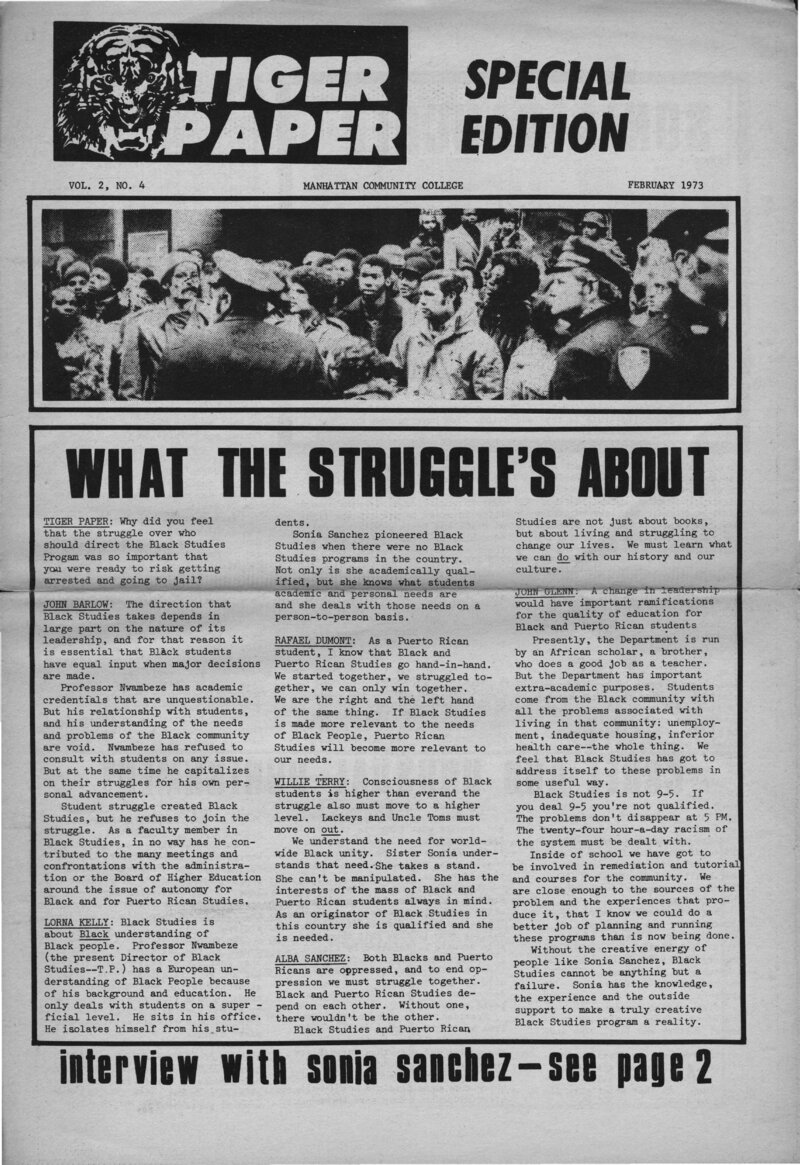
TIGER PAPER: Why did you feel
that the struggle over who
should direct the Black Studies
Progam was so important that
you were ready to risk getting
errested and going to jail? .
JOHN BARLOW: The direction that
Black Studies takes depends in
large part on the nature of its
leadership, and for that reason it
is essential that Black students
have equal input when major decisions
are made.
Professor Nwambeze has academic
credentials that are unquestionable.
But his relationship with students,
and his understanding of the needs
and problems of the Black community
are void. Nwambeze has refused to
consult with students on any issue.
But at the same time he capitalizes
on their struggles for his own per-
sonal advancement.
Student struggle created Black
Studies, but he refuses to join the
struggle. As a faculty member in
Black Studies, in no way has he con-
tributed to the many meetings and
confrontations with the administra-
tion or the Board of Higher Education
around the issue of autonomy for
Black and for Puerto Rican Studies.
LORNA KELLY: Black Studies is
about Black understanding of
Black people. Professor Nwambeze
(the present Director of Black
Studies--T.P.) has a European un-
derstanding of Black People because
of his background and education. He
only deals with students on a super -
ficial level. He sits in his office.
He isolates himself from his_stu-
MANHATTAN COMMUNITY COLLEGE
WHAT THE STRUGGLES ABOUT
dents,
Sonia Sanchez pioneered Black
Studies when there were no Black
Studies programs in the country.
Not only is she academically qual-
ified, but she knows what students _
“academic and personal needs are
and she deals with those needs on a
person-to-person basis.
RAFAEL DUMONT: As a Puerto Rican
student, I know that Black and
Puerto Rican Studies go hand-in-hand.
We started together, we struggled to-
gether, we can only win together.
We are the right and the left hand
of the same thing. If Black Studies
is made more relevant to the needs
of Black People, Puerto Rican
Studies will become more relevant to
our needs.
WILLIE TERRY: Consciousness of Black
students is higher than everand the
struggle also must move to a higher
level. Lackeys and Uncle Toms must
move on out.
We understand the need for world-
wide Black unity. Sister Sonia under-
stands that need.She takes a stand.
She can't be manipulated. She has the
interests of the mass of Black and
Puerto Rican students always in mind.
As an originator of Black Studies in
this country she is qualified and she
is needed.
ALBA SANCHEZ: Both Blacks and Puerto
Ricans are oppressed, and to end op-
pression we must struggle together.
Black and Puerto Rican Studies de-
pend on each other. Without one,
there wouldn't be the other.
Black Studies and Puerto Rican
FEBRUARY 1973
Studies are not just about books,
but about living and struggling to
change our lives. We must learn what
we can do with our history and our
culture.
~~ JOHN GLENN: A Change in-Teadership——
would have have important ramifications
for the quality of education for
Black and Puerto Rican students
Presently, the Department is run
by an African scholar, a brother,
who does a good job as a teacher.
But the Department has important
extra-academic purposes. Students
come from the Black community with
all the problems associated with
living in that community: unemploy-
ment, inadequate housing, inferior
health care--the whole thing. We
feel that Black Studies has got to
address itself to these problems in
some useful way.
Black Studies is not 9-5. If
you deal 9-5 you're not qualified.
The problems don't disappear at 5 PM,
The twenty-four hour-a-day racism of
the system must be dealt with. —
Inside of school we have got to
be involved in remediation and tutorial
and courses for the community. We
are close enough to the sources of the
problem and the experiences that pro-
duce it, that I know we could do a
better job of planning and running
these programs than is now being done.
Without the creative energy of
people like Sonia Sanchez, Black
Studies cannot be anything but a
failure. Sonia has the knowledge,
the experience and the outside
support to make a truly creative
Black Studies program a reality.
interview With sonia sanchez—Ssee page 2
PAGE TWO
Professor Sonia Sanchez:
community--this is true education.
out of darkness."
THE RECENT STRUGGLES over Black Stu-
dies at Manhattan Community College
are not over the different personal-
ities of Professor Sanchez and Prof-
fessor Nwabueze. They are not frivo-
lous power plays. They are over the
very real differences concerning the
substance and content of Black Stu-
. dies courses.
As one student said, "It seems we
have no direction in Black. Studies<=
we have courses but no direction."
That needed direction is what's
at issue. Professor Sanchez has ex-
pressed willingness to work with
Professor Nwabueze. But he has cat-
egorically refused to work with her.
As an appointee of the administra-
tion, it is his job: to keep control:
to attempt to make the courses dry
and tame, to squeeze out any real
content that would help Black peo-
ple fight for their liberation and
self-determination.
"Being responsible to the
You have to lead
Nwabueze is Draper's man. Drap-
er is Rockefeller's man. Rockefel-
ler and Nixon and others like them
want to strangle Third World commun-
ities in order to prevent the fight
of Black and Latin people for self-
determination--for control over
their own housing, health care, jobs
and education.
Sonia Sanchez is a fighter for
the self-determination of Black peo-
ple. Her ideas for the direction
of Black Studies, ideas which are
shared by many students, reflect this.
On February 22nd the Tiger Paper
interviewed Sonia Sanchez about her
vision of Black Studies and the kind
of educational direction needed.
First she discussed the events
of the last few months, and mention-
ed that President Draper told her
several weeks ago: "I'm with you
100% in your quest for the Chair of
Black Studies." (He has obviously
TIGER PAPER
changed his mind!) "But the point
is," Professor Sanchez said,"I was
not out ‘questing for the Chair’.
The students needed changes in Black
Studies and they found me."
She told Tiger Paper she believes
in a rotation system for department
chairpersons--two-year terms of of-
fice with co-chairpersons prepared
to take over. "We should all work
together--with innovative, communal-
istic leadership. None of this 'I
am the chairman!' stuff."
"This is a community college,"
Professor Sanchez continued. "Unless
you engage students in what's happen-
ing in the community--and all over
the world--you're only offering dry
intellectual courses, like any other
courses, that don't mean anything
to the community in Harlem or in all
the other Harlems in New York City.
"We have to have term papers as
part of courses. Yes. But more than
this we need projects to connect
Black intellect with the Black com-
munity. We have to be responsible
to the people in the community who
haven't been able to come to college.
._We need courses that are also mean-
ingful and helpful to them.
"In the course I teach on Black
Writing, the students write plays."
But it doesn't stop there. "TI ask
them to perform these plays in three
or four day care centers for child-
ren in Harlem.
"Performances, surveys, work in
men's and women's prisons, seminars
during the summer for students com-
ing to Manhattan Community College
for the first time, tutorial pro-
grams--we need these as part of the
syllabi for Black Studies courses ee
to help all the people who can't get
‘here.
"We have to get rid of elitism--
people have to stop being snobs,
stop thinking that college makes
them much better than other people.
"Being professors has to mean
more than professing in a classroom.
We're talking about professing out-
side the classroom!
"Being responsible to the commun-
ity--this is true education. You
have to lead out of darkness."
CRUEL AND UNUSUAL PUNISHMENT
ON FRIDAY, FEBRUARY 9, more than
two hundred Black and Puerto Rican
students and faculty went to the
office of President Draper to ex-
press their discontent over the
poor quality of the Black Studies
Program under Draper's appointee,
Chimgolu Nwabueze.
They presented a constructive
alternative: the appointment of
Sonia Sanchez, a founder of the
first Black Studies Program in the
country (San Francisco State), and
a teacher in Black Studies at MCC
who has won the confidence of
students.
After a brief exchange, the
President refused to discuss the
matter further and left. The stu-
dents and faculty remained in the
waiting room of the President's
office until Saturday afternoon
when the police were called to ar-
rest them. At that point they de-
cided to leave.
The following Tuesday students
and faculty went back to the Pres-
ident's office and asked to speak
to him again about the Black and
Puerto Rican Studies Program. He
refused to see them.
The students and faculty were
orderly and did not block any pas-
sages or obstruct access to any room.
They asked the office staff in the
waiting room if they felt uncomfort-
able or were intimidated by their
presence, The office staff assured
them that they were quite comfort-
able in the situation. The stu-
dents and faculty sat down and pre-
pared to wait.
President Draper never came out
from behind the locked door of his
office. The Administration called
the police and more than forty Black
and Puerto Rican students and fac-
ulty were arrested and taken to jail
where they were detained until well
after midnight. They were booked
on the charge of “criminal trespass"
(how can you trespass in your own
school?).
Not content with this degree of
harrassment and punishment, the fol-
lowing week the Administration sus-
pended these students from the col-
lege. Draper wants to keep the
students off campus and to bully
the rest of us into silence and in-
action.
The suspended students are now
cought in the following situation:
they must either stay out of clas-
ses and receive automatic failures,
according to the new compulsory at-
tendance rule (the only one in CUNY),
or attend classes and risk being
arrested on a second "criminal tres-
pass" charge.
An arrest and a suspension con-
stitute double jeopardy; another
arrest would mean triple jeopardy--
being punished three times for one
alleged offence. This is cruel and
unusual punishment:
TIGER PAPER
FOUR SHORT MONTHS ago, Edgar Draper
resorted to a court injunction to
head off a faculty vote of no-confi-
dence against him. The rights and
interests of the faculty meant no-
thing to him then, and they still
don't. Yet all of a sudden Draper
is casting himself as the faculty's
friend and protector, in an effort
to make teachers his shield against
demands for the appointment of Sonia
Sanchez as head of Black Studies,
and for independepnt Black and Puerto
Rican Studies departments.
In a full-page, single-space let-
ter to the faculty, written after he
had called in police to arrest 42
people, Draper never once mentions
that three of the people arrested
were faculty members--Sonia Sanchez,
John Glenn, and Jim Blake.
Three untenured Black faculty mem-
bers choose to be arrested in a strug-
gle side by side with Black and Puer-
to Rican students--and Draper writes
his letter as if it had never happen-
ed!
Why did he suppress that important
fact? Because by not mentioning it
he could pretend that the main is-
sue is "faculty integrity", instead
of the quality and independence of
Black and Puerto Rican Studies at MCC.
The one who has most consistently
attacked the interests and integrity
of the faculty on this campus is
Edgar Draper himself. He has arbi-
trarily fired faculty members, like
Edith Robbins and David Kahn. He
has refused to grant promotions re-
commended by both departmental and
college-wide personnel and budget
——-committees, as in the case of Mike
Rosenbaum in the Math department.
He gave Dean Sample Pittman early
tenure despite the unanimous recom-
“governance of the school to see if
mendation by Pittman's department
that he was incompetent and should
be let go. He has appointed chair-
men against the express wishes of
department members, as he did twice
within he last three years in the
English Department.
These outrages, and a host of
others, were fresh in faculty minds
four months ago. When the faculty
union, the Professional Staff Cong-
ress, sampled opinion about Draper's
it should call for a no-confidence
ballot, it concluded that Draper
would surely be condemned when a vote
MCG FACULTY:
PAGE THREE
are you on?
was taken. Draper only saved himself
from that humiliation by getting an
injunction against the ballot.
Is the faculty now going to unite
behind Draper against three of their
fellow faculty members and against
the interests of the Black and Puer-
to Rican students?
The three untenured faculty who
were arrested have shown their cour-
age and commitment. The Black fac-
ulty Association has also made its
choice: it voted to support the stu-
dent demands for Nwabueze's resigna-
tion and the appointment of Sonia
Sanchez, and last week sent a dele-
gation to Draper informing him of
their opposition to his policies.
We think the time has come for
the rest of us to make a choice.
The faculty can't continue to run
from pillar to post, alternately out-
raged by Draper and his administra-
tion, and fearful that students will
take away some of their limited power.
The faculty can choose to be iso-
lated in the middle. Or we can unite
with students who have shown in the
past that they can be strong allies
(in their support of Edith Robbins,
_.David Kahn, Jose Antonio Irizarry,
for example).
Only by uniting with students
around concerns we all share can we
move forward.
Sonia censored—
Who's next?
Ever since Sonia Sanchez came to Manhattan Community
College with fresh ideas and outspoken views on educa-
tion, she has been subjected to continual administrative
harrassment and attempts at intimidation.
The administration's efforts to censor, punish, and
terrorize Professor Sanchez have serious implications
for all teachers at MCC.
For example, if one teacher is told to "recall" her
syllabus--and the rest of us sit silently without a
word of protest--the administration with the help of
those department chairmen who are "yes men" will not
hesitate in the future to recall the syllabus of any
course they don't approve of, and make further inroads
against academic freedom.
The following are some of the ways in which the ad-
ministration at MCC has harrassed Professor Sanchez:
@Last year the College-Wide Committee on Personnel
and Budget attempted to fire her.
@ Professor Nwabueze refused to let her teach "The
Black Woman", a course she created, and has taught at
City College, Rutgers, and the University of Pittsberg.
® Recently Dean Pollack has been collecting a dos-
sier on her, writing to all the places where she has
worked, gathering material about her.
@On February 22nd, a policeman was stationed out-
side her classroom door.
@ An attempt has been made to interfere with the
content of the syllabus and examinations in her "Black
Writers" course this semester. One (out of four) of
her midterm questions reads:
Examine one insurrection here in this country
(Watts, Newark, Harlem, etc.). In essay form:
a) Explore causes for insurrections
b) Explain why they have'failed"
c) Discuss why it's impossible to begin and
conclude one successfully in 1973
In response to her midterm and to her syllabus, Prof-
essor Nwabueze sent the following memorandum to Profes-
sor Sanchez:
BOROUGH OF MANHATTAN COMMUNITY COLLEGE
Intradepartmental Memorandum
TO: Prof. S$. Sanchez
DATE: February 20, 1973
FROM: Prof. yabueze SUBJECT: Revising Of Syllabus
BLK 233 - Contemporary Blk Writers
This confirms our conversation of this afternoon February 20, 1973,
on the subject of deleting items 1, 2, and 3 assigned to the class as
Part of the midterm examination. It was also recommended that the
copies of the syllabus already distributed to the class be recalled
for these reasons:
1, The subject of "Insurrection" as a writing assignment
conflicts with the educational goals of the course,
a8 approved by the appropriate Committees of the College.
2. This assignment is also subject to various political
and legal interpretations.
I support your decision to clarify this issue in a memo to the Deans
of Liberal Art and Faculty.
Thank you.
ce: Dean Gourevitch
Dean Pollack
PAGE. FOUR
FOUR YEARS
THE STRUGGLE OVER Black and Puerto Rican Studies has
been going on for four years.
In the spring of 1969, after President Murray H.
Block had refused to establish any kind of program,
students occupied the "B" building and demanded that
the administration set up a department. The students
left the building when Block, backed up by a faculty
resolution, promised to go to Albany to get permission
from the state regents to create a department. In the
interim, he appointed a student-faculty committee to
coordinate an inter-departmental program of Third World
Studies.
Block was stalling when he said that he needed the
regents’ okay. Students quickly realized that the pro-
gram he established was a farce because the student-
faculty coordinating committee did not have the power
to hire teachers or supervise course content.
A year later, in May 1970, Block resigned when over
1,000 students, in a tremendous show of solidarity, oc-
cupied the college for several weeks after the admini-
stration had tried to stop their movement by closing
the school. Students, and their supporters among fac-
ulty and staff, organized around many issues--Black
and Puerto Rican Studies; a child care center; the Jack-
son and Kent State murders; the U.S. invasion of Cam-
bodia; and programs to serve the community. The admin-
istration regained control of the buildings only after
it brought in the police to arrest 54 students and two
faculty on charges that were later thrown out of court.
The new president, Edgar Draper, tried to silence
student discontent with promises, and limited autonomy
for the Black and Puerto Rican Studies Program which
for the first time had partial control over its cur-
riculum and staff. (Continued pressure, however, was
mounted against Draper so that he had to grant one of
the most important demands--a child care center.)
In the Spring of 1970 the faculty, in support of the
students, passed a resolution calling for a department
of Black and Puerto Rican Studies. Draper, like Block
before him, claimed that it was impossible because the
higher authorities had tied his hands.
The following school year (1970-71) Draper tried to
assert administrative control over the existing program
by firing the coordinator of Puerto Rican Studies,
MEMBERS OF THE TIGER PAPER collec-
OF STRUGGLE
TIGER PAPER
Migdalia de Jesus Torres de Garcia, and replacing the
coordinator of Black Studies, Onwuchekwa Jemie with
Chimgolu Nwabueze. The two coordinators he removed
were strong, independent people--like Sonia Sanchez.
At the same time, the president moved to divert stu-
dent support for the programs by postponing student
government elections for six months, cutting off funds
for the student newspaper, and in the Spring (1971)
arresting and suspending scores of students on phony
charges. As long as students were busy defending them-
selves against the administration's repressive policies
Draper had a relatively free hand to manipulate the
programs.
The students, however, regrouped, and last Spring,
when the administration fired Jose Antonio Irizarry of
the Puerto Rican Studies Program, they confronted Dra-
per with a mass show of strength and forced him to re-
verse the decision. It was an important victory, par-
ticularly after the setbacks of the previous spring,
because it showed students that they could win and pro-
vided a stepping stone upon which future victories
could be built. It led to the present struggle.
The history of the fight for Black and Puerto Rican
Studies clearly shows that no matter who is president,
the administration will turn if necessary to police
force to control the program. The real issue is not
just Black and Puerto Rican Studies, but rather who
will control the program: the administration and its
yes men or the faculty and students.
In every progressive struggle at this school, the
administration has emerged as the enemy. Every one of
these struggles is important, because if the adminis-
tration must fight on many fronts (childcare, cutbacks
in financial aid, faculty rights, etc.) its ability to
resist on any one of them is weakened. That is why we
cannot allow the administration to pit faculty against
students, race against race, or group against group.
We must support the progressive struggles of all groups.
At this particular moment, the most important of these
is the fight for truly independent departments of Black
and Puerto Rican Studies, under the leadership of
people like Sonia Sanchez who are ready to fight for
real autonomy.
landlords are enemies because they
tive attended last Friday's rally
in the "A" lounge to offer our full
support for student demands: the
establishment of autonomous Black
and Puerto Rican Studies departments
and the appointment of Sonia Sanchez
as Chairwoman of Black Studies.
However, we feel that one posi-
tion put forward at the rally does
not clearly reveal the nature of the
enemy we should all be fighting.
To isolate one group--the Jews--
as the enemy of the Blacks is to
make a muddle of who is really op-
pressing us, and to misdirect anger
into group hatred. Just as Draper
is an enemy because he is an agent
of the Board of Higher Education,so
exploit people, not because some of
them happen to be Jews. The Jews
in the educational system are enem-
ies if they line up with the BHE
and the racist policies of the sys-
tem. They are not enemies when they
support students by taking strong
anti-racist stands.
As long as people are confused
about who the biggest enemies are,
Rockefeller and all those like him
can laugh at us all the way home
from the bank.
The enemy in America is not the
Jews but the system of imperialism
which uses and abuses masses of
people to make huge profits for a
small handful.
ARE JEWS
THE ENEMY?
“ ke
by men
~
SPECIAL
Sj PAPERB DIC
VOL. 2, NO. 4
TIGER PAPER: Why did you feel
that the struggle over who
should direct the Black Studies
Progam was so important that
you were ready to risk getting
errested and going to jail? .
JOHN BARLOW: The direction that
Black Studies takes depends in
large part on the nature of its
leadership, and for that reason it
is essential that Black students
have equal input when major decisions
are made.
Professor Nwambeze has academic
credentials that are unquestionable.
But his relationship with students,
and his understanding of the needs
and problems of the Black community
are void. Nwambeze has refused to
consult with students on any issue.
But at the same time he capitalizes
on their struggles for his own per-
sonal advancement.
Student struggle created Black
Studies, but he refuses to join the
struggle. As a faculty member in
Black Studies, in no way has he con-
tributed to the many meetings and
confrontations with the administra-
tion or the Board of Higher Education
around the issue of autonomy for
Black and for Puerto Rican Studies.
LORNA KELLY: Black Studies is
about Black understanding of
Black people. Professor Nwambeze
(the present Director of Black
Studies--T.P.) has a European un-
derstanding of Black People because
of his background and education. He
only deals with students on a super -
ficial level. He sits in his office.
He isolates himself from his_stu-
MANHATTAN COMMUNITY COLLEGE
WHAT THE STRUGGLES ABOUT
dents,
Sonia Sanchez pioneered Black
Studies when there were no Black
Studies programs in the country.
Not only is she academically qual-
ified, but she knows what students _
“academic and personal needs are
and she deals with those needs on a
person-to-person basis.
RAFAEL DUMONT: As a Puerto Rican
student, I know that Black and
Puerto Rican Studies go hand-in-hand.
We started together, we struggled to-
gether, we can only win together.
We are the right and the left hand
of the same thing. If Black Studies
is made more relevant to the needs
of Black People, Puerto Rican
Studies will become more relevant to
our needs.
WILLIE TERRY: Consciousness of Black
students is higher than everand the
struggle also must move to a higher
level. Lackeys and Uncle Toms must
move on out.
We understand the need for world-
wide Black unity. Sister Sonia under-
stands that need.She takes a stand.
She can't be manipulated. She has the
interests of the mass of Black and
Puerto Rican students always in mind.
As an originator of Black Studies in
this country she is qualified and she
is needed.
ALBA SANCHEZ: Both Blacks and Puerto
Ricans are oppressed, and to end op-
pression we must struggle together.
Black and Puerto Rican Studies de-
pend on each other. Without one,
there wouldn't be the other.
Black Studies and Puerto Rican
FEBRUARY 1973
Studies are not just about books,
but about living and struggling to
change our lives. We must learn what
we can do with our history and our
culture.
~~ JOHN GLENN: A Change in-Teadership——
would have have important ramifications
for the quality of education for
Black and Puerto Rican students
Presently, the Department is run
by an African scholar, a brother,
who does a good job as a teacher.
But the Department has important
extra-academic purposes. Students
come from the Black community with
all the problems associated with
living in that community: unemploy-
ment, inadequate housing, inferior
health care--the whole thing. We
feel that Black Studies has got to
address itself to these problems in
some useful way.
Black Studies is not 9-5. If
you deal 9-5 you're not qualified.
The problems don't disappear at 5 PM,
The twenty-four hour-a-day racism of
the system must be dealt with. —
Inside of school we have got to
be involved in remediation and tutorial
and courses for the community. We
are close enough to the sources of the
problem and the experiences that pro-
duce it, that I know we could do a
better job of planning and running
these programs than is now being done.
Without the creative energy of
people like Sonia Sanchez, Black
Studies cannot be anything but a
failure. Sonia has the knowledge,
the experience and the outside
support to make a truly creative
Black Studies program a reality.
interview With sonia sanchez—Ssee page 2
PAGE TWO
Professor Sonia Sanchez:
community--this is true education.
out of darkness."
THE RECENT STRUGGLES over Black Stu-
dies at Manhattan Community College
are not over the different personal-
ities of Professor Sanchez and Prof-
fessor Nwabueze. They are not frivo-
lous power plays. They are over the
very real differences concerning the
substance and content of Black Stu-
. dies courses.
As one student said, "It seems we
have no direction in Black. Studies<=
we have courses but no direction."
That needed direction is what's
at issue. Professor Sanchez has ex-
pressed willingness to work with
Professor Nwabueze. But he has cat-
egorically refused to work with her.
As an appointee of the administra-
tion, it is his job: to keep control:
to attempt to make the courses dry
and tame, to squeeze out any real
content that would help Black peo-
ple fight for their liberation and
self-determination.
"Being responsible to the
You have to lead
Nwabueze is Draper's man. Drap-
er is Rockefeller's man. Rockefel-
ler and Nixon and others like them
want to strangle Third World commun-
ities in order to prevent the fight
of Black and Latin people for self-
determination--for control over
their own housing, health care, jobs
and education.
Sonia Sanchez is a fighter for
the self-determination of Black peo-
ple. Her ideas for the direction
of Black Studies, ideas which are
shared by many students, reflect this.
On February 22nd the Tiger Paper
interviewed Sonia Sanchez about her
vision of Black Studies and the kind
of educational direction needed.
First she discussed the events
of the last few months, and mention-
ed that President Draper told her
several weeks ago: "I'm with you
100% in your quest for the Chair of
Black Studies." (He has obviously
TIGER PAPER
changed his mind!) "But the point
is," Professor Sanchez said,"I was
not out ‘questing for the Chair’.
The students needed changes in Black
Studies and they found me."
She told Tiger Paper she believes
in a rotation system for department
chairpersons--two-year terms of of-
fice with co-chairpersons prepared
to take over. "We should all work
together--with innovative, communal-
istic leadership. None of this 'I
am the chairman!' stuff."
"This is a community college,"
Professor Sanchez continued. "Unless
you engage students in what's happen-
ing in the community--and all over
the world--you're only offering dry
intellectual courses, like any other
courses, that don't mean anything
to the community in Harlem or in all
the other Harlems in New York City.
"We have to have term papers as
part of courses. Yes. But more than
this we need projects to connect
Black intellect with the Black com-
munity. We have to be responsible
to the people in the community who
haven't been able to come to college.
._We need courses that are also mean-
ingful and helpful to them.
"In the course I teach on Black
Writing, the students write plays."
But it doesn't stop there. "TI ask
them to perform these plays in three
or four day care centers for child-
ren in Harlem.
"Performances, surveys, work in
men's and women's prisons, seminars
during the summer for students com-
ing to Manhattan Community College
for the first time, tutorial pro-
grams--we need these as part of the
syllabi for Black Studies courses ee
to help all the people who can't get
‘here.
"We have to get rid of elitism--
people have to stop being snobs,
stop thinking that college makes
them much better than other people.
"Being professors has to mean
more than professing in a classroom.
We're talking about professing out-
side the classroom!
"Being responsible to the commun-
ity--this is true education. You
have to lead out of darkness."
CRUEL AND UNUSUAL PUNISHMENT
ON FRIDAY, FEBRUARY 9, more than
two hundred Black and Puerto Rican
students and faculty went to the
office of President Draper to ex-
press their discontent over the
poor quality of the Black Studies
Program under Draper's appointee,
Chimgolu Nwabueze.
They presented a constructive
alternative: the appointment of
Sonia Sanchez, a founder of the
first Black Studies Program in the
country (San Francisco State), and
a teacher in Black Studies at MCC
who has won the confidence of
students.
After a brief exchange, the
President refused to discuss the
matter further and left. The stu-
dents and faculty remained in the
waiting room of the President's
office until Saturday afternoon
when the police were called to ar-
rest them. At that point they de-
cided to leave.
The following Tuesday students
and faculty went back to the Pres-
ident's office and asked to speak
to him again about the Black and
Puerto Rican Studies Program. He
refused to see them.
The students and faculty were
orderly and did not block any pas-
sages or obstruct access to any room.
They asked the office staff in the
waiting room if they felt uncomfort-
able or were intimidated by their
presence, The office staff assured
them that they were quite comfort-
able in the situation. The stu-
dents and faculty sat down and pre-
pared to wait.
President Draper never came out
from behind the locked door of his
office. The Administration called
the police and more than forty Black
and Puerto Rican students and fac-
ulty were arrested and taken to jail
where they were detained until well
after midnight. They were booked
on the charge of “criminal trespass"
(how can you trespass in your own
school?).
Not content with this degree of
harrassment and punishment, the fol-
lowing week the Administration sus-
pended these students from the col-
lege. Draper wants to keep the
students off campus and to bully
the rest of us into silence and in-
action.
The suspended students are now
cought in the following situation:
they must either stay out of clas-
ses and receive automatic failures,
according to the new compulsory at-
tendance rule (the only one in CUNY),
or attend classes and risk being
arrested on a second "criminal tres-
pass" charge.
An arrest and a suspension con-
stitute double jeopardy; another
arrest would mean triple jeopardy--
being punished three times for one
alleged offence. This is cruel and
unusual punishment:
TIGER PAPER
FOUR SHORT MONTHS ago, Edgar Draper
resorted to a court injunction to
head off a faculty vote of no-confi-
dence against him. The rights and
interests of the faculty meant no-
thing to him then, and they still
don't. Yet all of a sudden Draper
is casting himself as the faculty's
friend and protector, in an effort
to make teachers his shield against
demands for the appointment of Sonia
Sanchez as head of Black Studies,
and for independepnt Black and Puerto
Rican Studies departments.
In a full-page, single-space let-
ter to the faculty, written after he
had called in police to arrest 42
people, Draper never once mentions
that three of the people arrested
were faculty members--Sonia Sanchez,
John Glenn, and Jim Blake.
Three untenured Black faculty mem-
bers choose to be arrested in a strug-
gle side by side with Black and Puer-
to Rican students--and Draper writes
his letter as if it had never happen-
ed!
Why did he suppress that important
fact? Because by not mentioning it
he could pretend that the main is-
sue is "faculty integrity", instead
of the quality and independence of
Black and Puerto Rican Studies at MCC.
The one who has most consistently
attacked the interests and integrity
of the faculty on this campus is
Edgar Draper himself. He has arbi-
trarily fired faculty members, like
Edith Robbins and David Kahn. He
has refused to grant promotions re-
commended by both departmental and
college-wide personnel and budget
——-committees, as in the case of Mike
Rosenbaum in the Math department.
He gave Dean Sample Pittman early
tenure despite the unanimous recom-
“governance of the school to see if
mendation by Pittman's department
that he was incompetent and should
be let go. He has appointed chair-
men against the express wishes of
department members, as he did twice
within he last three years in the
English Department.
These outrages, and a host of
others, were fresh in faculty minds
four months ago. When the faculty
union, the Professional Staff Cong-
ress, sampled opinion about Draper's
it should call for a no-confidence
ballot, it concluded that Draper
would surely be condemned when a vote
MCG FACULTY:
PAGE THREE
are you on?
was taken. Draper only saved himself
from that humiliation by getting an
injunction against the ballot.
Is the faculty now going to unite
behind Draper against three of their
fellow faculty members and against
the interests of the Black and Puer-
to Rican students?
The three untenured faculty who
were arrested have shown their cour-
age and commitment. The Black fac-
ulty Association has also made its
choice: it voted to support the stu-
dent demands for Nwabueze's resigna-
tion and the appointment of Sonia
Sanchez, and last week sent a dele-
gation to Draper informing him of
their opposition to his policies.
We think the time has come for
the rest of us to make a choice.
The faculty can't continue to run
from pillar to post, alternately out-
raged by Draper and his administra-
tion, and fearful that students will
take away some of their limited power.
The faculty can choose to be iso-
lated in the middle. Or we can unite
with students who have shown in the
past that they can be strong allies
(in their support of Edith Robbins,
_.David Kahn, Jose Antonio Irizarry,
for example).
Only by uniting with students
around concerns we all share can we
move forward.
Sonia censored—
Who's next?
Ever since Sonia Sanchez came to Manhattan Community
College with fresh ideas and outspoken views on educa-
tion, she has been subjected to continual administrative
harrassment and attempts at intimidation.
The administration's efforts to censor, punish, and
terrorize Professor Sanchez have serious implications
for all teachers at MCC.
For example, if one teacher is told to "recall" her
syllabus--and the rest of us sit silently without a
word of protest--the administration with the help of
those department chairmen who are "yes men" will not
hesitate in the future to recall the syllabus of any
course they don't approve of, and make further inroads
against academic freedom.
The following are some of the ways in which the ad-
ministration at MCC has harrassed Professor Sanchez:
@Last year the College-Wide Committee on Personnel
and Budget attempted to fire her.
@ Professor Nwabueze refused to let her teach "The
Black Woman", a course she created, and has taught at
City College, Rutgers, and the University of Pittsberg.
® Recently Dean Pollack has been collecting a dos-
sier on her, writing to all the places where she has
worked, gathering material about her.
@On February 22nd, a policeman was stationed out-
side her classroom door.
@ An attempt has been made to interfere with the
content of the syllabus and examinations in her "Black
Writers" course this semester. One (out of four) of
her midterm questions reads:
Examine one insurrection here in this country
(Watts, Newark, Harlem, etc.). In essay form:
a) Explore causes for insurrections
b) Explain why they have'failed"
c) Discuss why it's impossible to begin and
conclude one successfully in 1973
In response to her midterm and to her syllabus, Prof-
essor Nwabueze sent the following memorandum to Profes-
sor Sanchez:
BOROUGH OF MANHATTAN COMMUNITY COLLEGE
Intradepartmental Memorandum
TO: Prof. S$. Sanchez
DATE: February 20, 1973
FROM: Prof. yabueze SUBJECT: Revising Of Syllabus
BLK 233 - Contemporary Blk Writers
This confirms our conversation of this afternoon February 20, 1973,
on the subject of deleting items 1, 2, and 3 assigned to the class as
Part of the midterm examination. It was also recommended that the
copies of the syllabus already distributed to the class be recalled
for these reasons:
1, The subject of "Insurrection" as a writing assignment
conflicts with the educational goals of the course,
a8 approved by the appropriate Committees of the College.
2. This assignment is also subject to various political
and legal interpretations.
I support your decision to clarify this issue in a memo to the Deans
of Liberal Art and Faculty.
Thank you.
ce: Dean Gourevitch
Dean Pollack
PAGE. FOUR
FOUR YEARS
THE STRUGGLE OVER Black and Puerto Rican Studies has
been going on for four years.
In the spring of 1969, after President Murray H.
Block had refused to establish any kind of program,
students occupied the "B" building and demanded that
the administration set up a department. The students
left the building when Block, backed up by a faculty
resolution, promised to go to Albany to get permission
from the state regents to create a department. In the
interim, he appointed a student-faculty committee to
coordinate an inter-departmental program of Third World
Studies.
Block was stalling when he said that he needed the
regents’ okay. Students quickly realized that the pro-
gram he established was a farce because the student-
faculty coordinating committee did not have the power
to hire teachers or supervise course content.
A year later, in May 1970, Block resigned when over
1,000 students, in a tremendous show of solidarity, oc-
cupied the college for several weeks after the admini-
stration had tried to stop their movement by closing
the school. Students, and their supporters among fac-
ulty and staff, organized around many issues--Black
and Puerto Rican Studies; a child care center; the Jack-
son and Kent State murders; the U.S. invasion of Cam-
bodia; and programs to serve the community. The admin-
istration regained control of the buildings only after
it brought in the police to arrest 54 students and two
faculty on charges that were later thrown out of court.
The new president, Edgar Draper, tried to silence
student discontent with promises, and limited autonomy
for the Black and Puerto Rican Studies Program which
for the first time had partial control over its cur-
riculum and staff. (Continued pressure, however, was
mounted against Draper so that he had to grant one of
the most important demands--a child care center.)
In the Spring of 1970 the faculty, in support of the
students, passed a resolution calling for a department
of Black and Puerto Rican Studies. Draper, like Block
before him, claimed that it was impossible because the
higher authorities had tied his hands.
The following school year (1970-71) Draper tried to
assert administrative control over the existing program
by firing the coordinator of Puerto Rican Studies,
MEMBERS OF THE TIGER PAPER collec-
OF STRUGGLE
TIGER PAPER
Migdalia de Jesus Torres de Garcia, and replacing the
coordinator of Black Studies, Onwuchekwa Jemie with
Chimgolu Nwabueze. The two coordinators he removed
were strong, independent people--like Sonia Sanchez.
At the same time, the president moved to divert stu-
dent support for the programs by postponing student
government elections for six months, cutting off funds
for the student newspaper, and in the Spring (1971)
arresting and suspending scores of students on phony
charges. As long as students were busy defending them-
selves against the administration's repressive policies
Draper had a relatively free hand to manipulate the
programs.
The students, however, regrouped, and last Spring,
when the administration fired Jose Antonio Irizarry of
the Puerto Rican Studies Program, they confronted Dra-
per with a mass show of strength and forced him to re-
verse the decision. It was an important victory, par-
ticularly after the setbacks of the previous spring,
because it showed students that they could win and pro-
vided a stepping stone upon which future victories
could be built. It led to the present struggle.
The history of the fight for Black and Puerto Rican
Studies clearly shows that no matter who is president,
the administration will turn if necessary to police
force to control the program. The real issue is not
just Black and Puerto Rican Studies, but rather who
will control the program: the administration and its
yes men or the faculty and students.
In every progressive struggle at this school, the
administration has emerged as the enemy. Every one of
these struggles is important, because if the adminis-
tration must fight on many fronts (childcare, cutbacks
in financial aid, faculty rights, etc.) its ability to
resist on any one of them is weakened. That is why we
cannot allow the administration to pit faculty against
students, race against race, or group against group.
We must support the progressive struggles of all groups.
At this particular moment, the most important of these
is the fight for truly independent departments of Black
and Puerto Rican Studies, under the leadership of
people like Sonia Sanchez who are ready to fight for
real autonomy.
landlords are enemies because they
tive attended last Friday's rally
in the "A" lounge to offer our full
support for student demands: the
establishment of autonomous Black
and Puerto Rican Studies departments
and the appointment of Sonia Sanchez
as Chairwoman of Black Studies.
However, we feel that one posi-
tion put forward at the rally does
not clearly reveal the nature of the
enemy we should all be fighting.
To isolate one group--the Jews--
as the enemy of the Blacks is to
make a muddle of who is really op-
pressing us, and to misdirect anger
into group hatred. Just as Draper
is an enemy because he is an agent
of the Board of Higher Education,so
exploit people, not because some of
them happen to be Jews. The Jews
in the educational system are enem-
ies if they line up with the BHE
and the racist policies of the sys-
tem. They are not enemies when they
support students by taking strong
anti-racist stands.
As long as people are confused
about who the biggest enemies are,
Rockefeller and all those like him
can laugh at us all the way home
from the bank.
The enemy in America is not the
Jews but the system of imperialism
which uses and abuses masses of
people to make huge profits for a
small handful.
ARE JEWS
THE ENEMY?
Title
Tiger Paper, February 1973
Description
This special issue of the Tiger Paper addresses the ongoing "struggle" over control of the Black Studies program at BMCC. The paper's editors, along with a group of radical students, supported the poet and educator Sonia Sanchez for the role of department chair. Sanchez, who is also interviewed in this issue, sought to implement an expansive vision for Black Studies at the college, one that would transcend the typical goals of academic departments.The Tiger Paper, which billed itself as "Manhattan Community College's only underground newspaper," was published between 1971 and 1974 by a group of radical faculty members at BMCC. The paper, whose name was a play on the quip of Mao Tse-tung that "U.S. imperialism is a paper tiger," addressed struggles both internal and external to the college while emphasizing the connections between them.
Creator
Tiger Paper Collective
Date
February 1973
Language
English
Publisher
Tiger Paper Collective
Rights
Creative Commons CDHA
Source
Friedheim, Bill
Original Format
Newspaper / Magazine / Journal
Tiger Paper Collective. Letter. “Tiger Paper, February 1973.”, CUNY DIGITAL HISTORY ARCHIVE, accessed September 5, 2026, https://stephenz.tailc22a4b.ts.net/s/cdha/item/242