Tiger Paper, March 1974
Item
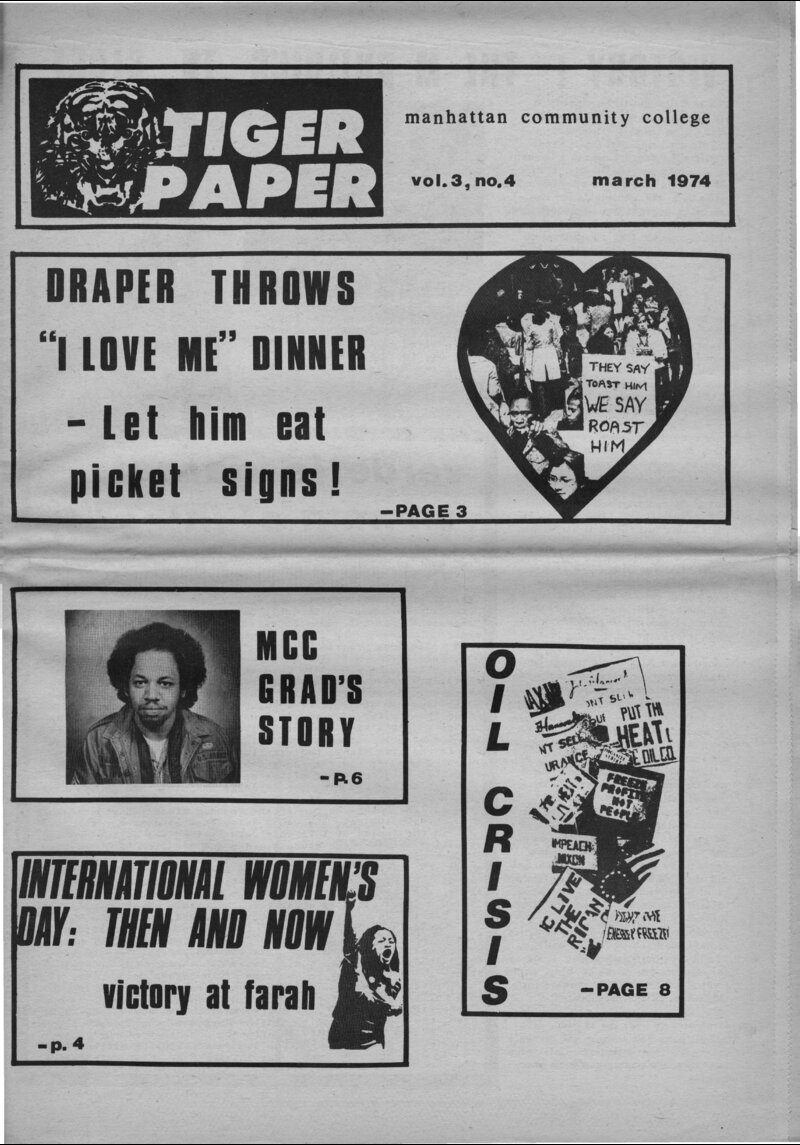
manhattan community college
vol.3,no,4 march 1974
DRAPER THROWS
“TL LOVE ME” DINNER
-Let him eat |
picket Signs!
victory at farah 3
if
PAGE 2
The M Building will be closed, It
will not be used for MCC classes
after the end of this semester.
This announcement from Presi-
dent Draper's office marks a tremen-
dous victory for the faculty, staff,
and students who waged a continuous
battle with the administration last
semester over M Building conditions,
It is obvious to all concerned that
without backing the administration
against the wall as they did, M Buil-
ding occupants could have changed
nothing.
The M Bldg. had been used by
MCC for over 3 years. Then last
semester the new Dept. of Devel-
opmental Skills (ESL & Reading)
was moved into it, Their reaction
to the terrible teaching conditions
in the M Bldg, led to a building-
wide faculty action.
The faculty stated that it was im-
possible for students to receive a
decent education in a building with
slow and often out-of-order eleva-
tors, poor sanitary conditions, bad
lighting, no ventilation, sometimes
no heat or too much heat, and many
other inadequate and unsafe condi-
tions. Students joined the action
and put over 1,000 names on a peti-
tion, and a building-wide strike was
threatened,
The administration now seems
to be hastily making some necessary
improvements in the building: a
fire alarm system was installed
(although it still does not work on
the upper floors); the roof was re~-
done to prevent the flooding that
occured last semester; and building
coordinator Rick Davis makes con-
stant checks to determine tempera-
ture levels on different floors.
But the major achievement is that
the building will be vacated, because
no amount of "improvements" could
ever make the M Bldg. a good place
for learning,
Now the question comes: Where
will the programs, especially Develop
mental Skills, be moved to? Will
Developmental Skills, on which the
entire college career of many Open
Admissions students depends, be gi-
ven appropriate facilities? Is the
decision by the administration to get
rid of the M Bldg.,in fact, a commit-
ment to providing a good education
to MCC students? Or will this move
just make it even more difficult for
Developmental Skills to function, i.e.
simply another way for the college
administration to. show what it showed
through its use of the M Bldg. in the
_ first place—its lack of concern for
Open Admissions students,
Students and faculty who won this
first victory over the M Bldg. must
not sit down and assume the struggle
is over, This college administration
puts up a new obstacle around every
corner,
VIGTORY | THE M BUILDING 10 CLOSE
Ay
SRA DPR PEA EP EPL IER RI II IIS LIER IE ETE II IER NG EY OTE
TIGER PAPER
(Top) The administration buys
itself fancy office space and
furniture, (Left) Students and
faculty face scenes like this
at every turn in the tty" bide.
verdelle garnett
woman of integrity
, Faculty and students are deeply saddened by the death o
Professor Verdelle Garnett, a counselor in the Student J a
Department, Because she refused to give in t9 her illness,
many of us did not know how sick she was--but this courage was
typical of Verdelle during her entire career at Manhattan
Community College, We remember her integrity when faced with
harassment from the administration, We remember how firmly she
stood up for what she believed: the necessity of a genuine
open admissions program,
Verdelle Garnett not only fought for open admissions in the
first place, she fought to keep it and to make it work, She
steadily opposed the administrators who tried to cut down on
services and cut back faculty lines, At the beginning of open
admissions--in November of 1970--when the M,C.C, administration
fired Irma Leifer, Jerry Solk, and Mel Daus, Verdelle wrote in
protest: "At a time when sensitive and experienced counselors
are desperately needed . ,. . it is especially distressing that
people who have always had excellent rapport and success with
our students are the very ones subject to dismissal," ( Asa
result of this and other protests, Prof; Daus was rehired, )
Her colleagues remember Verdelle stopping them in the hall
after time to ask if they were making sure their students
getting enough help, If she found a student having trouble
certain subject, she would tutor that student herself,
In the spring of 1971 when Dean Pittman was on the rampage,
arresting’ at least one student a day and creating havoc in the
Student Life Departmont, Professor Garnett grabbed the micro-
phone at a meeting of 1000 students and strongly denounced him,
Secause of this, and all the other times she took a courageous
stand, she was harassed, transferred to another office, and
denied a promotion year after year, S3ut this never stopped her
from getting up and saying what she believed,
Verdelle Garnett was one of the most nopular and respected
faculty members at H,.C.C, Tiger Paper talked to some of her
co , Uncompromising, is what they said: "Independent,"
Jourarzeous, Yerdelle could always cut throuczh the befocging
elements and set rictht to the core of an issue,"
Professor tarnett was one of the first faculty members at
this colleze to join the teacters' union, the UFCT, and ras one
of the first officers, She served on the Onen Admissions Task
Force, the Faculty Council, and the Personnel and Budeet Con-
mittee of the Student Life Denartment, She chaired the faculty's
ommittee on Committees and the Student Affairs Committee,
Ve miss her very much, Her integrity is an examnle for
us all,
TIGER PAPER
BANQUET FOR
DRAPER -- BUT
NO BREAD
FOR STUDENTS
On Friday, March 29th, at the
Americana Hotel, the Administration
of BMCC is planning to hold a $20-
a-plate testimonial dinner for Pre-
sident Draper. The Administration
is organizing the dinner at the urg-
ing of the President to try to make
him look good before the Board of
Higher Education and other City big-
shots. They want to make it look as
if he has the confidence of the stu-
dents, the faculty, and the staff at
BMCC. The question is: does he de-
serve to win what the Administration
has set up as a vote of confidence?
There is clearly no outpouring
of sentiment to honor the President.
One group of students (Students to
Fight Cutbacks) is planning to pick-
et the dinner to protest cuts in
financial aid and other attacks on
Open Admissions. At the recent well-
attended faculty union meeting, there
was an overwhelming vote calling for
a boycott of the dinner, and to look
into the possibility of a faculty
picket line. And, as one secretary
put it, "What has he ever done for
us?”
A QUICK LOOK AT THE RECORD SHOWS
WHY THERE IS NO SUPPORT FOR THE TEST.I-
MONIAL DINNER.
Students, staff, and faculty
cohtinue to be housed in the now
famous M Building, which for years
has been condemned in many reports
to President Draper as physically
unsafe as well as educationally un-
sound. Because he has been pushed
hard this year by strong protest
actions by those forced to use the
building, Draper now says he will
close it next year. But he took no
initiative all those years in spite
of his knowledge of the intolerable
conditions there.
Last Spring, Draper's Adminis-
tration conducted a behind-the-scenes
campaign to get rid of the duly elec-
ted student government, the Third
World Coalition. The TWC had mobil-
ized large groups of students and
won important victories for all of
us, like the beginning of the Child
Care Center (which Draper never sup-
fj
ported), and the beginning of the
Black and Puerto Rican Studies Pro-
gram.
Three years ago Draper brought
in Sample Pittman to be the Adminis-
tration's policeman. Many students
and faculty have been arrested (the
cases were usually thrown out of
court) and harrassed in other ways.
Draper has done nothing to
fight the serious cutbacks in finan-
cial aid for our students, These
cutbacks are slowly but surely driv-
ing third world and white working
class students out of BMCC. (This
does not upset the Administration
at all.)
Last Spring students and faculty
approved a new governance plan for
the College. Draper did not present
the plan as approved to the BHE, but
rewrote it first. And even so, there
has been no action on his "substitute
PAGE 3
proposal".
Under Draper's administration
part-time teachers have often been
fired at the last minute, and re-
hired only when strong student and
faculty actions have made it clear
that we would not accept the crowding :
and cancelling of classes that would
result.
Draper cooperated enthusiastical-
ly with the BHE's two major attempts
to impose tenure quotas on the
faculty.
Last Winter, Draper stopped a
probable vote of no confidence in
him by getting a court order (on a
technicality) to stop the Honest
Ballot Association from opening the
ballots.
The Tiger Paper urges every one
in the BMCC community to support the
faculty boycott-of the testimonial
dinner, and to join the student
picket line on March 29th.
COMMENTS ON DINNER
TIGER PAPER ASKED a number of stu-
dents, staff and faculty what they
thought about the president's test-
imonial dinner.
STUDENTS
(Some students said that they did
not know who President Draper was.
Others said that they did "not care
one way or the other." Many op-
posed the dinner; no students we
talked to supported it.)
He must be joking. He hasn't done
anything to deserve a testimonial
dinner. He's done more to cause an-
ger than happiness among the stud-
ents. What makes him think that
students will go.
Where I am I going to get twenty
bucks to go to his dinner. Any-
way, what's he done for us? What's
he done about the "M" building?
Wow!
I'm trying to get some finan-
cial aid and he wants $20 for a din-
er. If I had the money, no way I'd
spend it on that.
Yeah, I'll go if he accepts food
stamps.
A SECRETARY
He doesn't even know that the secre-
taries are alive. He's not inter-
ested in our welfare. We are just
cogs in the wheel.
FACULTY
He wants a vote of confidence from
the faculty. That's what the din-
ner is all about. On the basis of
his record, he doesn't merit it.
It's an attempt to shakedown the
faculty. To be honest I'm scared.
I'm going not because I want to,
but because if I don't, I might not
get tenure or a promotion.
PAGE 4
‘emonstration against inflation.
INTERNATIONAL WOMEN’S DAY
International Women’s Day, March 8, builds support in this country for the struggles of women in
the U.S. and the worldwide struggle of women against all oppression—as illustrated in the pictures
above. Left—Palestinian women take up arms, join struggle against Zionism and imperialism; Center—
Farah strikers in the southwest; Top right—-women demonstrate for equality; Lower right—.
VICTORY at FARAH
WOMEN FIGHT ang WIN
ON INTERNATIONAL WOMEN'S DAY,
March 8th, people around the world
commemorate the struggles of women
against all exploitation and op-
pression, and their participation
in the great revolutionary movements,
past and present.
This year, we have a special rea-
son to celebrate: a new page in
American labor history has been
written by the victorious struggle
of the Farah workers in the South-
west, 95% of whom are Mexican-Ameri-
can, 85% women.
Working-class women have been
responsible for some of the finest
hours in American labor history.
Their long tradition of militancy
is clearly reflected in the great
Farah victory where the 4,000 strik-
ing workers have won their 2-year
fight for a union, a decent wage,
and their basic democratic rights
as Mexican-Americans and as women.
Perhaps most important, the victory
at Farah will spark the unionization
of all workers in the South and
Southwest. This will stamp out
"runaway" shops and raise the wage
level of all American workers, espe-
cially in the garment industry! No
longer will bosses be able to black-
mail their workers into accepting
low wages by saying they will run
away to a cheap labor source in the
south.
The women at Farah carry on the
tradition begun by the 102 women cot-
ton workers who walked off the job~
with their male co-workers in Paw-
tucket, Rhode Island in 1824. This
is the earliest known strike of women
factory workers; the years following,
up to and including the present, are
filled with bloody strikes and cour-
ageous organizing efforts.
Sometimes women have led the way.
The women in the Weaver's Union in
Fall River, Mass., for example, trus-
ted themselves more than the male
members of the union. In 1873 the
men voted to accept a 10 percent
wage cut; but the women held their
own meeting and voted to strike. The
men then followed their lead and vic-
tory came after three months of bit-
ter struggle against factory owners.
Between 1895 and 1905. working women
took part in over 1200 strikes. The
real turning point in their organiz-
ing, however, did not come until
March 8th, 1908, with the "Uprising
of Twenty Thousand''--the struggle
which spurred an international soc-
ialist congress in 1910 to declare
March 8th around the world as Inter-
national Women's Day.
The shirt-waist makers of two New
York shops had been on strike for a
month when a mass meeting of women
garment workers was called. As-the
meeting began to degenerate into
speech-making, a teen-aged girl named
Clara Lemlich, who had already had
several ribs broken by police attacks
on the picket lines, stood up and
said:
I am a working girl and one
of those who are on strike
against intolerable condi-
tions. I am tired of listen-
ing to speakers who talk in
Lolita Lebron
TIGER PAPER
general terms. What we are
here for is to decide whether
or not we shall strike. I
offer a resolution that a
general strike be declared--
now!
Between 20 and 30 thousand women
went out the next day. This was a
fierce blow to the city's bosses, and
a potent answer to the threadbare ar-
guments about women's innate weak-
ness. The women held out through
three bitter winter months and many
arrests,
Today, even with a growing under-
standing of women as fighters in rev-
olutionary struggles on every conti-
nent in the world, too many women and
men still cling to the idea that wo-
men are weak, and dumb, and cannot or
should not be militant freedom fight-
ers.
Like racism, these myths divide us
and weaken all of our struggles in
the work places, in schools or in
other growing anti-imperialist move-
ments in the U.S.
When we grasp the truth of our his-
tory which is systematically hidden
from us, we will join together in a
unity of men and women, student and
worker, Black, brown, Asian and
white--a unity which will finally de-
feat all forms of exploitation and
oppression.
TIGER PAPER
BLACK WOMEN - HEROINES
OF AMERICAN HISTORY
While white women workers were
beginning to organize to free them-
selves from being factory slaves,
Black women and men were fighting
back against their own slavery.
Born a slave, Harriett Tubman
was eleven years old when the 1831
Nat Turner rebellion inspired so
much struggle for freedom. A few
years later she herself -helped a
slave escape to the North--the
first of over 300 slaves she help-
ed to free.
Her people came to call her
"Moses" because she led them to
freedom on the underground rail-
road, through swamps and forests,
to the North. Armed with a revol-
ver she defended her passengers
and never lost one of them. To
the slavemasters, "Moses" was a
crafty, dangerous man who was mak-
ing off with thousands of dollars'
worth of human "property." They
offered $40,000 for "his" capture.
Sojourner Truth was another ex-
slave who spent most of her life wor-
king for an end to slavery. She tra-
velled across the country speaking at
Abolitionist meetings, and she also
supported the movement to get voting
rights for women.
At one women's rights meeting af-
ter a male minister had preached
about the superiority of men, Sojour-
ner, got up and gave this unforget-
table response:
PAGE 5
Victory Celebration at MCC
MCC will join the world-wide cele-
bration of International Women's
Day and the victory of the Farah
workers with a program on Women
in Revolution Around the World.
The program, sponsored by the At-
tica Brigade, will have films,
slide shows, and speakers on wo-
men in revolutionary struggles in
Africa, Asia, Latin America, the
Mideast and the U.S.
JOIN US: Wed., March 6th
12-3 p.m.
"B'' Lounge
"That man over there say that a woman
needs to be helped into carriages,
and lifted over ditches, and to
have the best place everywhere.
Nobody ever helped me into carriages,
or over mud puddles, or gives me
a best place...
And ain't I a woman? Look at me.
Look at my arm! I have plowed
and planted and gathered into
barns, and no man could
head me...
And ain't I a-woman! I could work
as much and eat as much as a man
when I could get it, and bear the
lash as well...
And ain't I a woman? I have borned
thirteen children and seen
them most all sold off into slavery.
And when I cried out with a mother's
grief, none but Jesus heard...
And ain't I a woman?"
Sojurner Truth: Speech before the
Women's Rights Convention at Akron,
Ohio in 1851.
_
Ex-slave with a long memory, Alabama,
PAGE 6
A LOT OF US wonder what happens to
MCC students after they graduate,
and what effect MCC had on their
lives.
Mark LaFontaine, a Vietnam vet,
entered MCC before Open Admissions
started, and graduated in 1971. In
June 1973 he got his B.A. from Grin-
nell College, a small (1200 students)
liberal-arts school in Iowa.
Born in Haiti, educated in Jamaica,
Mark came to the U.S. in 1964, aged
21. "I had no special plans," he
told us, "I wanted just any kind of
job." Drafted that same year, he de-
cided to enlist in the paratroopers,
and thus became one of the 6-7 mil-
lion men who served in Indochina in
1964-72. Five months after he arriv-
ed in Vietnam, he lost an arm. As a
wounded veteran, he found new doors
opened to him; unable before to get
into college or to afford to go to
one, now suddenly the path was clear-
ed.
TIGER: Did your experience in the
army, before you came to MCC, change
you in any way?
ML: No. While I was in, I believed
in all that garbage. In the service
everything is simplistic. You eich
good and evil, right and wrong,
diddle-diddle-straight-up-the-middle,
red, white and blue forever, God and
country, that whole shebang. It was-
n't that I was into the idea of de-
fending freedom and democracy, no;
“it was more like I thought I was a
soldier, and that it was a profes-
sion, and you stick together, play
the game and all that.
TIGER: While you were in the army did
you ever question what the U.S. was
doing in Vietnam?
ML: No, that was not my business,
my business was to have a good time
and do my job. Even after I was
wounded, when I was in the hospital,
I didn't question. The army rein-
forced that. They'd come around in
the hospital and tell us about the
"hippies," the anti-war people, and
say "they do this, they believe
that." It used to bother me to hear
about the protesters. I had friends
who died in Vietnam, guys as close
as a brother to me, and I didn't want
to believe they died for nothing.
TIGER: But by the time we met you
at school in 1970, you thought dif-
ferently about Vietnam. Do you re-
member that Vietnam Vets Speakout
Against the War? You were the
strongest speaker there, not only
about Vietnam, but about U.S. imper-
ialism generally. What changed your
thinking?
ML: It was being at MCC. I started
reading and finding out about things.
I took courses in history and polit-
ical science and African studies,
then I started to branch out from
there, or to go deeper. And I be-
gan to talk to people who’had all
different kinds of views.
Ninety-nine percent of what you
learn in the classroom or from books
CC GRAD: “IT W
TIGER PAPER
EDUCATION IN
VIETNAM
is just pure garbage. It's that
other one percent that counts. You
have to learn to discriminate and
get that one percent. At MCC there
are students and professors who help
you to see that one percent. You
can really get something out of MCC,
more than you will ever get at a
place like Grinnell. At Grinnell,
‘you learn to do 30«page papers on
what is considered a high intellect-
ual level, but they don't have any-
thing to do with reality.
One of the big things that made
me understand what was going on was
realizing that, there I was, the
same person I'd been in '64 when I
went into the army, only at that
time it was impossible for me to get
into a school. Then all of a sudden,
because I'd been hurt and so forth,
the world is open to me, they'll pay
for me to go to school, and I can go
on to Grinnell, which is called one
of the top schools, whereas before I
couldn't.
It hit me that I was supposed to
serve as a sort of example to people,
to be a showpiece, so people would
say, "Look, they really took care of
him." Guys who were maybe thinking
of going the same route I did, into
the army, etc., would see me as a
positive example. But I began to
feel that people shouldn't have to
Pay an extra price like I did to get
an education.
Another thing that speeded up the
change process was that when I came
to MCC, a lot of students were sear-
ching for change too, and there was
a lot of protest going on--for exam-
ple, over the threat of tuition (you
know, that threat is always there),
and they also wanted more Black fac-
ulty, and to open the school to more
people--what we now call Open Admis-
sions. They wanted to make the
school more accessible to folks in
the community.
Well, we got Open Admissions.
Student protest brought it about.
But, see, we also got took. The peo-
ple who run things had to open up
the schools somehow, to make people
believe in the system. Folks were
getting restless, and Open Admissions
was supposed to cool them down, pull
them off the streets. But once they
were in school, there wasn't enough
money provided to help them make up
for the lack of preparation, the mis-
education, in the NYC school system.
There were a few remedial programs,
but not enough. No, we got took,
and we got Draper.
TIGER: President Draper? What's
Draper's special role in all this?
ML: Oh, he's just a good fellow,
just a good old fellow. He smiles
a lot. His job is exactly what he's
doing--nothing. But I don't really
want to talk about him. There's
another angle on Open Admissions we
should look at. MCC is like a hold-
ing pen. If you don't have the Black
and Puerto Rican students there, what
are you going to do with them? There
are no jobs out there to put the 10
million college kids into. It's like
a holding pen that's set up in the
hope the economy will catch up.
TIGER: Do you think the economy will
catch up?
ML: No. Because it's not the kind of
system that can catch up. It's like
a sponge that can hold but so much
water. Or, it's like a pyramid. A
pyramid must have a base, and the
base is us. The ones at the top are
on our backs.
TIGER: Who are "the ones at the top"?
ML: You know. The ones who rule
America, and their counterparts in
TIGER PAPER
'S AN
‘ALITY”
other countries. Call them the int-
ernational capitalists. They have
no allegiance to any nation, They
live off our labor, exploit us,
try to control.our lives* and how we
think, Their game is to keep things
as they are, because they don't have
to sweat, they don't have to toil.
TIGER: So that's some of what you
learned through reading and talking
to people at MCC, Was there any
other way you changed?
ML: Well, after a while I became
convinced that if I wanted to get
something from the school, I should
put something into it. I saw that
we should be helping to make a lot
of decisions that affect how the
school is run, instead of having
them made for us, There should be
student input into everything from
AT MCC
and the administration's basic thing
is to keep the situation as it is;
for the administration, if everybody
is cool, there's no problem. And
as long as everybody just comes in
off the A train or the D train and
just goes to class and then goes
home, nothing will ever happen.
People have to make up their minds
about what they want out of life.
But first of all, you have to under-
stand the world you live in, and who
you are, Find out where you fit in-
to the schemes of the people who run
things; find out what plans they have
for you. Once you do that, if you
decide to go along, fine. But you
should at least demand things from
MCC that will help you toward your
goal, toward a job, for instance.
As it stands, people are more or
less programmed for servitude. But
if you see through that and decide
you don't want to be a happy slave,
well, then, by that same process,
you'll learn what part you want to
play in bringing about basic change.
I myself intend to go to Africa,
That's where I want to work toward
building something. My wife and I
feel this is not our country, never
was and never will be.
curriculum to the budget to the day-
to-day running of the school, be-
cause after all we are the people
being affected, And I mean input
from all students, not just a few
chosen by the administration,
TIGER: Is that likely to happen?
ML: Not as long as students sit on
their butts and think all they have
to do is attend classes.
TIGER: Do you think the administra-
tion wants the students to be in on
things?
ML: No, because people want change,
¢
TIGER: Because you're Black, you
mean,
ML: That's it. I'm not suggesting
that every Black man, woman and
child feels like we do and should
get up Monday morning and say, "Well,
let's go on home to Africa.” It's
fust that that's the only way I per-
sonally can grow and have the peace
of mind that will enable me to grow,
TIGER: Where in Africa? Most of
the countries in Africa are what
you could call neo-colonized, for
instance Kenya, or Zaire, or Ghana
now, or Uganda, They've got their
PAGE 7
legal independence but they're con-
trolled by the very same people you
described before, the international
capitalists who exploit other peop-
le's labor.
ML: Right. They've got the symbols
of independence, a flag and so forth,
but they have overseer-type govern-
ments, overseers for that faceless
bunch at the top. The places in
Africa that attract me are, ‘say, Gui-
nea and Tanzania, because they're
socialist countries. They're a step
or two ahead, they're in the self-
determination phase.
TIGER: What would you say to stud-
ents who see their future here in
the U.S.?
ML: Keep on struggling for change,
the best you know how. But always
look back, so you don't lose sight
of what you are, That's the trouble
with the so-called intellectuals
and the ones who are making it--
they forget where they came from,
what's behind them,
I myself wouldn't feel like I had
done anything worthwhile if I man-
aged to reach the heights, and my
brother--meaning the guy like me--
could not move there with me, And
within this system that's imposs-
ible, TI have to be concerned, with
how the kid next door is doing, how
he's living, because the only way
I can take care of my own kid is if
I'm also concerned about the kid
next door. But this system here
teaches you to step on the guy. 4...
next door, step on the guy who's
working beside you, try and cut
down the student who might get one
of those five A's to be handed out
in this or that class,
You have to ask yourself, what's
the design behind me having to com-
pete with somebody else, or cut him >
down, instead of both of us trying
to help each other get as much as
we can, at nobody else's expense?
You have to understand the role of
competition, who really benefits
from it. It's not us, It's the
people who run the system we're liv-
ing under,
These are some of the things my
eyes got opened to after I came to
MCC, It was an education about
reality.
kkk kkk KK KEK
Mark LaFontaine has been back in NY
since he graduated from Grinnell in
June, Like several hundred thousand
other Vietnam vets, and like six per-
cent of the total labor force, Mark
is unemployed--actively seeking a
job but unable to find one, (Those
who have given up trying to find
work are not counted among the job-
less. So the actual unemployment
rates are much higher than the of-
ficial ones.)
This is discouraging news for
students at MCC who are struggling
to make it through college. But
having illusions about the system
doesn't help anybody except the
ones at the top.
If the system doesn't function
well enough to enable its people to
survive, what's got to go--the peop-
le or the system???
PAGE 8
Energy crisis:
MOST AMERICANS UNDERSTAND what's be-
hind the energy crisis.
"Profit, pure and simple." -
That's how one MCC student put it.
She continued: "It's the same old
story. These guys rob us blind.
First the oil and gas guys hit us.
Then the landlord wants his cut--
more rent because his heat bills
have gone up. The bastard. He
didn't give us any heat last year,
and it's the same no heat this year.
So what's he complaining about?
Then Con Ed wants more money from us
because they're losing money with
everybody saving energy. They got
us coming and going."
She's right. Profit is at the
heart of the energy crisis. Reduc-
ed to its simplest elements, the en-
ergy story goes something like this:
Finding it more and more difficult
to turn superprofits overseas, the
oil companies are now trying to make
up their losses at the expense of
American workers, consumers and tax-
payers. They are using the energy
crisis to (1) cut out what little
competition still threatens their
monopoly control, and (2) get their
most important ally, the government,
to work harder for them. Let's see
how this works.
Under capitalism, profit rather
then need determines what is prod-
uced. So it is profit that determin-
WHAT FOLLOWS IS a statement that
was made by Major General Smedly D.
Butler of the United States Marine
Corps. It makes clear the relat-
ionship between the government, the
military and corporate interests
like the oil companies.
There isn't a trick in the racket-
eering bag that the military gang
is blind to....
It may seem odd for me, a mil-
itary man, to adopt such a compari-
son. Truthfulness compels me to do
so. I spent thirty-three years and
four months in active military ser-
vice... And during that period I
spent most of my time being a high
class muscle man for Big Business,
for Wall Street and for the bankers.
In short I was a racketeer, a gang-
ster for capitalism.
I suspected that I was just part
of a racket at the time. Now I am
sure of it. Like all members of
the military profession I never had
an original thought until I left
the service. My mental faculties
remained in suspended animation
gangster for capitalism
WE CAN
FIGHT BACK!
es when and where oil is taken from
the ground, when and where it is re-
fined, and when and where it is mar-
keted.
What the energy giants care about
most is their rate of profit (that
is, how much they make on every dol-
lar they invest). Until recently,
it cost 35 times less to drill oil
in Saudi Arabia than it did in Tex-
as or Louisiana. So the big oil
companies invested billions in the
Mideast where the rate of profit was
high, and shut down 500 wells in the
Gulf of Mexico where the rate of pro-
fit was low.
In the United States, the oil mon-
opolies have made it clear that
their rate of profit comes before
decent wages, an unpolluted environ-
ment and the need for more gas. Be-
cause labor costs and environmental
restrictions have cut into their pro-
fits, they refuse to build new refin-
eries or explore for large new dep-
osits of oil.
The oil companies now want to take
advantage of cheap labor and the ab-
sence of tough environmental laws to
build huge refineries as part of a
super-port complex in Puerto Rico.
What big oil did not bank on was op-
position from the Puerto Rican peo-
ple who do not want their island
turned into an environmental waste=
land and their economy further col-
while I obeyed the orders of the
higher ups. This is typical with
everyone in the military service.
Thus I helped make Mexico and
especially Tampico safe for the A-
merican oil interests in 1914. I ©
helped amke Haiti and Cuba a decent
place for the National City Bank
boys to collect revenues in. I hel-
ped in the raping of a half a doz-
en Central American republics for
the benefit of Wall Street. The
record of racketeering is long. I
helped purify Nicaragua for the in-
ternational banking house of Brown
Brothers in 1902-12. I brought
light to the Dominican Republic
for the American sugar interests
in 1916. In China in 1927 I help-
ed see to it that the Standard Oil
went its way unmolested.
During those years, I had as the
boys in the back room would say, a
swell racket. I was rewarded with
honors, medals and promotion. Look-
ing back on it, I feel I might have
given Al Capone a few hints. The
best he could do was to operate his
racket in three city districts. I
operated on three continents.
ER ane ER a sa oe ek
onized by U.S. monopolies.
FIGHTING BACK
And now, what happened in Indo-
china is beginning to happen in the
Mideast. People are fighting back.
Nations are taking control of their
natural resources. A revolutionary
government has been established in
southern Yemen. In neighboring Om-
an, a liberation army is about to.
take power. Many oil rich countries
have demanded a greater share of the
monopolies' profits; others have nat-
ionalized their oil fields.
With their rate of profit falling,
and with the threat of further nat-
ionalizations hanging over them, the
petroleum corporations began pulling
back their Mideast investments long
before the recent Arab oil embargo.
The petroleum industry can no lon-
ger count on billions of dollars in
profit from the production of oil
overseas. So it is now trying to
increase its take from the sale of
petroleum--in the U.S., in Europe
and Japan. That means what they
once took out of the hides of exploi-
ted Mideast labor, they are now try-
ing to take from us.
SHAKEDOWN
The fame of the game is shakedown.
Until last year, one fourth of all
the gas in the U.S. was pumped by
small independents--like Merit Safe-
way. Since these companies sold
gas without frills (advertising,cre-
dit cards, games) they sold it for
less than the brand name stations.
Without competition from the indep-
endents, the major companies would
have raised their prices long ago.
There's a catch though. The ind-
ependents are not really indepen-
dent. They get their gas from the
brand name companies. Now that pro-
fits are threatened at the produc-
tion end of the business, the monop-
olies are using the freeze to ice
their competition at the sales end.
By withholding supplies of gaso-
line, the big guys are forcing the
small ones to raise their prices or
go out of business. Ten per cent
of the gas stations in New York
State folded last year--many of them
independents. By sdeezing the ind-
ependents and dumping their less
profitable brand name stations, the
big companies are consolidating
their monopoly control over sales.
BLACKMAIL
For the monopolies the -issue is
quite simple: no profits, no oil.
As Alan Hamilton, the treasurer of
Exxon put it in April, 1972: "Unless
profit levels become such that the
REAR SRA A AES
OP EVER A Op Cp KR Punt? AEA RR
PER A ASS ERR AS US OPER S EY MEE ERAT
TIGER PAPER
oil industry is confident that its
investment will bear fruit, the sup-
ply of oil will not be forthcoming."
It's blackmail. In return for as-
tronomical price increases, more tax
benefits, outright government sub-
sidies, and rollbacks of progressive
environmental legislation (enforce-
ment of which costs the industry $1
billion a year), these thieves tell
us they will do us the favor of dril-
ling for more oil, building new fe-
fineries, and increasing petroleum
supplies.
OIL COMPANIES,
NIXON, & YOU
PERCENTAGE OF INCOME PAID IN TAXES - (972
AVERAGE 20% TEXACO 2,7%
WORKER
5.2%
2.9%
EXXON * won't
occIp-
ENTAL tell
GULF
NIXON ‘1.5%
MOBIL
STANDARD 5,8%
of CALIF,
ARCO 7.6%
To an extent, their strategy is
already working. The government
has okayed the building of the Al-
askan oil pipeline over the strong
opposition of the ecology movement.
The rate of profit for the oil com-
panies is up a significant 16% in
the past year; Gulf's net profit is
up a whopping 153% for the past
three months.
GOVERNMENT'S ROLE
None of this should surprise us.
For years, the government has been
legalizing the plunder of the oil
monopolies, granting them billions
of dollars in special tax breaks.
In the mid-sixties, congress passed
a law permitting the petroleum ind-
ustry to buy other sources of ener-
gy as "reserves" and to write off
the expense on their tax returns. As
a result, the oil giants now control
all the major sources of energy in
the U.S.--oil, coal, natural gas and
uranium (for nuclear power). By cap-
ping natural gas wells in the south
and limiting coal production, they
can and have manipulated the price
of oil.
Even the new tax plans proposed
by "presumably anti-oil company"
politicians "would not cost the oil
companies a single penny in addition-
al income taxes," one expert pointed
out.
The wind in the windfall profits
tax is mostly hot air. Under this
"reform" proposal, the government
would tax excess profits,that is, un-
less the oil companies ploughed them
back into exploration for new wells,
drilling, and construction of new re-
fineries. For this, they would get
huge tax writeoffs. That's not a
plan to curb windfall profits, but
to increase them at our expense.
Somebody must make up the taxes that
the oil companies never pay. The av-
erage taxpayer gets stuck with the
bill.
U.S. foreign policy also serves
the oil interests (see accompanying
box),At present, the government is
trying to prepare American public
opinion for an invasion of the Mid-
east. Last summer it conducted
large scale war games in the Utah
desert; in October it put the sixth
fleet on alert in the Meditereanean;
in January it spread outrageous rum-
ors that premier Quaddafi of oil
rich Libya had concocted a mad plan
to assassinate Henry Kissinger; and
now it falsely claims that the Arabs
are responsible for the energy cris-
is. (To make up for the small loss
of embargoed mideast oil, the Ameri-
can based multinational oil compan-
ies have simply diverted shipments
of other foreign sources of petrol-
eum to the U,S.)
NO MORE VIETNAMS!
But after Vietnam, the American
people are not about to give the
green light to U.S, military adven-
tures overseas.
movement to get U.S. imperialism out
We built a people's
of Indochina. Now we must build an
even larger movement to keep it out
of the Mideast, and to stop its of-
fensive at home-TO DEMAND MORE JOBS,
MORE HEAT, MORE GAS; TO FIGHT ALL
ATTACKS ON OUR LIVING STANDARDS.
The profit system is at the root
of the energy crisis. The enemy is
capitalism and we must mobilize to
fight it.
“I Hear The Americans Are Suffering A
Fuel Shortage”
The U.S. government sends 23,000
barrels of oil a day to South
Vietnam's military government.
happy days
for big biz
FOR THE MONOPOLIES, it's progress
through catastrophe. They try to
turn crises,like the energy freeze,
to their advantage by applying the
screws to whatever competition re-
mains by cutting labor costs.
DuPont can survive an energy
crisis in the oil-based plastics
industry. Its smaller competitors
can't.
The crisis hurts small business,
but it is the workers who bear its
real costs. The Nixon administra-
tion has stated that an "acceptable'
amount of unemployment is necessary
to fight inflation. Big business
agrees since it was their idea in
the first place and since they are
not about to fight inflation by
cutting their profits.
This is where the energy crisis
comes in. The automobile industry,
for one, has seized on the crisis
to (1) layoff several hundred thou-
sand workers, (2) increase speedups
for those who remain, and (3) re-
tool idle factories so that they
can produce more small cars.
The trend toward compact cars
started long before the energy cri-
sis. Volkswagen, Toyota, and Dat-
sun have moved into the American
market and taken billions of doll-
ars in business away from GM, Ford,
and Chrysler. The energy freeze,
then, has very little to do with
massive layoffs in the automobile
industry; profits and foreign comp-
etition have everything to do with
it.
The airlines,in turn, have used
fuel cutbacks as an excuse to drop
unprofitable flights, to fire
155,000 people, and to squeeze more
work out of those who stay on the
job. The head of American Airlines
laid it out very clearly: "If it
hadn't been for the fuel crisis,we
would have had to invent one."
a ern
PAGE 10
VIETNAM:
peace only
on paper
A cornered rat is still a danger-
ous animal. More than a year ago the
U.S. Government, driven into a corner
by defeat on the battlefields of Viet-
nam and by world-wide support for the
Vietnamese people, signed a peace
treaty: the bombing of the PRG (the
Provisional Revolutionary Government,
the government of the liberation
forces in south Vietnam) villages was
to stop; the refugees were to be al-
lowed to return to their homes; the
hundreds of thousands of political
prisoners in Thieu's jails were to be
released; there were to be free
elections and a coalition government
so that the conflict could be resolv-
ed politically, rather than militari-
ly.
More than a year later it is
clear that the U.S. imperialist rat
never had any intention of keeping
any part of the agreement. It has
intended all along to keep a foot-
hold in South East Asia. In the
words of U.S. News & World Report
“(April 4, 1954) : "One of the
world's richest areas is open to the
winner of Indo-China. That's be-
hind the growing U.S. concern...tin,
rubber, rice, key strategic raw mat-
erials are what the war is really
about. The U.S. sees it as a
place to hold - at any cost."
And so for the past year, the
U.S. Government has used the same
method it used to defy the Geneva
Agreement on Vietnam in 1954: it has
poured in the money and arms and sup-
plies necessary to support a vicious
military dictator whose job is to
sabotage the peace agreement. The
U.S. Government now has more than
20,000 soldiers in Vietnam in civil-
ian clothes. The U.S. ships 23,000
4
STRUGCIE FOR NATIONAT, LIBERATION CONTINUES THROUGHOUT INDOCHINA
barrels of oil a day to Thieu. And
more and more is needed: Nixon's
proposed budget for next year asks
for $1.45 billion in military aid for
Thieu, nearly twice as much as this
year's $800 million.
Thieu has continued to arrest
even more political prisoners. Al-
most every family in south Vietnam
has a relative or a close friend in
one of Thieu's jails. According to
Frances Fitzgerald in the N.Y. Times,
"President Thieu's control over south
Vietnam (even in the absence of
Northern troops) rests on his abili-
ty to maintain American aid ata ,
level at which he can keep the major-
ity of the population in the army,
the jails, the cities, and the refu-
gee camps."
In the Saigon-controlled areas
the wage scale is among the lowest
in the world -- below even Hong Kong
and south Korea. The Thieu regime
outlaws and brutally opposes strikes.
There is very high unemployment, and
an almost complete lack of social
services for the common people.
Even the Wall Street Journal, which
has tried to paint a rosy picture of
Thieu's situation had to admit re-
cently that "in almost every econom-
ic respect, nothing here (Saigon-
controlled south Vietnam) is as good
as it was two.years ago. And nothing
was very good then."
On the other hand, according to
Don Luce, who was in Vietnam for a
month last Fall, "There is a kind of
pioneer atmosphere in the PRG areas.
in Dong Ha city there is the excite-
ment and enthusiasm of a frontier
town as well as the hardships." The
PRG areas have made amazing progress
pittman rides again
EVERYONE IS FAMILIAR with what we
can politely call a time-lag in the
duplicating room. If you need some~
ting in a hurry (a week?) you have
to go see Dean Pittman for his magic
signature, which isn't easy to get.
What everyone doesn't know is
that the people who work in the dup-
licating room have been fighting
for better working conditions, both
individually and through their un-
ion. They have been demanding more
machines, more personnel, and a
supervisor who knows duplicating
procedures.
At the moment, although one of
the people who has been working
there for years has passed the Sen-
ior Office Appliance Operator exam,
Dean Pittman prefers to stay in
charge. This means the workers
have to deal directly with him, in-
stead of a qualified person who can
be on the spot and know what's go-
ing on.
After a recent confrontation
with the union president, Pittman
agreed to hire an additional per-
son. This should improve the sit-
uation somewhat, but don't hold
your breath. To date, the new em-
ployee has been working in Pittman's
office stuffing letters for the
president's "testimonial" dinner.
— 98SOGSOOOOCO
PRG areas.
official, "Thieu must have a war to
make the people forget ‘the economic
problems that exist in Saigon."
happen.
in rebuilding their homes and roads
(all the liberated areas are now
connected by road) under extremely
difficult conditions, including as
many as 200 to 600 bombing raids
against them a day by Thieu's forces,
because the PRG represents and mobil-
izes the people. The PRG gives land
and assistance to the peasants. The
farmers in the PRG areas have harves-
ted more rice this year than ever be-
fore.
Now, with U.S. support, Thieu
is stepping up his attacks on the
According to one PRG
There is serious and urgent discus-
sion in the higher offices of U.S.
Imperialism about the possibility
of direct re-intervention in Vietnam.
The American people do not want this
to happen and we must not let it
Even more, we must demand
that the peace agreement be enforced.
ADJUNCTS WIN
A YEAR AGO, the administration fired
100 part-time teachers (adjuncts).
Last semester, they tried to do it
again. This time they didn't get aw-
ay with it.
The difference between last year
and this is that adjuncts organized
to save their jobs. They reached
out to other faculty and to students,
making it clear that if part-time
teachers lost their jobs, the rest
of us would pay with overcrowded clas
ses. On Thursday, December 6, they
mobilized thirty to forty faculty to
walk on the first union picket line
ever organized at MCC. Over 1700
students signed petitions in their
support.
The administration was not neces-
sarily impressed by the obvious jus-
tice of the adjuncts' case. What
did make an impression , however,
was the large numbers of faculty and
students who supported the adjuncts
and fully understood the issues that
were at stake. That's why, in early
January, the administration scrapped
its plan to lay off large numbers of
part-time teachers.
The adjuncts got their jobs back
because they organized, because they
were militant, and because they uni-
fied many faculty and students on an
issue that affected everyone at MCC.
It is a victory not just for ad-
juncts, but for all faculty and all
students.
TIGEK PAPER‘ : PAGE 11
The MCC Childcare Center has had
coat terres" CHILDCARE CENTER
cause the college administration ne-
ver wanted it to exist in the first
place and has never made any commit- Basically it is the administration their children because of the upheaval,
ment to it. which controls the BMCC Assoc, (See January Tiger Paper, )
Now located on the second floor money. The student government can
This kind of confusion could have
played right into the hands of the ad-
ministration, giving it an’ excuse to
simply close the center completely.
of the M Bldg., the Center was creat- either struggle over the use of the
ed in 1970 after the student government money, or it can just be good friends
at that time, the Third World Coalition, with the administration, And the ad-
led a long and bitter student struggle, ministration has always preferred to Fortunately things seem to have
to make the college administration spend money on things like fancy inau- Settled :downtnow..The GC entesde
more responsive to student needs, gural dinners for the college presi- open and operating Mon-Fri,, 8 am-
(Another result of this struggle was dent than on students!’ needs, 6pm; with about 50 childr t1
i The administration was also com- : on Pee eae.
the establishment of Black and Puerto a
: enrolled, Parents who have put their
Rican Studies, ) pletely opposed to the Third World Coa- : 5
. Pe, s re children in the Center recently feel
The Childcare Center provides lition because of its militancy, and has pretty satisfied with it, One of them
free daycare and meals for children conerantly Bought to. undermine whatever 5. iy sis Teaves hex we children there
of MCC students while they attend
their classes, This is a very impor-
tant service, especially for women
students who might otherwise have to
give up their own educations to take
care of their children,
The Center is financed from the
$47 fee for labs, library and activities
paid by each MCC student at regis-
tration, The activities portion of the
money, $27 per student, goes to what
is called the BMCC Association, For
the 1973-74 school year this totaled
about $239, 000,
The BMCC Association consists
of 12 representatives of the college
administration and 12 student repre-
sentatives of the student government,
Ty IS PUBLIC relations for capital-
ism. Advertising sells the products;
the programs sell the American pub-
lic a line on how good the system is.
If we were to believe television,
the medical profession always puts
the patient before the buck. TV doc-
tors never present a patient with a
bill, never perform unnecessary Or
expensive operations, never experi-
ment on the poor and never refuse to
make a house call in the middle of
the night. Only TV knows such dedi-
cation.
For every doctor on TV, there are
three cops. These aren't ordinary
cops, but supercops who are super-
good at (1) catching criminals and
(2) covering up the real role of the
police.
The corporations that buy TV adv-
ertizing and pay its bills don't
want us to understand that the law
serves them much more than it serves
us. That's why we have programs
like Columbo.
was won through TWC leadership,
In Spring '73, Students for Better
Government won control of the stu-
dent government, And when the stu-
dent government changed hands, so
did representation on the BMCC Assoc,
and so did control of the daycare cen-
ter, David Miller, who had been the
campaign manager for Students for
Better Government, was named Direc-
tor of the center, a $10,000 a year job,
The two previous teachers, Dorothy
Randall and Jeanette Williams, were
dismissed and a new head-teacher,
Antoinette Brown, was brought in,
This was done without consulting any
of the parents of the children in the
center, and many parents removed
Columbo is a supercop trying to
pass as a creep.
He slouches, walks in a shuffle,
squints (he has a glass eye), wears
a crumpled raincoat, drives a beat-
up old car and talks like he had
two dollars’ worth of wooden nickels
in his mouth,
Columbo is supposed to be the real
thing--no frills, no props, nothing
fancy. He's the people's cop.
He's engaged in a constant battle
of wits with wealthy, white-collar
criminals who are always trying to
set him up as a fall guy. In each
episode, a prominent, respected cit-
izen of the community (a U.S. Sena-
tor, a publisher, a think tank pres-
ident) commits a serious crime, us-
ually a murder, and than leaves a
trail of false clues for our suppos-
edly unsuspecting hero.
In the end, these btg shots are
shown up as no more than high class
punks and no match for one hell of
a smart detective.
Columbo is fighting a people's
war against the rich--TV style. He
not only exposes the high and mighty
as evil schemers, but uses every op-
portunity to show them up as stuff-
ed shirts and phonies.
For example, Columbo meets an im-
portant publisher and an editor for
lunch in a fancy French restaurant.
The conversation goes something like
this:
Publisher (obviously trying to im-
press Columbo): Let me recommend
the Boeuf Bourguignon although I
must say the Tripe & la Mode de
Caen is quite good.
Columbo: Nah! I'm-really hun-
gry. I want something more fil-
from 10am to 6pm three days a week,
and said, "I couldn't take my classes
if I couldn't leave my kids here,"
Also there is an active parents!
association, with Judy Smith as presi-
dent, Their efforts and attention should
be able to prevent such a disruption
from occuring again, They may even
be able to successfully pressure the
college administration to make a com-
mitment to MCC daycare, and to pro-
vide for adequate daycare facilities in
another location when the M Bldg, is
scrapped, The victory over the M Bldg,
must not become an opportunity for
the administration to just scrap the
childcare center,
ling. Waiter, get me a bowl of
chili and some saltines. And
don't forget the catsup.
Score one for Columbo.
Columbo is good fun, but it has no-§
thing to do with reality.
Cops, even honest ones, aren't in
business to protect us from the peo-
ple at the top. It's just the re-
verse.
The police won't bust Nixon for
major crimes against the American
people. But they did beat up scores
of demonstrators at a recent "Throw
the Bum Out" rally in New Jersey.
You won't ever see Columbo or Ko-
jak arresting the president of Exxon
for price gouging. But when anybody
threatens corporate profits, the po-
lice get tough. They used dogs to
attack strikers, mostly Mexican-
American women, at Farah plants in
Texas; they clubbed migrant farmwor-
kers whey they organized against Cal-
ifornia agribusiness and fought for
a union; they roughed up a striking
postal worker last month in New Jer-
sey and threw him in a ditch. They
have fired on picket lines and kil-
led hundreds of workers over the
past century of labor's struggle.
The list is endless and it tells
us a lot more about the role of the
police than do shows like Columbo.
As make believe, we like Columbo
because he identifies with the peo-
ple and against the fat cats. But
as a model for our own lives--forget
it! People--relying on themselves
and one another--can take care of
business a lot better without the
help of supercops, even when they
are disguised as one of us.
PAGE 12
a
aN:
In 1968-71 Third World Coalition-Student Government
held huge rallies in the "A" Auditorium,
so the ad-
5 inistration divided up the Auditorium into classrooms,
— ae
1970 STUDENT ELECTION
WAS RIGGED -- WHY??
IN THE SPRING OF 1973 the MCC adm-
inistration engineered the student
government elections in order to
get rid of Third World Coalition,
which had been the elected student
government for three years.
The election was planned and run
by the administration with the help
of certain faculty members who had
been the target of student protests
in the past. These self-appointed
managers of "Students for Better
Government"' enlisted candidates,
helped to write,type and distribute
leaflets, and unearthed and public-
ized issues which would discredit
TWC.
There's something truly rotten
about the idea of administrators
meeting behind closed doors to rig
a student government election. But
from where they're sitting, it was
a necessary act. Let's look at why:
TWC had a long history of stand-
ing up against the administration
in the interests of students, esp-
ecially Black and Puerto Rican stu-
dents. They also united with facul-
ty to protest unwarranted firings,
and helped to mobilize faculty ag-
ainst attacks on Open Admissions.
The administration has never giv-
en students or faculty anything.
Everything--from a child care cen-
ter, to the reinstatement of progr-
essive Black and Puerto Rican teach-
ers who have been fired--has been
demanded, fought for, and won from
the administration. TWC played a
leading role in these battles, and
others: for Black and Puerto Rican
Studies, against threats of increas-
ed tuition, for more work-study mon-
ey, for autonomy of the Black and
Puerto Rican Studies programs.
TWC made mistakes too. Because
they didn't involve enough students
in certain struggles, long lasting
gains could not be made on some is-
sues. And they were liberal in al-
ne
lowing certain people into their
ranks who were only out for their
own personal good.
The administration fought back ag-
ainst TWC, but not because of their
mistakes (which they later piously
aired through the leaflets of "Stud-
ents for Better Government"). They
fought back because TWC was effec-
tive in organizing students to fight
for their needs.
First the administration used the
tactic of mass arrest--jailing 56
people in the Spring of 1970. With
the arrival of Dean Pitman in 1971
a new tactic was put into practice--
pulling in students one at a time.
Several dozen students were arrested
in this period, mostly on phony "'cri-
minal trespass" charges, and tied up
in lengthy court cases.
But these tactics were not succes-
sful. And President Draper found
that he was having very little suc-
cess in cooling things out and put-
ting the lid on student and faculty
protests, which has been his main
task since coming to MCC. This is
his job, not just because a nice,
quiet ship is easier to run, but be-
cause he is under pressure from the
Board of Higher Education, which in
turn has to comply with city, state
and federal policies. As Jack Lon-
don said, "everyone is chained to
the machine, but some are chained to
the top of it."
Since other tactics failed, Draper
had to get rid of TWC by rigging the
election. It worked. SBG is a gen-
uine do-nothing government. Its re-
cord: one abortive dance which cost
thousands of dollars, two bland is-
sues of BMCC Press, an attack on the
child care center, little money for
clubs, no real student-sponsored ac-
tivities, and a mini-bus service
which can only serve a few students
(and cost $17,000). In addition,
control of student funds has been re-
gained by the administration through
TIGER PAPER
the BMCC Association (which includes
three members of student government
And meanwhile, financial aid is
being cut, enrollment is being cut,
programs are being eliminated, and
students have to go to classes ina
building which is a recognized fire-
trap, and others which are simply
slum-like.
People are fighting back against
these conditions, but a strong stu-
dent government would be of great
help to the students, faculty and
staff who have to work and study
here.
"We know through experience that
when we confront a common enemy to-
gether, in greater numbers, we get
better results than when we make—the
attempt as individuals " (from a
statement made by TWC in Oct., 1973).
The administration, on the other
hand, has always found its interests
are best served by isolating people
and keeping them from united action.
We should start seriously think-
ing about the next student govern-
ment election, and about the manip-
ulating practice of the MCC admini-
stration. We should start thinking
about what's needed around here, who
the school is for, in whose inter-
ests it is run--and on the basis of
this thinking determine who we
should rely on.
vol.3,no,4 march 1974
DRAPER THROWS
“TL LOVE ME” DINNER
-Let him eat |
picket Signs!
victory at farah 3
if
PAGE 2
The M Building will be closed, It
will not be used for MCC classes
after the end of this semester.
This announcement from Presi-
dent Draper's office marks a tremen-
dous victory for the faculty, staff,
and students who waged a continuous
battle with the administration last
semester over M Building conditions,
It is obvious to all concerned that
without backing the administration
against the wall as they did, M Buil-
ding occupants could have changed
nothing.
The M Bldg. had been used by
MCC for over 3 years. Then last
semester the new Dept. of Devel-
opmental Skills (ESL & Reading)
was moved into it, Their reaction
to the terrible teaching conditions
in the M Bldg, led to a building-
wide faculty action.
The faculty stated that it was im-
possible for students to receive a
decent education in a building with
slow and often out-of-order eleva-
tors, poor sanitary conditions, bad
lighting, no ventilation, sometimes
no heat or too much heat, and many
other inadequate and unsafe condi-
tions. Students joined the action
and put over 1,000 names on a peti-
tion, and a building-wide strike was
threatened,
The administration now seems
to be hastily making some necessary
improvements in the building: a
fire alarm system was installed
(although it still does not work on
the upper floors); the roof was re~-
done to prevent the flooding that
occured last semester; and building
coordinator Rick Davis makes con-
stant checks to determine tempera-
ture levels on different floors.
But the major achievement is that
the building will be vacated, because
no amount of "improvements" could
ever make the M Bldg. a good place
for learning,
Now the question comes: Where
will the programs, especially Develop
mental Skills, be moved to? Will
Developmental Skills, on which the
entire college career of many Open
Admissions students depends, be gi-
ven appropriate facilities? Is the
decision by the administration to get
rid of the M Bldg.,in fact, a commit-
ment to providing a good education
to MCC students? Or will this move
just make it even more difficult for
Developmental Skills to function, i.e.
simply another way for the college
administration to. show what it showed
through its use of the M Bldg. in the
_ first place—its lack of concern for
Open Admissions students,
Students and faculty who won this
first victory over the M Bldg. must
not sit down and assume the struggle
is over, This college administration
puts up a new obstacle around every
corner,
VIGTORY | THE M BUILDING 10 CLOSE
Ay
SRA DPR PEA EP EPL IER RI II IIS LIER IE ETE II IER NG EY OTE
TIGER PAPER
(Top) The administration buys
itself fancy office space and
furniture, (Left) Students and
faculty face scenes like this
at every turn in the tty" bide.
verdelle garnett
woman of integrity
, Faculty and students are deeply saddened by the death o
Professor Verdelle Garnett, a counselor in the Student J a
Department, Because she refused to give in t9 her illness,
many of us did not know how sick she was--but this courage was
typical of Verdelle during her entire career at Manhattan
Community College, We remember her integrity when faced with
harassment from the administration, We remember how firmly she
stood up for what she believed: the necessity of a genuine
open admissions program,
Verdelle Garnett not only fought for open admissions in the
first place, she fought to keep it and to make it work, She
steadily opposed the administrators who tried to cut down on
services and cut back faculty lines, At the beginning of open
admissions--in November of 1970--when the M,C.C, administration
fired Irma Leifer, Jerry Solk, and Mel Daus, Verdelle wrote in
protest: "At a time when sensitive and experienced counselors
are desperately needed . ,. . it is especially distressing that
people who have always had excellent rapport and success with
our students are the very ones subject to dismissal," ( Asa
result of this and other protests, Prof; Daus was rehired, )
Her colleagues remember Verdelle stopping them in the hall
after time to ask if they were making sure their students
getting enough help, If she found a student having trouble
certain subject, she would tutor that student herself,
In the spring of 1971 when Dean Pittman was on the rampage,
arresting’ at least one student a day and creating havoc in the
Student Life Departmont, Professor Garnett grabbed the micro-
phone at a meeting of 1000 students and strongly denounced him,
Secause of this, and all the other times she took a courageous
stand, she was harassed, transferred to another office, and
denied a promotion year after year, S3ut this never stopped her
from getting up and saying what she believed,
Verdelle Garnett was one of the most nopular and respected
faculty members at H,.C.C, Tiger Paper talked to some of her
co , Uncompromising, is what they said: "Independent,"
Jourarzeous, Yerdelle could always cut throuczh the befocging
elements and set rictht to the core of an issue,"
Professor tarnett was one of the first faculty members at
this colleze to join the teacters' union, the UFCT, and ras one
of the first officers, She served on the Onen Admissions Task
Force, the Faculty Council, and the Personnel and Budeet Con-
mittee of the Student Life Denartment, She chaired the faculty's
ommittee on Committees and the Student Affairs Committee,
Ve miss her very much, Her integrity is an examnle for
us all,
TIGER PAPER
BANQUET FOR
DRAPER -- BUT
NO BREAD
FOR STUDENTS
On Friday, March 29th, at the
Americana Hotel, the Administration
of BMCC is planning to hold a $20-
a-plate testimonial dinner for Pre-
sident Draper. The Administration
is organizing the dinner at the urg-
ing of the President to try to make
him look good before the Board of
Higher Education and other City big-
shots. They want to make it look as
if he has the confidence of the stu-
dents, the faculty, and the staff at
BMCC. The question is: does he de-
serve to win what the Administration
has set up as a vote of confidence?
There is clearly no outpouring
of sentiment to honor the President.
One group of students (Students to
Fight Cutbacks) is planning to pick-
et the dinner to protest cuts in
financial aid and other attacks on
Open Admissions. At the recent well-
attended faculty union meeting, there
was an overwhelming vote calling for
a boycott of the dinner, and to look
into the possibility of a faculty
picket line. And, as one secretary
put it, "What has he ever done for
us?”
A QUICK LOOK AT THE RECORD SHOWS
WHY THERE IS NO SUPPORT FOR THE TEST.I-
MONIAL DINNER.
Students, staff, and faculty
cohtinue to be housed in the now
famous M Building, which for years
has been condemned in many reports
to President Draper as physically
unsafe as well as educationally un-
sound. Because he has been pushed
hard this year by strong protest
actions by those forced to use the
building, Draper now says he will
close it next year. But he took no
initiative all those years in spite
of his knowledge of the intolerable
conditions there.
Last Spring, Draper's Adminis-
tration conducted a behind-the-scenes
campaign to get rid of the duly elec-
ted student government, the Third
World Coalition. The TWC had mobil-
ized large groups of students and
won important victories for all of
us, like the beginning of the Child
Care Center (which Draper never sup-
fj
ported), and the beginning of the
Black and Puerto Rican Studies Pro-
gram.
Three years ago Draper brought
in Sample Pittman to be the Adminis-
tration's policeman. Many students
and faculty have been arrested (the
cases were usually thrown out of
court) and harrassed in other ways.
Draper has done nothing to
fight the serious cutbacks in finan-
cial aid for our students, These
cutbacks are slowly but surely driv-
ing third world and white working
class students out of BMCC. (This
does not upset the Administration
at all.)
Last Spring students and faculty
approved a new governance plan for
the College. Draper did not present
the plan as approved to the BHE, but
rewrote it first. And even so, there
has been no action on his "substitute
PAGE 3
proposal".
Under Draper's administration
part-time teachers have often been
fired at the last minute, and re-
hired only when strong student and
faculty actions have made it clear
that we would not accept the crowding :
and cancelling of classes that would
result.
Draper cooperated enthusiastical-
ly with the BHE's two major attempts
to impose tenure quotas on the
faculty.
Last Winter, Draper stopped a
probable vote of no confidence in
him by getting a court order (on a
technicality) to stop the Honest
Ballot Association from opening the
ballots.
The Tiger Paper urges every one
in the BMCC community to support the
faculty boycott-of the testimonial
dinner, and to join the student
picket line on March 29th.
COMMENTS ON DINNER
TIGER PAPER ASKED a number of stu-
dents, staff and faculty what they
thought about the president's test-
imonial dinner.
STUDENTS
(Some students said that they did
not know who President Draper was.
Others said that they did "not care
one way or the other." Many op-
posed the dinner; no students we
talked to supported it.)
He must be joking. He hasn't done
anything to deserve a testimonial
dinner. He's done more to cause an-
ger than happiness among the stud-
ents. What makes him think that
students will go.
Where I am I going to get twenty
bucks to go to his dinner. Any-
way, what's he done for us? What's
he done about the "M" building?
Wow!
I'm trying to get some finan-
cial aid and he wants $20 for a din-
er. If I had the money, no way I'd
spend it on that.
Yeah, I'll go if he accepts food
stamps.
A SECRETARY
He doesn't even know that the secre-
taries are alive. He's not inter-
ested in our welfare. We are just
cogs in the wheel.
FACULTY
He wants a vote of confidence from
the faculty. That's what the din-
ner is all about. On the basis of
his record, he doesn't merit it.
It's an attempt to shakedown the
faculty. To be honest I'm scared.
I'm going not because I want to,
but because if I don't, I might not
get tenure or a promotion.
PAGE 4
‘emonstration against inflation.
INTERNATIONAL WOMEN’S DAY
International Women’s Day, March 8, builds support in this country for the struggles of women in
the U.S. and the worldwide struggle of women against all oppression—as illustrated in the pictures
above. Left—Palestinian women take up arms, join struggle against Zionism and imperialism; Center—
Farah strikers in the southwest; Top right—-women demonstrate for equality; Lower right—.
VICTORY at FARAH
WOMEN FIGHT ang WIN
ON INTERNATIONAL WOMEN'S DAY,
March 8th, people around the world
commemorate the struggles of women
against all exploitation and op-
pression, and their participation
in the great revolutionary movements,
past and present.
This year, we have a special rea-
son to celebrate: a new page in
American labor history has been
written by the victorious struggle
of the Farah workers in the South-
west, 95% of whom are Mexican-Ameri-
can, 85% women.
Working-class women have been
responsible for some of the finest
hours in American labor history.
Their long tradition of militancy
is clearly reflected in the great
Farah victory where the 4,000 strik-
ing workers have won their 2-year
fight for a union, a decent wage,
and their basic democratic rights
as Mexican-Americans and as women.
Perhaps most important, the victory
at Farah will spark the unionization
of all workers in the South and
Southwest. This will stamp out
"runaway" shops and raise the wage
level of all American workers, espe-
cially in the garment industry! No
longer will bosses be able to black-
mail their workers into accepting
low wages by saying they will run
away to a cheap labor source in the
south.
The women at Farah carry on the
tradition begun by the 102 women cot-
ton workers who walked off the job~
with their male co-workers in Paw-
tucket, Rhode Island in 1824. This
is the earliest known strike of women
factory workers; the years following,
up to and including the present, are
filled with bloody strikes and cour-
ageous organizing efforts.
Sometimes women have led the way.
The women in the Weaver's Union in
Fall River, Mass., for example, trus-
ted themselves more than the male
members of the union. In 1873 the
men voted to accept a 10 percent
wage cut; but the women held their
own meeting and voted to strike. The
men then followed their lead and vic-
tory came after three months of bit-
ter struggle against factory owners.
Between 1895 and 1905. working women
took part in over 1200 strikes. The
real turning point in their organiz-
ing, however, did not come until
March 8th, 1908, with the "Uprising
of Twenty Thousand''--the struggle
which spurred an international soc-
ialist congress in 1910 to declare
March 8th around the world as Inter-
national Women's Day.
The shirt-waist makers of two New
York shops had been on strike for a
month when a mass meeting of women
garment workers was called. As-the
meeting began to degenerate into
speech-making, a teen-aged girl named
Clara Lemlich, who had already had
several ribs broken by police attacks
on the picket lines, stood up and
said:
I am a working girl and one
of those who are on strike
against intolerable condi-
tions. I am tired of listen-
ing to speakers who talk in
Lolita Lebron
TIGER PAPER
general terms. What we are
here for is to decide whether
or not we shall strike. I
offer a resolution that a
general strike be declared--
now!
Between 20 and 30 thousand women
went out the next day. This was a
fierce blow to the city's bosses, and
a potent answer to the threadbare ar-
guments about women's innate weak-
ness. The women held out through
three bitter winter months and many
arrests,
Today, even with a growing under-
standing of women as fighters in rev-
olutionary struggles on every conti-
nent in the world, too many women and
men still cling to the idea that wo-
men are weak, and dumb, and cannot or
should not be militant freedom fight-
ers.
Like racism, these myths divide us
and weaken all of our struggles in
the work places, in schools or in
other growing anti-imperialist move-
ments in the U.S.
When we grasp the truth of our his-
tory which is systematically hidden
from us, we will join together in a
unity of men and women, student and
worker, Black, brown, Asian and
white--a unity which will finally de-
feat all forms of exploitation and
oppression.
TIGER PAPER
BLACK WOMEN - HEROINES
OF AMERICAN HISTORY
While white women workers were
beginning to organize to free them-
selves from being factory slaves,
Black women and men were fighting
back against their own slavery.
Born a slave, Harriett Tubman
was eleven years old when the 1831
Nat Turner rebellion inspired so
much struggle for freedom. A few
years later she herself -helped a
slave escape to the North--the
first of over 300 slaves she help-
ed to free.
Her people came to call her
"Moses" because she led them to
freedom on the underground rail-
road, through swamps and forests,
to the North. Armed with a revol-
ver she defended her passengers
and never lost one of them. To
the slavemasters, "Moses" was a
crafty, dangerous man who was mak-
ing off with thousands of dollars'
worth of human "property." They
offered $40,000 for "his" capture.
Sojourner Truth was another ex-
slave who spent most of her life wor-
king for an end to slavery. She tra-
velled across the country speaking at
Abolitionist meetings, and she also
supported the movement to get voting
rights for women.
At one women's rights meeting af-
ter a male minister had preached
about the superiority of men, Sojour-
ner, got up and gave this unforget-
table response:
PAGE 5
Victory Celebration at MCC
MCC will join the world-wide cele-
bration of International Women's
Day and the victory of the Farah
workers with a program on Women
in Revolution Around the World.
The program, sponsored by the At-
tica Brigade, will have films,
slide shows, and speakers on wo-
men in revolutionary struggles in
Africa, Asia, Latin America, the
Mideast and the U.S.
JOIN US: Wed., March 6th
12-3 p.m.
"B'' Lounge
"That man over there say that a woman
needs to be helped into carriages,
and lifted over ditches, and to
have the best place everywhere.
Nobody ever helped me into carriages,
or over mud puddles, or gives me
a best place...
And ain't I a woman? Look at me.
Look at my arm! I have plowed
and planted and gathered into
barns, and no man could
head me...
And ain't I a-woman! I could work
as much and eat as much as a man
when I could get it, and bear the
lash as well...
And ain't I a woman? I have borned
thirteen children and seen
them most all sold off into slavery.
And when I cried out with a mother's
grief, none but Jesus heard...
And ain't I a woman?"
Sojurner Truth: Speech before the
Women's Rights Convention at Akron,
Ohio in 1851.
_
Ex-slave with a long memory, Alabama,
PAGE 6
A LOT OF US wonder what happens to
MCC students after they graduate,
and what effect MCC had on their
lives.
Mark LaFontaine, a Vietnam vet,
entered MCC before Open Admissions
started, and graduated in 1971. In
June 1973 he got his B.A. from Grin-
nell College, a small (1200 students)
liberal-arts school in Iowa.
Born in Haiti, educated in Jamaica,
Mark came to the U.S. in 1964, aged
21. "I had no special plans," he
told us, "I wanted just any kind of
job." Drafted that same year, he de-
cided to enlist in the paratroopers,
and thus became one of the 6-7 mil-
lion men who served in Indochina in
1964-72. Five months after he arriv-
ed in Vietnam, he lost an arm. As a
wounded veteran, he found new doors
opened to him; unable before to get
into college or to afford to go to
one, now suddenly the path was clear-
ed.
TIGER: Did your experience in the
army, before you came to MCC, change
you in any way?
ML: No. While I was in, I believed
in all that garbage. In the service
everything is simplistic. You eich
good and evil, right and wrong,
diddle-diddle-straight-up-the-middle,
red, white and blue forever, God and
country, that whole shebang. It was-
n't that I was into the idea of de-
fending freedom and democracy, no;
“it was more like I thought I was a
soldier, and that it was a profes-
sion, and you stick together, play
the game and all that.
TIGER: While you were in the army did
you ever question what the U.S. was
doing in Vietnam?
ML: No, that was not my business,
my business was to have a good time
and do my job. Even after I was
wounded, when I was in the hospital,
I didn't question. The army rein-
forced that. They'd come around in
the hospital and tell us about the
"hippies," the anti-war people, and
say "they do this, they believe
that." It used to bother me to hear
about the protesters. I had friends
who died in Vietnam, guys as close
as a brother to me, and I didn't want
to believe they died for nothing.
TIGER: But by the time we met you
at school in 1970, you thought dif-
ferently about Vietnam. Do you re-
member that Vietnam Vets Speakout
Against the War? You were the
strongest speaker there, not only
about Vietnam, but about U.S. imper-
ialism generally. What changed your
thinking?
ML: It was being at MCC. I started
reading and finding out about things.
I took courses in history and polit-
ical science and African studies,
then I started to branch out from
there, or to go deeper. And I be-
gan to talk to people who’had all
different kinds of views.
Ninety-nine percent of what you
learn in the classroom or from books
CC GRAD: “IT W
TIGER PAPER
EDUCATION IN
VIETNAM
is just pure garbage. It's that
other one percent that counts. You
have to learn to discriminate and
get that one percent. At MCC there
are students and professors who help
you to see that one percent. You
can really get something out of MCC,
more than you will ever get at a
place like Grinnell. At Grinnell,
‘you learn to do 30«page papers on
what is considered a high intellect-
ual level, but they don't have any-
thing to do with reality.
One of the big things that made
me understand what was going on was
realizing that, there I was, the
same person I'd been in '64 when I
went into the army, only at that
time it was impossible for me to get
into a school. Then all of a sudden,
because I'd been hurt and so forth,
the world is open to me, they'll pay
for me to go to school, and I can go
on to Grinnell, which is called one
of the top schools, whereas before I
couldn't.
It hit me that I was supposed to
serve as a sort of example to people,
to be a showpiece, so people would
say, "Look, they really took care of
him." Guys who were maybe thinking
of going the same route I did, into
the army, etc., would see me as a
positive example. But I began to
feel that people shouldn't have to
Pay an extra price like I did to get
an education.
Another thing that speeded up the
change process was that when I came
to MCC, a lot of students were sear-
ching for change too, and there was
a lot of protest going on--for exam-
ple, over the threat of tuition (you
know, that threat is always there),
and they also wanted more Black fac-
ulty, and to open the school to more
people--what we now call Open Admis-
sions. They wanted to make the
school more accessible to folks in
the community.
Well, we got Open Admissions.
Student protest brought it about.
But, see, we also got took. The peo-
ple who run things had to open up
the schools somehow, to make people
believe in the system. Folks were
getting restless, and Open Admissions
was supposed to cool them down, pull
them off the streets. But once they
were in school, there wasn't enough
money provided to help them make up
for the lack of preparation, the mis-
education, in the NYC school system.
There were a few remedial programs,
but not enough. No, we got took,
and we got Draper.
TIGER: President Draper? What's
Draper's special role in all this?
ML: Oh, he's just a good fellow,
just a good old fellow. He smiles
a lot. His job is exactly what he's
doing--nothing. But I don't really
want to talk about him. There's
another angle on Open Admissions we
should look at. MCC is like a hold-
ing pen. If you don't have the Black
and Puerto Rican students there, what
are you going to do with them? There
are no jobs out there to put the 10
million college kids into. It's like
a holding pen that's set up in the
hope the economy will catch up.
TIGER: Do you think the economy will
catch up?
ML: No. Because it's not the kind of
system that can catch up. It's like
a sponge that can hold but so much
water. Or, it's like a pyramid. A
pyramid must have a base, and the
base is us. The ones at the top are
on our backs.
TIGER: Who are "the ones at the top"?
ML: You know. The ones who rule
America, and their counterparts in
TIGER PAPER
'S AN
‘ALITY”
other countries. Call them the int-
ernational capitalists. They have
no allegiance to any nation, They
live off our labor, exploit us,
try to control.our lives* and how we
think, Their game is to keep things
as they are, because they don't have
to sweat, they don't have to toil.
TIGER: So that's some of what you
learned through reading and talking
to people at MCC, Was there any
other way you changed?
ML: Well, after a while I became
convinced that if I wanted to get
something from the school, I should
put something into it. I saw that
we should be helping to make a lot
of decisions that affect how the
school is run, instead of having
them made for us, There should be
student input into everything from
AT MCC
and the administration's basic thing
is to keep the situation as it is;
for the administration, if everybody
is cool, there's no problem. And
as long as everybody just comes in
off the A train or the D train and
just goes to class and then goes
home, nothing will ever happen.
People have to make up their minds
about what they want out of life.
But first of all, you have to under-
stand the world you live in, and who
you are, Find out where you fit in-
to the schemes of the people who run
things; find out what plans they have
for you. Once you do that, if you
decide to go along, fine. But you
should at least demand things from
MCC that will help you toward your
goal, toward a job, for instance.
As it stands, people are more or
less programmed for servitude. But
if you see through that and decide
you don't want to be a happy slave,
well, then, by that same process,
you'll learn what part you want to
play in bringing about basic change.
I myself intend to go to Africa,
That's where I want to work toward
building something. My wife and I
feel this is not our country, never
was and never will be.
curriculum to the budget to the day-
to-day running of the school, be-
cause after all we are the people
being affected, And I mean input
from all students, not just a few
chosen by the administration,
TIGER: Is that likely to happen?
ML: Not as long as students sit on
their butts and think all they have
to do is attend classes.
TIGER: Do you think the administra-
tion wants the students to be in on
things?
ML: No, because people want change,
¢
TIGER: Because you're Black, you
mean,
ML: That's it. I'm not suggesting
that every Black man, woman and
child feels like we do and should
get up Monday morning and say, "Well,
let's go on home to Africa.” It's
fust that that's the only way I per-
sonally can grow and have the peace
of mind that will enable me to grow,
TIGER: Where in Africa? Most of
the countries in Africa are what
you could call neo-colonized, for
instance Kenya, or Zaire, or Ghana
now, or Uganda, They've got their
PAGE 7
legal independence but they're con-
trolled by the very same people you
described before, the international
capitalists who exploit other peop-
le's labor.
ML: Right. They've got the symbols
of independence, a flag and so forth,
but they have overseer-type govern-
ments, overseers for that faceless
bunch at the top. The places in
Africa that attract me are, ‘say, Gui-
nea and Tanzania, because they're
socialist countries. They're a step
or two ahead, they're in the self-
determination phase.
TIGER: What would you say to stud-
ents who see their future here in
the U.S.?
ML: Keep on struggling for change,
the best you know how. But always
look back, so you don't lose sight
of what you are, That's the trouble
with the so-called intellectuals
and the ones who are making it--
they forget where they came from,
what's behind them,
I myself wouldn't feel like I had
done anything worthwhile if I man-
aged to reach the heights, and my
brother--meaning the guy like me--
could not move there with me, And
within this system that's imposs-
ible, TI have to be concerned, with
how the kid next door is doing, how
he's living, because the only way
I can take care of my own kid is if
I'm also concerned about the kid
next door. But this system here
teaches you to step on the guy. 4...
next door, step on the guy who's
working beside you, try and cut
down the student who might get one
of those five A's to be handed out
in this or that class,
You have to ask yourself, what's
the design behind me having to com-
pete with somebody else, or cut him >
down, instead of both of us trying
to help each other get as much as
we can, at nobody else's expense?
You have to understand the role of
competition, who really benefits
from it. It's not us, It's the
people who run the system we're liv-
ing under,
These are some of the things my
eyes got opened to after I came to
MCC, It was an education about
reality.
kkk kkk KK KEK
Mark LaFontaine has been back in NY
since he graduated from Grinnell in
June, Like several hundred thousand
other Vietnam vets, and like six per-
cent of the total labor force, Mark
is unemployed--actively seeking a
job but unable to find one, (Those
who have given up trying to find
work are not counted among the job-
less. So the actual unemployment
rates are much higher than the of-
ficial ones.)
This is discouraging news for
students at MCC who are struggling
to make it through college. But
having illusions about the system
doesn't help anybody except the
ones at the top.
If the system doesn't function
well enough to enable its people to
survive, what's got to go--the peop-
le or the system???
PAGE 8
Energy crisis:
MOST AMERICANS UNDERSTAND what's be-
hind the energy crisis.
"Profit, pure and simple." -
That's how one MCC student put it.
She continued: "It's the same old
story. These guys rob us blind.
First the oil and gas guys hit us.
Then the landlord wants his cut--
more rent because his heat bills
have gone up. The bastard. He
didn't give us any heat last year,
and it's the same no heat this year.
So what's he complaining about?
Then Con Ed wants more money from us
because they're losing money with
everybody saving energy. They got
us coming and going."
She's right. Profit is at the
heart of the energy crisis. Reduc-
ed to its simplest elements, the en-
ergy story goes something like this:
Finding it more and more difficult
to turn superprofits overseas, the
oil companies are now trying to make
up their losses at the expense of
American workers, consumers and tax-
payers. They are using the energy
crisis to (1) cut out what little
competition still threatens their
monopoly control, and (2) get their
most important ally, the government,
to work harder for them. Let's see
how this works.
Under capitalism, profit rather
then need determines what is prod-
uced. So it is profit that determin-
WHAT FOLLOWS IS a statement that
was made by Major General Smedly D.
Butler of the United States Marine
Corps. It makes clear the relat-
ionship between the government, the
military and corporate interests
like the oil companies.
There isn't a trick in the racket-
eering bag that the military gang
is blind to....
It may seem odd for me, a mil-
itary man, to adopt such a compari-
son. Truthfulness compels me to do
so. I spent thirty-three years and
four months in active military ser-
vice... And during that period I
spent most of my time being a high
class muscle man for Big Business,
for Wall Street and for the bankers.
In short I was a racketeer, a gang-
ster for capitalism.
I suspected that I was just part
of a racket at the time. Now I am
sure of it. Like all members of
the military profession I never had
an original thought until I left
the service. My mental faculties
remained in suspended animation
gangster for capitalism
WE CAN
FIGHT BACK!
es when and where oil is taken from
the ground, when and where it is re-
fined, and when and where it is mar-
keted.
What the energy giants care about
most is their rate of profit (that
is, how much they make on every dol-
lar they invest). Until recently,
it cost 35 times less to drill oil
in Saudi Arabia than it did in Tex-
as or Louisiana. So the big oil
companies invested billions in the
Mideast where the rate of profit was
high, and shut down 500 wells in the
Gulf of Mexico where the rate of pro-
fit was low.
In the United States, the oil mon-
opolies have made it clear that
their rate of profit comes before
decent wages, an unpolluted environ-
ment and the need for more gas. Be-
cause labor costs and environmental
restrictions have cut into their pro-
fits, they refuse to build new refin-
eries or explore for large new dep-
osits of oil.
The oil companies now want to take
advantage of cheap labor and the ab-
sence of tough environmental laws to
build huge refineries as part of a
super-port complex in Puerto Rico.
What big oil did not bank on was op-
position from the Puerto Rican peo-
ple who do not want their island
turned into an environmental waste=
land and their economy further col-
while I obeyed the orders of the
higher ups. This is typical with
everyone in the military service.
Thus I helped make Mexico and
especially Tampico safe for the A-
merican oil interests in 1914. I ©
helped amke Haiti and Cuba a decent
place for the National City Bank
boys to collect revenues in. I hel-
ped in the raping of a half a doz-
en Central American republics for
the benefit of Wall Street. The
record of racketeering is long. I
helped purify Nicaragua for the in-
ternational banking house of Brown
Brothers in 1902-12. I brought
light to the Dominican Republic
for the American sugar interests
in 1916. In China in 1927 I help-
ed see to it that the Standard Oil
went its way unmolested.
During those years, I had as the
boys in the back room would say, a
swell racket. I was rewarded with
honors, medals and promotion. Look-
ing back on it, I feel I might have
given Al Capone a few hints. The
best he could do was to operate his
racket in three city districts. I
operated on three continents.
ER ane ER a sa oe ek
onized by U.S. monopolies.
FIGHTING BACK
And now, what happened in Indo-
china is beginning to happen in the
Mideast. People are fighting back.
Nations are taking control of their
natural resources. A revolutionary
government has been established in
southern Yemen. In neighboring Om-
an, a liberation army is about to.
take power. Many oil rich countries
have demanded a greater share of the
monopolies' profits; others have nat-
ionalized their oil fields.
With their rate of profit falling,
and with the threat of further nat-
ionalizations hanging over them, the
petroleum corporations began pulling
back their Mideast investments long
before the recent Arab oil embargo.
The petroleum industry can no lon-
ger count on billions of dollars in
profit from the production of oil
overseas. So it is now trying to
increase its take from the sale of
petroleum--in the U.S., in Europe
and Japan. That means what they
once took out of the hides of exploi-
ted Mideast labor, they are now try-
ing to take from us.
SHAKEDOWN
The fame of the game is shakedown.
Until last year, one fourth of all
the gas in the U.S. was pumped by
small independents--like Merit Safe-
way. Since these companies sold
gas without frills (advertising,cre-
dit cards, games) they sold it for
less than the brand name stations.
Without competition from the indep-
endents, the major companies would
have raised their prices long ago.
There's a catch though. The ind-
ependents are not really indepen-
dent. They get their gas from the
brand name companies. Now that pro-
fits are threatened at the produc-
tion end of the business, the monop-
olies are using the freeze to ice
their competition at the sales end.
By withholding supplies of gaso-
line, the big guys are forcing the
small ones to raise their prices or
go out of business. Ten per cent
of the gas stations in New York
State folded last year--many of them
independents. By sdeezing the ind-
ependents and dumping their less
profitable brand name stations, the
big companies are consolidating
their monopoly control over sales.
BLACKMAIL
For the monopolies the -issue is
quite simple: no profits, no oil.
As Alan Hamilton, the treasurer of
Exxon put it in April, 1972: "Unless
profit levels become such that the
REAR SRA A AES
OP EVER A Op Cp KR Punt? AEA RR
PER A ASS ERR AS US OPER S EY MEE ERAT
TIGER PAPER
oil industry is confident that its
investment will bear fruit, the sup-
ply of oil will not be forthcoming."
It's blackmail. In return for as-
tronomical price increases, more tax
benefits, outright government sub-
sidies, and rollbacks of progressive
environmental legislation (enforce-
ment of which costs the industry $1
billion a year), these thieves tell
us they will do us the favor of dril-
ling for more oil, building new fe-
fineries, and increasing petroleum
supplies.
OIL COMPANIES,
NIXON, & YOU
PERCENTAGE OF INCOME PAID IN TAXES - (972
AVERAGE 20% TEXACO 2,7%
WORKER
5.2%
2.9%
EXXON * won't
occIp-
ENTAL tell
GULF
NIXON ‘1.5%
MOBIL
STANDARD 5,8%
of CALIF,
ARCO 7.6%
To an extent, their strategy is
already working. The government
has okayed the building of the Al-
askan oil pipeline over the strong
opposition of the ecology movement.
The rate of profit for the oil com-
panies is up a significant 16% in
the past year; Gulf's net profit is
up a whopping 153% for the past
three months.
GOVERNMENT'S ROLE
None of this should surprise us.
For years, the government has been
legalizing the plunder of the oil
monopolies, granting them billions
of dollars in special tax breaks.
In the mid-sixties, congress passed
a law permitting the petroleum ind-
ustry to buy other sources of ener-
gy as "reserves" and to write off
the expense on their tax returns. As
a result, the oil giants now control
all the major sources of energy in
the U.S.--oil, coal, natural gas and
uranium (for nuclear power). By cap-
ping natural gas wells in the south
and limiting coal production, they
can and have manipulated the price
of oil.
Even the new tax plans proposed
by "presumably anti-oil company"
politicians "would not cost the oil
companies a single penny in addition-
al income taxes," one expert pointed
out.
The wind in the windfall profits
tax is mostly hot air. Under this
"reform" proposal, the government
would tax excess profits,that is, un-
less the oil companies ploughed them
back into exploration for new wells,
drilling, and construction of new re-
fineries. For this, they would get
huge tax writeoffs. That's not a
plan to curb windfall profits, but
to increase them at our expense.
Somebody must make up the taxes that
the oil companies never pay. The av-
erage taxpayer gets stuck with the
bill.
U.S. foreign policy also serves
the oil interests (see accompanying
box),At present, the government is
trying to prepare American public
opinion for an invasion of the Mid-
east. Last summer it conducted
large scale war games in the Utah
desert; in October it put the sixth
fleet on alert in the Meditereanean;
in January it spread outrageous rum-
ors that premier Quaddafi of oil
rich Libya had concocted a mad plan
to assassinate Henry Kissinger; and
now it falsely claims that the Arabs
are responsible for the energy cris-
is. (To make up for the small loss
of embargoed mideast oil, the Ameri-
can based multinational oil compan-
ies have simply diverted shipments
of other foreign sources of petrol-
eum to the U,S.)
NO MORE VIETNAMS!
But after Vietnam, the American
people are not about to give the
green light to U.S, military adven-
tures overseas.
movement to get U.S. imperialism out
We built a people's
of Indochina. Now we must build an
even larger movement to keep it out
of the Mideast, and to stop its of-
fensive at home-TO DEMAND MORE JOBS,
MORE HEAT, MORE GAS; TO FIGHT ALL
ATTACKS ON OUR LIVING STANDARDS.
The profit system is at the root
of the energy crisis. The enemy is
capitalism and we must mobilize to
fight it.
“I Hear The Americans Are Suffering A
Fuel Shortage”
The U.S. government sends 23,000
barrels of oil a day to South
Vietnam's military government.
happy days
for big biz
FOR THE MONOPOLIES, it's progress
through catastrophe. They try to
turn crises,like the energy freeze,
to their advantage by applying the
screws to whatever competition re-
mains by cutting labor costs.
DuPont can survive an energy
crisis in the oil-based plastics
industry. Its smaller competitors
can't.
The crisis hurts small business,
but it is the workers who bear its
real costs. The Nixon administra-
tion has stated that an "acceptable'
amount of unemployment is necessary
to fight inflation. Big business
agrees since it was their idea in
the first place and since they are
not about to fight inflation by
cutting their profits.
This is where the energy crisis
comes in. The automobile industry,
for one, has seized on the crisis
to (1) layoff several hundred thou-
sand workers, (2) increase speedups
for those who remain, and (3) re-
tool idle factories so that they
can produce more small cars.
The trend toward compact cars
started long before the energy cri-
sis. Volkswagen, Toyota, and Dat-
sun have moved into the American
market and taken billions of doll-
ars in business away from GM, Ford,
and Chrysler. The energy freeze,
then, has very little to do with
massive layoffs in the automobile
industry; profits and foreign comp-
etition have everything to do with
it.
The airlines,in turn, have used
fuel cutbacks as an excuse to drop
unprofitable flights, to fire
155,000 people, and to squeeze more
work out of those who stay on the
job. The head of American Airlines
laid it out very clearly: "If it
hadn't been for the fuel crisis,we
would have had to invent one."
a ern
PAGE 10
VIETNAM:
peace only
on paper
A cornered rat is still a danger-
ous animal. More than a year ago the
U.S. Government, driven into a corner
by defeat on the battlefields of Viet-
nam and by world-wide support for the
Vietnamese people, signed a peace
treaty: the bombing of the PRG (the
Provisional Revolutionary Government,
the government of the liberation
forces in south Vietnam) villages was
to stop; the refugees were to be al-
lowed to return to their homes; the
hundreds of thousands of political
prisoners in Thieu's jails were to be
released; there were to be free
elections and a coalition government
so that the conflict could be resolv-
ed politically, rather than militari-
ly.
More than a year later it is
clear that the U.S. imperialist rat
never had any intention of keeping
any part of the agreement. It has
intended all along to keep a foot-
hold in South East Asia. In the
words of U.S. News & World Report
“(April 4, 1954) : "One of the
world's richest areas is open to the
winner of Indo-China. That's be-
hind the growing U.S. concern...tin,
rubber, rice, key strategic raw mat-
erials are what the war is really
about. The U.S. sees it as a
place to hold - at any cost."
And so for the past year, the
U.S. Government has used the same
method it used to defy the Geneva
Agreement on Vietnam in 1954: it has
poured in the money and arms and sup-
plies necessary to support a vicious
military dictator whose job is to
sabotage the peace agreement. The
U.S. Government now has more than
20,000 soldiers in Vietnam in civil-
ian clothes. The U.S. ships 23,000
4
STRUGCIE FOR NATIONAT, LIBERATION CONTINUES THROUGHOUT INDOCHINA
barrels of oil a day to Thieu. And
more and more is needed: Nixon's
proposed budget for next year asks
for $1.45 billion in military aid for
Thieu, nearly twice as much as this
year's $800 million.
Thieu has continued to arrest
even more political prisoners. Al-
most every family in south Vietnam
has a relative or a close friend in
one of Thieu's jails. According to
Frances Fitzgerald in the N.Y. Times,
"President Thieu's control over south
Vietnam (even in the absence of
Northern troops) rests on his abili-
ty to maintain American aid ata ,
level at which he can keep the major-
ity of the population in the army,
the jails, the cities, and the refu-
gee camps."
In the Saigon-controlled areas
the wage scale is among the lowest
in the world -- below even Hong Kong
and south Korea. The Thieu regime
outlaws and brutally opposes strikes.
There is very high unemployment, and
an almost complete lack of social
services for the common people.
Even the Wall Street Journal, which
has tried to paint a rosy picture of
Thieu's situation had to admit re-
cently that "in almost every econom-
ic respect, nothing here (Saigon-
controlled south Vietnam) is as good
as it was two.years ago. And nothing
was very good then."
On the other hand, according to
Don Luce, who was in Vietnam for a
month last Fall, "There is a kind of
pioneer atmosphere in the PRG areas.
in Dong Ha city there is the excite-
ment and enthusiasm of a frontier
town as well as the hardships." The
PRG areas have made amazing progress
pittman rides again
EVERYONE IS FAMILIAR with what we
can politely call a time-lag in the
duplicating room. If you need some~
ting in a hurry (a week?) you have
to go see Dean Pittman for his magic
signature, which isn't easy to get.
What everyone doesn't know is
that the people who work in the dup-
licating room have been fighting
for better working conditions, both
individually and through their un-
ion. They have been demanding more
machines, more personnel, and a
supervisor who knows duplicating
procedures.
At the moment, although one of
the people who has been working
there for years has passed the Sen-
ior Office Appliance Operator exam,
Dean Pittman prefers to stay in
charge. This means the workers
have to deal directly with him, in-
stead of a qualified person who can
be on the spot and know what's go-
ing on.
After a recent confrontation
with the union president, Pittman
agreed to hire an additional per-
son. This should improve the sit-
uation somewhat, but don't hold
your breath. To date, the new em-
ployee has been working in Pittman's
office stuffing letters for the
president's "testimonial" dinner.
— 98SOGSOOOOCO
PRG areas.
official, "Thieu must have a war to
make the people forget ‘the economic
problems that exist in Saigon."
happen.
in rebuilding their homes and roads
(all the liberated areas are now
connected by road) under extremely
difficult conditions, including as
many as 200 to 600 bombing raids
against them a day by Thieu's forces,
because the PRG represents and mobil-
izes the people. The PRG gives land
and assistance to the peasants. The
farmers in the PRG areas have harves-
ted more rice this year than ever be-
fore.
Now, with U.S. support, Thieu
is stepping up his attacks on the
According to one PRG
There is serious and urgent discus-
sion in the higher offices of U.S.
Imperialism about the possibility
of direct re-intervention in Vietnam.
The American people do not want this
to happen and we must not let it
Even more, we must demand
that the peace agreement be enforced.
ADJUNCTS WIN
A YEAR AGO, the administration fired
100 part-time teachers (adjuncts).
Last semester, they tried to do it
again. This time they didn't get aw-
ay with it.
The difference between last year
and this is that adjuncts organized
to save their jobs. They reached
out to other faculty and to students,
making it clear that if part-time
teachers lost their jobs, the rest
of us would pay with overcrowded clas
ses. On Thursday, December 6, they
mobilized thirty to forty faculty to
walk on the first union picket line
ever organized at MCC. Over 1700
students signed petitions in their
support.
The administration was not neces-
sarily impressed by the obvious jus-
tice of the adjuncts' case. What
did make an impression , however,
was the large numbers of faculty and
students who supported the adjuncts
and fully understood the issues that
were at stake. That's why, in early
January, the administration scrapped
its plan to lay off large numbers of
part-time teachers.
The adjuncts got their jobs back
because they organized, because they
were militant, and because they uni-
fied many faculty and students on an
issue that affected everyone at MCC.
It is a victory not just for ad-
juncts, but for all faculty and all
students.
TIGEK PAPER‘ : PAGE 11
The MCC Childcare Center has had
coat terres" CHILDCARE CENTER
cause the college administration ne-
ver wanted it to exist in the first
place and has never made any commit- Basically it is the administration their children because of the upheaval,
ment to it. which controls the BMCC Assoc, (See January Tiger Paper, )
Now located on the second floor money. The student government can
This kind of confusion could have
played right into the hands of the ad-
ministration, giving it an’ excuse to
simply close the center completely.
of the M Bldg., the Center was creat- either struggle over the use of the
ed in 1970 after the student government money, or it can just be good friends
at that time, the Third World Coalition, with the administration, And the ad-
led a long and bitter student struggle, ministration has always preferred to Fortunately things seem to have
to make the college administration spend money on things like fancy inau- Settled :downtnow..The GC entesde
more responsive to student needs, gural dinners for the college presi- open and operating Mon-Fri,, 8 am-
(Another result of this struggle was dent than on students!’ needs, 6pm; with about 50 childr t1
i The administration was also com- : on Pee eae.
the establishment of Black and Puerto a
: enrolled, Parents who have put their
Rican Studies, ) pletely opposed to the Third World Coa- : 5
. Pe, s re children in the Center recently feel
The Childcare Center provides lition because of its militancy, and has pretty satisfied with it, One of them
free daycare and meals for children conerantly Bought to. undermine whatever 5. iy sis Teaves hex we children there
of MCC students while they attend
their classes, This is a very impor-
tant service, especially for women
students who might otherwise have to
give up their own educations to take
care of their children,
The Center is financed from the
$47 fee for labs, library and activities
paid by each MCC student at regis-
tration, The activities portion of the
money, $27 per student, goes to what
is called the BMCC Association, For
the 1973-74 school year this totaled
about $239, 000,
The BMCC Association consists
of 12 representatives of the college
administration and 12 student repre-
sentatives of the student government,
Ty IS PUBLIC relations for capital-
ism. Advertising sells the products;
the programs sell the American pub-
lic a line on how good the system is.
If we were to believe television,
the medical profession always puts
the patient before the buck. TV doc-
tors never present a patient with a
bill, never perform unnecessary Or
expensive operations, never experi-
ment on the poor and never refuse to
make a house call in the middle of
the night. Only TV knows such dedi-
cation.
For every doctor on TV, there are
three cops. These aren't ordinary
cops, but supercops who are super-
good at (1) catching criminals and
(2) covering up the real role of the
police.
The corporations that buy TV adv-
ertizing and pay its bills don't
want us to understand that the law
serves them much more than it serves
us. That's why we have programs
like Columbo.
was won through TWC leadership,
In Spring '73, Students for Better
Government won control of the stu-
dent government, And when the stu-
dent government changed hands, so
did representation on the BMCC Assoc,
and so did control of the daycare cen-
ter, David Miller, who had been the
campaign manager for Students for
Better Government, was named Direc-
tor of the center, a $10,000 a year job,
The two previous teachers, Dorothy
Randall and Jeanette Williams, were
dismissed and a new head-teacher,
Antoinette Brown, was brought in,
This was done without consulting any
of the parents of the children in the
center, and many parents removed
Columbo is a supercop trying to
pass as a creep.
He slouches, walks in a shuffle,
squints (he has a glass eye), wears
a crumpled raincoat, drives a beat-
up old car and talks like he had
two dollars’ worth of wooden nickels
in his mouth,
Columbo is supposed to be the real
thing--no frills, no props, nothing
fancy. He's the people's cop.
He's engaged in a constant battle
of wits with wealthy, white-collar
criminals who are always trying to
set him up as a fall guy. In each
episode, a prominent, respected cit-
izen of the community (a U.S. Sena-
tor, a publisher, a think tank pres-
ident) commits a serious crime, us-
ually a murder, and than leaves a
trail of false clues for our suppos-
edly unsuspecting hero.
In the end, these btg shots are
shown up as no more than high class
punks and no match for one hell of
a smart detective.
Columbo is fighting a people's
war against the rich--TV style. He
not only exposes the high and mighty
as evil schemers, but uses every op-
portunity to show them up as stuff-
ed shirts and phonies.
For example, Columbo meets an im-
portant publisher and an editor for
lunch in a fancy French restaurant.
The conversation goes something like
this:
Publisher (obviously trying to im-
press Columbo): Let me recommend
the Boeuf Bourguignon although I
must say the Tripe & la Mode de
Caen is quite good.
Columbo: Nah! I'm-really hun-
gry. I want something more fil-
from 10am to 6pm three days a week,
and said, "I couldn't take my classes
if I couldn't leave my kids here,"
Also there is an active parents!
association, with Judy Smith as presi-
dent, Their efforts and attention should
be able to prevent such a disruption
from occuring again, They may even
be able to successfully pressure the
college administration to make a com-
mitment to MCC daycare, and to pro-
vide for adequate daycare facilities in
another location when the M Bldg, is
scrapped, The victory over the M Bldg,
must not become an opportunity for
the administration to just scrap the
childcare center,
ling. Waiter, get me a bowl of
chili and some saltines. And
don't forget the catsup.
Score one for Columbo.
Columbo is good fun, but it has no-§
thing to do with reality.
Cops, even honest ones, aren't in
business to protect us from the peo-
ple at the top. It's just the re-
verse.
The police won't bust Nixon for
major crimes against the American
people. But they did beat up scores
of demonstrators at a recent "Throw
the Bum Out" rally in New Jersey.
You won't ever see Columbo or Ko-
jak arresting the president of Exxon
for price gouging. But when anybody
threatens corporate profits, the po-
lice get tough. They used dogs to
attack strikers, mostly Mexican-
American women, at Farah plants in
Texas; they clubbed migrant farmwor-
kers whey they organized against Cal-
ifornia agribusiness and fought for
a union; they roughed up a striking
postal worker last month in New Jer-
sey and threw him in a ditch. They
have fired on picket lines and kil-
led hundreds of workers over the
past century of labor's struggle.
The list is endless and it tells
us a lot more about the role of the
police than do shows like Columbo.
As make believe, we like Columbo
because he identifies with the peo-
ple and against the fat cats. But
as a model for our own lives--forget
it! People--relying on themselves
and one another--can take care of
business a lot better without the
help of supercops, even when they
are disguised as one of us.
PAGE 12
a
aN:
In 1968-71 Third World Coalition-Student Government
held huge rallies in the "A" Auditorium,
so the ad-
5 inistration divided up the Auditorium into classrooms,
— ae
1970 STUDENT ELECTION
WAS RIGGED -- WHY??
IN THE SPRING OF 1973 the MCC adm-
inistration engineered the student
government elections in order to
get rid of Third World Coalition,
which had been the elected student
government for three years.
The election was planned and run
by the administration with the help
of certain faculty members who had
been the target of student protests
in the past. These self-appointed
managers of "Students for Better
Government"' enlisted candidates,
helped to write,type and distribute
leaflets, and unearthed and public-
ized issues which would discredit
TWC.
There's something truly rotten
about the idea of administrators
meeting behind closed doors to rig
a student government election. But
from where they're sitting, it was
a necessary act. Let's look at why:
TWC had a long history of stand-
ing up against the administration
in the interests of students, esp-
ecially Black and Puerto Rican stu-
dents. They also united with facul-
ty to protest unwarranted firings,
and helped to mobilize faculty ag-
ainst attacks on Open Admissions.
The administration has never giv-
en students or faculty anything.
Everything--from a child care cen-
ter, to the reinstatement of progr-
essive Black and Puerto Rican teach-
ers who have been fired--has been
demanded, fought for, and won from
the administration. TWC played a
leading role in these battles, and
others: for Black and Puerto Rican
Studies, against threats of increas-
ed tuition, for more work-study mon-
ey, for autonomy of the Black and
Puerto Rican Studies programs.
TWC made mistakes too. Because
they didn't involve enough students
in certain struggles, long lasting
gains could not be made on some is-
sues. And they were liberal in al-
ne
lowing certain people into their
ranks who were only out for their
own personal good.
The administration fought back ag-
ainst TWC, but not because of their
mistakes (which they later piously
aired through the leaflets of "Stud-
ents for Better Government"). They
fought back because TWC was effec-
tive in organizing students to fight
for their needs.
First the administration used the
tactic of mass arrest--jailing 56
people in the Spring of 1970. With
the arrival of Dean Pitman in 1971
a new tactic was put into practice--
pulling in students one at a time.
Several dozen students were arrested
in this period, mostly on phony "'cri-
minal trespass" charges, and tied up
in lengthy court cases.
But these tactics were not succes-
sful. And President Draper found
that he was having very little suc-
cess in cooling things out and put-
ting the lid on student and faculty
protests, which has been his main
task since coming to MCC. This is
his job, not just because a nice,
quiet ship is easier to run, but be-
cause he is under pressure from the
Board of Higher Education, which in
turn has to comply with city, state
and federal policies. As Jack Lon-
don said, "everyone is chained to
the machine, but some are chained to
the top of it."
Since other tactics failed, Draper
had to get rid of TWC by rigging the
election. It worked. SBG is a gen-
uine do-nothing government. Its re-
cord: one abortive dance which cost
thousands of dollars, two bland is-
sues of BMCC Press, an attack on the
child care center, little money for
clubs, no real student-sponsored ac-
tivities, and a mini-bus service
which can only serve a few students
(and cost $17,000). In addition,
control of student funds has been re-
gained by the administration through
TIGER PAPER
the BMCC Association (which includes
three members of student government
And meanwhile, financial aid is
being cut, enrollment is being cut,
programs are being eliminated, and
students have to go to classes ina
building which is a recognized fire-
trap, and others which are simply
slum-like.
People are fighting back against
these conditions, but a strong stu-
dent government would be of great
help to the students, faculty and
staff who have to work and study
here.
"We know through experience that
when we confront a common enemy to-
gether, in greater numbers, we get
better results than when we make—the
attempt as individuals " (from a
statement made by TWC in Oct., 1973).
The administration, on the other
hand, has always found its interests
are best served by isolating people
and keeping them from united action.
We should start seriously think-
ing about the next student govern-
ment election, and about the manip-
ulating practice of the MCC admini-
stration. We should start thinking
about what's needed around here, who
the school is for, in whose inter-
ests it is run--and on the basis of
this thinking determine who we
should rely on.
Title
Tiger Paper, March 1974
Description
This issue of the Tiger Paper exposes what the editors consider a sham testimonial dinner for BMCC President Edgar Draper. Other articles of interest include an extended interview with a BMCC student who served in Vietnam, the detailing of "rigged" student elections, and commentary on the ongoing Vietnam War and energy crisis. The Tiger Paper, which billed itself as "Manhattan Community College's only underground newspaper," was published between 1971 and 1974 by a group of radical faculty members at BMCC. The paper, whose name was a play on the quip of Mao Tse-tung that "U.S. imperialism is a paper tiger," addressed struggles both internal and external to the college while emphasizing the connections between them.
Contributor
Friedheim, Bill
Creator
Tiger Paper Collective
Date
March 1974
Language
English
Publisher
Tiger Paper Collective
Rights
Creative Commons CDHA
Source
Friedheim, Bill
Original Format
Newspaper / Magazine / Journal
Tiger Paper Collective. Letter. 1974. “Tiger Paper, March 1974”, 1974, CUNY DIGITAL HISTORY ARCHIVE, accessed September 5, 2026, https://stephenz.tailc22a4b.ts.net/s/cdha/item/244