Tiger Paper, May 1974
Item
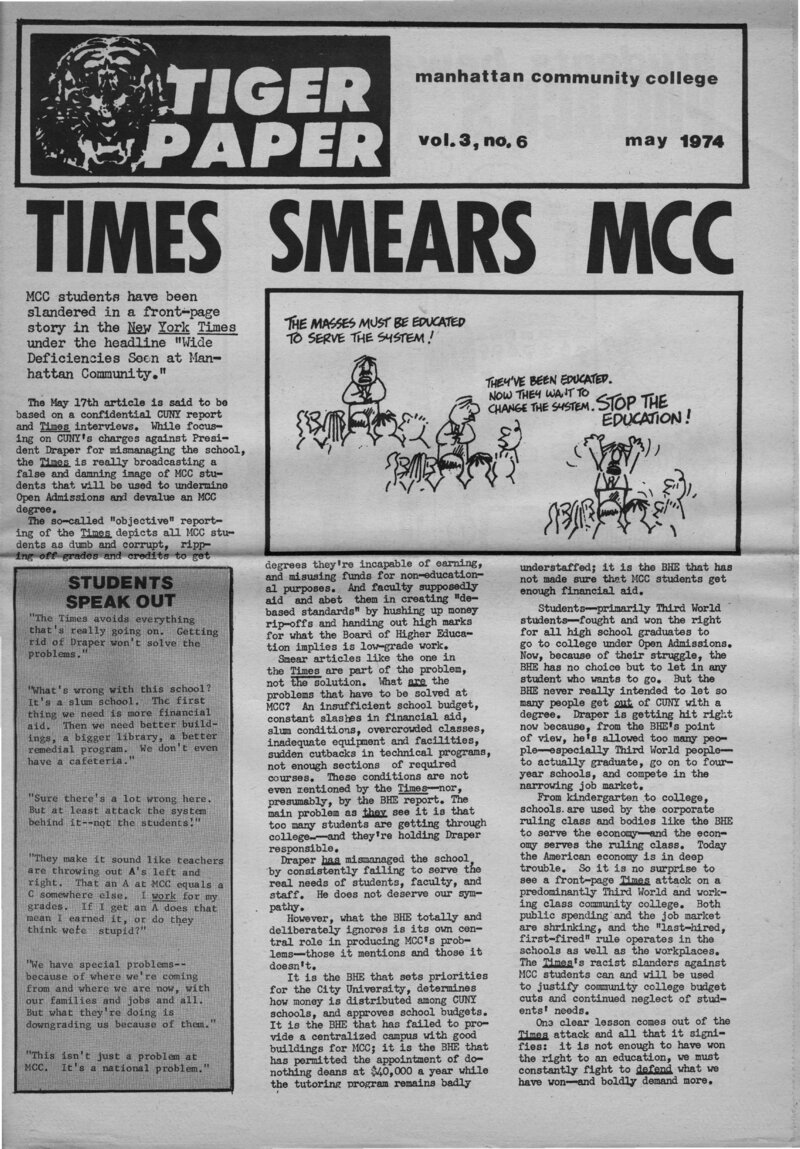
MCC students have been
slandered in a front=page
story in the New York Times
under the headline "Wide
Deficiencies Seen at Man=
hattan Community."
The May 17th article is said to be
based on a confidential CUNY report
and Times interviews. While focus-
ing on CUNY's charges against Presi=~
dent Draper for mismanaging the school,
the Times is really broadcasting a
false and damning image of MCC stu=
dents that will be used to undermine
Open Admissions and devalue an MCC
degree.
The so-called "objective" report=
ing of the Times depicts all MCC stu-
dents as dumb and corrupt, ripp-
s a slum school
ing we need is more
i. Then we need bet
ings, a bigger library, he
W =
have a cafeteria."
"Sure there's a lot wrong here.
But at least attack the system
behind it--not the students!"
"They make it sound like teachers
are throwing out A's left and
right. That an A at MCC equals a
C somewhere else. I work for my
grades. If I get an A does that
mean I earned it, or do they
think wete stupid?"
"We have special problems--
because of where we're coming
from and where we are now, with
our families and jobs and all.
THE MASSES MUST BE EDUCATED
TO SERvE THE System /
degrees they're incapable of earning,
and misusing funds for non~education-
al purposes. And faculty supposedly
aid and abet them in creating "de~
based standards" by hushing up money
rip-offs and handing out high marks
for what the Board of Higher Educa=
tion implies is low-grade work.
Smear articles like the one in
the Times are part of the problem,
not the solution. What are the
problems that have to be solved at
MCC? An insufficient school budget,
constant slashes in financial aid,
slum conditions, overcrowded classes,
inadequate equipment and facilities,
sudden cutbacks in technical programs,
not enough sections of required
courses, These conditions are not
even mentioned by the Times——nor,
presumably, by the BHE report. The
main problem as they see it is that
too many students are getting through
college~—and they*re holding Draper
responsible.
Draper has mismanaged the school
‘by consistently failing to serve the
real needs of students, faculty, and
staff. He does not deserve our sym
pathy.
However, what the BHE totally and
deliberately ignores is its own cen=
tral role in producing MCC's prob=
lems—those it mentions and those it
doesn't.
It is the BHE that sets priorities
for the City University, determines
how money is distributed among CUNY
manhattan community college
vol.3,no.6
may 1974
Tene BEEN enuceter.
w THEY Way
Pay Chanek THe swsten. STOP THE
DUCATION !
understaffed; it is the BHE that has
not made sure thet MCC students get
enough financial aid.
Students—=primarily Third World ~
students—fought and won the right
for all high school graduates to
go to college under Open Admissions.
Now, because of their struggle, the
BHE has no choice but to let in any
student who wants to go. But the
BHE never really intended to let so
many people get out of CUNY with a
degree. Draper is getting hit right
now because, from the BHE's point
of view, he's allowed too many peo=
ple—especially Third World people—
to actually graduate, go on to four=
year schools, and compete in the
narrowing job market,
From kindergarten to college,
schools. are used by the corporate
ruling class and bodies like the BHE
to serve the economy—-and the econ=
omy serves the ruling class. Today
the American economy is in deep
trouble. So it is no surprise to
see a front-page Times attack on a
predominantly Third World and work=
ing class community college. Both
public spending and the job market
are shrinking, and the "last=hired,
first-fired" rule operates in the
schools as well as the workplaces,
The Times's racist slanders against
MCC students can and will be used
to justify community college budget
cuts and continued neglect of stud=
ents! needs,
But what they're doing is
downgrading us because of them."
schools, and approves school budgets.
It is the BHE that has failed to pro= One clear lesson comes out of the
vide a centralized campus with good Times attack and all that it signi-
buildings for MCC; it is the BHE that fies: it is not enough to have won
has permitted the appointment of do= the right to an education, we must
nothing deans at $40,000 a year while constantly fight to defend what we
the tutoring program remains badly have won—and boldly demand more.
PAGE TWO
students beware!
POLLAGK'S PARTING SHOT
"certe ue 2
Fj
BEGINNING IN SEPTEMBER 1974, new
rules go into effect limiting
course withdrawals and the number
of semesters allowed for getting
a degree.
The "50=percent/6-semester"
rules (see box) are a last gift to
the college from soon=to—depart
Dean Myron Pollack, who brought them
up for a vote in the Faculty Coun-
cil after they'd been rejected by
the FC's own Academic Standing
Committee for reasons Pollack claim=-
ed not to know and was obviously
not interested in,
The FC dropped some of Pollack's
most blatantly repressive language,
and turned down provisions relating
to part-time students, but left
plenty of sting in Pollack's part=
ing shot.
Pollack aimed his shot at stud-
ents described as having attended
MCC "for many years with the appare
ent intention not of proceeding to-
ward educational objectives but
rather of participating in the extra=-
curricular life of the College..."=
fancy language to single out polit-
ical students and others who have
stood up to the administration over
the past few years.
The FC cut this part of the mo-
tion for the record, But it's
likely that Pollack's point stuck
in their minds, as did references
in the discussion to financial<eid
cheaters who supposedly register
-
c
asi
‘ = wi
iY tf
iN
for a full-time and then
drop the majority of their courses.
Neither Pollack nor anyone else
offered facts and figures of any
kind to show that excessive with-
drawals or slow progress toward a
degree were a genuine problem at
MCC. (Questioned later, the Reg-
istrar said that 13 percent of all
grades in the Fall 1973 semester
were W's and WP's =a small per=
centage in our opinion, considering
registration hassles and the kinds
of academic, financial, and person=
al problems faced by many students
at our school.)
Whatever Pollack's original ain,
the sting of his parting shot will
mainly be felt by students who have
the most difficulty in coping with
full-time course loads—students who
have been shortchanged by the high
schools or who have serious money
or personal problems which inter=
fere with their school work. With-
in three semesters, they could be
forced either into academic dismis-
sal or into becoming part~time stui-
ents ineligible for financial aid
or work-study.
Given the situation at MCC, this
is more than just a "shape up or
ship out" policy—it's literally
sink or swim, The support services
needed by these and other students
simply don't exist. There isn't
enough financial aid, the tutoring
program is starved for funds, coun=
‘TIGER PAPER
50% —6 semesters
NEW REGULATIONS passed by the Fac=
ulty Council, effective September
1974, are essentially as follows:
1. Every full-time student
has to complete (earn a grade in)
at least 50 percent of the cred=-
its he/she registers for. "Earn=
_ ed grades" include A,B,C,D,F,I,
R, and WF, W (withdrawal) and
WP (withdrawal passing) are not
considered "earned grades." -
Any student who doesn't
earn a grade for 50 percent of
his/her credits goes on proba=
tion the next semester; a stud-
ent who in that next semester
again fails to earn a grade in
at least 50 percent of the
courses registered for can be
academically dismissed,
2. Full-time matriculated
students have to complete all
degree requirements within 6 sem—
esters of full-time enrollment;
if they don't, they are open to
the same process of probation and
dismissal mentioned above.
3. "Any student so dismissed
may appeal to the Committee on
Academic Standing and submit wha
ever documentary evidence he/she
wishes in support of the appeal,
or a recommendation from a
College counselor or adviser,"
seling is not yet adequate, academ=
ic advisement is a joke (there are
three advisers to deal with 10,000
students!), and the remedial program
is still in the developmental stage,
Without effective support services,
the new rules are just another means
of limiting the number of students
who can actually succeed under
Open Admissions. What is more, the
blame for pot succeeding will fall
on the students, as it always has,
instead of on the system.
A lot of FC members who voted
for Pollack's measure may have
thought they were helping the stud=
ents by tightening up the rules.
But in the overall context, they have
actually lined up with the conserv=
ative forces who still think of ed=-
ucation as a privilege instead of
a right.
CHALLENGE GRADE ERRORS!
If you think any of the grades on
your semester reports, present or
past, are not what your instructor
actually gave you, be sure to go
to room A249 or H461 and file a
challenge form. There are pany
grade errors in student records,
and they will not be corrected
unless students themselves request
that specific grades be checked,
THE HONEST BALLOT ASSOCIATION has
thrown out the results of the stu-
dent government elections because
of irregularities and violations of
democratic procedures.
The administration and student
government (Students for Better Gov-
ernment - SBG) denied the Third Wor~
ld Coalition (TWC) and Students for
Unity and Democracy (SUD) the funds
and access to duplicating machines
and mailroom facilities necessary to
run an effective campaign. SBG on
the other hand was able to finance a
campaign blitz of parties, coffee
hours, newspapers, leaflets and home
mailings that cost several thousand
dollars.
At a meeting earlier this month
with Dean Harriet Van Sickle and SBG,
both TWC and SUD were promised $175
a piece to run their campaigns plus
use of college mimeograph machines.
This agreement was not honored.
Acccording to unofficial results,
the SBG ticket received the largest
block of votes--871. That means that
despite their well financed campaign,
SBG got support from barely 9% of
the student body. The result can on-
ly be interpreted as a resounding
vote of no confidence in SBG.
The TWC ticket came in second with
646 votes and SUD third with 183.
Only 22% of the student body bo-
thered to vote. Obviously, one rea-
son for this is that TWC and SUD we-
re severely handicapped in putting
out literature and reaching students.
Tiger Paper, however, feels that there
are several. other reasons:
1) SBG was a do nothing student
government. It did not deal with
the most pressing problems fac-
ing students. A month before the
election, however, it started to
make a lot of noise and launched
a massive public relations cam-
paign combining outright lies with
exaggerated claims of achievement.
Students, though, were hip to the
fact that SBG's sudden interest in
them was because of the election
and nothing else.
2) TWC, in the process of reor-
ganization and despite its history
of struggle, did not really estab-
lish itself this year as a force
that day in and day out fought
Tiger Paper
Tiger , r is published heim
possible an editorial collect-
ive of Manhattan Community sas catec
faculty and staff.
Tenured members of the collection
Kathy Chamberlain, Bill Friedheim,
Mary Kellogg, Naomi Woronov.
Untenured members: anonymous to
protect them against administrative
harassment.
PAGE THREE
STUDENT VOTE
THROWN OUT
RIDES AGAIN /
for students' needs.
3) The main issue in the elec-
tion was lost in a flood of char-
ges and counter-charges about mi-
ni-busses and student cars. Most
students did not understand that
the real choice was between a
group (SBG) that supported the ad-
ministration in return for petty
privileges and one (TWC) that had
a history of relying on students
and mobilizing them so that they
could win important victories--
like Black and Puerto Rican Stu-
dies in 1969 and a child-care cen-
ter in 1970.
4) It is difficult to organize
for an election when students at-
tend classes in 5 different buil-
dings spread over 25 blocks.
The campaign of Students for Bet-
ter Government was characterized by
lying from beginning to end.
An analysis of just one of SBG's
lies - about the "M' building - is
all we need to see which side it is
on.
When 1,000 students and faculty
signed petitions protesting slum con-
ditions in the "M"' building, SBG was
nowhere to be seen. Because of the
pressure mounted by "M" building fa-
culty and students, the administra-
tion agreed to close this firetrap
by. the end of the summer.
But SBG now tells us that it
is responsible for bringing classes
downtown next semester. That is non-
sense, What SBG does not tell us is
that the administration was planning
to move uptown classes to a building
at 3lst Street and Eigth Avenue.
That is downtown alright -- a mile
downtown from the "A" and "B" build-
ings! (Negotiations for the build-
ing, however, fell through a day or
two after the elections).
What is even more amoying is
that SBG has been boasting all year
that it moved the child-care cen-_
ter to safe, new quarters - the "M"
building!
When the administration said that
the ''M" building was good, SBG said
that the "M" building was good. When
the administration decided to move
classes to 3lst Street, SBG also said
that was good. But when it comes to
fighting for students' real needs,
SBG is too busy hiding behind the ad-
ministration's coat-tails to do any-
thing.
The issue in the new election,
then, is not only SBG's conduct in
the first vote, but its relation-
ship to the administration and what
that means when it comes to meeting.
the needs of students.
TIGER PAPER
AFRICA: LIBERATION 1S CERTAIN
<
-
gee
*
oot)
* on
AFRICAN LIBERATION DAY—MARCH ON WASHINGTON
M A | 2 + for bus information, call 636-9400
‘TIGER PAPER
PAGE FIVE
DEFEATS IN AFRICA TOPPLE
FASCISTS IN PORTUGAL
ON APRIL 25, a military junta seized
power in Portugal and ended 5 decades
of fascist rule. It was people's
wars against Portugese colonialism
in Angola, Guinea-Bissau and Mozam-
bique which led to the overthrow of
the world's longest fascist dicta-
torship.
Portugal's military efforts to
keep its colonies weakened it inter-
nally. Fifty percent of those in-
ducted into the Portugese army have
refused to serve, including more
than 100,000 draft resisters now liv-
ing abroad. The war has devastated
the Portugese economy, creating sky-
rocketing unemployment and a rate of
inflation that is the highest in Eur-
ope.
In spite of spending 40% of its
annual budget on its colonial wars,
Portugal was unable to defeat the
people's movements. Last September,
Guinea-Bissau declared independence
and recently people's armies have
made spectacular advances in Mozam-
bique and Angola.
These successes by African liber-
ation forces sparked new resistance
in Portugal itself. Workers defied
the government with wildcat strikes;
students in the face of police re-
pression agitated both on and off
campuses and spread the resistance;
a growing underground succéssfully —
carried out acts of sabotage; and
enlisted men and junior officers in
the military put pressure on the gen-
erals to move against the government.
The generals, convinced that they
could not successfully fight the re-
sistance, decided to join it so that
they could try to turn around its
revolutionary direction. By making
a few democratic reforms at home and
pushing phony. independence plans in
the colonies, the military junta
hopes to maintain Portugese control
in Africa. The junta is already ne-
gotiating semi-independence with
handpicked. groups of white settlers
and Africans (like GUM-The Group for
the Union of Mozambique) while con-
tinuing without let-up its war agai-
nst the liberation forces.
General Antonio de Spinola, the
head of the junta, let the cat out
of the bag when he said that "self-
determination should not be confus-
ed with independence." The junta
and groups like GUM have maintained
that Portugese troops should remain
in Africa to fight until the rebels
"lay down their arms" and join ne-
gotiations for some kind of semi-in-
dependent (meaning semi-colonial)
status, like that of Puerto Rico in
relationship to the United States.
While Portugal is much too weak
to maintain its colonial empire, it
has lots of reactionary. friends who
are ready to help her do the job.
The United States government, the
real power behind the scenes, contin-
ues to provide money and arms for
Portugese military operations in A-
frica so that it can protect the in-
Jus ees WED TOME REVO eu
terestsof corporations like Gulf Oil,
which has big investments in Angola.,
The new Portugese government is now
calling on its allies in the North
Atlantic Treaty Organization (NATO-
the U.S., Canada and western Europe)
to help save its African empire. Ra-
cist regimes in South Africa and Zim-
babwe (Rhodesia) are ready to send
troops to neighboring Mozambique,
knowing that it provides the key to
southern Africa.
Rebel forces in South Africa and
Zimbabwe have used liberated terri-
tories in Mozambique as. sanctuaries,
and staging areas for military acti-
vities. Landlocked Rhodesia must
maintain access to deep water ports
in Mozambique for almost all of its
exports and imports. South Africa
uses the same ports for diamond ship-
ments.
The recent moves by colonialists
in Portugal, the imperialists in the
U.S. and NATO, and the racist white
settlers in Zimbabwe, South Africa
and the Portugese colonies come out
of weakness rather than strength.
Liberation forces have vowed to con-
tinue the struggle knowing that vic-
tory is near and that only Africans
themselves can determine what poli-
tical, economic and social forms
their independénee and their destiny
will take.
The growing strength of the rev-
olutionary movement in the Third Wor-
ld and the corresponding decline of
imperialism is the single most impor-
tant historical trend in the world
today. Successful struggles for na-
tional liberation, whether they be
in Indochina or Africa, weaken im-
perialism overseas and make it more
difficult for it to rule at home. A-
frica was a turning point for Portu-
gal‘ and Vietnam was a turning point
for the United States.
The lesson in all of this is that
part of the fight against oppression
at home is support for liberation
struggles overseas. The people of
world are learning that there is
strength in their growing unity.
AFRICAN LIBERATION STRUGGLES IN ANGOLA (ABOVE) AND
GUINEA-BISSAU (BELOW RIGHT)
Southern Africa.
LW i
ANIZE TO FI
MCC students and banners at ‘lashington
10,000 go to washington
to THROW NIXON OUT
THE FRONT PAGES of every newspaper
are filled with all the latest dev
elopments in the impeachment proceed=
ings against Nixon. Every word of
every politician and every inch of
tape is laid out for public examin-
ation.
What the papers don't cover is the
ople's movement against Nixon.
Wor! people have organized work=
ers committees around the country
to "Throw the Bum Out", They've
written pamphlets and newsletters.
“They put on skits, hold rallies,
and demonstrate in the major U.S,
cities, But we don't hear about
that.
And when 10,000 people go to Wash=
ington, full of anger against Nix
on and the system he represents,
the press pretends it never happened.
Many people who went to Washington
think f oeigedraa rid of Nixon al=
one will solve the country's problems.
But many others, including the 50
MCC students who made the trip, un-
derstand that Nixon is not the one,
but just a front man for the imper=
ialist system. The "Throw the Bum
Out" contingent to the rally called
a second demonstration later in the
day to make perfectly clear that the
target of the people is the system
as a whole and not just Tricky Dick.
The march and rally was a good be=
ginning, and exciting because of
the large number of people. However,
many of the speakers failed to make
clear links between Nixon's actions
and the whole nature of the imper=
ialist system. In addition, sever=
al speakers suggested we should
place our reliance on politicians
who are part of this same system.
But most people know that Nixon
is part of this system, and that
we cannot rely on politicians,
Because of this, people were anx=
ious to go to the second demonstra=
tion, which focused their anger ag=
ainst the true enemy. More than
2,000 people participated in this
action which attacked the
Justice Department symbol of U.S.
imperialism, the system behind Nix-
on, the courts and Congress.
The U.S. Justice Department pro=
vides justice only for the rich,
while condoning nation-wide camp=
aigns against Black activists in
particular, and all people's move=
ments in general.
Before the march moved out, spea~
kers talked of the latest example
of U.S. "justice"—the police har=
assment of Black people in San Fran=
cisco on the pretext of looking for
"Zebra Killers."
The anti=imperialist contingent,
led by the Attica Brigade, organiz—
ed this demonstration= to show
that people must organize to fight
against the imperialist system in
order to win real and long-lasting
gains.
Although some felt that the anger
of the marchers could have been ex=
pressed more sharply and in a more
disciplined way, most people felt
that the demonstration was a success=
especially in that so many people
were willing to take a risk and put
into action what they know to be
right.
Looking at the entire day, people
agreed about two things: that we
must throw Nixon out, and
that we must use the strength
we develop in this struggle to
fight against the real eneny—=
the system he represents,
TIGER PAPER
"This was the first demonstration
I ever went on. I was thinking on
the way down, 'What am I partici-
pating in?' And I came up with an
answer. This is my country, and I
have a stake in it.
I didn't know how many people
would be there. But when we got
there, and I saw the view out the
window, I was pretty jubilant.
When I saw the great mass of peo-
ple, that made me feel good. You
know, when there's a mass of people
doing a thing--you know you're not
the only one. And you know you're
right.
The march on the justice dept.
was really enthusiastic--it was a
drive, a spearhead. The only thing
is, I don't know if we made enough
impact. It wasn't angry enough.
The march was good in itself.
But I'm looking for results."
"One main aspect of the day was
the unity of the people. It was
the first time, on the subject of
‘Nixon, that the people had a chance
to voice their feelings.
But the one positive point of the
day, which focused on the real issue
--why everyone went to Washington, --
was the march on the justice dept.
It was a necessary thing to do. The al
Impeachment groups which planned the
rallv wanted to keep everyone in the
park, like a picnic. The course the
planners took was peaceful and ac-
complished nothing. The justice dept
action highlighted the day--because
the majority of the people who went
there wanted to make their point--
that Nixon and the whole system he
represents have to be attacked.”
‘TIGER PAPER : PAGE SEVEN
THE SUMMER WILLBE HOT—
15 GRAPES< LETTUCE ROT!
The imperialist ruling class doesn't take a
vacation, so neither do we, Students in the
Attica Brigade will be on picket lines in
front of groceries and supermarkets all sum=
mer, spreading the boycott of scab grapes and
lettuce in support of the striking farmworkers.
Help build the boycott. Join the Brigade
summer farmworker project!
A heavy battle is being waged in the grape and lettuce fields of
California,
Thousands of farmworkers are fighting for a decent living standard
and for their right to be represented by the United Farmworkers, the
union they won in 1970 after five years of strike and boycott actions
against the grape and lettuce growers.
Now these same bankecontrolled agribusinesses which were defeated
in the 60's are again trying to smash the farmworkers! movement, The
struggles of the farmworkers, and their tremendous 1970 victory, set
an example for non=unionized workers all over the country, especially
for Chicanos in the Southwest (the Farah strike) and Blacks in the
South (the Oneita strike and others). The farmworkers won higher
wages, overtime pay, paid holidays, health and safety controls, job
security, medical care, pensions, and collective bargaining rights.
Now the big corporations want to rob them of their victory and smoth=
er their movement before its example spreads further.
In April 1973 when UFW contracts expired, the growers were ready
with their new strategy—replacing the UFW with a union they could
control. Helped by Nixon's pal Charles Colson, they made a deal with
the corrupt leadership of the Teamsters Union to take over the UFW
membership, In return the Teamsters signed "sweetheart" contracts
with the growers that stripped away all the earlier gains.
like the oil companies with their "energy crisis" and the rest of
the ruling class, these growers are always trying to squeeze more
out of the people, They've used the courts, the police, the govern=
ment, liberal politicians, and Teamster goons to try and break the
militant farmworker movement, But the farmworkers are fighting them,
to stop the growers from super—exploiting thousands of mainly Black,
Chicano and Filippino workers,
help build the boycott! THE STRIKE AND THE BOYCOTT ARE KEY WEAPONS IN THIS STRUGGLE.
THE NEXT FEW MONTHS ARE CRUCIAL—THE GRAPE HARVEST IS COMING
call 280-5113 (day) IN. NOW IS THE TIME TO GO ALL OUT IN SUPPORT OF THE FARM
WORKERS AND TO BUILD THE BOYCOTT OF GRAPES, LETTUCE, AND SCAB=
66 3-4927(eve.) GRAPE GALLO WINES.
ATTICA BRIGADE
WOMEN IN OUR SOCIETY are kept in ig~ it from being offered, When first
norance about their own bodies, their introduced at the Council, it was
own sexuality, and the effects of the rejected—emdst jokes and putdowns
female social role on physical and —as not needed and not justified.
mental health. But the chairman of the Health Ed
A new 3<credit elective course on Department called for a re~vote at
"Health Concerns of Women" will be the next meeting, where several
given by Norma Verdiner of the Health teachers and counselors reported
Ed Department starting next fall, to that women students very frequently
deal with women's need to know about brought up troubling health questions
their biological and psychological and that the course would serve a
functioning and related medical prob= real =: at MCC. The re-vote was
lems. succes °
Get this course into the cur= Students interested in "Health
Page not easy. Male chauvin= Concerns of Women" should see next
ism on the part of many members of fall's course schedule, under Health
the Faculty Council almost prevented Education.
PAGE EIGHT
AITIGA:
61 prisoners have been indicted for
their participation in the 1971 re-
bellion at New York's Attica State
Prison.
That rebellion ended with an
assault ‘by the N.Y. State Police
(under orders from Gov.Rockefeller)
which was, in the words of a spe-
cial investigating commission,"'the
bloodiest one-day encounter between
Americans since the Civil War." 39
people were killed and 80 others
wounded,
The special investigation after-
wards also confirmed the legitimacy
of the prisoners’ demands and the
previous lack of response from prison
officials to their complaints. It
clearly placed the responsibility for:
the massacre which occured at Attica
on the state officials.
But in the three years since
Attica, little or nothing has been
done about prison conditions, and no
state troopers or prison or state
officials were named in the indict-
ments.
A few weeks ago a documentary
film "Attica" played at a New York
movie theatre. Most people didn't
hear about it since it didn't get
much coverage, but two BMCC students
Raul Domingo and Roudi Munro went to
gee. it's
"I was in the Phillipines when
Attica happened," said Raoul Domingo,
“and I read about it in Time and
Newsweek. They really gave the
state's side -that the government
was brilliant, really brought about
law and order,etc. - with maybe a
short sentence about the poor con-
ditions in the prison."
"That film really made you think,"
said Munro, "It had a lot of informa-
tion in it. The film showed headlines
from newspapers like the Daily News
saying, ‘Convicts Slit Hostages'
Throats.' But afterwards they found
out that everyone who died, died of
gunshot wounds and the only ones
with guns were the state troopers.”
The Attica rebellion brought on
such severe repression from the state
because it was a definite threat
to the whole U.S.prison system and
the social system which it supports.
The unity of the black, white and
Spanish-speaking prisoners and their
resistance to inhumane and racist
prison treatment was a direct attack
on racism and the class system in
the U.S, overall. The prisoners had
identified the entire U.S. social
system as responsible for the condi-
tions in prisons, not just a few
officials or a few regulations. Their
actual concrece demands were later
AITA
r
iF:
viewed as reasonable; it was their
organization and their political
awareness that was the threat the
state had to crush.
And the state is still doing its
best to crush that threat through its
prosecution of the 61 Attica defendants
Millions of dollars, including the en-
tire funding for a task force against
organized crime, has been allocated to
the prosecution of the Attica case.
TIGER PAPER.
CONTINUE
The film "Attica" is an important
reminder of the courage and bravery of
the Attica prisoners. The events at
Attica are an example that people can
unite in struggle. But the film is
also a strong reminder that after all
the outrage and the investigations and
the reports, the government is hoping
that people will have forgotten Attica
so that it can continue along its same
old road of repression.
Attica and what is happening today —
show us that we cannot expect real
change until all issues are connected
and all the oppressions and injustices
are attacked at their source = the un-
just economic and social system which
we have today in the U.S.
In the words of one of the Attica
participants, we all have to "wake
up, stop hiding. . .stop saying you
don't understand. . .wake up, deal,
wake up. . .because nothing comes to
the sleeper but a dream."
BMCC students Domingo and Munro
are checking to see about the possi-
bility of showing the film "Attica"
on the BMCC campus next fall.
Meanwhile, funds are needed for
the Attica defense and contributions
can be sent to: Attica Brothers
Legal Defense, 1370 Main Street,
Buffalo, N.Y. 14209.
The events at —
slandered in a front=page
story in the New York Times
under the headline "Wide
Deficiencies Seen at Man=
hattan Community."
The May 17th article is said to be
based on a confidential CUNY report
and Times interviews. While focus-
ing on CUNY's charges against Presi=~
dent Draper for mismanaging the school,
the Times is really broadcasting a
false and damning image of MCC stu=
dents that will be used to undermine
Open Admissions and devalue an MCC
degree.
The so-called "objective" report=
ing of the Times depicts all MCC stu-
dents as dumb and corrupt, ripp-
s a slum school
ing we need is more
i. Then we need bet
ings, a bigger library, he
W =
have a cafeteria."
"Sure there's a lot wrong here.
But at least attack the system
behind it--not the students!"
"They make it sound like teachers
are throwing out A's left and
right. That an A at MCC equals a
C somewhere else. I work for my
grades. If I get an A does that
mean I earned it, or do they
think wete stupid?"
"We have special problems--
because of where we're coming
from and where we are now, with
our families and jobs and all.
THE MASSES MUST BE EDUCATED
TO SERvE THE System /
degrees they're incapable of earning,
and misusing funds for non~education-
al purposes. And faculty supposedly
aid and abet them in creating "de~
based standards" by hushing up money
rip-offs and handing out high marks
for what the Board of Higher Educa=
tion implies is low-grade work.
Smear articles like the one in
the Times are part of the problem,
not the solution. What are the
problems that have to be solved at
MCC? An insufficient school budget,
constant slashes in financial aid,
slum conditions, overcrowded classes,
inadequate equipment and facilities,
sudden cutbacks in technical programs,
not enough sections of required
courses, These conditions are not
even mentioned by the Times——nor,
presumably, by the BHE report. The
main problem as they see it is that
too many students are getting through
college~—and they*re holding Draper
responsible.
Draper has mismanaged the school
‘by consistently failing to serve the
real needs of students, faculty, and
staff. He does not deserve our sym
pathy.
However, what the BHE totally and
deliberately ignores is its own cen=
tral role in producing MCC's prob=
lems—those it mentions and those it
doesn't.
It is the BHE that sets priorities
for the City University, determines
how money is distributed among CUNY
manhattan community college
vol.3,no.6
may 1974
Tene BEEN enuceter.
w THEY Way
Pay Chanek THe swsten. STOP THE
DUCATION !
understaffed; it is the BHE that has
not made sure thet MCC students get
enough financial aid.
Students—=primarily Third World ~
students—fought and won the right
for all high school graduates to
go to college under Open Admissions.
Now, because of their struggle, the
BHE has no choice but to let in any
student who wants to go. But the
BHE never really intended to let so
many people get out of CUNY with a
degree. Draper is getting hit right
now because, from the BHE's point
of view, he's allowed too many peo=
ple—especially Third World people—
to actually graduate, go on to four=
year schools, and compete in the
narrowing job market,
From kindergarten to college,
schools. are used by the corporate
ruling class and bodies like the BHE
to serve the economy—-and the econ=
omy serves the ruling class. Today
the American economy is in deep
trouble. So it is no surprise to
see a front-page Times attack on a
predominantly Third World and work=
ing class community college. Both
public spending and the job market
are shrinking, and the "last=hired,
first-fired" rule operates in the
schools as well as the workplaces,
The Times's racist slanders against
MCC students can and will be used
to justify community college budget
cuts and continued neglect of stud=
ents! needs,
But what they're doing is
downgrading us because of them."
schools, and approves school budgets.
It is the BHE that has failed to pro= One clear lesson comes out of the
vide a centralized campus with good Times attack and all that it signi-
buildings for MCC; it is the BHE that fies: it is not enough to have won
has permitted the appointment of do= the right to an education, we must
nothing deans at $40,000 a year while constantly fight to defend what we
the tutoring program remains badly have won—and boldly demand more.
PAGE TWO
students beware!
POLLAGK'S PARTING SHOT
"certe ue 2
Fj
BEGINNING IN SEPTEMBER 1974, new
rules go into effect limiting
course withdrawals and the number
of semesters allowed for getting
a degree.
The "50=percent/6-semester"
rules (see box) are a last gift to
the college from soon=to—depart
Dean Myron Pollack, who brought them
up for a vote in the Faculty Coun-
cil after they'd been rejected by
the FC's own Academic Standing
Committee for reasons Pollack claim=-
ed not to know and was obviously
not interested in,
The FC dropped some of Pollack's
most blatantly repressive language,
and turned down provisions relating
to part-time students, but left
plenty of sting in Pollack's part=
ing shot.
Pollack aimed his shot at stud-
ents described as having attended
MCC "for many years with the appare
ent intention not of proceeding to-
ward educational objectives but
rather of participating in the extra=-
curricular life of the College..."=
fancy language to single out polit-
ical students and others who have
stood up to the administration over
the past few years.
The FC cut this part of the mo-
tion for the record, But it's
likely that Pollack's point stuck
in their minds, as did references
in the discussion to financial<eid
cheaters who supposedly register
-
c
asi
‘ = wi
iY tf
iN
for a full-time and then
drop the majority of their courses.
Neither Pollack nor anyone else
offered facts and figures of any
kind to show that excessive with-
drawals or slow progress toward a
degree were a genuine problem at
MCC. (Questioned later, the Reg-
istrar said that 13 percent of all
grades in the Fall 1973 semester
were W's and WP's =a small per=
centage in our opinion, considering
registration hassles and the kinds
of academic, financial, and person=
al problems faced by many students
at our school.)
Whatever Pollack's original ain,
the sting of his parting shot will
mainly be felt by students who have
the most difficulty in coping with
full-time course loads—students who
have been shortchanged by the high
schools or who have serious money
or personal problems which inter=
fere with their school work. With-
in three semesters, they could be
forced either into academic dismis-
sal or into becoming part~time stui-
ents ineligible for financial aid
or work-study.
Given the situation at MCC, this
is more than just a "shape up or
ship out" policy—it's literally
sink or swim, The support services
needed by these and other students
simply don't exist. There isn't
enough financial aid, the tutoring
program is starved for funds, coun=
‘TIGER PAPER
50% —6 semesters
NEW REGULATIONS passed by the Fac=
ulty Council, effective September
1974, are essentially as follows:
1. Every full-time student
has to complete (earn a grade in)
at least 50 percent of the cred=-
its he/she registers for. "Earn=
_ ed grades" include A,B,C,D,F,I,
R, and WF, W (withdrawal) and
WP (withdrawal passing) are not
considered "earned grades." -
Any student who doesn't
earn a grade for 50 percent of
his/her credits goes on proba=
tion the next semester; a stud-
ent who in that next semester
again fails to earn a grade in
at least 50 percent of the
courses registered for can be
academically dismissed,
2. Full-time matriculated
students have to complete all
degree requirements within 6 sem—
esters of full-time enrollment;
if they don't, they are open to
the same process of probation and
dismissal mentioned above.
3. "Any student so dismissed
may appeal to the Committee on
Academic Standing and submit wha
ever documentary evidence he/she
wishes in support of the appeal,
or a recommendation from a
College counselor or adviser,"
seling is not yet adequate, academ=
ic advisement is a joke (there are
three advisers to deal with 10,000
students!), and the remedial program
is still in the developmental stage,
Without effective support services,
the new rules are just another means
of limiting the number of students
who can actually succeed under
Open Admissions. What is more, the
blame for pot succeeding will fall
on the students, as it always has,
instead of on the system.
A lot of FC members who voted
for Pollack's measure may have
thought they were helping the stud=
ents by tightening up the rules.
But in the overall context, they have
actually lined up with the conserv=
ative forces who still think of ed=-
ucation as a privilege instead of
a right.
CHALLENGE GRADE ERRORS!
If you think any of the grades on
your semester reports, present or
past, are not what your instructor
actually gave you, be sure to go
to room A249 or H461 and file a
challenge form. There are pany
grade errors in student records,
and they will not be corrected
unless students themselves request
that specific grades be checked,
THE HONEST BALLOT ASSOCIATION has
thrown out the results of the stu-
dent government elections because
of irregularities and violations of
democratic procedures.
The administration and student
government (Students for Better Gov-
ernment - SBG) denied the Third Wor~
ld Coalition (TWC) and Students for
Unity and Democracy (SUD) the funds
and access to duplicating machines
and mailroom facilities necessary to
run an effective campaign. SBG on
the other hand was able to finance a
campaign blitz of parties, coffee
hours, newspapers, leaflets and home
mailings that cost several thousand
dollars.
At a meeting earlier this month
with Dean Harriet Van Sickle and SBG,
both TWC and SUD were promised $175
a piece to run their campaigns plus
use of college mimeograph machines.
This agreement was not honored.
Acccording to unofficial results,
the SBG ticket received the largest
block of votes--871. That means that
despite their well financed campaign,
SBG got support from barely 9% of
the student body. The result can on-
ly be interpreted as a resounding
vote of no confidence in SBG.
The TWC ticket came in second with
646 votes and SUD third with 183.
Only 22% of the student body bo-
thered to vote. Obviously, one rea-
son for this is that TWC and SUD we-
re severely handicapped in putting
out literature and reaching students.
Tiger Paper, however, feels that there
are several. other reasons:
1) SBG was a do nothing student
government. It did not deal with
the most pressing problems fac-
ing students. A month before the
election, however, it started to
make a lot of noise and launched
a massive public relations cam-
paign combining outright lies with
exaggerated claims of achievement.
Students, though, were hip to the
fact that SBG's sudden interest in
them was because of the election
and nothing else.
2) TWC, in the process of reor-
ganization and despite its history
of struggle, did not really estab-
lish itself this year as a force
that day in and day out fought
Tiger Paper
Tiger , r is published heim
possible an editorial collect-
ive of Manhattan Community sas catec
faculty and staff.
Tenured members of the collection
Kathy Chamberlain, Bill Friedheim,
Mary Kellogg, Naomi Woronov.
Untenured members: anonymous to
protect them against administrative
harassment.
PAGE THREE
STUDENT VOTE
THROWN OUT
RIDES AGAIN /
for students' needs.
3) The main issue in the elec-
tion was lost in a flood of char-
ges and counter-charges about mi-
ni-busses and student cars. Most
students did not understand that
the real choice was between a
group (SBG) that supported the ad-
ministration in return for petty
privileges and one (TWC) that had
a history of relying on students
and mobilizing them so that they
could win important victories--
like Black and Puerto Rican Stu-
dies in 1969 and a child-care cen-
ter in 1970.
4) It is difficult to organize
for an election when students at-
tend classes in 5 different buil-
dings spread over 25 blocks.
The campaign of Students for Bet-
ter Government was characterized by
lying from beginning to end.
An analysis of just one of SBG's
lies - about the "M' building - is
all we need to see which side it is
on.
When 1,000 students and faculty
signed petitions protesting slum con-
ditions in the "M"' building, SBG was
nowhere to be seen. Because of the
pressure mounted by "M" building fa-
culty and students, the administra-
tion agreed to close this firetrap
by. the end of the summer.
But SBG now tells us that it
is responsible for bringing classes
downtown next semester. That is non-
sense, What SBG does not tell us is
that the administration was planning
to move uptown classes to a building
at 3lst Street and Eigth Avenue.
That is downtown alright -- a mile
downtown from the "A" and "B" build-
ings! (Negotiations for the build-
ing, however, fell through a day or
two after the elections).
What is even more amoying is
that SBG has been boasting all year
that it moved the child-care cen-_
ter to safe, new quarters - the "M"
building!
When the administration said that
the ''M" building was good, SBG said
that the "M" building was good. When
the administration decided to move
classes to 3lst Street, SBG also said
that was good. But when it comes to
fighting for students' real needs,
SBG is too busy hiding behind the ad-
ministration's coat-tails to do any-
thing.
The issue in the new election,
then, is not only SBG's conduct in
the first vote, but its relation-
ship to the administration and what
that means when it comes to meeting.
the needs of students.
TIGER PAPER
AFRICA: LIBERATION 1S CERTAIN
<
-
gee
*
oot)
* on
AFRICAN LIBERATION DAY—MARCH ON WASHINGTON
M A | 2 + for bus information, call 636-9400
‘TIGER PAPER
PAGE FIVE
DEFEATS IN AFRICA TOPPLE
FASCISTS IN PORTUGAL
ON APRIL 25, a military junta seized
power in Portugal and ended 5 decades
of fascist rule. It was people's
wars against Portugese colonialism
in Angola, Guinea-Bissau and Mozam-
bique which led to the overthrow of
the world's longest fascist dicta-
torship.
Portugal's military efforts to
keep its colonies weakened it inter-
nally. Fifty percent of those in-
ducted into the Portugese army have
refused to serve, including more
than 100,000 draft resisters now liv-
ing abroad. The war has devastated
the Portugese economy, creating sky-
rocketing unemployment and a rate of
inflation that is the highest in Eur-
ope.
In spite of spending 40% of its
annual budget on its colonial wars,
Portugal was unable to defeat the
people's movements. Last September,
Guinea-Bissau declared independence
and recently people's armies have
made spectacular advances in Mozam-
bique and Angola.
These successes by African liber-
ation forces sparked new resistance
in Portugal itself. Workers defied
the government with wildcat strikes;
students in the face of police re-
pression agitated both on and off
campuses and spread the resistance;
a growing underground succéssfully —
carried out acts of sabotage; and
enlisted men and junior officers in
the military put pressure on the gen-
erals to move against the government.
The generals, convinced that they
could not successfully fight the re-
sistance, decided to join it so that
they could try to turn around its
revolutionary direction. By making
a few democratic reforms at home and
pushing phony. independence plans in
the colonies, the military junta
hopes to maintain Portugese control
in Africa. The junta is already ne-
gotiating semi-independence with
handpicked. groups of white settlers
and Africans (like GUM-The Group for
the Union of Mozambique) while con-
tinuing without let-up its war agai-
nst the liberation forces.
General Antonio de Spinola, the
head of the junta, let the cat out
of the bag when he said that "self-
determination should not be confus-
ed with independence." The junta
and groups like GUM have maintained
that Portugese troops should remain
in Africa to fight until the rebels
"lay down their arms" and join ne-
gotiations for some kind of semi-in-
dependent (meaning semi-colonial)
status, like that of Puerto Rico in
relationship to the United States.
While Portugal is much too weak
to maintain its colonial empire, it
has lots of reactionary. friends who
are ready to help her do the job.
The United States government, the
real power behind the scenes, contin-
ues to provide money and arms for
Portugese military operations in A-
frica so that it can protect the in-
Jus ees WED TOME REVO eu
terestsof corporations like Gulf Oil,
which has big investments in Angola.,
The new Portugese government is now
calling on its allies in the North
Atlantic Treaty Organization (NATO-
the U.S., Canada and western Europe)
to help save its African empire. Ra-
cist regimes in South Africa and Zim-
babwe (Rhodesia) are ready to send
troops to neighboring Mozambique,
knowing that it provides the key to
southern Africa.
Rebel forces in South Africa and
Zimbabwe have used liberated terri-
tories in Mozambique as. sanctuaries,
and staging areas for military acti-
vities. Landlocked Rhodesia must
maintain access to deep water ports
in Mozambique for almost all of its
exports and imports. South Africa
uses the same ports for diamond ship-
ments.
The recent moves by colonialists
in Portugal, the imperialists in the
U.S. and NATO, and the racist white
settlers in Zimbabwe, South Africa
and the Portugese colonies come out
of weakness rather than strength.
Liberation forces have vowed to con-
tinue the struggle knowing that vic-
tory is near and that only Africans
themselves can determine what poli-
tical, economic and social forms
their independénee and their destiny
will take.
The growing strength of the rev-
olutionary movement in the Third Wor-
ld and the corresponding decline of
imperialism is the single most impor-
tant historical trend in the world
today. Successful struggles for na-
tional liberation, whether they be
in Indochina or Africa, weaken im-
perialism overseas and make it more
difficult for it to rule at home. A-
frica was a turning point for Portu-
gal‘ and Vietnam was a turning point
for the United States.
The lesson in all of this is that
part of the fight against oppression
at home is support for liberation
struggles overseas. The people of
world are learning that there is
strength in their growing unity.
AFRICAN LIBERATION STRUGGLES IN ANGOLA (ABOVE) AND
GUINEA-BISSAU (BELOW RIGHT)
Southern Africa.
LW i
ANIZE TO FI
MCC students and banners at ‘lashington
10,000 go to washington
to THROW NIXON OUT
THE FRONT PAGES of every newspaper
are filled with all the latest dev
elopments in the impeachment proceed=
ings against Nixon. Every word of
every politician and every inch of
tape is laid out for public examin-
ation.
What the papers don't cover is the
ople's movement against Nixon.
Wor! people have organized work=
ers committees around the country
to "Throw the Bum Out", They've
written pamphlets and newsletters.
“They put on skits, hold rallies,
and demonstrate in the major U.S,
cities, But we don't hear about
that.
And when 10,000 people go to Wash=
ington, full of anger against Nix
on and the system he represents,
the press pretends it never happened.
Many people who went to Washington
think f oeigedraa rid of Nixon al=
one will solve the country's problems.
But many others, including the 50
MCC students who made the trip, un-
derstand that Nixon is not the one,
but just a front man for the imper=
ialist system. The "Throw the Bum
Out" contingent to the rally called
a second demonstration later in the
day to make perfectly clear that the
target of the people is the system
as a whole and not just Tricky Dick.
The march and rally was a good be=
ginning, and exciting because of
the large number of people. However,
many of the speakers failed to make
clear links between Nixon's actions
and the whole nature of the imper=
ialist system. In addition, sever=
al speakers suggested we should
place our reliance on politicians
who are part of this same system.
But most people know that Nixon
is part of this system, and that
we cannot rely on politicians,
Because of this, people were anx=
ious to go to the second demonstra=
tion, which focused their anger ag=
ainst the true enemy. More than
2,000 people participated in this
action which attacked the
Justice Department symbol of U.S.
imperialism, the system behind Nix-
on, the courts and Congress.
The U.S. Justice Department pro=
vides justice only for the rich,
while condoning nation-wide camp=
aigns against Black activists in
particular, and all people's move=
ments in general.
Before the march moved out, spea~
kers talked of the latest example
of U.S. "justice"—the police har=
assment of Black people in San Fran=
cisco on the pretext of looking for
"Zebra Killers."
The anti=imperialist contingent,
led by the Attica Brigade, organiz—
ed this demonstration= to show
that people must organize to fight
against the imperialist system in
order to win real and long-lasting
gains.
Although some felt that the anger
of the marchers could have been ex=
pressed more sharply and in a more
disciplined way, most people felt
that the demonstration was a success=
especially in that so many people
were willing to take a risk and put
into action what they know to be
right.
Looking at the entire day, people
agreed about two things: that we
must throw Nixon out, and
that we must use the strength
we develop in this struggle to
fight against the real eneny—=
the system he represents,
TIGER PAPER
"This was the first demonstration
I ever went on. I was thinking on
the way down, 'What am I partici-
pating in?' And I came up with an
answer. This is my country, and I
have a stake in it.
I didn't know how many people
would be there. But when we got
there, and I saw the view out the
window, I was pretty jubilant.
When I saw the great mass of peo-
ple, that made me feel good. You
know, when there's a mass of people
doing a thing--you know you're not
the only one. And you know you're
right.
The march on the justice dept.
was really enthusiastic--it was a
drive, a spearhead. The only thing
is, I don't know if we made enough
impact. It wasn't angry enough.
The march was good in itself.
But I'm looking for results."
"One main aspect of the day was
the unity of the people. It was
the first time, on the subject of
‘Nixon, that the people had a chance
to voice their feelings.
But the one positive point of the
day, which focused on the real issue
--why everyone went to Washington, --
was the march on the justice dept.
It was a necessary thing to do. The al
Impeachment groups which planned the
rallv wanted to keep everyone in the
park, like a picnic. The course the
planners took was peaceful and ac-
complished nothing. The justice dept
action highlighted the day--because
the majority of the people who went
there wanted to make their point--
that Nixon and the whole system he
represents have to be attacked.”
‘TIGER PAPER : PAGE SEVEN
THE SUMMER WILLBE HOT—
15 GRAPES< LETTUCE ROT!
The imperialist ruling class doesn't take a
vacation, so neither do we, Students in the
Attica Brigade will be on picket lines in
front of groceries and supermarkets all sum=
mer, spreading the boycott of scab grapes and
lettuce in support of the striking farmworkers.
Help build the boycott. Join the Brigade
summer farmworker project!
A heavy battle is being waged in the grape and lettuce fields of
California,
Thousands of farmworkers are fighting for a decent living standard
and for their right to be represented by the United Farmworkers, the
union they won in 1970 after five years of strike and boycott actions
against the grape and lettuce growers.
Now these same bankecontrolled agribusinesses which were defeated
in the 60's are again trying to smash the farmworkers! movement, The
struggles of the farmworkers, and their tremendous 1970 victory, set
an example for non=unionized workers all over the country, especially
for Chicanos in the Southwest (the Farah strike) and Blacks in the
South (the Oneita strike and others). The farmworkers won higher
wages, overtime pay, paid holidays, health and safety controls, job
security, medical care, pensions, and collective bargaining rights.
Now the big corporations want to rob them of their victory and smoth=
er their movement before its example spreads further.
In April 1973 when UFW contracts expired, the growers were ready
with their new strategy—replacing the UFW with a union they could
control. Helped by Nixon's pal Charles Colson, they made a deal with
the corrupt leadership of the Teamsters Union to take over the UFW
membership, In return the Teamsters signed "sweetheart" contracts
with the growers that stripped away all the earlier gains.
like the oil companies with their "energy crisis" and the rest of
the ruling class, these growers are always trying to squeeze more
out of the people, They've used the courts, the police, the govern=
ment, liberal politicians, and Teamster goons to try and break the
militant farmworker movement, But the farmworkers are fighting them,
to stop the growers from super—exploiting thousands of mainly Black,
Chicano and Filippino workers,
help build the boycott! THE STRIKE AND THE BOYCOTT ARE KEY WEAPONS IN THIS STRUGGLE.
THE NEXT FEW MONTHS ARE CRUCIAL—THE GRAPE HARVEST IS COMING
call 280-5113 (day) IN. NOW IS THE TIME TO GO ALL OUT IN SUPPORT OF THE FARM
WORKERS AND TO BUILD THE BOYCOTT OF GRAPES, LETTUCE, AND SCAB=
66 3-4927(eve.) GRAPE GALLO WINES.
ATTICA BRIGADE
WOMEN IN OUR SOCIETY are kept in ig~ it from being offered, When first
norance about their own bodies, their introduced at the Council, it was
own sexuality, and the effects of the rejected—emdst jokes and putdowns
female social role on physical and —as not needed and not justified.
mental health. But the chairman of the Health Ed
A new 3<credit elective course on Department called for a re~vote at
"Health Concerns of Women" will be the next meeting, where several
given by Norma Verdiner of the Health teachers and counselors reported
Ed Department starting next fall, to that women students very frequently
deal with women's need to know about brought up troubling health questions
their biological and psychological and that the course would serve a
functioning and related medical prob= real =: at MCC. The re-vote was
lems. succes °
Get this course into the cur= Students interested in "Health
Page not easy. Male chauvin= Concerns of Women" should see next
ism on the part of many members of fall's course schedule, under Health
the Faculty Council almost prevented Education.
PAGE EIGHT
AITIGA:
61 prisoners have been indicted for
their participation in the 1971 re-
bellion at New York's Attica State
Prison.
That rebellion ended with an
assault ‘by the N.Y. State Police
(under orders from Gov.Rockefeller)
which was, in the words of a spe-
cial investigating commission,"'the
bloodiest one-day encounter between
Americans since the Civil War." 39
people were killed and 80 others
wounded,
The special investigation after-
wards also confirmed the legitimacy
of the prisoners’ demands and the
previous lack of response from prison
officials to their complaints. It
clearly placed the responsibility for:
the massacre which occured at Attica
on the state officials.
But in the three years since
Attica, little or nothing has been
done about prison conditions, and no
state troopers or prison or state
officials were named in the indict-
ments.
A few weeks ago a documentary
film "Attica" played at a New York
movie theatre. Most people didn't
hear about it since it didn't get
much coverage, but two BMCC students
Raul Domingo and Roudi Munro went to
gee. it's
"I was in the Phillipines when
Attica happened," said Raoul Domingo,
“and I read about it in Time and
Newsweek. They really gave the
state's side -that the government
was brilliant, really brought about
law and order,etc. - with maybe a
short sentence about the poor con-
ditions in the prison."
"That film really made you think,"
said Munro, "It had a lot of informa-
tion in it. The film showed headlines
from newspapers like the Daily News
saying, ‘Convicts Slit Hostages'
Throats.' But afterwards they found
out that everyone who died, died of
gunshot wounds and the only ones
with guns were the state troopers.”
The Attica rebellion brought on
such severe repression from the state
because it was a definite threat
to the whole U.S.prison system and
the social system which it supports.
The unity of the black, white and
Spanish-speaking prisoners and their
resistance to inhumane and racist
prison treatment was a direct attack
on racism and the class system in
the U.S, overall. The prisoners had
identified the entire U.S. social
system as responsible for the condi-
tions in prisons, not just a few
officials or a few regulations. Their
actual concrece demands were later
AITA
r
iF:
viewed as reasonable; it was their
organization and their political
awareness that was the threat the
state had to crush.
And the state is still doing its
best to crush that threat through its
prosecution of the 61 Attica defendants
Millions of dollars, including the en-
tire funding for a task force against
organized crime, has been allocated to
the prosecution of the Attica case.
TIGER PAPER.
CONTINUE
The film "Attica" is an important
reminder of the courage and bravery of
the Attica prisoners. The events at
Attica are an example that people can
unite in struggle. But the film is
also a strong reminder that after all
the outrage and the investigations and
the reports, the government is hoping
that people will have forgotten Attica
so that it can continue along its same
old road of repression.
Attica and what is happening today —
show us that we cannot expect real
change until all issues are connected
and all the oppressions and injustices
are attacked at their source = the un-
just economic and social system which
we have today in the U.S.
In the words of one of the Attica
participants, we all have to "wake
up, stop hiding. . .stop saying you
don't understand. . .wake up, deal,
wake up. . .because nothing comes to
the sleeper but a dream."
BMCC students Domingo and Munro
are checking to see about the possi-
bility of showing the film "Attica"
on the BMCC campus next fall.
Meanwhile, funds are needed for
the Attica defense and contributions
can be sent to: Attica Brothers
Legal Defense, 1370 Main Street,
Buffalo, N.Y. 14209.
The events at —
Title
Tiger Paper, May 1974
Description
This issue of the Tiger Paper leads with a blistering rebuke of a New York Times investigation into mismanagement at BMCC, one which Tiger Paper editors claim paints a falsely damning picture of students at the college. Additional topics covered include a newly implemented 6-semester limit for obtaining a degree, student government election irregularities, and other news events around the U.S. and the globe.The Tiger Paper, which billed itself as "Manhattan Community College's only underground newspaper," was published between 1971 and 1974 by a group of radical faculty members at BMCC. The paper, whose name was a play on the quip of Mao Tse-tung that "U.S. imperialism is a paper tiger," addressed struggles both internal and external to the college while emphasizing the connections between them.
Contributor
Friedheim, Bill
Creator
Tiger Paper Collective
Date
May 1974
Language
English
Publisher
Tiger Paper Collective
Relation
1961
Rights
Creative Commons CDHA
Source
Friedheim, Bill
Original Format
Newspaper / Magazine / Journal
Tiger Paper Collective. Letter. 2000. “Tiger Paper, May 1974”. 1961, 2000, CUNY DIGITAL HISTORY ARCHIVE, accessed September 5, 2026, https://stephenz.tailc22a4b.ts.net/s/cdha/item/245