Tiger Paper, November 1971
Item
TIGER PAPER
MANHATTAN COMMUNITY COLLEGE’S ONLY UNDERGROUND NEWSPAPER
VOL. I, NO. 1
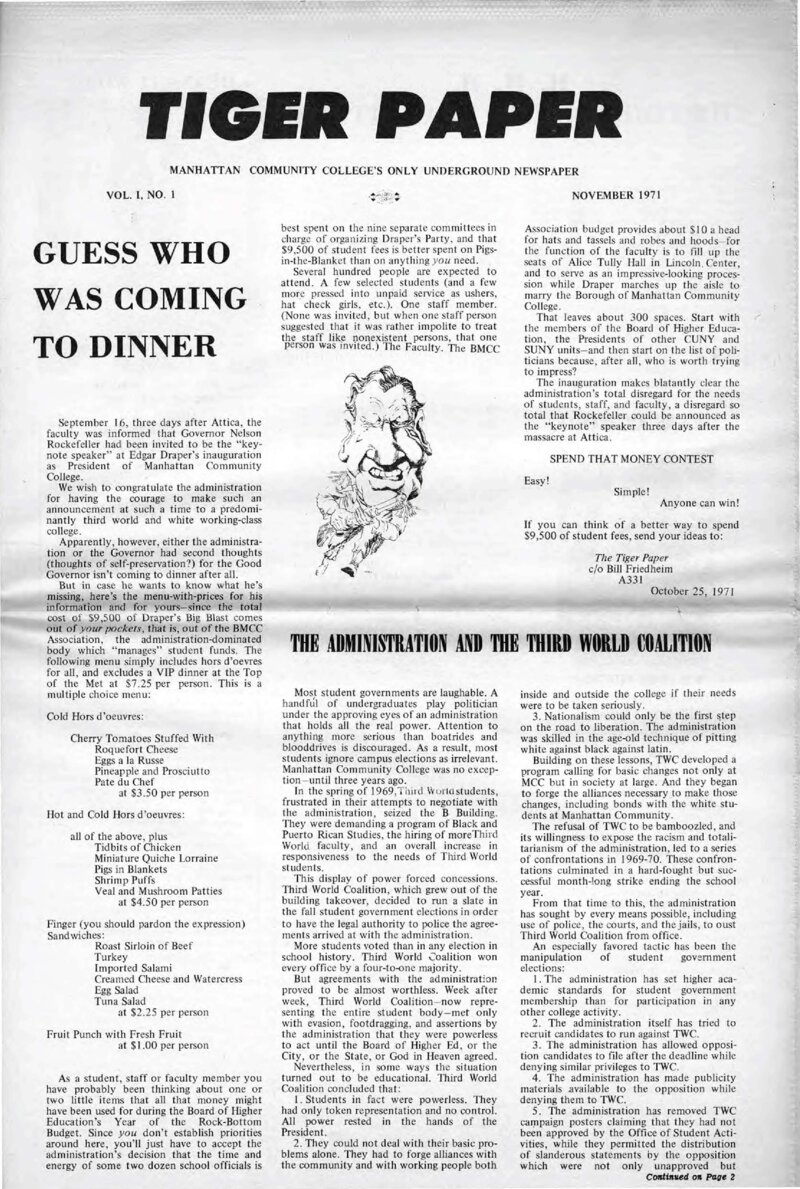
GUESS WHO
WAS COMING
TO DINNER
September 16, three days after Attica, the
faculty was informed that Governor Nelson
Rockefeller had been invited to be the “key-
note speaker” at Edgar Draper’s inauguration
as President of Manhattan Community
College.
We wish to congratulate the administration
for having the courage to make such an
announcement at such a time to a predomi-
nantly third world and white working-class
college.
Apparently, however, either the administra-
tion or the Governor had second thoughts
(thoughts of self-preservation?) for the Good
Governor isn’t coming to dinner after all.
But in case he wants to know what he’s
missing, here’s the menu-with-prices for his
information and for yours—since the total
cost of $9,500 of Draper’s Big Blast comes
out of your pockets, that is, out of the BMCC
Association, the administration-dominated
body which “manages” student funds. The
following menu simply includes hors d’oevres
for all, and excludes a VIP dinner at the Top
of the Met at $7.25 per person. This is a
multiple choice menu:
Cold Hors d’oeuvres:
Cherry Tomatoes Stuffed With
Roquefort Cheese
Eggs a la Russe
Pineapple and Prosciutto
Pate du Chef
at $3.50 per person
Hot and Cold Hors d’oeuvres:
all of the above, plus
Tidbits of Chicken
Miniature Quiche Lorraine
Pigs in Blankets
Shrimp Puffs
Veal and Mushroom Patties
at $4.50 per person
Finger (you should pardon the expression)
Sandwiches:
Roast Sirloin of Beef
Turkey
Imported Salami
Creamed Cheese and Watercress
Egg Salad
Tuna Salad
at $2.25 per person
Fruit Punch with Fresh Fruit
at $1.00 per person
As a student, staff or faculty member you
have probably been thinking about one or
two little items that all that money might
have been used for during the Board of Higher
Education’s Year of the Rock-Bottom
Budget. Since you don’t establish priorities
around here, you’ll just have to accept the
administration’s decision that the time and
energy of some two dozen school officials is
best spent on the nine separate committees in
charge of organizing Draper’s Party, and that
$9,500 of student fees is better spent on Pigs-
in-the-Blanket than on anything you need.
Several hundred people are expected to
attend. A few selected students (and a few
more pressed into unpaid service as ushers,
hat check girls, etc.). One staff member.
(None was invited, but when one staff person
suggested that it was rather impolite to treat
the staff like nonexistent persons, that one
person was invited.) The Faculty, The BMCC
NOVEMBER 1971
Association budget provides about $10 a head
for hats and tassels and robes and hoods—for
the function of the faculty is to fill up the
seats of Alice Tully Hall in Lincoln, Center,
and to serve as an impressive-looking proces-
sion while Draper marches up the aisle to
marry the Borough of Manhattan Community
College.
That leaves about 300 spaces. Start with
the members of the Board of Higher Educa-
tion, the Presidents of other CUNY and
SUNY units—and then start on the list of poli-
ticians because, after all, who is worth trying
to impress?
The inauguration makes blatantly clear the
administration’s total disregard for the needs
of students, staff, and faculty, a disregard so
total that Rockefeller could be announced as
the “keynote” speaker three days after the
massacre at Attica.
SPEND THAT MONEY CONTEST
Easy!
Simple!
Anyone can win!
If you can think of a better way to spend
$9,500 of student fees, send your ideas to:
The Tiger Paper
c/o Bill Friedheim
A331
October 25, 1971
*
THE ADMINISTRATION AND THE THIRD WORLD COALITION
Most student governments are laughable. A
handful of undergraduates play politician
under the approving eyes of an administration
that holds all the real power. Attention to
anything more serious than boatrides and
blooddrives is discouraged. As a result, most
students ignore campus elections as irrelevant.
Manhattan Community College was no excep-
tion—until three years ago.
In the spring of 1969, Vhird World students,
frustrated in their attempts to negotiate with
the administration, seized the B Building.
They were demanding a program of Black and
Puerto Rican Studies, the hiring of moreThird
World faculty, and an overall increase in
responsiveness to the needs of Third World
students.
This display of power forced concessions.
Third World Coalition, which grew out of the
building takeover, decided to run a slate in
the fall student government elections in order
to have the legal authority to police the agree-
ments arrived at with the administration.
More students voted than in any election in
school history. Third World Coalition won
every office by a four-to-one majority.
But agreements with the administration
proved to be almost worthless. Week after
week, Third World Coalition—now repre-
senting the entire student body—met only
with evasion, footdragging, and assertions by
the administration that they were powerless
to act until the Board of Higher Ed, or the
City, or the State, or God in Heaven agreed.
Nevertheless, in some ways the situation
turned out to be educational. Third World
Coalition concluded that:
1. Students in fact were powerless. They
had only token representation and no control.
All power rested in the hands of the
President.
2. They could not deal with their basic pro-
blems alone. They had to forge alliances with
the community and with working people both
inside and outside the college if their needs
were to be taken seriously.
3. Nationalism could only be the first step
on the road to liberation. The administration
was skilled in the age-old technique of pitting
white against black against latin.
Building on these lessons, TWC developed a
program calling for basic changes not only at
MCC but in society at large. And they began
to forge the alliances necessary to make those
changes, including bonds with the white stu-
dents at Manhattan Community.
The refusal of TWC to be bamboozled, and
its willingness to expose the racism and totali-
tarianism of the administration, led to a series
of confrontations in 1969-70. These confron-
tations culminated in a hard-fought but suc-
cessful month-long strike ending the school
year.
From that time to this, the administration
has sought by every means possible, including
use of police, the courts, and the jails, to oust
Third World Coalition from office.
An especially favored tactic has been the
manipulation of student government
elections:
1. The administration has set higher aca-
demic standards for student government
membership than for participation in any
other college activity.
2. The administration itself has tried to
recruit candidates to run against TWC.
3. The administration has allowed opposi-
tion candidates to file after the deadline while
denying similar privileges to TWC.
4. The administration has made publicity
materials available to the opposition while
denying them to TWC.
5. The administration has removed TWC
campaign posters claiming that they had not
been approved by the Office of Student Acti-
vities, while they permitted the distribution
of slanderous statements by the opposition
which were not only unapproved but
Continued on Page 2
—
i PAGE TWO TIGER PAPER
THE TIMES QUOTES DEAN PITTMAN &
The following excerpt is reprinted from a
New York Times article, “Dispute on Drugs
Dividing College,” which appeared on
Sunday, May 30, 1971.
Last spring the Puerto Rican faculty, con-
cerned about the widespread use of drugs at
M.C.C., called a series of press conferences.
The administration responded with a press
conference of its own. According to the
Times, “Administrators of Manhattan Com-
munity College maintained ... that students
were exaggerating the problem of drug usage
on campus and students asserted that adminis-
trators were failing to own up to it.”
The Times goes on to report:
Sample Pittman, associate dean of
students, said of the students agi-
tating for administrative action on
drugs, “‘They’re all Maoists, Com-
munists and militant socialists, bent
on destroying the American sys-
tem.”
DEANS AT WORK
DEAN LESTER WEINBERGER
PHOTOGRAPHS PICKETING STUDENTS
He called reporters to a private
news conference and showed them
a yellow pad that had 25 names on
it and was entitled “members of
revolutionary activists group.” (sic)
Each name was marked by an H.,
which he said stood for ‘‘hard-
core.” Some had three H’s.
At a public news conference later
he presented the theory with an
elaboration. “I wouldn’t be sur-
prised if they’re involved in these
cop-killings,” he shouted, pointing
to students raising complaints
about the drug problem.
His statement was greeted with
hoots and laughter.
WHATEVER HAPPENED TO PROMETHEUS?
The administration has prevented the publi-
cation of the student newspaper, Prometheus.
The staff of the newspaper had elected an
editorial board, but it has been unable to
function since school authorities have denied
it funds as well as access to the Prometheus
office on West SOth Street.
The administration has justified its decision
by claiming that only student government has
the authority to appoint the editorial board
and staff. It argues that since there is no stu-
dent government, it follows that there cannot
be a student newspaper.
The administration’s decision has no legal
basis. The by-laws stipulate that under certain
conditions and with cause, a student govern-
ment can—as it did last year—take over publi-
cation. of the coHege. newspaper... Student
government does not, however, have the
power to appoint or replace an editorial board
and staff whenever it feels moved to do so. It
must first hold a hearing before a board of
faculty and students to determine that the
newspaper is not being run in the best interest
of the student body.
The by-laws do not permit an administra-
tion to discontinue publication of a student
DEANS AT WORK
DEAN PITTMAN SEARCHING
FOR THE “HARD CORE”’
(Yearbook, 1971)
THE BMCC ASSOCIATION
The BMCC Association is charged
with responsibility for appropriating
approximately 300,000 dollars collec-
ted annually in student fees. The
Association consists of eleven students
selected by the Student Government
Association (but there is no student
goverrment, so there are no student re-
presentatives) and eleven faculty and ad-
ministrators. Of the latter, two are
elected by the faculty and the other
nine—mostly deans—sit automatically be-
dent is the chairman who holds an abso-
lute veto over any and all decisions.
The Association approves the annual
budget and elects a six-man Board of
Directors who make all important day-
to-day decisions on who spends how
much for what. The President is the
MAY, 1971 (Prometheus) newspaper in anticipation of an election of a seventh eatin of este Powe ana again
new student government which might or Femibuate a ule f ie Sead base
EES DOL Se eas DONS 2 Or eoeanon iE eruliar: students on the
VERSUS VERSES i LI ee Di ae be association get to vote only for the three
Dear Dean Pittman’s long been thinking
What a swell place this would be
If all the students were transported
Right into the penitentiary.
Old Dean James played merry old games,
like saying, I think John Doe might possibly
commit a crime next year so why don’t we
find him guilty before the fact and hang him
on the nearest tree.
All of this, of course, raises questions about
the administration’s motives. When it delays
student government elections and then stops
the publication of the student newspaper,
then we can only conclude that it is trying to
silence the voices of those who disagree with
student members of the Board. Faculty
and administrators vote for their three
members. The President sits automati-
cally.
Such an arrangement virtually guar-
antees that on every critical issue the
vote will show three students on one
side, three faculty-administrators on the
other, and the President “reluctantly”
TEN NG LT At
;
And merry old games played he: it { voting to break the tie in guess-whose
i - favor.
ed chaps mesa If you want to gain knowledge you must par- : In a nutshell: The President and the
And he called for the Infirmary. ticipate in the practice of changing reality. If ¢ ; deans control the expenditure of money
you want to know the taste of a pear you f from student Mien which is eg Lies!
had worked seven years or more/Must change the pear by eating it yourself. be spent on student activities, but which
Boe ee incon since: ... All genuine knowledge originates in direct is more and more frequently spent on
But while she was out ; experience. items like the President’s inauguration.
On vacation this year —Mao Tse-tung, July, 1937 ie } : |
James decided that his files needed space. Swe Pee a
ff ase THE ADMINISTRATION AND THE THIRD WORLD
So he threw all her stuff in a filthy old room :
With no sink and no toilet and no phone; unsigned. Continued from Page 1
Now James has his files
Right near at hand
And the nurse has the bone she was thrown.
Draper has a little lamb,
His job is highly hack:
“We’ll see,” says he,
And then shafts you
When you have turned your back.
Lester, Lester, quite contrary,
Where did you learn your trade?
“Where a man becomes a real man, boy,
For my mind is Army-made.”
6. The administration has cooperated with
the Immigration and Naturalization Service in
attempts to institute deportation proceedings
against the current student government Presi-
dent on the grounds that he is an “undesirable
alien.”
7. The administration “misplaced” the cor-
rect lists of eligible voters in last Fall’s elec-
tion. Approximately one out of every two
students trying to vote was told that he would
not be permitted to cast a ballot.
8. The administration scheduled last
Spring’s election to take place two days after
classes ended.
9. The administration is the only one in all
of City University to deny the legality of an
election when less than 30% of the student
body votes. And yet it has done everything in
its power to make sure that the total vote is
less than 30%.
Despite this harassment, Third World
Coalition has won every office in every elec-
tion since the Fall of 1969. But the key is the
30% Rule. Last Spring’s election was declared
invalid because the administration made it im-
possible to vote. Will the same thing happen
again?
October 25, 197]
TIGER PAPER
DRAPER READS
STATE OF THE COLLEGE MESSAGE
TO ASSEMBLED THRONG
Control is essential to any administrator’s
job. A college president is no exception to
this rule.
At the first faculty meeting of the school
year on Wednesday, September 1, the presi-
dent’s control of the school was the only mat-
ter that seemed to concern him. While the
meeting had its humorous moments, its essen-
tial purpose was to discipline the faculty in
advance of any serious trouble similar to that
of last Spring and Summer.
A number of events over the past six
months had brought into question the presi-
dent’s authority and resulted in bad publicity
for the school.
e In’ May, the Puerto Rican faculty
threatened to| resign en masse, citing as
one of their reasons the Administration’s
unwillingness to deal with a campus drug
problem of disastrous proportions. Sev-
eral days later, when the New York
Times picked up the story and ran it on
page one, the administration found itself
in a rather embarrassing position.
e The school continued to receive a bad
press when in July newspapers carried
accounts of the suicide of a student ona
college sponsored trip to Africa.
e Even though classes were over and many
instructors and professors had left, 102
faculty signed a petition in June asking
the Board of Higher Education to inves-
tigate the almost daily and seemingly
arbitrary arrests of students which to-
gether with violations of parliamentary
procedure at faculty eetings and other
undemocratic practices had created an
atmosphere of fear and intimidation at
the college.
Evidently Draper had gotten a very clear
message from his superiors at the Board of
Higher Education and in the chancellor’s of-
fice—get your house in order.
Of course if you cannot get your house in
order then the next best thing is to make it
look like it’s in order. So at the beginning of
the meeting, Draper announced the appoint-
ment of a new public relations officer, who
upon introduction, mechanically popped out
of his seat, smiled a nervous smile, and just as
mechanically popped back into place. Maybe
he was nervous because he knows that he is
no more secure in his job than any other
school functionary, for his position not only
depends upon his ability to place stories in
the mass media that portray dear old BMCC
and its president in a favorable light, but de-
pends upon his skill in keeping unfavorable
ones out. ;
The purpose of public relations is to mani-
pulate the way people see a situation. In order
to bolster his shaky authority, the president
tried to serve as his own PR man at the
faculty meeting. The results were rather
comical.
Draper played the role of the victim. He
told the faculty that the past six months had
been terribly trying and that he had suffered.
It was as if the New York Times, the Puerto
Rican faculty, certain students, 102 petition-
wielding faculty, the young man who com-
mitted suicide and other assorted bad guys
had conspired to victimize ‘‘your’’ president.
All of these people according to the presi-
dent, had brought undeserving shame upon
the school and the administration.
The Puerto Rican faculty, the New
York Times and certain students had
dramatized a serious drug problem
where supposedly none existed, since
the college had mysteriously deter-
mined that there were only fifteen
needle-scarred, hard-core, card-carry-
ing addicts at BMCC.
The 102 faculty (bad children) had
not come to big daddy president with
their problem before going to the
Board of Higher Education. In fact
they had come to him many times
only to realize that Big Daddy WAS
the problem.
The young man who committed sui-
cide, Draper suggested, put the school
in an awkward position where it had
to explain away what happened.
Outrageous as these attitudes are, they are
not really funny. They are the views of bur-
eaucrats whose only priority is control, and
maintaining the public image that will pre-
serve it.
The Administration is ready to make cyn-
ical use of the economic crisis, ‘faculty
accountability,” and student evaluations to
keep the staff in line. Because of the fiscal
crisis, faculty are more vulnerable. As instruc-
tional lines disappear, faculty must increase
individual “‘productivity” to hold their jobs.
At the moment, increased ‘‘productivity”
PAGE THREE
simply means larger classes and more of them.
However, the president hinted that the college
might also devise quantitative measures to
gauge teaching effectiveness. The question, of
course, is who will determine the criteria?
And how, we may ask, will student evalu-
ations enter into the equation? Dean Eric
James let it slip that he plans to channel these
evaluations through his office. That means
“watch out!” The administration is using a
necessary and essential reform—student evalu-
ations—only insofar as they can be employed
selectively to punish faculty.
And why is it that only students, staff, and
faculty feel the university’s economic
squeeze? Draper pleads poverty, yet funds
materialize for a gala inauguration’and for re-
decorating administrative offices, and the
Board of Higher Education appropriates
$50,000 to house him in presidential sple-
ndor. The CUNY Graduate Faculty and their
students live in the lap of luxury at the 42nd
Street Center while what a former MCC presi-
dent called “cur campus in the sky” de-
teriorates into a high-rise ‘slum. Are some
more equal than others?
Finally, what the president and Dean James
made abundantly clear at the meeting was
that faculty should be seen, but not he-
ard—unless, that is, their lines have been
written for them by the Administration,
The presidential task forces on college gov-
ernance and structure are a case in point. The
committees were not elected, but rather hand
picked by Dean James and assigned specific
tasks which engage faculty in busy-work.
“Once all the reports are submitted, it is the
Administration that will assemble them into a
final document. And lest anyone think that
the final script has not already been written,
James gave the Administration’s game away
when, with characteristic arrogance, he an-
nounced that the task force reports would be
submitted to the Board of Higher Education
“as the president sees fit.”
__ The president does what is in his own
interest, which is what best Serves those who
appointed him. When the president enforces
restrictive tenure policies, appoints depart-
ment chairmen, and totally dominates faculty
meetings, it becomes clear that the faculty is
not a privileged class that has a harmony of
interest with the Administration. In the face
of economic recession and _ increasing
academic repression, faculty must pay for
whatever privileges they get by becoming the
Administration’s yes-men.
Only when the faculty becomes aware of
its collective strength and begins to define its
own interests, will it be in a position to act,
rather than be acted upon.
TASK FORCES OR TASK FARCES?
Last spring, as directed by the Board of
Higher Education, Dean James established
task forces of administrators, faculty, and stu-
dents to propose new directions for the
structure and governance of Manhattan Com-
munity College. At first many committee
members expected to be able to do some real
work toward improving the college. Subse-
quently, many of them especially those on
the more crucial committees, have become
disillusioned—for good reason: most of the
task force committees are a farce.
The Administration is guilty of:
e Continuing attempts to keep important
task force committees under its control.
(All members were appointed by the Ad-
ministration to begin with; a number of
volunteers were refused.)
e Rendering the work of the committees
ineffective if committee conclusions do
not coincide with what the Ad-
ministration wants.
e Discouraging student participation on
the committees. (Many student members
have graduated. No: new students have
been chosen to replace them.)
e Attempting to use the committtes to
rubber stamp policies handed down from
above, and disregarding the work of the
committees if they refuse to do so.
The Administration has turned most of the
task force committees into purposeless bull
sessions, full of sound and fury, signifying
nothing. It is trying to siphon off faculty dis-
content into ineffectual busy work.
Task Force on Academic Governance
There is only one lecturer on this task force
committee and no instructors. The one lec-
turer was appointed only after members of
the faculty protested the lack of junior fac-
ulty.
The Administration in order to keep tighter
control has been shaping and reforming the
committee at will. At its most recent meeting
two more deans and two more department
chairmen appeared for the first time. They
had just been appointed by Dean James in an
apparent attempt to stack the committee in
the administration’s favor,
Proposals presented by faculty members of
the committee have not been given any ser-
ious consideration. Instead, the committee
chairman insists time after time on debating
the question of ‘ta bicameral vs. a unicameral
legislative body,” as a diversionary tactic to
keep the committee from its real business.
There is only one student on the com-
mittee.
Meetings are infrequent, occasionally can-
celled without notice, and dominated by the
chairman, Prof. Targum. At the last meeting
he tried to get the Task Force on Governance
to immediately approve a proposal that an
Academic Review Committee be appointed
by the College-wide P. and B. Committee. An
Academic Review Committee is a body to
which faculty members can appeal un-
favorable decisions of the College-wide P. and
B., relating to appointment, re-appointment,
and tenure. The Board of Higher Education
has mandated an Academic Review Com-
mittee; however, the Board does not stipulate
that the members be appointed by the Col-
lege-wide P. and B. Such an arrangement
would make a farce of any autonomy the Re-
view Committee might have.
A majority of the people on this task force
refused to rubber stamp Prof. Targum’s pro-
posal. continued on 6
PAGE FOUR
TIGER PAPER
THE STORY OF THE CHILDREN’S.CENTER
One student demand which emerged from
the Spring 1970 strike at Manhattan Com-
munity College was for a child care center. A
year later, after a prolonged struggle, the cen-
ter was born. It is open this semester at 1595
Broadway (on the second floor) and provides
free child care for the children of M.C.C.’s
day students.
The center is an example of the positive
accomplishments that result from people
getting together and staying together to fight
for services essential to them. During the
strike a Child Care Committee was formed,
made up of representatives from the M.C.C.
Women’s Liberation Club and the Third
World Coalition, along with parents and a few
faculty men and women. They put in months
of hard work and endured many fruitless
meetings with administrators before the cen-
ter became a reality.
When the administration at long last ac-
quiesced to the idea of a children’s center,
under pressure from the committee, a few of
them started talking a good line. At one
meeting President Draper said: “The adminis-
tration is here to service you. Just tell us what
you want us to do.” The Child Care Com-
mittee responded immediately with requests
they had presented in vain for weeks—lists of
items to be requisitioned, a request for con-
tracts for the co-directors, and requirements
for space. Many more weeks were wasted,
however, because despite what the President
said, Dean Weinberger dragged his heels. He
was unavailable for days on end, made
appointments he failed to keep, and was rude
and discouraging to members of the com-
mittee. The center could not open in Feb-
ruary of ’71 as planned. It was not operating
on a full scale until Summer Session. Some of
the requisitions ordered last winter have only
just come in. What has been at last accom-
plished has happened because of the perse-
verance and determination of the Child Care
Committee, not through any benevolence on
the part of male administrators.
Progress and Problems
The free Children’s Center is a start toward
ending discrimination against women who
wish to attend Manhattan Community Col-
lege, in particular working-class Black, Puerto
Rican, and white women who cannot afford
costly day care facilities or baby sitters.
In an interview Dorothy Randall and Susan
Cammer, the co-directors, said that mothers
called up all week before this fall’s registra-
tion. If it wasn’t for the Center they said,
they would not be able to go to college. “‘All
the time the mothers thank god the Children’s
Center is here.” Thirty children are using the
center now, 90% of them Black and Puerto
Rican.
But this is just the beginning. The directors
were asked what problems still existed and
presented a long list. No work-study students
were assigned until the Center had been
opened for two weeks; for two weeks
Dorothy and Susan had to manage by them-
selves, without even being able to take an
hour off for lunch. They are worried that the
budget for the forthcoming year will not be
adequate. They are waiting for the results of
the BMCC Association meeting to find out
how much it will be. The Children’s Center
handled eighty children during Summer
Session. In September part of that space was
taken away. Until more space is provided and
more work-study students are assigned, there
can be no program for the children of evening
students. To have a proper program for
evening students’ children, they also need an-
other full-time trained person. The male ad-
ministrators the Children’s Center has to deal
with are either pleasant but ineffectual or
downright unco-operative as is the case with
Dean Weinberger, who told the directors that
he personally held up the requisitions all
summer because he didn’t have time to make
one phone call.
What the Center Needs
The directors need a copy machine, prefer-
ably a mimeograph machine. If anyone has
one, please get in touch with Dorothy Randall
or Susan Cammer.
They would like more parent involvement
in the Children’s Center. If any mothers or
fathers are interested, please speak to
Dorothy or Susan.
The Center is in great need of hot water,
which only the college can provide. So far it
has refused to.
The Directors would like to get an estimate
of how many parents might use the Center
next semester. If you are interested, please fill
out the following, and take it to 1595 Broad-
way and 48th, second floor—or mail it to the
Center. (The Center can take only toilet-
trained children.)
I would like to use the Children’s Center next
semester (Spring, 1971).
Names.
Address:___
Phone Number:
Name of child (children): 5
Age(s): =
Day
; Evening
THE, CHILDREN’S CENTER
HAS NO HOT WATER
Mr. Gorelick in Dean Weinberger’s office
told the directors that the school is re-
quired to give the center heat but the
school is not required to provide hot
water for the Children’s Center. The
health of the children is in jeopardy. Hot
water is necessary for sanitation and
health.
w=
TIGER PAPER
The Secretaries:
Without them, BMCC absolutely could not
function. They’re as necessary to the daily
activities of the school as are students and
faculty, and a lot more important to us (and a
lot harder working) than most administrators.
All the same, they are low-paid and low-
rated, forced to punch time clocks, compelled
to work on school holidays, restricted from
all social functions from Christmas parties to
Presidential inaugurations. And though they
are indispensable members of the college com-
munity, MCC staff members—custodians,
secretaries, clerks—have no voice at all in
college affairs, not even on issues which di-
rectly affect them, such as child care.
Consider for a moment just a few of the
frustrations and humiliations endured by
college secretaries:
* In some departments, one or two secre-
taries do all the work for as many as fifty or
sixty faculty members.
* Transfers of secretaries from one depart-
ment or building to another are at’ the whim
of administrators, and though grievance
machinery does exist, past examples of retali-
ation make people afraid to use it.
* In the B, D, L and M buildings, there is
not so much as a corner where secretaries can
relax during lunch or breaks.
* A secretary punches the time clock in in
the morning, out at lunch, in again after lunch
and out again at night.
* Most secretaries address all faculty and
administrators as “Doctor” or “Sir” or
“Professor,” while most of them address her
by her first name, even if they’re twenty years
younger than she is. Once, when a union offi-
cial called the school and asked for Mrs.
Smith, the man for whom she had worked for
two years said there was no one there by that
name. His secretary was Jane, and he didn’t
even know her last name. (We are of course
not recommending formality of address, but
equality of address.)
Salary Squeeze
All of these indignities help to break
workers’ spirits, keep them from under-
standing the immense importance of the work
they do, and from feeling good about them-
selves as people. Above all, they help keep the
secretary in her place when new contract time
rolls around.
Wage control is odious for all workers, but
the wage squeeze is especially hard on secre-
taries whose new contract will be negotiated
this June under the pressure of Nixon’s starve
-a-worker-today policy.
There are two ways in which secretaries’
salaries are limited: first, the low scale itself;
then, the complex ways of preventing promo-
tion. These are CUNY secretaries’ salaries
negotiated during the last contract three years
ago:
College Secretary A
after July 1, 1969
minimum: $5,800
maximum: 7,860
after July 1, 1970
PAGE FIVE
M.C.C.’S INVISIBLE PEOPLE
minimum: 6,100
maximum: 8,460
after July 1, 1971
minimum: 6,600
maximum: 9,060
No Test, No Raise
Regardless of past experience, each secre-
tary is hired as a College Secretary A at the
minimum salary. Each secretary is raised to
the next minimum salary plus about $200.
Someone who has worked for Manhattan
since 1969 is now earning about $400 more
than a newly hired person. Try to raise one or
two kids in New York City—no less make it
yourself—on that salary! Furthermore, we
have no cafeteria here in our mid-town loca-
tions where anyone can get reasonably-priced
lunches. There is not so much as a refrigerator
where a secretary can keep yogurt. It should
be noted that on May 29, 1970, the faculty
voted to supplement workers’ demands for
abolishing the time clock, vacation days with
pay on school holidays, time off for staff
meetings, and the establishment of a non-
profit cafeteria. (But the faculty clearly has
no more power than the staff in this school,
and we are all still waiting for implementation
of what was agreed upon.)
To be promoted from an “A” to a “B” is
no promotion at all, since “A”s are already
doing as much work and have as much respon-
sibility as any human being could handle—but
it’s the only way you can get a real raise.
Secretary Helen Vorensky
To be promoted from “A” to “B” requires
that you pass a Civil Service test. Tests are
very infrequent. The last one (which has yet
to be graded) was given last June; the one
before that was three years ago. The union
contract says that 45% of the secretaries in
each school must be at the “B” level. But if
you can’t get to “B” without passing a test,
and the test isn’t given, the percentage of
“A”s grows larger and larger and the City
saves the difference on salaries.
Failure Built In
When the test was finally given last June, it
was rigged to produce an exceedingly high
failure rate. Before the test the union offered
a course for which each secretary paid $20.
The union, reasonably enough, used past tests
and information concerning the nature and
requirements of the job to train women for
ten weeks prior to the exam. 1,349 women
took the text. Approximately 80% failed.
(The exact figures s¢il] are not out.) How
come? Would the City argue that secretaries
just aren’t too bright, on the whole, and just
couldn’t make it, even after a ten-week
course?
The truth is that the City didn’t even try to
devise a test so difficult that 80% of the
women would fail. In fact, it devised no
test at all for secretaries—but gave them pre-
cisely the same exam given to office super-
visory personnel, that is, to people whose jobs
are entirely different from those of college
secretaries.
The Time Clock
Was it really precisely the same test? The
answers were published in THE CHIEF, the
Civil Employees Weekly, on June 2, 1971.
Every one of the hundred questions asked of
the secretaries was the same as those asked of
supervisory personnel,
The tests will have to be regraded on a
curve to achieve the 45% required by contract
(we hope). But this leaves even those who
finally pass feeling inadequate and unde-
serving. Many feel that they’re not really en-
titled to the raise because they didn’t really
pass the test—even though they know in their
heads that the test was supremely unfair. And
promotions (raises) based only on such absurd
criteria cannot help but create low morale
among workers.
Learn To Bea Zombie
The test questions themselves (designed, of
course, for supervisors and not for secretaries)
are revealing. They give us much insight into
the authoritarian nature of work relation-
ships. They show us how, on every count,
thinking, initiative, in fact any constructive
effort on the part of the person being super-
vised (typist, stenographer, clerk) is discour-
aged by a system of rote answers which super-
visors are supposed to memorize and spit back
at their “subordinates.” Here is just one
example (though the test provides dozens):
An employee’s performance has fallen
below established standards of quantity
and quality. The threat of monetary or
other disciplinary action as a device for
improving this employee’s performance
would probably be acceptable and most
effective:
(A) only if applied as soon as the per-
_ formance fell below standard.
(B). only after more constructive tech-
niques have failed
(C) at any time provided the employee
understands the punishment will be
carried out
(D) at no time
One secretary, who understood her position
as an adult human being (as well as an adult
covered by a union contract), answered (D).
She was marked wrong; (B) was the “‘correct”
answer.
Students are coming to understand that
they too will be workers when they graduate.
Faculty members, as workers, are beginning
to see that the same administrations (school,
City and State) which seek to demoralize and
immobilize secretaries have the power to stuff
their classrooms and raise their teaching loads.
Staff members are increasingly aware of how
they are manipulated into accepting low self-
esteem and similarly low salaries. Students,
faculty and staff are coming to know that
they must support one another individually
and en masse if any of them is to survive.
TIGER PAPER PAGE SEVEN
THE WAGE PRICE FREEZE:
A Cold Shoulder for the Poor and the Middle Class
covery by the auto industry that it has on its
businessmen.
Bit by bit, the truth comes out. What we
might have guessed would happen is hap-
pening: When the country gets into an eco-
nomic crisis, it’s ordinary people who feel it
worst, and when the government comes up
with a solution to the crisis, it’s ordinary peo-
ple who are expected to make the sacrifices.
The rich are solicitously cared for. They suf-
fer least and profit most.
Last spring, when the government was run-
ning short what happened?
—Welfare cuts
—Education cuts
—Health care cuts
—Employment cuts
Right here at Manhattan:
—Landlords got over a million dollars in rent
from the college
—The President got his $40,000 a year plus
$50,000 to buy him a home and pay for
maids and a chauffeur
But at the same time:
—Work-study was virtually eliminated
—Loans were cut
—Child-care funds were cut
—Staff who worked over the summer on
orientation were denied their pay
eee IN CONCLUSION, FELLOW
PEASANTS, LET ME STRESS
THE NEED FOR
PEACE AND HARMONY.
:§
H
America has become great by rewarding her
—Richard M. Nixon, August, 19717
Now, of course, there is a national plan for
dealing with the crisis—a wage .and price
freeze.
So far, the results are fascinating:
—Layoffs of government employees
—Abandonment of welfare reform
—Higher prices for imported goods
—Overcrowded classes and heavier workloads
for teachers
—Reduced aid for students
—Reduction in school lunch programs
But at the same time:
—No limits on corporate profits, on stock div-
idends, on interest charged by the banks.
—Tax bonuses for corporations
—Loopholes that permit price increases (e.g.,
Aluminum)
—No effective limits on the incomes of exec-
utives
And it turns out that the oil companies
were tipped off to the freeze in advance+so
that they had time to raise gasoline prices be-
fore it took effect (WINS, 9/20/71, quoting
Congressional testimony). Clearly not the suf-
ferings of ordinary people, but the needs of
giant corporations prompted government ac-
tion. How else would you explain that the
freeze follows right on the heels of the dis-
REMEMBER THE GOLDEN
RULE... WE MUST ALL
Live BY THE GOLDEN
hands the largest number of unsold cars in its
history?
Well, so what? Won’t we benefit in the long
run? Won’t prices stay down? And won’t cur-
rency changes and import quotas and tax in-
centives for business create more jobs?
First, productivity—what a person can pro-
duce in an hour of work—is always going up.
If your wages are frozen, who gets the benefit
of the increase in your productivity? Not you.
Not the consumer either. Prices are frozen as
well as wages. The businessman gets it all. In
other words, without wage increases and price
reductions, massive amounts of income are
taken from ordinary citizens and given to the
wealthy.
Second, tax concessions to business have
the same result. A larger share of public ex-
penses has to be carried by ordinary people.
Third, import quotas and surcharges make
foreign goods more expensive and permit do-
mestic producers to maintain current high
prices.
Fourth, currency changes that make Amer-
ican goods cheaper for foreigners to buy seem
likely to lead to retaliation by foreign govern-
ments.
But isn’t it true that if the rich get enough
favors, if they make greater profits, they then
invest more, produce more, and hence create
jobs? If the rich get richer won’t something
trickle down through their fingers to you and
me?
Not really. There already exists 27% more
plant and machinery than the corporations
can profitably use. It now lies idle. Why
should they invest in more?
And anyway, government layoffs and de-
creased budgets will cancel any benefits that
might arise from new investments. If you
create more jobs in one sector of the
economy only to eliminate them in others,
you’re back where you started. Third World
people are likely to be in the worst shape
since most of the cuts will occur in those
areas which most directly affect them: health,
welfare, education and government employ-
ment.
As for those measures designed to reduce
foreign competition, remember two can play
that game. Other countries will not take re-
strictions against the sale of their goods lying
down. We will end up selling even less abroad
than we do right now. And there will be fewer
jobs in those industries that depend signifi-
cantly on overseas sales. 3 ‘
The whole thing is a pathetic and im-
provised hoax. But Nixon’s New Economic
Policy has deadly implications.
First, it robs the poor and the middle class
without holding out any hope of easing their
problems. It does nothing to resolve the un-
derlying contradiction in American life; the
exploitation of the many in the interest of a
few.
Second, the NEP is a big step—along with
welfare payments to Penn Central and Lock-
heed—on the road to state capitalism. We are
moving rapidly toward a government con-
trolled but privately owned economy in
which control operates essentially if not ex-
clusively for the rich. NEP is a step toward
precisely that economic system that prevailed
in Fascist Italy and Nazi Germany in the thir-
ties and forties. It will mean more, not less,
militarism more, not less exploitation of the
Third World.
T MAKES THE
A RULES.
PAGE EIGHT
TIGER PAPER
REMEMBER ATTICA!
Rockefeller: Racist, Murderer, Enemy of the People
The Attica prison rebellion, according to
Nelson Rockefeller, is ‘another symptom of
the deep-seated illness of our society.” His
prescription for sick America is standard
among our rich physicians: apply rhetoric
liberally to affected areas; patch with white
band-aids; isolate stubborn cases; purge with
bullets during severe outbreaks.
If that treatment sounds dangerous to you,
it’s no wonder. For when the disease pretends
to be the doctor, the patient is surely going to
be killed instead of cured.
The governor’s consultants in this deadly
charade, the “impartial” state and federal
investigating committees, won’t come much
closer than Rockefeller himself to naming the
real sickness. They’ll admit the justice of the
28 demands accepted by Commissioner
Oswald before Rockefeller ordered the attack
on the prison; acknowledge the existence of
racism inside and outside the penal system;
recommend, for the thousandth, the millionth
time, “real social and economic change.” A
couple of the committees may actually go so
far as to condemn Rockefeller for using
“excessive” or “unnecessary” force. And then
the bundle of papers produced as epitaph for
43 dead men will be quietly filed away under
the heading Tragic Mistakes.
But Rockefeller’s assault on Attica was not
a mistake. It was, first of all, the logical out-
come of legalized, institutional racism in the
U.S. No amount-of whitewash can cover up
the blood-link between the massacre at
Attica, the murders of George Jackson and
Fred Hampton, the shootings at Orangeburg,
Jackson State, and Augusta, the killings and
brutalities by police in the black and Puerto
Rican ghettoes of the North. The fact that at
Attica white hostages were also slain by State
bullets doesn’t blunt the charge of racism; it
simply exposes a sometimes-hidden feature of
racist policy—the willingness to spill white
blood, too, if suppression of Black and Third
World militancy requires it.
Yet, unmistakably racist as it was,
Rockefeller’s attack on Attica has to be seen
in another context as well. The rebellion re-
presented a new level of threat to the system
that legitimizes Rockefeller’s wealth and
authority. Unlike ghetto risings, it was highly
organized. Unlike protest demonstrations, it
not only spoke the language of people’s
power, it translated that language into action.
And unlike many of the militant people’s
movements outside the prisons, it was a multi-
racial movement, uniting oppressed blacks
and browns and whites so closely in their
common interest that they were willing to
risk death together.
When people are angry, “angry from too
much suffering,” as one Attica inmate put it;
when they overcome the efforts of all our
institutions to confuse and divide them; when
they stop petitioning and start organizing;
when their organization and solidarity chal-
lenges the whole system of law-and-order that
jails the poor and crowns the rich; when the
struggle for justice and the right to live sparks
to such a point, who’s more frightened, more
vicious, more bloody-minded than a man like
It’s A Family Tradition
Rockefeller, whose wealth and power rest on
the poverty and powerlessness of millions, at
home and abroad?
] We should be outraged by what Rockefeller
did, yes, but we should not have been sur-
prised. For a look at American history shows
that in unleashing violence at Attica
Rockefeller was acting true to form for a
member both of his family and his class. His
grandfather John D. Sr. (founder of the
family’s Standard Oil empire) and fellow
robber barons like banker J. P. Morgan and
steelman Henry C, Frick and railroad magnate
Jay Gould habitually used violence to crush
people’s efforts to secure even a minimally
human existence and to organize in their own
interests. “I can hire one half the working
class to kill the other half,’ Gould boasted in
1886, and six years later, when Henry Frick
waged a war of arms and starvation against
working people in the famous Homestead,
Pa., steel strike, Rockefeller Sr. applauded
Frick’s campaign against “anarchy.” He him-
self allowed no bargaining with workers in his
companies; thinking of himself as a ‘“‘good
master,”’ he insisted that his employees be-
have like “obedient servants.””
From the 1870’s tu the 1930’s, on the rail-
roads and in the mines and factories and
sweatshops, American workers had literally to
pay with blood to win a living wage, protec-
tion against wage cuts, an eight-hour day, safe
working conditions. Against the concerted
power of big business, they sought to form
unions, recognizing solidarity and the power
to strike as their chief resources against the
Rockefellers, Morgans, Fricks and Goulds
who overworked and underpaid them and
tried to keep them ignorant and at war with
each other instead of with their exploiters.
The Rockefellers not only used their own
private armies of company gunmen to put
down strikes, but also drew on federal, state
and local troops, lent them by government to
preserve ‘law and order.” From 1880 to 1904
in Colorado alone, where the Rockefeller fam-
ily owned huge mining interests, troops were
ordered out against strikers on ten separate
occasions, at a cost of over a million dollars to
state taxpayers, and despite the existence of
state laws which guaranteed workers the
rights which the owners refused to concede
them.
The Rockefellers and the other company
owners fought the strikes furiously for long-
term as well as short-term reasons; more than
anything else, they wanted to prevent wide-
scale organization among working people.
Even when the courage and endurance of
strikers forced owners to grant more pay,
shorter hours, and better working conditions,
the owners resisted to the bitter end the
recognition of the unions themselves (and
they still do, as is clear from the struggles of
Cesar Chavez and the California farmworkers
in the 1960’s and numerous cases in the rela-
tively ununionized South today).
In the early part of this century Nelson
Rockefeller’s father, John D. Jr., was among
those who tried to destroy the unions whole-
sale, and, failing that, tried to preserve the
so-called open shop, where the employers had
the option of hiring non-union labor. Com-
bined with intimidation and blacklisting of
union members and activists, the ““open shop”
was intended to keep the workers divided and
thus maintain the power of the owners. John
D. Jr. never spoke publicly in these terms;
Gould-style candor was no ijonger possible, for
working people had made gains in spite of the
owners’ all-out war against them. Rather, as
during the 1913-14 strikes in the coalfields of
southern Colorado (owned largely by Rocke-
feller interests), John D. Jr. claimed that the
owners favored the open shop in order to pro-
tect the right of “American workmen...
under the Constitution, to work for whom
they please. That is the great principle at
stake. It is a national issue.”
In. April. 1914,, inthe name, of, this great
principle—which amounted to the workers”
“right” to be exploited as the owners
pleased—the famous Ludlow Massacre oc-
curred. State militia and company guards ma-
chine-gunned the tent camp where the
striking Ludlow, Colo., miners and their fam-
ilies were living, and set the oil-drenched tents
on fire. More than 30 people, including 13
children, were killed and over a hundred were
burned and wounded in this one incident
alone.
M'N.ROCKEFELLER
auas “KEROSENE”
ULPABLE oc ROBO
ASESINATO
ESTAFA
FRUST
y EXPLOTACION on
PUEBLO DE LATINOAMERICA
(This is some of the history we are never
taught in school. If you want to know more
about the “other America,” read Boyer and
Morais’ Labor’s Untold Story, Josephson’s The
Robber Barons, and Haywood’s The Autobio-
graphy of Big Bill Haywood for a start.)
Like grandfather, like father, like son. Nel-
son’s Massacre at Attica, it would seem, fol-
lows an old family and class tradition. Al-
though the social forces now contesting
TIGER PAPER
Rockefeller law-and-order are different from
those John D. Sr. and Jr. tried to check, Nel-
son’s reasons for suppressing those forces are
just as urgent to him. His decision to commit
mass murder at Attica was well-nigh in-
evitable; as one of the men who own and con-
trol America and who intend to keep owning
and controlling it by any means necessary, did
he really have any other choice? From his
point of view, the demands of the inmates
were not the real issue; the crux of the
struggle was power. A fully successful rebel-
lion at Attica—demands achieved, without
casualties, on the inmates’ own terms—would
have provided a model, an image, of organized
people’s power for prisons and cities and
schools throughout the country. That could
not be allowed, the revolt had to be crushed,
especially in a period when economic con-
ditions are worsening for the majority of peo-
ple (most disastrously for those at the bot-
tom, as always), and a mood of generalized
discontent is building.
FROM GEORGE JACKSON’S LETTERS
These prisons have always borne a
certain resemblance to Dachau and
Buchenwald, places for the bad niggers,
Mexicans, and poor whites. But the last
ten years have brought an increase in the
percentage of blacks for crimes that can
clearly be traced to political-economic
causes. There are still some blacks here
who consider themselves criminals—but
not many. Believe me, my friend, with
the time and incentive that these
brothers have to read, study, and think,
you will find no class or category more
aware, more embittered, desperate, or
dedicated to the ultimate remedy—revo-
lution. The most dedicated, the best of
our kind—you'll find them in the Fol-
soms, San Quentins, and Soledads. They
live like there was no tomorrow. And for
most of them there isn’t. Somewhere
along the line they, sensed this. Life on
the installment plan, three years of
prison, three months on parole; then
back. to start all over again, sometimes in
the same cell. Parole officers have sent
brothers back to the joint for selling
newspapers (the Black Panther paper).
Their official reason is “Failure to Main-
tain Gainful Employment,” etc,
We're something like 40 to 42 percent
of the prison population. Perhaps more,
since I’m relying on material published
by the media. The leadership of the
| black prison population now definitely
identifies with Huey, Bobby, Angela, El-
dridge, and antifascism. The savage re-
pression of blacks, which can be esti-
mated by reading the obituary columns
of the nation’s dailies, Fred Hampton,
etc,, has not failed to register on the
black inmates. The holds are fast being
broken. Men who read Lenin, Fanon,
and Che don’t riot, “they mass,” “they
rage,”’ they dig graves.
SS
If the economic crisis deepens, and if the
American people refuse to accept Nixan’s so-
lutions favoring the corporations at the ex-
penses of the public, we may see a resurgence
of social struggle on many fronts and possibly
the creation of alliances between white and
Black/Third World groups. To prevent this,
the Rockefellers will haul out every familiar
weapon in their arsenal—some piecemeal re-
forms ... the pitting of whites against blacks
and of men against women for jobs and ser-
vices... charges of communism, anarchy,
revolution... court injunctions ... arrest of
militant leaders... State violence. More and
more of us will find we have something in
common with the Attica inmates.
Nelson Rockefeller’s benevolent mask is
slipping. Our would-be healer, scion of Stand-
ard Oil and Chase Manhattan, adviser to presi-
dents, supporter of the Vietnam War, special-
ist on how to keep the nations of Latin Amer-
ica under the heel of U.S. corporations—he and
the other rulers of America are the real source
of the “deep-seated illness of our society.”
They, and the institutions that serve them, are
the disease of which we need to be cured .. .
cured by ourselves, through our own con-
sciousness, our own solidarity, our own organ-
ization, our own action.
Remember Attica!
PAGE NINE
ESSAY ON BLACK CULTURE
From the Foreword
Of a Forthcoming Book
by Michele Russell
To be published
by Black Star Press
During most of the time we have put in as
Afro-Americans, that’s exactly what it’s been:
putting in time. And the institutions we have
been trapped in—slave plantations, tenant
farms, migrant work camps, factories, jails,
churches, schools—have all been designed to
correct our natural propensities as a people.
They were to “‘rehabilitate’’ us from the wild
state we were first rescued from by slavery
and which Westerners believed we would try
to regain at every available opportunity. (That
“wild state’ is also known as freedom.) The
purpose of these institutions has been to
define our living space and to make us the
prisoners of the political, economic, and cul-
tural interests they serve—locking us in their
reality.
We were human beings, they made us
chattel. We were landowners, they made us
serfs. We lived communal, integrated lives;
they dispersed and segregated us. We had
highly developed social traditions and com-
plex moral systems; they judged us to be
primitive and deviant. Our metaphysics spoke
of the harmony of the universe; they gave us a
divided, Manichean world in which we, black,
were evil and in hell while they, white, were
in heaven and pure. We had a diversity of
tongues articulating our cultures, they forced
us to use one, echoing theirs.
Whenever we showed that our past survived
and lived in us, the heavy hand of the oppres-
sor came down: outlawing dancing, drums,
and singing except as entertainment, for-
bidding us to congregate in groups or our
families to remain together, lashing us for ex-
changing words while working in the fields.
No wonder so many slave | narratives like
Henry Bibb’s emphasize that “The only wea-
pon of self-defense I could use successfully
was that of deception.”
We could only be allowed to live while we
appeared passive to our oppression, desirous
of letting our masters mold us to their will—
sometimes even in their own image, as rulers
like to do. The pendulum we have been hung
on swings between extermination and imita-
tion. To break this rhythm of domination is
the meaning of decolonization. For four hun-
dred years we have been trying to break it.
Our culture is the record of the ways we have
succeeded and the areas where we have failed.
But we should not agree too easily that we
have a culture which has advanced our libera-
tion or that we can choose one which will. It
is at least a controversial matter and it goes to
the heart of what nation-building means. On
the one hand, spokesmen like Maulana Ron
Karenga say ‘“‘to go back to our African tradi-
tions is the first step forward.” On the other,
Huey P. Newton says “...returning to the
old African culture is unnecessary and not ad-
vantageous in many respects. We believe that
culture itself will not liberate us. We’re going
to need some stronger stuff.”
Waging the controversy in these terms,
however, obscures the real issue. The question
is not whether to celebrate those particular
aspects of our people’s experience that are
geographically determined or that are judged
valid because they are ancient. Disputes over
geography and appeals to tradition are two of
the ways we have been kept enslaved so long
as it is. Nor does it help to accept the colo-
nizer’s view that “culture” is somehow a
separable entity from “stronger stuff.” Frantz
Fanon has written that a people’s culture is
“the whole body of efforts made by a people
to describe, justify, and praise the action
through which that people has created itself
and keeps itself in existence.” Our ceaseless
fight to survive in America has given rise to a
culture, to concrete and many-faceted expres-
sions of our collective identity. That history
cannot be erased. The problem is how to use
that experience self-consciously, how to eval-
uate it politically, and finally, how to
strengthen it by isolating and rejecting all
those static, superstitious, and fratricidal ideas
and practices which reinforce our colonial
status, which displace our aggression, and
which defuse our natural impulse to do vio-
lence directly to the capitalist system which
keeps the colonizer in power.
In the present period, many of us have re-
sponded to this challenge simply by glorifying
everything black folk be and do. We are now
self-conscious enough to dig our positive
uniqueness as a people, developed antagonis-
tically to the oppressive values and structures
of Euro-American society. But then we have
been content to label our orientation “spiri-
tual,” “‘soul,” “blood.” We have simultane-
ously enshrined and levelled all our survival
activity in the U.S. We have focussed on the
metaphysical consciousness that has helped us
survive as if the radical nature of our black-
ness was a “state of being” transcending his-
tory. We have talked as if we were “pure,”
“good,” and capable of regeneration to the
extent that we are untouched by the West.
It is easy to see where this idea comes
from. The major historical events of the nine-
teenth and twentieth centuries (like the rise
of industrialism and the imperial expansion of
the West) which have signified ‘‘progress,”
“advancement,” and “change,” have been
secured at the price of black and other Third
World -peoples being erased, debased, encased,
and exploited. For us, modernization has
meant brutalization, savagery, and death. As a
result, we have resorted to looking “‘outside”
that history for our positive identity, for the
tools to rage against our extinction. But just
because our suppression has determined the
context of our lives, just because we have for
so long been written out of the history books,
we must not forget that we have participated
in and been affected by what has happened in
the world over the past four hundred yesrs.
Our labor has built and sustained the struc-
tures which kill us. We are colonized peoples:
a living contradiction, prevented from initi-
ating, selecting, or controlling the aspects of
the industrial development that would benefit
us as free peoples, but forced to participate in
reproducing the economic, social, and poli-
tical mechanisms which perpetuate our
slavery.
The soul of black folk we talk about in the
abstract becomes a dynamic political concept
only as it interacts with our historical situa-
tion. It becomes a positive part of the decolo-
nization process only as it helps lead us out of
powerless participation in our own oppres-
sion. More precisely, black spirituality in itself
is only a part of the culture of resistance we
have been building since our captivity in this
land began: the defensive part. Black spiritu-
ality aims to establish the validity of black
people’s existence by reversing the equation
of black with evil and white with good. Its
assumptions overturn the West’s “divine
right” to rule the world. Its elaboration marks
the first stage of decolonization. It readies us
ethically to battle for self-reliance and even-
tual liberation. It gives us room to pursue
material victories over our oppression and
exploitation. The next pages will be a dis-
cussion of the substance of black spirituality
in the U.S. and the activity it has produced.
To Be Continued in the Next Issue
“=
PAGE TEN
Notes on Madhatter Community College
by Alice
—Who has any more words left to express
what a disaster registration was? You would
have thought it was a crazy plot against stu-
dents dreamed up by madmen and idiots.
We’re still suffering the consequences ‘of
overcrowded classes and impossible
programs.
—Dean Weinberger has more office space than
a department of over sixty people.
—What brought on the moving mania this
August while everyone was on vacation?
Teachers, nurses, statisticians, and secre-
taries returned to find their belongings flung
hither and yon, some of them lost for ever.
Meanwhile the Deans and the President on
the second floor have more space than ever.
Take a look sometime.
—Two full-time Assistant Professors were
brought in on English department lines this
fall without so much as a telephone consul-
tation with the department’s P. and B. Com-
mittee.
—Whatever happened to plans for the Black
Studies Department and the Puerto Rican
Studies Department voted for by the faculty
in 1969?
—Students and teachers have to travel from
the downtown buildings to the L. and M.
Buildings and back. It costs money and is
more than a nuisance—people just can’t get
to their classes in time. The college should
provide transportation or at least reimburse
the students.
TIGER PAPER
TEACHER EVALUATION FORM
Several departments are now using ob-
servation and evaluation forms devised
by the central administration of the City
University to assess the performance of
their teachers.
The forms represent an attempt by
the college to quantitatively measure the
effectiveness of teachers, rating them
from unsatisfactory to superior ac-
cording to several dozen criteria, all of
which are supposedly given equal weight.
Conceivably, a teacher could compensate
for his total ignorance ofa subject by
superior scores for “punctuality, , Stue
dent discipline,” “use of visual aids”’ and
“speaking ability.” :
The proposed evaluation form ranks
the instructional staff in areas such as
“personal appearance,” = “manners,
“adaptability,” “willingness to accept di-
rection” and “relationship with adminis-
trators,”’ among others.
It is rumored that to date only two
superior ratings have been given, one toa
blackboard in the “M”’ building and the
other to a computer in the “‘A”’ building.
How To Bust Unions
On An Austerity Budget
The Legislative Conference (one of the two
unions representing faculty) has informed us
that the Board of Higher Education has paid
$65,000 in legal fees since last Spring for arbi-
tration and court appeals to fight grievances
filed by the Conference and the United Feder-
ation of College Teachers. The figures do not
include the cost of arbitration which the
Board must share with the unions.
Since we do not have ready access to the
financial records of the Board, we cannot
vouch for the complete accuracy of the fig-
ures. What we do know, however, is that the
Board, by hiring outside lawyers instead, of...
using its own legal staff or that of the Corpor-
ation Counsel of the City of New York, is
spending a small fortune to combat the
unions.
The University has much more money to
draw upon than the unions to pay for the
costs of court and arbitration procedures.
And the Board seems bent on taking as many
cases as possible to arbitration, and when
things do not go their way, to the courts. It
does not seem terribly concerned about losing
these cases, as it frequently does, or spending
the taxpayer’s money. Rather, its policy ap-
pears calculated to bust the unions by forcing
them to spend their relatively limited funds
on legal costs.
If there is a moral to this story, it is that
the University pleads poverty as a matter of
convenience. While it has no money to give its
employees and students, it has plenty to keep
them in line.
A Run Down on
Legislative Conference Grievances Pending
{. The sdith Robbins—David Cahn
Case. These two M.C.C. teachers were
unanimously recommended for tenure
by their departmental P. and. B. Com
mittees and by the school-wide P. and B.
Committee last year, but were fired by
President Draper. Their case is now at
arbitration.
2. Salary Inequities Resulting from Pro-
motion. 10 Assistant Professors ap-
pointed in 1969 (Siegel, Picard, Bria,
Garnett, Miller, Spector, Allison, Christ-
odoulou, Friedheim, Kasper) suffered a
loss of pay because of their promotions.
The L.C. hopes to win it back for them.
3. Pay for Summer Session '71. The
L.C. is asking that Professors Matt Lanna
and Bob DiRivera receive for their work
during summer session the salary pro-
mised them by the Dean of students.
In addition to these, The Legislative
Conference is involved in a series of in-
dividual grievance concerning—among
other issues—faculty facilities, secret
files, and class size.
TIGER PAPER
The following is an interview, taped on Fri-
day, Oct. 22, with Howie Jones, the BMCC
basketball coach.
Tiger Paper: Do you think that there is any
truth to the old axiom that sports builds char-
acter?
Howie: Yes, | believe so. | can’t think of
anything else where a youngster gets involved
in a situation playing a basketball game, or a
football game—no matter what the sport is—
where he is involved with other youngsters
and they have to come into a unit and agree
on one thing together, although there may be
conflicting personalities. They have to agree
on one type of offense, on one type of de-
fense, and work together. And it helps them
to mold one another because they have their
differences. And it’s not only the coach trying
to do this. They themselves as individuals
must understand each other and get along
with each other. And I think that one of the
things also in molding character through
sports is that youngsters have to learn how to
fail sometimes, meaning they have to accept
what it is to lose. It is more or less a trial and
error situation and it helps to mold them as
men. If they want to win all of the time, if
they’re used to winning, then when they lose
it becomes a traumatic thing. So it helps to
build character. It helps to build personality if
~ they learn how to lose sometimes, because
that’s the only way you're going to be a
winner, if you know what it is to lose.
Tiger: Would you say that on balance then,
the kind of competition that comes out of
sports is healthy? Do you see any destructive
aspects to it? 2
Howie: It could be destructive. It depends
upon the person who is handling the situa-
tion. If the coach or the administrators put all
the emphasis on winning, making it a big
money deal for winning football games and
basketball games, it can become destructive.
If people’s jobs are on the line because the
only particular basis for them being in this
position is to win, then, it is destructive. It’s
destructive if you have youngsters on the
team and you don’t emphasize the scholastic
aspects and if the only thing you emphasize is
the athletic aspect. It’s destructive when a
youngster leaves the gymnasium or the foot-
ball field and you don’t have any socializing
activities with the young man. If you don’t
talk to him other than on the football field or
basketball court, then it can be destructive. I
think that in the long run, many of us in the
field of coaching have forgotten this. I think
that the emphasis has been put too much on
winning. And it is unhealthy and so it can be
destructive. However, I think the majority of
it can be a very constructive thing in terms of
learning to understand one another, learning
to do things together and learning to do
things under pressure. I can’t think of any
field other than sports where a youngster is
called upon to do something within a few
seconds or a minute or so and he might have
to do it as an individual as well as part of a
group and a decision has to be made. This is
part of living; this is part of the world we live
in. He has to make decisions on his own some-
times and in sports you learn to do this.
Tiger: Do you think that there’s a danger
that sports is becoming too much of a
business, that the important thing is not parti-
cipating, but turning a profit? Packaging a
product for consumption by millions of spec-
tators, such as in professional athletics and
some of the college sports?
Howie: I could say yes or no, but that
wouldn’t mean anything. My only answer is
that it depends upon who’s handling the situ-
ation. In some cases, in big colleges today, the
emphasis has been placed on making money.
However, the positive aspect of this is that, if
you have winning football teams, winning bas-
ketball teams which bring in large sums of
money, it helps pay the salaries of teachers
and faculty. It also opens up new buildings
for new students to come in. It’s a wide open
field as a result of putting emphasis on win-
ning and trying to get some money out of this
thing. Gymnasiums are built, libraries are
built. ’'m thinking of the University of Notre
Dame right now, which decided after two or
three years to go into Bowl football game
competition. Originally they were opposed to
this. It meant they had to play an extra ball-
game. But as a result of this they have pulled
in a huge amount of money, and that money
is being used to bring underprivileged young-
sters into their university, and to build more
buildings. It can be educationally sound if it is
projected in the right direction. Of course
there are people who abuse this. | admit there
are many schools, many administrators who
put too much emphasis on making money,
and not enough emphasis on the academic
aspects. And what happens to the young man
when he leaves the school?
Tiger: Do you think ‘that since athletes are
bringing money into some of the bigger uni-
versities that have high-powered athletic pro-
grams, they should be paid a salary; that the
business aspects of this should be more above
board; that there should be less hypocrisy
about it?
Howie: Well, the best way I can answer that
is, | think that every student attending school,
from elementary school on up, should be paid
a salary for going to school. Then we
wouldn’t have so many dropouts. If an athlete
is performing in school, and he’s given a
scholarship which entails his room and board
and his books, and tuition, then that’s an ade-
quate amount of pay as it is. But I’m thinking
beyond the athlete. I’m thinking that every-
one who goes to school should be given some
type of financial aid. Unfortunately it’s only
limited to colleges. I’m thinking about thou-
sands of young people who drop out of
school within New York City alone who are
not given money. Whether you want to sub-
sidize an athlete because he’s bringing the
school money, I don’t know. That depends on
what you mean by subsidizing. Extra money
in his pocket? I think his first ambition
should be going to school. If he’s going to
play sports and he has a scholarship, his
ambition—just because he’s playing sports—
might be to become a professional, hoping
that he’ll find a large contract. I think the
PAGE ELEVEN
position as a teacher at a university. It’s
through sports that I got my teaching exper-
ience in New York City. It’s through sports
that I'm here,right now. So as far as I’m con-
cerned, sports have helped me a great deal.
Tiger: How did you get into coaching?
Howie: Well, strange as it may seem, I was a
major in history while I was in college. In
fact, my degree is in history. During my
senior year in college, I was approached by a
principal of a high school in the area of Rich-
mond, Virginia, who asked me to consider a
coaching position. I didn’t hesitate to say that
I would, but it was on the condition that he
wanted me to major in physical education for
my Master’s. I consented that I would go
ahead and work on my Master’s in the field of
physical education. While in the process of
starting my Master’s in the field of physical
education at NYU, I found out that I didn’t
have a job. But since I started the Master’s
program, I did not stop. As a result, the col-
lege from which I graduated gave me a head
coaching job. That’s how I got started in
coaching.
Tiger: What do you think is the difference
between high school. coaching and college
coaching? You’ve done both.
Howie: Well, the difference would be that,
one, on the high school level, which I consider
the most complicated level of coaching, you
take a young man in his embryonic stage. A
better description would be that you are
putting the polish on the shoe in high school
and in college you’re taking the rag and
shining the shoe. In other words the product
is there. All you have to do is perfect the
product in college. High school is a little more
complicated because you are dealing with
youngsters who are raw. They have a very
limited amount of basketball knowledge.
They may have basketball ability, but they
AN INTERVIEW
WITH
COACH HOWIE JONES
schools can be obligated to this young man
only by seeing that he has taken the proper
amount of course credits, and that he has not
dropped back because he is playing the sport.
Many coaches and many colleges will take a
young man and say, “Okay, you only have 15
credits, you need 18 credits per semester to
graduate on time. But we don’t want you to
take 18 credits.” I think this is something that
is detrimental in the field of sports. But to
pay a youngster other than his scholarship I’m
opposed to, regardless of whether he’s
bringing money into the school or not.
Tiger: How would you say sports have
affected your life?
Howie: Well, I don’t think my life is any diff)’
ferent than that of any other youngster com-
ing out of a poverty-stricken area. I was
brought up in the Bedford-Stuyvesant area,
and I could have gone one or the other way.
The ‘“‘other way” is that I could have become
a juvenile delinquent. During my day we had
gangs—street gangs—and either you got asso-
ciated with the street gang, or you got in-
volved with your peers who were participating
in sports. I think it motivated me to go to
school, and I can’t kid myself one bit. If I had
not made one of the school teams—it so hap-
pened I made the track team and the basket-
ball team—I don’t think I would have had the
motivation to go to school. It was not strictly
a scholastic or academic motivation for me. I
realized I had to maintain my scholastic aver-
ages to play sports. But I was motivated
through sports to go to school. It’s through
sports that I received a scholarship to go to
college. Other than that my parents could not
have afforded to send me to college. It’s
through sports that I was given special con-
sideration in the army and I didn’t have to go
to war. It’s through sports that I got my first
lack the knowledge of the game. So it’s a chal-
lenge. Basically, you are teaching. I think that
a lot of poeple don’t understand that when
you say coaching—on a high school level—you
are actually teaching youngsters. Some young-
sters don’t know how to shoot properly.
Some youngsters don’t know how to run cor-
rectly. A lot of things that people take for
granted that a youngster can do in high
school, he can’t. On the college level you
know what you want. Eighty percent of
success in college is how you go about re-
cruiting your talent. You can recruit the
talent. You see what you want. You see them
in action. You say that this particular young
man can fit into my system. I think that it is
not as difficult to coach. The only thing is
that it depends upon the philosophy of the
university at that time. If they desire that you
have to win, then college coaching becomes
very complicated.
Tiger: How would you describe the function
of a coach? For example, is he a teacher, a
motivator, a recruiter or what?
Howie: A coach is all of those categories. He
is even a father and a mother sometimes. I
think that the philosophy of a coach should
be first that he’s always teaching. I think that
I mentioned before that many coaches fail,
and we have the conflict in the situation with
black athletes, because coaching does not
begin and end in the gymnasium. Many
coaches feel that all they have to do is tell a
kid to do a certain amount of sit-ups, run
around the gym and shoot the ball in the bas-
ket, and if you do that, well, it is accepted.
But it is more than that. You have to be con-
cerned about his scholastic work; you have to
be concerned about whether he is happy in
the school, and if you are not concerned
about that, it will reflect in his play. So be-
PAGE TWELVE
sides basketball, besides the sport itself, the
coach has to take a definite interest in his
social affairs. What is a young man thinking
about when he is leaving the gymnasium? Is
he happy? Is he dissatisfied? Is he hungry?
Does he have any problems in the neighbor-
hood? These are things that coaches have to
take into consideration. It will always be that
a youngster has a problem. He is human like
everybody else. And a coach must find this
out or else he is not going to be able to com-
pete as well as he should compete. So he’s a
teacher, he’s a motivator, he’s a father, he’s a
mother. He falls into every one of those cate-
gories and sometimes he wears a mask.
Tiger: What are the most common personal
problems that intrude upon the athletic
scene?
Howie: ... My problems as far as coaching is
concerned would be minimized if I had a dor-
mitory where I could make sure that the
youngsters were eating properly, getting the
proper rest, and studying properly. My exper-
ience at Boy’s High and my experience here is
that the youngsters have problems financially.
They have home problems. They have social
problems. And these all come back to me as a
coach. An example is a youngster not having
enough food at home because he comes from
conditions that are deplorable. Without exag-
geration, they are deplorable. Many of them
are problems that even an adult couldn’t
handle. These are some of the problems that
we encounter.
Tiger: To what extent do you think that ra-
cism is a problem in organized sports?
Howie: It becomes a problem when one is
not treated as an equal. If for example, I am
competing for a position and there is a quota
system—that is only a certain number of
blacks and Puerto Ricans can be accepted—
then this is racism and we are not being
treated as equals. If you look around and you
ask yourself why in professional baseball out
of all of the black stars who have come up in
the last fifteen years—Ernie Banks, Willie
Mays, Roberto Clemente and Hank Aaron—
we still don’t have a black manager; if you ask
yourself out of all the quarterbacks in the
professional leagues, why we don’t have a
black quarterback; if you ask of all the quar-
terbacks in the college ranks, why you don’t
have a black quarterback, you must conclude
that there is racism. They can play. They can
perform. Yet the requirement for their perfor-
mance is that it must be above the average. It
has to be above just being good. It has to be
superior. In every sense of the word, they
have proven this, but they are not good
enough to lead, only follow. This is a form of
racism. I see it within the coaching ranks.
Within the college ranks, how many black
coaches are there? And yet you find predom-
inantly black athletes on all of the teams. The
majority of the teams are made up of black
athletes. In New York City, in 1960, when I
first became a high school coach, I was the
first black high school coach in the city. And
this is in the sixties! All these years they
didn’t have a black high school coach. I can’t
understand this. It only leads me to believe
that this is part of racism.
Tiger: To what extent are drugs a problem in
organized sports?
Howie: First of all one has to definitely
accept that drugs are a part of sports. It is
happening. Athletes are taking drugs. Athletes
are involved with it. A perfect/ example is the
article in the New York Times as recently as
Sunday [Oct. 17 in the yhagazine section]
stating that our best Olympic runners and per-
formers have used some/form of narcotic as a
stimulant to perform. Jt’s here. The question
is how do we handle’it. But most important
of all, do we face it. Do we accept the fact
that it is here. I think that many people do
not want to recognize this. People try to
shove it under/the rug and say that it presents
a very poor isnage of sports. We are not saying
that all athletes are addicted to drugs. We are
saying a certain number of athletes are in-
volved with drugs. The thing is, how do we
stop it? This problem comes about because
drugs are very much a part of our society.
And this is what is happening in the field of
sports. It is hurting us. It’s hurting the young-
sters. It’s hurting the coaches and I think it is
hurting the environment, in itself, and it has
to be dealt with.
Tiger: How do you handle the drug problem
with the teams that you coach?
Howie: First of all, to be honest with you, I
was as naive as many people who feel that it
couldn’t exist among athletes. 1 was naive
about the fact that a youngster could not take
drugs and perform to the maximum so I
never looked for it. And then when I was
made aware of it with certain experiences at
Boy’s High and possibly my first experience
with it here at Manhattan Community Col-
lege, I made great strides in trying to alleviate
the problem, by first having these youngsters
checked out not by just an ordinary doctor,
but by a doctor who has been exposed to this
type of thing, who knows what to look for—
and many doctors don’t know what to look
for, ‘they don’t see it everyday. ... The
second move was to bring in people to speak
to them—former athletes who were addicted
at one time, who came up through the Syna-
non program; and also to bring in a law en-
forcement narcotic agent, who would tell
them what are the pitfalls of being caught
with things like this, or being a part of things
like this. I think that I have to first—and I
have—accept that it could happen here, it
could happen anywhere and so before it hap-
pens I want to deal with it. And the one way
to deal with it is to let the youngsters know
that I am aware of certain things and that I
am going to do everything humanly possible
to see that it doesn’t happen.
Tiger: To what extent do you think that
players on a team should make vital decisions
affecting it? For example, do you approve of
~~ eet et
the policy of the high school football coach in
California who every week allows his team to
elect the starting lineup?
Howie: They tell me that a healthy mind is a
mind that can make decisions. I am in full
accordance with youngsters sitting down with
the coach and helping to decide what kind of
defense, what kind of offense and what we
should look for and what we shouldn’t look
for, because this is what I call team effort. I
am totally against the coach being a dictator,
totally against a coach living in the days of
the eighteenth and nineteenth century; that I
am God almighty and that whatever I say you
do. I am strictly against anything of the sort
where the youngster does not have the chance
to use his own mind and his own intellectual
capacity. He must be able to think and to
create. He must be able to accept his decisions
whether he passes or fails. This is teaching.
This is where character is being molded—when
they sit down and think together just how
they are going to go into an athletic contest.
They themselves make the decisions. If there
is any correction, the coach can act as an ar-
bitrator or mediator. But let the youngsters
make these decisions. It’s fun. Keep the game
as fun, not as a war.
Tiger: Do you think that most coaches share
this philosophy?
Howie: Right now, I don’t think so, judging
by what I have read and some of the exper-
ences that I have encountered. Many coaches
are more or less obsessed with their own ego-
tism. They want to prove that they can be the
creator and God almighty. They don’t leave
any room for criticism. I think that this is also
true of teachers. I think this is truc of police-
TIGER PAPER
men. | think that this is true of our whole
society—that no one can criticize the other
person. This is where we are sick. But I think
that coaches in the long run will find out that
if they open themselves and listen to the
youngsters that they are coaching, they will
learn more than when they do all the talking.
Tiger: What do you consider to be the purest
kind of basketball—playground basketball,
street basketball, high school basketball, col-
lege basketball or professional basketball?
What kind of basketball do you like to watch?
Howie: First of all, I don’t like to watch it in
that I don’t watch it in the sense that a true
spectator watches it. I am too critical. I like
to watch football, baseball, hockey and other
sports. Basketball is at its purest when it’s
played in fun. I think of little league basket-
ball and football and I see a lot of adults
handling these things and it can be very detri-
mental. I don’t want this thing to stop. I
think that youngsters ought to be able to
learn how to play and to get along with one
another. But when it becomes so highly com-
petitive so that it’s no longer fun, that’s when
it is no longer positive. It should always be
fun. I think that the adults in charge—the ad-
ministrators and the coaches—should fix it so
that these youngsters enjoy playing. When
they don’t enjoy playing, then it is no longer
positive.
Tiger: What kind of offense do you like to
use—run ’n shoot or an offense with set plays?
Howie: I am totally opposed to any kind of
computerized basketball. In other words, I
don’t want my youngsters to feel as though
they are robots, that they are mechanical men
and that they have to move like mechanical
men. This is not teaching them anything. I
like to run and shoot, because these young-
sters can run and shoot. Set plays—only when
they are necessary. I don’t like to make bas-
ketball complicated. This is the fault of many
coaches—that we make it a little too compli-
cated, There is no fun when you are a com-
puterized basketball player.
Tiger: How important do you think defense
is in today’s college game?
Howie: It will vary. But as far as I am con-
cerned, I go along with the old school that
your defense is your offense. Example—when
you are on defense, if you can create a
fumble, create a bad pass, create an offensive
mistake, it automatically turns the ball over
to you. There is no doubt that the whole ob-
jective of basketball is to score. But any bas-
ketball player is capable of scoring. The whole
idea is can you keep them down to a min-
imum. So I believe defense is your offense. I
put a lot of emphasis on that.
Tiger: What are the prospects for the team
this year?
Howie: Building character! I don’t think that
we can repeat the distance that we covered
last year to go all the way to the nationals. We
have some young fellows. We have four sen-
iors back. Of the twelve players, eight of them
are freshmen. The tallest player we have is six
foot six and from that point on I think that
everybody is under six feet. So I always say
that when this happens that I am going to
build character. Forget about winning this
year. We'll teach them how to lose.
MANHATTAN COMMUNITY COLLEGE’S ONLY UNDERGROUND NEWSPAPER
VOL. I, NO. 1
GUESS WHO
WAS COMING
TO DINNER
September 16, three days after Attica, the
faculty was informed that Governor Nelson
Rockefeller had been invited to be the “key-
note speaker” at Edgar Draper’s inauguration
as President of Manhattan Community
College.
We wish to congratulate the administration
for having the courage to make such an
announcement at such a time to a predomi-
nantly third world and white working-class
college.
Apparently, however, either the administra-
tion or the Governor had second thoughts
(thoughts of self-preservation?) for the Good
Governor isn’t coming to dinner after all.
But in case he wants to know what he’s
missing, here’s the menu-with-prices for his
information and for yours—since the total
cost of $9,500 of Draper’s Big Blast comes
out of your pockets, that is, out of the BMCC
Association, the administration-dominated
body which “manages” student funds. The
following menu simply includes hors d’oevres
for all, and excludes a VIP dinner at the Top
of the Met at $7.25 per person. This is a
multiple choice menu:
Cold Hors d’oeuvres:
Cherry Tomatoes Stuffed With
Roquefort Cheese
Eggs a la Russe
Pineapple and Prosciutto
Pate du Chef
at $3.50 per person
Hot and Cold Hors d’oeuvres:
all of the above, plus
Tidbits of Chicken
Miniature Quiche Lorraine
Pigs in Blankets
Shrimp Puffs
Veal and Mushroom Patties
at $4.50 per person
Finger (you should pardon the expression)
Sandwiches:
Roast Sirloin of Beef
Turkey
Imported Salami
Creamed Cheese and Watercress
Egg Salad
Tuna Salad
at $2.25 per person
Fruit Punch with Fresh Fruit
at $1.00 per person
As a student, staff or faculty member you
have probably been thinking about one or
two little items that all that money might
have been used for during the Board of Higher
Education’s Year of the Rock-Bottom
Budget. Since you don’t establish priorities
around here, you’ll just have to accept the
administration’s decision that the time and
energy of some two dozen school officials is
best spent on the nine separate committees in
charge of organizing Draper’s Party, and that
$9,500 of student fees is better spent on Pigs-
in-the-Blanket than on anything you need.
Several hundred people are expected to
attend. A few selected students (and a few
more pressed into unpaid service as ushers,
hat check girls, etc.). One staff member.
(None was invited, but when one staff person
suggested that it was rather impolite to treat
the staff like nonexistent persons, that one
person was invited.) The Faculty, The BMCC
NOVEMBER 1971
Association budget provides about $10 a head
for hats and tassels and robes and hoods—for
the function of the faculty is to fill up the
seats of Alice Tully Hall in Lincoln, Center,
and to serve as an impressive-looking proces-
sion while Draper marches up the aisle to
marry the Borough of Manhattan Community
College.
That leaves about 300 spaces. Start with
the members of the Board of Higher Educa-
tion, the Presidents of other CUNY and
SUNY units—and then start on the list of poli-
ticians because, after all, who is worth trying
to impress?
The inauguration makes blatantly clear the
administration’s total disregard for the needs
of students, staff, and faculty, a disregard so
total that Rockefeller could be announced as
the “keynote” speaker three days after the
massacre at Attica.
SPEND THAT MONEY CONTEST
Easy!
Simple!
Anyone can win!
If you can think of a better way to spend
$9,500 of student fees, send your ideas to:
The Tiger Paper
c/o Bill Friedheim
A331
October 25, 1971
*
THE ADMINISTRATION AND THE THIRD WORLD COALITION
Most student governments are laughable. A
handful of undergraduates play politician
under the approving eyes of an administration
that holds all the real power. Attention to
anything more serious than boatrides and
blooddrives is discouraged. As a result, most
students ignore campus elections as irrelevant.
Manhattan Community College was no excep-
tion—until three years ago.
In the spring of 1969, Vhird World students,
frustrated in their attempts to negotiate with
the administration, seized the B Building.
They were demanding a program of Black and
Puerto Rican Studies, the hiring of moreThird
World faculty, and an overall increase in
responsiveness to the needs of Third World
students.
This display of power forced concessions.
Third World Coalition, which grew out of the
building takeover, decided to run a slate in
the fall student government elections in order
to have the legal authority to police the agree-
ments arrived at with the administration.
More students voted than in any election in
school history. Third World Coalition won
every office by a four-to-one majority.
But agreements with the administration
proved to be almost worthless. Week after
week, Third World Coalition—now repre-
senting the entire student body—met only
with evasion, footdragging, and assertions by
the administration that they were powerless
to act until the Board of Higher Ed, or the
City, or the State, or God in Heaven agreed.
Nevertheless, in some ways the situation
turned out to be educational. Third World
Coalition concluded that:
1. Students in fact were powerless. They
had only token representation and no control.
All power rested in the hands of the
President.
2. They could not deal with their basic pro-
blems alone. They had to forge alliances with
the community and with working people both
inside and outside the college if their needs
were to be taken seriously.
3. Nationalism could only be the first step
on the road to liberation. The administration
was skilled in the age-old technique of pitting
white against black against latin.
Building on these lessons, TWC developed a
program calling for basic changes not only at
MCC but in society at large. And they began
to forge the alliances necessary to make those
changes, including bonds with the white stu-
dents at Manhattan Community.
The refusal of TWC to be bamboozled, and
its willingness to expose the racism and totali-
tarianism of the administration, led to a series
of confrontations in 1969-70. These confron-
tations culminated in a hard-fought but suc-
cessful month-long strike ending the school
year.
From that time to this, the administration
has sought by every means possible, including
use of police, the courts, and the jails, to oust
Third World Coalition from office.
An especially favored tactic has been the
manipulation of student government
elections:
1. The administration has set higher aca-
demic standards for student government
membership than for participation in any
other college activity.
2. The administration itself has tried to
recruit candidates to run against TWC.
3. The administration has allowed opposi-
tion candidates to file after the deadline while
denying similar privileges to TWC.
4. The administration has made publicity
materials available to the opposition while
denying them to TWC.
5. The administration has removed TWC
campaign posters claiming that they had not
been approved by the Office of Student Acti-
vities, while they permitted the distribution
of slanderous statements by the opposition
which were not only unapproved but
Continued on Page 2
—
i PAGE TWO TIGER PAPER
THE TIMES QUOTES DEAN PITTMAN &
The following excerpt is reprinted from a
New York Times article, “Dispute on Drugs
Dividing College,” which appeared on
Sunday, May 30, 1971.
Last spring the Puerto Rican faculty, con-
cerned about the widespread use of drugs at
M.C.C., called a series of press conferences.
The administration responded with a press
conference of its own. According to the
Times, “Administrators of Manhattan Com-
munity College maintained ... that students
were exaggerating the problem of drug usage
on campus and students asserted that adminis-
trators were failing to own up to it.”
The Times goes on to report:
Sample Pittman, associate dean of
students, said of the students agi-
tating for administrative action on
drugs, “‘They’re all Maoists, Com-
munists and militant socialists, bent
on destroying the American sys-
tem.”
DEANS AT WORK
DEAN LESTER WEINBERGER
PHOTOGRAPHS PICKETING STUDENTS
He called reporters to a private
news conference and showed them
a yellow pad that had 25 names on
it and was entitled “members of
revolutionary activists group.” (sic)
Each name was marked by an H.,
which he said stood for ‘‘hard-
core.” Some had three H’s.
At a public news conference later
he presented the theory with an
elaboration. “I wouldn’t be sur-
prised if they’re involved in these
cop-killings,” he shouted, pointing
to students raising complaints
about the drug problem.
His statement was greeted with
hoots and laughter.
WHATEVER HAPPENED TO PROMETHEUS?
The administration has prevented the publi-
cation of the student newspaper, Prometheus.
The staff of the newspaper had elected an
editorial board, but it has been unable to
function since school authorities have denied
it funds as well as access to the Prometheus
office on West SOth Street.
The administration has justified its decision
by claiming that only student government has
the authority to appoint the editorial board
and staff. It argues that since there is no stu-
dent government, it follows that there cannot
be a student newspaper.
The administration’s decision has no legal
basis. The by-laws stipulate that under certain
conditions and with cause, a student govern-
ment can—as it did last year—take over publi-
cation. of the coHege. newspaper... Student
government does not, however, have the
power to appoint or replace an editorial board
and staff whenever it feels moved to do so. It
must first hold a hearing before a board of
faculty and students to determine that the
newspaper is not being run in the best interest
of the student body.
The by-laws do not permit an administra-
tion to discontinue publication of a student
DEANS AT WORK
DEAN PITTMAN SEARCHING
FOR THE “HARD CORE”’
(Yearbook, 1971)
THE BMCC ASSOCIATION
The BMCC Association is charged
with responsibility for appropriating
approximately 300,000 dollars collec-
ted annually in student fees. The
Association consists of eleven students
selected by the Student Government
Association (but there is no student
goverrment, so there are no student re-
presentatives) and eleven faculty and ad-
ministrators. Of the latter, two are
elected by the faculty and the other
nine—mostly deans—sit automatically be-
dent is the chairman who holds an abso-
lute veto over any and all decisions.
The Association approves the annual
budget and elects a six-man Board of
Directors who make all important day-
to-day decisions on who spends how
much for what. The President is the
MAY, 1971 (Prometheus) newspaper in anticipation of an election of a seventh eatin of este Powe ana again
new student government which might or Femibuate a ule f ie Sead base
EES DOL Se eas DONS 2 Or eoeanon iE eruliar: students on the
VERSUS VERSES i LI ee Di ae be association get to vote only for the three
Dear Dean Pittman’s long been thinking
What a swell place this would be
If all the students were transported
Right into the penitentiary.
Old Dean James played merry old games,
like saying, I think John Doe might possibly
commit a crime next year so why don’t we
find him guilty before the fact and hang him
on the nearest tree.
All of this, of course, raises questions about
the administration’s motives. When it delays
student government elections and then stops
the publication of the student newspaper,
then we can only conclude that it is trying to
silence the voices of those who disagree with
student members of the Board. Faculty
and administrators vote for their three
members. The President sits automati-
cally.
Such an arrangement virtually guar-
antees that on every critical issue the
vote will show three students on one
side, three faculty-administrators on the
other, and the President “reluctantly”
TEN NG LT At
;
And merry old games played he: it { voting to break the tie in guess-whose
i - favor.
ed chaps mesa If you want to gain knowledge you must par- : In a nutshell: The President and the
And he called for the Infirmary. ticipate in the practice of changing reality. If ¢ ; deans control the expenditure of money
you want to know the taste of a pear you f from student Mien which is eg Lies!
had worked seven years or more/Must change the pear by eating it yourself. be spent on student activities, but which
Boe ee incon since: ... All genuine knowledge originates in direct is more and more frequently spent on
But while she was out ; experience. items like the President’s inauguration.
On vacation this year —Mao Tse-tung, July, 1937 ie } : |
James decided that his files needed space. Swe Pee a
ff ase THE ADMINISTRATION AND THE THIRD WORLD
So he threw all her stuff in a filthy old room :
With no sink and no toilet and no phone; unsigned. Continued from Page 1
Now James has his files
Right near at hand
And the nurse has the bone she was thrown.
Draper has a little lamb,
His job is highly hack:
“We’ll see,” says he,
And then shafts you
When you have turned your back.
Lester, Lester, quite contrary,
Where did you learn your trade?
“Where a man becomes a real man, boy,
For my mind is Army-made.”
6. The administration has cooperated with
the Immigration and Naturalization Service in
attempts to institute deportation proceedings
against the current student government Presi-
dent on the grounds that he is an “undesirable
alien.”
7. The administration “misplaced” the cor-
rect lists of eligible voters in last Fall’s elec-
tion. Approximately one out of every two
students trying to vote was told that he would
not be permitted to cast a ballot.
8. The administration scheduled last
Spring’s election to take place two days after
classes ended.
9. The administration is the only one in all
of City University to deny the legality of an
election when less than 30% of the student
body votes. And yet it has done everything in
its power to make sure that the total vote is
less than 30%.
Despite this harassment, Third World
Coalition has won every office in every elec-
tion since the Fall of 1969. But the key is the
30% Rule. Last Spring’s election was declared
invalid because the administration made it im-
possible to vote. Will the same thing happen
again?
October 25, 197]
TIGER PAPER
DRAPER READS
STATE OF THE COLLEGE MESSAGE
TO ASSEMBLED THRONG
Control is essential to any administrator’s
job. A college president is no exception to
this rule.
At the first faculty meeting of the school
year on Wednesday, September 1, the presi-
dent’s control of the school was the only mat-
ter that seemed to concern him. While the
meeting had its humorous moments, its essen-
tial purpose was to discipline the faculty in
advance of any serious trouble similar to that
of last Spring and Summer.
A number of events over the past six
months had brought into question the presi-
dent’s authority and resulted in bad publicity
for the school.
e In’ May, the Puerto Rican faculty
threatened to| resign en masse, citing as
one of their reasons the Administration’s
unwillingness to deal with a campus drug
problem of disastrous proportions. Sev-
eral days later, when the New York
Times picked up the story and ran it on
page one, the administration found itself
in a rather embarrassing position.
e The school continued to receive a bad
press when in July newspapers carried
accounts of the suicide of a student ona
college sponsored trip to Africa.
e Even though classes were over and many
instructors and professors had left, 102
faculty signed a petition in June asking
the Board of Higher Education to inves-
tigate the almost daily and seemingly
arbitrary arrests of students which to-
gether with violations of parliamentary
procedure at faculty eetings and other
undemocratic practices had created an
atmosphere of fear and intimidation at
the college.
Evidently Draper had gotten a very clear
message from his superiors at the Board of
Higher Education and in the chancellor’s of-
fice—get your house in order.
Of course if you cannot get your house in
order then the next best thing is to make it
look like it’s in order. So at the beginning of
the meeting, Draper announced the appoint-
ment of a new public relations officer, who
upon introduction, mechanically popped out
of his seat, smiled a nervous smile, and just as
mechanically popped back into place. Maybe
he was nervous because he knows that he is
no more secure in his job than any other
school functionary, for his position not only
depends upon his ability to place stories in
the mass media that portray dear old BMCC
and its president in a favorable light, but de-
pends upon his skill in keeping unfavorable
ones out. ;
The purpose of public relations is to mani-
pulate the way people see a situation. In order
to bolster his shaky authority, the president
tried to serve as his own PR man at the
faculty meeting. The results were rather
comical.
Draper played the role of the victim. He
told the faculty that the past six months had
been terribly trying and that he had suffered.
It was as if the New York Times, the Puerto
Rican faculty, certain students, 102 petition-
wielding faculty, the young man who com-
mitted suicide and other assorted bad guys
had conspired to victimize ‘‘your’’ president.
All of these people according to the presi-
dent, had brought undeserving shame upon
the school and the administration.
The Puerto Rican faculty, the New
York Times and certain students had
dramatized a serious drug problem
where supposedly none existed, since
the college had mysteriously deter-
mined that there were only fifteen
needle-scarred, hard-core, card-carry-
ing addicts at BMCC.
The 102 faculty (bad children) had
not come to big daddy president with
their problem before going to the
Board of Higher Education. In fact
they had come to him many times
only to realize that Big Daddy WAS
the problem.
The young man who committed sui-
cide, Draper suggested, put the school
in an awkward position where it had
to explain away what happened.
Outrageous as these attitudes are, they are
not really funny. They are the views of bur-
eaucrats whose only priority is control, and
maintaining the public image that will pre-
serve it.
The Administration is ready to make cyn-
ical use of the economic crisis, ‘faculty
accountability,” and student evaluations to
keep the staff in line. Because of the fiscal
crisis, faculty are more vulnerable. As instruc-
tional lines disappear, faculty must increase
individual “‘productivity” to hold their jobs.
At the moment, increased ‘‘productivity”
PAGE THREE
simply means larger classes and more of them.
However, the president hinted that the college
might also devise quantitative measures to
gauge teaching effectiveness. The question, of
course, is who will determine the criteria?
And how, we may ask, will student evalu-
ations enter into the equation? Dean Eric
James let it slip that he plans to channel these
evaluations through his office. That means
“watch out!” The administration is using a
necessary and essential reform—student evalu-
ations—only insofar as they can be employed
selectively to punish faculty.
And why is it that only students, staff, and
faculty feel the university’s economic
squeeze? Draper pleads poverty, yet funds
materialize for a gala inauguration’and for re-
decorating administrative offices, and the
Board of Higher Education appropriates
$50,000 to house him in presidential sple-
ndor. The CUNY Graduate Faculty and their
students live in the lap of luxury at the 42nd
Street Center while what a former MCC presi-
dent called “cur campus in the sky” de-
teriorates into a high-rise ‘slum. Are some
more equal than others?
Finally, what the president and Dean James
made abundantly clear at the meeting was
that faculty should be seen, but not he-
ard—unless, that is, their lines have been
written for them by the Administration,
The presidential task forces on college gov-
ernance and structure are a case in point. The
committees were not elected, but rather hand
picked by Dean James and assigned specific
tasks which engage faculty in busy-work.
“Once all the reports are submitted, it is the
Administration that will assemble them into a
final document. And lest anyone think that
the final script has not already been written,
James gave the Administration’s game away
when, with characteristic arrogance, he an-
nounced that the task force reports would be
submitted to the Board of Higher Education
“as the president sees fit.”
__ The president does what is in his own
interest, which is what best Serves those who
appointed him. When the president enforces
restrictive tenure policies, appoints depart-
ment chairmen, and totally dominates faculty
meetings, it becomes clear that the faculty is
not a privileged class that has a harmony of
interest with the Administration. In the face
of economic recession and _ increasing
academic repression, faculty must pay for
whatever privileges they get by becoming the
Administration’s yes-men.
Only when the faculty becomes aware of
its collective strength and begins to define its
own interests, will it be in a position to act,
rather than be acted upon.
TASK FORCES OR TASK FARCES?
Last spring, as directed by the Board of
Higher Education, Dean James established
task forces of administrators, faculty, and stu-
dents to propose new directions for the
structure and governance of Manhattan Com-
munity College. At first many committee
members expected to be able to do some real
work toward improving the college. Subse-
quently, many of them especially those on
the more crucial committees, have become
disillusioned—for good reason: most of the
task force committees are a farce.
The Administration is guilty of:
e Continuing attempts to keep important
task force committees under its control.
(All members were appointed by the Ad-
ministration to begin with; a number of
volunteers were refused.)
e Rendering the work of the committees
ineffective if committee conclusions do
not coincide with what the Ad-
ministration wants.
e Discouraging student participation on
the committees. (Many student members
have graduated. No: new students have
been chosen to replace them.)
e Attempting to use the committtes to
rubber stamp policies handed down from
above, and disregarding the work of the
committees if they refuse to do so.
The Administration has turned most of the
task force committees into purposeless bull
sessions, full of sound and fury, signifying
nothing. It is trying to siphon off faculty dis-
content into ineffectual busy work.
Task Force on Academic Governance
There is only one lecturer on this task force
committee and no instructors. The one lec-
turer was appointed only after members of
the faculty protested the lack of junior fac-
ulty.
The Administration in order to keep tighter
control has been shaping and reforming the
committee at will. At its most recent meeting
two more deans and two more department
chairmen appeared for the first time. They
had just been appointed by Dean James in an
apparent attempt to stack the committee in
the administration’s favor,
Proposals presented by faculty members of
the committee have not been given any ser-
ious consideration. Instead, the committee
chairman insists time after time on debating
the question of ‘ta bicameral vs. a unicameral
legislative body,” as a diversionary tactic to
keep the committee from its real business.
There is only one student on the com-
mittee.
Meetings are infrequent, occasionally can-
celled without notice, and dominated by the
chairman, Prof. Targum. At the last meeting
he tried to get the Task Force on Governance
to immediately approve a proposal that an
Academic Review Committee be appointed
by the College-wide P. and B. Committee. An
Academic Review Committee is a body to
which faculty members can appeal un-
favorable decisions of the College-wide P. and
B., relating to appointment, re-appointment,
and tenure. The Board of Higher Education
has mandated an Academic Review Com-
mittee; however, the Board does not stipulate
that the members be appointed by the Col-
lege-wide P. and B. Such an arrangement
would make a farce of any autonomy the Re-
view Committee might have.
A majority of the people on this task force
refused to rubber stamp Prof. Targum’s pro-
posal. continued on 6
PAGE FOUR
TIGER PAPER
THE STORY OF THE CHILDREN’S.CENTER
One student demand which emerged from
the Spring 1970 strike at Manhattan Com-
munity College was for a child care center. A
year later, after a prolonged struggle, the cen-
ter was born. It is open this semester at 1595
Broadway (on the second floor) and provides
free child care for the children of M.C.C.’s
day students.
The center is an example of the positive
accomplishments that result from people
getting together and staying together to fight
for services essential to them. During the
strike a Child Care Committee was formed,
made up of representatives from the M.C.C.
Women’s Liberation Club and the Third
World Coalition, along with parents and a few
faculty men and women. They put in months
of hard work and endured many fruitless
meetings with administrators before the cen-
ter became a reality.
When the administration at long last ac-
quiesced to the idea of a children’s center,
under pressure from the committee, a few of
them started talking a good line. At one
meeting President Draper said: “The adminis-
tration is here to service you. Just tell us what
you want us to do.” The Child Care Com-
mittee responded immediately with requests
they had presented in vain for weeks—lists of
items to be requisitioned, a request for con-
tracts for the co-directors, and requirements
for space. Many more weeks were wasted,
however, because despite what the President
said, Dean Weinberger dragged his heels. He
was unavailable for days on end, made
appointments he failed to keep, and was rude
and discouraging to members of the com-
mittee. The center could not open in Feb-
ruary of ’71 as planned. It was not operating
on a full scale until Summer Session. Some of
the requisitions ordered last winter have only
just come in. What has been at last accom-
plished has happened because of the perse-
verance and determination of the Child Care
Committee, not through any benevolence on
the part of male administrators.
Progress and Problems
The free Children’s Center is a start toward
ending discrimination against women who
wish to attend Manhattan Community Col-
lege, in particular working-class Black, Puerto
Rican, and white women who cannot afford
costly day care facilities or baby sitters.
In an interview Dorothy Randall and Susan
Cammer, the co-directors, said that mothers
called up all week before this fall’s registra-
tion. If it wasn’t for the Center they said,
they would not be able to go to college. “‘All
the time the mothers thank god the Children’s
Center is here.” Thirty children are using the
center now, 90% of them Black and Puerto
Rican.
But this is just the beginning. The directors
were asked what problems still existed and
presented a long list. No work-study students
were assigned until the Center had been
opened for two weeks; for two weeks
Dorothy and Susan had to manage by them-
selves, without even being able to take an
hour off for lunch. They are worried that the
budget for the forthcoming year will not be
adequate. They are waiting for the results of
the BMCC Association meeting to find out
how much it will be. The Children’s Center
handled eighty children during Summer
Session. In September part of that space was
taken away. Until more space is provided and
more work-study students are assigned, there
can be no program for the children of evening
students. To have a proper program for
evening students’ children, they also need an-
other full-time trained person. The male ad-
ministrators the Children’s Center has to deal
with are either pleasant but ineffectual or
downright unco-operative as is the case with
Dean Weinberger, who told the directors that
he personally held up the requisitions all
summer because he didn’t have time to make
one phone call.
What the Center Needs
The directors need a copy machine, prefer-
ably a mimeograph machine. If anyone has
one, please get in touch with Dorothy Randall
or Susan Cammer.
They would like more parent involvement
in the Children’s Center. If any mothers or
fathers are interested, please speak to
Dorothy or Susan.
The Center is in great need of hot water,
which only the college can provide. So far it
has refused to.
The Directors would like to get an estimate
of how many parents might use the Center
next semester. If you are interested, please fill
out the following, and take it to 1595 Broad-
way and 48th, second floor—or mail it to the
Center. (The Center can take only toilet-
trained children.)
I would like to use the Children’s Center next
semester (Spring, 1971).
Names.
Address:___
Phone Number:
Name of child (children): 5
Age(s): =
Day
; Evening
THE, CHILDREN’S CENTER
HAS NO HOT WATER
Mr. Gorelick in Dean Weinberger’s office
told the directors that the school is re-
quired to give the center heat but the
school is not required to provide hot
water for the Children’s Center. The
health of the children is in jeopardy. Hot
water is necessary for sanitation and
health.
w=
TIGER PAPER
The Secretaries:
Without them, BMCC absolutely could not
function. They’re as necessary to the daily
activities of the school as are students and
faculty, and a lot more important to us (and a
lot harder working) than most administrators.
All the same, they are low-paid and low-
rated, forced to punch time clocks, compelled
to work on school holidays, restricted from
all social functions from Christmas parties to
Presidential inaugurations. And though they
are indispensable members of the college com-
munity, MCC staff members—custodians,
secretaries, clerks—have no voice at all in
college affairs, not even on issues which di-
rectly affect them, such as child care.
Consider for a moment just a few of the
frustrations and humiliations endured by
college secretaries:
* In some departments, one or two secre-
taries do all the work for as many as fifty or
sixty faculty members.
* Transfers of secretaries from one depart-
ment or building to another are at’ the whim
of administrators, and though grievance
machinery does exist, past examples of retali-
ation make people afraid to use it.
* In the B, D, L and M buildings, there is
not so much as a corner where secretaries can
relax during lunch or breaks.
* A secretary punches the time clock in in
the morning, out at lunch, in again after lunch
and out again at night.
* Most secretaries address all faculty and
administrators as “Doctor” or “Sir” or
“Professor,” while most of them address her
by her first name, even if they’re twenty years
younger than she is. Once, when a union offi-
cial called the school and asked for Mrs.
Smith, the man for whom she had worked for
two years said there was no one there by that
name. His secretary was Jane, and he didn’t
even know her last name. (We are of course
not recommending formality of address, but
equality of address.)
Salary Squeeze
All of these indignities help to break
workers’ spirits, keep them from under-
standing the immense importance of the work
they do, and from feeling good about them-
selves as people. Above all, they help keep the
secretary in her place when new contract time
rolls around.
Wage control is odious for all workers, but
the wage squeeze is especially hard on secre-
taries whose new contract will be negotiated
this June under the pressure of Nixon’s starve
-a-worker-today policy.
There are two ways in which secretaries’
salaries are limited: first, the low scale itself;
then, the complex ways of preventing promo-
tion. These are CUNY secretaries’ salaries
negotiated during the last contract three years
ago:
College Secretary A
after July 1, 1969
minimum: $5,800
maximum: 7,860
after July 1, 1970
PAGE FIVE
M.C.C.’S INVISIBLE PEOPLE
minimum: 6,100
maximum: 8,460
after July 1, 1971
minimum: 6,600
maximum: 9,060
No Test, No Raise
Regardless of past experience, each secre-
tary is hired as a College Secretary A at the
minimum salary. Each secretary is raised to
the next minimum salary plus about $200.
Someone who has worked for Manhattan
since 1969 is now earning about $400 more
than a newly hired person. Try to raise one or
two kids in New York City—no less make it
yourself—on that salary! Furthermore, we
have no cafeteria here in our mid-town loca-
tions where anyone can get reasonably-priced
lunches. There is not so much as a refrigerator
where a secretary can keep yogurt. It should
be noted that on May 29, 1970, the faculty
voted to supplement workers’ demands for
abolishing the time clock, vacation days with
pay on school holidays, time off for staff
meetings, and the establishment of a non-
profit cafeteria. (But the faculty clearly has
no more power than the staff in this school,
and we are all still waiting for implementation
of what was agreed upon.)
To be promoted from an “A” to a “B” is
no promotion at all, since “A”s are already
doing as much work and have as much respon-
sibility as any human being could handle—but
it’s the only way you can get a real raise.
Secretary Helen Vorensky
To be promoted from “A” to “B” requires
that you pass a Civil Service test. Tests are
very infrequent. The last one (which has yet
to be graded) was given last June; the one
before that was three years ago. The union
contract says that 45% of the secretaries in
each school must be at the “B” level. But if
you can’t get to “B” without passing a test,
and the test isn’t given, the percentage of
“A”s grows larger and larger and the City
saves the difference on salaries.
Failure Built In
When the test was finally given last June, it
was rigged to produce an exceedingly high
failure rate. Before the test the union offered
a course for which each secretary paid $20.
The union, reasonably enough, used past tests
and information concerning the nature and
requirements of the job to train women for
ten weeks prior to the exam. 1,349 women
took the text. Approximately 80% failed.
(The exact figures s¢il] are not out.) How
come? Would the City argue that secretaries
just aren’t too bright, on the whole, and just
couldn’t make it, even after a ten-week
course?
The truth is that the City didn’t even try to
devise a test so difficult that 80% of the
women would fail. In fact, it devised no
test at all for secretaries—but gave them pre-
cisely the same exam given to office super-
visory personnel, that is, to people whose jobs
are entirely different from those of college
secretaries.
The Time Clock
Was it really precisely the same test? The
answers were published in THE CHIEF, the
Civil Employees Weekly, on June 2, 1971.
Every one of the hundred questions asked of
the secretaries was the same as those asked of
supervisory personnel,
The tests will have to be regraded on a
curve to achieve the 45% required by contract
(we hope). But this leaves even those who
finally pass feeling inadequate and unde-
serving. Many feel that they’re not really en-
titled to the raise because they didn’t really
pass the test—even though they know in their
heads that the test was supremely unfair. And
promotions (raises) based only on such absurd
criteria cannot help but create low morale
among workers.
Learn To Bea Zombie
The test questions themselves (designed, of
course, for supervisors and not for secretaries)
are revealing. They give us much insight into
the authoritarian nature of work relation-
ships. They show us how, on every count,
thinking, initiative, in fact any constructive
effort on the part of the person being super-
vised (typist, stenographer, clerk) is discour-
aged by a system of rote answers which super-
visors are supposed to memorize and spit back
at their “subordinates.” Here is just one
example (though the test provides dozens):
An employee’s performance has fallen
below established standards of quantity
and quality. The threat of monetary or
other disciplinary action as a device for
improving this employee’s performance
would probably be acceptable and most
effective:
(A) only if applied as soon as the per-
_ formance fell below standard.
(B). only after more constructive tech-
niques have failed
(C) at any time provided the employee
understands the punishment will be
carried out
(D) at no time
One secretary, who understood her position
as an adult human being (as well as an adult
covered by a union contract), answered (D).
She was marked wrong; (B) was the “‘correct”
answer.
Students are coming to understand that
they too will be workers when they graduate.
Faculty members, as workers, are beginning
to see that the same administrations (school,
City and State) which seek to demoralize and
immobilize secretaries have the power to stuff
their classrooms and raise their teaching loads.
Staff members are increasingly aware of how
they are manipulated into accepting low self-
esteem and similarly low salaries. Students,
faculty and staff are coming to know that
they must support one another individually
and en masse if any of them is to survive.
TIGER PAPER PAGE SEVEN
THE WAGE PRICE FREEZE:
A Cold Shoulder for the Poor and the Middle Class
covery by the auto industry that it has on its
businessmen.
Bit by bit, the truth comes out. What we
might have guessed would happen is hap-
pening: When the country gets into an eco-
nomic crisis, it’s ordinary people who feel it
worst, and when the government comes up
with a solution to the crisis, it’s ordinary peo-
ple who are expected to make the sacrifices.
The rich are solicitously cared for. They suf-
fer least and profit most.
Last spring, when the government was run-
ning short what happened?
—Welfare cuts
—Education cuts
—Health care cuts
—Employment cuts
Right here at Manhattan:
—Landlords got over a million dollars in rent
from the college
—The President got his $40,000 a year plus
$50,000 to buy him a home and pay for
maids and a chauffeur
But at the same time:
—Work-study was virtually eliminated
—Loans were cut
—Child-care funds were cut
—Staff who worked over the summer on
orientation were denied their pay
eee IN CONCLUSION, FELLOW
PEASANTS, LET ME STRESS
THE NEED FOR
PEACE AND HARMONY.
:§
H
America has become great by rewarding her
—Richard M. Nixon, August, 19717
Now, of course, there is a national plan for
dealing with the crisis—a wage .and price
freeze.
So far, the results are fascinating:
—Layoffs of government employees
—Abandonment of welfare reform
—Higher prices for imported goods
—Overcrowded classes and heavier workloads
for teachers
—Reduced aid for students
—Reduction in school lunch programs
But at the same time:
—No limits on corporate profits, on stock div-
idends, on interest charged by the banks.
—Tax bonuses for corporations
—Loopholes that permit price increases (e.g.,
Aluminum)
—No effective limits on the incomes of exec-
utives
And it turns out that the oil companies
were tipped off to the freeze in advance+so
that they had time to raise gasoline prices be-
fore it took effect (WINS, 9/20/71, quoting
Congressional testimony). Clearly not the suf-
ferings of ordinary people, but the needs of
giant corporations prompted government ac-
tion. How else would you explain that the
freeze follows right on the heels of the dis-
REMEMBER THE GOLDEN
RULE... WE MUST ALL
Live BY THE GOLDEN
hands the largest number of unsold cars in its
history?
Well, so what? Won’t we benefit in the long
run? Won’t prices stay down? And won’t cur-
rency changes and import quotas and tax in-
centives for business create more jobs?
First, productivity—what a person can pro-
duce in an hour of work—is always going up.
If your wages are frozen, who gets the benefit
of the increase in your productivity? Not you.
Not the consumer either. Prices are frozen as
well as wages. The businessman gets it all. In
other words, without wage increases and price
reductions, massive amounts of income are
taken from ordinary citizens and given to the
wealthy.
Second, tax concessions to business have
the same result. A larger share of public ex-
penses has to be carried by ordinary people.
Third, import quotas and surcharges make
foreign goods more expensive and permit do-
mestic producers to maintain current high
prices.
Fourth, currency changes that make Amer-
ican goods cheaper for foreigners to buy seem
likely to lead to retaliation by foreign govern-
ments.
But isn’t it true that if the rich get enough
favors, if they make greater profits, they then
invest more, produce more, and hence create
jobs? If the rich get richer won’t something
trickle down through their fingers to you and
me?
Not really. There already exists 27% more
plant and machinery than the corporations
can profitably use. It now lies idle. Why
should they invest in more?
And anyway, government layoffs and de-
creased budgets will cancel any benefits that
might arise from new investments. If you
create more jobs in one sector of the
economy only to eliminate them in others,
you’re back where you started. Third World
people are likely to be in the worst shape
since most of the cuts will occur in those
areas which most directly affect them: health,
welfare, education and government employ-
ment.
As for those measures designed to reduce
foreign competition, remember two can play
that game. Other countries will not take re-
strictions against the sale of their goods lying
down. We will end up selling even less abroad
than we do right now. And there will be fewer
jobs in those industries that depend signifi-
cantly on overseas sales. 3 ‘
The whole thing is a pathetic and im-
provised hoax. But Nixon’s New Economic
Policy has deadly implications.
First, it robs the poor and the middle class
without holding out any hope of easing their
problems. It does nothing to resolve the un-
derlying contradiction in American life; the
exploitation of the many in the interest of a
few.
Second, the NEP is a big step—along with
welfare payments to Penn Central and Lock-
heed—on the road to state capitalism. We are
moving rapidly toward a government con-
trolled but privately owned economy in
which control operates essentially if not ex-
clusively for the rich. NEP is a step toward
precisely that economic system that prevailed
in Fascist Italy and Nazi Germany in the thir-
ties and forties. It will mean more, not less,
militarism more, not less exploitation of the
Third World.
T MAKES THE
A RULES.
PAGE EIGHT
TIGER PAPER
REMEMBER ATTICA!
Rockefeller: Racist, Murderer, Enemy of the People
The Attica prison rebellion, according to
Nelson Rockefeller, is ‘another symptom of
the deep-seated illness of our society.” His
prescription for sick America is standard
among our rich physicians: apply rhetoric
liberally to affected areas; patch with white
band-aids; isolate stubborn cases; purge with
bullets during severe outbreaks.
If that treatment sounds dangerous to you,
it’s no wonder. For when the disease pretends
to be the doctor, the patient is surely going to
be killed instead of cured.
The governor’s consultants in this deadly
charade, the “impartial” state and federal
investigating committees, won’t come much
closer than Rockefeller himself to naming the
real sickness. They’ll admit the justice of the
28 demands accepted by Commissioner
Oswald before Rockefeller ordered the attack
on the prison; acknowledge the existence of
racism inside and outside the penal system;
recommend, for the thousandth, the millionth
time, “real social and economic change.” A
couple of the committees may actually go so
far as to condemn Rockefeller for using
“excessive” or “unnecessary” force. And then
the bundle of papers produced as epitaph for
43 dead men will be quietly filed away under
the heading Tragic Mistakes.
But Rockefeller’s assault on Attica was not
a mistake. It was, first of all, the logical out-
come of legalized, institutional racism in the
U.S. No amount-of whitewash can cover up
the blood-link between the massacre at
Attica, the murders of George Jackson and
Fred Hampton, the shootings at Orangeburg,
Jackson State, and Augusta, the killings and
brutalities by police in the black and Puerto
Rican ghettoes of the North. The fact that at
Attica white hostages were also slain by State
bullets doesn’t blunt the charge of racism; it
simply exposes a sometimes-hidden feature of
racist policy—the willingness to spill white
blood, too, if suppression of Black and Third
World militancy requires it.
Yet, unmistakably racist as it was,
Rockefeller’s attack on Attica has to be seen
in another context as well. The rebellion re-
presented a new level of threat to the system
that legitimizes Rockefeller’s wealth and
authority. Unlike ghetto risings, it was highly
organized. Unlike protest demonstrations, it
not only spoke the language of people’s
power, it translated that language into action.
And unlike many of the militant people’s
movements outside the prisons, it was a multi-
racial movement, uniting oppressed blacks
and browns and whites so closely in their
common interest that they were willing to
risk death together.
When people are angry, “angry from too
much suffering,” as one Attica inmate put it;
when they overcome the efforts of all our
institutions to confuse and divide them; when
they stop petitioning and start organizing;
when their organization and solidarity chal-
lenges the whole system of law-and-order that
jails the poor and crowns the rich; when the
struggle for justice and the right to live sparks
to such a point, who’s more frightened, more
vicious, more bloody-minded than a man like
It’s A Family Tradition
Rockefeller, whose wealth and power rest on
the poverty and powerlessness of millions, at
home and abroad?
] We should be outraged by what Rockefeller
did, yes, but we should not have been sur-
prised. For a look at American history shows
that in unleashing violence at Attica
Rockefeller was acting true to form for a
member both of his family and his class. His
grandfather John D. Sr. (founder of the
family’s Standard Oil empire) and fellow
robber barons like banker J. P. Morgan and
steelman Henry C, Frick and railroad magnate
Jay Gould habitually used violence to crush
people’s efforts to secure even a minimally
human existence and to organize in their own
interests. “I can hire one half the working
class to kill the other half,’ Gould boasted in
1886, and six years later, when Henry Frick
waged a war of arms and starvation against
working people in the famous Homestead,
Pa., steel strike, Rockefeller Sr. applauded
Frick’s campaign against “anarchy.” He him-
self allowed no bargaining with workers in his
companies; thinking of himself as a ‘“‘good
master,”’ he insisted that his employees be-
have like “obedient servants.””
From the 1870’s tu the 1930’s, on the rail-
roads and in the mines and factories and
sweatshops, American workers had literally to
pay with blood to win a living wage, protec-
tion against wage cuts, an eight-hour day, safe
working conditions. Against the concerted
power of big business, they sought to form
unions, recognizing solidarity and the power
to strike as their chief resources against the
Rockefellers, Morgans, Fricks and Goulds
who overworked and underpaid them and
tried to keep them ignorant and at war with
each other instead of with their exploiters.
The Rockefellers not only used their own
private armies of company gunmen to put
down strikes, but also drew on federal, state
and local troops, lent them by government to
preserve ‘law and order.” From 1880 to 1904
in Colorado alone, where the Rockefeller fam-
ily owned huge mining interests, troops were
ordered out against strikers on ten separate
occasions, at a cost of over a million dollars to
state taxpayers, and despite the existence of
state laws which guaranteed workers the
rights which the owners refused to concede
them.
The Rockefellers and the other company
owners fought the strikes furiously for long-
term as well as short-term reasons; more than
anything else, they wanted to prevent wide-
scale organization among working people.
Even when the courage and endurance of
strikers forced owners to grant more pay,
shorter hours, and better working conditions,
the owners resisted to the bitter end the
recognition of the unions themselves (and
they still do, as is clear from the struggles of
Cesar Chavez and the California farmworkers
in the 1960’s and numerous cases in the rela-
tively ununionized South today).
In the early part of this century Nelson
Rockefeller’s father, John D. Jr., was among
those who tried to destroy the unions whole-
sale, and, failing that, tried to preserve the
so-called open shop, where the employers had
the option of hiring non-union labor. Com-
bined with intimidation and blacklisting of
union members and activists, the ““open shop”
was intended to keep the workers divided and
thus maintain the power of the owners. John
D. Jr. never spoke publicly in these terms;
Gould-style candor was no ijonger possible, for
working people had made gains in spite of the
owners’ all-out war against them. Rather, as
during the 1913-14 strikes in the coalfields of
southern Colorado (owned largely by Rocke-
feller interests), John D. Jr. claimed that the
owners favored the open shop in order to pro-
tect the right of “American workmen...
under the Constitution, to work for whom
they please. That is the great principle at
stake. It is a national issue.”
In. April. 1914,, inthe name, of, this great
principle—which amounted to the workers”
“right” to be exploited as the owners
pleased—the famous Ludlow Massacre oc-
curred. State militia and company guards ma-
chine-gunned the tent camp where the
striking Ludlow, Colo., miners and their fam-
ilies were living, and set the oil-drenched tents
on fire. More than 30 people, including 13
children, were killed and over a hundred were
burned and wounded in this one incident
alone.
M'N.ROCKEFELLER
auas “KEROSENE”
ULPABLE oc ROBO
ASESINATO
ESTAFA
FRUST
y EXPLOTACION on
PUEBLO DE LATINOAMERICA
(This is some of the history we are never
taught in school. If you want to know more
about the “other America,” read Boyer and
Morais’ Labor’s Untold Story, Josephson’s The
Robber Barons, and Haywood’s The Autobio-
graphy of Big Bill Haywood for a start.)
Like grandfather, like father, like son. Nel-
son’s Massacre at Attica, it would seem, fol-
lows an old family and class tradition. Al-
though the social forces now contesting
TIGER PAPER
Rockefeller law-and-order are different from
those John D. Sr. and Jr. tried to check, Nel-
son’s reasons for suppressing those forces are
just as urgent to him. His decision to commit
mass murder at Attica was well-nigh in-
evitable; as one of the men who own and con-
trol America and who intend to keep owning
and controlling it by any means necessary, did
he really have any other choice? From his
point of view, the demands of the inmates
were not the real issue; the crux of the
struggle was power. A fully successful rebel-
lion at Attica—demands achieved, without
casualties, on the inmates’ own terms—would
have provided a model, an image, of organized
people’s power for prisons and cities and
schools throughout the country. That could
not be allowed, the revolt had to be crushed,
especially in a period when economic con-
ditions are worsening for the majority of peo-
ple (most disastrously for those at the bot-
tom, as always), and a mood of generalized
discontent is building.
FROM GEORGE JACKSON’S LETTERS
These prisons have always borne a
certain resemblance to Dachau and
Buchenwald, places for the bad niggers,
Mexicans, and poor whites. But the last
ten years have brought an increase in the
percentage of blacks for crimes that can
clearly be traced to political-economic
causes. There are still some blacks here
who consider themselves criminals—but
not many. Believe me, my friend, with
the time and incentive that these
brothers have to read, study, and think,
you will find no class or category more
aware, more embittered, desperate, or
dedicated to the ultimate remedy—revo-
lution. The most dedicated, the best of
our kind—you'll find them in the Fol-
soms, San Quentins, and Soledads. They
live like there was no tomorrow. And for
most of them there isn’t. Somewhere
along the line they, sensed this. Life on
the installment plan, three years of
prison, three months on parole; then
back. to start all over again, sometimes in
the same cell. Parole officers have sent
brothers back to the joint for selling
newspapers (the Black Panther paper).
Their official reason is “Failure to Main-
tain Gainful Employment,” etc,
We're something like 40 to 42 percent
of the prison population. Perhaps more,
since I’m relying on material published
by the media. The leadership of the
| black prison population now definitely
identifies with Huey, Bobby, Angela, El-
dridge, and antifascism. The savage re-
pression of blacks, which can be esti-
mated by reading the obituary columns
of the nation’s dailies, Fred Hampton,
etc,, has not failed to register on the
black inmates. The holds are fast being
broken. Men who read Lenin, Fanon,
and Che don’t riot, “they mass,” “they
rage,”’ they dig graves.
SS
If the economic crisis deepens, and if the
American people refuse to accept Nixan’s so-
lutions favoring the corporations at the ex-
penses of the public, we may see a resurgence
of social struggle on many fronts and possibly
the creation of alliances between white and
Black/Third World groups. To prevent this,
the Rockefellers will haul out every familiar
weapon in their arsenal—some piecemeal re-
forms ... the pitting of whites against blacks
and of men against women for jobs and ser-
vices... charges of communism, anarchy,
revolution... court injunctions ... arrest of
militant leaders... State violence. More and
more of us will find we have something in
common with the Attica inmates.
Nelson Rockefeller’s benevolent mask is
slipping. Our would-be healer, scion of Stand-
ard Oil and Chase Manhattan, adviser to presi-
dents, supporter of the Vietnam War, special-
ist on how to keep the nations of Latin Amer-
ica under the heel of U.S. corporations—he and
the other rulers of America are the real source
of the “deep-seated illness of our society.”
They, and the institutions that serve them, are
the disease of which we need to be cured .. .
cured by ourselves, through our own con-
sciousness, our own solidarity, our own organ-
ization, our own action.
Remember Attica!
PAGE NINE
ESSAY ON BLACK CULTURE
From the Foreword
Of a Forthcoming Book
by Michele Russell
To be published
by Black Star Press
During most of the time we have put in as
Afro-Americans, that’s exactly what it’s been:
putting in time. And the institutions we have
been trapped in—slave plantations, tenant
farms, migrant work camps, factories, jails,
churches, schools—have all been designed to
correct our natural propensities as a people.
They were to “‘rehabilitate’’ us from the wild
state we were first rescued from by slavery
and which Westerners believed we would try
to regain at every available opportunity. (That
“wild state’ is also known as freedom.) The
purpose of these institutions has been to
define our living space and to make us the
prisoners of the political, economic, and cul-
tural interests they serve—locking us in their
reality.
We were human beings, they made us
chattel. We were landowners, they made us
serfs. We lived communal, integrated lives;
they dispersed and segregated us. We had
highly developed social traditions and com-
plex moral systems; they judged us to be
primitive and deviant. Our metaphysics spoke
of the harmony of the universe; they gave us a
divided, Manichean world in which we, black,
were evil and in hell while they, white, were
in heaven and pure. We had a diversity of
tongues articulating our cultures, they forced
us to use one, echoing theirs.
Whenever we showed that our past survived
and lived in us, the heavy hand of the oppres-
sor came down: outlawing dancing, drums,
and singing except as entertainment, for-
bidding us to congregate in groups or our
families to remain together, lashing us for ex-
changing words while working in the fields.
No wonder so many slave | narratives like
Henry Bibb’s emphasize that “The only wea-
pon of self-defense I could use successfully
was that of deception.”
We could only be allowed to live while we
appeared passive to our oppression, desirous
of letting our masters mold us to their will—
sometimes even in their own image, as rulers
like to do. The pendulum we have been hung
on swings between extermination and imita-
tion. To break this rhythm of domination is
the meaning of decolonization. For four hun-
dred years we have been trying to break it.
Our culture is the record of the ways we have
succeeded and the areas where we have failed.
But we should not agree too easily that we
have a culture which has advanced our libera-
tion or that we can choose one which will. It
is at least a controversial matter and it goes to
the heart of what nation-building means. On
the one hand, spokesmen like Maulana Ron
Karenga say ‘“‘to go back to our African tradi-
tions is the first step forward.” On the other,
Huey P. Newton says “...returning to the
old African culture is unnecessary and not ad-
vantageous in many respects. We believe that
culture itself will not liberate us. We’re going
to need some stronger stuff.”
Waging the controversy in these terms,
however, obscures the real issue. The question
is not whether to celebrate those particular
aspects of our people’s experience that are
geographically determined or that are judged
valid because they are ancient. Disputes over
geography and appeals to tradition are two of
the ways we have been kept enslaved so long
as it is. Nor does it help to accept the colo-
nizer’s view that “culture” is somehow a
separable entity from “stronger stuff.” Frantz
Fanon has written that a people’s culture is
“the whole body of efforts made by a people
to describe, justify, and praise the action
through which that people has created itself
and keeps itself in existence.” Our ceaseless
fight to survive in America has given rise to a
culture, to concrete and many-faceted expres-
sions of our collective identity. That history
cannot be erased. The problem is how to use
that experience self-consciously, how to eval-
uate it politically, and finally, how to
strengthen it by isolating and rejecting all
those static, superstitious, and fratricidal ideas
and practices which reinforce our colonial
status, which displace our aggression, and
which defuse our natural impulse to do vio-
lence directly to the capitalist system which
keeps the colonizer in power.
In the present period, many of us have re-
sponded to this challenge simply by glorifying
everything black folk be and do. We are now
self-conscious enough to dig our positive
uniqueness as a people, developed antagonis-
tically to the oppressive values and structures
of Euro-American society. But then we have
been content to label our orientation “spiri-
tual,” “‘soul,” “blood.” We have simultane-
ously enshrined and levelled all our survival
activity in the U.S. We have focussed on the
metaphysical consciousness that has helped us
survive as if the radical nature of our black-
ness was a “state of being” transcending his-
tory. We have talked as if we were “pure,”
“good,” and capable of regeneration to the
extent that we are untouched by the West.
It is easy to see where this idea comes
from. The major historical events of the nine-
teenth and twentieth centuries (like the rise
of industrialism and the imperial expansion of
the West) which have signified ‘‘progress,”
“advancement,” and “change,” have been
secured at the price of black and other Third
World -peoples being erased, debased, encased,
and exploited. For us, modernization has
meant brutalization, savagery, and death. As a
result, we have resorted to looking “‘outside”
that history for our positive identity, for the
tools to rage against our extinction. But just
because our suppression has determined the
context of our lives, just because we have for
so long been written out of the history books,
we must not forget that we have participated
in and been affected by what has happened in
the world over the past four hundred yesrs.
Our labor has built and sustained the struc-
tures which kill us. We are colonized peoples:
a living contradiction, prevented from initi-
ating, selecting, or controlling the aspects of
the industrial development that would benefit
us as free peoples, but forced to participate in
reproducing the economic, social, and poli-
tical mechanisms which perpetuate our
slavery.
The soul of black folk we talk about in the
abstract becomes a dynamic political concept
only as it interacts with our historical situa-
tion. It becomes a positive part of the decolo-
nization process only as it helps lead us out of
powerless participation in our own oppres-
sion. More precisely, black spirituality in itself
is only a part of the culture of resistance we
have been building since our captivity in this
land began: the defensive part. Black spiritu-
ality aims to establish the validity of black
people’s existence by reversing the equation
of black with evil and white with good. Its
assumptions overturn the West’s “divine
right” to rule the world. Its elaboration marks
the first stage of decolonization. It readies us
ethically to battle for self-reliance and even-
tual liberation. It gives us room to pursue
material victories over our oppression and
exploitation. The next pages will be a dis-
cussion of the substance of black spirituality
in the U.S. and the activity it has produced.
To Be Continued in the Next Issue
“=
PAGE TEN
Notes on Madhatter Community College
by Alice
—Who has any more words left to express
what a disaster registration was? You would
have thought it was a crazy plot against stu-
dents dreamed up by madmen and idiots.
We’re still suffering the consequences ‘of
overcrowded classes and impossible
programs.
—Dean Weinberger has more office space than
a department of over sixty people.
—What brought on the moving mania this
August while everyone was on vacation?
Teachers, nurses, statisticians, and secre-
taries returned to find their belongings flung
hither and yon, some of them lost for ever.
Meanwhile the Deans and the President on
the second floor have more space than ever.
Take a look sometime.
—Two full-time Assistant Professors were
brought in on English department lines this
fall without so much as a telephone consul-
tation with the department’s P. and B. Com-
mittee.
—Whatever happened to plans for the Black
Studies Department and the Puerto Rican
Studies Department voted for by the faculty
in 1969?
—Students and teachers have to travel from
the downtown buildings to the L. and M.
Buildings and back. It costs money and is
more than a nuisance—people just can’t get
to their classes in time. The college should
provide transportation or at least reimburse
the students.
TIGER PAPER
TEACHER EVALUATION FORM
Several departments are now using ob-
servation and evaluation forms devised
by the central administration of the City
University to assess the performance of
their teachers.
The forms represent an attempt by
the college to quantitatively measure the
effectiveness of teachers, rating them
from unsatisfactory to superior ac-
cording to several dozen criteria, all of
which are supposedly given equal weight.
Conceivably, a teacher could compensate
for his total ignorance ofa subject by
superior scores for “punctuality, , Stue
dent discipline,” “use of visual aids”’ and
“speaking ability.” :
The proposed evaluation form ranks
the instructional staff in areas such as
“personal appearance,” = “manners,
“adaptability,” “willingness to accept di-
rection” and “relationship with adminis-
trators,”’ among others.
It is rumored that to date only two
superior ratings have been given, one toa
blackboard in the “M”’ building and the
other to a computer in the “‘A”’ building.
How To Bust Unions
On An Austerity Budget
The Legislative Conference (one of the two
unions representing faculty) has informed us
that the Board of Higher Education has paid
$65,000 in legal fees since last Spring for arbi-
tration and court appeals to fight grievances
filed by the Conference and the United Feder-
ation of College Teachers. The figures do not
include the cost of arbitration which the
Board must share with the unions.
Since we do not have ready access to the
financial records of the Board, we cannot
vouch for the complete accuracy of the fig-
ures. What we do know, however, is that the
Board, by hiring outside lawyers instead, of...
using its own legal staff or that of the Corpor-
ation Counsel of the City of New York, is
spending a small fortune to combat the
unions.
The University has much more money to
draw upon than the unions to pay for the
costs of court and arbitration procedures.
And the Board seems bent on taking as many
cases as possible to arbitration, and when
things do not go their way, to the courts. It
does not seem terribly concerned about losing
these cases, as it frequently does, or spending
the taxpayer’s money. Rather, its policy ap-
pears calculated to bust the unions by forcing
them to spend their relatively limited funds
on legal costs.
If there is a moral to this story, it is that
the University pleads poverty as a matter of
convenience. While it has no money to give its
employees and students, it has plenty to keep
them in line.
A Run Down on
Legislative Conference Grievances Pending
{. The sdith Robbins—David Cahn
Case. These two M.C.C. teachers were
unanimously recommended for tenure
by their departmental P. and. B. Com
mittees and by the school-wide P. and B.
Committee last year, but were fired by
President Draper. Their case is now at
arbitration.
2. Salary Inequities Resulting from Pro-
motion. 10 Assistant Professors ap-
pointed in 1969 (Siegel, Picard, Bria,
Garnett, Miller, Spector, Allison, Christ-
odoulou, Friedheim, Kasper) suffered a
loss of pay because of their promotions.
The L.C. hopes to win it back for them.
3. Pay for Summer Session '71. The
L.C. is asking that Professors Matt Lanna
and Bob DiRivera receive for their work
during summer session the salary pro-
mised them by the Dean of students.
In addition to these, The Legislative
Conference is involved in a series of in-
dividual grievance concerning—among
other issues—faculty facilities, secret
files, and class size.
TIGER PAPER
The following is an interview, taped on Fri-
day, Oct. 22, with Howie Jones, the BMCC
basketball coach.
Tiger Paper: Do you think that there is any
truth to the old axiom that sports builds char-
acter?
Howie: Yes, | believe so. | can’t think of
anything else where a youngster gets involved
in a situation playing a basketball game, or a
football game—no matter what the sport is—
where he is involved with other youngsters
and they have to come into a unit and agree
on one thing together, although there may be
conflicting personalities. They have to agree
on one type of offense, on one type of de-
fense, and work together. And it helps them
to mold one another because they have their
differences. And it’s not only the coach trying
to do this. They themselves as individuals
must understand each other and get along
with each other. And I think that one of the
things also in molding character through
sports is that youngsters have to learn how to
fail sometimes, meaning they have to accept
what it is to lose. It is more or less a trial and
error situation and it helps to mold them as
men. If they want to win all of the time, if
they’re used to winning, then when they lose
it becomes a traumatic thing. So it helps to
build character. It helps to build personality if
~ they learn how to lose sometimes, because
that’s the only way you're going to be a
winner, if you know what it is to lose.
Tiger: Would you say that on balance then,
the kind of competition that comes out of
sports is healthy? Do you see any destructive
aspects to it? 2
Howie: It could be destructive. It depends
upon the person who is handling the situa-
tion. If the coach or the administrators put all
the emphasis on winning, making it a big
money deal for winning football games and
basketball games, it can become destructive.
If people’s jobs are on the line because the
only particular basis for them being in this
position is to win, then, it is destructive. It’s
destructive if you have youngsters on the
team and you don’t emphasize the scholastic
aspects and if the only thing you emphasize is
the athletic aspect. It’s destructive when a
youngster leaves the gymnasium or the foot-
ball field and you don’t have any socializing
activities with the young man. If you don’t
talk to him other than on the football field or
basketball court, then it can be destructive. I
think that in the long run, many of us in the
field of coaching have forgotten this. I think
that the emphasis has been put too much on
winning. And it is unhealthy and so it can be
destructive. However, I think the majority of
it can be a very constructive thing in terms of
learning to understand one another, learning
to do things together and learning to do
things under pressure. I can’t think of any
field other than sports where a youngster is
called upon to do something within a few
seconds or a minute or so and he might have
to do it as an individual as well as part of a
group and a decision has to be made. This is
part of living; this is part of the world we live
in. He has to make decisions on his own some-
times and in sports you learn to do this.
Tiger: Do you think that there’s a danger
that sports is becoming too much of a
business, that the important thing is not parti-
cipating, but turning a profit? Packaging a
product for consumption by millions of spec-
tators, such as in professional athletics and
some of the college sports?
Howie: I could say yes or no, but that
wouldn’t mean anything. My only answer is
that it depends upon who’s handling the situ-
ation. In some cases, in big colleges today, the
emphasis has been placed on making money.
However, the positive aspect of this is that, if
you have winning football teams, winning bas-
ketball teams which bring in large sums of
money, it helps pay the salaries of teachers
and faculty. It also opens up new buildings
for new students to come in. It’s a wide open
field as a result of putting emphasis on win-
ning and trying to get some money out of this
thing. Gymnasiums are built, libraries are
built. ’'m thinking of the University of Notre
Dame right now, which decided after two or
three years to go into Bowl football game
competition. Originally they were opposed to
this. It meant they had to play an extra ball-
game. But as a result of this they have pulled
in a huge amount of money, and that money
is being used to bring underprivileged young-
sters into their university, and to build more
buildings. It can be educationally sound if it is
projected in the right direction. Of course
there are people who abuse this. | admit there
are many schools, many administrators who
put too much emphasis on making money,
and not enough emphasis on the academic
aspects. And what happens to the young man
when he leaves the school?
Tiger: Do you think ‘that since athletes are
bringing money into some of the bigger uni-
versities that have high-powered athletic pro-
grams, they should be paid a salary; that the
business aspects of this should be more above
board; that there should be less hypocrisy
about it?
Howie: Well, the best way I can answer that
is, | think that every student attending school,
from elementary school on up, should be paid
a salary for going to school. Then we
wouldn’t have so many dropouts. If an athlete
is performing in school, and he’s given a
scholarship which entails his room and board
and his books, and tuition, then that’s an ade-
quate amount of pay as it is. But I’m thinking
beyond the athlete. I’m thinking that every-
one who goes to school should be given some
type of financial aid. Unfortunately it’s only
limited to colleges. I’m thinking about thou-
sands of young people who drop out of
school within New York City alone who are
not given money. Whether you want to sub-
sidize an athlete because he’s bringing the
school money, I don’t know. That depends on
what you mean by subsidizing. Extra money
in his pocket? I think his first ambition
should be going to school. If he’s going to
play sports and he has a scholarship, his
ambition—just because he’s playing sports—
might be to become a professional, hoping
that he’ll find a large contract. I think the
PAGE ELEVEN
position as a teacher at a university. It’s
through sports that I got my teaching exper-
ience in New York City. It’s through sports
that I'm here,right now. So as far as I’m con-
cerned, sports have helped me a great deal.
Tiger: How did you get into coaching?
Howie: Well, strange as it may seem, I was a
major in history while I was in college. In
fact, my degree is in history. During my
senior year in college, I was approached by a
principal of a high school in the area of Rich-
mond, Virginia, who asked me to consider a
coaching position. I didn’t hesitate to say that
I would, but it was on the condition that he
wanted me to major in physical education for
my Master’s. I consented that I would go
ahead and work on my Master’s in the field of
physical education. While in the process of
starting my Master’s in the field of physical
education at NYU, I found out that I didn’t
have a job. But since I started the Master’s
program, I did not stop. As a result, the col-
lege from which I graduated gave me a head
coaching job. That’s how I got started in
coaching.
Tiger: What do you think is the difference
between high school. coaching and college
coaching? You’ve done both.
Howie: Well, the difference would be that,
one, on the high school level, which I consider
the most complicated level of coaching, you
take a young man in his embryonic stage. A
better description would be that you are
putting the polish on the shoe in high school
and in college you’re taking the rag and
shining the shoe. In other words the product
is there. All you have to do is perfect the
product in college. High school is a little more
complicated because you are dealing with
youngsters who are raw. They have a very
limited amount of basketball knowledge.
They may have basketball ability, but they
AN INTERVIEW
WITH
COACH HOWIE JONES
schools can be obligated to this young man
only by seeing that he has taken the proper
amount of course credits, and that he has not
dropped back because he is playing the sport.
Many coaches and many colleges will take a
young man and say, “Okay, you only have 15
credits, you need 18 credits per semester to
graduate on time. But we don’t want you to
take 18 credits.” I think this is something that
is detrimental in the field of sports. But to
pay a youngster other than his scholarship I’m
opposed to, regardless of whether he’s
bringing money into the school or not.
Tiger: How would you say sports have
affected your life?
Howie: Well, I don’t think my life is any diff)’
ferent than that of any other youngster com-
ing out of a poverty-stricken area. I was
brought up in the Bedford-Stuyvesant area,
and I could have gone one or the other way.
The ‘“‘other way” is that I could have become
a juvenile delinquent. During my day we had
gangs—street gangs—and either you got asso-
ciated with the street gang, or you got in-
volved with your peers who were participating
in sports. I think it motivated me to go to
school, and I can’t kid myself one bit. If I had
not made one of the school teams—it so hap-
pened I made the track team and the basket-
ball team—I don’t think I would have had the
motivation to go to school. It was not strictly
a scholastic or academic motivation for me. I
realized I had to maintain my scholastic aver-
ages to play sports. But I was motivated
through sports to go to school. It’s through
sports that I received a scholarship to go to
college. Other than that my parents could not
have afforded to send me to college. It’s
through sports that I was given special con-
sideration in the army and I didn’t have to go
to war. It’s through sports that I got my first
lack the knowledge of the game. So it’s a chal-
lenge. Basically, you are teaching. I think that
a lot of poeple don’t understand that when
you say coaching—on a high school level—you
are actually teaching youngsters. Some young-
sters don’t know how to shoot properly.
Some youngsters don’t know how to run cor-
rectly. A lot of things that people take for
granted that a youngster can do in high
school, he can’t. On the college level you
know what you want. Eighty percent of
success in college is how you go about re-
cruiting your talent. You can recruit the
talent. You see what you want. You see them
in action. You say that this particular young
man can fit into my system. I think that it is
not as difficult to coach. The only thing is
that it depends upon the philosophy of the
university at that time. If they desire that you
have to win, then college coaching becomes
very complicated.
Tiger: How would you describe the function
of a coach? For example, is he a teacher, a
motivator, a recruiter or what?
Howie: A coach is all of those categories. He
is even a father and a mother sometimes. I
think that the philosophy of a coach should
be first that he’s always teaching. I think that
I mentioned before that many coaches fail,
and we have the conflict in the situation with
black athletes, because coaching does not
begin and end in the gymnasium. Many
coaches feel that all they have to do is tell a
kid to do a certain amount of sit-ups, run
around the gym and shoot the ball in the bas-
ket, and if you do that, well, it is accepted.
But it is more than that. You have to be con-
cerned about his scholastic work; you have to
be concerned about whether he is happy in
the school, and if you are not concerned
about that, it will reflect in his play. So be-
PAGE TWELVE
sides basketball, besides the sport itself, the
coach has to take a definite interest in his
social affairs. What is a young man thinking
about when he is leaving the gymnasium? Is
he happy? Is he dissatisfied? Is he hungry?
Does he have any problems in the neighbor-
hood? These are things that coaches have to
take into consideration. It will always be that
a youngster has a problem. He is human like
everybody else. And a coach must find this
out or else he is not going to be able to com-
pete as well as he should compete. So he’s a
teacher, he’s a motivator, he’s a father, he’s a
mother. He falls into every one of those cate-
gories and sometimes he wears a mask.
Tiger: What are the most common personal
problems that intrude upon the athletic
scene?
Howie: ... My problems as far as coaching is
concerned would be minimized if I had a dor-
mitory where I could make sure that the
youngsters were eating properly, getting the
proper rest, and studying properly. My exper-
ience at Boy’s High and my experience here is
that the youngsters have problems financially.
They have home problems. They have social
problems. And these all come back to me as a
coach. An example is a youngster not having
enough food at home because he comes from
conditions that are deplorable. Without exag-
geration, they are deplorable. Many of them
are problems that even an adult couldn’t
handle. These are some of the problems that
we encounter.
Tiger: To what extent do you think that ra-
cism is a problem in organized sports?
Howie: It becomes a problem when one is
not treated as an equal. If for example, I am
competing for a position and there is a quota
system—that is only a certain number of
blacks and Puerto Ricans can be accepted—
then this is racism and we are not being
treated as equals. If you look around and you
ask yourself why in professional baseball out
of all of the black stars who have come up in
the last fifteen years—Ernie Banks, Willie
Mays, Roberto Clemente and Hank Aaron—
we still don’t have a black manager; if you ask
yourself out of all the quarterbacks in the
professional leagues, why we don’t have a
black quarterback; if you ask of all the quar-
terbacks in the college ranks, why you don’t
have a black quarterback, you must conclude
that there is racism. They can play. They can
perform. Yet the requirement for their perfor-
mance is that it must be above the average. It
has to be above just being good. It has to be
superior. In every sense of the word, they
have proven this, but they are not good
enough to lead, only follow. This is a form of
racism. I see it within the coaching ranks.
Within the college ranks, how many black
coaches are there? And yet you find predom-
inantly black athletes on all of the teams. The
majority of the teams are made up of black
athletes. In New York City, in 1960, when I
first became a high school coach, I was the
first black high school coach in the city. And
this is in the sixties! All these years they
didn’t have a black high school coach. I can’t
understand this. It only leads me to believe
that this is part of racism.
Tiger: To what extent are drugs a problem in
organized sports?
Howie: First of all one has to definitely
accept that drugs are a part of sports. It is
happening. Athletes are taking drugs. Athletes
are involved with it. A perfect/ example is the
article in the New York Times as recently as
Sunday [Oct. 17 in the yhagazine section]
stating that our best Olympic runners and per-
formers have used some/form of narcotic as a
stimulant to perform. Jt’s here. The question
is how do we handle’it. But most important
of all, do we face it. Do we accept the fact
that it is here. I think that many people do
not want to recognize this. People try to
shove it under/the rug and say that it presents
a very poor isnage of sports. We are not saying
that all athletes are addicted to drugs. We are
saying a certain number of athletes are in-
volved with drugs. The thing is, how do we
stop it? This problem comes about because
drugs are very much a part of our society.
And this is what is happening in the field of
sports. It is hurting us. It’s hurting the young-
sters. It’s hurting the coaches and I think it is
hurting the environment, in itself, and it has
to be dealt with.
Tiger: How do you handle the drug problem
with the teams that you coach?
Howie: First of all, to be honest with you, I
was as naive as many people who feel that it
couldn’t exist among athletes. 1 was naive
about the fact that a youngster could not take
drugs and perform to the maximum so I
never looked for it. And then when I was
made aware of it with certain experiences at
Boy’s High and possibly my first experience
with it here at Manhattan Community Col-
lege, I made great strides in trying to alleviate
the problem, by first having these youngsters
checked out not by just an ordinary doctor,
but by a doctor who has been exposed to this
type of thing, who knows what to look for—
and many doctors don’t know what to look
for, ‘they don’t see it everyday. ... The
second move was to bring in people to speak
to them—former athletes who were addicted
at one time, who came up through the Syna-
non program; and also to bring in a law en-
forcement narcotic agent, who would tell
them what are the pitfalls of being caught
with things like this, or being a part of things
like this. I think that I have to first—and I
have—accept that it could happen here, it
could happen anywhere and so before it hap-
pens I want to deal with it. And the one way
to deal with it is to let the youngsters know
that I am aware of certain things and that I
am going to do everything humanly possible
to see that it doesn’t happen.
Tiger: To what extent do you think that
players on a team should make vital decisions
affecting it? For example, do you approve of
~~ eet et
the policy of the high school football coach in
California who every week allows his team to
elect the starting lineup?
Howie: They tell me that a healthy mind is a
mind that can make decisions. I am in full
accordance with youngsters sitting down with
the coach and helping to decide what kind of
defense, what kind of offense and what we
should look for and what we shouldn’t look
for, because this is what I call team effort. I
am totally against the coach being a dictator,
totally against a coach living in the days of
the eighteenth and nineteenth century; that I
am God almighty and that whatever I say you
do. I am strictly against anything of the sort
where the youngster does not have the chance
to use his own mind and his own intellectual
capacity. He must be able to think and to
create. He must be able to accept his decisions
whether he passes or fails. This is teaching.
This is where character is being molded—when
they sit down and think together just how
they are going to go into an athletic contest.
They themselves make the decisions. If there
is any correction, the coach can act as an ar-
bitrator or mediator. But let the youngsters
make these decisions. It’s fun. Keep the game
as fun, not as a war.
Tiger: Do you think that most coaches share
this philosophy?
Howie: Right now, I don’t think so, judging
by what I have read and some of the exper-
ences that I have encountered. Many coaches
are more or less obsessed with their own ego-
tism. They want to prove that they can be the
creator and God almighty. They don’t leave
any room for criticism. I think that this is also
true of teachers. I think this is truc of police-
TIGER PAPER
men. | think that this is true of our whole
society—that no one can criticize the other
person. This is where we are sick. But I think
that coaches in the long run will find out that
if they open themselves and listen to the
youngsters that they are coaching, they will
learn more than when they do all the talking.
Tiger: What do you consider to be the purest
kind of basketball—playground basketball,
street basketball, high school basketball, col-
lege basketball or professional basketball?
What kind of basketball do you like to watch?
Howie: First of all, I don’t like to watch it in
that I don’t watch it in the sense that a true
spectator watches it. I am too critical. I like
to watch football, baseball, hockey and other
sports. Basketball is at its purest when it’s
played in fun. I think of little league basket-
ball and football and I see a lot of adults
handling these things and it can be very detri-
mental. I don’t want this thing to stop. I
think that youngsters ought to be able to
learn how to play and to get along with one
another. But when it becomes so highly com-
petitive so that it’s no longer fun, that’s when
it is no longer positive. It should always be
fun. I think that the adults in charge—the ad-
ministrators and the coaches—should fix it so
that these youngsters enjoy playing. When
they don’t enjoy playing, then it is no longer
positive.
Tiger: What kind of offense do you like to
use—run ’n shoot or an offense with set plays?
Howie: I am totally opposed to any kind of
computerized basketball. In other words, I
don’t want my youngsters to feel as though
they are robots, that they are mechanical men
and that they have to move like mechanical
men. This is not teaching them anything. I
like to run and shoot, because these young-
sters can run and shoot. Set plays—only when
they are necessary. I don’t like to make bas-
ketball complicated. This is the fault of many
coaches—that we make it a little too compli-
cated, There is no fun when you are a com-
puterized basketball player.
Tiger: How important do you think defense
is in today’s college game?
Howie: It will vary. But as far as I am con-
cerned, I go along with the old school that
your defense is your offense. Example—when
you are on defense, if you can create a
fumble, create a bad pass, create an offensive
mistake, it automatically turns the ball over
to you. There is no doubt that the whole ob-
jective of basketball is to score. But any bas-
ketball player is capable of scoring. The whole
idea is can you keep them down to a min-
imum. So I believe defense is your offense. I
put a lot of emphasis on that.
Tiger: What are the prospects for the team
this year?
Howie: Building character! I don’t think that
we can repeat the distance that we covered
last year to go all the way to the nationals. We
have some young fellows. We have four sen-
iors back. Of the twelve players, eight of them
are freshmen. The tallest player we have is six
foot six and from that point on I think that
everybody is under six feet. So I always say
that when this happens that I am going to
build character. Forget about winning this
year. We'll teach them how to lose.
Title
Tiger Paper, November 1971
Description
This inaugural issue of the Tiger Paper takes on the BMCC administration over mismangement of student fees and interference in student government. It also contains stories on BMCC's newly-inaugurated childcare center, a feature on the travails of BMCC secretaries, and commentary on the Attica prison rebellion of two months prior.The Tiger Paper, which billed itself as "Manhattan Community College's only underground newspaper," was published between 1971 and 1974 by a group of radical faculty members at BMCC. The paper, whose name was a play on the quip of Mao Tse-tung that "U.S. imperialism is a paper tiger," addressed struggles both internal and external to the college while emphasizing the connections between them.
Contributor
Friedheim, Bill
Creator
Tiger Paper Collective
Date
November 1971
Language
English
Publisher
Paper Tiger Collective
Rights
Creative Commons CDHA
Source
Friedheim, Bill
Original Format
Newspaper / Magazine / Journal
Tiger Paper Collective. Letter. “Tiger Paper, November 1971.”, CUNY DIGITAL HISTORY ARCHIVE, accessed September 5, 2026, https://stephenz.tailc22a4b.ts.net/s/cdha/item/246