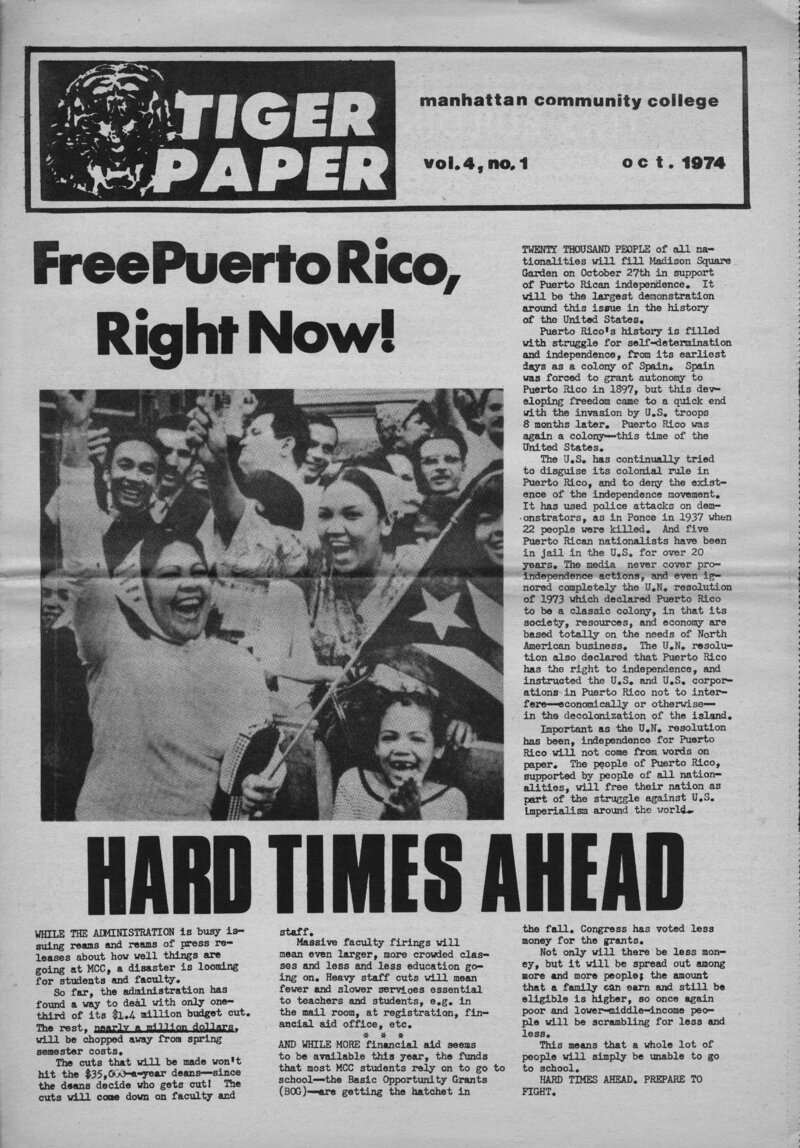
Tiger Paper, October 1974
Item
manhattan community college
vol.4, no,1
FreePuertoRico,
Right Now!
WHILE THE ADMINISTRATION is busy is-
suing reams and reams of press re~
leases about how well things are
going at MCC, a disaster is looming
for students and faculty.
So far, the administration has
found a way to deal with only one~
third of its $1.4 million budget cut.
The rest, nearly a million dollars,
will be chopped away from spring
semester costs.
The cuts that will be made won't
hit the $35,6G0-a-year deans—since
the deans decide who gets cut! The
cuts will come down on faculty and
HARD TIMES A
staff.
Massive faculty firings will
mean even larger, more crowded clas-
ses and less and less education go=
ing on. Heavy staff cuts will mean
fewer and slower services essential
to teachers and students, e.g. in
the mail room, at registration, fin-
ancial aid office, etc.
ee &
AND WHILE MORE financial aid seems
to be available this year, the funds
that most MCC students rely on to go to
school==the Basic Opportunity Grants
(BOG)—<~are getting the hatchet in
oct. 1974
TWENTY THOUSAND PEOPLE of all na=
tionalities will fill Madison Square
Garden on October 27th in support
of Puerto Rican independence, It
will be the largest demonstration
around this issue in the history
of the United States,
Puerto Rico's history is filled
with struggle for self-determination
and independence, from its earliest
days as a colony of Spain. Spain
was forced to grant autonomy to
Puerto Rico in 1897, but this dev-
eloping freedom came to a quick end
with the invasion by U.S. troops
8 months later. Puerto Rico was
again a colony--this time of the
United States.
The U.S. has continually tried
to disguise its colonial rule in
Puerto Rico, and to deny the exist-
ence of the independence movement.
It has used police attacks on dem=
-onstrators, as in Ponce in 1937 when
22 people were killed. And five
Puerto Rican nationalists have been
in jail in the U.S. for over 20
years, The media never cover pro=
independence actions, and even ig=
nored completely the U.N, resolution
of 1973 which declared Puerto Rico
to be a classic colony, in that its
society, resources, and economy are
based totally on the needs of North
American business, The U.N. resolu-
tion also declared that Puerto Rico
has the right to independence, and
instructed the U.S. and U.S. corpor=
ations:in Puerto Rico not to inter=
fere—economically or otherwise
in the decolonization of the island.
Important as the U.N. resolution
has been, independence for Puerto
Rico will not come from words on
paper. The people of Puerto Rico,
supported by people of all nation=
alities, will free their nation as
part of the struggle against U.S.
imperialism around the world.
HEAD
the fall. Congress has voted less
money for the grants.
Not only will there be less mon=
ey, but it will be spread out among
more and more peoplez the amount
that a family can earn and still be
eligible is higher, so once again
poor and lower=middle=income peo=
ple will be scrambling for less and
less.
This means that a whole lot of
people will simply be unable to go
to school.
HARD TIMES AHEAD, PREPARE TO
FIGHT.
PAGE TWO
WOULD YOU RENT
THIS BUILDING ??
One year after a massive resistance
to the use of the M Building by
Manhattan Community College, BMCC is
still using the building, and most
of the programs in it are still oper-
ating under the same -inadequate con-
ditions as last year. What happened,
and why?
Last year faculty and students in
the M Building focused on the follow-
ing major problem areas:
Elevators
Toilets
Lighting
Health Hazards
Ventilation
Heating
Fire Hazards
In a letter to President Draper
they stated that the M Building pre-
vented learning and was physically
dangerous. They also attacked the
administration for having allowed
these conditions to exist for three
years, and for its lack of concern
and responsibility for Open Admissions
students, (The majority of programs in
the Building are for the development
of skills crucial to all other college
work: Reading, Math Remediation, and
English as a Second Language. )
The college administration at fist
tried to ignore the issue and then
finally, after more letters peti-
tions, TV coverage, and the threat
of more militant action such as a
strike, became sufficiently embar-
rassed to promise a move to a
new building by Sept.'74. Many
faculty and students accepted this
promise "on good faith", and by the
time it became clear that the move
was not, in fact, going to take
place it was already the beginning of
summer vacation and too late to do
anything.
The administration has made cer-
tain repairs on the M Building (for
example the installation of a fire
alarm system, which hopefully works,
and repairs on the elevators so that
none have broken yet). These chan-
ges were made ONLY because organized
student and faculty action made it
clear that the administration could
no longer get by with last year's
conditions.
But most conditions in the M Build-
ing can never be improved enough to
make it a good building for classes.
As one M Bldg. student told his teach-
er last week, "I can't work in this
classroom for two hours --there's no
air." It's true - there is no air in
the M Building, and very little light
either, because there are no windows
in the entire building. And the ven-
tilationsystem -if one exists- is
terrible. In addition, the heating
and cooling system makes it 80 on the
sixth flpgor and freezing at the sane
time in the reading lab on the third
floor. The lack of light and air also
produces an extremely oppressive at-
mosphere, like that of a huge cave or
a bomb shelter. Teachers who often
have to spend all day in the building
without going out say that this is
their major complaint. But the com-
plaints could go on and on: the rooms’
all echo and are noisy, the elevator
service is too slow, etc. etc.
And this year the administration had
the nerve to announce "with pride"
that it had found nice, clean, bright
$150,000/yr. space for additional
offices.
The conditions in the M Building
continue to look like insufficient
attention to the basic skills needs
of students, a negligent attitude
towards the Department of Develop-
mental Skills (many of whose teachers
still do not have desks, much less
offices), and.an interest in under-
mining Open Admissions rather than
supporting it.
Clearly students and faculty will
have to fight again on this issue if
they expect better conditions, because
clearly the administration has no
commitment to education at BMCC, and
is not going to "give" them anything.
But last year's effort will certainly
provide a greater awareness of what
has to be done to win a struggle when
confronting an administration like
that at BMCC.
(11/7)
Ehcht-
SBE?
OVER THE SUMMER, President Draper
quietly returned control of student
government to SBG - Students for Bet-
ter Government.
Last Spring, the Honest Ballot As-
sociation threw out the results of
the student government election be-
cause SBG and the administration vi-
olated a pre-election agreement by
denying two opposing groups - Stu-
dents for Unity and Democracy (SUD)
and Third World Coalition (TWC) -
access to duplicating machines, mail-
room facilities and $175 to run their
campaigns. As a result, neither SUD
or TWC could effectively publicize
their candidates or platforms.
Only 22% of the student body vo-
ted in the election with less than
10% voting for the winning SBG tic-
ket. Draper has refused to call a
new election and has given SBG every
seat on the student government.
Draper has not certified the
results of some past elections be-
cause less than 30% of the student
body voted. But his decision this
summer was consistent with his ad-
ministration's past support for SBG--
support to the point where in the
Spring of 1973, the administration
even helped to manage SBG's elect-
ion campaign.
Paper i publish veneer
Tiger Pose to rb torial collec= —
tive of ‘aination, Community Col=
lege faculty.
: Tenured members of the collective: —
Kathy Chamberlain, Bill —
- Mary Kellogg, Naomi Woronov. ©
Untenured members: anonymous to
protect them from administrative
harassment.
For further information, contact
Bill Friedheim (Social Science) —
at 262-3560, or Naomi Moreowe
. (English) ‘at 262-3584,
THE CONTINUING scandals of President
Draper's administration have made it
easier for state officials to justify
budget cuts and for the media to pre-
sent MCC and open admissions in a
bad light.
Last May, the New York Times, in
a front page story, used Draper's
incredible mismanagement of the schoo],
as a cover for a slanderous attack
against MCC students and open admis-
sions. Then in July, the Times prin-
ted a piece about MCC's Urban Center,
where the administration is mishand-
ling a lot of money and lot of stu-
dents are paying the consequences.
The article reported that despite a
300% increase to $1.3 million in its
budget, the Urban Center had placed
only 32 students in jobs as compar-
ed to 166 in 1968.
This summer, state officials slash-
ed MCC's budget by $1.4 million--a
cut that students and faculty will
feel the full force of next semester.
What Draper, the Times and those
who slice community sollege budgets
share in common is that their actions
and policies undermine open admis-
sions. With Draper, it is more than
just mismanagement. His administra-
tion, like those before it, never
really fought budget cuts, but rath-
er enforced those cuts by laying-
off faculty, packing classrooms and
allowing bad facilities to get even
worse.
MCC students have consistently
opposed the policies of Draper's
administration and fought budget
cuts, and last May, led by nursing
students and faculty, organized a
militant demonstration in front of
the Times to protest all of the lies
that paper printed about the college
and open admissions.
Open admissions at CUNY was won
as a result of militant struggle by
third world and working class stu-
dents in 1969. Since then, it has
been under continuing attack. But
the actions of MCC students make
clear that they are ready to defend
with the same militancy what their
brothers and sisters won in the 60's.
FORDS PHONY UNITY
A _NO-WIN PIAN
IT'S GOING ON 3 MONTHS since Gerald
Ford took over at the White House
with the claim that "the nightmare
is over."
A lot of people at the time prob=-
ably believed, or hoped, that Ford
could turn things around, stop the
coverups and scandals, and start
dealing with the country's economic
problems., But by now it's obvious
that nothing has changed for the
better.
In fact, things have gotten worse.
On top of the Nixon pardon and the
appointment of Rockefeller as V=P,
there's a tremendous economic storm
in the making. Prices are rising
at a faster rate week by week, un~
employment and underemployment are
on the upswing, overall economic pro=
duction is falling, and spending for
public services like education and
transportation is being cut.
Why are we facing these problems?
What can we do about them? Neither
Ford nor any of the "economic ex=
perts" are going to give us a good
explanation or a real solution, be-
cause their first concern is saving
the capitalist profit system. They
may slice the pie in slightly differ-
ent ways, but all of them give the
biggest wedge to the owners of the
corporations and the banks. Under
capitalism, that's the way it has
to be.
Consider this: even in the last
year of sharp economic downturn, big
business profits are up 18% over
last year. How did the corporations
manage it? In the tried<and-true
. Capitalist way—-by raising prices,
laying off and firing workers, and
speeding-up the ones who are still
on the job. It's not their fault,
they say; they haye to do these
things—-to keep up their profit rates,
And they're right. Under capital-
ism, that's the way it has to be.
This isn't just happening in the
factories, it's happening in offices
too. Last week a strike hit one of
the biggest publishers, Macmillan,
after it fired nearly 300 employees
with no advance warning. Way before
the mass firings, Macmillan workers
had begun to unionize, realizing
that working in an office, even in
a@ semi~professional job, is no pro=
tection against what's coming down
from the corporations as they try
to keep their profits up.
It would be a big mistake, though,
to see these attacks by the corpor=
ations as a sign of their strength.
The fact is that they and the gov-
ernment that represents them is in
a genuine crisis. Politically and
economically, their system is fall-
apart.
Politically, on the home scene,
Watergate, the Nixon pardon, the
exposure of the CIA's role in Chile,
and the new scandals about Rocky
($2 million worth of gifts to friends
who "happened" to hold political of=
fice, plus $900,000 worth of tax
dodging in just 5 years!) have crea-
ted such distrust that the ruling
class is finding it harder Beg hard=
er to maintain people's faith in
the system,
Economically, the system is ex=
periencing a new thing, Sstagfla-
tion"—rising prices and economic
stagnation (slowiowm of production).
The only way big business can get
itself out of its bind without
risking a Great Depression like the
one in the 1930's is to keep prices
up and wages down, while squeezing
more labor out of every worker,
The government is supposed to do
its part by cutting back on non=
military spending, giving tax ben-
efits to the corporations, and
gouging more tax=money out of the
majority of the people,
This is just what Ford's anti-
inflation plan tries to do, But the
"economic experts" have warned that
Ford's present plan isn't drastic
enough to take care of the crisis.
So we can eventually expect him to
come up with a "better" one—better
for the corporations, that is, and
worse for the people,
But what if the American people
refuse to be speeded=up, wage=con+
trolled, taxed, and denied vital
social services? Then big busin=
ess is in a deeper hole. And they
“mow it. Ford Rnows it too. So
his main job as president is to
put this program over on the people,
That's why hets been going around
preaching "national unity," "pro=
ductivity," and "sacrifice" ever
since he got into the White House.
The soft-sell isn't working.
People just aren't falling for this
unity-and=sacrifice rhetoric, The
last 9 months have seen the biggest
wave of strikes since World War II—
strikes for higher wages to keep up
with inflation, strikes to gain
unions as a protection against pro=
fit-hungry bosses, Protests have
flared over cuts in educational pro=
grams, child care, and health ser=
vices, too, and these protests will
get bigger and more frequent as the
cuts multiply. And while all this
is happening, more and more people
are questioning the very system it-
self, wondering if we haye to live
this way.
The resistance of people to at=
tacks on their living standards is
leading the pushers for the ruling
class to use other tactics, Like
trying to whip up a kind of wartime
spirit of patriotism and solidar~
ity (Ford's WIN buttons, WIN gardens,
etc.). Like trying to incite "Am-
erica First" feelings (listen to
the latest Coca-Cola ads on radio
and TV). Like trying to direct
people's anger against "enemies"
abroad (e.g., the oil-producing
countries, which were considered
our friends as long as they let
U.S. corporations rip off their
resources), Like trying to stir
up racial conflicts and make peo=
ple fight each other for crumbs
instead of uniting to demand e~
nough for everybody's needs,
These are hard and confusing
times, A lot of people think
that a "liberal" Democrat like
Teddy Kennedy could restore the
country to working order and
remedy many of the economic and
social injustices of our society.
In our next issue we'll take up
the question of why liberal poli~
ticians like Kennedy can't provide
any better solution to our situation
than Ford and Rocky can.
The system can't be reformed
but it can be changed.
SOME SACRIFICES
ARE NECESSARY
To ACHIENE
ECoWNCMIC GROWTH
Titi rod hn Pag
pial BR e.
PAGE FOUR
THREE YEARS AGO the man who's await=
ing appointment as Vice-President or=-
dered an assault on Attica State
Prison which resulted in the deaths
of 41 prisoners and hostages.
The demands for which the 1200
Black, Latin and white prisoners
seized the prison were unanimously
recognized as legitimate and "one
hundred years overdue." but then-
Gov. Nelson Rockefeller refused to
even.go to Attica, or to meet with
members of the negotiating team, and
instead ordered an armed assault by
state troopers. The result was "the
bloodiest encounter between Americans
since the Civil War," with 41 deaths
caused by the gunfire of the attack=
ing trooopers, as well as incidents
of beatings, torture, and abuse from
prison guards,
Since then the state has continued
to hound the Attica prisoners:1) there
has been practically no change in the
prison conditions against which the
prisoners revolted; 2) 61 Attica pri-
soners are now on trial or awaiting
trial for their role in the 1971 re=
bellion; 3) N.Y. State has spent over
$3 million of our tax money on the
prosecution of the Attica defendants.
This massive show of state power
is not just directed against the
Attica prisoners, or even against all
prisoners, It is intended as a warn-
ing to all economically and racially
oppressed people, or people who don't
agree with what's done with their tax
money, that they better not protest
or disagree except within certain
"safe" limits, that they better not
fight back when they are attacked,
that they should never take things
into their own hands when their de=
mands or protests are ignored, Or
the power of the state will come
down on them as it has done on the
prisoners of Attica,
But the power of the state has ex=
posed itself in trying to teach this
lesson, and in fact another real les-
son is becoming clearer and clearer
to a lot of people, The events of
Attica, of Watergate, of the oil cri~
sis, of inflation, of CIA actions in
Chile, etc., have revealed that the
TIGER PAPER.
THE SPIRIT OF AT
entire power structure of the state
(and not just New York State)—the
courts, the legal system, the police,
the news media, government agencies,
and, yes, the schools too—operate
for, and represent, certain interests
over others,
In communities of all ethnic min-
orities—-Black, Latin, Chinese, Amer=
ican Indian—economic repression has
always made it glaringly obvious
that this country has been rum for
the interests of some over others.
And especially in the Black and Lat-
in communities, where people have a
long history of fighting back, pol=
ice and legal repression made this
lesson even clearer.
But now a lot of people are wak=-
ing up to the fact that the institu~
tions of this country also operate
time and time again in the interests
of profit rather than people, and
that racism has neatly served the
interests of the powerful and weal-
thy, because it has kept the large
majority of people from uniting with
each other.
Most people have always known
that money means power, but they sort
of just accepted it as "o.k.," "a
fact of life," "the way things are,"
etc. But these days lots of people
are beginning to see and feel the
effect of that power in their daily
lives, in a way that used to be not~
iced by the poor and racially oppress~
ed, and they don't like it, They
feel used and manipulated for someone
else's interest—in the same way that
the poor and racially oppressed have
always felt—-and they too are begin=
ning to get angry, to resist and to
protest.
They don't like the idea that o~
normously wealthy individuals and
corporations 1)get so much more than
everyone else, and 2)have so much in=
fluence and power over the whole so=
ciety that they can arrange to keep
things that way. And what really
gets people hopping mad is the real-
ization that all the benefits of the
"American way of life" for which the
government and the corporations take
TIGA
the eredit were really only won thr=
ough long hard struggle against the
government and those corporations.
With all these new lessons crop=
ping up around them right and left,
people are having a hard time know=
ing what to do with them, Many peo=
ple are frustrated, confused, and
angry. But things are moving, and
people aren't going to be just let=
ting things happen now that they see
what's going one
In New York and New Jersey, a
wave of police repression in the
Black and Latin communities has been
responded to immediately, Angry com-
munity groups and individuals forced
the dismissal of Thomas Shea from
the police force for his killing of
10—year=old Clifford Glover, Demon=
strations took place in Browns=
ville over the. murder of l4=year—
old Claude Reese, and a Committee
for Justice for Claude Reese has
been formed, An Anti-fRepresdon Co=
alition has also seen formed for
the New York/New Jersey area.
And 800 people turned out to
"greet" Rockefeller when he was sup=
posed to make an appearance at N.Y.'s
Cooper Union last week, They were
telling Rockefeller that they hold
him personally responsible for the
massacre at Attica, that they do not
want him as Vice-President of the
U.S., that they are not afraid of
police and courts which he and others
like him cnntrol, and that they are
completely opposed to the rule of this
country by wealthy private interests.
The demonstrators shattered the wind=
ows of a nearby Chase Manhattan Bank,
owned by the Rockefeller family,
These actions might be seen as
small things——a few demonstrations —
but they represent a kind of public
taking of a stand, a going into ac=
tion, for the kind of society people
want to live in and raise their chil-
dren in. And these actions are in=
creasing and will increase even fur=
ther as more and more people begin
to face what they already know about
the true nature of the kind of so=-
ciety we have and for whose inter=
ests it operates,
vol.4, no,1
FreePuertoRico,
Right Now!
WHILE THE ADMINISTRATION is busy is-
suing reams and reams of press re~
leases about how well things are
going at MCC, a disaster is looming
for students and faculty.
So far, the administration has
found a way to deal with only one~
third of its $1.4 million budget cut.
The rest, nearly a million dollars,
will be chopped away from spring
semester costs.
The cuts that will be made won't
hit the $35,6G0-a-year deans—since
the deans decide who gets cut! The
cuts will come down on faculty and
HARD TIMES A
staff.
Massive faculty firings will
mean even larger, more crowded clas-
ses and less and less education go=
ing on. Heavy staff cuts will mean
fewer and slower services essential
to teachers and students, e.g. in
the mail room, at registration, fin-
ancial aid office, etc.
ee &
AND WHILE MORE financial aid seems
to be available this year, the funds
that most MCC students rely on to go to
school==the Basic Opportunity Grants
(BOG)—<~are getting the hatchet in
oct. 1974
TWENTY THOUSAND PEOPLE of all na=
tionalities will fill Madison Square
Garden on October 27th in support
of Puerto Rican independence, It
will be the largest demonstration
around this issue in the history
of the United States,
Puerto Rico's history is filled
with struggle for self-determination
and independence, from its earliest
days as a colony of Spain. Spain
was forced to grant autonomy to
Puerto Rico in 1897, but this dev-
eloping freedom came to a quick end
with the invasion by U.S. troops
8 months later. Puerto Rico was
again a colony--this time of the
United States.
The U.S. has continually tried
to disguise its colonial rule in
Puerto Rico, and to deny the exist-
ence of the independence movement.
It has used police attacks on dem=
-onstrators, as in Ponce in 1937 when
22 people were killed. And five
Puerto Rican nationalists have been
in jail in the U.S. for over 20
years, The media never cover pro=
independence actions, and even ig=
nored completely the U.N, resolution
of 1973 which declared Puerto Rico
to be a classic colony, in that its
society, resources, and economy are
based totally on the needs of North
American business, The U.N. resolu-
tion also declared that Puerto Rico
has the right to independence, and
instructed the U.S. and U.S. corpor=
ations:in Puerto Rico not to inter=
fere—economically or otherwise
in the decolonization of the island.
Important as the U.N. resolution
has been, independence for Puerto
Rico will not come from words on
paper. The people of Puerto Rico,
supported by people of all nation=
alities, will free their nation as
part of the struggle against U.S.
imperialism around the world.
HEAD
the fall. Congress has voted less
money for the grants.
Not only will there be less mon=
ey, but it will be spread out among
more and more peoplez the amount
that a family can earn and still be
eligible is higher, so once again
poor and lower=middle=income peo=
ple will be scrambling for less and
less.
This means that a whole lot of
people will simply be unable to go
to school.
HARD TIMES AHEAD, PREPARE TO
FIGHT.
PAGE TWO
WOULD YOU RENT
THIS BUILDING ??
One year after a massive resistance
to the use of the M Building by
Manhattan Community College, BMCC is
still using the building, and most
of the programs in it are still oper-
ating under the same -inadequate con-
ditions as last year. What happened,
and why?
Last year faculty and students in
the M Building focused on the follow-
ing major problem areas:
Elevators
Toilets
Lighting
Health Hazards
Ventilation
Heating
Fire Hazards
In a letter to President Draper
they stated that the M Building pre-
vented learning and was physically
dangerous. They also attacked the
administration for having allowed
these conditions to exist for three
years, and for its lack of concern
and responsibility for Open Admissions
students, (The majority of programs in
the Building are for the development
of skills crucial to all other college
work: Reading, Math Remediation, and
English as a Second Language. )
The college administration at fist
tried to ignore the issue and then
finally, after more letters peti-
tions, TV coverage, and the threat
of more militant action such as a
strike, became sufficiently embar-
rassed to promise a move to a
new building by Sept.'74. Many
faculty and students accepted this
promise "on good faith", and by the
time it became clear that the move
was not, in fact, going to take
place it was already the beginning of
summer vacation and too late to do
anything.
The administration has made cer-
tain repairs on the M Building (for
example the installation of a fire
alarm system, which hopefully works,
and repairs on the elevators so that
none have broken yet). These chan-
ges were made ONLY because organized
student and faculty action made it
clear that the administration could
no longer get by with last year's
conditions.
But most conditions in the M Build-
ing can never be improved enough to
make it a good building for classes.
As one M Bldg. student told his teach-
er last week, "I can't work in this
classroom for two hours --there's no
air." It's true - there is no air in
the M Building, and very little light
either, because there are no windows
in the entire building. And the ven-
tilationsystem -if one exists- is
terrible. In addition, the heating
and cooling system makes it 80 on the
sixth flpgor and freezing at the sane
time in the reading lab on the third
floor. The lack of light and air also
produces an extremely oppressive at-
mosphere, like that of a huge cave or
a bomb shelter. Teachers who often
have to spend all day in the building
without going out say that this is
their major complaint. But the com-
plaints could go on and on: the rooms’
all echo and are noisy, the elevator
service is too slow, etc. etc.
And this year the administration had
the nerve to announce "with pride"
that it had found nice, clean, bright
$150,000/yr. space for additional
offices.
The conditions in the M Building
continue to look like insufficient
attention to the basic skills needs
of students, a negligent attitude
towards the Department of Develop-
mental Skills (many of whose teachers
still do not have desks, much less
offices), and.an interest in under-
mining Open Admissions rather than
supporting it.
Clearly students and faculty will
have to fight again on this issue if
they expect better conditions, because
clearly the administration has no
commitment to education at BMCC, and
is not going to "give" them anything.
But last year's effort will certainly
provide a greater awareness of what
has to be done to win a struggle when
confronting an administration like
that at BMCC.
(11/7)
Ehcht-
SBE?
OVER THE SUMMER, President Draper
quietly returned control of student
government to SBG - Students for Bet-
ter Government.
Last Spring, the Honest Ballot As-
sociation threw out the results of
the student government election be-
cause SBG and the administration vi-
olated a pre-election agreement by
denying two opposing groups - Stu-
dents for Unity and Democracy (SUD)
and Third World Coalition (TWC) -
access to duplicating machines, mail-
room facilities and $175 to run their
campaigns. As a result, neither SUD
or TWC could effectively publicize
their candidates or platforms.
Only 22% of the student body vo-
ted in the election with less than
10% voting for the winning SBG tic-
ket. Draper has refused to call a
new election and has given SBG every
seat on the student government.
Draper has not certified the
results of some past elections be-
cause less than 30% of the student
body voted. But his decision this
summer was consistent with his ad-
ministration's past support for SBG--
support to the point where in the
Spring of 1973, the administration
even helped to manage SBG's elect-
ion campaign.
Paper i publish veneer
Tiger Pose to rb torial collec= —
tive of ‘aination, Community Col=
lege faculty.
: Tenured members of the collective: —
Kathy Chamberlain, Bill —
- Mary Kellogg, Naomi Woronov. ©
Untenured members: anonymous to
protect them from administrative
harassment.
For further information, contact
Bill Friedheim (Social Science) —
at 262-3560, or Naomi Moreowe
. (English) ‘at 262-3584,
THE CONTINUING scandals of President
Draper's administration have made it
easier for state officials to justify
budget cuts and for the media to pre-
sent MCC and open admissions in a
bad light.
Last May, the New York Times, in
a front page story, used Draper's
incredible mismanagement of the schoo],
as a cover for a slanderous attack
against MCC students and open admis-
sions. Then in July, the Times prin-
ted a piece about MCC's Urban Center,
where the administration is mishand-
ling a lot of money and lot of stu-
dents are paying the consequences.
The article reported that despite a
300% increase to $1.3 million in its
budget, the Urban Center had placed
only 32 students in jobs as compar-
ed to 166 in 1968.
This summer, state officials slash-
ed MCC's budget by $1.4 million--a
cut that students and faculty will
feel the full force of next semester.
What Draper, the Times and those
who slice community sollege budgets
share in common is that their actions
and policies undermine open admis-
sions. With Draper, it is more than
just mismanagement. His administra-
tion, like those before it, never
really fought budget cuts, but rath-
er enforced those cuts by laying-
off faculty, packing classrooms and
allowing bad facilities to get even
worse.
MCC students have consistently
opposed the policies of Draper's
administration and fought budget
cuts, and last May, led by nursing
students and faculty, organized a
militant demonstration in front of
the Times to protest all of the lies
that paper printed about the college
and open admissions.
Open admissions at CUNY was won
as a result of militant struggle by
third world and working class stu-
dents in 1969. Since then, it has
been under continuing attack. But
the actions of MCC students make
clear that they are ready to defend
with the same militancy what their
brothers and sisters won in the 60's.
FORDS PHONY UNITY
A _NO-WIN PIAN
IT'S GOING ON 3 MONTHS since Gerald
Ford took over at the White House
with the claim that "the nightmare
is over."
A lot of people at the time prob=-
ably believed, or hoped, that Ford
could turn things around, stop the
coverups and scandals, and start
dealing with the country's economic
problems., But by now it's obvious
that nothing has changed for the
better.
In fact, things have gotten worse.
On top of the Nixon pardon and the
appointment of Rockefeller as V=P,
there's a tremendous economic storm
in the making. Prices are rising
at a faster rate week by week, un~
employment and underemployment are
on the upswing, overall economic pro=
duction is falling, and spending for
public services like education and
transportation is being cut.
Why are we facing these problems?
What can we do about them? Neither
Ford nor any of the "economic ex=
perts" are going to give us a good
explanation or a real solution, be-
cause their first concern is saving
the capitalist profit system. They
may slice the pie in slightly differ-
ent ways, but all of them give the
biggest wedge to the owners of the
corporations and the banks. Under
capitalism, that's the way it has
to be.
Consider this: even in the last
year of sharp economic downturn, big
business profits are up 18% over
last year. How did the corporations
manage it? In the tried<and-true
. Capitalist way—-by raising prices,
laying off and firing workers, and
speeding-up the ones who are still
on the job. It's not their fault,
they say; they haye to do these
things—-to keep up their profit rates,
And they're right. Under capital-
ism, that's the way it has to be.
This isn't just happening in the
factories, it's happening in offices
too. Last week a strike hit one of
the biggest publishers, Macmillan,
after it fired nearly 300 employees
with no advance warning. Way before
the mass firings, Macmillan workers
had begun to unionize, realizing
that working in an office, even in
a@ semi~professional job, is no pro=
tection against what's coming down
from the corporations as they try
to keep their profits up.
It would be a big mistake, though,
to see these attacks by the corpor=
ations as a sign of their strength.
The fact is that they and the gov-
ernment that represents them is in
a genuine crisis. Politically and
economically, their system is fall-
apart.
Politically, on the home scene,
Watergate, the Nixon pardon, the
exposure of the CIA's role in Chile,
and the new scandals about Rocky
($2 million worth of gifts to friends
who "happened" to hold political of=
fice, plus $900,000 worth of tax
dodging in just 5 years!) have crea-
ted such distrust that the ruling
class is finding it harder Beg hard=
er to maintain people's faith in
the system,
Economically, the system is ex=
periencing a new thing, Sstagfla-
tion"—rising prices and economic
stagnation (slowiowm of production).
The only way big business can get
itself out of its bind without
risking a Great Depression like the
one in the 1930's is to keep prices
up and wages down, while squeezing
more labor out of every worker,
The government is supposed to do
its part by cutting back on non=
military spending, giving tax ben-
efits to the corporations, and
gouging more tax=money out of the
majority of the people,
This is just what Ford's anti-
inflation plan tries to do, But the
"economic experts" have warned that
Ford's present plan isn't drastic
enough to take care of the crisis.
So we can eventually expect him to
come up with a "better" one—better
for the corporations, that is, and
worse for the people,
But what if the American people
refuse to be speeded=up, wage=con+
trolled, taxed, and denied vital
social services? Then big busin=
ess is in a deeper hole. And they
“mow it. Ford Rnows it too. So
his main job as president is to
put this program over on the people,
That's why hets been going around
preaching "national unity," "pro=
ductivity," and "sacrifice" ever
since he got into the White House.
The soft-sell isn't working.
People just aren't falling for this
unity-and=sacrifice rhetoric, The
last 9 months have seen the biggest
wave of strikes since World War II—
strikes for higher wages to keep up
with inflation, strikes to gain
unions as a protection against pro=
fit-hungry bosses, Protests have
flared over cuts in educational pro=
grams, child care, and health ser=
vices, too, and these protests will
get bigger and more frequent as the
cuts multiply. And while all this
is happening, more and more people
are questioning the very system it-
self, wondering if we haye to live
this way.
The resistance of people to at=
tacks on their living standards is
leading the pushers for the ruling
class to use other tactics, Like
trying to whip up a kind of wartime
spirit of patriotism and solidar~
ity (Ford's WIN buttons, WIN gardens,
etc.). Like trying to incite "Am-
erica First" feelings (listen to
the latest Coca-Cola ads on radio
and TV). Like trying to direct
people's anger against "enemies"
abroad (e.g., the oil-producing
countries, which were considered
our friends as long as they let
U.S. corporations rip off their
resources), Like trying to stir
up racial conflicts and make peo=
ple fight each other for crumbs
instead of uniting to demand e~
nough for everybody's needs,
These are hard and confusing
times, A lot of people think
that a "liberal" Democrat like
Teddy Kennedy could restore the
country to working order and
remedy many of the economic and
social injustices of our society.
In our next issue we'll take up
the question of why liberal poli~
ticians like Kennedy can't provide
any better solution to our situation
than Ford and Rocky can.
The system can't be reformed
but it can be changed.
SOME SACRIFICES
ARE NECESSARY
To ACHIENE
ECoWNCMIC GROWTH
Titi rod hn Pag
pial BR e.
PAGE FOUR
THREE YEARS AGO the man who's await=
ing appointment as Vice-President or=-
dered an assault on Attica State
Prison which resulted in the deaths
of 41 prisoners and hostages.
The demands for which the 1200
Black, Latin and white prisoners
seized the prison were unanimously
recognized as legitimate and "one
hundred years overdue." but then-
Gov. Nelson Rockefeller refused to
even.go to Attica, or to meet with
members of the negotiating team, and
instead ordered an armed assault by
state troopers. The result was "the
bloodiest encounter between Americans
since the Civil War," with 41 deaths
caused by the gunfire of the attack=
ing trooopers, as well as incidents
of beatings, torture, and abuse from
prison guards,
Since then the state has continued
to hound the Attica prisoners:1) there
has been practically no change in the
prison conditions against which the
prisoners revolted; 2) 61 Attica pri-
soners are now on trial or awaiting
trial for their role in the 1971 re=
bellion; 3) N.Y. State has spent over
$3 million of our tax money on the
prosecution of the Attica defendants.
This massive show of state power
is not just directed against the
Attica prisoners, or even against all
prisoners, It is intended as a warn-
ing to all economically and racially
oppressed people, or people who don't
agree with what's done with their tax
money, that they better not protest
or disagree except within certain
"safe" limits, that they better not
fight back when they are attacked,
that they should never take things
into their own hands when their de=
mands or protests are ignored, Or
the power of the state will come
down on them as it has done on the
prisoners of Attica,
But the power of the state has ex=
posed itself in trying to teach this
lesson, and in fact another real les-
son is becoming clearer and clearer
to a lot of people, The events of
Attica, of Watergate, of the oil cri~
sis, of inflation, of CIA actions in
Chile, etc., have revealed that the
TIGER PAPER.
THE SPIRIT OF AT
entire power structure of the state
(and not just New York State)—the
courts, the legal system, the police,
the news media, government agencies,
and, yes, the schools too—operate
for, and represent, certain interests
over others,
In communities of all ethnic min-
orities—-Black, Latin, Chinese, Amer=
ican Indian—economic repression has
always made it glaringly obvious
that this country has been rum for
the interests of some over others.
And especially in the Black and Lat-
in communities, where people have a
long history of fighting back, pol=
ice and legal repression made this
lesson even clearer.
But now a lot of people are wak=-
ing up to the fact that the institu~
tions of this country also operate
time and time again in the interests
of profit rather than people, and
that racism has neatly served the
interests of the powerful and weal-
thy, because it has kept the large
majority of people from uniting with
each other.
Most people have always known
that money means power, but they sort
of just accepted it as "o.k.," "a
fact of life," "the way things are,"
etc. But these days lots of people
are beginning to see and feel the
effect of that power in their daily
lives, in a way that used to be not~
iced by the poor and racially oppress~
ed, and they don't like it, They
feel used and manipulated for someone
else's interest—in the same way that
the poor and racially oppressed have
always felt—-and they too are begin=
ning to get angry, to resist and to
protest.
They don't like the idea that o~
normously wealthy individuals and
corporations 1)get so much more than
everyone else, and 2)have so much in=
fluence and power over the whole so=
ciety that they can arrange to keep
things that way. And what really
gets people hopping mad is the real-
ization that all the benefits of the
"American way of life" for which the
government and the corporations take
TIGA
the eredit were really only won thr=
ough long hard struggle against the
government and those corporations.
With all these new lessons crop=
ping up around them right and left,
people are having a hard time know=
ing what to do with them, Many peo=
ple are frustrated, confused, and
angry. But things are moving, and
people aren't going to be just let=
ting things happen now that they see
what's going one
In New York and New Jersey, a
wave of police repression in the
Black and Latin communities has been
responded to immediately, Angry com-
munity groups and individuals forced
the dismissal of Thomas Shea from
the police force for his killing of
10—year=old Clifford Glover, Demon=
strations took place in Browns=
ville over the. murder of l4=year—
old Claude Reese, and a Committee
for Justice for Claude Reese has
been formed, An Anti-fRepresdon Co=
alition has also seen formed for
the New York/New Jersey area.
And 800 people turned out to
"greet" Rockefeller when he was sup=
posed to make an appearance at N.Y.'s
Cooper Union last week, They were
telling Rockefeller that they hold
him personally responsible for the
massacre at Attica, that they do not
want him as Vice-President of the
U.S., that they are not afraid of
police and courts which he and others
like him cnntrol, and that they are
completely opposed to the rule of this
country by wealthy private interests.
The demonstrators shattered the wind=
ows of a nearby Chase Manhattan Bank,
owned by the Rockefeller family,
These actions might be seen as
small things——a few demonstrations —
but they represent a kind of public
taking of a stand, a going into ac=
tion, for the kind of society people
want to live in and raise their chil-
dren in. And these actions are in=
creasing and will increase even fur=
ther as more and more people begin
to face what they already know about
the true nature of the kind of so=-
ciety we have and for whose inter=
ests it operates,
Title
Tiger Paper, October 1974
Description
This copy of the Tiger Paper advocates self-determination for Puerto Rico, criticizes the poor condition of facilities at BMCC, and encourages readers to remember "the spirit of Attica."The Tiger Paper, which billed itself as "Manhattan Community College's only underground newspaper," was published between 1971 and 1974 by a group of radical faculty members at BMCC. The paper, whose name was a play on the quip of Mao Tse-tung that "U.S. imperialism is a paper tiger," addressed struggles both internal and external to the college while emphasizing the connections between them.
Contributor
Friedheim, Bill
Creator
Tiger Paper Collective
Date
October 1974
Language
English
Publisher
Tiger Paper Collective
Rights
Creative Commons CDHA
Source
Friedheim, Bill
Original Format
Newspaper / Magazine / Journal
Tiger Paper Collective. Letter. “Tiger Paper, October 1974.”, CUNY DIGITAL HISTORY ARCHIVE, accessed September 5, 2026, https://stephenz.tailc22a4b.ts.net/s/cdha/item/248