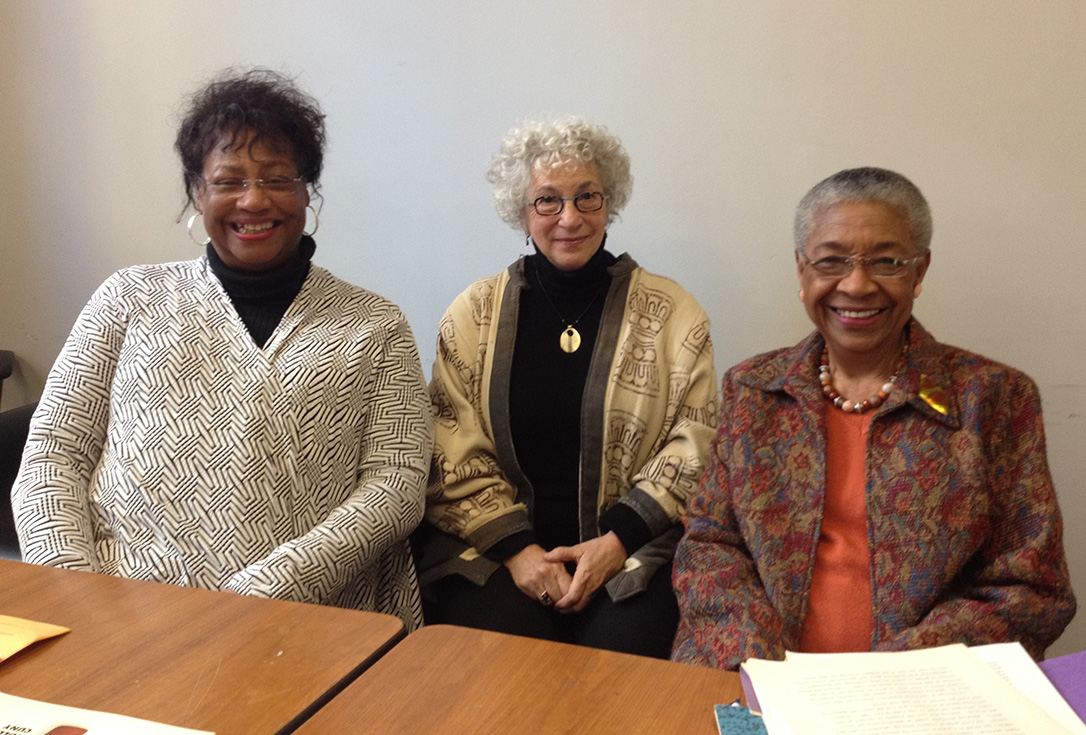
Oral History Interview with Joan Greenbaum, Fern Khan, and Sandy Watson of LaGuardia Community College
Item

DIGITALHISTORYARCHIVE
CUNY Digital History Archive
Transcript of interview with LaGuardia Community College faculty: Joan Greenbaum,
Fern Khan, and Sandy Watson
Interviewers: Andrea Ades Vasquez and Steve Brier
January 22, 2015
CUNY Graduate Center, New York, NY
Transcription: Jessica Murray
Transcript edited by: Andrea Ades Vasquez
ANDREA ADES VASQUEZ: This is Andrea Ades Vasquez and Steve Brier on January 22,
2015. We're here with Joan Greenbaum, Sandy Watson, and Fern Khan of LaGuardia
Community College doing an interview for the CUNY Digital History Archive.
JOAN GREENBAUM: And, | want to frame it in the history of Continuing Ed as being a part of
the one-college concept of LaGuardia when it was first formed. And, Fern Khan and Sandy
Watson were two of the most phenomenally important people in that movement of making that
happen. Together with Ann Marcus and Gussie [Augusta] Kappner. So, over to you.
STEVE BRIER: So, we were talking a little bit about the founding of LaGuardia in 1971. And,
Khan, you came in '71 and Sandy, you came in '74. And this—as we were saying, it was part of
this, kind of, amazing transformation of CUNY with open admissions and the influx of large
numbers of students of color across the CUNY system, but especially in a place like LaGuardia,
which was brand new in being, sort of, the bridge. So, that—I want you to characterize, | don't
want to characterize for you—tell us about what the student population was like and what the
faculty were like in these early years.
FERN KHAN: Well, | came to LaGuardia in 1971 from Hunter College [Education Clinic],
educational training, and LaGuardia was opened at a time when the city was undergoing a real
downturn, and across CUNY, programs are closing because of lack of funding. But, LaGuardia
was opening up. And, so, LaGuardia brought a sort of special optimism, in a way, to, not only
CUNY, but to communities in general. And, Joe Shenker was the first president at LaGuardia.
He was the youngest president in the country at the time, he was 29 years old. And, he hada
vision in terms of having LaGuardia become, not just a model for other community colleges, but
also making a difference in the lives of adults and special populations, non-traditional
populations. He wanted to make sure that we would impact the lives of children, of adults as
learners, as parents, as community residents. Whatever role the adult played, Joe really wanted
to make a difference, and he saw Continuing Ed as a way to do that because, the people who
were in the academic programs, they had a focus. They were going to work towards a degree.
And, so, the faculty couldn't do everything, so Continuing Ed had much more flexibility. It was
responsive. It could start like this, you could start a program immediately, you didn't have to go
through a lot of, um, processes, to get permission, and so, Continuing Ed became sort of, the
viable tool to achieve Joe's goal. And, it worked. And, not only did he see the college as a one
college concept, but he provided the tax levy lines in Continuing Ed. so that the people who
worked there were secure in their jobs. | was hired on a professor's line when | went there and
moved up. When | left LaGuardia, | was on a full professor's line, even though | didn't have a
PhD. | had a Masters in Education, | mean, in Social Work, how could | say that? [laughter]
KHAN: This is because | spent 25 years at Bank Street College as Dean of Continuing Ed, so
education is still very powerful. But, at LaGuardia, we just—there was an excitement, there was
a lot of innovation taking place, across all areas. There—we had the largest business division,
um, Rose Palmer was known to be the person who controlled entire division and brought in a lot
of money, and um, social science was there hiring faculty and, you know, people were doing
really creative things. Janet Lieberman was among the individuals who really had another set of
visions to bring innovative programs into LaGuardia. She developed, | mean, she—her
programs are so many, but I'm just going to touch on one, the Transfer Program, because it's
still alive right now. And, | mention it, not because it was in Continuing Ed, it wasn't. However,
Continuing Ed, as Sandy mentioned earlier, worked across all the divisions. And, so, we were
fully integrated across all divisions, which is not normal in most colleges. And, but at LaGuardia,
it happened. And so, | was on the committee, which developed the Transfer Program. And I'm
sure there was—there are other people from Continuing Ed, too. But it was a cross-college
effort.
BRIER: So, people went and took Continuing Education credits or units, could transfer those
credits into academic programs, is that what you mean by transfer?
SANDY WATSON: No, no, but we did develop a program that did have it.
KHAN: Yes, yes. But, the transfer program is a special program where the research showed
that kids who went to community colleges didn't often transfer to senior colleges. And, not only
was there not a natural sort of articulation between community colleges and four-year colleges,
even within CUNY, it was very difficult to get kids—graduates to move into, without going—
taking a lot of courses over.
BRIER: Are they what we call articulation?
KHAN: Articulation, definitely.
VASQUEZ: So, can | follow up. You were talking about, sort of, the spirit and innovation that
was going on, and Sandy, you described yourself more as an outsider in the beginning, right?
And then you got absorbed into the college. | guess I'm interested in a little bit more of the
atmosphere of—so there were really innovative programs, and a welcoming of new kinds of
programs, and relationships, and just, it sounds like, even in the hiring. They were ready to hire
good people much more easily than it sounds like happens now, right? But, I'm interested in
other things that were going on, like were there also, um, student groups that were involved, or
community groups on their own? So, in other words, not just the things that were happening
within the college, but around and...
WATSON: Well, I'm going to give you an example of a group that became very powerful at the
institution. The women's movement taking place in the 70's and, what grew out of that
movement was women demanding education, demanding education in timeframes that would
allow them to be parents as well as workers. And, we had a program called the Women's
Program, right? Where we worked with a community group in Carroll Gardens, a group of
women in Carroll Gardens, Brooklyn, who wanted to have their entire degree off-campus.
KHAN: You mean NCNW?
WATSON: NCNW. National Council of Neighborhood Women. Women's program [Khan
agreeing]. And, so that was a very powerful group. They were, they had become very—they had
become activists around women's issues, and they came to the college and negotiated with
Gussie and Ann, around having a program that would allow them to take courses in degrees
that they developed, okay? They wanted to develop the degrees. That was a very, very difficult
program, because they had no respect for the faculty.
BRIER: The NCNW women didn't?
WATSON: That's right. They had no respect for—so...
KHAN: They were in Williamsburg, by the way. Not Carroll Gardens, Williamsburg.
WATSON: Well, later, it was Carroll Gardens. They started in Williamsburg and then later they
opened up in Carroll Gardens, too. And, what they did—
BRIER: Before Williamsburg was trendy, right?
[laughter]
WATSON: Right, right, right.
VASQUEZ: And Carroll Gardens!
WATSON: And Carroll Gardens! Right. So, this is an example of a women’s organization that
came to us, and that's how we developed a lot of programs. And, they would come to us, we
would do the negotiation. We would meet with the faculty members, a chairperson of the various
programs. A lot of the work that | did when | became the Director of that program was
smoothing the waters when they would go and demand that they had a teacher at 8 o'clock in
Introduction to Social Science on Wednesday in the community. And, the chairperson would
say, 'Uh, oh' and then they'd call me, or Fern and say, 'How are we going to work this out?' And
so, we were mediators in that process. But, that was an organization that came to us. We had a
lot of, um, community based organizations that came seeking educational programs that we
designed for them. And then they became integrated into the institution.
GREENBAUM: And, maybe you could go back now, and talk a little bit about the Vietnam Vets
program.
WATSON: Okay, um.
GREENBAUM: In the '70s, yeah.
KHAN: That's when you came on board.
BRIER: That's when you were hired?
WATSON: Yes, okay.
VASQUEZ: And, you were hired primarily to serve that population?
WATSON: Yes, | was hired as a vocational counselor.
KHAN: Tell the story about yourself. You have to go over it, sorry.
BRIER: That's our bad, haha.
KHAN: You didn't know anything about counseling...Tell the whole story.
[laughter]
WATSON: | worked very closely with—
GREENBAUM: We can each tell each other's stories.
WATSON: —right—David Heaphy, who, now is the Dean of Continuing Education at Johns
Hopkins. And, he was working with—in the Queens House of Detention, in a prison program—in
a program that we had for prisoners connected to LaGuardia. Okay? He was also working with
a veteran's program. And, so | was a mental health worker, a counselor, a therapist in the
prison, and | was having lunch and, somebody said, 'Sandy Watson, is that your voice?’ And, |
said, 'Yes, that's me!'
VASQUEZ: Your characteristic voice, right?
WATSON: Right. And, he says, 'l have a job for you, | tried to get you to come to LaGuardia
three years ago, you wouldn't come, you've got to come now.' Because, we had been working
together getting African American students and Hispanic students into traditionally white
colleges around the country. And, so that's how we met each other, but we never met in person.
So, here, he knew my voice over the telephone for four or five years, he calls me, | come for an
interview, it's for Vocational Skills Counselor at LaGuardia Community College, | did not know
what that was. | went to Barnes and Noble, we didn't have the Internet then, um, | went to my
best friend at the time, Janet Cyril, who was a former Panther, who, um...
GREENBAUM: Is no longer with us.
WATSON: ...who's no longer with us. And Janet worked with me on how to—what a vocational
counselor is. Went through the process, went through the interview, go into a room at
LaGuardia, and that's—it's two blocks away from the prison. So, | walk up the block, and when |
went into the room, nine people are sitting there. And, | said, 'What is this?’ You know? How
important could they think they are that they need nine people to interview one person?
GREENBAUM: In a factory floor.
WATSON: In a factory floor.
BRIER: Right, that's an old converted factory.
WATSON: —in the munitions. Listen, okay, after | got the job, | went to tour, and | saw people
coming in, in motorcycles, into the building, Lenny Zaremsky, just 'Vroom!' he goes, | said,
‘What kind of place is this?"
[laughter]
GREENBAUM: They were loading docks, you could drive your motorcycle in.
VASQUEZ: Is that still one of the buildings? Is it the same location?
BRIER: That was the original building.
WATSON: Yes! It was the original building.
KHAN: They totally renovated it.
WATSON: Munitions. We had, Continuing Ed was there, with tennis courts, we had tennis
courts, there were—I said, ‘This is crazy, and | love it. This is where | want to be.’ So, anyhow,
got the job, thanks to Fern, | walked in here—
GREENBAUM: And, Gussie was there, then.
WATSON: No, Gussie was not in the room. Gussie came later. And, um...
VASQUEZ: You got the job.
WATSON: | got an idea of the single college concept through (indistinguishable) and Marcus,
because the Deans—there were five Deans, at that time there were no Vice Presidents. They all
sat at the table with the same power. Joe gave them—the Dean of Continuing Education—the
same power as the Dean of, um, Academic Affairs.
[indistinguishable]
WATSON: Whatever it was. And, | got a sense of, what that single college concept was. Janet
Cyril came to the college, five months pregnant, in the co-op division. Co-op worked with the
businesses, and so, there was a certain face that they wanted to present to business. Not a
former Panther who's five months pregnant. Right? She's brilliant, she's a genius, she's brilliant,
and, um, her boss, who | will not name, is giving her a lot of trouble. And, | said—she came to
me and she said, 'Sandy, | don't know what to do, you know.’ | said, 'l don't know what to do,
either.' You know, it took about two years to understand the culture, | didn't understand what
was happening. So | go to Ann, and | said, 'Ann, they're messing with my friend over there.' So,
she says, 'Oh, who's messing with her?' | gave her the name. He wasn't there in six months. |
said, 'Oh my God, how did she have that power?' Then | understood—maybe that's not a nice
story—but, then | understood the relationship that they had around the table, that she had the
power to be able to go talk to the Dean of Cooperative Education, to say, 'You have someone
who is harassing a black woman because she's pregnant.’
BRIER: And so, Cooperative Education was this notion that students, in addition to studying,
would do mentor—
WATSON: Internships.
BRIER: —internships out in business.
KHAN: Paid, paid internships.
BRIER: Paid internships in the community. That was a—
WATSON: It was a very sophisticated system, based on the CAEL model, Council for [Adult
and] Experiential Learning. Based on that CAEL model. And, we were at Northeastern and
LaGuardia, were the preeminent institutions in Cooperative Education.
BRIER: And, Northeastern still is.
WATSON: Yes!
GREENBAUM: And, experiential learning was—
WATSON: experiential learning...
GREENBAUM: —part of what Fern, you were talking about with the intensive courses, with one
week in the classroom and one week in the field. So, everything was based on experiential
learning.
VASQUEZ: And, the one college campus idea—and | don't know if that's described somewhat
in the literature that you brought today—was that also something that came out of that prison, or
was that, sort of, a larger national...?
WATSON and KHAN: No. That was Joe.
KHAN: That was Joe Shenker's vision, and he was a kind of leader, that, whatever he thought, it
came right down, it filtered down to everyone. And, so, even if people didn't want to be like that,
you know, because academic divisions typically are—
GREENBAUM: Slow to change...
KHAN: —but, because there was not an, um, a history, LaGuardia was fresh, it was new, so
everybody was at the same level. You know? And it was an institution alliance.
WATSON: It was very innovative, yeah.
KHAN: So, everything went.
GREENBAUM: So, in the academic division, we could institute new courses.
KHAN: That's right.
GREENBAUM: And, they were interdisciplinary, and they were experiential-based in outside,
outside of the classroom.
WATSON: And, some of those courses started in Continuing Education.
BRIER: In then they got transferred.
KHAN: Then moved over.
BRIER: And, Joe stayed at least ten years, right? He stayed until the early '80's? Or mid '80's? |
can't remember, because when |—
KHAN: He left in 1988—
BRIER: '88
KHAN: —to go to Bank Street, as the President of Bank Street College.
BRIER: Bank Street, that's right.
WATSON: So, he took the college through many years.
GREENBAUM: And, guess who the next President of Bank Street College was?
VASQUEZ and BRIER: Gussie.
[everyone agreeing]
KHAN: So. So, you know, | guess, um, | do want to stress that Ann Marcus was really very key
in carrying out many of Joe's visions in Continuing Ed, because she was young, she was
flexible, she had a vision, too, of how—how you help staff to grow. And so, she nurtured many
of us to become administrators. | didn't know anything about administration. Ann told me,
‘There's nothing to it, you will learn.’ And, | did learn. But, she helped me.
WATSON: Fern told me the same thing.
[laughter]
VASQUEZ: She saw a natural ability there!
BRIER: Each one, teach one, right?
GREENBAUM: These two went on, Sandy and Fern, between them, developed more programs
and brought in more money—what was the total amount, Sandy?
WATSON: Well, | brought between 60 and 70 million over the years.
BRIER: Which is when 60 and 70 million really meant something.
WATSON: Right. | mean, there was one program that, um, when | was leaving was 20 million
dollars. | didn't bring that one in, but, you know.
VASQUEZ: You were there 40 years?
WATSON: Yeah, and so...
VASQUEZ: And, getting back to those early years of serving these many different populations,
and having outside populations come to you with ideas; early open admissions, new, new whole
new group of students, questions of remediation, and—how did you deal with this?
KHAN: Well, you know, it was interesting. At first, there wasn't a big issue—at first, because
everyone is in the class now, and they're working, and you're—people are excited about
meeting there. It was not until later—
GREENBAUM: We didn't separate.
WATSON: We didn't, right. It was not until later—
GREENBAUM: Nor did we have grades.
WATSON: Right. But there were lots of social—
KHAN: That's right!
GREENBAUM: We had EGP, yeah.
KHAN: That's right, we didn't have grades.
BRIER: No grades, pass/fail?
VASQUEZ: What is EGP?
KHAN: Yes, yes, yes.
WATSON: Excellent, Good, Passing.
GREENBAUM: Excellent, Good, Pass, No Credit.
VASQUEZ: No grades in any classes? In the early years?
(multiple people: No, nothing)
WATSON: How many years was that, Joan?
GREENBAUM: Um, through the end of the '70's into the '80's.
WATSON: Okay.
VASQUEZ: And, what was class size like?
WATSON: Twenty? Twenty—
GREENBAUM: Very small.
WATSON: Twenty was a big class.
BRIER: Because you were building your student pop—body as you went, sort of.
GREENBAUM: That's right.
KHAN: At the same time.
WATSON: A lot of our students were immigrant students, that, um, were in that community,
because we were in Queens, Astoria.
VASQUEZ: That population was there then.
WATSON: So you would have Chinese, um, Greek, Russian.
KHAN: No, no, no, no I'm sorry to disagree with you. Initially, we didn't have Greek students,
because their parents wouldn't allow them to come. Initially.
WATSON: Okay.
KHAN: Afterwards, you know.
GREENBAUM: We recruited, yeah.
KHAN: Yeah. We had to do that. And what had to happen was that the students would come in
and register in the business area and then switch to Liberal Arts without telling their parents.
Because, for the Greek population, Liberal Arts meant nothing.
VASQUEZ: Didn't mean success.
KHAN: Right.
WATSON: Also what happened—we became a major employer for women in the community.
And so, Greek women, Italian women, um, Polish women would come and work at the
institution, and then bring their children, or their grandchildren, and that's how that happened—it
really became—
BRIER: That's interesting.
GREENBAUM: Talk a little bit about the Children’s College.
10
WATSON: Oh gosh.The Children's college, wow.
VASQUEZ: And then, you also mentioned the Deaf program. | want to hear about, yes.
WATSON: We've had—! mean, if we named the different programs—
KHAN: Before the children's college, we have to talk about the Family Daycare Provider
Training Program.
WATSON: Oh, yes.
KHAN: Gussie Kappner—
WATSON: Yes.
KHAN: —talk about, as you mentioned, Steve, what was happening in the wider world. So,
there was a lot of monies available now to train family daycare providers. And, LaGuardia went
for that money, and got that, ha, got that money, a lot of money to train family daycare providers
who were in the Red Hook area in Brooklyn. And, there were numerous centers, and Gussie,
she was a Dean, but she personally handled that program. And, she—I tell you, it was a
program that was so challenging. It was so challenging because there were lots of criteria to be
met, and if you didn't meet all of them, you know, you had to worry about getting reimbursed,
and then eventually, the city just stopped the program after about three years. It was really a
terrible, terrible blow for LaGuardia, because, um, all of these people who had been hired full-
time lost their jobs. There were no jobs for them, you know..
BRIER: When did the city end the program? Was it in the fiscal crisis?
KHAN: This was in the '80's, early '80's.
BRIER: Oh, in the '80's, early '80's.
WATSON: After the fiscal crisis, yeah.
KHAN: So, it was a terrible, terrible disappointment. But that was a big program, that was one of
the big programs during Gussie's era, and there is even a report that's available, and | don't
have it with me today, but it's another of those reports that is available, and Gussie would have
a copy, and | think | have a copy, too, at home. It did a lot of good for the women because they
were trained as early childhood providers, then they could go to college. And, they took college
courses, and many of them did go on to get degrees. So, it was another form of a career ladder
program, which, which was very popular during the '70's and early ‘80's.
WATSON: We had a very, um, strong program called IEP, which was the—
11
KHAN: Integrated?
WATSON: —no, it was the prison program, where we were providing courses in, um, Riker's.
And, that was a program—you know, a lot of our programs came from fund—having large
funding base, so we got money from the Department of Correction. And, we became—how can
| say this—not the rival, not the challenger, what's a nicer word to, um, what's the college for...
GREENBAUM: John Jay?
WATSON: John Jay. For John Jay College.
BRIER: Criminal Justice.
WATSON: Criminal Justice. John Jay had, had this contract, and we applied for it and got the
contract. It was a big, big thing. You know, how did this little community college get John Jay's
you know? Haha.
GREENBAUM: But, it was a good program.
WATSON: But, it was a very, it was a very good program, it was very strong, a lot of those
students. So, we were the feeder. Continuing Education was the feeder organization for
students coming into the college. So, the Vietnam era veteran program fed students into the
college. When you talk about open admissions, these were the students. The former prisoners,
the women from various women’s organizations, un—
KHAN: The teachers, the paraprofessionals—
WATSON: —the teachers, they became part of the student body. And, | would say at any time,
now, now the college is documenting the number of students that come from Continuing
Education, our GED programs, our high school equivalency programs, um, so we're up to about
20%, you know, that they documented. But, | think, in the earlier days, there was a larger
population—
GREENBAUM: Yes.
WATSON: —of the student population. But now, we're about 20, 25%.
GREENBAUM: | want to back up to Steve's question, because, you're—you answered exactly
what the feeder was. It probably is not so well known, Steve, but the, the original community
college line into LaGuardia, the experiential learning in the community was for the factory
workers in the area. It was designed for the factory workers. And so, when Sandy was
mentioning who the majority of the students were, they were ethnic workers in the factories in
the area.
12
BRIER: And, they were coming to LaGuardia to do what, exactly?
GREENBAUM: To, to—
BRIER: Get an AA —or and AS degree?
GREENBAUM: Yes.
WATSON: Upgrade their skills
GREENBAUM: Upgrade—well, but no, they were coming to get degrees—
KHAN: Yes, and degrees.
WATSON: Both, both.
GREENBAUM: —right, and to get degrees, and to, and because—
VASQUEZ: So, it wasn't a very young student body.
WATSON: Oh, no. Average student was 25 years old.
GREENBAUM: Ri—at least, yeah right.
WATSON: Average student age.
GREENBAUM: And, within—the original plan was within a year and a half, because we had a
quarter system, that students would graduate with six to nine months of experience on a real
job, not a factory job, but a middle class job in the city.
WATSON: And, often, they were hired. | don't know what percentage, but the goal of
Cooperative Education instructors, counselors, their goal was to develop internships that would
turn into jobs.
GREENBAUM: Dory Williams, who recruited me was instrumental in bringing IBM into that.
WATSON: Yes!
GREENBAUM: And, they hired a lot of students.
BRIER: So, the goal was to go from factory work to white collar work?
GREENBAUM: That's correct.
13
BRIER: In Manhattan, that was sort of the—that was the upward mobility imagined.
GREENBAUM: That was it, to actually take the train into the city.
BRIER: Do you remember what kinds of industries were there in Queens in those days?
GREENBAUM: Oh sure, the Chiclet factory.
WATSON: Chiclet factory, the donut—there was the donut factory—
VASQUEZ: Domingo—the sugar, right? The sugar plant was there?
GREENBAUM: And the sugar, and Breyer's.
WATSON: Domino.
BRIER: Ice cream...
GREENBAUM: | had students from Breyer's Ice Cream who always took me and my kids on
tours.
KHAN: What is that bread called? That bread?
VASQUEZ: Oh, yes, right.
KHAN: It smelled of the bread!
GREENBAUM: Silver, Silver Cup.
BRIER: Silver Cup Bakery, yeah.
KHAN: It just smelled like it, the college smelled like it [a bakery].
VASQUEZ: Now it's a studio.
BRIER: Now, it's a studio, yeah.
WATSON: The college smelled like bread and gum, because that’s—
[laughter]
BRIER: What a great line, haha.
14
GREENBAUM: So, | want to return it to—
VASQUEZ: it could have been worse [the smell].
BRIER: It could have been—it could have been a lot worse.
GREENBAUM: The Chiclet—the Chiclet factory blew up at one point. That was a real tragedy.
Um, just to return to what Sandy was talking about—so, here's this white working-class factory
population coming for courses, and the concept of Continuing Ed being part of it was,
Continuing Ed was reaching out to a broader community. Because, women weren't originally
thought of in this.
WATSON and KHAN: No.
BRIER: It was meant for white male factory workers.
GREENBAUM. ...male factory workers.
WATSON: And immigrants. We have to say immigrants because we had one of the largest ESL
programs in the country.
GREENBAUM: In Continuing Ed—
WATSON: In Continuing Ed—
GREENBAUM: —and the other colleges didn't have this.
WATSON: — There was credit and non-credit. Eventually, the faculty said, 'Well, we want to be
faculty members in the academic division,’ so that was a little bit of a struggle, and they left
Continuing Education, but originally, they started in Continuing Ed, and so...
VASQUEZ: So how many were in—what was the student body? What number? And, how did it
grow?
GREENBAUM: Oh, the original one?
WATSON: Two hundred, hahaha.
GREENBAUM: | think it was two hundred.
VASQUEZ: And, how quickly did it grow?
GREENBAUM: To... 25,000 now in credit-bearing and 50,000 when they count the one college.
15
WATSON: | would say it's a little less, about 18,000 in the credit-bearing area, and in Continuing
Ed, we always had anywhere from 25,000 on.
KHAN: But you know, we—one thing we haven't mentioned yet is that, we had all these
programs which are mostly grant-funded or contract-funded, but we also had an extended day
program, which was all credit-bearing, so that was for older adults, people who were working,
they could come in the evenings and on weekends—
WATSON: And, get a degree.
KHAN: —and get a degree. Through extended day. Now, that program attracted a lot of
policemen. And, there were lots of stories about the same group of policemen; the faculty would
talk about them, you know, because they, they were always there and they gave—some of them
gave some challenges, you know? But, there was a whole thing around these policemen who
were coming to get their degrees. And, it was, you know, it was just interesting.
BRIER: So, you were kind of a rival of John Jay's in some ways? At least, as a community
college.
WATSON: Only in certain areas. | mean, the area, in terms of providing educational programs in
the, in the prisons, we, we just took that away from them. And so, we balanced back and forth,
you know, between John Jay getting the contract, and we getting the contract. So, all these
special populations, the prisoners, the Vietnam era, the women, you know, the immigrants...
One of the populations that we never had a large number of, in terms of Open Admissions, were
African American students. That was always a challenge and, | took that on—
GREENBAUM: You did.
WATSON: —to make sure that—
BRIER: Well, the immediate neighborhood, not a lot of African Americans in that part of
Queens.
WATSON: No, but we were, we were a community college, also. So, you have think, you know,
all of the community colleges were usually commuter colleges, except Medgar Evars has a, you
know, they're in the black community...
BRIER: Hostos.
VASQUEZ: So, did you get students from Harlem coming?
WATSON: Huh?
VASQUEZ: Did you get students from Harlem?
16
WATSON: We had students from every borough after a while.
KHAN: Something happened though, because when the college first opened up, the African
American population was about 30%, and |, | was going to bring a chart because |—
WATSON: But that was Educational Associates, too, right?
KHAN: Including Ed Associates. But, the college population, they had a chart that showed—we
had about 33%, um, Latino and African Americans and white students. And, but after about
three years, there was a shift. And, it was blatant, that the African American students weren't
there, and it was noticeable.
VASQUEZ and BRIER: What happened?
KHAN: | don't know—we still don't know whether people moved out of the area, or went to
another school...
WATSON: Because, we had students from Corona, from the African American—
VASQUEZ: When did the other community colleges open?
WATSON: —community in Corona, East Elmhurst.
BRIER: They opened at different times, depending on the college's—
VASQUEZ: And, that's why | was wondering when—
GREENBAUM: This was the last one.
BRIER: This was the last one. This was—BMCC was a decade before.
VASQUEZ: So, that wouldn't explain it. Because of course, the Bronx had—.
WATSON: So, when | came in, | was very concerned about not having African American
students. | was very concerned, | said, 'Why, this wonderful place?' You know, African American
students need co-op, they need entreé into the workplace. How are they going to get it? You
know, if they want that, how are they going to get it? You know? And so, we had recruitment
efforts to do that.
BRIER: Interesting.
17
GREENBAUM: My sense was—and this is just my sense from teaching there from 1973 on—
was that, since the white working class dominated in the '70's there, that it wasn't sucha
comfortable place.
WATSON: Chilly, chilly classroom?
GREENBAUM: Yeah.
BRIER: Just, the neighborhood was such that black students might not have felt as comfortable.
GREENBAUM: Coming to this factory area, and it's dark at night—
BRIER: Yeah, yeah, and the elevated train, and the whole deal, yeah.
GREENBAUM: —it wasn't a neighborhood that people knew.
WATSON: See, | just don't know.
VASQUEZ: Joan, give us, you—tell us about when you came, and what were your impressions
of the school, and the atmosphere, the spirit of the college, that Fern and Sandy were
describing, too?
GREENBAUM: Well, I'll be brief. | came in '73, | was recruited by Dory Williams, who had the—it
was a similar story to Sandy's in that Dory had been trying since '71 to bring me there. And, |
kept saying, 'No, no, | don't think | want this.’ Um...
WATSON: We don't want to work in a factory.
GREENBAUM: Yeah, haha. And, um, and Dory was instrumental in starting and working with
this cooperative education. So, | bought into the philosophy of co-op ed, and | kept it in the back
of my mind that this experiential learning, this is great. And then, the other person who recruited
me is Herman Washington.
KHAN: Yeah, we remember Herman.
GREENBAUM: Yeah. And, Herman had hired me and fired me twice already.
[laughter]
WATSON: At IBM.
GREENBAUM: Once at IBM and once at a computer consulting company we started. Um, he
fired me for organizing a computer workers union against him and his manager.
18
[laughter]
GREENBAUM: He thought, he and Dory thought | was the kind of person that LaGuardia
needed. So | came in and discovered shortly after | gave birth to a baby, right—l was hired—in
the interview, | was nine and a half months pregnant, walking those steps to the EL, and—
WATSON: Everybody was pregnant at LaGuardia.
[laughter]
GREENBAUM: Well, everybody, that’s—
[laughter]
WATSON: That was the criteria for getting hired—
BRIER: That was the cri—you couldn't get a job unless you were at least five months pregnant.
GREENBAUM: Right, well.
WATSON: —you had to be pregnant. Oh my God. Because | had my two children there, too.
GREENBAUM: Right. And then, there was Janet Cyril, wno— | thought | had brought, but
Sandy says you brought her there, so...
BRIER: Can you spell her last name?
WATSON and BRIER: C-Y-R-I-L.
WATSON: She was one of the Black Panthers. She later became the, the head of the, um,
prison program, which was just—we all found our niche at LaGuardia.
KHAN: That's a good name for it, haha.
WATSON: —that's what happened. We all found our place, you know, whether it—you know,
we had to develop it, or whether, but, you know, we found our place.
VASQUEZ: And, you had the freedom to do that.
GREENBAUM: We had total freedom.
WATSON: And, we had the freedom to fail. Joe allowed you to fail. See, | don't know at what
level—I don't know if his Deans could fail, but at our Directors level, we could experiment and
fail, and experiment and fail. | don't know if Ann could fail, huh?
19
KHAN: Well, | think it came from the top. If the top allows you, if the leader allows you the ability
to fail, or—then it's going to happen all around.
VASQUEZ: You're going to have successes, too, right?
KHAN: Joe was the kind of inspirational leader who didn't say much, was very economical with
his words, but, he really—if you understood him, you would have no problems.
WATSON: No problem.
KHAN: And, he was the kind of person—very hands-on—because, | remember there were
programs we had developed for that were running out of money, and Joe would say—
BRIER: Yes, | remember, | remember.
KHAN: —what do you need? And, he would go out there and get the money to make sure the
programs didn't end. That happened with our Deaf program; we had gotten, um, a pro—we had
gotten a lot of money from the federal government. It was a three-year grant, it was ending, and
the program was getting so popular, we were having a lot of Deaf students at one time, we were
having, like 500 Deaf students at LaGuardia. The program had grown—we were the only
program that provided access—full access—for Deaf and hard of hearing students, so they
came in Continuing Ed, they could go through a GED, ABE, (Adult Basic Ed, GED), then move
into the college with all the supports that were needed.
GREENBAUM: It was always wonderful having Deaf students in the classes.
KHAN: Yes. You would have Deaf students, you would have veterans, you'd have returning
women.
GREENBAUM: There were people supporting them, there were counselors. Also, counseling
was part of that vision, too.
VASQUEZ: So, you were telling us about your early impressions.
GREENBAUM: So, the early impressions, |, | was hired in, what was called, data processing,
um, which was in the computer area, which was officially under Business. But, right off the bat,
we did everything in an interdisciplinary way. So, we designed these interdisciplinary social
science/English—
WATSON: Technology
GREENBAUM: —technology courses that went out into the community and then the populations
that Continuing Ed—(Adult in Continuing Ed, what it eventually became)—brought in, were so
20
interesting, because every classroom was full of totally different people. Right? | mean, towards
the end, of course, when it—now, not the end of LaGuardia, but our period there— it was—a
classroom would be full of people from—each person would be from a different country.
WATSON: | mean, one of the things now, you know I'm looking at—l'm looking at Continuing Ed
now, Business is extremely important. The new college President—well, she's been there ten
years—the college President that came in, Gail Mellow. The first line in her resume is business,
small business development. That's the first line, that she, you know, she was interested in
small business development. And so now the college—Continuing Education has a huge
program with Goldman Sachs. And, we've always had a business program from the—from the
very beginning. But, we were able to, to balance the business with the social, you know, social
welfare—
GREENBAUM: Justice.
WATSON: —program, social justice, programs for homeless. But Business has always been
important. Now, the college is taking in—the division is taking a new turn in terms of, you know,
business.
BRIER: And, and how did you see yourself—you mention this sort of slight conflict with John
Jay. How did you see yourself and the college positioned within CUNY? Did you see—did you
think of yourselves as a CUNY entity?
WATSON: Yes.
BRIER: Or, in other words, I'm very inter—you were brand new, you had no history—
GREENBAUM: That's interesting.
BRIER: —with CUNY.
WATSON: We didn't feel ghettoized, we didn't feel inferior. See, that's one—it took me many,
many years to understand the hierarchy and—the social hierarchy in CUNY. You know what |
mean? Because, we were doing the good work. Haha. You know? We were—we had
educational backgrounds, you know, we could have been professors, but we were doing this
work. And, we saw ourselves as equal at the table. It wasn't until we went to meetings outside of
the colleges, and said, 'Oh, my God, that's how they treat you in Continuing Education? You're
second-class citizens.' We never felt that we were second-class citizens.
GREENBAUM: That's right.
WATSON: It was very interesting. And, we became leaders in the Continuing Education
movement.
21
BRIER: In CUNY?
WATSON: In CUNY. Yeah. The go-to division, if there was a program to be developed, was
ACE. Um, us.
GREENBAUM: Adult and Continuing Ed.
WATSON: If there was a big federal grant that was coming down, and they wanted—they'd
come to us and say, ‘Could you mount this? That's how | got into programs for young adults.
The Jobward Bound Program.
BRIER: When did that change? You were there forty years, | mean, now | would say if you
asked me, 'Where does that go?’ it goes to the central office and John Mogulescu's office.
WATSON: But, John Mogulescu and Ann were very, very close in terms of—not necessarily
friends, but very close in terms of—I'm sorry, Judy McGaughey, and John were very close. And
so, John would call Judy and say—
BRIER: Who was the head of Continuing Ed at LaGuardia.
GREENBAUM: Right.
WATSON: Yes. And so, now, Continuing Ed—we watched John's operation grow. And, a lot—
they came to us. | remember, um, what's his name?
[00:36:25]
KHAN: But John was at—he was not always at head office.
WATSON: No.
KHAN: He used to be in Brooklyn.
WATSON: He used to be in Brooklyn. He was on the ground.
KHAN: Yeah, he was one of the Directors.
WATSON: Brooklyn, umn—New York City Tech.
KHAN: New York City Tech.
WATSON: But, there was a whole little core of people, and, um...and Jay—
KHAN: With Fanny Eisenhower.
22
WATSON: —yes, she was their mentor. So, what happened was, it was very interesting, when
they decided workforce development became so important in the city, and in the federal
government, they came to us and said, ‘Tell us how you did this.’ Because, we developed a
workforce development system where we were doing contracts with the city, you know,
healthcare, we had the workforce development center, you know, and um. God, I've been away
from the people. I'm trying to think, who is, who is the Dean over there, now?
BRIER: Where?
WATSON: With John.
BRIER: Well, Suri Duitch is there.
WATSON: Suri came and met with me—she came and met with me and Jane Schulman. Jane
was the Vice President, | was the Dean, she says, 'Okay, | got this position.’
BRIER: Oh, when she first got the position?
WATSON: Yeah, she says, 'What are, what are you doing? What can we do? How can we work
together? Teach me." You know...
[laughter]
WATSON: But, that's what happened.
BRIER: It's okay.
WATSON: But, that's what happened. She came to us, and we just did like this, 'Bluh bluh bluh,
bluh bluh'
VASQUEZ: At least she was looking for....
WATSON: So, we worked together with central office, you know. A lot of times, we took the
leadership around big federal grants. So we would go get—LaGuardia would create a
consortium. And then, later, CUNY central became our competitor. We would apply for the grant
and so would CUNY central. It was very interesting.
GREENBAUM: That's why you were asking the question.
BRIER: That's exactly why | was asking the question, because of course, the centralization of
CUNY is an interesting—you know, and | would say, part of the reason you have Gail Mellow as
the President now—this is my personal, political opinion—you have Gail Mellow now as the
President of LaGuardia is because Matthew Goldstein is Chancellor, who had a vision of, sort
23
of, business development, and he wanted to pick Presidents who, sort of, you know, conformed
to that particular approach. And so, you know, much of what gets deter—that's why it's such an
interesting question about what's the relationship between the constituent college institution and
the central administration.
WATSON: Well, it changed over a period of time with CUNY central. You know, we were
colleagues, then we became competitors, and I'm sure now we're colleagues again.
BRIER: Well, so, if you think of the Joe Shenker era, and by the time he left—you know, when
he started, he was working for Albert Bowker, and when he left, he was working for Joe Murphy.
KHAN: Joe Murphy, yes.
GREENBAUM: And they were friends.
BRIER: And, they were friends—oh no, Shenker and Murphy were very much friends, and so,
—that must have looked, at one level—
WATSON: Well, it was an interesting friendship.
BRIER: Rivals, perhaps?
VASQUEZ: Yes, speak of that. And, Fern, do you have something to say on this?
WATSON: No, don't say it.
GREENBAUM: No, she's not saying.
BRIER: Hahaha, not saying anything. Well, one's dead and the other's still—
WATSON: No, Joe's [Shenker] dead, too. They're both dead.
BRIER: | didn't know, when did Shenker die?
WATSON: About five years ago.
KHAN: No before—yeah, four—three or four years ago.
BRIER: God, | missed that, how did he, such a young man.
GREENBAUM: Five years ago, yes.
BRIER: Five years, geez.
24
WATSON: He died at 68.
BRIER: That's how old | am, hahaha, damn.
KHAN: He retired one week after, he died.
BRIER: Oh my God, | missed that.
WATSON: He retired one week after he died?
[laughter]
KHAN: No, he retired, and one week after, he died.
VASQUEZ: Picky, picky, haha. What did you want to say about him?
WATSON: No, I, | just, | just wanted to add that Joe [Shenker] had a style, he was a very
independent person—
BRIER and WATSON: Yes.
WATSON: —and, he stated straight —wanted to have everybody be alike and report directly to
them. There were lots of things that Joe did independently.
KHAN: We were the rebels.
WATSON: Yeah, LaGuardia was.
GREENBAUM: But, he let us be. And in—
BRIER: Murphy did.
GREENBAUM: Murphy did, and Murphy let Joe be.
BRIER: Yeah, that's what | remember.
GREENBAUM: And, what | was going to say in answer to your question about, what was our
relationship to CUNY, | could say, in the '70's, | don't even remember CUNY.
BRIER: Right.
GREENBAUM: It wasn't until tuition came in, and the fiscal crisis, and then we all banded
together with other CUNY colleges.
25
WATSON: No, we always had a relationship with CUNY.
GREENBAUM: We were independent. But, you did it—
WATSON: We did, because, initially when funding came down, for certain kinds of programs,
um, they came to us.
BRIER: That came through, through CUNY central? Yeah.
WATSON: They came—went to CUNY central, and Joe would turn around—! mean, John
would turn around and say, 'Well, who can do this? Who can mount this?' and then come to us.
They'd come, you know...
VASQUEZ: So, in those early years, was there much of a union presence?
GREENBAUM: Well, the union was just forming. So, in the early years, there wasn't a union,
and then there was a union presence once we formed the union, and then once we— how do
you say, Rebelled against the union?
BRIER: Haha, yes, had an opposition caucus, yes.
GREENBAUM: Yes, we were the first to break away, in '91 we ran a slate. But in the early
years—no, in fact, the—part of CUNY—Steve, you would remember what the organization was
that we had this CUNY-wide organization to keep tuition free.
BRIER: Oh yes, absolutely.
GREENBAUM: And also, to make the union fight for that.
BRIER: Right.
GREENBAUM: So it was, | forgot what it was called.
VASQUEZ: Well, we did an interview with John Hyland, who was involved in some of that.
WATSON: Oh, yeah, good. So, he gave you the history. | mean, Joan was our chapter chair at
LaGuardia. So, it was, you know, we were very active. We were very active for LaGuardia.
GREENBAUM: Yeah, and we always made sure we had people from Continuing Ed on the
Executive Committee.
WATSON: Always, always.
26
BRIER: | have a student at 3, what I'm going to do is tell him—it's Tahir—I might ask him, if you
don't mind, he can just sit in and listen while we're doing this, so let me just put this on pause.
[Pause in audio]
WATSON: No, they—you could what?
GREENBAUM: Well, you were bringing in programs that could bring in money.
WATSON: Our, our programs had to bring in money.
VASQUEZ: Right, so the fiscal crisis didn't threaten what you were doing.
GREENBAUM: So, the fiscal crisis wasn't the same story that you get.
WATSON: Often times, we were helpful to the rest of the college in terms of funding. | think the
Veterans Program, how many people—
VASQUEZ: Okay, so why don't we do a brief thing about the fiscal crisis, just so you position it,
because it was a major event that happened [indistinguishable].
BRIER: But, even if you position us to say it didn't affect you in Continuing Ed, that's fine.
VASQUEZ: Right, your programs.
WATSON: It did, in terms of us sharing the wealth.
GREENBAUM: Wait, wait, did you start?
BRIER: Yeah | started it.
GREENBAUM: So tell us, well somebody say if it's turned on.
VASQUEZ: It is turned on.
BRIER: It's on, | got it. I'm in control, it's on, haha.
VASQUEZ: Tell us how the fiscal crisis did and did not affect—or what was just the sentiment
around LaGuardia, and your programs specifically.
WATSON: We didn't lose—
KHAN: When was the fiscal crisis?
27
WATSON: Right! Haha.
KHAN: '72 are they talking about?
BRIER: '76, we're talking about.
WATSON: When we didn't get paid that month, hahaha.
BRIER: You didn't get paid, that's how you remember that, hahaha.
KHAN: Oh, yes, yes, yes, | remember that now.
BRIER: That one, that fiscal crisis.
WATSON: We didn't lose people. We didn't lose people because we had our funding. And we,
actually we gave money to the college. Hahahaha.
KHAN: Well, | remember that we had to go to Social Security, we had to go to unemployment
office and register—
BRIER: For those two weeks?
KHAN: —for those two weeks. And, | remember being so embarrassed, and feeling, 'Gee,
suppose somebody sees me here. What am | doing on line?’ You know? No, now you mention
it, | remember it. Oh, my God.
BRIER: So, | mean, the key, the key for the history of CUNY, of course, is to understand it up to
this point just to fill you in. The City of New York funded all of CUNY, not at, not 100%, but
90+%, and especially the community colleges. And, when the city went into fiscal crisis—so you
have the context—the compromise was the state would take over the financing of the senior
colleges, the city would continue to fund the community colleges, like LaGuardia, but the trade-
off to get that to happen, to get the state buy-in was, tuition had to be imposed. And, that's when
tuition start—so, back in the early '70's, none of your students paid tuition. Because, there
wasn't—there was a brief moment where there was tuition paid in the community colleges, and
that ended in the mid '60's, well before you got—so, your students never paid tuition before
1977.
WATSON: Right, right.
KHAN: But, didn't they pay a registration fee?
VASQUEZ: Yes, they did.
KHAN: I think they did pay—
28
VASQUEZ: Yes, there were fees.
BRIER: Probably. Yeah, all colleges have that; student activity fees...
KHAN: Yeah, yes, that's right.
VASQUEZ: But, your programs were not threatened by any of that because it was outside
funding that—grant funding that you raised, and were responsible for.
GREENBAUM: And that you kicked in the money to the rest of the college.
KHAN: But, because we were on faculty lines, we were on those lines—
WATSON: We were already on those lines.
KHAN: —we had to leave, | think— for two weeks, we had to register every week with
unemployment, but we did get that money back, eventually. We did get it back, so, so it wasn't a
major [indistinguishable].
BRIER: It was court-ordered, and, and you got paid—it was—many years later.
WATSON: What was unique about the division, in terms of its funding, is we always tried to
make it diversified, so one third was grant-funded, one third was tuition, and one third was tax-
levied. And, we tried to keep that balance so that we would never, you know, our programs were
never really affected negatively. When a grant, when we lost a grant, okay?, we would start
looking for where that talent could go. And we'd start writing other grants, so it was a
continuation of writing grants, and you know, bringing money in.
GREENBAUM: | remember quite clearly, certainly through the '80's and '90's, the—you were
always thinking in that model of, 'Where's the next grant going to come—What community
needs our help?’
WATSON: What social—right.
GREENBAUM: — "Who can we work with? Where can the funding come from?’ and beginning
to write that so that the...
BRIER: Well, and also, | mean we have to say that the differences in the '70's and '80's, the
notion of an activist government had not been totally discredited or demonized such—| mean,
you're coming out of the war on poverty in the '60's and these, sort of, federal programs, and
state programs that provided funding, so you had a field to play on. And, now, with the
demonization of government, it becomes increasingly, it seems to me, more difficult to make
those kinds of arguments. Beyond the workforce—
29
[00:50:12]
WATSON: No, getting money—yeah, beyond the workforce, because—and, certain kinds of
programs. I've worked with a lot of youth programs. When Obama came into office, there was
so much money coming into the community colleges, | mean, in terms of my area, for programs,
| mean, you know, he said, and you know I'm an Obama person, but he said, 'I'm going to help
fund the community college.’ And, a lot of the programs that we—not necessarily on the, um,
credit area, but in terms of workforce development, | had never seen so much money.
BRIER: Really? That's interesting.
WATSON: In youth programs, you know, youth initiatives. We just had, um, we developed
consortiums with the other CUNY, Adult and Continuing Education programs to access this
money, there was so much money coming in.
BRIER: Hmm, interesting.
WATSON: In the last ten years that | was there.
BRIER: So, | asked a question about Middle College, and if I—just curious if you guys had
connections to it, relations with it, you know, | knew Cece [Cecilia Cunningham], and she was—
we had—it was our first connection at the Social History Project.
WATSON: | had a very personal connection, my son went there, because he was attacked on
the trains in front of Brooklyn College, his face was slashed, and | didn't know what to do with
him. And, | went to Cece, and | said, 'Cece, | don't know what to do with my son. He's afraid of
New York City, and | can't send him to a regular high school.’ And, she let him come into Middle
College for three months until | sent him to Wisconsin, and it was a nurturing, wonderful
environment. And, so |I—
VASQUEZ: And, when was that? What year did it start?
WATSON: Oh, God...
KHAN: Middle College was in the '80's.
GREENBAUM: Yeah.
WATSON: Yeah, Temu was 15. He was born in 1978.
BRIER: So, this was '94.
WATSON: Right, right. And, Middle College had been around for about—
30
KHAN: It had been around.
BRIER: Oh yeah, a long time.
WATSON: —for about, yeah for a long time.
BRIER: And, we hooked up in '81, '82.
VASQUEZ: And, was that the first col—the first example of that—
WATSON: Middle College, it was the first one.
BRIER: First one in CUNY.
WATSON: It was the first one in CUNY, and now, they're all over.
BRIER: They're all over.
WATSON: | mean, that was Janet Lieberman.
KHAN: And, that was Janet Lieberman.
BRIER: Yes, that's when | met Janet, yeah.
KHAN: Janet, as | mentioned earlier, she was such a creative person. She had a lot of ideas,
and all those special programs that became models nationally came from Janet. And, Middle
College—
WATSON: That was one of them.
KHAN: —when she went to Joe, and said, 'We've got to do this,’ and Joe said yes. And, the one
thing | remember about Middle College was, it's like, you know, when they said, 'Give me your
poor, your—'
WATSON: Your tired, your poor, your huddled masses, right.
KHAN: —right. The only criteria for getting into Middle College was that you were failing in high
school. That was the only criteria. And, you had to be doing terrible.
BRIER: It was the last resort, it was the place of last resort.
KHAN: It was, but, it was a place that was going to uplift you, and give you all the supports that
you needed.
31
VASQUEZ: It wasn't a 600 school.
KHAN: No, no, no, actually, it was like going to a college when, you know...
WATSON: And, the students took courses, regular courses—
KHAN: Yeah, they were, yeah.
WATSON: —college courses.
KHAN: ...accepted into classes, and got credit.
WATSON: It was a wonderful program—got credit.
KHAN: And then, from that, it led to the International High School, and—
WATSON: Art and design.
KHAN: —the um, Art—
WATSON: Technology?
KHAN: No, Art, I'm thinking the person who headed it.
WATSON: Oh, oh, oh.
KHAN: Anyway, the headmaster there, the Principal.
WATSON: Headmaster, that's Jamaican, haha.
BRIER: That's the Jamaican concept of a Principal, hahahaha.
WATSON: The headmaster, hahaha.
KHAN: Oh, my gosh. Anyway. But, International High School began—and then, now there are
models all over.
WATSON: Yeah, all over the country.
KHAN: And, that's what | meant by the transfer program.
VASQUEZ: LaGuardia models so many things.
32
WATSON: We did, we did.
KHAN: That was another model that Janet developed, the TRANSFER, in capital letters
program, where we had a relationship with Vassar—
BRIER: | remember.
KHAN: —and kids from—
GREENBAUM: Oh, | taught in that.
KHAN: Of course.
WATSON: All of our programs—
KHAN: That was an amazing program.
WATSON: All of our programs became international, no—national models. We spoke at
conferences all the time because people want to know, how did you do it? How did you do your
ESL program? We had four different ESL programs. Right?
GREENBAUM: Do you remember that time we were in Dallas?
WATSON: Yeah, oh please.
GREENBAUM: with Ann Richardson.
WATSON: Ann Richardson.
GREENBAUM: The governor.
WATSON: Ann Richards.
BRIER: Ann Richards.
GREENBAUM: Richards, right, sorry.
BRIER: You know, it's, it's sort of, um, it's sort of interesting, because what | remember was the
sense | had that it was easier to get a LaGuardia student into Vassar than it would have been to
get a LaGuardia student into Queens College.
WATSON: Into CUNY. Hahaha.
GREENBAUM: That's right.
33
BRIER: And, that, that has stuck in my mind for 25 years, and now | understand, | didn't realize
you actually had a—
WATSON: A program.
BRIER: —an articulation program, but you couldn't set that program up with Queens, because
the Queens faculty, or whomever would—or administration would not allow that articulation
agreement to happen.
GREENBAUM: And the Queens—
WATSON: Well, we were a community college, Queens was not going to do that. Maybe it's
Queensborough, but...
BRIER: Well, no, but the articulation agreement only made sense if you could go from
LaGuardia to Queens because you were going—
WATSON: Oh, | see what you're saying.
BRIER: —you see what I'm saying? You're going with your AA degree and your sixty credits,
and you want those credits to count towards your BA.
VASQUEZ: It's easier to go outside of CUNY.
BRIER: You could do it at Vassar, but you couldn't do it at Queens.
WATSON: Couldn't do it at Queens, right.
GREENBAUM: And, one of the things that Janet Lieberman was good at was what you
mentioned earlier, Fern, about letting people fail. You could just try anything. You have a good
idea, you try it. Okay, you want a program with Vassar? Let's do it. Okay, the next thing we
know, Vassar's offering scholarships to our students, not the next thing we know, we pushed for
that.
BRIER: It took some time, yeah.
GREENBAUM: Right. Because they wanted a diverse student body.
KHAN: Definitely.
GREENBAUM: And, we had it.
KHAN: We fulfilled that role for them.
34
GREENBAUM: And, we had good students.
BRIER: They needed students of color.
KHAN: And good students.
WATSON: And good students, right.
KHAN: And, you know what was interesting, though? It had a negative effect on the community
college graduation rate, because when the students came back to LaGuardia, at least | know
the first few years, they were so self-assured, they were so confident that they could do difficult
work, that they transferred—
WATSON: And didn't graduate.
KHAN: — before graduation. So, some went to Vassar, some went to NYU...
GREENBAUM: Sarah Lawrence.
KHAN: ...Sarah—They went, they went. They left.
WATSON: The good students.
KHAN: And, they were so confident, and they did well, you know? But going to Vassar that
summer; they spent five weeks at Vassar, and it—I know how it changed their lives, because |
remember the first group of kids who went there. Franklin Thomas came to that first, um,
orientation meeting we had.
BRIER: Head of the Ford Foundation.
KHAN: Yes. He was then the head of the Ford Foundation. And, he asked a student, she was
an African American woman student who had gone to University of Michigan, and he said to
her, 'What do you have to offer Vassar?' because she had been—she was accepted at Vassar.
And she said, 'You mean, what Vassar has to offer me?’
WATSON and GREENBAUM: Yes.
KHAN: And what had happened, she was a synchronized swimmer. And so, she chose Vassar
because it had synchronized swimming. And so, she was very confident, you know. She went to
Vassar, did very well, and | think they kept her on. But, it was a great program.
GREENBAUM: My—my experience of teaching there that first summer was—this one memory
sticks in mind, that the students were in a dorm, which meant that women with children couldn't
35
come, we had to fight for that in later years. And, we gave them assignments for the library, and
| remember passing by the dorm and there's this one young woman, and she's standing in the
doorway, and she says, 'I can't go to the library.’ And, | said, 'Why?' and she said, 'It's dark.' And
| said, 'Well, it's night.’ She said, ‘There aren't street lights, | can't go out if there are not street
lights.' And it was so terrifying for her to be in this environment. They got over that.
BRIER: There are no streetlights on the Vassar campus to this day. It's sort of interesting.
VASQUEZ: What about your campus? | mean, it grew, and | know Joan, you're very involved
with health and safety in workplaces, how—what were the facilities issues, any—it sounds like
in the beginning you were in a factory building—
GREENBAUM: We were in a factory building.
BRIER: Parking motorcycles, hahaha.
GREENBAUM: It was called the Great Hall.
KHAN: The Great Hall?
VASQUEZ: So, how did it transform physically, the college?
WATSON: Well, we bought up buildings. | mean, we were renters in a lot of buildings around,—
around the Great Hall, the main building, and then when we started buying buildings, then we
could do renovation, you know. So, we renovated the main building, we went to the C building
and we renovated that, you know, so it was always a constant change in terms of, there were
some challenges. We did have asbestos, we did have mold, we did have—these were old
buildings.
GREENBAUM: We still have crossing streets, the students have to cross a lot of very, very busy
streets.
BRIER: Big streets.
GREENBAUM: And it's still asthma alley because there are working factories all around it, and
in those working factories, there are trucks pulling up all day and night.
WATSON: With exhaust.
KHAN: Well, | remember in the early years, it was, we were always moving, it seemed. Moving
from one office to the next office, to the next office because they were fixing, you know the main
building. Before we bought the other building, so | remember myself moving, 'Why do | have to
move?’ But, that was a little thing.
36
BRIER: Even, you know, even in the—from the '80's until now, the expansion and the build out
of—has been stunning.
KHAN: It has.
GREENBAUM: Phenomenal.
KHAN: It shocks me, going back.
BRIER: | remember the Middle College, where Middle College was, across the street, the first
building, and it was—now | go out to LaGuardia—
KHAN: There's a building.
BRIER: —I barely recognize it.
KHAN: They have their own place on Van Dam Avenue. It's amazing. But, | did want to address
one thing you had asked about whether we were part of any national organization. The National
Association of—it's AACJC, the Association of Community Colleges, association. So, they
selected LaGuardia during the '80s as one of, | think, four community colleges nationwide, to
conduct a needs assessment, and to see how—what kind of impact we would have on the
community. And, | was on maternity leave, with Nafees, and, Gussie called me, and | knew,
when she called me, | had to go back to work, and | was enjoying staying home so much. Haha.
WATSON: Haha, that's because you loved little Nafees.
KHAN: Hahaha, Gussie said, 'Hello, Fern' | said, 'Oh, God."
BRIER: That's not good.
[laughter]
BRIER: Gussie has her stern voice on, right?
KHAN: Hahaha, so, | went back, and | was given this assignment to coordinate an assessment,
and this is a report— assessment of Western Queens. And, it was a wonderful project, out of
which came, not only a huge publication, but | had an article out of it for AACJC, and on that—
WATSON: But, also, programs came out of that, because we identified needs in the community,
so the Children's College was one of the pri—you asked about the Children's College. The
Children's College was one of the programs that came out that needs assessment, because the
people in the community said, 'We have nowhere to send our children for recreation, for
academic remediation, for, academic enhancement.’ The children. So, we developed the
Children's College based on that.
37
[01:01:50]
VASQUEZ: What—explain the Children's College.
WATSON: And also, vocational skills training came out of that, too, because the people said,
‘We need ways to get into the workforce. You know, immediate ways of getting into the
workforce." So, a lot of the programs that | developed with—they were a response to this—was
the needs assessment.
VASQUEZ: What other documents—do you want to walk us through some of these documents?
WATSON: [laughter]
GREENBAUM: But, you want to know about the Children's College?
VASQUEZ: Yes. Tell us a little bit more about what, what it is.
GREENBAUM: You didn't explain that—what it was.
KHAN: No, it's different from the—there were the children's programs. There was a different—
WATSON: There was a different Family College. There was the Family College, which we were
a part of, but the Children's College were—
KHAN: College for Children.
WATSON: —College for the Children, right.
KHAN: It came out—you were right, it came out from this doc here. Because, as Sandy said, the
parents said they had nowhere to send their children. The only after-school activity in Western
Queens—
VASQUEZ: So, was it daycare, was it early—
WATSON and KHAN: No, no, no, no
WATSON: It was an academic enrichment and recreation program. So, on Saturdays—
VASQUEZ: Okay, and after-school.
WATSON: Yeah. Children would come, and they'd get computer, you know, computer training,
music—
38
VASQUEZ: You guys did everything.
WATSON: Everything. Tai chi... | taught Judy Bloom, my daughter and | team, taught Judy
Bloom. Remember, Fern?
KHAN: Yes. We even had a Head Start for, Head Start for reading, something like that. For four-
year-olds.
WATSON: Reading for Head Start students. So, it was a program that dealt with academic
enrichment and recreation for young people, and it was very, very popular.
KHAN: It was successful.
GREENBAUM: And, this is people coming to, really, an isolated factory area that is several
blocks from the nearest subway, and, with very limited bus service. And, they came.
WATSON: It became a recruitment effort, too. A recruitment vehicle for the parents, because
the parents brought their children, and then we would give them parent orientations, and say,
you know, this is what LaGuardia has to offer you and your children.
BRIER: So, this is sort of striking to me to hear the panoply of things that you all came up with—
WATSON: Oh my God, you can't imagine.
BRIER: —and it was, but it does feel to me like you had this enormous open field you could run
in, you could literally try different things.
GREENBAUM: And we were recruited from backgrounds where they knew we would run. Fern,
Sandy...
WATSON: | want to talk about the responsiveness of our division, which was so exciting. Okay,
Cuomo and—
GREENBAUM: As in, not Andy.
WATSON: Yeah. One of the Cuomos, whoever, and the Department of Transportation, New
York State Department of Transportation Commissioner were on the train coming from Albany.
And, they looked out and they said, 'Oh my God, it's so dirty, how can we—how can New
York—how can we have a state where—' So they said ‘Well, we have children, we have young
teenagers who are not working. Why don't we develop something where we could combine
cleaning the, you know, the corridor, where the trains were going, and job skills training?’ So,
when the idea came to me, | said, ‘I'm not training kids to pick up dag garn garbage!’
BRIER: This is the Amtrack from Albany to New York City? That's what they're talking about?
39
WATSON and GREENBAUM: Yes.
WATSON: And so, | said, 'No, I'm not doing that,’ to whoever came to me and then, they said,
‘But, look, they want to give you a million dollars a year for a program where you can design
whatever you want.’ And, | said, ‘Wait a minute, now, we can do academic enrichment, we can
do GED, we can do jobs—that could be one of the job skills training, cleaning up that thing—we
could also do computer...’ So, that—and we developed that for five years, we had a program
called the Junior Green Team, where we incorporated environmental awareness, green
training—
VASQUEZ: And, you were ahead of the curve on that.
GREENBAUM: Oh yeah, that was a long time ago.
BRIER: That was the first Governor Cuomo. So, that’s...
WATSON: Right, green training, you know. But, it was interesting because politically—
VASQUEZ: Now, they had a connection to Queens too, right?
WATSON: —so, politically, we had to say, 'Do we want to teach—do we have the—' And, kids
got paid, you know, but we gave them everything else. We took that money, and we gave them
everything else. But, that was the responsiveness. That turned into the Senior Green Team,
where they were not cleaning, but they were doing different job skills training. And, a lot of
people got good jobs out of that. So, you know,—that's how, some of that happened.
BRIER: Final thoughts?
VASQUEZ: Yeah, any other?
WATSON: There's so much. We haven't even scratched the surface.
BRIER: I'm sure you haven't.
KHAN: No, we have to talk about Governor Cuomo, really.
BRIER: The first Governor Cuomo.
KHAN: The first Governor.
WATSON: Yeah, the first Governor.
40
KHAN: There's an article here, "Governor Cuomo Visits LaGuardia's Program for the Deaf."
And, there's a picture of him wearing the—, what do you call it?
VASQUEZ: Sweatshirt, yeah.
KHAN: Sweatshirt. There it is, oh yes, yes. Now, this is one example of how the President
kept—
GREENBAUM: Joe.
KHAN: —Joe Shenker, kept involved with programs. Now, | would go to different places with
Joe to—for whatever we're talking about. Joe would know more about my programs than |
would, and he would—! would say, 'Where did you hear of this?’
WATSON: Oh, we did an annual report every year.
KHAN: Do other Presidents read the annual reports?
[laughter]
WATSON: I'm just saying, we were—you know, how would he know we did an annual report
every year?
KHAN: No, but he had a way of just picking up the essence of the programs that we worked
with, and he could describe them in a way that you wonder, where did he get this from? It's not
just reading, it—there's something about how he absorbed information, and how he distilled it.
He had—what?
WATSON: He had me read a book, I'm trying to think, it was Trends, or something like that.
And, he said, ‘Sandy, you have to read this book, because, down the road, you're going to have
to develop some programs based on this.' And, | read the book. And, | developed programs.
KHAN: He was really a master at this. Anyway, he—when the Deaf program was winding down
in terms of dollars, | went to him, and | said, 'Joe, we have a real problem, there is no money,
and we're having more students come in now because the program is famous, and we have no
money.’ And, | was so worried, | remember | was so worried, and Joe said, 'Don't worry, we're
going to find the money.' He called Eileen Mentone—
WATSON: Mmm hmm, told Eileen.
KHAN: —Eileen, and said, 'You're going to drop everything and you're going to work on
money’—
WATSON: ‘And, find money’
41
KHAN: —and, no—You're going to bring Governor Cuomo to the college."
WATSON: Okay.
KHAN: He had it worked out. You know, that's the thing with him, he didn't—he knew what to
do. And so, Eileen dropped everything and worked her—
BRIER: She was at central—
KHAN: She was at central office, yes.
BRIER: —office as a fundraiser.
WATSON: Yes, yes, yes.
KHAN: But, she knew politics, and politicians, and so, she began to work with the Albany
people, and don't you know, within a few months, we got Governor Cuomo down to LaGuardia
to see the Deaf program, and he was so amazed when he met all these Deaf students, and he
saw what we were doing. He said, this is government working at it's best. He gave us
immediately $125,000, immediately. And then, we got on the line item, and now every year, we
get 300-something thousand, you know. It was a line item. So, you know, those are the kinds of
things that came out of LaGuardia, and a leader who understood programs, understood the
value of programs, that you could use them to promote your college while you're doing good.
VASQUEZ: They had such confidence in you guys, they hired the right people and they let you
run with it. You had confidence, and...
GREENBAUM: Well, they weren't sure they were hiring the right people, but we got to be the
right people.
WATSON: At one time, Continuing— Adult Continuing Education was the third largest in the
state, you know?
BRIER: Wow. You always had that reputation within CUNY, as, you know...
WATSON: NYU was the first one, and | don't know who the second one is.
KHAN: Oh, but, Bronx Community College used to be The Continuing Ed program.
WATSON: Really?
KHAN: Yes.
42
WATSON: Not in my day.
KHAN: No, when | went to LaGuardia, it was. Bronx Community College was the leader. It had a
very strong Dean, or whatever his title was. And, he was good.
WATSON: Okay. Oh, | know who that is. Yunno something.
KHAN: What?
WATSON: | know who it is, we'll talk.
GREENBAUM: In terms of, and, this is to return to when we talk about some of the academic
programs another day, but when LaGuardia became part of CUNY and CUNY centralized, the
quarter system was taken away, and the quarter system was something that let [indecipherable]
students move from Continuing Ed into semesters that went all year long. So, you could work
and go to school at the same time. The non-grading system went away. The credits were
reduced, which took cooperative education, or the new President said, took cooperative
education out. And, the idea of interdisciplinary teaching and experience-based teaching in the
field went out.
VASQUEZ: When was all this?
GREENBAUM: Um, '90's
BRIER: After Shenker left.
GREENBAUM: After Shenker left, but it's a combination of Shenker, Murphy leaving, but CUNY
as a whole take—
WATSON: Centralizing.
BRIER: Yeah, it was the [Chancellor] Ann Reynolds era.
KHAN: It became institutionalized, unfortunately.
GREENBAUM: Yes, yes.
WATSON: Right.
BRIER: It's another story.
KHAN: There's another story, hahaha.
GREENBAUM: For another day, yeah.
43
VASQUEZ: Well, are there any other things? This was really, thank you so much.
BRIER: Thank you, this was really edifying, and eye-opening.
VASQUEZ: Very thorough.
GREENBAUM: That's why | wanted to meet.
WATSON: | mean, what's happening, you know, um, over the weekend, | looked in a box of
pictures that | have, and, we changed so many people's lives that would have never had the
opportunities. So, | can get very, very sentimental. At my retirement, | told the story of me
asking Fern, | said, 'Fern, what motivates you? What do you want to do?' You know,—I'm early
in my career. And she said, 'Oh man, very easy Sandy, | just want everybody to be happy.’ And,
| laughed, | said, 'What a gullible, silly woman this is. You want to make people happy? That's
why you come to work every day?'
GREENBAUM: | think they still have this on.
BRIER: It's on, hahaha.
WATSON: And, after forty years, and after forty years, at my retirement, | turned around and
said, 'Fern, you were right. That's what we were trying to do, we were doing good work to make
people happy.’ And, that was it.
VASQUEZ: Changed lives, really changed lives.
GREENBAUM: And sitting in on a meeting with one or two of you was always amazing,
because you'd start out with one idea, and it would grow into fifty, and then it would come out
into six or seven different ideas, and then there'd be a plan for implementing it.
WATSON: Oh, we were good at that.
GREENBAUM: It was fabulous, it was exciting.
WATSON: It was. We were good at that. Because we had the freedom! We'd say, 'Oh, welfare
reform? Oh, God, what are we going to do? How can we help those women so that they do not,
you know, get boxed into these certain kinds of careers—not even careers, jobs. How can we
get them into college to get a degree?’ You know, our goal was the Ph.D., that was my goal.
Any training program that | was doing, the end goal, if that's what you wanted, was a Ph.D. Ora
JD. It was not a little certificate that says you know how to do data processing. It was always—
GREENBAUM: Bigger.
44
WATSON: Even if it was a GED program, an ESL program. That was the vision.
BRIER: You wanted to have a vision, and have them dream. Possibility, yeah. Well, that's what
makes CUNY a great institution.
WATSON: A great institution. The dream, that it's possible.
KHAN: | cannot end this without saying the first graduates of LaGuardia were four
paraprofessionals.
WATSON: That's right.
KHAN: They were the first graduates. Two years after LaGuardia opened up.
BRIER: They, they came out with their AA degrees?
KHAN: Yes, came out with their AA. And, this was within, it was less than two years, actually.
BRIER: See, one of the great tragedies, just to fill you in a little bit, and you may remember this
historically. Albert Shanker created the paraprofessional program after the 1968 UFT strike, in
part because he needed to respond to the pressures around community control issues, and he
created it, and he was very successful in recruiting a large number of women of color, and black
and Puerto Rican, into the paraprofessional ranks. They were in the union, they were a strong
base in the union, and then it got wiped out in the fiscal crisis. Same thing that killed tuition at
CUNY killed the paraprofessional, you know. It's back at some level, but it never came back the
way it was when he launched it, you know, at LaGuardia.
KHAN: And, it was CUNY-wide.
BRIER: Oh, no, no, | know.
KHAN: It was CUNY-wide, because | remember working with Ray, he was the Director—CUNY
Director, and we would all—all the Directors from the various colleges would meet once a month
to talk about what we were doing. And, LaGuardia was always out front, saying, ‘Oh, you know,
we were doing this and that,’ and there was a, 'How do you do it? How do you...?' You know,
like you were saying. But, we had freedom to do what it took to make a program successful.
[END HERE 01:15:13]
45
CUNY Digital History Archive
Transcript of interview with LaGuardia Community College faculty: Joan Greenbaum,
Fern Khan, and Sandy Watson
Interviewers: Andrea Ades Vasquez and Steve Brier
January 22, 2015
CUNY Graduate Center, New York, NY
Transcription: Jessica Murray
Transcript edited by: Andrea Ades Vasquez
ANDREA ADES VASQUEZ: This is Andrea Ades Vasquez and Steve Brier on January 22,
2015. We're here with Joan Greenbaum, Sandy Watson, and Fern Khan of LaGuardia
Community College doing an interview for the CUNY Digital History Archive.
JOAN GREENBAUM: And, | want to frame it in the history of Continuing Ed as being a part of
the one-college concept of LaGuardia when it was first formed. And, Fern Khan and Sandy
Watson were two of the most phenomenally important people in that movement of making that
happen. Together with Ann Marcus and Gussie [Augusta] Kappner. So, over to you.
STEVE BRIER: So, we were talking a little bit about the founding of LaGuardia in 1971. And,
Khan, you came in '71 and Sandy, you came in '74. And this—as we were saying, it was part of
this, kind of, amazing transformation of CUNY with open admissions and the influx of large
numbers of students of color across the CUNY system, but especially in a place like LaGuardia,
which was brand new in being, sort of, the bridge. So, that—I want you to characterize, | don't
want to characterize for you—tell us about what the student population was like and what the
faculty were like in these early years.
FERN KHAN: Well, | came to LaGuardia in 1971 from Hunter College [Education Clinic],
educational training, and LaGuardia was opened at a time when the city was undergoing a real
downturn, and across CUNY, programs are closing because of lack of funding. But, LaGuardia
was opening up. And, so, LaGuardia brought a sort of special optimism, in a way, to, not only
CUNY, but to communities in general. And, Joe Shenker was the first president at LaGuardia.
He was the youngest president in the country at the time, he was 29 years old. And, he hada
vision in terms of having LaGuardia become, not just a model for other community colleges, but
also making a difference in the lives of adults and special populations, non-traditional
populations. He wanted to make sure that we would impact the lives of children, of adults as
learners, as parents, as community residents. Whatever role the adult played, Joe really wanted
to make a difference, and he saw Continuing Ed as a way to do that because, the people who
were in the academic programs, they had a focus. They were going to work towards a degree.
And, so, the faculty couldn't do everything, so Continuing Ed had much more flexibility. It was
responsive. It could start like this, you could start a program immediately, you didn't have to go
through a lot of, um, processes, to get permission, and so, Continuing Ed became sort of, the
viable tool to achieve Joe's goal. And, it worked. And, not only did he see the college as a one
college concept, but he provided the tax levy lines in Continuing Ed. so that the people who
worked there were secure in their jobs. | was hired on a professor's line when | went there and
moved up. When | left LaGuardia, | was on a full professor's line, even though | didn't have a
PhD. | had a Masters in Education, | mean, in Social Work, how could | say that? [laughter]
KHAN: This is because | spent 25 years at Bank Street College as Dean of Continuing Ed, so
education is still very powerful. But, at LaGuardia, we just—there was an excitement, there was
a lot of innovation taking place, across all areas. There—we had the largest business division,
um, Rose Palmer was known to be the person who controlled entire division and brought in a lot
of money, and um, social science was there hiring faculty and, you know, people were doing
really creative things. Janet Lieberman was among the individuals who really had another set of
visions to bring innovative programs into LaGuardia. She developed, | mean, she—her
programs are so many, but I'm just going to touch on one, the Transfer Program, because it's
still alive right now. And, | mention it, not because it was in Continuing Ed, it wasn't. However,
Continuing Ed, as Sandy mentioned earlier, worked across all the divisions. And, so, we were
fully integrated across all divisions, which is not normal in most colleges. And, but at LaGuardia,
it happened. And so, | was on the committee, which developed the Transfer Program. And I'm
sure there was—there are other people from Continuing Ed, too. But it was a cross-college
effort.
BRIER: So, people went and took Continuing Education credits or units, could transfer those
credits into academic programs, is that what you mean by transfer?
SANDY WATSON: No, no, but we did develop a program that did have it.
KHAN: Yes, yes. But, the transfer program is a special program where the research showed
that kids who went to community colleges didn't often transfer to senior colleges. And, not only
was there not a natural sort of articulation between community colleges and four-year colleges,
even within CUNY, it was very difficult to get kids—graduates to move into, without going—
taking a lot of courses over.
BRIER: Are they what we call articulation?
KHAN: Articulation, definitely.
VASQUEZ: So, can | follow up. You were talking about, sort of, the spirit and innovation that
was going on, and Sandy, you described yourself more as an outsider in the beginning, right?
And then you got absorbed into the college. | guess I'm interested in a little bit more of the
atmosphere of—so there were really innovative programs, and a welcoming of new kinds of
programs, and relationships, and just, it sounds like, even in the hiring. They were ready to hire
good people much more easily than it sounds like happens now, right? But, I'm interested in
other things that were going on, like were there also, um, student groups that were involved, or
community groups on their own? So, in other words, not just the things that were happening
within the college, but around and...
WATSON: Well, I'm going to give you an example of a group that became very powerful at the
institution. The women's movement taking place in the 70's and, what grew out of that
movement was women demanding education, demanding education in timeframes that would
allow them to be parents as well as workers. And, we had a program called the Women's
Program, right? Where we worked with a community group in Carroll Gardens, a group of
women in Carroll Gardens, Brooklyn, who wanted to have their entire degree off-campus.
KHAN: You mean NCNW?
WATSON: NCNW. National Council of Neighborhood Women. Women's program [Khan
agreeing]. And, so that was a very powerful group. They were, they had become very—they had
become activists around women's issues, and they came to the college and negotiated with
Gussie and Ann, around having a program that would allow them to take courses in degrees
that they developed, okay? They wanted to develop the degrees. That was a very, very difficult
program, because they had no respect for the faculty.
BRIER: The NCNW women didn't?
WATSON: That's right. They had no respect for—so...
KHAN: They were in Williamsburg, by the way. Not Carroll Gardens, Williamsburg.
WATSON: Well, later, it was Carroll Gardens. They started in Williamsburg and then later they
opened up in Carroll Gardens, too. And, what they did—
BRIER: Before Williamsburg was trendy, right?
[laughter]
WATSON: Right, right, right.
VASQUEZ: And Carroll Gardens!
WATSON: And Carroll Gardens! Right. So, this is an example of a women’s organization that
came to us, and that's how we developed a lot of programs. And, they would come to us, we
would do the negotiation. We would meet with the faculty members, a chairperson of the various
programs. A lot of the work that | did when | became the Director of that program was
smoothing the waters when they would go and demand that they had a teacher at 8 o'clock in
Introduction to Social Science on Wednesday in the community. And, the chairperson would
say, 'Uh, oh' and then they'd call me, or Fern and say, 'How are we going to work this out?' And
so, we were mediators in that process. But, that was an organization that came to us. We had a
lot of, um, community based organizations that came seeking educational programs that we
designed for them. And then they became integrated into the institution.
GREENBAUM: And, maybe you could go back now, and talk a little bit about the Vietnam Vets
program.
WATSON: Okay, um.
GREENBAUM: In the '70s, yeah.
KHAN: That's when you came on board.
BRIER: That's when you were hired?
WATSON: Yes, okay.
VASQUEZ: And, you were hired primarily to serve that population?
WATSON: Yes, | was hired as a vocational counselor.
KHAN: Tell the story about yourself. You have to go over it, sorry.
BRIER: That's our bad, haha.
KHAN: You didn't know anything about counseling...Tell the whole story.
[laughter]
WATSON: | worked very closely with—
GREENBAUM: We can each tell each other's stories.
WATSON: —right—David Heaphy, who, now is the Dean of Continuing Education at Johns
Hopkins. And, he was working with—in the Queens House of Detention, in a prison program—in
a program that we had for prisoners connected to LaGuardia. Okay? He was also working with
a veteran's program. And, so | was a mental health worker, a counselor, a therapist in the
prison, and | was having lunch and, somebody said, 'Sandy Watson, is that your voice?’ And, |
said, 'Yes, that's me!'
VASQUEZ: Your characteristic voice, right?
WATSON: Right. And, he says, 'l have a job for you, | tried to get you to come to LaGuardia
three years ago, you wouldn't come, you've got to come now.' Because, we had been working
together getting African American students and Hispanic students into traditionally white
colleges around the country. And, so that's how we met each other, but we never met in person.
So, here, he knew my voice over the telephone for four or five years, he calls me, | come for an
interview, it's for Vocational Skills Counselor at LaGuardia Community College, | did not know
what that was. | went to Barnes and Noble, we didn't have the Internet then, um, | went to my
best friend at the time, Janet Cyril, who was a former Panther, who, um...
GREENBAUM: Is no longer with us.
WATSON: ...who's no longer with us. And Janet worked with me on how to—what a vocational
counselor is. Went through the process, went through the interview, go into a room at
LaGuardia, and that's—it's two blocks away from the prison. So, | walk up the block, and when |
went into the room, nine people are sitting there. And, | said, 'What is this?’ You know? How
important could they think they are that they need nine people to interview one person?
GREENBAUM: In a factory floor.
WATSON: In a factory floor.
BRIER: Right, that's an old converted factory.
WATSON: —in the munitions. Listen, okay, after | got the job, | went to tour, and | saw people
coming in, in motorcycles, into the building, Lenny Zaremsky, just 'Vroom!' he goes, | said,
‘What kind of place is this?"
[laughter]
GREENBAUM: They were loading docks, you could drive your motorcycle in.
VASQUEZ: Is that still one of the buildings? Is it the same location?
BRIER: That was the original building.
WATSON: Yes! It was the original building.
KHAN: They totally renovated it.
WATSON: Munitions. We had, Continuing Ed was there, with tennis courts, we had tennis
courts, there were—I said, ‘This is crazy, and | love it. This is where | want to be.’ So, anyhow,
got the job, thanks to Fern, | walked in here—
GREENBAUM: And, Gussie was there, then.
WATSON: No, Gussie was not in the room. Gussie came later. And, um...
VASQUEZ: You got the job.
WATSON: | got an idea of the single college concept through (indistinguishable) and Marcus,
because the Deans—there were five Deans, at that time there were no Vice Presidents. They all
sat at the table with the same power. Joe gave them—the Dean of Continuing Education—the
same power as the Dean of, um, Academic Affairs.
[indistinguishable]
WATSON: Whatever it was. And, | got a sense of, what that single college concept was. Janet
Cyril came to the college, five months pregnant, in the co-op division. Co-op worked with the
businesses, and so, there was a certain face that they wanted to present to business. Not a
former Panther who's five months pregnant. Right? She's brilliant, she's a genius, she's brilliant,
and, um, her boss, who | will not name, is giving her a lot of trouble. And, | said—she came to
me and she said, 'Sandy, | don't know what to do, you know.’ | said, 'l don't know what to do,
either.' You know, it took about two years to understand the culture, | didn't understand what
was happening. So | go to Ann, and | said, 'Ann, they're messing with my friend over there.' So,
she says, 'Oh, who's messing with her?' | gave her the name. He wasn't there in six months. |
said, 'Oh my God, how did she have that power?' Then | understood—maybe that's not a nice
story—but, then | understood the relationship that they had around the table, that she had the
power to be able to go talk to the Dean of Cooperative Education, to say, 'You have someone
who is harassing a black woman because she's pregnant.’
BRIER: And so, Cooperative Education was this notion that students, in addition to studying,
would do mentor—
WATSON: Internships.
BRIER: —internships out in business.
KHAN: Paid, paid internships.
BRIER: Paid internships in the community. That was a—
WATSON: It was a very sophisticated system, based on the CAEL model, Council for [Adult
and] Experiential Learning. Based on that CAEL model. And, we were at Northeastern and
LaGuardia, were the preeminent institutions in Cooperative Education.
BRIER: And, Northeastern still is.
WATSON: Yes!
GREENBAUM: And, experiential learning was—
WATSON: experiential learning...
GREENBAUM: —part of what Fern, you were talking about with the intensive courses, with one
week in the classroom and one week in the field. So, everything was based on experiential
learning.
VASQUEZ: And, the one college campus idea—and | don't know if that's described somewhat
in the literature that you brought today—was that also something that came out of that prison, or
was that, sort of, a larger national...?
WATSON and KHAN: No. That was Joe.
KHAN: That was Joe Shenker's vision, and he was a kind of leader, that, whatever he thought, it
came right down, it filtered down to everyone. And, so, even if people didn't want to be like that,
you know, because academic divisions typically are—
GREENBAUM: Slow to change...
KHAN: —but, because there was not an, um, a history, LaGuardia was fresh, it was new, so
everybody was at the same level. You know? And it was an institution alliance.
WATSON: It was very innovative, yeah.
KHAN: So, everything went.
GREENBAUM: So, in the academic division, we could institute new courses.
KHAN: That's right.
GREENBAUM: And, they were interdisciplinary, and they were experiential-based in outside,
outside of the classroom.
WATSON: And, some of those courses started in Continuing Education.
BRIER: In then they got transferred.
KHAN: Then moved over.
BRIER: And, Joe stayed at least ten years, right? He stayed until the early '80's? Or mid '80's? |
can't remember, because when |—
KHAN: He left in 1988—
BRIER: '88
KHAN: —to go to Bank Street, as the President of Bank Street College.
BRIER: Bank Street, that's right.
WATSON: So, he took the college through many years.
GREENBAUM: And, guess who the next President of Bank Street College was?
VASQUEZ and BRIER: Gussie.
[everyone agreeing]
KHAN: So. So, you know, | guess, um, | do want to stress that Ann Marcus was really very key
in carrying out many of Joe's visions in Continuing Ed, because she was young, she was
flexible, she had a vision, too, of how—how you help staff to grow. And so, she nurtured many
of us to become administrators. | didn't know anything about administration. Ann told me,
‘There's nothing to it, you will learn.’ And, | did learn. But, she helped me.
WATSON: Fern told me the same thing.
[laughter]
VASQUEZ: She saw a natural ability there!
BRIER: Each one, teach one, right?
GREENBAUM: These two went on, Sandy and Fern, between them, developed more programs
and brought in more money—what was the total amount, Sandy?
WATSON: Well, | brought between 60 and 70 million over the years.
BRIER: Which is when 60 and 70 million really meant something.
WATSON: Right. | mean, there was one program that, um, when | was leaving was 20 million
dollars. | didn't bring that one in, but, you know.
VASQUEZ: You were there 40 years?
WATSON: Yeah, and so...
VASQUEZ: And, getting back to those early years of serving these many different populations,
and having outside populations come to you with ideas; early open admissions, new, new whole
new group of students, questions of remediation, and—how did you deal with this?
KHAN: Well, you know, it was interesting. At first, there wasn't a big issue—at first, because
everyone is in the class now, and they're working, and you're—people are excited about
meeting there. It was not until later—
GREENBAUM: We didn't separate.
WATSON: We didn't, right. It was not until later—
GREENBAUM: Nor did we have grades.
WATSON: Right. But there were lots of social—
KHAN: That's right!
GREENBAUM: We had EGP, yeah.
KHAN: That's right, we didn't have grades.
BRIER: No grades, pass/fail?
VASQUEZ: What is EGP?
KHAN: Yes, yes, yes.
WATSON: Excellent, Good, Passing.
GREENBAUM: Excellent, Good, Pass, No Credit.
VASQUEZ: No grades in any classes? In the early years?
(multiple people: No, nothing)
WATSON: How many years was that, Joan?
GREENBAUM: Um, through the end of the '70's into the '80's.
WATSON: Okay.
VASQUEZ: And, what was class size like?
WATSON: Twenty? Twenty—
GREENBAUM: Very small.
WATSON: Twenty was a big class.
BRIER: Because you were building your student pop—body as you went, sort of.
GREENBAUM: That's right.
KHAN: At the same time.
WATSON: A lot of our students were immigrant students, that, um, were in that community,
because we were in Queens, Astoria.
VASQUEZ: That population was there then.
WATSON: So you would have Chinese, um, Greek, Russian.
KHAN: No, no, no, no I'm sorry to disagree with you. Initially, we didn't have Greek students,
because their parents wouldn't allow them to come. Initially.
WATSON: Okay.
KHAN: Afterwards, you know.
GREENBAUM: We recruited, yeah.
KHAN: Yeah. We had to do that. And what had to happen was that the students would come in
and register in the business area and then switch to Liberal Arts without telling their parents.
Because, for the Greek population, Liberal Arts meant nothing.
VASQUEZ: Didn't mean success.
KHAN: Right.
WATSON: Also what happened—we became a major employer for women in the community.
And so, Greek women, Italian women, um, Polish women would come and work at the
institution, and then bring their children, or their grandchildren, and that's how that happened—it
really became—
BRIER: That's interesting.
GREENBAUM: Talk a little bit about the Children’s College.
10
WATSON: Oh gosh.The Children's college, wow.
VASQUEZ: And then, you also mentioned the Deaf program. | want to hear about, yes.
WATSON: We've had—! mean, if we named the different programs—
KHAN: Before the children's college, we have to talk about the Family Daycare Provider
Training Program.
WATSON: Oh, yes.
KHAN: Gussie Kappner—
WATSON: Yes.
KHAN: —talk about, as you mentioned, Steve, what was happening in the wider world. So,
there was a lot of monies available now to train family daycare providers. And, LaGuardia went
for that money, and got that, ha, got that money, a lot of money to train family daycare providers
who were in the Red Hook area in Brooklyn. And, there were numerous centers, and Gussie,
she was a Dean, but she personally handled that program. And, she—I tell you, it was a
program that was so challenging. It was so challenging because there were lots of criteria to be
met, and if you didn't meet all of them, you know, you had to worry about getting reimbursed,
and then eventually, the city just stopped the program after about three years. It was really a
terrible, terrible blow for LaGuardia, because, um, all of these people who had been hired full-
time lost their jobs. There were no jobs for them, you know..
BRIER: When did the city end the program? Was it in the fiscal crisis?
KHAN: This was in the '80's, early '80's.
BRIER: Oh, in the '80's, early '80's.
WATSON: After the fiscal crisis, yeah.
KHAN: So, it was a terrible, terrible disappointment. But that was a big program, that was one of
the big programs during Gussie's era, and there is even a report that's available, and | don't
have it with me today, but it's another of those reports that is available, and Gussie would have
a copy, and | think | have a copy, too, at home. It did a lot of good for the women because they
were trained as early childhood providers, then they could go to college. And, they took college
courses, and many of them did go on to get degrees. So, it was another form of a career ladder
program, which, which was very popular during the '70's and early ‘80's.
WATSON: We had a very, um, strong program called IEP, which was the—
11
KHAN: Integrated?
WATSON: —no, it was the prison program, where we were providing courses in, um, Riker's.
And, that was a program—you know, a lot of our programs came from fund—having large
funding base, so we got money from the Department of Correction. And, we became—how can
| say this—not the rival, not the challenger, what's a nicer word to, um, what's the college for...
GREENBAUM: John Jay?
WATSON: John Jay. For John Jay College.
BRIER: Criminal Justice.
WATSON: Criminal Justice. John Jay had, had this contract, and we applied for it and got the
contract. It was a big, big thing. You know, how did this little community college get John Jay's
you know? Haha.
GREENBAUM: But, it was a good program.
WATSON: But, it was a very, it was a very good program, it was very strong, a lot of those
students. So, we were the feeder. Continuing Education was the feeder organization for
students coming into the college. So, the Vietnam era veteran program fed students into the
college. When you talk about open admissions, these were the students. The former prisoners,
the women from various women’s organizations, un—
KHAN: The teachers, the paraprofessionals—
WATSON: —the teachers, they became part of the student body. And, | would say at any time,
now, now the college is documenting the number of students that come from Continuing
Education, our GED programs, our high school equivalency programs, um, so we're up to about
20%, you know, that they documented. But, | think, in the earlier days, there was a larger
population—
GREENBAUM: Yes.
WATSON: —of the student population. But now, we're about 20, 25%.
GREENBAUM: | want to back up to Steve's question, because, you're—you answered exactly
what the feeder was. It probably is not so well known, Steve, but the, the original community
college line into LaGuardia, the experiential learning in the community was for the factory
workers in the area. It was designed for the factory workers. And so, when Sandy was
mentioning who the majority of the students were, they were ethnic workers in the factories in
the area.
12
BRIER: And, they were coming to LaGuardia to do what, exactly?
GREENBAUM: To, to—
BRIER: Get an AA —or and AS degree?
GREENBAUM: Yes.
WATSON: Upgrade their skills
GREENBAUM: Upgrade—well, but no, they were coming to get degrees—
KHAN: Yes, and degrees.
WATSON: Both, both.
GREENBAUM: —right, and to get degrees, and to, and because—
VASQUEZ: So, it wasn't a very young student body.
WATSON: Oh, no. Average student was 25 years old.
GREENBAUM: Ri—at least, yeah right.
WATSON: Average student age.
GREENBAUM: And, within—the original plan was within a year and a half, because we had a
quarter system, that students would graduate with six to nine months of experience on a real
job, not a factory job, but a middle class job in the city.
WATSON: And, often, they were hired. | don't know what percentage, but the goal of
Cooperative Education instructors, counselors, their goal was to develop internships that would
turn into jobs.
GREENBAUM: Dory Williams, who recruited me was instrumental in bringing IBM into that.
WATSON: Yes!
GREENBAUM: And, they hired a lot of students.
BRIER: So, the goal was to go from factory work to white collar work?
GREENBAUM: That's correct.
13
BRIER: In Manhattan, that was sort of the—that was the upward mobility imagined.
GREENBAUM: That was it, to actually take the train into the city.
BRIER: Do you remember what kinds of industries were there in Queens in those days?
GREENBAUM: Oh sure, the Chiclet factory.
WATSON: Chiclet factory, the donut—there was the donut factory—
VASQUEZ: Domingo—the sugar, right? The sugar plant was there?
GREENBAUM: And the sugar, and Breyer's.
WATSON: Domino.
BRIER: Ice cream...
GREENBAUM: | had students from Breyer's Ice Cream who always took me and my kids on
tours.
KHAN: What is that bread called? That bread?
VASQUEZ: Oh, yes, right.
KHAN: It smelled of the bread!
GREENBAUM: Silver, Silver Cup.
BRIER: Silver Cup Bakery, yeah.
KHAN: It just smelled like it, the college smelled like it [a bakery].
VASQUEZ: Now it's a studio.
BRIER: Now, it's a studio, yeah.
WATSON: The college smelled like bread and gum, because that’s—
[laughter]
BRIER: What a great line, haha.
14
GREENBAUM: So, | want to return it to—
VASQUEZ: it could have been worse [the smell].
BRIER: It could have been—it could have been a lot worse.
GREENBAUM: The Chiclet—the Chiclet factory blew up at one point. That was a real tragedy.
Um, just to return to what Sandy was talking about—so, here's this white working-class factory
population coming for courses, and the concept of Continuing Ed being part of it was,
Continuing Ed was reaching out to a broader community. Because, women weren't originally
thought of in this.
WATSON and KHAN: No.
BRIER: It was meant for white male factory workers.
GREENBAUM. ...male factory workers.
WATSON: And immigrants. We have to say immigrants because we had one of the largest ESL
programs in the country.
GREENBAUM: In Continuing Ed—
WATSON: In Continuing Ed—
GREENBAUM: —and the other colleges didn't have this.
WATSON: — There was credit and non-credit. Eventually, the faculty said, 'Well, we want to be
faculty members in the academic division,’ so that was a little bit of a struggle, and they left
Continuing Education, but originally, they started in Continuing Ed, and so...
VASQUEZ: So how many were in—what was the student body? What number? And, how did it
grow?
GREENBAUM: Oh, the original one?
WATSON: Two hundred, hahaha.
GREENBAUM: | think it was two hundred.
VASQUEZ: And, how quickly did it grow?
GREENBAUM: To... 25,000 now in credit-bearing and 50,000 when they count the one college.
15
WATSON: | would say it's a little less, about 18,000 in the credit-bearing area, and in Continuing
Ed, we always had anywhere from 25,000 on.
KHAN: But you know, we—one thing we haven't mentioned yet is that, we had all these
programs which are mostly grant-funded or contract-funded, but we also had an extended day
program, which was all credit-bearing, so that was for older adults, people who were working,
they could come in the evenings and on weekends—
WATSON: And, get a degree.
KHAN: —and get a degree. Through extended day. Now, that program attracted a lot of
policemen. And, there were lots of stories about the same group of policemen; the faculty would
talk about them, you know, because they, they were always there and they gave—some of them
gave some challenges, you know? But, there was a whole thing around these policemen who
were coming to get their degrees. And, it was, you know, it was just interesting.
BRIER: So, you were kind of a rival of John Jay's in some ways? At least, as a community
college.
WATSON: Only in certain areas. | mean, the area, in terms of providing educational programs in
the, in the prisons, we, we just took that away from them. And so, we balanced back and forth,
you know, between John Jay getting the contract, and we getting the contract. So, all these
special populations, the prisoners, the Vietnam era, the women, you know, the immigrants...
One of the populations that we never had a large number of, in terms of Open Admissions, were
African American students. That was always a challenge and, | took that on—
GREENBAUM: You did.
WATSON: —to make sure that—
BRIER: Well, the immediate neighborhood, not a lot of African Americans in that part of
Queens.
WATSON: No, but we were, we were a community college, also. So, you have think, you know,
all of the community colleges were usually commuter colleges, except Medgar Evars has a, you
know, they're in the black community...
BRIER: Hostos.
VASQUEZ: So, did you get students from Harlem coming?
WATSON: Huh?
VASQUEZ: Did you get students from Harlem?
16
WATSON: We had students from every borough after a while.
KHAN: Something happened though, because when the college first opened up, the African
American population was about 30%, and |, | was going to bring a chart because |—
WATSON: But that was Educational Associates, too, right?
KHAN: Including Ed Associates. But, the college population, they had a chart that showed—we
had about 33%, um, Latino and African Americans and white students. And, but after about
three years, there was a shift. And, it was blatant, that the African American students weren't
there, and it was noticeable.
VASQUEZ and BRIER: What happened?
KHAN: | don't know—we still don't know whether people moved out of the area, or went to
another school...
WATSON: Because, we had students from Corona, from the African American—
VASQUEZ: When did the other community colleges open?
WATSON: —community in Corona, East Elmhurst.
BRIER: They opened at different times, depending on the college's—
VASQUEZ: And, that's why | was wondering when—
GREENBAUM: This was the last one.
BRIER: This was the last one. This was—BMCC was a decade before.
VASQUEZ: So, that wouldn't explain it. Because of course, the Bronx had—.
WATSON: So, when | came in, | was very concerned about not having African American
students. | was very concerned, | said, 'Why, this wonderful place?' You know, African American
students need co-op, they need entreé into the workplace. How are they going to get it? You
know, if they want that, how are they going to get it? You know? And so, we had recruitment
efforts to do that.
BRIER: Interesting.
17
GREENBAUM: My sense was—and this is just my sense from teaching there from 1973 on—
was that, since the white working class dominated in the '70's there, that it wasn't sucha
comfortable place.
WATSON: Chilly, chilly classroom?
GREENBAUM: Yeah.
BRIER: Just, the neighborhood was such that black students might not have felt as comfortable.
GREENBAUM: Coming to this factory area, and it's dark at night—
BRIER: Yeah, yeah, and the elevated train, and the whole deal, yeah.
GREENBAUM: —it wasn't a neighborhood that people knew.
WATSON: See, | just don't know.
VASQUEZ: Joan, give us, you—tell us about when you came, and what were your impressions
of the school, and the atmosphere, the spirit of the college, that Fern and Sandy were
describing, too?
GREENBAUM: Well, I'll be brief. | came in '73, | was recruited by Dory Williams, who had the—it
was a similar story to Sandy's in that Dory had been trying since '71 to bring me there. And, |
kept saying, 'No, no, | don't think | want this.’ Um...
WATSON: We don't want to work in a factory.
GREENBAUM: Yeah, haha. And, um, and Dory was instrumental in starting and working with
this cooperative education. So, | bought into the philosophy of co-op ed, and | kept it in the back
of my mind that this experiential learning, this is great. And then, the other person who recruited
me is Herman Washington.
KHAN: Yeah, we remember Herman.
GREENBAUM: Yeah. And, Herman had hired me and fired me twice already.
[laughter]
WATSON: At IBM.
GREENBAUM: Once at IBM and once at a computer consulting company we started. Um, he
fired me for organizing a computer workers union against him and his manager.
18
[laughter]
GREENBAUM: He thought, he and Dory thought | was the kind of person that LaGuardia
needed. So | came in and discovered shortly after | gave birth to a baby, right—l was hired—in
the interview, | was nine and a half months pregnant, walking those steps to the EL, and—
WATSON: Everybody was pregnant at LaGuardia.
[laughter]
GREENBAUM: Well, everybody, that’s—
[laughter]
WATSON: That was the criteria for getting hired—
BRIER: That was the cri—you couldn't get a job unless you were at least five months pregnant.
GREENBAUM: Right, well.
WATSON: —you had to be pregnant. Oh my God. Because | had my two children there, too.
GREENBAUM: Right. And then, there was Janet Cyril, wno— | thought | had brought, but
Sandy says you brought her there, so...
BRIER: Can you spell her last name?
WATSON and BRIER: C-Y-R-I-L.
WATSON: She was one of the Black Panthers. She later became the, the head of the, um,
prison program, which was just—we all found our niche at LaGuardia.
KHAN: That's a good name for it, haha.
WATSON: —that's what happened. We all found our place, you know, whether it—you know,
we had to develop it, or whether, but, you know, we found our place.
VASQUEZ: And, you had the freedom to do that.
GREENBAUM: We had total freedom.
WATSON: And, we had the freedom to fail. Joe allowed you to fail. See, | don't know at what
level—I don't know if his Deans could fail, but at our Directors level, we could experiment and
fail, and experiment and fail. | don't know if Ann could fail, huh?
19
KHAN: Well, | think it came from the top. If the top allows you, if the leader allows you the ability
to fail, or—then it's going to happen all around.
VASQUEZ: You're going to have successes, too, right?
KHAN: Joe was the kind of inspirational leader who didn't say much, was very economical with
his words, but, he really—if you understood him, you would have no problems.
WATSON: No problem.
KHAN: And, he was the kind of person—very hands-on—because, | remember there were
programs we had developed for that were running out of money, and Joe would say—
BRIER: Yes, | remember, | remember.
KHAN: —what do you need? And, he would go out there and get the money to make sure the
programs didn't end. That happened with our Deaf program; we had gotten, um, a pro—we had
gotten a lot of money from the federal government. It was a three-year grant, it was ending, and
the program was getting so popular, we were having a lot of Deaf students at one time, we were
having, like 500 Deaf students at LaGuardia. The program had grown—we were the only
program that provided access—full access—for Deaf and hard of hearing students, so they
came in Continuing Ed, they could go through a GED, ABE, (Adult Basic Ed, GED), then move
into the college with all the supports that were needed.
GREENBAUM: It was always wonderful having Deaf students in the classes.
KHAN: Yes. You would have Deaf students, you would have veterans, you'd have returning
women.
GREENBAUM: There were people supporting them, there were counselors. Also, counseling
was part of that vision, too.
VASQUEZ: So, you were telling us about your early impressions.
GREENBAUM: So, the early impressions, |, | was hired in, what was called, data processing,
um, which was in the computer area, which was officially under Business. But, right off the bat,
we did everything in an interdisciplinary way. So, we designed these interdisciplinary social
science/English—
WATSON: Technology
GREENBAUM: —technology courses that went out into the community and then the populations
that Continuing Ed—(Adult in Continuing Ed, what it eventually became)—brought in, were so
20
interesting, because every classroom was full of totally different people. Right? | mean, towards
the end, of course, when it—now, not the end of LaGuardia, but our period there— it was—a
classroom would be full of people from—each person would be from a different country.
WATSON: | mean, one of the things now, you know I'm looking at—l'm looking at Continuing Ed
now, Business is extremely important. The new college President—well, she's been there ten
years—the college President that came in, Gail Mellow. The first line in her resume is business,
small business development. That's the first line, that she, you know, she was interested in
small business development. And so now the college—Continuing Education has a huge
program with Goldman Sachs. And, we've always had a business program from the—from the
very beginning. But, we were able to, to balance the business with the social, you know, social
welfare—
GREENBAUM: Justice.
WATSON: —program, social justice, programs for homeless. But Business has always been
important. Now, the college is taking in—the division is taking a new turn in terms of, you know,
business.
BRIER: And, and how did you see yourself—you mention this sort of slight conflict with John
Jay. How did you see yourself and the college positioned within CUNY? Did you see—did you
think of yourselves as a CUNY entity?
WATSON: Yes.
BRIER: Or, in other words, I'm very inter—you were brand new, you had no history—
GREENBAUM: That's interesting.
BRIER: —with CUNY.
WATSON: We didn't feel ghettoized, we didn't feel inferior. See, that's one—it took me many,
many years to understand the hierarchy and—the social hierarchy in CUNY. You know what |
mean? Because, we were doing the good work. Haha. You know? We were—we had
educational backgrounds, you know, we could have been professors, but we were doing this
work. And, we saw ourselves as equal at the table. It wasn't until we went to meetings outside of
the colleges, and said, 'Oh, my God, that's how they treat you in Continuing Education? You're
second-class citizens.' We never felt that we were second-class citizens.
GREENBAUM: That's right.
WATSON: It was very interesting. And, we became leaders in the Continuing Education
movement.
21
BRIER: In CUNY?
WATSON: In CUNY. Yeah. The go-to division, if there was a program to be developed, was
ACE. Um, us.
GREENBAUM: Adult and Continuing Ed.
WATSON: If there was a big federal grant that was coming down, and they wanted—they'd
come to us and say, ‘Could you mount this? That's how | got into programs for young adults.
The Jobward Bound Program.
BRIER: When did that change? You were there forty years, | mean, now | would say if you
asked me, 'Where does that go?’ it goes to the central office and John Mogulescu's office.
WATSON: But, John Mogulescu and Ann were very, very close in terms of—not necessarily
friends, but very close in terms of—I'm sorry, Judy McGaughey, and John were very close. And
so, John would call Judy and say—
BRIER: Who was the head of Continuing Ed at LaGuardia.
GREENBAUM: Right.
WATSON: Yes. And so, now, Continuing Ed—we watched John's operation grow. And, a lot—
they came to us. | remember, um, what's his name?
[00:36:25]
KHAN: But John was at—he was not always at head office.
WATSON: No.
KHAN: He used to be in Brooklyn.
WATSON: He used to be in Brooklyn. He was on the ground.
KHAN: Yeah, he was one of the Directors.
WATSON: Brooklyn, umn—New York City Tech.
KHAN: New York City Tech.
WATSON: But, there was a whole little core of people, and, um...and Jay—
KHAN: With Fanny Eisenhower.
22
WATSON: —yes, she was their mentor. So, what happened was, it was very interesting, when
they decided workforce development became so important in the city, and in the federal
government, they came to us and said, ‘Tell us how you did this.’ Because, we developed a
workforce development system where we were doing contracts with the city, you know,
healthcare, we had the workforce development center, you know, and um. God, I've been away
from the people. I'm trying to think, who is, who is the Dean over there, now?
BRIER: Where?
WATSON: With John.
BRIER: Well, Suri Duitch is there.
WATSON: Suri came and met with me—she came and met with me and Jane Schulman. Jane
was the Vice President, | was the Dean, she says, 'Okay, | got this position.’
BRIER: Oh, when she first got the position?
WATSON: Yeah, she says, 'What are, what are you doing? What can we do? How can we work
together? Teach me." You know...
[laughter]
WATSON: But, that's what happened.
BRIER: It's okay.
WATSON: But, that's what happened. She came to us, and we just did like this, 'Bluh bluh bluh,
bluh bluh'
VASQUEZ: At least she was looking for....
WATSON: So, we worked together with central office, you know. A lot of times, we took the
leadership around big federal grants. So we would go get—LaGuardia would create a
consortium. And then, later, CUNY central became our competitor. We would apply for the grant
and so would CUNY central. It was very interesting.
GREENBAUM: That's why you were asking the question.
BRIER: That's exactly why | was asking the question, because of course, the centralization of
CUNY is an interesting—you know, and | would say, part of the reason you have Gail Mellow as
the President now—this is my personal, political opinion—you have Gail Mellow now as the
President of LaGuardia is because Matthew Goldstein is Chancellor, who had a vision of, sort
23
of, business development, and he wanted to pick Presidents who, sort of, you know, conformed
to that particular approach. And so, you know, much of what gets deter—that's why it's such an
interesting question about what's the relationship between the constituent college institution and
the central administration.
WATSON: Well, it changed over a period of time with CUNY central. You know, we were
colleagues, then we became competitors, and I'm sure now we're colleagues again.
BRIER: Well, so, if you think of the Joe Shenker era, and by the time he left—you know, when
he started, he was working for Albert Bowker, and when he left, he was working for Joe Murphy.
KHAN: Joe Murphy, yes.
GREENBAUM: And they were friends.
BRIER: And, they were friends—oh no, Shenker and Murphy were very much friends, and so,
—that must have looked, at one level—
WATSON: Well, it was an interesting friendship.
BRIER: Rivals, perhaps?
VASQUEZ: Yes, speak of that. And, Fern, do you have something to say on this?
WATSON: No, don't say it.
GREENBAUM: No, she's not saying.
BRIER: Hahaha, not saying anything. Well, one's dead and the other's still—
WATSON: No, Joe's [Shenker] dead, too. They're both dead.
BRIER: | didn't know, when did Shenker die?
WATSON: About five years ago.
KHAN: No before—yeah, four—three or four years ago.
BRIER: God, | missed that, how did he, such a young man.
GREENBAUM: Five years ago, yes.
BRIER: Five years, geez.
24
WATSON: He died at 68.
BRIER: That's how old | am, hahaha, damn.
KHAN: He retired one week after, he died.
BRIER: Oh my God, | missed that.
WATSON: He retired one week after he died?
[laughter]
KHAN: No, he retired, and one week after, he died.
VASQUEZ: Picky, picky, haha. What did you want to say about him?
WATSON: No, I, | just, | just wanted to add that Joe [Shenker] had a style, he was a very
independent person—
BRIER and WATSON: Yes.
WATSON: —and, he stated straight —wanted to have everybody be alike and report directly to
them. There were lots of things that Joe did independently.
KHAN: We were the rebels.
WATSON: Yeah, LaGuardia was.
GREENBAUM: But, he let us be. And in—
BRIER: Murphy did.
GREENBAUM: Murphy did, and Murphy let Joe be.
BRIER: Yeah, that's what | remember.
GREENBAUM: And, what | was going to say in answer to your question about, what was our
relationship to CUNY, | could say, in the '70's, | don't even remember CUNY.
BRIER: Right.
GREENBAUM: It wasn't until tuition came in, and the fiscal crisis, and then we all banded
together with other CUNY colleges.
25
WATSON: No, we always had a relationship with CUNY.
GREENBAUM: We were independent. But, you did it—
WATSON: We did, because, initially when funding came down, for certain kinds of programs,
um, they came to us.
BRIER: That came through, through CUNY central? Yeah.
WATSON: They came—went to CUNY central, and Joe would turn around—! mean, John
would turn around and say, 'Well, who can do this? Who can mount this?' and then come to us.
They'd come, you know...
VASQUEZ: So, in those early years, was there much of a union presence?
GREENBAUM: Well, the union was just forming. So, in the early years, there wasn't a union,
and then there was a union presence once we formed the union, and then once we— how do
you say, Rebelled against the union?
BRIER: Haha, yes, had an opposition caucus, yes.
GREENBAUM: Yes, we were the first to break away, in '91 we ran a slate. But in the early
years—no, in fact, the—part of CUNY—Steve, you would remember what the organization was
that we had this CUNY-wide organization to keep tuition free.
BRIER: Oh yes, absolutely.
GREENBAUM: And also, to make the union fight for that.
BRIER: Right.
GREENBAUM: So it was, | forgot what it was called.
VASQUEZ: Well, we did an interview with John Hyland, who was involved in some of that.
WATSON: Oh, yeah, good. So, he gave you the history. | mean, Joan was our chapter chair at
LaGuardia. So, it was, you know, we were very active. We were very active for LaGuardia.
GREENBAUM: Yeah, and we always made sure we had people from Continuing Ed on the
Executive Committee.
WATSON: Always, always.
26
BRIER: | have a student at 3, what I'm going to do is tell him—it's Tahir—I might ask him, if you
don't mind, he can just sit in and listen while we're doing this, so let me just put this on pause.
[Pause in audio]
WATSON: No, they—you could what?
GREENBAUM: Well, you were bringing in programs that could bring in money.
WATSON: Our, our programs had to bring in money.
VASQUEZ: Right, so the fiscal crisis didn't threaten what you were doing.
GREENBAUM: So, the fiscal crisis wasn't the same story that you get.
WATSON: Often times, we were helpful to the rest of the college in terms of funding. | think the
Veterans Program, how many people—
VASQUEZ: Okay, so why don't we do a brief thing about the fiscal crisis, just so you position it,
because it was a major event that happened [indistinguishable].
BRIER: But, even if you position us to say it didn't affect you in Continuing Ed, that's fine.
VASQUEZ: Right, your programs.
WATSON: It did, in terms of us sharing the wealth.
GREENBAUM: Wait, wait, did you start?
BRIER: Yeah | started it.
GREENBAUM: So tell us, well somebody say if it's turned on.
VASQUEZ: It is turned on.
BRIER: It's on, | got it. I'm in control, it's on, haha.
VASQUEZ: Tell us how the fiscal crisis did and did not affect—or what was just the sentiment
around LaGuardia, and your programs specifically.
WATSON: We didn't lose—
KHAN: When was the fiscal crisis?
27
WATSON: Right! Haha.
KHAN: '72 are they talking about?
BRIER: '76, we're talking about.
WATSON: When we didn't get paid that month, hahaha.
BRIER: You didn't get paid, that's how you remember that, hahaha.
KHAN: Oh, yes, yes, yes, | remember that now.
BRIER: That one, that fiscal crisis.
WATSON: We didn't lose people. We didn't lose people because we had our funding. And we,
actually we gave money to the college. Hahahaha.
KHAN: Well, | remember that we had to go to Social Security, we had to go to unemployment
office and register—
BRIER: For those two weeks?
KHAN: —for those two weeks. And, | remember being so embarrassed, and feeling, 'Gee,
suppose somebody sees me here. What am | doing on line?’ You know? No, now you mention
it, | remember it. Oh, my God.
BRIER: So, | mean, the key, the key for the history of CUNY, of course, is to understand it up to
this point just to fill you in. The City of New York funded all of CUNY, not at, not 100%, but
90+%, and especially the community colleges. And, when the city went into fiscal crisis—so you
have the context—the compromise was the state would take over the financing of the senior
colleges, the city would continue to fund the community colleges, like LaGuardia, but the trade-
off to get that to happen, to get the state buy-in was, tuition had to be imposed. And, that's when
tuition start—so, back in the early '70's, none of your students paid tuition. Because, there
wasn't—there was a brief moment where there was tuition paid in the community colleges, and
that ended in the mid '60's, well before you got—so, your students never paid tuition before
1977.
WATSON: Right, right.
KHAN: But, didn't they pay a registration fee?
VASQUEZ: Yes, they did.
KHAN: I think they did pay—
28
VASQUEZ: Yes, there were fees.
BRIER: Probably. Yeah, all colleges have that; student activity fees...
KHAN: Yeah, yes, that's right.
VASQUEZ: But, your programs were not threatened by any of that because it was outside
funding that—grant funding that you raised, and were responsible for.
GREENBAUM: And that you kicked in the money to the rest of the college.
KHAN: But, because we were on faculty lines, we were on those lines—
WATSON: We were already on those lines.
KHAN: —we had to leave, | think— for two weeks, we had to register every week with
unemployment, but we did get that money back, eventually. We did get it back, so, so it wasn't a
major [indistinguishable].
BRIER: It was court-ordered, and, and you got paid—it was—many years later.
WATSON: What was unique about the division, in terms of its funding, is we always tried to
make it diversified, so one third was grant-funded, one third was tuition, and one third was tax-
levied. And, we tried to keep that balance so that we would never, you know, our programs were
never really affected negatively. When a grant, when we lost a grant, okay?, we would start
looking for where that talent could go. And we'd start writing other grants, so it was a
continuation of writing grants, and you know, bringing money in.
GREENBAUM: | remember quite clearly, certainly through the '80's and '90's, the—you were
always thinking in that model of, 'Where's the next grant going to come—What community
needs our help?’
WATSON: What social—right.
GREENBAUM: — "Who can we work with? Where can the funding come from?’ and beginning
to write that so that the...
BRIER: Well, and also, | mean we have to say that the differences in the '70's and '80's, the
notion of an activist government had not been totally discredited or demonized such—| mean,
you're coming out of the war on poverty in the '60's and these, sort of, federal programs, and
state programs that provided funding, so you had a field to play on. And, now, with the
demonization of government, it becomes increasingly, it seems to me, more difficult to make
those kinds of arguments. Beyond the workforce—
29
[00:50:12]
WATSON: No, getting money—yeah, beyond the workforce, because—and, certain kinds of
programs. I've worked with a lot of youth programs. When Obama came into office, there was
so much money coming into the community colleges, | mean, in terms of my area, for programs,
| mean, you know, he said, and you know I'm an Obama person, but he said, 'I'm going to help
fund the community college.’ And, a lot of the programs that we—not necessarily on the, um,
credit area, but in terms of workforce development, | had never seen so much money.
BRIER: Really? That's interesting.
WATSON: In youth programs, you know, youth initiatives. We just had, um, we developed
consortiums with the other CUNY, Adult and Continuing Education programs to access this
money, there was so much money coming in.
BRIER: Hmm, interesting.
WATSON: In the last ten years that | was there.
BRIER: So, | asked a question about Middle College, and if I—just curious if you guys had
connections to it, relations with it, you know, | knew Cece [Cecilia Cunningham], and she was—
we had—it was our first connection at the Social History Project.
WATSON: | had a very personal connection, my son went there, because he was attacked on
the trains in front of Brooklyn College, his face was slashed, and | didn't know what to do with
him. And, | went to Cece, and | said, 'Cece, | don't know what to do with my son. He's afraid of
New York City, and | can't send him to a regular high school.’ And, she let him come into Middle
College for three months until | sent him to Wisconsin, and it was a nurturing, wonderful
environment. And, so |I—
VASQUEZ: And, when was that? What year did it start?
WATSON: Oh, God...
KHAN: Middle College was in the '80's.
GREENBAUM: Yeah.
WATSON: Yeah, Temu was 15. He was born in 1978.
BRIER: So, this was '94.
WATSON: Right, right. And, Middle College had been around for about—
30
KHAN: It had been around.
BRIER: Oh yeah, a long time.
WATSON: —for about, yeah for a long time.
BRIER: And, we hooked up in '81, '82.
VASQUEZ: And, was that the first col—the first example of that—
WATSON: Middle College, it was the first one.
BRIER: First one in CUNY.
WATSON: It was the first one in CUNY, and now, they're all over.
BRIER: They're all over.
WATSON: | mean, that was Janet Lieberman.
KHAN: And, that was Janet Lieberman.
BRIER: Yes, that's when | met Janet, yeah.
KHAN: Janet, as | mentioned earlier, she was such a creative person. She had a lot of ideas,
and all those special programs that became models nationally came from Janet. And, Middle
College—
WATSON: That was one of them.
KHAN: —when she went to Joe, and said, 'We've got to do this,’ and Joe said yes. And, the one
thing | remember about Middle College was, it's like, you know, when they said, 'Give me your
poor, your—'
WATSON: Your tired, your poor, your huddled masses, right.
KHAN: —right. The only criteria for getting into Middle College was that you were failing in high
school. That was the only criteria. And, you had to be doing terrible.
BRIER: It was the last resort, it was the place of last resort.
KHAN: It was, but, it was a place that was going to uplift you, and give you all the supports that
you needed.
31
VASQUEZ: It wasn't a 600 school.
KHAN: No, no, no, actually, it was like going to a college when, you know...
WATSON: And, the students took courses, regular courses—
KHAN: Yeah, they were, yeah.
WATSON: —college courses.
KHAN: ...accepted into classes, and got credit.
WATSON: It was a wonderful program—got credit.
KHAN: And then, from that, it led to the International High School, and—
WATSON: Art and design.
KHAN: —the um, Art—
WATSON: Technology?
KHAN: No, Art, I'm thinking the person who headed it.
WATSON: Oh, oh, oh.
KHAN: Anyway, the headmaster there, the Principal.
WATSON: Headmaster, that's Jamaican, haha.
BRIER: That's the Jamaican concept of a Principal, hahahaha.
WATSON: The headmaster, hahaha.
KHAN: Oh, my gosh. Anyway. But, International High School began—and then, now there are
models all over.
WATSON: Yeah, all over the country.
KHAN: And, that's what | meant by the transfer program.
VASQUEZ: LaGuardia models so many things.
32
WATSON: We did, we did.
KHAN: That was another model that Janet developed, the TRANSFER, in capital letters
program, where we had a relationship with Vassar—
BRIER: | remember.
KHAN: —and kids from—
GREENBAUM: Oh, | taught in that.
KHAN: Of course.
WATSON: All of our programs—
KHAN: That was an amazing program.
WATSON: All of our programs became international, no—national models. We spoke at
conferences all the time because people want to know, how did you do it? How did you do your
ESL program? We had four different ESL programs. Right?
GREENBAUM: Do you remember that time we were in Dallas?
WATSON: Yeah, oh please.
GREENBAUM: with Ann Richardson.
WATSON: Ann Richardson.
GREENBAUM: The governor.
WATSON: Ann Richards.
BRIER: Ann Richards.
GREENBAUM: Richards, right, sorry.
BRIER: You know, it's, it's sort of, um, it's sort of interesting, because what | remember was the
sense | had that it was easier to get a LaGuardia student into Vassar than it would have been to
get a LaGuardia student into Queens College.
WATSON: Into CUNY. Hahaha.
GREENBAUM: That's right.
33
BRIER: And, that, that has stuck in my mind for 25 years, and now | understand, | didn't realize
you actually had a—
WATSON: A program.
BRIER: —an articulation program, but you couldn't set that program up with Queens, because
the Queens faculty, or whomever would—or administration would not allow that articulation
agreement to happen.
GREENBAUM: And the Queens—
WATSON: Well, we were a community college, Queens was not going to do that. Maybe it's
Queensborough, but...
BRIER: Well, no, but the articulation agreement only made sense if you could go from
LaGuardia to Queens because you were going—
WATSON: Oh, | see what you're saying.
BRIER: —you see what I'm saying? You're going with your AA degree and your sixty credits,
and you want those credits to count towards your BA.
VASQUEZ: It's easier to go outside of CUNY.
BRIER: You could do it at Vassar, but you couldn't do it at Queens.
WATSON: Couldn't do it at Queens, right.
GREENBAUM: And, one of the things that Janet Lieberman was good at was what you
mentioned earlier, Fern, about letting people fail. You could just try anything. You have a good
idea, you try it. Okay, you want a program with Vassar? Let's do it. Okay, the next thing we
know, Vassar's offering scholarships to our students, not the next thing we know, we pushed for
that.
BRIER: It took some time, yeah.
GREENBAUM: Right. Because they wanted a diverse student body.
KHAN: Definitely.
GREENBAUM: And, we had it.
KHAN: We fulfilled that role for them.
34
GREENBAUM: And, we had good students.
BRIER: They needed students of color.
KHAN: And good students.
WATSON: And good students, right.
KHAN: And, you know what was interesting, though? It had a negative effect on the community
college graduation rate, because when the students came back to LaGuardia, at least | know
the first few years, they were so self-assured, they were so confident that they could do difficult
work, that they transferred—
WATSON: And didn't graduate.
KHAN: — before graduation. So, some went to Vassar, some went to NYU...
GREENBAUM: Sarah Lawrence.
KHAN: ...Sarah—They went, they went. They left.
WATSON: The good students.
KHAN: And, they were so confident, and they did well, you know? But going to Vassar that
summer; they spent five weeks at Vassar, and it—I know how it changed their lives, because |
remember the first group of kids who went there. Franklin Thomas came to that first, um,
orientation meeting we had.
BRIER: Head of the Ford Foundation.
KHAN: Yes. He was then the head of the Ford Foundation. And, he asked a student, she was
an African American woman student who had gone to University of Michigan, and he said to
her, 'What do you have to offer Vassar?' because she had been—she was accepted at Vassar.
And she said, 'You mean, what Vassar has to offer me?’
WATSON and GREENBAUM: Yes.
KHAN: And what had happened, she was a synchronized swimmer. And so, she chose Vassar
because it had synchronized swimming. And so, she was very confident, you know. She went to
Vassar, did very well, and | think they kept her on. But, it was a great program.
GREENBAUM: My—my experience of teaching there that first summer was—this one memory
sticks in mind, that the students were in a dorm, which meant that women with children couldn't
35
come, we had to fight for that in later years. And, we gave them assignments for the library, and
| remember passing by the dorm and there's this one young woman, and she's standing in the
doorway, and she says, 'I can't go to the library.’ And, | said, 'Why?' and she said, 'It's dark.' And
| said, 'Well, it's night.’ She said, ‘There aren't street lights, | can't go out if there are not street
lights.' And it was so terrifying for her to be in this environment. They got over that.
BRIER: There are no streetlights on the Vassar campus to this day. It's sort of interesting.
VASQUEZ: What about your campus? | mean, it grew, and | know Joan, you're very involved
with health and safety in workplaces, how—what were the facilities issues, any—it sounds like
in the beginning you were in a factory building—
GREENBAUM: We were in a factory building.
BRIER: Parking motorcycles, hahaha.
GREENBAUM: It was called the Great Hall.
KHAN: The Great Hall?
VASQUEZ: So, how did it transform physically, the college?
WATSON: Well, we bought up buildings. | mean, we were renters in a lot of buildings around,—
around the Great Hall, the main building, and then when we started buying buildings, then we
could do renovation, you know. So, we renovated the main building, we went to the C building
and we renovated that, you know, so it was always a constant change in terms of, there were
some challenges. We did have asbestos, we did have mold, we did have—these were old
buildings.
GREENBAUM: We still have crossing streets, the students have to cross a lot of very, very busy
streets.
BRIER: Big streets.
GREENBAUM: And it's still asthma alley because there are working factories all around it, and
in those working factories, there are trucks pulling up all day and night.
WATSON: With exhaust.
KHAN: Well, | remember in the early years, it was, we were always moving, it seemed. Moving
from one office to the next office, to the next office because they were fixing, you know the main
building. Before we bought the other building, so | remember myself moving, 'Why do | have to
move?’ But, that was a little thing.
36
BRIER: Even, you know, even in the—from the '80's until now, the expansion and the build out
of—has been stunning.
KHAN: It has.
GREENBAUM: Phenomenal.
KHAN: It shocks me, going back.
BRIER: | remember the Middle College, where Middle College was, across the street, the first
building, and it was—now | go out to LaGuardia—
KHAN: There's a building.
BRIER: —I barely recognize it.
KHAN: They have their own place on Van Dam Avenue. It's amazing. But, | did want to address
one thing you had asked about whether we were part of any national organization. The National
Association of—it's AACJC, the Association of Community Colleges, association. So, they
selected LaGuardia during the '80s as one of, | think, four community colleges nationwide, to
conduct a needs assessment, and to see how—what kind of impact we would have on the
community. And, | was on maternity leave, with Nafees, and, Gussie called me, and | knew,
when she called me, | had to go back to work, and | was enjoying staying home so much. Haha.
WATSON: Haha, that's because you loved little Nafees.
KHAN: Hahaha, Gussie said, 'Hello, Fern' | said, 'Oh, God."
BRIER: That's not good.
[laughter]
BRIER: Gussie has her stern voice on, right?
KHAN: Hahaha, so, | went back, and | was given this assignment to coordinate an assessment,
and this is a report— assessment of Western Queens. And, it was a wonderful project, out of
which came, not only a huge publication, but | had an article out of it for AACJC, and on that—
WATSON: But, also, programs came out of that, because we identified needs in the community,
so the Children's College was one of the pri—you asked about the Children's College. The
Children's College was one of the programs that came out that needs assessment, because the
people in the community said, 'We have nowhere to send our children for recreation, for
academic remediation, for, academic enhancement.’ The children. So, we developed the
Children's College based on that.
37
[01:01:50]
VASQUEZ: What—explain the Children's College.
WATSON: And also, vocational skills training came out of that, too, because the people said,
‘We need ways to get into the workforce. You know, immediate ways of getting into the
workforce." So, a lot of the programs that | developed with—they were a response to this—was
the needs assessment.
VASQUEZ: What other documents—do you want to walk us through some of these documents?
WATSON: [laughter]
GREENBAUM: But, you want to know about the Children's College?
VASQUEZ: Yes. Tell us a little bit more about what, what it is.
GREENBAUM: You didn't explain that—what it was.
KHAN: No, it's different from the—there were the children's programs. There was a different—
WATSON: There was a different Family College. There was the Family College, which we were
a part of, but the Children's College were—
KHAN: College for Children.
WATSON: —College for the Children, right.
KHAN: It came out—you were right, it came out from this doc here. Because, as Sandy said, the
parents said they had nowhere to send their children. The only after-school activity in Western
Queens—
VASQUEZ: So, was it daycare, was it early—
WATSON and KHAN: No, no, no, no
WATSON: It was an academic enrichment and recreation program. So, on Saturdays—
VASQUEZ: Okay, and after-school.
WATSON: Yeah. Children would come, and they'd get computer, you know, computer training,
music—
38
VASQUEZ: You guys did everything.
WATSON: Everything. Tai chi... | taught Judy Bloom, my daughter and | team, taught Judy
Bloom. Remember, Fern?
KHAN: Yes. We even had a Head Start for, Head Start for reading, something like that. For four-
year-olds.
WATSON: Reading for Head Start students. So, it was a program that dealt with academic
enrichment and recreation for young people, and it was very, very popular.
KHAN: It was successful.
GREENBAUM: And, this is people coming to, really, an isolated factory area that is several
blocks from the nearest subway, and, with very limited bus service. And, they came.
WATSON: It became a recruitment effort, too. A recruitment vehicle for the parents, because
the parents brought their children, and then we would give them parent orientations, and say,
you know, this is what LaGuardia has to offer you and your children.
BRIER: So, this is sort of striking to me to hear the panoply of things that you all came up with—
WATSON: Oh my God, you can't imagine.
BRIER: —and it was, but it does feel to me like you had this enormous open field you could run
in, you could literally try different things.
GREENBAUM: And we were recruited from backgrounds where they knew we would run. Fern,
Sandy...
WATSON: | want to talk about the responsiveness of our division, which was so exciting. Okay,
Cuomo and—
GREENBAUM: As in, not Andy.
WATSON: Yeah. One of the Cuomos, whoever, and the Department of Transportation, New
York State Department of Transportation Commissioner were on the train coming from Albany.
And, they looked out and they said, 'Oh my God, it's so dirty, how can we—how can New
York—how can we have a state where—' So they said ‘Well, we have children, we have young
teenagers who are not working. Why don't we develop something where we could combine
cleaning the, you know, the corridor, where the trains were going, and job skills training?’ So,
when the idea came to me, | said, ‘I'm not training kids to pick up dag garn garbage!’
BRIER: This is the Amtrack from Albany to New York City? That's what they're talking about?
39
WATSON and GREENBAUM: Yes.
WATSON: And so, | said, 'No, I'm not doing that,’ to whoever came to me and then, they said,
‘But, look, they want to give you a million dollars a year for a program where you can design
whatever you want.’ And, | said, ‘Wait a minute, now, we can do academic enrichment, we can
do GED, we can do jobs—that could be one of the job skills training, cleaning up that thing—we
could also do computer...’ So, that—and we developed that for five years, we had a program
called the Junior Green Team, where we incorporated environmental awareness, green
training—
VASQUEZ: And, you were ahead of the curve on that.
GREENBAUM: Oh yeah, that was a long time ago.
BRIER: That was the first Governor Cuomo. So, that’s...
WATSON: Right, green training, you know. But, it was interesting because politically—
VASQUEZ: Now, they had a connection to Queens too, right?
WATSON: —so, politically, we had to say, 'Do we want to teach—do we have the—' And, kids
got paid, you know, but we gave them everything else. We took that money, and we gave them
everything else. But, that was the responsiveness. That turned into the Senior Green Team,
where they were not cleaning, but they were doing different job skills training. And, a lot of
people got good jobs out of that. So, you know,—that's how, some of that happened.
BRIER: Final thoughts?
VASQUEZ: Yeah, any other?
WATSON: There's so much. We haven't even scratched the surface.
BRIER: I'm sure you haven't.
KHAN: No, we have to talk about Governor Cuomo, really.
BRIER: The first Governor Cuomo.
KHAN: The first Governor.
WATSON: Yeah, the first Governor.
40
KHAN: There's an article here, "Governor Cuomo Visits LaGuardia's Program for the Deaf."
And, there's a picture of him wearing the—, what do you call it?
VASQUEZ: Sweatshirt, yeah.
KHAN: Sweatshirt. There it is, oh yes, yes. Now, this is one example of how the President
kept—
GREENBAUM: Joe.
KHAN: —Joe Shenker, kept involved with programs. Now, | would go to different places with
Joe to—for whatever we're talking about. Joe would know more about my programs than |
would, and he would—! would say, 'Where did you hear of this?’
WATSON: Oh, we did an annual report every year.
KHAN: Do other Presidents read the annual reports?
[laughter]
WATSON: I'm just saying, we were—you know, how would he know we did an annual report
every year?
KHAN: No, but he had a way of just picking up the essence of the programs that we worked
with, and he could describe them in a way that you wonder, where did he get this from? It's not
just reading, it—there's something about how he absorbed information, and how he distilled it.
He had—what?
WATSON: He had me read a book, I'm trying to think, it was Trends, or something like that.
And, he said, ‘Sandy, you have to read this book, because, down the road, you're going to have
to develop some programs based on this.' And, | read the book. And, | developed programs.
KHAN: He was really a master at this. Anyway, he—when the Deaf program was winding down
in terms of dollars, | went to him, and | said, 'Joe, we have a real problem, there is no money,
and we're having more students come in now because the program is famous, and we have no
money.’ And, | was so worried, | remember | was so worried, and Joe said, 'Don't worry, we're
going to find the money.' He called Eileen Mentone—
WATSON: Mmm hmm, told Eileen.
KHAN: —Eileen, and said, 'You're going to drop everything and you're going to work on
money’—
WATSON: ‘And, find money’
41
KHAN: —and, no—You're going to bring Governor Cuomo to the college."
WATSON: Okay.
KHAN: He had it worked out. You know, that's the thing with him, he didn't—he knew what to
do. And so, Eileen dropped everything and worked her—
BRIER: She was at central—
KHAN: She was at central office, yes.
BRIER: —office as a fundraiser.
WATSON: Yes, yes, yes.
KHAN: But, she knew politics, and politicians, and so, she began to work with the Albany
people, and don't you know, within a few months, we got Governor Cuomo down to LaGuardia
to see the Deaf program, and he was so amazed when he met all these Deaf students, and he
saw what we were doing. He said, this is government working at it's best. He gave us
immediately $125,000, immediately. And then, we got on the line item, and now every year, we
get 300-something thousand, you know. It was a line item. So, you know, those are the kinds of
things that came out of LaGuardia, and a leader who understood programs, understood the
value of programs, that you could use them to promote your college while you're doing good.
VASQUEZ: They had such confidence in you guys, they hired the right people and they let you
run with it. You had confidence, and...
GREENBAUM: Well, they weren't sure they were hiring the right people, but we got to be the
right people.
WATSON: At one time, Continuing— Adult Continuing Education was the third largest in the
state, you know?
BRIER: Wow. You always had that reputation within CUNY, as, you know...
WATSON: NYU was the first one, and | don't know who the second one is.
KHAN: Oh, but, Bronx Community College used to be The Continuing Ed program.
WATSON: Really?
KHAN: Yes.
42
WATSON: Not in my day.
KHAN: No, when | went to LaGuardia, it was. Bronx Community College was the leader. It had a
very strong Dean, or whatever his title was. And, he was good.
WATSON: Okay. Oh, | know who that is. Yunno something.
KHAN: What?
WATSON: | know who it is, we'll talk.
GREENBAUM: In terms of, and, this is to return to when we talk about some of the academic
programs another day, but when LaGuardia became part of CUNY and CUNY centralized, the
quarter system was taken away, and the quarter system was something that let [indecipherable]
students move from Continuing Ed into semesters that went all year long. So, you could work
and go to school at the same time. The non-grading system went away. The credits were
reduced, which took cooperative education, or the new President said, took cooperative
education out. And, the idea of interdisciplinary teaching and experience-based teaching in the
field went out.
VASQUEZ: When was all this?
GREENBAUM: Um, '90's
BRIER: After Shenker left.
GREENBAUM: After Shenker left, but it's a combination of Shenker, Murphy leaving, but CUNY
as a whole take—
WATSON: Centralizing.
BRIER: Yeah, it was the [Chancellor] Ann Reynolds era.
KHAN: It became institutionalized, unfortunately.
GREENBAUM: Yes, yes.
WATSON: Right.
BRIER: It's another story.
KHAN: There's another story, hahaha.
GREENBAUM: For another day, yeah.
43
VASQUEZ: Well, are there any other things? This was really, thank you so much.
BRIER: Thank you, this was really edifying, and eye-opening.
VASQUEZ: Very thorough.
GREENBAUM: That's why | wanted to meet.
WATSON: | mean, what's happening, you know, um, over the weekend, | looked in a box of
pictures that | have, and, we changed so many people's lives that would have never had the
opportunities. So, | can get very, very sentimental. At my retirement, | told the story of me
asking Fern, | said, 'Fern, what motivates you? What do you want to do?' You know,—I'm early
in my career. And she said, 'Oh man, very easy Sandy, | just want everybody to be happy.’ And,
| laughed, | said, 'What a gullible, silly woman this is. You want to make people happy? That's
why you come to work every day?'
GREENBAUM: | think they still have this on.
BRIER: It's on, hahaha.
WATSON: And, after forty years, and after forty years, at my retirement, | turned around and
said, 'Fern, you were right. That's what we were trying to do, we were doing good work to make
people happy.’ And, that was it.
VASQUEZ: Changed lives, really changed lives.
GREENBAUM: And sitting in on a meeting with one or two of you was always amazing,
because you'd start out with one idea, and it would grow into fifty, and then it would come out
into six or seven different ideas, and then there'd be a plan for implementing it.
WATSON: Oh, we were good at that.
GREENBAUM: It was fabulous, it was exciting.
WATSON: It was. We were good at that. Because we had the freedom! We'd say, 'Oh, welfare
reform? Oh, God, what are we going to do? How can we help those women so that they do not,
you know, get boxed into these certain kinds of careers—not even careers, jobs. How can we
get them into college to get a degree?’ You know, our goal was the Ph.D., that was my goal.
Any training program that | was doing, the end goal, if that's what you wanted, was a Ph.D. Ora
JD. It was not a little certificate that says you know how to do data processing. It was always—
GREENBAUM: Bigger.
44
WATSON: Even if it was a GED program, an ESL program. That was the vision.
BRIER: You wanted to have a vision, and have them dream. Possibility, yeah. Well, that's what
makes CUNY a great institution.
WATSON: A great institution. The dream, that it's possible.
KHAN: | cannot end this without saying the first graduates of LaGuardia were four
paraprofessionals.
WATSON: That's right.
KHAN: They were the first graduates. Two years after LaGuardia opened up.
BRIER: They, they came out with their AA degrees?
KHAN: Yes, came out with their AA. And, this was within, it was less than two years, actually.
BRIER: See, one of the great tragedies, just to fill you in a little bit, and you may remember this
historically. Albert Shanker created the paraprofessional program after the 1968 UFT strike, in
part because he needed to respond to the pressures around community control issues, and he
created it, and he was very successful in recruiting a large number of women of color, and black
and Puerto Rican, into the paraprofessional ranks. They were in the union, they were a strong
base in the union, and then it got wiped out in the fiscal crisis. Same thing that killed tuition at
CUNY killed the paraprofessional, you know. It's back at some level, but it never came back the
way it was when he launched it, you know, at LaGuardia.
KHAN: And, it was CUNY-wide.
BRIER: Oh, no, no, | know.
KHAN: It was CUNY-wide, because | remember working with Ray, he was the Director—CUNY
Director, and we would all—all the Directors from the various colleges would meet once a month
to talk about what we were doing. And, LaGuardia was always out front, saying, ‘Oh, you know,
we were doing this and that,’ and there was a, 'How do you do it? How do you...?' You know,
like you were saying. But, we had freedom to do what it took to make a program successful.
[END HERE 01:15:13]
45
Title
Oral History Interview with Joan Greenbaum, Fern Khan, and Sandy Watson of LaGuardia Community College
Description
Oral history interview with Sandy Watson, Joan Greenbaum, and Fern Khan of LaGuardia Community College. The interview was conducted on January 22, 2015 at the CUNY Graduate Center by Steve Brier and Andrea Ades Vásquez. The subjects discuss the founding of the college, its mission, and the array of innovative programs developed by a young faculty. Under a progressive administration, they were given free rein to build a college that would listen to, and serve, its surrounding community. Their adult and continuing education programs served a broad range of needs and many non-traditional learners.
Contributor
Vásquez, Andrea Ades
Creator
CDHA
Date
January 22, 2015
Language
English
Relation
2341
Rights
Creative Commons CDHA
Source
CUNY Digital History Archive
interviewer
Vásquez, Andrea Ades
Brier, Steve
interviewee
Greenbaum, Joan
Khan, Fern
Watson, Sandy
Location
CUNY Graduate Center
Transcription
CUNY Digital History Archive
Transcript of interview with LaGuardia Community College faculty: Joan Greenbaum, Fern Khan, and Sandy Watson
Interviewers: Andrea Ades Vásquez and Steve Brier
January 22, 2015
CUNY Graduate Center, New York, NY
Transcription: Jessica Murray
Transcript edited by: Andrea Ades Vásquez
____________________________________________________________________
ANDREA ADES VÁSQUEZ: This is Andrea Ades Vásquez and Steve Brier on January 22, 2015. We're here with Joan Greenbaum, Sandy Watson, and Fern Khan of LaGuardia Community College doing an interview for the CUNY Digital History Archive.
JOAN GREENBAUM: And, I want to frame it in the history of Continuing Ed as being a part of the one-college concept of LaGuardia when it was first formed. And, Fern Khan and Sandy Watson were two of the most phenomenally important people in that movement of making that happen. Together with Ann Marcus and Gussie [Augusta] Kappner. So, over to you.
STEVE BRIER: So, we were talking a little bit about the founding of LaGuardia in 1971. And, Khan, you came in '71 and Sandy, you came in '74. And this—as we were saying, it was part of this, kind of, amazing transformation of CUNY with open admissions and the influx of large numbers of students of color across the CUNY system, but especially in a place like LaGuardia, which was brand new in being, sort of, the bridge. So, that—I want you to characterize, I don't want to characterize for you—tell us about what the student population was like and what the faculty were like in these early years.
FERN KHAN: Well, I came to LaGuardia in 1971 from Hunter College [Education Clinic], educational training, and LaGuardia was opened at a time when the city was undergoing a real downturn, and across CUNY, programs are closing because of lack of funding. But, LaGuardia was opening up. And, so, LaGuardia brought a sort of special optimism, in a way, to, not only CUNY, but to communities in general. And, Joe Shenker was the first president at LaGuardia. He was the youngest president in the country at the time, he was 29 years old. And, he had a vision in terms of having LaGuardia become, not just a model for other community colleges, but also making a difference in the lives of adults and special populations, non-traditional populations. He wanted to make sure that we would impact the lives of children, of adults as learners, as parents, as community residents. Whatever role the adult played, Joe really wanted to make a difference, and he saw Continuing Ed as a way to do that because, the people who were in the academic programs, they had a focus. They were going to work towards a degree. And, so, the faculty couldn't do everything, so Continuing Ed had much more flexibility. It was responsive. It could start like this, you could start a program immediately, you didn't have to go through a lot of, um, processes, to get permission, and so, Continuing Ed became sort of, the viable tool to achieve Joe's goal. And, it worked. And, not only did he see the college as a one college concept, but he provided the tax levy lines in Continuing Ed. so that the people who worked there were secure in their jobs. I was hired on a professor's line when I went there and moved up. When I left LaGuardia, I was on a full professor's line, even though I didn't have a PhD. I had a Masters in Education, I mean, in Social Work, how could I say that? [laughter]
KHAN: This is because I spent 25 years at Bank Street College as Dean of Continuing Ed, so education is still very powerful. But, at LaGuardia, we just—there was an excitement, there was a lot of innovation taking place, across all areas. There—we had the largest business division, um, Rose Palmer was known to be the person who controlled entire division and brought in a lot of money, and um, social science was there hiring faculty and, you know, people were doing really creative things. Janet Lieberman was among the individuals who really had another set of visions to bring innovative programs into LaGuardia. She developed, I mean, she—her programs are so many, but I'm just going to touch on one, the Transfer Program, because it's still alive right now. And, I mention it, not because it was in Continuing Ed, it wasn't. However, Continuing Ed, as Sandy mentioned earlier, worked across all the divisions. And, so, we were fully integrated across all divisions, which is not normal in most colleges. And, but at LaGuardia, it happened. And so, I was on the committee, which developed the Transfer Program. And I'm sure there was—there are other people from Continuing Ed, too. But it was a cross-college effort.
BRIER: So, people went and took Continuing Education credits or units, could transfer those credits into academic programs, is that what you mean by transfer?
SANDY WATSON: No, no, but we did develop a program that did have it.
KHAN: Yes, yes. But, the transfer program is a special program where the research showed that kids who went to community colleges didn't often transfer to senior colleges. And, not only was there not a natural sort of articulation between community colleges and four-year colleges, even within CUNY, it was very difficult to get kids—graduates to move into, without going—taking a lot of courses over.
BRIER: Are they what we call articulation?
KHAN: Articulation, definitely.
VÁSQUEZ: So, can I follow up. You were talking about, sort of, the spirit and innovation that was going on, and Sandy, you described yourself more as an outsider in the beginning, right? And then you got absorbed into the college. I guess I'm interested in a little bit more of the atmosphere of—so there were really innovative programs, and a welcoming of new kinds of programs, and relationships, and just, it sounds like, even in the hiring. They were ready to hire good people much more easily than it sounds like happens now, right? But, I'm interested in other things that were going on, like were there also, um, student groups that were involved, or community groups on their own? So, in other words, not just the things that were happening within the college, but around and...
WATSON: Well, I'm going to give you an example of a group that became very powerful at the institution. The women's movement taking place in the 70's and, what grew out of that movement was women demanding education, demanding education in timeframes that would allow them to be parents as well as workers. And, we had a program called the Women's Program, right? Where we worked with a community group in Carroll Gardens, a group of women in Carroll Gardens, Brooklyn, who wanted to have their entire degree off-campus.
KHAN: You mean NCNW?
WATSON: NCNW. National Council of Neighborhood Women. Women's program [Khan agreeing]. And, so that was a very powerful group. They were, they had become very—they had become activists around women's issues, and they came to the college and negotiated with Gussie and Ann, around having a program that would allow them to take courses in degrees that they developed, okay? They wanted to develop the degrees. That was a very, very difficult program, because they had no respect for the faculty.
BRIER: The NCNW women didn't?
WATSON: That's right. They had no respect for—so...
KHAN: They were in Williamsburg, by the way. Not Carroll Gardens, Williamsburg.
WATSON: Well, later, it was Carroll Gardens. They started in Williamsburg and then later they opened up in Carroll Gardens, too. And, what they did—
BRIER: Before Williamsburg was trendy, right?
[laughter]
WATSON: Right, right, right.
VÁSQUEZ: And Carroll Gardens!
WATSON: And Carroll Gardens! Right. So, this is an example of a women’s organization that came to us, and that's how we developed a lot of programs. And, they would come to us, we would do the negotiation. We would meet with the faculty members, a chairperson of the various programs. A lot of the work that I did when I became the Director of that program was smoothing the waters when they would go and demand that they had a teacher at 8 o'clock in Introduction to Social Science on Wednesday in the community. And, the chairperson would say, 'Uh, oh' and then they'd call me, or Fern and say, 'How are we going to work this out?' And so, we were mediators in that process. But, that was an organization that came to us. We had a lot of, um, community based organizations that came seeking educational programs that we designed for them. And then they became integrated into the institution.
GREENBAUM: And, maybe you could go back now, and talk a little bit about the Vietnam Vets program.
WATSON: Okay, um.
GREENBAUM: In the '70s, yeah.
KHAN: That's when you came on board.
BRIER: That's when you were hired?
WATSON: Yes, okay.
VÁSQUEZ: And, you were hired primarily to serve that population?
WATSON: Yes, I was hired as a vocational counselor.
KHAN: Tell the story about yourself. You have to go over it, sorry.
BRIER: That's our bad, haha.
KHAN: You didn't know anything about counseling...Tell the whole story.
[laughter]
WATSON: I worked very closely with—
GREENBAUM: We can each tell each other's stories.
WATSON: —right—David Heaphy, who, now is the Dean of Continuing Education at Johns Hopkins. And, he was working with—in the Queens House of Detention, in a prison program—in a program that we had for prisoners connected to LaGuardia. Okay? He was also working with a veteran's program. And, so I was a mental health worker, a counselor, a therapist in the prison, and I was having lunch and, somebody said, 'Sandy Watson, is that your voice?' And, I said, 'Yes, that's me!'
VÁSQUEZ: Your characteristic voice, right?
WATSON: Right. And, he says, 'I have a job for you, I tried to get you to come to LaGuardia three years ago, you wouldn't come, you've got to come now.' Because, we had been working together getting African American students and Hispanic students into traditionally white colleges around the country. And, so that's how we met each other, but we never met in person. So, here, he knew my voice over the telephone for four or five years, he calls me, I come for an interview, it's for Vocational Skills Counselor at LaGuardia Community College, I did not know what that was. I went to Barnes and Noble, we didn't have the Internet then, um, I went to my best friend at the time, Janet Cyril, who was a former Panther, who, um...
GREENBAUM: Is no longer with us.
WATSON: ...who's no longer with us. And Janet worked with me on how to—what a vocational counselor is. Went through the process, went through the interview, go into a room at LaGuardia, and that's—it's two blocks away from the prison. So, I walk up the block, and when I went into the room, nine people are sitting there. And, I said, 'What is this?' You know? How important could they think they are that they need nine people to interview one person?
GREENBAUM: In a factory floor.
WATSON: In a factory floor.
BRIER: Right, that's an old converted factory.
WATSON: —in the munitions. Listen, okay, after I got the job, I went to tour, and I saw people coming in, in motorcycles, into the building, Lenny Zaremsky, just 'Vroom!' he goes, I said, 'What kind of place is this?'
[laughter]
GREENBAUM: They were loading docks, you could drive your motorcycle in.
VÁSQUEZ: Is that still one of the buildings? Is it the same location?
BRIER: That was the original building.
WATSON: Yes! It was the original building.
KHAN: They totally renovated it.
WATSON: Munitions. We had, Continuing Ed was there, with tennis courts, we had tennis courts, there were—I said, 'This is crazy, and I love it. This is where I want to be.' So, anyhow, got the job, thanks to Fern, I walked in here—
GREENBAUM: And, Gussie was there, then.
WATSON: No, Gussie was not in the room. Gussie came later. And, um...
VÁSQUEZ: You got the job.
WATSON: I got an idea of the single college concept through (indistinguishable) and Marcus, because the Deans—there were five Deans, at that time there were no Vice Presidents. They all sat at the table with the same power. Joe gave them—the Dean of Continuing Education—the same power as the Dean of, um, Academic Affairs.
[indistinguishable]
WATSON: Whatever it was. And, I got a sense of, what that single college concept was. Janet Cyril came to the college, five months pregnant, in the co-op division. Co-op worked with the businesses, and so, there was a certain face that they wanted to present to business. Not a former Panther who's five months pregnant. Right? She's brilliant, she's a genius, she's brilliant, and, um, her boss, who I will not name, is giving her a lot of trouble. And, I said—she came to me and she said, 'Sandy, I don't know what to do, you know.' I said, 'I don't know what to do, either.' You know, it took about two years to understand the culture, I didn't understand what was happening. So I go to Ann, and I said, 'Ann, they're messing with my friend over there.' So, she says, 'Oh, who's messing with her?' I gave her the name. He wasn't there in six months. I said, 'Oh my God, how did she have that power?' Then I understood—maybe that's not a nice story—but, then I understood the relationship that they had around the table, that she had the power to be able to go talk to the Dean of Cooperative Education, to say, 'You have someone who is harassing a black woman because she's pregnant.'
BRIER: And so, Cooperative Education was this notion that students, in addition to studying, would do mentor—
WATSON: Internships.
BRIER: —internships out in business.
KHAN: Paid, paid internships.
BRIER: Paid internships in the community. That was a—
WATSON: It was a very sophisticated system, based on the CAEL model, Council for [Adult and] Experiential Learning. Based on that CAEL model. And, we were at Northeastern and LaGuardia, were the preeminent institutions in Cooperative Education.
BRIER: And, Northeastern still is.
WATSON: Yes!
GREENBAUM: And, experiential learning was—
WATSON: experiential learning...
GREENBAUM: —part of what Fern, you were talking about with the intensive courses, with one week in the classroom and one week in the field. So, everything was based on experiential learning.
VÁSQUEZ: And, the one college campus idea—and I don't know if that's described somewhat in the literature that you brought today—was that also something that came out of that prison, or was that, sort of, a larger national...?
WATSON and KHAN: No. That was Joe.
KHAN: That was Joe Shenker's vision, and he was a kind of leader, that, whatever he thought, it came right down, it filtered down to everyone. And, so, even if people didn't want to be like that, you know, because academic divisions typically are—
GREENBAUM: Slow to change...
KHAN: —but, because there was not an, um, a history, LaGuardia was fresh, it was new, so everybody was at the same level. You know? And it was an institution alliance.
WATSON: It was very innovative, yeah.
KHAN: So, everything went.
GREENBAUM: So, in the academic division, we could institute new courses.
KHAN: That's right.
GREENBAUM: And, they were interdisciplinary, and they were experiential-based in outside, outside of the classroom.
WATSON: And, some of those courses started in Continuing Education.
BRIER: In then they got transferred.
KHAN: Then moved over.
BRIER: And, Joe stayed at least ten years, right? He stayed until the early '80's? Or mid '80's? I can't remember, because when I—
KHAN: He left in 1988—
BRIER: '88
KHAN: —to go to Bank Street, as the President of Bank Street College.
BRIER: Bank Street, that's right.
WATSON: So, he took the college through many years.
GREENBAUM: And, guess who the next President of Bank Street College was?
VÁSQUEZ and BRIER: Gussie.
[everyone agreeing]
KHAN: So. So, you know, I guess, um, I do want to stress that Ann Marcus was really very key in carrying out many of Joe's visions in Continuing Ed, because she was young, she was flexible, she had a vision, too, of how—how you help staff to grow. And so, she nurtured many of us to become administrators. I didn't know anything about administration. Ann told me, 'There's nothing to it, you will learn.' And, I did learn. But, she helped me.
WATSON: Fern told me the same thing.
[laughter]
VÁSQUEZ: She saw a natural ability there!
BRIER: Each one, teach one, right?
GREENBAUM: These two went on, Sandy and Fern, between them, developed more programs and brought in more money—what was the total amount, Sandy?
WATSON: Well, I brought between 60 and 70 million over the years.
BRIER: Which is when 60 and 70 million really meant something.
WATSON: Right. I mean, there was one program that, um, when I was leaving was 20 million dollars. I didn't bring that one in, but, you know.
VÁSQUEZ: You were there 40 years?
WATSON: Yeah, and so...
VÁSQUEZ: And, getting back to those early years of serving these many different populations, and having outside populations come to you with ideas; early open admissions, new, new whole new group of students, questions of remediation, and—how did you deal with this?
KHAN: Well, you know, it was interesting. At first, there wasn't a big issue—at first, because everyone is in the class now, and they're working, and you're—people are excited about meeting there. It was not until later—
GREENBAUM: We didn't separate.
WATSON: We didn't, right. It was not until later—
GREENBAUM: Nor did we have grades.
WATSON: Right. But there were lots of social—
KHAN: That's right!
GREENBAUM: We had EGP, yeah.
KHAN: That's right, we didn't have grades.
BRIER: No grades, pass/fail?
VÁSQUEZ: What is EGP?
KHAN: Yes, yes, yes.
WATSON: Excellent, Good, Passing.
GREENBAUM: Excellent, Good, Pass, No Credit.
VÁSQUEZ: No grades in any classes? In the early years?
(multiple people: No, nothing)
WATSON: How many years was that, Joan?
GREENBAUM: Um, through the end of the '70's into the '80's.
WATSON: Okay.
VÁSQUEZ: And, what was class size like?
WATSON: Twenty? Twenty—
GREENBAUM: Very small.
WATSON: Twenty was a big class.
BRIER: Because you were building your student pop—body as you went, sort of.
GREENBAUM: That's right.
KHAN: At the same time.
WATSON: A lot of our students were immigrant students, that, um, were in that community, because we were in Queens, Astoria.
VÁSQUEZ: That population was there then.
WATSON: So you would have Chinese, um, Greek, Russian.
KHAN: No, no, no, no I'm sorry to disagree with you. Initially, we didn't have Greek students, because their parents wouldn't allow them to come. Initially.
WATSON: Okay.
KHAN: Afterwards, you know.
GREENBAUM: We recruited, yeah.
KHAN: Yeah. We had to do that. And what had to happen was that the students would come in and register in the business area and then switch to Liberal Arts without telling their parents. Because, for the Greek population, Liberal Arts meant nothing.
VÁSQUEZ: Didn't mean success.
KHAN: Right.
WATSON: Also what happened—we became a major employer for women in the community. And so, Greek women, Italian women, um, Polish women would come and work at the institution, and then bring their children, or their grandchildren, and that's how that happened—it really became—
BRIER: That's interesting.
GREENBAUM: Talk a little bit about the Children’s College.
WATSON: Oh gosh.The Children's college, wow.
VÁSQUEZ: And then, you also mentioned the Deaf program. I want to hear about, yes.
WATSON: We've had—I mean, if we named the different programs—
KHAN: Before the children's college, we have to talk about the Family Daycare Provider Training Program.
WATSON: Oh, yes.
KHAN: Gussie Kappner—
WATSON: Yes.
KHAN: —talk about, as you mentioned, Steve, what was happening in the wider world. So, there was a lot of monies available now to train family daycare providers. And, LaGuardia went for that money, and got that, ha, got that money, a lot of money to train family daycare providers who were in the Red Hook area in Brooklyn. And, there were numerous centers, and Gussie, she was a Dean, but she personally handled that program. And, she—I tell you, it was a program that was so challenging. It was so challenging because there were lots of criteria to be met, and if you didn't meet all of them, you know, you had to worry about getting reimbursed, and then eventually, the city just stopped the program after about three years. It was really a terrible, terrible blow for LaGuardia, because, um, all of these people who had been hired full-time lost their jobs. There were no jobs for them, you know..
BRIER: When did the city end the program? Was it in the fiscal crisis?
KHAN: This was in the '80's, early '80's.
BRIER: Oh, in the '80's, early '80's.
WATSON: After the fiscal crisis, yeah.
KHAN: So, it was a terrible, terrible disappointment. But that was a big program, that was one of the big programs during Gussie's era, and there is even a report that's available, and I don't have it with me today, but it's another of those reports that is available, and Gussie would have a copy, and I think I have a copy, too, at home. It did a lot of good for the women because they were trained as early childhood providers, then they could go to college. And, they took college courses, and many of them did go on to get degrees. So, it was another form of a career ladder program, which, which was very popular during the '70's and early '80's.
WATSON: We had a very, um, strong program called IEP, which was the—
KHAN: Integrated?
WATSON: —no, it was the prison program, where we were providing courses in, um, Riker's. And, that was a program—you know, a lot of our programs came from fund—having large funding base, so we got money from the Department of Correction. And, we became—how can I say this—not the rival, not the challenger, what's a nicer word to, um, what's the college for...
GREENBAUM: John Jay?
WATSON: John Jay. For John Jay College.
BRIER: Criminal Justice.
WATSON: Criminal Justice. John Jay had, had this contract, and we applied for it and got the contract. It was a big, big thing. You know, how did this little community college get John Jay's you know? Haha.
GREENBAUM: But, it was a good program.
WATSON: But, it was a very, it was a very good program, it was very strong, a lot of those students. So, we were the feeder. Continuing Education was the feeder organization for students coming into the college. So, the Vietnam era veteran program fed students into the college. When you talk about open admissions, these were the students. The former prisoners, the women from various women’s organizations, um—
KHAN: The teachers, the paraprofessionals—
WATSON: —the teachers, they became part of the student body. And, I would say at any time, now, now the college is documenting the number of students that come from Continuing Education, our GED programs, our high school equivalency programs, um, so we're up to about 20%, you know, that they documented. But, I think, in the earlier days, there was a larger population—
GREENBAUM: Yes.
WATSON: —of the student population. But now, we're about 20, 25%.
GREENBAUM: I want to back up to Steve's question, because, you're—you answered exactly what the feeder was. It probably is not so well known, Steve, but the, the original community college line into LaGuardia, the experiential learning in the community was for the factory workers in the area. It was designed for the factory workers. And so, when Sandy was mentioning who the majority of the students were, they were ethnic workers in the factories in the area.
BRIER: And, they were coming to LaGuardia to do what, exactly?
GREENBAUM: To, to—
BRIER: Get an AA —or and AS degree?
GREENBAUM: Yes.
WATSON: Upgrade their skills
GREENBAUM: Upgrade—well, but no, they were coming to get degrees—
KHAN: Yes, and degrees.
WATSON: Both, both.
GREENBAUM: —right, and to get degrees, and to, and because—
VÁSQUEZ: So, it wasn't a very young student body.
WATSON: Oh, no. Average student was 25 years old.
GREENBAUM: Ri—at least, yeah right.
WATSON: Average student age.
GREENBAUM: And, within—the original plan was within a year and a half, because we had a quarter system, that students would graduate with six to nine months of experience on a real job, not a factory job, but a middle class job in the city.
WATSON: And, often, they were hired. I don't know what percentage, but the goal of Cooperative Education instructors, counselors, their goal was to develop internships that would turn into jobs.
GREENBAUM: Dory Williams, who recruited me was instrumental in bringing IBM into that.
WATSON: Yes!
GREENBAUM: And, they hired a lot of students.
BRIER: So, the goal was to go from factory work to white collar work?
GREENBAUM: That's correct.
BRIER: In Manhattan, that was sort of the—that was the upward mobility imagined.
GREENBAUM: That was it, to actually take the train into the city.
BRIER: Do you remember what kinds of industries were there in Queens in those days?
GREENBAUM: Oh sure, the Chiclet factory.
WATSON: Chiclet factory, the donut—there was the donut factory—
VÁSQUEZ: Domingo—the sugar, right? The sugar plant was there?
GREENBAUM: And the sugar, and Breyer's.
WATSON: Domino.
BRIER: Ice cream...
GREENBAUM: I had students from Breyer's Ice Cream who always took me and my kids on tours.
KHAN: What is that bread called? That bread?
VÁSQUEZ: Oh, yes, right.
KHAN: It smelled of the bread!
GREENBAUM: Silver, Silver Cup.
BRIER: Silver Cup Bakery, yeah.
KHAN: It just smelled like it, the college smelled like it [a bakery].
VÁSQUEZ: Now it's a studio.
BRIER: Now, it's a studio, yeah.
WATSON: The college smelled like bread and gum, because that’s—
[laughter]
BRIER: What a great line, haha.
GREENBAUM: So, I want to return it to—
VÁSQUEZ: it could have been worse [the smell].
BRIER: It could have been—it could have been a lot worse.
GREENBAUM: The Chiclet—the Chiclet factory blew up at one point. That was a real tragedy. Um, just to return to what Sandy was talking about—so, here's this white working-class factory population coming for courses, and the concept of Continuing Ed being part of it was, Continuing Ed was reaching out to a broader community. Because, women weren't originally thought of in this.
WATSON and KHAN: No.
BRIER: It was meant for white male factory workers.
GREENBAUM: ...male factory workers.
WATSON: And immigrants. We have to say immigrants because we had one of the largest ESL programs in the country.
GREENBAUM: In Continuing Ed—
WATSON: In Continuing Ed—
GREENBAUM: —and the other colleges didn't have this.
WATSON: — There was credit and non-credit. Eventually, the faculty said, 'Well, we want to be faculty members in the academic division,' so that was a little bit of a struggle, and they left Continuing Education, but originally, they started in Continuing Ed, and so...
VÁSQUEZ: So how many were in—what was the student body? What number? And, how did it grow?
GREENBAUM: Oh, the original one?
WATSON: Two hundred, hahaha.
GREENBAUM: I think it was two hundred.
VÁSQUEZ: And, how quickly did it grow?
GREENBAUM: To... 25,000 now in credit-bearing and 50,000 when they count the one college.
WATSON: I would say it's a little less, about 18,000 in the credit-bearing area, and in Continuing Ed, we always had anywhere from 25,000 on.
KHAN: But you know, we—one thing we haven't mentioned yet is that, we had all these programs which are mostly grant-funded or contract-funded, but we also had an extended day program, which was all credit-bearing, so that was for older adults, people who were working, they could come in the evenings and on weekends—
WATSON: And, get a degree.
KHAN: —and get a degree. Through extended day. Now, that program attracted a lot of policemen. And, there were lots of stories about the same group of policemen; the faculty would talk about them, you know, because they, they were always there and they gave—some of them gave some challenges, you know? But, there was a whole thing around these policemen who were coming to get their degrees. And, it was, you know, it was just interesting.
BRIER: So, you were kind of a rival of John Jay's in some ways? At least, as a community college.
WATSON: Only in certain areas. I mean, the area, in terms of providing educational programs in the, in the prisons, we, we just took that away from them. And so, we balanced back and forth, you know, between John Jay getting the contract, and we getting the contract. So, all these special populations, the prisoners, the Vietnam era, the women, you know, the immigrants... One of the populations that we never had a large number of, in terms of Open Admissions, were African American students. That was always a challenge and, I took that on—
GREENBAUM: You did.
WATSON: —to make sure that—
BRIER: Well, the immediate neighborhood, not a lot of African Americans in that part of Queens.
WATSON: No, but we were, we were a community college, also. So, you have think, you know, all of the community colleges were usually commuter colleges, except Medgar Evars has a, you know, they're in the black community...
BRIER: Hostos.
VÁSQUEZ: So, did you get students from Harlem coming?
WATSON: Huh?
VÁSQUEZ: Did you get students from Harlem?
WATSON: We had students from every borough after a while.
KHAN: Something happened though, because when the college first opened up, the African American population was about 30%, and I, I was going to bring a chart because I—
WATSON: But that was Educational Associates, too, right?
KHAN: Including Ed Associates. But, the college population, they had a chart that showed—we had about 33%, um, Latino and African Americans and white students. And, but after about three years, there was a shift. And, it was blatant, that the African American students weren't there, and it was noticeable.
VÁSQUEZ and BRIER: What happened?
KHAN: I don't know—we still don't know whether people moved out of the area, or went to another school...
WATSON: Because, we had students from Corona, from the African American—
VÁSQUEZ: When did the other community colleges open?
WATSON: —community in Corona, East Elmhurst.
BRIER: They opened at different times, depending on the college's—
VÁSQUEZ: And, that's why I was wondering when—
GREENBAUM: This was the last one.
BRIER: This was the last one. This was—BMCC was a decade before.
VÁSQUEZ: So, that wouldn't explain it. Because of course, the Bronx had—.
WATSON: So, when I came in, I was very concerned about not having African American students. I was very concerned, I said, 'Why, this wonderful place?' You know, African American students need co-op, they need entreé into the workplace. How are they going to get it? You know, if they want that, how are they going to get it? You know? And so, we had recruitment efforts to do that.
BRIER: Interesting.
GREENBAUM: My sense was—and this is just my sense from teaching there from 1973 on—was that, since the white working class dominated in the '70's there, that it wasn't such a comfortable place.
WATSON: Chilly, chilly classroom?
GREENBAUM: Yeah.
BRIER: Just, the neighborhood was such that black students might not have felt as comfortable.
GREENBAUM: Coming to this factory area, and it's dark at night—
BRIER: Yeah, yeah, and the elevated train, and the whole deal, yeah.
GREENBAUM: —it wasn't a neighborhood that people knew.
WATSON: See, I just don't know.
VÁSQUEZ: Joan, give us, you—tell us about when you came, and what were your impressions of the school, and the atmosphere, the spirit of the college, that Fern and Sandy were describing, too?
GREENBAUM: Well, I'll be brief. I came in '73, I was recruited by Dory Williams, who had the—it was a similar story to Sandy's in that Dory had been trying since '71 to bring me there. And, I kept saying, 'No, no, I don't think I want this.' Um...
WATSON: We don't want to work in a factory.
GREENBAUM: Yeah, haha. And, um, and Dory was instrumental in starting and working with this cooperative education. So, I bought into the philosophy of co-op ed, and I kept it in the back of my mind that this experiential learning, this is great. And then, the other person who recruited me is Herman Washington.
KHAN: Yeah, we remember Herman.
GREENBAUM: Yeah. And, Herman had hired me and fired me twice already.
[laughter]
WATSON: At IBM.
GREENBAUM: Once at IBM and once at a computer consulting company we started. Um, he fired me for organizing a computer workers union against him and his manager.
[laughter]
GREENBAUM: He thought, he and Dory thought I was the kind of person that LaGuardia needed. So I came in and discovered shortly after I gave birth to a baby, right—I was hired—in the interview, I was nine and a half months pregnant, walking those steps to the EL, and—
WATSON: Everybody was pregnant at LaGuardia.
[laughter]
GREENBAUM: Well, everybody, that’s—
[laughter]
WATSON: That was the criteria for getting hired—
BRIER: That was the cri—you couldn't get a job unless you were at least five months pregnant.
GREENBAUM: Right, well.
WATSON: —you had to be pregnant. Oh my God. Because I had my two children there, too.
GREENBAUM: Right. And then, there was Janet Cyril, who— I thought I had brought, but Sandy says you brought her there, so...
BRIER: Can you spell her last name?
WATSON and BRIER: C-Y-R-I-L.
WATSON: She was one of the Black Panthers. She later became the, the head of the, um, prison program, which was just—we all found our niche at LaGuardia.
KHAN: That's a good name for it, haha.
WATSON: —that's what happened. We all found our place, you know, whether it—you know, we had to develop it, or whether, but, you know, we found our place.
VÁSQUEZ: And, you had the freedom to do that.
GREENBAUM: We had total freedom.
WATSON: And, we had the freedom to fail. Joe allowed you to fail. See, I don't know at what level—I don't know if his Deans could fail, but at our Directors level, we could experiment and fail, and experiment and fail. I don't know if Ann could fail, huh?
KHAN: Well, I think it came from the top. If the top allows you, if the leader allows you the ability to fail, or—then it's going to happen all around.
VÁSQUEZ: You're going to have successes, too, right?
KHAN: Joe was the kind of inspirational leader who didn't say much, was very economical with his words, but, he really—if you understood him, you would have no problems.
WATSON: No problem.
KHAN: And, he was the kind of person—very hands-on—because, I remember there were programs we had developed for that were running out of money, and Joe would say—
BRIER: Yes, I remember, I remember.
KHAN: —what do you need? And, he would go out there and get the money to make sure the programs didn't end. That happened with our Deaf program; we had gotten, um, a pro—we had gotten a lot of money from the federal government. It was a three-year grant, it was ending, and the program was getting so popular, we were having a lot of Deaf students at one time, we were having, like 500 Deaf students at LaGuardia. The program had grown—we were the only program that provided access—full access—for Deaf and hard of hearing students, so they came in Continuing Ed, they could go through a GED, ABE, (Adult Basic Ed, GED), then move into the college with all the supports that were needed.
GREENBAUM: It was always wonderful having Deaf students in the classes.
KHAN: Yes. You would have Deaf students, you would have veterans, you'd have returning women.
GREENBAUM: There were people supporting them, there were counselors. Also, counseling was part of that vision, too.
VÁSQUEZ: So, you were telling us about your early impressions.
GREENBAUM: So, the early impressions, I, I was hired in, what was called, data processing, um, which was in the computer area, which was officially under Business. But, right off the bat, we did everything in an interdisciplinary way. So, we designed these interdisciplinary social science/English—
WATSON: Technology
GREENBAUM: —technology courses that went out into the community and then the populations that Continuing Ed—(Adult in Continuing Ed, what it eventually became)—brought in, were so interesting, because every classroom was full of totally different people. Right? I mean, towards the end, of course, when it—now, not the end of LaGuardia, but our period there— it was—a classroom would be full of people from—each person would be from a different country.
WATSON: I mean, one of the things now, you know I'm looking at—I'm looking at Continuing Ed now, Business is extremely important. The new college President—well, she's been there ten years—the college President that came in, Gail Mellow. The first line in her resume is business, small business development. That's the first line, that she, you know, she was interested in small business development. And so now the college—Continuing Education has a huge program with Goldman Sachs. And, we've always had a business program from the—from the very beginning. But, we were able to, to balance the business with the social, you know, social welfare—
GREENBAUM: Justice.
WATSON: —program, social justice, programs for homeless. But Business has always been important. Now, the college is taking in—the division is taking a new turn in terms of, you know, business.
BRIER: And, and how did you see yourself—you mention this sort of slight conflict with John Jay. How did you see yourself and the college positioned within CUNY? Did you see—did you think of yourselves as a CUNY entity?
WATSON: Yes.
BRIER: Or, in other words, I'm very inter—you were brand new, you had no history—
GREENBAUM: That's interesting.
BRIER: —with CUNY.
WATSON: We didn't feel ghettoized, we didn't feel inferior. See, that's one—it took me many, many years to understand the hierarchy and—the social hierarchy in CUNY. You know what I mean? Because, we were doing the good work. Haha. You know? We were—we had educational backgrounds, you know, we could have been professors, but we were doing this work. And, we saw ourselves as equal at the table. It wasn't until we went to meetings outside of the colleges, and said, 'Oh, my God, that's how they treat you in Continuing Education? You're second-class citizens.' We never felt that we were second-class citizens.
GREENBAUM: That's right.
WATSON: It was very interesting. And, we became leaders in the Continuing Education movement.
BRIER: In CUNY?
WATSON: In CUNY. Yeah. The go-to division, if there was a program to be developed, was ACE. Um, us.
GREENBAUM: Adult and Continuing Ed.
WATSON: If there was a big federal grant that was coming down, and they wanted—they'd come to us and say, 'Could you mount this? That's how I got into programs for young adults. The Jobward Bound Program.
BRIER: When did that change? You were there forty years, I mean, now I would say if you asked me, 'Where does that go?' it goes to the central office and John Mogulescu's office.
WATSON: But, John Mogulescu and Ann were very, very close in terms of—not necessarily friends, but very close in terms of—I'm sorry, Judy McGaughey, and John were very close. And so, John would call Judy and say—
BRIER: Who was the head of Continuing Ed at LaGuardia.
GREENBAUM: Right.
WATSON: Yes. And so, now, Continuing Ed—we watched John's operation grow. And, a lot—they came to us. I remember, um, what's his name?
[00:36:25]
KHAN: But John was at—he was not always at head office.
WATSON: No.
KHAN: He used to be in Brooklyn.
WATSON: He used to be in Brooklyn. He was on the ground.
KHAN: Yeah, he was one of the Directors.
WATSON: Brooklyn, um—New York City Tech.
KHAN: New York City Tech.
WATSON: But, there was a whole little core of people, and, um...and Jay—
KHAN: With Fanny Eisenhower.
WATSON: —yes, she was their mentor. So, what happened was, it was very interesting, when they decided workforce development became so important in the city, and in the federal government, they came to us and said, 'Tell us how you did this.' Because, we developed a workforce development system where we were doing contracts with the city, you know, healthcare, we had the workforce development center, you know, and um. God, I've been away from the people. I'm trying to think, who is, who is the Dean over there, now?
BRIER: Where?
WATSON: With John.
BRIER: Well, Suri Duitch is there.
WATSON: Suri came and met with me—she came and met with me and Jane Schulman. Jane was the Vice President, I was the Dean, she says, 'Okay, I got this position.'
BRIER: Oh, when she first got the position?
WATSON: Yeah, she says, 'What are, what are you doing? What can we do? How can we work together? Teach me.' You know...
[laughter]
WATSON: But, that's what happened.
BRIER: It's okay.
WATSON: But, that's what happened. She came to us, and we just did like this, 'Bluh bluh bluh, bluh bluh'
VÁSQUEZ: At least she was looking for....
WATSON: So, we worked together with central office, you know. A lot of times, we took the leadership around big federal grants. So we would go get—LaGuardia would create a consortium. And then, later, CUNY central became our competitor. We would apply for the grant and so would CUNY central. It was very interesting.
GREENBAUM: That's why you were asking the question.
BRIER: That's exactly why I was asking the question, because of course, the centralization of CUNY is an interesting—you know, and I would say, part of the reason you have Gail Mellow as the President now—this is my personal, political opinion—you have Gail Mellow now as the President of LaGuardia is because Matthew Goldstein is Chancellor, who had a vision of, sort of, business development, and he wanted to pick Presidents who, sort of, you know, conformed to that particular approach. And so, you know, much of what gets deter—that's why it's such an interesting question about what's the relationship between the constituent college institution and the central administration.
WATSON: Well, it changed over a period of time with CUNY central. You know, we were colleagues, then we became competitors, and I'm sure now we're colleagues again.
BRIER: Well, so, if you think of the Joe Shenker era, and by the time he left—you know, when he started, he was working for Albert Bowker, and when he left, he was working for Joe Murphy.
KHAN: Joe Murphy, yes.
GREENBAUM: And they were friends.
BRIER: And, they were friends—oh no, Shenker and Murphy were very much friends, and so, —that must have looked, at one level—
WATSON: Well, it was an interesting friendship.
BRIER: Rivals, perhaps?
VÁSQUEZ: Yes, speak of that. And, Fern, do you have something to say on this?
WATSON: No, don't say it.
GREENBAUM: No, she's not saying.
BRIER: Hahaha, not saying anything. Well, one's dead and the other's still—
WATSON: No, Joe's [Shenker] dead, too. They're both dead.
BRIER: I didn't know, when did Shenker die?
WATSON: About five years ago.
KHAN: No before—yeah, four—three or four years ago.
BRIER: God, I missed that, how did he, such a young man.
GREENBAUM: Five years ago, yes.
BRIER: Five years, geez.
WATSON: He died at 68.
BRIER: That's how old I am, hahaha, damn.
KHAN: He retired one week after, he died.
BRIER: Oh my God, I missed that.
WATSON: He retired one week after he died?
[laughter]
KHAN: No, he retired, and one week after, he died.
VÁSQUEZ: Picky, picky, haha. What did you want to say about him?
WATSON: No, I, I just, I just wanted to add that Joe [Shenker] had a style, he was a very independent person—
BRIER and WATSON: Yes.
WATSON: —and, he stated straight —wanted to have everybody be alike and report directly to them. There were lots of things that Joe did independently.
KHAN: We were the rebels.
WATSON: Yeah, LaGuardia was.
GREENBAUM: But, he let us be. And in—
BRIER: Murphy did.
GREENBAUM: Murphy did, and Murphy let Joe be.
BRIER: Yeah, that's what I remember.
GREENBAUM: And, what I was going to say in answer to your question about, what was our relationship to CUNY, I could say, in the '70's, I don't even remember CUNY.
BRIER: Right.
GREENBAUM: It wasn't until tuition came in, and the fiscal crisis, and then we all banded together with other CUNY colleges.
WATSON: No, we always had a relationship with CUNY.
GREENBAUM: We were independent. But, you did it—
WATSON: We did, because, initially when funding came down, for certain kinds of programs, um, they came to us.
BRIER: That came through, through CUNY central? Yeah.
WATSON: They came—went to CUNY central, and Joe would turn around—I mean, John would turn around and say, 'Well, who can do this? Who can mount this?' and then come to us. They'd come, you know...
VÁSQUEZ: So, in those early years, was there much of a union presence?
GREENBAUM: Well, the union was just forming. So, in the early years, there wasn't a union, and then there was a union presence once we formed the union, and then once we— how do you say, Rebelled against the union?
BRIER: Haha, yes, had an opposition caucus, yes.
GREENBAUM: Yes, we were the first to break away, in '91 we ran a slate. But in the early years—no, in fact, the—part of CUNY—Steve, you would remember what the organization was that we had this CUNY-wide organization to keep tuition free.
BRIER: Oh yes, absolutely.
GREENBAUM: And also, to make the union fight for that.
BRIER: Right.
GREENBAUM: So it was, I forgot what it was called.
VÁSQUEZ: Well, we did an interview with John Hyland, who was involved in some of that.
WATSON: Oh, yeah, good. So, he gave you the history. I mean, Joan was our chapter chair at LaGuardia. So, it was, you know, we were very active. We were very active for LaGuardia.
GREENBAUM: Yeah, and we always made sure we had people from Continuing Ed on the Executive Committee.
WATSON: Always, always.
BRIER: I have a student at 3, what I'm going to do is tell him—it's Tahir—I might ask him, if you don't mind, he can just sit in and listen while we're doing this, so let me just put this on pause.
[Pause in audio]
WATSON: No, they—you could what?
GREENBAUM: Well, you were bringing in programs that could bring in money.
WATSON: Our, our programs had to bring in money.
VÁSQUEZ: Right, so the fiscal crisis didn't threaten what you were doing.
GREENBAUM: So, the fiscal crisis wasn't the same story that you get.
WATSON: Often times, we were helpful to the rest of the college in terms of funding. I think the Veterans Program, how many people—
VÁSQUEZ: Okay, so why don't we do a brief thing about the fiscal crisis, just so you position it, because it was a major event that happened [indistinguishable].
BRIER: But, even if you position us to say it didn't affect you in Continuing Ed, that's fine.
VÁSQUEZ: Right, your programs.
WATSON: It did, in terms of us sharing the wealth.
GREENBAUM: Wait, wait, did you start?
BRIER: Yeah I started it.
GREENBAUM: So tell us, well somebody say if it's turned on.
VÁSQUEZ: It is turned on.
BRIER: It's on, I got it. I'm in control, it's on, haha.
VÁSQUEZ: Tell us how the fiscal crisis did and did not affect—or what was just the sentiment around LaGuardia, and your programs specifically.
WATSON: We didn't lose—
KHAN: When was the fiscal crisis?
WATSON: Right! Haha.
KHAN: '72 are they talking about?
BRIER: '76, we're talking about.
WATSON: When we didn't get paid that month, hahaha.
BRIER: You didn't get paid, that's how you remember that, hahaha.
KHAN: Oh, yes, yes, yes, I remember that now.
BRIER: That one, that fiscal crisis.
WATSON: We didn't lose people. We didn't lose people because we had our funding. And we, actually we gave money to the college. Hahahaha.
KHAN: Well, I remember that we had to go to Social Security, we had to go to unemployment office and register—
BRIER: For those two weeks?
KHAN: —for those two weeks. And, I remember being so embarrassed, and feeling, 'Gee, suppose somebody sees me here. What am I doing on line?' You know? No, now you mention it, I remember it. Oh, my God.
BRIER: So, I mean, the key, the key for the history of CUNY, of course, is to understand it up to this point just to fill you in. The City of New York funded all of CUNY, not at, not 100%, but 90+%, and especially the community colleges. And, when the city went into fiscal crisis—so you have the context—the compromise was the state would take over the financing of the senior colleges, the city would continue to fund the community colleges, like LaGuardia, but the trade-off to get that to happen, to get the state buy-in was, tuition had to be imposed. And, that's when tuition start—so, back in the early '70's, none of your students paid tuition. Because, there wasn't—there was a brief moment where there was tuition paid in the community colleges, and that ended in the mid '60's, well before you got—so, your students never paid tuition before 1977.
WATSON: Right, right.
KHAN: But, didn't they pay a registration fee?
VÁSQUEZ: Yes, they did.
KHAN: I think they did pay—
VÁSQUEZ: Yes, there were fees.
BRIER: Probably. Yeah, all colleges have that; student activity fees...
KHAN: Yeah, yes, that's right.
VÁSQUEZ: But, your programs were not threatened by any of that because it was outside funding that—grant funding that you raised, and were responsible for.
GREENBAUM: And that you kicked in the money to the rest of the college.
KHAN: But, because we were on faculty lines, we were on those lines—
WATSON: We were already on those lines.
KHAN: —we had to leave, I think— for two weeks, we had to register every week with unemployment, but we did get that money back, eventually. We did get it back, so, so it wasn't a major [indistinguishable].
BRIER: It was court-ordered, and, and you got paid—it was—many years later.
WATSON: What was unique about the division, in terms of its funding, is we always tried to make it diversified, so one third was grant-funded, one third was tuition, and one third was tax-levied. And, we tried to keep that balance so that we would never, you know, our programs were never really affected negatively. When a grant, when we lost a grant, okay?, we would start looking for where that talent could go. And we'd start writing other grants, so it was a continuation of writing grants, and you know, bringing money in.
GREENBAUM: I remember quite clearly, certainly through the '80's and '90's, the—you were always thinking in that model of, 'Where's the next grant going to come—What community needs our help?'
WATSON: What social—right.
GREENBAUM: — "Who can we work with? Where can the funding come from?' and beginning to write that so that the...
BRIER: Well, and also, I mean we have to say that the differences in the '70's and '80's, the notion of an activist government had not been totally discredited or demonized such—I mean, you're coming out of the war on poverty in the '60's and these, sort of, federal programs, and state programs that provided funding, so you had a field to play on. And, now, with the demonization of government, it becomes increasingly, it seems to me, more difficult to make those kinds of arguments. Beyond the workforce—
[00:50:12]
WATSON: No, getting money—yeah, beyond the workforce, because—and, certain kinds of programs. I've worked with a lot of youth programs. When Obama came into office, there was so much money coming into the community colleges, I mean, in terms of my area, for programs, I mean, you know, he said, and you know I'm an Obama person, but he said, 'I'm going to help fund the community college.' And, a lot of the programs that we—not necessarily on the, um, credit area, but in terms of workforce development, I had never seen so much money.
BRIER: Really? That's interesting.
WATSON: In youth programs, you know, youth initiatives. We just had, um, we developed consortiums with the other CUNY, Adult and Continuing Education programs to access this money, there was so much money coming in.
BRIER: Hmm, interesting.
WATSON: In the last ten years that I was there.
BRIER: So, I asked a question about Middle College, and if I—just curious if you guys had connections to it, relations with it, you know, I knew Cece [Cecilia Cunningham], and she was—we had—it was our first connection at the Social History Project.
WATSON: I had a very personal connection, my son went there, because he was attacked on the trains in front of Brooklyn College, his face was slashed, and I didn't know what to do with him. And, I went to Cece, and I said, 'Cece, I don't know what to do with my son. He's afraid of New York City, and I can't send him to a regular high school.' And, she let him come into Middle College for three months until I sent him to Wisconsin, and it was a nurturing, wonderful environment. And, so I—
VÁSQUEZ: And, when was that? What year did it start?
WATSON: Oh, God...
KHAN: Middle College was in the '80's.
GREENBAUM: Yeah.
WATSON: Yeah, Temu was 15. He was born in 1978.
BRIER: So, this was '94.
WATSON: Right, right. And, Middle College had been around for about—
KHAN: It had been around.
BRIER: Oh yeah, a long time.
WATSON: —for about, yeah for a long time.
BRIER: And, we hooked up in '81, '82.
VÁSQUEZ: And, was that the first col—the first example of that—
WATSON: Middle College, it was the first one.
BRIER: First one in CUNY.
WATSON: It was the first one in CUNY, and now, they're all over.
BRIER: They're all over.
WATSON: I mean, that was Janet Lieberman.
KHAN: And, that was Janet Lieberman.
BRIER: Yes, that's when I met Janet, yeah.
KHAN: Janet, as I mentioned earlier, she was such a creative person. She had a lot of ideas, and all those special programs that became models nationally came from Janet. And, Middle College—
WATSON: That was one of them.
KHAN: —when she went to Joe, and said, 'We've got to do this,' and Joe said yes. And, the one thing I remember about Middle College was, it's like, you know, when they said, 'Give me your poor, your—'
WATSON: Your tired, your poor, your huddled masses, right.
KHAN: —right. The only criteria for getting into Middle College was that you were failing in high school. That was the only criteria. And, you had to be doing terrible.
BRIER: It was the last resort, it was the place of last resort.
KHAN: It was, but, it was a place that was going to uplift you, and give you all the supports that you needed.
VÁSQUEZ: It wasn't a 600 school.
KHAN: No, no, no, actually, it was like going to a college when, you know...
WATSON: And, the students took courses, regular courses—
KHAN: Yeah, they were, yeah.
WATSON: —college courses.
KHAN: ...accepted into classes, and got credit.
WATSON: It was a wonderful program—got credit.
KHAN: And then, from that, it led to the International High School, and—
WATSON: Art and design.
KHAN: —the um, Art—
WATSON: Technology?
KHAN: No, Art, I'm thinking the person who headed it.
WATSON: Oh, oh, oh.
KHAN: Anyway, the headmaster there, the Principal.
WATSON: Headmaster, that's Jamaican, haha.
BRIER: That's the Jamaican concept of a Principal, hahahaha.
WATSON: The headmaster, hahaha.
KHAN: Oh, my gosh. Anyway. But, International High School began—and then, now there are models all over.
WATSON: Yeah, all over the country.
KHAN: And, that's what I meant by the transfer program.
VÁSQUEZ: LaGuardia models so many things.
WATSON: We did, we did.
KHAN: That was another model that Janet developed, the TRANSFER, in capital letters program, where we had a relationship with Vassar—
BRIER: I remember.
KHAN: —and kids from—
GREENBAUM: Oh, I taught in that.
KHAN: Of course.
WATSON: All of our programs—
KHAN: That was an amazing program.
WATSON: All of our programs became international, no—national models. We spoke at conferences all the time because people want to know, how did you do it? How did you do your ESL program? We had four different ESL programs. Right?
GREENBAUM: Do you remember that time we were in Dallas?
WATSON: Yeah, oh please.
GREENBAUM: with Ann Richardson.
WATSON: Ann Richardson.
GREENBAUM: The governor.
WATSON: Ann Richards.
BRIER: Ann Richards.
GREENBAUM: Richards, right, sorry.
BRIER: You know, it's, it's sort of, um, it's sort of interesting, because what I remember was the sense I had that it was easier to get a LaGuardia student into Vassar than it would have been to get a LaGuardia student into Queens College.
WATSON: Into CUNY. Hahaha.
GREENBAUM: That's right.
BRIER: And, that, that has stuck in my mind for 25 years, and now I understand, I didn't realize you actually had a—
WATSON: A program.
BRIER: —an articulation program, but you couldn't set that program up with Queens, because the Queens faculty, or whomever would—or administration would not allow that articulation agreement to happen.
GREENBAUM: And the Queens—
WATSON: Well, we were a community college, Queens was not going to do that. Maybe it's Queensborough, but...
BRIER: Well, no, but the articulation agreement only made sense if you could go from LaGuardia to Queens because you were going—
WATSON: Oh, I see what you're saying.
BRIER: —you see what I'm saying? You're going with your AA degree and your sixty credits, and you want those credits to count towards your BA.
VÁSQUEZ: It's easier to go outside of CUNY.
BRIER: You could do it at Vassar, but you couldn't do it at Queens.
WATSON: Couldn't do it at Queens, right.
GREENBAUM: And, one of the things that Janet Lieberman was good at was what you mentioned earlier, Fern, about letting people fail. You could just try anything. You have a good idea, you try it. Okay, you want a program with Vassar? Let's do it. Okay, the next thing we know, Vassar's offering scholarships to our students, not the next thing we know, we pushed for that.
BRIER: It took some time, yeah.
GREENBAUM: Right. Because they wanted a diverse student body.
KHAN: Definitely.
GREENBAUM: And, we had it.
KHAN: We fulfilled that role for them.
GREENBAUM: And, we had good students.
BRIER: They needed students of color.
KHAN: And good students.
WATSON: And good students, right.
KHAN: And, you know what was interesting, though? It had a negative effect on the community college graduation rate, because when the students came back to LaGuardia, at least I know the first few years, they were so self-assured, they were so confident that they could do difficult work, that they transferred—
WATSON: And didn't graduate.
KHAN: — before graduation. So, some went to Vassar, some went to NYU...
GREENBAUM: Sarah Lawrence.
KHAN: ...Sarah—They went, they went. They left.
WATSON: The good students.
KHAN: And, they were so confident, and they did well, you know? But going to Vassar that summer; they spent five weeks at Vassar, and it—I know how it changed their lives, because I remember the first group of kids who went there. Franklin Thomas came to that first, um, orientation meeting we had.
BRIER: Head of the Ford Foundation.
KHAN: Yes. He was then the head of the Ford Foundation. And, he asked a student, she was an African American woman student who had gone to University of Michigan, and he said to her, 'What do you have to offer Vassar?' because she had been—she was accepted at Vassar. And she said, 'You mean, what Vassar has to offer me?'
WATSON and GREENBAUM: Yes.
KHAN: And what had happened, she was a synchronized swimmer. And so, she chose Vassar because it had synchronized swimming. And so, she was very confident, you know. She went to Vassar, did very well, and I think they kept her on. But, it was a great program.
GREENBAUM: My—my experience of teaching there that first summer was—this one memory sticks in mind, that the students were in a dorm, which meant that women with children couldn't come, we had to fight for that in later years. And, we gave them assignments for the library, and I remember passing by the dorm and there's this one young woman, and she's standing in the doorway, and she says, 'I can't go to the library.' And, I said, 'Why?' and she said, 'It's dark.' And I said, 'Well, it's night.' She said, 'There aren't street lights, I can't go out if there are not street lights.' And it was so terrifying for her to be in this environment. They got over that.
BRIER: There are no streetlights on the Vassar campus to this day. It's sort of interesting.
VÁSQUEZ: What about your campus? I mean, it grew, and I know Joan, you're very involved with health and safety in workplaces, how—what were the facilities issues, any—it sounds like in the beginning you were in a factory building—
GREENBAUM: We were in a factory building.
BRIER: Parking motorcycles, hahaha.
GREENBAUM: It was called the Great Hall.
KHAN: The Great Hall?
VÁSQUEZ: So, how did it transform physically, the college?
WATSON: Well, we bought up buildings. I mean, we were renters in a lot of buildings around,—around the Great Hall, the main building, and then when we started buying buildings, then we could do renovation, you know. So, we renovated the main building, we went to the C building and we renovated that, you know, so it was always a constant change in terms of, there were some challenges. We did have asbestos, we did have mold, we did have—these were old buildings.
GREENBAUM: We still have crossing streets, the students have to cross a lot of very, very busy streets.
BRIER: Big streets.
GREENBAUM: And it's still asthma alley because there are working factories all around it, and in those working factories, there are trucks pulling up all day and night.
WATSON: With exhaust.
KHAN: Well, I remember in the early years, it was, we were always moving, it seemed. Moving from one office to the next office, to the next office because they were fixing, you know the main building. Before we bought the other building, so I remember myself moving, 'Why do I have to move?' But, that was a little thing.
BRIER: Even, you know, even in the—from the '80's until now, the expansion and the build out of—has been stunning.
KHAN: It has.
GREENBAUM: Phenomenal.
KHAN: It shocks me, going back.
BRIER: I remember the Middle College, where Middle College was, across the street, the first building, and it was—now I go out to LaGuardia—
KHAN: There's a building.
BRIER: —I barely recognize it.
KHAN: They have their own place on Van Dam Avenue. It's amazing. But, I did want to address one thing you had asked about whether we were part of any national organization. The National Association of—it's AACJC, the Association of Community Colleges, association. So, they selected LaGuardia during the '80s as one of, I think, four community colleges nationwide, to conduct a needs assessment, and to see how—what kind of impact we would have on the community. And, I was on maternity leave, with Nafees, and, Gussie called me, and I knew, when she called me, I had to go back to work, and I was enjoying staying home so much. Haha.
WATSON: Haha, that's because you loved little Nafees.
KHAN: Hahaha, Gussie said, 'Hello, Fern' I said, 'Oh, God.'
BRIER: That's not good.
[laughter]
BRIER: Gussie has her stern voice on, right?
KHAN: Hahaha, so, I went back, and I was given this assignment to coordinate an assessment, and this is a report— assessment of Western Queens. And, it was a wonderful project, out of which came, not only a huge publication, but I had an article out of it for AACJC, and on that—
WATSON: But, also, programs came out of that, because we identified needs in the community, so the Children's College was one of the pri—you asked about the Children's College. The Children's College was one of the programs that came out that needs assessment, because the people in the community said, 'We have nowhere to send our children for recreation, for academic remediation, for, academic enhancement.' The children. So, we developed the Children's College based on that.
[01:01:50]
VÁSQUEZ: What—explain the Children's College.
WATSON: And also, vocational skills training came out of that, too, because the people said, 'We need ways to get into the workforce. You know, immediate ways of getting into the workforce.' So, a lot of the programs that I developed with—they were a response to this—was the needs assessment.
VÁSQUEZ: What other documents—do you want to walk us through some of these documents?
WATSON: [laughter]
GREENBAUM: But, you want to know about the Children's College?
VÁSQUEZ: Yes. Tell us a little bit more about what, what it is.
GREENBAUM: You didn't explain that—what it was.
KHAN: No, it's different from the—there were the children's programs. There was a different—
WATSON: There was a different Family College. There was the Family College, which we were a part of, but the Children's College were—
KHAN: College for Children.
WATSON: —College for the Children, right.
KHAN: It came out—you were right, it came out from this doc here. Because, as Sandy said, the parents said they had nowhere to send their children. The only after-school activity in Western Queens—
VÁSQUEZ: So, was it daycare, was it early—
WATSON and KHAN: No, no, no, no
WATSON: It was an academic enrichment and recreation program. So, on Saturdays—
VÁSQUEZ: Okay, and after-school.
WATSON: Yeah. Children would come, and they'd get computer, you know, computer training, music—
VÁSQUEZ: You guys did everything.
WATSON: Everything. Tai chi... I taught Judy Bloom, my daughter and I team, taught Judy Bloom. Remember, Fern?
KHAN: Yes. We even had a Head Start for, Head Start for reading, something like that. For four-year-olds.
WATSON: Reading for Head Start students. So, it was a program that dealt with academic enrichment and recreation for young people, and it was very, very popular.
KHAN: It was successful.
GREENBAUM: And, this is people coming to, really, an isolated factory area that is several blocks from the nearest subway, and, with very limited bus service. And, they came.
WATSON: It became a recruitment effort, too. A recruitment vehicle for the parents, because the parents brought their children, and then we would give them parent orientations, and say, you know, this is what LaGuardia has to offer you and your children.
BRIER: So, this is sort of striking to me to hear the panoply of things that you all came up with—
WATSON: Oh my God, you can't imagine.
BRIER: —and it was, but it does feel to me like you had this enormous open field you could run in, you could literally try different things.
GREENBAUM: And we were recruited from backgrounds where they knew we would run. Fern, Sandy...
WATSON: I want to talk about the responsiveness of our division, which was so exciting. Okay, Cuomo and—
GREENBAUM: As in, not Andy.
WATSON: Yeah. One of the Cuomos, whoever, and the Department of Transportation, New York State Department of Transportation Commissioner were on the train coming from Albany. And, they looked out and they said, 'Oh my God, it's so dirty, how can we—how can New York—how can we have a state where—' So they said 'Well, we have children, we have young teenagers who are not working. Why don't we develop something where we could combine cleaning the, you know, the corridor, where the trains were going, and job skills training?' So, when the idea came to me, I said, 'I'm not training kids to pick up dag garn garbage!'
BRIER: This is the Amtrack from Albany to New York City? That's what they're talking about?
WATSON and GREENBAUM: Yes.
WATSON: And so, I said, 'No, I'm not doing that,' to whoever came to me and then, they said, 'But, look, they want to give you a million dollars a year for a program where you can design whatever you want.' And, I said, 'Wait a minute, now, we can do academic enrichment, we can do GED, we can do jobs—that could be one of the job skills training, cleaning up that thing—we could also do computer...' So, that—and we developed that for five years, we had a program called the Junior Green Team, where we incorporated environmental awareness, green training—
VÁSQUEZ: And, you were ahead of the curve on that.
GREENBAUM: Oh yeah, that was a long time ago.
BRIER: That was the first Governor Cuomo. So, that’s...
WATSON: Right, green training, you know. But, it was interesting because politically—
VÁSQUEZ: Now, they had a connection to Queens too, right?
WATSON: —so, politically, we had to say, 'Do we want to teach—do we have the—' And, kids got paid, you know, but we gave them everything else. We took that money, and we gave them everything else. But, that was the responsiveness. That turned into the Senior Green Team, where they were not cleaning, but they were doing different job skills training. And, a lot of people got good jobs out of that. So, you know,—that's how, some of that happened.
BRIER: Final thoughts?
VÁSQUEZ: Yeah, any other?
WATSON: There's so much. We haven't even scratched the surface.
BRIER: I'm sure you haven't.
KHAN: No, we have to talk about Governor Cuomo, really.
BRIER: The first Governor Cuomo.
KHAN: The first Governor.
WATSON: Yeah, the first Governor.
KHAN: There's an article here, "Governor Cuomo Visits LaGuardia's Program for the Deaf." And, there's a picture of him wearing the—, what do you call it?
VÁSQUEZ: Sweatshirt, yeah.
KHAN: Sweatshirt. There it is, oh yes, yes. Now, this is one example of how the President kept—
GREENBAUM: Joe.
KHAN: —Joe Shenker, kept involved with programs. Now, I would go to different places with Joe to—for whatever we're talking about. Joe would know more about my programs than I would, and he would—I would say, 'Where did you hear of this?'
WATSON: Oh, we did an annual report every year.
KHAN: Do other Presidents read the annual reports?
[laughter]
WATSON: I'm just saying, we were—you know, how would he know we did an annual report every year?
KHAN: No, but he had a way of just picking up the essence of the programs that we worked with, and he could describe them in a way that you wonder, where did he get this from? It's not just reading, it—there's something about how he absorbed information, and how he distilled it. He had—what?
WATSON: He had me read a book, I'm trying to think, it was Trends, or something like that. And, he said, 'Sandy, you have to read this book, because, down the road, you're going to have to develop some programs based on this.' And, I read the book. And, I developed programs.
KHAN: He was really a master at this. Anyway, he—when the Deaf program was winding down in terms of dollars, I went to him, and I said, 'Joe, we have a real problem, there is no money, and we're having more students come in now because the program is famous, and we have no money.' And, I was so worried, I remember I was so worried, and Joe said, 'Don't worry, we're going to find the money.' He called Eileen Mentone—
WATSON: Mmm hmm, told Eileen.
KHAN: —Eileen, and said, 'You're going to drop everything and you're going to work on money’—
WATSON: ‘And, find money’
KHAN: —and, no—‘You're going to bring Governor Cuomo to the college.'
WATSON: Okay.
KHAN: He had it worked out. You know, that's the thing with him, he didn't—he knew what to do. And so, Eileen dropped everything and worked her—
BRIER: She was at central—
KHAN: She was at central office, yes.
BRIER: —office as a fundraiser.
WATSON: Yes, yes, yes.
KHAN: But, she knew politics, and politicians, and so, she began to work with the Albany people, and don't you know, within a few months, we got Governor Cuomo down to LaGuardia to see the Deaf program, and he was so amazed when he met all these Deaf students, and he saw what we were doing. He said, this is government working at it's best. He gave us immediately $125,000, immediately. And then, we got on the line item, and now every year, we get 300-something thousand, you know. It was a line item. So, you know, those are the kinds of things that came out of LaGuardia, and a leader who understood programs, understood the value of programs, that you could use them to promote your college while you're doing good.
VÁSQUEZ: They had such confidence in you guys, they hired the right people and they let you run with it. You had confidence, and...
GREENBAUM: Well, they weren't sure they were hiring the right people, but we got to be the right people.
WATSON: At one time, Continuing— Adult Continuing Education was the third largest in the state, you know?
BRIER: Wow. You always had that reputation within CUNY, as, you know...
WATSON: NYU was the first one, and I don't know who the second one is.
KHAN: Oh, but, Bronx Community College used to be The Continuing Ed program.
WATSON: Really?
KHAN: Yes.
WATSON: Not in my day.
KHAN: No, when I went to LaGuardia, it was. Bronx Community College was the leader. It had a very strong Dean, or whatever his title was. And, he was good.
WATSON: Okay. Oh, I know who that is. Yunno something.
KHAN: What?
WATSON: I know who it is, we'll talk.
GREENBAUM: In terms of, and, this is to return to when we talk about some of the academic programs another day, but when LaGuardia became part of CUNY and CUNY centralized, the quarter system was taken away, and the quarter system was something that let [indecipherable] students move from Continuing Ed into semesters that went all year long. So, you could work and go to school at the same time. The non-grading system went away. The credits were reduced, which took cooperative education, or the new President said, took cooperative education out. And, the idea of interdisciplinary teaching and experience-based teaching in the field went out.
VÁSQUEZ: When was all this?
GREENBAUM: Um, '90's
BRIER: After Shenker left.
GREENBAUM: After Shenker left, but it's a combination of Shenker, Murphy leaving, but CUNY as a whole take—
WATSON: Centralizing.
BRIER: Yeah, it was the [Chancellor] Ann Reynolds era.
KHAN: It became institutionalized, unfortunately.
GREENBAUM: Yes, yes.
WATSON: Right.
BRIER: It's another story.
KHAN: There's another story, hahaha.
GREENBAUM: For another day, yeah.
VÁSQUEZ: Well, are there any other things? This was really, thank you so much.
BRIER: Thank you, this was really edifying, and eye-opening.
VÁSQUEZ: Very thorough.
GREENBAUM: That's why I wanted to meet.
WATSON: I mean, what's happening, you know, um, over the weekend, I looked in a box of pictures that I have, and, we changed so many people's lives that would have never had the opportunities. So, I can get very, very sentimental. At my retirement, I told the story of me asking Fern, I said, 'Fern, what motivates you? What do you want to do?' You know,—I'm early in my career. And she said, 'Oh man, very easy Sandy, I just want everybody to be happy.' And, I laughed, I said, 'What a gullible, silly woman this is. You want to make people happy? That's why you come to work every day?'
GREENBAUM: I think they still have this on.
BRIER: It's on, hahaha.
WATSON: And, after forty years, and after forty years, at my retirement, I turned around and said, 'Fern, you were right. That's what we were trying to do, we were doing good work to make people happy.' And, that was it.
VÁSQUEZ: Changed lives, really changed lives.
GREENBAUM: And sitting in on a meeting with one or two of you was always amazing, because you'd start out with one idea, and it would grow into fifty, and then it would come out into six or seven different ideas, and then there'd be a plan for implementing it.
WATSON: Oh, we were good at that.
GREENBAUM: It was fabulous, it was exciting.
WATSON: It was. We were good at that. Because we had the freedom! We'd say, 'Oh, welfare reform? Oh, God, what are we going to do? How can we help those women so that they do not, you know, get boxed into these certain kinds of careers—not even careers, jobs. How can we get them into college to get a degree?' You know, our goal was the Ph.D., that was my goal. Any training program that I was doing, the end goal, if that's what you wanted, was a Ph.D. Or a JD. It was not a little certificate that says you know how to do data processing. It was always—
GREENBAUM: Bigger.
WATSON: Even if it was a GED program, an ESL program. That was the vision.
BRIER: You wanted to have a vision, and have them dream. Possibility, yeah. Well, that's what makes CUNY a great institution.
WATSON: A great institution. The dream, that it's possible.
KHAN: I cannot end this without saying the first graduates of LaGuardia were four paraprofessionals.
WATSON: That's right.
KHAN: They were the first graduates. Two years after LaGuardia opened up.
BRIER: They, they came out with their AA degrees?
KHAN: Yes, came out with their AA. And, this was within, it was less than two years, actually.
BRIER: See, one of the great tragedies, just to fill you in a little bit, and you may remember this historically. Albert Shanker created the paraprofessional program after the 1968 UFT strike, in part because he needed to respond to the pressures around community control issues, and he created it, and he was very successful in recruiting a large number of women of color, and black and Puerto Rican, into the paraprofessional ranks. They were in the union, they were a strong base in the union, and then it got wiped out in the fiscal crisis. Same thing that killed tuition at CUNY killed the paraprofessional, you know. It's back at some level, but it never came back the way it was when he launched it, you know, at LaGuardia.
KHAN: And, it was CUNY-wide.
BRIER: Oh, no, no, I know.
KHAN: It was CUNY-wide, because I remember working with Ray, he was the Director—CUNY Director, and we would all—all the Directors from the various colleges would meet once a month to talk about what we were doing. And, LaGuardia was always out front, saying, 'Oh, you know, we were doing this and that,' and there was a, 'How do you do it? How do you...?' You know, like you were saying. But, we had freedom to do what it took to make a program successful.
[END HERE 01:15:13]
Original Format
Digital
Duration
01:15:12
Bit Rate/Frequency
256kbps
CDHA. “Oral History Interview With Joan Greenbaum, Fern Khan, and Sandy Watson of LaGuardia Community College”. 2341, CUNY DIGITAL HISTORY ARCHIVE, accessed September 5, 2026, https://stephenz.tailc22a4b.ts.net/s/cdha/item/261