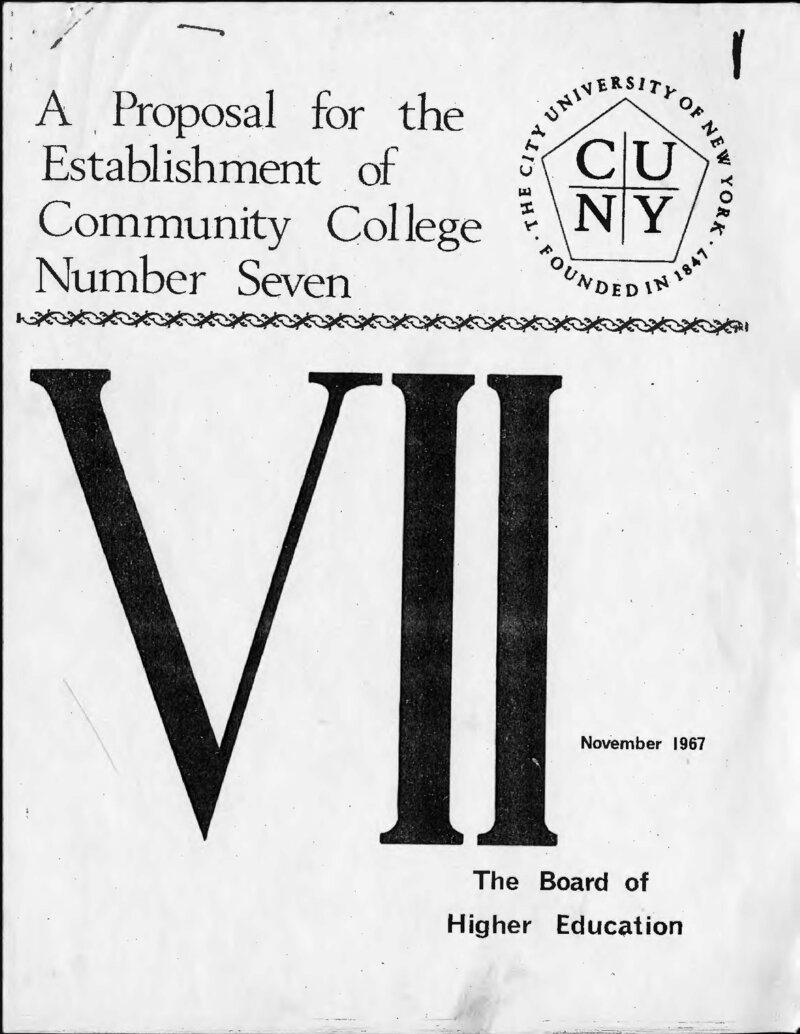
A Proposal for the Establishment of Community College Number Seven
Item
. 4 a
s
A. Proposal for the
Establishment of
Community College
Number Seven |
b$ OPRAH PRAR ROU
November 1967
The Board of
Higher Education
wits
school performance as is now the case.
Thus, the college will be experimental in that it will reach for
improved patterns and methods for meeting the needs of the City's high
school graduates.
The Common First Semester Program
At the present time, students apply for and are admitted to speci-
fic programs of study in the community colleges; e.g., nursing, X-ray tech-
nology, transfer programs, etc. The procedure permits students to choose a
program before they enter college, but it has off-setting disadvantages.
The procedure assumes high school seniors can make intelligent choices among
a wide variety of career and transfer programs without any exposure to the
program and before counselling in the colleges.
The proposed institution would admit students to the college rather
than to specific programs of study. Every student would have an opportunity
to qualify for any program offered at the school regardless of his high
school performance or the extent of his high school academic work. During
the first semester, the student will receive cougselling on all the major
areas of study offered at the college. At the end of the first semester,
students will be permitted to select their program of study; students will
be given preference on the basis of their first iietacene's work.
Thus, the new institution will experiment in a two-year program
of study that will. assure every student of the opportunity to choose a pro-
gram of study with the full irivae fire of the opportunities available in that
field and consistent with his ability as measured by college performance
without regard to his high school record.
5 bd
Location of the College
In locating new community colleges, the City University has, in
the past, sought sites outside the ghettos in order to assure an integrated
institution and to provide ghetto-area residents with an opportunity for
study in a different environment. This structure has served its purpose
well. The new college, taking a different approach, will be located in, or
near, a low-income community. The proposed institution will give greater
emphasis to the problems of disadvantaged youth not only in terms of its
enrollment objectives, but also in experimenting with new programs oriented
more specifically to the needs of ghetto youth. Thus, the college will have
a strong "pre-college" component which, among other objectives, will provide
intensive counselling and remedial work to compensate for the educational
disabilities of its new students.
The new community college would serve as a testing ground for many
new programs. in the health area and in the expanding field of social tech-
nology designed to produce recreation leaders, child day care personnel, wel-
fare assistants, and aides for elementary and secondary schools. It will
also provide a range of other career and transfer ‘programs.
Community Orientation
Location of the institution in a poverty-area will provide the
community with a resource that can extend beyond traditional instructional
programs. The new college will concentrate greater resources in community
programs than has beam tratittonal among community colleges. Emphasis will
be placed on develloutie programs which help disadvantaged adults progress
upward on career ladders via courses cenducted on or near job sites, and
other modes of educational programs now being tested in the Public Service
-13-
Career Training Program. The scope and nature of these programs will depend
on the site selected, but generally, they will provide a means for mobilizing
community involvement in resolving community problems.
Admission to the College
In order to provide an ASEhe method of limiting enrollments to
existing capacity, the City University has used high school performance and
the results of the scholastic achievement test as a basis for admissions.
Shortages of space have resulted in relatively high cut-off scores even for
career programs. Further, most career programs require the completion of
ten or more academic credits, limiting admissions of high school graduates
holding vocational and general diplomas.
The new institution will seek to develop wholly new admissions
standards which do not penalize students for poor choices or poor performance
in high school.
Several alternatives are possible -- and those are discussed below
under "Student Body to be Served."
Student Body to be Served:
The new college should be designed to accommodate 5,000 students.
The projected enrollment, beginning with 500 in 1969, and aimee to 5,000
by 1980, is shown in Table IV.
Admissions policies would be designed to offer:every student who
is able and eager to profit from education beyond the high school the chance
to become "all that-he is capable of being." However, because of the commit-
ment of this community college to its surrounding community, and in recogni-
tion of the limitations in the educational preparation of the potential
ie
student body coming from a poverty area, variations of existing City Univer-
‘sity admissions policy will be experimented with. Among the possibilities
are:
1. Local comunity high schools would receive preferential treat-
ment, possibly using an admissions formula based on the "depri-
vation index" currently used by College Discovery Program.
2. An “open enrollment" admissions policy ("first come, first
served") would be structured to favor residents of the community.
The exact patterns to be followed would receive serious study be-
fore implementation. Consideration would be given to all the many implica-
tions inherent in any such change with particular emphasis on the basic
mechanics of implesencatton which gives rise to a host of legal and educa-
tional problems. It should be noted, however, that the common first semester
concept, as outlined on page 11, will facilitate the introduction of either
policy.
The composition of the student body of the new community college
ee likelihood, be different from that of existing community col-
x leges. A natural result of the proposed location and community commitment
ve thts institution, will be that a significant portion of the students would
come from the ghetto community.
4. Facilities and Operating Budget
The following information on space requirements and costs, and. the
projected operating budget are presented only to indicate the general magni-
tude of the commitment and should not be construed as a definition of the
specific level of expenditures.
=15-
A. Facilities
No recommendations on a permanent site or facilities are
included in this report in accordance with the policy followed in the estab-
lishment of the other community colleges. They will come to the Board after
a president is appointed and a careful study of alternatives is made.
Wherever located, the new community college would be designed to
house 5,000 full-time students requiring 800,000 square feet. A general
cost estimate indicates that a capital budget allocation of $32,000,000
would be needed (5,000 students x 160 square feet x $40 = $32,000,000).
The above formula is based on a rule of thumb and should be inter-
preted as a guideline in the broadest sense. When the new president is
appointed, an academic program will be developed and based on that program
and the requirements of the site, an architect will define specific require-
ments.
Construction of permanent facilities will take approximately six
youre (1969-1975). Temporary facilities will be needed during this period
of time. Rental costs are estimated at $1 million annually .2
The University should initiate steps to procure temporary quarters
as soon as the new college is approved.
B. Operating Budget
Operating cost estimates are guided in part by the actual experience
2since it is difficult to pin down the exact cost of renting tem-
porary facilities because of the many changing variables; e.g., rising rental
costs, site location, etc., the following formula is proposed as a guideline:
100 square feet x 2,000 students x $4.75 = $950,000 per year. The figure 100
square feet per student may cause crowded conditions and therefore could be
increased if so desired. The figure 2,000 students takes into account the fact
that while the college will open with 500 students, it must annually absorb an
increase of 300 students and eventually che atime 2,000 students in temporary
facilities (during 1974-75).
s
A. Proposal for the
Establishment of
Community College
Number Seven |
b$ OPRAH PRAR ROU
November 1967
The Board of
Higher Education
wits
school performance as is now the case.
Thus, the college will be experimental in that it will reach for
improved patterns and methods for meeting the needs of the City's high
school graduates.
The Common First Semester Program
At the present time, students apply for and are admitted to speci-
fic programs of study in the community colleges; e.g., nursing, X-ray tech-
nology, transfer programs, etc. The procedure permits students to choose a
program before they enter college, but it has off-setting disadvantages.
The procedure assumes high school seniors can make intelligent choices among
a wide variety of career and transfer programs without any exposure to the
program and before counselling in the colleges.
The proposed institution would admit students to the college rather
than to specific programs of study. Every student would have an opportunity
to qualify for any program offered at the school regardless of his high
school performance or the extent of his high school academic work. During
the first semester, the student will receive cougselling on all the major
areas of study offered at the college. At the end of the first semester,
students will be permitted to select their program of study; students will
be given preference on the basis of their first iietacene's work.
Thus, the new institution will experiment in a two-year program
of study that will. assure every student of the opportunity to choose a pro-
gram of study with the full irivae fire of the opportunities available in that
field and consistent with his ability as measured by college performance
without regard to his high school record.
5 bd
Location of the College
In locating new community colleges, the City University has, in
the past, sought sites outside the ghettos in order to assure an integrated
institution and to provide ghetto-area residents with an opportunity for
study in a different environment. This structure has served its purpose
well. The new college, taking a different approach, will be located in, or
near, a low-income community. The proposed institution will give greater
emphasis to the problems of disadvantaged youth not only in terms of its
enrollment objectives, but also in experimenting with new programs oriented
more specifically to the needs of ghetto youth. Thus, the college will have
a strong "pre-college" component which, among other objectives, will provide
intensive counselling and remedial work to compensate for the educational
disabilities of its new students.
The new community college would serve as a testing ground for many
new programs. in the health area and in the expanding field of social tech-
nology designed to produce recreation leaders, child day care personnel, wel-
fare assistants, and aides for elementary and secondary schools. It will
also provide a range of other career and transfer ‘programs.
Community Orientation
Location of the institution in a poverty-area will provide the
community with a resource that can extend beyond traditional instructional
programs. The new college will concentrate greater resources in community
programs than has beam tratittonal among community colleges. Emphasis will
be placed on develloutie programs which help disadvantaged adults progress
upward on career ladders via courses cenducted on or near job sites, and
other modes of educational programs now being tested in the Public Service
-13-
Career Training Program. The scope and nature of these programs will depend
on the site selected, but generally, they will provide a means for mobilizing
community involvement in resolving community problems.
Admission to the College
In order to provide an ASEhe method of limiting enrollments to
existing capacity, the City University has used high school performance and
the results of the scholastic achievement test as a basis for admissions.
Shortages of space have resulted in relatively high cut-off scores even for
career programs. Further, most career programs require the completion of
ten or more academic credits, limiting admissions of high school graduates
holding vocational and general diplomas.
The new institution will seek to develop wholly new admissions
standards which do not penalize students for poor choices or poor performance
in high school.
Several alternatives are possible -- and those are discussed below
under "Student Body to be Served."
Student Body to be Served:
The new college should be designed to accommodate 5,000 students.
The projected enrollment, beginning with 500 in 1969, and aimee to 5,000
by 1980, is shown in Table IV.
Admissions policies would be designed to offer:every student who
is able and eager to profit from education beyond the high school the chance
to become "all that-he is capable of being." However, because of the commit-
ment of this community college to its surrounding community, and in recogni-
tion of the limitations in the educational preparation of the potential
ie
student body coming from a poverty area, variations of existing City Univer-
‘sity admissions policy will be experimented with. Among the possibilities
are:
1. Local comunity high schools would receive preferential treat-
ment, possibly using an admissions formula based on the "depri-
vation index" currently used by College Discovery Program.
2. An “open enrollment" admissions policy ("first come, first
served") would be structured to favor residents of the community.
The exact patterns to be followed would receive serious study be-
fore implementation. Consideration would be given to all the many implica-
tions inherent in any such change with particular emphasis on the basic
mechanics of implesencatton which gives rise to a host of legal and educa-
tional problems. It should be noted, however, that the common first semester
concept, as outlined on page 11, will facilitate the introduction of either
policy.
The composition of the student body of the new community college
ee likelihood, be different from that of existing community col-
x leges. A natural result of the proposed location and community commitment
ve thts institution, will be that a significant portion of the students would
come from the ghetto community.
4. Facilities and Operating Budget
The following information on space requirements and costs, and. the
projected operating budget are presented only to indicate the general magni-
tude of the commitment and should not be construed as a definition of the
specific level of expenditures.
=15-
A. Facilities
No recommendations on a permanent site or facilities are
included in this report in accordance with the policy followed in the estab-
lishment of the other community colleges. They will come to the Board after
a president is appointed and a careful study of alternatives is made.
Wherever located, the new community college would be designed to
house 5,000 full-time students requiring 800,000 square feet. A general
cost estimate indicates that a capital budget allocation of $32,000,000
would be needed (5,000 students x 160 square feet x $40 = $32,000,000).
The above formula is based on a rule of thumb and should be inter-
preted as a guideline in the broadest sense. When the new president is
appointed, an academic program will be developed and based on that program
and the requirements of the site, an architect will define specific require-
ments.
Construction of permanent facilities will take approximately six
youre (1969-1975). Temporary facilities will be needed during this period
of time. Rental costs are estimated at $1 million annually .2
The University should initiate steps to procure temporary quarters
as soon as the new college is approved.
B. Operating Budget
Operating cost estimates are guided in part by the actual experience
2since it is difficult to pin down the exact cost of renting tem-
porary facilities because of the many changing variables; e.g., rising rental
costs, site location, etc., the following formula is proposed as a guideline:
100 square feet x 2,000 students x $4.75 = $950,000 per year. The figure 100
square feet per student may cause crowded conditions and therefore could be
increased if so desired. The figure 2,000 students takes into account the fact
that while the college will open with 500 students, it must annually absorb an
increase of 300 students and eventually che atime 2,000 students in temporary
facilities (during 1974-75).
Title
A Proposal for the Establishment of Community College Number Seven
Description
This proposal for the founding of Community College Number Seven (later named Medgar Evers College) was put forward by the Board of Higher Education in November 1967. In this excerpt (pages 11-15), the Board establishes their desire to place a new two-year college in or near a low-income community, a first for CUNY, where it will give greater emphasis to "the problems of disadvantaged youth." Consequently, it is stated, the proposed institution will be tasked to experiment with new programs designed to meet the unique needs of the community that it serves. The proposal also discusses the implementation of a common first semester, plans for location and facilities, aims for community involvement, and admissions goals.
Contributor
Tager, Florence
Creator
The Board of Higher Education
Date
November 1967 (Circa)
Language
English
Rights
Obtained from Contributor - Copyright Unknown
Source
CUNY Central Archives
Original Format
Report / Paper / Proposal
The Board of Higher Education. Letter. “A Proposal for the Establishment of Community College Number Seven.”, CUNY DIGITAL HISTORY ARCHIVE, accessed September 6, 2026, https://stephenz.tailc22a4b.ts.net/s/cdha/item/268