Spheric: Ground Zero
Item
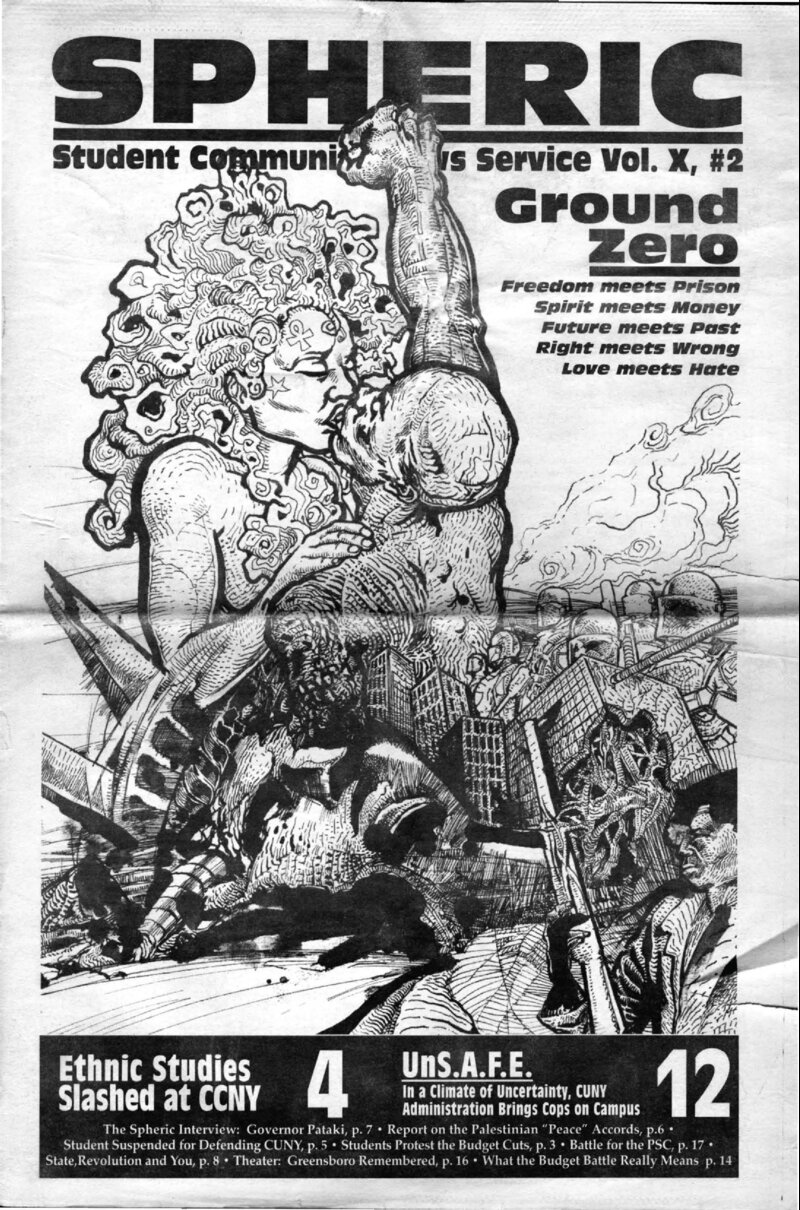
Freedom meets Prison
Spirit meets Money
Future meets Past
Right meets Wrong
Love meets Hate
Ethnic Studies UnS.A.F.E.
Slashed at CCNY in a Climate of Uncertainty, CUNY
Administration Brings Cops on Campus
The Spheric Interview: Governor Pataki, p. 7 * Report on the Palestinian “Peace” Accords, p.6 *
Student Suspended for Defending CUNY, p.5 + Students Protest the Budget Cuts, p. 3 » Battle for the PSC, p. 17 +
State,Revolution and You, p. 8 * Theater: Greensboro Remembered, p. 16 * What the Budget Battle Really Means p. 14
695 Park Avenue,
Room 207TH
New York City 10021
Spheric is all things except square.
Spheric is an autonomous organic entity birthed in CUNY and devoured
the world over. Spheric is a weapon, a decoy, a bastion of foresight for
those with eyes in the backs of their heads, a many splendor’d thing, an
anti-bible for some, the god-given scripture for others, and for your
convenience, FREE. Spheric’s pages are open to all who are open.
Spheric joins in the world-wide movement to make all which we make
ours, all that we use ours and all we can dream of real. Spheric loves you.
Hunter College:
Mad Cracker: Jed Brandt, Editor
SubComandante: Ramiro Campos
Princess Jasmine: Nilda Laguar
La Sad Girl: Sandra Barros
Lenina Nadal
Claudia Zequeira
Trip Delicious:
Chicken Wing:
Origina, Man: Adam Peres
Chief; Asif Ullah
pe ckiyn College Hit Squad
* Baby Blue: William Kopp
Mama Cool: Sattara Lenz
“Francesca”: Carolyn
CCNY/Harlem University
Mystic Ballistic: David Suker in exile
The Graduate Center Intellectual Mafia
Alex Vi
Rob Holla
Good Student
Bad Student
NYU Errant Hipsters
Oona Chatterjee
Ersellia Ferron
The One
The All
SPHERIC
(212)
112-4219
New School for Anti-Social Researchers
TS.RK.A.:
CUNY Law Pod/Queens College
Sue Bartone
SUNY No Pulse:
Luck O’ the Haitians: Malcom Gaff
Folks About Town
EI Fé: Fred Zabinski, designer
Grasshopper: John Kim, illustrations
Bronx Rumbler: Susan Rothman, prfreeding
Jessica Klonsky
Illegal Eagle:
San Francisco Tentacle
Adam Bomb: Jeffrey
Vermont Tentacle:
Luna Fringe: Victoria Kravitz
Colorado Tentacle
Robbie Ronzoni
And:
Your Name Here:___
Big Gumbah:
OPHERIG
Volume X, Number 2: Ground Zero
Ground Zero
Letters
ALUMNI SHOUTOUT
Dear Spheric and the CUNY
Community(ies):
Your Birth of An Internation issue
is great. CUNY has needed a CUNY-
wide paper for a long time. I've sent
issues to various student groups
around the country. Is Spheric on the
internet/ WWW?
As part of the struggle against
budget cuts and tuition increases in
1989-91, I keenly keep in touch with
the struggles at CUNY. I'm sure I'm
not alone in this.
I suggest that those of us who
have graduated, or are about to grad-
uate, form a CUNY Progressive
Alumni Network to offer support to
present day CUNY student activists
and to take action ourselves.
We could also network with
similar progressive alumni networks
at the other colleges to change policy
nationally for what the struggle is
about: EDUCATION 1S A RIGHT! |
(Free tuition, open admissions, multi-
cultural studies, full support services)
A long-term struggle requires
our own long-term alternative insti-
tutions; SPHERIC, the CUNY Coali-
tion (SLAM!), and a CUNY Progres-
sive Alumni Network are important
parts of our struggle(s) for liberation.
Jesse Heiwa
GPO Box 7045
NY, NY 10116
hapanes@blythe.org
Editor's response:
Interwhat? Hey, 25 years ago, all
the people like you were talking
about acid. Yeah, “Acid’s going to
change the world... If Nixon dropped
acid, the war would be over, man.”
Now you're saying,“ The Internet's
like Jacob’s ladder, God is a goo-
goobyte, man.” But, you know, acid is
groovy, and the Internet will look real
good on our resumes. So hang tight;
we'll be the Web this semester; the
address will be in the next issue
RACIST ILLITERATE WRITES
RE: “This is Not a Love Song”
Your mad dog deatribe [sic]
reflects what is wrong with your race.
No wonder people degragate sic] you
by calling you a nigger. How do you
expect to graduate and cope with soci-
ety? Wake up!
signed,
Hate Breeds Hate
(postmarked from Westchester County)
Editor's response:
It's exciti
has spread f
ag ti
cronies. But now we see Mr. and Ms.
America reads Spheric, too.
Special thanks to all the upstate
distributors.
WHITE FIGHT
Dear Spheric,
I liked your article in the last
Spheric, “What's Wrong With White
People,” but I did want to raise a
point or two.
You conclude your article by
calling for white people to “try and
deal with the basic realities of black
America and aid in the struggle for
black self-determination. It is only in
the freedom of all people on their
own terms that we can even begin to
speak of love.”
I don’t disagree with this. I think
one of the problems for far too many
white people, including many white
activists, is an unwillingness to really
understand, politically and personal-
ly, this concept.Concretely, at its root,
and the reality of — all-African-
American, or all-Latino, or all people
of color organizations, even as we as
white people work to break down the
racism which prevents, or at least
frustrates, the building of multi-cul-
tural unity.
This is the flip side, the very
related flip side, of your conclusion
Strategically, we have no hope of win-
ning either our short-term struggles
against budget cuts or our long-term
struggle for a non-capitalist, liberat-
ing society unless we can build rela-
tionships of equality between people
of color and white people.
We can only do this if those of us
who are white take seriously the task
of un-learning racism, and people of
color deal with the internalized
oppression which comes from institu-
tionalized racism. The primary
responsibility is on those of us who
have benefited from white privilege
To unlearn racism we need to
undertake serious study of the histo-
ry of racism in the U.S. beginning 504
years ago with Christopher Colum-
bus. We need to consciously develop
genuine, honest friendships with
individual people of color so that
both sides can grow beyond the anxi-
ety, fear, anger and/or guilt that pre-
vent relationships of equality. And
we need to find ways to interact on a
daily basis with people of color so
that those of us who don’t experience
racism can be constantly reminded,
criticized, confronted and/or
exposed to these realities as often as
possible. If we do these things, then
there is hope that we can become reli-
In the struggle
Glick, National Independent
Politics Summit
Ground Zero
es sia!
Students SLAM Governor
“SPHERIC age 3
pias SpuUe
4
OpIOUsA
gam by R. W. Guerra
he first day of spring in
New York City was brought
in with a powerful and
determined demonstration
against Governor Pataki’s
budget cuts by 1,000 high school and
college students. The action on
March 21 launched a new season of
struggle against the government's
war on the poor. The students
marched through midtown Manhat-
tan to make it known that they will
not stand by while Pataki and Giu-
liani bring down yet another round
of budget cuts that will destroy the
lives of tens of thousands of people.
The march was led by a huge
30-foot-wide banner that read:
“Defend Our Education—SLAM the
Cuts!” As the march made its way
through the streets, there was sym-
pathy and support from many office
workers as well as people driving by
in trucks and cars.
The march and rally were
called by SLAM! (Student Liberation
Action Movement). SLAM! is a
multinational group of students that
came together out of last year’s
struggle against the budget cuts. The
crowd was very multinational and
ranged in age from kids about 12
years old to college students in their
mid-20s and came from many high
schools and CUNY campuses.
This demonstration was the
first major action against the latest
round of budget cuts. Because of tax
cuts in the state budget last year, the
state budget has a $2 billion deficit.
40% of these tax cuts go to people
poe more thea He res a J ;
ed, Gov. Pataki has prosaete a rarhcle
new series of cuts that will hit poor
people the hardest. These include
massive cuts in public education.
Pataki wants to cut state fund-
ing of CUNY by $57.6 million dollars
when last year’s cuts caused a
tuition increase of $750 to $3,200 a
year. The new cuts would raise it
another $250. Programs like SEEK
that help students improve their aca-
demic skills were cut by 25%. The
Tuition Assistance Program (TAP)
for the poorest students will be cut
by $119 million and students will not
be able to use their TAP funds until
they've wavered half their tuition
with federal Pell grants.
A recent New York Times editori-
al said “at some community colleges,
low-income students would lose
roughly 60% of their state aid.” Thou-
sands of students have already been
forced out of school by last year’s
cuts. Speakers told the crowd that at
Brooklyn College alone, 1,500 stu-
dents could not come back to school
because they couldn't afford it.
Many academic programs have
already been eliminated and more
are on the chopping block—especial-
ly programs in Black and Latino
Studies. Just two days before,
CCNY announced it was abolishing
programs in Black Studies, Puerto
Rican Studies and Jewish Studies.
Dozens of faculty members have
been laid off. At most schools, 40%
of classes are already taught by
graduate students.
There are fewer classes and they
are more crowded. At Baruch Col-
lege, the new cuts would result in
elimination of 11% of the faculty. The
number of adjunct professors would
class offerings—which means their
students will not be able to get into
courses that they need to graduate.
A woman from the Urban Jus-
tice Center summed up the situation
this way: “The powers-that-be want
to take our education away from us.
The action on
March 21
launched a
new season of
struggle
against the
government’s
war on the poor
They want to make it a privilege and
not a right. They want to make it
inaccessible to people of color and
poor people.... They have already
taken affordable housing and decent
jobs from us. Now they want to take
our education. What's next? Our
minds? The air we breathe? Our
very existence? They want us off
public assistance but have no jobs
for us. They want us off welfare but
continue to place obstacles in our
way so that we can’t receive a quali-
ty education. Over 20,000 CUNY stu-
dents are on public assistance. Over
7,000 students this school year have
been forced to drop out to work per-
forming menial tasks for a welfare
check. A lot of these students have
one or two classes left for their
degree, but our ‘industrious’ mayor
and governor would rather have
them do this than get an education.
What's wrong with this system?
person on she siuket basking 90g for
change tomorrow. No education
equals no jobs, no jobs equals no
money, no money equals no hous-
ing, no housing equals homeless-
ness, homelessness equals despair.
Power to the people!”
LeDon James, a member of the
Welfare Rights Initiative at Hunter
College, spoke about how the cuts
are affecting mothers who need child
care: “At CUNY, the child care cen-_
ters are being threatened to have our
funding cut. They have been cut
25%. That means that less parents
will be able to take their children
into a place that is warm, that is car-
ing, that is nurturing, that is conve-
nient because it’s right on campus.
And they're going to have to drop
out of school, not only because
tuition is going up and grants are
being cut, but because the child care
is being threatened.”
Deteriorating High Schools
About half the students who
came were high school students
from around the city. In most cases,
school authorities threatened stu-
dents who wanted to come to the
demonstration. Police tried to stop
some from leaving their schools.
There was a big contingent from
LaGuardia, an arts high school in
midtown Manhattan. Students from
nearby Martin Luther King High
School were detained by the police
goto page 11
who's ot the money? the ich go the money! who must pay?
¢ aor
a
na’ halo, natal )
a ED viicarion
Turning Back the Clock On Ethnic Studies
auummmms by Christopher Day
ecent events at City College and
Columbia University have put
Ethnic Studies on the agenda of
politically conscious stu-
dents. At City College, Pres-
ident Yolanda Moses announced that
the Departments of Black, Asian, Jew-
ish, and Hispanic and Caribbean Stud-
ies were being reduced to the status of
a combined ethnic studies program. At
Columbia University a coalition com-
posed mainly of students of color
waged a militant struggle for the estab-
lishment of a Department of Ethnic
Studies. Having been rebuffed by the
administration, a coalition of mainly
Black, Latino, Native and Asian stu-
dents initiated a four person hunger
strike on April 1. After several
demonstrations the coalition seized a
section of the administration building
on April 9, 22 students, including the
hunger strikers, were arrested for the
occupation. After several more build-
ing occupations the Columbia students
negotiated an agreement with the
administration to hire several new fac-
ulty of color and to develop new ethnic
studies programs, The demand for a
department, however, went unmet.
At City College, the Sons of Afri-
ka, an organization of students in the
Black Studies Department, protested
outside the Upper West Side home of
Yolanda Moses on April 6.
On April 18 students from across
CUNY gathered at City College and
marched off campus and into the
community in defense of Ethnic stud-
ies. Returning to campus the demon-
stration poured into the administra-
tion building. Blocked from entrance
to Moses’ office the crowd gathered
briefly on the roof of the building
where the US flag was turned upside
down before occupying the lobby for
the afternoon demanding to speak
with Moses.
These two struggles reflect the
strange state of what is broadly called
Ethnic Studies these days. The fight
for Ethnic Studies began in the late
1960s when considerably fewer stu-
dents of color were to be found on
most college campuses. Small groups
of students of color were engaged in
intensive study of the respective histo-
ries and cultures of the non-white
peoples largely ignored by the educa-
tional system in this country. But these
efforts at study took place outside of
any official departmental structure
within the universities. The broad and
militant student movement of the late
60s began to demand the creation of
departments of Black Studies.
These demands were initially
rejected, but one by one Black Studies
Departments were created when stu-
dents took direct action: seizing
buildings, organizing student strikes,
and otherwise showing their willing-
ness to disrupt the normal function-
ing of their schools until their
demands were met. Two struggles
were particularly key in the creation
Student at one of the first protests for Black Studies over 25 years ago.
of Black Studies as a recognized acad-
emic discipline: the Third World Stu-
dent Strike at San Francisco State and
the struggle for open admissions at
City College. Both of these struggles
lead to the eventual creation of Black
Studies departments on those cam-
puses and inspired struggles across
the country.
The initial victories of Black stu-
dents also inspired other groups to
demand the creation of new depart-
ments. Over the course of the 70s and
80s student struggles lead to the
establishment of Chicano, Asian,
Native, Women’s, and Gay and Les-
bian Studies Programs and Depart-
ments on campuses across the coun-
try. On some campuses Departments
of Ethnic Studies, which encom-
passed a broad range of peoples his-
tories and cultures, were established.
What is Ethnic Studies?
It has always been a little difficult
to define ethnic studies. The first prob-
lem is, of course, that the pantheon of
“great white men” who dominate
what we study at college have ethnici-
ty. One of the worst aspects of Euro-
centrism in the college curriculum is
the view that the teachings and experi-
ences of a tiny minority of humanity
(white men) are treated as uniquely
universal in their appeal. Just as
important as studying the full diversi-
ty of human experience is breaking
down the idea that only Western Euro-
pean civilization has produced works
of universal importance
American Universities have
always had Ethnic Studies, Our Liter-
ature Departments are largely White
Literature Departments. Our History
Departments are largely White Histo-
ry Departments. Art History classes
are usually really White Art History
classes.
The administration at Columbia
University has rejected the creation of
an Ethnic Studies Department in part
on the grounds that the concerns of
such a department should be the con-
cerns of all the respective disciplines.
Initially this might sound like a more
expansive and open-minded vision.
But in practice it would mean that the
Black literature classes would be
under the supervision of a largely
white English Department faculty.
The Puerto Rican History classes
would be designed by a largely white
History Department. And so on,
Does this mean that white peo-
ple are automatically disqualified
from teaching such subjects? Of
course not. But these white people are
the very white people who have
demonstrably failed to develop an
inclusive curriculum already. To put
them in charge of the various pieces
of a dismembered ethnic studies pro-
gram is to sabotage what is most
important about ethnic studies — that
it enables the voiceless at last to be
heard.
The struggle over Ethnic Studies
is a struggle for power. Increasingly,
corporate America has adopted the
ideology of multiculturalism for its
own purposes. In an increasingly
global market, in an increasingly
diverse United States, a basic aware-
ness of the diversity of human cul-
tures has become a matter of basic
business sense. The question is no
longer whether we will study African
history or Latin American poetry or
Chines art. The question is whether
that study will be in the service of the
needs of those peoples or whether it
will be controlled by the existing
power structure.
This is made all the clearer by
looking at the struggles taking place
at City College and Columbia. Even
though on one campus they are trying
to dismantle Ethnic Studies and on
the other it doesn’t yet exist, and even
though one school is overwhelmingly
working class and the other is an elite
university, the terms of the struggle
are remarkably similar. At both City
and Columbia the struggle has been
not over whether the experiences of
people should be included in the cur-
riculum but over how that inclusion
will be controlled.
City College Attacks
The attempt to dismantle the
various Ethnic Studies Departments
at City College come after a pro-
longed battle between the City Col-
lege administration and the former
chair of Black Studies, Dr. Leonard
Jeffries. A number of Jeffries teach-
ings made him vulnerable to attack.
In various contexts he made remarks
about Jewish involvement in the
trans-Atlantic slave trade and in Hol-
lywood’s perpetuation of racist por-
trayals of Black people that were
widely regarded as anti-Semitic. He
has also been a proponent of theories
that some sort of “melanin deficien-
cy” is responsible for the aggressive-
ness of white people whom he
describes as “ice people” (in contrast
with the “sun people” as he describes
people of color). The City College
administration in a blatant violation
of the most basic principles of acade-
mic freedom dismissed Jeffries, who
in turn sued the university.
While Jeffries conducted a back
and forth battle in the courts the City
College adminstration took advan-
tage of the disarray in the Black Stud-
ies Department to-in effect create its
own Black studies curriculum in the
form of courses scattered through
other Departments. These classes
drew students away from the official
Black Studies Department courses
and in effect eroded the substantial
student base of support for the
Department. In this way the adminis-
tration prepared the ground for its
most recent action: the dismantling of
all the vari studies depart-
ments at City College.
The attack on the Departments
of Ethnic Studies at City College must
be understood for what they really
are: an attack on the right of
oppressed communities to develop
their own understanding of their own
histories. The reasons for such an
attack are straightforward enough:
history is a weapon. Black history in
the hands of Black people becomes a
weapon for Black liberation.
Although small numbers of students
major in Black Studies or any other
ethnic studies major, large numbers of
students take classes in those depart-
ments and bring the knowledge that
they acquire in those classes into the
rest of their lives as students. Ethnic
Studies Departments become in this
way base areas for students of color
(mainly) to fight white supremacy as
it expresses itself elsewhere in the
university. To say the least, this is a
monumental hassle for the powers
that be.
White professors are more likely
to be challenged in classes, adminis-
trators are less likely to find students
compliant with their outrageous
demands. And in a larger sense the
University is turning out educated
people committed to fighting for lib-
eration — which from the point of
view of the truly powerful is not what
a university should be doing.
Confessions of an Ice Person
lam a senior majoring in Black
and Puerto Rican Studies at Hunter
College and concentrating on the
Africana sequence of courses the
Department offers. I am also, for lack
of a better term, “white.” For better
Ground Zero
SPHERIC
age 5
aS cui
Outrage Over CCNY 'S tudent’s Suspension
by Rob Hollander, Grad
Center, Kate McCarthy & Jed,
Hunter College
disciplinary panel at City Col-
lege has given a one year
suspension to the presi-
dent of CCNY’s graduate stu-
dent government (Graduate Student
Council) for leading protests on cam-
pus against last year’s budget cuts to
higher education.
The student, Dave Suker, was
subject to surveillance and harass-
ment from campus police last spring
when his name appeared on a univer-
sity administration ‘black list’ of stu-
dent activists who had been arrested
at various protest events.
Suker’s activism was directed
towards saving the university from
crippling budget cuts. Harassment
included verbal threats from campus
police; an on-campus arrest by CUNY
"Peace Officers’ for attempting to
board a bus to Albany for student lob-
bying; and attempts to bar his entry to
events on other CUNY campuses.
Suker’s activism was directed
towards saving the university from
crippling budget cuts. He became a
special target after embarrassing the
university and college administration
with accusations that CCNY Presi-
dent Yolanda Moses, and CUNY
Chancellor W. Anne Reynolds had
invited cuts in CCNY’s budget by set-
ting up retrenchment committees to
recommend firing faculty and elimi-
nating programs.
"The university wants to make
an example of the most prominent
student leaders so the Chancellor can
avoid the embarrassment of unruly
student protests that expose the pub-
lic to what's really happening here at
City College,” said Steve Gottlieb, a
recent CCNY mathematics graduate.
Dave's suspension takes place in
atre and Dance, Classical Languages
and Hebrew Department, the School
of Education, and the SEEK program
were all retrenched last year.
This year the Black Studies
Department. was demoted, along
with all ethnic studies, to a ‘program’,
losing seniority for faculty.
Suker is highly regarded among
students and faculty as a tireless stu-
dent advocate and organizer in the
defense of the City University system.
While some people have merely
attended marches, Dave Suker has
put his body and educational future
on the line to defend our schools.
Dave helped organize the
hunger strike “Starving for Educa-
tion”, is a member of CitySLAM! (Stu-
dent Liberation Action Movement),
and has helped organize in many
protests. Such efforts do not go
unnoticed at CUNY.
The Charges
As a central activist both at
CCNY and in the city-wide move-
ment, Dave has repeatedly incurred
the wrath of the administration and
police.
According to CUNY Administra-
tion, his dedication is nothing more
than a violation of Article 129A of the
Education Law, also known as the
“Henderson Rules”.
These rules exist solely for the
purpose of limiting student expres-
sion and have now been put to use.
His four charges began on April
14, 1995 for entering the President's
office at CCNY and speaking his
atime when CCNY’s Nursing School, President
The question is, why is anyone
being silenced for speaking out
against budget cuts?
mind. He is quoted as having said,
“she would pay for what she has
done in the last three days.”
Dave was actually referring to
get cuts
construed as a possible threat. 5
On May 23, 1995 he was arrest-
ed for obstruction of two busses
transporting City College faculty,
and students bound for Albany to
lobby against New York State budget
cuts.
There was no mention of Dave's
responsibility for obtaining the
busses, or how he was refused expla-
nation as to why he was not allowed
to go.
“In the CUNY-wide
student movement, he’s
the best organizer we've
got. This is a calculated
move on the part of the
administration to
undermine the voice of
student dissent.”
--Rob Hollander,
Co-chair of the Doctoral
Students’ Council at the
Graduate Center
“It's not only because
they want to make an
Dave was then charged on May
30, 1995 in the NAC Rotunda for a
verbal confrontation with Security
Sergeant Lawrence, who told Mr.
€ final charge occurred on
December 14, 1995 in Shepard Hall.
He is charged with disruption of a
presentation regarding the state bud-
get by New York State Comptroller H.
Carl McCall.
Dave questioned the purpose of
the panel, the alleged absence of stu-
dents, and asserted that he would seat
himself on the panel to represent
CCNY students.
An administration memo in
regarding this incident was written
from Dean Jeffrey Rosen to Vice Presi-
dent Morales stating, “Were this an iso-
lated incident and given the fact that
Dave was able to offer a public apology
it would seem to me that an official
warning would be both appropriate
and sufficient. If on the other hand this
is part of a repeated pattern of disrup-
Who is David Suker?
example out of him.
They're flexing their
muscles, administration is
demonstrating the power
they wield when we
challenge them.”
--Grasshopper, a member
of the Student Power
Movement
“1 don’t mean to be rude,
but if a puke like Yolanda
Moses can cast out an
angel like Dave Suker,
then the whole idea of
tive behavior on Mr. Suker's part,
sterner action should be considered.”
When Spheric questioned mem-
bers of the administration at CCNY L
Student. This Violates
regulations of student privacy”.
The question is, why is anyone
being silenced for speaking out
against budget cuts? Common sense
tells us the more money cut, the less
of an education we get.
While the attacks on our educa-
tion have escalated, Administration
seems more concerned with stopping
the defenders than mounting a
defense.
If we voice our opinions and
fight to preserve our education, will
we also be expelled in order to silence
our efforts?
When Spheric spoke to Dave, he
said, “So much money is spent on
student disciplinary action, student
surveillance, and security - this must
mean we are doing something right.”
Freedom of Speech in
america is as much
bullshit as I thought.”
~anonymous student
“We will not let this go
unopposed. The attack
on David Suker is an
attack on CUNY. He
represents the passion of
this city and shows in his
actions the value of
education. This will not
slow us down or divert
our energies.”
-- Spheric
age 6
SPHERIC
Ground Zero
PES aati c:
Palestine, Piece by “Peace”
Ee by Carolyn
Brooklyn College
he Oslo I and II Accords
begin with two fundamen-
tal assumptions. One, that
the partition of Palestine
into two states in 1948 by Western
imperialism was just. Two, that sub-
sequent Israeli expansionism, the
occupation of the Gaza Strip, the West
Bank and East Jerusalem in 1967, and
Israeli settlements in those territories
is just.
Oslo breaks UN security resolu-
tion 242, which called for Israel to
withdraw from the Gaza Strip, the
In Brief
L.A. Cops Make News
The Only Way They Know How
Once again, videotaped police
brutality in Los Angeles makes
nationwide headlines. On April Ist,
Roberto Lovato, director bt the
Central American refugee center in
Los Angeles stated “This is some-
thing that we know goes on every
day in the lives of immigrants,
African-Americans and poor peo-
ple generally.”
As usual, media coverage only
arrived when the incident was
caught on video tape,
In Bolivia, on April 2, protests
called in late March escalated to full
blown rebellion in the streets of the
capital La Paz. Striking public
workers shut down public trans-
portation, threw dynamite sticks at
riot police, and ransacked the
offices of the recently privatized
state railroad.
The Bolivian Workers Center,
the country’s leading union, called a
general strike in protest of a govern-
ment plan to sell the state-owned oil
company, Bolivian State Oil
Reserves, as well as higher wages.
Bolivian police estimated that at
Jeast 50,000 workers took part in the
April 2's demonstration.
America Still Full of Ghettos
From Chocolate Cities like
Newark and Detroit to immigrant
slums in Chicago, people are still
kept in substandard housing solely
on the basis of skin color or nation-
al origin.
As the election season gears up,
not one single candidate has spo-°
West Bank, including the occupied
city of East Jerusalem, to the pre-’67
borders.
Oslo Il, signed on September 28,
1995, divides the West Bank into four
separate zones of control.
Zone A consists of two percent of
Palestinian urban concentrations
under Palestinian authority. Zone C,
consisting of over 70% of the West
Bank is under Israel’s authority.
Zone B consists of scattered towns
and villages inside of Zone C and is
considered autonomous, meaning
the Palestinians would be adminis-
tering what is actually Israeli con-
trolled,
For instance, in Hebron, part of
Zone C cite of the massacre of 29
Palestinians by settler Baruch Gold-
stein, Israeli troops guard fewer than
450 settlers from the over 100,000
Palestinians.
Palestinians are still subject to
arbitrary curfews and house arrest
invading every aspect of their lives
and delegitimating their national sov-
ereignty.
Zone D East Jerusalem an area
technically to be decided at a later
date, is a dead issue. Acting Israeli
Prime Minister Shimon Peres, consid-
ered politically left of slain Prime
Minister Yitzhak Rabin, has make it
clear that East Jerusalem will never be
returned to the Palestinians.
Oslo also ensures that the Palestin-
ian authorities cannot “deal with a
security issue” or “threaten other
Israeli interests.”
Israeli courts will have broad
powers to interpret Palestinian law
and have “veto power over all legisla-
tion.” In the Gaza Strip, a parallel
program exists whereby Israel will
maintain authority of the 30% of the
land considered most valuable and de
facto control over the rest.
The PLO has recognized Israeli
plans to expand their state further. In
signing Oslo, the PLO has accepted
“Israeli ‘soldier searches Palestinians in “autonomous” area.
Palestinian youths fight occupying Israeli soldiers during the Intifada. This prolonged uprising in the
occupied territories
orced Israel to the bargaining table.
the legality of “existing and future
settlement in the West Bank.”
[emphasis mine]
The Israeli Labor Party's proposed
budget for 1996, supported by Likud,
provides $40 million for new settle-
ments in the West Bank and the Gaza
Strip. Settlers are even given subsi-
dies for segregated fish ponds in the
Gaza Strip.
Water, a scarce resource for Pales-
tinians, is used by settlers generously
for lawns, swimming pools, and arti-
ficial lakes for resort hotels.
Labor's budget also includes fund-
ing for specially constructed security
roads, so settlers and tourists alike can
by-pass Palestinian homelands.
The mass uprising of the Palestin-
ian people, the Intifada, forced the
PLO and the Labor Party of Israel to
make peace or risk the fire of the
Palestinian liberation movement.
The Intifada was moving beyond
the pre-'67 borders, into the shanty-
towns and refugee camps of dispos-
sessed Palestinians, and across the
land now called Israel.
Had this continued, the Israelis
and Arafat would have been left as
minor players. Together in Oslo they
built a peace based on their own self
interest and survival.
The PLO has committed to disci-
plining the people's aspirations. As
Rabin said, the Palestinian authorities
will handle their people without the
interference of the “bleeding hearts”
that for so long undermined Israel dur-
ing 46 years of “benign” occupation.
The Palestinian Elections
During the months of December
and January, under a hail of stones
and molotovs, Israeli troops with-
drew from six West Bank cities:
Nablus, Bethlehem Ramallah, Jenin,
Qalkilya and Tulkarm. In Ramallah,
Palestinians smashed symbols of the
occupation and raised their flag over
the police station where many of
them had been tortured. Yet Palestine
is not free.
Israeli troops have only partially
or temporarily re deployed; since
their “withdrawal” they have repeat-
edly declared curfews, crippling the
nascent Palestinian economy. On Jan-
uary 5 Shin Bet [Israeli secret service]
agents assassinated Yahaya Ayyash of
Hamas in the Gaza Strip.
On January 20, the Palestinians
again declared their liberation, voting
in their first-ever national elections.
The elections are a direct response to
the Israeli troop redeployments, and a
desire to express Palestinian national
identity. Even with Yassar Arafat's
manipulation of the Fatah electoral
slate, the elections give political inde-
pendents in the Palestinian Authority
(PA) some room to breath.
Before the elections took place, two
decisions shaped their outcome. One,
the electoral system was to be based
on majority vote and multi-constituen-
cies, rather than a proportional repre-
sentation and single constituency.
The former favored Fatah, which
has dominated the occupied territo-
ries since the Intifada, and its social
bases: the petit-bourgeois mercantile
class and tribal social structures.
Arafat's authoritarian hand in shap-
ing the PA lead directly to opposition
forces within the PLO boycotting the
elections.
The oppositional forces are the
PLO’s Marxist-Leninist Popular Front
for the Liberation of Palestine (PFLP),
the Democratic Front for the Libera-
tion of Palestine (DFLP), the Islamist
Hamas, and Islamic Jihad.
The opposition wrongly assumed
the elections would be a referendum
on Oslo only, In response, the people
ignored their calls for a boycott
The results of the elections seem to
give Arafat and Fatah a clear majority
on the PA. However, what is not clear
is how much control Arafat has over
the 88 newly elected members of the
Palestinian Council, including the
members of his own party.
The new PA is filled with the street
fighters, community activists, stu-
dents, and former prison leaders of
the Intifada generation, a generation
that rose directly contesting the PLO.
The elections have deeply frac-
tured all of the political parties repre-
senting a revolt from below. The PLO
and Arafat have been given an order:
represent the people or else.
The PA was elected on a platform
expressing the kind of Palestine the
people desire: one where East
Jerusalem is the capital, all settle-
ments are removed, and all refugees
returned. These demands go beyond
Oslo and Israel’s agenda. But the
elections have also legitimated Oslo.
The PA will have to struggle for their
autonomy and for a just peace under
immense pressure from U.S. imperial-
ism and Israel to accept Oslo.
Whether or not the PA struggles
for Palestinian liberation, the opening
of the political landscape due to the
fractures of the PLO parties offer the
people a new opportunity to spark the
Intifada one again. The liberation of
Palestine is not finished, and the sign-
ing of Oslo will bring no just peace.
page7
* fates
SPHERIC
Ground Zero
aaa WEATHER
Semmes by Fred Zabinski
Man About Town
wo weeks since they let me
go at my last job, and I've
done nothing about getting
more work. I've barely started
any of the projects I've planned —
updating my portfolio, redesigning
my résumé, contacting the publica-
tions I'd like to work for. The one draft
of my new résumé sits in the pile of
unpaid bills and ignored paperwork.
All my self-discipline has col-
lapsed. I haven't been doing my yoga,
working out or meditating. The worst
is that I've completely neglected my
diary, which means I’ve stopped writ-
ing anything of value.
It's hard to keep a diary when all
day you do nothing you can be proud
of. | am very conscious of the fact that
1am being a bum; it’s always on my
mind, but to put that in words and
write them down where I'll read them
decades from now is more than I
could stand.
“The ined
living.” This is the credo
keep my diary; it is by writing about
my life day by day that I gain insight
and get in better touch with myself —
when I'm not too depressed to write
entries of decent length. And now
that word “unexamined” seems so
perfect a description of the way I've
been living. I eat, I nap, I tinker with
my computer, I poke around the
Internet and blather with strangers.
All done impulsively, without plan or
reflection, like an animal foraging for
bits of food.
T haven't even kept my room clean.
But I don’t know if the paper and
other junk lying around is really
worse to look at than the crappy fur-
niture it covers. So much junk I'd love
to replace if only | had the money.
How many years have I been saying
that to myself? The more | think the
more | hate my life and myself. So I
try not to think.
I'm so ashamed to be spending a
Friday night, or any night, like this. I
can’t stand it anymore; I've got to get
away from here. But it’s too late to get
together with anyone, and no one’s
going to leave their home with this
blizzard raging. Maybe a walk in the
snow would do me some good. At
least it couldn't make me feel any
worse. I bundle up good and step out-
side into the garden the housing com-
plex surrounds.
The snow is several feet deep. It’s
falling so thick the water tower is
barely visible, yet there is almost no
wind, so all is silent. In fact, I have
never heard such silence in the city.
The snow dampens all sound.
Everything has been transformed.
It is a new landscape, white, clean,
unspeakably beautiful.
Thank God I decided to come out
here; all my frustrations and self-
my mind. | quietly drink in this
vision, thrilled to be here, profoundly
grateful to be alive and have the eyes
to see this.
Every day when I say my prayers I
thank God for all Her creations, but in
the city Nature remains far away, an
abstraction. Now She is right here,
taking back the city and quickly bury-
ing it.
I can hear the sound of each tree as
the breezes move their branches; each
one sings differently. I can see small
silent eddies of breezes where the
snowflakes shift in their flight. Indi-
vidual flakes glisten everywhere on
the smooth white slopes as the shad-
ows of falling snow pass over.
Slowly I wander out of the complex
and into the street, stopping here and
there to savor some sound or vision.
There are no more boundaries
between street and sidewalk, no cars
are out, so I walk down the middle of
the street.
I'm surprised to see an occasional
passer-by trudging through the snow,
off to God knows where. They look
up at me, unsmiling. My black mask
completely covers my face; it’s the
kind the homeboys wear. I know how
scary it looks, not that this is my
intention. They seem suspicious of
my standing silently in the snow-
storm. | just look away from them.
I head down 126th Street, towards
the water tower and the Long Island
Railroad tracks. There will be fewer
people there than on Lefferts Boule-
vard, the shopping strip where I usu-
ally wander when depression drives
me from my apartment.
As I suspected, the landscape is
even wilder here. The streetlamps are
scarce and the railroad is dark. I see
someone's tracks in the snow and
It hits me how silly it is that I never
have come here to clear my mind, but
instead wander where I do my shop-
ping every day. It show how well I
forge the chains of my own slavery.
The sense of magic is building,
exhilarating and frightening me. I feel
as if 1 am about to do something I
have never done before; a new life is a
as WAT
We All Live In This City, Sometimes It Snows
step away... My eyes run down the
shabby, sagging chain-link fence run-
ning the length of the railroad. Is that
all there is to keep me off the tracks?
Thave been standing in the snow for
ten minutes, seéing no reason to move.
Again I think of how my neighbors
looked at me suspiciously. Looking
behind at the dark houses, I imagine
someone calling the police on me, I can
easily picture a police car pulling up,
cops getting out and demanding to
know who I am and what I'm doing.
I'm not doing anything, I’m just out
watching the snow fall. Can I prove
who I am or that I live here? No, all
my ID is in my wallet, which I left at
home. I can’t be arrested for not hav-
ing ID or for just hanging around out-
side. But if the cops tell you to move
on, you'd better move. And now that I
think about it, I'm starting to feel
uncomfortable here. I turn around
and head on towards home
Up ahead, on Kew Gardens Road,
is where the cops would probably
pull up. I stop, catching myself in the
middle of this fantasy. It is a recurring
thing. It comes at times like these,
when I'm alone and aimlessly walk-
ing around outside. I start to feel
alienated from society, and expect
hostility from people. For perhaps the
first time in my life, I ask myself what
this fantasy means.
Looking up the hill t
ards the
that police car materialize just by
focussing on the image of it. The white-
ness is a canvas on which I can project
my fantasies and make them real...
Who are these cops? It’s I who have
called them. Why do I want them? I
call them at times like these, when I
can’t name a purpose I’m pursuing.
They're the behavior police, here to
bind me to plans, reasons, disciplines.
When I'm hanging out with other peo-
ple I can feel free to drop the sched-
ules and programs, to be spontaneous
and enjoy purposelessness, but when
alone | better be doing something for a
reason, or the police come.
All this time I've been wasting on
the Internet and bbs’s, I've been run-
ning from the cops, trying to ignore
them. Here in the silence and white
emptiness, they stand out before me. I
can examine them, see them for what
they are. I can make them go away.
Wipe away your preconceptions
Cleanse your mind. Let your thoughts be
buried in the snow,
My eyes run
down the
shabby
sagging chain-
link fence
running the
length of the
railroad. Is
that all there is
to keep me off
the tracks?
I walk up the hill. It seems
ties are infinite. Like the world of
dreams, this place only seems alien
and different because | ignore it,
knowing nothing but the products of
my mind. Expectations, plans, wants
and fears make for short-mindedness
and inattention; they get in the way
and limit the potentia. It's how I walk
down this landscape that determines
what it is.
A number of phone calls from confused readers have made it necessary for Spheric to clarify the distinction
between Unabomber suspect Ted Kaczynski and our own Fred Zabinski.
Fred has no relation to the retired professor accused of the string of bombings that have terrorized the nation since
1978. Callers were perhaps led to this mistake by Fred's repeated public declarations that protest letters to Governor
Pataki and other legislators are useless unless “you put a bomb in the envelope.”
Mr. Kaczynski’s guilt, however, remains unproven and Fred has refused to comment concerning his hobbies,
SPHERIC
Ground Zero
hameless Commie Propaganda
muummmmes by Zachary Arcidiacono
Hunter College
t this historical juncture, in
which the left is disori-
ented and demoralized,
it is necessary to take a critical
self-inventory of the ideologies which
have guided the people's struggles for
self-emancipation.
Lenin's State and Revolution,
written on the eve of the October
Revolution, remains one of the land-
mark Marxist trestises on the role of
the state in history.
Revolutionary theory is
required to guide revolutionary prac-
tice, but dogma which insulates peo-
ple from the harsh reality can only
serve to derail the movement for pro-
gressive social transformation. his-
torical experience since 1917 has
uncovered numerous flaws in
Lenin's understanding of the state.
Nevertheless, the basic premises of
State and Revolution remain true and
should serve as a general orientation
for any project of human liberation.
What Is The State?
Lenin proceeds from the Marx-
ist theory that class struggle is the
motor force of history. He then says
that historically the state (i.e., the
police, army and the courts) exists
not to promote a reconciliation of the
classes, but invariably is an instru-
ment of the violent domination of the
ruling class.
The state came into being with
the division of society into conflict-
ing economic groups; consequently it
will disappear when classes have
been eliminated.
This is best illustrated by the
historical development of human
society. In ancient communal soci-
eties there was no special armed body
(police or professional army) stand-
ing above society. Technological
development increased productivity,
allowing for the exploitation of man
by man. Hence the state was neces-
sary in slave holding societies. It con-
tinued in various permutations
throughout feudalism and capitalism.
The importance of this truth
cannot be understated. Any regime
would prefer to rule by consensus.
However, if the consensus breaks
down, violence will be used to main-
tain order.
This was shown during the
social upheavals in the United States
in the 1960's. This violence was not
applied in a neutral manner. Bour-
geois textbooks generally portray the
state as a neutral arbiter between
competing interest groups. The FBI's
infiltration of subversive groups
under COINTELPRO (Counter Intel-
ligence Program) targeted left-wing
groups, such as the Black Panthers,
for destruction, regardless of whether
or not they adhered to the law.
Intelligence gathered on right-
wing groups such as the Ku Klux
Klan was rarely used to prevent them
from carrying out illegal, racist
attacks. At times these groups were
used as unofficial arms of law
enforcement, much like death squads
in many Latin American countries.
In contrast, the power of the
people rests solely in their capacity
for extra-parliamentary organization
and mobilization around their inter-
ests, If our protests are only requests,
we never get at the real problem:
people whose interests are hostile to
ours control the state. We protest to
them and so, they can simply say no.
They have the state to back them up,
we only have ourselves. This applies
whether the battle is for abortion
rights or against the CUNY budget
cuts. Without power, all is illusion.
State More Than Violence
One disappointing aspect of
State and Revolution is Lenin's
emphasis on the violence of the state,
to the exclusion of the importance of
the ideological hegemony of the rul-
ing class, Power does ultimately rest
on violence. However, the authority
of the ruling class also rests on its
control of the media and educational
institutions.
By framing social questions
within a certain framework, people's
capability for independent action is
limited by a range of choices those
who have power present them with.
The best example is whether we
should vote for Democrats or Repub-
licans, We live in a democratic
republic, so we can only vote for dif-
ferent styles of management within
the same system. No choice is
offered which contradicts the right of
small groups to control the land,
resources and social organization for
the rest of us.
Lenin also guts the ideal of
democracy. Democracy is a form of
political rule and there fore is predi-
cated on class exploitation and the
division between mental and manual
labor. Democracy only exists for the
members of the propertied class who
rule society. This was as true in
ancient Athens as it is in America
today.
Lenin then proceeded to grap-
ple with the implications of his
analysis for revolution in the modern
era. The violent overthrow of capi-
talism would result in the triumph of
socialism. the period of socialism
would be a dictatorship of the prole-
tariat and a transition to a future era
of communism.
When communism was reached
the state would wither away and
society would resume the voluntary
character it possessed in ancient
communal society. Lenin made
Much maligned and rarely read, V.I. Lenin stands
as one of the great figures
of the 20th Century. He
is most known as the founding leader of the Soviet
Union; however, his wr
revolutionaries far beyond those borders.
the Black Panther Party
itings have influenced
From
in Oakland to Sendero
Luminoso in Peru, people who have been serious
about the struggle to bring power to ordinary
people have had to read his works.
Revolution stands as one
government?
theories have for us today.
numerous errors in regard to his
understanding of this transitional
period, in part due to the fact that
Russia was our first sustained
attempt at socialism.
His analysis was based primarily
on the Paris Commune of 1871. In this
short lived uprising the Parisian work-
ers seized control of the state machin-
ery and established a form of direct
democracy, dispensing with such
institutions as the standing army.
Previous revolutions by rising
propertied classes had simply seized
control of the old state machinery.
Lenin saw the necessity of violently
destroying the old state and establish-
ing a workers’ state, in accordance
with its historic mission of liberating
humanity. He regarded the Paris
Commune as a model to emulate.
Facts on the ground in Russia
quickly illustrated this mistake. The
invasion of 17 foreign pro-capitalist
armies necessitated maintaining a
standing army. This, coupled with
the defeat of the international revolu-
tion in Western and Central Europe,
after the October revolution in Rus-
sia, insured the institution would be
kept around for a considerable length
of time.
Whither the Wither?
Lenin did not anticipate the pro-
tracted nature of the socialist transition
period and the difficulties which would
What does *
this spirit Zach tries to tig
State and
of his greatest. What is
revolution” mean? In
ure Out What value these
beset transferring power to the people.
Related to this issue is how
Lenin dealt with the bureaucracy. He
stubbornly insisted that bureaucracy
simplified the functions of govern-
ment and therefore an entire nation
could be governed like a post office.
After the Bolshevik consolida-
tion of power, problems with the
bureaucracy began to crop up. the
new Party system became distanced
from the people.
Lenin responded with rectifica-
tion campaigns to weed out degener-
ative elements. Later, with Stalin in
power, the state and bureaucracy
assumed grotesque proportions,
Mao & The Chinese Road
It was Mao Tse-Tung who later
developed a more systematic Marxist
approach to deal with this tendency.
He analyzed that socialism contains
elements of the old capitalist society
as well as the future communist soci-
ety. This awareness of the internal
contradictions under socialism
explained the betrayal of leading Par-
ty elements as more than just their
individual problem. It was a symp-
tom of the battles raging for the direc-
tion of society.
The solution was mass struggle,
whereby the people would depose
these misleaders, transforming their
political understanding in the process
Cont. page 8
Ground Zero
ia CUNY
43; Pad t=
SPHERIC
A Short History of CUNY
Gees By Deirdre Kornhiser
Brooklyn College
he City University of New
York (CUNY) opened its
doors in 1847 as a school
for middle class Protestant girls
called the Free Academy, which
became subsidized by wealthy New
Yorkers like Andrew Carnegie with
the specific am of assimilating and
acculturating Jews.
Sherry Gorelick states in her
book, City College and the Jewish Poor,
that these philanthropists believed
that the Eastern European Jewish
immigrants needed to be refined, so
the local business entrepreneurs
decided to finance the restructuring
of the school in return for their carte
blanche ability to dictate the school’s
curriculum.
The Academy was established in
time of economic depression. Even
then city politicians threatened to
defund the college at each recession.
Nonetheless, the Academy flourished
into what is now known as the City
University of New York with 21 indi-
vidual campuses that has the largest
minority population in the country.
This century-old institution has
graduated thousands of poor, work-
ing class people of all colors, ethnici-
ties, religions and walks of life. It has
graduated 11 Nobel prize-winners,
award-winning authors, actors, musi-
cians, artists, prominent scholars,
politicians and business leaders.
It is important to be clear that
many city residents were either
denied entrance to CUNY or denied
matriculated student status.. Many
could not play on school teams or run
for student government offices
because of their skin color or religion.
By the 1950s City College of
New York was mostly white, middle
class, Protestant and were resistant to
accepting applications from Jewish
students. The student protests paved
the way for a more inclusive campus.
Back then, students picketed City
x College, demand-
ing and eventually winning the
entrance of Jewish students.
Moreover, Blacks and Latinos
were denied enrollment or matricu-
lated student status until 1966 when
Black and Latino students of the
Search for Education, Elevation and
Knowledge (SEEK) and their teachers
fought back. The SEEK students and
supporters raised their voices on the
Brooklyn College campus every day.
Many were arrested, and some col-
lege staff even lost their jobs fighting
for equal access for Black and Latino
students.
Through the SEEK movement
other forms of activism spread
throughout CUNY, especially against
the Vietnam War. Many CUNY
activists from the Civil rights move-
ment, the SEEK movement and the
anti-Vietnam War movement met
strong resistance on the mostly bour-
geois, white male campuses. Howev-
er, they persevered by educating and
activating the student body.
These movements anticipated
one of the most significant CUNY bat-
tles for open admissions, the fight to
ensure the right of all New York City
high school graduates to receive an
education at CUNY. By 1972 these
activists won the battle for a CUNY-
wide open admissions policy. Soon
first time in the Free Academy's
existence. Immediately
following the open
admissions policy,
the percent-
age of
I325EG
page 9
Shameless Commieprop, from pg. 7
and taking a greater role in adminis- _ within and outside the Party.
tering state power. Lenin, and to a greater degree
This ethos guided the Great Stalin, failed to see that such people
Proletarian Cultural Revolution. were often not “counter-revolution-
Lenin’s error resulted from not fully
applying dialectics to the contradic-
tions contained in socialist society.
aries”, but were engendered by the
contradictions of socialism. The led
to the dictatorship of the proletariat
often being administered as a dicta-
Democracy and Dictatorship torship of the Party. Peaceful strug-
gle is the means by which to resolve
One common accusation against —_the political struggles under social-
State and Revolution made by the ism. efforts must be made to pre-
apologists and promoters of the bour- serve the greatest degree of freedom
geois democratic order, is that it is a
blueprint for totalitarianism which
negates civil liberties. Errors in this
regard actually stem, again, from
Lenin’s insufficient application of
of expression and freedom of criti-
cism of socialist society. The tragic
results of this doctrine were seen in
the Stalin era in the Soviet Union.
The importance of State and
dialectics. Revolution rests in its emphasis on
In the era of the proletarian dic- — the class nature of the state and its
tatorship, the old ruling class must be insistence on the necessity of vio-
suppressed and politically disenfran- lence to overthrow and destroy the
chised. Therefore, Lenin emphasizes
the violent suppression of the bour-
geoisie, without regard to “law”.
This set a dangerous precedent for
dealing with future dissenters, both
old state and establish a new peo-
ple’s power. However, it is also nec-
essary to sum up the lessons of histo-
ty to avoid dogmatism and prevent
the previous mistakes of socialism,
people of all colors admitted rose sub-
stantially.
Following the open admissions
victory, New York City was engulfed
in a fiscal crisis. At the same time,
many wealthy and middle class New
Yorkers, who were themselves CUNY
alumni, left the city. In addition,
much of the city government's clout
mind boggling, but profitable for
some, bureaucratic system of finan-
cial aid.
For 129 years the City University
of New York developed a slogan,
“Access, Excellence and Community
Service” while it was tuition free;
back then it was the University’s
intention to serve the community by
was crippled by an increasingly pow- _ educating the populace.
erful state legislature. The financial In 1996, the logo currently used
emergency forced the city to relin- by CUNY, “Access and Excellence”
quish control of its budget to the state.
Tt remains state controlled today in
back room deals by basically three
people: Governor Pataki, Assembly
Speaker Sheldon Silver, and Senate
Majority Leader Joe Bruno.
For the first time in CUNY histo-
ry, a referendum requiring a tuition
fee for attending CUNY was passed.
By 1976 CUNY started charging a
tuition fee of $650. For many, win-
ning the open admissions battle for
Blacks and Latinos meant little
because people could not
afford the tuition fee,
which resulted in
tripling the cost
and size of the
administra-
tion, and
| more: as
skyrocket, thus denying
access. And with the current trend to
cut the CUNY budget yearly, the sys-
tem and its students can only strive
for an “S” for satisfactory, not an “E”
for excellence.
The term public higher educa-
tion is also misleading because most
New Yorkers these days are unable to
afford college or even qualify for
financial aid as they try to survive ina
brutal economy.
CUNY’s mission and contract
with this city is to educate the highest
percentage possible of each genera-
tion of New Yorkers. We should be
wary of those who suggest that
CUNY is no longer financially capa-
ble of fulfilling its mission. This is the
typical argument used against public
education since the Middle Ages.
Historically the City University
has faced four economic depression.
Each time prompted affluent New
Yorkers to immediately point to
CUNY as an expenditure to be cut
back; nonetheless, CUNY managed to
stay tuition free for 129 years. The
economic argument is still used to
justify the budget cuts that have
threatened CUNY and public educa-
tion nationwide for the last decade.
The bottom line of this debate
really depends not on financial mat-
ters, but rather on our society's priori-
ties. The public education system is a
long term investment in any society,
and an educated society is apt to be a
more prosperous community.
In a few words, the budget cuts
are not a force of nature. They are
man-made.
Ground Zero
= ‘ Election ’96
Editorial At promises To Bea
Giant Shit Sandwich
Having barely finished walking through the Republican primary field, the
Spheric staff keeps checking the bottoms of our shoes ‘cause something smells
so fiercely of shit it’s hard to concentrate in class.
When Bill Clinton has been so hostile to the basic interests of most Americans
that a racist goblin like Pat Buchanan can play himself off as a friend of the white
page 10 SPHERIC
American worker, it seems we're more likely to step on a mine than good ol’ fash-
ioned political bull.
For the first time since George Wallace ran his segregationist campaign back in
the day, a straight-up fascist has hit prime-time in a national election. In simply rec-
ognizing the increasing poverty and general insecurity facing the poor and those in
the barely middle-class, Buchanan has been able to portray himself as a champion of
the common man. The media has been only too friendly to this message, leaving out
the fact that every piece of his platform promises more of the same and worse.
In blaming immigrants, black folk, women with their own lives, homosexuals,
trade unions, and Jews, Buchanan has simply clearly stated what the realities in
America are. For this he is called “courageous”, while students who actually stand up
for education and equal rights for all people are called truants.
For now his campaign is on hold. But what is really interesting about Buchanan
is how he makes Bob Dole into a “moderate”. Dole, for his part, has embraced every
part of Buchanan's campaign except for international trade policy and the explicit
racism, He supports making abortion illegal, criminalizing immigrants (except when
they're working for a sub-minimum wage), expanding the powers of police, main-
taining an aggressive foreign policy, ending affirmative action and on and on and on.
But what is really interesting about Dole is how he makes Clinton into a “lesser
of two evils”. Clinton, who signed NAFTA and betrayed the votes of labor, Clinton,
who has done more to hurt social welfare programs than Ronald Keagan. Clinton,
who has bragged about his record of deporting immigrants. Clinton, who has person-
ally signed a death warrant for a mentally retarded man, while the others just talk
about it. Clinton, who promised to help the people of Haiti and ended up invading.
i Bill “lesser of two evils” Clinton is now supposed to be the only reasonable choice.
All of this campaigning reminds SPHERIC of alch In olden times, would-
be scientists tried to turn lead into gold, now would-be social scientists try to turn ass-
D
“tay,
Mae
ie
ne
A
promotion
serial Hes
at GUNY'S
expense
a by Alex S. Vitale
CUNY Grad Center
arch is protest season
at CUNY, and this
year is no exception.
As we face another
year of budget cuts and
tuition increases, students, faculty,
and the CUNY administration are all
pursuing a variety of political strate-
gies to keep CUNY’s mission of edu-
cating poor and middle-class New
Yorkers alive.
On March 28th the Student gov-
ernment types under the leadership
of the University Student Senate
(USS) orchestrated their version of
CUNY student politics in a march
from Borough of Manhattan Commu-
nity College to Governor Pataki’s
office at the World Trade Center.
To understand this event it is
necessary to deal for just a minute on
the internal politics of CUNY. It is
probably a surprise to most CUNY
students to learn that there even was
such a demo. This is in part because
the majority of student activists work-
ing on the budget cuts have chosen to
work with the more grassroots
focused SLAM! coalition or NYPIRG.
As a result the Grad Center spent its
effort building for the March 21st
demo in Times Square.
The SLAM! activists, who are
heavily concentrated at the senior col-
leges, have a more open and democ-
ratic structure and have stated their
rejection of a political strategy based
on simply supporting the Democratic
Party. They are trying to create a mul-
ti-issue student movement that could
challenge the ineffectiveness of the
liberal check-book politics pursued
by the USS and the Faculty through
the Faculty Senate and the Profession-
holes into presidents.
SPHERIC bets that the people of New York will choose wisely. Just like in past
years when given such a choice, New York will resoundingly vote for none of the
above.
What we want to know is: If Nobody keeps winning, why isn't Nobody president?
USS Egos Spoil Unified March
al Staff Congress (PSC) leadership.
The USS bases its organizing
strategy on gathering together stu-
dent government leaders and having
a carefully orchestrated rally and
march in which the people who par-
ticipate are there to be a backdrop for
the political lobbying that the USS
sees as its primary political mission
Participants (meaning CUNY stu-
dents) are excluded from playing a
meaningful role in the planning and
politics of the events, Turnout is
acomplished primarily through
patronage systems and the charisma
of particular studeat government
leaders.
Tepid march more about enhancing USS Chair Bill Negron’s resume than stopping the cuts.
Originally the USS and SLAM!
had attempted to organize a joint
event on the 21st. It was hoped that a
combined effort by students would
draw in the faculty and a major
CUNY-wide event could be held.
SLAM!, which had been doing the
only organizing for the event at that
stage, decided that they wanted an
event without politicians, Unfortu-
nately, the faculty through the Faculty
Senate, the PSC and the New Caucus,
a left-wing dissident faction within
the PSC, demanded the demo be
focused on voter registration and
having democratic party politicians
on the stage. When SLAM! refused,
they pulled out. The USS from the
very beginning chose to follow the
lead of the faculty rather than articu-
lating their own politics or having a
real dialog with SLAM!
The USS then
nize its own event for the 28th. The
faculty also boycotted this event
decided to org
because it was on the same day as the
March for Racial Justice. The results
of the USS’s organizing on its own
terms was that 3-400 students came
out to BMCC, The irony is that the
USS's rally was comprised entirely of
student speakers. In other words: no
politicians.
This indicates that the USS isn’t
actually commited to a particular
political strategy as much as they are
to retaining their independent politi-
cal feifdoms. By refusing to work
with a broad base of student activists
in a democratic process they indicate
their fear of an open political process
in which their views are a minority.
The USS needs to either work with
the students who are really organiz-
ing or it needs to get out of the way.
The events of March make it
clear that if there is going to be a
major mobilization of CUNY stu-
dents, the faculty and the USS must
open up the process and quit pander-
ing soley to the Democratic party to
solve what is a much more funda-
mental political problem of austerity
and corporate downsizing
Ground Zero
page 11
from page 3
after their school was surrounded by
authorities to prevent a mass walkout.
Even so, some made their way to the
protest.
The conditions in New York
City’s high schools are horrible. Years
of budget cuts and neglect of a system
that’s mostly students from poor fami-
lies and oppressed nationalities have
resulted in unbearable conditions, A
group of students from an alternative
high school brought a spray-painted
banner that said simply “Our School
Sucks!” They came because “we have a
library and no books in it and we have
a music room and no music teacher
and in our gym we can touch the ceiling
and our lunchroom we can’t even fit 30
people and we have no hot lunch.”
A student from a Brooklyn high
school said: “We've got books from a
long time ago. Like when my uncle
went to school they had the same
books. They put money into other
things that we really don’t need, but
then when we ask for something, they
say they don’t have no money for it.
But yet they can always find money for
stuff that we really didn’t ask for and
don’t really need, like jails, you know
what I'm saying? If you give us some-
thing to do, we're not gonna be in jail.”
Up Against
Police Brutality and Prisons
While all kinds of cuts to public
services are coming down, the govern-
ment is putting more cops on the street
and building more prisons. New York
ts of Spring
State has three new maximum security
prisons in the works. And they are
moving to “privatize” the prisons.
They want to turn them over to private
corporations who make a profit,
including by forcing prisoners to work
for almost no pay. One woman who is
a former student at Hunter and was
unable to return this year because of
last year’s cuts spoke angrily to the
crowd: “How is it that they can’t keep
our schools open, but they're opening
up jails every fucking day? When they
tell you that you can’t go to school,
what are you supposed to do? They're
trying to make us believe that the
brothers up in jail have nothing to do
with us. But when they toss our people
out of school, what are we supposed to
do?” The crowd responded with angry
chants of “Fight! Fight! Fight!”
What's All This Talk About SLAM?
In the last few months, students
from a number of CUNY campuses
and private colleges have come
together and formed an independent
student movement. Tired of placing
faith in the promises of far away
politicians while CUNY keeps
getting gutted, the Student
Liberation Action Movement
(SLAM!) has decided students need
to take matters into their own hands.
forms, and SLAM! with admirable
foresight, has created a democratic
structure to make room for everyone.
Building on the ashes of 1995's
CUNY Coalition, SLAM! has tried to
remedy some of the student
movement's problems by adopting a
campus-based _ representative
structure and maintaining
democratic decision making. Instead
of a set program, different groups on
the campuses, be they clubs or just
groups of friends, can have their own
input locally and city-wide.
March 21st was SLAM!"’s first
mobilization against Governor
Pataki’s budget cuts. Over a
thousand students from around the
city marched in the rain to stand up
for their schools and stand up with
pride. A SLAM! member from
Hunter College called the march “a
giant organizing meeting, because if
the powers that be won't listen to
what we've said, then we've got to
get our communities
together so we can make =
our own decisions."
SLAM! can be reached at
212-642-2549.
~
SPHERIC couldn't agree more:
In a time when the system has
declared war on the people, SLAM!
has begun to organize so that we, the
people, can wage war on this system.
That war promises to take many
a
i SUR
age 12
ap 0 Bo be
ePHERIC
y+)
Ce Zero
BS INSECURITY
Keeping CUNY S.A.FE From S tudents
Gummmmmenummmmm by Lee Wengraf
he 1994-1995 wave of bud-
get cuts and student protests
has seen CUNY administra-
tors put policing and security
front and center on the Uni-
versity agenda. They have not
restricted their actions to security
issues on campus, but have been
directly involved in various forms of
policing students of campus.
Many students are aware by now
of the role of police during protests
last spring. On March 23, the demon-
stration at city hall against proposed
budget cuts drew 20.000 people. Fac-
ing off to the police, students and
The peace
officers
themselves
have arrest
powers and
can carry
arms if the
college
president
where they
work designates
them to do so.
faulty were attacked, pepper-gassed,
dragged over barricades and arrested.
any others faced a dangerous crowd-
ing situation as police closed off the
city hall park area.
For many students, the actions of
the police that day sent a clear mes-
sage that the police were not there
to look out for their inter-
ests. In fact, they 4
the Daily News and New York maga-
zine both revealed a newly -discov-
ered wealth of information on the
CUNY administration ‘s meddling in
the realm of student activism.
Documents subpoenaed by Ron
McGuire, the arrested students’
lawyer, revealed how CUNY admin-
istrators spent considerably more
time surveying student protests than
fighting the budget cuts.
Wherever possible, they followed
students at protests, seeking out the
assistance of the police and collecting
information on student protesters
They have at least 600 pages of docu-
mentation on student activities.
Although most of the documents
report on activities from the last
school year, some documents show
that as early as spring 1992. Chancel-
lor Wynetka Ann Reynolds sought
ways to strengthen ties between her
office and the NYPD.
This new information is important
for several reasons. For one, many of
the documents, memos written back
and forth between CUNY administra-
tion and the NYPD, show how the
University had been preparing for
some time to put down student
protests. On January 11, shortly after
Pataki came to office on a campaign
of balancing the budget, the death
penalty, and cuts in the state’s univer-
sity systems, Elique met with Captain
McDermott of the NYPD's Disorder
Control Unit to discuss strategies for
dealing with student protests.
In his outline, McDermott recom-
mends specific strategies for dealing
with, “civil disorder, student unrest,
and building takeovers.” He suggests
forming a “platoon” of three so-called
“ Public Safety Response Teams,”
each with a supervisor and eight
“peace officers.” These teams would
become a “formidable deterrent,”
says McDermott.
He proceeds to outline a protocol
for campus security and NYPD mobi-
lization if, as he succinctly puts it,“ a
situation arises that would necessitate
the possible need of a substantial
police response to a specific campus
for a non- emergency event, student
protests, etc.
It's clear that Elique’s and McDer-
mott’s main concern is not the
i purse snatching and
mugging on the
were standing in subway.
the way of them, Obviously
literally, as thou- CUNY
sands of students Administra-
trying to march to tors anticipat-
Wall Street were ed student
physically pushed back anger erupting
by police in riot gear, and around budget
were instigated with ver- cuts, which
bal assaults of a person's _ slashed 25% of the
gender or color. ~ operating budget of
What perhaps is less well CUNY. Many stu-
known to students is the dents know that
extent to which the the
CUNY adminis-
tration actual-
ly worked
with the
police to
keep stu
dents at bay.
On
August 14, Goofy alone, menacing in packs, Admin-
the SAFE Team has to go.
Above: SAFE Team gets trial by ae arresting 44 hunger
strikers at CCNY, April 11, 1995.
istrators have not taken up the fight
as strongly as they might have liked,
to say the least. In fact, Rey-nolds was
forced out of the California University
System by the
students for executing the same sort
of university downsizing due to bud-
get cuts. But what these documents
reveals that more than being passive
hand-writing victims of Pataki’s
orders, they are working with the
NYPD to undermine the student's
fight back.
On March 23rd, for example, as
students converged on city hall, staff
members from the CUNY Adminis- ®
tration of Student Affairs hung
around the edges of the demonstra-
tion, taking notes and watching the
going-ons.
Sheila Thomas, Assistant Dean of
Student Affairs, wrote a memo to Elsa
Nunez-Wormack, Vice-Chancellor for
Student Affairs, late that afternoon
giving a play by play account of the
rally, stating how Student Affairs " fol-
lowed the group.” Thomas writes,
“Elique confirmed that the group did
have a permit to march to Wall Street
after the 2 pm rally.” She goes on to
write that, “Police maintained tight
controls to keep everyone on the side-
walk and did not permit students to
march along the designated.....Police
also sealed areas, corralling students
behind barricades and at times not
allowing people to move in either
direction....During the period of 2:45-
3:00, confrontations began to occur.
Reports were that police had sprayed
a number of people with mace.”
Staff members on the scene pro-
vided administrators with a clear pic-
ture of unfolding eveats and of the
Clifford N. Ible / The C
chaos caused by the police’s crowd
control. And believing the students
had a permit to march, administrative
none the less stood by and allowed
the police to force students into a dan-
gerous overcrowded space, arrest stu-
dents demanding access to education,
and as Thomas puts it, “drag away”
students fro the scene. Administrators
proved to be no friends of students in
their battle with police that day.
CUNY administrators have also
been busy with other activities con-
cerning student protests. As was
Administration was keeping tabs on
them in spring ‘95.
The Hunter Envoy reported on
May 15 that a CCNY student who
tried to attend an overnight vigil at
Hunter on April 26 was turned away
because his name appeared on a list
Hunter Security had of people who
were to be prohibited from entering
the building.
According to Ann Lam, an assis-
tant to the students’ attorney Ron
McGuire, the Administration initially
denied that this list exists. The
Hunter Envoy said on September 12
that Jay Hershenson, Vice-Chancellor
for University Relations, wrote a let-
ter to New York magazine's editor
stating that “There is no emphasis or
program to maintain lists of student
protesters.” Yet it is clear that the sur-
veillance has in fact taken place.
Nunez-Wormack has attempted to
justify Administration actions by say-
ing that they compiled the list for the
benefit of the students, to answer
questions from concerned parents
about their children following
demonstrations. The Hunter Envoy
i] reported on September 12 that she
i claimed students benefited from the
lists for “medical reasons”.
contained no medical information.
The lists
It seems that Jose Elique went to
work on this project shortly after the
March 23 demonstration. Sheila
Thomas writes to Nunez-Wormack on
March 30 with apparent regret that
Elique was unable to pry information
on arrestees’ Social Security numbers
and birth dates from the NYPD. This
development must have thrown a
wrench in the works of the spy project
as CUNY students are identified in
the University's computer by Social
Security number. Nonetheless, they
did not have too much of a problem
compiling the list and circulating it to
the college presidents.
The bottom line on all this “secret”
information is that CUNY Adminis-
trators spent time and money using
their highly paid 33-member Special
Assistance for Events (SAFE) team to
Sa iene ane.
“The timing of the arrival of the
peace officers at CUNY when
students were protesting budget
cuts seemed too much of a
coincidence.”
widely reported in the press, these
600 pages of subpoenaed documents
reveal that they were compiling infor-
mation on students, including may
from CUNY Grad, arrested at
demonstrations: at a protest at
Hunter on March 15, at City Hall on
March 23, at the hunger strike at
CCNY on April 11 and 12, and at sev-
eral bridges and tunnels blockaded
by activists on April 25.
Administrators put together what
New York magazine described as an
“Enemies List” with students’ school,
race, grade point average, and acade-
mic specifics such as whether they
were in remedial education programs
and so on.
Activists first learned that the
trail students, and their security staff
to research them and devise ways to
police them last spring. No figure
was given for exactly how much all
this work cost, but the University
spends $30 million a year on security,
says the Daily News.
The security budget, they state, is
up by almost 50% in five years. But
apparently keeping tabs on these
kinds of student activities went on
throughout the academic year, from
the protests last November against
Mayor Giuliani's budget and continu-
ing through the spring.
Campus security logs record the
observations of SAFE team officers
working in plain clothes on the scene,
cont. next page
Ground Zero
‘SPHERIC page 13
un-SAFE
from last page| last from last page|
The SAFE team is a relatively new
incarnation at CUNY. According to
Lam, it was first conceived in 1992
and finally implemented last January,
drawn from the 559 peace officers
that work at CUNY. They are used,
as their name implies, as “special
event” security, although that has
amounted, in reality, only to work at
demonstrations.
The peace officers themselves
have arrest powers and can carry
arms if the college president where
they work designates them to do so.
While crime is often the stated rea-
son for increases in police presence,
the New York Times reported in
August of this year that since the
Federal Student Right-to-Know and
Campus Security Act was passed in
1990, “most campuses are very safe,
compared with municipalities.”
The reasoning behind the growth
of police forces on campuses lies else-
where, the article implies, showing
that campus police forces grew dur-
ing the Vietnam War era. While some
college administrations, the article
claims, fear that guns “would tarnish
the campuses’ sanctuary-like atmos-
phere,” CUNY’s own Jose Elique,
quoted in the very same article, feels
chagrined that he must argue for
weapons. As he says, “it's somewhat
ironic, this is the largest urban uni-
versity system in the country, possi-
ble in the world, and we're still fight-
ing for pepper spray and handcuffs.”
Incidentally, before coming to CUNY,
Elique worked for ten years as the
head of Port Authority’s Anti-Terror-
ist Unit, 2
Fromvtheir record on surveillance
and the peace officers, the CUNY
Administration is not making Elique
fight too hard: They have given him
the green light to intimidate students
with armed guards on the campuses
and to turn a blind eye to police vio-
lence towards students.
Yet CUNY Administrators are
hardly original on this score. They're
taking their due from politicians who
have cut money for CUNY while
increasing the budget for police.
The budget for fiscal year 1996
from the City of New York, which
mainly affects the community col-
leges, was $3.72 million down from
$3.94 million, a 5% decrease, from the
year before. The budget for the NYPD
for this year is $2.3 billion, an increase
of 10.3% over the previous year's.
This trend is mirrored at the state
and national levels. From Clinton's
multi-billion dollar crime bill on
down, the message politicians are
sending is push through austerity in
public institutions and have a well
trained police back-up to handle any
problems. Security officials may very
well cry for the need of “crime pre-
vention” and “student protection”,
but both their actions on the street
and their behind the scene dealings
show otherwise.
As the peace officer team around
CUNY grows, increasingly adminis-
trators will scramble to justify their
presence and their expense in the face
of heightened austerity.
But the peace officers are police on
campus just like the NYPD police stu-
dents off campus. Their roles are the
same and students need to call them
for what they are. It can be the first
step to turning back austerity at CUNY.
Spheric is unlike anything you've ever
known. -You can't eat it,-yett leaves
you full. You can’t make love to it yet
it sends you poetry. You can’t pay your’
“rent with it, but it would piss your
/, landlord off: Sphericican’t live
without you either. Send us yout life, j
,/ your hopes, your dreams. Send us to
hell if you-wish, but send us
your letters
-695 park avenue
_— Rm 207TH
NYC, NY 10021
No matter who you vote for
WE’RE STILL HEE®
fl owen
age 14
ean:
SPHERIC
evra S Feet cee
Ground Ze
rf
TO
eee THE is
Belligerent Budget Battles
RRM by RW &
Sattara Lenz, Brooklyn
n November, the White
House and Congress faced
off in a three-week shut-
down of many government
operations in a battle over the 1996
federal budget
The Republican-controlled Con-
gress passed a bill which President
Clinton then vetoed. Congress
responded by temporarily laying off
almost 300,000 federal workers and
paychecks were held up for most of
the government's 800,000 other
employees. This resulted in the shut-
down of all kinds of government
offices and services, from passport
services to federal support checks.
Meanwhile, of course, this “gov-
ernment shutdown” didn’t shut down
the armed enforcers of the system: the
military, the FBI, the border police,
and the federal prisons. These were
labeled “essential”. To finance these
operations, the Clinton administration
borrowed up $60 billion from the fed-
eral pension funds and on January 9,
the Republican Congress passed tem-
porary funding for most federal oper-
ations. They also borrowed with inter-
est $24 billion from several privately
owned banks. The only crisis is how
much money is for military, police
and weapons. and none of the key
players suffered in the least from the
shutdown, however, nearly a million
people had to find other ways to feed
their families and pay the bills.
The “reopening of the govern-
ment” does not end this conflict
inside the government. There is still
no agreement between the White
ay)
t 7
Who's the Man?: A gathering of wolves: (from left) Democratic President Clinton, Republican Senator Dole, and Republican
Speaker of the House Newt
planning to go ahead with deep cuts
in federal subsides for welfare, educa-
tion, health care, arts, non-military
scientific research, farm prices and
many other programs that one way or
another affect the people. At the
same time, different sections of the
tuling class have opposing views
about what should be cut. There is a
struggle between them because tril-
lion-dollar budget decisions will
affect whole industries and regions
for years to come and because budget
cuts could provoke massive resistance
from the people. None of their differ-
ing plans have anything to do with
serving the people. All their propos-
Clinton is working to draw lots
of middle forces into supporting
the government by telling them
his version is the “lesser evil.
House and the Congress about how
much to spend and how much to tax
in 1996 — even though the fiscal year
1996 started in September. There is
widespread talk that there may not be
an agreement on this year’s federal
budget. They could pass bills for the
government to be financed on a day-
to-day basis — maintaining an air of
conflict and crisis until the 1996 elec-
tion. This with money they say they
don’t have in the first place.
This budget conflict is a
struggle within the government. The
politicians in Washington — of both
parties —protect the interests of huge
privately owned corporations, that do
business all over the world.
Here is what the current govern-
ment conflict shows: The ruling class
of the U.S. is deadly serious about
deeply cuttin’ ~~ ins that many
people rely 2, .o-Survive — they are
als would strike poor and working
class on the edge of comfort hard —
and deeply affect the lives and hopes
of millions of middle class people too.
What Both Parties Agree On
The mainstream press has
focused on the disagreements between
the Democratic White House and the
Republican dominated Congress. but
the things they agree on are even
more revealing.
First: One reason the two parties
have allowed a government shutdown
to happen is because they both want to
make budget cuts into an even more
commanding issue as the system
moves full-steam into its election year.
Both the White House and the
Republican majorities of Congress
now support reaching a balanced bud-
get in seven years. This specific time-
ingrich sharpen their teeth.
frame represents a new agreement
within the ruling class. It is significant
because the time-frame more-or-less
determines how rapid and how deep
budget cuts will ultimately have to be.
Until recently, the Clinton White
House said it was “unthinkable” to
balance the budget in less than ten
years. Liberal experts said it would
mean cutting government expendi-
tures that are necessary for the system
and would dangerously increase
“social tensions.” But in the last few
months, the White House changed its
position and openly embraced the
Republicans’ call for a seven-year
timetable, maybe because social unrest
hasn't increased as much as feared
Over the last five years, they
have forged a consensus that they
must sharply reduce its budget
deficits and get its national debt
“under control.” There is no longer
much difference in the size of the cuts
proposed by the White House
Democrats and the Congressional
Republicans. Clinton’s January 6
budget plan proposes cutting the fed-
eral budget $602 billion over seven
years, while the Congressional
Republican plan would have cut $664
billion over the same seven years.
This is only a small difference of $62
billion — within a seven-year overall
budget plan involving many trillions
of dollars.
At a time when problems like
homelessness, lousy education and
poverty are intense for us, there is no
discussion in the government about
solving those problems.
All sides in the Washington bud-
get negotiations plan to cut the gov-
ernment's deficits by cutting federal
programs that help most people. A
special target is the so-called “entitle-
ment” programs. “Entitlement” pro-
grams are the safety nets which pro-
vide minimum survival income and
health care for many poor, retired and
disabled people — including AFDC,
welfare, Medicaid (federal health care
insurance for the poor), Medicare
(federal health care insurance for the
elderly) and SSI (social security pay-
ments to the disabled). Clinton pro-
poses $307 billion in entitlement cuts
over seven years — the Republicans’
November budget proposal proposed
$381 billion in cuts. Clinton proposed
$102 billion in Medicare cuts — while
the Republicans proposed $201 billion
in cuts. Clinton's plan would cut $43
billion from welfare, food stamps and
other poverty programs — but
wouldn't cut farm subsidies and stu-
dent loans. The Republicans want to
gut welfare and cut $4.5 million from
farm subsidies and student loans
And so it stands: both government
parties support huge cuts that would
hurt millions of people,
The ruling class is determined
that budget cuts should not weaken
the core of its state power: its armed
forces and police. Both parties sup-
port significant increases in the funds
spent for the military, police and pris-
ons — even though the trillion-dollar
military buildup of the 1980's was a
major cause of the system’s current
financial crisis.
After a few years of declining
military budgets, Congress approved
several huge new weapons projects in
this year’s budget that the Pentagon
had not even requested.
On January 6, right in the middle
of the “budget crisis,” Clinton signed
a law increasing the budget of the
Immigration and Naturalization Ser-
vice (INS) by 24% to $2.6 billion —
most of the increase will be spent on
militarizing the border and rounding
up immigrants. It is not hard to see
what parts of the population are
being left out of the negotiations.
If you attend a public school,
were to lose your means of subsis-
tence if you lost your job or your
business shut down, if you get finan-
cial or other aid, or don’t own a mullti-
national corporation: this means you.
The truth is that the government is
negotiating a cold-hearted assault on
millions of working people, the poor,
the unemployed, the old, and the
young. Such cuts would wipe out the
thin margins for survival of many
people in the ghettos, trailer parks
and farms. They will increase hunger,
homelessness, poverty, and neglect.
They target immigrants. They will
make decent medical care even less
affordable for the poor, and cause
even more sick people to die unneces-
sarily. These cuts are designed to
accelerate major changes in the work-
force: the ruling class wants a more
desperate workforce — with millions
of people willing to work for less,
under any kind of conditions.
What is the Government
Infighting About?
The insignificant conflicts within
the budget battle revolve around
three issues:
1. Powerful Republicans in Congress
want the federal government to stop
guaranteeing a certain national safety
net of minimum income and health
care. Check your social welfare histo-
ry, this thinking was the basis for the
1601 Poor Laws in England which
made family members economically
responsible for each other, made it
illegal to beg, to travel to look for oth-
er jobs , to refuse the wage that was
offered you and put all people with-
out jobs in workhouses. The new
American Republic adopted the
English plan as a basis for its own.
Again today the government
wants its programs to stop being fed-
eral entitlements. Instead they want
Ground Zero
SPHERIC
age 15
Belie Strange Bedfellows
to fund all welfare and Medicaid pro-
grams as block grants (a set amount).
Money would run out for these ser-
vices even if there is a big jump in
need (like during a recession). The
Democrats argue that completely
ending entitlements would make the
system less flexible. Some worry that
this could increase the danger of
“class warfare” in the U.S.
of people, including sections of the
population that are very wealthy.
That is why the government can agree
to make major cuts, while bitterly dis-
agreeing over precisely where and when to
cut. What underlies this is how far
into the future the plan is reaching.
Some of the most blunt Republi-
cans openly talk about the need for
another wave of changes after the one
They are deeply worried that the
cuts they make may not go far
enough toward making U.S.
capitalism lean and mean.
2. The Republicans want to shift much
of the control of social policy from the
federal governments to state govern-
ments. They want to end most federal
control over how funds are spent, and
allow each state government to estab-
lish its own requirements for welfare
and levels of benefits.
This would allow state govern-
ments to impose extreme reactionary
policies locally — including rapid
cut-off of welfare, forced work, pun-
ishing hospitals that provide abor-
tions, more reactionary school cur-
riculums, etc.
On this issue, Clinton has
moved toward the Republican posi-
tion. Clinton's latest budget propos-
al, for example, would allow states to
reduce Medicaid payments to hospi-
tals and nursing homes, and they
would no longer be required to make
“reasonable and adequate” pay-
ments: The Democrats argue that
decentralization would reduce the
ability of the government to intervene
in different regions, and that extreme
unevenness in policies might trigger
explosions of oppressed peoples(the
way Jim Crow segregation in South-
ern states caused the Civil Rights
movement).
Clinton appointees now allow
state governments to experiment with
vicious new welfare restrictions.
However, Clinton's budget plans still
envision federal control over many
social policies. This was the same bat-
tle between the Federalists and the
Democratic Republicans in the writ-
ing of the Constitution and again at
the Civil War with the North for more
Federal power and the South for
more state power.
3. The details of the budget battle are
less distinct. One of the main issues is
the amount of money that is to be
redistributed from poor and middle
income people to corporations, banks
and the government. The Republi-
cans are calling for extensive tax cuts
— especially helping the upper class-
es and corporations,
Clinton has moved close to the
Republicans on this too — he says he
would approve a $147 billion tax cut
over seven years, while the Republi-
cans insist on at least a $241 billion tax
cut. Already $700 billion goes for cor-
porate welfare and the budget being
negotiated is how much more tax cuts
will go to corporations. These varying
tax policies shift billions of dollars
within the economy, affecting the
future of industries, regions and vari-
ous sections of the population.
Changes in spending affect the politi-
cal loyalties and activities of millions
now being negotiated: including com-
pletely abolishing the federal govern-
ment's social net: privatizing welfare,
Medicare, Social Security and even
public education. Some Republican
presidential candidates have called for
abolishing the minimum wage and
virtually all environmental laws.
The ultimate goal here is privati-
zation, which has already started in
New York City. Three public hospitals,
including Elmhurst and Queens have
been put on the auction block and oth-
ers are being shut down, under the
same auspices of a budget crisis.
Meanwhile, Guiliani continues to offer
millions in welfare too Wall Street.
At the same time, financial pro-
jections suggest that the plans now
under consideration would not cut
deep enough to solve the system's
financial problems: The New York
Times (November 11, 1995) quotes
Senate estimates saying that even if
the most extreme plans now under
discussion are enacted, the deficits
would “rapidly flare” soon after 2002,
and the federal government would
quickly be unable to finance Social
Security or Medicare. All this talk of
crisis calls for some one to solve it.
The ruling class is creating an illusion
of power which calls for its necessity.
The government is basically
downsizing, which we have heard so
much about, in order be more effi-
cient, without regard to any worker
in a corporate situation or to the
masses of people in this situation.
The proposals now being discussed
could possibly create major new
political unrest.
In other words, two opposite
fears are underlying this budget: On
the one hand, the ruling class is wor-
ried that their “restructuring” could
go too far and explode, triggering
massive resistance. At the same time,
they are deeply worried that the cuts
they make may not go far enough
toward making U.S. capitalism “lean
and mean,” more competitive
internationally and able to solve its
economic crisis, which will never end
as long as we borrow money from
other nations and banks.
This System Offers No Future
But Oppression
This election season is so far shap-
ing up as a game of “good cop/bad
cop.” Clinton plays good cop, he
claims that his plan will protect educa-
tion, children, the poor and the envi-
ronment. Ata recent press conference,
he said, “We can balance the budget.
We can do it in a way that invests in
our people and reflects our values,
opportunity for all, doing our duty for
our parents and our children, strength-
ening our communities, our families
and America.” Clinton is working to
draw lots of middle forces into sup-
porting government cuts by telling
them his version is the “lesser evil.”
At the same time, some “bad
cop” Republicans are even more
aggressively trying to drive wedges
between the middle classes and the
proletarian people. They openly
promised privileged strata that they
will actually benefit from a lower tax
The } New Caucus & T.
by Rob Hollander
CUNY Grad Center
hat do you do with a
paternalistic and tired
union that doesn’t orga-
nize its rank and file
membership, is in bed
with politicians and plays off factions
within its membership against one
another? Organize the grass roots,
develop a new progressive program,
oust the leadership and take it over.
That’s what the New Caucus of the
CUNY faculty union thinks is the way
forward, and that’s what they’re in
the midst of doing.
“The largest army of intellectu-
als in the city,” as historian Michael
Weinstien describes the CUNY facul-
ty, is “placated by politicians for the
sake of its contract.” Liberating the
power of that army is what the New
Caucus is about.
Union leadership falls into two
categories: service oriented bureau-
cracy and activist mobilizers. Service
oriented union bureuacracies orga-
nize with other unions and with
politicians to expand their field of
power while playing a paternalistic
tole towards their membership, pro-
viding good contracts without trou-
bling the membership with the nego~
process.
Activist union leadership
engages the membership in the
process of pressuring management.
folie. paternalistic union runs
of complicating its relations
with its membership when it incurs
obligations to the outside authorities
it deals with. Since it doesn’t engage
its membership in the process of deal-
ing with the authorities that deter-
mine the contract, there is a further
risk of alienating the membership
while servicing those authorities, all
in the name of getting a good con-
tract. An activist union, because it cul-
tivates the participation and resources
of membership, won't rum this risk
even when it plays the political game
with authority. The City University
Union Caucus (CUUC) which cur-
tently runs the CUNY faculty union,
the Professional Staff Congress (PSC),
is a service oriented, paternalistic
bureaucracy. Its control is being chal-
lenged by a New Caucus of progres-
sive, activist faculty.
The idea of challenging the cur-
rent leadership, the CUUC, came first
to Professor John Hyland of
LaGuardia Community College dur-
ing the student takeovers in 1989.
“The PSC spoke at the rallies,”
Hyland remembers, “but they
wouldn't take an official position in
support of the students.” That fall,
Hyland ran against the CUUC slate at
LaGuardia and won on an platform of
activist opposition to the state budget
cuts then being implemented by
Mario Cuomo, the democratic gover-
nor of New York State.
Hyland's challenge remained an
isolated case until the chapter chair at
Brooklyn College came up for retire-
ment, opening an opportunity for
experienced union activist leader
Steve London to run a slate for all sev-
enteen seats. His
Independent
Caucus of Brooklyn College (ICBC)
captured sixteen of those seats in
1993. Then, last ie Bill Friedheim
New Caucus CUNY-wide came into
being. Currently the New Caucus is
slates at City College, Queens
College, and at Baruch College where
their slate is unopposed. With luck
they will replace Irwin Polishook,
CUUC chair, by the end of next year.
These faculty activists plan to
give leadership back to the grass roots;
to educate, enfranchise and mobilize
the rank and file; to revitalize the sense
of agency among the faculty.
In opposition to the CUUC,
which they describe in their Draft
Platform fo the New Caucus as a
“closed elite that monopolizes virtual-
ly all decision-making, that removes
membership from the policy debates
that are the lifeblood of the union,”
the New Caucus wants “a union that
speaks to the diversity of the instruc-
tional staff, while forging a unity of
purpose” to fight the “passivity and
negativsm born out of demoralization
and disgust.”
Crucial to the continued success
of the New Caucus will be the cultiva-
tion of the adjunct faculty. Currently
adjuncts are represented by the PSC
but are not encouraged to pay dues
and thereby become voting members.
Since adjuncts are low-paid and often
transient members of CUNY, they
rarely choose the option of paying
high dues just for the privilege of vot-
ing in a union that they do not plan to
be long term members of.
As a result, they have historical-
ly had little voice in union affairs. The
New Caucus has committed to nego-
tiating lower dues for adjuncts, while
at the same time requiring that dues
be taken out of the adjuncts’ pay-
checks as they already are of full time
of BMCC and the.
burden after savage attacks on the
poor. They promise that slashing the
federal budget will “get the govern-
ment out of the lives of ordinary peo-
ple.” All of these promises are false.
It is certainly true that humanity
need to have the U.S. government of
its back. The U.S. government is
nothing but the state machinery of an
oppressive ruling class. It is a swollen
and utterly corrupt monstrosity. It
sucks up trillions of dollars in taxes
and rearranges such money to benefit
corporate profits and the stable oper-
ations of capitalism. This state mech-
anism bribes some sections of the
people into supporting this system,
while it aims armed terror at those it
cannot bribe, both in oppressed com-
munities here and around the world.
But nothing decided in Washing-
ton corridors will ever lift the U.S. gov-
ernment from the backs of the people.
The proposed budgets of both parties
intend to finance a rush toward more
cops, more prison guards, more high-
tech jails, more weapons, more spying,
more border control.
This country has always been a
nightmare, but now the government
plans to take it to another level,
That's why their plans for cuts come
with plans for prisons.
So, what are your plans?
e PSC
ulty work force. As long as the New
Caucus cultivates this element within
its ranks, it will have a voting block
large enough to maintain control over
leadership. This dynamic has attract-
ed the interest of all adjunct activists,
who are looking to the New Caucus
as the best access to better wages and
benefits. :
Better wages for adjuncts will
financially coerce the university to
return to a preference for hiring full
time faculty over adjuncts. This too
benefits adjuncts since their ultimate
goal is to enter the job market as full
timers, a market that has recently suf-
fered — just as the business job mar-
ket has — from the over utilization of
cheap part-time labor. As long as the
loss of adjunct positions translates
into an expanded full time market,
adjuncts within the union will be sup-
portive.
While it struggles to attain
authority within the union, the New
Caucus will have its own political
game to play. Once the CUUC is out,
the game is up, and we can expect
powerful changes in the image and
the actions of the faculty union. The
difference for students will be seen in
the influence that an activist union
will have over the University Student
Senate.
The USS has a long history of
association with the PSC, which has
consistently used the USS as a pawn
towards its own political ends. The
accomplishment of those ends has too
often meant a stifling of student grass
roots organizing and a marginaliza-
tion of student protests disruptive to
the political field in which the PSC
plays. The New Caucus can be count-
ed on to bring a fresh wind to the
stagnant politics within CUNY’s insti-
age 16
SPHERIC
Ground Zero
ae MOVEMENT
Greensboro Massacre Remembered
Gq by Sattara Lenz
Brooklyn College
he Klan normally were
night riders and they
would attack people at
night wearing sheets and
hoods and such. What was different
about this was they came in broad
daylight and didn’t have on their
Klan robes, they were just dressed in
street clothes and fired on us with the
sense that they would get away with
it," said Dr. Sally Bermanzohn, a
political science professor at Brooklyn
College and a survivor of the Greens-
boro Massacre.
On November 3, 1979, five peo-
ple were murdered by members of
Men got out of
the last car, got
their rifles from
the back and
started to fire at
people as they
ran for safety.
the Klu Klux Klan and the American
Nazi Party of North Carolina; four
whites and one black, and eight other
people were wounded, including Sal-
ly’s husband, who was partially para-
lyzed.
Greensboro: A Requiem, a rendi-
tion of the incident opened in Febru-
ary at the McCarter theater of Prince-
ton College. Many of the survivors
said they felt some sort of justice will
be served by getting their story told.
The playwright and artistic
director, Emily Mann has been work-
ing on the play for the past five years,
and based it largely on Bermanzohn’s
doctoral dissertation, which she
wrote about the survivors of the inci-
dent.
Mann also directed The Delaney
Sisters: Having Their Say which played
on Broadway. I attended Greensboro:
A Requiem, this past week-end and
this article is based on an interview
with Dr, Bermanzohn.
Bermanzohn said she remem-
Events:
bers the signal shot that sent people
running towards the slaughter. The
organizers were getting ready for the
march that was to begin in the black
housing project, Morningside Homes
in Greensboro, NC. People were scat-
tered across the perpendicular road
intersection when at least six cars
stopped along the roadway.
A man in the first car fired into
the air. She said she remembers
crouching down between two cars
that were parked in the street. Mean-
while, men got out of the last car, got
their rifles from the back and started
to fire at people as they ran for safety.
The man Beranzohn was talking
with moments before, Mike Nathan,
was shot and killed as he tried to run
around the project building to safety.
She said she remembers thinking that
he was probably smarter than her for
running.
Cesar Cruce was in a direct line
between the shooters and the crowd
and tried to use his large body to give
cover to those who were fleeing. He
was killed. Jim Waller and Bill Samp-
son were picked off as they ran. Sandi
Smith had rounded up the children
and got them to safety behind a build-
ing and had come back around to sur-
vey the situation when she was shot
and killed. Eight others were wound-
ed. Paul Bermanzohn was shot in the
head. He barely survived and is per-
manently crippled.
Sally Bermanzohn had been an
organizer in the South for 15 years,
beginning in her college years at
Duke. Although she had grown up in
New York, her mother was originally
from the South and she wanted to go
down south to take part in the Civil
Rights struggles that were exploding
all over the area. She was involved in
the anti-war movement and the
women’s movement, but her focus
was civil rights and race issues.
After college she worked in the
poverty program, and she participat-
ed in welfare rights and trade union
organizing. She decided to become a
No Klan and Nazi members or
Woman kneeling over anti-racist shot by Klan in
Greensboro, North Carolina on November 3, 1979.
They had felt very moved by the
work that they had done and
although major anti-segregation legis-
lation had been passed, she recalls,
“there was still much racism and
tremendous poverty.” In the late
1960's, a federal minimum wage was
established at $1.60 per hour which
almost doubled the .85¢ hourly wage
of the service workers of the Duke
University hospital. She said she
remembers the streets in the black
comunities were not paved.
She remembers people saying at
law inforcement informants were
found guilty, or served any time
for the murders.
committed activist and when the larg-
er movement settled down she and
other committed activists formed a
collective to continue organizing.
“The combination of the economic sit-
uation and trying to fight racism and
sexism became important to us,” she
said.
JULY 8, 1979 In China Grove,
the time, “You know, it is great to be
able to walk into Woolworth’s (site in
Greensboro of where one of the first
major sit-ins of the Civil Rights move-
ment took place) and to be able to sit
at the lunch counter and order lunch,
the problem was paying for the
lunch.”
NC, members of group
“As the hospitals, schools,
and other public facilities became
integrated, they became re-segregated
economically.” She talked about the
mostly white Watts hospital which
got a great deal of more funding than
the mostly black Lincoln hospital, and
also the Duke University hospital
which separated its private from its
public wards. She remarked, “ You
don’t have to be Communists to put it
together.”
The collective of white organiz-
ers in Durham hooked up with a col-
lective of black organizers that were
doing similar work and were both
studying Marxism. The two collec-
tives joined and tackled issues like
racism and police brutality, also
workers and education issues and
union organizing. She fondly remi-
nesced that they did a lot of good
work together.
Until the late 1970's Berman-
zohn says she doesn’t remember see-
ing even one robed Klansman. They
were relatively quiet during the
upsurge of the Civil Rights move-
ment, but as it died down were
becoming more active.
The Klan strictly opposed union
dation in areas where union activity
was brewing. The Klan polarized
black and white workers who were
fighting together for their rights as
workers. They resorted to their tradi-
tional tactic of crossburnings, but
were also intensifying recruitment
drives and could often be seen hand-
ing out hate literature at high schools,
said Bermanzohn.
The Klan was planning on hold-
ing a recruitment drive in China
Grove, NC, by showing D.W. Grif-
fith’s, “The Birth of a Nation.” The
joined collectives which now called
themselves Workers Viewpoint(WV),
organized a protest to interrupt the
recruiting.
Bermanzohn said she remem-
bers thinking that it was successful
because they couldn't recruit. What
she says she didn’t know at the time
was that would be their impetus for
what was to occur in Greensboro.
Workers Viewpoint was a local
Communist group and two weeks
before the November 3rd massacre,
they joined the national organization,
the Communist Workers Party(CWP).
She said she remembers that it
was a big deal to change their name
because Communism was a taboo
subject. “The atmosphere was very
anti-Communist after the incident,
and we were dehumanized by the
press and in the courts.”
The CWP led by now Minister
Nelson Johnson was to hold a march:
on November 3, 1979, which hacrbeen—
permitted by the local police. A per-
mitted march guarantees that it will
have police protection. Patrolling
police were nowhere to be found, but
Eddie Dawson, an FBI mole and for-
mer Klan member was working
“undercover” for the Greensboro
police and was in the armory car with
the Klan that day.
Dawson was a major organizer
of the event, which was revealed in
court transcripst and his interviews
with the playwright. He successfully
brought together two groups, the Klu
Klux Klan and the American Nazi
Party, to execute a revenge on the
CWP organizers.
The groups are only two strains
of the same bacteria, of which accord-
ing to Bermanzohn, the leaders are
often interchangeable. “David Duke
was both a Grand Dragon for the
KluKlux Klan in Louisanna and a
leader in the American Nazi group,
National Association for the
Advancement for White People.”
During the organizing, there
were also FBI and Alcohol, Tobacco _
cont. next page
Timeline of
Greensboro
the Klan schedule a recruiting meeting at the
China Grove Community Center featuring a
screening of D.W, Griffith's Birth of a Nation.
Members of the Southern Conference Educa-
tional Fund and Worker's Viewpoint Organiza-
tion, led by Nelson Johnson, protest the event.
Mike Nathan, Jim Waller, Sandi Smith, Cesar
Cauce, and Paul and Sally Bermanzohn all join
in the protest
NOVEMBER 3, 1979 Shortly before 11:00 am, a
protestors gathers ina predonimately Klux Klan are brought up
black Greensboro, NC housing project known as__ response to the Greensboro slayings. Twelve
Morningside Homes for the start of aCommunist _ charged with four counts of murder each,
Workers Party-sponsored anti-Klan demonstra- with individual counts of “conspiracy to co
tion. A caravan of vehicles occupied by Klans- _ mit murder.” The remaining two Klansmen
men, members of the American Nazi Party, and
at least one police informant drive into the area
and open fire on the marchers, Five demonstra-
tors, all prominent local activists, are killed, and
eight others are wounded. No Klansman is shot. °
NOVEMBER 5, 1979 14 members of the Khu
NOVEMBER 17, 1980 After a week of deliber
ation, the all-white jury returns a not-guilty ve
°SPHERIC
from last page
and Firearms agents (BATF) that were
“undercover” in the Nazi group, one
of whom, Bruster Cooper, pho-
tographed the event as it happened.
No attempts were made either before
or during the incident to stop it.
Bermanzohn says she remem-
bers very clearly thinking that there
were no police in the area when the
Klan cars pulled up. Police dispatch
transcript records show that patrolling
police were called out of there to go to
lunch right before the Klan arrived.
Several news stations had cap-
tured the entire event on tape. Despite
the footage and eyewitnesses, no Klan
and Nazi members or law inforce-
ment informants were found guilty,
or served any time for the murders.
November 17, 1980, fourteen
Klan members were charged in crimi-
nal court with “conspiracy, to commit
murder.“-Aftera Week of deliberation,
the all-white jury returned a not-guilty
verdict on all counts.
On November 21, 1983, nine of
the Klan members were brought up
on federal charges, “a conspiracy to
violate a federal law,” and “ a conspir-
acy to violate the rights of a person
because they
were partic-
ipating in an
_f integrated activi-
E> ty.” After three-
nN months of delibera-
tion, the all-white jury
tound the defendants not-
guilty on all counts. Bermanzohn said
neither the District Attorney nor the
federal attorney brought up the issue
of police or federal collusion.
In November of 1985 the city of
Greensboro settled a civil suit and
agreed to pay $351,000 to the widow
of Michael Nathan, and set the total
settlement at $394,959.55. Nathan was
the only one slain that was not a
member of the Communist Workers
Party.
The trial did find the police and
the Klan jointly liable in the deaths,
which sets a historical precedent in
proving collusion in the 100-year
working relationship of the groups.
The events have had an uncalcu-
lateable affect on her life. Berman-
zohn said that she is no longer a Com-
munist but still embraces the ideals
that led her to Communism, that “all
human beings are human beings.
She is adamantly opposed to bigotry
and stili-teeis strongly committed to
economic and social justice.
“[ see myself more a part of a tra-
dition of critics of the US and advo-
cates for change that fought for the
rights of the scapegoated, like
Thomas Paine, Frederick Douglas and
Harriet Tubman, as opposed to seeing
myself as a Communist
The philosophers have only
interpreted the world,
the point is to change it.
-- Karl Marx,
Theses on Feuerbach
Many of the survivors feel
bonded together by the tragedy and
continue to keep in touch. Several of
the key CWP members are still orga-
nizing in Greensboro. Many are still
active through the Greensboro Justice
Fund which was created with the set-
tlement money from the civil suit and
continue to raise money. They give
grants to groups that continue to
fight economic, racial, and social
injustice.
At the reception following to
opening night, the Justice Fund gave a
grant to striking K-Mart workers.
They have been working for two years
without a contract, while the manage-
ment still tries to bust up the union.
The reception audience was in tearful
recognition of their experience and of
the struggle that must continue.
She continues to fight racism
and economic injustice by reflecting
her experiences in her teaching, and
said she has enjoyed the process of
becoming a teacher that has allowed
her to reflect on these issues, because
they are still present today.
“T think that the budget cuts to
CUNY are a perfect example of eco-
nomic and social! injustice. The cut-
backs to fund tax cuts for the rich are
simply a redistribution of money
from poor and middle income to the
rich.” She said the social aspect is
reflected in the politics. These cuts are
aimed to hurt New York City and
cities all over the country where there
are high concentrations of African-
Americans and people from all over
the world
Armed communists stood in defense at the funeral of the Greensboro 5.
Over 1,000 people attended the service.
or worse there are very few other
white students majoring in any of
the Ethnic Studies departments in
CUNY. I am frequently asked why I
am in the Department, mainly by
other white people. I hope that by
answering that question I can also
explain why I think it is so impor-
tant for more white people to seri-
ously take up the defense of Ethnic
Studies.
There are a lot of reasons | am
in Black and Puerto Rican Studies.
But basically it comes down to this:
[hate this system. I hate what it
does to people. I hate how it com-
pels so many of us to live while a
privileged few enjoy the fruits of
other peoples’ sweat and blood.
And I want this system to come
down and to be replaced with a
very different way of living in
which the relations between people
are characterized by respect and
equality, not dehumanization and
oppression. I don’t believe that this
is a simple task.
In order to bring about that
kind of revolutionary change it is
crucial to have an accurate under-
standing of precisely how this sys-
tem came into being. Who did
what to whom when and where
such that we live in a world where
people sleep in doorwells and chil-
dren die of treatable illnesses. The
problem is that generally history is
written by the victors and that is
precisely the sort of history that is
mainly taught in History Depart-
ments.
Departments like the Depart-
ment of Black and Puerto Rican
Studies offer a place where the his-
tory of oppressed peoples can be
studied and taught by oppressed
peoples themselves to some degree
outside of control by the academic
white power structure.
I believe that we are all prod-
ucts of the brutal history of this
country. We all are products of the
attempted extermination of native
peoples, of the trans-Atlantic slave
trade, of the conquest of Puerto Rico
and northern Mexico, of the mass
importation of Asian laborers to
build the railroads. While these
events and processes shaped differ-
ent groups in different ways all of
Revolution Books
212-691-3345 * 9 West 19th Street NYC, NY 10011
Ethnic Studies
them shaped all of us and all of us
have a crying need to understand
these things accurately.
In this sense I reject the “Balka-
nization” of history — I don’t
believe that, for example, only white
people can truly understand Euro-
pean history or are uniquely quali-
fied to have opinions on it. But I do
believe that in general Black people
have a much deeper investment in
an accurate understanding of the
experiences of the African diaspora
and that such an understanding is
crucial to making sense not just of
where Black people are today but
also where white people are.
I don’t think its possible, for
example, to make sense of Pat
Buchanan's popular appeal without
an accurate understanding of slav-
ery and the system of white
supremacy that developed out of
slavery. The behavior of white peo-
ple makes no sense if we don't
know the history of Black people.
And frankly the place to get that
history has been Black Studies
Departments.
The system of white suprema-
cy has given lots of white people
some very distorted ideas about the
history of this country. Many pro-
gressive white people uncritically
accept all sorts of things that simply
aren't true about this country
because they have never had to hear
those things systematically criti-
cized. This is particularly apparent
on questions of race
The racist nature of this society
is glaringly obvious to anybody
who cares enough to look. Many
white people acknowledge this fact
but go no further. They want to be
able to think of themselves as anti-
racist but they don’t want to investi-
gate further the workings of racism
in this society because to do so
inevitably involves confronting
their own place in that system and
their own obligation to take action
to bring that system down.
This is as true of white profes-
sors as it is of white students. Until
that situation changes profoundly
the call for integrating Ethnic Stud-
ies into existing disciplines must be
regarded as nothing more or less
than an attack on the right of
oppressed peoples to know their
own histories and to struggle for a
better world.
timeline
ultimately brought to trial.
NOVEMBER 21, 1983 Nine of the Klansmen
and Nazis are indicted by a Federal Grand Jury
inder section 371, title18 of the US code “a gen-
eral conspiracy to violate a federal law.” They
are also charged with “a conspiracy to violate
the civil rights of persons because of their race
and religion” and “a conspiracy to violate the
rights of a persons because they were partic-
ipating in an integrated activity.”
APRIL 15, 1984 After a three-month trial and
three days of deliberations, the jury returns its
verdict in the case of the nine Nazis and Klans-
men, now known as US ws Virgil Griffin, They
are found not guilty of the 48 counts against
them. d
NOVMEBER 6, 1985 The Greensboro Civil
Rights Fund attorneys and the plantiffs in the
Waller vs Butkovich, a$48 million civil suit orig-
inally filed in 1980, announce a settlement: the
city of Greensboro consents to pay $351,000 to
the estate of Michael Nathan, one of the slain
protestors. The verdict and setlement come
after a three-month trial. Total damages are set
at $394,959.55. The Greensboro police and the
Klu Klux Klan are found jointly liable in this
wrongful death suit. The case sets a historical
precedent in proving collusion between the
Kian and law enforcement officials. The city of
Greensboro pays limited damages for the
police. No Klansman ever serves a jail sentence
or pays a judgement.
NOVEMBER 1994 The City of Greensboro
sponsors city-wide commemorative events in
recognition of the 15th anniversary of the mas-
sacre, and lays a plaque to honor the five who
died: Cesar Cauce, Michael Mathan, William
Sampson, James Waller, and Sandra Smith.
age 18
SPHERIC
Ground Zero
EES wre ce cs RSE a
Pataki’s Secret Confessions to Spheric
mummme = by 1M. Cutt, UR. Cutt &
Werall Skrewd
o, the three of us who want-
ed to write this article are
basically really good peo-
ple. We're your average
CUNY students. We go to classes. We
go to work. We hang with our friends
Whatever, you know? We try to treat
everyone nicely, and we assume that
everyone else is coming from the same
place.
So, when we heard that
Governor Pataki had proposed to slam
students and all poor and working
people with massive cuts again this
year, naturally we wanted to know
why. Why make the poor pay for tax
cuts for the rich? Why disinvest in the
very structures that sustain the
humanity of our world? Where is
George P. coming from? What a cryp-
tic and puzzling man! What an enig-
matic soul!
So we conceived the idea of
a personal interview. After weeks of
phone calling, and waiting outside the
Capitol in snow, sleet and hail, we
realized he was dissing us. We realized
he didn’t want to talk to us. We real-
ized, well, he doesn’t have a soft spot
in his heart for hardworking well-
meaning CUNY students at all. Not
even a semi-soft spot. Not even medi-
um-firm.
But as we all know, CUNY
students are hard to deter. Well,
impossible is more like it. We couldn’t
get the interview, so, well, ummm, we
made it up. Sorry George.
Spheric: You've proposed to cut $39.7
million dollars (or more depending on
how you look at the figures) from
CUNY’s budget this year. Don’t you
think students got slammed hard
enough last year with tuition increases
and faculty lay-offs? We can’t afford
further tuition increases, George. We
really can’t.
George: Well, umm, I worked hard all
my life to pay for my education.
Spheric: Yeah. Us too.
George: Well, I worked really hard.
i * 2)
.
—
&
SD
@
=
ee
De
—
e
<7>
&
=x
&
on,
Spheric: Really? See now, these are
just the kind of interesting personal
facts we were hoping to uncover in
this interview. Where did you go to
school?
George: (beaming proudly) I went to
Yale.
Spheric: Aaah. How many students
work full time while attending Yale,
George? 60% of CUNY students work
while going to school at CUNY. Let's
not talk about working hard for your
education, okay?
George: Well, ummm... Private insitu-
tions have always served different
contituencies than public institutions...
Spheric: “Constituencies,” huh?
What's that a code word for, George?
People of different economic classes,
you mean? Poor people vs. rich peo-
ple? Black, Latino, and Asian people
as opposed to white people? Do you
think this kind of segregation is a good
idea, George? By the way, is that why
you proposed slashing the Higher
Education Opportunity Program at
private schools by another 25% this
year, making the total cuts over the
last two years a whopping 50% of the
prior HEOP budget? HEOP enables
hundreds of economically disadvan-
taged young people attend private col-
leges and universities every year.
What's bad about that?
George: Well, nothing. | mean... that's
not really what I meant.
Spheric: Let's talk about financial aid.
You seem to have devised an especial-
ly crafty scheme for cutting financial
aid this year. It looks like cuts... It feels
like cuts... But it’s hard to find the
cuts!
You've proposed to reduce
the tuition level used to compute TAP
(Tutition Assistance Program) awards
by 50% of a student’s Pell Grant.
You've also proposed to switch the
way TAP awards are computed, by
using a family’s Adjusted Gross
Income instead of their Net Taxable
Income to compute the awards. By
changing the way that TAP awards are
computed, you have essentially
reduced aid to CUNY students by 38%
and cost them a combined total of $59
million. You've also created a situation
in which the poorest students get hit
the hardest, because the cuts to their
TAP awards are proportionately larger
than those of other students, and of
course, the rely on financial aid to a
greater degree. Is this all about con-
stituencies again? Are you trying to
make sure poor sudents can’t get an
education?
Financial Aid Will Be “Block Granted”
eit will no longer be an entitlement, meaning that if the money allocated at
the sinning of the year runs out, YOU AIN’T GETTIN’ NONE!
Chump deluxe George Pataki after his interrogation by Spheric heavies.
George: I never said that!
Spheric: But that’s what you mean
George, isn’t it?
George: This isn’t fair.
Spheric: No George, it’s not. That's
exactly our point. Moving right
along...
Talk to us if you will about the fact that
major enrollment losses will surely fol-
low from these backhanded proposals
to cut financial aid. You realize that a
TAP is proposed to be cut by at least $59 million, including:
*reduction of tuition level used for TAP calculations by 50% of Pell Grant
erequired “C” average by fifth payment
*one year lag for inclusion of tuition increases in award calculation
*Net loss to CUNY students will be at least $50 million
State aid to CUNY Senior Colleges will be cut by 11.2% or $57.6 million.
What does this all mean?
entral Administration
n the system
it it is not already cw this saben al bullshit, SLAM THE CUTS!!!
10% reduction in enrollment would
decrease revenue for the university by
$21.3 million dollars?
George: I've heard those estimates.
They re just estimates, though.
Spheric: Do you have any evidence to
show that students will magically all
win the lottery and be able to pay ris-
ing tuition costs even though their
finaical aid will be cut?
George: Students should work to pay
for their education.
Spheric: We do work. We've already
been through this. Let's talk about the
cuts you’ re proposing to public entitle-
ments like welfare. Are you aware that
the “Workfare” program is forcing
some students to choose between
courses which are required to main-
tain a particular scholarship or course
of study and reporting to their work-
fare assignment?
George: I'm not sure that's true.
Spheric: It’s true. It's happening to our
friends! They've been forced to choose
between public assistance money and
school. Don’t you want these people to
get an education so they can get good,
fulfilling jobs. Why do you want to
diminish people's options that way?
Meanwhile, you're proposing a 25%
cut in benefits to a family on welfare,
and block granting of welfare funds,
proposals which will have a drastic
effect on the CUNY student popula-
tion. 22,000 of CUNY students are on
welfare. Don’t you think the reason
they’re in school is because they want to
get off of welfare? What is your logic?
Pataki: Students should work for their
education.
Spheric: Geez, George! We've been
through that already! Tell us about
your justification for investing $700
million dollars in building new pris-
ons while you're disinvesting in edu-
cation. Is there some kind of message
you're trying to send young people in
New York?
George: What do you mean?
Spheric: Gee, George. Sorry if we're
being to subtle for you. We figured
you'd probably be able to catch on,
given your stellar education and all.
Let's put it this way... DO WANT CER-
TAIN “CONSTITUENCIES”, AS YOU
LIKE TO REFER TO THEM, TO GO
TO JAIL INSTEAD OF TO SCHOOL?
George: You people are scary.
Spheric: Aaaah! So now we're getting
to the bottom things, huh? Our “con-
stituencies” are a little scary to you,
huh?
George: I didn’t say that!
Spheric: It’s okay George. Don’t wor-
ty. We know exactly what you mean.
Ground Zero
SPHERIC
page 19
eee Last wonas
Politics Don’t “Suit” Me, Dude
mums by Asif Ullah
Hunter College
here comes a time in all our
lives when we realize our
actions are being governed by
some obscure external forces.
For instance, the other day I found
myself signing off $90 for Salvation
Army-like Ralph Lauren jeans that I
would probably wear no more than
twice a month.
Concerned about the weightiness
of my purchase I turned to my Polo
plastered friend and began thinking
out loud:
“Are these jeans worth a week of
shelving a thousand books, answering
a hundred phone calls, waiting a
dozen tables while people the world
over are starving and tuition, trans-
portation, snapple and everything else
including toilet paper are seeing the
greatest price rises of their life?”
“I'm not into politics, “ he
responded.
In that spirit, the apoliticism of
America has gained wide popularity
among today’s urban youth.
Validated in the cool circles of
high schools and colleges, apoliticism
has become an obese smothering
goose down bubble jacket. Down the
hallways, young women dressed in
their best and tightest becoming self-
selling models no longer in school, but
on a catwalk, while the clustered male
population act as highly vocal judges.
It becomes difficult to distinguish
whether their rampant howling stems
from a missed lunch, or from a lack of
free lunches and tuition increases or
they've just been released from Rikers
after a five year bid.
What the I’m not into politics
vibe fails to recognize is that POLI-
TICS IS INTO YOU. From the name of
the street we walk on to the token we
drop to ride the subway, politics is
omnipresent. I personally never real-
ized the political undertone of some-
thing as trivial as purchasing Polo
wear (which is like donating money to
Mr. Ralph Lauren's swine bank), until
I saw an elderly homeless woman
shivering outside the Madison Avenue
Polo mansion. My friend had just
come out with a sixty dollar t-shirt.
Sixty dollars for a t-shirt that read the
name of a carnivorous pig, yet we
couldn't spare a dime for a fellow
human! There's no apoliticism about
that.
When speculated on, the term
apolitical is an oxymoron, almost a
nonentity that societally cannot exist, a
state of mental contradiction. The term_
' shifts a oe The use of the term as
at its core suggests a dismemberment
of an individual from the body of indi-
viduals s/he is unconditionally con-
nected to.
Even the serial killer living in the
middle of a forest in Wyoming is a
member, however reluctantly, of the
larger political system. He has a social
Validated in
the cool circles
of high schools
and colleges,
apoliticism
has become an
obese
smothering
goose down
bubble jacket.
security number! There is little choice,
except maybe going back twenty or
thirty years and consciously escaping
birth. Unfortunately, for many who
favor this option, modern technology
is still inadequate in the field of I-wish-
I-were-never-born.
Now, as for the apoliticism
among the in, lowly, and neo-nineties-
Gap-hippie, the definition of the term
The Four Horsemen of the fashion apocal
Klein, Car Polo and, ona pale horse,
found in the commonly spoken phrase
I'm not into politics, draws on a care-
free aloofness, an unwillingness to
become involved in any organization _
or group, or take any individual initia-
tive for action. This group suffers from
oblivious-complacent-indolence or
compulsive-obsessive-MTVdom. They
genuinely believe the world is a 1982
Coke commercial, when everyone is
holding hands and singing in “perfect
harmony.” Either that or they just
don’t care. What the I'm not into poli-
tics vibe fails to recognize is that POL-
ITICS IS INTO YOU.
Sometimes the reek of gunshots,
police, drugs, racism, or whatever else
it is that goes on in our neighborhoods
immensely benefits the credence of I-
don't-careness. Lack of meals, fathers,
education and an abundance of .22's,
crack vials, and white male role mod-
els may serve as the Novocain for any-
one who once cared.
The emotional aftermath of all
this usually may set the stage for an
implosion, as was the case in L.A at a
more macroscopic level.
Divert the inverted hostility and
what you have is the perfect ingredi-
ents essential for a power-to-the-peo-
ple recipe; the one desperately needed
to save the disintegrating Apple from
altogether rotting. Besides, if we care
enough to fight each other over looks,
loot and rob in our neighborhoods, we
are little more than artificial exemplars
of I-don’t-careness. Thus, I-don’t-care,
like its relative root, apolitical, is a life-
less word.
In the interest of this column,
apolitical can be redefined as
bystander apathy. To gain a clearer
image of this, there is the case of Kitty
Genovese, a suburbanite, who upon
returning home from work was brutal-
ized and raped in her own neighbor-
hood under the agape eyes of her
neighbors. As the rapist openly raped
Mrs. Genovese her neighbors rushed
to their windows, some watched from
, (from left) Calvin
ommy Hilfiger
outside, one woman almost even
called the police. But none did any-
thing. There was said to have been
over twenty witnesses to the incident.
There was one lone rapist.
What happened to Kitty Gen-
ovese is a case of bystander apathy.
What happened when millions of
black South Africans were systemati-
cally being eliminated by the
apartheid government while the U.S
and the other great powers watched is
Whatever the
case may be, it’s
cool to be a
mannequin.
But mannequins
are political too!
bystander apathy. What happened
when Bangladeshi’s were dying in
record numbers from the famine of
1941 while many in America suffered
from obesity is sheer bystander apathy.
What is happening is that home-
lessness is a problem in the place of
dreams, education is being made for
the privileged, to be poor is a crime,
jobs are scarce, healthcare doesn’t care.
The list goes on, not in a foreign coun-
try but in the backyards of America.
Still we sit and watch. Bystander apa-
thy. But unlike the witnesses to the
Kitty Genovese case, we are watching
our own rapes by Oedipal-complexed
white males who care so much, they
go out of their way to suffocate us.
If we can parade in Tommy Hill
figure and Timberlands, then we can
look to our friends and ourselves to
take back our streets, education, lives
Besides, there is little choice or more
ungenially put — there is no choice;
assuming the born-into-it theory dis-
cussed above, we are already,
oPHERIC
Student Community News Vol. X, #2
round Zero
Spirit meets Money
Future meets Past
Right meets Wrong
Love meets Hate
Ethnic Studies UnS.A.F.E.
Slashed at CCNY in a Climate of Uncertainty, CUNY
Administration Brings Cops on Campus
The Spheric Interview: Governor Pataki, p. 7 * Report on the Palestinian “Peace” Accords, p.6 *
Student Suspended for Defending CUNY, p.5 + Students Protest the Budget Cuts, p. 3 » Battle for the PSC, p. 17 +
State,Revolution and You, p. 8 * Theater: Greensboro Remembered, p. 16 * What the Budget Battle Really Means p. 14
695 Park Avenue,
Room 207TH
New York City 10021
Spheric is all things except square.
Spheric is an autonomous organic entity birthed in CUNY and devoured
the world over. Spheric is a weapon, a decoy, a bastion of foresight for
those with eyes in the backs of their heads, a many splendor’d thing, an
anti-bible for some, the god-given scripture for others, and for your
convenience, FREE. Spheric’s pages are open to all who are open.
Spheric joins in the world-wide movement to make all which we make
ours, all that we use ours and all we can dream of real. Spheric loves you.
Hunter College:
Mad Cracker: Jed Brandt, Editor
SubComandante: Ramiro Campos
Princess Jasmine: Nilda Laguar
La Sad Girl: Sandra Barros
Lenina Nadal
Claudia Zequeira
Trip Delicious:
Chicken Wing:
Origina, Man: Adam Peres
Chief; Asif Ullah
pe ckiyn College Hit Squad
* Baby Blue: William Kopp
Mama Cool: Sattara Lenz
“Francesca”: Carolyn
CCNY/Harlem University
Mystic Ballistic: David Suker in exile
The Graduate Center Intellectual Mafia
Alex Vi
Rob Holla
Good Student
Bad Student
NYU Errant Hipsters
Oona Chatterjee
Ersellia Ferron
The One
The All
SPHERIC
(212)
112-4219
New School for Anti-Social Researchers
TS.RK.A.:
CUNY Law Pod/Queens College
Sue Bartone
SUNY No Pulse:
Luck O’ the Haitians: Malcom Gaff
Folks About Town
EI Fé: Fred Zabinski, designer
Grasshopper: John Kim, illustrations
Bronx Rumbler: Susan Rothman, prfreeding
Jessica Klonsky
Illegal Eagle:
San Francisco Tentacle
Adam Bomb: Jeffrey
Vermont Tentacle:
Luna Fringe: Victoria Kravitz
Colorado Tentacle
Robbie Ronzoni
And:
Your Name Here:___
Big Gumbah:
OPHERIG
Volume X, Number 2: Ground Zero
Ground Zero
Letters
ALUMNI SHOUTOUT
Dear Spheric and the CUNY
Community(ies):
Your Birth of An Internation issue
is great. CUNY has needed a CUNY-
wide paper for a long time. I've sent
issues to various student groups
around the country. Is Spheric on the
internet/ WWW?
As part of the struggle against
budget cuts and tuition increases in
1989-91, I keenly keep in touch with
the struggles at CUNY. I'm sure I'm
not alone in this.
I suggest that those of us who
have graduated, or are about to grad-
uate, form a CUNY Progressive
Alumni Network to offer support to
present day CUNY student activists
and to take action ourselves.
We could also network with
similar progressive alumni networks
at the other colleges to change policy
nationally for what the struggle is
about: EDUCATION 1S A RIGHT! |
(Free tuition, open admissions, multi-
cultural studies, full support services)
A long-term struggle requires
our own long-term alternative insti-
tutions; SPHERIC, the CUNY Coali-
tion (SLAM!), and a CUNY Progres-
sive Alumni Network are important
parts of our struggle(s) for liberation.
Jesse Heiwa
GPO Box 7045
NY, NY 10116
hapanes@blythe.org
Editor's response:
Interwhat? Hey, 25 years ago, all
the people like you were talking
about acid. Yeah, “Acid’s going to
change the world... If Nixon dropped
acid, the war would be over, man.”
Now you're saying,“ The Internet's
like Jacob’s ladder, God is a goo-
goobyte, man.” But, you know, acid is
groovy, and the Internet will look real
good on our resumes. So hang tight;
we'll be the Web this semester; the
address will be in the next issue
RACIST ILLITERATE WRITES
RE: “This is Not a Love Song”
Your mad dog deatribe [sic]
reflects what is wrong with your race.
No wonder people degragate sic] you
by calling you a nigger. How do you
expect to graduate and cope with soci-
ety? Wake up!
signed,
Hate Breeds Hate
(postmarked from Westchester County)
Editor's response:
It's exciti
has spread f
ag ti
cronies. But now we see Mr. and Ms.
America reads Spheric, too.
Special thanks to all the upstate
distributors.
WHITE FIGHT
Dear Spheric,
I liked your article in the last
Spheric, “What's Wrong With White
People,” but I did want to raise a
point or two.
You conclude your article by
calling for white people to “try and
deal with the basic realities of black
America and aid in the struggle for
black self-determination. It is only in
the freedom of all people on their
own terms that we can even begin to
speak of love.”
I don’t disagree with this. I think
one of the problems for far too many
white people, including many white
activists, is an unwillingness to really
understand, politically and personal-
ly, this concept.Concretely, at its root,
and the reality of — all-African-
American, or all-Latino, or all people
of color organizations, even as we as
white people work to break down the
racism which prevents, or at least
frustrates, the building of multi-cul-
tural unity.
This is the flip side, the very
related flip side, of your conclusion
Strategically, we have no hope of win-
ning either our short-term struggles
against budget cuts or our long-term
struggle for a non-capitalist, liberat-
ing society unless we can build rela-
tionships of equality between people
of color and white people.
We can only do this if those of us
who are white take seriously the task
of un-learning racism, and people of
color deal with the internalized
oppression which comes from institu-
tionalized racism. The primary
responsibility is on those of us who
have benefited from white privilege
To unlearn racism we need to
undertake serious study of the histo-
ry of racism in the U.S. beginning 504
years ago with Christopher Colum-
bus. We need to consciously develop
genuine, honest friendships with
individual people of color so that
both sides can grow beyond the anxi-
ety, fear, anger and/or guilt that pre-
vent relationships of equality. And
we need to find ways to interact on a
daily basis with people of color so
that those of us who don’t experience
racism can be constantly reminded,
criticized, confronted and/or
exposed to these realities as often as
possible. If we do these things, then
there is hope that we can become reli-
In the struggle
Glick, National Independent
Politics Summit
Ground Zero
es sia!
Students SLAM Governor
“SPHERIC age 3
pias SpuUe
4
OpIOUsA
gam by R. W. Guerra
he first day of spring in
New York City was brought
in with a powerful and
determined demonstration
against Governor Pataki’s
budget cuts by 1,000 high school and
college students. The action on
March 21 launched a new season of
struggle against the government's
war on the poor. The students
marched through midtown Manhat-
tan to make it known that they will
not stand by while Pataki and Giu-
liani bring down yet another round
of budget cuts that will destroy the
lives of tens of thousands of people.
The march was led by a huge
30-foot-wide banner that read:
“Defend Our Education—SLAM the
Cuts!” As the march made its way
through the streets, there was sym-
pathy and support from many office
workers as well as people driving by
in trucks and cars.
The march and rally were
called by SLAM! (Student Liberation
Action Movement). SLAM! is a
multinational group of students that
came together out of last year’s
struggle against the budget cuts. The
crowd was very multinational and
ranged in age from kids about 12
years old to college students in their
mid-20s and came from many high
schools and CUNY campuses.
This demonstration was the
first major action against the latest
round of budget cuts. Because of tax
cuts in the state budget last year, the
state budget has a $2 billion deficit.
40% of these tax cuts go to people
poe more thea He res a J ;
ed, Gov. Pataki has prosaete a rarhcle
new series of cuts that will hit poor
people the hardest. These include
massive cuts in public education.
Pataki wants to cut state fund-
ing of CUNY by $57.6 million dollars
when last year’s cuts caused a
tuition increase of $750 to $3,200 a
year. The new cuts would raise it
another $250. Programs like SEEK
that help students improve their aca-
demic skills were cut by 25%. The
Tuition Assistance Program (TAP)
for the poorest students will be cut
by $119 million and students will not
be able to use their TAP funds until
they've wavered half their tuition
with federal Pell grants.
A recent New York Times editori-
al said “at some community colleges,
low-income students would lose
roughly 60% of their state aid.” Thou-
sands of students have already been
forced out of school by last year’s
cuts. Speakers told the crowd that at
Brooklyn College alone, 1,500 stu-
dents could not come back to school
because they couldn't afford it.
Many academic programs have
already been eliminated and more
are on the chopping block—especial-
ly programs in Black and Latino
Studies. Just two days before,
CCNY announced it was abolishing
programs in Black Studies, Puerto
Rican Studies and Jewish Studies.
Dozens of faculty members have
been laid off. At most schools, 40%
of classes are already taught by
graduate students.
There are fewer classes and they
are more crowded. At Baruch Col-
lege, the new cuts would result in
elimination of 11% of the faculty. The
number of adjunct professors would
class offerings—which means their
students will not be able to get into
courses that they need to graduate.
A woman from the Urban Jus-
tice Center summed up the situation
this way: “The powers-that-be want
to take our education away from us.
The action on
March 21
launched a
new season of
struggle
against the
government’s
war on the poor
They want to make it a privilege and
not a right. They want to make it
inaccessible to people of color and
poor people.... They have already
taken affordable housing and decent
jobs from us. Now they want to take
our education. What's next? Our
minds? The air we breathe? Our
very existence? They want us off
public assistance but have no jobs
for us. They want us off welfare but
continue to place obstacles in our
way so that we can’t receive a quali-
ty education. Over 20,000 CUNY stu-
dents are on public assistance. Over
7,000 students this school year have
been forced to drop out to work per-
forming menial tasks for a welfare
check. A lot of these students have
one or two classes left for their
degree, but our ‘industrious’ mayor
and governor would rather have
them do this than get an education.
What's wrong with this system?
person on she siuket basking 90g for
change tomorrow. No education
equals no jobs, no jobs equals no
money, no money equals no hous-
ing, no housing equals homeless-
ness, homelessness equals despair.
Power to the people!”
LeDon James, a member of the
Welfare Rights Initiative at Hunter
College, spoke about how the cuts
are affecting mothers who need child
care: “At CUNY, the child care cen-_
ters are being threatened to have our
funding cut. They have been cut
25%. That means that less parents
will be able to take their children
into a place that is warm, that is car-
ing, that is nurturing, that is conve-
nient because it’s right on campus.
And they're going to have to drop
out of school, not only because
tuition is going up and grants are
being cut, but because the child care
is being threatened.”
Deteriorating High Schools
About half the students who
came were high school students
from around the city. In most cases,
school authorities threatened stu-
dents who wanted to come to the
demonstration. Police tried to stop
some from leaving their schools.
There was a big contingent from
LaGuardia, an arts high school in
midtown Manhattan. Students from
nearby Martin Luther King High
School were detained by the police
goto page 11
who's ot the money? the ich go the money! who must pay?
¢ aor
a
na’ halo, natal )
a ED viicarion
Turning Back the Clock On Ethnic Studies
auummmms by Christopher Day
ecent events at City College and
Columbia University have put
Ethnic Studies on the agenda of
politically conscious stu-
dents. At City College, Pres-
ident Yolanda Moses announced that
the Departments of Black, Asian, Jew-
ish, and Hispanic and Caribbean Stud-
ies were being reduced to the status of
a combined ethnic studies program. At
Columbia University a coalition com-
posed mainly of students of color
waged a militant struggle for the estab-
lishment of a Department of Ethnic
Studies. Having been rebuffed by the
administration, a coalition of mainly
Black, Latino, Native and Asian stu-
dents initiated a four person hunger
strike on April 1. After several
demonstrations the coalition seized a
section of the administration building
on April 9, 22 students, including the
hunger strikers, were arrested for the
occupation. After several more build-
ing occupations the Columbia students
negotiated an agreement with the
administration to hire several new fac-
ulty of color and to develop new ethnic
studies programs, The demand for a
department, however, went unmet.
At City College, the Sons of Afri-
ka, an organization of students in the
Black Studies Department, protested
outside the Upper West Side home of
Yolanda Moses on April 6.
On April 18 students from across
CUNY gathered at City College and
marched off campus and into the
community in defense of Ethnic stud-
ies. Returning to campus the demon-
stration poured into the administra-
tion building. Blocked from entrance
to Moses’ office the crowd gathered
briefly on the roof of the building
where the US flag was turned upside
down before occupying the lobby for
the afternoon demanding to speak
with Moses.
These two struggles reflect the
strange state of what is broadly called
Ethnic Studies these days. The fight
for Ethnic Studies began in the late
1960s when considerably fewer stu-
dents of color were to be found on
most college campuses. Small groups
of students of color were engaged in
intensive study of the respective histo-
ries and cultures of the non-white
peoples largely ignored by the educa-
tional system in this country. But these
efforts at study took place outside of
any official departmental structure
within the universities. The broad and
militant student movement of the late
60s began to demand the creation of
departments of Black Studies.
These demands were initially
rejected, but one by one Black Studies
Departments were created when stu-
dents took direct action: seizing
buildings, organizing student strikes,
and otherwise showing their willing-
ness to disrupt the normal function-
ing of their schools until their
demands were met. Two struggles
were particularly key in the creation
Student at one of the first protests for Black Studies over 25 years ago.
of Black Studies as a recognized acad-
emic discipline: the Third World Stu-
dent Strike at San Francisco State and
the struggle for open admissions at
City College. Both of these struggles
lead to the eventual creation of Black
Studies departments on those cam-
puses and inspired struggles across
the country.
The initial victories of Black stu-
dents also inspired other groups to
demand the creation of new depart-
ments. Over the course of the 70s and
80s student struggles lead to the
establishment of Chicano, Asian,
Native, Women’s, and Gay and Les-
bian Studies Programs and Depart-
ments on campuses across the coun-
try. On some campuses Departments
of Ethnic Studies, which encom-
passed a broad range of peoples his-
tories and cultures, were established.
What is Ethnic Studies?
It has always been a little difficult
to define ethnic studies. The first prob-
lem is, of course, that the pantheon of
“great white men” who dominate
what we study at college have ethnici-
ty. One of the worst aspects of Euro-
centrism in the college curriculum is
the view that the teachings and experi-
ences of a tiny minority of humanity
(white men) are treated as uniquely
universal in their appeal. Just as
important as studying the full diversi-
ty of human experience is breaking
down the idea that only Western Euro-
pean civilization has produced works
of universal importance
American Universities have
always had Ethnic Studies, Our Liter-
ature Departments are largely White
Literature Departments. Our History
Departments are largely White Histo-
ry Departments. Art History classes
are usually really White Art History
classes.
The administration at Columbia
University has rejected the creation of
an Ethnic Studies Department in part
on the grounds that the concerns of
such a department should be the con-
cerns of all the respective disciplines.
Initially this might sound like a more
expansive and open-minded vision.
But in practice it would mean that the
Black literature classes would be
under the supervision of a largely
white English Department faculty.
The Puerto Rican History classes
would be designed by a largely white
History Department. And so on,
Does this mean that white peo-
ple are automatically disqualified
from teaching such subjects? Of
course not. But these white people are
the very white people who have
demonstrably failed to develop an
inclusive curriculum already. To put
them in charge of the various pieces
of a dismembered ethnic studies pro-
gram is to sabotage what is most
important about ethnic studies — that
it enables the voiceless at last to be
heard.
The struggle over Ethnic Studies
is a struggle for power. Increasingly,
corporate America has adopted the
ideology of multiculturalism for its
own purposes. In an increasingly
global market, in an increasingly
diverse United States, a basic aware-
ness of the diversity of human cul-
tures has become a matter of basic
business sense. The question is no
longer whether we will study African
history or Latin American poetry or
Chines art. The question is whether
that study will be in the service of the
needs of those peoples or whether it
will be controlled by the existing
power structure.
This is made all the clearer by
looking at the struggles taking place
at City College and Columbia. Even
though on one campus they are trying
to dismantle Ethnic Studies and on
the other it doesn’t yet exist, and even
though one school is overwhelmingly
working class and the other is an elite
university, the terms of the struggle
are remarkably similar. At both City
and Columbia the struggle has been
not over whether the experiences of
people should be included in the cur-
riculum but over how that inclusion
will be controlled.
City College Attacks
The attempt to dismantle the
various Ethnic Studies Departments
at City College come after a pro-
longed battle between the City Col-
lege administration and the former
chair of Black Studies, Dr. Leonard
Jeffries. A number of Jeffries teach-
ings made him vulnerable to attack.
In various contexts he made remarks
about Jewish involvement in the
trans-Atlantic slave trade and in Hol-
lywood’s perpetuation of racist por-
trayals of Black people that were
widely regarded as anti-Semitic. He
has also been a proponent of theories
that some sort of “melanin deficien-
cy” is responsible for the aggressive-
ness of white people whom he
describes as “ice people” (in contrast
with the “sun people” as he describes
people of color). The City College
administration in a blatant violation
of the most basic principles of acade-
mic freedom dismissed Jeffries, who
in turn sued the university.
While Jeffries conducted a back
and forth battle in the courts the City
College adminstration took advan-
tage of the disarray in the Black Stud-
ies Department to-in effect create its
own Black studies curriculum in the
form of courses scattered through
other Departments. These classes
drew students away from the official
Black Studies Department courses
and in effect eroded the substantial
student base of support for the
Department. In this way the adminis-
tration prepared the ground for its
most recent action: the dismantling of
all the vari studies depart-
ments at City College.
The attack on the Departments
of Ethnic Studies at City College must
be understood for what they really
are: an attack on the right of
oppressed communities to develop
their own understanding of their own
histories. The reasons for such an
attack are straightforward enough:
history is a weapon. Black history in
the hands of Black people becomes a
weapon for Black liberation.
Although small numbers of students
major in Black Studies or any other
ethnic studies major, large numbers of
students take classes in those depart-
ments and bring the knowledge that
they acquire in those classes into the
rest of their lives as students. Ethnic
Studies Departments become in this
way base areas for students of color
(mainly) to fight white supremacy as
it expresses itself elsewhere in the
university. To say the least, this is a
monumental hassle for the powers
that be.
White professors are more likely
to be challenged in classes, adminis-
trators are less likely to find students
compliant with their outrageous
demands. And in a larger sense the
University is turning out educated
people committed to fighting for lib-
eration — which from the point of
view of the truly powerful is not what
a university should be doing.
Confessions of an Ice Person
lam a senior majoring in Black
and Puerto Rican Studies at Hunter
College and concentrating on the
Africana sequence of courses the
Department offers. I am also, for lack
of a better term, “white.” For better
Ground Zero
SPHERIC
age 5
aS cui
Outrage Over CCNY 'S tudent’s Suspension
by Rob Hollander, Grad
Center, Kate McCarthy & Jed,
Hunter College
disciplinary panel at City Col-
lege has given a one year
suspension to the presi-
dent of CCNY’s graduate stu-
dent government (Graduate Student
Council) for leading protests on cam-
pus against last year’s budget cuts to
higher education.
The student, Dave Suker, was
subject to surveillance and harass-
ment from campus police last spring
when his name appeared on a univer-
sity administration ‘black list’ of stu-
dent activists who had been arrested
at various protest events.
Suker’s activism was directed
towards saving the university from
crippling budget cuts. Harassment
included verbal threats from campus
police; an on-campus arrest by CUNY
"Peace Officers’ for attempting to
board a bus to Albany for student lob-
bying; and attempts to bar his entry to
events on other CUNY campuses.
Suker’s activism was directed
towards saving the university from
crippling budget cuts. He became a
special target after embarrassing the
university and college administration
with accusations that CCNY Presi-
dent Yolanda Moses, and CUNY
Chancellor W. Anne Reynolds had
invited cuts in CCNY’s budget by set-
ting up retrenchment committees to
recommend firing faculty and elimi-
nating programs.
"The university wants to make
an example of the most prominent
student leaders so the Chancellor can
avoid the embarrassment of unruly
student protests that expose the pub-
lic to what's really happening here at
City College,” said Steve Gottlieb, a
recent CCNY mathematics graduate.
Dave's suspension takes place in
atre and Dance, Classical Languages
and Hebrew Department, the School
of Education, and the SEEK program
were all retrenched last year.
This year the Black Studies
Department. was demoted, along
with all ethnic studies, to a ‘program’,
losing seniority for faculty.
Suker is highly regarded among
students and faculty as a tireless stu-
dent advocate and organizer in the
defense of the City University system.
While some people have merely
attended marches, Dave Suker has
put his body and educational future
on the line to defend our schools.
Dave helped organize the
hunger strike “Starving for Educa-
tion”, is a member of CitySLAM! (Stu-
dent Liberation Action Movement),
and has helped organize in many
protests. Such efforts do not go
unnoticed at CUNY.
The Charges
As a central activist both at
CCNY and in the city-wide move-
ment, Dave has repeatedly incurred
the wrath of the administration and
police.
According to CUNY Administra-
tion, his dedication is nothing more
than a violation of Article 129A of the
Education Law, also known as the
“Henderson Rules”.
These rules exist solely for the
purpose of limiting student expres-
sion and have now been put to use.
His four charges began on April
14, 1995 for entering the President's
office at CCNY and speaking his
atime when CCNY’s Nursing School, President
The question is, why is anyone
being silenced for speaking out
against budget cuts?
mind. He is quoted as having said,
“she would pay for what she has
done in the last three days.”
Dave was actually referring to
get cuts
construed as a possible threat. 5
On May 23, 1995 he was arrest-
ed for obstruction of two busses
transporting City College faculty,
and students bound for Albany to
lobby against New York State budget
cuts.
There was no mention of Dave's
responsibility for obtaining the
busses, or how he was refused expla-
nation as to why he was not allowed
to go.
“In the CUNY-wide
student movement, he’s
the best organizer we've
got. This is a calculated
move on the part of the
administration to
undermine the voice of
student dissent.”
--Rob Hollander,
Co-chair of the Doctoral
Students’ Council at the
Graduate Center
“It's not only because
they want to make an
Dave was then charged on May
30, 1995 in the NAC Rotunda for a
verbal confrontation with Security
Sergeant Lawrence, who told Mr.
€ final charge occurred on
December 14, 1995 in Shepard Hall.
He is charged with disruption of a
presentation regarding the state bud-
get by New York State Comptroller H.
Carl McCall.
Dave questioned the purpose of
the panel, the alleged absence of stu-
dents, and asserted that he would seat
himself on the panel to represent
CCNY students.
An administration memo in
regarding this incident was written
from Dean Jeffrey Rosen to Vice Presi-
dent Morales stating, “Were this an iso-
lated incident and given the fact that
Dave was able to offer a public apology
it would seem to me that an official
warning would be both appropriate
and sufficient. If on the other hand this
is part of a repeated pattern of disrup-
Who is David Suker?
example out of him.
They're flexing their
muscles, administration is
demonstrating the power
they wield when we
challenge them.”
--Grasshopper, a member
of the Student Power
Movement
“1 don’t mean to be rude,
but if a puke like Yolanda
Moses can cast out an
angel like Dave Suker,
then the whole idea of
tive behavior on Mr. Suker's part,
sterner action should be considered.”
When Spheric questioned mem-
bers of the administration at CCNY L
Student. This Violates
regulations of student privacy”.
The question is, why is anyone
being silenced for speaking out
against budget cuts? Common sense
tells us the more money cut, the less
of an education we get.
While the attacks on our educa-
tion have escalated, Administration
seems more concerned with stopping
the defenders than mounting a
defense.
If we voice our opinions and
fight to preserve our education, will
we also be expelled in order to silence
our efforts?
When Spheric spoke to Dave, he
said, “So much money is spent on
student disciplinary action, student
surveillance, and security - this must
mean we are doing something right.”
Freedom of Speech in
america is as much
bullshit as I thought.”
~anonymous student
“We will not let this go
unopposed. The attack
on David Suker is an
attack on CUNY. He
represents the passion of
this city and shows in his
actions the value of
education. This will not
slow us down or divert
our energies.”
-- Spheric
age 6
SPHERIC
Ground Zero
PES aati c:
Palestine, Piece by “Peace”
Ee by Carolyn
Brooklyn College
he Oslo I and II Accords
begin with two fundamen-
tal assumptions. One, that
the partition of Palestine
into two states in 1948 by Western
imperialism was just. Two, that sub-
sequent Israeli expansionism, the
occupation of the Gaza Strip, the West
Bank and East Jerusalem in 1967, and
Israeli settlements in those territories
is just.
Oslo breaks UN security resolu-
tion 242, which called for Israel to
withdraw from the Gaza Strip, the
In Brief
L.A. Cops Make News
The Only Way They Know How
Once again, videotaped police
brutality in Los Angeles makes
nationwide headlines. On April Ist,
Roberto Lovato, director bt the
Central American refugee center in
Los Angeles stated “This is some-
thing that we know goes on every
day in the lives of immigrants,
African-Americans and poor peo-
ple generally.”
As usual, media coverage only
arrived when the incident was
caught on video tape,
In Bolivia, on April 2, protests
called in late March escalated to full
blown rebellion in the streets of the
capital La Paz. Striking public
workers shut down public trans-
portation, threw dynamite sticks at
riot police, and ransacked the
offices of the recently privatized
state railroad.
The Bolivian Workers Center,
the country’s leading union, called a
general strike in protest of a govern-
ment plan to sell the state-owned oil
company, Bolivian State Oil
Reserves, as well as higher wages.
Bolivian police estimated that at
Jeast 50,000 workers took part in the
April 2's demonstration.
America Still Full of Ghettos
From Chocolate Cities like
Newark and Detroit to immigrant
slums in Chicago, people are still
kept in substandard housing solely
on the basis of skin color or nation-
al origin.
As the election season gears up,
not one single candidate has spo-°
West Bank, including the occupied
city of East Jerusalem, to the pre-’67
borders.
Oslo Il, signed on September 28,
1995, divides the West Bank into four
separate zones of control.
Zone A consists of two percent of
Palestinian urban concentrations
under Palestinian authority. Zone C,
consisting of over 70% of the West
Bank is under Israel’s authority.
Zone B consists of scattered towns
and villages inside of Zone C and is
considered autonomous, meaning
the Palestinians would be adminis-
tering what is actually Israeli con-
trolled,
For instance, in Hebron, part of
Zone C cite of the massacre of 29
Palestinians by settler Baruch Gold-
stein, Israeli troops guard fewer than
450 settlers from the over 100,000
Palestinians.
Palestinians are still subject to
arbitrary curfews and house arrest
invading every aspect of their lives
and delegitimating their national sov-
ereignty.
Zone D East Jerusalem an area
technically to be decided at a later
date, is a dead issue. Acting Israeli
Prime Minister Shimon Peres, consid-
ered politically left of slain Prime
Minister Yitzhak Rabin, has make it
clear that East Jerusalem will never be
returned to the Palestinians.
Oslo also ensures that the Palestin-
ian authorities cannot “deal with a
security issue” or “threaten other
Israeli interests.”
Israeli courts will have broad
powers to interpret Palestinian law
and have “veto power over all legisla-
tion.” In the Gaza Strip, a parallel
program exists whereby Israel will
maintain authority of the 30% of the
land considered most valuable and de
facto control over the rest.
The PLO has recognized Israeli
plans to expand their state further. In
signing Oslo, the PLO has accepted
“Israeli ‘soldier searches Palestinians in “autonomous” area.
Palestinian youths fight occupying Israeli soldiers during the Intifada. This prolonged uprising in the
occupied territories
orced Israel to the bargaining table.
the legality of “existing and future
settlement in the West Bank.”
[emphasis mine]
The Israeli Labor Party's proposed
budget for 1996, supported by Likud,
provides $40 million for new settle-
ments in the West Bank and the Gaza
Strip. Settlers are even given subsi-
dies for segregated fish ponds in the
Gaza Strip.
Water, a scarce resource for Pales-
tinians, is used by settlers generously
for lawns, swimming pools, and arti-
ficial lakes for resort hotels.
Labor's budget also includes fund-
ing for specially constructed security
roads, so settlers and tourists alike can
by-pass Palestinian homelands.
The mass uprising of the Palestin-
ian people, the Intifada, forced the
PLO and the Labor Party of Israel to
make peace or risk the fire of the
Palestinian liberation movement.
The Intifada was moving beyond
the pre-'67 borders, into the shanty-
towns and refugee camps of dispos-
sessed Palestinians, and across the
land now called Israel.
Had this continued, the Israelis
and Arafat would have been left as
minor players. Together in Oslo they
built a peace based on their own self
interest and survival.
The PLO has committed to disci-
plining the people's aspirations. As
Rabin said, the Palestinian authorities
will handle their people without the
interference of the “bleeding hearts”
that for so long undermined Israel dur-
ing 46 years of “benign” occupation.
The Palestinian Elections
During the months of December
and January, under a hail of stones
and molotovs, Israeli troops with-
drew from six West Bank cities:
Nablus, Bethlehem Ramallah, Jenin,
Qalkilya and Tulkarm. In Ramallah,
Palestinians smashed symbols of the
occupation and raised their flag over
the police station where many of
them had been tortured. Yet Palestine
is not free.
Israeli troops have only partially
or temporarily re deployed; since
their “withdrawal” they have repeat-
edly declared curfews, crippling the
nascent Palestinian economy. On Jan-
uary 5 Shin Bet [Israeli secret service]
agents assassinated Yahaya Ayyash of
Hamas in the Gaza Strip.
On January 20, the Palestinians
again declared their liberation, voting
in their first-ever national elections.
The elections are a direct response to
the Israeli troop redeployments, and a
desire to express Palestinian national
identity. Even with Yassar Arafat's
manipulation of the Fatah electoral
slate, the elections give political inde-
pendents in the Palestinian Authority
(PA) some room to breath.
Before the elections took place, two
decisions shaped their outcome. One,
the electoral system was to be based
on majority vote and multi-constituen-
cies, rather than a proportional repre-
sentation and single constituency.
The former favored Fatah, which
has dominated the occupied territo-
ries since the Intifada, and its social
bases: the petit-bourgeois mercantile
class and tribal social structures.
Arafat's authoritarian hand in shap-
ing the PA lead directly to opposition
forces within the PLO boycotting the
elections.
The oppositional forces are the
PLO’s Marxist-Leninist Popular Front
for the Liberation of Palestine (PFLP),
the Democratic Front for the Libera-
tion of Palestine (DFLP), the Islamist
Hamas, and Islamic Jihad.
The opposition wrongly assumed
the elections would be a referendum
on Oslo only, In response, the people
ignored their calls for a boycott
The results of the elections seem to
give Arafat and Fatah a clear majority
on the PA. However, what is not clear
is how much control Arafat has over
the 88 newly elected members of the
Palestinian Council, including the
members of his own party.
The new PA is filled with the street
fighters, community activists, stu-
dents, and former prison leaders of
the Intifada generation, a generation
that rose directly contesting the PLO.
The elections have deeply frac-
tured all of the political parties repre-
senting a revolt from below. The PLO
and Arafat have been given an order:
represent the people or else.
The PA was elected on a platform
expressing the kind of Palestine the
people desire: one where East
Jerusalem is the capital, all settle-
ments are removed, and all refugees
returned. These demands go beyond
Oslo and Israel’s agenda. But the
elections have also legitimated Oslo.
The PA will have to struggle for their
autonomy and for a just peace under
immense pressure from U.S. imperial-
ism and Israel to accept Oslo.
Whether or not the PA struggles
for Palestinian liberation, the opening
of the political landscape due to the
fractures of the PLO parties offer the
people a new opportunity to spark the
Intifada one again. The liberation of
Palestine is not finished, and the sign-
ing of Oslo will bring no just peace.
page7
* fates
SPHERIC
Ground Zero
aaa WEATHER
Semmes by Fred Zabinski
Man About Town
wo weeks since they let me
go at my last job, and I've
done nothing about getting
more work. I've barely started
any of the projects I've planned —
updating my portfolio, redesigning
my résumé, contacting the publica-
tions I'd like to work for. The one draft
of my new résumé sits in the pile of
unpaid bills and ignored paperwork.
All my self-discipline has col-
lapsed. I haven't been doing my yoga,
working out or meditating. The worst
is that I've completely neglected my
diary, which means I’ve stopped writ-
ing anything of value.
It's hard to keep a diary when all
day you do nothing you can be proud
of. | am very conscious of the fact that
1am being a bum; it’s always on my
mind, but to put that in words and
write them down where I'll read them
decades from now is more than I
could stand.
“The ined
living.” This is the credo
keep my diary; it is by writing about
my life day by day that I gain insight
and get in better touch with myself —
when I'm not too depressed to write
entries of decent length. And now
that word “unexamined” seems so
perfect a description of the way I've
been living. I eat, I nap, I tinker with
my computer, I poke around the
Internet and blather with strangers.
All done impulsively, without plan or
reflection, like an animal foraging for
bits of food.
T haven't even kept my room clean.
But I don’t know if the paper and
other junk lying around is really
worse to look at than the crappy fur-
niture it covers. So much junk I'd love
to replace if only | had the money.
How many years have I been saying
that to myself? The more | think the
more | hate my life and myself. So I
try not to think.
I'm so ashamed to be spending a
Friday night, or any night, like this. I
can’t stand it anymore; I've got to get
away from here. But it’s too late to get
together with anyone, and no one’s
going to leave their home with this
blizzard raging. Maybe a walk in the
snow would do me some good. At
least it couldn't make me feel any
worse. I bundle up good and step out-
side into the garden the housing com-
plex surrounds.
The snow is several feet deep. It’s
falling so thick the water tower is
barely visible, yet there is almost no
wind, so all is silent. In fact, I have
never heard such silence in the city.
The snow dampens all sound.
Everything has been transformed.
It is a new landscape, white, clean,
unspeakably beautiful.
Thank God I decided to come out
here; all my frustrations and self-
my mind. | quietly drink in this
vision, thrilled to be here, profoundly
grateful to be alive and have the eyes
to see this.
Every day when I say my prayers I
thank God for all Her creations, but in
the city Nature remains far away, an
abstraction. Now She is right here,
taking back the city and quickly bury-
ing it.
I can hear the sound of each tree as
the breezes move their branches; each
one sings differently. I can see small
silent eddies of breezes where the
snowflakes shift in their flight. Indi-
vidual flakes glisten everywhere on
the smooth white slopes as the shad-
ows of falling snow pass over.
Slowly I wander out of the complex
and into the street, stopping here and
there to savor some sound or vision.
There are no more boundaries
between street and sidewalk, no cars
are out, so I walk down the middle of
the street.
I'm surprised to see an occasional
passer-by trudging through the snow,
off to God knows where. They look
up at me, unsmiling. My black mask
completely covers my face; it’s the
kind the homeboys wear. I know how
scary it looks, not that this is my
intention. They seem suspicious of
my standing silently in the snow-
storm. | just look away from them.
I head down 126th Street, towards
the water tower and the Long Island
Railroad tracks. There will be fewer
people there than on Lefferts Boule-
vard, the shopping strip where I usu-
ally wander when depression drives
me from my apartment.
As I suspected, the landscape is
even wilder here. The streetlamps are
scarce and the railroad is dark. I see
someone's tracks in the snow and
It hits me how silly it is that I never
have come here to clear my mind, but
instead wander where I do my shop-
ping every day. It show how well I
forge the chains of my own slavery.
The sense of magic is building,
exhilarating and frightening me. I feel
as if 1 am about to do something I
have never done before; a new life is a
as WAT
We All Live In This City, Sometimes It Snows
step away... My eyes run down the
shabby, sagging chain-link fence run-
ning the length of the railroad. Is that
all there is to keep me off the tracks?
Thave been standing in the snow for
ten minutes, seéing no reason to move.
Again I think of how my neighbors
looked at me suspiciously. Looking
behind at the dark houses, I imagine
someone calling the police on me, I can
easily picture a police car pulling up,
cops getting out and demanding to
know who I am and what I'm doing.
I'm not doing anything, I’m just out
watching the snow fall. Can I prove
who I am or that I live here? No, all
my ID is in my wallet, which I left at
home. I can’t be arrested for not hav-
ing ID or for just hanging around out-
side. But if the cops tell you to move
on, you'd better move. And now that I
think about it, I'm starting to feel
uncomfortable here. I turn around
and head on towards home
Up ahead, on Kew Gardens Road,
is where the cops would probably
pull up. I stop, catching myself in the
middle of this fantasy. It is a recurring
thing. It comes at times like these,
when I'm alone and aimlessly walk-
ing around outside. I start to feel
alienated from society, and expect
hostility from people. For perhaps the
first time in my life, I ask myself what
this fantasy means.
Looking up the hill t
ards the
that police car materialize just by
focussing on the image of it. The white-
ness is a canvas on which I can project
my fantasies and make them real...
Who are these cops? It’s I who have
called them. Why do I want them? I
call them at times like these, when I
can’t name a purpose I’m pursuing.
They're the behavior police, here to
bind me to plans, reasons, disciplines.
When I'm hanging out with other peo-
ple I can feel free to drop the sched-
ules and programs, to be spontaneous
and enjoy purposelessness, but when
alone | better be doing something for a
reason, or the police come.
All this time I've been wasting on
the Internet and bbs’s, I've been run-
ning from the cops, trying to ignore
them. Here in the silence and white
emptiness, they stand out before me. I
can examine them, see them for what
they are. I can make them go away.
Wipe away your preconceptions
Cleanse your mind. Let your thoughts be
buried in the snow,
My eyes run
down the
shabby
sagging chain-
link fence
running the
length of the
railroad. Is
that all there is
to keep me off
the tracks?
I walk up the hill. It seems
ties are infinite. Like the world of
dreams, this place only seems alien
and different because | ignore it,
knowing nothing but the products of
my mind. Expectations, plans, wants
and fears make for short-mindedness
and inattention; they get in the way
and limit the potentia. It's how I walk
down this landscape that determines
what it is.
A number of phone calls from confused readers have made it necessary for Spheric to clarify the distinction
between Unabomber suspect Ted Kaczynski and our own Fred Zabinski.
Fred has no relation to the retired professor accused of the string of bombings that have terrorized the nation since
1978. Callers were perhaps led to this mistake by Fred's repeated public declarations that protest letters to Governor
Pataki and other legislators are useless unless “you put a bomb in the envelope.”
Mr. Kaczynski’s guilt, however, remains unproven and Fred has refused to comment concerning his hobbies,
SPHERIC
Ground Zero
hameless Commie Propaganda
muummmmes by Zachary Arcidiacono
Hunter College
t this historical juncture, in
which the left is disori-
ented and demoralized,
it is necessary to take a critical
self-inventory of the ideologies which
have guided the people's struggles for
self-emancipation.
Lenin's State and Revolution,
written on the eve of the October
Revolution, remains one of the land-
mark Marxist trestises on the role of
the state in history.
Revolutionary theory is
required to guide revolutionary prac-
tice, but dogma which insulates peo-
ple from the harsh reality can only
serve to derail the movement for pro-
gressive social transformation. his-
torical experience since 1917 has
uncovered numerous flaws in
Lenin's understanding of the state.
Nevertheless, the basic premises of
State and Revolution remain true and
should serve as a general orientation
for any project of human liberation.
What Is The State?
Lenin proceeds from the Marx-
ist theory that class struggle is the
motor force of history. He then says
that historically the state (i.e., the
police, army and the courts) exists
not to promote a reconciliation of the
classes, but invariably is an instru-
ment of the violent domination of the
ruling class.
The state came into being with
the division of society into conflict-
ing economic groups; consequently it
will disappear when classes have
been eliminated.
This is best illustrated by the
historical development of human
society. In ancient communal soci-
eties there was no special armed body
(police or professional army) stand-
ing above society. Technological
development increased productivity,
allowing for the exploitation of man
by man. Hence the state was neces-
sary in slave holding societies. It con-
tinued in various permutations
throughout feudalism and capitalism.
The importance of this truth
cannot be understated. Any regime
would prefer to rule by consensus.
However, if the consensus breaks
down, violence will be used to main-
tain order.
This was shown during the
social upheavals in the United States
in the 1960's. This violence was not
applied in a neutral manner. Bour-
geois textbooks generally portray the
state as a neutral arbiter between
competing interest groups. The FBI's
infiltration of subversive groups
under COINTELPRO (Counter Intel-
ligence Program) targeted left-wing
groups, such as the Black Panthers,
for destruction, regardless of whether
or not they adhered to the law.
Intelligence gathered on right-
wing groups such as the Ku Klux
Klan was rarely used to prevent them
from carrying out illegal, racist
attacks. At times these groups were
used as unofficial arms of law
enforcement, much like death squads
in many Latin American countries.
In contrast, the power of the
people rests solely in their capacity
for extra-parliamentary organization
and mobilization around their inter-
ests, If our protests are only requests,
we never get at the real problem:
people whose interests are hostile to
ours control the state. We protest to
them and so, they can simply say no.
They have the state to back them up,
we only have ourselves. This applies
whether the battle is for abortion
rights or against the CUNY budget
cuts. Without power, all is illusion.
State More Than Violence
One disappointing aspect of
State and Revolution is Lenin's
emphasis on the violence of the state,
to the exclusion of the importance of
the ideological hegemony of the rul-
ing class, Power does ultimately rest
on violence. However, the authority
of the ruling class also rests on its
control of the media and educational
institutions.
By framing social questions
within a certain framework, people's
capability for independent action is
limited by a range of choices those
who have power present them with.
The best example is whether we
should vote for Democrats or Repub-
licans, We live in a democratic
republic, so we can only vote for dif-
ferent styles of management within
the same system. No choice is
offered which contradicts the right of
small groups to control the land,
resources and social organization for
the rest of us.
Lenin also guts the ideal of
democracy. Democracy is a form of
political rule and there fore is predi-
cated on class exploitation and the
division between mental and manual
labor. Democracy only exists for the
members of the propertied class who
rule society. This was as true in
ancient Athens as it is in America
today.
Lenin then proceeded to grap-
ple with the implications of his
analysis for revolution in the modern
era. The violent overthrow of capi-
talism would result in the triumph of
socialism. the period of socialism
would be a dictatorship of the prole-
tariat and a transition to a future era
of communism.
When communism was reached
the state would wither away and
society would resume the voluntary
character it possessed in ancient
communal society. Lenin made
Much maligned and rarely read, V.I. Lenin stands
as one of the great figures
of the 20th Century. He
is most known as the founding leader of the Soviet
Union; however, his wr
revolutionaries far beyond those borders.
the Black Panther Party
itings have influenced
From
in Oakland to Sendero
Luminoso in Peru, people who have been serious
about the struggle to bring power to ordinary
people have had to read his works.
Revolution stands as one
government?
theories have for us today.
numerous errors in regard to his
understanding of this transitional
period, in part due to the fact that
Russia was our first sustained
attempt at socialism.
His analysis was based primarily
on the Paris Commune of 1871. In this
short lived uprising the Parisian work-
ers seized control of the state machin-
ery and established a form of direct
democracy, dispensing with such
institutions as the standing army.
Previous revolutions by rising
propertied classes had simply seized
control of the old state machinery.
Lenin saw the necessity of violently
destroying the old state and establish-
ing a workers’ state, in accordance
with its historic mission of liberating
humanity. He regarded the Paris
Commune as a model to emulate.
Facts on the ground in Russia
quickly illustrated this mistake. The
invasion of 17 foreign pro-capitalist
armies necessitated maintaining a
standing army. This, coupled with
the defeat of the international revolu-
tion in Western and Central Europe,
after the October revolution in Rus-
sia, insured the institution would be
kept around for a considerable length
of time.
Whither the Wither?
Lenin did not anticipate the pro-
tracted nature of the socialist transition
period and the difficulties which would
What does *
this spirit Zach tries to tig
State and
of his greatest. What is
revolution” mean? In
ure Out What value these
beset transferring power to the people.
Related to this issue is how
Lenin dealt with the bureaucracy. He
stubbornly insisted that bureaucracy
simplified the functions of govern-
ment and therefore an entire nation
could be governed like a post office.
After the Bolshevik consolida-
tion of power, problems with the
bureaucracy began to crop up. the
new Party system became distanced
from the people.
Lenin responded with rectifica-
tion campaigns to weed out degener-
ative elements. Later, with Stalin in
power, the state and bureaucracy
assumed grotesque proportions,
Mao & The Chinese Road
It was Mao Tse-Tung who later
developed a more systematic Marxist
approach to deal with this tendency.
He analyzed that socialism contains
elements of the old capitalist society
as well as the future communist soci-
ety. This awareness of the internal
contradictions under socialism
explained the betrayal of leading Par-
ty elements as more than just their
individual problem. It was a symp-
tom of the battles raging for the direc-
tion of society.
The solution was mass struggle,
whereby the people would depose
these misleaders, transforming their
political understanding in the process
Cont. page 8
Ground Zero
ia CUNY
43; Pad t=
SPHERIC
A Short History of CUNY
Gees By Deirdre Kornhiser
Brooklyn College
he City University of New
York (CUNY) opened its
doors in 1847 as a school
for middle class Protestant girls
called the Free Academy, which
became subsidized by wealthy New
Yorkers like Andrew Carnegie with
the specific am of assimilating and
acculturating Jews.
Sherry Gorelick states in her
book, City College and the Jewish Poor,
that these philanthropists believed
that the Eastern European Jewish
immigrants needed to be refined, so
the local business entrepreneurs
decided to finance the restructuring
of the school in return for their carte
blanche ability to dictate the school’s
curriculum.
The Academy was established in
time of economic depression. Even
then city politicians threatened to
defund the college at each recession.
Nonetheless, the Academy flourished
into what is now known as the City
University of New York with 21 indi-
vidual campuses that has the largest
minority population in the country.
This century-old institution has
graduated thousands of poor, work-
ing class people of all colors, ethnici-
ties, religions and walks of life. It has
graduated 11 Nobel prize-winners,
award-winning authors, actors, musi-
cians, artists, prominent scholars,
politicians and business leaders.
It is important to be clear that
many city residents were either
denied entrance to CUNY or denied
matriculated student status.. Many
could not play on school teams or run
for student government offices
because of their skin color or religion.
By the 1950s City College of
New York was mostly white, middle
class, Protestant and were resistant to
accepting applications from Jewish
students. The student protests paved
the way for a more inclusive campus.
Back then, students picketed City
x College, demand-
ing and eventually winning the
entrance of Jewish students.
Moreover, Blacks and Latinos
were denied enrollment or matricu-
lated student status until 1966 when
Black and Latino students of the
Search for Education, Elevation and
Knowledge (SEEK) and their teachers
fought back. The SEEK students and
supporters raised their voices on the
Brooklyn College campus every day.
Many were arrested, and some col-
lege staff even lost their jobs fighting
for equal access for Black and Latino
students.
Through the SEEK movement
other forms of activism spread
throughout CUNY, especially against
the Vietnam War. Many CUNY
activists from the Civil rights move-
ment, the SEEK movement and the
anti-Vietnam War movement met
strong resistance on the mostly bour-
geois, white male campuses. Howev-
er, they persevered by educating and
activating the student body.
These movements anticipated
one of the most significant CUNY bat-
tles for open admissions, the fight to
ensure the right of all New York City
high school graduates to receive an
education at CUNY. By 1972 these
activists won the battle for a CUNY-
wide open admissions policy. Soon
first time in the Free Academy's
existence. Immediately
following the open
admissions policy,
the percent-
age of
I325EG
page 9
Shameless Commieprop, from pg. 7
and taking a greater role in adminis- _ within and outside the Party.
tering state power. Lenin, and to a greater degree
This ethos guided the Great Stalin, failed to see that such people
Proletarian Cultural Revolution. were often not “counter-revolution-
Lenin’s error resulted from not fully
applying dialectics to the contradic-
tions contained in socialist society.
aries”, but were engendered by the
contradictions of socialism. The led
to the dictatorship of the proletariat
often being administered as a dicta-
Democracy and Dictatorship torship of the Party. Peaceful strug-
gle is the means by which to resolve
One common accusation against —_the political struggles under social-
State and Revolution made by the ism. efforts must be made to pre-
apologists and promoters of the bour- serve the greatest degree of freedom
geois democratic order, is that it is a
blueprint for totalitarianism which
negates civil liberties. Errors in this
regard actually stem, again, from
Lenin’s insufficient application of
of expression and freedom of criti-
cism of socialist society. The tragic
results of this doctrine were seen in
the Stalin era in the Soviet Union.
The importance of State and
dialectics. Revolution rests in its emphasis on
In the era of the proletarian dic- — the class nature of the state and its
tatorship, the old ruling class must be insistence on the necessity of vio-
suppressed and politically disenfran- lence to overthrow and destroy the
chised. Therefore, Lenin emphasizes
the violent suppression of the bour-
geoisie, without regard to “law”.
This set a dangerous precedent for
dealing with future dissenters, both
old state and establish a new peo-
ple’s power. However, it is also nec-
essary to sum up the lessons of histo-
ty to avoid dogmatism and prevent
the previous mistakes of socialism,
people of all colors admitted rose sub-
stantially.
Following the open admissions
victory, New York City was engulfed
in a fiscal crisis. At the same time,
many wealthy and middle class New
Yorkers, who were themselves CUNY
alumni, left the city. In addition,
much of the city government's clout
mind boggling, but profitable for
some, bureaucratic system of finan-
cial aid.
For 129 years the City University
of New York developed a slogan,
“Access, Excellence and Community
Service” while it was tuition free;
back then it was the University’s
intention to serve the community by
was crippled by an increasingly pow- _ educating the populace.
erful state legislature. The financial In 1996, the logo currently used
emergency forced the city to relin- by CUNY, “Access and Excellence”
quish control of its budget to the state.
Tt remains state controlled today in
back room deals by basically three
people: Governor Pataki, Assembly
Speaker Sheldon Silver, and Senate
Majority Leader Joe Bruno.
For the first time in CUNY histo-
ry, a referendum requiring a tuition
fee for attending CUNY was passed.
By 1976 CUNY started charging a
tuition fee of $650. For many, win-
ning the open admissions battle for
Blacks and Latinos meant little
because people could not
afford the tuition fee,
which resulted in
tripling the cost
and size of the
administra-
tion, and
| more: as
skyrocket, thus denying
access. And with the current trend to
cut the CUNY budget yearly, the sys-
tem and its students can only strive
for an “S” for satisfactory, not an “E”
for excellence.
The term public higher educa-
tion is also misleading because most
New Yorkers these days are unable to
afford college or even qualify for
financial aid as they try to survive ina
brutal economy.
CUNY’s mission and contract
with this city is to educate the highest
percentage possible of each genera-
tion of New Yorkers. We should be
wary of those who suggest that
CUNY is no longer financially capa-
ble of fulfilling its mission. This is the
typical argument used against public
education since the Middle Ages.
Historically the City University
has faced four economic depression.
Each time prompted affluent New
Yorkers to immediately point to
CUNY as an expenditure to be cut
back; nonetheless, CUNY managed to
stay tuition free for 129 years. The
economic argument is still used to
justify the budget cuts that have
threatened CUNY and public educa-
tion nationwide for the last decade.
The bottom line of this debate
really depends not on financial mat-
ters, but rather on our society's priori-
ties. The public education system is a
long term investment in any society,
and an educated society is apt to be a
more prosperous community.
In a few words, the budget cuts
are not a force of nature. They are
man-made.
Ground Zero
= ‘ Election ’96
Editorial At promises To Bea
Giant Shit Sandwich
Having barely finished walking through the Republican primary field, the
Spheric staff keeps checking the bottoms of our shoes ‘cause something smells
so fiercely of shit it’s hard to concentrate in class.
When Bill Clinton has been so hostile to the basic interests of most Americans
that a racist goblin like Pat Buchanan can play himself off as a friend of the white
page 10 SPHERIC
American worker, it seems we're more likely to step on a mine than good ol’ fash-
ioned political bull.
For the first time since George Wallace ran his segregationist campaign back in
the day, a straight-up fascist has hit prime-time in a national election. In simply rec-
ognizing the increasing poverty and general insecurity facing the poor and those in
the barely middle-class, Buchanan has been able to portray himself as a champion of
the common man. The media has been only too friendly to this message, leaving out
the fact that every piece of his platform promises more of the same and worse.
In blaming immigrants, black folk, women with their own lives, homosexuals,
trade unions, and Jews, Buchanan has simply clearly stated what the realities in
America are. For this he is called “courageous”, while students who actually stand up
for education and equal rights for all people are called truants.
For now his campaign is on hold. But what is really interesting about Buchanan
is how he makes Bob Dole into a “moderate”. Dole, for his part, has embraced every
part of Buchanan's campaign except for international trade policy and the explicit
racism, He supports making abortion illegal, criminalizing immigrants (except when
they're working for a sub-minimum wage), expanding the powers of police, main-
taining an aggressive foreign policy, ending affirmative action and on and on and on.
But what is really interesting about Dole is how he makes Clinton into a “lesser
of two evils”. Clinton, who signed NAFTA and betrayed the votes of labor, Clinton,
who has done more to hurt social welfare programs than Ronald Keagan. Clinton,
who has bragged about his record of deporting immigrants. Clinton, who has person-
ally signed a death warrant for a mentally retarded man, while the others just talk
about it. Clinton, who promised to help the people of Haiti and ended up invading.
i Bill “lesser of two evils” Clinton is now supposed to be the only reasonable choice.
All of this campaigning reminds SPHERIC of alch In olden times, would-
be scientists tried to turn lead into gold, now would-be social scientists try to turn ass-
D
“tay,
Mae
ie
ne
A
promotion
serial Hes
at GUNY'S
expense
a by Alex S. Vitale
CUNY Grad Center
arch is protest season
at CUNY, and this
year is no exception.
As we face another
year of budget cuts and
tuition increases, students, faculty,
and the CUNY administration are all
pursuing a variety of political strate-
gies to keep CUNY’s mission of edu-
cating poor and middle-class New
Yorkers alive.
On March 28th the Student gov-
ernment types under the leadership
of the University Student Senate
(USS) orchestrated their version of
CUNY student politics in a march
from Borough of Manhattan Commu-
nity College to Governor Pataki’s
office at the World Trade Center.
To understand this event it is
necessary to deal for just a minute on
the internal politics of CUNY. It is
probably a surprise to most CUNY
students to learn that there even was
such a demo. This is in part because
the majority of student activists work-
ing on the budget cuts have chosen to
work with the more grassroots
focused SLAM! coalition or NYPIRG.
As a result the Grad Center spent its
effort building for the March 21st
demo in Times Square.
The SLAM! activists, who are
heavily concentrated at the senior col-
leges, have a more open and democ-
ratic structure and have stated their
rejection of a political strategy based
on simply supporting the Democratic
Party. They are trying to create a mul-
ti-issue student movement that could
challenge the ineffectiveness of the
liberal check-book politics pursued
by the USS and the Faculty through
the Faculty Senate and the Profession-
holes into presidents.
SPHERIC bets that the people of New York will choose wisely. Just like in past
years when given such a choice, New York will resoundingly vote for none of the
above.
What we want to know is: If Nobody keeps winning, why isn't Nobody president?
USS Egos Spoil Unified March
al Staff Congress (PSC) leadership.
The USS bases its organizing
strategy on gathering together stu-
dent government leaders and having
a carefully orchestrated rally and
march in which the people who par-
ticipate are there to be a backdrop for
the political lobbying that the USS
sees as its primary political mission
Participants (meaning CUNY stu-
dents) are excluded from playing a
meaningful role in the planning and
politics of the events, Turnout is
acomplished primarily through
patronage systems and the charisma
of particular studeat government
leaders.
Tepid march more about enhancing USS Chair Bill Negron’s resume than stopping the cuts.
Originally the USS and SLAM!
had attempted to organize a joint
event on the 21st. It was hoped that a
combined effort by students would
draw in the faculty and a major
CUNY-wide event could be held.
SLAM!, which had been doing the
only organizing for the event at that
stage, decided that they wanted an
event without politicians, Unfortu-
nately, the faculty through the Faculty
Senate, the PSC and the New Caucus,
a left-wing dissident faction within
the PSC, demanded the demo be
focused on voter registration and
having democratic party politicians
on the stage. When SLAM! refused,
they pulled out. The USS from the
very beginning chose to follow the
lead of the faculty rather than articu-
lating their own politics or having a
real dialog with SLAM!
The USS then
nize its own event for the 28th. The
faculty also boycotted this event
decided to org
because it was on the same day as the
March for Racial Justice. The results
of the USS’s organizing on its own
terms was that 3-400 students came
out to BMCC, The irony is that the
USS's rally was comprised entirely of
student speakers. In other words: no
politicians.
This indicates that the USS isn’t
actually commited to a particular
political strategy as much as they are
to retaining their independent politi-
cal feifdoms. By refusing to work
with a broad base of student activists
in a democratic process they indicate
their fear of an open political process
in which their views are a minority.
The USS needs to either work with
the students who are really organiz-
ing or it needs to get out of the way.
The events of March make it
clear that if there is going to be a
major mobilization of CUNY stu-
dents, the faculty and the USS must
open up the process and quit pander-
ing soley to the Democratic party to
solve what is a much more funda-
mental political problem of austerity
and corporate downsizing
Ground Zero
page 11
from page 3
after their school was surrounded by
authorities to prevent a mass walkout.
Even so, some made their way to the
protest.
The conditions in New York
City’s high schools are horrible. Years
of budget cuts and neglect of a system
that’s mostly students from poor fami-
lies and oppressed nationalities have
resulted in unbearable conditions, A
group of students from an alternative
high school brought a spray-painted
banner that said simply “Our School
Sucks!” They came because “we have a
library and no books in it and we have
a music room and no music teacher
and in our gym we can touch the ceiling
and our lunchroom we can’t even fit 30
people and we have no hot lunch.”
A student from a Brooklyn high
school said: “We've got books from a
long time ago. Like when my uncle
went to school they had the same
books. They put money into other
things that we really don’t need, but
then when we ask for something, they
say they don’t have no money for it.
But yet they can always find money for
stuff that we really didn’t ask for and
don’t really need, like jails, you know
what I'm saying? If you give us some-
thing to do, we're not gonna be in jail.”
Up Against
Police Brutality and Prisons
While all kinds of cuts to public
services are coming down, the govern-
ment is putting more cops on the street
and building more prisons. New York
ts of Spring
State has three new maximum security
prisons in the works. And they are
moving to “privatize” the prisons.
They want to turn them over to private
corporations who make a profit,
including by forcing prisoners to work
for almost no pay. One woman who is
a former student at Hunter and was
unable to return this year because of
last year’s cuts spoke angrily to the
crowd: “How is it that they can’t keep
our schools open, but they're opening
up jails every fucking day? When they
tell you that you can’t go to school,
what are you supposed to do? They're
trying to make us believe that the
brothers up in jail have nothing to do
with us. But when they toss our people
out of school, what are we supposed to
do?” The crowd responded with angry
chants of “Fight! Fight! Fight!”
What's All This Talk About SLAM?
In the last few months, students
from a number of CUNY campuses
and private colleges have come
together and formed an independent
student movement. Tired of placing
faith in the promises of far away
politicians while CUNY keeps
getting gutted, the Student
Liberation Action Movement
(SLAM!) has decided students need
to take matters into their own hands.
forms, and SLAM! with admirable
foresight, has created a democratic
structure to make room for everyone.
Building on the ashes of 1995's
CUNY Coalition, SLAM! has tried to
remedy some of the student
movement's problems by adopting a
campus-based _ representative
structure and maintaining
democratic decision making. Instead
of a set program, different groups on
the campuses, be they clubs or just
groups of friends, can have their own
input locally and city-wide.
March 21st was SLAM!"’s first
mobilization against Governor
Pataki’s budget cuts. Over a
thousand students from around the
city marched in the rain to stand up
for their schools and stand up with
pride. A SLAM! member from
Hunter College called the march “a
giant organizing meeting, because if
the powers that be won't listen to
what we've said, then we've got to
get our communities
together so we can make =
our own decisions."
SLAM! can be reached at
212-642-2549.
~
SPHERIC couldn't agree more:
In a time when the system has
declared war on the people, SLAM!
has begun to organize so that we, the
people, can wage war on this system.
That war promises to take many
a
i SUR
age 12
ap 0 Bo be
ePHERIC
y+)
Ce Zero
BS INSECURITY
Keeping CUNY S.A.FE From S tudents
Gummmmmenummmmm by Lee Wengraf
he 1994-1995 wave of bud-
get cuts and student protests
has seen CUNY administra-
tors put policing and security
front and center on the Uni-
versity agenda. They have not
restricted their actions to security
issues on campus, but have been
directly involved in various forms of
policing students of campus.
Many students are aware by now
of the role of police during protests
last spring. On March 23, the demon-
stration at city hall against proposed
budget cuts drew 20.000 people. Fac-
ing off to the police, students and
The peace
officers
themselves
have arrest
powers and
can carry
arms if the
college
president
where they
work designates
them to do so.
faulty were attacked, pepper-gassed,
dragged over barricades and arrested.
any others faced a dangerous crowd-
ing situation as police closed off the
city hall park area.
For many students, the actions of
the police that day sent a clear mes-
sage that the police were not there
to look out for their inter-
ests. In fact, they 4
the Daily News and New York maga-
zine both revealed a newly -discov-
ered wealth of information on the
CUNY administration ‘s meddling in
the realm of student activism.
Documents subpoenaed by Ron
McGuire, the arrested students’
lawyer, revealed how CUNY admin-
istrators spent considerably more
time surveying student protests than
fighting the budget cuts.
Wherever possible, they followed
students at protests, seeking out the
assistance of the police and collecting
information on student protesters
They have at least 600 pages of docu-
mentation on student activities.
Although most of the documents
report on activities from the last
school year, some documents show
that as early as spring 1992. Chancel-
lor Wynetka Ann Reynolds sought
ways to strengthen ties between her
office and the NYPD.
This new information is important
for several reasons. For one, many of
the documents, memos written back
and forth between CUNY administra-
tion and the NYPD, show how the
University had been preparing for
some time to put down student
protests. On January 11, shortly after
Pataki came to office on a campaign
of balancing the budget, the death
penalty, and cuts in the state’s univer-
sity systems, Elique met with Captain
McDermott of the NYPD's Disorder
Control Unit to discuss strategies for
dealing with student protests.
In his outline, McDermott recom-
mends specific strategies for dealing
with, “civil disorder, student unrest,
and building takeovers.” He suggests
forming a “platoon” of three so-called
“ Public Safety Response Teams,”
each with a supervisor and eight
“peace officers.” These teams would
become a “formidable deterrent,”
says McDermott.
He proceeds to outline a protocol
for campus security and NYPD mobi-
lization if, as he succinctly puts it,“ a
situation arises that would necessitate
the possible need of a substantial
police response to a specific campus
for a non- emergency event, student
protests, etc.
It's clear that Elique’s and McDer-
mott’s main concern is not the
i purse snatching and
mugging on the
were standing in subway.
the way of them, Obviously
literally, as thou- CUNY
sands of students Administra-
trying to march to tors anticipat-
Wall Street were ed student
physically pushed back anger erupting
by police in riot gear, and around budget
were instigated with ver- cuts, which
bal assaults of a person's _ slashed 25% of the
gender or color. ~ operating budget of
What perhaps is less well CUNY. Many stu-
known to students is the dents know that
extent to which the the
CUNY adminis-
tration actual-
ly worked
with the
police to
keep stu
dents at bay.
On
August 14, Goofy alone, menacing in packs, Admin-
the SAFE Team has to go.
Above: SAFE Team gets trial by ae arresting 44 hunger
strikers at CCNY, April 11, 1995.
istrators have not taken up the fight
as strongly as they might have liked,
to say the least. In fact, Rey-nolds was
forced out of the California University
System by the
students for executing the same sort
of university downsizing due to bud-
get cuts. But what these documents
reveals that more than being passive
hand-writing victims of Pataki’s
orders, they are working with the
NYPD to undermine the student's
fight back.
On March 23rd, for example, as
students converged on city hall, staff
members from the CUNY Adminis- ®
tration of Student Affairs hung
around the edges of the demonstra-
tion, taking notes and watching the
going-ons.
Sheila Thomas, Assistant Dean of
Student Affairs, wrote a memo to Elsa
Nunez-Wormack, Vice-Chancellor for
Student Affairs, late that afternoon
giving a play by play account of the
rally, stating how Student Affairs " fol-
lowed the group.” Thomas writes,
“Elique confirmed that the group did
have a permit to march to Wall Street
after the 2 pm rally.” She goes on to
write that, “Police maintained tight
controls to keep everyone on the side-
walk and did not permit students to
march along the designated.....Police
also sealed areas, corralling students
behind barricades and at times not
allowing people to move in either
direction....During the period of 2:45-
3:00, confrontations began to occur.
Reports were that police had sprayed
a number of people with mace.”
Staff members on the scene pro-
vided administrators with a clear pic-
ture of unfolding eveats and of the
Clifford N. Ible / The C
chaos caused by the police’s crowd
control. And believing the students
had a permit to march, administrative
none the less stood by and allowed
the police to force students into a dan-
gerous overcrowded space, arrest stu-
dents demanding access to education,
and as Thomas puts it, “drag away”
students fro the scene. Administrators
proved to be no friends of students in
their battle with police that day.
CUNY administrators have also
been busy with other activities con-
cerning student protests. As was
Administration was keeping tabs on
them in spring ‘95.
The Hunter Envoy reported on
May 15 that a CCNY student who
tried to attend an overnight vigil at
Hunter on April 26 was turned away
because his name appeared on a list
Hunter Security had of people who
were to be prohibited from entering
the building.
According to Ann Lam, an assis-
tant to the students’ attorney Ron
McGuire, the Administration initially
denied that this list exists. The
Hunter Envoy said on September 12
that Jay Hershenson, Vice-Chancellor
for University Relations, wrote a let-
ter to New York magazine's editor
stating that “There is no emphasis or
program to maintain lists of student
protesters.” Yet it is clear that the sur-
veillance has in fact taken place.
Nunez-Wormack has attempted to
justify Administration actions by say-
ing that they compiled the list for the
benefit of the students, to answer
questions from concerned parents
about their children following
demonstrations. The Hunter Envoy
i] reported on September 12 that she
i claimed students benefited from the
lists for “medical reasons”.
contained no medical information.
The lists
It seems that Jose Elique went to
work on this project shortly after the
March 23 demonstration. Sheila
Thomas writes to Nunez-Wormack on
March 30 with apparent regret that
Elique was unable to pry information
on arrestees’ Social Security numbers
and birth dates from the NYPD. This
development must have thrown a
wrench in the works of the spy project
as CUNY students are identified in
the University's computer by Social
Security number. Nonetheless, they
did not have too much of a problem
compiling the list and circulating it to
the college presidents.
The bottom line on all this “secret”
information is that CUNY Adminis-
trators spent time and money using
their highly paid 33-member Special
Assistance for Events (SAFE) team to
Sa iene ane.
“The timing of the arrival of the
peace officers at CUNY when
students were protesting budget
cuts seemed too much of a
coincidence.”
widely reported in the press, these
600 pages of subpoenaed documents
reveal that they were compiling infor-
mation on students, including may
from CUNY Grad, arrested at
demonstrations: at a protest at
Hunter on March 15, at City Hall on
March 23, at the hunger strike at
CCNY on April 11 and 12, and at sev-
eral bridges and tunnels blockaded
by activists on April 25.
Administrators put together what
New York magazine described as an
“Enemies List” with students’ school,
race, grade point average, and acade-
mic specifics such as whether they
were in remedial education programs
and so on.
Activists first learned that the
trail students, and their security staff
to research them and devise ways to
police them last spring. No figure
was given for exactly how much all
this work cost, but the University
spends $30 million a year on security,
says the Daily News.
The security budget, they state, is
up by almost 50% in five years. But
apparently keeping tabs on these
kinds of student activities went on
throughout the academic year, from
the protests last November against
Mayor Giuliani's budget and continu-
ing through the spring.
Campus security logs record the
observations of SAFE team officers
working in plain clothes on the scene,
cont. next page
Ground Zero
‘SPHERIC page 13
un-SAFE
from last page| last from last page|
The SAFE team is a relatively new
incarnation at CUNY. According to
Lam, it was first conceived in 1992
and finally implemented last January,
drawn from the 559 peace officers
that work at CUNY. They are used,
as their name implies, as “special
event” security, although that has
amounted, in reality, only to work at
demonstrations.
The peace officers themselves
have arrest powers and can carry
arms if the college president where
they work designates them to do so.
While crime is often the stated rea-
son for increases in police presence,
the New York Times reported in
August of this year that since the
Federal Student Right-to-Know and
Campus Security Act was passed in
1990, “most campuses are very safe,
compared with municipalities.”
The reasoning behind the growth
of police forces on campuses lies else-
where, the article implies, showing
that campus police forces grew dur-
ing the Vietnam War era. While some
college administrations, the article
claims, fear that guns “would tarnish
the campuses’ sanctuary-like atmos-
phere,” CUNY’s own Jose Elique,
quoted in the very same article, feels
chagrined that he must argue for
weapons. As he says, “it's somewhat
ironic, this is the largest urban uni-
versity system in the country, possi-
ble in the world, and we're still fight-
ing for pepper spray and handcuffs.”
Incidentally, before coming to CUNY,
Elique worked for ten years as the
head of Port Authority’s Anti-Terror-
ist Unit, 2
Fromvtheir record on surveillance
and the peace officers, the CUNY
Administration is not making Elique
fight too hard: They have given him
the green light to intimidate students
with armed guards on the campuses
and to turn a blind eye to police vio-
lence towards students.
Yet CUNY Administrators are
hardly original on this score. They're
taking their due from politicians who
have cut money for CUNY while
increasing the budget for police.
The budget for fiscal year 1996
from the City of New York, which
mainly affects the community col-
leges, was $3.72 million down from
$3.94 million, a 5% decrease, from the
year before. The budget for the NYPD
for this year is $2.3 billion, an increase
of 10.3% over the previous year's.
This trend is mirrored at the state
and national levels. From Clinton's
multi-billion dollar crime bill on
down, the message politicians are
sending is push through austerity in
public institutions and have a well
trained police back-up to handle any
problems. Security officials may very
well cry for the need of “crime pre-
vention” and “student protection”,
but both their actions on the street
and their behind the scene dealings
show otherwise.
As the peace officer team around
CUNY grows, increasingly adminis-
trators will scramble to justify their
presence and their expense in the face
of heightened austerity.
But the peace officers are police on
campus just like the NYPD police stu-
dents off campus. Their roles are the
same and students need to call them
for what they are. It can be the first
step to turning back austerity at CUNY.
Spheric is unlike anything you've ever
known. -You can't eat it,-yett leaves
you full. You can’t make love to it yet
it sends you poetry. You can’t pay your’
“rent with it, but it would piss your
/, landlord off: Sphericican’t live
without you either. Send us yout life, j
,/ your hopes, your dreams. Send us to
hell if you-wish, but send us
your letters
-695 park avenue
_— Rm 207TH
NYC, NY 10021
No matter who you vote for
WE’RE STILL HEE®
fl owen
age 14
ean:
SPHERIC
evra S Feet cee
Ground Ze
rf
TO
eee THE is
Belligerent Budget Battles
RRM by RW &
Sattara Lenz, Brooklyn
n November, the White
House and Congress faced
off in a three-week shut-
down of many government
operations in a battle over the 1996
federal budget
The Republican-controlled Con-
gress passed a bill which President
Clinton then vetoed. Congress
responded by temporarily laying off
almost 300,000 federal workers and
paychecks were held up for most of
the government's 800,000 other
employees. This resulted in the shut-
down of all kinds of government
offices and services, from passport
services to federal support checks.
Meanwhile, of course, this “gov-
ernment shutdown” didn’t shut down
the armed enforcers of the system: the
military, the FBI, the border police,
and the federal prisons. These were
labeled “essential”. To finance these
operations, the Clinton administration
borrowed up $60 billion from the fed-
eral pension funds and on January 9,
the Republican Congress passed tem-
porary funding for most federal oper-
ations. They also borrowed with inter-
est $24 billion from several privately
owned banks. The only crisis is how
much money is for military, police
and weapons. and none of the key
players suffered in the least from the
shutdown, however, nearly a million
people had to find other ways to feed
their families and pay the bills.
The “reopening of the govern-
ment” does not end this conflict
inside the government. There is still
no agreement between the White
ay)
t 7
Who's the Man?: A gathering of wolves: (from left) Democratic President Clinton, Republican Senator Dole, and Republican
Speaker of the House Newt
planning to go ahead with deep cuts
in federal subsides for welfare, educa-
tion, health care, arts, non-military
scientific research, farm prices and
many other programs that one way or
another affect the people. At the
same time, different sections of the
tuling class have opposing views
about what should be cut. There is a
struggle between them because tril-
lion-dollar budget decisions will
affect whole industries and regions
for years to come and because budget
cuts could provoke massive resistance
from the people. None of their differ-
ing plans have anything to do with
serving the people. All their propos-
Clinton is working to draw lots
of middle forces into supporting
the government by telling them
his version is the “lesser evil.
House and the Congress about how
much to spend and how much to tax
in 1996 — even though the fiscal year
1996 started in September. There is
widespread talk that there may not be
an agreement on this year’s federal
budget. They could pass bills for the
government to be financed on a day-
to-day basis — maintaining an air of
conflict and crisis until the 1996 elec-
tion. This with money they say they
don’t have in the first place.
This budget conflict is a
struggle within the government. The
politicians in Washington — of both
parties —protect the interests of huge
privately owned corporations, that do
business all over the world.
Here is what the current govern-
ment conflict shows: The ruling class
of the U.S. is deadly serious about
deeply cuttin’ ~~ ins that many
people rely 2, .o-Survive — they are
als would strike poor and working
class on the edge of comfort hard —
and deeply affect the lives and hopes
of millions of middle class people too.
What Both Parties Agree On
The mainstream press has
focused on the disagreements between
the Democratic White House and the
Republican dominated Congress. but
the things they agree on are even
more revealing.
First: One reason the two parties
have allowed a government shutdown
to happen is because they both want to
make budget cuts into an even more
commanding issue as the system
moves full-steam into its election year.
Both the White House and the
Republican majorities of Congress
now support reaching a balanced bud-
get in seven years. This specific time-
ingrich sharpen their teeth.
frame represents a new agreement
within the ruling class. It is significant
because the time-frame more-or-less
determines how rapid and how deep
budget cuts will ultimately have to be.
Until recently, the Clinton White
House said it was “unthinkable” to
balance the budget in less than ten
years. Liberal experts said it would
mean cutting government expendi-
tures that are necessary for the system
and would dangerously increase
“social tensions.” But in the last few
months, the White House changed its
position and openly embraced the
Republicans’ call for a seven-year
timetable, maybe because social unrest
hasn't increased as much as feared
Over the last five years, they
have forged a consensus that they
must sharply reduce its budget
deficits and get its national debt
“under control.” There is no longer
much difference in the size of the cuts
proposed by the White House
Democrats and the Congressional
Republicans. Clinton’s January 6
budget plan proposes cutting the fed-
eral budget $602 billion over seven
years, while the Congressional
Republican plan would have cut $664
billion over the same seven years.
This is only a small difference of $62
billion — within a seven-year overall
budget plan involving many trillions
of dollars.
At a time when problems like
homelessness, lousy education and
poverty are intense for us, there is no
discussion in the government about
solving those problems.
All sides in the Washington bud-
get negotiations plan to cut the gov-
ernment's deficits by cutting federal
programs that help most people. A
special target is the so-called “entitle-
ment” programs. “Entitlement” pro-
grams are the safety nets which pro-
vide minimum survival income and
health care for many poor, retired and
disabled people — including AFDC,
welfare, Medicaid (federal health care
insurance for the poor), Medicare
(federal health care insurance for the
elderly) and SSI (social security pay-
ments to the disabled). Clinton pro-
poses $307 billion in entitlement cuts
over seven years — the Republicans’
November budget proposal proposed
$381 billion in cuts. Clinton proposed
$102 billion in Medicare cuts — while
the Republicans proposed $201 billion
in cuts. Clinton's plan would cut $43
billion from welfare, food stamps and
other poverty programs — but
wouldn't cut farm subsidies and stu-
dent loans. The Republicans want to
gut welfare and cut $4.5 million from
farm subsidies and student loans
And so it stands: both government
parties support huge cuts that would
hurt millions of people,
The ruling class is determined
that budget cuts should not weaken
the core of its state power: its armed
forces and police. Both parties sup-
port significant increases in the funds
spent for the military, police and pris-
ons — even though the trillion-dollar
military buildup of the 1980's was a
major cause of the system’s current
financial crisis.
After a few years of declining
military budgets, Congress approved
several huge new weapons projects in
this year’s budget that the Pentagon
had not even requested.
On January 6, right in the middle
of the “budget crisis,” Clinton signed
a law increasing the budget of the
Immigration and Naturalization Ser-
vice (INS) by 24% to $2.6 billion —
most of the increase will be spent on
militarizing the border and rounding
up immigrants. It is not hard to see
what parts of the population are
being left out of the negotiations.
If you attend a public school,
were to lose your means of subsis-
tence if you lost your job or your
business shut down, if you get finan-
cial or other aid, or don’t own a mullti-
national corporation: this means you.
The truth is that the government is
negotiating a cold-hearted assault on
millions of working people, the poor,
the unemployed, the old, and the
young. Such cuts would wipe out the
thin margins for survival of many
people in the ghettos, trailer parks
and farms. They will increase hunger,
homelessness, poverty, and neglect.
They target immigrants. They will
make decent medical care even less
affordable for the poor, and cause
even more sick people to die unneces-
sarily. These cuts are designed to
accelerate major changes in the work-
force: the ruling class wants a more
desperate workforce — with millions
of people willing to work for less,
under any kind of conditions.
What is the Government
Infighting About?
The insignificant conflicts within
the budget battle revolve around
three issues:
1. Powerful Republicans in Congress
want the federal government to stop
guaranteeing a certain national safety
net of minimum income and health
care. Check your social welfare histo-
ry, this thinking was the basis for the
1601 Poor Laws in England which
made family members economically
responsible for each other, made it
illegal to beg, to travel to look for oth-
er jobs , to refuse the wage that was
offered you and put all people with-
out jobs in workhouses. The new
American Republic adopted the
English plan as a basis for its own.
Again today the government
wants its programs to stop being fed-
eral entitlements. Instead they want
Ground Zero
SPHERIC
age 15
Belie Strange Bedfellows
to fund all welfare and Medicaid pro-
grams as block grants (a set amount).
Money would run out for these ser-
vices even if there is a big jump in
need (like during a recession). The
Democrats argue that completely
ending entitlements would make the
system less flexible. Some worry that
this could increase the danger of
“class warfare” in the U.S.
of people, including sections of the
population that are very wealthy.
That is why the government can agree
to make major cuts, while bitterly dis-
agreeing over precisely where and when to
cut. What underlies this is how far
into the future the plan is reaching.
Some of the most blunt Republi-
cans openly talk about the need for
another wave of changes after the one
They are deeply worried that the
cuts they make may not go far
enough toward making U.S.
capitalism lean and mean.
2. The Republicans want to shift much
of the control of social policy from the
federal governments to state govern-
ments. They want to end most federal
control over how funds are spent, and
allow each state government to estab-
lish its own requirements for welfare
and levels of benefits.
This would allow state govern-
ments to impose extreme reactionary
policies locally — including rapid
cut-off of welfare, forced work, pun-
ishing hospitals that provide abor-
tions, more reactionary school cur-
riculums, etc.
On this issue, Clinton has
moved toward the Republican posi-
tion. Clinton's latest budget propos-
al, for example, would allow states to
reduce Medicaid payments to hospi-
tals and nursing homes, and they
would no longer be required to make
“reasonable and adequate” pay-
ments: The Democrats argue that
decentralization would reduce the
ability of the government to intervene
in different regions, and that extreme
unevenness in policies might trigger
explosions of oppressed peoples(the
way Jim Crow segregation in South-
ern states caused the Civil Rights
movement).
Clinton appointees now allow
state governments to experiment with
vicious new welfare restrictions.
However, Clinton's budget plans still
envision federal control over many
social policies. This was the same bat-
tle between the Federalists and the
Democratic Republicans in the writ-
ing of the Constitution and again at
the Civil War with the North for more
Federal power and the South for
more state power.
3. The details of the budget battle are
less distinct. One of the main issues is
the amount of money that is to be
redistributed from poor and middle
income people to corporations, banks
and the government. The Republi-
cans are calling for extensive tax cuts
— especially helping the upper class-
es and corporations,
Clinton has moved close to the
Republicans on this too — he says he
would approve a $147 billion tax cut
over seven years, while the Republi-
cans insist on at least a $241 billion tax
cut. Already $700 billion goes for cor-
porate welfare and the budget being
negotiated is how much more tax cuts
will go to corporations. These varying
tax policies shift billions of dollars
within the economy, affecting the
future of industries, regions and vari-
ous sections of the population.
Changes in spending affect the politi-
cal loyalties and activities of millions
now being negotiated: including com-
pletely abolishing the federal govern-
ment's social net: privatizing welfare,
Medicare, Social Security and even
public education. Some Republican
presidential candidates have called for
abolishing the minimum wage and
virtually all environmental laws.
The ultimate goal here is privati-
zation, which has already started in
New York City. Three public hospitals,
including Elmhurst and Queens have
been put on the auction block and oth-
ers are being shut down, under the
same auspices of a budget crisis.
Meanwhile, Guiliani continues to offer
millions in welfare too Wall Street.
At the same time, financial pro-
jections suggest that the plans now
under consideration would not cut
deep enough to solve the system's
financial problems: The New York
Times (November 11, 1995) quotes
Senate estimates saying that even if
the most extreme plans now under
discussion are enacted, the deficits
would “rapidly flare” soon after 2002,
and the federal government would
quickly be unable to finance Social
Security or Medicare. All this talk of
crisis calls for some one to solve it.
The ruling class is creating an illusion
of power which calls for its necessity.
The government is basically
downsizing, which we have heard so
much about, in order be more effi-
cient, without regard to any worker
in a corporate situation or to the
masses of people in this situation.
The proposals now being discussed
could possibly create major new
political unrest.
In other words, two opposite
fears are underlying this budget: On
the one hand, the ruling class is wor-
ried that their “restructuring” could
go too far and explode, triggering
massive resistance. At the same time,
they are deeply worried that the cuts
they make may not go far enough
toward making U.S. capitalism “lean
and mean,” more competitive
internationally and able to solve its
economic crisis, which will never end
as long as we borrow money from
other nations and banks.
This System Offers No Future
But Oppression
This election season is so far shap-
ing up as a game of “good cop/bad
cop.” Clinton plays good cop, he
claims that his plan will protect educa-
tion, children, the poor and the envi-
ronment. Ata recent press conference,
he said, “We can balance the budget.
We can do it in a way that invests in
our people and reflects our values,
opportunity for all, doing our duty for
our parents and our children, strength-
ening our communities, our families
and America.” Clinton is working to
draw lots of middle forces into sup-
porting government cuts by telling
them his version is the “lesser evil.”
At the same time, some “bad
cop” Republicans are even more
aggressively trying to drive wedges
between the middle classes and the
proletarian people. They openly
promised privileged strata that they
will actually benefit from a lower tax
The } New Caucus & T.
by Rob Hollander
CUNY Grad Center
hat do you do with a
paternalistic and tired
union that doesn’t orga-
nize its rank and file
membership, is in bed
with politicians and plays off factions
within its membership against one
another? Organize the grass roots,
develop a new progressive program,
oust the leadership and take it over.
That’s what the New Caucus of the
CUNY faculty union thinks is the way
forward, and that’s what they’re in
the midst of doing.
“The largest army of intellectu-
als in the city,” as historian Michael
Weinstien describes the CUNY facul-
ty, is “placated by politicians for the
sake of its contract.” Liberating the
power of that army is what the New
Caucus is about.
Union leadership falls into two
categories: service oriented bureau-
cracy and activist mobilizers. Service
oriented union bureuacracies orga-
nize with other unions and with
politicians to expand their field of
power while playing a paternalistic
tole towards their membership, pro-
viding good contracts without trou-
bling the membership with the nego~
process.
Activist union leadership
engages the membership in the
process of pressuring management.
folie. paternalistic union runs
of complicating its relations
with its membership when it incurs
obligations to the outside authorities
it deals with. Since it doesn’t engage
its membership in the process of deal-
ing with the authorities that deter-
mine the contract, there is a further
risk of alienating the membership
while servicing those authorities, all
in the name of getting a good con-
tract. An activist union, because it cul-
tivates the participation and resources
of membership, won't rum this risk
even when it plays the political game
with authority. The City University
Union Caucus (CUUC) which cur-
tently runs the CUNY faculty union,
the Professional Staff Congress (PSC),
is a service oriented, paternalistic
bureaucracy. Its control is being chal-
lenged by a New Caucus of progres-
sive, activist faculty.
The idea of challenging the cur-
rent leadership, the CUUC, came first
to Professor John Hyland of
LaGuardia Community College dur-
ing the student takeovers in 1989.
“The PSC spoke at the rallies,”
Hyland remembers, “but they
wouldn't take an official position in
support of the students.” That fall,
Hyland ran against the CUUC slate at
LaGuardia and won on an platform of
activist opposition to the state budget
cuts then being implemented by
Mario Cuomo, the democratic gover-
nor of New York State.
Hyland's challenge remained an
isolated case until the chapter chair at
Brooklyn College came up for retire-
ment, opening an opportunity for
experienced union activist leader
Steve London to run a slate for all sev-
enteen seats. His
Independent
Caucus of Brooklyn College (ICBC)
captured sixteen of those seats in
1993. Then, last ie Bill Friedheim
New Caucus CUNY-wide came into
being. Currently the New Caucus is
slates at City College, Queens
College, and at Baruch College where
their slate is unopposed. With luck
they will replace Irwin Polishook,
CUUC chair, by the end of next year.
These faculty activists plan to
give leadership back to the grass roots;
to educate, enfranchise and mobilize
the rank and file; to revitalize the sense
of agency among the faculty.
In opposition to the CUUC,
which they describe in their Draft
Platform fo the New Caucus as a
“closed elite that monopolizes virtual-
ly all decision-making, that removes
membership from the policy debates
that are the lifeblood of the union,”
the New Caucus wants “a union that
speaks to the diversity of the instruc-
tional staff, while forging a unity of
purpose” to fight the “passivity and
negativsm born out of demoralization
and disgust.”
Crucial to the continued success
of the New Caucus will be the cultiva-
tion of the adjunct faculty. Currently
adjuncts are represented by the PSC
but are not encouraged to pay dues
and thereby become voting members.
Since adjuncts are low-paid and often
transient members of CUNY, they
rarely choose the option of paying
high dues just for the privilege of vot-
ing in a union that they do not plan to
be long term members of.
As a result, they have historical-
ly had little voice in union affairs. The
New Caucus has committed to nego-
tiating lower dues for adjuncts, while
at the same time requiring that dues
be taken out of the adjuncts’ pay-
checks as they already are of full time
of BMCC and the.
burden after savage attacks on the
poor. They promise that slashing the
federal budget will “get the govern-
ment out of the lives of ordinary peo-
ple.” All of these promises are false.
It is certainly true that humanity
need to have the U.S. government of
its back. The U.S. government is
nothing but the state machinery of an
oppressive ruling class. It is a swollen
and utterly corrupt monstrosity. It
sucks up trillions of dollars in taxes
and rearranges such money to benefit
corporate profits and the stable oper-
ations of capitalism. This state mech-
anism bribes some sections of the
people into supporting this system,
while it aims armed terror at those it
cannot bribe, both in oppressed com-
munities here and around the world.
But nothing decided in Washing-
ton corridors will ever lift the U.S. gov-
ernment from the backs of the people.
The proposed budgets of both parties
intend to finance a rush toward more
cops, more prison guards, more high-
tech jails, more weapons, more spying,
more border control.
This country has always been a
nightmare, but now the government
plans to take it to another level,
That's why their plans for cuts come
with plans for prisons.
So, what are your plans?
e PSC
ulty work force. As long as the New
Caucus cultivates this element within
its ranks, it will have a voting block
large enough to maintain control over
leadership. This dynamic has attract-
ed the interest of all adjunct activists,
who are looking to the New Caucus
as the best access to better wages and
benefits. :
Better wages for adjuncts will
financially coerce the university to
return to a preference for hiring full
time faculty over adjuncts. This too
benefits adjuncts since their ultimate
goal is to enter the job market as full
timers, a market that has recently suf-
fered — just as the business job mar-
ket has — from the over utilization of
cheap part-time labor. As long as the
loss of adjunct positions translates
into an expanded full time market,
adjuncts within the union will be sup-
portive.
While it struggles to attain
authority within the union, the New
Caucus will have its own political
game to play. Once the CUUC is out,
the game is up, and we can expect
powerful changes in the image and
the actions of the faculty union. The
difference for students will be seen in
the influence that an activist union
will have over the University Student
Senate.
The USS has a long history of
association with the PSC, which has
consistently used the USS as a pawn
towards its own political ends. The
accomplishment of those ends has too
often meant a stifling of student grass
roots organizing and a marginaliza-
tion of student protests disruptive to
the political field in which the PSC
plays. The New Caucus can be count-
ed on to bring a fresh wind to the
stagnant politics within CUNY’s insti-
age 16
SPHERIC
Ground Zero
ae MOVEMENT
Greensboro Massacre Remembered
Gq by Sattara Lenz
Brooklyn College
he Klan normally were
night riders and they
would attack people at
night wearing sheets and
hoods and such. What was different
about this was they came in broad
daylight and didn’t have on their
Klan robes, they were just dressed in
street clothes and fired on us with the
sense that they would get away with
it," said Dr. Sally Bermanzohn, a
political science professor at Brooklyn
College and a survivor of the Greens-
boro Massacre.
On November 3, 1979, five peo-
ple were murdered by members of
Men got out of
the last car, got
their rifles from
the back and
started to fire at
people as they
ran for safety.
the Klu Klux Klan and the American
Nazi Party of North Carolina; four
whites and one black, and eight other
people were wounded, including Sal-
ly’s husband, who was partially para-
lyzed.
Greensboro: A Requiem, a rendi-
tion of the incident opened in Febru-
ary at the McCarter theater of Prince-
ton College. Many of the survivors
said they felt some sort of justice will
be served by getting their story told.
The playwright and artistic
director, Emily Mann has been work-
ing on the play for the past five years,
and based it largely on Bermanzohn’s
doctoral dissertation, which she
wrote about the survivors of the inci-
dent.
Mann also directed The Delaney
Sisters: Having Their Say which played
on Broadway. I attended Greensboro:
A Requiem, this past week-end and
this article is based on an interview
with Dr, Bermanzohn.
Bermanzohn said she remem-
Events:
bers the signal shot that sent people
running towards the slaughter. The
organizers were getting ready for the
march that was to begin in the black
housing project, Morningside Homes
in Greensboro, NC. People were scat-
tered across the perpendicular road
intersection when at least six cars
stopped along the roadway.
A man in the first car fired into
the air. She said she remembers
crouching down between two cars
that were parked in the street. Mean-
while, men got out of the last car, got
their rifles from the back and started
to fire at people as they ran for safety.
The man Beranzohn was talking
with moments before, Mike Nathan,
was shot and killed as he tried to run
around the project building to safety.
She said she remembers thinking that
he was probably smarter than her for
running.
Cesar Cruce was in a direct line
between the shooters and the crowd
and tried to use his large body to give
cover to those who were fleeing. He
was killed. Jim Waller and Bill Samp-
son were picked off as they ran. Sandi
Smith had rounded up the children
and got them to safety behind a build-
ing and had come back around to sur-
vey the situation when she was shot
and killed. Eight others were wound-
ed. Paul Bermanzohn was shot in the
head. He barely survived and is per-
manently crippled.
Sally Bermanzohn had been an
organizer in the South for 15 years,
beginning in her college years at
Duke. Although she had grown up in
New York, her mother was originally
from the South and she wanted to go
down south to take part in the Civil
Rights struggles that were exploding
all over the area. She was involved in
the anti-war movement and the
women’s movement, but her focus
was civil rights and race issues.
After college she worked in the
poverty program, and she participat-
ed in welfare rights and trade union
organizing. She decided to become a
No Klan and Nazi members or
Woman kneeling over anti-racist shot by Klan in
Greensboro, North Carolina on November 3, 1979.
They had felt very moved by the
work that they had done and
although major anti-segregation legis-
lation had been passed, she recalls,
“there was still much racism and
tremendous poverty.” In the late
1960's, a federal minimum wage was
established at $1.60 per hour which
almost doubled the .85¢ hourly wage
of the service workers of the Duke
University hospital. She said she
remembers the streets in the black
comunities were not paved.
She remembers people saying at
law inforcement informants were
found guilty, or served any time
for the murders.
committed activist and when the larg-
er movement settled down she and
other committed activists formed a
collective to continue organizing.
“The combination of the economic sit-
uation and trying to fight racism and
sexism became important to us,” she
said.
JULY 8, 1979 In China Grove,
the time, “You know, it is great to be
able to walk into Woolworth’s (site in
Greensboro of where one of the first
major sit-ins of the Civil Rights move-
ment took place) and to be able to sit
at the lunch counter and order lunch,
the problem was paying for the
lunch.”
NC, members of group
“As the hospitals, schools,
and other public facilities became
integrated, they became re-segregated
economically.” She talked about the
mostly white Watts hospital which
got a great deal of more funding than
the mostly black Lincoln hospital, and
also the Duke University hospital
which separated its private from its
public wards. She remarked, “ You
don’t have to be Communists to put it
together.”
The collective of white organiz-
ers in Durham hooked up with a col-
lective of black organizers that were
doing similar work and were both
studying Marxism. The two collec-
tives joined and tackled issues like
racism and police brutality, also
workers and education issues and
union organizing. She fondly remi-
nesced that they did a lot of good
work together.
Until the late 1970's Berman-
zohn says she doesn’t remember see-
ing even one robed Klansman. They
were relatively quiet during the
upsurge of the Civil Rights move-
ment, but as it died down were
becoming more active.
The Klan strictly opposed union
dation in areas where union activity
was brewing. The Klan polarized
black and white workers who were
fighting together for their rights as
workers. They resorted to their tradi-
tional tactic of crossburnings, but
were also intensifying recruitment
drives and could often be seen hand-
ing out hate literature at high schools,
said Bermanzohn.
The Klan was planning on hold-
ing a recruitment drive in China
Grove, NC, by showing D.W. Grif-
fith’s, “The Birth of a Nation.” The
joined collectives which now called
themselves Workers Viewpoint(WV),
organized a protest to interrupt the
recruiting.
Bermanzohn said she remem-
bers thinking that it was successful
because they couldn't recruit. What
she says she didn’t know at the time
was that would be their impetus for
what was to occur in Greensboro.
Workers Viewpoint was a local
Communist group and two weeks
before the November 3rd massacre,
they joined the national organization,
the Communist Workers Party(CWP).
She said she remembers that it
was a big deal to change their name
because Communism was a taboo
subject. “The atmosphere was very
anti-Communist after the incident,
and we were dehumanized by the
press and in the courts.”
The CWP led by now Minister
Nelson Johnson was to hold a march:
on November 3, 1979, which hacrbeen—
permitted by the local police. A per-
mitted march guarantees that it will
have police protection. Patrolling
police were nowhere to be found, but
Eddie Dawson, an FBI mole and for-
mer Klan member was working
“undercover” for the Greensboro
police and was in the armory car with
the Klan that day.
Dawson was a major organizer
of the event, which was revealed in
court transcripst and his interviews
with the playwright. He successfully
brought together two groups, the Klu
Klux Klan and the American Nazi
Party, to execute a revenge on the
CWP organizers.
The groups are only two strains
of the same bacteria, of which accord-
ing to Bermanzohn, the leaders are
often interchangeable. “David Duke
was both a Grand Dragon for the
KluKlux Klan in Louisanna and a
leader in the American Nazi group,
National Association for the
Advancement for White People.”
During the organizing, there
were also FBI and Alcohol, Tobacco _
cont. next page
Timeline of
Greensboro
the Klan schedule a recruiting meeting at the
China Grove Community Center featuring a
screening of D.W, Griffith's Birth of a Nation.
Members of the Southern Conference Educa-
tional Fund and Worker's Viewpoint Organiza-
tion, led by Nelson Johnson, protest the event.
Mike Nathan, Jim Waller, Sandi Smith, Cesar
Cauce, and Paul and Sally Bermanzohn all join
in the protest
NOVEMBER 3, 1979 Shortly before 11:00 am, a
protestors gathers ina predonimately Klux Klan are brought up
black Greensboro, NC housing project known as__ response to the Greensboro slayings. Twelve
Morningside Homes for the start of aCommunist _ charged with four counts of murder each,
Workers Party-sponsored anti-Klan demonstra- with individual counts of “conspiracy to co
tion. A caravan of vehicles occupied by Klans- _ mit murder.” The remaining two Klansmen
men, members of the American Nazi Party, and
at least one police informant drive into the area
and open fire on the marchers, Five demonstra-
tors, all prominent local activists, are killed, and
eight others are wounded. No Klansman is shot. °
NOVEMBER 5, 1979 14 members of the Khu
NOVEMBER 17, 1980 After a week of deliber
ation, the all-white jury returns a not-guilty ve
°SPHERIC
from last page
and Firearms agents (BATF) that were
“undercover” in the Nazi group, one
of whom, Bruster Cooper, pho-
tographed the event as it happened.
No attempts were made either before
or during the incident to stop it.
Bermanzohn says she remem-
bers very clearly thinking that there
were no police in the area when the
Klan cars pulled up. Police dispatch
transcript records show that patrolling
police were called out of there to go to
lunch right before the Klan arrived.
Several news stations had cap-
tured the entire event on tape. Despite
the footage and eyewitnesses, no Klan
and Nazi members or law inforce-
ment informants were found guilty,
or served any time for the murders.
November 17, 1980, fourteen
Klan members were charged in crimi-
nal court with “conspiracy, to commit
murder.“-Aftera Week of deliberation,
the all-white jury returned a not-guilty
verdict on all counts.
On November 21, 1983, nine of
the Klan members were brought up
on federal charges, “a conspiracy to
violate a federal law,” and “ a conspir-
acy to violate the rights of a person
because they
were partic-
ipating in an
_f integrated activi-
E> ty.” After three-
nN months of delibera-
tion, the all-white jury
tound the defendants not-
guilty on all counts. Bermanzohn said
neither the District Attorney nor the
federal attorney brought up the issue
of police or federal collusion.
In November of 1985 the city of
Greensboro settled a civil suit and
agreed to pay $351,000 to the widow
of Michael Nathan, and set the total
settlement at $394,959.55. Nathan was
the only one slain that was not a
member of the Communist Workers
Party.
The trial did find the police and
the Klan jointly liable in the deaths,
which sets a historical precedent in
proving collusion in the 100-year
working relationship of the groups.
The events have had an uncalcu-
lateable affect on her life. Berman-
zohn said that she is no longer a Com-
munist but still embraces the ideals
that led her to Communism, that “all
human beings are human beings.
She is adamantly opposed to bigotry
and stili-teeis strongly committed to
economic and social justice.
“[ see myself more a part of a tra-
dition of critics of the US and advo-
cates for change that fought for the
rights of the scapegoated, like
Thomas Paine, Frederick Douglas and
Harriet Tubman, as opposed to seeing
myself as a Communist
The philosophers have only
interpreted the world,
the point is to change it.
-- Karl Marx,
Theses on Feuerbach
Many of the survivors feel
bonded together by the tragedy and
continue to keep in touch. Several of
the key CWP members are still orga-
nizing in Greensboro. Many are still
active through the Greensboro Justice
Fund which was created with the set-
tlement money from the civil suit and
continue to raise money. They give
grants to groups that continue to
fight economic, racial, and social
injustice.
At the reception following to
opening night, the Justice Fund gave a
grant to striking K-Mart workers.
They have been working for two years
without a contract, while the manage-
ment still tries to bust up the union.
The reception audience was in tearful
recognition of their experience and of
the struggle that must continue.
She continues to fight racism
and economic injustice by reflecting
her experiences in her teaching, and
said she has enjoyed the process of
becoming a teacher that has allowed
her to reflect on these issues, because
they are still present today.
“T think that the budget cuts to
CUNY are a perfect example of eco-
nomic and social! injustice. The cut-
backs to fund tax cuts for the rich are
simply a redistribution of money
from poor and middle income to the
rich.” She said the social aspect is
reflected in the politics. These cuts are
aimed to hurt New York City and
cities all over the country where there
are high concentrations of African-
Americans and people from all over
the world
Armed communists stood in defense at the funeral of the Greensboro 5.
Over 1,000 people attended the service.
or worse there are very few other
white students majoring in any of
the Ethnic Studies departments in
CUNY. I am frequently asked why I
am in the Department, mainly by
other white people. I hope that by
answering that question I can also
explain why I think it is so impor-
tant for more white people to seri-
ously take up the defense of Ethnic
Studies.
There are a lot of reasons | am
in Black and Puerto Rican Studies.
But basically it comes down to this:
[hate this system. I hate what it
does to people. I hate how it com-
pels so many of us to live while a
privileged few enjoy the fruits of
other peoples’ sweat and blood.
And I want this system to come
down and to be replaced with a
very different way of living in
which the relations between people
are characterized by respect and
equality, not dehumanization and
oppression. I don’t believe that this
is a simple task.
In order to bring about that
kind of revolutionary change it is
crucial to have an accurate under-
standing of precisely how this sys-
tem came into being. Who did
what to whom when and where
such that we live in a world where
people sleep in doorwells and chil-
dren die of treatable illnesses. The
problem is that generally history is
written by the victors and that is
precisely the sort of history that is
mainly taught in History Depart-
ments.
Departments like the Depart-
ment of Black and Puerto Rican
Studies offer a place where the his-
tory of oppressed peoples can be
studied and taught by oppressed
peoples themselves to some degree
outside of control by the academic
white power structure.
I believe that we are all prod-
ucts of the brutal history of this
country. We all are products of the
attempted extermination of native
peoples, of the trans-Atlantic slave
trade, of the conquest of Puerto Rico
and northern Mexico, of the mass
importation of Asian laborers to
build the railroads. While these
events and processes shaped differ-
ent groups in different ways all of
Revolution Books
212-691-3345 * 9 West 19th Street NYC, NY 10011
Ethnic Studies
them shaped all of us and all of us
have a crying need to understand
these things accurately.
In this sense I reject the “Balka-
nization” of history — I don’t
believe that, for example, only white
people can truly understand Euro-
pean history or are uniquely quali-
fied to have opinions on it. But I do
believe that in general Black people
have a much deeper investment in
an accurate understanding of the
experiences of the African diaspora
and that such an understanding is
crucial to making sense not just of
where Black people are today but
also where white people are.
I don’t think its possible, for
example, to make sense of Pat
Buchanan's popular appeal without
an accurate understanding of slav-
ery and the system of white
supremacy that developed out of
slavery. The behavior of white peo-
ple makes no sense if we don't
know the history of Black people.
And frankly the place to get that
history has been Black Studies
Departments.
The system of white suprema-
cy has given lots of white people
some very distorted ideas about the
history of this country. Many pro-
gressive white people uncritically
accept all sorts of things that simply
aren't true about this country
because they have never had to hear
those things systematically criti-
cized. This is particularly apparent
on questions of race
The racist nature of this society
is glaringly obvious to anybody
who cares enough to look. Many
white people acknowledge this fact
but go no further. They want to be
able to think of themselves as anti-
racist but they don’t want to investi-
gate further the workings of racism
in this society because to do so
inevitably involves confronting
their own place in that system and
their own obligation to take action
to bring that system down.
This is as true of white profes-
sors as it is of white students. Until
that situation changes profoundly
the call for integrating Ethnic Stud-
ies into existing disciplines must be
regarded as nothing more or less
than an attack on the right of
oppressed peoples to know their
own histories and to struggle for a
better world.
timeline
ultimately brought to trial.
NOVEMBER 21, 1983 Nine of the Klansmen
and Nazis are indicted by a Federal Grand Jury
inder section 371, title18 of the US code “a gen-
eral conspiracy to violate a federal law.” They
are also charged with “a conspiracy to violate
the civil rights of persons because of their race
and religion” and “a conspiracy to violate the
rights of a persons because they were partic-
ipating in an integrated activity.”
APRIL 15, 1984 After a three-month trial and
three days of deliberations, the jury returns its
verdict in the case of the nine Nazis and Klans-
men, now known as US ws Virgil Griffin, They
are found not guilty of the 48 counts against
them. d
NOVMEBER 6, 1985 The Greensboro Civil
Rights Fund attorneys and the plantiffs in the
Waller vs Butkovich, a$48 million civil suit orig-
inally filed in 1980, announce a settlement: the
city of Greensboro consents to pay $351,000 to
the estate of Michael Nathan, one of the slain
protestors. The verdict and setlement come
after a three-month trial. Total damages are set
at $394,959.55. The Greensboro police and the
Klu Klux Klan are found jointly liable in this
wrongful death suit. The case sets a historical
precedent in proving collusion between the
Kian and law enforcement officials. The city of
Greensboro pays limited damages for the
police. No Klansman ever serves a jail sentence
or pays a judgement.
NOVEMBER 1994 The City of Greensboro
sponsors city-wide commemorative events in
recognition of the 15th anniversary of the mas-
sacre, and lays a plaque to honor the five who
died: Cesar Cauce, Michael Mathan, William
Sampson, James Waller, and Sandra Smith.
age 18
SPHERIC
Ground Zero
EES wre ce cs RSE a
Pataki’s Secret Confessions to Spheric
mummme = by 1M. Cutt, UR. Cutt &
Werall Skrewd
o, the three of us who want-
ed to write this article are
basically really good peo-
ple. We're your average
CUNY students. We go to classes. We
go to work. We hang with our friends
Whatever, you know? We try to treat
everyone nicely, and we assume that
everyone else is coming from the same
place.
So, when we heard that
Governor Pataki had proposed to slam
students and all poor and working
people with massive cuts again this
year, naturally we wanted to know
why. Why make the poor pay for tax
cuts for the rich? Why disinvest in the
very structures that sustain the
humanity of our world? Where is
George P. coming from? What a cryp-
tic and puzzling man! What an enig-
matic soul!
So we conceived the idea of
a personal interview. After weeks of
phone calling, and waiting outside the
Capitol in snow, sleet and hail, we
realized he was dissing us. We realized
he didn’t want to talk to us. We real-
ized, well, he doesn’t have a soft spot
in his heart for hardworking well-
meaning CUNY students at all. Not
even a semi-soft spot. Not even medi-
um-firm.
But as we all know, CUNY
students are hard to deter. Well,
impossible is more like it. We couldn’t
get the interview, so, well, ummm, we
made it up. Sorry George.
Spheric: You've proposed to cut $39.7
million dollars (or more depending on
how you look at the figures) from
CUNY’s budget this year. Don’t you
think students got slammed hard
enough last year with tuition increases
and faculty lay-offs? We can’t afford
further tuition increases, George. We
really can’t.
George: Well, umm, I worked hard all
my life to pay for my education.
Spheric: Yeah. Us too.
George: Well, I worked really hard.
i * 2)
.
—
&
SD
@
=
ee
De
—
e
<7>
&
=x
&
on,
Spheric: Really? See now, these are
just the kind of interesting personal
facts we were hoping to uncover in
this interview. Where did you go to
school?
George: (beaming proudly) I went to
Yale.
Spheric: Aaah. How many students
work full time while attending Yale,
George? 60% of CUNY students work
while going to school at CUNY. Let's
not talk about working hard for your
education, okay?
George: Well, ummm... Private insitu-
tions have always served different
contituencies than public institutions...
Spheric: “Constituencies,” huh?
What's that a code word for, George?
People of different economic classes,
you mean? Poor people vs. rich peo-
ple? Black, Latino, and Asian people
as opposed to white people? Do you
think this kind of segregation is a good
idea, George? By the way, is that why
you proposed slashing the Higher
Education Opportunity Program at
private schools by another 25% this
year, making the total cuts over the
last two years a whopping 50% of the
prior HEOP budget? HEOP enables
hundreds of economically disadvan-
taged young people attend private col-
leges and universities every year.
What's bad about that?
George: Well, nothing. | mean... that's
not really what I meant.
Spheric: Let's talk about financial aid.
You seem to have devised an especial-
ly crafty scheme for cutting financial
aid this year. It looks like cuts... It feels
like cuts... But it’s hard to find the
cuts!
You've proposed to reduce
the tuition level used to compute TAP
(Tutition Assistance Program) awards
by 50% of a student’s Pell Grant.
You've also proposed to switch the
way TAP awards are computed, by
using a family’s Adjusted Gross
Income instead of their Net Taxable
Income to compute the awards. By
changing the way that TAP awards are
computed, you have essentially
reduced aid to CUNY students by 38%
and cost them a combined total of $59
million. You've also created a situation
in which the poorest students get hit
the hardest, because the cuts to their
TAP awards are proportionately larger
than those of other students, and of
course, the rely on financial aid to a
greater degree. Is this all about con-
stituencies again? Are you trying to
make sure poor sudents can’t get an
education?
Financial Aid Will Be “Block Granted”
eit will no longer be an entitlement, meaning that if the money allocated at
the sinning of the year runs out, YOU AIN’T GETTIN’ NONE!
Chump deluxe George Pataki after his interrogation by Spheric heavies.
George: I never said that!
Spheric: But that’s what you mean
George, isn’t it?
George: This isn’t fair.
Spheric: No George, it’s not. That's
exactly our point. Moving right
along...
Talk to us if you will about the fact that
major enrollment losses will surely fol-
low from these backhanded proposals
to cut financial aid. You realize that a
TAP is proposed to be cut by at least $59 million, including:
*reduction of tuition level used for TAP calculations by 50% of Pell Grant
erequired “C” average by fifth payment
*one year lag for inclusion of tuition increases in award calculation
*Net loss to CUNY students will be at least $50 million
State aid to CUNY Senior Colleges will be cut by 11.2% or $57.6 million.
What does this all mean?
entral Administration
n the system
it it is not already cw this saben al bullshit, SLAM THE CUTS!!!
10% reduction in enrollment would
decrease revenue for the university by
$21.3 million dollars?
George: I've heard those estimates.
They re just estimates, though.
Spheric: Do you have any evidence to
show that students will magically all
win the lottery and be able to pay ris-
ing tuition costs even though their
finaical aid will be cut?
George: Students should work to pay
for their education.
Spheric: We do work. We've already
been through this. Let's talk about the
cuts you’ re proposing to public entitle-
ments like welfare. Are you aware that
the “Workfare” program is forcing
some students to choose between
courses which are required to main-
tain a particular scholarship or course
of study and reporting to their work-
fare assignment?
George: I'm not sure that's true.
Spheric: It’s true. It's happening to our
friends! They've been forced to choose
between public assistance money and
school. Don’t you want these people to
get an education so they can get good,
fulfilling jobs. Why do you want to
diminish people's options that way?
Meanwhile, you're proposing a 25%
cut in benefits to a family on welfare,
and block granting of welfare funds,
proposals which will have a drastic
effect on the CUNY student popula-
tion. 22,000 of CUNY students are on
welfare. Don’t you think the reason
they’re in school is because they want to
get off of welfare? What is your logic?
Pataki: Students should work for their
education.
Spheric: Geez, George! We've been
through that already! Tell us about
your justification for investing $700
million dollars in building new pris-
ons while you're disinvesting in edu-
cation. Is there some kind of message
you're trying to send young people in
New York?
George: What do you mean?
Spheric: Gee, George. Sorry if we're
being to subtle for you. We figured
you'd probably be able to catch on,
given your stellar education and all.
Let's put it this way... DO WANT CER-
TAIN “CONSTITUENCIES”, AS YOU
LIKE TO REFER TO THEM, TO GO
TO JAIL INSTEAD OF TO SCHOOL?
George: You people are scary.
Spheric: Aaaah! So now we're getting
to the bottom things, huh? Our “con-
stituencies” are a little scary to you,
huh?
George: I didn’t say that!
Spheric: It’s okay George. Don’t wor-
ty. We know exactly what you mean.
Ground Zero
SPHERIC
page 19
eee Last wonas
Politics Don’t “Suit” Me, Dude
mums by Asif Ullah
Hunter College
here comes a time in all our
lives when we realize our
actions are being governed by
some obscure external forces.
For instance, the other day I found
myself signing off $90 for Salvation
Army-like Ralph Lauren jeans that I
would probably wear no more than
twice a month.
Concerned about the weightiness
of my purchase I turned to my Polo
plastered friend and began thinking
out loud:
“Are these jeans worth a week of
shelving a thousand books, answering
a hundred phone calls, waiting a
dozen tables while people the world
over are starving and tuition, trans-
portation, snapple and everything else
including toilet paper are seeing the
greatest price rises of their life?”
“I'm not into politics, “ he
responded.
In that spirit, the apoliticism of
America has gained wide popularity
among today’s urban youth.
Validated in the cool circles of
high schools and colleges, apoliticism
has become an obese smothering
goose down bubble jacket. Down the
hallways, young women dressed in
their best and tightest becoming self-
selling models no longer in school, but
on a catwalk, while the clustered male
population act as highly vocal judges.
It becomes difficult to distinguish
whether their rampant howling stems
from a missed lunch, or from a lack of
free lunches and tuition increases or
they've just been released from Rikers
after a five year bid.
What the I’m not into politics
vibe fails to recognize is that POLI-
TICS IS INTO YOU. From the name of
the street we walk on to the token we
drop to ride the subway, politics is
omnipresent. I personally never real-
ized the political undertone of some-
thing as trivial as purchasing Polo
wear (which is like donating money to
Mr. Ralph Lauren's swine bank), until
I saw an elderly homeless woman
shivering outside the Madison Avenue
Polo mansion. My friend had just
come out with a sixty dollar t-shirt.
Sixty dollars for a t-shirt that read the
name of a carnivorous pig, yet we
couldn't spare a dime for a fellow
human! There's no apoliticism about
that.
When speculated on, the term
apolitical is an oxymoron, almost a
nonentity that societally cannot exist, a
state of mental contradiction. The term_
' shifts a oe The use of the term as
at its core suggests a dismemberment
of an individual from the body of indi-
viduals s/he is unconditionally con-
nected to.
Even the serial killer living in the
middle of a forest in Wyoming is a
member, however reluctantly, of the
larger political system. He has a social
Validated in
the cool circles
of high schools
and colleges,
apoliticism
has become an
obese
smothering
goose down
bubble jacket.
security number! There is little choice,
except maybe going back twenty or
thirty years and consciously escaping
birth. Unfortunately, for many who
favor this option, modern technology
is still inadequate in the field of I-wish-
I-were-never-born.
Now, as for the apoliticism
among the in, lowly, and neo-nineties-
Gap-hippie, the definition of the term
The Four Horsemen of the fashion apocal
Klein, Car Polo and, ona pale horse,
found in the commonly spoken phrase
I'm not into politics, draws on a care-
free aloofness, an unwillingness to
become involved in any organization _
or group, or take any individual initia-
tive for action. This group suffers from
oblivious-complacent-indolence or
compulsive-obsessive-MTVdom. They
genuinely believe the world is a 1982
Coke commercial, when everyone is
holding hands and singing in “perfect
harmony.” Either that or they just
don’t care. What the I'm not into poli-
tics vibe fails to recognize is that POL-
ITICS IS INTO YOU.
Sometimes the reek of gunshots,
police, drugs, racism, or whatever else
it is that goes on in our neighborhoods
immensely benefits the credence of I-
don't-careness. Lack of meals, fathers,
education and an abundance of .22's,
crack vials, and white male role mod-
els may serve as the Novocain for any-
one who once cared.
The emotional aftermath of all
this usually may set the stage for an
implosion, as was the case in L.A at a
more macroscopic level.
Divert the inverted hostility and
what you have is the perfect ingredi-
ents essential for a power-to-the-peo-
ple recipe; the one desperately needed
to save the disintegrating Apple from
altogether rotting. Besides, if we care
enough to fight each other over looks,
loot and rob in our neighborhoods, we
are little more than artificial exemplars
of I-don’t-careness. Thus, I-don’t-care,
like its relative root, apolitical, is a life-
less word.
In the interest of this column,
apolitical can be redefined as
bystander apathy. To gain a clearer
image of this, there is the case of Kitty
Genovese, a suburbanite, who upon
returning home from work was brutal-
ized and raped in her own neighbor-
hood under the agape eyes of her
neighbors. As the rapist openly raped
Mrs. Genovese her neighbors rushed
to their windows, some watched from
, (from left) Calvin
ommy Hilfiger
outside, one woman almost even
called the police. But none did any-
thing. There was said to have been
over twenty witnesses to the incident.
There was one lone rapist.
What happened to Kitty Gen-
ovese is a case of bystander apathy.
What happened when millions of
black South Africans were systemati-
cally being eliminated by the
apartheid government while the U.S
and the other great powers watched is
Whatever the
case may be, it’s
cool to be a
mannequin.
But mannequins
are political too!
bystander apathy. What happened
when Bangladeshi’s were dying in
record numbers from the famine of
1941 while many in America suffered
from obesity is sheer bystander apathy.
What is happening is that home-
lessness is a problem in the place of
dreams, education is being made for
the privileged, to be poor is a crime,
jobs are scarce, healthcare doesn’t care.
The list goes on, not in a foreign coun-
try but in the backyards of America.
Still we sit and watch. Bystander apa-
thy. But unlike the witnesses to the
Kitty Genovese case, we are watching
our own rapes by Oedipal-complexed
white males who care so much, they
go out of their way to suffocate us.
If we can parade in Tommy Hill
figure and Timberlands, then we can
look to our friends and ourselves to
take back our streets, education, lives
Besides, there is little choice or more
ungenially put — there is no choice;
assuming the born-into-it theory dis-
cussed above, we are already,
oPHERIC
Student Community News Vol. X, #2
round Zero
Title
Spheric: Ground Zero
Description
This issue of Spheric, a Hunter College newspaper produced by activists from the CUNY Coalition, covers efforts organized by the Students Liberation Action Movement (SLAM!) to protest New York Governor George Pataki's plan to decrease state funding to CUNY. Additional articles cover such topics as: a CCNY student's lengthy suspension, the increased security presence on campuses, and a student's history of CUNY.
Contributor
Subways, Suzy
Creator
Spheric
Date
1996
Language
English
Publisher
Spheric
Relation
661
671
631
Rights
Copyrighted
Source
Subways, Suzy
Original Format
Newspaper / Magazine / Journal
Spheric. Letter. 1995. “Spheric: Ground Zero”. 661, 1995, CUNY DIGITAL HISTORY ARCHIVE, accessed September 5, 2026, https://stephenz.tailc22a4b.ts.net/s/cdha/item/329