NY Faculty Protest Move to Increase Use of Part-Timers
Item
VPage 5 HIGHER EDUCATION DAILY June 4, 1982
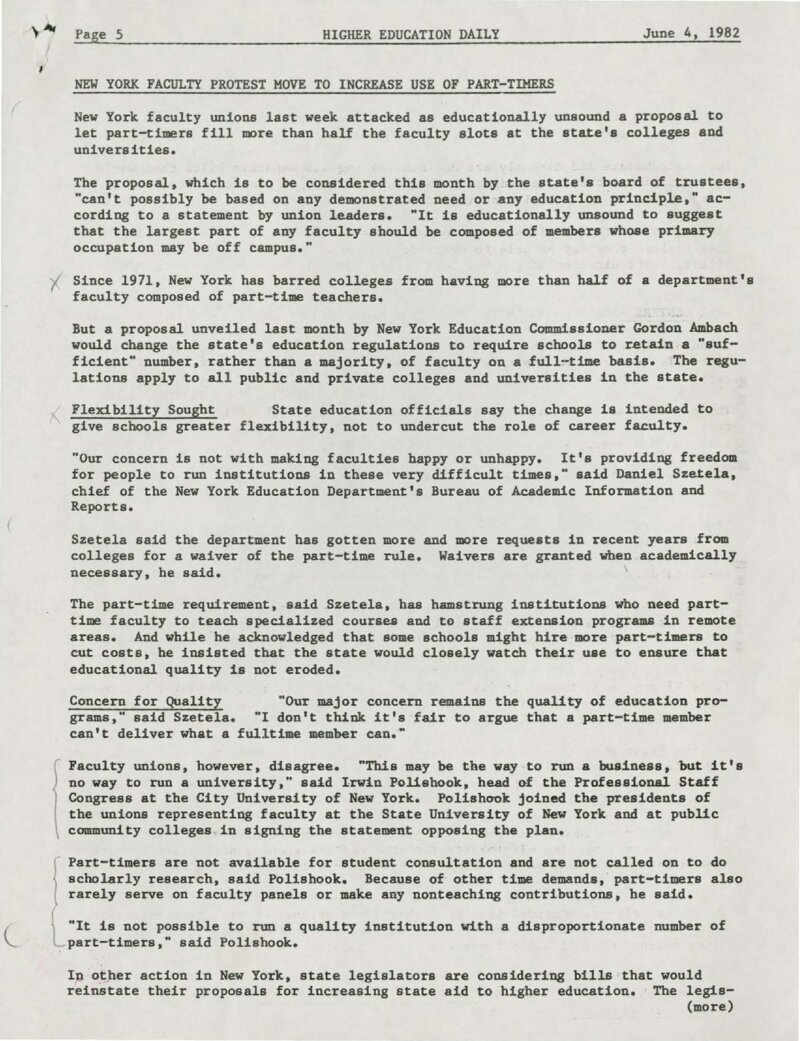
NEW YORK FACULTY PROTEST MOVE TO INCREASE USE OF PART-TIMERS
New York faculty unions last week attacked as educationally unsound a proposal to
let part-timers fill more than half the faculty slots at the state's colleges and
universities.
The proposal, which is to be considered this month by the state's board of trustees,
“can't possibly be based on any demonstrated need or any education principle,” ac-
cording to a statement by union leaders. “It is educationally unsound to suggest
that the largest part of any faculty should be composed of members whose primary
occupation may be off campus.”
Since 1971, New York has barred colleges from having more than half of a department's
faculty composed of part-time teachers.
But a proposal unveiled last month by New York Education Commissioner Gordon Ambach
would change the state's education regulations to require schools to retain a “suf-
ficient” number, rather than a majority, of faculty on a full-time basis. The regu-
lations apply to all public and private colleges and universities in the state.
Flexibility Sought State education officials say the change is intended to
give schools greater flexibility, not to undercut the role of career faculty.
“Our concern is not with making faculties happy or unhappy. It's providing freedom
for people to run institutions in these very difficult times,” said Daniel Szetela,
chief of the New York Education Department's Bureau of Academic Information and
Reports.
Szetela said the department has gotten more and more requests in recent years from
colleges for a waiver of the part-time rule. Waivers are granted when academically
necessary, he said.
The part-time requirement, said Szetela, has hamstrung institutions who need part-
time faculty to teach specialized courses and to staff extension programs in remote
areas. And while he acknowledged that some schools might hire more part-timers to
cut costs, he insisted that the state would closely watch their use to ensure that
educational quality is not eroded.
Concern for Quality “Our major concern remains the quality of education pro-
grams," said Szetela. “I don't think it's fair to argue that a part-time member
can't deliver what a fulltime member can.”
| Faculty unions, however, disagree. “This may be the way to run a business, but it's
) no way to run a university,” said Irwin Polishook, head of the Professional Staff
) Congress at the City University of New York. Polishook joined the presidents of
| the unions representing faculty at the State University of New York and at public
| community colleges.in signing the statement opposing the plan.
{ Part-timers are not available for student consultation and are not called on to do
{ scholarly research, said Polishook. Because of other time demands, part-timers also
| rarely serve on faculty panels or make any nonteaching contributions, he said.
“It is not possible to run a quality institution with a disproportionate number of
\_part-timers,” said Polishook.
In other action in New York, state legislators are considering bills that would
reinstate their proposals for increasing state aid to higher education. The legis-
(more)
Page 6 HIGHER EDUCATION DAILY June 4, 1982
NEW YORK FACULTY PROTEST MOVE TO INCREASE USE OF PART-TIMERS (Cont.)
lature's budget for fiscal 1983 was vetoed by Gov. Hugh Carey in April because it
would have meant a $500 million deficit next year.
The state Senate and Assembly are now considering 126 separate bills that would add
$386 million to the state budget. Among the measures is one to increase higher edu-
cation spending to $2.6 billion in 1983. Carey had asked for $35 million less.
Although New York legislators are certain Carey will veto their new spending bills,
they believe they may be able to override his vetoes this time, according to Dave
Billet, staff director of the New York Senate Education Committee. —-DL, MJB
AREA CENTERS SHOULD CHANGE WITH THE TIMES, RAND SAYS
Campus—based foreign area study centers are stronger than ever but must become more
responsive to economic trends and employment opportunities, says a new Rand Corp.
report.
The centers have been “attentive” to training and outreach activities and have used
federal funds “judiciously and cost effectively,” according to Rand researchers
Lorraine McDonnell, Sue Berryman and Douglas Scott.
Nevertheless, they said, the centers have not responded to shrinking academic employ-
ment opportunities and general “fiscal stringency” in higher education.
“The centers should make efforts to link their programs to more policy-oriented dis-
ciplines and help their students identify and prepare for nonacademic jobs. Most
have done neither. The result is a disjunction between center focus and national
need, as defined by academic, governmental and business employers,” the report says.
Title VI Focus Some 90 centers receive the bulk of Title VI Higher Education
Act funds for foreign language and area studies, which formerly came under the
National Defense Education Act. Rand studied Title VI activities for the National
Institute of Education.
Title VI programs, funded at $19.2 million in 1982, have been scheduled for heavy
cuts under President Reagan's 1983 budget. Only $8.7 million would be earmarked
for foreign language and international education studies next year.
For the first phase of the Rand project, researchers reviewed grant proposals and
interviewed staff of Congress, the Education Department and area and international
studies programs. They will look next at employment trends and the match between
employment and training in those areas.
Rand made three recommendations to ED for “redirecting” center activities through
grant programs: broaden eligibility for area centers grants, strengthen requirements
that area centers have links with professional schools and broaden requirements for
outreach activities.
The report also recommended that ED evaluate and strengthen ways to disseminate re-
search and other grant projects funded by Title VI, as well as make “more timely
disbursement" of fellowship funds and get better feedback on grantees' reports.
Copies of "Federal Support for International Studies: The Role of NDEA Title VI”
are available for $15 from the Publications Department, Rand Corp., 1700 Main St.,
Santa Monica, Calif. 90406. --HH
{
NEW YORK FACULTY PROTEST MOVE TO INCREASE USE OF PART-TIMERS
New York faculty unions last week attacked as educationally unsound a proposal to
let part-timers fill more than half the faculty slots at the state's colleges and
universities.
The proposal, which is to be considered this month by the state's board of trustees,
“can't possibly be based on any demonstrated need or any education principle,” ac-
cording to a statement by union leaders. “It is educationally unsound to suggest
that the largest part of any faculty should be composed of members whose primary
occupation may be off campus.”
Since 1971, New York has barred colleges from having more than half of a department's
faculty composed of part-time teachers.
But a proposal unveiled last month by New York Education Commissioner Gordon Ambach
would change the state's education regulations to require schools to retain a “suf-
ficient” number, rather than a majority, of faculty on a full-time basis. The regu-
lations apply to all public and private colleges and universities in the state.
Flexibility Sought State education officials say the change is intended to
give schools greater flexibility, not to undercut the role of career faculty.
“Our concern is not with making faculties happy or unhappy. It's providing freedom
for people to run institutions in these very difficult times,” said Daniel Szetela,
chief of the New York Education Department's Bureau of Academic Information and
Reports.
Szetela said the department has gotten more and more requests in recent years from
colleges for a waiver of the part-time rule. Waivers are granted when academically
necessary, he said.
The part-time requirement, said Szetela, has hamstrung institutions who need part-
time faculty to teach specialized courses and to staff extension programs in remote
areas. And while he acknowledged that some schools might hire more part-timers to
cut costs, he insisted that the state would closely watch their use to ensure that
educational quality is not eroded.
Concern for Quality “Our major concern remains the quality of education pro-
grams," said Szetela. “I don't think it's fair to argue that a part-time member
can't deliver what a fulltime member can.”
| Faculty unions, however, disagree. “This may be the way to run a business, but it's
) no way to run a university,” said Irwin Polishook, head of the Professional Staff
) Congress at the City University of New York. Polishook joined the presidents of
| the unions representing faculty at the State University of New York and at public
| community colleges.in signing the statement opposing the plan.
{ Part-timers are not available for student consultation and are not called on to do
{ scholarly research, said Polishook. Because of other time demands, part-timers also
| rarely serve on faculty panels or make any nonteaching contributions, he said.
“It is not possible to run a quality institution with a disproportionate number of
\_part-timers,” said Polishook.
In other action in New York, state legislators are considering bills that would
reinstate their proposals for increasing state aid to higher education. The legis-
(more)
Page 6 HIGHER EDUCATION DAILY June 4, 1982
NEW YORK FACULTY PROTEST MOVE TO INCREASE USE OF PART-TIMERS (Cont.)
lature's budget for fiscal 1983 was vetoed by Gov. Hugh Carey in April because it
would have meant a $500 million deficit next year.
The state Senate and Assembly are now considering 126 separate bills that would add
$386 million to the state budget. Among the measures is one to increase higher edu-
cation spending to $2.6 billion in 1983. Carey had asked for $35 million less.
Although New York legislators are certain Carey will veto their new spending bills,
they believe they may be able to override his vetoes this time, according to Dave
Billet, staff director of the New York Senate Education Committee. —-DL, MJB
AREA CENTERS SHOULD CHANGE WITH THE TIMES, RAND SAYS
Campus—based foreign area study centers are stronger than ever but must become more
responsive to economic trends and employment opportunities, says a new Rand Corp.
report.
The centers have been “attentive” to training and outreach activities and have used
federal funds “judiciously and cost effectively,” according to Rand researchers
Lorraine McDonnell, Sue Berryman and Douglas Scott.
Nevertheless, they said, the centers have not responded to shrinking academic employ-
ment opportunities and general “fiscal stringency” in higher education.
“The centers should make efforts to link their programs to more policy-oriented dis-
ciplines and help their students identify and prepare for nonacademic jobs. Most
have done neither. The result is a disjunction between center focus and national
need, as defined by academic, governmental and business employers,” the report says.
Title VI Focus Some 90 centers receive the bulk of Title VI Higher Education
Act funds for foreign language and area studies, which formerly came under the
National Defense Education Act. Rand studied Title VI activities for the National
Institute of Education.
Title VI programs, funded at $19.2 million in 1982, have been scheduled for heavy
cuts under President Reagan's 1983 budget. Only $8.7 million would be earmarked
for foreign language and international education studies next year.
For the first phase of the Rand project, researchers reviewed grant proposals and
interviewed staff of Congress, the Education Department and area and international
studies programs. They will look next at employment trends and the match between
employment and training in those areas.
Rand made three recommendations to ED for “redirecting” center activities through
grant programs: broaden eligibility for area centers grants, strengthen requirements
that area centers have links with professional schools and broaden requirements for
outreach activities.
The report also recommended that ED evaluate and strengthen ways to disseminate re-
search and other grant projects funded by Title VI, as well as make “more timely
disbursement" of fellowship funds and get better feedback on grantees' reports.
Copies of "Federal Support for International Studies: The Role of NDEA Title VI”
are available for $15 from the Publications Department, Rand Corp., 1700 Main St.,
Santa Monica, Calif. 90406. --HH
{
Title
NY Faculty Protest Move to Increase Use of Part-Timers
Description
Published on June 4, 1982 in he Higher Education Daily, this article, entitled "NY Faculty Protest Move to Increase Use of Part-Timers," reported that NYS faculty unions attacked NYS Education Commissioner Gordon Ambach’s proposal to let part-timers fill more than half the faculty slots at both public and private universities. State education officials claimed that the intention was to give colleges more flexibility, while faculty unions were concerned that the proposal was “educationally unsound.”
Contributor
Professional Staff Congress
Creator
Higher Education Daily
Date
June 4, 1982
Language
English
Rights
Copyrighted
Source
The Tamiment Institute Library and Robert F. Wagner Labor Archives
Original Format
Newspaper / Magazine / Journal
Higher Education Daily. Letter. “NY Faculty Protest Move to Increase Use of Part-Timers.”, CUNY DIGITAL HISTORY ARCHIVE, accessed September 5, 2026, https://stephenz.tailc22a4b.ts.net/s/cdha/item/1400