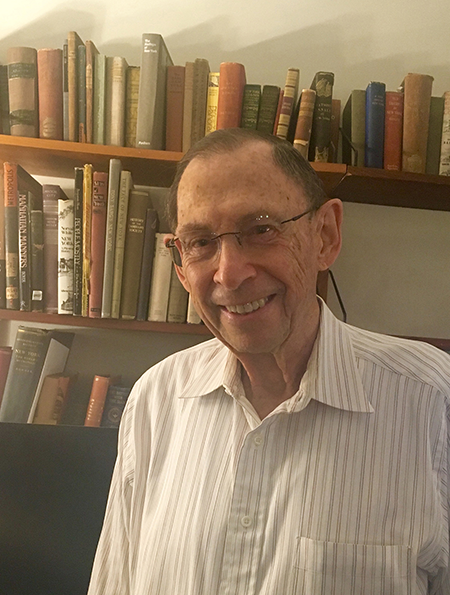
Oral History Interview with Irwin Yellowitz
Item

CUNY
DIGITALHISTORYARCHIVE
CUNY Digital History Archive
Transcript of interview with Irwin Yellowitz
Interviewers: Bill Friedheim and Andrea Vasquez
November 5, 2014
New York, NY
Irwin Yellowitz:
Bill Friedheim:
Irwin:
.. want to know who the interviewers are.
Right. All right, it’s November 5, 2014. Bill Friedheim and Andrea
Vasquez are interviewing Irwin Yellowitz. So why don’t we start? So
Irwin, maybe first you could tell us something about your background, I
know you're a CCNY graduate. Did you come from a political or union
family? I know you're a labor historian. What led you to that career path?
Okay, Bill. I did go to City College, and left there to go for my doctorate at
Brown, where I worked with a very well know labor historian at the time,
Philip Taft. I was interested in labor history, I think, because of my
background. It wasn’t a union family in the sense that any of my parents
were union leaders. But my mother was a member of the millinery
workers’ union. She had been in the union before she got married. She got
married; she stopped working, as women did in those days. Then when
my father died in 1943, she had to go back to work. So she went back to
work, and she went into the first shop. She hadn’t worked in 13 years, and
she started working on hats, ladies’ hats.
By the end of the day her fingers were bloodied from the needles. Her
production was low. It was piecework. So the boss comes to her, and he
says, we can’t use you here. Well, she was heartbroken, because she
needed that job badly. That was what we were going to live on. So she
spoke to what they called the floor lady, the person who was the
intermediary between the boss and the workers. She said, well, why don’t
you talk to the union rep. His name was Mendelowitz, as it turned out. He
heard the story, and he goes up to the employer, and he says, you know,
you've really got to give this lady a chance. | think two weeks would be a
fair time. He says, I don’t want to do it. He says, okay; I’ll pull out the
Andrea Vasquez:
Irwin:
whole shop, and you'll have a strike on your hands. So she stayed for two
weeks; and of course in two weeks, [of course,] she was working as
quickly as the 20-year-olds who were working there.
So the humanity of that situation impressed on me the value of unions in
a very personal way. Then when I became a historian, I just gravitated in
that direction. When I got to Brown, h[H]ere was this eminent labor
historian. He was actually in the economics department, but he had
written on the AFL. I said, that’s the way I want to go; and that’s how I did.
So I came back to CUNY in 1961 with my new doctorate and went into the
history department at City College. It just happened, in those days, jobs
were much easier to come by than they are now; full-time jobs, not
adjunct positions.
So I came back, and after two years the chairman came to me, and he said,
I’m sending you down to Baruch, which was part of City College at that
time, the business school. We ran a small history program down there. He
said, I want you to go there, and you're going to stay there. It was the
equivalent of slavery. He told me [I] was going there; I was staying. But
that’s where I went. I was there ‘til 68 when Baruch became an
independent college. I had a choice then of staying with Baruch or going
back to City. I went back to City, and I spent the rest of my career at City
and also at the graduate center.
Now, when I was at Baruch is when I joined the UFCT, which had been
organized by Israel Kugler, was the United Federation College Teachers.
There was another union, the Legislative Conference; but the UFCT’s
position was that, first of all, everybody should be in the same union, from
adjuncts to the top professor; and second, that that union should be
affiliated with the Labor Movement. The LC did not believe in affiliation
with the Labor Movement at that time. Later they did, but not then.
So I joined the UFCT, and that’s when I met Bill Friedheim; who, as it
turned out, was also active in the UFCT. We were both on the executive
board of the UFCT at that time. Collective bargaining elections took place,
which I won’t go into in detail because they’re pretty well documented.
We had two unions. We had the UFCT representing lecturers and
adjuncts, and we had the [L]legislative [C]conference representing the
full-time faculty. They merged in 1972.
And staff.
Yes, all full timers, whether it was staff or teaching faculty. The merger
came about because of financial necessity. Each of these unions was being
supported by a national affiliate. They were fighting with each other. One
was the National Education Association: The LC had joined in 1970; the
Bill:
Irwin:
Bill:
Irwin:
second was the American Federation of Teachers and its NYC local, the
United Federation of Teachers]. Iz Kugler’s group had been supported by
the UFT from the very beginning. As a matter of fact, he started in the UFT
as the college division of the UFT and then separated out in 1963. Well, it
cost both of these national organizations a lot of money to support this
fight within CUNY; and then they decided, for their own reasons, that they
were going to merge in New York State, merge the NEA affiliates
throughout the state with the AFT affiliates; and that left CUNY hanging
out there with this conflict. The word came down: There will be no more
financial support for this. That led to the discussions to merge, and the
merger took place in 1972.
The first year was hectic, because the positions were divided 50/50.
Caucuses formed immediately, one around Belle Zeller, who headed the
Legislative Conference.
Was that the CUUC [City University Union Caucus]?
Yes. Well, it wasn’t called that at the time.
It wasn’t called that back then.
It was founded around her. The other one was centered around Israel
Kugler. There was quite a conflict there. In 1973, they ran against each
other; and Iz was bitter about it, even before the election. He told me
personally. He said, when I agreed to merge, Belle Zeller was to be the
president. I was the deputy president. We were going to divide all these
jobs. Belle said to me, you know, I’m much older; I’m going to retire after
this one year, and I’m not running - well, that didn’t happen. She didn’t
retire. She ran against him, and the election was very close. There was a
third candidate in that election, who Bill may remember. It was a man
named Edgar Pauk from Queens College. He was in the UFCT, and he had
a dispute with Iz Kugler; about what, I still don’t know. But it was
personal, and he ran on an independent ticket and got 300 votes; and Iz
Kugler lost by 200 votes to Belle Zeller. To the end of his life - and he told
me this again personally many times - he said, I should have been the
president of the PSC. Those were my 300 votes that went to Edgar Pauk.
They weren’t coming from Belle Zeller, because who was going to vote for
Belle Zeller and Edgar Pauk? Nobody.
Well then, he continued in opposition, because he still had about a third of
the executive council in his caucus. Then in 1976 he ran against Irwin
Polishook, and that’s when the CUUC caucus was now in existence. He lost
quite badly. It’s in the middle of the fiscal crisis that this election is taking
place; which is, in itself, a problem. He then disbanded his caucus; and all
of his members - I think everybody - joined the CUUC caucus.
Bill:
Irwin:
Bill:
Irwin:
Bill:
Irwin:
Bill:
Irwin:
Bill:
Irwin:
Why did he disband his caucus?
Well, he felt there was no future in it. He didn’t think he would be able to
win another election. He felt that Irwin was a formidable president and
would simply hold on; and he and his people would be pushed to the side.
He much preferred to have them join into the CUUC caucus. The CUUC
caucus was open to them. So that way the union had one strong
leadership. There was no divided leadership. Now, this is a little different
from when the New Caucus replaced CUUC, because by the time most of
the leaders just simply didn’t join any caucus; they just disappeared,
because it was it was an older group by the time. So the New Caucus, I
don’t think, recruited very many of the CUUC people; but the CUUC caucus
recruited, I would say, almost all of Iz Kugler’s leadership.
How was the CUUC caucus organized? Was it essentially shaped by
leadership? Was there a grassroots component in it?
No, there wasn’t much of a grassroots component. It was pretty much top
down. It had a structure. It had meetings. But really, it was the officers of
the union who had been elected through the CUUC caucus who
determined what the caucus did.
Did it actively function between elections, or basically just came together
at the time of...
It functioned in loose way.
... of CUNY wide ...?
There was at least one meeting a year or two meetings a year. Candidates
were chosen through the caucus, although very often they were the
candidates that the officers wanted. It was not a bottom up organization. I
don’t know whether the New Caucus is, either; but it functioned that the
officers really were the controlling force in the CUUC caucus.
Now, the tensions inside of the PSC, from ’72 to ’76: Did they essentially
dissipate after ’76; and were the tensions, basically, a continuation of the
different philosophies of the UFCT and the Legislative Conference in the
‘60s?
They had been [a continuation], and they were personified. If you were in
the UFCT, and you supported Israel Kugler, as long as Israel Kugler was
the leader of that caucus, you continued to support him; and the same for
Belle Zeller. But when he disbanded his caucus and told his people to join
Bill:
Irwin:
Bill:
Irwin:
Bill:
Irwin:
Bill:
Irwin:
Bill:
the CUUC caucus, that really ended the conflict. I would say five years
after that, nobody remembered who was in which caucus before 1976.
Now you, of course, were a veteran of the UFCT.
Yes.
I believe you told me that you voted for Zeller rather than Kugler in ’73.
Yes. I was asked to serve by Iz, to run on his ticket in 1973; and I was also
asked to run on Belle Zeller’s ticket. | was the chairman of the City College
PSC chapter, because we were now merged.
So you were also chair with the UFCT, right, at the time of merger?
I don’t think I was ever chair of the UFCT City College chapter. But I was
on the executive - as you remember, the UFCT was a much smaller
organization. Its chapter structure was not 100 percent. There were holes
in it. But there was a City College UFCT chapter; but I was not the chair of
that. I was the chair of the PSC chapter after the merger. So I was asked to
run on both tickets. Now, the problem for me, the reason | ran with Belle
Zeller, was that Iz Kugler, at this time, was taken up with the idea of a
strike. He believed that, if we put up a picket line, in front of a CUNY
building, that nobody would cross it. He believed this even before the
merger. This was a fundamental belief of his. I didn’t believe that. I felt
that the union solidarity among this faculty was not that deeply
ingrained; that if we had a strike under the Taylor Law, which meant
penalties for individuals and for the union, that it could be devastating.
The greatest failure for a union is to call a strike and not win it.
So I told him all this. I argued this with him. I said, I can’t support you;
because if you win and you call us out on strike - this was before the
fiscal crisis - and we take a hit, it could destroy the PSC. We’re a brand
new union. He wouldn't accept that. So I went over to the Belle Zeller side,
and Belle did not believe that a strike was a feasible weapon, although we
took a strike vote - two strike votes. But those were clearly intended to
put pressure on CUNY, not intended to ever carry them out.
You say clearly intended. Was that Kugler’s - this first strike vote was in
1972, right, at the time the first contract ...
Yes, December of 1972.
.. was being negotiated, and we'll discuss that ina moment.
Irwin:
Bill:
Irwin:
Bill:
Irwin:
Bill:
Irwin:
Bill:
Irwin:
Bill:
Irwin:
Bill:
Irwin:
Bill:
Irwin:
Both of them were in connection with that contract, and the first one was
the possibility of a work stoppage; and the second one actually set a date.
Both were overwhelmingly approved by the members. The date was
October 1, 1973. We had a contract in July. We fully expected we would
have a contract, that we would never have to go to that October 1 date.
But the threat was there, and it did put pressure on CUNY to settle. They
were tough. That first contract went through fact finding and a lot of
other things before ...
So the leadership - Zeller as well as Kugler - were united on having these
strike votes, even though ...
Yes, absolutely. But the real crunch came two years later on the strike
issue. It’s now 1975. Iz Kugler still has a sizable contingent on the
executive council and in the DA, and he put out a resolution for a strike.
This was in the midst of the fiscal crisis, now. Belle opposed it, and he lost
by two to one.
Fifty-eight to 26 ...
Something like that.
.. is the figure that I picked up from your history of the union.
So that was a crucial vote, because if we had gone out on strike at that
point, I think it would have destroyed the PSC; because in the middle of
the fiscal crisis, we would have been hit by the Taylor Law and everything
that followed from that.
So you were on Zeller’s ticket ...
In’73.
.. when she ran against Kugler? In what position?
I ran for vice president for senior colleges.
And how long did you hold that position?
I held that until 1984, and in 1984 the treasurer of the PSC resigned, and I
took over that position.
And served ‘til when?
‘Til I retired in 1997.
Bill:
Irwin:
Bill:
Irwin:
Did the tensions between the Kugler - lack of a better term - the Kugler
wing of the PSC and the Zeller wing of the PSC at all mirror some of the
divisions within our national affiliate, the Federation of Teachers? I know
rather early on, in the early ‘70s, Albert Shanker defeated David Selden,
by a pretty overwhelming vote, to head the AFT.
Yes. That was really before we merged. So the PSC was not a participant
in that. The UFCT had a contingent at the convention. I was not at that
convention, so I really don’t know that first hand. But the UFCT - Iz
Kugler was, of course, a socialist -- and I think many of his supporters
were on the left of the faculty, as the faculty is represented at that time.
The Legislative Conference probably represented, politically, a more
moderate group. But I don’t think that was the issue that really
determined whether you were in the UFCT or whether you were in the
LC. I think it had to do with placement in the faculty. If you were a
professor at a big senior college, you were most likely in the Legislative
Conference; because that was the group that went back to the 1930s, that
everybody knew, that had negotiated pension improvements and salaries.
Although it wasn’t a union, it was a very effective lobbying group. So you
knew them, and that would be the group you joined.
Iz tended to draw people like myself, for example, who believed in
unionism and wanted any union in CUNY to be part of the labor
movement and some on the left -- 1960s left - although he was an old left,
not a new left by any means - he didn’t have a lot of enthusiasm for the
new left. But he represented a left position politically, and some people
might have gone for that. But I think he tended to pick up into the UFCT
the people who the LC ignored. They did tend to ignore them: the
adjuncts, the higher education officers, the college lab techs, the lecturers,
the instructors who didn’t have tenure at that time. It was not a tenure
bearing position. So all those people would tend to move toward the
UFCT because it was willing to represent them, whereas the LC was not
really that interested in them. So I think that was the dividing line, more
than political divisions.
So walk us through that first contract. What were the issues? How did the
PSC ...?
Well, there was a contract already in existence. In 1969, after that first
collective bargaining election, there were now two agents. Each one
negotiated a contract with CUNY, and rather easily; because the
chancellor at the time, Albert Bowker, although he opposed unionism,
once there was a union, he decided to negotiate contracts. In 1972, after
the merger, CUNY’s attitude hardened significantly. The Vice Chancellor
for Faculty and Staff was a man named David Newton, whom I had
known from City College. He had been involved at City College with
Bill:
Irwin:
Bill:
Irwin:
Bill:
student activities, house plan and other student activities. How he got to
that position in CUNY, I never quite figured out; but he was a very difficult
person. That contract was the one you're talking about. That’s the first
PSC contract, and that was extremely difficult.
I think that CUNY decided that these two unions they had agreed
to[contracts] in 1969 had now become something much bigger, stronger;
and they were going to cut it down to size. That’s not unusual in first
contracts. Unions almost always have trouble negotiating the first
contract. So they made it as difficult as they could. They stalled. They
refused to bargain. Finally we couldn’t get anywhere. We went to New
York State Public Employees Relations Board, and we had a fact-finding
session, which was part of the Taylor Law procedure. Fact finders made
their report. We accepted it. CUNY rejected it, and they rejected it because
they were hoping to force us into something like a strike, which they
thought would happen because we had already taken strike votes. I don’t
think they were unhappy with that. If we wanted to strike and bring
down public opprobrium on us, they weren’t going to stop it.
But fortuitously, this fact finding report was picked up by the New York
Times. The New York Times wrote a very strong editorial condemning
CUNY for obstruction, saying that the fact finding report was eminently
reasonable, and CUNY should accept it. So we went back to the bargaining
table, now with this New York Times editorial out there, and suddenly
CUNY’s attitude changed. | think it changed because the politicians, the
governor and the mayor, said this is not good for us and for the
university. You’ve got to settle [the] contract. They did, and they settled it
almost overnight. Issues that couldn’t be approached were solved, and
the contract that was finally approved in July or June of 1973 was very
close to that fact finders’ report on the issues that were in dispute.
How did the PSC - what was the PSC strategy in terms of getting a
contract?
It was quite a varied strategy. There were demonstrations and rallies not
unlike the ones that we went to [recently], the two of us. Maybe, Andrea,
you were there, too.
She was.
The last two: Those were very reminiscent - as a matter of fact, Joel
Berger, whom I met at the first one, said, well, it’s déja vu all over again.
He was with me in the rallies back in 1973. So they were ...
So Joel Berger is also a member of the retirees’ chapter with you, and
back then was teaching at Richmond College, right?
Irwin:
Bill:
Irwin:
Andrea:
Irwin:
Bill:
Yes. I guess he’s the vice chair of the retirees’ chapter.
That’s right.
So we did that. There were many of those. There were mass meetings,
some at the Marc Ballroom on Union Square; which, | think, has
disappeared now. It’s torn down; huge meetings. Again, 500
[participants] - like the one we had [recently] at the community church.
We had an ad campaign in the newspapers and on the radio, saying, do
you want CUNY to be destroyed; a fair contract will produce a strong
university. Remember, this was a free tuition university at that time. We
did that. We also used NYSUT, which was this merger of the NEA and AFT
in New York State, which lasted three years. But they were merged at that
time.
So we got NYSUT to put pressure on the governor, and we also went to
the municipal labor coalition that was just forming, really, in the city. We
got support from them and particularly from Al Shanker of UFT; and to a
lesser degree from Victor Gotbaum at DC37. So that pulled out just about
every stop. The students were involved. We got students to join us in
picketing and rallies. So it was a very broad campaign.
In that contract, what do you think were the main strengths of it, and
maybe where did it fall short, that first contract?
The first one was pretty good. I don’t remember all the details of it now,
about which feature was in which contract. But I believe that was the
contract that established the 13.3B [job security] for HEOs. I believe that
contract also established the workload, which later was changed during
the fiscal crisis; and we eventually won an arbitration to restore it. It
retained increments, which the university - that was one of the big issues
-- the university wanted to eliminate increments, and they remained. It
retained the chairs as part of the bargaining unit, another issue that CUNY
wanted to take out. There are others that are in my pamphlet. | think
there are a few that I mentioned that I might not have gotten to. But it
was a very important contract. It built on 1969. If you look at the 1969
contracts and look at the contract we had, the last one in 2010, you
wouldn’t have any trouble seeing the similarities; because really, there’s
been a very strong continuity across the decades. So those were some of
the major features.
Now correct me if I’m wrong, but earlier contracts by the Legislative
Conference and the UFCT, and even before there were unions, were
generally tied to certain levels of teacher pay; right?
Irwin:
Bill:
Irwin:
Bill:
Irwin:
Bill:
Irwin:
Bill:
Yes. There were no contracts before 1969.
Right. But pay scales ...
Before that there’d been an agreement back in the 1950s that CUNY -
well, there was no CUNY then -- but the four city colleges, the faculty, and
I’m not sure whether it included professional staff, because that was
another feature of one of the early contracts, I don’t remember which, but
they were really trailblazing. Community college and senior college
faculty were paid the same. That was 1969. HEOs of a similar rank were
paid the same as faculty. That was not common practice in higher
education. Neither of those were common practice. Community college
faculty, even to this day, outside of CUNY, are paid much less than four-
year college faculty; and the same for HEOs where they exist, whatever
name they give them. They’re usually paid less than teaching faculty.
But those two principles were in those early contracts. So they were very
progressive. But this business with indexing: Before there was a contract,
the LC agreed that the professors would be slotted in to the supervisory
ranks of the public schools. So I think an assistant professor was [in
salary equivalent to] an assistant principal; an associate professor to a
principal; and a full professor to an assistant superintendent. So as those
salaries went up - and they did in the ‘50s and ‘60s, in part because of the
UFT; when the UFT raised teachers’ salaries, all these supervisory
salaries went up. So our salaries went up. We didn’t do anything to get it.
It just went up. Some people groused about that when we were talking
about a union. They said, well, what do we need a union for? We’re
basically a free rider on the UFT. That’s what it was.
Did that continue with our first and second and third contracts, or was
this ...
No, because once we started getting our own raises ...
.. independently negotiated?
.. it was independent of the UFT. We did, I think, as well as they did. Then
when we get to the fiscal crisis, we'll see that we did much better in terms
of holding onto our faculty than did the UFT. They lost 20,000 teachers in
that fiscal crisis, and we didn’t lose anything like that in the university.
Now this contract was negotiated in the context of something very
significant in the history of CUNY, namely open admissions. You say that
we were able to draw students on to picket lines. Did open admissions
intersect in any way with the contract negotiations?
10
Irwin:
Andrea:
Irwin:
Andrea:
Irwin:
Andrea:
Irwin:
Andrea:
Irwin:
It wasn’t a big issue for the union. We accepted it from the very beginning.
We accepted it, but it was not an issue for us. We didn’t necessarily push
it. It came in 1970, and the board [Board of Higher Education] had
established a master plan. Open admissions was supposed to come in in
1975, and then be phased in. Forget it. It all came at once, and I can’t tell
you what chaos it created at City College; because we suddenly had all
these students coming in who were very poorly prepared. We didn’t
know what to do with them. So we set up remedial English courses
without anybody knowing anything about remedial English.
There was a woman named Mina Shaughnessy. You know her name. She
was a wonderful person. She wasn’t really a remedial English teacher, but
she took it on herself to become an expert in this field, and she developed
our program in remedial writing and led it. She was in the English
Department. Whatever we could do, I would say, was attributed to her
energy and her thinking about it. In the math department, well,
mathematicians - college-level mathematicians - are not the people to
teach arithmetic to students who don’t know arithmetic. They just don’t
have the - it’s the wrong cohort to do that. So we started hiring adjuncts
to do that, and the math department ended up with a huge number of
adjuncts whose only job was to teach remedial math.
Can I take step backwards to the period before open admissions was
implemented?
Yes.
I think there were new hires. So there were probably the people who had
been there a long time, and then with open admissions came a lot of
younger hires.
Well, we were hiring steadily during the 1960s.
So how did that year or two before open admissions - how did that play
out?
In terms of hiring?
In terms of hiring, but also around that issue of open admissions. I
imagine students were also vocal and involved in that struggle.
The faculty was not particularly involved with open admissions. There
were some faculty members who favored it for social and political
reasons, but I would say the faculty generally was very passive about it.
Open admissions came from student militancy, taking over campuses and
that kind of thing; not from the faculty. But once it came in ...
11
Bill:
Irwin:
Bill:
Irwin:
Bill:
Irwin:
Bill:
Irwin:
Bill:
Irwin:
How did faculty engage or not engage when that was happening with the
students?
Most of them were rather hostile. They were hostile because they felt the
students coming in were very weak, were not of the standards that we
had in the 1960s; and they didn’t know how to teach them. College
professors are not good teachers. I have observed my colleagues over my
30 years, and I can tell you, they are not good teachers. The students have
to make up the difference. Many faculty have no idea, really, of how to
make an effective class. Well, that’s magnified. When you have good
students, they will run with it. If the professor is a weak teacher, it doesn’t
matter. If you have something to say, they’ll find it, and they'll go with it.
But if you have poor students who are struggling, they need, really,
pedagogues. They need people who know something about teaching and
about how to relate to educational deficiencies. We didn’t know any of
that. Mina was one of the few who made it her career to do that. But I’d
say the others did the best they could under the circumstances, but they
were not enthusiastic about it.
So am I right in concluding that you would argue that open admissions
was pretty much an issue to the side of the union that didn’t directly
affect the course of the union or its history?
Yes. It was not a major issue. We supported it. Once it came in, we
supported it. We never called for it to be eliminated. There was a call to
eliminate open admissions during the fiscal crisis. It came from CUNY
central, not from the union. The union actually opposed it.
We'll come to the fiscal crisis ina moment. It’s an important ...
So we accepted it. Once our members were teaching those classes and
dealing with those students, we accepted it. That was the bottom line.
Yes. Before we go to the fiscal crisis, one other - it seems to me -
important event of the early ‘70s, when the PSC was formed, was fighting
the Kibbee tenure quotas. Talk a little bit about that and how the union
organized around that issue.
Yes. That came right after the merger.
What prompted Kibbee and the central administration ...?
Well, there had been a tenure quota proposal by Bowker before the
merger but after the two unions had been certified in 1969. He wanted, if
I remember, a 75 percent tenure quota. So when you reached 75 percent
12
Andrea:
Irwin:
tenured you could not add anyone else. Robert Kibbee had just come in
as chancellor, and I think he was instructed that he had to apply a tenure
quota, which Bowker had proposed and dropped when the unions
opposed it. That was the LC and UFCT. He made it 50 percent, tried to
make it stricter. When you reached 50 percent, you needed a waiver from
CUNY central to get a tenure approval. This is interesting, because CUNY
central was not the dominant entity that it is now. The presidents in the
colleges still had a lot of independence. When you had a tenure request,
the president had signed off on it. Otherwise it did not go to the Board for
formal approval. So what they were saying was that the presidents were
going to be overridden by the chancellor, which was going to give a lot of
power to the chancellor that he never had before.
Where this came from, I don’t know. I can’t say that I know where Kibbee
got this from, but he did get it. He got the Board to approve it, which
Bowker never did. The Board never approved Bowker’s proposal. It was
dropped in discussion in October of ’73, or’72 - I’m not sure of the date. I
think it’s in my pamphlet, the exact date. The union fought it tooth and
nail. It reminds me very much of Pathways. The tactics that we used then
against Kibbee’s tenure quotas are very similar to what the PSC used
against Pathways. We allied ourselves with all the faculty bodies around
the university, particularly the University Faculty Senate, which had been
created by Bowker in ’68 in an attempt to block collective bargaining. In
addition, the individual colleges had their own faculty bodies. They had
faculty senates, faculty councils. They had all sorts of faculty bodies, and
we got those bodies overwhelmingly to oppose the tenure quotas.
Then the union went further. It called for a vote of no confidence in the
chancellor. A good number - a lesser number than opposed the tenure
quotas, but a good number - of faculty bodies voted that. Then the
PSC went further, and it said we were going to shun the chancellor, the
way they did in Ireland. Shun him. We will not talk with him. We will not
meet with him. For example, if he goes to City College, we will ask people
at City College not to meet with him, not to have lunch with him.
That’s crazy.
Even PSC today didn’t get to that with Goldstein. But we shunned him,
and he took tremendous offense at that. He had just come and here he
was being shunned by faculty. They wouldn’t meet with him. They
wouldn’t talk with him. Well, we took out some more ads saying, do you
want CUNY to be a university with a tenure quota, when no other first-
rate university has one. This means we won't get decent faculty to come.
Six months later, the board rescinded it, after this campaign went on. I
can give you the ...
13
Bill:
Irwin:
Bill:
Irwin:
Bill:
Irwin:
Bill:
Irwin:
April 22"4, 1974 is the date they rescinded.
Yes. So it was 1973 when they passed it, October of ’73.
October 29th, 1973.
They rescinded it six months later. Now of course, PSC has not been able
to get Pathways rescinded. But we were able to do that. The ironic thing is
that - Kibbee, of course, played a central role in the fiscal crisis; | think a
very negative role. But after the fiscal crisis ended, he was able to work
very well with the PSC after 1979. For about three years — he left, I think,
in 1982 for health reasons. He died shortly after he left office. He was
replaced by Joe Murphy. We worked very well with Kibbee from ’79 to ’82
when there was money in the university, when we were not facing crises.
But first in the Kibbee quotas and then in the fiscal crisis, Kibbee was not
a positive force for the university.
So why don’t we segue to the fiscal crisis? Why don’t you walk us through
what the PSC’s approach was to this; and you, since you are an officer of
the PSC and also a labor historian, can maybe put that in the context of
the approach of the municipal labor unions in general to the crisis.
Okay. It was a continuous series of crises. It wasn’t one crisis.
Right, and if you could also give us dates so the people listening to this
interview or reading it can situate it ...
It started in 1973. ’73-’74 was the first - or was it ’74-’75? I just want to
check that, on the dates. J think it began - the first of the crises began in
73. | think ’73-’74 was the beginning, but the worst parts of it were ’74-
’75 and ’75-’76. But there were waves of crises, and the problem was that
New York City went bankrupt, essentially. It was bailed out in the end by
the unions, which set up a fund to support the bonds. It was set up by the
governor, but the unions put pension fund money behind it; and that
allowed New York City bonds to be sold again on the market. But for a
period of time the city could not sell its bonds, and it used bonds - one of
the things it shouldn’t have been doing is, it used bonds to finance daily
operations -- because the city’s tax structure was inadequate to support
the various operations of the city, which had expanded under Mayor John
Lindsay.
Mayor Lindsay was there from ’65 to ’73. Then he was replaced by Mayor
Beame. Abraham Beame was a City College alumnus. We thought, oh, this
is good for us. It wasn’t, because Abe Beame was an accountant. That was
his career. He thought more as an accountant than he did as a City College
alumnus. But the issues were real. The city did not have the money to
14
Bill:
Irwin:
Bill:
Irwin:
Bill:
Irwin:
fund its different departments. CUNY had much more support from the
city then than it does now. The city supported the community colleges
and half of the senior colleges. The state supported the other half of the
senior colleges. Well, this was a funding formula that couldn’t work when
the city went broke.
So as the city started struggling, what it did is it cut the appropriations to
CUNY; and CUNY’s reaction was to cut the university in all sorts of ways.
The first round, everyone who did not have tenure was on the block, and
loads of adjuncts and non-tenured people were dismissed. In the History
Department at City College, we had seven non-tenured assistant
professors. We lost six. We lost them all, but one of them had had a CCE as
a lecturer; so she went back to her former ...
Certificate of Continuing Education.
Certificate of Continuous Employment.
Oh, employment. Excuse me.
Right. She had come up through the lecturer’s ranks and been appointed
assistant professor, and she went back to that rank. So she remained in
the university. The other six were gone. This was the pattern across the
whole university in that first round of cuts. They were non-tenured, and
adjuncts were laid off in very large numbers. So the program suffered, of
course. You're laying off faculty. The university had expanded through
open admissions. I think by 1973 we had 200,000 students. So the classes
got bigger. Classes were cancelled. People couldn’t graduate, because they
couldn’t get their courses. All sorts of support services were cut; also
counseling, library services. Everything was on the line, and of course we
reacted against this.
Our argument from the first day - and I must say, this was the right
argument - don’t cut the university. You don’t save the university by
destroying it. You have to bring in more money. New York City can’t
provide that money. We acknowledge that. So it has to come from New
York State. Now, to get that idea across took five years, from ’74 to ’79.
But it actually was accepted by the governor in ’77, but it didn’t come into
effect until ’79. So really, three years of constant work by PSC, and also by
NYSUT. Again, our affiliation to NYSUT is critical.
Describe the political operation during the fiscal crisis.
Well, the political operation - we opposed - we didn’t oppose politicians.
We opposed what they were doing. So we didn’t, for instance, oppose or
try to argue that we were going to defeat Mayor Beame or defeat
15
Bill:
Irwin:
Bill:
Irwin:
Bill:
Irwin:
Bill:
Irwin:
Bill:
Irwin:
Andrea:
Governor Carey. What we wanted was for them to provide support for the
university. I think it was more based on programs, saving programs,
saving the university, than on politics as we understand them.
So was this mainly through lobbying? How did you persuade ...
Yes, through lobbying.
... twist arms, or whatever, or ...
Well, we used the methods we ...
... what leverage, if any, did you have?
.. used before. We had rallies to galvanize public interest in this, because
after all, the public’s interest in CUNY was pretty far down the list. We
realized the whole city was on the verge of collapse. People were much
more concerned about the K-12 schools than they were about CUNY. They
were much more concerned about the sanitation and fire departments
than they were about CUNY. So we were far down on the public list. So
again, we tried to, by demonstration and rally, get attention. Again we
used the municipal labor coalition; which was, now, fully formed. We
tried to get their support for CUNY. They did respond. Again, Al Shanker
was tremendously helpful to us.
In what ways was Shanker helpful? And what about Gotbaum?
Putting pressure on - Gotbaum to a lesser degree. But Al Shanker,
because we were part of AFT; and Irwin Polishook had a very good
personal relationship with Al Shanker. Maybe we could talk about this
when we get to Irwin Polishook. But he was very professorial, and Al
Shanker had wanted to be a professor. As a matter of fact, he had
completed all the credits for a PhD at Columbia, but he didn’t do the
dissertation, and he dropped out and went into teaching mathematics in
the public schools and never went back to it. But he always had that
affinity for professors, and Irwin was a professor. To the core he was a
professor. They got along very well, and I think this helped us
tremendously many times. It also helped us in AFT, which we may talk
about later. Irwin became the head of the AFT Higher Education Council.
This was already in the ‘70s, or ...?
I don’t know exactly when it started, but it certainly ran for at least 20
years.
What were your main arguments about [unintelligible 00:51:29]?
16
Irwin:
Bill:
Irwin:
Andrea:
Irwin:
Bill:
Irwin:
Bill:
Irwin:
Well, the arguments were that, if we didn’t get more money CUNY would
be destroyed. We pointed out, as the next wave of cuts hit us, now the
second wave included a restructuring plan to dismember the university.
There were several of them, but Kibbee had his own plan. He was going to
close five colleges. The president of my college, City College, Robert
Marshak, had his own plan. He was going to close six colleges, not
including City College.
But not CCNY.
No. But he was going to take City, Hunter, Queens, and Brooklyn, and
move them into SUNY and make them university centers, which are
funded much more generously. The only problem was, SUNY didn’t want
us. They didn’t want any more university centers that they were going to
have to fund. In 1977 there was a commission called the Wessell [Nils
Wessell] Commission, which proposed breaking up CUNY into two
universities, with the community colleges being put in one part and the
senior colleges in another. So these ideas were out there, and Kibbee had
his own plan. So we fought against that. Again we went public. We had
ads that this just wouldn’t work; this would destroy CUNY.
Because fairly recently the student body had grown by so much; and the
nature, the composition of the student body changed so much.
Yes, and we pointed out that the destruction of the university was going
to hurt the newest wave of immigrants who were now coming into CUNY
through open admissions; that there was a social result of this. So
Hispanic and black students, who were almost always the first in their
family to ever attend college, would now be either - well, there was a plan
to end open admissions. Again, it came from Kibbee. But that he got from
Governor Carey. If you ended open admissions, then of course you took
all these students out [which made CUNY cheaper to fund]. But as long as
they were there, the program was going to be made poorer and poorer
and poorer. So then instead of getting a first-class education, they were
going to get a second or third-class education.
So what was the PSC’s position on open admissions at that point?
We still supported it. We supported it all through the fiscal crisis.
And on tuition? At that point there’s still free tuition.
Now tuition came in. There was no - still free tuition. The head of the
Board - the Board at that time was made up of 10 members, and they
were all appointed by the mayor -- the head of it was Alfred Giardino who
17
Bill:
Irwin:
Bill:
Irwin:
was a fanatic on free tuition; an absolute fanatic. He wouldn't give it up
for anything. As a matter of fact, he resigned from the board when free
tuition ended. We supported free tuition. We continued to support free
tuition. But it became clear, as we get to 1976, that Mayor Beame now
takes the lead. Although he had gone through CUNY on free tuition, he
wants to end free tuition because, he says, free tuition is equal to $32
million. I don’t want to put up $32 million that you can get from tuition.
So if you don’t end free tuition, I’m going to take away the $32 million that
I would have given you for the university.
This was an impossible situation. It led the chancellor, When - he took
away the $32 million, we didn’t have the money to pay the payroll, and
the PSC voted not to work without being paid. So Chancellor Kibbee said,
well, I’m going to close the university for four weeks. That would have
been a devastating closure. So we, with NYSUT’s help, got Governor Carey
to put up the money for that payroll; which, I think - it wasn’t $32 million.
It was much less. We negotiated, instead of a four-week closure, a two-
week deferral of pay; which we eventually got back, years and years later,
with interest. It was paid back with interest. I remember at the time my
colleague saying, oh, we'll never get that money back, ever. It’s gone. We
got it back.
But that was the lesser evil, because Kibbee was going to close CUNY for
four weeks with no payment and no plan to repay at a later date. So we
fought to get the least onerous terms. CUNY also set up a retrenchment
plan. They didn’t consult us. They did it from management, and
eventually the AAUP censured CUNY; put us on the censure list because of
that retrenchment plan. They also censured SUNY. SUNY is still on the
AAUP censure list, because their retrenchment plan also came from the
top; and they never revised it. We revised ours in the 1980s and put ina
significant amount of faculty involvement in any future retrenchment;
and therefore the censure was lifted. SUNY never did that.
Was the AAUP an affiliate of the PSC at that point?
No, it was not.
That came later. We'll get into that later.
So it was not. So the retrenchments then took place. We fought them
again using the same tactics; NYSUT attempting to get money from the
state, municipal coalition to get money from the city. But that was a hard
sell, because those unions were all being hit. At the same time we were
asking them for help - and we were a small union - they were being hit.
So what could UFT do for us when it was losing its own members,
eventually 20,000 members? DC37 was very hard hit. The city laid off a
18
Bill:
Irwin:
Bill:
Irwin:
Bill:
Irwin:
Bill:
Irwin:
lot of employees from that area. But what PSC did get in this
retrenchment plan - originally it said that CUNY could lay off any tenured
faculty member without any faculty involvement. Finally what we got was
that they could not lay off tenured faculty unless a whole department was
closed.
How did you get that?
By pressure on the university, by arguing, again, that we would keep up
this campaign of publicity that this kind of retrenchment would destroy
the reputation of the university; we’d never get faculty. We did get
support from the UFT on that. We got support from NYSUT. I think they
finally decided the PR - the pressure on them, the public relations
problems, just weren’t worth fighting that point. Because what they could
do is, they could close departments; and they did. They closed, at City
College, the counseling department; 12 people all laid off. Some of them
retired. Some of them just had to go elsewhere. They closed the education
department at Queens. They closed other units that were support units.
But what they didn’t do, because of this agreement, was, they did not
indiscriminately go through the faculty and simply fire faculty. So we
were able to avoid the kinds of layoffs that they had in UFT and DC37,
because there was a limit to how many departments you could close.
Right. Now, was that in writing?
I don’t know if it was in writing.
Or was that just simply a verbal agreement?
It was in writing in the Board’s program, but the original proposal by
Kibbee was that the Board could lay off any tenured or certificated
employee for fiscal reasons. After all of this back and forth, it came out
that they could only close departments. They did not fire any individually
tenured or certificated people. So that saved an enormous number of
faculty positions; because if they had been able to just do it on an
individual basis, we would have lost a lot more people. We didn’t come
out scot free, but we came out in much better shape than we would have
been.
Then at the state level, what was the negotiated ...?
Well, now, NYSUT played a major role in all this. I think one reason CUNY
agreed to this was that they understood that the state was going to come
in to finance CUNY. The signals were already coming from the governor,
even in 1976, that the state would step in. In ’77 he made it public. But I
19
Bill:
Irwin:
Bill:
Irwin:
Bill:
Irwin:
Bill:
Irwin:
think CUNY was aware of it. So they realized that the worst was over.
They were not going to be facing a continuous round of budget cuts every
year, because once the state took over, the state was in much better shape
than the city and would be able to fund the university at some reasonable
level.
This created a new Board, right?
That was part of it. When the state took over the funding, they agreed to
75 percent beginning in 1979 and 100 percent beginning in 1982.
For senior colleges.
Senior colleges. Yes. But they also put more money in community
colleges. As we know today, the state funds most of the community
colleges as well. So they also enhanced the formula that they used for the
community colleges. But that was critical, because that ended the fiscal
crisis.
Is that when this new formula was developed where the governor would
appoint 10 members to the Board, and the mayor five?
Yes. That was part of the agreement. The old Board was disbanded, and
10 by the governor and five by the mayor - we set up what was called a
Board of Trustees to replace the old Board of Higher Education that had
10 members.
As a union activist and as a labor historian, just briefly, what’s your sum
up of, generally, the role that municipal labor played in the crisis? Do you
think it was positive? Do you think the labor movement fully used its
leverage? There have certainly been critiques on the left of the role of
Gotbaum and Shanker, I guess, in particular; and the use of pension funds
to help bail out the city. There are certainly many other voices that would
argue differently.
I think the unions - I know that critique, and I don’t agree with it, having
lived through it. If the unions had not supported the city, the city would
have collapsed; and I think if that had happened, the impact on the
municipal workforce would have been much greater than it was. It was
significant, but it would have been incomparably greater. So the unions -
I think their obligation is to their members. Their first obligation, in
American unions, is to their members; not to larger political objectives. I
think they did as good a job as you could expect in protecting their
members in a very serious crisis. We haven’t had anything like that since.
I think we did a good job; but other unions, which took bigger hits, took
20
Bill:
Irwin:
Bill:
Irwin:
Bill:
Irwin:
bigger hits because they were bigger. They were bigger targets. So they
had to give up more.
But I don’t agree that, if we had adopted a more militant position - and
I’m not sure what militancy would have mean, a general strike to close
the city -- I doubt very much whether that would have led to the mayor
and the governor making a fundamental change in their policies. They
might have done something to get the city working again, but I think,
overall, they would not have changed their policies because of that. It
would have put the labor movement - with the public -- it would have
mad the labor movement’s position very negative. One of the reasons we
were able to be successful, or relatively successful, was that we had the
public on our side. We did a lot of work in cultivating that and in making
people aware of what would happen to CUNY if these cuts went through;
that their children, children of New York City, would be disadvantaged
and would not have a university to go to either free or at very low tuition.
So we kept the public on our side, I think, pretty much throughout.
And how was that done, through ads, through ...
Yes, ads and -
.. newspapers?
Yes, all of that. Irwin was on television. He was on radio. He was
interviewed. We had paid ads in the media that we used. Just the news -
the news reports often would include some item on CUNY, because of the
disastrous nature of these cuts that were being proposed. We highlighted
that. We made sure that news reporters knew what the results would be
for CUNY, that this was not just going to be absorbed without any impact
on the university. It was going to be bad.
Within the union, what were the dynamics in terms of how we
approached the crisis? Was the leadership pretty unified? Was there
pressure from the rank and file? What role, if any, did rallies play?
Yes. Iz Kugler’s caucus was still in existence until May of 1976; and as I
said earlier, he was critical of the leadership, the Belle Zeller leadership,
because he thought that they did not do enough; that they should have
been more militant. We went over the issue of the strike. There was some
ambiguity about it. Some of the people who voted for the strike, the 26,
said it was going to be a one-day strike. Other people who voted for it said
it was going to be an unlimited strike. So there wasn’t complete
agreement on what kind of strike they were voting on, but of course the
21
Bill:
Irwin:
Bill:
Irwin:
Bill:
Irwin:
Bill:
Irwin:
Bill:
majority didn’t want any strike. So they weren’t too concerned about the
details of that.
But yes, there was, throughout, a militant caucus inside the university
that called for more militant action than was being done.
Just one last thing on the crisis. In terms of the ads, other moneys that
were needed to do a public campaign, did NYSUT help out on this? Did the
AFT help out on this? Or don’t you remember?
I don’t know about that. I wasn’t the treasurer then. I think we pretty
much used our own resources. We may have gotten some support from
AFT and NYSUT, but I really don’t know firsthand about that. We had, I
would say, adequate money to do what we thought what we had to do. I
don’t remember at any meeting of the PSC Executive Council, for
example, the officers coming and saying, well, we want to do this and that
but we don’t have the money. It was often a question of, do we have the
staff; because we had a small staff, and they were being stretched very
thin to try to do all of this, to write these ads, to get this stuff out to the
news media, to - the political contacts, I think, were made mostly by the
officers.
Another factor that was very helpful for us was Belle Zeller. Belle Zeller
had written on lobbying and state legislatures. That was her book. It was
the definitive book, and she had been lobbying in Albany all those years
for the Legislative Conference. She knew everybody. She was able to get a
hearing from people. Some were her students. Stanley Fink, who later
became the speaker, was her student. She had many other students who
were in the Assembly and the State Senate. So she was able to get access
in a way which an ordinary labor leader would not have been able to do.
So that helped us, also.
Let’s go to - maybe it’s a happier period; maybe not - the ‘80s.
Much happier.
You say much happier. First of all, there was a restoration of salary and
benefits, right, through success of the contracts in the ‘80s?
Yes.
And what do you attribute that to? Just better times, or ...
Yes.
... better fiscal climate?
22
Irwin:
Bill:
Irwin:
Bill:
Irwin:
Bill:
Irwin:
Yes. Both the city and state were in much better shape up through 1987.
After ’87 it changes. So I would say from 1979 to 1987, that eight-year
period, both the city and state of New York were stable fiscally. When
Governor Mario Cuomo came in in 1982, he initially was favorable to both
CUNY and SUNY. We had supported him in 1982. As a matter of fact, we
were a significant factor in his campaign, much like PSC supported Bill De
Blasio in this campaign. We supported Cuomo against Ed Koch, who was
running also for governor. I think he understood that, and he was
certainly not overwhelmingly friendly, but also not a problem in that first
term,’82-’86.
Did other municipal labor unions line up behind Cuomo? How many lined
up behind Koch? Or don’t you remember?
I don’t recall. I think most of them - no, they were split. But NYSUT lined
up behind Cuomo, and that was very important in him getting the
nomination. It was not a sure thing. He had been the Secretary of State in
New York, an office that people don’t even know exists; and I’m not sure
it still does exist. But that was his office. So he did not have a lot of
political experience or visibility; whereas Koch, of course, as Mayor of
New York, was also highly visible. Of course Ed Koch made it even more
visible.
Of course Cuomo had lost to Koch in the democratic primary.
Yes. So it was a tough road for Cuomo, and I think he understood that
NYSUT’s support was very important. When he was elected, they made
clear that the CUNY and SUNY systems had to be restored after the bitter
times of the 1970s. That was a high agenda item for NYSUT. Again, this
had to do with our relationship with NYSUT. Irwin Polishook was on the
Executive Committee, of NYSUT. He was very close to the leadership
there. Tom Hobart was the leader. There were a number of others; Dan
Sanders from UFT, a number of other people who came out of UFT; who
held that Executive Vice President position, which Andy Pallotta has now.
That has always been a UFT position, and that was the main political and
lobbying position. So Irwin was very close with those people, and he was
able to get a lot of attention in NYSUT for higher education. We’re about
10 percent of NYSUT. It’s not automatic that NYSUT is going to be a strong
supporter of ours. But it was. It was a very strong supporter of ours.
Were you also on the Executive Committee at some point?
I was on the Board of Directors. No, I was not on the Executive
Committee. The Executive Committee was made up of maybe about a
dozen people. Barbara Bowen is on it now. The Board of Directors is a
23
Bill:
Irwin:
Bill:
Irwin:
Bill:
Irwin:
Bill:
Irwin:
Bill:
Irwin:
much larger group, something like the PSC Delegate Assembly that has
maybe 75 people on it.
Now, when contracts were negotiated in the ‘80s - and I actually meant to
ask you this question about the earlier contract negotiations in the ‘70s -
right now the model is that the officers do the negotiation.
We had a negotiating committee.
For a lot of unions, it’s the executive director who generally handles the
negotiations. What was the pattern during ...
Well that was very interesting.
... the first, what, 28 years of the PSC?
It was constant from the very beginning. Arnold Cantor, the Executive
Director, did all the talking at the negotiating table. There was a
negotiating committee made up of, maybe, seven or eight people. So it
would include a couple of officers, included Irwin. It would include the
other two officers. The First Vice President, of course, would be there. But
it also included some other people. There would be a representative of
the CLTs. There would be a representative of the HEOs. There would be a
representative of librarians. These would be people who would be sitting
at the negotiating table, but they never said anything. Every word that
came from the PSC side was from Arnold Cantor.
So when we caucused, we decided what Arnold Cantor was going to say;
and he said it. He made all the arguments. He argued with them, and
usually CUNY did it the same way. They would have an array of people
seated there, but only one person would ever talk.
The labor designee.
Yes, the Vice Chancellor for Faculty and Staff Relations. That’s how it was
done. Then ...
And the rationale for that - was it done because most other unions did it
that way, or ...?
No. That rationale was that doing it that way, neither the chancellor of the
university nor Irwin Polishook, the president of the union, had taken a
position on any issue. The contracts were settled by the two of them or by
the faculty and staff vice chancellor; who, of course, would consult with
the chancellor.
24
Bill:
Irwin:
Bill:
Irwin:
Bill:
Irwin:
So it’s settled after negotiations had reached a critical point.
After negotiations had narrowed down the issues to the real tough ones,
the real core of what was going to go into the new contract, then Irwin
and Ira Bloom, for instance, who was the Vice Chancellor for Faculty and
Staff Relations - or whoever it was, they would talk about it privately,
usually. They would come up with some sort of tentative solution for the
problems. Then they would bring it back to their caucuses. So Ira Bloom,
let’s say — he did it in the late ‘80s - would have to go back to his array of
people there and say, this is what I’m proposing. Irwin would have to
come back to his negotiating committee of eight or 10 people and say, this
is what I’m proposing. That committee would then have to sign off on it.
Sometimes they didn’t sign off. They said, no, no; can’t do it. Then he’d
have to go back and, again, have a private conversation.
What role do you think personalities played in this? You mentioned
earlier that David Newton was really difficult ...
Oh, personality - important.
... to deal with. There was a whole succession of chancellors from Bowker
through Kibbee, Joe Murphy, on through Ann Reynolds to Matthew
Goldstein and today. So ...
I think the faculty and staff person was the key. The chancellor has so
many responsibilities that I don’t think they played a major role in
contract negotiations. I think the way it worked - and this is from a
distance - is that the faculty and staff person really had that area but
wouldn’t make a final agreement without getting the approval of the
chancellor. But the chancellor - it wasn’t coming from the chancellor
down. It was coming from the faculty and staff person up. In the union
side, we had the same general procedure that the New Caucus leadership
has today. We generated a series of demands from the membership. We
went to all the campuses and got those demands. They then went to the
Executive Council, which was the final negotiating committee. They
pruned them out and came up with a negotiating document, and that
negotiating document is what that negotiating committee then carried
into the actual sessions.
When they got the agreement, it went back to the Executive Council; and
they had to sign off on it, which they did, usually; and then finally to the
Delegate Assembly, which is the last level. The Delegate Assembly is not
usually closely involved in this until the final stage. So that’s how it was
done, at least when I was - after 1984 is when I was actively involved in
negotiations, and that’s how it was done.
25
Bill:
Irwin:
Bill:
Irwin:
Bill:
Irwin:
Bill:
Irwin:
Bill:
Irwin:
Bill:
Irwin:
Bill:
Irwin:
You were actively involved through ’97. Is that when you retired?
Yes. We always did it the same way. We had that same negotiating
committee, that same private discussion between Irwin and whoever was
the faculty and staff person; tentative agreement, coming back to the
negotiating committee; tweaked a bit, and finally taken to the Executive
Council for approval. Of course, then, there was also the referendum, the
approval by the membership; but that was always overwhelming. People
were anxious to get a contract, although in the ‘80s we didn’t have these
long delays. The ‘80s was a period - I think we had three or four contracts
within a 10-year period. So they came along pretty regularly.
These were generally three-year contracts.
Yes. It’s the ‘90s. Beginning of the ‘90s we began to fall into this very
destructive situation of long periods without a contract.
Well, we'll get to the ‘90s ina moment. Why don’t we just ...
Yes. It began there, it’s just continued right on up to now.
.. keep moving through the ‘80s. Obviously another important event was
the suit brought by - is it Lyla or Leila?
Lilia Melani.
Lilia Melani at Brooklyn College.
Very much so.
Which was brought independent of the union, but the union played a role
of support. So if you can just tell us about that ...
Yes. When Lilia first proposed this, she was a member of the UFCT. You
may remember her. She supported Iz Kugler right up to 1976. She was
part of his leadership group right up to that point. But she began work on
this around ’73. It was not a political issue. Many people in the union ...
Just for clarification for people who are listening to the interview, tell us:
what is it that she began work on?
She began working - that’s right. We didn’t define what the Melani Case
was about. Lilia believed that women had been inequitably treated in
CUNY, probably forever. But she started in 1968, because she said, before
1968, the records just were too difficult to find; and also the number of
female members of the faculty and staff increased very rapidly in the late
26
Bill:
Irwin:
Bill:
Irwin:
‘60s. We were hiring in the ‘60s. We were hiring a lot of people, and many
of them were women. This was the first time that women came into
CUNY. I remember when I was a student, the History Department had one
woman, Helene Wieruszowski, who came from Germany; had been
chased out by the Nazis and become an eminent medievalist. They hired
her. You could barely understand her, but she was a brilliant person. She
was the one woman who was in the History Department.
By the time we get to the 1970s, I would say that my department had a
dozen women. So one reason Lilia got into this is that, the number of
women was increasing rapidly in CUNY. She felt they were not being
treated fairly. They were getting lower starting salaries. They were not
being promoted as rapidly. So they fell behind from the very beginning
and continued to fall behind. The problem was, how do you prove this?
We said, a good number of people, I don’t think you could ever prove this.
How are you going to do that? She said, I'll do it. Working with a small
group of supporters, she went through the public records. CUNY’s records
were public. She was able over - it took a long time. It took probably five
or six years until she developed a sufficient database to prove her
contention that women had been treated inequitably.
Then she came to the union, and the union said, well, the way that this has
to be done is, there has to be a lawsuit charging CUNY with violations of
the law. So we engaged the Judith Vladick firm. Now, when the Vladick
firm came in, they first took it as a pro bono case. But as it got more
complicated and got into the courts, they said it was taking too much staff
time. They needed payment. So we paid them, I think, somewhere around
$100,000 to get the case to its final resolution. Of course, the judge finally
ruled in favor of Lilia Melani. Then the PSC negotiated a settlement with
CUNY to pay back compensation to all the women back to 1968. That took
years, just to calculate that, and to pay it out. But the union - so the union
came in, really, at the end of this. It was vital. I don’t think she could have
won it without union support and money. But she did it. Without her it
never would have happened.
Right. Another thing that happened in the ‘80s: Securing retirement
health benefits for TIAA-CREF members, in 1983.
Yes. Well, this is not a sexy item.
But an important one.
Absolutely, because beginning with 1960, or 1970, the public retirement
system was changed. Now we’re in tier six. We started in tier one. The
public retirement system, when I came into the university, was a very fine
system. There was no need for a private system. But the public system
27
Bill:
Irwin:
Bill:
Irwin:
began to deteriorate as these different tiers came in; and in addition,
when we were hiring in the ‘60s, we began hiring a different type of
faculty member. We were hiring young people who were not necessarily
committed to CUNY as a lifetime career. When I came into the university
in 1961, if you were hired into CUNY and got tenure, the likelihood was
you were going to stay.
So the Teachers’ Retirement System, the public system, was fine. You
didn’t need anything else. But by the late ‘60s, we were getting a lot of
young people who said, I don’t want to come into a university where
there’s a confined pension system. Suppose I don’t stay? Suppose I don’t
get tenure? What do I do then? I want to have TIAA-CREF, which is a
portable system, that I can carry with me. So since we were eager to hire
the best faculty possible, CUNY agreed to that. That was before collective
bargaining, 1968.
This decision had come from up top as a result of being pushed by the LC.
Yes. The LC particularly pushed this idea, but CUNY was not averse to it;
because they wanted to recruit good quality faculty, and they understood
that the mentality was such that, if you had only a defined pension system
within your own university, that a lot of people wouldn’t come. They were
happy to have TIAA-CREF. Well, there were young people; so the issue of
retirement was something that nobody really thought too much about in
1968. But when we get to the 1980s, suddenly we’re looking at people
who were starting to close in on retirement. There was one big gap in the
TIAA system, which was that, when you retired, you did not get the health
benefits that you did get in the public system. When you retired in the
public system, you got the New York City health benefits continued as a
retiree. That was not true of TIAA-CREF.
In the early ‘80s, do you remember, approximate what percentage were
in TIAA and what percentage were in the public Teachers’ Retirement
System?
Oh, it was rapidly changing over. Almost everybody who came into the
university after 1968 went into TIAA-CREF, because the public system
was becoming poorer. There were several other tiers added during the
fiscal crisis, which also made it worse. People worried. The fiscal crisis
got them to worry about the economic stability of New York City and
whether it would ever be able to pay these pensions. So TIAA-CREF;
which is a private, nationwide system, looked more and more appealing.
So I'd say by the ‘80s, probably a majority of the faculty were already in
TIAA-CREF, and all the younger people.
28
Bill:
Irwin:
Bill:
Irwin:
Bill:
Irwin:
But the problem with the health benefits - so, Irwin was placed on a
commission that looked into this whole question. It looked at the whole
question of TIAA-CREF. It had to do with the financing of TIAA-CREF and
how much the individual should pay and how much the ...
And whose commission was this?
This was a state commission. It was going to also apply to SUNY, and the
head of that commission was Frank Macchiarola who was the chancellor
of the New York City school system for a while. As a result of that, Irwin
lobbied very heavily for the idea that there had to be some sort of health
benefit for TIAA-CREF people, or the system was going to become
nonfunctional, because you wouldn't be able to recruit people if they felt
that when they retired they weren’t going to have health benefits. Well,
I’m not sure everybody bought that argument; but he kept on pushing
this. He pushed it with the city. He pushed it with the state. NYSUT got on
board.
I went to a meeting where the city actuary - I forget his name -- J think it
was Howard Green - said, we can’t do this. This could become a $450
million obligation of the city down the road. So Irwin argued, you're right,
but it’s going to be spread out over all these years, and the city can afford
it; and again, he got support from NYSED and from the Municipal Labor
Coalition. So he got political support there, and he convinced the city and
state to sign onto this agreement.
Ed Koch was mayor at the time. Cuomo was governor.
Yes. There were several times during this negotiation when I said to
Irwin, this is impossible. This will never happen. Why should the city and
state do this? He said, they'll do it. He was right. Eventually there was
enough - remember, it was a good time; 1983. Finances were stable at
that time, and the argument was - and he made this argument all the way
through - that this obligation is going to be spread out over so long a
period of time that it’s not going to be a significant burden to the city and
state. Of course the New York City actuary disagreed with him, but I think
he ultimately convinced the governor - remember, Cuomo who had been
elected with NYSUT support - to go for this. So Cuomo did approve it, and
it was established in 1983. I think it’s one of the most significant
achievements of PSC in its history.
You seem to be arguing that it was mainly an achievement of Irwin
Polishook and [unintelligible 01:34:16] on this.
Yes, he carried the ball on this one, I’d say, overwhelmingly. When we talk
about him in other terms, his leadership style was varied. But one thing -
29
Bill:
Irwin:
Bill:
Irwin:
Bill:
Irwin:
Bill:
Irwin:
Bill:
Irwin:
Bill:
when he took an issue as a major responsibility of his, he would just go
with it.
So there was kind of a singular focus.
Yes, singular focus; and he had the connections. Those connections in
NYSUT were critical.
So you think mainly NYSUT connections.
Again, NYSUT helped enormously with this, with the governor, Cuomo.
The city - Koch was not a great proponent of this, but I think that he was
convinced that it could be done financially - he didn’t agree with his
actuary, in other words, that it was going to bankrupt the city. Being a
politician of course, he wanted to keep the Municipal Labor Coalition as
much on his side as possible. They supported this. They supported TIAA-
CREF. Everybody understood that CUNY was different from the K-12
teachers or DC37, that there you didn’t need TIAA-CREF. But in a
university which is competing in a nationwide private pool, you did. So
it’s one of those things where the intellectual argument was really
overpowering. We were able to get the political support.
That’s interesting, that the rest of the Municipal Labor Coalition (MLC)
was actually persuaded by this.
Yes; but again, it was our - I think Al Shanker was a big part of that. That
relationship with him was very important throughout the years. He was
still president of the UFT at that time. He didn’t give it up ‘til 86.
Just shifting gears a little bit, also still in the ‘80s, you want to talk a little
bit about the restructuring of the Welfare Fund and your role in the
Welfare Fund from ’86 to ’97?
Okay. The Welfare Fund had been set up back in the ‘60s. It was an
independent body that managed the welfare benefits. The money for
them came from the union contract after ...
Was this typical of MLC unions, or what were to become MLC unions, that
the Welfare Fund would be independent?
Yes. I think most; they had a separate board; but maybe not - well, let me
continue. The problem with ours was that the separate board really did
not - was not closely connected to the leadership of the union.
How was it chosen?
30
Irwin:
Bill:
Irwin:
Bill:
Irwin:
Bill:
Irwin:
Bill:
Irwin:
Bill:
To answer your question, in other unions, they may have had a separate
board; but say, in the UFT, the people who were on that separate board
were closely connected to Al Shanker. So he didn’t have to sit on the
board himself, but he could call them and tell them what he thought
should be done.
So how was our board chosen?
Our board was separately elected by the faculty, separate from the union.
So it was really quite a separate operation. Its money came through the
union contract, but its policies were determined by its own people.
That was set up ...
1960s, ’68 I believe; before the union contract.
Before the merger of the UFCT and...
So the unions were sort of superimposed on this existing structure. This
continued into the ‘80s, and there were disagreements. Their policies
tended to be very conservative. The board was quite conservative. It was
loaded with economists and actuaries and that kind of thinking.
Did management have any representatives on that board?
No. It was an elected faculty body. Finally, when Joe Murphy was the
chancellor, Irwin got him - he explained the situation to him and said, you
know, CUNY has no representation on this board. We have no
representation on this board. Let’s see if we can arrange a tripartite
agreement - CUNY, Welfare Fund, PSC - to restructure the Welfare Fund
completely. Joe Murphy said yes, I’ll buy onto that. The Welfare Fund,
with the CUNY and PSC now ready to do this, really had very little choice.
They were dragooned into this. So everybody was onboard. Sam
Ehrenpreis was their representative at the time. I became the PSC’s
representative. I was treasurer. We worked with CUNY, and we drew up a
tripartite agreement.
It was a legal document, signed off by the three parties, establishing a
new governance structure for the Welfare Fund. That governance
structure is the one that exists today. The Board of Trustees is appointed
by the President of the PSC, which is just a complete change from what
had existed before. The argument for that was ...
Including - weren’t’ there two management members?
31
Irwin:
Bill:
Irwin:
Bill:
Irwin:
Bill:
One. Originally, then, there was one CUNY representative. Later it became
two. The argument for doing - the union obviously controlled this,
because it had nine or 10 representatives, and CUNY had one. But Joe
Murphy wasn’t interested in that. He was interested in simply having a
representative there on theBoard of Trustees who could find out what’s
happening with this fund. Money was coming from CUNY, and he really
didn’t know what was happening with it. It was being controlled entirely
by faculty. At least this way he had a pair of eyes there.
But the rationale for giving the President of PSC the power to appoint
most of the trustees was that Welfare Fund benefits are very sensitive.
People get very excited about it. Let’s put all the responsibility for this on
the elected official who’s most visible in the union; not spread it out over
a whole multitude of people so there’s nobody to blame. If anything went
wrong in the Welfare Fund, you’d know who to blame: the president,
because the president appoints everybody else and obviously has an
overwhelming influence on what’s going to happen. So that was the
argument. It was restructured that way.
Then Irwin discovered very quickly that he could not do this Welfare
Fund. He’s running a union. He cannot add on the responsibilities of day
by day operation of the Welfare Fund. So he asked me, as Treasurer of the
PSC, to become the head of what was called the ad hoc committee. That
was the committee that operated between meetings of the Welfare Fund
Board of Trustees. I was the chair of that committee. We basically
developed the new programs and hired the consultants and did a lot of
the day by day. We met very often, maybe every week. The trustees
would meet every few months. Irwin would come in and sit at the head of
the table. We would approve what the ad hoc committee had brought in,
because we were doing the day by day work. It’s very technical work. You
just can’t come in and say you want to change A, B, and C unless you’ve
thought it through and know that it’s feasible to change A, B, and C. That
was how the fund operated when I was there ‘til ’97.
Who were the main movers on that ad hoc committee?
David Allen was one of the fund officers. The fund also had its own
officers, and Sam Ehrenpreis was the other one.
David from BMCC ...
David Allen from BMCC. He was ...
And Ehrenpreis from Bronx Community College.
32
Irwin:
Bill:
Irwin:
Bill:
Irwin:
Bill:
Irwin:
Right. Now, David Allen was a very, very smart guy and knew a lot. Sam
had been the connection back to the old board prior to the tripartite
agreement. So he knew what had been done before, and he could explain
why things had been done, and so on. So they were the two main persons.
Jack Judd - Jack had been on the old board before the tripartite
agreement, and continued through and played a major role in new
arrangement. So | think those were the main figures. It worked out pretty
well, and I think it’s basically the same now. I don’t know whether there’s
an ad hoc committee anymore or how they have arranged it; but I’m sure
Barbara Bowen is not - well, I know she’s not. Steve London is the officer
who is doing the job that I did. He’s the officer from the PSC who’s really
in charge of the Welfare Fund, not Barbara.
So let’s move into the ‘90s.
Bad times. So we move from the difficult times of the mid and late ‘70s to
the better times of the 1980s, and what you just characterized as the bad
times of the 1990s.
What do you attribute the bad times to? You alluded to before the fact
that contracts were generally delayed.
Started then.
There were a number of contracts, years, with zeroes in them, right?
One. One contract, yes. It started with Mario Cuomo, who had now been
reelected for a second term. In 1987, he adopted a new tax structure for
New York State, which reduced taxes significantly. His argument was that
- it was a typical Republican Party argument - if you reduced taxes on
business particularly, and also on the wealthier people, they will invest
money in business; invest money that produces jobs. So he cut the rates
of New York State taxes; which yielded, of course, less money. As a result,
he had to cut spending. So beginning in 1987, we had another series of
budget cuts. These budget cuts got worse and worse. There was the stock
market crash of 1987, which hurt the state’s finances. The city began to
run into more financial problems, although it now had a much smaller
part of CUNY; but it still was something.
But it was primarily the state. The state funding began to significantly
decline, and when Governor Hugh Carey cut the budget in the early ‘80s,
we were able to get overrides in the legislature. We couldn’t do that this
time with Cuomo. So those cuts were significant. They were deep. CUNY,
again, had to adopt a response. So the first response was to cut programs
- always the first response. There were significant cuts in all sorts of
programs in the early ‘90s. Bill, you know them as well as I. They affected
the university significantly.
33
Bill:
Irwin:
Bill:
Irwin:
We got over that in part by early retirements. We got the legislature to
approve an early retirement incentive program - several; I think there
were four. These early retirement plans took out the top echelon of
salaried people; huge savings to the university, especially when they
didn’t replace the positions. They were supposed to replace those faculty
lines, and they didn’t.
So there weren’t early retirement plans until the ‘90s. These were the
first.
Yes, these were the first. I don’t recall any before that. They were done in
order to try to buffer these cuts, and they did.
Who were the main players pushing for the early retirement plans?
Union, management?
We came in late. Our argument was that the state should fund CUNY and
not cut out the faculty, not try to push the faculty out; but as I say, we
were unable to get as much support in the legislature as we did in the
early ‘80s. Times weren’t as good. The early ‘80s were good times, and
the ‘90s - there was another recession in 1993, and the economy was
weak. Thiss was the economy that did in George Bush, the father, in 1992
when he ran for president against Bill Clinton. So it was not a particularly
good time economically. We’re affected by what’s happening around us.
We don't operate in a vacuum. So these cuts were serious. We were able
to stave them off. We, of course, supported the early retirement plan
rather than have people cut.
But then CUNY went further, because the cuts continued. In 1994, they
got worse, because George Pataki was elected governor. Rudolph Giuliani
was elected mayor in ’93. We had two politicians who were not
particularly interested in public education. But I wouldn’t blame them as
starting this. They didn’t. Cuomo was responsible, Cuomo the father. But
they certainly continued it. CUNY drafted retrenchment plans, and you
may remember them, at BMCC. | think relatively few people were actually
retrenched in those plans, because again, the early retirement was
helping out. We also mercilessly cut all sorts of services. Libraries were
practically gutted. So I don’t believe that we had any significant
retrenchments; although there was a retrenchment plan, which called
again for firing of tenured and certificated faculty. There was no provision
about departments. This would have been individuals.
Things improved in the late ‘90s economically. That was the end of the
Bill Clinton years. So we got through that without significant
retrenchments, but certainly we did not - the university suffered. The
educational plant suffered. Everything suffered. That’s when that contract
34
Bill:
Irwin:
Bill:
Irwin:
Bill:
Irwin:
Bill:
Irwin:
Bill:
came in. We had a contract that had expired. I don’t remember exactly
when, maybe ’94. There was a lag, and the city - Giuliani was the mayor -
and the governor insisted that there had to be a five-year contract, which
we had never had before; it had always been two or three years; and that
there had to be two zeroes in it.
Giuliani also ...
Was this generally true for other ...?
Yes. Giuliani put this into all the city contracts. All the unions had two
zeroes.
For other public sector unions in the state ...
The state, I can’t say. I don’t know what the situation was. I know the UUP
contract was not a good one either at this time, but their contract years
were different; so I’m not sure that they had two zeroes. But all the
contracts that unions signed at that time were bad contracts; and in New
York City, the two zeroes was right across the board. Every union had two
zeroes. So we suffered with that. Of course in the ‘90s, the New Caucus
was already here. So this series of difficulties was facing the university,
and also facing the union, because no union likes to have two zeroes.
There was now active criticism of this, which there hadn’t been since
1976. So it was - I think the union leadership was put on the defensive.
I left in 1997. Irwin was still President. Richard Boris became the First
Vice President. I never had a great deal of - I didn’t think he was a very
effective person. His background was very slight in unionism, very slight.
I don’t know why Irwin pushed him into that position.
But he was pretty much handpicked by Irwin.
Pretty much.
Or is that overstating it?
I wouldn’t say handpicked as much as, when Howie Jones retired, I
believe in 1995, we needed someone to replace him as First Vice
President. We may talk about this when we talk about the New Caucus,
but one of the problems with CUUC at this time was that it was aging out.
Wherever you looked, everybody was in their 50s, late 50s, 60s, 70s.
So did the CUUC leadership at any point address the issue of training
younger leadership?
35
Irwin:
Bill:
Irwin:
Bill:
Irwin:
Bill:
Irwin:
Bill:
Irwin:
Bill:
Irwin:
Bill:
Irwin:
No. I must say - I think I mentioned before we started - I have been
talking about PSC history to PSC’s leadership training program. Naomi
Zauderer is running that. We didn’t have that. I tell Naomi over and over
again - and I tell Steve London the same thing - that I wish we did;
because if we did, we might have been able to defend ourselves better in
the 1990s. But we had an aging leadership, and no leadership coming up.
So when Howie Jones stepped out, there was a vacuum there; and Irwin
suggested Richard Boris. There wasn’t an overwhelming amount of
jubilation about this, because nobody knew who he was. He had not been
active in the union. He was union chapter chair at York at the time.
York, yes.
But lacking - well, there was one other candidate; Mohammed Yousef,
who comes from the College of Staten Island and was very prominent in
the Welfare Fund. He was another person active in the Welfare Fund for
many years. He wanted to oppose Boris, and actually this was where the
caucus actually met and took a vote. Boris was nominated. So ...
Do you think Boris won because he was pushed hard by Polishook?
I think with Irwin’s support, yes. I think Irwin’s support was probably the
critical element, because I don’t think he had a great deal of other
support. But Mohammed was not ...
Because Mohammed had a much longer history in the PSC.
Yes, but Mohammed had his own weaknesses in terms of becoming the
president of a union. The first vice president, it was assumed, would
eventually become the president; because Irwin was aging out, too. He
retired in 2000. If you remember, he retired just before the election. So
when Barbara won in 2000, she was running against Richard Boris.
Do you think the election might have been different in - we’ll get to the
New Caucus - in 2000 if Irwin had been the candidate?
Probably, because in ’97, when Steve London ran against Irwin, he lost
very badly.
Two to one, yes.
Yes. Now, things had happened in between.
Right. Yes, a lot happened...
That terrible contract with those two zeroes had happened.
36
Bill:
Irwin:
Bill:
Irwin:
Bill:
Irwin:
Bill:
Irwin:
Also the New Caucus took over more chapters.
And the New Caucus had won at many of the senior colleges. So it was
really a well organized. It was not just coming in for the election the way
Rina Yarmish did in 2006 when she ran against the New Caucus, and her
slate materialized three months before the election. Nobody knew who
she was.
Well, let’s come back to what’s happening in the late ‘90s, between the
New Caucus and ...
That was that difficult period with those two zeroes.
Was your Executive Council at all - in the face of this new reality of
limited budgets, two zeroes - rethinking its approach to contract
negotiations, or ...?
No. There was just that one contract. The one before it was tolerable. The
one that expired in ’94 probably was negotiated around 1990. So it was
just that one very bad contract with those two zeroes. We held the line on
some of the other demands. Again, they were still pushing to get chairs
out of the unit and end increments. So we held the line on those things,
but we couldn’t defend against two zeroes if every other union in New
York City had two zeroes.
You know, this pattern of funding: You suggested it starts with Papa
Cuomo, his second term, and certainly gets worse under Pataki; but
there’s been a pattern of declining public funding for the City University,
certainly over the last 25 years; and along with that, tuition has increased
incrementally; sometimes maybe not incrementally, sometimes sharply.
How the university is funded is much different. In the ‘90s when this was
beginning to come to a head, was there much discussion among PSC
leadership about - it’s easier now to discern what was happening with 25
years of hindsight.
Oh, no question. There was significant discussion of it. What to do about
was more difficult. But we knew that, beginning with 100 percent funding
from the state, that the state’s objective was to put in 100 percent of a
smaller number so that they wouldn’t actually have to put in more
dollars. So if you put in 100 percent of a budget which you've cut by 20
percent, it’s not going to cost you more than maybe the 50 percent you
were putting in of a larger budget. So every governor, whether they were
democrat or republican, cut CUNY. This goes all the way back to Carey in
the ‘70s. Of course the fiscal crisis was his excuse. But it certainly
37
Bill:
Irwin:
continued through Cuomo with one respite in his first term. First term I
think there were no serious budget issues.
But then beginning in ’87, he became a budget cutter; and of course,
Pataki was another one who was cutting budgets. This has continued past
2000. When the New Caucus leadership came in, that did not solve the
budget problems. We continued to be cut. Every year we're up there in
Albany fighting for the budget. So I think it’s part of the feeling that
somehow higher education doesn’t have the same impact on people as K-
12, or other services that the state and city provide; going back to the
fiscal crisis and the fact that we had to raise our visibility. We still have to
raise our visibility; because to a lot of people in New York State, CUNY
and SUNY are not that critical. So they are on the top of the budget cutting
list. The only thing, maybe, that saves us is that we’re not as big a budget
item as K-12. K-12 is an enormous part of the state budget, and we're not.
Before we get to - you suggested before that you wanted to talk about -
assess Irwin Polishook’s leadership in general. Before we get to that, just
a couple of questions. One: Affiliates, the role of the PSC in putting higher
education on the agenda. When did this agreement happen with the
AAUP, where the PSC basically took out a thousand memberships in the
American Association of University Professors?
Okay. Again, in AFT and NYSUT, Irwin Polishook was the key person. He
established close relationships with the leadership of those two unions.
He was on the executive board. He was a major figure in AFT in higher
education. He issued a series of columns along with a staff person from
AFT that went on for years on higher education topics. He headed their
policy council in higher education, which brought in higher ed people
from all over the country. So he was clearly the top person. This meant
that our visibility in AFT was very high; same in NYSUT. He had very good
relationships there; I think better than UUP people did. He was able to get
cooperation and support from NYSUT. Now, they would have supported
us anyway. We were an affiliate.
But I think the role of leadership is that you add the increment above
what’s expected. You're going to get a certain level of support no matter
how good a leader you are; but if you’re a good leader, you're going to be
able to raise that significantly. That’s what he did. So he was very good
there.
AAUP: We joined them in order to get rid of the censure. We felt that it
was an insult to a public university that it was on a censure list when the
faculty had done nothing to provoke this censure. It was because of
management behavior. We also wanted to support AAUP’s academic
freedom activities, which were significant. So we decided that we would
38
Bill:
Irwin:
Bill:
Irwin:
Bill:
Irwin:
join them. So we made an agreement with them for a thousand
memberships, and we paid a third; AFT paid a third; and NYSUT paid a
third. I think that may still be the arrangement.
I think it is.
This gave us input into AAUP, especially in the academic freedom side. It
also meant we were able to arrange with Kibbee - this was one of the last
things he did before he left and died - to change the retrenchment
guidelines for CUNY so that the faculty had a significant amount of input
into any future retrenchment. In ‘90s, when we had retrenchment, faculty
were involved. I remember that very clearly. Departments had to draw up
lists for retrenchment. Some departments didn’t want to do it. Others did.
There was a faculty review committee. You could make exceptions, and
all kinds of things. There was much more faculty involvement than in ’76.
So when we got Kibbee to agree to that, then Joe Murphy also signed onto
it, we were taken off the censure list. SUNY stayed on because UUP could
not get their board to agree to revise that top down retrenchment system.
We weren't on AAUP very long before the National Education Association
(NEA) made an offer essentially to buy Committee A on Academic
Freedom and Tenure, remove it from AAUP, and pay AAUP $100,000 or
some amount. AAUP was always struggling for money, and we opposed it.
I remember I was on the AAUP National Council at that time, representing
PSC, and we fought it. The president of AAUP was in favor of it.
He was.
We defeated it, and that was the last attempt by NEA to dismantle AAUP
in pieces. That was the most valuable part of it. The collective bargaining
congress of AAUP is tiny compared to NEA or AFT, but not the academic
freedom. That’s their most prestigious and most important function. That
would have essentially become an NEA affiliate. So we were important
from the very beginning, and we have maintained a very active presence
in AAUP. I was the president of the New York Conference of AAUP in the
‘90s for two years. I’ve been active in the New York Conference right up
until today. We have always had a very major role both in the national
and in New York AAUP.
Do you think that the PSC, up until the year 2000 - is it your conclusion
that it not only raised the visibility of higher education through NYSUT
and AFT, but made both organizations more active around higher
education issues?
Definitely. Definitely did, and again I would attribute a lot of that to Irwin
Polishook’s active involvement with both of these organizations. He spent
39
Bill:
Irwin:
Bill:
Irwin:
Bill:
Irwin:
Bill:
Irwin:
Bill:
Irwin:
Bill:
Irwin:
a lot of time in both places, Albany and Washington, and had very close
connections with the leadership of both of these unions. So he did a lot in
raising the visibility of PSC within both of them, and then raising the
visibility of higher ed in general.
Shifting gears a little bit, but still an important higher education issue:
The adjuntification [sic] of the City University. Of course the City
University isn’t isolated in this sense. This is a national trend. Can you just
say a few words about, at least, up until the year 2000, the PSC’s evolving
positions on adjuncts and - were adjuncts during this period organizing
within the PSC?
No, they were not organizing. One of the most significant changes from
the CUUC leadership to the New Caucus leadership was in the treatment
of adjuncts. In the CUUC period, adjuncts paid full dues. We had maybe
600 to 700 adjuncts. There weren’t as many adjuncts in the university at
large. So we had a nice number. They were organized as they are now,
with a separate status on the PSC Executive Council. But when New
Caucus came in, they changed adjunct dues and lowered the dues for
adjuncts. Adjuncts pay - what is it? - three quarters of a percent of their
earnings, of their salary.
I think 1.05 percent, but I’m not absolutely sure when that ...
Isn’t that general number, 1.05?
I think the general number is 1.10 percent.
They pay a little - oh, yes? Maybe it’s up now.
They pay a little less, but not - yes, it shifted to a percentage basis.
It shifted to a percentage, which of course reduced the dues for adjuncts;
and a number joined. I don’t know what the number is today, but it’s
probably 4000 adjuncts who are in the union, compared to that 600, 700
that we had in the CUUC years.
So, in the CUUC years, was there ...?
That change is significant in itself.
Was there an attempt to organize adjuncts into the union?
Yes. There was always an attempt to organize them, but I don’t think it
was overly successful, because of the dues. If you have an adjunct who’s
earning very little, he’s not going to put up $600 or $700 for an adjunct
40
Bill:
Irwin:
Bill:
Irwin:
Bill:
Irwin:
Bill:
Irwin:
dues rate that was equivalent to that of a full timer. There were people
who argued, well, it should be shifted over to a percentage basis. But it
never was. I think one of the problems with adjuncts - and really the dues
is just part of the larger issue - CUNY used adjuncts as cheap labor. In the
negotiations that I was part of, they were most rigid on adjunct issues.
They did not want to do anything for adjuncts, because adjuncts were
cheap labor; and whereas they would make changes for full time faculty,
who they expected to be here for a long time and who they had a financial
commitment to, they did not want to raise the amount of money that
went into the adjunct pot.
So in everything that the PSC is asking for today, we asked for. We
couldn't get it.
What about adjunct healthcare?
Adjunct healthcare we did get through the Welfare Fund. We got that in
the 1980s, in that good period between 1980 and 1986.
What was the motivating force for that? Was that inside the union?
Outside the union?
No, it was inside. As I say, the CUUC leadership advocated for adjuncts
very strongly, but they didn’t win a lot for adjuncts because the university
was absolutely opposed to giving anything on the adjunct side. They just
wouldn’t. So this was one thing they were willing to do, and it was a very
modest improvement; but it was an improvement. So we set up an
adjunct health plan. The university put up, I think, 1/125 of the
instructional salaries. It was some fixed number, which was fine when
there were very few adjuncts in the program; but as the number of
adjuncts - then what we did is, we progressively reduced the
requirements to get into this program. So the number began increasing,
and yet CUNY would not change that fixed number. So the dollars coming
from CUNY to support the adjunct health plan were inadequate.
Therefore the Welfare Fund had to take dollars from other programs and
put them into the adjunct health program.
Did the Welfare Fund, when you were in its leadership, ever consider
dropping adjunct healthcare?
No.
Because it became kind of a drain.
No. It had not reached that - it did not reach the point until 2010 where -
or was it 2012? - where the Welfare Fund proposed that. No, it had not
41
Bill:
Irwin:
Bill:
Irwin:
reached that; because now the number of adjuncts, I think, has grown
even larger; and also the plan has grown more expensive that the
adjuncts are given. So the costs continue to grow larger and larger, and
they were becoming a greater drain. But up to 2000, I don’t think that was
the case. But you know, as you say, the university is using adjuncts more
and more; so there are more and more adjuncts who are eligible now for
the Welfare Fund program; a program that was designed for a much
smaller cohort of adjuncts, suddenly is being overwhelmed by a much
larger group. So they had to do what finally was done.
We had first proposed that in the ‘90s: putting the adjuncts on the city
health plan. Giuliani wouldn’t even talk about it. He wouldn’t even talk
about it, let alone reject it. He wouldn’t even talk about it. Then when
Michael Bloomberg came in, he also was very resistant to that. | know
Steve London was working on that for who knows how many years - over
a decade. As long as Bloomberg was there, he wasn’t going to get it. It
took De Blasio and a very farsighted decision by PSC to support him in the
primaries, because I think that was a quid pro quo for that.
Right. So people listening to this interview should understand that finally,
in 2014, adjuncts were put on the city plan. Another constituency:
Professional staff, higher education officers and CLTs. What ...?
They had been well represented. Going back to the earliest days, the first
contract, 69, had multiple year appointments for HEOs. CLTs already had
tenure, which is an anomaly. It goes back to the 1938 tenure law. But we
were able, for HEOs, to develop a series, what’s called 13.3b in the PSC
contract, of protections for HEOs. It’s not tenure, but it advances job
security for them quite significantly. If you look back to what it was in the
‘60s before the PSC came in, and what it is today, it’s been a tremendous
advance. So the HEOs - not only do they share the salaries - I pointed
earlier. It’s not usual for professional staff to have the same salary as
faculty, and that goes again back to the original contracts - but all of these
protections. Grievance protections are the same. Many HEO cases have
been grieved and arbitrated.
So I think they have been well served. If you look at higher education in
the country, the PSC HEOs are probably as well represented as anybody,
maybe better.
Now certainly in recent years there’s been noise by HEOs around issues
of promotion. Were those demands being made?
Yes, we were making those demands; because there is no promotional
structure. In teaching faculty you do have a promotional structure. It’s
laid out in the bylaws what the requirements are for promotion, what the
42
Bill:
Irwin:
Bill:
Irwin:
Bill:
Irwin:
Bill:
Irwin:
Bill:
Irwin:
Bill:
Irwin:
procedure is for promotion, what qualifications you need for promotion.
None of that existed for HEOs. They are promoted by - well, I guess it’s a
combination of increasing their responsibilities and also having the
support of some significant person in the college who’s willing to go to
the president and say, well, I want a better title for this person, because
they’re important to me, important to running the college. That’s how it’s
done, and that shouldn’t be done that way; but we were not able to get
that from CUNY. We did argue for it, but we didn’t get it.
During the years ’72 to 2000, did the PSC have a director - | think initially
Irv Pankin was the director of organization.
Yes, he was.
He, for people listening to this interview, came to the PSC from the United
Federation of College Teachers; was very close to Israel Kugler.
He was the director of organization, yes. When he retired in the early
‘80s, that position was not filled.
It was not.
There was no one who held that title. Now ...
Was there discussion of that? Was there a rationale for it?
Yes. The first vice president was supposed to do a lot of that work, what
was done by the staff person, the director of organization; and I don’t
know that that actually happened; but the rationale was that we didn’t
need a staff director of organization. We should have an officer who had,
as prime responsibility, going out to campuses and talking to people. But
more and more of that fell to Irwin, and he went out on the campuses. I
would say in a year, each year, he visited just about every campus.
There was never any discussion of hiring professional organizers, a staff
of professional organizers.
No, we didn’t have that.
Let me ask you just quickly a question about - internal to the PSC. Right
now there are two staff unions, a professional staff union and then a
union for the clerical staff. How did that evolve; and did they negotiate
with you as treasurer for their contracts?
Yes, they did. One. The clerical union, which is Office and Professional
Employees International Union 153, negotiated with Arnold Cantor. Over
43
Bill:
Irwin:
Bill:
Irwin:
Bill:
the years the salaries in that clerical union outpaced similar salaries in
other clerical jobs of similar type. They reached the point where
eventually Arnold said we have to cap these salaries because they are
much better than the salaries anywhere else, even in other unions. So I
think at the very end - I’m not sure whether I was still Treasurer or not -
I believe the PSC did cap the salaries. But still they were - to reach that
cap, as a PSC clerical person, you exceeded the salaries for similar jobs in
almost any other office.
The professional staff was a different story. They had a very small group.
They had only six or seven people. They had a union. Nick Russo was the
president.
And Nick Russo for years and years was legal counsel to the PSC.
Right. He came in the late ‘70s, and I think he retired in 2004. So he was
there all the years that I was involved. The Treasurer was the head of the
bargaining committee, and we bargained contracts with them, just the
way we would if we were on the other side of the table. | would say we
were pretty easygoing. You'd have to ask Nick. There were times when he
was very unhappy about A, B, or C. But I think in general the salaries,
again, and working conditions in the professional staff were very good.
Nick’s gripe was that, as a lawyer, he was underpaid. I think he might
have been right. As a lawyer, he was getting a salary which was quite
good, but maybe not for a lawyer in private practice. So he may have been
right on that. But I think in general the staff was well compensated. The
contract had a lot of protections for them.
I don’t ever recall a grievance. They had a grievance procedure. I don’t
ever recall one. The relationship between the officers and the staff was
excellent. We worked together every day without the slightest acrimony,
problems. We worked very closely with the staff.
Yes. It’s kind of a strange, I guess, contradiction, where union leadership
becomes management in a different situation.
Well, you know, in other unions it didn’t work that way. The UFT had
several strikes by their unionized employees. We never had any such
thing. I think we were pretty good as employers.
So as we wind this down, let me just ask you a couple - I mean, you
alluded to - you have an assessment of Irwin Polishook’s leadership. Let’s
talk about the transition between CUUC and New Caucus let’s talk about
the role that you played in leadership with the retirees’ chapter. First
Irwin Polishook.
44
Irwin:
Bill:
Irwin:
Well, I’ve referred to Irwin many times in this interview because you can’t
do a history of the PSC without focusing on him, because he was the
president for 24 years. I think he was effective in all those years, and
before that he had been the first vice president under Belle; and she was
well along in age, and he did a lot of the work. So essentially he was the
prime officer for 27, 28 years. So you can’t do a history without focusing
on him. I think his leadership was generally very good, very positive. I’ve
referred to the fact that he was able to form good personal relationships
with other union leaders, Al Shanker being a principal one but not the
only one - NYSUT leadership.
He was an excellent lobbyist, because when an issue was being discussed,
he knew more about that issue than anybody else in the room. I saw this
time and time again. I saw it with the TIAA-CREF issue that we talked
about and budgets. He would go up there. He knew the CUNY budget
better than the chancellor knew it. So when you're very well informed,
and you're talking to politicians, they realize they can’t use the usual
ploys that they do to try to evade your questions. So he was a very
effective lobbyist, because he was well informed. He took the time to
know what was happening.
He was a hands-on leader. Inside the PSC, as I think I pointed out, he
knew everything that was happening; and nothing happened without his
involvement; not necessarily his agreement. There were times when he
was overruled by others, but never, never did anything happen without
him knowing about it and having a role in what was going to happen. So
he was very hands on and very much involved with every aspect of the
union. In a way he probably took on too much. He was not great at
delegating. He did delegate sometimes, like the Welfare Fund. He
delegated that. I think that worked out well. But he did spread himself
pretty thin by the end. He was in AFT. He was in NYSUT. He was in
Municipal Labor Committee. He was inside the union in every aspect, and
I think that is a problem and to some degree is probably a problem for
Barbara, too; because she’s taken on many of the same functions that he
has. I’m not sure - maybe she’s delegated more to Steve London than he
did to his first vice president. He did not delegate a lot to them. He pretty
much did it.
Do you think that maybe ultimately that was both a strength and liability
of the CUUC caucus?
I think it was a liability of his that you could spread yourself too thin if
you are in charge of everything. But he was so capable that it was hard for
anybody else to say, well, I want to do this in your place, when he could
do it so well. He was doing it well.
45
Bill:
Irwin:
Bill:
Irwin:
Bill:
Irwin:
Bill:
Well, my question was more, did that mean there wasn’t really any new
leadership that could step in?
Now we're getting to the area with the New Caucus. | think where he was
not strong was in developing new leadership. I discussed this with him,
and he said, the problem is, I’m not able. I’m not a dictator. I’m not able to
go to chapter chair who’s been there for 20 years and say to her, I want
you to step down so we can put in a younger person. That chapter chair is
going to say to me, no, I don’t want to step down; I’ve been here, and if
you're going to try to push me out, I’m going to fight against you. So, he
said, there’s a limited amount that a union president can do in that area,
and that was his argument. But I think the result ...
But he certainly had, I would think - correct me if I’m wrong on this - a
significant role to play in terms of how CUUC filled out its slate, the CUNY
wide elections, for the principal officers ...
Oh yes, for the top positions.
.. and for the executive council.
Yes, he did; but not for the chapters. I think the way that CUUC lost to the
New Caucus was really the way that any opposing caucus has to win. I
think the New Caucus did it the right way. You can’t come in, as I said
earlier with Rina, out of the blue, and attempt to take over the leadership
of unions. Unions are very difficult to change around. This is historically
the case going way back. Union members will usually stick with the
incumbent leadership, so if you’re going to change an incumbent
leadership, you can’t start at the top. If the New Caucus had started at the
top, they would have failed. They had to start at the chapters, and that
was the weak underside of the CUUC caucus. You had aging people there
who were not as effective as they had been in the past. We had very
effective chapter chairs, but they’d been there a long time. They were
running tired, and yet they weren’t stepping down, and they were
ultimately defeated in elections at the major colleges: Queens, Brooklyn,
City. They were close elections, but they were defeated.
So the New Caucus built a structure based on the chapters, especially the
big ones; and changed the leadership there. That’s how you have to do it.
Irwin really was unable to do anything about that.
Now, for the first time, really, since ’72 to ’76, there was some dispute at
Delegate Assembly meetings. The New Caucus was absolutely a minority
at thoseDelegate Assembly meetings, but more and more of a visible
presence. How did - what was your sense of those years, really, from’95
to 2000?
46
Irwin:
Bill:
Irwin:
Bill:
Irwin:
Bill:
Irwin:
Well, it became very politicized. As the New Caucus won on the campus
levels, it increased its membership in the Delegate Assembly. Therefore
things became politicized. Some of the attacks that were made in the
Delegate Assembly on Irwin were political. They were intended to
weaken him and weaken his political position, especially prior to the ’97
election. In turn, he responded in a political fashion. He did not
necessarily - it was not a conversation between two people over a cup of
coffee. This was a very politicized exercise that was going on there. So I
think that it lost any sense of real discussion, and it became a political
campaign.
So the opponents looked to find everything that was wrong with the PSC.
The PSC was all bad, and Irwin defended everything, even though he
knew there had been things that he couldn’t have done, that the PSC did
not accomplish. He would have said it you in an interview, but he
wouldn’t say it in a delegate assembly. So it became - | think it was not
very useful. It was political, like the US Senate.
What do you think prompted him to resign when he did? He’d served for
24 years, so it’s not as though ...
He was becoming ill. He has since developed Parkinson’s disease, and I
think some of the symptoms were already starting at that time. So the
idea of serving another three-year term was just not something he
wanted to do, and he’d done it for 24 years. But I think that was the
primary reason.
Why do you think the CUUC caucus dissolved, almost within a year?
Right. It dissolved because it did not have an understory of leadership.
The failure to train new leaders meant that, when the old ones were
voted out, there was nobody there to say, well, if I continue the CUUC
caucus, maybe I will be able to become a leader of the union at some point
in the future. There weren’t any prospective leaders in the wings. So once
the New Caucus won on those chapter levels, they eliminated, basically,
that leadership. When they came in in 2000, there were some CUUC
caucuses left, CUUC chapters: Lehman, Baruch was a fused one. It didn’t
all go over at one time. But...
Bronx Community, Queens, Brooklyn.
Yes, there were others. But they gradually - again, the leadership left.
Now the New Caucus was the majority in the union, so they were able to
bring in leaders to replace them.
47
Bill:
Irwin:
Bill:
Irwin:
Bill:
Irwin:
Bill:
Irwin:
Personally, how were you able to deal with the new leadership?
I think I’ve dealt with the new leadership quite well. I deal on the basis of
the issues. We agree on a lot. We disagree on some things. Well, we don’t
talk about those. I’m not an officer. I don’t have to vote on those things. So
I support the union leadership, because I think most of the time they are
doing the right thing. I think they’ve become more effective as a union
leadership over time. I think when they first came in, there was some
tendency to look at the larger political world as their world; and CUNY
was only a part of it. But I think they have discovered that the larger
political world goes on regardless of what PSC leadership thinks, and that
if you’re running a union, you have to run it to deal with the issues that
face your members. So they have focused more on the union issues - and
union issues can be quite wide - but less on issues that | think are
unrelated to the PSC. Therefore they’ve become increasingly effective as a
union leadership.
So you seem to have a good relationship with the caucus leadership,
whatever your differences might be.
Yes, whatever. I don’t know what they are. I don’t talk about them. I’ve
supported them publicly. I supported them in 2006 and 2009. So I’m on
record as supporting the current leadership; because I think they've been
doing an increasingly good job as leaders.
[The Belle Zeller Scholarship Fund had been supported by the PSC since
1979, although legally it was a separate body. In 2006, it cut all ties to
the PSC. You were a trustee of the Fund for its entire existence.] I don’t
know if you want to talk about that much.
It was an unfortunate situation; it’s a big subject, and I don’t know
whether you want to get into it. But the scholarship fund had been set up
in 1979. It was PSC sponsored, although it was run by an independent
board. I think one of the mistakes in setting that up was, unlike the
Welfare Fund, where the PSC President appointed the trustees, the Belle
Zeller Scholarship Fund board appointed its successors. So the head of
the fund in 2004 or 2005 was Shirley Beheshti, and she made some very
unwise decisions. After the New Caucus came in, the scholarship fund
continued to be active.
Absolutely.
There was no reason why it shouldn’t have continued. She made some
very unwise decisions. I opposed them. I opposed them as a Belle Zeller
trustee. I opposed them in the trustees. But she was able to get a small
majority, five to three, on a crucial vote whether to disaffiliate from PSC,
48
Bill:
Irwin:
Bill:
Irwin:
with one absent. It was enough to carry it. Therefore it was withdrawn.
She blamed the PSC. I told her that was nonsense. PSC had not changed
any of the fundamental relationships with the Belle Zeller Fund. Now I
think when the New Caucus first came in, they didn’t understand the Belle
Zeller Fund. There was a period of a couple years where I had to talk to
people and explain what the Fund did, how it operated. They thought it
was a part of the union, the way a committee was a part of the union. I
said, no, no. It’s set up under the IRS, and it’s a separate unit. But there
was no reason for that split, absolutely no reason. It was a mistake. The
result has been disastrous, because Shirley took it out of the PSC and
lodged it in her college; New York City Tech. She had these trustees, five
of whom had voted. The three who didn’t vote left, including me. So she
now had five. That shrunk to four. That shrunk to three. Her trustees
vanished. So essentially the fund has stopped operating.
Wow. That’s unfortunate.
There is some talk now in PSC about trying to revive it, bring PSC back
into the picture, and work out some sort of revitalization of the Belle
Zeller Fund; which would be wonderful, because they have money. They
should be giving scholarships, and in fact they’re not because of this
problem.
So finally, your role in leadership of the Retirees Chapter: You were chair
from when to when?
2000 to 2006. I was the Vice Chair under Larry Kaplan. After I retired I, of
course, immediately joined the Retirees Chapter. I knew all of them
because when I was Treasurer, I was often assigned the job as ad hoc
committee chair of the Welfare Fund to go to the Retirees Chapter to tell
them that the Welfare Fund was going to change some benefit for
retirees. They didn’t want to hear that. We didn’t do it very much, I must
say. The retiree benefits were maintained, but there were always periods
when that was on the table.
So I knew all the leadership, and when I came into the chapter, Larry
asked me if I would serve as Vice Chair; and I said okay. I assumed he
would continue on, because he was in his mid 80s, but he was so vigorous
and on top of things that I thought, this man’s going to go on forever. But
nobody goes on forever. He had a fall; he broke his arm; and he came to
me, and he said, you know, it’s a sign. This is a sign that I should give up
this job. I said, I don’t know that it’s a sign or not, but if you want to give it
up, that’s your decision. He did. He gave it up like that, overnight. So I
became acting chair when he stepped out, and then when the normal
election cycle came up, I was elected twice as Chair.
49
Bill:
Irwin:
Bill:
Irwin:
Then I stepped out sa part of a larger issue. We had two representatives
on the Executive Council, of which you are now one. But in 2006, we had a
number of people like Jack Judd and Peter Jonas who had been working
with retirees for a long time, and I thought they should be those
representatives. Well, it turned out that Barbara felt that members of the
New Caucus should be those representatives. So we finally decided that
one way to handle this was that I was planning to retire as Chair in 2007.
I had one year to go. I said, why don’t I step out early. Jack Judd will
replace me. He was the Vice Chair. As Chair he will not be involved with
the Executive Council. Then we’ll work it out so that one of your choices
and one of the Retiree Chapter leaders go in. So it was Peter Jonas and Jim
Pearlstein.
So that was how I chose to leave one year before I finished my term a part
of that political arrangement. Then after that, the choices just became
clearer and clearer, so we didn’t have that problem anymore. | think the
Retirees Chapter has worked out very well. What has happened, of
course, is that when I first retired, the leadership was primarily CUUC
leadership; because that’s who had retired. But as we’re going on now,
more and more of the leadership are New Caucus leadership, which is
what you would expect. So the Retirees Chapter has taken on that
leadership. The CUUC leadership is now out. So that’s normal ...
But there are still people who are CUUC, including yourself.
They’re still there, but the leadership of the chapter will be from the New
Caucus leadership; and that’s the way it should be.
How do you think Larry Kaplan and you energized the Retirees Chapter?
Well, I give him the credit for that. I think he created the chapter, actually.
When I was an officer of PSC, the Retirees Chapter was, if anything, a
nuisance. It was small. Its leadership was not in tune with the PSC
leadership. It often opposed the PSC leadership on different things. It was
very insular, thinking only of retiree issues without reference to the rest
of the union. It just wasn’t an effective force. Larry changed all that. He
said the Retirees Chapter has to grow. We have to reach out to retirees
and bring them in. We have to integrate ourselves better with the
leadership. We have to make our meetings more interesting and get
people to come to those meetings. We have to become a political force.
He was the one who worked very hard with other retiree leaders to get
Part B. Medicare Part B is reimbursed by the city, and that had declined. It
started with Mayor Lindsay, and it declined under Giuliani to where, I
think, the reimbursement was 30 percent. Giuliani wanted to end it
altogether. Larry was one of the major forces, along with UFT and other
50
Bill:
Irwin:
Bill:
Irwin:
Bill:
unions, to get the 100 percent reimbursement that we enjoy today. But in
the process he also raised the visibility of PSC, and then he was the man
who took COMRO (Council of Municipal Retiree Organizations), which
was a moribund organization, and made it into an effective organization,
now headed by a PSC person, John Hyland. He was the head, also, for
many years. So again, that has helped raise the visibility of PSC quite
significantly.
Well, as somebody who has been a CUNY union member in one iteration -
well, I guess initially it would be UFCT and a second with the PSC for 50
years, is there anything that you want to add to this interview; maybe
explain why you're been so active for 50 years?
That’s a good question. I asked that to myself many times. I think it was
because I felt the PSC was doing good work. I came into it, as I explained
earlier, out of that experience with my mother; but I wouldn’t have stayed
in it if I didn’t think that unionism, first of all, was the right thing - I
thought it was the right thing in the ‘60s when I joined the UFCT in 1965.
Very few people in the university were in the union. But I felt it was the
right thing. It was not going to destroy governance. I wrote an article in
the AAUP journal about that. It was not going to destroy governance. It
didn’t destroy governance. It actually enhanced governance in the
university. So I felt it was part of what I thought of as a professor’s
responsibility as a faculty member.
We should have been a self governing profession, and we were. We’ve lost
a lot of it, and as tenure disappears, we’re going to lose it all; but we were
a self governing profession. Faculty governance was one part of that, and
the union was the other. | felt the union did things that governance bodies
couldn’t do. It had a contract, a legally enforceable document. I saw the
impact on individuals, on people who would have been fired, who would
have been maligned, and who won grievances and had their reputations
and their jobs restored. I thought the union was just the right
organization. It did good work. So I stayed with it.
So on that note, why don’t we conclude. I just want to thank you, Irwin.
You've lived this history for, what, 49 years; almost a half century. You
know this history much better than any other member of the PSC right
now, and I just want to thank you for such a rich, provocative interview.
Thank you, Bill, for having the patience to sit with me for this period of
time.
It was my pleasure.
[End of recorded material at 02:49:15]
51
DIGITALHISTORYARCHIVE
CUNY Digital History Archive
Transcript of interview with Irwin Yellowitz
Interviewers: Bill Friedheim and Andrea Vasquez
November 5, 2014
New York, NY
Irwin Yellowitz:
Bill Friedheim:
Irwin:
.. want to know who the interviewers are.
Right. All right, it’s November 5, 2014. Bill Friedheim and Andrea
Vasquez are interviewing Irwin Yellowitz. So why don’t we start? So
Irwin, maybe first you could tell us something about your background, I
know you're a CCNY graduate. Did you come from a political or union
family? I know you're a labor historian. What led you to that career path?
Okay, Bill. I did go to City College, and left there to go for my doctorate at
Brown, where I worked with a very well know labor historian at the time,
Philip Taft. I was interested in labor history, I think, because of my
background. It wasn’t a union family in the sense that any of my parents
were union leaders. But my mother was a member of the millinery
workers’ union. She had been in the union before she got married. She got
married; she stopped working, as women did in those days. Then when
my father died in 1943, she had to go back to work. So she went back to
work, and she went into the first shop. She hadn’t worked in 13 years, and
she started working on hats, ladies’ hats.
By the end of the day her fingers were bloodied from the needles. Her
production was low. It was piecework. So the boss comes to her, and he
says, we can’t use you here. Well, she was heartbroken, because she
needed that job badly. That was what we were going to live on. So she
spoke to what they called the floor lady, the person who was the
intermediary between the boss and the workers. She said, well, why don’t
you talk to the union rep. His name was Mendelowitz, as it turned out. He
heard the story, and he goes up to the employer, and he says, you know,
you've really got to give this lady a chance. | think two weeks would be a
fair time. He says, I don’t want to do it. He says, okay; I’ll pull out the
Andrea Vasquez:
Irwin:
whole shop, and you'll have a strike on your hands. So she stayed for two
weeks; and of course in two weeks, [of course,] she was working as
quickly as the 20-year-olds who were working there.
So the humanity of that situation impressed on me the value of unions in
a very personal way. Then when I became a historian, I just gravitated in
that direction. When I got to Brown, h[H]ere was this eminent labor
historian. He was actually in the economics department, but he had
written on the AFL. I said, that’s the way I want to go; and that’s how I did.
So I came back to CUNY in 1961 with my new doctorate and went into the
history department at City College. It just happened, in those days, jobs
were much easier to come by than they are now; full-time jobs, not
adjunct positions.
So I came back, and after two years the chairman came to me, and he said,
I’m sending you down to Baruch, which was part of City College at that
time, the business school. We ran a small history program down there. He
said, I want you to go there, and you're going to stay there. It was the
equivalent of slavery. He told me [I] was going there; I was staying. But
that’s where I went. I was there ‘til 68 when Baruch became an
independent college. I had a choice then of staying with Baruch or going
back to City. I went back to City, and I spent the rest of my career at City
and also at the graduate center.
Now, when I was at Baruch is when I joined the UFCT, which had been
organized by Israel Kugler, was the United Federation College Teachers.
There was another union, the Legislative Conference; but the UFCT’s
position was that, first of all, everybody should be in the same union, from
adjuncts to the top professor; and second, that that union should be
affiliated with the Labor Movement. The LC did not believe in affiliation
with the Labor Movement at that time. Later they did, but not then.
So I joined the UFCT, and that’s when I met Bill Friedheim; who, as it
turned out, was also active in the UFCT. We were both on the executive
board of the UFCT at that time. Collective bargaining elections took place,
which I won’t go into in detail because they’re pretty well documented.
We had two unions. We had the UFCT representing lecturers and
adjuncts, and we had the [L]legislative [C]conference representing the
full-time faculty. They merged in 1972.
And staff.
Yes, all full timers, whether it was staff or teaching faculty. The merger
came about because of financial necessity. Each of these unions was being
supported by a national affiliate. They were fighting with each other. One
was the National Education Association: The LC had joined in 1970; the
Bill:
Irwin:
Bill:
Irwin:
second was the American Federation of Teachers and its NYC local, the
United Federation of Teachers]. Iz Kugler’s group had been supported by
the UFT from the very beginning. As a matter of fact, he started in the UFT
as the college division of the UFT and then separated out in 1963. Well, it
cost both of these national organizations a lot of money to support this
fight within CUNY; and then they decided, for their own reasons, that they
were going to merge in New York State, merge the NEA affiliates
throughout the state with the AFT affiliates; and that left CUNY hanging
out there with this conflict. The word came down: There will be no more
financial support for this. That led to the discussions to merge, and the
merger took place in 1972.
The first year was hectic, because the positions were divided 50/50.
Caucuses formed immediately, one around Belle Zeller, who headed the
Legislative Conference.
Was that the CUUC [City University Union Caucus]?
Yes. Well, it wasn’t called that at the time.
It wasn’t called that back then.
It was founded around her. The other one was centered around Israel
Kugler. There was quite a conflict there. In 1973, they ran against each
other; and Iz was bitter about it, even before the election. He told me
personally. He said, when I agreed to merge, Belle Zeller was to be the
president. I was the deputy president. We were going to divide all these
jobs. Belle said to me, you know, I’m much older; I’m going to retire after
this one year, and I’m not running - well, that didn’t happen. She didn’t
retire. She ran against him, and the election was very close. There was a
third candidate in that election, who Bill may remember. It was a man
named Edgar Pauk from Queens College. He was in the UFCT, and he had
a dispute with Iz Kugler; about what, I still don’t know. But it was
personal, and he ran on an independent ticket and got 300 votes; and Iz
Kugler lost by 200 votes to Belle Zeller. To the end of his life - and he told
me this again personally many times - he said, I should have been the
president of the PSC. Those were my 300 votes that went to Edgar Pauk.
They weren’t coming from Belle Zeller, because who was going to vote for
Belle Zeller and Edgar Pauk? Nobody.
Well then, he continued in opposition, because he still had about a third of
the executive council in his caucus. Then in 1976 he ran against Irwin
Polishook, and that’s when the CUUC caucus was now in existence. He lost
quite badly. It’s in the middle of the fiscal crisis that this election is taking
place; which is, in itself, a problem. He then disbanded his caucus; and all
of his members - I think everybody - joined the CUUC caucus.
Bill:
Irwin:
Bill:
Irwin:
Bill:
Irwin:
Bill:
Irwin:
Bill:
Irwin:
Why did he disband his caucus?
Well, he felt there was no future in it. He didn’t think he would be able to
win another election. He felt that Irwin was a formidable president and
would simply hold on; and he and his people would be pushed to the side.
He much preferred to have them join into the CUUC caucus. The CUUC
caucus was open to them. So that way the union had one strong
leadership. There was no divided leadership. Now, this is a little different
from when the New Caucus replaced CUUC, because by the time most of
the leaders just simply didn’t join any caucus; they just disappeared,
because it was it was an older group by the time. So the New Caucus, I
don’t think, recruited very many of the CUUC people; but the CUUC caucus
recruited, I would say, almost all of Iz Kugler’s leadership.
How was the CUUC caucus organized? Was it essentially shaped by
leadership? Was there a grassroots component in it?
No, there wasn’t much of a grassroots component. It was pretty much top
down. It had a structure. It had meetings. But really, it was the officers of
the union who had been elected through the CUUC caucus who
determined what the caucus did.
Did it actively function between elections, or basically just came together
at the time of...
It functioned in loose way.
... of CUNY wide ...?
There was at least one meeting a year or two meetings a year. Candidates
were chosen through the caucus, although very often they were the
candidates that the officers wanted. It was not a bottom up organization. I
don’t know whether the New Caucus is, either; but it functioned that the
officers really were the controlling force in the CUUC caucus.
Now, the tensions inside of the PSC, from ’72 to ’76: Did they essentially
dissipate after ’76; and were the tensions, basically, a continuation of the
different philosophies of the UFCT and the Legislative Conference in the
‘60s?
They had been [a continuation], and they were personified. If you were in
the UFCT, and you supported Israel Kugler, as long as Israel Kugler was
the leader of that caucus, you continued to support him; and the same for
Belle Zeller. But when he disbanded his caucus and told his people to join
Bill:
Irwin:
Bill:
Irwin:
Bill:
Irwin:
Bill:
Irwin:
Bill:
the CUUC caucus, that really ended the conflict. I would say five years
after that, nobody remembered who was in which caucus before 1976.
Now you, of course, were a veteran of the UFCT.
Yes.
I believe you told me that you voted for Zeller rather than Kugler in ’73.
Yes. I was asked to serve by Iz, to run on his ticket in 1973; and I was also
asked to run on Belle Zeller’s ticket. | was the chairman of the City College
PSC chapter, because we were now merged.
So you were also chair with the UFCT, right, at the time of merger?
I don’t think I was ever chair of the UFCT City College chapter. But I was
on the executive - as you remember, the UFCT was a much smaller
organization. Its chapter structure was not 100 percent. There were holes
in it. But there was a City College UFCT chapter; but I was not the chair of
that. I was the chair of the PSC chapter after the merger. So I was asked to
run on both tickets. Now, the problem for me, the reason | ran with Belle
Zeller, was that Iz Kugler, at this time, was taken up with the idea of a
strike. He believed that, if we put up a picket line, in front of a CUNY
building, that nobody would cross it. He believed this even before the
merger. This was a fundamental belief of his. I didn’t believe that. I felt
that the union solidarity among this faculty was not that deeply
ingrained; that if we had a strike under the Taylor Law, which meant
penalties for individuals and for the union, that it could be devastating.
The greatest failure for a union is to call a strike and not win it.
So I told him all this. I argued this with him. I said, I can’t support you;
because if you win and you call us out on strike - this was before the
fiscal crisis - and we take a hit, it could destroy the PSC. We’re a brand
new union. He wouldn't accept that. So I went over to the Belle Zeller side,
and Belle did not believe that a strike was a feasible weapon, although we
took a strike vote - two strike votes. But those were clearly intended to
put pressure on CUNY, not intended to ever carry them out.
You say clearly intended. Was that Kugler’s - this first strike vote was in
1972, right, at the time the first contract ...
Yes, December of 1972.
.. was being negotiated, and we'll discuss that ina moment.
Irwin:
Bill:
Irwin:
Bill:
Irwin:
Bill:
Irwin:
Bill:
Irwin:
Bill:
Irwin:
Bill:
Irwin:
Bill:
Irwin:
Both of them were in connection with that contract, and the first one was
the possibility of a work stoppage; and the second one actually set a date.
Both were overwhelmingly approved by the members. The date was
October 1, 1973. We had a contract in July. We fully expected we would
have a contract, that we would never have to go to that October 1 date.
But the threat was there, and it did put pressure on CUNY to settle. They
were tough. That first contract went through fact finding and a lot of
other things before ...
So the leadership - Zeller as well as Kugler - were united on having these
strike votes, even though ...
Yes, absolutely. But the real crunch came two years later on the strike
issue. It’s now 1975. Iz Kugler still has a sizable contingent on the
executive council and in the DA, and he put out a resolution for a strike.
This was in the midst of the fiscal crisis, now. Belle opposed it, and he lost
by two to one.
Fifty-eight to 26 ...
Something like that.
.. is the figure that I picked up from your history of the union.
So that was a crucial vote, because if we had gone out on strike at that
point, I think it would have destroyed the PSC; because in the middle of
the fiscal crisis, we would have been hit by the Taylor Law and everything
that followed from that.
So you were on Zeller’s ticket ...
In’73.
.. when she ran against Kugler? In what position?
I ran for vice president for senior colleges.
And how long did you hold that position?
I held that until 1984, and in 1984 the treasurer of the PSC resigned, and I
took over that position.
And served ‘til when?
‘Til I retired in 1997.
Bill:
Irwin:
Bill:
Irwin:
Did the tensions between the Kugler - lack of a better term - the Kugler
wing of the PSC and the Zeller wing of the PSC at all mirror some of the
divisions within our national affiliate, the Federation of Teachers? I know
rather early on, in the early ‘70s, Albert Shanker defeated David Selden,
by a pretty overwhelming vote, to head the AFT.
Yes. That was really before we merged. So the PSC was not a participant
in that. The UFCT had a contingent at the convention. I was not at that
convention, so I really don’t know that first hand. But the UFCT - Iz
Kugler was, of course, a socialist -- and I think many of his supporters
were on the left of the faculty, as the faculty is represented at that time.
The Legislative Conference probably represented, politically, a more
moderate group. But I don’t think that was the issue that really
determined whether you were in the UFCT or whether you were in the
LC. I think it had to do with placement in the faculty. If you were a
professor at a big senior college, you were most likely in the Legislative
Conference; because that was the group that went back to the 1930s, that
everybody knew, that had negotiated pension improvements and salaries.
Although it wasn’t a union, it was a very effective lobbying group. So you
knew them, and that would be the group you joined.
Iz tended to draw people like myself, for example, who believed in
unionism and wanted any union in CUNY to be part of the labor
movement and some on the left -- 1960s left - although he was an old left,
not a new left by any means - he didn’t have a lot of enthusiasm for the
new left. But he represented a left position politically, and some people
might have gone for that. But I think he tended to pick up into the UFCT
the people who the LC ignored. They did tend to ignore them: the
adjuncts, the higher education officers, the college lab techs, the lecturers,
the instructors who didn’t have tenure at that time. It was not a tenure
bearing position. So all those people would tend to move toward the
UFCT because it was willing to represent them, whereas the LC was not
really that interested in them. So I think that was the dividing line, more
than political divisions.
So walk us through that first contract. What were the issues? How did the
PSC ...?
Well, there was a contract already in existence. In 1969, after that first
collective bargaining election, there were now two agents. Each one
negotiated a contract with CUNY, and rather easily; because the
chancellor at the time, Albert Bowker, although he opposed unionism,
once there was a union, he decided to negotiate contracts. In 1972, after
the merger, CUNY’s attitude hardened significantly. The Vice Chancellor
for Faculty and Staff was a man named David Newton, whom I had
known from City College. He had been involved at City College with
Bill:
Irwin:
Bill:
Irwin:
Bill:
student activities, house plan and other student activities. How he got to
that position in CUNY, I never quite figured out; but he was a very difficult
person. That contract was the one you're talking about. That’s the first
PSC contract, and that was extremely difficult.
I think that CUNY decided that these two unions they had agreed
to[contracts] in 1969 had now become something much bigger, stronger;
and they were going to cut it down to size. That’s not unusual in first
contracts. Unions almost always have trouble negotiating the first
contract. So they made it as difficult as they could. They stalled. They
refused to bargain. Finally we couldn’t get anywhere. We went to New
York State Public Employees Relations Board, and we had a fact-finding
session, which was part of the Taylor Law procedure. Fact finders made
their report. We accepted it. CUNY rejected it, and they rejected it because
they were hoping to force us into something like a strike, which they
thought would happen because we had already taken strike votes. I don’t
think they were unhappy with that. If we wanted to strike and bring
down public opprobrium on us, they weren’t going to stop it.
But fortuitously, this fact finding report was picked up by the New York
Times. The New York Times wrote a very strong editorial condemning
CUNY for obstruction, saying that the fact finding report was eminently
reasonable, and CUNY should accept it. So we went back to the bargaining
table, now with this New York Times editorial out there, and suddenly
CUNY’s attitude changed. | think it changed because the politicians, the
governor and the mayor, said this is not good for us and for the
university. You’ve got to settle [the] contract. They did, and they settled it
almost overnight. Issues that couldn’t be approached were solved, and
the contract that was finally approved in July or June of 1973 was very
close to that fact finders’ report on the issues that were in dispute.
How did the PSC - what was the PSC strategy in terms of getting a
contract?
It was quite a varied strategy. There were demonstrations and rallies not
unlike the ones that we went to [recently], the two of us. Maybe, Andrea,
you were there, too.
She was.
The last two: Those were very reminiscent - as a matter of fact, Joel
Berger, whom I met at the first one, said, well, it’s déja vu all over again.
He was with me in the rallies back in 1973. So they were ...
So Joel Berger is also a member of the retirees’ chapter with you, and
back then was teaching at Richmond College, right?
Irwin:
Bill:
Irwin:
Andrea:
Irwin:
Bill:
Yes. I guess he’s the vice chair of the retirees’ chapter.
That’s right.
So we did that. There were many of those. There were mass meetings,
some at the Marc Ballroom on Union Square; which, | think, has
disappeared now. It’s torn down; huge meetings. Again, 500
[participants] - like the one we had [recently] at the community church.
We had an ad campaign in the newspapers and on the radio, saying, do
you want CUNY to be destroyed; a fair contract will produce a strong
university. Remember, this was a free tuition university at that time. We
did that. We also used NYSUT, which was this merger of the NEA and AFT
in New York State, which lasted three years. But they were merged at that
time.
So we got NYSUT to put pressure on the governor, and we also went to
the municipal labor coalition that was just forming, really, in the city. We
got support from them and particularly from Al Shanker of UFT; and to a
lesser degree from Victor Gotbaum at DC37. So that pulled out just about
every stop. The students were involved. We got students to join us in
picketing and rallies. So it was a very broad campaign.
In that contract, what do you think were the main strengths of it, and
maybe where did it fall short, that first contract?
The first one was pretty good. I don’t remember all the details of it now,
about which feature was in which contract. But I believe that was the
contract that established the 13.3B [job security] for HEOs. I believe that
contract also established the workload, which later was changed during
the fiscal crisis; and we eventually won an arbitration to restore it. It
retained increments, which the university - that was one of the big issues
-- the university wanted to eliminate increments, and they remained. It
retained the chairs as part of the bargaining unit, another issue that CUNY
wanted to take out. There are others that are in my pamphlet. | think
there are a few that I mentioned that I might not have gotten to. But it
was a very important contract. It built on 1969. If you look at the 1969
contracts and look at the contract we had, the last one in 2010, you
wouldn’t have any trouble seeing the similarities; because really, there’s
been a very strong continuity across the decades. So those were some of
the major features.
Now correct me if I’m wrong, but earlier contracts by the Legislative
Conference and the UFCT, and even before there were unions, were
generally tied to certain levels of teacher pay; right?
Irwin:
Bill:
Irwin:
Bill:
Irwin:
Bill:
Irwin:
Bill:
Yes. There were no contracts before 1969.
Right. But pay scales ...
Before that there’d been an agreement back in the 1950s that CUNY -
well, there was no CUNY then -- but the four city colleges, the faculty, and
I’m not sure whether it included professional staff, because that was
another feature of one of the early contracts, I don’t remember which, but
they were really trailblazing. Community college and senior college
faculty were paid the same. That was 1969. HEOs of a similar rank were
paid the same as faculty. That was not common practice in higher
education. Neither of those were common practice. Community college
faculty, even to this day, outside of CUNY, are paid much less than four-
year college faculty; and the same for HEOs where they exist, whatever
name they give them. They’re usually paid less than teaching faculty.
But those two principles were in those early contracts. So they were very
progressive. But this business with indexing: Before there was a contract,
the LC agreed that the professors would be slotted in to the supervisory
ranks of the public schools. So I think an assistant professor was [in
salary equivalent to] an assistant principal; an associate professor to a
principal; and a full professor to an assistant superintendent. So as those
salaries went up - and they did in the ‘50s and ‘60s, in part because of the
UFT; when the UFT raised teachers’ salaries, all these supervisory
salaries went up. So our salaries went up. We didn’t do anything to get it.
It just went up. Some people groused about that when we were talking
about a union. They said, well, what do we need a union for? We’re
basically a free rider on the UFT. That’s what it was.
Did that continue with our first and second and third contracts, or was
this ...
No, because once we started getting our own raises ...
.. independently negotiated?
.. it was independent of the UFT. We did, I think, as well as they did. Then
when we get to the fiscal crisis, we'll see that we did much better in terms
of holding onto our faculty than did the UFT. They lost 20,000 teachers in
that fiscal crisis, and we didn’t lose anything like that in the university.
Now this contract was negotiated in the context of something very
significant in the history of CUNY, namely open admissions. You say that
we were able to draw students on to picket lines. Did open admissions
intersect in any way with the contract negotiations?
10
Irwin:
Andrea:
Irwin:
Andrea:
Irwin:
Andrea:
Irwin:
Andrea:
Irwin:
It wasn’t a big issue for the union. We accepted it from the very beginning.
We accepted it, but it was not an issue for us. We didn’t necessarily push
it. It came in 1970, and the board [Board of Higher Education] had
established a master plan. Open admissions was supposed to come in in
1975, and then be phased in. Forget it. It all came at once, and I can’t tell
you what chaos it created at City College; because we suddenly had all
these students coming in who were very poorly prepared. We didn’t
know what to do with them. So we set up remedial English courses
without anybody knowing anything about remedial English.
There was a woman named Mina Shaughnessy. You know her name. She
was a wonderful person. She wasn’t really a remedial English teacher, but
she took it on herself to become an expert in this field, and she developed
our program in remedial writing and led it. She was in the English
Department. Whatever we could do, I would say, was attributed to her
energy and her thinking about it. In the math department, well,
mathematicians - college-level mathematicians - are not the people to
teach arithmetic to students who don’t know arithmetic. They just don’t
have the - it’s the wrong cohort to do that. So we started hiring adjuncts
to do that, and the math department ended up with a huge number of
adjuncts whose only job was to teach remedial math.
Can I take step backwards to the period before open admissions was
implemented?
Yes.
I think there were new hires. So there were probably the people who had
been there a long time, and then with open admissions came a lot of
younger hires.
Well, we were hiring steadily during the 1960s.
So how did that year or two before open admissions - how did that play
out?
In terms of hiring?
In terms of hiring, but also around that issue of open admissions. I
imagine students were also vocal and involved in that struggle.
The faculty was not particularly involved with open admissions. There
were some faculty members who favored it for social and political
reasons, but I would say the faculty generally was very passive about it.
Open admissions came from student militancy, taking over campuses and
that kind of thing; not from the faculty. But once it came in ...
11
Bill:
Irwin:
Bill:
Irwin:
Bill:
Irwin:
Bill:
Irwin:
Bill:
Irwin:
How did faculty engage or not engage when that was happening with the
students?
Most of them were rather hostile. They were hostile because they felt the
students coming in were very weak, were not of the standards that we
had in the 1960s; and they didn’t know how to teach them. College
professors are not good teachers. I have observed my colleagues over my
30 years, and I can tell you, they are not good teachers. The students have
to make up the difference. Many faculty have no idea, really, of how to
make an effective class. Well, that’s magnified. When you have good
students, they will run with it. If the professor is a weak teacher, it doesn’t
matter. If you have something to say, they’ll find it, and they'll go with it.
But if you have poor students who are struggling, they need, really,
pedagogues. They need people who know something about teaching and
about how to relate to educational deficiencies. We didn’t know any of
that. Mina was one of the few who made it her career to do that. But I’d
say the others did the best they could under the circumstances, but they
were not enthusiastic about it.
So am I right in concluding that you would argue that open admissions
was pretty much an issue to the side of the union that didn’t directly
affect the course of the union or its history?
Yes. It was not a major issue. We supported it. Once it came in, we
supported it. We never called for it to be eliminated. There was a call to
eliminate open admissions during the fiscal crisis. It came from CUNY
central, not from the union. The union actually opposed it.
We'll come to the fiscal crisis ina moment. It’s an important ...
So we accepted it. Once our members were teaching those classes and
dealing with those students, we accepted it. That was the bottom line.
Yes. Before we go to the fiscal crisis, one other - it seems to me -
important event of the early ‘70s, when the PSC was formed, was fighting
the Kibbee tenure quotas. Talk a little bit about that and how the union
organized around that issue.
Yes. That came right after the merger.
What prompted Kibbee and the central administration ...?
Well, there had been a tenure quota proposal by Bowker before the
merger but after the two unions had been certified in 1969. He wanted, if
I remember, a 75 percent tenure quota. So when you reached 75 percent
12
Andrea:
Irwin:
tenured you could not add anyone else. Robert Kibbee had just come in
as chancellor, and I think he was instructed that he had to apply a tenure
quota, which Bowker had proposed and dropped when the unions
opposed it. That was the LC and UFCT. He made it 50 percent, tried to
make it stricter. When you reached 50 percent, you needed a waiver from
CUNY central to get a tenure approval. This is interesting, because CUNY
central was not the dominant entity that it is now. The presidents in the
colleges still had a lot of independence. When you had a tenure request,
the president had signed off on it. Otherwise it did not go to the Board for
formal approval. So what they were saying was that the presidents were
going to be overridden by the chancellor, which was going to give a lot of
power to the chancellor that he never had before.
Where this came from, I don’t know. I can’t say that I know where Kibbee
got this from, but he did get it. He got the Board to approve it, which
Bowker never did. The Board never approved Bowker’s proposal. It was
dropped in discussion in October of ’73, or’72 - I’m not sure of the date. I
think it’s in my pamphlet, the exact date. The union fought it tooth and
nail. It reminds me very much of Pathways. The tactics that we used then
against Kibbee’s tenure quotas are very similar to what the PSC used
against Pathways. We allied ourselves with all the faculty bodies around
the university, particularly the University Faculty Senate, which had been
created by Bowker in ’68 in an attempt to block collective bargaining. In
addition, the individual colleges had their own faculty bodies. They had
faculty senates, faculty councils. They had all sorts of faculty bodies, and
we got those bodies overwhelmingly to oppose the tenure quotas.
Then the union went further. It called for a vote of no confidence in the
chancellor. A good number - a lesser number than opposed the tenure
quotas, but a good number - of faculty bodies voted that. Then the
PSC went further, and it said we were going to shun the chancellor, the
way they did in Ireland. Shun him. We will not talk with him. We will not
meet with him. For example, if he goes to City College, we will ask people
at City College not to meet with him, not to have lunch with him.
That’s crazy.
Even PSC today didn’t get to that with Goldstein. But we shunned him,
and he took tremendous offense at that. He had just come and here he
was being shunned by faculty. They wouldn’t meet with him. They
wouldn’t talk with him. Well, we took out some more ads saying, do you
want CUNY to be a university with a tenure quota, when no other first-
rate university has one. This means we won't get decent faculty to come.
Six months later, the board rescinded it, after this campaign went on. I
can give you the ...
13
Bill:
Irwin:
Bill:
Irwin:
Bill:
Irwin:
Bill:
Irwin:
April 22"4, 1974 is the date they rescinded.
Yes. So it was 1973 when they passed it, October of ’73.
October 29th, 1973.
They rescinded it six months later. Now of course, PSC has not been able
to get Pathways rescinded. But we were able to do that. The ironic thing is
that - Kibbee, of course, played a central role in the fiscal crisis; | think a
very negative role. But after the fiscal crisis ended, he was able to work
very well with the PSC after 1979. For about three years — he left, I think,
in 1982 for health reasons. He died shortly after he left office. He was
replaced by Joe Murphy. We worked very well with Kibbee from ’79 to ’82
when there was money in the university, when we were not facing crises.
But first in the Kibbee quotas and then in the fiscal crisis, Kibbee was not
a positive force for the university.
So why don’t we segue to the fiscal crisis? Why don’t you walk us through
what the PSC’s approach was to this; and you, since you are an officer of
the PSC and also a labor historian, can maybe put that in the context of
the approach of the municipal labor unions in general to the crisis.
Okay. It was a continuous series of crises. It wasn’t one crisis.
Right, and if you could also give us dates so the people listening to this
interview or reading it can situate it ...
It started in 1973. ’73-’74 was the first - or was it ’74-’75? I just want to
check that, on the dates. J think it began - the first of the crises began in
73. | think ’73-’74 was the beginning, but the worst parts of it were ’74-
’75 and ’75-’76. But there were waves of crises, and the problem was that
New York City went bankrupt, essentially. It was bailed out in the end by
the unions, which set up a fund to support the bonds. It was set up by the
governor, but the unions put pension fund money behind it; and that
allowed New York City bonds to be sold again on the market. But for a
period of time the city could not sell its bonds, and it used bonds - one of
the things it shouldn’t have been doing is, it used bonds to finance daily
operations -- because the city’s tax structure was inadequate to support
the various operations of the city, which had expanded under Mayor John
Lindsay.
Mayor Lindsay was there from ’65 to ’73. Then he was replaced by Mayor
Beame. Abraham Beame was a City College alumnus. We thought, oh, this
is good for us. It wasn’t, because Abe Beame was an accountant. That was
his career. He thought more as an accountant than he did as a City College
alumnus. But the issues were real. The city did not have the money to
14
Bill:
Irwin:
Bill:
Irwin:
Bill:
Irwin:
fund its different departments. CUNY had much more support from the
city then than it does now. The city supported the community colleges
and half of the senior colleges. The state supported the other half of the
senior colleges. Well, this was a funding formula that couldn’t work when
the city went broke.
So as the city started struggling, what it did is it cut the appropriations to
CUNY; and CUNY’s reaction was to cut the university in all sorts of ways.
The first round, everyone who did not have tenure was on the block, and
loads of adjuncts and non-tenured people were dismissed. In the History
Department at City College, we had seven non-tenured assistant
professors. We lost six. We lost them all, but one of them had had a CCE as
a lecturer; so she went back to her former ...
Certificate of Continuing Education.
Certificate of Continuous Employment.
Oh, employment. Excuse me.
Right. She had come up through the lecturer’s ranks and been appointed
assistant professor, and she went back to that rank. So she remained in
the university. The other six were gone. This was the pattern across the
whole university in that first round of cuts. They were non-tenured, and
adjuncts were laid off in very large numbers. So the program suffered, of
course. You're laying off faculty. The university had expanded through
open admissions. I think by 1973 we had 200,000 students. So the classes
got bigger. Classes were cancelled. People couldn’t graduate, because they
couldn’t get their courses. All sorts of support services were cut; also
counseling, library services. Everything was on the line, and of course we
reacted against this.
Our argument from the first day - and I must say, this was the right
argument - don’t cut the university. You don’t save the university by
destroying it. You have to bring in more money. New York City can’t
provide that money. We acknowledge that. So it has to come from New
York State. Now, to get that idea across took five years, from ’74 to ’79.
But it actually was accepted by the governor in ’77, but it didn’t come into
effect until ’79. So really, three years of constant work by PSC, and also by
NYSUT. Again, our affiliation to NYSUT is critical.
Describe the political operation during the fiscal crisis.
Well, the political operation - we opposed - we didn’t oppose politicians.
We opposed what they were doing. So we didn’t, for instance, oppose or
try to argue that we were going to defeat Mayor Beame or defeat
15
Bill:
Irwin:
Bill:
Irwin:
Bill:
Irwin:
Bill:
Irwin:
Bill:
Irwin:
Andrea:
Governor Carey. What we wanted was for them to provide support for the
university. I think it was more based on programs, saving programs,
saving the university, than on politics as we understand them.
So was this mainly through lobbying? How did you persuade ...
Yes, through lobbying.
... twist arms, or whatever, or ...
Well, we used the methods we ...
... what leverage, if any, did you have?
.. used before. We had rallies to galvanize public interest in this, because
after all, the public’s interest in CUNY was pretty far down the list. We
realized the whole city was on the verge of collapse. People were much
more concerned about the K-12 schools than they were about CUNY. They
were much more concerned about the sanitation and fire departments
than they were about CUNY. So we were far down on the public list. So
again, we tried to, by demonstration and rally, get attention. Again we
used the municipal labor coalition; which was, now, fully formed. We
tried to get their support for CUNY. They did respond. Again, Al Shanker
was tremendously helpful to us.
In what ways was Shanker helpful? And what about Gotbaum?
Putting pressure on - Gotbaum to a lesser degree. But Al Shanker,
because we were part of AFT; and Irwin Polishook had a very good
personal relationship with Al Shanker. Maybe we could talk about this
when we get to Irwin Polishook. But he was very professorial, and Al
Shanker had wanted to be a professor. As a matter of fact, he had
completed all the credits for a PhD at Columbia, but he didn’t do the
dissertation, and he dropped out and went into teaching mathematics in
the public schools and never went back to it. But he always had that
affinity for professors, and Irwin was a professor. To the core he was a
professor. They got along very well, and I think this helped us
tremendously many times. It also helped us in AFT, which we may talk
about later. Irwin became the head of the AFT Higher Education Council.
This was already in the ‘70s, or ...?
I don’t know exactly when it started, but it certainly ran for at least 20
years.
What were your main arguments about [unintelligible 00:51:29]?
16
Irwin:
Bill:
Irwin:
Andrea:
Irwin:
Bill:
Irwin:
Bill:
Irwin:
Well, the arguments were that, if we didn’t get more money CUNY would
be destroyed. We pointed out, as the next wave of cuts hit us, now the
second wave included a restructuring plan to dismember the university.
There were several of them, but Kibbee had his own plan. He was going to
close five colleges. The president of my college, City College, Robert
Marshak, had his own plan. He was going to close six colleges, not
including City College.
But not CCNY.
No. But he was going to take City, Hunter, Queens, and Brooklyn, and
move them into SUNY and make them university centers, which are
funded much more generously. The only problem was, SUNY didn’t want
us. They didn’t want any more university centers that they were going to
have to fund. In 1977 there was a commission called the Wessell [Nils
Wessell] Commission, which proposed breaking up CUNY into two
universities, with the community colleges being put in one part and the
senior colleges in another. So these ideas were out there, and Kibbee had
his own plan. So we fought against that. Again we went public. We had
ads that this just wouldn’t work; this would destroy CUNY.
Because fairly recently the student body had grown by so much; and the
nature, the composition of the student body changed so much.
Yes, and we pointed out that the destruction of the university was going
to hurt the newest wave of immigrants who were now coming into CUNY
through open admissions; that there was a social result of this. So
Hispanic and black students, who were almost always the first in their
family to ever attend college, would now be either - well, there was a plan
to end open admissions. Again, it came from Kibbee. But that he got from
Governor Carey. If you ended open admissions, then of course you took
all these students out [which made CUNY cheaper to fund]. But as long as
they were there, the program was going to be made poorer and poorer
and poorer. So then instead of getting a first-class education, they were
going to get a second or third-class education.
So what was the PSC’s position on open admissions at that point?
We still supported it. We supported it all through the fiscal crisis.
And on tuition? At that point there’s still free tuition.
Now tuition came in. There was no - still free tuition. The head of the
Board - the Board at that time was made up of 10 members, and they
were all appointed by the mayor -- the head of it was Alfred Giardino who
17
Bill:
Irwin:
Bill:
Irwin:
was a fanatic on free tuition; an absolute fanatic. He wouldn't give it up
for anything. As a matter of fact, he resigned from the board when free
tuition ended. We supported free tuition. We continued to support free
tuition. But it became clear, as we get to 1976, that Mayor Beame now
takes the lead. Although he had gone through CUNY on free tuition, he
wants to end free tuition because, he says, free tuition is equal to $32
million. I don’t want to put up $32 million that you can get from tuition.
So if you don’t end free tuition, I’m going to take away the $32 million that
I would have given you for the university.
This was an impossible situation. It led the chancellor, When - he took
away the $32 million, we didn’t have the money to pay the payroll, and
the PSC voted not to work without being paid. So Chancellor Kibbee said,
well, I’m going to close the university for four weeks. That would have
been a devastating closure. So we, with NYSUT’s help, got Governor Carey
to put up the money for that payroll; which, I think - it wasn’t $32 million.
It was much less. We negotiated, instead of a four-week closure, a two-
week deferral of pay; which we eventually got back, years and years later,
with interest. It was paid back with interest. I remember at the time my
colleague saying, oh, we'll never get that money back, ever. It’s gone. We
got it back.
But that was the lesser evil, because Kibbee was going to close CUNY for
four weeks with no payment and no plan to repay at a later date. So we
fought to get the least onerous terms. CUNY also set up a retrenchment
plan. They didn’t consult us. They did it from management, and
eventually the AAUP censured CUNY; put us on the censure list because of
that retrenchment plan. They also censured SUNY. SUNY is still on the
AAUP censure list, because their retrenchment plan also came from the
top; and they never revised it. We revised ours in the 1980s and put ina
significant amount of faculty involvement in any future retrenchment;
and therefore the censure was lifted. SUNY never did that.
Was the AAUP an affiliate of the PSC at that point?
No, it was not.
That came later. We'll get into that later.
So it was not. So the retrenchments then took place. We fought them
again using the same tactics; NYSUT attempting to get money from the
state, municipal coalition to get money from the city. But that was a hard
sell, because those unions were all being hit. At the same time we were
asking them for help - and we were a small union - they were being hit.
So what could UFT do for us when it was losing its own members,
eventually 20,000 members? DC37 was very hard hit. The city laid off a
18
Bill:
Irwin:
Bill:
Irwin:
Bill:
Irwin:
Bill:
Irwin:
lot of employees from that area. But what PSC did get in this
retrenchment plan - originally it said that CUNY could lay off any tenured
faculty member without any faculty involvement. Finally what we got was
that they could not lay off tenured faculty unless a whole department was
closed.
How did you get that?
By pressure on the university, by arguing, again, that we would keep up
this campaign of publicity that this kind of retrenchment would destroy
the reputation of the university; we’d never get faculty. We did get
support from the UFT on that. We got support from NYSUT. I think they
finally decided the PR - the pressure on them, the public relations
problems, just weren’t worth fighting that point. Because what they could
do is, they could close departments; and they did. They closed, at City
College, the counseling department; 12 people all laid off. Some of them
retired. Some of them just had to go elsewhere. They closed the education
department at Queens. They closed other units that were support units.
But what they didn’t do, because of this agreement, was, they did not
indiscriminately go through the faculty and simply fire faculty. So we
were able to avoid the kinds of layoffs that they had in UFT and DC37,
because there was a limit to how many departments you could close.
Right. Now, was that in writing?
I don’t know if it was in writing.
Or was that just simply a verbal agreement?
It was in writing in the Board’s program, but the original proposal by
Kibbee was that the Board could lay off any tenured or certificated
employee for fiscal reasons. After all of this back and forth, it came out
that they could only close departments. They did not fire any individually
tenured or certificated people. So that saved an enormous number of
faculty positions; because if they had been able to just do it on an
individual basis, we would have lost a lot more people. We didn’t come
out scot free, but we came out in much better shape than we would have
been.
Then at the state level, what was the negotiated ...?
Well, now, NYSUT played a major role in all this. I think one reason CUNY
agreed to this was that they understood that the state was going to come
in to finance CUNY. The signals were already coming from the governor,
even in 1976, that the state would step in. In ’77 he made it public. But I
19
Bill:
Irwin:
Bill:
Irwin:
Bill:
Irwin:
Bill:
Irwin:
think CUNY was aware of it. So they realized that the worst was over.
They were not going to be facing a continuous round of budget cuts every
year, because once the state took over, the state was in much better shape
than the city and would be able to fund the university at some reasonable
level.
This created a new Board, right?
That was part of it. When the state took over the funding, they agreed to
75 percent beginning in 1979 and 100 percent beginning in 1982.
For senior colleges.
Senior colleges. Yes. But they also put more money in community
colleges. As we know today, the state funds most of the community
colleges as well. So they also enhanced the formula that they used for the
community colleges. But that was critical, because that ended the fiscal
crisis.
Is that when this new formula was developed where the governor would
appoint 10 members to the Board, and the mayor five?
Yes. That was part of the agreement. The old Board was disbanded, and
10 by the governor and five by the mayor - we set up what was called a
Board of Trustees to replace the old Board of Higher Education that had
10 members.
As a union activist and as a labor historian, just briefly, what’s your sum
up of, generally, the role that municipal labor played in the crisis? Do you
think it was positive? Do you think the labor movement fully used its
leverage? There have certainly been critiques on the left of the role of
Gotbaum and Shanker, I guess, in particular; and the use of pension funds
to help bail out the city. There are certainly many other voices that would
argue differently.
I think the unions - I know that critique, and I don’t agree with it, having
lived through it. If the unions had not supported the city, the city would
have collapsed; and I think if that had happened, the impact on the
municipal workforce would have been much greater than it was. It was
significant, but it would have been incomparably greater. So the unions -
I think their obligation is to their members. Their first obligation, in
American unions, is to their members; not to larger political objectives. I
think they did as good a job as you could expect in protecting their
members in a very serious crisis. We haven’t had anything like that since.
I think we did a good job; but other unions, which took bigger hits, took
20
Bill:
Irwin:
Bill:
Irwin:
Bill:
Irwin:
bigger hits because they were bigger. They were bigger targets. So they
had to give up more.
But I don’t agree that, if we had adopted a more militant position - and
I’m not sure what militancy would have mean, a general strike to close
the city -- I doubt very much whether that would have led to the mayor
and the governor making a fundamental change in their policies. They
might have done something to get the city working again, but I think,
overall, they would not have changed their policies because of that. It
would have put the labor movement - with the public -- it would have
mad the labor movement’s position very negative. One of the reasons we
were able to be successful, or relatively successful, was that we had the
public on our side. We did a lot of work in cultivating that and in making
people aware of what would happen to CUNY if these cuts went through;
that their children, children of New York City, would be disadvantaged
and would not have a university to go to either free or at very low tuition.
So we kept the public on our side, I think, pretty much throughout.
And how was that done, through ads, through ...
Yes, ads and -
.. newspapers?
Yes, all of that. Irwin was on television. He was on radio. He was
interviewed. We had paid ads in the media that we used. Just the news -
the news reports often would include some item on CUNY, because of the
disastrous nature of these cuts that were being proposed. We highlighted
that. We made sure that news reporters knew what the results would be
for CUNY, that this was not just going to be absorbed without any impact
on the university. It was going to be bad.
Within the union, what were the dynamics in terms of how we
approached the crisis? Was the leadership pretty unified? Was there
pressure from the rank and file? What role, if any, did rallies play?
Yes. Iz Kugler’s caucus was still in existence until May of 1976; and as I
said earlier, he was critical of the leadership, the Belle Zeller leadership,
because he thought that they did not do enough; that they should have
been more militant. We went over the issue of the strike. There was some
ambiguity about it. Some of the people who voted for the strike, the 26,
said it was going to be a one-day strike. Other people who voted for it said
it was going to be an unlimited strike. So there wasn’t complete
agreement on what kind of strike they were voting on, but of course the
21
Bill:
Irwin:
Bill:
Irwin:
Bill:
Irwin:
Bill:
Irwin:
Bill:
majority didn’t want any strike. So they weren’t too concerned about the
details of that.
But yes, there was, throughout, a militant caucus inside the university
that called for more militant action than was being done.
Just one last thing on the crisis. In terms of the ads, other moneys that
were needed to do a public campaign, did NYSUT help out on this? Did the
AFT help out on this? Or don’t you remember?
I don’t know about that. I wasn’t the treasurer then. I think we pretty
much used our own resources. We may have gotten some support from
AFT and NYSUT, but I really don’t know firsthand about that. We had, I
would say, adequate money to do what we thought what we had to do. I
don’t remember at any meeting of the PSC Executive Council, for
example, the officers coming and saying, well, we want to do this and that
but we don’t have the money. It was often a question of, do we have the
staff; because we had a small staff, and they were being stretched very
thin to try to do all of this, to write these ads, to get this stuff out to the
news media, to - the political contacts, I think, were made mostly by the
officers.
Another factor that was very helpful for us was Belle Zeller. Belle Zeller
had written on lobbying and state legislatures. That was her book. It was
the definitive book, and she had been lobbying in Albany all those years
for the Legislative Conference. She knew everybody. She was able to get a
hearing from people. Some were her students. Stanley Fink, who later
became the speaker, was her student. She had many other students who
were in the Assembly and the State Senate. So she was able to get access
in a way which an ordinary labor leader would not have been able to do.
So that helped us, also.
Let’s go to - maybe it’s a happier period; maybe not - the ‘80s.
Much happier.
You say much happier. First of all, there was a restoration of salary and
benefits, right, through success of the contracts in the ‘80s?
Yes.
And what do you attribute that to? Just better times, or ...
Yes.
... better fiscal climate?
22
Irwin:
Bill:
Irwin:
Bill:
Irwin:
Bill:
Irwin:
Yes. Both the city and state were in much better shape up through 1987.
After ’87 it changes. So I would say from 1979 to 1987, that eight-year
period, both the city and state of New York were stable fiscally. When
Governor Mario Cuomo came in in 1982, he initially was favorable to both
CUNY and SUNY. We had supported him in 1982. As a matter of fact, we
were a significant factor in his campaign, much like PSC supported Bill De
Blasio in this campaign. We supported Cuomo against Ed Koch, who was
running also for governor. I think he understood that, and he was
certainly not overwhelmingly friendly, but also not a problem in that first
term,’82-’86.
Did other municipal labor unions line up behind Cuomo? How many lined
up behind Koch? Or don’t you remember?
I don’t recall. I think most of them - no, they were split. But NYSUT lined
up behind Cuomo, and that was very important in him getting the
nomination. It was not a sure thing. He had been the Secretary of State in
New York, an office that people don’t even know exists; and I’m not sure
it still does exist. But that was his office. So he did not have a lot of
political experience or visibility; whereas Koch, of course, as Mayor of
New York, was also highly visible. Of course Ed Koch made it even more
visible.
Of course Cuomo had lost to Koch in the democratic primary.
Yes. So it was a tough road for Cuomo, and I think he understood that
NYSUT’s support was very important. When he was elected, they made
clear that the CUNY and SUNY systems had to be restored after the bitter
times of the 1970s. That was a high agenda item for NYSUT. Again, this
had to do with our relationship with NYSUT. Irwin Polishook was on the
Executive Committee, of NYSUT. He was very close to the leadership
there. Tom Hobart was the leader. There were a number of others; Dan
Sanders from UFT, a number of other people who came out of UFT; who
held that Executive Vice President position, which Andy Pallotta has now.
That has always been a UFT position, and that was the main political and
lobbying position. So Irwin was very close with those people, and he was
able to get a lot of attention in NYSUT for higher education. We’re about
10 percent of NYSUT. It’s not automatic that NYSUT is going to be a strong
supporter of ours. But it was. It was a very strong supporter of ours.
Were you also on the Executive Committee at some point?
I was on the Board of Directors. No, I was not on the Executive
Committee. The Executive Committee was made up of maybe about a
dozen people. Barbara Bowen is on it now. The Board of Directors is a
23
Bill:
Irwin:
Bill:
Irwin:
Bill:
Irwin:
Bill:
Irwin:
Bill:
Irwin:
much larger group, something like the PSC Delegate Assembly that has
maybe 75 people on it.
Now, when contracts were negotiated in the ‘80s - and I actually meant to
ask you this question about the earlier contract negotiations in the ‘70s -
right now the model is that the officers do the negotiation.
We had a negotiating committee.
For a lot of unions, it’s the executive director who generally handles the
negotiations. What was the pattern during ...
Well that was very interesting.
... the first, what, 28 years of the PSC?
It was constant from the very beginning. Arnold Cantor, the Executive
Director, did all the talking at the negotiating table. There was a
negotiating committee made up of, maybe, seven or eight people. So it
would include a couple of officers, included Irwin. It would include the
other two officers. The First Vice President, of course, would be there. But
it also included some other people. There would be a representative of
the CLTs. There would be a representative of the HEOs. There would be a
representative of librarians. These would be people who would be sitting
at the negotiating table, but they never said anything. Every word that
came from the PSC side was from Arnold Cantor.
So when we caucused, we decided what Arnold Cantor was going to say;
and he said it. He made all the arguments. He argued with them, and
usually CUNY did it the same way. They would have an array of people
seated there, but only one person would ever talk.
The labor designee.
Yes, the Vice Chancellor for Faculty and Staff Relations. That’s how it was
done. Then ...
And the rationale for that - was it done because most other unions did it
that way, or ...?
No. That rationale was that doing it that way, neither the chancellor of the
university nor Irwin Polishook, the president of the union, had taken a
position on any issue. The contracts were settled by the two of them or by
the faculty and staff vice chancellor; who, of course, would consult with
the chancellor.
24
Bill:
Irwin:
Bill:
Irwin:
Bill:
Irwin:
So it’s settled after negotiations had reached a critical point.
After negotiations had narrowed down the issues to the real tough ones,
the real core of what was going to go into the new contract, then Irwin
and Ira Bloom, for instance, who was the Vice Chancellor for Faculty and
Staff Relations - or whoever it was, they would talk about it privately,
usually. They would come up with some sort of tentative solution for the
problems. Then they would bring it back to their caucuses. So Ira Bloom,
let’s say — he did it in the late ‘80s - would have to go back to his array of
people there and say, this is what I’m proposing. Irwin would have to
come back to his negotiating committee of eight or 10 people and say, this
is what I’m proposing. That committee would then have to sign off on it.
Sometimes they didn’t sign off. They said, no, no; can’t do it. Then he’d
have to go back and, again, have a private conversation.
What role do you think personalities played in this? You mentioned
earlier that David Newton was really difficult ...
Oh, personality - important.
... to deal with. There was a whole succession of chancellors from Bowker
through Kibbee, Joe Murphy, on through Ann Reynolds to Matthew
Goldstein and today. So ...
I think the faculty and staff person was the key. The chancellor has so
many responsibilities that I don’t think they played a major role in
contract negotiations. I think the way it worked - and this is from a
distance - is that the faculty and staff person really had that area but
wouldn’t make a final agreement without getting the approval of the
chancellor. But the chancellor - it wasn’t coming from the chancellor
down. It was coming from the faculty and staff person up. In the union
side, we had the same general procedure that the New Caucus leadership
has today. We generated a series of demands from the membership. We
went to all the campuses and got those demands. They then went to the
Executive Council, which was the final negotiating committee. They
pruned them out and came up with a negotiating document, and that
negotiating document is what that negotiating committee then carried
into the actual sessions.
When they got the agreement, it went back to the Executive Council; and
they had to sign off on it, which they did, usually; and then finally to the
Delegate Assembly, which is the last level. The Delegate Assembly is not
usually closely involved in this until the final stage. So that’s how it was
done, at least when I was - after 1984 is when I was actively involved in
negotiations, and that’s how it was done.
25
Bill:
Irwin:
Bill:
Irwin:
Bill:
Irwin:
Bill:
Irwin:
Bill:
Irwin:
Bill:
Irwin:
Bill:
Irwin:
You were actively involved through ’97. Is that when you retired?
Yes. We always did it the same way. We had that same negotiating
committee, that same private discussion between Irwin and whoever was
the faculty and staff person; tentative agreement, coming back to the
negotiating committee; tweaked a bit, and finally taken to the Executive
Council for approval. Of course, then, there was also the referendum, the
approval by the membership; but that was always overwhelming. People
were anxious to get a contract, although in the ‘80s we didn’t have these
long delays. The ‘80s was a period - I think we had three or four contracts
within a 10-year period. So they came along pretty regularly.
These were generally three-year contracts.
Yes. It’s the ‘90s. Beginning of the ‘90s we began to fall into this very
destructive situation of long periods without a contract.
Well, we'll get to the ‘90s ina moment. Why don’t we just ...
Yes. It began there, it’s just continued right on up to now.
.. keep moving through the ‘80s. Obviously another important event was
the suit brought by - is it Lyla or Leila?
Lilia Melani.
Lilia Melani at Brooklyn College.
Very much so.
Which was brought independent of the union, but the union played a role
of support. So if you can just tell us about that ...
Yes. When Lilia first proposed this, she was a member of the UFCT. You
may remember her. She supported Iz Kugler right up to 1976. She was
part of his leadership group right up to that point. But she began work on
this around ’73. It was not a political issue. Many people in the union ...
Just for clarification for people who are listening to the interview, tell us:
what is it that she began work on?
She began working - that’s right. We didn’t define what the Melani Case
was about. Lilia believed that women had been inequitably treated in
CUNY, probably forever. But she started in 1968, because she said, before
1968, the records just were too difficult to find; and also the number of
female members of the faculty and staff increased very rapidly in the late
26
Bill:
Irwin:
Bill:
Irwin:
‘60s. We were hiring in the ‘60s. We were hiring a lot of people, and many
of them were women. This was the first time that women came into
CUNY. I remember when I was a student, the History Department had one
woman, Helene Wieruszowski, who came from Germany; had been
chased out by the Nazis and become an eminent medievalist. They hired
her. You could barely understand her, but she was a brilliant person. She
was the one woman who was in the History Department.
By the time we get to the 1970s, I would say that my department had a
dozen women. So one reason Lilia got into this is that, the number of
women was increasing rapidly in CUNY. She felt they were not being
treated fairly. They were getting lower starting salaries. They were not
being promoted as rapidly. So they fell behind from the very beginning
and continued to fall behind. The problem was, how do you prove this?
We said, a good number of people, I don’t think you could ever prove this.
How are you going to do that? She said, I'll do it. Working with a small
group of supporters, she went through the public records. CUNY’s records
were public. She was able over - it took a long time. It took probably five
or six years until she developed a sufficient database to prove her
contention that women had been treated inequitably.
Then she came to the union, and the union said, well, the way that this has
to be done is, there has to be a lawsuit charging CUNY with violations of
the law. So we engaged the Judith Vladick firm. Now, when the Vladick
firm came in, they first took it as a pro bono case. But as it got more
complicated and got into the courts, they said it was taking too much staff
time. They needed payment. So we paid them, I think, somewhere around
$100,000 to get the case to its final resolution. Of course, the judge finally
ruled in favor of Lilia Melani. Then the PSC negotiated a settlement with
CUNY to pay back compensation to all the women back to 1968. That took
years, just to calculate that, and to pay it out. But the union - so the union
came in, really, at the end of this. It was vital. I don’t think she could have
won it without union support and money. But she did it. Without her it
never would have happened.
Right. Another thing that happened in the ‘80s: Securing retirement
health benefits for TIAA-CREF members, in 1983.
Yes. Well, this is not a sexy item.
But an important one.
Absolutely, because beginning with 1960, or 1970, the public retirement
system was changed. Now we’re in tier six. We started in tier one. The
public retirement system, when I came into the university, was a very fine
system. There was no need for a private system. But the public system
27
Bill:
Irwin:
Bill:
Irwin:
began to deteriorate as these different tiers came in; and in addition,
when we were hiring in the ‘60s, we began hiring a different type of
faculty member. We were hiring young people who were not necessarily
committed to CUNY as a lifetime career. When I came into the university
in 1961, if you were hired into CUNY and got tenure, the likelihood was
you were going to stay.
So the Teachers’ Retirement System, the public system, was fine. You
didn’t need anything else. But by the late ‘60s, we were getting a lot of
young people who said, I don’t want to come into a university where
there’s a confined pension system. Suppose I don’t stay? Suppose I don’t
get tenure? What do I do then? I want to have TIAA-CREF, which is a
portable system, that I can carry with me. So since we were eager to hire
the best faculty possible, CUNY agreed to that. That was before collective
bargaining, 1968.
This decision had come from up top as a result of being pushed by the LC.
Yes. The LC particularly pushed this idea, but CUNY was not averse to it;
because they wanted to recruit good quality faculty, and they understood
that the mentality was such that, if you had only a defined pension system
within your own university, that a lot of people wouldn’t come. They were
happy to have TIAA-CREF. Well, there were young people; so the issue of
retirement was something that nobody really thought too much about in
1968. But when we get to the 1980s, suddenly we’re looking at people
who were starting to close in on retirement. There was one big gap in the
TIAA system, which was that, when you retired, you did not get the health
benefits that you did get in the public system. When you retired in the
public system, you got the New York City health benefits continued as a
retiree. That was not true of TIAA-CREF.
In the early ‘80s, do you remember, approximate what percentage were
in TIAA and what percentage were in the public Teachers’ Retirement
System?
Oh, it was rapidly changing over. Almost everybody who came into the
university after 1968 went into TIAA-CREF, because the public system
was becoming poorer. There were several other tiers added during the
fiscal crisis, which also made it worse. People worried. The fiscal crisis
got them to worry about the economic stability of New York City and
whether it would ever be able to pay these pensions. So TIAA-CREF;
which is a private, nationwide system, looked more and more appealing.
So I'd say by the ‘80s, probably a majority of the faculty were already in
TIAA-CREF, and all the younger people.
28
Bill:
Irwin:
Bill:
Irwin:
Bill:
Irwin:
But the problem with the health benefits - so, Irwin was placed on a
commission that looked into this whole question. It looked at the whole
question of TIAA-CREF. It had to do with the financing of TIAA-CREF and
how much the individual should pay and how much the ...
And whose commission was this?
This was a state commission. It was going to also apply to SUNY, and the
head of that commission was Frank Macchiarola who was the chancellor
of the New York City school system for a while. As a result of that, Irwin
lobbied very heavily for the idea that there had to be some sort of health
benefit for TIAA-CREF people, or the system was going to become
nonfunctional, because you wouldn't be able to recruit people if they felt
that when they retired they weren’t going to have health benefits. Well,
I’m not sure everybody bought that argument; but he kept on pushing
this. He pushed it with the city. He pushed it with the state. NYSUT got on
board.
I went to a meeting where the city actuary - I forget his name -- J think it
was Howard Green - said, we can’t do this. This could become a $450
million obligation of the city down the road. So Irwin argued, you're right,
but it’s going to be spread out over all these years, and the city can afford
it; and again, he got support from NYSED and from the Municipal Labor
Coalition. So he got political support there, and he convinced the city and
state to sign onto this agreement.
Ed Koch was mayor at the time. Cuomo was governor.
Yes. There were several times during this negotiation when I said to
Irwin, this is impossible. This will never happen. Why should the city and
state do this? He said, they'll do it. He was right. Eventually there was
enough - remember, it was a good time; 1983. Finances were stable at
that time, and the argument was - and he made this argument all the way
through - that this obligation is going to be spread out over so long a
period of time that it’s not going to be a significant burden to the city and
state. Of course the New York City actuary disagreed with him, but I think
he ultimately convinced the governor - remember, Cuomo who had been
elected with NYSUT support - to go for this. So Cuomo did approve it, and
it was established in 1983. I think it’s one of the most significant
achievements of PSC in its history.
You seem to be arguing that it was mainly an achievement of Irwin
Polishook and [unintelligible 01:34:16] on this.
Yes, he carried the ball on this one, I’d say, overwhelmingly. When we talk
about him in other terms, his leadership style was varied. But one thing -
29
Bill:
Irwin:
Bill:
Irwin:
Bill:
Irwin:
Bill:
Irwin:
Bill:
Irwin:
Bill:
when he took an issue as a major responsibility of his, he would just go
with it.
So there was kind of a singular focus.
Yes, singular focus; and he had the connections. Those connections in
NYSUT were critical.
So you think mainly NYSUT connections.
Again, NYSUT helped enormously with this, with the governor, Cuomo.
The city - Koch was not a great proponent of this, but I think that he was
convinced that it could be done financially - he didn’t agree with his
actuary, in other words, that it was going to bankrupt the city. Being a
politician of course, he wanted to keep the Municipal Labor Coalition as
much on his side as possible. They supported this. They supported TIAA-
CREF. Everybody understood that CUNY was different from the K-12
teachers or DC37, that there you didn’t need TIAA-CREF. But in a
university which is competing in a nationwide private pool, you did. So
it’s one of those things where the intellectual argument was really
overpowering. We were able to get the political support.
That’s interesting, that the rest of the Municipal Labor Coalition (MLC)
was actually persuaded by this.
Yes; but again, it was our - I think Al Shanker was a big part of that. That
relationship with him was very important throughout the years. He was
still president of the UFT at that time. He didn’t give it up ‘til 86.
Just shifting gears a little bit, also still in the ‘80s, you want to talk a little
bit about the restructuring of the Welfare Fund and your role in the
Welfare Fund from ’86 to ’97?
Okay. The Welfare Fund had been set up back in the ‘60s. It was an
independent body that managed the welfare benefits. The money for
them came from the union contract after ...
Was this typical of MLC unions, or what were to become MLC unions, that
the Welfare Fund would be independent?
Yes. I think most; they had a separate board; but maybe not - well, let me
continue. The problem with ours was that the separate board really did
not - was not closely connected to the leadership of the union.
How was it chosen?
30
Irwin:
Bill:
Irwin:
Bill:
Irwin:
Bill:
Irwin:
Bill:
Irwin:
Bill:
To answer your question, in other unions, they may have had a separate
board; but say, in the UFT, the people who were on that separate board
were closely connected to Al Shanker. So he didn’t have to sit on the
board himself, but he could call them and tell them what he thought
should be done.
So how was our board chosen?
Our board was separately elected by the faculty, separate from the union.
So it was really quite a separate operation. Its money came through the
union contract, but its policies were determined by its own people.
That was set up ...
1960s, ’68 I believe; before the union contract.
Before the merger of the UFCT and...
So the unions were sort of superimposed on this existing structure. This
continued into the ‘80s, and there were disagreements. Their policies
tended to be very conservative. The board was quite conservative. It was
loaded with economists and actuaries and that kind of thinking.
Did management have any representatives on that board?
No. It was an elected faculty body. Finally, when Joe Murphy was the
chancellor, Irwin got him - he explained the situation to him and said, you
know, CUNY has no representation on this board. We have no
representation on this board. Let’s see if we can arrange a tripartite
agreement - CUNY, Welfare Fund, PSC - to restructure the Welfare Fund
completely. Joe Murphy said yes, I’ll buy onto that. The Welfare Fund,
with the CUNY and PSC now ready to do this, really had very little choice.
They were dragooned into this. So everybody was onboard. Sam
Ehrenpreis was their representative at the time. I became the PSC’s
representative. I was treasurer. We worked with CUNY, and we drew up a
tripartite agreement.
It was a legal document, signed off by the three parties, establishing a
new governance structure for the Welfare Fund. That governance
structure is the one that exists today. The Board of Trustees is appointed
by the President of the PSC, which is just a complete change from what
had existed before. The argument for that was ...
Including - weren’t’ there two management members?
31
Irwin:
Bill:
Irwin:
Bill:
Irwin:
Bill:
One. Originally, then, there was one CUNY representative. Later it became
two. The argument for doing - the union obviously controlled this,
because it had nine or 10 representatives, and CUNY had one. But Joe
Murphy wasn’t interested in that. He was interested in simply having a
representative there on theBoard of Trustees who could find out what’s
happening with this fund. Money was coming from CUNY, and he really
didn’t know what was happening with it. It was being controlled entirely
by faculty. At least this way he had a pair of eyes there.
But the rationale for giving the President of PSC the power to appoint
most of the trustees was that Welfare Fund benefits are very sensitive.
People get very excited about it. Let’s put all the responsibility for this on
the elected official who’s most visible in the union; not spread it out over
a whole multitude of people so there’s nobody to blame. If anything went
wrong in the Welfare Fund, you’d know who to blame: the president,
because the president appoints everybody else and obviously has an
overwhelming influence on what’s going to happen. So that was the
argument. It was restructured that way.
Then Irwin discovered very quickly that he could not do this Welfare
Fund. He’s running a union. He cannot add on the responsibilities of day
by day operation of the Welfare Fund. So he asked me, as Treasurer of the
PSC, to become the head of what was called the ad hoc committee. That
was the committee that operated between meetings of the Welfare Fund
Board of Trustees. I was the chair of that committee. We basically
developed the new programs and hired the consultants and did a lot of
the day by day. We met very often, maybe every week. The trustees
would meet every few months. Irwin would come in and sit at the head of
the table. We would approve what the ad hoc committee had brought in,
because we were doing the day by day work. It’s very technical work. You
just can’t come in and say you want to change A, B, and C unless you’ve
thought it through and know that it’s feasible to change A, B, and C. That
was how the fund operated when I was there ‘til ’97.
Who were the main movers on that ad hoc committee?
David Allen was one of the fund officers. The fund also had its own
officers, and Sam Ehrenpreis was the other one.
David from BMCC ...
David Allen from BMCC. He was ...
And Ehrenpreis from Bronx Community College.
32
Irwin:
Bill:
Irwin:
Bill:
Irwin:
Bill:
Irwin:
Right. Now, David Allen was a very, very smart guy and knew a lot. Sam
had been the connection back to the old board prior to the tripartite
agreement. So he knew what had been done before, and he could explain
why things had been done, and so on. So they were the two main persons.
Jack Judd - Jack had been on the old board before the tripartite
agreement, and continued through and played a major role in new
arrangement. So | think those were the main figures. It worked out pretty
well, and I think it’s basically the same now. I don’t know whether there’s
an ad hoc committee anymore or how they have arranged it; but I’m sure
Barbara Bowen is not - well, I know she’s not. Steve London is the officer
who is doing the job that I did. He’s the officer from the PSC who’s really
in charge of the Welfare Fund, not Barbara.
So let’s move into the ‘90s.
Bad times. So we move from the difficult times of the mid and late ‘70s to
the better times of the 1980s, and what you just characterized as the bad
times of the 1990s.
What do you attribute the bad times to? You alluded to before the fact
that contracts were generally delayed.
Started then.
There were a number of contracts, years, with zeroes in them, right?
One. One contract, yes. It started with Mario Cuomo, who had now been
reelected for a second term. In 1987, he adopted a new tax structure for
New York State, which reduced taxes significantly. His argument was that
- it was a typical Republican Party argument - if you reduced taxes on
business particularly, and also on the wealthier people, they will invest
money in business; invest money that produces jobs. So he cut the rates
of New York State taxes; which yielded, of course, less money. As a result,
he had to cut spending. So beginning in 1987, we had another series of
budget cuts. These budget cuts got worse and worse. There was the stock
market crash of 1987, which hurt the state’s finances. The city began to
run into more financial problems, although it now had a much smaller
part of CUNY; but it still was something.
But it was primarily the state. The state funding began to significantly
decline, and when Governor Hugh Carey cut the budget in the early ‘80s,
we were able to get overrides in the legislature. We couldn’t do that this
time with Cuomo. So those cuts were significant. They were deep. CUNY,
again, had to adopt a response. So the first response was to cut programs
- always the first response. There were significant cuts in all sorts of
programs in the early ‘90s. Bill, you know them as well as I. They affected
the university significantly.
33
Bill:
Irwin:
Bill:
Irwin:
We got over that in part by early retirements. We got the legislature to
approve an early retirement incentive program - several; I think there
were four. These early retirement plans took out the top echelon of
salaried people; huge savings to the university, especially when they
didn’t replace the positions. They were supposed to replace those faculty
lines, and they didn’t.
So there weren’t early retirement plans until the ‘90s. These were the
first.
Yes, these were the first. I don’t recall any before that. They were done in
order to try to buffer these cuts, and they did.
Who were the main players pushing for the early retirement plans?
Union, management?
We came in late. Our argument was that the state should fund CUNY and
not cut out the faculty, not try to push the faculty out; but as I say, we
were unable to get as much support in the legislature as we did in the
early ‘80s. Times weren’t as good. The early ‘80s were good times, and
the ‘90s - there was another recession in 1993, and the economy was
weak. Thiss was the economy that did in George Bush, the father, in 1992
when he ran for president against Bill Clinton. So it was not a particularly
good time economically. We’re affected by what’s happening around us.
We don't operate in a vacuum. So these cuts were serious. We were able
to stave them off. We, of course, supported the early retirement plan
rather than have people cut.
But then CUNY went further, because the cuts continued. In 1994, they
got worse, because George Pataki was elected governor. Rudolph Giuliani
was elected mayor in ’93. We had two politicians who were not
particularly interested in public education. But I wouldn’t blame them as
starting this. They didn’t. Cuomo was responsible, Cuomo the father. But
they certainly continued it. CUNY drafted retrenchment plans, and you
may remember them, at BMCC. | think relatively few people were actually
retrenched in those plans, because again, the early retirement was
helping out. We also mercilessly cut all sorts of services. Libraries were
practically gutted. So I don’t believe that we had any significant
retrenchments; although there was a retrenchment plan, which called
again for firing of tenured and certificated faculty. There was no provision
about departments. This would have been individuals.
Things improved in the late ‘90s economically. That was the end of the
Bill Clinton years. So we got through that without significant
retrenchments, but certainly we did not - the university suffered. The
educational plant suffered. Everything suffered. That’s when that contract
34
Bill:
Irwin:
Bill:
Irwin:
Bill:
Irwin:
Bill:
Irwin:
Bill:
came in. We had a contract that had expired. I don’t remember exactly
when, maybe ’94. There was a lag, and the city - Giuliani was the mayor -
and the governor insisted that there had to be a five-year contract, which
we had never had before; it had always been two or three years; and that
there had to be two zeroes in it.
Giuliani also ...
Was this generally true for other ...?
Yes. Giuliani put this into all the city contracts. All the unions had two
zeroes.
For other public sector unions in the state ...
The state, I can’t say. I don’t know what the situation was. I know the UUP
contract was not a good one either at this time, but their contract years
were different; so I’m not sure that they had two zeroes. But all the
contracts that unions signed at that time were bad contracts; and in New
York City, the two zeroes was right across the board. Every union had two
zeroes. So we suffered with that. Of course in the ‘90s, the New Caucus
was already here. So this series of difficulties was facing the university,
and also facing the union, because no union likes to have two zeroes.
There was now active criticism of this, which there hadn’t been since
1976. So it was - I think the union leadership was put on the defensive.
I left in 1997. Irwin was still President. Richard Boris became the First
Vice President. I never had a great deal of - I didn’t think he was a very
effective person. His background was very slight in unionism, very slight.
I don’t know why Irwin pushed him into that position.
But he was pretty much handpicked by Irwin.
Pretty much.
Or is that overstating it?
I wouldn’t say handpicked as much as, when Howie Jones retired, I
believe in 1995, we needed someone to replace him as First Vice
President. We may talk about this when we talk about the New Caucus,
but one of the problems with CUUC at this time was that it was aging out.
Wherever you looked, everybody was in their 50s, late 50s, 60s, 70s.
So did the CUUC leadership at any point address the issue of training
younger leadership?
35
Irwin:
Bill:
Irwin:
Bill:
Irwin:
Bill:
Irwin:
Bill:
Irwin:
Bill:
Irwin:
Bill:
Irwin:
No. I must say - I think I mentioned before we started - I have been
talking about PSC history to PSC’s leadership training program. Naomi
Zauderer is running that. We didn’t have that. I tell Naomi over and over
again - and I tell Steve London the same thing - that I wish we did;
because if we did, we might have been able to defend ourselves better in
the 1990s. But we had an aging leadership, and no leadership coming up.
So when Howie Jones stepped out, there was a vacuum there; and Irwin
suggested Richard Boris. There wasn’t an overwhelming amount of
jubilation about this, because nobody knew who he was. He had not been
active in the union. He was union chapter chair at York at the time.
York, yes.
But lacking - well, there was one other candidate; Mohammed Yousef,
who comes from the College of Staten Island and was very prominent in
the Welfare Fund. He was another person active in the Welfare Fund for
many years. He wanted to oppose Boris, and actually this was where the
caucus actually met and took a vote. Boris was nominated. So ...
Do you think Boris won because he was pushed hard by Polishook?
I think with Irwin’s support, yes. I think Irwin’s support was probably the
critical element, because I don’t think he had a great deal of other
support. But Mohammed was not ...
Because Mohammed had a much longer history in the PSC.
Yes, but Mohammed had his own weaknesses in terms of becoming the
president of a union. The first vice president, it was assumed, would
eventually become the president; because Irwin was aging out, too. He
retired in 2000. If you remember, he retired just before the election. So
when Barbara won in 2000, she was running against Richard Boris.
Do you think the election might have been different in - we’ll get to the
New Caucus - in 2000 if Irwin had been the candidate?
Probably, because in ’97, when Steve London ran against Irwin, he lost
very badly.
Two to one, yes.
Yes. Now, things had happened in between.
Right. Yes, a lot happened...
That terrible contract with those two zeroes had happened.
36
Bill:
Irwin:
Bill:
Irwin:
Bill:
Irwin:
Bill:
Irwin:
Also the New Caucus took over more chapters.
And the New Caucus had won at many of the senior colleges. So it was
really a well organized. It was not just coming in for the election the way
Rina Yarmish did in 2006 when she ran against the New Caucus, and her
slate materialized three months before the election. Nobody knew who
she was.
Well, let’s come back to what’s happening in the late ‘90s, between the
New Caucus and ...
That was that difficult period with those two zeroes.
Was your Executive Council at all - in the face of this new reality of
limited budgets, two zeroes - rethinking its approach to contract
negotiations, or ...?
No. There was just that one contract. The one before it was tolerable. The
one that expired in ’94 probably was negotiated around 1990. So it was
just that one very bad contract with those two zeroes. We held the line on
some of the other demands. Again, they were still pushing to get chairs
out of the unit and end increments. So we held the line on those things,
but we couldn’t defend against two zeroes if every other union in New
York City had two zeroes.
You know, this pattern of funding: You suggested it starts with Papa
Cuomo, his second term, and certainly gets worse under Pataki; but
there’s been a pattern of declining public funding for the City University,
certainly over the last 25 years; and along with that, tuition has increased
incrementally; sometimes maybe not incrementally, sometimes sharply.
How the university is funded is much different. In the ‘90s when this was
beginning to come to a head, was there much discussion among PSC
leadership about - it’s easier now to discern what was happening with 25
years of hindsight.
Oh, no question. There was significant discussion of it. What to do about
was more difficult. But we knew that, beginning with 100 percent funding
from the state, that the state’s objective was to put in 100 percent of a
smaller number so that they wouldn’t actually have to put in more
dollars. So if you put in 100 percent of a budget which you've cut by 20
percent, it’s not going to cost you more than maybe the 50 percent you
were putting in of a larger budget. So every governor, whether they were
democrat or republican, cut CUNY. This goes all the way back to Carey in
the ‘70s. Of course the fiscal crisis was his excuse. But it certainly
37
Bill:
Irwin:
continued through Cuomo with one respite in his first term. First term I
think there were no serious budget issues.
But then beginning in ’87, he became a budget cutter; and of course,
Pataki was another one who was cutting budgets. This has continued past
2000. When the New Caucus leadership came in, that did not solve the
budget problems. We continued to be cut. Every year we're up there in
Albany fighting for the budget. So I think it’s part of the feeling that
somehow higher education doesn’t have the same impact on people as K-
12, or other services that the state and city provide; going back to the
fiscal crisis and the fact that we had to raise our visibility. We still have to
raise our visibility; because to a lot of people in New York State, CUNY
and SUNY are not that critical. So they are on the top of the budget cutting
list. The only thing, maybe, that saves us is that we’re not as big a budget
item as K-12. K-12 is an enormous part of the state budget, and we're not.
Before we get to - you suggested before that you wanted to talk about -
assess Irwin Polishook’s leadership in general. Before we get to that, just
a couple of questions. One: Affiliates, the role of the PSC in putting higher
education on the agenda. When did this agreement happen with the
AAUP, where the PSC basically took out a thousand memberships in the
American Association of University Professors?
Okay. Again, in AFT and NYSUT, Irwin Polishook was the key person. He
established close relationships with the leadership of those two unions.
He was on the executive board. He was a major figure in AFT in higher
education. He issued a series of columns along with a staff person from
AFT that went on for years on higher education topics. He headed their
policy council in higher education, which brought in higher ed people
from all over the country. So he was clearly the top person. This meant
that our visibility in AFT was very high; same in NYSUT. He had very good
relationships there; I think better than UUP people did. He was able to get
cooperation and support from NYSUT. Now, they would have supported
us anyway. We were an affiliate.
But I think the role of leadership is that you add the increment above
what’s expected. You're going to get a certain level of support no matter
how good a leader you are; but if you’re a good leader, you're going to be
able to raise that significantly. That’s what he did. So he was very good
there.
AAUP: We joined them in order to get rid of the censure. We felt that it
was an insult to a public university that it was on a censure list when the
faculty had done nothing to provoke this censure. It was because of
management behavior. We also wanted to support AAUP’s academic
freedom activities, which were significant. So we decided that we would
38
Bill:
Irwin:
Bill:
Irwin:
Bill:
Irwin:
join them. So we made an agreement with them for a thousand
memberships, and we paid a third; AFT paid a third; and NYSUT paid a
third. I think that may still be the arrangement.
I think it is.
This gave us input into AAUP, especially in the academic freedom side. It
also meant we were able to arrange with Kibbee - this was one of the last
things he did before he left and died - to change the retrenchment
guidelines for CUNY so that the faculty had a significant amount of input
into any future retrenchment. In ‘90s, when we had retrenchment, faculty
were involved. I remember that very clearly. Departments had to draw up
lists for retrenchment. Some departments didn’t want to do it. Others did.
There was a faculty review committee. You could make exceptions, and
all kinds of things. There was much more faculty involvement than in ’76.
So when we got Kibbee to agree to that, then Joe Murphy also signed onto
it, we were taken off the censure list. SUNY stayed on because UUP could
not get their board to agree to revise that top down retrenchment system.
We weren't on AAUP very long before the National Education Association
(NEA) made an offer essentially to buy Committee A on Academic
Freedom and Tenure, remove it from AAUP, and pay AAUP $100,000 or
some amount. AAUP was always struggling for money, and we opposed it.
I remember I was on the AAUP National Council at that time, representing
PSC, and we fought it. The president of AAUP was in favor of it.
He was.
We defeated it, and that was the last attempt by NEA to dismantle AAUP
in pieces. That was the most valuable part of it. The collective bargaining
congress of AAUP is tiny compared to NEA or AFT, but not the academic
freedom. That’s their most prestigious and most important function. That
would have essentially become an NEA affiliate. So we were important
from the very beginning, and we have maintained a very active presence
in AAUP. I was the president of the New York Conference of AAUP in the
‘90s for two years. I’ve been active in the New York Conference right up
until today. We have always had a very major role both in the national
and in New York AAUP.
Do you think that the PSC, up until the year 2000 - is it your conclusion
that it not only raised the visibility of higher education through NYSUT
and AFT, but made both organizations more active around higher
education issues?
Definitely. Definitely did, and again I would attribute a lot of that to Irwin
Polishook’s active involvement with both of these organizations. He spent
39
Bill:
Irwin:
Bill:
Irwin:
Bill:
Irwin:
Bill:
Irwin:
Bill:
Irwin:
Bill:
Irwin:
a lot of time in both places, Albany and Washington, and had very close
connections with the leadership of both of these unions. So he did a lot in
raising the visibility of PSC within both of them, and then raising the
visibility of higher ed in general.
Shifting gears a little bit, but still an important higher education issue:
The adjuntification [sic] of the City University. Of course the City
University isn’t isolated in this sense. This is a national trend. Can you just
say a few words about, at least, up until the year 2000, the PSC’s evolving
positions on adjuncts and - were adjuncts during this period organizing
within the PSC?
No, they were not organizing. One of the most significant changes from
the CUUC leadership to the New Caucus leadership was in the treatment
of adjuncts. In the CUUC period, adjuncts paid full dues. We had maybe
600 to 700 adjuncts. There weren’t as many adjuncts in the university at
large. So we had a nice number. They were organized as they are now,
with a separate status on the PSC Executive Council. But when New
Caucus came in, they changed adjunct dues and lowered the dues for
adjuncts. Adjuncts pay - what is it? - three quarters of a percent of their
earnings, of their salary.
I think 1.05 percent, but I’m not absolutely sure when that ...
Isn’t that general number, 1.05?
I think the general number is 1.10 percent.
They pay a little - oh, yes? Maybe it’s up now.
They pay a little less, but not - yes, it shifted to a percentage basis.
It shifted to a percentage, which of course reduced the dues for adjuncts;
and a number joined. I don’t know what the number is today, but it’s
probably 4000 adjuncts who are in the union, compared to that 600, 700
that we had in the CUUC years.
So, in the CUUC years, was there ...?
That change is significant in itself.
Was there an attempt to organize adjuncts into the union?
Yes. There was always an attempt to organize them, but I don’t think it
was overly successful, because of the dues. If you have an adjunct who’s
earning very little, he’s not going to put up $600 or $700 for an adjunct
40
Bill:
Irwin:
Bill:
Irwin:
Bill:
Irwin:
Bill:
Irwin:
dues rate that was equivalent to that of a full timer. There were people
who argued, well, it should be shifted over to a percentage basis. But it
never was. I think one of the problems with adjuncts - and really the dues
is just part of the larger issue - CUNY used adjuncts as cheap labor. In the
negotiations that I was part of, they were most rigid on adjunct issues.
They did not want to do anything for adjuncts, because adjuncts were
cheap labor; and whereas they would make changes for full time faculty,
who they expected to be here for a long time and who they had a financial
commitment to, they did not want to raise the amount of money that
went into the adjunct pot.
So in everything that the PSC is asking for today, we asked for. We
couldn't get it.
What about adjunct healthcare?
Adjunct healthcare we did get through the Welfare Fund. We got that in
the 1980s, in that good period between 1980 and 1986.
What was the motivating force for that? Was that inside the union?
Outside the union?
No, it was inside. As I say, the CUUC leadership advocated for adjuncts
very strongly, but they didn’t win a lot for adjuncts because the university
was absolutely opposed to giving anything on the adjunct side. They just
wouldn’t. So this was one thing they were willing to do, and it was a very
modest improvement; but it was an improvement. So we set up an
adjunct health plan. The university put up, I think, 1/125 of the
instructional salaries. It was some fixed number, which was fine when
there were very few adjuncts in the program; but as the number of
adjuncts - then what we did is, we progressively reduced the
requirements to get into this program. So the number began increasing,
and yet CUNY would not change that fixed number. So the dollars coming
from CUNY to support the adjunct health plan were inadequate.
Therefore the Welfare Fund had to take dollars from other programs and
put them into the adjunct health program.
Did the Welfare Fund, when you were in its leadership, ever consider
dropping adjunct healthcare?
No.
Because it became kind of a drain.
No. It had not reached that - it did not reach the point until 2010 where -
or was it 2012? - where the Welfare Fund proposed that. No, it had not
41
Bill:
Irwin:
Bill:
Irwin:
reached that; because now the number of adjuncts, I think, has grown
even larger; and also the plan has grown more expensive that the
adjuncts are given. So the costs continue to grow larger and larger, and
they were becoming a greater drain. But up to 2000, I don’t think that was
the case. But you know, as you say, the university is using adjuncts more
and more; so there are more and more adjuncts who are eligible now for
the Welfare Fund program; a program that was designed for a much
smaller cohort of adjuncts, suddenly is being overwhelmed by a much
larger group. So they had to do what finally was done.
We had first proposed that in the ‘90s: putting the adjuncts on the city
health plan. Giuliani wouldn’t even talk about it. He wouldn’t even talk
about it, let alone reject it. He wouldn’t even talk about it. Then when
Michael Bloomberg came in, he also was very resistant to that. | know
Steve London was working on that for who knows how many years - over
a decade. As long as Bloomberg was there, he wasn’t going to get it. It
took De Blasio and a very farsighted decision by PSC to support him in the
primaries, because I think that was a quid pro quo for that.
Right. So people listening to this interview should understand that finally,
in 2014, adjuncts were put on the city plan. Another constituency:
Professional staff, higher education officers and CLTs. What ...?
They had been well represented. Going back to the earliest days, the first
contract, 69, had multiple year appointments for HEOs. CLTs already had
tenure, which is an anomaly. It goes back to the 1938 tenure law. But we
were able, for HEOs, to develop a series, what’s called 13.3b in the PSC
contract, of protections for HEOs. It’s not tenure, but it advances job
security for them quite significantly. If you look back to what it was in the
‘60s before the PSC came in, and what it is today, it’s been a tremendous
advance. So the HEOs - not only do they share the salaries - I pointed
earlier. It’s not usual for professional staff to have the same salary as
faculty, and that goes again back to the original contracts - but all of these
protections. Grievance protections are the same. Many HEO cases have
been grieved and arbitrated.
So I think they have been well served. If you look at higher education in
the country, the PSC HEOs are probably as well represented as anybody,
maybe better.
Now certainly in recent years there’s been noise by HEOs around issues
of promotion. Were those demands being made?
Yes, we were making those demands; because there is no promotional
structure. In teaching faculty you do have a promotional structure. It’s
laid out in the bylaws what the requirements are for promotion, what the
42
Bill:
Irwin:
Bill:
Irwin:
Bill:
Irwin:
Bill:
Irwin:
Bill:
Irwin:
Bill:
Irwin:
procedure is for promotion, what qualifications you need for promotion.
None of that existed for HEOs. They are promoted by - well, I guess it’s a
combination of increasing their responsibilities and also having the
support of some significant person in the college who’s willing to go to
the president and say, well, I want a better title for this person, because
they’re important to me, important to running the college. That’s how it’s
done, and that shouldn’t be done that way; but we were not able to get
that from CUNY. We did argue for it, but we didn’t get it.
During the years ’72 to 2000, did the PSC have a director - | think initially
Irv Pankin was the director of organization.
Yes, he was.
He, for people listening to this interview, came to the PSC from the United
Federation of College Teachers; was very close to Israel Kugler.
He was the director of organization, yes. When he retired in the early
‘80s, that position was not filled.
It was not.
There was no one who held that title. Now ...
Was there discussion of that? Was there a rationale for it?
Yes. The first vice president was supposed to do a lot of that work, what
was done by the staff person, the director of organization; and I don’t
know that that actually happened; but the rationale was that we didn’t
need a staff director of organization. We should have an officer who had,
as prime responsibility, going out to campuses and talking to people. But
more and more of that fell to Irwin, and he went out on the campuses. I
would say in a year, each year, he visited just about every campus.
There was never any discussion of hiring professional organizers, a staff
of professional organizers.
No, we didn’t have that.
Let me ask you just quickly a question about - internal to the PSC. Right
now there are two staff unions, a professional staff union and then a
union for the clerical staff. How did that evolve; and did they negotiate
with you as treasurer for their contracts?
Yes, they did. One. The clerical union, which is Office and Professional
Employees International Union 153, negotiated with Arnold Cantor. Over
43
Bill:
Irwin:
Bill:
Irwin:
Bill:
the years the salaries in that clerical union outpaced similar salaries in
other clerical jobs of similar type. They reached the point where
eventually Arnold said we have to cap these salaries because they are
much better than the salaries anywhere else, even in other unions. So I
think at the very end - I’m not sure whether I was still Treasurer or not -
I believe the PSC did cap the salaries. But still they were - to reach that
cap, as a PSC clerical person, you exceeded the salaries for similar jobs in
almost any other office.
The professional staff was a different story. They had a very small group.
They had only six or seven people. They had a union. Nick Russo was the
president.
And Nick Russo for years and years was legal counsel to the PSC.
Right. He came in the late ‘70s, and I think he retired in 2004. So he was
there all the years that I was involved. The Treasurer was the head of the
bargaining committee, and we bargained contracts with them, just the
way we would if we were on the other side of the table. | would say we
were pretty easygoing. You'd have to ask Nick. There were times when he
was very unhappy about A, B, or C. But I think in general the salaries,
again, and working conditions in the professional staff were very good.
Nick’s gripe was that, as a lawyer, he was underpaid. I think he might
have been right. As a lawyer, he was getting a salary which was quite
good, but maybe not for a lawyer in private practice. So he may have been
right on that. But I think in general the staff was well compensated. The
contract had a lot of protections for them.
I don’t ever recall a grievance. They had a grievance procedure. I don’t
ever recall one. The relationship between the officers and the staff was
excellent. We worked together every day without the slightest acrimony,
problems. We worked very closely with the staff.
Yes. It’s kind of a strange, I guess, contradiction, where union leadership
becomes management in a different situation.
Well, you know, in other unions it didn’t work that way. The UFT had
several strikes by their unionized employees. We never had any such
thing. I think we were pretty good as employers.
So as we wind this down, let me just ask you a couple - I mean, you
alluded to - you have an assessment of Irwin Polishook’s leadership. Let’s
talk about the transition between CUUC and New Caucus let’s talk about
the role that you played in leadership with the retirees’ chapter. First
Irwin Polishook.
44
Irwin:
Bill:
Irwin:
Well, I’ve referred to Irwin many times in this interview because you can’t
do a history of the PSC without focusing on him, because he was the
president for 24 years. I think he was effective in all those years, and
before that he had been the first vice president under Belle; and she was
well along in age, and he did a lot of the work. So essentially he was the
prime officer for 27, 28 years. So you can’t do a history without focusing
on him. I think his leadership was generally very good, very positive. I’ve
referred to the fact that he was able to form good personal relationships
with other union leaders, Al Shanker being a principal one but not the
only one - NYSUT leadership.
He was an excellent lobbyist, because when an issue was being discussed,
he knew more about that issue than anybody else in the room. I saw this
time and time again. I saw it with the TIAA-CREF issue that we talked
about and budgets. He would go up there. He knew the CUNY budget
better than the chancellor knew it. So when you're very well informed,
and you're talking to politicians, they realize they can’t use the usual
ploys that they do to try to evade your questions. So he was a very
effective lobbyist, because he was well informed. He took the time to
know what was happening.
He was a hands-on leader. Inside the PSC, as I think I pointed out, he
knew everything that was happening; and nothing happened without his
involvement; not necessarily his agreement. There were times when he
was overruled by others, but never, never did anything happen without
him knowing about it and having a role in what was going to happen. So
he was very hands on and very much involved with every aspect of the
union. In a way he probably took on too much. He was not great at
delegating. He did delegate sometimes, like the Welfare Fund. He
delegated that. I think that worked out well. But he did spread himself
pretty thin by the end. He was in AFT. He was in NYSUT. He was in
Municipal Labor Committee. He was inside the union in every aspect, and
I think that is a problem and to some degree is probably a problem for
Barbara, too; because she’s taken on many of the same functions that he
has. I’m not sure - maybe she’s delegated more to Steve London than he
did to his first vice president. He did not delegate a lot to them. He pretty
much did it.
Do you think that maybe ultimately that was both a strength and liability
of the CUUC caucus?
I think it was a liability of his that you could spread yourself too thin if
you are in charge of everything. But he was so capable that it was hard for
anybody else to say, well, I want to do this in your place, when he could
do it so well. He was doing it well.
45
Bill:
Irwin:
Bill:
Irwin:
Bill:
Irwin:
Bill:
Well, my question was more, did that mean there wasn’t really any new
leadership that could step in?
Now we're getting to the area with the New Caucus. | think where he was
not strong was in developing new leadership. I discussed this with him,
and he said, the problem is, I’m not able. I’m not a dictator. I’m not able to
go to chapter chair who’s been there for 20 years and say to her, I want
you to step down so we can put in a younger person. That chapter chair is
going to say to me, no, I don’t want to step down; I’ve been here, and if
you're going to try to push me out, I’m going to fight against you. So, he
said, there’s a limited amount that a union president can do in that area,
and that was his argument. But I think the result ...
But he certainly had, I would think - correct me if I’m wrong on this - a
significant role to play in terms of how CUUC filled out its slate, the CUNY
wide elections, for the principal officers ...
Oh yes, for the top positions.
.. and for the executive council.
Yes, he did; but not for the chapters. I think the way that CUUC lost to the
New Caucus was really the way that any opposing caucus has to win. I
think the New Caucus did it the right way. You can’t come in, as I said
earlier with Rina, out of the blue, and attempt to take over the leadership
of unions. Unions are very difficult to change around. This is historically
the case going way back. Union members will usually stick with the
incumbent leadership, so if you’re going to change an incumbent
leadership, you can’t start at the top. If the New Caucus had started at the
top, they would have failed. They had to start at the chapters, and that
was the weak underside of the CUUC caucus. You had aging people there
who were not as effective as they had been in the past. We had very
effective chapter chairs, but they’d been there a long time. They were
running tired, and yet they weren’t stepping down, and they were
ultimately defeated in elections at the major colleges: Queens, Brooklyn,
City. They were close elections, but they were defeated.
So the New Caucus built a structure based on the chapters, especially the
big ones; and changed the leadership there. That’s how you have to do it.
Irwin really was unable to do anything about that.
Now, for the first time, really, since ’72 to ’76, there was some dispute at
Delegate Assembly meetings. The New Caucus was absolutely a minority
at thoseDelegate Assembly meetings, but more and more of a visible
presence. How did - what was your sense of those years, really, from’95
to 2000?
46
Irwin:
Bill:
Irwin:
Bill:
Irwin:
Bill:
Irwin:
Well, it became very politicized. As the New Caucus won on the campus
levels, it increased its membership in the Delegate Assembly. Therefore
things became politicized. Some of the attacks that were made in the
Delegate Assembly on Irwin were political. They were intended to
weaken him and weaken his political position, especially prior to the ’97
election. In turn, he responded in a political fashion. He did not
necessarily - it was not a conversation between two people over a cup of
coffee. This was a very politicized exercise that was going on there. So I
think that it lost any sense of real discussion, and it became a political
campaign.
So the opponents looked to find everything that was wrong with the PSC.
The PSC was all bad, and Irwin defended everything, even though he
knew there had been things that he couldn’t have done, that the PSC did
not accomplish. He would have said it you in an interview, but he
wouldn’t say it in a delegate assembly. So it became - | think it was not
very useful. It was political, like the US Senate.
What do you think prompted him to resign when he did? He’d served for
24 years, so it’s not as though ...
He was becoming ill. He has since developed Parkinson’s disease, and I
think some of the symptoms were already starting at that time. So the
idea of serving another three-year term was just not something he
wanted to do, and he’d done it for 24 years. But I think that was the
primary reason.
Why do you think the CUUC caucus dissolved, almost within a year?
Right. It dissolved because it did not have an understory of leadership.
The failure to train new leaders meant that, when the old ones were
voted out, there was nobody there to say, well, if I continue the CUUC
caucus, maybe I will be able to become a leader of the union at some point
in the future. There weren’t any prospective leaders in the wings. So once
the New Caucus won on those chapter levels, they eliminated, basically,
that leadership. When they came in in 2000, there were some CUUC
caucuses left, CUUC chapters: Lehman, Baruch was a fused one. It didn’t
all go over at one time. But...
Bronx Community, Queens, Brooklyn.
Yes, there were others. But they gradually - again, the leadership left.
Now the New Caucus was the majority in the union, so they were able to
bring in leaders to replace them.
47
Bill:
Irwin:
Bill:
Irwin:
Bill:
Irwin:
Bill:
Irwin:
Personally, how were you able to deal with the new leadership?
I think I’ve dealt with the new leadership quite well. I deal on the basis of
the issues. We agree on a lot. We disagree on some things. Well, we don’t
talk about those. I’m not an officer. I don’t have to vote on those things. So
I support the union leadership, because I think most of the time they are
doing the right thing. I think they’ve become more effective as a union
leadership over time. I think when they first came in, there was some
tendency to look at the larger political world as their world; and CUNY
was only a part of it. But I think they have discovered that the larger
political world goes on regardless of what PSC leadership thinks, and that
if you’re running a union, you have to run it to deal with the issues that
face your members. So they have focused more on the union issues - and
union issues can be quite wide - but less on issues that | think are
unrelated to the PSC. Therefore they’ve become increasingly effective as a
union leadership.
So you seem to have a good relationship with the caucus leadership,
whatever your differences might be.
Yes, whatever. I don’t know what they are. I don’t talk about them. I’ve
supported them publicly. I supported them in 2006 and 2009. So I’m on
record as supporting the current leadership; because I think they've been
doing an increasingly good job as leaders.
[The Belle Zeller Scholarship Fund had been supported by the PSC since
1979, although legally it was a separate body. In 2006, it cut all ties to
the PSC. You were a trustee of the Fund for its entire existence.] I don’t
know if you want to talk about that much.
It was an unfortunate situation; it’s a big subject, and I don’t know
whether you want to get into it. But the scholarship fund had been set up
in 1979. It was PSC sponsored, although it was run by an independent
board. I think one of the mistakes in setting that up was, unlike the
Welfare Fund, where the PSC President appointed the trustees, the Belle
Zeller Scholarship Fund board appointed its successors. So the head of
the fund in 2004 or 2005 was Shirley Beheshti, and she made some very
unwise decisions. After the New Caucus came in, the scholarship fund
continued to be active.
Absolutely.
There was no reason why it shouldn’t have continued. She made some
very unwise decisions. I opposed them. I opposed them as a Belle Zeller
trustee. I opposed them in the trustees. But she was able to get a small
majority, five to three, on a crucial vote whether to disaffiliate from PSC,
48
Bill:
Irwin:
Bill:
Irwin:
with one absent. It was enough to carry it. Therefore it was withdrawn.
She blamed the PSC. I told her that was nonsense. PSC had not changed
any of the fundamental relationships with the Belle Zeller Fund. Now I
think when the New Caucus first came in, they didn’t understand the Belle
Zeller Fund. There was a period of a couple years where I had to talk to
people and explain what the Fund did, how it operated. They thought it
was a part of the union, the way a committee was a part of the union. I
said, no, no. It’s set up under the IRS, and it’s a separate unit. But there
was no reason for that split, absolutely no reason. It was a mistake. The
result has been disastrous, because Shirley took it out of the PSC and
lodged it in her college; New York City Tech. She had these trustees, five
of whom had voted. The three who didn’t vote left, including me. So she
now had five. That shrunk to four. That shrunk to three. Her trustees
vanished. So essentially the fund has stopped operating.
Wow. That’s unfortunate.
There is some talk now in PSC about trying to revive it, bring PSC back
into the picture, and work out some sort of revitalization of the Belle
Zeller Fund; which would be wonderful, because they have money. They
should be giving scholarships, and in fact they’re not because of this
problem.
So finally, your role in leadership of the Retirees Chapter: You were chair
from when to when?
2000 to 2006. I was the Vice Chair under Larry Kaplan. After I retired I, of
course, immediately joined the Retirees Chapter. I knew all of them
because when I was Treasurer, I was often assigned the job as ad hoc
committee chair of the Welfare Fund to go to the Retirees Chapter to tell
them that the Welfare Fund was going to change some benefit for
retirees. They didn’t want to hear that. We didn’t do it very much, I must
say. The retiree benefits were maintained, but there were always periods
when that was on the table.
So I knew all the leadership, and when I came into the chapter, Larry
asked me if I would serve as Vice Chair; and I said okay. I assumed he
would continue on, because he was in his mid 80s, but he was so vigorous
and on top of things that I thought, this man’s going to go on forever. But
nobody goes on forever. He had a fall; he broke his arm; and he came to
me, and he said, you know, it’s a sign. This is a sign that I should give up
this job. I said, I don’t know that it’s a sign or not, but if you want to give it
up, that’s your decision. He did. He gave it up like that, overnight. So I
became acting chair when he stepped out, and then when the normal
election cycle came up, I was elected twice as Chair.
49
Bill:
Irwin:
Bill:
Irwin:
Then I stepped out sa part of a larger issue. We had two representatives
on the Executive Council, of which you are now one. But in 2006, we had a
number of people like Jack Judd and Peter Jonas who had been working
with retirees for a long time, and I thought they should be those
representatives. Well, it turned out that Barbara felt that members of the
New Caucus should be those representatives. So we finally decided that
one way to handle this was that I was planning to retire as Chair in 2007.
I had one year to go. I said, why don’t I step out early. Jack Judd will
replace me. He was the Vice Chair. As Chair he will not be involved with
the Executive Council. Then we’ll work it out so that one of your choices
and one of the Retiree Chapter leaders go in. So it was Peter Jonas and Jim
Pearlstein.
So that was how I chose to leave one year before I finished my term a part
of that political arrangement. Then after that, the choices just became
clearer and clearer, so we didn’t have that problem anymore. | think the
Retirees Chapter has worked out very well. What has happened, of
course, is that when I first retired, the leadership was primarily CUUC
leadership; because that’s who had retired. But as we’re going on now,
more and more of the leadership are New Caucus leadership, which is
what you would expect. So the Retirees Chapter has taken on that
leadership. The CUUC leadership is now out. So that’s normal ...
But there are still people who are CUUC, including yourself.
They’re still there, but the leadership of the chapter will be from the New
Caucus leadership; and that’s the way it should be.
How do you think Larry Kaplan and you energized the Retirees Chapter?
Well, I give him the credit for that. I think he created the chapter, actually.
When I was an officer of PSC, the Retirees Chapter was, if anything, a
nuisance. It was small. Its leadership was not in tune with the PSC
leadership. It often opposed the PSC leadership on different things. It was
very insular, thinking only of retiree issues without reference to the rest
of the union. It just wasn’t an effective force. Larry changed all that. He
said the Retirees Chapter has to grow. We have to reach out to retirees
and bring them in. We have to integrate ourselves better with the
leadership. We have to make our meetings more interesting and get
people to come to those meetings. We have to become a political force.
He was the one who worked very hard with other retiree leaders to get
Part B. Medicare Part B is reimbursed by the city, and that had declined. It
started with Mayor Lindsay, and it declined under Giuliani to where, I
think, the reimbursement was 30 percent. Giuliani wanted to end it
altogether. Larry was one of the major forces, along with UFT and other
50
Bill:
Irwin:
Bill:
Irwin:
Bill:
unions, to get the 100 percent reimbursement that we enjoy today. But in
the process he also raised the visibility of PSC, and then he was the man
who took COMRO (Council of Municipal Retiree Organizations), which
was a moribund organization, and made it into an effective organization,
now headed by a PSC person, John Hyland. He was the head, also, for
many years. So again, that has helped raise the visibility of PSC quite
significantly.
Well, as somebody who has been a CUNY union member in one iteration -
well, I guess initially it would be UFCT and a second with the PSC for 50
years, is there anything that you want to add to this interview; maybe
explain why you're been so active for 50 years?
That’s a good question. I asked that to myself many times. I think it was
because I felt the PSC was doing good work. I came into it, as I explained
earlier, out of that experience with my mother; but I wouldn’t have stayed
in it if I didn’t think that unionism, first of all, was the right thing - I
thought it was the right thing in the ‘60s when I joined the UFCT in 1965.
Very few people in the university were in the union. But I felt it was the
right thing. It was not going to destroy governance. I wrote an article in
the AAUP journal about that. It was not going to destroy governance. It
didn’t destroy governance. It actually enhanced governance in the
university. So I felt it was part of what I thought of as a professor’s
responsibility as a faculty member.
We should have been a self governing profession, and we were. We’ve lost
a lot of it, and as tenure disappears, we’re going to lose it all; but we were
a self governing profession. Faculty governance was one part of that, and
the union was the other. | felt the union did things that governance bodies
couldn’t do. It had a contract, a legally enforceable document. I saw the
impact on individuals, on people who would have been fired, who would
have been maligned, and who won grievances and had their reputations
and their jobs restored. I thought the union was just the right
organization. It did good work. So I stayed with it.
So on that note, why don’t we conclude. I just want to thank you, Irwin.
You've lived this history for, what, 49 years; almost a half century. You
know this history much better than any other member of the PSC right
now, and I just want to thank you for such a rich, provocative interview.
Thank you, Bill, for having the patience to sit with me for this period of
time.
It was my pleasure.
[End of recorded material at 02:49:15]
51
Title
Oral History Interview with Irwin Yellowitz
Description
This oral history interview was conducted by Bill Friedheim on November 5, 2014 at the offices of the Professional Staff Congress (PSC). Irwin Yellowitz discusses his experience as a professor of history at City College of New York, events surrounding the merger of the Legislative Conference and the United Federation of College Teachers into what became the Professional Staff Congress in 1972, and his tenure as treasurer in the early years of the PSC.
Contributor
Friedheim, Bill
Creator
Friedheim, Bill
Date
November 5, 2014
Language
English
Relation
2812
4362
Rights
Creative Commons CDHA
Source
CUNY Digital History Archive
interviewer
Friedheim, Bill
interviewee
Yellowitz, Irwin
Location
Professional Staff Congress office
Original Format
Digital
Duration
02:49:15
Friedheim, Bill. “Oral History Interview With Irwin Yellowitz”. 2812, CUNY DIGITAL HISTORY ARCHIVE, accessed July 8, 2026, https://stephenz.tailc22a4b.ts.net/s/cdha/item/358