LaGuardia's Community Service Programs, 1987-88
Item
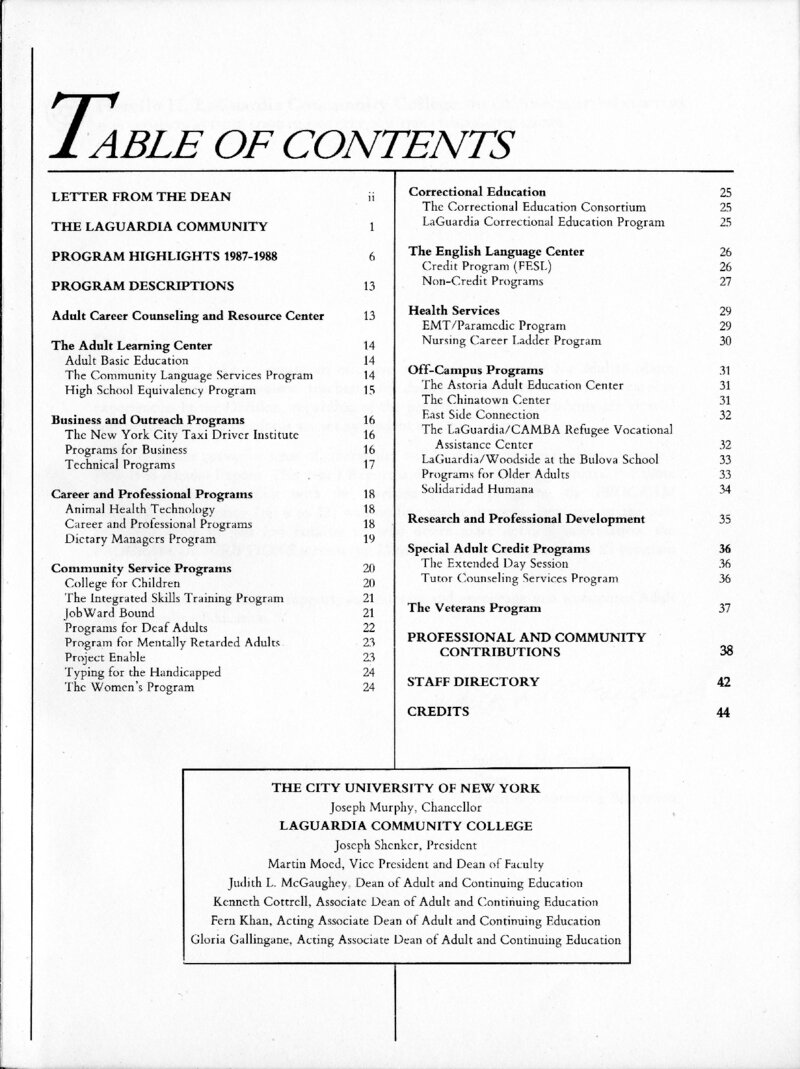
Lasie OF CONTENTS
Correctional Education 25,
LETTER FROM THE DEAN ii ‘ : 3
The Correctional Education Consortium 25
THE LAGUARDIA COMMUNITY 1 LaGuardia Correctional Education Program 25)
PROGRAM HIGHLIGHTS 1987-1988 6 | The English Language Center 26
Credit Program (FESL) 26
PROGRAM DESCRIPTIONS 13 Non-Credit Programs 27
Adult C. Cc Li d Ri Cant 3 Health Services 29
ult Career Counseling and Resource Center EMT/Paramedic Program ra
The Adult Learning Center 14 Nursing Career Ladder Program 30
Adult Basic Education 4 Sf
The Community Language Services Program 14 Off-Campus Programs : 31
High School Equivalency Program 5 The Astoria Adult Education Center 31
‘ The Chinatown Center 31
Business and Outreach Programs 6 East Side Connection : 32
The New York City Taxi Driver Institute 16 The LaGuardia/CAMBA Refugee Vocational
Programs for Business 6 Assistance Center 32
Technical Programs 17 LaGuardia/ Woodside at the Bulova School es)
Programs for Older Adults 33
Career and Professional Programs 18 Solidaridad Humana 4
Animal Health Technology 8 f
Career and Professional Programs 18 Research and Professional Development 35
Dietary M s P 9
OO eae MRE en te Special Adult Credit Programs 36
Community Service Programs 20 The Extended Day Session 36
College for Children 20 Tutor Counseling Services Program 36
The Integrated Skills Training Program 21
JobWard Bound 1 The Veterans Program 37
Programs for Deaf Adults 22
Program for Mentally Retarded Adults 23 PROFESSIONAL AND COMMUNITY 38
Project Enable 23 CONTRIBUTIONS
Typing for the Handicapped 24
The Women’s Program 24 STAFF DIRECTORY 42
CREDITS 44
THE CITY UNIVERSITY OF NEW YORK
Joseph Murphy, Chancellor
LAGUARDIA COMMUNITY COLLEGE
Joseph Shenker, President
Martin Moed, Vice President and Dean of Faculty
Judith L. McGaughey, Dean of Adult and Continuing Education
Kenneth Cottrell, Associate Dean of Adult and Continuing Education
Fern Khan, Acting Associate Dean of Adult and Continuing Education
Gloria Gallingane, Acting Associate Dean of Adult and Continuing Education
OMMUNITY SERVICE
PROGRAMS
COLLEGE FOR
CHILDREN
Laura MacDermeid, Coordinator
(718) 482-5323
PROGRAM GOALS: The COLLEGE FOR CHILDREN
(CFC) began in 1982 in response to a community survey
which showed a clear need for extra-curricular activities
for area youngsters attending public schools providing only
limited programs in the arts and other special subjects.
This year 1,510 parents and children attended the COLLEGE
FOR CHILDREN, choosing from nearly 36 different classes
designed to provide a positive learning atmosphere, expand
the concept of family learning, and draw together the
College and the community.
THE STUDENT POPULATION: Children aged 3 to
16 attend the COLLEGE FOR CHILDREN on Saturdays.
One-third of the students come from the Sunnyside,
Woodside and Long Island City area; the rest are from
outlying areas, even as far away as Brooklyn and Manhattan.
THE CLASSES: Whether students want to overcome
their fear of the water or fear of fractions, they can choose
classes which focus on recreation, the arts, and academic
skills. Sessions are relaxed and informal; classes are small—
16 students or less. Teachers and assistants are highly
qualified and make learning an active and creative process.
Class fees are modest, generally $45.00 per quarter for 8
class sessions.
Course offerings this year included: “Martial Arts,”
“Conversational French,”’ ‘Kids on Stage,’”’ ‘“‘Dance
Workshop,” “Teen Typing,” “Reading Tutorial,” and
“SAT Math” or “SAT Verbal Skills.” New course offerings
included: ‘“‘Discovering Dinosaurs,” “‘Music Makers,”
“Junior High Study Skills,” and ‘Expressive Writing
Workshop for Teens,” which produced its own literary
journal. Teenagers can select courses specifically designed
for that age group in the PROGRAM FOR TEENS.
COLLABORATIVE EFFORTS: Several joint efforts
were undertaken this year with other Community Service
Programs. With PROJECT ENABLE, a learning center
for homeless children was established with funds from the
Kenworthy-Swift Foundation. CFC and PROJECT
ENABLE will provide weekday homework help and
tutoring in basic skills to homeless children at the Park
Departments site in Jamaica.
Working with the PROGRAM FOR DEAF ADULTS,
CFC will pilot a workshop which addresses the needs of
deaf parents and their hearing children aged 3 to 6 years.
In the workshop entitled, ‘““The Learning Environments for
Deaf Parents and their Children,” mothers and fathers will
20
Sandra Rivers and Theresa Lestingi, students in Programs for Deaf
Adults, cite the support system and Guided Independent Study courses as
integral parts of their academic success. They plan to earn their bachelor
degrees in education and accounting.
attend parenting skills sessions on topics such as “Parent
Effectiveness” and “Deaf Parent Advocacy,” while their
children attend a separate class which provides play
activities aimed at enhancing their language skill
development.
COLLEGE FOR CHILDREN also collaborated with the
Queens Child Guidance Clinic to offer “POWWOW,”
(Parents of Woodside Workshops), free sessions with
counselors on specific parenting issues.
INNOVATIONS: As the Regents Action Plan goes into
effect, more tutoring and language skills courses will be
offered to meet the language requirement mandate for high
school graduation. In addition, other new courses being
developed include a computer class for teens, a cooking/
nutrition class, and more science offerings for young
children.
Due to the success of this year’s field trips, language
classes next year will be enhanced by more off-site trips
to ethnic restaurants, and the creative writing classes will
be enriched by trips to the Botanical Gardens and other
sites. In the winter, students in the “Expressive Writing
Workshop for Teens,” visited an exhibition on “‘The
Blizzard of 1888” at the Queens Historical Society
Kingsland House. The poetry and prose generated from
the trip were published in a literary magazine produced
by the class and will soon appear in the Queens Historical
Society’s newsletter.
THE INTEGRATED
SKILLS VOCATIONAL
TRAINING PROGRAM
Dolores Perin, Project Director
(718) 482-5326
PROGRAMS GOALS: Serving learning disabled young
adults who want to develop work skills, improve their basic
skills, and obtain jobs, THE INTEGRATED SKILLS
VOCATIONAL TRAINING PROGRAM provides half-
time vocational training at Federation Employment and
Guidance Service (FEGS) sites in the areas of upholstering,
operating mailroom/office machinery, furniture finishing,
jewelry manufacturing, and building maintenance. In
addition, half-time training is provided at LaGuardia in
basic reading, writing, math, and social skills. Students also
receive on-campus work experience and tutoring.
THE STUDENT POPULATION: The students, who
come from high school special education programs, often
lack high school diplomas, and need the life skills and work
skills necessary for obtaining and sustaining employment.
Therefore, students enrolling in this program receive both
academic training in the community college setting and
vocational training in a non-profit trade school, which helps
them develop employment skills, as well as skills for
independent living—especially, how to communicate and
work with others, and how to accept criticism. Program
involvement greatly enhances student self-esteem, as well.
HISTORY: This is a joint project with the Division of
Adult and Continuing Education and the CASE Institute
for Research and Development in Occupational Education
of the CUNY Graduate Center.
JOBWARD BOUND
Sandra Watson, Director
(718) 482-5351
PROGRAM GOALS: The JOBWARD BOUND pro-
gram targets young people, aged 17 to 21, living in
neighborhoods in Queens and western Brooklyn where
school dropout and unemployment rates reach as high as
60 percent. Students participate in a five-month program,
consisting of ten weeks of concentrated study, followed
by nine weeks of part-time internship supplemented by
more classroom activity.
STUDENT POPULATION: JOBWARD BOUND
admits young men and women who are not currently
enrolled in school or do not possess high school diplomas.
There are no minimum math requirements, but an eighth
grade reading level is mandatory. The JOBWARD
BOUND staff recognizes the complex needs of these young
people—teenagers in many cases—who bring with them
adult problems.
The annual picnic for students in JobWard Bound marks the end of the
5-month vocational training program.
THE PROGRAM: There are four components to the
program: 1) Academic skills training is geared towards the
level of the student: high school equivalency, Adult Basic
Education, or college preparation. 2) Career education
activities concentrate on the development of interview skills
and techniques. Students are videotaped in practice inter-
views and are critiqued. 3) A cultural awareness component,
developed by the staff, focuses on the personal importance
of having a job, as well as developing students’ general
understanding of history, current events, and their
relationship to both the local and the global human
community. As 70 percent of the participants are Afro-
American, emphasis is given to this history and culture.
4) Job development focuses on areas predicted to have high
employment in the 1990’s: data processing/word processing,
clerical skills, food service, bank teller training, and
automotive mechanics training. Students continue to attend
academic classes one day a week while they are completing
their internship. During this phase of the program, they
also meet regularly with a job counselor to discuss future
plans, as well as any problems that may arise on the job.
Students who have completed the program but have not
passed the GED can continue to receive assistance from
tutors.
During the 1987-1988 academic year, 70 percent of
JOBWARD BOUND graduates were successfully placed
in jobs, and received on average, $5.25 per hour. Twenty
percent of this group of participants chose to go on to
college. This year 95 percent of the students who took
the GED passed the examination.
NEW DIRECTIONS: As the program develops, it
becomes increasingly apparent that issues like self-esteem,
assertiveness, sexuality, women’s roles, racism, money, and
parenting (as approximately one-quarter of the participants
are parents) are just as essential as reading and resumes
if participants are to make the needed transition to the
world of work. Staff/student relations and decision making
methods have been identified as important components of
the role-modeling process that is an intrinsic, but sometimes
unconscious dimension of the program.
PROGRAMS FOR DEAF
ADULTS
Paul Menkis, Director
(718) 482-5308
PROGRAM GOALS: Referred to by The New York Times
as “‘the most comprehensive educational program for deaf
persons in metropolitan New York City,”” PROGRAMS
FOR DEAF ADULTS (PDA), offers specialized support
services and vocational/career training for deaf or hearing-
impaired students enrolled in the College in either degree
or non-degree programs. The program provides: academic
and personal development programs, such as Guided
Independent Study, designed to help improve the academic
skills of students not ready to enroll in degree programs;
specialized training programs in office skills and word
processing; support services, which include interpreters and
notetakers, for students enrolled in degree programs; and,
if necessary, tutorial assistance and counseling services to
deaf and hearing-impaired students at any stage of their
studies.
ACADEMIC AND PERSONAL DEVELOPMENT
PROGRAMS: A major component in this unit is the non-
credit GUIDED INDEPENDENT STUDY program (GIS)
which provides non-credit options to students at different
levels: Adult Basic Education, high school/GED prepara-
tion, English as a Second Language for Foreign Deaf
Persons, and college preparation which includes counseling,
orientation, and coursework designed to prepare deaf and
hearing-impaired students for degree programs at
LaGuardia and other colleges. In addition, PDA offers non-
credit business and community service courses in
microcomputers and drivers’ education. The drivers’
education course is one of the most successful in the
country—with 11 out of 12 adults passing the written
driver’s license test.
A large number of students have continued from this
program into degree programs at LaGuardia. Approxi-
mately 40 students enroll each quarter as degree candidates.
312 students were served in both the degree and non-degree
programs this year.
TRAINING PROGRAMS: The aim of the training
programs is to provide students with specific job-related
skills in office skills and word processing. Students in the
word processing program, for example, enroll in an eight-
month course, conducted twice a week in the evening,
which focuses on keyboarding skills, word processing,
increased vocabulary skills development, career prepara-
tion, and personal development. The program is funded
through the Carl D. Perkins Act by the New York State
Education Department.
SUPPORT SERVICES: PDA provides an extensive
support system for deaf and hearing-impaired students
enrolled in degree programs. Interpreters, counseling
services, and, if necessary, tutorial assistance are available.
Additional support mechanisms include tutors in The
Writing Center who are able to sign and notetakers who
sit in with deaf students in their classes. Telecommunications
Devices for the Deaf (TDDs) were purchased which allow
deaf students to communicate by phone to the non-deaf.
TDDs were installed in the Library, Public Relations Office,
and other key locations, as well as the offices of any program
in which deaf adults participate. LaGuardia is also increasing
the number of closed caption decoders. One was installed
in the College’s cafeteria to enable deaf students to
understand the dialogue on T.V.
FOCUS: The curriculum has changed to encourage the
formation of a positive self-image for deaf students and
an increased awareness of the deaf culture. As part of this
effort, close-captioned T.V. programming on deafness-
related issues from the Silent Network in California is
copied and made available to students. PROGRAMS FOR
DEAF ADULTS has also hired deaf instructors who help
students develop a sense that they too, can succeed. Students
are encouraged to join the Deaf Students Club at the
College, as well as other state-wide athletic and advocacy
organizations.
INNOVATIONS: A JOB CLUB program will start in
the fall which will feature career presentations by successful
deaf people in various fields. Students participating in the
program will get career advice from these experts and
will also do mock interviews on videotape to prepare for
their job search. Once on the job, a counselor will also
help the deaf adult make the transition to the work
environment by providing guidance to both the employer
and the deaf employee.
A program which prepares deaf students for the
REGENTS COMPETENCY TEST was started this year
partly in response to changes in the test format which
includes a writing component as well as a more rigorous
section on social sciences.
PROGRAMS FOR DEAF ADULTS is working with
COLLEGE FOR CHILDREN to offer an educational
program for deaf parents and their hearing children aged
3 to 6.
PROGRAM FOR
MENTALLY RETARDED
ADULTS
Shirley Miller, Acting Director
(718) 482-5321
PROGRAM GOALS: In collaboration with the Asso-
ciation for the Help of Retarded Children (AHRC), the
PROGRAM FOR MENTALLY RETARDED ADULTS
offers a series of continuing education courses for mentally
retarded adults on Saturdays. Courses are arranged
thematically—American History and the Psychology of
Daily Living, for example—and are designed to further
the education and independence of this student population.
This year, students took several field trips to Manhattan
and listened to a lecture by a guest speaker. The program,
now in its 4th year, enrolls approximately 10 students per
session and continues to receive praise from parents and
students, as well as the educational community.
PROJECT ENABLE
Linda Johnson, Coordinator
(718) 482-5320
PROGRAM GOALS: Given the difficult circumstances
and unique problems homeless heads of households face
on a day-to-day basis, PROJECT ENABLE provides not
only job skill training and placement, but also the support
services needed to keep homeless heads of households
enrolled in a training program. In addition to GED
preparation and ESL, the program provides secretarial
science training which focuses on: business communications,
Project Enable provides job skill training and placement, as well as sup-
port services to homeless heads of households.
secretarial procedures, typing, word processing, compu-
terized bookkeeping, and accounting. All students have
access to a support network which offers child care,
transportation, job placement, and comprehensive social,
personal, and career development counseling.
THE COURSES: Operating on an open admissions
policy, PROJECT ENABLE tailors a flexible curriculum
to the needs and circumstances of each individual. Given
the acute attendance problem of many single parents
dependent on the public welfare system, the individualized
curriculum is a necessity.
The coursework is divided into two, components:
academic preparation and job skills training. Personal
development sessions on career and life planning, parenting
under stress, dealing with the poverty cycle, time
management, and self-concept management complement
the coursework. These sessions help participants develop
the self-confidence and life management skills required to
make the transition from the culture of homelessness to
the working world.
INNOVATIONS: A number of new components were
added to the program this year: 1) an ESL pilot program
for Hispanic homeless and public assistance recipients who
have limited English proficiency; 2) Food Facts III, a
nutrition education project which was administered as a
joint project with the Natural and Applied Science
Department at the College, which provided nutrition
education workshops at several hotels, as well as training
in food science for homeless students; 3) a job skills
component added to the program in April provides advanced
secretarial and microcomputer training to PROJECT
ENABLE students; and 4) two off-site classes for high school
equivalency preparation started in shelters in East New
York and Jamaica, Queens.
FUNDING: PROJECT ENABLE was established as a
pilot project titled, ‘Program for Homeless Heads of
Households” through funding support from the New York
Community Trust and a grant from the Chase Manhattan
Bank in 1985. The program receives additional financial
support from the New York State Education Department
(Carl D. Perkins Act monies), the Kenworthy-Swift
Foundation, the Booth-Ferris Foundation, and New York
Community Trust. This year the program received two
additional grants from The New York City Community
Development Agency and the Edna McConnell Clark
Foundation.
TYPING FOR THE
HANDICAPPED
Shirley Miller, Acting Director
(718) 482-5321
PROGRAM GOALS: TYPING FOR THE HANDI-
CAPPED offers free Saturday morning courses in typing,
as well as instruction in reading, math, computer skills,
and American Sign Language to 75 disabled students each
year. The goal of the program is to enable students to
enter the work force, and, indeed, many graduates from
the program have found employment.
STUDENT POPULATION: Under the direction of Jack
Heller, a nationally-recognized leader in education for the
disabled, the program serves a student group including the
blind, hearing impaired, neurologically impaired, emotion-
ally disturbed, autistic, cerebral palsied, and stroke victims,
ranging in age from 6 to 70.
CURRICULUM: The overriding principle of the
program is respect for the dignity of each, regardless of
disability. Therefore, the program is highly individualized,
encouraging students to acquire a range of academic,
interpersonal and job-related skills. The curriculum, derived
from Jack Heller’s book, Typing for the Handicapped, utilizes
the computer’s capacity to generate instructional modules
tailored to the specific needs of each handicapped student.
FUNDING: The program is jointly funded by the Board
of Education, Division of Special Education, and by
LaGuardia Community College. In addition, Parents
Association for the Handicapped (PATH), directed by
Mollie Polanski, continues its generous support through
donations of computers, software, and auxiliary units.
THE WOMEN’S
PROGRAM
Sandra Watson, Director
Claudia Iredell, Training Program Coordinator
(718) 482-5351
PROGRAM GOALS: THE WOMEN’S PROGRAM
provides mature students returning to school with a support
system of counseling, specialized workshops, and training
in specific job skills, such as word processing. This one-
year certificate program offers mature students a sense of
community and added confidence which helps them in the
transition into the working world. The central component
of THE WOMEN’S PROGRAM is the OFFICE AUTO-
MATION TRAINING PROJECT which prepares students
for work in corporations by training them to use state-
of-the-art electronic and computerized office equipment.
THE STUDENT POPULATION: In 1987-1988, 45
students attended classes two nights a week and all day
Saturday to obtain training in specific office skills including
word processing, data base use, and electronic accounting
practice on microcomputers. Students typically range in
age from 24 to 65 years. 50 percent are single heads of
households.
IMPACT: Some graduates have obtained excellent
promotions in major private corporations, while others
were promoted by their employers because of their ad-
vanced word processing and computer application skills.
A number of students in THE WOMEN’S PROGRAM
apply regularly to the College for admission to degree
programs.
INNOVATIONS: THE WOMEN’S PROGRAM will
provide 300 hours of training to 30 minority and women
entrepreneurs in northern Brooklyn and western Queens
in The MINORITY AND WOMEN’S ENTREPRENEUR
TRAINING program which will be conducted over a 50-
week period starting in July 1988. Areas of instruction
include: career development skills, technical skills, oral and
written business communication, and individual business
assessment.
Correctional Education 25,
LETTER FROM THE DEAN ii ‘ : 3
The Correctional Education Consortium 25
THE LAGUARDIA COMMUNITY 1 LaGuardia Correctional Education Program 25)
PROGRAM HIGHLIGHTS 1987-1988 6 | The English Language Center 26
Credit Program (FESL) 26
PROGRAM DESCRIPTIONS 13 Non-Credit Programs 27
Adult C. Cc Li d Ri Cant 3 Health Services 29
ult Career Counseling and Resource Center EMT/Paramedic Program ra
The Adult Learning Center 14 Nursing Career Ladder Program 30
Adult Basic Education 4 Sf
The Community Language Services Program 14 Off-Campus Programs : 31
High School Equivalency Program 5 The Astoria Adult Education Center 31
‘ The Chinatown Center 31
Business and Outreach Programs 6 East Side Connection : 32
The New York City Taxi Driver Institute 16 The LaGuardia/CAMBA Refugee Vocational
Programs for Business 6 Assistance Center 32
Technical Programs 17 LaGuardia/ Woodside at the Bulova School es)
Programs for Older Adults 33
Career and Professional Programs 18 Solidaridad Humana 4
Animal Health Technology 8 f
Career and Professional Programs 18 Research and Professional Development 35
Dietary M s P 9
OO eae MRE en te Special Adult Credit Programs 36
Community Service Programs 20 The Extended Day Session 36
College for Children 20 Tutor Counseling Services Program 36
The Integrated Skills Training Program 21
JobWard Bound 1 The Veterans Program 37
Programs for Deaf Adults 22
Program for Mentally Retarded Adults 23 PROFESSIONAL AND COMMUNITY 38
Project Enable 23 CONTRIBUTIONS
Typing for the Handicapped 24
The Women’s Program 24 STAFF DIRECTORY 42
CREDITS 44
THE CITY UNIVERSITY OF NEW YORK
Joseph Murphy, Chancellor
LAGUARDIA COMMUNITY COLLEGE
Joseph Shenker, President
Martin Moed, Vice President and Dean of Faculty
Judith L. McGaughey, Dean of Adult and Continuing Education
Kenneth Cottrell, Associate Dean of Adult and Continuing Education
Fern Khan, Acting Associate Dean of Adult and Continuing Education
Gloria Gallingane, Acting Associate Dean of Adult and Continuing Education
OMMUNITY SERVICE
PROGRAMS
COLLEGE FOR
CHILDREN
Laura MacDermeid, Coordinator
(718) 482-5323
PROGRAM GOALS: The COLLEGE FOR CHILDREN
(CFC) began in 1982 in response to a community survey
which showed a clear need for extra-curricular activities
for area youngsters attending public schools providing only
limited programs in the arts and other special subjects.
This year 1,510 parents and children attended the COLLEGE
FOR CHILDREN, choosing from nearly 36 different classes
designed to provide a positive learning atmosphere, expand
the concept of family learning, and draw together the
College and the community.
THE STUDENT POPULATION: Children aged 3 to
16 attend the COLLEGE FOR CHILDREN on Saturdays.
One-third of the students come from the Sunnyside,
Woodside and Long Island City area; the rest are from
outlying areas, even as far away as Brooklyn and Manhattan.
THE CLASSES: Whether students want to overcome
their fear of the water or fear of fractions, they can choose
classes which focus on recreation, the arts, and academic
skills. Sessions are relaxed and informal; classes are small—
16 students or less. Teachers and assistants are highly
qualified and make learning an active and creative process.
Class fees are modest, generally $45.00 per quarter for 8
class sessions.
Course offerings this year included: “Martial Arts,”
“Conversational French,”’ ‘Kids on Stage,’”’ ‘“‘Dance
Workshop,” “Teen Typing,” “Reading Tutorial,” and
“SAT Math” or “SAT Verbal Skills.” New course offerings
included: ‘“‘Discovering Dinosaurs,” “‘Music Makers,”
“Junior High Study Skills,” and ‘Expressive Writing
Workshop for Teens,” which produced its own literary
journal. Teenagers can select courses specifically designed
for that age group in the PROGRAM FOR TEENS.
COLLABORATIVE EFFORTS: Several joint efforts
were undertaken this year with other Community Service
Programs. With PROJECT ENABLE, a learning center
for homeless children was established with funds from the
Kenworthy-Swift Foundation. CFC and PROJECT
ENABLE will provide weekday homework help and
tutoring in basic skills to homeless children at the Park
Departments site in Jamaica.
Working with the PROGRAM FOR DEAF ADULTS,
CFC will pilot a workshop which addresses the needs of
deaf parents and their hearing children aged 3 to 6 years.
In the workshop entitled, ‘““The Learning Environments for
Deaf Parents and their Children,” mothers and fathers will
20
Sandra Rivers and Theresa Lestingi, students in Programs for Deaf
Adults, cite the support system and Guided Independent Study courses as
integral parts of their academic success. They plan to earn their bachelor
degrees in education and accounting.
attend parenting skills sessions on topics such as “Parent
Effectiveness” and “Deaf Parent Advocacy,” while their
children attend a separate class which provides play
activities aimed at enhancing their language skill
development.
COLLEGE FOR CHILDREN also collaborated with the
Queens Child Guidance Clinic to offer “POWWOW,”
(Parents of Woodside Workshops), free sessions with
counselors on specific parenting issues.
INNOVATIONS: As the Regents Action Plan goes into
effect, more tutoring and language skills courses will be
offered to meet the language requirement mandate for high
school graduation. In addition, other new courses being
developed include a computer class for teens, a cooking/
nutrition class, and more science offerings for young
children.
Due to the success of this year’s field trips, language
classes next year will be enhanced by more off-site trips
to ethnic restaurants, and the creative writing classes will
be enriched by trips to the Botanical Gardens and other
sites. In the winter, students in the “Expressive Writing
Workshop for Teens,” visited an exhibition on “‘The
Blizzard of 1888” at the Queens Historical Society
Kingsland House. The poetry and prose generated from
the trip were published in a literary magazine produced
by the class and will soon appear in the Queens Historical
Society’s newsletter.
THE INTEGRATED
SKILLS VOCATIONAL
TRAINING PROGRAM
Dolores Perin, Project Director
(718) 482-5326
PROGRAMS GOALS: Serving learning disabled young
adults who want to develop work skills, improve their basic
skills, and obtain jobs, THE INTEGRATED SKILLS
VOCATIONAL TRAINING PROGRAM provides half-
time vocational training at Federation Employment and
Guidance Service (FEGS) sites in the areas of upholstering,
operating mailroom/office machinery, furniture finishing,
jewelry manufacturing, and building maintenance. In
addition, half-time training is provided at LaGuardia in
basic reading, writing, math, and social skills. Students also
receive on-campus work experience and tutoring.
THE STUDENT POPULATION: The students, who
come from high school special education programs, often
lack high school diplomas, and need the life skills and work
skills necessary for obtaining and sustaining employment.
Therefore, students enrolling in this program receive both
academic training in the community college setting and
vocational training in a non-profit trade school, which helps
them develop employment skills, as well as skills for
independent living—especially, how to communicate and
work with others, and how to accept criticism. Program
involvement greatly enhances student self-esteem, as well.
HISTORY: This is a joint project with the Division of
Adult and Continuing Education and the CASE Institute
for Research and Development in Occupational Education
of the CUNY Graduate Center.
JOBWARD BOUND
Sandra Watson, Director
(718) 482-5351
PROGRAM GOALS: The JOBWARD BOUND pro-
gram targets young people, aged 17 to 21, living in
neighborhoods in Queens and western Brooklyn where
school dropout and unemployment rates reach as high as
60 percent. Students participate in a five-month program,
consisting of ten weeks of concentrated study, followed
by nine weeks of part-time internship supplemented by
more classroom activity.
STUDENT POPULATION: JOBWARD BOUND
admits young men and women who are not currently
enrolled in school or do not possess high school diplomas.
There are no minimum math requirements, but an eighth
grade reading level is mandatory. The JOBWARD
BOUND staff recognizes the complex needs of these young
people—teenagers in many cases—who bring with them
adult problems.
The annual picnic for students in JobWard Bound marks the end of the
5-month vocational training program.
THE PROGRAM: There are four components to the
program: 1) Academic skills training is geared towards the
level of the student: high school equivalency, Adult Basic
Education, or college preparation. 2) Career education
activities concentrate on the development of interview skills
and techniques. Students are videotaped in practice inter-
views and are critiqued. 3) A cultural awareness component,
developed by the staff, focuses on the personal importance
of having a job, as well as developing students’ general
understanding of history, current events, and their
relationship to both the local and the global human
community. As 70 percent of the participants are Afro-
American, emphasis is given to this history and culture.
4) Job development focuses on areas predicted to have high
employment in the 1990’s: data processing/word processing,
clerical skills, food service, bank teller training, and
automotive mechanics training. Students continue to attend
academic classes one day a week while they are completing
their internship. During this phase of the program, they
also meet regularly with a job counselor to discuss future
plans, as well as any problems that may arise on the job.
Students who have completed the program but have not
passed the GED can continue to receive assistance from
tutors.
During the 1987-1988 academic year, 70 percent of
JOBWARD BOUND graduates were successfully placed
in jobs, and received on average, $5.25 per hour. Twenty
percent of this group of participants chose to go on to
college. This year 95 percent of the students who took
the GED passed the examination.
NEW DIRECTIONS: As the program develops, it
becomes increasingly apparent that issues like self-esteem,
assertiveness, sexuality, women’s roles, racism, money, and
parenting (as approximately one-quarter of the participants
are parents) are just as essential as reading and resumes
if participants are to make the needed transition to the
world of work. Staff/student relations and decision making
methods have been identified as important components of
the role-modeling process that is an intrinsic, but sometimes
unconscious dimension of the program.
PROGRAMS FOR DEAF
ADULTS
Paul Menkis, Director
(718) 482-5308
PROGRAM GOALS: Referred to by The New York Times
as “‘the most comprehensive educational program for deaf
persons in metropolitan New York City,”” PROGRAMS
FOR DEAF ADULTS (PDA), offers specialized support
services and vocational/career training for deaf or hearing-
impaired students enrolled in the College in either degree
or non-degree programs. The program provides: academic
and personal development programs, such as Guided
Independent Study, designed to help improve the academic
skills of students not ready to enroll in degree programs;
specialized training programs in office skills and word
processing; support services, which include interpreters and
notetakers, for students enrolled in degree programs; and,
if necessary, tutorial assistance and counseling services to
deaf and hearing-impaired students at any stage of their
studies.
ACADEMIC AND PERSONAL DEVELOPMENT
PROGRAMS: A major component in this unit is the non-
credit GUIDED INDEPENDENT STUDY program (GIS)
which provides non-credit options to students at different
levels: Adult Basic Education, high school/GED prepara-
tion, English as a Second Language for Foreign Deaf
Persons, and college preparation which includes counseling,
orientation, and coursework designed to prepare deaf and
hearing-impaired students for degree programs at
LaGuardia and other colleges. In addition, PDA offers non-
credit business and community service courses in
microcomputers and drivers’ education. The drivers’
education course is one of the most successful in the
country—with 11 out of 12 adults passing the written
driver’s license test.
A large number of students have continued from this
program into degree programs at LaGuardia. Approxi-
mately 40 students enroll each quarter as degree candidates.
312 students were served in both the degree and non-degree
programs this year.
TRAINING PROGRAMS: The aim of the training
programs is to provide students with specific job-related
skills in office skills and word processing. Students in the
word processing program, for example, enroll in an eight-
month course, conducted twice a week in the evening,
which focuses on keyboarding skills, word processing,
increased vocabulary skills development, career prepara-
tion, and personal development. The program is funded
through the Carl D. Perkins Act by the New York State
Education Department.
SUPPORT SERVICES: PDA provides an extensive
support system for deaf and hearing-impaired students
enrolled in degree programs. Interpreters, counseling
services, and, if necessary, tutorial assistance are available.
Additional support mechanisms include tutors in The
Writing Center who are able to sign and notetakers who
sit in with deaf students in their classes. Telecommunications
Devices for the Deaf (TDDs) were purchased which allow
deaf students to communicate by phone to the non-deaf.
TDDs were installed in the Library, Public Relations Office,
and other key locations, as well as the offices of any program
in which deaf adults participate. LaGuardia is also increasing
the number of closed caption decoders. One was installed
in the College’s cafeteria to enable deaf students to
understand the dialogue on T.V.
FOCUS: The curriculum has changed to encourage the
formation of a positive self-image for deaf students and
an increased awareness of the deaf culture. As part of this
effort, close-captioned T.V. programming on deafness-
related issues from the Silent Network in California is
copied and made available to students. PROGRAMS FOR
DEAF ADULTS has also hired deaf instructors who help
students develop a sense that they too, can succeed. Students
are encouraged to join the Deaf Students Club at the
College, as well as other state-wide athletic and advocacy
organizations.
INNOVATIONS: A JOB CLUB program will start in
the fall which will feature career presentations by successful
deaf people in various fields. Students participating in the
program will get career advice from these experts and
will also do mock interviews on videotape to prepare for
their job search. Once on the job, a counselor will also
help the deaf adult make the transition to the work
environment by providing guidance to both the employer
and the deaf employee.
A program which prepares deaf students for the
REGENTS COMPETENCY TEST was started this year
partly in response to changes in the test format which
includes a writing component as well as a more rigorous
section on social sciences.
PROGRAMS FOR DEAF ADULTS is working with
COLLEGE FOR CHILDREN to offer an educational
program for deaf parents and their hearing children aged
3 to 6.
PROGRAM FOR
MENTALLY RETARDED
ADULTS
Shirley Miller, Acting Director
(718) 482-5321
PROGRAM GOALS: In collaboration with the Asso-
ciation for the Help of Retarded Children (AHRC), the
PROGRAM FOR MENTALLY RETARDED ADULTS
offers a series of continuing education courses for mentally
retarded adults on Saturdays. Courses are arranged
thematically—American History and the Psychology of
Daily Living, for example—and are designed to further
the education and independence of this student population.
This year, students took several field trips to Manhattan
and listened to a lecture by a guest speaker. The program,
now in its 4th year, enrolls approximately 10 students per
session and continues to receive praise from parents and
students, as well as the educational community.
PROJECT ENABLE
Linda Johnson, Coordinator
(718) 482-5320
PROGRAM GOALS: Given the difficult circumstances
and unique problems homeless heads of households face
on a day-to-day basis, PROJECT ENABLE provides not
only job skill training and placement, but also the support
services needed to keep homeless heads of households
enrolled in a training program. In addition to GED
preparation and ESL, the program provides secretarial
science training which focuses on: business communications,
Project Enable provides job skill training and placement, as well as sup-
port services to homeless heads of households.
secretarial procedures, typing, word processing, compu-
terized bookkeeping, and accounting. All students have
access to a support network which offers child care,
transportation, job placement, and comprehensive social,
personal, and career development counseling.
THE COURSES: Operating on an open admissions
policy, PROJECT ENABLE tailors a flexible curriculum
to the needs and circumstances of each individual. Given
the acute attendance problem of many single parents
dependent on the public welfare system, the individualized
curriculum is a necessity.
The coursework is divided into two, components:
academic preparation and job skills training. Personal
development sessions on career and life planning, parenting
under stress, dealing with the poverty cycle, time
management, and self-concept management complement
the coursework. These sessions help participants develop
the self-confidence and life management skills required to
make the transition from the culture of homelessness to
the working world.
INNOVATIONS: A number of new components were
added to the program this year: 1) an ESL pilot program
for Hispanic homeless and public assistance recipients who
have limited English proficiency; 2) Food Facts III, a
nutrition education project which was administered as a
joint project with the Natural and Applied Science
Department at the College, which provided nutrition
education workshops at several hotels, as well as training
in food science for homeless students; 3) a job skills
component added to the program in April provides advanced
secretarial and microcomputer training to PROJECT
ENABLE students; and 4) two off-site classes for high school
equivalency preparation started in shelters in East New
York and Jamaica, Queens.
FUNDING: PROJECT ENABLE was established as a
pilot project titled, ‘Program for Homeless Heads of
Households” through funding support from the New York
Community Trust and a grant from the Chase Manhattan
Bank in 1985. The program receives additional financial
support from the New York State Education Department
(Carl D. Perkins Act monies), the Kenworthy-Swift
Foundation, the Booth-Ferris Foundation, and New York
Community Trust. This year the program received two
additional grants from The New York City Community
Development Agency and the Edna McConnell Clark
Foundation.
TYPING FOR THE
HANDICAPPED
Shirley Miller, Acting Director
(718) 482-5321
PROGRAM GOALS: TYPING FOR THE HANDI-
CAPPED offers free Saturday morning courses in typing,
as well as instruction in reading, math, computer skills,
and American Sign Language to 75 disabled students each
year. The goal of the program is to enable students to
enter the work force, and, indeed, many graduates from
the program have found employment.
STUDENT POPULATION: Under the direction of Jack
Heller, a nationally-recognized leader in education for the
disabled, the program serves a student group including the
blind, hearing impaired, neurologically impaired, emotion-
ally disturbed, autistic, cerebral palsied, and stroke victims,
ranging in age from 6 to 70.
CURRICULUM: The overriding principle of the
program is respect for the dignity of each, regardless of
disability. Therefore, the program is highly individualized,
encouraging students to acquire a range of academic,
interpersonal and job-related skills. The curriculum, derived
from Jack Heller’s book, Typing for the Handicapped, utilizes
the computer’s capacity to generate instructional modules
tailored to the specific needs of each handicapped student.
FUNDING: The program is jointly funded by the Board
of Education, Division of Special Education, and by
LaGuardia Community College. In addition, Parents
Association for the Handicapped (PATH), directed by
Mollie Polanski, continues its generous support through
donations of computers, software, and auxiliary units.
THE WOMEN’S
PROGRAM
Sandra Watson, Director
Claudia Iredell, Training Program Coordinator
(718) 482-5351
PROGRAM GOALS: THE WOMEN’S PROGRAM
provides mature students returning to school with a support
system of counseling, specialized workshops, and training
in specific job skills, such as word processing. This one-
year certificate program offers mature students a sense of
community and added confidence which helps them in the
transition into the working world. The central component
of THE WOMEN’S PROGRAM is the OFFICE AUTO-
MATION TRAINING PROJECT which prepares students
for work in corporations by training them to use state-
of-the-art electronic and computerized office equipment.
THE STUDENT POPULATION: In 1987-1988, 45
students attended classes two nights a week and all day
Saturday to obtain training in specific office skills including
word processing, data base use, and electronic accounting
practice on microcomputers. Students typically range in
age from 24 to 65 years. 50 percent are single heads of
households.
IMPACT: Some graduates have obtained excellent
promotions in major private corporations, while others
were promoted by their employers because of their ad-
vanced word processing and computer application skills.
A number of students in THE WOMEN’S PROGRAM
apply regularly to the College for admission to degree
programs.
INNOVATIONS: THE WOMEN’S PROGRAM will
provide 300 hours of training to 30 minority and women
entrepreneurs in northern Brooklyn and western Queens
in The MINORITY AND WOMEN’S ENTREPRENEUR
TRAINING program which will be conducted over a 50-
week period starting in July 1988. Areas of instruction
include: career development skills, technical skills, oral and
written business communication, and individual business
assessment.
Title
LaGuardia's Community Service Programs, 1987-88
Description
This selection from the 1987-8 catalog of LaGuardia Community College's Continuing Education division highlights the college's commitment to serving the western Queens community. The diverse array of programs cater to local children, young adults, homeless, and those with disabilities, among others. Of particular note is the school's programming for Deaf adults and youth, an initiative that began in 1974.
Contributor
Khan, Fern
Creator
Division of Continuing Education
Date
1988
Language
English
Relation
2922
2882
Rights
Obtained from Contributor - Copyright Unknown
Source
Khan, Fern
Original Format
Article / Essay
Division of Continuing Education. Letter. 1987. “LaGuardia’s Community Service Programs, 1987-88”. 2922, 1987, CUNY DIGITAL HISTORY ARCHIVE, accessed September 5, 2026, https://stephenz.tailc22a4b.ts.net/s/cdha/item/372