Statements of Belle Zeller and Israel Kugler before the Board of Higher Education
Item
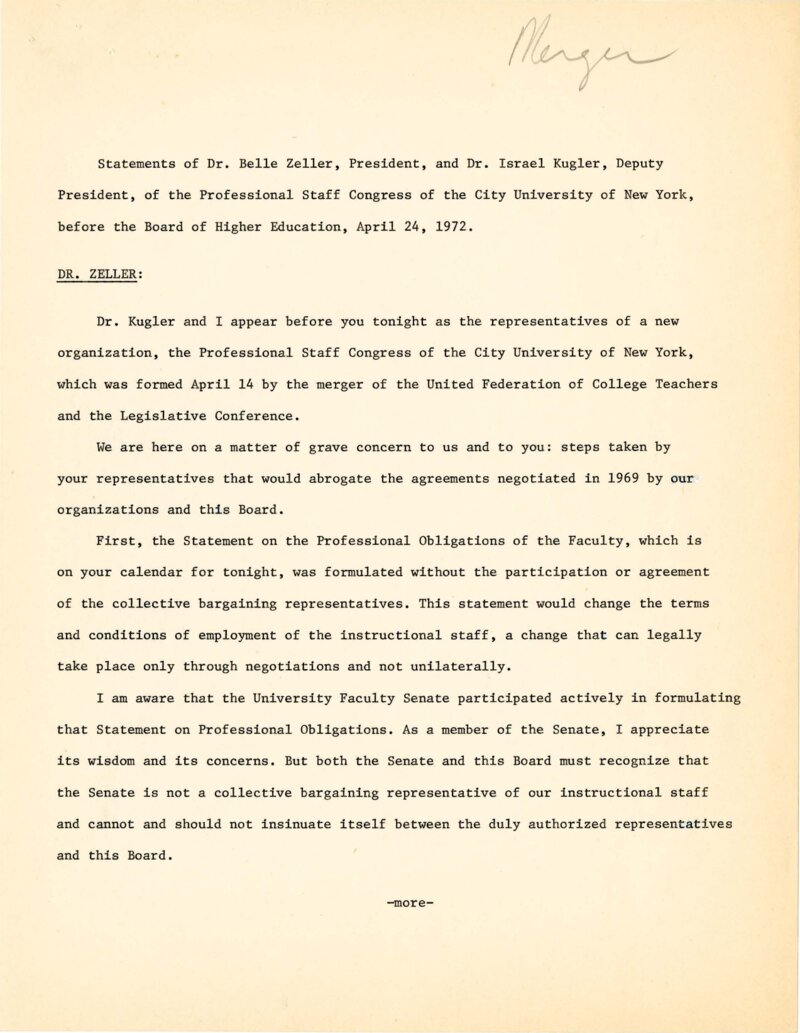
Statements of Dr. Belle Zeller, President, and Dr. Israel Kugler, Deputy
President, of the Professional Staff Congress of the City University of New York,
before the Board of Higher Education, April 24, 1972.
DR. ZELLER:
Dr. Kugler and I appear before you tonight as the representatives of a new
organization, the Professional Staff Congress of the City University of New York,
which was formed April 14 by the merger of the United Federation of College Teachers
and the Legislative Conference.
We are here on a matter of grave concern to us and to you: steps taken by
your representatives that would abrogate the agreements negotiated in 1969 by our
organizations and this Board.
First, the Statement on the Professional Obligations of the Faculty, which is
on your calendar for tonight, was formulated without the participation or agreement
of the collective bargaining representatives. This statement would change the terms
and conditions of employment of the instructional staff, a change that can legally
take place only through negotiations and not unilaterally.
I am aware that the University Faculty Senate participated actively in formulating
that Statement on Professional Obligations. As a member of the Senate, I appreciate
its wisdom and its concerns. But both the Senate and this Board must recognize that
the Senate is not a collective bargaining representative of our instructional staff
and cannot and should not insinuate itself between the duly authorized representatives
and this Board.
-more-
-* SSS. ES oe sete
‘Zeller Statement /Page 2/April 24, 1972 Fi
. oo,
The Senate's input on this matter does not fulfill the obligation of this Board
to negotiate with the duly authorized bargaining bodies.
Secondly, this Board on February 28 rescinded its mandate that student evaluations
of faculty be implemented this semester. The Board acted after the Legislative
Conference initiated an improper practice charge against the mandate, and the Board
acted wisely and in good faith by withdrawing its mandate.
Now, however, a University Dean has instructed the college Presidents to implement
a student evaluation system immediately.
The Professional Staff Congress and its predecessor organizations have stated
time and again that we favor and appreciate the value of student evaluations, and we
intend to initiate such an evaluation system in the next contract. But until such
negotiations are carried out and ratified, and without the participation and
acquiescence of the collective bargaining representative, such a system may not be
implemented.
Now both these problems---student evaluations and professional obligations---
can be solved. They can be solved through contract negotiations, and they can be
solved immediately---if the Board's representatives were willing to negotiate.
We are eager and willing to negotiate on these and all other matters. We have
offered to begin negotiating immediately---either as one unit or, pending the outcome
of an election, as two. Thus far, your representatives have refused to do so.
I am here to inform you of the implications of their actions, its effect on
the collective bargaining process and on the Board's relations with the instructional
staff.
DR. KUGLER:
Our university community has just passed through an important phase of the most
~more-
Zeller, Kugler Statements/Page 3/April 24, 1972
disturbing fiscal crisis affecting CUNY. Together we have worked to effectuate a
change in the State Legislature. In line with this the Chancellor called a conference
where he presented the unified presence in the form of what he designated as "CUNY
United".
On March 29, 1972, the Chancellor on the occasion of a press conference
announcing the merger between the Legislative Conference and the United Federation
of College Teachers, issued the following public statement:
The merger proposed by the leadership of the Legislative Conference and the
United Federation of College Teachers indicates once again that all of us who
make up the CUNY ocmmunity have far more in common than we have in conflict.
The university will continue to negotiate in good faith with the faculty's
representatives to strengthen our areas of common interest and to serve and
enhance quality public higher education in the City of New York. (my emphasis)
When we were two separate organizations, each one represented a part of the
Instructional Staff. These two parts add up to the entire Instructional Staff. No
other staff organization has come forward to challenge our representation jurisdiction.
The existing contracts call for negotiations to have begun six months before their
expiration at the end of August, 1972.
The ratification vote by the respective memberships was overwhelming, exceeding
10 to 1. The desire of the staff is for unity in harmony with the Board of Higher
Education by-laws' definition of the Instructional Staff and in harmony with the
Board's position in 1968, presented by Judge Morris Lasker in its behalf.
We are asking the Board tonight to grant the Professional Staff Congress recognition
as the continuing successor organization for the entire Instructional Staff and to
get down to negotiate a new contract in good faith.
It is not for the employer to come forth and challenge this proposal. Any challenge
must come from within the staff. None has been forthcoming despite a campaign which
dates back to the Spring of 1971.
-more—
Zeller, Kugler Statements/Page 4/April 24, 1972
The representatives of the Board have refused any recognition unless it is on the
basis of three units. They have refused a consent election unless it's on a three-
unit basis. In essence, unless they can have their way, there can be no negotiations
until PERB has made a formal decision sometime in the summer when the staff is
unavailable. We submit that this flies in the face of the Chancellor's constructive
and conciliatory statement. It is entirely unreasonable.
We would be willing to revert to negotiations on the basis of the status quo ante,
pending the outcome of the PERB decision, and getting down to immediate negotiations.
This has also been refused.
You can play a constructive role tonight by recognizing the PSC-CUNY so that we
can go ahead in developing a new contract. If you don't the consequences are not
difficult to foresee. You will anger the anxiety-ridden staff and create a wide gulf
between them and the Board. We hope you will act with wisdom and foresight and make
the Chancellor's statement a reality.
RKKKE
President, of the Professional Staff Congress of the City University of New York,
before the Board of Higher Education, April 24, 1972.
DR. ZELLER:
Dr. Kugler and I appear before you tonight as the representatives of a new
organization, the Professional Staff Congress of the City University of New York,
which was formed April 14 by the merger of the United Federation of College Teachers
and the Legislative Conference.
We are here on a matter of grave concern to us and to you: steps taken by
your representatives that would abrogate the agreements negotiated in 1969 by our
organizations and this Board.
First, the Statement on the Professional Obligations of the Faculty, which is
on your calendar for tonight, was formulated without the participation or agreement
of the collective bargaining representatives. This statement would change the terms
and conditions of employment of the instructional staff, a change that can legally
take place only through negotiations and not unilaterally.
I am aware that the University Faculty Senate participated actively in formulating
that Statement on Professional Obligations. As a member of the Senate, I appreciate
its wisdom and its concerns. But both the Senate and this Board must recognize that
the Senate is not a collective bargaining representative of our instructional staff
and cannot and should not insinuate itself between the duly authorized representatives
and this Board.
-more-
-* SSS. ES oe sete
‘Zeller Statement /Page 2/April 24, 1972 Fi
. oo,
The Senate's input on this matter does not fulfill the obligation of this Board
to negotiate with the duly authorized bargaining bodies.
Secondly, this Board on February 28 rescinded its mandate that student evaluations
of faculty be implemented this semester. The Board acted after the Legislative
Conference initiated an improper practice charge against the mandate, and the Board
acted wisely and in good faith by withdrawing its mandate.
Now, however, a University Dean has instructed the college Presidents to implement
a student evaluation system immediately.
The Professional Staff Congress and its predecessor organizations have stated
time and again that we favor and appreciate the value of student evaluations, and we
intend to initiate such an evaluation system in the next contract. But until such
negotiations are carried out and ratified, and without the participation and
acquiescence of the collective bargaining representative, such a system may not be
implemented.
Now both these problems---student evaluations and professional obligations---
can be solved. They can be solved through contract negotiations, and they can be
solved immediately---if the Board's representatives were willing to negotiate.
We are eager and willing to negotiate on these and all other matters. We have
offered to begin negotiating immediately---either as one unit or, pending the outcome
of an election, as two. Thus far, your representatives have refused to do so.
I am here to inform you of the implications of their actions, its effect on
the collective bargaining process and on the Board's relations with the instructional
staff.
DR. KUGLER:
Our university community has just passed through an important phase of the most
~more-
Zeller, Kugler Statements/Page 3/April 24, 1972
disturbing fiscal crisis affecting CUNY. Together we have worked to effectuate a
change in the State Legislature. In line with this the Chancellor called a conference
where he presented the unified presence in the form of what he designated as "CUNY
United".
On March 29, 1972, the Chancellor on the occasion of a press conference
announcing the merger between the Legislative Conference and the United Federation
of College Teachers, issued the following public statement:
The merger proposed by the leadership of the Legislative Conference and the
United Federation of College Teachers indicates once again that all of us who
make up the CUNY ocmmunity have far more in common than we have in conflict.
The university will continue to negotiate in good faith with the faculty's
representatives to strengthen our areas of common interest and to serve and
enhance quality public higher education in the City of New York. (my emphasis)
When we were two separate organizations, each one represented a part of the
Instructional Staff. These two parts add up to the entire Instructional Staff. No
other staff organization has come forward to challenge our representation jurisdiction.
The existing contracts call for negotiations to have begun six months before their
expiration at the end of August, 1972.
The ratification vote by the respective memberships was overwhelming, exceeding
10 to 1. The desire of the staff is for unity in harmony with the Board of Higher
Education by-laws' definition of the Instructional Staff and in harmony with the
Board's position in 1968, presented by Judge Morris Lasker in its behalf.
We are asking the Board tonight to grant the Professional Staff Congress recognition
as the continuing successor organization for the entire Instructional Staff and to
get down to negotiate a new contract in good faith.
It is not for the employer to come forth and challenge this proposal. Any challenge
must come from within the staff. None has been forthcoming despite a campaign which
dates back to the Spring of 1971.
-more—
Zeller, Kugler Statements/Page 4/April 24, 1972
The representatives of the Board have refused any recognition unless it is on the
basis of three units. They have refused a consent election unless it's on a three-
unit basis. In essence, unless they can have their way, there can be no negotiations
until PERB has made a formal decision sometime in the summer when the staff is
unavailable. We submit that this flies in the face of the Chancellor's constructive
and conciliatory statement. It is entirely unreasonable.
We would be willing to revert to negotiations on the basis of the status quo ante,
pending the outcome of the PERB decision, and getting down to immediate negotiations.
This has also been refused.
You can play a constructive role tonight by recognizing the PSC-CUNY so that we
can go ahead in developing a new contract. If you don't the consequences are not
difficult to foresee. You will anger the anxiety-ridden staff and create a wide gulf
between them and the Board. We hope you will act with wisdom and foresight and make
the Chancellor's statement a reality.
RKKKE
Title
Statements of Belle Zeller and Israel Kugler before the Board of Higher Education
Description
These statements were prepared shortly after the Legislative Conference, led by Belle Zeller, and the United Federation of College Teachers, led by Israel Kugler, merged to form the Professional Staff Congress (PSC) in April 1972. This marked the first appearance by Zeller and Kugler in front of the Board of Higher Education as representatives of the PSC. Zeller focused on CUNY's recently developed "Statement on Professional Obligations for Faculty," as well as newly instituted student evaluations of faculty. Both, she charged, were developed without consultation of faculty and therefore violated existing contracts negotiated in 1969. Kugler, deputy president of the PSC, focused on CUNY’s refusal to bargain with the new union and their insistence on a division into three separate bargaining units for full-time, part-time, and non-classroom staff.
CUNY's initial opposition to the PSC led to hostility between the two parties as well as strike votes by members of the union. Despite the insistence of CUNY administration, the PSC would come to serve as the single bargaining representative for all faculty and staff at CUNY and their first contract was negotiated in July 1973.
CUNY's initial opposition to the PSC led to hostility between the two parties as well as strike votes by members of the union. Despite the insistence of CUNY administration, the PSC would come to serve as the single bargaining representative for all faculty and staff at CUNY and their first contract was negotiated in July 1973.
Contributor
Professional Staff Congress
Creator
Zeller, Belle
Kugler, Israel
Date
April 24, 1972
Language
English
Rights
Obtained from Contributor - Copyright Unknown
Source
Robert F. Wagner Labor Archives
Original Format
Report / Paper / Proposal
Zeller, Belle, and Kugler, Israel. Letter. “Statements of Belle Zeller and Israel Kugler before the Board of Higher Education.”, CUNY DIGITAL HISTORY ARCHIVE, accessed July 8, 2026, https://stephenz.tailc22a4b.ts.net/s/cdha/item/454