Women's Studies Program Report of Activities
Item
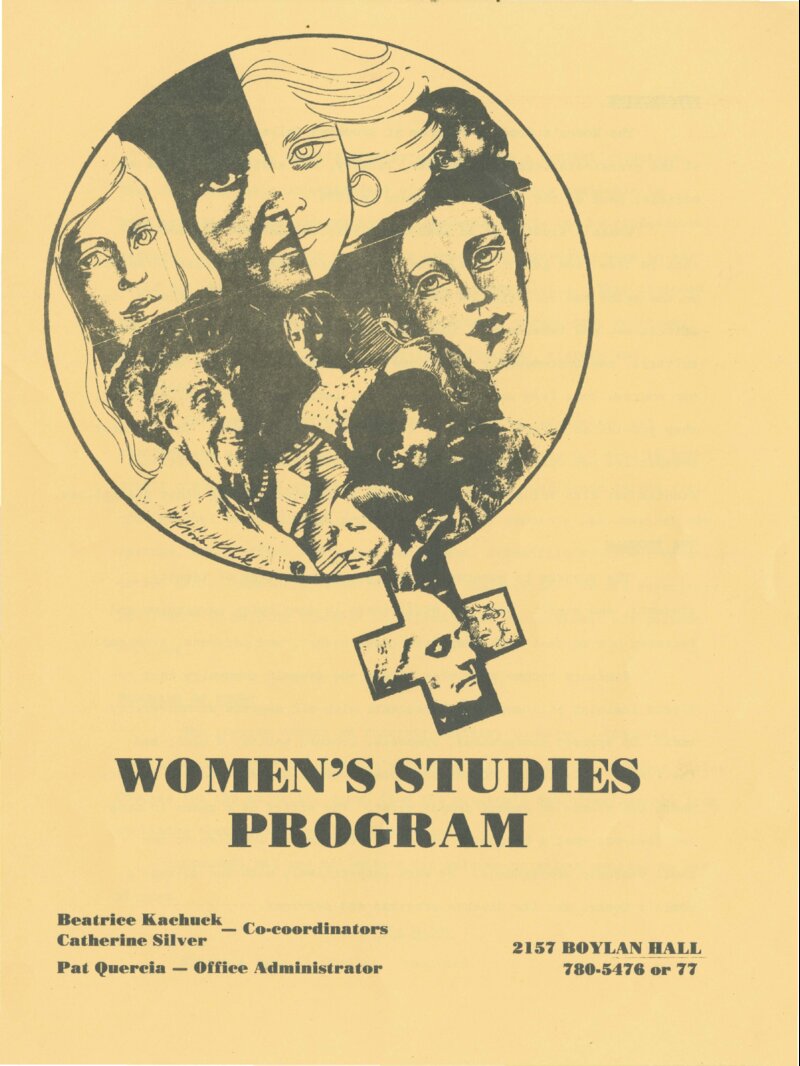
WOMEN’S STUDIES
PROGRAM
Beatrice Kachuek_ ¢. .cordinaters
Catherine Silver 2157 BOYLAN HALL
Pat Quercia — Office Administrator 780-5476 or 77
PERS PECTIVE
The Women's Studies Program at Brooklyn College was initiated
at the grassroots level by students, faculty, and staff. It became an
official part of the college structure in 1974.
Women's Studies is an academic discipline devoted to knowledge
that is free from gender bias. The program provides a feminist perspective
on the myths and realities of women's lives. Studies of individuals, in-
stitutions, sah eiciaecedat ideas are approached from historical, cross-
cultural, and contemporary viewpoints. The feminist scholars who teach
our courses come from various departments; individually and collectively,
they provide an interdisciplinary framework to the program. The feminist
perspective not only introduces enriched understanding of traditional
studies but also bridges important areas of knowledge among other disciplines.
THE PROGRAM
The program is governed by a steering committee of faculty,
students, and staff. Students participate in developing curriculum and
learning how to deal with administrative, budget, and personnel problems.
Students become part of a lively and dynamic community that re-
flects feminist philosophy and interacts with all aspects of university
life. We sponsor conferences, symposia, lecture series, a club, and
festivals. Celebration of International Women's Day and Women's History
Month has become an annual campus event. The office is a place to drop
in, find out what's happening on and off campus--in addition to the
usual academic conferences. We work cooperatively with the college's
Women's Center and its diverse programs and services.
CAREER OPTIONS
Students in Women's Studies courses have a special advantage.
They increase their understanding of options that are available in
both traditional and non-traditional academic fields and in professional
careers. Women's Studies majors are prepared for graduate work in any
field for which liberal arts studies ere a prerequisite. This includes
political science, law, anthropology, business, psychology, medicine,
economics, computer science, journalism, education, history and
sociology.
Employment opportunities immediately after graduation are
numerous and varied, in the public and private sector, and also in non-
profit organizations and institutions. With the confidence gained from
studies that break through gender stereotypes, students can consider new
options, e.g., office and agency management, scientific research, communi-
cation media, computers, architecture and engineering. We are especially
interested in helping students to expand their occupational and personal
horizons,
PROGRAMS OF STUDY
The program offers an interdisciplinary co-major. Students
combine a concentration in Women's Studies with any one of 40 other fields.
Courses for the major are drawn from the program's own offerings and from
co-listed electives in various departments.
Students who are not majors are welcome to select courses in the
program.
The Major
Students take 18 credits. Required:
Women's Studies 10.7 Introduction to Women's Studies: Social Science
3 hours; 3 credits.
General survey to introduce students to basic issues and scholar-
ship dealing with women's role in society. Analyzing the sources of in-
equality, the role and position of women, psychological consequences for
women's self-image and motivation, the women's movement in relation to
other social movements, women's careers.
Women's Studies 10.8 Introduction to Women's Studies: Humanities
3 hours; 3 credits.
Images of women in cultures, as expressed in novels, diaries,
poetry and visual arts, e.g., painting, film, sculpture, photo. Dis-
cussion of female and male writers and artists and how they see women.
Women's Studies 83 Senior Seminar.
3 hours; 3 credits.
Advanced seminar to study interdisciplinary theory and methodology
applied to a selected theme. Students completing the course with dis-
tinction are recommended for honors.
Nine Credits Chosen From the Following:
Women's Studies 32 Women's Popular Culture: Creation in the Arts
Crafts and Music
3 hours; 3 credits.
Aspects of women's sepubbenda reclaimed from their own records
in arts, crafts, letters, diaries, and folk songs. Social influence on
eriteria for defining "art."
Women's Studies 34 The Lesbian Experience.
3 hours; 3 credits.
Interdisciplinary study of lesbianism, focusing on but not limited
to Western culture. The course materials include works from history,
psychology, sociology, literature, and the arts.
Women's Studies 35 Women and Medicine: A Feminist Perspective.
3 hours; 3 credits.
A feminist analysis of modern medical systems and women's place
in them as medical workers and consumers of medical services.
Women's Studies 36 Sex, Power, and Money: A Political Economy
of Women.
3 hours; 3 credits.
Economic and political analysis of women's power in U.S. society.
Women as paid workers in the formal economic structure and as unpaid
workers in the parallel home economy.
Women's Studies 58 Special Topics in Humanities.
3 hours; 3 credits.
Selected topics vary from term to term. May be taken for credit
twice but may not repeat topics.
Women's Studies 59 Special Topics in Social Science.
3 hours; 3 credits.
Selected topics vary from term to term. May be taken for credit
twice but may not repeat topics. Offerings: Education and Career Choices;
Reproductive Rights; Feminist Issues and World Peace.
Women's Studies 81.1 Interdisciplinary Project: Humanities.
Minimum of 9 hours conference and independent work; 3 credits.
Independent or group project in the humanities approved by a faculty
committee. The project must involve more than one department in the
college.
Women's Studies 81.2 Interdisciplinary Project: Social Science.
Same as Women's Studies 81.1, in Social Science.
5.
CO-LISTED COURSES: :
Africana Studies 44.6; The Black Woman in America
Anthropology 31: Women: Anthropological Perspectives
Art 15.6: Women in Modern Art
Classics 54: Women in Classical Antiquity
Comparative Literature 46: European Literature by Women
Writers
Economics 40.4: Economics of Welfare and Social Security
English 11.1: the section, "Creative Writing from a Feminist
Perspective"
English 50.4: Women and Literature
Film 22: Women in Film
Health Science 35: Human Sexuality
History 27.8: Women in Modern Europe
History 43.14: Daughters of the Promised Land: Women in
American History
Home Economics and Consumer Studies 62: Women and their Roles:
Changing Perspectives
Home Economics and Consumer Studies 64: Human Sexuality
Judaic Studies 17: The Jewish Woman
Philosophy 6: Ethics and ‘Society
Political Science 53: Contemporary Political Thought
Political Science 77.6: Women in Comparative Political Perspective
Psychology 34: Psychological Study of Women
Puerto Rican Studies 19: Women in Puerto Rican Society
Sociology 51.5: Female and Male: The Sociology of Gender
6.
FACULTY
Our faculty members are stimulating teachers. They are also
feminist scholars, researchers, authors, lecturers, political activists,
and performers. The teaching faculty includes the following professors
and instructors.
Harriet Alonso (Women's Center) Judith Lorber (Sociology)
Bonnie Anderson (History) Doris Meyer (Modern Languages)
Rachel Brownstein (English) Lilia Melani (English)
Renate Bridenthal (History) Marguerite F. Olmos (Modern Languages)
Pamella Farley (English) Karel Rose (Education)
Renee Feinberg (Library) Nancy Romer (Psychology)
Beatrice Kachuck (Education) Roberta Satow (Sociology)
Patricia Lander (Anthropology) Catherine Silver (Sociology)
Carole Livingston (English) Mary Wiseman (Philosophy)
The Steering Committee includes current teaching faculty in Women's
Studies and also Professors Ruth Allen (Home Economics), Gertrude Berger
(Education), Jackie Eubanks (Library), Lucille Goodman (Music), Regine
Latortue (Africana Studies), Sally Lipsey (Math), Suki Nishi (Sociology),
Philippa Strum (Political Science), Vera Tarr (Education), Judy Tick (Music),
Fredrica Wachsberger (Art), Patricia Quercia, Office Administrator, and
representatives of the Women's Studies Club.
Members of our faculty do research and write on issues such as re-
thinking the family, matriarchy, sexuality, educational equity, and comparable
worth; they challenge ideas and values regarding women's roles, images,
sexuality, and education--in a Variety of contexts ranging from writing
scholarly books and articles to making speeches at conventions, doing legis-
lative lobbying, organizing teach-in demonstrations, and performing in the
arts; they sponsor events stressing women's contribution to the arts and
culture; they organize workshops and seminars to introduce women's concerns
in the curriculum and they are part of a national network of women's studies
keeping abreast of social, political and legislative changes.
LIBRARY
The Brooklyn College Library houses an unusually large and
distinctive collection of published work on and by women. The Women's
Studies Program Archives include unpublished material for enriched and
original research by students and faculty.
ADDITIONAL INFORMATION
Call the Women's Studies Program at 780-5476 and ask to speak
to Patricia Quercia, Office Administrator, or either Catherine Silver
or Beatrice Kachuck, Co-coordinators.
PROGRAM
Beatrice Kachuek_ ¢. .cordinaters
Catherine Silver 2157 BOYLAN HALL
Pat Quercia — Office Administrator 780-5476 or 77
PERS PECTIVE
The Women's Studies Program at Brooklyn College was initiated
at the grassroots level by students, faculty, and staff. It became an
official part of the college structure in 1974.
Women's Studies is an academic discipline devoted to knowledge
that is free from gender bias. The program provides a feminist perspective
on the myths and realities of women's lives. Studies of individuals, in-
stitutions, sah eiciaecedat ideas are approached from historical, cross-
cultural, and contemporary viewpoints. The feminist scholars who teach
our courses come from various departments; individually and collectively,
they provide an interdisciplinary framework to the program. The feminist
perspective not only introduces enriched understanding of traditional
studies but also bridges important areas of knowledge among other disciplines.
THE PROGRAM
The program is governed by a steering committee of faculty,
students, and staff. Students participate in developing curriculum and
learning how to deal with administrative, budget, and personnel problems.
Students become part of a lively and dynamic community that re-
flects feminist philosophy and interacts with all aspects of university
life. We sponsor conferences, symposia, lecture series, a club, and
festivals. Celebration of International Women's Day and Women's History
Month has become an annual campus event. The office is a place to drop
in, find out what's happening on and off campus--in addition to the
usual academic conferences. We work cooperatively with the college's
Women's Center and its diverse programs and services.
CAREER OPTIONS
Students in Women's Studies courses have a special advantage.
They increase their understanding of options that are available in
both traditional and non-traditional academic fields and in professional
careers. Women's Studies majors are prepared for graduate work in any
field for which liberal arts studies ere a prerequisite. This includes
political science, law, anthropology, business, psychology, medicine,
economics, computer science, journalism, education, history and
sociology.
Employment opportunities immediately after graduation are
numerous and varied, in the public and private sector, and also in non-
profit organizations and institutions. With the confidence gained from
studies that break through gender stereotypes, students can consider new
options, e.g., office and agency management, scientific research, communi-
cation media, computers, architecture and engineering. We are especially
interested in helping students to expand their occupational and personal
horizons,
PROGRAMS OF STUDY
The program offers an interdisciplinary co-major. Students
combine a concentration in Women's Studies with any one of 40 other fields.
Courses for the major are drawn from the program's own offerings and from
co-listed electives in various departments.
Students who are not majors are welcome to select courses in the
program.
The Major
Students take 18 credits. Required:
Women's Studies 10.7 Introduction to Women's Studies: Social Science
3 hours; 3 credits.
General survey to introduce students to basic issues and scholar-
ship dealing with women's role in society. Analyzing the sources of in-
equality, the role and position of women, psychological consequences for
women's self-image and motivation, the women's movement in relation to
other social movements, women's careers.
Women's Studies 10.8 Introduction to Women's Studies: Humanities
3 hours; 3 credits.
Images of women in cultures, as expressed in novels, diaries,
poetry and visual arts, e.g., painting, film, sculpture, photo. Dis-
cussion of female and male writers and artists and how they see women.
Women's Studies 83 Senior Seminar.
3 hours; 3 credits.
Advanced seminar to study interdisciplinary theory and methodology
applied to a selected theme. Students completing the course with dis-
tinction are recommended for honors.
Nine Credits Chosen From the Following:
Women's Studies 32 Women's Popular Culture: Creation in the Arts
Crafts and Music
3 hours; 3 credits.
Aspects of women's sepubbenda reclaimed from their own records
in arts, crafts, letters, diaries, and folk songs. Social influence on
eriteria for defining "art."
Women's Studies 34 The Lesbian Experience.
3 hours; 3 credits.
Interdisciplinary study of lesbianism, focusing on but not limited
to Western culture. The course materials include works from history,
psychology, sociology, literature, and the arts.
Women's Studies 35 Women and Medicine: A Feminist Perspective.
3 hours; 3 credits.
A feminist analysis of modern medical systems and women's place
in them as medical workers and consumers of medical services.
Women's Studies 36 Sex, Power, and Money: A Political Economy
of Women.
3 hours; 3 credits.
Economic and political analysis of women's power in U.S. society.
Women as paid workers in the formal economic structure and as unpaid
workers in the parallel home economy.
Women's Studies 58 Special Topics in Humanities.
3 hours; 3 credits.
Selected topics vary from term to term. May be taken for credit
twice but may not repeat topics.
Women's Studies 59 Special Topics in Social Science.
3 hours; 3 credits.
Selected topics vary from term to term. May be taken for credit
twice but may not repeat topics. Offerings: Education and Career Choices;
Reproductive Rights; Feminist Issues and World Peace.
Women's Studies 81.1 Interdisciplinary Project: Humanities.
Minimum of 9 hours conference and independent work; 3 credits.
Independent or group project in the humanities approved by a faculty
committee. The project must involve more than one department in the
college.
Women's Studies 81.2 Interdisciplinary Project: Social Science.
Same as Women's Studies 81.1, in Social Science.
5.
CO-LISTED COURSES: :
Africana Studies 44.6; The Black Woman in America
Anthropology 31: Women: Anthropological Perspectives
Art 15.6: Women in Modern Art
Classics 54: Women in Classical Antiquity
Comparative Literature 46: European Literature by Women
Writers
Economics 40.4: Economics of Welfare and Social Security
English 11.1: the section, "Creative Writing from a Feminist
Perspective"
English 50.4: Women and Literature
Film 22: Women in Film
Health Science 35: Human Sexuality
History 27.8: Women in Modern Europe
History 43.14: Daughters of the Promised Land: Women in
American History
Home Economics and Consumer Studies 62: Women and their Roles:
Changing Perspectives
Home Economics and Consumer Studies 64: Human Sexuality
Judaic Studies 17: The Jewish Woman
Philosophy 6: Ethics and ‘Society
Political Science 53: Contemporary Political Thought
Political Science 77.6: Women in Comparative Political Perspective
Psychology 34: Psychological Study of Women
Puerto Rican Studies 19: Women in Puerto Rican Society
Sociology 51.5: Female and Male: The Sociology of Gender
6.
FACULTY
Our faculty members are stimulating teachers. They are also
feminist scholars, researchers, authors, lecturers, political activists,
and performers. The teaching faculty includes the following professors
and instructors.
Harriet Alonso (Women's Center) Judith Lorber (Sociology)
Bonnie Anderson (History) Doris Meyer (Modern Languages)
Rachel Brownstein (English) Lilia Melani (English)
Renate Bridenthal (History) Marguerite F. Olmos (Modern Languages)
Pamella Farley (English) Karel Rose (Education)
Renee Feinberg (Library) Nancy Romer (Psychology)
Beatrice Kachuck (Education) Roberta Satow (Sociology)
Patricia Lander (Anthropology) Catherine Silver (Sociology)
Carole Livingston (English) Mary Wiseman (Philosophy)
The Steering Committee includes current teaching faculty in Women's
Studies and also Professors Ruth Allen (Home Economics), Gertrude Berger
(Education), Jackie Eubanks (Library), Lucille Goodman (Music), Regine
Latortue (Africana Studies), Sally Lipsey (Math), Suki Nishi (Sociology),
Philippa Strum (Political Science), Vera Tarr (Education), Judy Tick (Music),
Fredrica Wachsberger (Art), Patricia Quercia, Office Administrator, and
representatives of the Women's Studies Club.
Members of our faculty do research and write on issues such as re-
thinking the family, matriarchy, sexuality, educational equity, and comparable
worth; they challenge ideas and values regarding women's roles, images,
sexuality, and education--in a Variety of contexts ranging from writing
scholarly books and articles to making speeches at conventions, doing legis-
lative lobbying, organizing teach-in demonstrations, and performing in the
arts; they sponsor events stressing women's contribution to the arts and
culture; they organize workshops and seminars to introduce women's concerns
in the curriculum and they are part of a national network of women's studies
keeping abreast of social, political and legislative changes.
LIBRARY
The Brooklyn College Library houses an unusually large and
distinctive collection of published work on and by women. The Women's
Studies Program Archives include unpublished material for enriched and
original research by students and faculty.
ADDITIONAL INFORMATION
Call the Women's Studies Program at 780-5476 and ask to speak
to Patricia Quercia, Office Administrator, or either Catherine Silver
or Beatrice Kachuck, Co-coordinators.
Title
Women's Studies Program Report of Activities
Description
This report outlines the academic and outreach activities conducted by the Women's Studies Program at Brooklyn College during first year the BA was offered. This document offers a record of the establishment of program governance, collaborations with the Women's Center on returning women students, plans for a regional Women's Studies Conference, and network building with other professional women's associations.
Contributor
Brooklyn College Library Archive
Creator
Brooklyn College Women Studies Program
Date
1975
Language
English
Rights
Obtained from Contributor - Copyright Unknown
Source
Brooklyn College Library, Archives and Special Collections
Original Format
Report / Paper / Proposal
Brooklyn College Women Studies Program. Letter. 1974. “Women’s Studies Program Report of Activities”, 1974, CUNY DIGITAL HISTORY ARCHIVE, accessed July 8, 2026, https://stephenz.tailc22a4b.ts.net/s/cdha/item/639