"Asian Studies Crisis?"
Item
The Enve
April 9-29, 2008 © Volume 63, Issue 14
Y
The voice of
Hunter College
since 1944
For Faculty and
Staff, Still No
Contract
PSC Union President calls for
CUNY to address salary “crisis”
Tatyana Gulko
News Editor
n open letter written by Barbara
Bowen, the president of the union
that represents CUNY faculty and staff,
placing pressure on CUNY to fix what she
calls a salary “crisis,” has only triggered
a lackluster response from the university
administration, as staff and faculty
continue to work without a contract.
Bowen’s letter, dated March 17
and addressed to CUNY Chancellor
Matthew Goldstein, marked six months
that CUNY faculty and staff have been
working without a contract. And though
negotiations have been ongoing for over
a year, the union, called the Professional
Staff Congress, has yet to see an economic
offer. The. Sha i
in negotiations. “Since 1971, the salary
steps for CUNY faculty and staff have lost
between 27 percent and 51 percent of their
value when adjusting for inflation,” said
PSC spokesperson Dorothee Benz.
In her letter, Bowen wrote that “it
is an abuse of [the workers’] loyalty to
expect [them] to continue giving [their]
all to CUNY without even discussion of a
raise ... CUNY salaries are now thousands
of dollars behind salaries at other public
universities in the region, such as the
University of Connecticut and Rutgers,
and totally uncompetitive nationally.”
Goldstein’s response to Bowen’s
letter, which was emailed out on CUNY
e-News at the end of March, stressed the
importance of being “factual and accurate”
during the collective bargaining process,
adding that her letter “has a significant
distance to go in helping to achieve that
vital need.”
His letter went on to explain how
CUNY is “bookended” by the settlements
of city and state employees, such as SUNY
faculty and staff. “Only when CUNY and
SUNY can work together and speak as
a unified voice will we be able to break
out of outdated approaches to funding
and garner the necessary resources,” said
Goldstein.
Continued on page 5
Get to Know
Her Before
She’s Famous
Page 7
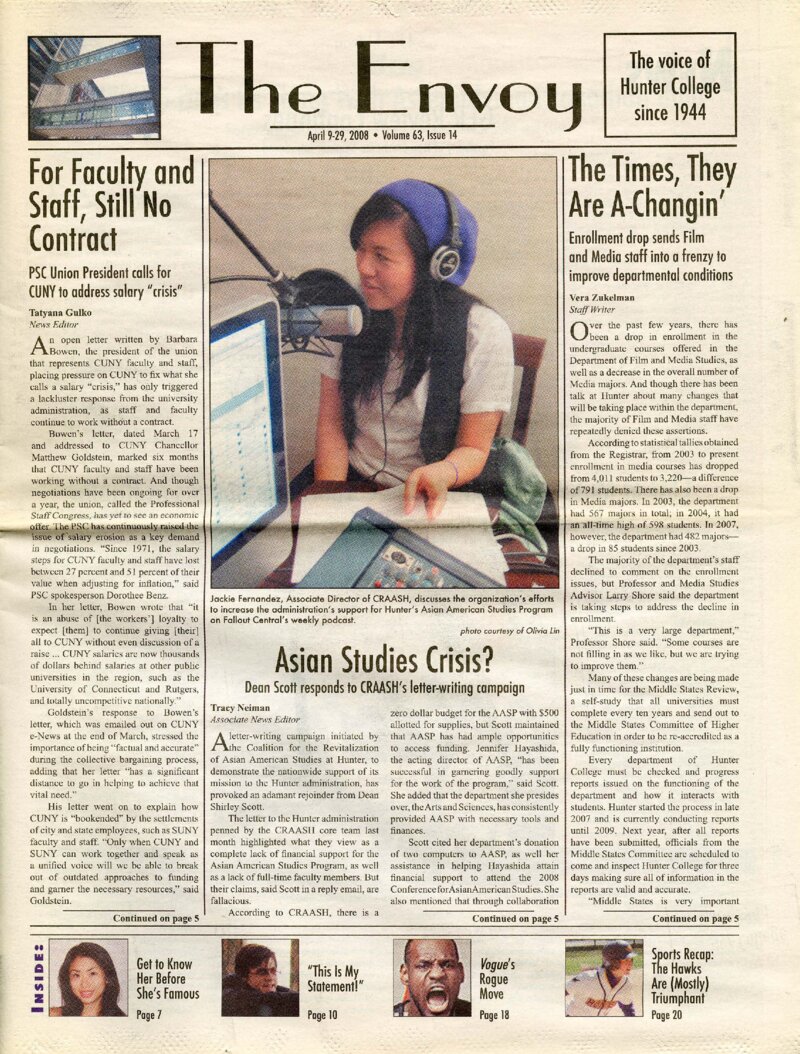
Jackie Fernandez, Associate Director of CRAASH, discusses the organization’s efforts
to increase the administration’s support for Hunter’s Asian American Studies Program
on Fallout Central’s weekly podcast.
photo courtesy of Olivia Lin
Asian Studies Crisis?
Dean Scott responds to CRAASH’s letter-writing campaign
Tracy Neiman
Associate News Editor
letter-writing campaign initiated by.
he Coalition for the Revitalization
of Asian American Studies at Hunter, to
demonstrate the nationwide support of its
mission to the Hunter administration, has
provoked an adamant rejoinder from Dean
Shirley Scott.
The letter to the Hunter administration
penned by the CRAASH core team last
month highlighted what they view as a
complete lack of financial support for the
Asian American Studies Program, as well
as a lack of full-time faculty members. But
their claims, said Scott in a reply email, are
fallacious.
According to CRAASH, there is a
“This Is My
Statement!”
Page 10
zero dollar budget for the AASP with $500
allotted for supplies, but Scott maintained
that AASP has had ample opportunities
to access funding. Jennifer Hayashida,
the acting director of AASP, “has been
successful in garnering goodly support
for the work of the program,” said Scott.
She added that the department she presides
over, the Arts and Sciences, has consistently
provided AASP with necessary tools and
finances.
Scott cited her department’s donation
of two computers to AASP, as well her
assistance in helping Hayashida attain
financial support to attend the 2008
Conference forAsianAmerican Studies. She
also mentioned that through collaboration
Continued on page 5
Vogue's
Rogue
Move
Page 18
The Times, They
Are A-Changin’
Enrollment drop sends Film
and Media staff into a frenzy to
improve departmental conditions
Vera Zukelman
Staff Writer
ver the past few years, there has
been a drop in enrollment in the
undergraduate courses offered in the
Department of Film and Media Studies, as
well as a decrease in the overall number of
Media majors. And though there has been
talk at Hunter about many changes that
will be taking place within the department,
the majority of Film and Media staff have
repeatedly denied these assertions.
According to statistical tallies obtained
from the Registrar, from 2003 to present
enrollment in media courses has dropped
from 4,011 students to 3,220—a difference
of 791 students. There has also been a drop
in Media majors. In 2003, the department
had 567 majors in total; in 2004, it had
san all-time high of 598 students. In 2007,
however, the department had 482 majors—
a drop in 85 students since 2003.
The majority of the department’s staff
declined to comment on the enrollment
issues, but Professor and Media Studies
Advisor Larry Shore said the department
is taking steps to address the decline in
enrollment.
“This is a very large department,”
Professor Shore said. “Some courses are
not filling in as we like, but we are trying
to improve them.”
Many of these changes are being made
just in time for the Middle States Review,
a self-study that all universities must
complete every ten years and send out to
the Middle States Committee of Higher
Education in order to be re-accredited as a
fully functioning institution.
Every department of Hunter
College must be checked and progress
reports issued on the functioning of the
department and how it interacts with
students. Hunter started the process in late
2007 and is currently conducting reports
until 2009. Next year, after all reports
have been submitted, officials from the
Middle States Committee are scheduled to
come and inspect Hunter College for three
days making sure all of information in the
reports are valid and accurate.
“Middle States is very important
Continued on page 5
spar Recap:
The Hawks
Are (Mostly)
Triumphant
Page 20
April 9-29, 2008
PSC cont. from page 1
Goldstein added that while the PSC
believes that an economic offer is needed
to advance negotiations, “with state and
city settlements in place, it is not difficult
to envision the likely economic parameters
within which we will be working.”
But Bowen’s letter did acknowledge
the issue of the tight fiscal climate that
CUNY must work around. In fact, she
said that while she recognizes “CUNY’s
legal requirement to gain approval from
the City and the State, the University’s
financial offer is ultimately a statement of
the University’s priorities. Is restoration of
our salaries a priority or not?” she asked
Goldstein.
But Goldstein said that “it is a mistake
for anyone to pit compensation for faculty
and staff against CUNY’s many needs.”
He also wrote, that while he recognizes
the need for a fair contract, “The need
for a fair contract is not exclusive of
the University’s other needs for modern
facilities on its campuses, a rational
tuition policy, a strong program of science
research, and active communications
and fund-raising campaigns. These and
many other components are necessary
to a vibrant university—and all of them
support the work of our faculty and staff.”
But Bowen maintained that CUNY’s
infrastructure would not survive without
the “best of the next generation of scholars,
teachers and professional staff.”
The PSC was disappointed with
Goldstein’s response. “He has been a very
aggressive champion of certain projects
and priorities,” explained Benz, adding
that “he has to advocate for faculty and
staff needs—particularly competitive
salaries—with the same kind of energy
and commitment.”
Benz also noted that the previous
CUNY contract took over three years to
achieve.
In the mean time, the PSC is seeking
increased funding for CUNY and their
advocacy before the State and City
legislatures.
Just last week, New York City Council
Members attended the annual CUNY Day
legislative breakfast sponsored by the
PSC, which kicked off PSC’s campaign to
restore budget cuts and increase funding
for CUNY, in general.
City Councilwoman Maria del
Carmen Arroyo, who is also co-chair of the
Council’s Black, Latino and Asian Caucus,
which was honored at the breakfast by
the PSC for its support of CUNY as they
continue to fight for CUNY funds in the
City’s Budget, spoke about the importance
of securing CUNY’s affordability. “An
investment in CUNY is an investment in
New York,” she said. The other co-chair
of the Caucus, Robert Jackson, agreed as
he vowed to keep fighting to restore the
$65 million in budget cuts proposed by the
Mayor.
Benz said that it is important that
CUNY, as well as community groups and
political leaders in New York, “understand
just how important restoring our salaries is
to the health of our University. I think the
letter also helped do that.”
Trhcslsiiwes
CRAASH cont. from page 1
with other related departments, AASP has
been able to organize many successful
events relevant to Asian American Studies.
In addition, Scott alluded to the grant
provided to AASP by the Hunter Auxiliary
Enterprise Board as yet another source of
support from the Hunter administration.
But the CRAASH core team insists
that Scott’s examples of support for AASP
are not adequate. “The measly AEB grant
that Acting Director Jennifer Hayashida
applied for and received,” said CRAASH
in an email response, does not reflect
support from the Hunter administration.
Instead, they say, it reflects Hayashida’s
commitment to “strategically [planning]
the growth of AASP for the future” when
her time could be better spent focusing on
the AASP curriculum and students.
The email added, “The AASP would
not have to compete for this scarce amount
of money if the administration allotted the
program its proper funding. It should not
have been granted a zero dollar budget
with 500 dollars allotted for supplies in
the first place. Even student clubs receive
substantially larger funding than the AASP
from Hunter College.”
The CRAASH core team further
asserted that “the Hunter administration
deserves none of the credit” for the previous
and upcoming events hosted by AASP.
“There was no concrete financial and
institutional support for the development of
those events,” they said. AASP’s ability to
have had such a successful year, CRAASH
said, comes solely from “the determination
and resourcefulness of Ms. Hayashida,
AASP faculty members and students.”
CRAASH also used Scott’s argument
that the current AASP office has two
computers given to them by the School
of Arts and Sciences to point out that the
AASP does not have a permanent office
space. They deem the current space “a
miserable excuse for an office ... meant
for four to five staff members,” in which
“professors are forced to meet with
students.”
Because AASP’s lack of permanent
office space was not addressed in
CRAASH’s initial email to the Hunter
administration, Scott did not refute this
point. She did, however, maintain that
the “perception that there are no full-time
faculty involved in the program is simply
wrong.” Scott went on to list dozens
of faculty members, both old and new,
“whose area of specialization is in the field
of Asian American Studies and who teach
in the program.”
Scott added that there are currently
fewer than 20 individuals minoring in
AASP but that those who are have many
opportunities to apply their academic work
to outside experiences. According to Scott,
“Under Ms. Hayashida’s guidance the
minors have been applying for nationally
competitive internships and grants, and
faculty [members] have been sponsoring
the minors for internships in magazines,
arts organizations and community
advocacy groups.”
_ Scott further alluded to the recent
conference AASP hosted about Asian
American Studies in the university
curriculum. AASP hosted a workshop
at the New York City Asian American
Student Conferences, which enabled
AASP students and faculty to network with
“similar groups at NYU, New School and
Columbia,” she said. Scott made additional
mention of the recent partnership between
Hunter and the Asia Society, which will
provide “various academic and cultural
opportunities for students in the Asian
American Studies program.”
“All in all,” Scott asserted to conclude
her email response, “this seems to me
to have been a successful year for Asian
American Studies.”
To that, the CRAASH core group
retorted, “All in all, it has been a successful
year for Asian American Studies at Hunter
College, all because of recent efforts
from students, AASP faculty and Acting
Director Hayashida—NOT because of the
Hunter administration.”
In a brief reply, Scott explained that
the “Asian American Studies program was
set up as an interdisciplinary program,
not as a free standing department,” thus
accounting for its current circumstances.
But CRAASH does not believe the
AASP’s status as a program justifies its
present condition. Chui- Hung Wong, one
of CRAASH’s core members, maintained
that, “Even though it’s a program, it’s not
a well-functioning program.” The state the
program is currently in, she said, whether
it is a free standing department or not, is
unacceptable.
Wong further emphasized that Scott’s
“argument was kind of just circling around
but not really getting to the point, which
was frustrating.” She pointed out that the
professors Scott cited as being involved
with AASP are from other disciplines, like
Mandarin or Politics of India. While they
may teach in the program, their primary
responsibilities are to other departments.
“The whole field of academia,” Wong
stressed, “is about expanding knowledge
and learning more. To say that you are
putting a limit on Asian American Studies,”
she emphasized, is essentially, “limiting
learning” as a whole.
MEDIA cont. from page 1
to us,” said James Roman, Chair of the
Department of Film and Media Studies.
“The faculty has been concerned about
that. After reading the External Review
reports we try to implement their
recommendations.”
Similar to the Middle States, the
External Review is also a study of various
departments within Hunter College by
accredited outside visitors. Their job
is to review the department, address
any problems, and suggest possible
improvements.
According to the External Review
report, the main problems in the department
are the lack ofnew digital media equipment,
“inadequate facilities for screening and
teaching films, no dedicated budget for
maintenance, replacement and upgrade
of equipment software, the need for the
installation of a proper HVAC system
and a need for a 40-75 seat screening
classroom.”
“We now have | million dollars from
City Council,” said Roman. “We will have
a new screening room, renovate the space,
improve the HVAC system and have
upgraded the media labs.” In addition to
the above changes, the department will
also hire six new faculty members and is
currently building a television studio.
Since the reports were released,
the department has begun the process of
implementing changes. However, Roman
said that the changes in the department
should not be attributed to pressure to
look good in front of the Middle States
Committee; rather, he said the department
simply wishes to achieve a positive
response from students in the department.
If the drop in enrollment and Media
majors comes because of the lack of
equipment and inadequate facilities as
stated in the External Review Report, then
hopefully all of the positive changes will
attract more students to the department in
coming years, said Roman.
Deputy Chair and Advisor, Kelly
Anderson, candidly spoke about her
concerns for the department and noted
that tougher standards for entry into the
department may be one explanation for the
decline in enrollment.
“We implemented a rule where
students had to get a B or better in Media
180 to declare a Media Major,” said
Anderson. “It was our plan to reduce the
majors. Maybe that drove away some
students who did not receive the grade.”
Still, said Anderson, ““We don’t know
why [enrollment is declining], but we are
working hard to fix it.”
(Sot something fo say? Write a letter fo The Frvoy.
We'd love fo hear trom you.
Email your thoughts and ideas fo us al envoyeditor@gmail.com
April 9-29, 2008 © Volume 63, Issue 14
Y
The voice of
Hunter College
since 1944
For Faculty and
Staff, Still No
Contract
PSC Union President calls for
CUNY to address salary “crisis”
Tatyana Gulko
News Editor
n open letter written by Barbara
Bowen, the president of the union
that represents CUNY faculty and staff,
placing pressure on CUNY to fix what she
calls a salary “crisis,” has only triggered
a lackluster response from the university
administration, as staff and faculty
continue to work without a contract.
Bowen’s letter, dated March 17
and addressed to CUNY Chancellor
Matthew Goldstein, marked six months
that CUNY faculty and staff have been
working without a contract. And though
negotiations have been ongoing for over
a year, the union, called the Professional
Staff Congress, has yet to see an economic
offer. The. Sha i
in negotiations. “Since 1971, the salary
steps for CUNY faculty and staff have lost
between 27 percent and 51 percent of their
value when adjusting for inflation,” said
PSC spokesperson Dorothee Benz.
In her letter, Bowen wrote that “it
is an abuse of [the workers’] loyalty to
expect [them] to continue giving [their]
all to CUNY without even discussion of a
raise ... CUNY salaries are now thousands
of dollars behind salaries at other public
universities in the region, such as the
University of Connecticut and Rutgers,
and totally uncompetitive nationally.”
Goldstein’s response to Bowen’s
letter, which was emailed out on CUNY
e-News at the end of March, stressed the
importance of being “factual and accurate”
during the collective bargaining process,
adding that her letter “has a significant
distance to go in helping to achieve that
vital need.”
His letter went on to explain how
CUNY is “bookended” by the settlements
of city and state employees, such as SUNY
faculty and staff. “Only when CUNY and
SUNY can work together and speak as
a unified voice will we be able to break
out of outdated approaches to funding
and garner the necessary resources,” said
Goldstein.
Continued on page 5
Get to Know
Her Before
She’s Famous
Page 7
Jackie Fernandez, Associate Director of CRAASH, discusses the organization’s efforts
to increase the administration’s support for Hunter’s Asian American Studies Program
on Fallout Central’s weekly podcast.
photo courtesy of Olivia Lin
Asian Studies Crisis?
Dean Scott responds to CRAASH’s letter-writing campaign
Tracy Neiman
Associate News Editor
letter-writing campaign initiated by.
he Coalition for the Revitalization
of Asian American Studies at Hunter, to
demonstrate the nationwide support of its
mission to the Hunter administration, has
provoked an adamant rejoinder from Dean
Shirley Scott.
The letter to the Hunter administration
penned by the CRAASH core team last
month highlighted what they view as a
complete lack of financial support for the
Asian American Studies Program, as well
as a lack of full-time faculty members. But
their claims, said Scott in a reply email, are
fallacious.
According to CRAASH, there is a
“This Is My
Statement!”
Page 10
zero dollar budget for the AASP with $500
allotted for supplies, but Scott maintained
that AASP has had ample opportunities
to access funding. Jennifer Hayashida,
the acting director of AASP, “has been
successful in garnering goodly support
for the work of the program,” said Scott.
She added that the department she presides
over, the Arts and Sciences, has consistently
provided AASP with necessary tools and
finances.
Scott cited her department’s donation
of two computers to AASP, as well her
assistance in helping Hayashida attain
financial support to attend the 2008
Conference forAsianAmerican Studies. She
also mentioned that through collaboration
Continued on page 5
Vogue's
Rogue
Move
Page 18
The Times, They
Are A-Changin’
Enrollment drop sends Film
and Media staff into a frenzy to
improve departmental conditions
Vera Zukelman
Staff Writer
ver the past few years, there has
been a drop in enrollment in the
undergraduate courses offered in the
Department of Film and Media Studies, as
well as a decrease in the overall number of
Media majors. And though there has been
talk at Hunter about many changes that
will be taking place within the department,
the majority of Film and Media staff have
repeatedly denied these assertions.
According to statistical tallies obtained
from the Registrar, from 2003 to present
enrollment in media courses has dropped
from 4,011 students to 3,220—a difference
of 791 students. There has also been a drop
in Media majors. In 2003, the department
had 567 majors in total; in 2004, it had
san all-time high of 598 students. In 2007,
however, the department had 482 majors—
a drop in 85 students since 2003.
The majority of the department’s staff
declined to comment on the enrollment
issues, but Professor and Media Studies
Advisor Larry Shore said the department
is taking steps to address the decline in
enrollment.
“This is a very large department,”
Professor Shore said. “Some courses are
not filling in as we like, but we are trying
to improve them.”
Many of these changes are being made
just in time for the Middle States Review,
a self-study that all universities must
complete every ten years and send out to
the Middle States Committee of Higher
Education in order to be re-accredited as a
fully functioning institution.
Every department of Hunter
College must be checked and progress
reports issued on the functioning of the
department and how it interacts with
students. Hunter started the process in late
2007 and is currently conducting reports
until 2009. Next year, after all reports
have been submitted, officials from the
Middle States Committee are scheduled to
come and inspect Hunter College for three
days making sure all of information in the
reports are valid and accurate.
“Middle States is very important
Continued on page 5
spar Recap:
The Hawks
Are (Mostly)
Triumphant
Page 20
April 9-29, 2008
PSC cont. from page 1
Goldstein added that while the PSC
believes that an economic offer is needed
to advance negotiations, “with state and
city settlements in place, it is not difficult
to envision the likely economic parameters
within which we will be working.”
But Bowen’s letter did acknowledge
the issue of the tight fiscal climate that
CUNY must work around. In fact, she
said that while she recognizes “CUNY’s
legal requirement to gain approval from
the City and the State, the University’s
financial offer is ultimately a statement of
the University’s priorities. Is restoration of
our salaries a priority or not?” she asked
Goldstein.
But Goldstein said that “it is a mistake
for anyone to pit compensation for faculty
and staff against CUNY’s many needs.”
He also wrote, that while he recognizes
the need for a fair contract, “The need
for a fair contract is not exclusive of
the University’s other needs for modern
facilities on its campuses, a rational
tuition policy, a strong program of science
research, and active communications
and fund-raising campaigns. These and
many other components are necessary
to a vibrant university—and all of them
support the work of our faculty and staff.”
But Bowen maintained that CUNY’s
infrastructure would not survive without
the “best of the next generation of scholars,
teachers and professional staff.”
The PSC was disappointed with
Goldstein’s response. “He has been a very
aggressive champion of certain projects
and priorities,” explained Benz, adding
that “he has to advocate for faculty and
staff needs—particularly competitive
salaries—with the same kind of energy
and commitment.”
Benz also noted that the previous
CUNY contract took over three years to
achieve.
In the mean time, the PSC is seeking
increased funding for CUNY and their
advocacy before the State and City
legislatures.
Just last week, New York City Council
Members attended the annual CUNY Day
legislative breakfast sponsored by the
PSC, which kicked off PSC’s campaign to
restore budget cuts and increase funding
for CUNY, in general.
City Councilwoman Maria del
Carmen Arroyo, who is also co-chair of the
Council’s Black, Latino and Asian Caucus,
which was honored at the breakfast by
the PSC for its support of CUNY as they
continue to fight for CUNY funds in the
City’s Budget, spoke about the importance
of securing CUNY’s affordability. “An
investment in CUNY is an investment in
New York,” she said. The other co-chair
of the Caucus, Robert Jackson, agreed as
he vowed to keep fighting to restore the
$65 million in budget cuts proposed by the
Mayor.
Benz said that it is important that
CUNY, as well as community groups and
political leaders in New York, “understand
just how important restoring our salaries is
to the health of our University. I think the
letter also helped do that.”
Trhcslsiiwes
CRAASH cont. from page 1
with other related departments, AASP has
been able to organize many successful
events relevant to Asian American Studies.
In addition, Scott alluded to the grant
provided to AASP by the Hunter Auxiliary
Enterprise Board as yet another source of
support from the Hunter administration.
But the CRAASH core team insists
that Scott’s examples of support for AASP
are not adequate. “The measly AEB grant
that Acting Director Jennifer Hayashida
applied for and received,” said CRAASH
in an email response, does not reflect
support from the Hunter administration.
Instead, they say, it reflects Hayashida’s
commitment to “strategically [planning]
the growth of AASP for the future” when
her time could be better spent focusing on
the AASP curriculum and students.
The email added, “The AASP would
not have to compete for this scarce amount
of money if the administration allotted the
program its proper funding. It should not
have been granted a zero dollar budget
with 500 dollars allotted for supplies in
the first place. Even student clubs receive
substantially larger funding than the AASP
from Hunter College.”
The CRAASH core team further
asserted that “the Hunter administration
deserves none of the credit” for the previous
and upcoming events hosted by AASP.
“There was no concrete financial and
institutional support for the development of
those events,” they said. AASP’s ability to
have had such a successful year, CRAASH
said, comes solely from “the determination
and resourcefulness of Ms. Hayashida,
AASP faculty members and students.”
CRAASH also used Scott’s argument
that the current AASP office has two
computers given to them by the School
of Arts and Sciences to point out that the
AASP does not have a permanent office
space. They deem the current space “a
miserable excuse for an office ... meant
for four to five staff members,” in which
“professors are forced to meet with
students.”
Because AASP’s lack of permanent
office space was not addressed in
CRAASH’s initial email to the Hunter
administration, Scott did not refute this
point. She did, however, maintain that
the “perception that there are no full-time
faculty involved in the program is simply
wrong.” Scott went on to list dozens
of faculty members, both old and new,
“whose area of specialization is in the field
of Asian American Studies and who teach
in the program.”
Scott added that there are currently
fewer than 20 individuals minoring in
AASP but that those who are have many
opportunities to apply their academic work
to outside experiences. According to Scott,
“Under Ms. Hayashida’s guidance the
minors have been applying for nationally
competitive internships and grants, and
faculty [members] have been sponsoring
the minors for internships in magazines,
arts organizations and community
advocacy groups.”
_ Scott further alluded to the recent
conference AASP hosted about Asian
American Studies in the university
curriculum. AASP hosted a workshop
at the New York City Asian American
Student Conferences, which enabled
AASP students and faculty to network with
“similar groups at NYU, New School and
Columbia,” she said. Scott made additional
mention of the recent partnership between
Hunter and the Asia Society, which will
provide “various academic and cultural
opportunities for students in the Asian
American Studies program.”
“All in all,” Scott asserted to conclude
her email response, “this seems to me
to have been a successful year for Asian
American Studies.”
To that, the CRAASH core group
retorted, “All in all, it has been a successful
year for Asian American Studies at Hunter
College, all because of recent efforts
from students, AASP faculty and Acting
Director Hayashida—NOT because of the
Hunter administration.”
In a brief reply, Scott explained that
the “Asian American Studies program was
set up as an interdisciplinary program,
not as a free standing department,” thus
accounting for its current circumstances.
But CRAASH does not believe the
AASP’s status as a program justifies its
present condition. Chui- Hung Wong, one
of CRAASH’s core members, maintained
that, “Even though it’s a program, it’s not
a well-functioning program.” The state the
program is currently in, she said, whether
it is a free standing department or not, is
unacceptable.
Wong further emphasized that Scott’s
“argument was kind of just circling around
but not really getting to the point, which
was frustrating.” She pointed out that the
professors Scott cited as being involved
with AASP are from other disciplines, like
Mandarin or Politics of India. While they
may teach in the program, their primary
responsibilities are to other departments.
“The whole field of academia,” Wong
stressed, “is about expanding knowledge
and learning more. To say that you are
putting a limit on Asian American Studies,”
she emphasized, is essentially, “limiting
learning” as a whole.
MEDIA cont. from page 1
to us,” said James Roman, Chair of the
Department of Film and Media Studies.
“The faculty has been concerned about
that. After reading the External Review
reports we try to implement their
recommendations.”
Similar to the Middle States, the
External Review is also a study of various
departments within Hunter College by
accredited outside visitors. Their job
is to review the department, address
any problems, and suggest possible
improvements.
According to the External Review
report, the main problems in the department
are the lack ofnew digital media equipment,
“inadequate facilities for screening and
teaching films, no dedicated budget for
maintenance, replacement and upgrade
of equipment software, the need for the
installation of a proper HVAC system
and a need for a 40-75 seat screening
classroom.”
“We now have | million dollars from
City Council,” said Roman. “We will have
a new screening room, renovate the space,
improve the HVAC system and have
upgraded the media labs.” In addition to
the above changes, the department will
also hire six new faculty members and is
currently building a television studio.
Since the reports were released,
the department has begun the process of
implementing changes. However, Roman
said that the changes in the department
should not be attributed to pressure to
look good in front of the Middle States
Committee; rather, he said the department
simply wishes to achieve a positive
response from students in the department.
If the drop in enrollment and Media
majors comes because of the lack of
equipment and inadequate facilities as
stated in the External Review Report, then
hopefully all of the positive changes will
attract more students to the department in
coming years, said Roman.
Deputy Chair and Advisor, Kelly
Anderson, candidly spoke about her
concerns for the department and noted
that tougher standards for entry into the
department may be one explanation for the
decline in enrollment.
“We implemented a rule where
students had to get a B or better in Media
180 to declare a Media Major,” said
Anderson. “It was our plan to reduce the
majors. Maybe that drove away some
students who did not receive the grade.”
Still, said Anderson, ““We don’t know
why [enrollment is declining], but we are
working hard to fix it.”
(Sot something fo say? Write a letter fo The Frvoy.
We'd love fo hear trom you.
Email your thoughts and ideas fo us al envoyeditor@gmail.com
Title
"Asian Studies Crisis?"
Description
This article in the Hunter Envoy from April 2008 covers Dean Shirley Scott's response to claims made by the Coalition for the Revitalization of Asian American Studies at Hunter (CRAASH) about the lack of financial support from the Hunter administration for the Asian American Studies Program (AASP). Scott cited the program's success in order to disprove the claims and further used the AASP's status as an interdisciplinary program, rather than a free-standing department, to justify the administration's lack of investment. CRAASH insisted that the program's success was a result of efforts by AASP students, faculty, and acting director Jennifer Hayashida, and not the Hunter administration, and also refused Scott's use of the program's status as justification for its present condition.
The Hunter College Asian American Studies Program (AASP) was established in 1993. As the only academic program in Asian American studies in the CUNY system, the AASP offers a minor in Asian American Studies and other resources and programming. The AASP supports scholars, artists, and activists advancing scholarship in the fields of Asian American studies and critical ethnic studies and serves as a resource for New York City's Asian American communities. In 2006, the program was at risk of being cut due to a lack of funding. Students formed the Coalition for the Revitalization of Asian American Studies at Hunter (CRAASH) and saved the program within a year. CRAASH is now a student-run club that continues to advocate for the AASP.
The Hunter College Asian American Studies Program (AASP) was established in 1993. As the only academic program in Asian American studies in the CUNY system, the AASP offers a minor in Asian American Studies and other resources and programming. The AASP supports scholars, artists, and activists advancing scholarship in the fields of Asian American studies and critical ethnic studies and serves as a resource for New York City's Asian American communities. In 2006, the program was at risk of being cut due to a lack of funding. Students formed the Coalition for the Revitalization of Asian American Studies at Hunter (CRAASH) and saved the program within a year. CRAASH is now a student-run club that continues to advocate for the AASP.
Creator
Neiman, Tracy
Date
April 9, 2008
Language
English
Publisher
The Envoy
Rights
Copyrighted
Source
Hunter College Asian American Studies Program
Original Format
Newspaper / Magazine / Journal
Neiman, Tracy. Letter. “‘Asian Studies Crisis?’.”, CUNY DIGITAL HISTORY ARCHIVE, accessed September 5, 2026, https://stephenz.tailc22a4b.ts.net/s/cdha/item/1514