Letter to Jane Gould, Barnard Women's College
Item
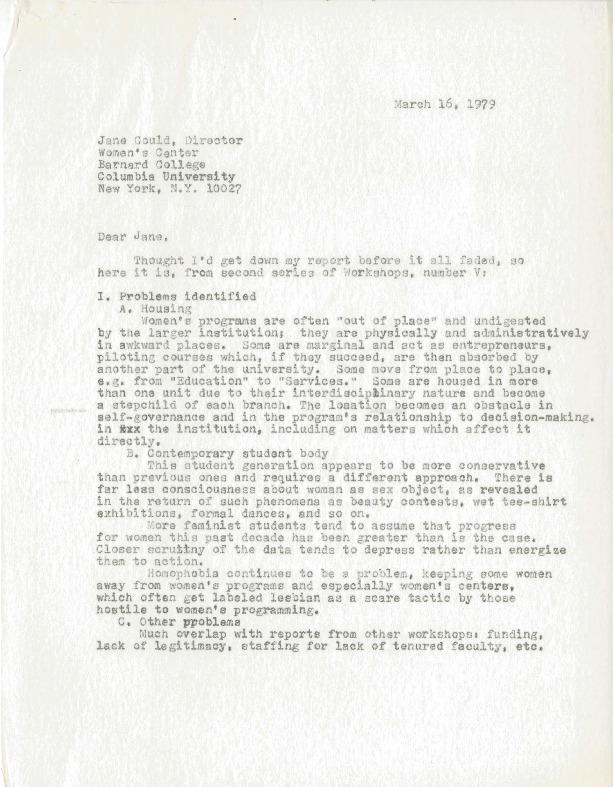
March 16, 1979
Jane Gould, Director
Women's Center
Barnard College
Columbia University
New York, N.Y. 10027
Dear Jane,
Thought I'd get down my report before it all faded, s0
here it is, from second series of Workshops, number V:
I. Problems identified
A. Housing
Women’s programs are often “out of place" and undigested
by the larger institution; they are onbukonkay and administratively
in awkward places. Some are marginal and act as entrepreneurs,
piloting courses which, if they succeed, are then absorbed by
another part of the university. Some move from place to place,
e.g. from "Education" to "Services." Some are housed in more
than one unit due to their interdisciphinary nature and become
a stepchild of each branch. The Seaman becomes an obstacle in
self-governance and in the program's relationship to decision-making.
in #xx the institution, Lnelasine on matters which affect it
directly.
B. Contemporary student body
This student generation appears to be more conservative
than previous ones and requires a different approach. There is
far less consciousness about woman as sex object, as revealed
in the return of such phenomena as beauty contests, wet tee-shirt
exhibitions, formal dances, and so on.
More feminist students tend to assume that progress
for women this past decade has been greater than is the case.
Closer scrutiny of the data tends to depress rather than energize
them to action.
Homophobia continues to be a Lehr pgps keeping some women
away from women's programs and especially women's centers,
which often get labeled lesbian as a scare tactic by those
hostile to women's programming.
Cc. Other problems
Much overlap with reports from other workshops: funding,
lack of legitimacy, staffing for lack of tenured faculty, etc.
II. Strategies
A. Conerete propetede
1. Establish alamnae associations, as
a) support group for graduates of women's programs
to help them cope with their new situations,
b) orientation for current women's studies students
¢) support by alumnae of program
2. In-house publiations for
a) ce relations
b) information exchange
ec) forum foyrrelevant issues
3. Catalogue funding resources, to avoid duplicating
some of the effort of grantspersonship.
4%, Broaden research goals to include low-income and
Third World Women and questions of health and sexuality.
5, Develop an evluation instrument that would assess the
effect of women's programming on students, measuring, @s&.
its impact on their self-image and self-esteem.
B. General suggestions
1. Develop strategies for dealing with admingstrators.
E,g. move in teams of at least two, use "cood-guy/tough/guy" approach,
don't be intimidated, Carrot-and-stick tactics work wells
remind administrators of the benefits they reap fromwomen's
programming and of the penalties they might pay if they don't
cooperate (law suits, protests, loss of valuable programming).
2. THING BIG! move off the defensive onto the offensive again.
Move off survival to beyond survival, to demanding MORE.
We are here at this conference because the institutions have
made some space for us; we got it out of struggle, but they support
it out of gains; they have a good thing cheaply. We have become
unduly srateful, following a traditional woman's image, forgetting
our own worth to the constituency we serve and which administrations
claim they wish to serve. We should remind them that they and we
are aligned in this respect and we should proceed km to enlarge
our arena out of that shared work. ‘This means moving beyond
mere maintenance of our hard-won womanspace to participation
in the policy-making bodies that decide the fate of that womanspace.
We should demand entry to university governance and to public
and private educational policy-making bodies.
(see resolution # 5)
Respectfully submitted,
Renate Bridenthal
P.S. And I had a wonderful time at the conference: Thanks again!
Jane Gould, Director
Women's Center
Barnard College
Columbia University
New York, N.Y. 10027
Dear Jane,
Thought I'd get down my report before it all faded, s0
here it is, from second series of Workshops, number V:
I. Problems identified
A. Housing
Women’s programs are often “out of place" and undigested
by the larger institution; they are onbukonkay and administratively
in awkward places. Some are marginal and act as entrepreneurs,
piloting courses which, if they succeed, are then absorbed by
another part of the university. Some move from place to place,
e.g. from "Education" to "Services." Some are housed in more
than one unit due to their interdisciphinary nature and become
a stepchild of each branch. The Seaman becomes an obstacle in
self-governance and in the program's relationship to decision-making.
in #xx the institution, Lnelasine on matters which affect it
directly.
B. Contemporary student body
This student generation appears to be more conservative
than previous ones and requires a different approach. There is
far less consciousness about woman as sex object, as revealed
in the return of such phenomena as beauty contests, wet tee-shirt
exhibitions, formal dances, and so on.
More feminist students tend to assume that progress
for women this past decade has been greater than is the case.
Closer scrutiny of the data tends to depress rather than energize
them to action.
Homophobia continues to be a Lehr pgps keeping some women
away from women's programs and especially women's centers,
which often get labeled lesbian as a scare tactic by those
hostile to women's programming.
Cc. Other problems
Much overlap with reports from other workshops: funding,
lack of legitimacy, staffing for lack of tenured faculty, etc.
II. Strategies
A. Conerete propetede
1. Establish alamnae associations, as
a) support group for graduates of women's programs
to help them cope with their new situations,
b) orientation for current women's studies students
¢) support by alumnae of program
2. In-house publiations for
a) ce relations
b) information exchange
ec) forum foyrrelevant issues
3. Catalogue funding resources, to avoid duplicating
some of the effort of grantspersonship.
4%, Broaden research goals to include low-income and
Third World Women and questions of health and sexuality.
5, Develop an evluation instrument that would assess the
effect of women's programming on students, measuring, @s&.
its impact on their self-image and self-esteem.
B. General suggestions
1. Develop strategies for dealing with admingstrators.
E,g. move in teams of at least two, use "cood-guy/tough/guy" approach,
don't be intimidated, Carrot-and-stick tactics work wells
remind administrators of the benefits they reap fromwomen's
programming and of the penalties they might pay if they don't
cooperate (law suits, protests, loss of valuable programming).
2. THING BIG! move off the defensive onto the offensive again.
Move off survival to beyond survival, to demanding MORE.
We are here at this conference because the institutions have
made some space for us; we got it out of struggle, but they support
it out of gains; they have a good thing cheaply. We have become
unduly srateful, following a traditional woman's image, forgetting
our own worth to the constituency we serve and which administrations
claim they wish to serve. We should remind them that they and we
are aligned in this respect and we should proceed km to enlarge
our arena out of that shared work. ‘This means moving beyond
mere maintenance of our hard-won womanspace to participation
in the policy-making bodies that decide the fate of that womanspace.
We should demand entry to university governance and to public
and private educational policy-making bodies.
(see resolution # 5)
Respectfully submitted,
Renate Bridenthal
P.S. And I had a wonderful time at the conference: Thanks again!
Title
Letter to Jane Gould, Barnard Women's College
Description
This letter from Brooklyn College Women's Studies Program co-founder Renate Bridenthal to the director of the Women's Center at Barnard College demonstrates the inter-institutional collaboration within academic feminist activism, and the co-development of the field of Women's Studies. Writing after attending a women's studies faculty conference at Barnard, Bridenthal is eager to address issues facing women's centers and women's studies programs in academic institutions around the country. The issues presented here are emblematic of the issues facing the field as a whole, including: departmental homes for women's studies programs, homophobia as a barrier to students's access to resources, a lack of feminist consciousness in the student body, and lack of funding, staffing, and legitimacy for programs. Bridenthal lists ideas for professional support that attendants brainstormed for moving "beyond survival," including alumni associations for women's studies graduates, funding opportunities, broadening research on women of low-income and in developing countries, dealing with administrators, and the development of an outcomes-based evaluation metric for the effects of a women's studies curriculum on the student body,
Creator
Bridenthal, Renate
Date
March 16, 1979
Language
English
Rights
Obtained from Contributor - Copyright Unknown
Source
Brooklyn College Library, Archives and Special Collections
Original Format
Diary / Correspondence
Bridenthal, Renate. Letter. “Letter to Jane Gould, Barnard Women’s College.”, CUNY DIGITAL HISTORY ARCHIVE, accessed September 5, 2026, https://stephenz.tailc22a4b.ts.net/s/cdha/item/872