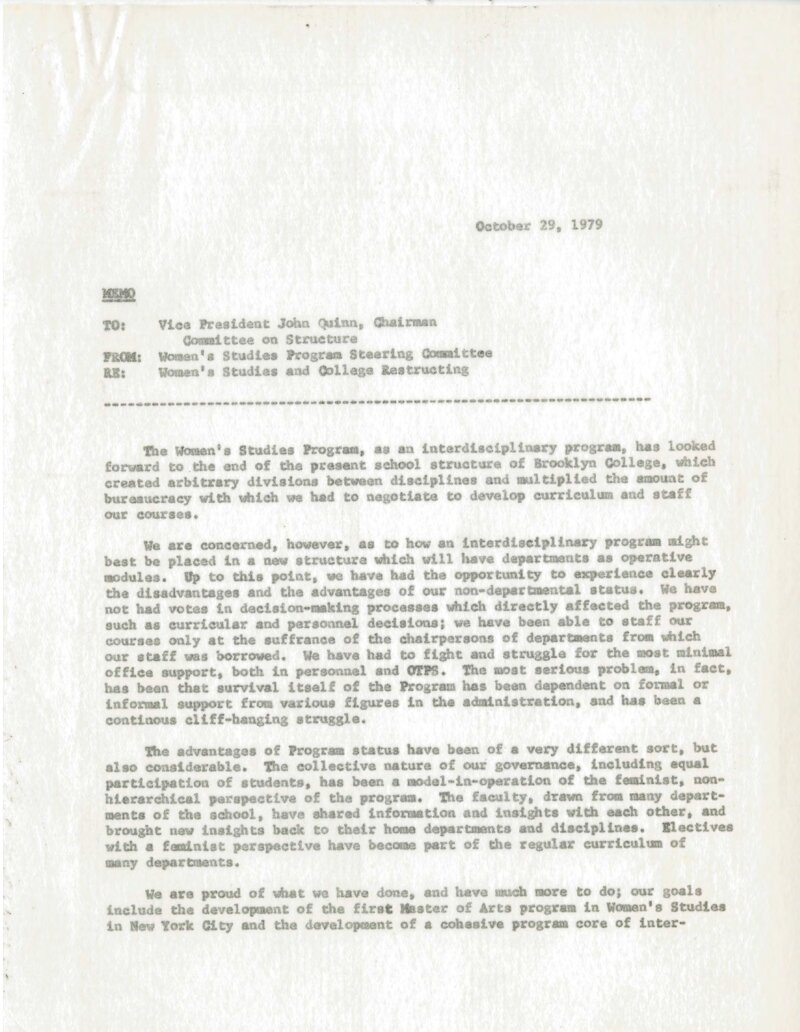
Memo to Brooklyn College Vice President John Quinn
Item
October 29, 1979
TO: Vice President John Qsinn, Chairman
Committee on Structure
FROM: Women's Studies Program Steering Committee
RE: Women's Studies and College Restructing
Oe ee EE OO OE OED TE DF EE SO LO OH OY
The Women's Studies Program, as an interdisciplinary program, has looked
forward to the end of the present school structure of Brooklyn College, which
created arbitrary divisions between disciplines and multiplied the amount of
bureaucracy with which we had to negotiate to develop curriculum and staff
our courses.
We are concerned, however, as to how an interdiseiplinary program might
best be placed in a new structure which will have departments as operative
modules. Up to this point, we have had the opportunity to experience clearly
the disadvantages and the advantages of our non-departmental status. We have
not had votes in decision-making processes which directly affected the program,
such as curricular and personnel decisions; we have been able to staff our
courses only at the suffrance of the chairpersons of departments from which
our staff was borrowed. We have had to fight and struggle for the most minimal
office support, both in personnel and OFPS. The most serious problem, in fact,
has been that survival itself of the Program has been dependent on formal or
informal support from various figures in the administration, and has been a
continous cliff-hanging struggle.
fhe advantages of Program status have been of a very different sort, but
also considerable. The collective nature of our governance, including equal
participation of students, has been a model-in-operation of the feminist, non-
hierarchical perspective of the program. The faculty, drawn from many depart-
ments of the school, have shared information and insights with each other, and
brought new insights back to their home departments and disciplines. Electives
with a feminist perspective have become part of the regular curriculum of
many departments.
We are proud of what we have done, and have much more to do; our goals
include the development of the first Master of Arts program in Women's Studies
in New York City and the development of a cohesive program core of inter-
Vice President John Quinn, Chairman Bee 2
disciplinary electives on the undergraduate level. We realize that the
best insurance of stability, staffing control, and validated participation
in curriculum and personnel decisions would be found through achieving de-
partmental status. We feel firmly dedicated, however, to collective governance,
validated student input, and interdiseiplinary sharing of faculty.
We would like to speak for the development of a new structure which would
be flexible enough to permit the existence of new models in administration as
well as curriculum; we would like to participate in developing 4 model for a
program with depatopénged petegatives, or a collectively administered depart-
ment. This might, for example, include a sharing of lines between departments
and/or staffing the new structure with faculty on rotating leaves from their
“home" departments, or other arrangements which would allow for creative
flexibility.
TO: Vice President John Qsinn, Chairman
Committee on Structure
FROM: Women's Studies Program Steering Committee
RE: Women's Studies and College Restructing
Oe ee EE OO OE OED TE DF EE SO LO OH OY
The Women's Studies Program, as an interdisciplinary program, has looked
forward to the end of the present school structure of Brooklyn College, which
created arbitrary divisions between disciplines and multiplied the amount of
bureaucracy with which we had to negotiate to develop curriculum and staff
our courses.
We are concerned, however, as to how an interdiseiplinary program might
best be placed in a new structure which will have departments as operative
modules. Up to this point, we have had the opportunity to experience clearly
the disadvantages and the advantages of our non-departmental status. We have
not had votes in decision-making processes which directly affected the program,
such as curricular and personnel decisions; we have been able to staff our
courses only at the suffrance of the chairpersons of departments from which
our staff was borrowed. We have had to fight and struggle for the most minimal
office support, both in personnel and OFPS. The most serious problem, in fact,
has been that survival itself of the Program has been dependent on formal or
informal support from various figures in the administration, and has been a
continous cliff-hanging struggle.
fhe advantages of Program status have been of a very different sort, but
also considerable. The collective nature of our governance, including equal
participation of students, has been a model-in-operation of the feminist, non-
hierarchical perspective of the program. The faculty, drawn from many depart-
ments of the school, have shared information and insights with each other, and
brought new insights back to their home departments and disciplines. Electives
with a feminist perspective have become part of the regular curriculum of
many departments.
We are proud of what we have done, and have much more to do; our goals
include the development of the first Master of Arts program in Women's Studies
in New York City and the development of a cohesive program core of inter-
Vice President John Quinn, Chairman Bee 2
disciplinary electives on the undergraduate level. We realize that the
best insurance of stability, staffing control, and validated participation
in curriculum and personnel decisions would be found through achieving de-
partmental status. We feel firmly dedicated, however, to collective governance,
validated student input, and interdiseiplinary sharing of faculty.
We would like to speak for the development of a new structure which would
be flexible enough to permit the existence of new models in administration as
well as curriculum; we would like to participate in developing 4 model for a
program with depatopénged petegatives, or a collectively administered depart-
ment. This might, for example, include a sharing of lines between departments
and/or staffing the new structure with faculty on rotating leaves from their
“home" departments, or other arrangements which would allow for creative
flexibility.
Title
Memo to Brooklyn College Vice President John Quinn
Description
This memo from the Women's Studies Steering Committee to Brooklyn College Vice President John Quinn (also the Committee Chairman on Structure) argues for the restructuring of interdisciplinary programs into a Women's Studies department, with the aim of fostering collective governance, reducing bureaucracy in curriculum development and shared faculty appointments. This resource demonstrates the politics of resource allocation and the staffing difficulties within interdisciplinary programs.
Creator
Women's Studies Program Steering Committee
Date
October 29, 1979
Language
English
Rights
Obtained from Contributor - Copyright Unknown
Source
Brooklyn College Library, Archives and Special Collections
Original Format
Memorandum
Women’s Studies Program Steering Committee. Letter. “Memo to Brooklyn College Vice President John Quinn.”, CUNY DIGITAL HISTORY ARCHIVE, accessed July 8, 2026, https://stephenz.tailc22a4b.ts.net/s/cdha/item/651