Center for Occupational and Environmental Health - Oral History Interview
Item

CUNY
DIGITALHISTORYARCHIVE
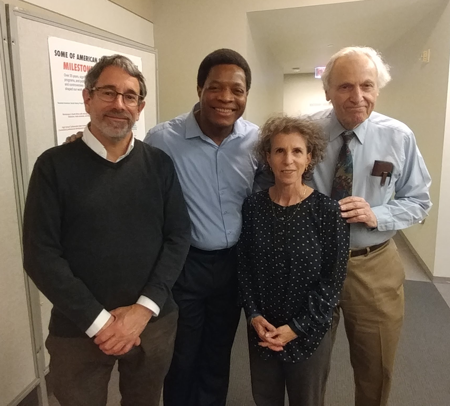
Interview with Andrew Burgie, Dan Kass, Dave Kotelchuck and Amy Manowitz of
Hunter College’s Center for Environmental and Occupational Health
Interviewer: Andrea Vasquez
March 9, 2018
New York, NY
Andrea Vasquez: Good afternoon. Today is March 9", 2018. This is Andrea Vasquez and I’m
here with Peter D’ Antonio on behalf of the CUNY Digital History Archive and
we’ll be interviewing four people on the history of the Center for
Environmental and Occupational Health (COEH) at Hunter College. Before we
get into the meat of the discussion, I wonder if we can go around and each of
you can say a little bit about yourself — when you joined and what your role
was. Dave will lead the discussion.
Dave Kotelchuck: I was director of the academic “Environmental and Occupational Health
Andrew Burgie:
Sciences Program” at Hunter College and served on the faculty from 1982 ‘til
2006. I was a co-founder with Steve Zoloth of the COEH.
My name is Andrew Burgie. I was with the Center from 2002 until it closed in
2017. When I started off I was a project manager for the Hazard Waste
Managerial program, then in 2006 I was the associate director and then 2008 I
became the co-director until I finished out.
Amy Manowitz: I started working at Hunter College a few years before the Center was formed in
Dan Kass:
Andrea:
Dave:
1985 and I stayed until 2000, working on various projects. First as training
director and then as project director for several of our projects.
I was hired by Dave, Steve Zoloth, and David Michaels in 1988 to be the first
staff coordinator and director of the Center and I stayed until 2000.
Dave, do you want to start with a little background and the lead up to the
Center?
Sure. The Center was formally established in 1990 by the Board of Trustees of
CUNY. The Center of Environmental and Occupational Health was established
Andrea:
Dave:
Andrea:
with the mission of promoting community and workplace health. Over the
course of the later decades, it would involve a variety of efforts that paired it
with community groups, labor unions, public employees, students, and others.
A research training and education center, the COEH (The Center of
Environmental and Occupational Health) tackled topics as disparate as work
place ergonomics and hazardous waste training to asthma management and
lead poisoning prevention and in so doing, the Center offered hundreds of
courses, published dozens of reports and engaged first hand with
neighborhoods across New York City. Over the course of its existence the
Center’s footprint really stretched far beyond CUNY and impacted groups in
the city, the state and the Northeast. The way we got formally started was that
Steve Zoloth had a major grant studying asbestos-related diseases among sheet
metal workers in the construction industry. Amy and I worked on ‘Working
Well’, a program [that did] health and safety training for New York State
employees who were members of the union PEF (Public Employees
Federation)
Were you already teaching at Hunter?
Yes, I was teaching at Hunter. That was the first couple of years I was at
Hunter. But it wasn’t until 1987 when we got a grant from the National
Institute for Environmental Health Sciences to do hazardous waste worker
training that we got a five-year grant. We were part of a New York/New Jersey
consortium, and once we got that grant we had, both of us, sufficient money to
be able to say we’re a stable center, to go to the trustees and say we have
enough money to fund ourselves; we have a program that we want to carry out,
and they bought into it and approved us in 1990. During the early years of the
hazardous waste worker training, Chris Proctor was working with me along
with a number of other people. First we did a 24-hour course that all hazardous
waste workers have to have before they ever work on a hazardous waste site or
try and clean up a site. But then after that, annually, the law requires that
people get eight hours of training every year, which by the way, was a
challenge because one of our main clients was the New York State Department
of Environmental Conservation (DEC). They have three or four hundred
inspectors across New York State — at forests, rivers, hazardous waste sites—
and they encounter lots of problems. We needed to give the eight-hour training
by law, but as an academic institution it was our honor that we were never
going to repeat any eight-hour training. There were other programs that would
give one eight-hour curriculum, and they would give it every year for years; we
were not going to do that. So every year we had to come up with some other
project or program. In the early years we would call up the folks in DEC and
then decide on a focus for a particular eight-hour training,
Which folks in DEC?
Dave:
Andrea:
Andrew:
We called up the education directors and the health and safety directors. There
were a group of them whom we would talk with and plan what is our agenda
for this year’s training? Some of the early agenda topics were respiratory
protection, which was most of the day, and we did chemical hazards. For
example, there was a period when we were talking about chlorinated
hydrocarbons, which people encountered whenever you have chlorine, whether
it’s in a paper mill or some other place. We would do physical hazards. For
example, heat and cold stress, radiation, and how to protect yourself—how to
detect that you had radiation coming in, and then how to protect yourself. So
we did that from ‘87 until the middle nineties or really until almost 2000. And
then Andrew Burgie came and joined us, and he started, I would say, a more
sophisticated level of training for our program. Maybe you want to talk about
that, Andrew.
First maybe you could tell us a little bit about how you found yourself there,
before you tell us about what you actually did there. How did you wind up
there?
Well, actually I graduated from Hunter in ‘96 and got my masters in
Environmental and Occupational Health Sciences. And at the time it was part
of the Hazardous Waste Worker Training grant, and I had the NIH fellowship
for that. So it was interesting that I actually got into the hazardous waste aspect
of it thank you to Derrick Hodge—he was the person who told me about the
job initially. So it was one of those things where it was nice to come back to
Hunter being a graduate and able to contribute to the program. And 2000 was a
good time to come. I came, actually, on Valentine’s Day. It was something
where, at the time, it was just nice to learn about the field.
But something pretty spectacular happened, because the year later—that’s
when 9/11 occurred, and that’s when hazardous waste worker training
definitely took off, because weapons of mass destruction were very prominent
at the time. So it was something where they had an additional module—
domestic preparedness training—that they had for a specialized grant. So that
was something we were able to provide to the Department of Environmental
Conservation because it was something they were obviously short on for that.
The nice thing about that relationship is, throughout the time, even with
Hurricane Sandy later on—by law they have to be there during every major
disaster. So as the time came every year, we would actually meet with the
department to see what their upcoming needs would be. We even offered to go
out to various sites over the years.
We would do specialized training, as far as their pesticide workers are doing
specialized work—auto reclamation facilities—if it’s something with soil
vapor gas, things that had to be captured. We actually had a chance to get quite
a bit of an archive with just pictures and documents so we were able to
specialize the training. And ideally they initially started off with three types of
Andrea:
Andrew:
Andrea:
Andrew:
Dan:
Andrew:
Andrea:
Andrew:
Dave:
training. So there were three curricula. Basically, they had spill responders;
they also had solid and hazardous materials workers. They had different
specialized fields. So among the three, they had specialized training. Again, the
thing that was nice about that is that you got to see different aspects of what
they were doing as workers. And again, being more specialized, as a matter of
fact, by the time we left, the Department of Environmental Remediation
actually took on one of our modules: the auto reclamation facility, and they
made that part of their basic training.
What was it called again?
An auto reclamation facility. These are people that would go out to junkyard
sites basically. So, everything from slips, trips and falls, to different types of
gasoline products, and so forth. So for their inspectors, I became part of the
initial training for workers that were starting off at that site.
And what was the Center like when you entered it?
It was very dynamic actually, because there were a lot of different programs
going on, as Dan was talking about before. You had integrated pest
management, you had community health care workers—there was also an
environmental justice component that was being worked on. Jason Corburn
was director for a little while. So it was a combination of...—in addition to
occupational health, you had a lot of environmental health initiatives. Some of
them were even bilingual training. What was her name? Elena?
Elena.
Elena, yes.
So we didn’t have all of that on tape—...when you came in something else was
going on?
We were dynamic in the sense that you had all these trainings being done in
Spanish as well. We had a newsletter in 2000 that encompassed all of that and
talked about all the different offerings of the Center. So there were a lot of
grants being offered; a lot of interns were getting a lot of opportunities, and the
community health care worker program, which Sergio Matos had grown, is
something that started off while I was there. So it was just a great time to see
where environmental and occupational health were going at the same time.
It was also—to me—a pleasure to be able to have great colleagues—Dan,
Amy, Andrew—and to be able to say look, we have this project, you take over
the grant, I’m still administering the academic program and teaching. So we
could give them the ball, and they ran with it.
Andrea:
Dave:
Andrea:
Dan:
Andrea:
Dan:
Dave:
Amy:
Andrea:
Amy:
Andrea:
Amy:
[14:45]
Dave:
Amy:
So you were on staff? You were faculty, correct?
I was a faculty member.
What about the rest of you? You came in as staff?
We were all staff.
You were all full time staff.
Yeah, we were all under the Research Foundation of CUNY, and then some of
us were teaching adjuncts also over the course of time that we were at CUNY.
Maybe this might be a good time for Amy to be talking about some of the work
that you were doing with the Susan Harwood grants and the paper workers.
Okay. Yeah, I guess the first project that I worked on was...
Let’s back up for a second.
Okay.
How did you find yourself at the Center?
I worked at Mount Sinai when I graduated from college. I got a job at the
environmental sciences laboratory where I worked with Irving J. Selikoff, who
is probably the most famous asbestos researcher in the world. So I was lucky I
landed that job. It was just a coincidental thing, someone I went to college
with, her neighbor was Dr. Teirstein who worked with Dr. Selikoff— he was a
pulmonologist — and when we graduated he said, “you should think about
going to work for Dr. Selikoff’s office.” So I went, and I called, and I asked to
volunteer and they said, “Well, we don’t have any volunteer jobs, but we have
a research assistant job.” So I ended up working there, and after being there for
about six years, and, I guess, I had completed my degree in public health, my
master’s in public health. Someone Dave knew, Linda Glickman, told me “Oh
I heard about this job at Hunter College.” And I think I applied for the
administrative director job, but then you had someone else in mind, so I
became training director. That was the New York State Public Employees
Federation job that Dave mentioned before.
Right, the Working Well program. Yes.
And that project was very ambitious. We developed a training manual for the
top-level agency folks. I think there were eight agencies that we trained, people
from labor, transportation, social services, corrections, etc. We did a three-day
Dave:
Amy:
Dave:
Amy:
training in Lake Lucerne, and the main goal was to teach people to be proactive
about health and safety, rather than reactive, because that was really what was
going on. Then later that year we developed a second manual geared more
towards the work-place level, and then we did — this was the unbelievable part
— 33 three-day training sessions between January and June. And we did it
successfully. I mean, we developed a three-day curriculum and that was
something in itself. But, I always joke, and I say I knew after that first year at
Hunter, when we completed all that successfully, that if I can do this I can do
anything. And it definitely did prepare me for a lot of what came after that.
By the way, I remember in the middle of that training, in the middle of those
33 three-day trainings, that one of the top staff people, Jim Jones, who worked
for us, developed colon cancer and had to go to the hospital. So people like
Amy and me and others... he never lost a paycheck, because that’s who you
are — he got sick, and we’re going to support him. But we all took over his job
—all of his administrative functions right in the middle of all that. In fact, it
was Jim Jones, who was the administrative director, who got hired over you
(Amy); I didn’t remember that.
But it all worked out, because being Training Director was actually very
interesting and challenging, and I enjoyed that, and I kept doing that for many
years after that. But after that, we did the asbestos awareness training for the
carpenters and also operating engineers. And we developed a really nice
booklet that is probably going to be in the archives. I guess when Dave said
think of stories to tell—I guess one of my favorite memories of working at the
Hunter College Center for Occupational and Environmental Health was related
to ergonomics training that we did for the New York State paper workers. And
that was made possible through a grant; it was called the New York State
Hazard Abatement Board, which, I guess, was [part of the] New York State
Department of Labor.
That’s right.
Yeah. So we published a booklet on the basics of ergonomics. It was called
“Working without Pain: A Paper Worker’s Guide to Improving Jobs in the
Converting Sector.” Because initially, we were focusing primarily on, not the
paper manufacturing, but the paper converting, which is paper product. You
know, people who made boxes and tissues and paper towels and all that.
We went around the New York metropolitan area, and we took photographs.
And we incorporated those photographs in the booklet, so that really helped the
workers to relate to what we were talking about and to understand that failure
to pay attention to ergonomics in the workplace was a problem for the paper
workers. I think the statistics [for these workers] at the time that we started
this—the OSHA [Occupational Safety and Health Administration] statistics —
were that 60% of all injuries reported were repetitive strain injuries. So it was a
[21:05]
Dave:
Amy:
very timely project. But after we finished the booklet, then we started to do
training across New York State.
I can’t remember how long the training was—I think it was a two-day training.
Basically we taught people to recognize the risk factors for ergonomics, like
repetition, excessive force and stressful postures. And also, we taught them
about prevention because so many of these injuries are preventable—probably
most of them. So we talked about things like redesigning workstations, proper
tool selection, changing management practices such as increasing breaks or
rotating jobs. We emphasized that, sometimes, even simple changes that didn’t
require a lot of money could significantly reduce the stress of work and prevent
ergonomic injuries. We also emphasized that workers know best what the jobs
are, so their input for making changes was really crucial. We made sure the
training was geared towards that.
But the story I love to tell about this project is that after—it happened at a
Georgia Pacific plant—after we did the training... Well, actually, let me
describe the job first. So it was a napkin [factory]; they made napkins there
then they sealed the napkins after they were manufactured, and the packaged
napkins would come down the conveyor-belt at a very rapid pace. Somebody’s
job was to grab the napkins, and the seal was on the side that was away from
the workers. So their job was to grab the package, twist their wrists so they
could see the other side, and then twist their wrist again and put it down on the
conveyor-belt. This was actually done 400 times an hour; so over the course of
a day they were doing this motion thousands of times. After going through the
training, one of our health and safety committee members, whom we trained,
came up with a brilliant idea. He went to a local drug store, bought a mirror for
$1.29, or maybe two dollars or something and he had the idea to place the
mirror on the other side of the conveyor-belt. So all the worker had to do was
look in the mirror at the reflection of the seal, and make sure that the seal was
complete. So the twisting motion was completely eliminated. So the task—the
purpose of the task, which was to check the seal, was also accomplished.
Right, wow!
I always think of that because the fact that this highly repetitive task was
eliminated with such a simple, effective, and inexpensive solution just stuck in
my mind and showed the power of training. Because for less than two dollars,
thanks to this training that was made possible by the New York State
Department of Labor, workers who performed this task were much safer. And
we don’t know the exact number, but I’m sure many injuries were prevented,
because this was a job where people were developing repetitive strain injuries.
After that New York State training that became the basis for the national Train
the Trainer program that we did under the Susan Harwood OSHA training
grant.
Dan:
Amy:
Andrea:
Dan:
Andrea:
Dan:
Andrea:
Amy:
Dan:
Amy:
Dave:
Dan:
Was it with the unions?
Oh, still with the paper workers, [but] now working with the International
union. This wasn’t a state project. This training was all around the country. We
conducted 15 two-day Train the Trainer programs for union and management
over three years, and in the second and third years, we also did four two-day
Train the Trainer programs for union leadership.
How many people were working on this? Were any of you also working on
this?
I think at its peak, the Center probably employed, at any one time, maybe 14 or
15 people at its peak. But it ebbed and flowed with funding sources.
How many different projects would those 14 or 15 people be working on?
It could easily be six or eight.
So on this project how many did you have with you?
There was Dan, Robin Gillespie, and Paula Knudson.
And each of us worked on other things, too.
Right. What was great about that Train the Trainer program is that after going
through this training we prepared a curriculum, we had audio-visuals—it was
over-heads at the time, not PowerPoint—we had a video we made at one of the
sites where people could practice evaluating jobs. After they went through
Train the Trainer, they were supposed to go back to their work places and train
at least twenty people. We actually tracked that and found that because of this
three-year project, where we trained about 600 people in the paper industry,
over 6000 paper workers received the awareness training in 56 plants around
the country. So it was a really great project, and had a huge impact on the
health and safety of the paper workers.
Interesting. Dan, maybe you could talk a little bit about the work you did, both
on a number of particular projects and in general.
There was never any work I uniquely did. There was always a team attached to
any kind of project, and sometimes it was fluid. I came to the Center because I
was finishing grad school at UCLA. I happened to go to a workshop that was
organized by the Labor Center in New York City, which was a pro-union
training and communications non-profit organization. Then a few of the unions
organized a workshop at the Highlander Center in Tennessee to talk about
adapting adult learning techniques to the field of health and safety based on
Andrea:
[27:00]
Dan:
Andrea:
Dave:
Andrea:
Dave:
Paulo Freire’s approach to empowerment and conscientization. That’s where I
met David Michaels and that’s how I ended up coming to New York for the
job.
Maybe that’s one comment that runs through a lot of the stuff you talked about.
One of the things that was really nice about the work at the was that there was
really close political alignment among the staff in terms of really understanding
that health and safety was a technical matter, but it was really, fundamentally
about power. It really had to do with availing workers of their rights, and
where there weren’t rights, to engage them in a process of evaluating what they
can do absent those things, to kind of improve their lot. I think most of the
people who arrived at the Center either entered the field of public health, or
occupational health, or environmental health, from a political analytic
perspective, or were technical, but really wanted to apply their scientific skills
in this way. They could have worked for industry, and they didn’t choose to. I
think one of the threads that runs throughout all these training programs was a
really deep commitment to the idea, not of educating or training in the
traditional sense, but really engaging all the participants in a process of
evaluating their workplaces, thinking about how they can work as a group to
improve things, how to communicate with their employers or their supervisors
about how to problem-solve in the workplace. That was a really nice feature.
Were most of the workers you worked with in unions?
Most were in unions, because the way we were able to secure funding was
through a partner, and the partner was usually a labor union. As we moved into
more community related work or environmental health work, workers were no
longer the population. It was community members or community organizations
that wanted or needed support to do better science or to understand science.
Before we get into what those community groups were, I am curious about the
culture of the Center and how it started. Obviously it was a smaller group of
people and you expanded to a peak of around 14. Aside from the shared
politics and how you landed there, how did you work together in the group?
You know, I was going to say when Dan was talking, the other thing that
seemed to characterize our efforts was a real attempt that the staff tried to work
as a team and we did not respect that somebody had a higher position than
somebody else. Everybody was involved, and we valued everybody’s ideas and
that was an important thing for me and for a lot of us.
So you weren’t in charge of every project or something like that?
I most certainly was not in charge of every project.
All:
Dave:
Andrea:
Dave:
Dan:
All:
Dave:
Amy:
Andrew:
Andrea:
[laughter]
In fact the projects were carried out...
You didn’t have to sign off on things?
No, I signed off on things —
Let’s just be clear, I remember distinctly for years trying to get Dave to even
maintain records of his travel expenses and turn in his travel receipts.
[laughter]
No, it’s true we worked together and there was a certain spirit. But remember
that was the spirit of the early days of the occupational and environmental
health movement in the sixties and seventies when laws opened up that gave
workers rights, that provided money from the federal government to train
workers. In the old days, who got money? Corporations got money to do
something in health and safety, but there wasn’t any emphasis on training
workers or training community people. And Dan I do hope you will talk about
your IPM project for the integrated pest management with the community
groups.
Before we change topics I just want to say that I think—when I was just trying
to conjure up memories; it’s been a while, I left 18 years ago. But I think that
one of the things that stands out in my mind, and it relates to what Dan just
said about our political alignment, was that we could have all worked for
industry and we could have just been churning out training and getting paid a
lot of money for it. But what I liked is that we would get enough funding that
we could really put a lot of thought into the projects. And we spent months
developing a three-hour curriculum or a three-day curriculum or a two-day
curriculum. And we had that luxury, but I think that the quality of the training
that we produced, when I was looking back at some of the manuals in
preparation for today, was really amazing work.
Just to piggy back on that, especially with the hazardous waste worker training,
a fair amount of money came from the DEC as far as we would charge them
for the training we did. And a lot of that money was used toward the Center to
do work for other projects. The thing that was kind of nice about it was that we
were all helping each other with our projects as far as the funding goes. And
we had money to allocate to different things and make them work on a larger
scale.
It doesn’t sound like there was a lot of turn over; people probably wanted to
stay.
10
Dave:
[32:00]
Andrew:
Andrea:
Dan:
If you worked for the Research Foundation of the City University of New
York, there were minimal retirement benefits, minimal health benefits, really
they weren’t like lifetime jobs. It was understood that we have money so let’s
do what we can while we can do it, but I remember at least one staff member,
Elena, who loved the training work that we did and wanted to stay on, but she
said Dave, I’m getting older and I need a pension and I can’t get a pension here
that will take care of me—I’m leaving to work for the City Health Department.
And it was a shame to lose her, but that was a reality that we faced.
Actually, I just have a quick thing to say along those lines, because when you
think about occupational versus not occupational, one of the things that’s
lamented about is that—I’m glad that the occupational lasted as long as it did,
but there were a lot of great programs like asthma that weren’t getting funded
on a larger scale. And the thing was that there was a short sightedness in the
sense that with workers, because they’re generating money for the system, so
to speak, there is a need for workers to have health and safety training. But if
children are asthmatic, they prevent their parents from going to work, and they
didn’t seem to be making that connection as much. A lot of programs should
have been funded a lot more if people looked at the bigger picture. But I think
they were kind of short sighted and just looked at the health-child fact and
didn’t look at the worker impact. I hope that that could change, and it would be
nice to be able to see that, at least from my perspective as far as, is there
another way of approaching these things so that they could be better funded,
and it works for everybody in the grand scheme?
Dan, you were going to tell us about a program.
It must have been around 1996 or so, maybe ’95 that we started working in
some new areas. And I personally wanted to move into some other areas partly
opportunistically, because there was some funding available, and partly
because it was intellectually interesting, and partly because we were a New
York institution and we wanted to do something for New York.
We had worked a little bit with funding from the New York City Health
Department at the time to do some lead poisoning prevention training. The idea
was that there were a bunch of people who were already in homes as social
workers or as people who worked for the Agency of Children Services, and if
they could learn to do a visual inspection for peeling paint we could jumpstart
some activities to basically get people into their homes to make changes in the
conditions. That began a relationship with the Health Department, and then a
couple of us—it was me and Andy Goodman at the Health Department at the
time—I’m blanking on who the third person was—oh, it was based out of
some of the community work we did. We knew that asthma was becoming
epidemic, prevalence rates were rising, hospitalization rates were rising, and no
11
Andrew:
Dan:
Andrea:
Dan:
Dave:
Dan:
one was really sure why, and New York wasn’t alone, but we had better data
then other places.
And we developed a proposal to convince the mayor’s office to fund a big—
Louise Cohen, who was a graduate of CUNY—kicked in a bunch of money to
do a community-oriented asthma program that would essentially address the
absence of knowledge on the part of providers about best clinical practices,
engage communities or identify children with asthma to direct them into
clinical care and networks, and then to shift attitudes. Because back then
asthma was understood as a kind of disease you were fated to have, and you
couldn’t do much about.
We ended up getting the city to agree to fund this. The contract for broad
program evaluation came to our Center, and we started the community health
worker program out of that asthma training money. As part of that, we were
aware that one of the things we were concerned with that was driving the
asthma attack epidemic was the presence of pests in homes. A couple of us got
some EPA funding to do a demonstration project and we organized a coalition
with the Housing Authority, the Health Department and us to do an experiment
to see if safe pest control worked better than the basic practice, which was to
spray some chemicals and leave. We had a couple-year grant to basically do
that kind of work, and it was a great collaboration. The Housing Authority was
fantastic to work with, and we had a great staff that come in over the next
couple of years.
Maria Hernandez was one of the staff members.
And Ted Outwater came in on that program. And that ended up being an on-
going experiment that eventually left the Center and came to the Health
Department. But it went on for years, and in the end a total of six housing
developments—and indeed it was found and published that a simple
intervention for safer pest control had far greater impact on allergens than...
What was the intervention?
It was pretty commonsensical stuff, cleaning up the kitchen, caulk and seal
gaps and holes in walls where pests thrive, fix minimal water leaks, do some
basic education of families and give them some food storage containers that
reduced the availability of food for pests. And there was no spraying.
And the results were really exciting, and I think it’s been adopted much more
broadly around the country at this point.
Yes, it has. I think our goal was what was then a boutique practice. A person
on the Upper East Side could pay one of these firms to come in and do that in
12
Dave:
Dan:
Andrea:
Dave:
Andrea:
Dan:
Dave:
Dan:
Dave:
Andrea:
Dave:
Dan:
Andrea:
Dan:
their kitchen. It was not a service for poor people, who had far worse pest
problems.
And not in a public housing project.
And certainly not in public housing. And now it’s standard practice in public
housing.
Were you working directly with the families and the communities?
Absolutely.
And what was that like when you came it? How many people would visit
families when you implemented the project?
Our role was organizing the whole thing, and we trained housing residents to
get the jobs to be the new exterminators for this program. So there was a nice
community economic development component of it.
Exactly.
Our staff went in and did the evaluations. We set out traps for cockroaches and
mice and went in a week later and collected them and froze them and counted
them and speciated them. It was fun!
And also you met with the people in the building. You would speak to them,
right? They would have meetings and ask what are we about?
So there was an organizing component to it?
Absolutely, and I’m sure you had to convince people that this was something
that was serious and worthwhile and not just another thing the government says
its going to do for us but isn’t going to do it, because there’s a sense of
defeatism in many of the public housing projects.
And I will say the fact that we were from CUNY helped. CUNY is a
community institution. You walk in as CUNY and people think: well, at least
you’re not Harvard.
Did you encounter any resistance or reluctance?
Well, there’s always resistance. At the apartment level, people are inured to
pests and don’t want people coming into their homes. And at the institutional
level at NYHSA it took a lot of convincing to let the Housing Authority to let
us try this out. But they were enlightened enough to give it a shot.
13
Dave:
Andrew:
Andrea:
Dan:
Andrew:
But this, and not just here but in some of the other projects, the notion that we
were training people to begin to take jobs in this field—the kids in the public
housing projects often were not going to go to college, maybe weren’t going to
finish high school or were just finishing, and that we could say, look there are
jobs out there; you can make a living, and a good living, doing this. And in
Dan’s case, he would undertake training of 50, I believe, young people. Or we
went to the carpenters who had a minority-worker training program, and we
helped them recruit minority people and also did training. So we did engage --
trying to get people into the professional fields. And actually Andrew, you did
a fair amount of work in a number of communities.
Yeah, because at the time I was the president of the American Industrial
Hygiene Association, the Metropolitan New York Local Section, and it was a
good time in terms of having an occupational health background. But again,
the importance of public health and seeing the bigger picture—I would say
that’s definitely something I'll be forever grateful for about the Center, because
it took me from the subsection of occupational health and enabled me to see
the larger picture. Even what Dave was talking about, the minority training
program, I started working with them in 2001, I guess, and this was a program
that was about four and a half months where they learned additional life skills.
They had a series of licenses they gave these students, so they were basically
trained to go into the carpenter’s union. But as far things like environmental
sampling and things like that, we would teach those classes.
And all of this was in the same grant?
There was a separate funding stream for this so-called ‘Minority
Environmental Worker Training Program’.
Yeah, in that case I was part of the consortium, Hunter was part of the
consortium, and you also had Rutgers School of Public Health. And then we
had about six others [in the consortium]. But the main thing was we were
charged with doing eight hour and forty hour training courses that dealt with
hazardous waste worker training. But again, here’s a situation where a lot of
kids were either unemployed, underemployed, or in some cases they might
have had some sort of prison situation where if they wanted a second chance,
here are some skills you get—environmental skill sets are very high paying,
and it’s something transferrable.
At the time we had the Brownfields project. So in that case we were going
back to communities and taking a site that might be abandoned and you’re
trying to rebuild it. It might be a bus depot, a gas station, and you’re basically
trying to gut it and reclaim it. But the thing is, in addition to cleaning your own
community you also have a transferrable job skill. So a lot of these students
became very successful and have jobs ‘til this day. And just being part of that
process was very rewarding.
14
Dave:
Dan:
Dave:
Andrew:
Andrea:
Andrew:
Andrea:
Andrew:
Dan:
In addition to that, as far as getting students involved, we paired up with
Medgar Evers [College, CUNY]. We started an initiative in 2001 working with
Medgar Evers students. At the time, Hunter students were getting the forty-
hour training, and in 2001 that was something we introduced to the Medgar
Evers students. To this day they’re still getting forty-hour training, and coming
to our eight-hour refresher classes.
Medgar Evers historically has a largely Afro-Caribbean student population.
That program also had the secondary but real goal of trying to break the color
barrier in the construction trade, whose apprentice programs were really
historically racist. So this was a funding stream that specifically sought to-.
And it served their [union] needs, because most of them had been sued and
some were under Federal supervision in part around this issue.
Oh the Carpenter’s certainly were. As long as we saw that they were willing to
carry out the mandate of the courts sincerely and welcome it and not fight it,
then we were very glad to participate with them. And a lot of people got jobs
and are doing well to this day.
Also a quick thing along those lines, when you talk about public health
initiatives. We worked with the Department of Health and their Asian Fish
population study. So there’s something about the Asian population having high
levels of mercury in their blood, and they’re trying to figure out what was the
reason for that. The great thing about the project, especially being from
Queens, NY, originally, was that we had to go through all the boroughs to all
the major fish markets and basically figure out what kind of fish people were
eating, how are they preparing it, and going to a series of different markets.
Before food was as big a deal as it is now.
Exactly, it was in 2007. It was great, because it was just going to the
supermarkets, looking at these unique types of fish, sending them out to a lab
for analysis out in Albany, and just figuring out what the components are.Are
people eating the whole fish, a certain type of fish, where is the source of the
fish?.
What did you find?
They didn’t find anything conclusive, per se. It’s something they had to build
in the study.
We did find that—and I was at the Health Department at the time, so one nice
thing at being at the Department was that we kept leaning on the Center for
work. The typical advisories for fish avoidance, especially for pregnant
15
Dave:
Andrea:
Dan:
[47:36]
Amy:
Dave:
Andrew:
women, were based largely on national market surveys. So they focused on
tuna, and tilefish, and swordfish. And it turns out that the Chinese communities
in New York City don’t eat that stuff. We learned essentially that the mercury
accumulation that was much higher in foreign-born Asian New Yorkers was
really because of the volume of fish rather than the particular type of fish. They
ate much more fish that was moderate in mercury, as opposed to a little bit
more of fish that was very high in mercury. And that’s a very important finding
from a health communications standpoint.
You know it may be time to talk about some of the community health-worker
things?
Sure, but can I ask you one more question about how the grants worked? When
they were winding down, and you were finishing a project would you
collectively evaluate the work that you did? You probably had to report back to
the granter, but how did projects end? Did you bother, or did you just move on
to the next thing?
I think most of our evaluation, to be candid, was more process evaluation as
opposed to impact evaluation. We didn’t have the luxury or the connection to a
work force to necessarily find whether injury rates were reduced. We evaluated
whether we did what we said we were going to do, and we collected stories and
narratives about the meaning it had for people.
I guess with the Susan Harwood Training Grant, at least according to the report
that you dug up, we did do some follow-up to see if some changes had been
made. And we had stories that were gathered about specific changes that were
made. But I think in general we had pre and post-tests and asked ourselves:
‘did we meet our numbers’; it was more goal-oriented. We said we were going
to train x-number of people, how many did we train? But we also did
satisfaction [testing], because we always distributed evaluation forms at the
end of the training, and that’s specifically on training, not other types of
projects. But x-number said they found the training useful or very useful. So it
wasn’t, like Dan said, more goal-oriented where you were able to say we
reduced injuries in that particular work place or industry.
I think in the employment area, though, it’s clear that we did have a longer-
term effect, because people learned skills that they are presumably working in
the fields today in good jobs, many of them in construction union jobs.
I would say with the hazardous waste worker training we do have a
supervisor’s class and a lot of time we would get their injury and illness report
as part of the training. So we could sort of see where you had certain situations
you had to address, so it’s sort of getting the supervisors aware of the fact that
16
Andrea:
Dave:
Andrea:
Dave:
Andrea:
Dave:
these are the conditions in your particular work place and how could you better
address them. And then also just advocating on the part of just having some
sort of health and safety committee that could sort of address these issues. So
just pushing it from that angle so far as here’s some things that are problematic,
especially when you’re doing more work with them in the field, how could this
be better done. Here are some of the things that happened during the course of
a year, what were some of the lessons learned and try to make those as
presentations so people can kind of learn from that on a larger scale.
Dave, I also wanted to ask you about your involvement with Hunter College
and what your relationship was like with faculty and presidents? And I’m also
curious about your relationship with Hunter students.
With the students, I was heading the academic program for most of that period,
and we sent our students to do internships in occupational and environmental
health, that’s what they were studying.
And was it a public health program? Were they master students?
We had a masters level program in environmental and occupational health
sciences. We had some specialty in industrial hygiene, but our students had to
do field work, and they would do fieldwork with the Center, many of them
would. The relationship to Hunter, I would say, was more complex, because
certainly as a faculty member involved with this, working with the Center other
than bringing money in on grants that was noted and we did bring in a fair
amount of money. I think it was five million dollars over the years, and Hunter
got a share of that of course.
And you were not at the main campus?
We were down at Brookdale, that’s right. But among my academic colleagues,
doing work with the community was—oh, very nice Dave, very nice that
you're doing it, but don’t think that’s going to get you a promotion, because it
isn’t. And I understood that, that unless I turned out a sufficient quantity and
quality of research, I wasn’t going to be promoted from assistant to associate
professor and I retired as an associate [professor]. I always understood that the
administration and many of my colleagues on the faculty did not value
communication as part of what a scientist did. On the other hand, the very
definition of public health is that it combines science with communication. If
you don’t communicate its not public health, and I understood this, people we
worked with like Irving Selikoff [understood this.] He was a great researcher,
but he spent time talking to people and talking to workers about their health.
So, we were in some senses under the radar. I always answered to my Dean
and told people in the department what we were doing, but the quality of it was
that it was nice, not imperative. Whereas, as a public health person, to me
17
Dan:
Dave:
Andrea:
Dan:
Andrew:
Dan:
communication in public health is an imperative of the field. I value it, I
always did. We were there, but I never felt secure that if our funding dried,
that’s it. I didn’t feel that our university would step in and say this is just a
great program we’ll try to help you a little bit. It was more like, okay, you’re
doing it. There were colleagues in our School of Health Sciences that were
very supportive of what we were doing. I mentioned Steve Zoloth and many
others. Broadly, at Hunter College, to those who decided on promotions, it was
nice, but didn’t really count.
We were lucky in a sense, too, because we wrote our Center proposal right
around the same time that Nick Freudenberg was writing his Center proposal
for the Center on AIDs, Drugs, and Community Health. That was a much more
forward-facing issue for the public. Hunter wanted to be known as a university
that was doing something about AIDs, this was the late eighties and early
nineties, so as long as his Center was given space and allowed to happen, then
why not ours?
Yeah.
So it helped you?
Yes, it definitely helped us.
I think it’s interesting what Dave is saying, because I felt the same things
happening. But another way of looking at public health is it’s a way of looking
at these initiatives in a different way. Because one of the things we did earlier
was working with Hunter College High School. They had this unique project
where they were trying to get the students who didn’t pass the chemistry
regents to retake it. They worked with our Center as far as how you quantify
different things in chemistry. So we did an indoor air quality assessment and
we did a lead-based paint assessment. So they actually took paint chips and
sent them off to a lab, and the premise of it was that science is not something
happening in the corner somewhere, this is how it’s being integrated, so
something in conjunction with doing these sorts of hands on exercises. And
they would get different types of tutorials. And the program went well, and I
think they all passed the chemistry regents. But that has got to be a unique way
of getting the school involved in some other projects.
And the other one along the same lines was when we worked with the asthma-
free school zone [project]. They were trying to assess different types of
pollution impact and black carbon impact and they had different types of
instrumentation we helped them with so far as setting up different types of sites
to be studied.
The person who started that was a Hunter grad.
18
Andrew:
Andrea:
[56:57]
Dave:
Andrea:
Dan:
Dave:
Dan:
Dave:
As far as community, there was Hurricane Preparedness Awareness. The
Council for Bajan [Barbados] Organizations in New York approached me to do
a three-hour presentation on hurricane preparedness. It’s a council that has
about six or seven organizations that are Barbadian in background, and they do
different types of health education. So they wanted us to do a module on
hurricane preparedness.
Someone mentioned you had a newsletter. And I guess that went to people who
knew you, who you somehow crossed paths with. Were you also interviewed
by the press for different things or called upon in other public ways as a
resource?
On particular projects, certainly the integrated pest management. But most of
them I would say not. Working to help workers and community people
understand things, what were they going to interview? Whereas with the
integrated pest management, there was, were we able to cut down on pest
infestation and cut down the asthma rate? But generally no, working among
the community isn’t normally, to me, news.
Well I think in CUNY people knew about your Center. It was a big deal.
Yes but we didn’t have a communications arm for external work. Although we
were in a lot of community meetings with elected officials, and we spoke on
behalf of other organizations in the public forum. But I don’t think we had a
major media presence.
Yeah, I don’t think so. I did not feel the support from on high and from my
colleagues, other than in the School of Health Sciences itself, to feel that this is
something we have to promote.
My recollection is that there were so few funding streams for occupational and
environmental health at the time. And there was competition for it, including a
lot of friends and organizations around the city, and there was a movement
organization, NYCOSH, in New York City, that was much more oriented
toward publicity for their work around worker protection. I think we were
pretty sheepish about it. We didn’t want to step on toes; we weren’t sort of
forceful advocates and activists out there for our work. We sort of leaned more
on the science more than we did the-.
I think that’s true. But NYCOSH depends upon the community for its funding.
They had no real funding streams. We had funding streams through science
and public health. They were small, but we found them and we worked with
them. To my mind what was important was not the publicity but actually
training people and helping people, workers, community people. And as long
as we were doing that we were doing good work. We didn’t need outside
19
Andrea:
Dave:
Dan:
Dave:
validation. Amy never got an award for great public health work, nor did any
of us. But we did it. Because it was important to do and it was of value.
This discussion and this work and the archive is valuable to us in terms of
preserving [information about] the program. When Andrew and Jack
Caravanos, who were the last two directors of the program, left Hunter and are
now at New York University, the program ended.
I wouldn’t mind talking a few moments about the community health workers
because that’s a project that is living today as a result of the work that we did
in the Center. Sergio Matos and Elena Schwolsky-Fitch were members of our
staff, and they were very interested in trying to develop, work with, and
support community health workers. Now, community health workers, in China
they call them barefoot doctors, in this country they are people who lived in the
community who played an important role in communicating health issues and
talking to people about lead poisoning in local organizations, quite local
organizations. And they felt that this was a very important group of people;
they are the closest connection between the health system and people in the
community.
When did that program start?
They started around the late 1990’s.
1998 probably.
Until 2000 or something like that. They formed a Community Health Worker
Network of New York City. Their purpose was to support the community
health workers and also to gain professional recognition for them as a specific
kind of community worker who played a key role because they were in touch
directly with people in the community. Sergio was ill today and couldn’t join
us, but he did leave me a message:
“Since leaving Hunter, the Community Healthcare Network of New York City
has grown and matured into a professional organization of health workers with
approximately four thousand members, today in 2018. Our mission is to
advance the community health work practice while preserving the integrity of
the professional work. Our mission is in three areas of concentration: education
and training, advocacy, and research.
One of the things, for example, they’ve been able to do nationally has been that
in advocacy, “we have led a policy initiative to secure a unique standard
occupational classification for community health workers with the U.S.
Department of Labor.” It wasn’t even a recognized profession. If I’m a
physicist, or if I’m an academic, there’s a job title at the U.S. Department of
Labor when it does census work. Well they managed to get recognition that
20
Andrea:
Dan:
this was a specific class of worker that’s different than other workers, and that
was a very important thing. And he [Sergio] said that “we hope to create a
national community health worker professional association to be launched late
this summer.”
There are other things they’ve done in New York City. ““We’ve trained many
of the community health workers deployed in the delivery system reform
incentive program, DYSRIP, preferred provider systems, and we’re named by
SEIU local 1100 as the preferred trainer for community health workers
deployed in asthma programs through One City Health.”
What we [the Center] provided wasn’t occupational or environmental, it was
public health, but we recognized this as a need, and we’re public health people;
we never lost sight of this. Instead of looking at the profession, environmental
and occupational health narrowly, we talked about no, we ’re a public health
function, and we are a specific group within it. When they came to us they
didn’t have a home and only a little bit of money, and we said come, we have
an office, you'll get some work done. They wrote grants; they were able to keep
functioning for a few years and we provide a home and even after they lost
their money, our 7" floor center. They had a home and a place to meet. So it
was a very nice thing.
I think for myself there is one last thing I would like to mention, one last
person. One of our staff people, Dawn Mays-Hardy, died a few years ago.
Dawn Mays-Hardy was a minister and also a public health person, and she had
what she called a public health ministry. When she was a staff member with us,
she did trainings in lead poisoning identification; she did work with awareness
about environmental causes of cancer. And I remember vividly her working
with a group of Jewish Orthodox women talking about breast cancer and also
how you identify breast cancer. I remember sitting with her, and they [the
women] had particular views about the human body and what you could not
show, if you were going to do some work around breast cancer. It helps to have
drawings and things, but we couldn’t offend their religious beliefs and we
worked to think about sketches that would be appropriate: can we put a nipple
in; can we not put a nipple in? But it was an important group to train; there are
thousands of women and they, like other women, have breast cancer and they
were not a community that had been reached out to. Dan remembers more
about it than I do, but I certainly remember Dawn as doing that. She was really
a lovely person.
Did you want to say more about that program?
Dawn was a unique talent by virtue of her faith, which wasn’t how she did her
work, but it was why she did her work. She had immense patience for the time
it takes to bring a reluctant group along much more than I did. In fact, when we
first started that program, I think I was the one who negotiated with the
21
Andrea:
Dave:
Andrea:
Dan:
Dave:
Amy:
Dave:
Rabbinical Council of the United Jewish Organization in Williamsburg for
access to community members to talk about the program and the issue. They
were careful and reluctant, but they opened the door. And I think the first
training she and I did together was about environmental cancer. So I think I
used this analogy when someone asked why some chemicals cause cancer
more than others; I said the body evolved over millions of years when exposed
to certain chemicals, but novel chemicals, we have not developed
evolutionarily to novel chemicals. And the face of the crowd was ashen. And I
basically got told: you can’t come back. And Dawn figured out another way to
describe it. [laughter]
Were you all over New York City? What communities did you hit?
We were all over New York. Partially, and this has come up before, the fact
that we were part of the City University of New York meant that we are a
community institution and there was a degree of trust in many neighborhoods
and communities, that they wanted to work with us. And there were city
agencies that said, okay it’s the City University, it’s another agency of the city
so this is good. So they were open to working with us, and the community was
open to working with us, and they were open to working with us because
CUNY has a reputation of being part of the community. And people had good
feelings about us and were, therefore, willing to talk with us as opposed to, as
we were laughing before, a group of folks coming in from Harvard or coming
in from another city. We are part of the city.
It sounds like they felt you were coming in to give something not to get
something.
Yeah, we never suffered from the kind of peril that a lot of academics did,
especially back then, where the idea was that you gather a lot of information
you effectively benefit from it. That was never something we did. But we
weren’t just in New York City; we were all over New York State and the
country with some of these programs.
Well, Amy’s program was national.
Yeah, we trained carpenter apprenticeship coordinators, and we did that all
around the country as well. We went to Stevens Point, Wisconsin; Atlantic
City, New Jersey; Columbus, Ohio; Indianapolis, Indiana; Las Vegas, Little
Rock, Destin, Florida; Springfield, Massachusetts; Mobile, Alabama and
Richmond, Virginia. So we were all over.
But communities in New York City, the Lehman Houses were in upper
Manhattan.
22
Dan:
Dave:
[1:12:32]
Andrea:
Andrew:
The Housing Authority was in the South Bronx, East Harlem, and Bushwick,
Brooklyn.
Yeah, and we worked with Greenpoint and Williamsburg in studies. We did
studies of different communities and we also had people who used to do ‘toxic
tours,’ going around and taking a bus to go into a certain area and talk about
what the problems were. I don’t think the folks here did that, but we certainly
did do it as a group.
So as the Center has been winding down, how do you find closure in a Center
like this? And Id like to hear from everybody about what you think the legacy
of your work has been. And now at CUNY we have a School of Public Health,
and I’m sure you planted the seeds for that.
From my perspective, the key thing for me is outreach. That was and always
will be the future of a lot of things, and especially in today’s climate. As much
as I love science, it’s not about science anymore; it’s really about better story
telling. And if you can get a scientific background with a good story, then
that’s how a lot of things can happen. So even when you were talking about the
evolution of the Center where there were a lot of good stories that came out of
what we did how do we compile that, and the powers that be sort of say this is
nice idea or concept, how can we build upon this? We want more people to be
involved in public health. How do we reach out? And one of the things I’m
grateful to Dave for is that he allowed me to go to different schools. We did a
lot of high school outreach, just getting students interested in industrial
hygiene. What does that entail, what is that field like? Because a lot of people,
probably most people, don’t know what industrial hygiene is if they’re outside
of the field and a lot of them fall into it. So how do you learn about this field if
you don’t have any type of exposure [to it]?
So as far as closure, it’s not really closure, but it’s more like opportunity in the
sense that you have the science, now how do you get the passion? Say I had the
background in the occupational side, you’re looking at the bigger picture,
public health, what are we all trying to do? We’re trying to work together and
function as a community. How do you inspire people to do that? What does
that look like? How do you reach out to people now and get them involved in
programs? Public health is an opportunity. If you’re part of a community, how
does a community learn more about what you do? Oh this is what you do:
you’re doing things in outreach with domestic preparedness, you’re dealing
with things that are chemical exposures, biological exposures, and as I was
saying before, it’s not science that happens in a corner somewhere; it’s all
around us every time you read the newspaper it’s environmental and
occupational health. How do you get people to see it that way? So for me, it’s
an opportunity so far as how to improve, in the story telling, in the message,
that public health is something that’s integral and must be had no matter what.
23
Amy:
Dan:
I forget which project it was, although I think it might have been the paper
workers, because I remember being upstate New York and we included in the
training a statistic that the number of people who died from occupational
illness... Injury is easy to identify, but there’s a much bigger impact when you
include illnesses. Even in the most conservative estimate, it would be the
equivalent of a jumbo jet going down every single day. I remember that really
sticking in my mind because I would say to myself why aren’t more people
interested and involved in occupational health? It’s such an important issue,
and it’s such a terrible tragedy, what goes on in the work place. We’re
fortunate; we get to go to work and come home unharmed everyday, but for
people who work in factories and construction, they don’t have that luxury. But
they want to make money the way we all do. It’s so unfair that there’s a
situation where the people who have control over their environment don’t care
about that. So I think in the work that we did at the Center hopefully we did
inspire people to be interested in that.
And that sort of relates to when Dan was first talking about his coming to the
Center. I think that Dan sort of helped to instill in everybody who he
supervised was the concept of not just training people, not talking at them, but
giving them the skills that they need so that our training has a long lasting
impact on the work place. Because if you go in and out and you just talk at
people they’re not going to be able to make any changes, and it won’t sink in
as well. So we used small group exercise and the exercises were designed to
really give people the skills they needed to hopefully make a change. It’s not
easy, but that’s hopefully a legacy from the Center: that all the people we
trained then trained someone else, so hopefully we hade a big impact in that
way.
To your question of how I feel about the Center ending: at some level it’s kind
of sad that an institution we’ve all been a part of is no longer officially here,
but twenty-eight to thirty years is a pretty decent life span for any university-
based program. First of all, one of the legacies is that the notion of a center is
within a university is a really important one. The idea of moving beyond any
individual academic’s personal interest and research interest; but creating an
opportunity where more than one, and staff as well, can come together and take
advantage of economies of scale, developing a real infrastructure for
employment, for internal promotion, and nowadays a data infrastructure on
architecture is a really important thing. And every university has embraced this
kind of model. And, in fact, a lot of funding in public health and NIH funding
depends on a center, rather then going to individual or small groups of
academics. So I think we were early—it was early as an idea—we matured to a
certain extent, but I think it’s a really important thing. And I would hope that
CUNY is going to keep embracing it.
24
Amy:
Dave:
A lot of the centers nowadays are focused more on being constellations of
research projects as opposed to service projects. So that’s something unique
about this. So I hope that the notion of service continues in the School of
Public Health. And I suspect it does in different forms.
I look back on it and I think about all the great careers we launched. Maybe at
the peak we had fourteen people, but all in total we probably employed forty or
so people while I was there or more maybe. And almost everybody is in public
health or doing something similar that’s kind of important. And most of the
people came to us right out of grad school, so it was an early training ground
for learning how to work and function as a group and work in teams. And
every day in my own work I think about how foundational the years in the
Center were.
And I just had a thought—something else that I think about with the Center is
the importance of reaching out to the community and educating them—
including the workplace. Because something that also always sticks out in my
mind is the fact that when people go through medical school the average time
spent in occupational health—probably in environmental health as well—is,
like, an hour, or something like that.
I was talking to my son yesterday; he was describing a patient that came in
who had pain in their wrist. And my son said maybe they had arthritis, or
maybe... —I forget what else. But he said he asked what kind of job they did
and—living with me his whole life—it turned out the person had a repetitive
job, and the person worked in a very cold environment; I think they were in
something related to food processing. So that’s great that he was thinking to
ask about it, but most doctors won’t. It really is incumbent upon people in the
community and the workplace to educate even the medical community. So
that’s another way that we probably had a good effect.
I consider myself lucky to have grown up in the sixties, seventies, and eighties.
At a personal level, my parents were leftists, and we were harassed and life
was very difficult during the Joe McCarthy period. But I felt, as I grew up, like
I had a chance to enter a field that was redeveloping because there was a long
hiatus between the great work that was done in worker health and safety in
New York City in the 1920’s. Then there were occupational health hospitals in
New York City and upper Manhattan, and they kind of petered out, but then it
came back to life in health and safety. It is and was a very exciting period; we
discovered many things because research hadn’t been done for a while. So
there was, if you will, a lot of low lying fruit; and we could find out if such and
such a chemical caused cancer, and then talk to workers about it, and tell them
what are the symptoms that you might look for, and if they see them to go to a
doctor or a health facility.
25
Andrea:
Dave:
Andrea:
Dave:
Andrea:
Andrew:
Dave:
Dan:
[1:26:25]
I feel personally blessed to have grown up in this period. On the other hand,
what had to be done was that there had to be longer-term programs—the
asthma programs that Andrew was talking about—somehow the federal and
state governments had to put money into helping prevent asthma. Informing
not just New York City folks, but the population of our country, and looking at
the causes and dealing with them, and that has not happened.
We opened up the possibility that politically never reached fruition. And, in
fact, we’re going backwards now, in my opinion, in terms of health and safety,
environmental or occupational. Minimally, I think the Center shined a light on
problems and showed how a certain kind of work could be done and could be
done effectively. And I would hope that the light would shine until the world of
affairs changes, and the federal government finally does public health as a
mandatory program for this country. So that’s the legacy we opened, we turned
a light on, and I hope it will be viewed by people when things change in this
country because I hope and trust they will.
Anything we didn’t think of asking you that you want to throw in these last few
minutes? This has been an incredible interview, I think it’s really amazing, and
I knew there were many projects; I never imagined there were this many and
that you reached this many people in so many different ways. So I thank you
very much for sharing this history and stories. I feel like we’ve gotten a great
lesson here that others will have. So thanks very much.
And thank you, because I think that the digital archive will allow folks to
continue to view what has happened. So many things in the world of affairs
disappear; you start reading about what happened in the United States twenty
years ago and say oh yeah, I forgot all about that; I lived through it, but I
forgot about it.
You mention 9/11,
That’s right.
It’s been a while, right?
A lot of students don’t even remember that.
I think this helps preserve a history that hasn’t always been written down, and
that people in the future can build upon. And maybe do better.
Thank you, it was really fun.
26
DIGITALHISTORYARCHIVE
Interview with Andrew Burgie, Dan Kass, Dave Kotelchuck and Amy Manowitz of
Hunter College’s Center for Environmental and Occupational Health
Interviewer: Andrea Vasquez
March 9, 2018
New York, NY
Andrea Vasquez: Good afternoon. Today is March 9", 2018. This is Andrea Vasquez and I’m
here with Peter D’ Antonio on behalf of the CUNY Digital History Archive and
we’ll be interviewing four people on the history of the Center for
Environmental and Occupational Health (COEH) at Hunter College. Before we
get into the meat of the discussion, I wonder if we can go around and each of
you can say a little bit about yourself — when you joined and what your role
was. Dave will lead the discussion.
Dave Kotelchuck: I was director of the academic “Environmental and Occupational Health
Andrew Burgie:
Sciences Program” at Hunter College and served on the faculty from 1982 ‘til
2006. I was a co-founder with Steve Zoloth of the COEH.
My name is Andrew Burgie. I was with the Center from 2002 until it closed in
2017. When I started off I was a project manager for the Hazard Waste
Managerial program, then in 2006 I was the associate director and then 2008 I
became the co-director until I finished out.
Amy Manowitz: I started working at Hunter College a few years before the Center was formed in
Dan Kass:
Andrea:
Dave:
1985 and I stayed until 2000, working on various projects. First as training
director and then as project director for several of our projects.
I was hired by Dave, Steve Zoloth, and David Michaels in 1988 to be the first
staff coordinator and director of the Center and I stayed until 2000.
Dave, do you want to start with a little background and the lead up to the
Center?
Sure. The Center was formally established in 1990 by the Board of Trustees of
CUNY. The Center of Environmental and Occupational Health was established
Andrea:
Dave:
Andrea:
with the mission of promoting community and workplace health. Over the
course of the later decades, it would involve a variety of efforts that paired it
with community groups, labor unions, public employees, students, and others.
A research training and education center, the COEH (The Center of
Environmental and Occupational Health) tackled topics as disparate as work
place ergonomics and hazardous waste training to asthma management and
lead poisoning prevention and in so doing, the Center offered hundreds of
courses, published dozens of reports and engaged first hand with
neighborhoods across New York City. Over the course of its existence the
Center’s footprint really stretched far beyond CUNY and impacted groups in
the city, the state and the Northeast. The way we got formally started was that
Steve Zoloth had a major grant studying asbestos-related diseases among sheet
metal workers in the construction industry. Amy and I worked on ‘Working
Well’, a program [that did] health and safety training for New York State
employees who were members of the union PEF (Public Employees
Federation)
Were you already teaching at Hunter?
Yes, I was teaching at Hunter. That was the first couple of years I was at
Hunter. But it wasn’t until 1987 when we got a grant from the National
Institute for Environmental Health Sciences to do hazardous waste worker
training that we got a five-year grant. We were part of a New York/New Jersey
consortium, and once we got that grant we had, both of us, sufficient money to
be able to say we’re a stable center, to go to the trustees and say we have
enough money to fund ourselves; we have a program that we want to carry out,
and they bought into it and approved us in 1990. During the early years of the
hazardous waste worker training, Chris Proctor was working with me along
with a number of other people. First we did a 24-hour course that all hazardous
waste workers have to have before they ever work on a hazardous waste site or
try and clean up a site. But then after that, annually, the law requires that
people get eight hours of training every year, which by the way, was a
challenge because one of our main clients was the New York State Department
of Environmental Conservation (DEC). They have three or four hundred
inspectors across New York State — at forests, rivers, hazardous waste sites—
and they encounter lots of problems. We needed to give the eight-hour training
by law, but as an academic institution it was our honor that we were never
going to repeat any eight-hour training. There were other programs that would
give one eight-hour curriculum, and they would give it every year for years; we
were not going to do that. So every year we had to come up with some other
project or program. In the early years we would call up the folks in DEC and
then decide on a focus for a particular eight-hour training,
Which folks in DEC?
Dave:
Andrea:
Andrew:
We called up the education directors and the health and safety directors. There
were a group of them whom we would talk with and plan what is our agenda
for this year’s training? Some of the early agenda topics were respiratory
protection, which was most of the day, and we did chemical hazards. For
example, there was a period when we were talking about chlorinated
hydrocarbons, which people encountered whenever you have chlorine, whether
it’s in a paper mill or some other place. We would do physical hazards. For
example, heat and cold stress, radiation, and how to protect yourself—how to
detect that you had radiation coming in, and then how to protect yourself. So
we did that from ‘87 until the middle nineties or really until almost 2000. And
then Andrew Burgie came and joined us, and he started, I would say, a more
sophisticated level of training for our program. Maybe you want to talk about
that, Andrew.
First maybe you could tell us a little bit about how you found yourself there,
before you tell us about what you actually did there. How did you wind up
there?
Well, actually I graduated from Hunter in ‘96 and got my masters in
Environmental and Occupational Health Sciences. And at the time it was part
of the Hazardous Waste Worker Training grant, and I had the NIH fellowship
for that. So it was interesting that I actually got into the hazardous waste aspect
of it thank you to Derrick Hodge—he was the person who told me about the
job initially. So it was one of those things where it was nice to come back to
Hunter being a graduate and able to contribute to the program. And 2000 was a
good time to come. I came, actually, on Valentine’s Day. It was something
where, at the time, it was just nice to learn about the field.
But something pretty spectacular happened, because the year later—that’s
when 9/11 occurred, and that’s when hazardous waste worker training
definitely took off, because weapons of mass destruction were very prominent
at the time. So it was something where they had an additional module—
domestic preparedness training—that they had for a specialized grant. So that
was something we were able to provide to the Department of Environmental
Conservation because it was something they were obviously short on for that.
The nice thing about that relationship is, throughout the time, even with
Hurricane Sandy later on—by law they have to be there during every major
disaster. So as the time came every year, we would actually meet with the
department to see what their upcoming needs would be. We even offered to go
out to various sites over the years.
We would do specialized training, as far as their pesticide workers are doing
specialized work—auto reclamation facilities—if it’s something with soil
vapor gas, things that had to be captured. We actually had a chance to get quite
a bit of an archive with just pictures and documents so we were able to
specialize the training. And ideally they initially started off with three types of
Andrea:
Andrew:
Andrea:
Andrew:
Dan:
Andrew:
Andrea:
Andrew:
Dave:
training. So there were three curricula. Basically, they had spill responders;
they also had solid and hazardous materials workers. They had different
specialized fields. So among the three, they had specialized training. Again, the
thing that was nice about that is that you got to see different aspects of what
they were doing as workers. And again, being more specialized, as a matter of
fact, by the time we left, the Department of Environmental Remediation
actually took on one of our modules: the auto reclamation facility, and they
made that part of their basic training.
What was it called again?
An auto reclamation facility. These are people that would go out to junkyard
sites basically. So, everything from slips, trips and falls, to different types of
gasoline products, and so forth. So for their inspectors, I became part of the
initial training for workers that were starting off at that site.
And what was the Center like when you entered it?
It was very dynamic actually, because there were a lot of different programs
going on, as Dan was talking about before. You had integrated pest
management, you had community health care workers—there was also an
environmental justice component that was being worked on. Jason Corburn
was director for a little while. So it was a combination of...—in addition to
occupational health, you had a lot of environmental health initiatives. Some of
them were even bilingual training. What was her name? Elena?
Elena.
Elena, yes.
So we didn’t have all of that on tape—...when you came in something else was
going on?
We were dynamic in the sense that you had all these trainings being done in
Spanish as well. We had a newsletter in 2000 that encompassed all of that and
talked about all the different offerings of the Center. So there were a lot of
grants being offered; a lot of interns were getting a lot of opportunities, and the
community health care worker program, which Sergio Matos had grown, is
something that started off while I was there. So it was just a great time to see
where environmental and occupational health were going at the same time.
It was also—to me—a pleasure to be able to have great colleagues—Dan,
Amy, Andrew—and to be able to say look, we have this project, you take over
the grant, I’m still administering the academic program and teaching. So we
could give them the ball, and they ran with it.
Andrea:
Dave:
Andrea:
Dan:
Andrea:
Dan:
Dave:
Amy:
Andrea:
Amy:
Andrea:
Amy:
[14:45]
Dave:
Amy:
So you were on staff? You were faculty, correct?
I was a faculty member.
What about the rest of you? You came in as staff?
We were all staff.
You were all full time staff.
Yeah, we were all under the Research Foundation of CUNY, and then some of
us were teaching adjuncts also over the course of time that we were at CUNY.
Maybe this might be a good time for Amy to be talking about some of the work
that you were doing with the Susan Harwood grants and the paper workers.
Okay. Yeah, I guess the first project that I worked on was...
Let’s back up for a second.
Okay.
How did you find yourself at the Center?
I worked at Mount Sinai when I graduated from college. I got a job at the
environmental sciences laboratory where I worked with Irving J. Selikoff, who
is probably the most famous asbestos researcher in the world. So I was lucky I
landed that job. It was just a coincidental thing, someone I went to college
with, her neighbor was Dr. Teirstein who worked with Dr. Selikoff— he was a
pulmonologist — and when we graduated he said, “you should think about
going to work for Dr. Selikoff’s office.” So I went, and I called, and I asked to
volunteer and they said, “Well, we don’t have any volunteer jobs, but we have
a research assistant job.” So I ended up working there, and after being there for
about six years, and, I guess, I had completed my degree in public health, my
master’s in public health. Someone Dave knew, Linda Glickman, told me “Oh
I heard about this job at Hunter College.” And I think I applied for the
administrative director job, but then you had someone else in mind, so I
became training director. That was the New York State Public Employees
Federation job that Dave mentioned before.
Right, the Working Well program. Yes.
And that project was very ambitious. We developed a training manual for the
top-level agency folks. I think there were eight agencies that we trained, people
from labor, transportation, social services, corrections, etc. We did a three-day
Dave:
Amy:
Dave:
Amy:
training in Lake Lucerne, and the main goal was to teach people to be proactive
about health and safety, rather than reactive, because that was really what was
going on. Then later that year we developed a second manual geared more
towards the work-place level, and then we did — this was the unbelievable part
— 33 three-day training sessions between January and June. And we did it
successfully. I mean, we developed a three-day curriculum and that was
something in itself. But, I always joke, and I say I knew after that first year at
Hunter, when we completed all that successfully, that if I can do this I can do
anything. And it definitely did prepare me for a lot of what came after that.
By the way, I remember in the middle of that training, in the middle of those
33 three-day trainings, that one of the top staff people, Jim Jones, who worked
for us, developed colon cancer and had to go to the hospital. So people like
Amy and me and others... he never lost a paycheck, because that’s who you
are — he got sick, and we’re going to support him. But we all took over his job
—all of his administrative functions right in the middle of all that. In fact, it
was Jim Jones, who was the administrative director, who got hired over you
(Amy); I didn’t remember that.
But it all worked out, because being Training Director was actually very
interesting and challenging, and I enjoyed that, and I kept doing that for many
years after that. But after that, we did the asbestos awareness training for the
carpenters and also operating engineers. And we developed a really nice
booklet that is probably going to be in the archives. I guess when Dave said
think of stories to tell—I guess one of my favorite memories of working at the
Hunter College Center for Occupational and Environmental Health was related
to ergonomics training that we did for the New York State paper workers. And
that was made possible through a grant; it was called the New York State
Hazard Abatement Board, which, I guess, was [part of the] New York State
Department of Labor.
That’s right.
Yeah. So we published a booklet on the basics of ergonomics. It was called
“Working without Pain: A Paper Worker’s Guide to Improving Jobs in the
Converting Sector.” Because initially, we were focusing primarily on, not the
paper manufacturing, but the paper converting, which is paper product. You
know, people who made boxes and tissues and paper towels and all that.
We went around the New York metropolitan area, and we took photographs.
And we incorporated those photographs in the booklet, so that really helped the
workers to relate to what we were talking about and to understand that failure
to pay attention to ergonomics in the workplace was a problem for the paper
workers. I think the statistics [for these workers] at the time that we started
this—the OSHA [Occupational Safety and Health Administration] statistics —
were that 60% of all injuries reported were repetitive strain injuries. So it was a
[21:05]
Dave:
Amy:
very timely project. But after we finished the booklet, then we started to do
training across New York State.
I can’t remember how long the training was—I think it was a two-day training.
Basically we taught people to recognize the risk factors for ergonomics, like
repetition, excessive force and stressful postures. And also, we taught them
about prevention because so many of these injuries are preventable—probably
most of them. So we talked about things like redesigning workstations, proper
tool selection, changing management practices such as increasing breaks or
rotating jobs. We emphasized that, sometimes, even simple changes that didn’t
require a lot of money could significantly reduce the stress of work and prevent
ergonomic injuries. We also emphasized that workers know best what the jobs
are, so their input for making changes was really crucial. We made sure the
training was geared towards that.
But the story I love to tell about this project is that after—it happened at a
Georgia Pacific plant—after we did the training... Well, actually, let me
describe the job first. So it was a napkin [factory]; they made napkins there
then they sealed the napkins after they were manufactured, and the packaged
napkins would come down the conveyor-belt at a very rapid pace. Somebody’s
job was to grab the napkins, and the seal was on the side that was away from
the workers. So their job was to grab the package, twist their wrists so they
could see the other side, and then twist their wrist again and put it down on the
conveyor-belt. This was actually done 400 times an hour; so over the course of
a day they were doing this motion thousands of times. After going through the
training, one of our health and safety committee members, whom we trained,
came up with a brilliant idea. He went to a local drug store, bought a mirror for
$1.29, or maybe two dollars or something and he had the idea to place the
mirror on the other side of the conveyor-belt. So all the worker had to do was
look in the mirror at the reflection of the seal, and make sure that the seal was
complete. So the twisting motion was completely eliminated. So the task—the
purpose of the task, which was to check the seal, was also accomplished.
Right, wow!
I always think of that because the fact that this highly repetitive task was
eliminated with such a simple, effective, and inexpensive solution just stuck in
my mind and showed the power of training. Because for less than two dollars,
thanks to this training that was made possible by the New York State
Department of Labor, workers who performed this task were much safer. And
we don’t know the exact number, but I’m sure many injuries were prevented,
because this was a job where people were developing repetitive strain injuries.
After that New York State training that became the basis for the national Train
the Trainer program that we did under the Susan Harwood OSHA training
grant.
Dan:
Amy:
Andrea:
Dan:
Andrea:
Dan:
Andrea:
Amy:
Dan:
Amy:
Dave:
Dan:
Was it with the unions?
Oh, still with the paper workers, [but] now working with the International
union. This wasn’t a state project. This training was all around the country. We
conducted 15 two-day Train the Trainer programs for union and management
over three years, and in the second and third years, we also did four two-day
Train the Trainer programs for union leadership.
How many people were working on this? Were any of you also working on
this?
I think at its peak, the Center probably employed, at any one time, maybe 14 or
15 people at its peak. But it ebbed and flowed with funding sources.
How many different projects would those 14 or 15 people be working on?
It could easily be six or eight.
So on this project how many did you have with you?
There was Dan, Robin Gillespie, and Paula Knudson.
And each of us worked on other things, too.
Right. What was great about that Train the Trainer program is that after going
through this training we prepared a curriculum, we had audio-visuals—it was
over-heads at the time, not PowerPoint—we had a video we made at one of the
sites where people could practice evaluating jobs. After they went through
Train the Trainer, they were supposed to go back to their work places and train
at least twenty people. We actually tracked that and found that because of this
three-year project, where we trained about 600 people in the paper industry,
over 6000 paper workers received the awareness training in 56 plants around
the country. So it was a really great project, and had a huge impact on the
health and safety of the paper workers.
Interesting. Dan, maybe you could talk a little bit about the work you did, both
on a number of particular projects and in general.
There was never any work I uniquely did. There was always a team attached to
any kind of project, and sometimes it was fluid. I came to the Center because I
was finishing grad school at UCLA. I happened to go to a workshop that was
organized by the Labor Center in New York City, which was a pro-union
training and communications non-profit organization. Then a few of the unions
organized a workshop at the Highlander Center in Tennessee to talk about
adapting adult learning techniques to the field of health and safety based on
Andrea:
[27:00]
Dan:
Andrea:
Dave:
Andrea:
Dave:
Paulo Freire’s approach to empowerment and conscientization. That’s where I
met David Michaels and that’s how I ended up coming to New York for the
job.
Maybe that’s one comment that runs through a lot of the stuff you talked about.
One of the things that was really nice about the work at the was that there was
really close political alignment among the staff in terms of really understanding
that health and safety was a technical matter, but it was really, fundamentally
about power. It really had to do with availing workers of their rights, and
where there weren’t rights, to engage them in a process of evaluating what they
can do absent those things, to kind of improve their lot. I think most of the
people who arrived at the Center either entered the field of public health, or
occupational health, or environmental health, from a political analytic
perspective, or were technical, but really wanted to apply their scientific skills
in this way. They could have worked for industry, and they didn’t choose to. I
think one of the threads that runs throughout all these training programs was a
really deep commitment to the idea, not of educating or training in the
traditional sense, but really engaging all the participants in a process of
evaluating their workplaces, thinking about how they can work as a group to
improve things, how to communicate with their employers or their supervisors
about how to problem-solve in the workplace. That was a really nice feature.
Were most of the workers you worked with in unions?
Most were in unions, because the way we were able to secure funding was
through a partner, and the partner was usually a labor union. As we moved into
more community related work or environmental health work, workers were no
longer the population. It was community members or community organizations
that wanted or needed support to do better science or to understand science.
Before we get into what those community groups were, I am curious about the
culture of the Center and how it started. Obviously it was a smaller group of
people and you expanded to a peak of around 14. Aside from the shared
politics and how you landed there, how did you work together in the group?
You know, I was going to say when Dan was talking, the other thing that
seemed to characterize our efforts was a real attempt that the staff tried to work
as a team and we did not respect that somebody had a higher position than
somebody else. Everybody was involved, and we valued everybody’s ideas and
that was an important thing for me and for a lot of us.
So you weren’t in charge of every project or something like that?
I most certainly was not in charge of every project.
All:
Dave:
Andrea:
Dave:
Dan:
All:
Dave:
Amy:
Andrew:
Andrea:
[laughter]
In fact the projects were carried out...
You didn’t have to sign off on things?
No, I signed off on things —
Let’s just be clear, I remember distinctly for years trying to get Dave to even
maintain records of his travel expenses and turn in his travel receipts.
[laughter]
No, it’s true we worked together and there was a certain spirit. But remember
that was the spirit of the early days of the occupational and environmental
health movement in the sixties and seventies when laws opened up that gave
workers rights, that provided money from the federal government to train
workers. In the old days, who got money? Corporations got money to do
something in health and safety, but there wasn’t any emphasis on training
workers or training community people. And Dan I do hope you will talk about
your IPM project for the integrated pest management with the community
groups.
Before we change topics I just want to say that I think—when I was just trying
to conjure up memories; it’s been a while, I left 18 years ago. But I think that
one of the things that stands out in my mind, and it relates to what Dan just
said about our political alignment, was that we could have all worked for
industry and we could have just been churning out training and getting paid a
lot of money for it. But what I liked is that we would get enough funding that
we could really put a lot of thought into the projects. And we spent months
developing a three-hour curriculum or a three-day curriculum or a two-day
curriculum. And we had that luxury, but I think that the quality of the training
that we produced, when I was looking back at some of the manuals in
preparation for today, was really amazing work.
Just to piggy back on that, especially with the hazardous waste worker training,
a fair amount of money came from the DEC as far as we would charge them
for the training we did. And a lot of that money was used toward the Center to
do work for other projects. The thing that was kind of nice about it was that we
were all helping each other with our projects as far as the funding goes. And
we had money to allocate to different things and make them work on a larger
scale.
It doesn’t sound like there was a lot of turn over; people probably wanted to
stay.
10
Dave:
[32:00]
Andrew:
Andrea:
Dan:
If you worked for the Research Foundation of the City University of New
York, there were minimal retirement benefits, minimal health benefits, really
they weren’t like lifetime jobs. It was understood that we have money so let’s
do what we can while we can do it, but I remember at least one staff member,
Elena, who loved the training work that we did and wanted to stay on, but she
said Dave, I’m getting older and I need a pension and I can’t get a pension here
that will take care of me—I’m leaving to work for the City Health Department.
And it was a shame to lose her, but that was a reality that we faced.
Actually, I just have a quick thing to say along those lines, because when you
think about occupational versus not occupational, one of the things that’s
lamented about is that—I’m glad that the occupational lasted as long as it did,
but there were a lot of great programs like asthma that weren’t getting funded
on a larger scale. And the thing was that there was a short sightedness in the
sense that with workers, because they’re generating money for the system, so
to speak, there is a need for workers to have health and safety training. But if
children are asthmatic, they prevent their parents from going to work, and they
didn’t seem to be making that connection as much. A lot of programs should
have been funded a lot more if people looked at the bigger picture. But I think
they were kind of short sighted and just looked at the health-child fact and
didn’t look at the worker impact. I hope that that could change, and it would be
nice to be able to see that, at least from my perspective as far as, is there
another way of approaching these things so that they could be better funded,
and it works for everybody in the grand scheme?
Dan, you were going to tell us about a program.
It must have been around 1996 or so, maybe ’95 that we started working in
some new areas. And I personally wanted to move into some other areas partly
opportunistically, because there was some funding available, and partly
because it was intellectually interesting, and partly because we were a New
York institution and we wanted to do something for New York.
We had worked a little bit with funding from the New York City Health
Department at the time to do some lead poisoning prevention training. The idea
was that there were a bunch of people who were already in homes as social
workers or as people who worked for the Agency of Children Services, and if
they could learn to do a visual inspection for peeling paint we could jumpstart
some activities to basically get people into their homes to make changes in the
conditions. That began a relationship with the Health Department, and then a
couple of us—it was me and Andy Goodman at the Health Department at the
time—I’m blanking on who the third person was—oh, it was based out of
some of the community work we did. We knew that asthma was becoming
epidemic, prevalence rates were rising, hospitalization rates were rising, and no
11
Andrew:
Dan:
Andrea:
Dan:
Dave:
Dan:
one was really sure why, and New York wasn’t alone, but we had better data
then other places.
And we developed a proposal to convince the mayor’s office to fund a big—
Louise Cohen, who was a graduate of CUNY—kicked in a bunch of money to
do a community-oriented asthma program that would essentially address the
absence of knowledge on the part of providers about best clinical practices,
engage communities or identify children with asthma to direct them into
clinical care and networks, and then to shift attitudes. Because back then
asthma was understood as a kind of disease you were fated to have, and you
couldn’t do much about.
We ended up getting the city to agree to fund this. The contract for broad
program evaluation came to our Center, and we started the community health
worker program out of that asthma training money. As part of that, we were
aware that one of the things we were concerned with that was driving the
asthma attack epidemic was the presence of pests in homes. A couple of us got
some EPA funding to do a demonstration project and we organized a coalition
with the Housing Authority, the Health Department and us to do an experiment
to see if safe pest control worked better than the basic practice, which was to
spray some chemicals and leave. We had a couple-year grant to basically do
that kind of work, and it was a great collaboration. The Housing Authority was
fantastic to work with, and we had a great staff that come in over the next
couple of years.
Maria Hernandez was one of the staff members.
And Ted Outwater came in on that program. And that ended up being an on-
going experiment that eventually left the Center and came to the Health
Department. But it went on for years, and in the end a total of six housing
developments—and indeed it was found and published that a simple
intervention for safer pest control had far greater impact on allergens than...
What was the intervention?
It was pretty commonsensical stuff, cleaning up the kitchen, caulk and seal
gaps and holes in walls where pests thrive, fix minimal water leaks, do some
basic education of families and give them some food storage containers that
reduced the availability of food for pests. And there was no spraying.
And the results were really exciting, and I think it’s been adopted much more
broadly around the country at this point.
Yes, it has. I think our goal was what was then a boutique practice. A person
on the Upper East Side could pay one of these firms to come in and do that in
12
Dave:
Dan:
Andrea:
Dave:
Andrea:
Dan:
Dave:
Dan:
Dave:
Andrea:
Dave:
Dan:
Andrea:
Dan:
their kitchen. It was not a service for poor people, who had far worse pest
problems.
And not in a public housing project.
And certainly not in public housing. And now it’s standard practice in public
housing.
Were you working directly with the families and the communities?
Absolutely.
And what was that like when you came it? How many people would visit
families when you implemented the project?
Our role was organizing the whole thing, and we trained housing residents to
get the jobs to be the new exterminators for this program. So there was a nice
community economic development component of it.
Exactly.
Our staff went in and did the evaluations. We set out traps for cockroaches and
mice and went in a week later and collected them and froze them and counted
them and speciated them. It was fun!
And also you met with the people in the building. You would speak to them,
right? They would have meetings and ask what are we about?
So there was an organizing component to it?
Absolutely, and I’m sure you had to convince people that this was something
that was serious and worthwhile and not just another thing the government says
its going to do for us but isn’t going to do it, because there’s a sense of
defeatism in many of the public housing projects.
And I will say the fact that we were from CUNY helped. CUNY is a
community institution. You walk in as CUNY and people think: well, at least
you’re not Harvard.
Did you encounter any resistance or reluctance?
Well, there’s always resistance. At the apartment level, people are inured to
pests and don’t want people coming into their homes. And at the institutional
level at NYHSA it took a lot of convincing to let the Housing Authority to let
us try this out. But they were enlightened enough to give it a shot.
13
Dave:
Andrew:
Andrea:
Dan:
Andrew:
But this, and not just here but in some of the other projects, the notion that we
were training people to begin to take jobs in this field—the kids in the public
housing projects often were not going to go to college, maybe weren’t going to
finish high school or were just finishing, and that we could say, look there are
jobs out there; you can make a living, and a good living, doing this. And in
Dan’s case, he would undertake training of 50, I believe, young people. Or we
went to the carpenters who had a minority-worker training program, and we
helped them recruit minority people and also did training. So we did engage --
trying to get people into the professional fields. And actually Andrew, you did
a fair amount of work in a number of communities.
Yeah, because at the time I was the president of the American Industrial
Hygiene Association, the Metropolitan New York Local Section, and it was a
good time in terms of having an occupational health background. But again,
the importance of public health and seeing the bigger picture—I would say
that’s definitely something I'll be forever grateful for about the Center, because
it took me from the subsection of occupational health and enabled me to see
the larger picture. Even what Dave was talking about, the minority training
program, I started working with them in 2001, I guess, and this was a program
that was about four and a half months where they learned additional life skills.
They had a series of licenses they gave these students, so they were basically
trained to go into the carpenter’s union. But as far things like environmental
sampling and things like that, we would teach those classes.
And all of this was in the same grant?
There was a separate funding stream for this so-called ‘Minority
Environmental Worker Training Program’.
Yeah, in that case I was part of the consortium, Hunter was part of the
consortium, and you also had Rutgers School of Public Health. And then we
had about six others [in the consortium]. But the main thing was we were
charged with doing eight hour and forty hour training courses that dealt with
hazardous waste worker training. But again, here’s a situation where a lot of
kids were either unemployed, underemployed, or in some cases they might
have had some sort of prison situation where if they wanted a second chance,
here are some skills you get—environmental skill sets are very high paying,
and it’s something transferrable.
At the time we had the Brownfields project. So in that case we were going
back to communities and taking a site that might be abandoned and you’re
trying to rebuild it. It might be a bus depot, a gas station, and you’re basically
trying to gut it and reclaim it. But the thing is, in addition to cleaning your own
community you also have a transferrable job skill. So a lot of these students
became very successful and have jobs ‘til this day. And just being part of that
process was very rewarding.
14
Dave:
Dan:
Dave:
Andrew:
Andrea:
Andrew:
Andrea:
Andrew:
Dan:
In addition to that, as far as getting students involved, we paired up with
Medgar Evers [College, CUNY]. We started an initiative in 2001 working with
Medgar Evers students. At the time, Hunter students were getting the forty-
hour training, and in 2001 that was something we introduced to the Medgar
Evers students. To this day they’re still getting forty-hour training, and coming
to our eight-hour refresher classes.
Medgar Evers historically has a largely Afro-Caribbean student population.
That program also had the secondary but real goal of trying to break the color
barrier in the construction trade, whose apprentice programs were really
historically racist. So this was a funding stream that specifically sought to-.
And it served their [union] needs, because most of them had been sued and
some were under Federal supervision in part around this issue.
Oh the Carpenter’s certainly were. As long as we saw that they were willing to
carry out the mandate of the courts sincerely and welcome it and not fight it,
then we were very glad to participate with them. And a lot of people got jobs
and are doing well to this day.
Also a quick thing along those lines, when you talk about public health
initiatives. We worked with the Department of Health and their Asian Fish
population study. So there’s something about the Asian population having high
levels of mercury in their blood, and they’re trying to figure out what was the
reason for that. The great thing about the project, especially being from
Queens, NY, originally, was that we had to go through all the boroughs to all
the major fish markets and basically figure out what kind of fish people were
eating, how are they preparing it, and going to a series of different markets.
Before food was as big a deal as it is now.
Exactly, it was in 2007. It was great, because it was just going to the
supermarkets, looking at these unique types of fish, sending them out to a lab
for analysis out in Albany, and just figuring out what the components are.Are
people eating the whole fish, a certain type of fish, where is the source of the
fish?.
What did you find?
They didn’t find anything conclusive, per se. It’s something they had to build
in the study.
We did find that—and I was at the Health Department at the time, so one nice
thing at being at the Department was that we kept leaning on the Center for
work. The typical advisories for fish avoidance, especially for pregnant
15
Dave:
Andrea:
Dan:
[47:36]
Amy:
Dave:
Andrew:
women, were based largely on national market surveys. So they focused on
tuna, and tilefish, and swordfish. And it turns out that the Chinese communities
in New York City don’t eat that stuff. We learned essentially that the mercury
accumulation that was much higher in foreign-born Asian New Yorkers was
really because of the volume of fish rather than the particular type of fish. They
ate much more fish that was moderate in mercury, as opposed to a little bit
more of fish that was very high in mercury. And that’s a very important finding
from a health communications standpoint.
You know it may be time to talk about some of the community health-worker
things?
Sure, but can I ask you one more question about how the grants worked? When
they were winding down, and you were finishing a project would you
collectively evaluate the work that you did? You probably had to report back to
the granter, but how did projects end? Did you bother, or did you just move on
to the next thing?
I think most of our evaluation, to be candid, was more process evaluation as
opposed to impact evaluation. We didn’t have the luxury or the connection to a
work force to necessarily find whether injury rates were reduced. We evaluated
whether we did what we said we were going to do, and we collected stories and
narratives about the meaning it had for people.
I guess with the Susan Harwood Training Grant, at least according to the report
that you dug up, we did do some follow-up to see if some changes had been
made. And we had stories that were gathered about specific changes that were
made. But I think in general we had pre and post-tests and asked ourselves:
‘did we meet our numbers’; it was more goal-oriented. We said we were going
to train x-number of people, how many did we train? But we also did
satisfaction [testing], because we always distributed evaluation forms at the
end of the training, and that’s specifically on training, not other types of
projects. But x-number said they found the training useful or very useful. So it
wasn’t, like Dan said, more goal-oriented where you were able to say we
reduced injuries in that particular work place or industry.
I think in the employment area, though, it’s clear that we did have a longer-
term effect, because people learned skills that they are presumably working in
the fields today in good jobs, many of them in construction union jobs.
I would say with the hazardous waste worker training we do have a
supervisor’s class and a lot of time we would get their injury and illness report
as part of the training. So we could sort of see where you had certain situations
you had to address, so it’s sort of getting the supervisors aware of the fact that
16
Andrea:
Dave:
Andrea:
Dave:
Andrea:
Dave:
these are the conditions in your particular work place and how could you better
address them. And then also just advocating on the part of just having some
sort of health and safety committee that could sort of address these issues. So
just pushing it from that angle so far as here’s some things that are problematic,
especially when you’re doing more work with them in the field, how could this
be better done. Here are some of the things that happened during the course of
a year, what were some of the lessons learned and try to make those as
presentations so people can kind of learn from that on a larger scale.
Dave, I also wanted to ask you about your involvement with Hunter College
and what your relationship was like with faculty and presidents? And I’m also
curious about your relationship with Hunter students.
With the students, I was heading the academic program for most of that period,
and we sent our students to do internships in occupational and environmental
health, that’s what they were studying.
And was it a public health program? Were they master students?
We had a masters level program in environmental and occupational health
sciences. We had some specialty in industrial hygiene, but our students had to
do field work, and they would do fieldwork with the Center, many of them
would. The relationship to Hunter, I would say, was more complex, because
certainly as a faculty member involved with this, working with the Center other
than bringing money in on grants that was noted and we did bring in a fair
amount of money. I think it was five million dollars over the years, and Hunter
got a share of that of course.
And you were not at the main campus?
We were down at Brookdale, that’s right. But among my academic colleagues,
doing work with the community was—oh, very nice Dave, very nice that
you're doing it, but don’t think that’s going to get you a promotion, because it
isn’t. And I understood that, that unless I turned out a sufficient quantity and
quality of research, I wasn’t going to be promoted from assistant to associate
professor and I retired as an associate [professor]. I always understood that the
administration and many of my colleagues on the faculty did not value
communication as part of what a scientist did. On the other hand, the very
definition of public health is that it combines science with communication. If
you don’t communicate its not public health, and I understood this, people we
worked with like Irving Selikoff [understood this.] He was a great researcher,
but he spent time talking to people and talking to workers about their health.
So, we were in some senses under the radar. I always answered to my Dean
and told people in the department what we were doing, but the quality of it was
that it was nice, not imperative. Whereas, as a public health person, to me
17
Dan:
Dave:
Andrea:
Dan:
Andrew:
Dan:
communication in public health is an imperative of the field. I value it, I
always did. We were there, but I never felt secure that if our funding dried,
that’s it. I didn’t feel that our university would step in and say this is just a
great program we’ll try to help you a little bit. It was more like, okay, you’re
doing it. There were colleagues in our School of Health Sciences that were
very supportive of what we were doing. I mentioned Steve Zoloth and many
others. Broadly, at Hunter College, to those who decided on promotions, it was
nice, but didn’t really count.
We were lucky in a sense, too, because we wrote our Center proposal right
around the same time that Nick Freudenberg was writing his Center proposal
for the Center on AIDs, Drugs, and Community Health. That was a much more
forward-facing issue for the public. Hunter wanted to be known as a university
that was doing something about AIDs, this was the late eighties and early
nineties, so as long as his Center was given space and allowed to happen, then
why not ours?
Yeah.
So it helped you?
Yes, it definitely helped us.
I think it’s interesting what Dave is saying, because I felt the same things
happening. But another way of looking at public health is it’s a way of looking
at these initiatives in a different way. Because one of the things we did earlier
was working with Hunter College High School. They had this unique project
where they were trying to get the students who didn’t pass the chemistry
regents to retake it. They worked with our Center as far as how you quantify
different things in chemistry. So we did an indoor air quality assessment and
we did a lead-based paint assessment. So they actually took paint chips and
sent them off to a lab, and the premise of it was that science is not something
happening in the corner somewhere, this is how it’s being integrated, so
something in conjunction with doing these sorts of hands on exercises. And
they would get different types of tutorials. And the program went well, and I
think they all passed the chemistry regents. But that has got to be a unique way
of getting the school involved in some other projects.
And the other one along the same lines was when we worked with the asthma-
free school zone [project]. They were trying to assess different types of
pollution impact and black carbon impact and they had different types of
instrumentation we helped them with so far as setting up different types of sites
to be studied.
The person who started that was a Hunter grad.
18
Andrew:
Andrea:
[56:57]
Dave:
Andrea:
Dan:
Dave:
Dan:
Dave:
As far as community, there was Hurricane Preparedness Awareness. The
Council for Bajan [Barbados] Organizations in New York approached me to do
a three-hour presentation on hurricane preparedness. It’s a council that has
about six or seven organizations that are Barbadian in background, and they do
different types of health education. So they wanted us to do a module on
hurricane preparedness.
Someone mentioned you had a newsletter. And I guess that went to people who
knew you, who you somehow crossed paths with. Were you also interviewed
by the press for different things or called upon in other public ways as a
resource?
On particular projects, certainly the integrated pest management. But most of
them I would say not. Working to help workers and community people
understand things, what were they going to interview? Whereas with the
integrated pest management, there was, were we able to cut down on pest
infestation and cut down the asthma rate? But generally no, working among
the community isn’t normally, to me, news.
Well I think in CUNY people knew about your Center. It was a big deal.
Yes but we didn’t have a communications arm for external work. Although we
were in a lot of community meetings with elected officials, and we spoke on
behalf of other organizations in the public forum. But I don’t think we had a
major media presence.
Yeah, I don’t think so. I did not feel the support from on high and from my
colleagues, other than in the School of Health Sciences itself, to feel that this is
something we have to promote.
My recollection is that there were so few funding streams for occupational and
environmental health at the time. And there was competition for it, including a
lot of friends and organizations around the city, and there was a movement
organization, NYCOSH, in New York City, that was much more oriented
toward publicity for their work around worker protection. I think we were
pretty sheepish about it. We didn’t want to step on toes; we weren’t sort of
forceful advocates and activists out there for our work. We sort of leaned more
on the science more than we did the-.
I think that’s true. But NYCOSH depends upon the community for its funding.
They had no real funding streams. We had funding streams through science
and public health. They were small, but we found them and we worked with
them. To my mind what was important was not the publicity but actually
training people and helping people, workers, community people. And as long
as we were doing that we were doing good work. We didn’t need outside
19
Andrea:
Dave:
Dan:
Dave:
validation. Amy never got an award for great public health work, nor did any
of us. But we did it. Because it was important to do and it was of value.
This discussion and this work and the archive is valuable to us in terms of
preserving [information about] the program. When Andrew and Jack
Caravanos, who were the last two directors of the program, left Hunter and are
now at New York University, the program ended.
I wouldn’t mind talking a few moments about the community health workers
because that’s a project that is living today as a result of the work that we did
in the Center. Sergio Matos and Elena Schwolsky-Fitch were members of our
staff, and they were very interested in trying to develop, work with, and
support community health workers. Now, community health workers, in China
they call them barefoot doctors, in this country they are people who lived in the
community who played an important role in communicating health issues and
talking to people about lead poisoning in local organizations, quite local
organizations. And they felt that this was a very important group of people;
they are the closest connection between the health system and people in the
community.
When did that program start?
They started around the late 1990’s.
1998 probably.
Until 2000 or something like that. They formed a Community Health Worker
Network of New York City. Their purpose was to support the community
health workers and also to gain professional recognition for them as a specific
kind of community worker who played a key role because they were in touch
directly with people in the community. Sergio was ill today and couldn’t join
us, but he did leave me a message:
“Since leaving Hunter, the Community Healthcare Network of New York City
has grown and matured into a professional organization of health workers with
approximately four thousand members, today in 2018. Our mission is to
advance the community health work practice while preserving the integrity of
the professional work. Our mission is in three areas of concentration: education
and training, advocacy, and research.
One of the things, for example, they’ve been able to do nationally has been that
in advocacy, “we have led a policy initiative to secure a unique standard
occupational classification for community health workers with the U.S.
Department of Labor.” It wasn’t even a recognized profession. If I’m a
physicist, or if I’m an academic, there’s a job title at the U.S. Department of
Labor when it does census work. Well they managed to get recognition that
20
Andrea:
Dan:
this was a specific class of worker that’s different than other workers, and that
was a very important thing. And he [Sergio] said that “we hope to create a
national community health worker professional association to be launched late
this summer.”
There are other things they’ve done in New York City. ““We’ve trained many
of the community health workers deployed in the delivery system reform
incentive program, DYSRIP, preferred provider systems, and we’re named by
SEIU local 1100 as the preferred trainer for community health workers
deployed in asthma programs through One City Health.”
What we [the Center] provided wasn’t occupational or environmental, it was
public health, but we recognized this as a need, and we’re public health people;
we never lost sight of this. Instead of looking at the profession, environmental
and occupational health narrowly, we talked about no, we ’re a public health
function, and we are a specific group within it. When they came to us they
didn’t have a home and only a little bit of money, and we said come, we have
an office, you'll get some work done. They wrote grants; they were able to keep
functioning for a few years and we provide a home and even after they lost
their money, our 7" floor center. They had a home and a place to meet. So it
was a very nice thing.
I think for myself there is one last thing I would like to mention, one last
person. One of our staff people, Dawn Mays-Hardy, died a few years ago.
Dawn Mays-Hardy was a minister and also a public health person, and she had
what she called a public health ministry. When she was a staff member with us,
she did trainings in lead poisoning identification; she did work with awareness
about environmental causes of cancer. And I remember vividly her working
with a group of Jewish Orthodox women talking about breast cancer and also
how you identify breast cancer. I remember sitting with her, and they [the
women] had particular views about the human body and what you could not
show, if you were going to do some work around breast cancer. It helps to have
drawings and things, but we couldn’t offend their religious beliefs and we
worked to think about sketches that would be appropriate: can we put a nipple
in; can we not put a nipple in? But it was an important group to train; there are
thousands of women and they, like other women, have breast cancer and they
were not a community that had been reached out to. Dan remembers more
about it than I do, but I certainly remember Dawn as doing that. She was really
a lovely person.
Did you want to say more about that program?
Dawn was a unique talent by virtue of her faith, which wasn’t how she did her
work, but it was why she did her work. She had immense patience for the time
it takes to bring a reluctant group along much more than I did. In fact, when we
first started that program, I think I was the one who negotiated with the
21
Andrea:
Dave:
Andrea:
Dan:
Dave:
Amy:
Dave:
Rabbinical Council of the United Jewish Organization in Williamsburg for
access to community members to talk about the program and the issue. They
were careful and reluctant, but they opened the door. And I think the first
training she and I did together was about environmental cancer. So I think I
used this analogy when someone asked why some chemicals cause cancer
more than others; I said the body evolved over millions of years when exposed
to certain chemicals, but novel chemicals, we have not developed
evolutionarily to novel chemicals. And the face of the crowd was ashen. And I
basically got told: you can’t come back. And Dawn figured out another way to
describe it. [laughter]
Were you all over New York City? What communities did you hit?
We were all over New York. Partially, and this has come up before, the fact
that we were part of the City University of New York meant that we are a
community institution and there was a degree of trust in many neighborhoods
and communities, that they wanted to work with us. And there were city
agencies that said, okay it’s the City University, it’s another agency of the city
so this is good. So they were open to working with us, and the community was
open to working with us, and they were open to working with us because
CUNY has a reputation of being part of the community. And people had good
feelings about us and were, therefore, willing to talk with us as opposed to, as
we were laughing before, a group of folks coming in from Harvard or coming
in from another city. We are part of the city.
It sounds like they felt you were coming in to give something not to get
something.
Yeah, we never suffered from the kind of peril that a lot of academics did,
especially back then, where the idea was that you gather a lot of information
you effectively benefit from it. That was never something we did. But we
weren’t just in New York City; we were all over New York State and the
country with some of these programs.
Well, Amy’s program was national.
Yeah, we trained carpenter apprenticeship coordinators, and we did that all
around the country as well. We went to Stevens Point, Wisconsin; Atlantic
City, New Jersey; Columbus, Ohio; Indianapolis, Indiana; Las Vegas, Little
Rock, Destin, Florida; Springfield, Massachusetts; Mobile, Alabama and
Richmond, Virginia. So we were all over.
But communities in New York City, the Lehman Houses were in upper
Manhattan.
22
Dan:
Dave:
[1:12:32]
Andrea:
Andrew:
The Housing Authority was in the South Bronx, East Harlem, and Bushwick,
Brooklyn.
Yeah, and we worked with Greenpoint and Williamsburg in studies. We did
studies of different communities and we also had people who used to do ‘toxic
tours,’ going around and taking a bus to go into a certain area and talk about
what the problems were. I don’t think the folks here did that, but we certainly
did do it as a group.
So as the Center has been winding down, how do you find closure in a Center
like this? And Id like to hear from everybody about what you think the legacy
of your work has been. And now at CUNY we have a School of Public Health,
and I’m sure you planted the seeds for that.
From my perspective, the key thing for me is outreach. That was and always
will be the future of a lot of things, and especially in today’s climate. As much
as I love science, it’s not about science anymore; it’s really about better story
telling. And if you can get a scientific background with a good story, then
that’s how a lot of things can happen. So even when you were talking about the
evolution of the Center where there were a lot of good stories that came out of
what we did how do we compile that, and the powers that be sort of say this is
nice idea or concept, how can we build upon this? We want more people to be
involved in public health. How do we reach out? And one of the things I’m
grateful to Dave for is that he allowed me to go to different schools. We did a
lot of high school outreach, just getting students interested in industrial
hygiene. What does that entail, what is that field like? Because a lot of people,
probably most people, don’t know what industrial hygiene is if they’re outside
of the field and a lot of them fall into it. So how do you learn about this field if
you don’t have any type of exposure [to it]?
So as far as closure, it’s not really closure, but it’s more like opportunity in the
sense that you have the science, now how do you get the passion? Say I had the
background in the occupational side, you’re looking at the bigger picture,
public health, what are we all trying to do? We’re trying to work together and
function as a community. How do you inspire people to do that? What does
that look like? How do you reach out to people now and get them involved in
programs? Public health is an opportunity. If you’re part of a community, how
does a community learn more about what you do? Oh this is what you do:
you’re doing things in outreach with domestic preparedness, you’re dealing
with things that are chemical exposures, biological exposures, and as I was
saying before, it’s not science that happens in a corner somewhere; it’s all
around us every time you read the newspaper it’s environmental and
occupational health. How do you get people to see it that way? So for me, it’s
an opportunity so far as how to improve, in the story telling, in the message,
that public health is something that’s integral and must be had no matter what.
23
Amy:
Dan:
I forget which project it was, although I think it might have been the paper
workers, because I remember being upstate New York and we included in the
training a statistic that the number of people who died from occupational
illness... Injury is easy to identify, but there’s a much bigger impact when you
include illnesses. Even in the most conservative estimate, it would be the
equivalent of a jumbo jet going down every single day. I remember that really
sticking in my mind because I would say to myself why aren’t more people
interested and involved in occupational health? It’s such an important issue,
and it’s such a terrible tragedy, what goes on in the work place. We’re
fortunate; we get to go to work and come home unharmed everyday, but for
people who work in factories and construction, they don’t have that luxury. But
they want to make money the way we all do. It’s so unfair that there’s a
situation where the people who have control over their environment don’t care
about that. So I think in the work that we did at the Center hopefully we did
inspire people to be interested in that.
And that sort of relates to when Dan was first talking about his coming to the
Center. I think that Dan sort of helped to instill in everybody who he
supervised was the concept of not just training people, not talking at them, but
giving them the skills that they need so that our training has a long lasting
impact on the work place. Because if you go in and out and you just talk at
people they’re not going to be able to make any changes, and it won’t sink in
as well. So we used small group exercise and the exercises were designed to
really give people the skills they needed to hopefully make a change. It’s not
easy, but that’s hopefully a legacy from the Center: that all the people we
trained then trained someone else, so hopefully we hade a big impact in that
way.
To your question of how I feel about the Center ending: at some level it’s kind
of sad that an institution we’ve all been a part of is no longer officially here,
but twenty-eight to thirty years is a pretty decent life span for any university-
based program. First of all, one of the legacies is that the notion of a center is
within a university is a really important one. The idea of moving beyond any
individual academic’s personal interest and research interest; but creating an
opportunity where more than one, and staff as well, can come together and take
advantage of economies of scale, developing a real infrastructure for
employment, for internal promotion, and nowadays a data infrastructure on
architecture is a really important thing. And every university has embraced this
kind of model. And, in fact, a lot of funding in public health and NIH funding
depends on a center, rather then going to individual or small groups of
academics. So I think we were early—it was early as an idea—we matured to a
certain extent, but I think it’s a really important thing. And I would hope that
CUNY is going to keep embracing it.
24
Amy:
Dave:
A lot of the centers nowadays are focused more on being constellations of
research projects as opposed to service projects. So that’s something unique
about this. So I hope that the notion of service continues in the School of
Public Health. And I suspect it does in different forms.
I look back on it and I think about all the great careers we launched. Maybe at
the peak we had fourteen people, but all in total we probably employed forty or
so people while I was there or more maybe. And almost everybody is in public
health or doing something similar that’s kind of important. And most of the
people came to us right out of grad school, so it was an early training ground
for learning how to work and function as a group and work in teams. And
every day in my own work I think about how foundational the years in the
Center were.
And I just had a thought—something else that I think about with the Center is
the importance of reaching out to the community and educating them—
including the workplace. Because something that also always sticks out in my
mind is the fact that when people go through medical school the average time
spent in occupational health—probably in environmental health as well—is,
like, an hour, or something like that.
I was talking to my son yesterday; he was describing a patient that came in
who had pain in their wrist. And my son said maybe they had arthritis, or
maybe... —I forget what else. But he said he asked what kind of job they did
and—living with me his whole life—it turned out the person had a repetitive
job, and the person worked in a very cold environment; I think they were in
something related to food processing. So that’s great that he was thinking to
ask about it, but most doctors won’t. It really is incumbent upon people in the
community and the workplace to educate even the medical community. So
that’s another way that we probably had a good effect.
I consider myself lucky to have grown up in the sixties, seventies, and eighties.
At a personal level, my parents were leftists, and we were harassed and life
was very difficult during the Joe McCarthy period. But I felt, as I grew up, like
I had a chance to enter a field that was redeveloping because there was a long
hiatus between the great work that was done in worker health and safety in
New York City in the 1920’s. Then there were occupational health hospitals in
New York City and upper Manhattan, and they kind of petered out, but then it
came back to life in health and safety. It is and was a very exciting period; we
discovered many things because research hadn’t been done for a while. So
there was, if you will, a lot of low lying fruit; and we could find out if such and
such a chemical caused cancer, and then talk to workers about it, and tell them
what are the symptoms that you might look for, and if they see them to go to a
doctor or a health facility.
25
Andrea:
Dave:
Andrea:
Dave:
Andrea:
Andrew:
Dave:
Dan:
[1:26:25]
I feel personally blessed to have grown up in this period. On the other hand,
what had to be done was that there had to be longer-term programs—the
asthma programs that Andrew was talking about—somehow the federal and
state governments had to put money into helping prevent asthma. Informing
not just New York City folks, but the population of our country, and looking at
the causes and dealing with them, and that has not happened.
We opened up the possibility that politically never reached fruition. And, in
fact, we’re going backwards now, in my opinion, in terms of health and safety,
environmental or occupational. Minimally, I think the Center shined a light on
problems and showed how a certain kind of work could be done and could be
done effectively. And I would hope that the light would shine until the world of
affairs changes, and the federal government finally does public health as a
mandatory program for this country. So that’s the legacy we opened, we turned
a light on, and I hope it will be viewed by people when things change in this
country because I hope and trust they will.
Anything we didn’t think of asking you that you want to throw in these last few
minutes? This has been an incredible interview, I think it’s really amazing, and
I knew there were many projects; I never imagined there were this many and
that you reached this many people in so many different ways. So I thank you
very much for sharing this history and stories. I feel like we’ve gotten a great
lesson here that others will have. So thanks very much.
And thank you, because I think that the digital archive will allow folks to
continue to view what has happened. So many things in the world of affairs
disappear; you start reading about what happened in the United States twenty
years ago and say oh yeah, I forgot all about that; I lived through it, but I
forgot about it.
You mention 9/11,
That’s right.
It’s been a while, right?
A lot of students don’t even remember that.
I think this helps preserve a history that hasn’t always been written down, and
that people in the future can build upon. And maybe do better.
Thank you, it was really fun.
26
Title
Center for Occupational and Environmental Health - Oral History Interview
Description
In this group interview, Dave Kotelchuck, Andrew Burgie, Amy Manowitz, and Dan Kass document their involvement with the Center for Occupational and Environmental Health (COEH) based out of Hunter College, CUNY. Conducted by Andrea Vásquez on March 9, 2018, it details the origin of the COEH, how each interviewee became involved, what their roles were, and how the COEH evolved over its 27 years, from 1990 to 2017.
Kotelchuck, founder with Steve Zoloff of the COEH, explains how the Center was an embodiment of the values that grew out of the civil rights era in the 1960s and 70s and how the spirit of that time revived the discourse surrounding public health, especially as an academic discipline. Andrew Burgie, project manager, associate director, and eventually co-director of the COEH, explains some of the projects he worked on and the importance of community outreach. Amy Manowitz, project manager until 2000, describes the rigorous trainings the COEH gave to workers across the country, as well as several notable successes in occupational health. Dan Kass, staff coordinator and director of the COEH until 2000, describes the center’s transition from working with unions and job site risk to community health workers and organizations.
Kotelchuck, founder with Steve Zoloff of the COEH, explains how the Center was an embodiment of the values that grew out of the civil rights era in the 1960s and 70s and how the spirit of that time revived the discourse surrounding public health, especially as an academic discipline. Andrew Burgie, project manager, associate director, and eventually co-director of the COEH, explains some of the projects he worked on and the importance of community outreach. Amy Manowitz, project manager until 2000, describes the rigorous trainings the COEH gave to workers across the country, as well as several notable successes in occupational health. Dan Kass, staff coordinator and director of the COEH until 2000, describes the center’s transition from working with unions and job site risk to community health workers and organizations.
Creator
Vasquez, Andrea
Date
March 9, 2018
Language
English
Rights
Creative Commons CDHA
Source
CUNY Digital History Archive
interviewer
Vásquez, Andrea
interviewee
Burgie, Andrew
Kass, Dan
Kotelchuck, Dave
Manowitz, Amy
Location
Graduate Center, CUNY, NYC
Transcription
Interview with Andrew Burgie, Dan Kass, Dave Kotelchuck and Amy Manowitz of Hunter College’s Center for Environmental and Occupational Health
Interviewer: Andrea Vásquez
March 9, 2018
New York, NY
Andrea Vásquez: Good afternoon. Today is March 9th, 2018. This is Andrea Vásquez and I’m here with Peter D’Antonio on behalf of the CUNY Digital History Archive and we’ll be interviewing four people on the history of the Center for Environmental and Occupational Health (COEH) at Hunter College. Before we get into the meat of the discussion, I wonder if we can go around and each of you can say a little bit about yourself – when you joined and what your role was. Dave will lead the discussion.
Dave Kotelchuck: I was director of the academic “Environmental and Occupational Health Sciences Program” at Hunter College and served on the faculty from 1982 ‘til 2006. I was a co-founder with Steve Zoloth of the COEH.
Andrew Burgie: My name is Andrew Burgie. I was with the Center from 2002 until it closed in 2017. When I started off I was a project manager for the Hazard Waste Managerial program, then in 2006 I was the associate director and then 2008 I became the co-director until I finished out.
Amy Manowitz: I started working at Hunter College a few years before the Center was formed in 1985 and I stayed until 2000, working on various projects. First as training director and then as project director for several of our projects.
Dan Kass: I was hired by Dave, Steve Zoloth, and David Michaels in 1988 to be the first staff coordinator and director of the Center and I stayed until 2000.
Andrea: Dave, do you want to start with a little background and the lead up to the Center?
Dave: Sure. The Center was formally established in 1990 by the Board of Trustees of CUNY. The Center of Environmental and Occupational Health was established with the mission of promoting community and workplace health. Over the course of the later decades, it would involve a variety of efforts that paired it with community groups, labor unions, public employees, students, and others. A research training and education center, the COEH (The Center of Environmental and Occupational Health) tackled topics as disparate as work place ergonomics and hazardous waste training to asthma management and lead poisoning prevention and in so doing, the Center offered hundreds of courses, published dozens of reports and engaged first hand with neighborhoods across New York City. Over the course of its existence the Center’s footprint really stretched far beyond CUNY and impacted groups in the city, the state and the Northeast. The way we got formally started was that Steve Zoloth had a major grant studying asbestos-related diseases among sheet metal workers in the construction industry. Amy and I worked on ‘Working Well’, a program [that did] health and safety training for New York State employees who were members of the union PEF (Public Employees Federation)
Andrea: Were you already teaching at Hunter?
Dave: Yes, I was teaching at Hunter. That was the first couple of years I was at Hunter. But it wasn’t until 1987 when we got a grant from the National Institute for Environmental Health Sciences to do hazardous waste worker training that we got a five-year grant. We were part of a New York/New Jersey consortium, and once we got that grant we had, both of us, sufficient money to be able to say we’re a stable center, to go to the trustees and say we have enough money to fund ourselves; we have a program that we want to carry out, and they bought into it and approved us in 1990. During the early years of the hazardous waste worker training, Chris Proctor was working with me along with a number of other people. First we did a 24-hour course that all hazardous waste workers have to have before they ever work on a hazardous waste site or try and clean up a site. But then after that, annually, the law requires that people get eight hours of training every year, which by the way, was a challenge because one of our main clients was the New York State Department of Environmental Conservation (DEC). They have three or four hundred inspectors across New York State – at forests, rivers, hazardous waste sites—and they encounter lots of problems. We needed to give the eight-hour training by law, but as an academic institution it was our honor that we were never going to repeat any eight-hour training. There were other programs that would give one eight-hour curriculum, and they would give it every year for years; we were not going to do that. So every year we had to come up with some other project or program. In the early years we would call up the folks in DEC and then decide on a focus for a particular eight-hour training,
Andrea: Which folks in DEC?
Dave: We called up the education directors and the health and safety directors. There were a group of them whom we would talk with and plan what is our agenda for this year’s training? Some of the early agenda topics were respiratory protection, which was most of the day, and we did chemical hazards. For example, there was a period when we were talking about chlorinated hydrocarbons, which people encountered whenever you have chlorine, whether it’s in a paper mill or some other place. We would do physical hazards. For example, heat and cold stress, radiation, and how to protect yourself—how to detect that you had radiation coming in, and then how to protect yourself. So we did that from ‘87 until the middle nineties or really until almost 2000. And then Andrew Burgie came and joined us, and he started, I would say, a more sophisticated level of training for our program. Maybe you want to talk about that, Andrew.
Andrea: First maybe you could tell us a little bit about how you found yourself there, before you tell us about what you actually did there. How did you wind up there?
Andrew: Well, actually I graduated from Hunter in ‘96 and got my masters in Environmental and Occupational Health Sciences. And at the time it was part of the Hazardous Waste Worker Training grant, and I had the NIH fellowship for that. So it was interesting that I actually got into the hazardous waste aspect of it thank you to Derrick Hodge—he was the person who told me about the job initially. So it was one of those things where it was nice to come back to Hunter being a graduate and able to contribute to the program. And 2000 was a good time to come. I came, actually, on Valentine’s Day. It was something where, at the time, it was just nice to learn about the field.
But something pretty spectacular happened, because the year later—that’s when 9/11 occurred, and that’s when hazardous waste worker training definitely took off, because weapons of mass destruction were very prominent at the time. So it was something where they had an additional module—domestic preparedness training—that they had for a specialized grant. So that was something we were able to provide to the Department of Environmental Conservation because it was something they were obviously short on for that. The nice thing about that relationship is, throughout the time, even with Hurricane Sandy later on—by law they have to be there during every major disaster. So as the time came every year, we would actually meet with the department to see what their upcoming needs would be. We even offered to go out to various sites over the years.
We would do specialized training, as far as their pesticide workers are doing specialized work—auto reclamation facilities—if it’s something with soil vapor gas, things that had to be captured. We actually had a chance to get quite a bit of an archive with just pictures and documents so we were able to specialize the training. And ideally they initially started off with three types of training. So there were three curricula. Basically, they had spill responders; they also had solid and hazardous materials workers. They had different specialized fields. So among the three, they had specialized training. Again, the thing that was nice about that is that you got to see different aspects of what they were doing as workers. And again, being more specialized, as a matter of fact, by the time we left, the Department of Environmental Remediation actually took on one of our modules: the auto reclamation facility, and they made that part of their basic training.
Andrea: What was it called again?
Andrew: An auto reclamation facility. These are people that would go out to junkyard sites basically. So, everything from slips, trips and falls, to different types of gasoline products, and so forth. So for their inspectors, I became part of the initial training for workers that were starting off at that site.
Andrea: And what was the Center like when you entered it?
Andrew: It was very dynamic actually, because there were a lot of different programs going on, as Dan was talking about before. You had integrated pest management, you had community health care workers—there was also an environmental justice component that was being worked on. Jason Corburn was director for a little while. So it was a combination of…—in addition to occupational health, you had a lot of environmental health initiatives. Some of them were even bilingual training. What was her name? Elena?
Dan: Elena.
Andrew: Elena, yes.
Andrea: So we didn’t have all of that on tape—…when you came in something else was going on?
Andrew: We were dynamic in the sense that you had all these trainings being done in Spanish as well. We had a newsletter in 2000 that encompassed all of that and talked about all the different offerings of the Center. So there were a lot of grants being offered; a lot of interns were getting a lot of opportunities, and the community health care worker program, which Sergio Matos had grown, is something that started off while I was there. So it was just a great time to see where environmental and occupational health were going at the same time.
Dave: It was also—to me—a pleasure to be able to have great colleagues—Dan, Amy, Andrew—and to be able to say look, we have this project, you take over the grant, I’m still administering the academic program and teaching. So we could give them the ball, and they ran with it.
Andrea: So you were on staff? You were faculty, correct?
Dave: I was a faculty member.
Andrea: What about the rest of you? You came in as staff?
Dan: We were all staff.
Andrea: You were all full time staff.
Dan: Yeah, we were all under the Research Foundation of CUNY, and then some of us were teaching adjuncts also over the course of time that we were at CUNY.
Dave: Maybe this might be a good time for Amy to be talking about some of the work that you were doing with the Susan Harwood grants and the paper workers.
Amy: Okay. Yeah, I guess the first project that I worked on was…
Andrea: Let’s back up for a second.
Amy: Okay.
Andrea: How did you find yourself at the Center?
Amy: I worked at Mount Sinai when I graduated from college. I got a job at the environmental sciences laboratory where I worked with Irving J. Selikoff, who is probably the most famous asbestos researcher in the world. So I was lucky I landed that job. It was just a coincidental thing, someone I went to college with, her neighbor was Dr. Teirstein who worked with Dr. Selikoff – he was a pulmonologist – and when we graduated he said, “you should think about going to work for Dr. Selikoff’s office.” So I went, and I called, and I asked to volunteer and they said, “Well, we don’t have any volunteer jobs, but we have a research assistant job.” So I ended up working there, and after being there for about six years, and, I guess, I had completed my degree in public health, my master’s in public health. Someone Dave knew, Linda Glickman, told me “Oh I heard about this job at Hunter College.” And I think I applied for the administrative director job, but then you had someone else in mind, so I became training director. That was the New York State Public Employees Federation job that Dave mentioned before.
[14:45]
Dave: Right, the Working Well program. Yes.
Amy: And that project was very ambitious. We developed a training manual for the top-level agency folks. I think there were eight agencies that we trained, people from labor, transportation, social services, corrections, etc. We did a three-day training in Lake Lucerne, and the main goal was to teach people to be proactive about health and safety, rather than reactive, because that was really what was going on. Then later that year we developed a second manual geared more towards the work-place level, and then we did – this was the unbelievable part – 33 three-day training sessions between January and June. And we did it successfully. I mean, we developed a three-day curriculum and that was something in itself. But, I always joke, and I say I knew after that first year at Hunter, when we completed all that successfully, that if I can do this I can do anything. And it definitely did prepare me for a lot of what came after that.
Dave: By the way, I remember in the middle of that training, in the middle of those 33 three-day trainings, that one of the top staff people, Jim Jones, who worked for us, developed colon cancer and had to go to the hospital. So people like Amy and me and others… he never lost a paycheck, because that’s who you are – he got sick, and we’re going to support him. But we all took over his job – all of his administrative functions right in the middle of all that. In fact, it was Jim Jones, who was the administrative director, who got hired over you (Amy); I didn’t remember that.
Amy: But it all worked out, because being Training Director was actually very interesting and challenging, and I enjoyed that, and I kept doing that for many years after that. But after that, we did the asbestos awareness training for the carpenters and also operating engineers. And we developed a really nice booklet that is probably going to be in the archives. I guess when Dave said think of stories to tell—I guess one of my favorite memories of working at the Hunter College Center for Occupational and Environmental Health was related to ergonomics training that we did for the New York State paper workers. And that was made possible through a grant; it was called the New York State Hazard Abatement Board, which, I guess, was [part of the] New York State Department of Labor.
Dave: That’s right.
Amy: Yeah. So we published a booklet on the basics of ergonomics. It was called “Working without Pain: A Paper Worker’s Guide to Improving Jobs in the Converting Sector.” Because initially, we were focusing primarily on, not the paper manufacturing, but the paper converting, which is paper product. You know, people who made boxes and tissues and paper towels and all that.
We went around the New York metropolitan area, and we took photographs. And we incorporated those photographs in the booklet, so that really helped the workers to relate to what we were talking about and to understand that failure to pay attention to ergonomics in the workplace was a problem for the paper workers. I think the statistics [for these workers] at the time that we started this—the OSHA [Occupational Safety and Health Administration] statistics —were that 60% of all injuries reported were repetitive strain injuries. So it was a very timely project. But after we finished the booklet, then we started to do training across New York State.
I can’t remember how long the training was—I think it was a two-day training. Basically we taught people to recognize the risk factors for ergonomics, like repetition, excessive force and stressful postures. And also, we taught them about prevention because so many of these injuries are preventable—probably most of them. So we talked about things like redesigning workstations, proper tool selection, changing management practices such as increasing breaks or rotating jobs. We emphasized that, sometimes, even simple changes that didn’t require a lot of money could significantly reduce the stress of work and prevent ergonomic injuries. We also emphasized that workers know best what the jobs are, so their input for making changes was really crucial. We made sure the training was geared towards that.
But the story I love to tell about this project is that after—it happened at a Georgia Pacific plant—after we did the training… Well, actually, let me describe the job first. So it was a napkin [factory]; they made napkins there then they sealed the napkins after they were manufactured, and the packaged napkins would come down the conveyor-belt at a very rapid pace. Somebody’s job was to grab the napkins, and the seal was on the side that was away from the workers. So their job was to grab the package, twist their wrists so they could see the other side, and then twist their wrist again and put it down on the conveyor-belt. This was actually done 400 times an hour; so over the course of a day they were doing this motion thousands of times. After going through the training, one of our health and safety committee members, whom we trained, came up with a brilliant idea. He went to a local drug store, bought a mirror for $1.29, or maybe two dollars or something and he had the idea to place the mirror on the other side of the conveyor-belt. So all the worker had to do was look in the mirror at the reflection of the seal, and make sure that the seal was complete. So the twisting motion was completely eliminated. So the task—the purpose of the task, which was to check the seal, was also accomplished.
[21:05]
Dave: Right, wow!
Amy: I always think of that because the fact that this highly repetitive task was eliminated with such a simple, effective, and inexpensive solution just stuck in my mind and showed the power of training. Because for less than two dollars, thanks to this training that was made possible by the New York State Department of Labor, workers who performed this task were much safer. And we don’t know the exact number, but I’m sure many injuries were prevented, because this was a job where people were developing repetitive strain injuries. After that New York State training that became the basis for the national Train the Trainer program that we did under the Susan Harwood OSHA training grant.
Dan: Was it with the unions?
Amy: Oh, still with the paper workers, [but] now working with the International union. This wasn’t a state project. This training was all around the country. We conducted 15 two-day Train the Trainer programs for union and management over three years, and in the second and third years, we also did four two-day Train the Trainer programs for union leadership.
Andrea: How many people were working on this? Were any of you also working on this?
Dan: I think at its peak, the Center probably employed, at any one time, maybe 14 or 15 people at its peak. But it ebbed and flowed with funding sources.
Andrea: How many different projects would those 14 or 15 people be working on?
Dan: It could easily be six or eight.
Andrea: So on this project how many did you have with you?
Amy: There was Dan, Robin Gillespie, and Paula Knudson.
Dan: And each of us worked on other things, too.
Amy: Right. What was great about that Train the Trainer program is that after going through this training we prepared a curriculum, we had audio-visuals—it was over-heads at the time, not PowerPoint—we had a video we made at one of the sites where people could practice evaluating jobs. After they went through Train the Trainer, they were supposed to go back to their work places and train at least twenty people. We actually tracked that and found that because of this three-year project, where we trained about 600 people in the paper industry, over 6000 paper workers received the awareness training in 56 plants around the country. So it was a really great project, and had a huge impact on the health and safety of the paper workers.
Dave: Interesting. Dan, maybe you could talk a little bit about the work you did, both on a number of particular projects and in general.
Dan: There was never any work I uniquely did. There was always a team attached to any kind of project, and sometimes it was fluid. I came to the Center because I was finishing grad school at UCLA. I happened to go to a workshop that was organized by the Labor Center in New York City, which was a pro-union training and communications non-profit organization. Then a few of the unions organized a workshop at the Highlander Center in Tennessee to talk about adapting adult learning techniques to the field of health and safety based on Paulo Freire’s approach to empowerment and conscientization. That’s where I met David Michaels and that’s how I ended up coming to New York for the job.
Maybe that’s one comment that runs through a lot of the stuff you talked about. One of the things that was really nice about the work at the was that there was really close political alignment among the staff in terms of really understanding that health and safety was a technical matter, but it was really, fundamentally about power. It really had to do with availing workers of their rights, and where there weren’t rights, to engage them in a process of evaluating what they can do absent those things, to kind of improve their lot. I think most of the people who arrived at the Center either entered the field of public health, or occupational health, or environmental health, from a political analytic perspective, or were technical, but really wanted to apply their scientific skills in this way. They could have worked for industry, and they didn’t choose to. I think one of the threads that runs throughout all these training programs was a really deep commitment to the idea, not of educating or training in the traditional sense, but really engaging all the participants in a process of evaluating their workplaces, thinking about how they can work as a group to improve things, how to communicate with their employers or their supervisors about how to problem-solve in the workplace. That was a really nice feature.
Andrea: Were most of the workers you worked with in unions?
[27:00]
Dan: Most were in unions, because the way we were able to secure funding was through a partner, and the partner was usually a labor union. As we moved into more community related work or environmental health work, workers were no longer the population. It was community members or community organizations that wanted or needed support to do better science or to understand science.
Andrea: Before we get into what those community groups were, I am curious about the culture of the Center and how it started. Obviously it was a smaller group of people and you expanded to a peak of around 14. Aside from the shared politics and how you landed there, how did you work together in the group?
Dave: You know, I was going to say when Dan was talking, the other thing that seemed to characterize our efforts was a real attempt that the staff tried to work as a team and we did not respect that somebody had a higher position than somebody else. Everybody was involved, and we valued everybody’s ideas and that was an important thing for me and for a lot of us.
Andrea: So you weren’t in charge of every project or something like that?
Dave: I most certainly was not in charge of every project.
All: [laughter]
Dave: In fact the projects were carried out…
Andrea: You didn’t have to sign off on things?
Dave: No, I signed off on things –
Dan: Let’s just be clear, I remember distinctly for years trying to get Dave to even maintain records of his travel expenses and turn in his travel receipts.
All: [laughter]
Dave: No, it’s true we worked together and there was a certain spirit. But remember that was the spirit of the early days of the occupational and environmental health movement in the sixties and seventies when laws opened up that gave workers rights, that provided money from the federal government to train workers. In the old days, who got money? Corporations got money to do something in health and safety, but there wasn’t any emphasis on training workers or training community people. And Dan I do hope you will talk about your IPM project for the integrated pest management with the community groups.
Amy: Before we change topics I just want to say that I think—when I was just trying to conjure up memories; it’s been a while, I left 18 years ago. But I think that one of the things that stands out in my mind, and it relates to what Dan just said about our political alignment, was that we could have all worked for industry and we could have just been churning out training and getting paid a lot of money for it. But what I liked is that we would get enough funding that we could really put a lot of thought into the projects. And we spent months developing a three-hour curriculum or a three-day curriculum or a two-day curriculum. And we had that luxury, but I think that the quality of the training that we produced, when I was looking back at some of the manuals in preparation for today, was really amazing work.
Andrew: Just to piggy back on that, especially with the hazardous waste worker training, a fair amount of money came from the DEC as far as we would charge them for the training we did. And a lot of that money was used toward the Center to do work for other projects. The thing that was kind of nice about it was that we were all helping each other with our projects as far as the funding goes. And we had money to allocate to different things and make them work on a larger scale.
Andrea: It doesn’t sound like there was a lot of turn over; people probably wanted to stay.
Dave: If you worked for the Research Foundation of the City University of New York, there were minimal retirement benefits, minimal health benefits, really they weren’t like lifetime jobs. It was understood that we have money so let’s do what we can while we can do it, but I remember at least one staff member, Elena, who loved the training work that we did and wanted to stay on, but she said Dave, I’m getting older and I need a pension and I can’t get a pension here that will take care of me—I’m leaving to work for the City Health Department. And it was a shame to lose her, but that was a reality that we faced.
[32:00]
Andrew: Actually, I just have a quick thing to say along those lines, because when you think about occupational versus not occupational, one of the things that’s lamented about is that—I’m glad that the occupational lasted as long as it did, but there were a lot of great programs like asthma that weren’t getting funded on a larger scale. And the thing was that there was a short sightedness in the sense that with workers, because they’re generating money for the system, so to speak, there is a need for workers to have health and safety training. But if children are asthmatic, they prevent their parents from going to work, and they didn’t seem to be making that connection as much. A lot of programs should have been funded a lot more if people looked at the bigger picture. But I think they were kind of short sighted and just looked at the health-child fact and didn’t look at the worker impact. I hope that that could change, and it would be nice to be able to see that, at least from my perspective as far as, is there another way of approaching these things so that they could be better funded, and it works for everybody in the grand scheme?
Andrea: Dan, you were going to tell us about a program.
Dan: It must have been around 1996 or so, maybe ’95 that we started working in some new areas. And I personally wanted to move into some other areas partly opportunistically, because there was some funding available, and partly because it was intellectually interesting, and partly because we were a New York institution and we wanted to do something for New York.
.
We had worked a little bit with funding from the New York City Health Department at the time to do some lead poisoning prevention training. The idea was that there were a bunch of people who were already in homes as social workers or as people who worked for the Agency of Children Services, and if they could learn to do a visual inspection for peeling paint we could jumpstart some activities to basically get people into their homes to make changes in the conditions. That began a relationship with the Health Department, and then a couple of us—it was me and Andy Goodman at the Health Department at the time—I’m blanking on who the third person was—oh, it was based out of some of the community work we did. We knew that asthma was becoming epidemic, prevalence rates were rising, hospitalization rates were rising, and no one was really sure why, and New York wasn’t alone, but we had better data then other places.
And we developed a proposal to convince the mayor’s office to fund a big—Louise Cohen, who was a graduate of CUNY—kicked in a bunch of money to do a community-oriented asthma program that would essentially address the absence of knowledge on the part of providers about best clinical practices, engage communities or identify children with asthma to direct them into clinical care and networks, and then to shift attitudes. Because back then asthma was understood as a kind of disease you were fated to have, and you couldn’t do much about.
We ended up getting the city to agree to fund this. The contract for broad program evaluation came to our Center, and we started the community health worker program out of that asthma training money. As part of that, we were aware that one of the things we were concerned with that was driving the asthma attack epidemic was the presence of pests in homes. A couple of us got some EPA funding to do a demonstration project and we organized a coalition with the Housing Authority, the Health Department and us to do an experiment to see if safe pest control worked better than the basic practice, which was to spray some chemicals and leave. We had a couple-year grant to basically do that kind of work, and it was a great collaboration. The Housing Authority was fantastic to work with, and we had a great staff that come in over the next couple of years.
Andrew: Maria Hernandez was one of the staff members.
Dan: And Ted Outwater came in on that program. And that ended up being an on-going experiment that eventually left the Center and came to the Health Department. But it went on for years, and in the end a total of six housing developments—and indeed it was found and published that a simple intervention for safer pest control had far greater impact on allergens than…
Andrea: What was the intervention?
Dan: It was pretty commonsensical stuff, cleaning up the kitchen, caulk and seal gaps and holes in walls where pests thrive, fix minimal water leaks, do some basic education of families and give them some food storage containers that reduced the availability of food for pests. And there was no spraying.
Dave: And the results were really exciting, and I think it’s been adopted much more broadly around the country at this point.
Dan: Yes, it has. I think our goal was what was then a boutique practice. A person on the Upper East Side could pay one of these firms to come in and do that in their kitchen. It was not a service for poor people, who had far worse pest problems.
Dave: And not in a public housing project.
Dan: And certainly not in public housing. And now it’s standard practice in public housing.
Andrea: Were you working directly with the families and the communities?
Dave: Absolutely.
Andrea: And what was that like when you came it? How many people would visit families when you implemented the project?
Dan: Our role was organizing the whole thing, and we trained housing residents to get the jobs to be the new exterminators for this program. So there was a nice community economic development component of it.
Dave: Exactly.
Dan: Our staff went in and did the evaluations. We set out traps for cockroaches and mice and went in a week later and collected them and froze them and counted them and speciated them. It was fun!
Dave: And also you met with the people in the building. You would speak to them, right? They would have meetings and ask what are we about?
Andrea: So there was an organizing component to it?
Dave: Absolutely, and I’m sure you had to convince people that this was something that was serious and worthwhile and not just another thing the government says its going to do for us but isn’t going to do it, because there’s a sense of defeatism in many of the public housing projects.
Dan: And I will say the fact that we were from CUNY helped. CUNY is a community institution. You walk in as CUNY and people think: well, at least you’re not Harvard.
Andrea: Did you encounter any resistance or reluctance?
Dan: Well, there’s always resistance. At the apartment level, people are inured to pests and don’t want people coming into their homes. And at the institutional level at NYHSA it took a lot of convincing to let the Housing Authority to let us try this out. But they were enlightened enough to give it a shot.
Dave: But this, and not just here but in some of the other projects, the notion that we were training people to begin to take jobs in this field—the kids in the public housing projects often were not going to go to college, maybe weren’t going to finish high school or were just finishing, and that we could say, look there are jobs out there; you can make a living, and a good living, doing this. And in Dan’s case, he would undertake training of 50, I believe, young people. Or we went to the carpenters who had a minority-worker training program, and we helped them recruit minority people and also did training. So we did engage -- trying to get people into the professional fields. And actually Andrew, you did a fair amount of work in a number of communities.
Andrew: Yeah, because at the time I was the president of the American Industrial Hygiene Association, the Metropolitan New York Local Section, and it was a good time in terms of having an occupational health background. But again, the importance of public health and seeing the bigger picture—I would say that’s definitely something I’ll be forever grateful for about the Center, because it took me from the subsection of occupational health and enabled me to see the larger picture. Even what Dave was talking about, the minority training program, I started working with them in 2001, I guess, and this was a program that was about four and a half months where they learned additional life skills. They had a series of licenses they gave these students, so they were basically trained to go into the carpenter’s union. But as far things like environmental sampling and things like that, we would teach those classes.
Andrea: And all of this was in the same grant?
Dan: There was a separate funding stream for this so-called ‘Minority Environmental Worker Training Program’.
Andrew: Yeah, in that case I was part of the consortium, Hunter was part of the consortium, and you also had Rutgers School of Public Health. And then we had about six others [in the consortium]. But the main thing was we were charged with doing eight hour and forty hour training courses that dealt with hazardous waste worker training. But again, here’s a situation where a lot of kids were either unemployed, underemployed, or in some cases they might have had some sort of prison situation where if they wanted a second chance, here are some skills you get—environmental skill sets are very high paying, and it’s something transferrable.
At the time we had the Brownfields project. So in that case we were going back to communities and taking a site that might be abandoned and you’re trying to rebuild it. It might be a bus depot, a gas station, and you’re basically trying to gut it and reclaim it. But the thing is, in addition to cleaning your own community you also have a transferrable job skill. So a lot of these students became very successful and have jobs ‘til this day. And just being part of that process was very rewarding.
In addition to that, as far as getting students involved, we paired up with Medgar Evers [College, CUNY]. We started an initiative in 2001 working with Medgar Evers students. At the time, Hunter students were getting the forty-hour training, and in 2001 that was something we introduced to the Medgar Evers students. To this day they’re still getting forty-hour training, and coming to our eight-hour refresher classes.
Dave: Medgar Evers historically has a largely Afro-Caribbean student population.
Dan: That program also had the secondary but real goal of trying to break the color barrier in the construction trade, whose apprentice programs were really historically racist. So this was a funding stream that specifically sought to-. And it served their [union] needs, because most of them had been sued and some were under Federal supervision in part around this issue.
Dave: Oh the Carpenter’s certainly were. As long as we saw that they were willing to carry out the mandate of the courts sincerely and welcome it and not fight it, then we were very glad to participate with them. And a lot of people got jobs and are doing well to this day.
Andrew: Also a quick thing along those lines, when you talk about public health initiatives. We worked with the Department of Health and their Asian Fish population study. So there’s something about the Asian population having high levels of mercury in their blood, and they’re trying to figure out what was the reason for that. The great thing about the project, especially being from Queens, NY, originally, was that we had to go through all the boroughs to all the major fish markets and basically figure out what kind of fish people were eating, how are they preparing it, and going to a series of different markets.
Andrea: Before food was as big a deal as it is now.
Andrew: Exactly, it was in 2007. It was great, because it was just going to the supermarkets, looking at these unique types of fish, sending them out to a lab for analysis out in Albany, and just figuring out what the components are.Are people eating the whole fish, a certain type of fish, where is the source of the fish?.
Andrea: What did you find?
Andrew: They didn’t find anything conclusive, per se. It’s something they had to build in the study.
Dan: We did find that—and I was at the Health Department at the time, so one nice thing at being at the Department was that we kept leaning on the Center for work. The typical advisories for fish avoidance, especially for pregnant women, were based largely on national market surveys. So they focused on tuna, and tilefish, and swordfish. And it turns out that the Chinese communities in New York City don’t eat that stuff. We learned essentially that the mercury accumulation that was much higher in foreign-born Asian New Yorkers was really because of the volume of fish rather than the particular type of fish. They ate much more fish that was moderate in mercury, as opposed to a little bit more of fish that was very high in mercury. And that’s a very important finding from a health communications standpoint.
Dave: You know it may be time to talk about some of the community health-worker things?
Andrea: Sure, but can I ask you one more question about how the grants worked? When they were winding down, and you were finishing a project would you collectively evaluate the work that you did? You probably had to report back to the granter, but how did projects end? Did you bother, or did you just move on to the next thing?
Dan: I think most of our evaluation, to be candid, was more process evaluation as opposed to impact evaluation. We didn’t have the luxury or the connection to a work force to necessarily find whether injury rates were reduced. We evaluated whether we did what we said we were going to do, and we collected stories and narratives about the meaning it had for people.
[47:36]
Amy: I guess with the Susan Harwood Training Grant, at least according to the report that you dug up, we did do some follow-up to see if some changes had been made. And we had stories that were gathered about specific changes that were made. But I think in general we had pre and post-tests and asked ourselves: ‘did we meet our numbers’; it was more goal-oriented. We said we were going to train x-number of people, how many did we train? But we also did satisfaction [testing], because we always distributed evaluation forms at the end of the training, and that’s specifically on training, not other types of projects. But x-number said they found the training useful or very useful. So it wasn’t, like Dan said, more goal-oriented where you were able to say we reduced injuries in that particular work place or industry.
Dave: I think in the employment area, though, it’s clear that we did have a longer-term effect, because people learned skills that they are presumably working in the fields today in good jobs, many of them in construction union jobs.
Andrew: I would say with the hazardous waste worker training we do have a supervisor’s class and a lot of time we would get their injury and illness report as part of the training. So we could sort of see where you had certain situations you had to address, so it’s sort of getting the supervisors aware of the fact that these are the conditions in your particular work place and how could you better address them. And then also just advocating on the part of just having some sort of health and safety committee that could sort of address these issues. So just pushing it from that angle so far as here’s some things that are problematic, especially when you’re doing more work with them in the field, how could this be better done. Here are some of the things that happened during the course of a year, what were some of the lessons learned and try to make those as presentations so people can kind of learn from that on a larger scale.
Andrea: Dave, I also wanted to ask you about your involvement with Hunter College and what your relationship was like with faculty and presidents? And I’m also curious about your relationship with Hunter students.
Dave: With the students, I was heading the academic program for most of that period, and we sent our students to do internships in occupational and environmental health, that’s what they were studying.
Andrea: And was it a public health program? Were they master students?
Dave: We had a masters level program in environmental and occupational health sciences. We had some specialty in industrial hygiene, but our students had to do field work, and they would do fieldwork with the Center, many of them would. The relationship to Hunter, I would say, was more complex, because certainly as a faculty member involved with this, working with the Center other than bringing money in on grants that was noted and we did bring in a fair amount of money. I think it was five million dollars over the years, and Hunter got a share of that of course.
Andrea: And you were not at the main campus?
Dave: We were down at Brookdale, that’s right. But among my academic colleagues, doing work with the community was—oh, very nice Dave, very nice that you’re doing it, but don’t think that’s going to get you a promotion, because it isn’t. And I understood that, that unless I turned out a sufficient quantity and quality of research, I wasn’t going to be promoted from assistant to associate professor and I retired as an associate [professor]. I always understood that the administration and many of my colleagues on the faculty did not value communication as part of what a scientist did. On the other hand, the very definition of public health is that it combines science with communication. If you don’t communicate its not public health, and I understood this, people we worked with like Irving Selikoff [understood this.] He was a great researcher, but he spent time talking to people and talking to workers about their health.
So, we were in some senses under the radar. I always answered to my Dean and told people in the department what we were doing, but the quality of it was that it was nice, not imperative. Whereas, as a public health person, to me communication in public health is an imperative of the field. I value it, I always did. We were there, but I never felt secure that if our funding dried, that’s it. I didn’t feel that our university would step in and say this is just a great program we’ll try to help you a little bit. It was more like, okay, you’re doing it. There were colleagues in our School of Health Sciences that were very supportive of what we were doing. I mentioned Steve Zoloth and many others. Broadly, at Hunter College, to those who decided on promotions, it was nice, but didn’t really count.
Dan: We were lucky in a sense, too, because we wrote our Center proposal right around the same time that Nick Freudenberg was writing his Center proposal for the Center on AIDs, Drugs, and Community Health. That was a much more forward-facing issue for the public. Hunter wanted to be known as a university that was doing something about AIDs, this was the late eighties and early nineties, so as long as his Center was given space and allowed to happen, then why not ours?
Dave: Yeah.
Andrea: So it helped you?
Dan: Yes, it definitely helped us.
Andrew: I think it’s interesting what Dave is saying, because I felt the same things happening. But another way of looking at public health is it’s a way of looking at these initiatives in a different way. Because one of the things we did earlier was working with Hunter College High School. They had this unique project where they were trying to get the students who didn’t pass the chemistry regents to retake it. They worked with our Center as far as how you quantify different things in chemistry. So we did an indoor air quality assessment and we did a lead-based paint assessment. So they actually took paint chips and sent them off to a lab, and the premise of it was that science is not something happening in the corner somewhere, this is how it’s being integrated, so something in conjunction with doing these sorts of hands on exercises. And they would get different types of tutorials. And the program went well, and I think they all passed the chemistry regents. But that has got to be a unique way of getting the school involved in some other projects.
And the other one along the same lines was when we worked with the asthma-free school zone [project]. They were trying to assess different types of pollution impact and black carbon impact and they had different types of instrumentation we helped them with so far as setting up different types of sites to be studied.
Dan: The person who started that was a Hunter grad.
Andrew: As far as community, there was Hurricane Preparedness Awareness. The Council for Bajan [Barbados] Organizations in New York approached me to do a three-hour presentation on hurricane preparedness. It’s a council that has about six or seven organizations that are Barbadian in background, and they do different types of health education. So they wanted us to do a module on hurricane preparedness.
Andrea: Someone mentioned you had a newsletter. And I guess that went to people who knew you, who you somehow crossed paths with. Were you also interviewed by the press for different things or called upon in other public ways as a resource?
[56:57]
Dave: On particular projects, certainly the integrated pest management. But most of them I would say not. Working to help workers and community people understand things, what were they going to interview? Whereas with the integrated pest management, there was, were we able to cut down on pest infestation and cut down the asthma rate? But generally no, working among the community isn’t normally, to me, news.
Andrea: Well I think in CUNY people knew about your Center. It was a big deal.
Dan: Yes but we didn’t have a communications arm for external work. Although we were in a lot of community meetings with elected officials, and we spoke on behalf of other organizations in the public forum. But I don’t think we had a major media presence.
Dave: Yeah, I don’t think so. I did not feel the support from on high and from my colleagues, other than in the School of Health Sciences itself, to feel that this is something we have to promote.
Dan: My recollection is that there were so few funding streams for occupational and environmental health at the time. And there was competition for it, including a lot of friends and organizations around the city, and there was a movement organization, NYCOSH, in New York City, that was much more oriented toward publicity for their work around worker protection. I think we were pretty sheepish about it. We didn’t want to step on toes; we weren’t sort of forceful advocates and activists out there for our work. We sort of leaned more on the science more than we did the-.
Dave: I think that’s true. But NYCOSH depends upon the community for its funding. They had no real funding streams. We had funding streams through science and public health. They were small, but we found them and we worked with them. To my mind what was important was not the publicity but actually training people and helping people, workers, community people. And as long as we were doing that we were doing good work. We didn’t need outside validation. Amy never got an award for great public health work, nor did any of us. But we did it. Because it was important to do and it was of value.
This discussion and this work and the archive is valuable to us in terms of preserving [information about] the program. When Andrew and Jack Caravanos, who were the last two directors of the program, left Hunter and are now at New York University, the program ended.
I wouldn’t mind talking a few moments about the community health workers because that’s a project that is living today as a result of the work that we did in the Center. Sergio Matos and Elena Schwolsky-Fitch were members of our staff, and they were very interested in trying to develop, work with, and support community health workers. Now, community health workers, in China they call them barefoot doctors, in this country they are people who lived in the community who played an important role in communicating health issues and talking to people about lead poisoning in local organizations, quite local organizations. And they felt that this was a very important group of people; they are the closest connection between the health system and people in the community.
Andrea: When did that program start?
Dave: They started around the late 1990’s.
Dan: 1998 probably.
Dave: Until 2000 or something like that. They formed a Community Health Worker Network of New York City. Their purpose was to support the community health workers and also to gain professional recognition for them as a specific kind of community worker who played a key role because they were in touch directly with people in the community. Sergio was ill today and couldn’t join us, but he did leave me a message:
“Since leaving Hunter, the Community Healthcare Network of New York City has grown and matured into a professional organization of health workers with approximately four thousand members, today in 2018. Our mission is to advance the community health work practice while preserving the integrity of the professional work. Our mission is in three areas of concentration: education and training, advocacy, and research.
One of the things, for example, they’ve been able to do nationally has been that in advocacy, “we have led a policy initiative to secure a unique standard occupational classification for community health workers with the U.S. Department of Labor.” It wasn’t even a recognized profession. If I’m a physicist, or if I’m an academic, there’s a job title at the U.S. Department of Labor when it does census work. Well they managed to get recognition that this was a specific class of worker that’s different than other workers, and that was a very important thing. And he [Sergio] said that “we hope to create a national community health worker professional association to be launched late this summer.”
There are other things they’ve done in New York City. “We’ve trained many of the community health workers deployed in the delivery system reform incentive program, DYSRIP, preferred provider systems, and we’re named by SEIU local 1100 as the preferred trainer for community health workers deployed in asthma programs through One City Health.”
What we [the Center] provided wasn’t occupational or environmental, it was public health, but we recognized this as a need, and we’re public health people; we never lost sight of this. Instead of looking at the profession, environmental and occupational health narrowly, we talked about no, we’re a public health function, and we are a specific group within it. When they came to us they didn’t have a home and only a little bit of money, and we said come, we have an office, you’ll get some work done. They wrote grants; they were able to keep functioning for a few years and we provide a home and even after they lost their money, our 7th floor center. They had a home and a place to meet. So it was a very nice thing.
I think for myself there is one last thing I would like to mention, one last person. One of our staff people, Dawn Mays-Hardy, died a few years ago. Dawn Mays-Hardy was a minister and also a public health person, and she had what she called a public health ministry. When she was a staff member with us, she did trainings in lead poisoning identification; she did work with awareness about environmental causes of cancer. And I remember vividly her working with a group of Jewish Orthodox women talking about breast cancer and also how you identify breast cancer. I remember sitting with her, and they [the women] had particular views about the human body and what you could not show, if you were going to do some work around breast cancer. It helps to have drawings and things, but we couldn’t offend their religious beliefs and we worked to think about sketches that would be appropriate: can we put a nipple in; can we not put a nipple in? But it was an important group to train; there are thousands of women and they, like other women, have breast cancer and they were not a community that had been reached out to. Dan remembers more about it than I do, but I certainly remember Dawn as doing that. She was really a lovely person.
Andrea: Did you want to say more about that program?
Dan: Dawn was a unique talent by virtue of her faith, which wasn’t how she did her work, but it was why she did her work. She had immense patience for the time it takes to bring a reluctant group along much more than I did. In fact, when we first started that program, I think I was the one who negotiated with the Rabbinical Council of the United Jewish Organization in Williamsburg for access to community members to talk about the program and the issue. They were careful and reluctant, but they opened the door. And I think the first training she and I did together was about environmental cancer. So I think I used this analogy when someone asked why some chemicals cause cancer more than others; I said the body evolved over millions of years when exposed to certain chemicals, but novel chemicals, we have not developed evolutionarily to novel chemicals. And the face of the crowd was ashen. And I basically got told: you can’t come back. And Dawn figured out another way to describe it. [laughter]
Andrea: Were you all over New York City? What communities did you hit?
Dave: We were all over New York. Partially, and this has come up before, the fact that we were part of the City University of New York meant that we are a community institution and there was a degree of trust in many neighborhoods and communities, that they wanted to work with us. And there were city agencies that said, okay it’s the City University, it’s another agency of the city so this is good. So they were open to working with us, and the community was open to working with us, and they were open to working with us because CUNY has a reputation of being part of the community. And people had good feelings about us and were, therefore, willing to talk with us as opposed to, as we were laughing before, a group of folks coming in from Harvard or coming in from another city. We are part of the city.
Andrea: It sounds like they felt you were coming in to give something not to get something.
Dan: Yeah, we never suffered from the kind of peril that a lot of academics did, especially back then, where the idea was that you gather a lot of information you effectively benefit from it. That was never something we did. But we weren’t just in New York City; we were all over New York State and the country with some of these programs.
Dave: Well, Amy’s program was national.
Amy: Yeah, we trained carpenter apprenticeship coordinators, and we did that all around the country as well. We went to Stevens Point, Wisconsin; Atlantic City, New Jersey; Columbus, Ohio; Indianapolis, Indiana; Las Vegas, Little Rock, Destin, Florida; Springfield, Massachusetts; Mobile, Alabama and Richmond, Virginia. So we were all over.
Dave: But communities in New York City, the Lehman Houses were in upper Manhattan.
Dan: The Housing Authority was in the South Bronx, East Harlem, and Bushwick, Brooklyn.
Dave: Yeah, and we worked with Greenpoint and Williamsburg in studies. We did studies of different communities and we also had people who used to do ‘toxic tours,’ going around and taking a bus to go into a certain area and talk about what the problems were. I don’t think the folks here did that, but we certainly did do it as a group.
[1:12:32]
Andrea: So as the Center has been winding down, how do you find closure in a Center like this? And I’d like to hear from everybody about what you think the legacy of your work has been. And now at CUNY we have a School of Public Health, and I’m sure you planted the seeds for that.
Andrew: From my perspective, the key thing for me is outreach. That was and always will be the future of a lot of things, and especially in today’s climate. As much as I love science, it’s not about science anymore; it’s really about better story telling. And if you can get a scientific background with a good story, then that’s how a lot of things can happen. So even when you were talking about the evolution of the Center where there were a lot of good stories that came out of what we did how do we compile that, and the powers that be sort of say this is nice idea or concept, how can we build upon this? We want more people to be involved in public health. How do we reach out? And one of the things I’m grateful to Dave for is that he allowed me to go to different schools. We did a lot of high school outreach, just getting students interested in industrial hygiene. What does that entail, what is that field like? Because a lot of people, probably most people, don’t know what industrial hygiene is if they’re outside of the field and a lot of them fall into it. So how do you learn about this field if you don’t have any type of exposure [to it]?
So as far as closure, it’s not really closure, but it’s more like opportunity in the sense that you have the science, now how do you get the passion? Say I had the background in the occupational side, you’re looking at the bigger picture, public health, what are we all trying to do? We’re trying to work together and function as a community. How do you inspire people to do that? What does that look like? How do you reach out to people now and get them involved in programs? Public health is an opportunity. If you’re part of a community, how does a community learn more about what you do? Oh this is what you do: you’re doing things in outreach with domestic preparedness, you’re dealing with things that are chemical exposures, biological exposures, and as I was saying before, it’s not science that happens in a corner somewhere; it’s all around us every time you read the newspaper it’s environmental and occupational health. How do you get people to see it that way? So for me, it’s an opportunity so far as how to improve, in the story telling, in the message, that public health is something that’s integral and must be had no matter what.
Amy: I forget which project it was, although I think it might have been the paper workers, because I remember being upstate New York and we included in the training a statistic that the number of people who died from occupational illness… Injury is easy to identify, but there’s a much bigger impact when you include illnesses. Even in the most conservative estimate, it would be the equivalent of a jumbo jet going down every single day. I remember that really sticking in my mind because I would say to myself why aren’t more people interested and involved in occupational health? It’s such an important issue, and it’s such a terrible tragedy, what goes on in the work place. We’re fortunate; we get to go to work and come home unharmed everyday, but for people who work in factories and construction, they don’t have that luxury. But they want to make money the way we all do. It’s so unfair that there’s a situation where the people who have control over their environment don’t care about that. So I think in the work that we did at the Center hopefully we did inspire people to be interested in that.
And that sort of relates to when Dan was first talking about his coming to the Center. I think that Dan sort of helped to instill in everybody who he supervised was the concept of not just training people, not talking at them, but giving them the skills that they need so that our training has a long lasting impact on the work place. Because if you go in and out and you just talk at people they’re not going to be able to make any changes, and it won’t sink in as well. So we used small group exercise and the exercises were designed to really give people the skills they needed to hopefully make a change. It’s not easy, but that’s hopefully a legacy from the Center: that all the people we trained then trained someone else, so hopefully we hade a big impact in that way.
Dan: To your question of how I feel about the Center ending: at some level it’s kind of sad that an institution we’ve all been a part of is no longer officially here, but twenty-eight to thirty years is a pretty decent life span for any university-based program. First of all, one of the legacies is that the notion of a center is within a university is a really important one. The idea of moving beyond any individual academic’s personal interest and research interest; but creating an opportunity where more than one, and staff as well, can come together and take advantage of economies of scale, developing a real infrastructure for employment, for internal promotion, and nowadays a data infrastructure on architecture is a really important thing. And every university has embraced this kind of model. And, in fact, a lot of funding in public health and NIH funding depends on a center, rather then going to individual or small groups of academics. So I think we were early—it was early as an idea—we matured to a certain extent, but I think it’s a really important thing. And I would hope that CUNY is going to keep embracing it.
A lot of the centers nowadays are focused more on being constellations of research projects as opposed to service projects. So that’s something unique about this. So I hope that the notion of service continues in the School of Public Health. And I suspect it does in different forms.
I look back on it and I think about all the great careers we launched. Maybe at the peak we had fourteen people, but all in total we probably employed forty or so people while I was there or more maybe. And almost everybody is in public health or doing something similar that’s kind of important. And most of the people came to us right out of grad school, so it was an early training ground for learning how to work and function as a group and work in teams. And every day in my own work I think about how foundational the years in the Center were.
Amy: And I just had a thought—something else that I think about with the Center is the importance of reaching out to the community and educating them—including the workplace. Because something that also always sticks out in my mind is the fact that when people go through medical school the average time spent in occupational health—probably in environmental health as well—is, like, an hour, or something like that.
I was talking to my son yesterday; he was describing a patient that came in who had pain in their wrist. And my son said maybe they had arthritis, or maybe… —I forget what else. But he said he asked what kind of job they did and—living with me his whole life—it turned out the person had a repetitive job, and the person worked in a very cold environment; I think they were in something related to food processing. So that’s great that he was thinking to ask about it, but most doctors won’t. It really is incumbent upon people in the community and the workplace to educate even the medical community. So that’s another way that we probably had a good effect.
Dave: I consider myself lucky to have grown up in the sixties, seventies, and eighties. At a personal level, my parents were leftists, and we were harassed and life was very difficult during the Joe McCarthy period. But I felt, as I grew up, like I had a chance to enter a field that was redeveloping because there was a long hiatus between the great work that was done in worker health and safety in New York City in the 1920’s. Then there were occupational health hospitals in New York City and upper Manhattan, and they kind of petered out, but then it came back to life in health and safety. It is and was a very exciting period; we discovered many things because research hadn’t been done for a while. So there was, if you will, a lot of low lying fruit; and we could find out if such and such a chemical caused cancer, and then talk to workers about it, and tell them what are the symptoms that you might look for, and if they see them to go to a doctor or a health facility.
I feel personally blessed to have grown up in this period. On the other hand, what had to be done was that there had to be longer-term programs—the asthma programs that Andrew was talking about—somehow the federal and state governments had to put money into helping prevent asthma. Informing not just New York City folks, but the population of our country, and looking at the causes and dealing with them, and that has not happened.
We opened up the possibility that politically never reached fruition. And, in fact, we’re going backwards now, in my opinion, in terms of health and safety, environmental or occupational. Minimally, I think the Center shined a light on problems and showed how a certain kind of work could be done and could be done effectively. And I would hope that the light would shine until the world of affairs changes, and the federal government finally does public health as a mandatory program for this country. So that’s the legacy we opened, we turned a light on, and I hope it will be viewed by people when things change in this country because I hope and trust they will.
Andrea: Anything we didn’t think of asking you that you want to throw in these last few minutes? This has been an incredible interview, I think it’s really amazing, and I knew there were many projects; I never imagined there were this many and that you reached this many people in so many different ways. So I thank you very much for sharing this history and stories. I feel like we’ve gotten a great lesson here that others will have. So thanks very much.
Dave: And thank you, because I think that the digital archive will allow folks to continue to view what has happened. So many things in the world of affairs disappear; you start reading about what happened in the United States twenty years ago and say oh yeah, I forgot all about that; I lived through it, but I forgot about it.
Andrea: You mention 9/11,
Dave: That’s right.
Andrea: It’s been a while, right?
Andrew: A lot of students don’t even remember that.
Dave: I think this helps preserve a history that hasn’t always been written down, and that people in the future can build upon. And maybe do better.
Dan: Thank you, it was really fun.
[1:26:25]
Interviewer: Andrea Vásquez
March 9, 2018
New York, NY
Andrea Vásquez: Good afternoon. Today is March 9th, 2018. This is Andrea Vásquez and I’m here with Peter D’Antonio on behalf of the CUNY Digital History Archive and we’ll be interviewing four people on the history of the Center for Environmental and Occupational Health (COEH) at Hunter College. Before we get into the meat of the discussion, I wonder if we can go around and each of you can say a little bit about yourself – when you joined and what your role was. Dave will lead the discussion.
Dave Kotelchuck: I was director of the academic “Environmental and Occupational Health Sciences Program” at Hunter College and served on the faculty from 1982 ‘til 2006. I was a co-founder with Steve Zoloth of the COEH.
Andrew Burgie: My name is Andrew Burgie. I was with the Center from 2002 until it closed in 2017. When I started off I was a project manager for the Hazard Waste Managerial program, then in 2006 I was the associate director and then 2008 I became the co-director until I finished out.
Amy Manowitz: I started working at Hunter College a few years before the Center was formed in 1985 and I stayed until 2000, working on various projects. First as training director and then as project director for several of our projects.
Dan Kass: I was hired by Dave, Steve Zoloth, and David Michaels in 1988 to be the first staff coordinator and director of the Center and I stayed until 2000.
Andrea: Dave, do you want to start with a little background and the lead up to the Center?
Dave: Sure. The Center was formally established in 1990 by the Board of Trustees of CUNY. The Center of Environmental and Occupational Health was established with the mission of promoting community and workplace health. Over the course of the later decades, it would involve a variety of efforts that paired it with community groups, labor unions, public employees, students, and others. A research training and education center, the COEH (The Center of Environmental and Occupational Health) tackled topics as disparate as work place ergonomics and hazardous waste training to asthma management and lead poisoning prevention and in so doing, the Center offered hundreds of courses, published dozens of reports and engaged first hand with neighborhoods across New York City. Over the course of its existence the Center’s footprint really stretched far beyond CUNY and impacted groups in the city, the state and the Northeast. The way we got formally started was that Steve Zoloth had a major grant studying asbestos-related diseases among sheet metal workers in the construction industry. Amy and I worked on ‘Working Well’, a program [that did] health and safety training for New York State employees who were members of the union PEF (Public Employees Federation)
Andrea: Were you already teaching at Hunter?
Dave: Yes, I was teaching at Hunter. That was the first couple of years I was at Hunter. But it wasn’t until 1987 when we got a grant from the National Institute for Environmental Health Sciences to do hazardous waste worker training that we got a five-year grant. We were part of a New York/New Jersey consortium, and once we got that grant we had, both of us, sufficient money to be able to say we’re a stable center, to go to the trustees and say we have enough money to fund ourselves; we have a program that we want to carry out, and they bought into it and approved us in 1990. During the early years of the hazardous waste worker training, Chris Proctor was working with me along with a number of other people. First we did a 24-hour course that all hazardous waste workers have to have before they ever work on a hazardous waste site or try and clean up a site. But then after that, annually, the law requires that people get eight hours of training every year, which by the way, was a challenge because one of our main clients was the New York State Department of Environmental Conservation (DEC). They have three or four hundred inspectors across New York State – at forests, rivers, hazardous waste sites—and they encounter lots of problems. We needed to give the eight-hour training by law, but as an academic institution it was our honor that we were never going to repeat any eight-hour training. There were other programs that would give one eight-hour curriculum, and they would give it every year for years; we were not going to do that. So every year we had to come up with some other project or program. In the early years we would call up the folks in DEC and then decide on a focus for a particular eight-hour training,
Andrea: Which folks in DEC?
Dave: We called up the education directors and the health and safety directors. There were a group of them whom we would talk with and plan what is our agenda for this year’s training? Some of the early agenda topics were respiratory protection, which was most of the day, and we did chemical hazards. For example, there was a period when we were talking about chlorinated hydrocarbons, which people encountered whenever you have chlorine, whether it’s in a paper mill or some other place. We would do physical hazards. For example, heat and cold stress, radiation, and how to protect yourself—how to detect that you had radiation coming in, and then how to protect yourself. So we did that from ‘87 until the middle nineties or really until almost 2000. And then Andrew Burgie came and joined us, and he started, I would say, a more sophisticated level of training for our program. Maybe you want to talk about that, Andrew.
Andrea: First maybe you could tell us a little bit about how you found yourself there, before you tell us about what you actually did there. How did you wind up there?
Andrew: Well, actually I graduated from Hunter in ‘96 and got my masters in Environmental and Occupational Health Sciences. And at the time it was part of the Hazardous Waste Worker Training grant, and I had the NIH fellowship for that. So it was interesting that I actually got into the hazardous waste aspect of it thank you to Derrick Hodge—he was the person who told me about the job initially. So it was one of those things where it was nice to come back to Hunter being a graduate and able to contribute to the program. And 2000 was a good time to come. I came, actually, on Valentine’s Day. It was something where, at the time, it was just nice to learn about the field.
But something pretty spectacular happened, because the year later—that’s when 9/11 occurred, and that’s when hazardous waste worker training definitely took off, because weapons of mass destruction were very prominent at the time. So it was something where they had an additional module—domestic preparedness training—that they had for a specialized grant. So that was something we were able to provide to the Department of Environmental Conservation because it was something they were obviously short on for that. The nice thing about that relationship is, throughout the time, even with Hurricane Sandy later on—by law they have to be there during every major disaster. So as the time came every year, we would actually meet with the department to see what their upcoming needs would be. We even offered to go out to various sites over the years.
We would do specialized training, as far as their pesticide workers are doing specialized work—auto reclamation facilities—if it’s something with soil vapor gas, things that had to be captured. We actually had a chance to get quite a bit of an archive with just pictures and documents so we were able to specialize the training. And ideally they initially started off with three types of training. So there were three curricula. Basically, they had spill responders; they also had solid and hazardous materials workers. They had different specialized fields. So among the three, they had specialized training. Again, the thing that was nice about that is that you got to see different aspects of what they were doing as workers. And again, being more specialized, as a matter of fact, by the time we left, the Department of Environmental Remediation actually took on one of our modules: the auto reclamation facility, and they made that part of their basic training.
Andrea: What was it called again?
Andrew: An auto reclamation facility. These are people that would go out to junkyard sites basically. So, everything from slips, trips and falls, to different types of gasoline products, and so forth. So for their inspectors, I became part of the initial training for workers that were starting off at that site.
Andrea: And what was the Center like when you entered it?
Andrew: It was very dynamic actually, because there were a lot of different programs going on, as Dan was talking about before. You had integrated pest management, you had community health care workers—there was also an environmental justice component that was being worked on. Jason Corburn was director for a little while. So it was a combination of…—in addition to occupational health, you had a lot of environmental health initiatives. Some of them were even bilingual training. What was her name? Elena?
Dan: Elena.
Andrew: Elena, yes.
Andrea: So we didn’t have all of that on tape—…when you came in something else was going on?
Andrew: We were dynamic in the sense that you had all these trainings being done in Spanish as well. We had a newsletter in 2000 that encompassed all of that and talked about all the different offerings of the Center. So there were a lot of grants being offered; a lot of interns were getting a lot of opportunities, and the community health care worker program, which Sergio Matos had grown, is something that started off while I was there. So it was just a great time to see where environmental and occupational health were going at the same time.
Dave: It was also—to me—a pleasure to be able to have great colleagues—Dan, Amy, Andrew—and to be able to say look, we have this project, you take over the grant, I’m still administering the academic program and teaching. So we could give them the ball, and they ran with it.
Andrea: So you were on staff? You were faculty, correct?
Dave: I was a faculty member.
Andrea: What about the rest of you? You came in as staff?
Dan: We were all staff.
Andrea: You were all full time staff.
Dan: Yeah, we were all under the Research Foundation of CUNY, and then some of us were teaching adjuncts also over the course of time that we were at CUNY.
Dave: Maybe this might be a good time for Amy to be talking about some of the work that you were doing with the Susan Harwood grants and the paper workers.
Amy: Okay. Yeah, I guess the first project that I worked on was…
Andrea: Let’s back up for a second.
Amy: Okay.
Andrea: How did you find yourself at the Center?
Amy: I worked at Mount Sinai when I graduated from college. I got a job at the environmental sciences laboratory where I worked with Irving J. Selikoff, who is probably the most famous asbestos researcher in the world. So I was lucky I landed that job. It was just a coincidental thing, someone I went to college with, her neighbor was Dr. Teirstein who worked with Dr. Selikoff – he was a pulmonologist – and when we graduated he said, “you should think about going to work for Dr. Selikoff’s office.” So I went, and I called, and I asked to volunteer and they said, “Well, we don’t have any volunteer jobs, but we have a research assistant job.” So I ended up working there, and after being there for about six years, and, I guess, I had completed my degree in public health, my master’s in public health. Someone Dave knew, Linda Glickman, told me “Oh I heard about this job at Hunter College.” And I think I applied for the administrative director job, but then you had someone else in mind, so I became training director. That was the New York State Public Employees Federation job that Dave mentioned before.
[14:45]
Dave: Right, the Working Well program. Yes.
Amy: And that project was very ambitious. We developed a training manual for the top-level agency folks. I think there were eight agencies that we trained, people from labor, transportation, social services, corrections, etc. We did a three-day training in Lake Lucerne, and the main goal was to teach people to be proactive about health and safety, rather than reactive, because that was really what was going on. Then later that year we developed a second manual geared more towards the work-place level, and then we did – this was the unbelievable part – 33 three-day training sessions between January and June. And we did it successfully. I mean, we developed a three-day curriculum and that was something in itself. But, I always joke, and I say I knew after that first year at Hunter, when we completed all that successfully, that if I can do this I can do anything. And it definitely did prepare me for a lot of what came after that.
Dave: By the way, I remember in the middle of that training, in the middle of those 33 three-day trainings, that one of the top staff people, Jim Jones, who worked for us, developed colon cancer and had to go to the hospital. So people like Amy and me and others… he never lost a paycheck, because that’s who you are – he got sick, and we’re going to support him. But we all took over his job – all of his administrative functions right in the middle of all that. In fact, it was Jim Jones, who was the administrative director, who got hired over you (Amy); I didn’t remember that.
Amy: But it all worked out, because being Training Director was actually very interesting and challenging, and I enjoyed that, and I kept doing that for many years after that. But after that, we did the asbestos awareness training for the carpenters and also operating engineers. And we developed a really nice booklet that is probably going to be in the archives. I guess when Dave said think of stories to tell—I guess one of my favorite memories of working at the Hunter College Center for Occupational and Environmental Health was related to ergonomics training that we did for the New York State paper workers. And that was made possible through a grant; it was called the New York State Hazard Abatement Board, which, I guess, was [part of the] New York State Department of Labor.
Dave: That’s right.
Amy: Yeah. So we published a booklet on the basics of ergonomics. It was called “Working without Pain: A Paper Worker’s Guide to Improving Jobs in the Converting Sector.” Because initially, we were focusing primarily on, not the paper manufacturing, but the paper converting, which is paper product. You know, people who made boxes and tissues and paper towels and all that.
We went around the New York metropolitan area, and we took photographs. And we incorporated those photographs in the booklet, so that really helped the workers to relate to what we were talking about and to understand that failure to pay attention to ergonomics in the workplace was a problem for the paper workers. I think the statistics [for these workers] at the time that we started this—the OSHA [Occupational Safety and Health Administration] statistics —were that 60% of all injuries reported were repetitive strain injuries. So it was a very timely project. But after we finished the booklet, then we started to do training across New York State.
I can’t remember how long the training was—I think it was a two-day training. Basically we taught people to recognize the risk factors for ergonomics, like repetition, excessive force and stressful postures. And also, we taught them about prevention because so many of these injuries are preventable—probably most of them. So we talked about things like redesigning workstations, proper tool selection, changing management practices such as increasing breaks or rotating jobs. We emphasized that, sometimes, even simple changes that didn’t require a lot of money could significantly reduce the stress of work and prevent ergonomic injuries. We also emphasized that workers know best what the jobs are, so their input for making changes was really crucial. We made sure the training was geared towards that.
But the story I love to tell about this project is that after—it happened at a Georgia Pacific plant—after we did the training… Well, actually, let me describe the job first. So it was a napkin [factory]; they made napkins there then they sealed the napkins after they were manufactured, and the packaged napkins would come down the conveyor-belt at a very rapid pace. Somebody’s job was to grab the napkins, and the seal was on the side that was away from the workers. So their job was to grab the package, twist their wrists so they could see the other side, and then twist their wrist again and put it down on the conveyor-belt. This was actually done 400 times an hour; so over the course of a day they were doing this motion thousands of times. After going through the training, one of our health and safety committee members, whom we trained, came up with a brilliant idea. He went to a local drug store, bought a mirror for $1.29, or maybe two dollars or something and he had the idea to place the mirror on the other side of the conveyor-belt. So all the worker had to do was look in the mirror at the reflection of the seal, and make sure that the seal was complete. So the twisting motion was completely eliminated. So the task—the purpose of the task, which was to check the seal, was also accomplished.
[21:05]
Dave: Right, wow!
Amy: I always think of that because the fact that this highly repetitive task was eliminated with such a simple, effective, and inexpensive solution just stuck in my mind and showed the power of training. Because for less than two dollars, thanks to this training that was made possible by the New York State Department of Labor, workers who performed this task were much safer. And we don’t know the exact number, but I’m sure many injuries were prevented, because this was a job where people were developing repetitive strain injuries. After that New York State training that became the basis for the national Train the Trainer program that we did under the Susan Harwood OSHA training grant.
Dan: Was it with the unions?
Amy: Oh, still with the paper workers, [but] now working with the International union. This wasn’t a state project. This training was all around the country. We conducted 15 two-day Train the Trainer programs for union and management over three years, and in the second and third years, we also did four two-day Train the Trainer programs for union leadership.
Andrea: How many people were working on this? Were any of you also working on this?
Dan: I think at its peak, the Center probably employed, at any one time, maybe 14 or 15 people at its peak. But it ebbed and flowed with funding sources.
Andrea: How many different projects would those 14 or 15 people be working on?
Dan: It could easily be six or eight.
Andrea: So on this project how many did you have with you?
Amy: There was Dan, Robin Gillespie, and Paula Knudson.
Dan: And each of us worked on other things, too.
Amy: Right. What was great about that Train the Trainer program is that after going through this training we prepared a curriculum, we had audio-visuals—it was over-heads at the time, not PowerPoint—we had a video we made at one of the sites where people could practice evaluating jobs. After they went through Train the Trainer, they were supposed to go back to their work places and train at least twenty people. We actually tracked that and found that because of this three-year project, where we trained about 600 people in the paper industry, over 6000 paper workers received the awareness training in 56 plants around the country. So it was a really great project, and had a huge impact on the health and safety of the paper workers.
Dave: Interesting. Dan, maybe you could talk a little bit about the work you did, both on a number of particular projects and in general.
Dan: There was never any work I uniquely did. There was always a team attached to any kind of project, and sometimes it was fluid. I came to the Center because I was finishing grad school at UCLA. I happened to go to a workshop that was organized by the Labor Center in New York City, which was a pro-union training and communications non-profit organization. Then a few of the unions organized a workshop at the Highlander Center in Tennessee to talk about adapting adult learning techniques to the field of health and safety based on Paulo Freire’s approach to empowerment and conscientization. That’s where I met David Michaels and that’s how I ended up coming to New York for the job.
Maybe that’s one comment that runs through a lot of the stuff you talked about. One of the things that was really nice about the work at the was that there was really close political alignment among the staff in terms of really understanding that health and safety was a technical matter, but it was really, fundamentally about power. It really had to do with availing workers of their rights, and where there weren’t rights, to engage them in a process of evaluating what they can do absent those things, to kind of improve their lot. I think most of the people who arrived at the Center either entered the field of public health, or occupational health, or environmental health, from a political analytic perspective, or were technical, but really wanted to apply their scientific skills in this way. They could have worked for industry, and they didn’t choose to. I think one of the threads that runs throughout all these training programs was a really deep commitment to the idea, not of educating or training in the traditional sense, but really engaging all the participants in a process of evaluating their workplaces, thinking about how they can work as a group to improve things, how to communicate with their employers or their supervisors about how to problem-solve in the workplace. That was a really nice feature.
Andrea: Were most of the workers you worked with in unions?
[27:00]
Dan: Most were in unions, because the way we were able to secure funding was through a partner, and the partner was usually a labor union. As we moved into more community related work or environmental health work, workers were no longer the population. It was community members or community organizations that wanted or needed support to do better science or to understand science.
Andrea: Before we get into what those community groups were, I am curious about the culture of the Center and how it started. Obviously it was a smaller group of people and you expanded to a peak of around 14. Aside from the shared politics and how you landed there, how did you work together in the group?
Dave: You know, I was going to say when Dan was talking, the other thing that seemed to characterize our efforts was a real attempt that the staff tried to work as a team and we did not respect that somebody had a higher position than somebody else. Everybody was involved, and we valued everybody’s ideas and that was an important thing for me and for a lot of us.
Andrea: So you weren’t in charge of every project or something like that?
Dave: I most certainly was not in charge of every project.
All: [laughter]
Dave: In fact the projects were carried out…
Andrea: You didn’t have to sign off on things?
Dave: No, I signed off on things –
Dan: Let’s just be clear, I remember distinctly for years trying to get Dave to even maintain records of his travel expenses and turn in his travel receipts.
All: [laughter]
Dave: No, it’s true we worked together and there was a certain spirit. But remember that was the spirit of the early days of the occupational and environmental health movement in the sixties and seventies when laws opened up that gave workers rights, that provided money from the federal government to train workers. In the old days, who got money? Corporations got money to do something in health and safety, but there wasn’t any emphasis on training workers or training community people. And Dan I do hope you will talk about your IPM project for the integrated pest management with the community groups.
Amy: Before we change topics I just want to say that I think—when I was just trying to conjure up memories; it’s been a while, I left 18 years ago. But I think that one of the things that stands out in my mind, and it relates to what Dan just said about our political alignment, was that we could have all worked for industry and we could have just been churning out training and getting paid a lot of money for it. But what I liked is that we would get enough funding that we could really put a lot of thought into the projects. And we spent months developing a three-hour curriculum or a three-day curriculum or a two-day curriculum. And we had that luxury, but I think that the quality of the training that we produced, when I was looking back at some of the manuals in preparation for today, was really amazing work.
Andrew: Just to piggy back on that, especially with the hazardous waste worker training, a fair amount of money came from the DEC as far as we would charge them for the training we did. And a lot of that money was used toward the Center to do work for other projects. The thing that was kind of nice about it was that we were all helping each other with our projects as far as the funding goes. And we had money to allocate to different things and make them work on a larger scale.
Andrea: It doesn’t sound like there was a lot of turn over; people probably wanted to stay.
Dave: If you worked for the Research Foundation of the City University of New York, there were minimal retirement benefits, minimal health benefits, really they weren’t like lifetime jobs. It was understood that we have money so let’s do what we can while we can do it, but I remember at least one staff member, Elena, who loved the training work that we did and wanted to stay on, but she said Dave, I’m getting older and I need a pension and I can’t get a pension here that will take care of me—I’m leaving to work for the City Health Department. And it was a shame to lose her, but that was a reality that we faced.
[32:00]
Andrew: Actually, I just have a quick thing to say along those lines, because when you think about occupational versus not occupational, one of the things that’s lamented about is that—I’m glad that the occupational lasted as long as it did, but there were a lot of great programs like asthma that weren’t getting funded on a larger scale. And the thing was that there was a short sightedness in the sense that with workers, because they’re generating money for the system, so to speak, there is a need for workers to have health and safety training. But if children are asthmatic, they prevent their parents from going to work, and they didn’t seem to be making that connection as much. A lot of programs should have been funded a lot more if people looked at the bigger picture. But I think they were kind of short sighted and just looked at the health-child fact and didn’t look at the worker impact. I hope that that could change, and it would be nice to be able to see that, at least from my perspective as far as, is there another way of approaching these things so that they could be better funded, and it works for everybody in the grand scheme?
Andrea: Dan, you were going to tell us about a program.
Dan: It must have been around 1996 or so, maybe ’95 that we started working in some new areas. And I personally wanted to move into some other areas partly opportunistically, because there was some funding available, and partly because it was intellectually interesting, and partly because we were a New York institution and we wanted to do something for New York.
.
We had worked a little bit with funding from the New York City Health Department at the time to do some lead poisoning prevention training. The idea was that there were a bunch of people who were already in homes as social workers or as people who worked for the Agency of Children Services, and if they could learn to do a visual inspection for peeling paint we could jumpstart some activities to basically get people into their homes to make changes in the conditions. That began a relationship with the Health Department, and then a couple of us—it was me and Andy Goodman at the Health Department at the time—I’m blanking on who the third person was—oh, it was based out of some of the community work we did. We knew that asthma was becoming epidemic, prevalence rates were rising, hospitalization rates were rising, and no one was really sure why, and New York wasn’t alone, but we had better data then other places.
And we developed a proposal to convince the mayor’s office to fund a big—Louise Cohen, who was a graduate of CUNY—kicked in a bunch of money to do a community-oriented asthma program that would essentially address the absence of knowledge on the part of providers about best clinical practices, engage communities or identify children with asthma to direct them into clinical care and networks, and then to shift attitudes. Because back then asthma was understood as a kind of disease you were fated to have, and you couldn’t do much about.
We ended up getting the city to agree to fund this. The contract for broad program evaluation came to our Center, and we started the community health worker program out of that asthma training money. As part of that, we were aware that one of the things we were concerned with that was driving the asthma attack epidemic was the presence of pests in homes. A couple of us got some EPA funding to do a demonstration project and we organized a coalition with the Housing Authority, the Health Department and us to do an experiment to see if safe pest control worked better than the basic practice, which was to spray some chemicals and leave. We had a couple-year grant to basically do that kind of work, and it was a great collaboration. The Housing Authority was fantastic to work with, and we had a great staff that come in over the next couple of years.
Andrew: Maria Hernandez was one of the staff members.
Dan: And Ted Outwater came in on that program. And that ended up being an on-going experiment that eventually left the Center and came to the Health Department. But it went on for years, and in the end a total of six housing developments—and indeed it was found and published that a simple intervention for safer pest control had far greater impact on allergens than…
Andrea: What was the intervention?
Dan: It was pretty commonsensical stuff, cleaning up the kitchen, caulk and seal gaps and holes in walls where pests thrive, fix minimal water leaks, do some basic education of families and give them some food storage containers that reduced the availability of food for pests. And there was no spraying.
Dave: And the results were really exciting, and I think it’s been adopted much more broadly around the country at this point.
Dan: Yes, it has. I think our goal was what was then a boutique practice. A person on the Upper East Side could pay one of these firms to come in and do that in their kitchen. It was not a service for poor people, who had far worse pest problems.
Dave: And not in a public housing project.
Dan: And certainly not in public housing. And now it’s standard practice in public housing.
Andrea: Were you working directly with the families and the communities?
Dave: Absolutely.
Andrea: And what was that like when you came it? How many people would visit families when you implemented the project?
Dan: Our role was organizing the whole thing, and we trained housing residents to get the jobs to be the new exterminators for this program. So there was a nice community economic development component of it.
Dave: Exactly.
Dan: Our staff went in and did the evaluations. We set out traps for cockroaches and mice and went in a week later and collected them and froze them and counted them and speciated them. It was fun!
Dave: And also you met with the people in the building. You would speak to them, right? They would have meetings and ask what are we about?
Andrea: So there was an organizing component to it?
Dave: Absolutely, and I’m sure you had to convince people that this was something that was serious and worthwhile and not just another thing the government says its going to do for us but isn’t going to do it, because there’s a sense of defeatism in many of the public housing projects.
Dan: And I will say the fact that we were from CUNY helped. CUNY is a community institution. You walk in as CUNY and people think: well, at least you’re not Harvard.
Andrea: Did you encounter any resistance or reluctance?
Dan: Well, there’s always resistance. At the apartment level, people are inured to pests and don’t want people coming into their homes. And at the institutional level at NYHSA it took a lot of convincing to let the Housing Authority to let us try this out. But they were enlightened enough to give it a shot.
Dave: But this, and not just here but in some of the other projects, the notion that we were training people to begin to take jobs in this field—the kids in the public housing projects often were not going to go to college, maybe weren’t going to finish high school or were just finishing, and that we could say, look there are jobs out there; you can make a living, and a good living, doing this. And in Dan’s case, he would undertake training of 50, I believe, young people. Or we went to the carpenters who had a minority-worker training program, and we helped them recruit minority people and also did training. So we did engage -- trying to get people into the professional fields. And actually Andrew, you did a fair amount of work in a number of communities.
Andrew: Yeah, because at the time I was the president of the American Industrial Hygiene Association, the Metropolitan New York Local Section, and it was a good time in terms of having an occupational health background. But again, the importance of public health and seeing the bigger picture—I would say that’s definitely something I’ll be forever grateful for about the Center, because it took me from the subsection of occupational health and enabled me to see the larger picture. Even what Dave was talking about, the minority training program, I started working with them in 2001, I guess, and this was a program that was about four and a half months where they learned additional life skills. They had a series of licenses they gave these students, so they were basically trained to go into the carpenter’s union. But as far things like environmental sampling and things like that, we would teach those classes.
Andrea: And all of this was in the same grant?
Dan: There was a separate funding stream for this so-called ‘Minority Environmental Worker Training Program’.
Andrew: Yeah, in that case I was part of the consortium, Hunter was part of the consortium, and you also had Rutgers School of Public Health. And then we had about six others [in the consortium]. But the main thing was we were charged with doing eight hour and forty hour training courses that dealt with hazardous waste worker training. But again, here’s a situation where a lot of kids were either unemployed, underemployed, or in some cases they might have had some sort of prison situation where if they wanted a second chance, here are some skills you get—environmental skill sets are very high paying, and it’s something transferrable.
At the time we had the Brownfields project. So in that case we were going back to communities and taking a site that might be abandoned and you’re trying to rebuild it. It might be a bus depot, a gas station, and you’re basically trying to gut it and reclaim it. But the thing is, in addition to cleaning your own community you also have a transferrable job skill. So a lot of these students became very successful and have jobs ‘til this day. And just being part of that process was very rewarding.
In addition to that, as far as getting students involved, we paired up with Medgar Evers [College, CUNY]. We started an initiative in 2001 working with Medgar Evers students. At the time, Hunter students were getting the forty-hour training, and in 2001 that was something we introduced to the Medgar Evers students. To this day they’re still getting forty-hour training, and coming to our eight-hour refresher classes.
Dave: Medgar Evers historically has a largely Afro-Caribbean student population.
Dan: That program also had the secondary but real goal of trying to break the color barrier in the construction trade, whose apprentice programs were really historically racist. So this was a funding stream that specifically sought to-. And it served their [union] needs, because most of them had been sued and some were under Federal supervision in part around this issue.
Dave: Oh the Carpenter’s certainly were. As long as we saw that they were willing to carry out the mandate of the courts sincerely and welcome it and not fight it, then we were very glad to participate with them. And a lot of people got jobs and are doing well to this day.
Andrew: Also a quick thing along those lines, when you talk about public health initiatives. We worked with the Department of Health and their Asian Fish population study. So there’s something about the Asian population having high levels of mercury in their blood, and they’re trying to figure out what was the reason for that. The great thing about the project, especially being from Queens, NY, originally, was that we had to go through all the boroughs to all the major fish markets and basically figure out what kind of fish people were eating, how are they preparing it, and going to a series of different markets.
Andrea: Before food was as big a deal as it is now.
Andrew: Exactly, it was in 2007. It was great, because it was just going to the supermarkets, looking at these unique types of fish, sending them out to a lab for analysis out in Albany, and just figuring out what the components are.Are people eating the whole fish, a certain type of fish, where is the source of the fish?.
Andrea: What did you find?
Andrew: They didn’t find anything conclusive, per se. It’s something they had to build in the study.
Dan: We did find that—and I was at the Health Department at the time, so one nice thing at being at the Department was that we kept leaning on the Center for work. The typical advisories for fish avoidance, especially for pregnant women, were based largely on national market surveys. So they focused on tuna, and tilefish, and swordfish. And it turns out that the Chinese communities in New York City don’t eat that stuff. We learned essentially that the mercury accumulation that was much higher in foreign-born Asian New Yorkers was really because of the volume of fish rather than the particular type of fish. They ate much more fish that was moderate in mercury, as opposed to a little bit more of fish that was very high in mercury. And that’s a very important finding from a health communications standpoint.
Dave: You know it may be time to talk about some of the community health-worker things?
Andrea: Sure, but can I ask you one more question about how the grants worked? When they were winding down, and you were finishing a project would you collectively evaluate the work that you did? You probably had to report back to the granter, but how did projects end? Did you bother, or did you just move on to the next thing?
Dan: I think most of our evaluation, to be candid, was more process evaluation as opposed to impact evaluation. We didn’t have the luxury or the connection to a work force to necessarily find whether injury rates were reduced. We evaluated whether we did what we said we were going to do, and we collected stories and narratives about the meaning it had for people.
[47:36]
Amy: I guess with the Susan Harwood Training Grant, at least according to the report that you dug up, we did do some follow-up to see if some changes had been made. And we had stories that were gathered about specific changes that were made. But I think in general we had pre and post-tests and asked ourselves: ‘did we meet our numbers’; it was more goal-oriented. We said we were going to train x-number of people, how many did we train? But we also did satisfaction [testing], because we always distributed evaluation forms at the end of the training, and that’s specifically on training, not other types of projects. But x-number said they found the training useful or very useful. So it wasn’t, like Dan said, more goal-oriented where you were able to say we reduced injuries in that particular work place or industry.
Dave: I think in the employment area, though, it’s clear that we did have a longer-term effect, because people learned skills that they are presumably working in the fields today in good jobs, many of them in construction union jobs.
Andrew: I would say with the hazardous waste worker training we do have a supervisor’s class and a lot of time we would get their injury and illness report as part of the training. So we could sort of see where you had certain situations you had to address, so it’s sort of getting the supervisors aware of the fact that these are the conditions in your particular work place and how could you better address them. And then also just advocating on the part of just having some sort of health and safety committee that could sort of address these issues. So just pushing it from that angle so far as here’s some things that are problematic, especially when you’re doing more work with them in the field, how could this be better done. Here are some of the things that happened during the course of a year, what were some of the lessons learned and try to make those as presentations so people can kind of learn from that on a larger scale.
Andrea: Dave, I also wanted to ask you about your involvement with Hunter College and what your relationship was like with faculty and presidents? And I’m also curious about your relationship with Hunter students.
Dave: With the students, I was heading the academic program for most of that period, and we sent our students to do internships in occupational and environmental health, that’s what they were studying.
Andrea: And was it a public health program? Were they master students?
Dave: We had a masters level program in environmental and occupational health sciences. We had some specialty in industrial hygiene, but our students had to do field work, and they would do fieldwork with the Center, many of them would. The relationship to Hunter, I would say, was more complex, because certainly as a faculty member involved with this, working with the Center other than bringing money in on grants that was noted and we did bring in a fair amount of money. I think it was five million dollars over the years, and Hunter got a share of that of course.
Andrea: And you were not at the main campus?
Dave: We were down at Brookdale, that’s right. But among my academic colleagues, doing work with the community was—oh, very nice Dave, very nice that you’re doing it, but don’t think that’s going to get you a promotion, because it isn’t. And I understood that, that unless I turned out a sufficient quantity and quality of research, I wasn’t going to be promoted from assistant to associate professor and I retired as an associate [professor]. I always understood that the administration and many of my colleagues on the faculty did not value communication as part of what a scientist did. On the other hand, the very definition of public health is that it combines science with communication. If you don’t communicate its not public health, and I understood this, people we worked with like Irving Selikoff [understood this.] He was a great researcher, but he spent time talking to people and talking to workers about their health.
So, we were in some senses under the radar. I always answered to my Dean and told people in the department what we were doing, but the quality of it was that it was nice, not imperative. Whereas, as a public health person, to me communication in public health is an imperative of the field. I value it, I always did. We were there, but I never felt secure that if our funding dried, that’s it. I didn’t feel that our university would step in and say this is just a great program we’ll try to help you a little bit. It was more like, okay, you’re doing it. There were colleagues in our School of Health Sciences that were very supportive of what we were doing. I mentioned Steve Zoloth and many others. Broadly, at Hunter College, to those who decided on promotions, it was nice, but didn’t really count.
Dan: We were lucky in a sense, too, because we wrote our Center proposal right around the same time that Nick Freudenberg was writing his Center proposal for the Center on AIDs, Drugs, and Community Health. That was a much more forward-facing issue for the public. Hunter wanted to be known as a university that was doing something about AIDs, this was the late eighties and early nineties, so as long as his Center was given space and allowed to happen, then why not ours?
Dave: Yeah.
Andrea: So it helped you?
Dan: Yes, it definitely helped us.
Andrew: I think it’s interesting what Dave is saying, because I felt the same things happening. But another way of looking at public health is it’s a way of looking at these initiatives in a different way. Because one of the things we did earlier was working with Hunter College High School. They had this unique project where they were trying to get the students who didn’t pass the chemistry regents to retake it. They worked with our Center as far as how you quantify different things in chemistry. So we did an indoor air quality assessment and we did a lead-based paint assessment. So they actually took paint chips and sent them off to a lab, and the premise of it was that science is not something happening in the corner somewhere, this is how it’s being integrated, so something in conjunction with doing these sorts of hands on exercises. And they would get different types of tutorials. And the program went well, and I think they all passed the chemistry regents. But that has got to be a unique way of getting the school involved in some other projects.
And the other one along the same lines was when we worked with the asthma-free school zone [project]. They were trying to assess different types of pollution impact and black carbon impact and they had different types of instrumentation we helped them with so far as setting up different types of sites to be studied.
Dan: The person who started that was a Hunter grad.
Andrew: As far as community, there was Hurricane Preparedness Awareness. The Council for Bajan [Barbados] Organizations in New York approached me to do a three-hour presentation on hurricane preparedness. It’s a council that has about six or seven organizations that are Barbadian in background, and they do different types of health education. So they wanted us to do a module on hurricane preparedness.
Andrea: Someone mentioned you had a newsletter. And I guess that went to people who knew you, who you somehow crossed paths with. Were you also interviewed by the press for different things or called upon in other public ways as a resource?
[56:57]
Dave: On particular projects, certainly the integrated pest management. But most of them I would say not. Working to help workers and community people understand things, what were they going to interview? Whereas with the integrated pest management, there was, were we able to cut down on pest infestation and cut down the asthma rate? But generally no, working among the community isn’t normally, to me, news.
Andrea: Well I think in CUNY people knew about your Center. It was a big deal.
Dan: Yes but we didn’t have a communications arm for external work. Although we were in a lot of community meetings with elected officials, and we spoke on behalf of other organizations in the public forum. But I don’t think we had a major media presence.
Dave: Yeah, I don’t think so. I did not feel the support from on high and from my colleagues, other than in the School of Health Sciences itself, to feel that this is something we have to promote.
Dan: My recollection is that there were so few funding streams for occupational and environmental health at the time. And there was competition for it, including a lot of friends and organizations around the city, and there was a movement organization, NYCOSH, in New York City, that was much more oriented toward publicity for their work around worker protection. I think we were pretty sheepish about it. We didn’t want to step on toes; we weren’t sort of forceful advocates and activists out there for our work. We sort of leaned more on the science more than we did the-.
Dave: I think that’s true. But NYCOSH depends upon the community for its funding. They had no real funding streams. We had funding streams through science and public health. They were small, but we found them and we worked with them. To my mind what was important was not the publicity but actually training people and helping people, workers, community people. And as long as we were doing that we were doing good work. We didn’t need outside validation. Amy never got an award for great public health work, nor did any of us. But we did it. Because it was important to do and it was of value.
This discussion and this work and the archive is valuable to us in terms of preserving [information about] the program. When Andrew and Jack Caravanos, who were the last two directors of the program, left Hunter and are now at New York University, the program ended.
I wouldn’t mind talking a few moments about the community health workers because that’s a project that is living today as a result of the work that we did in the Center. Sergio Matos and Elena Schwolsky-Fitch were members of our staff, and they were very interested in trying to develop, work with, and support community health workers. Now, community health workers, in China they call them barefoot doctors, in this country they are people who lived in the community who played an important role in communicating health issues and talking to people about lead poisoning in local organizations, quite local organizations. And they felt that this was a very important group of people; they are the closest connection between the health system and people in the community.
Andrea: When did that program start?
Dave: They started around the late 1990’s.
Dan: 1998 probably.
Dave: Until 2000 or something like that. They formed a Community Health Worker Network of New York City. Their purpose was to support the community health workers and also to gain professional recognition for them as a specific kind of community worker who played a key role because they were in touch directly with people in the community. Sergio was ill today and couldn’t join us, but he did leave me a message:
“Since leaving Hunter, the Community Healthcare Network of New York City has grown and matured into a professional organization of health workers with approximately four thousand members, today in 2018. Our mission is to advance the community health work practice while preserving the integrity of the professional work. Our mission is in three areas of concentration: education and training, advocacy, and research.
One of the things, for example, they’ve been able to do nationally has been that in advocacy, “we have led a policy initiative to secure a unique standard occupational classification for community health workers with the U.S. Department of Labor.” It wasn’t even a recognized profession. If I’m a physicist, or if I’m an academic, there’s a job title at the U.S. Department of Labor when it does census work. Well they managed to get recognition that this was a specific class of worker that’s different than other workers, and that was a very important thing. And he [Sergio] said that “we hope to create a national community health worker professional association to be launched late this summer.”
There are other things they’ve done in New York City. “We’ve trained many of the community health workers deployed in the delivery system reform incentive program, DYSRIP, preferred provider systems, and we’re named by SEIU local 1100 as the preferred trainer for community health workers deployed in asthma programs through One City Health.”
What we [the Center] provided wasn’t occupational or environmental, it was public health, but we recognized this as a need, and we’re public health people; we never lost sight of this. Instead of looking at the profession, environmental and occupational health narrowly, we talked about no, we’re a public health function, and we are a specific group within it. When they came to us they didn’t have a home and only a little bit of money, and we said come, we have an office, you’ll get some work done. They wrote grants; they were able to keep functioning for a few years and we provide a home and even after they lost their money, our 7th floor center. They had a home and a place to meet. So it was a very nice thing.
I think for myself there is one last thing I would like to mention, one last person. One of our staff people, Dawn Mays-Hardy, died a few years ago. Dawn Mays-Hardy was a minister and also a public health person, and she had what she called a public health ministry. When she was a staff member with us, she did trainings in lead poisoning identification; she did work with awareness about environmental causes of cancer. And I remember vividly her working with a group of Jewish Orthodox women talking about breast cancer and also how you identify breast cancer. I remember sitting with her, and they [the women] had particular views about the human body and what you could not show, if you were going to do some work around breast cancer. It helps to have drawings and things, but we couldn’t offend their religious beliefs and we worked to think about sketches that would be appropriate: can we put a nipple in; can we not put a nipple in? But it was an important group to train; there are thousands of women and they, like other women, have breast cancer and they were not a community that had been reached out to. Dan remembers more about it than I do, but I certainly remember Dawn as doing that. She was really a lovely person.
Andrea: Did you want to say more about that program?
Dan: Dawn was a unique talent by virtue of her faith, which wasn’t how she did her work, but it was why she did her work. She had immense patience for the time it takes to bring a reluctant group along much more than I did. In fact, when we first started that program, I think I was the one who negotiated with the Rabbinical Council of the United Jewish Organization in Williamsburg for access to community members to talk about the program and the issue. They were careful and reluctant, but they opened the door. And I think the first training she and I did together was about environmental cancer. So I think I used this analogy when someone asked why some chemicals cause cancer more than others; I said the body evolved over millions of years when exposed to certain chemicals, but novel chemicals, we have not developed evolutionarily to novel chemicals. And the face of the crowd was ashen. And I basically got told: you can’t come back. And Dawn figured out another way to describe it. [laughter]
Andrea: Were you all over New York City? What communities did you hit?
Dave: We were all over New York. Partially, and this has come up before, the fact that we were part of the City University of New York meant that we are a community institution and there was a degree of trust in many neighborhoods and communities, that they wanted to work with us. And there were city agencies that said, okay it’s the City University, it’s another agency of the city so this is good. So they were open to working with us, and the community was open to working with us, and they were open to working with us because CUNY has a reputation of being part of the community. And people had good feelings about us and were, therefore, willing to talk with us as opposed to, as we were laughing before, a group of folks coming in from Harvard or coming in from another city. We are part of the city.
Andrea: It sounds like they felt you were coming in to give something not to get something.
Dan: Yeah, we never suffered from the kind of peril that a lot of academics did, especially back then, where the idea was that you gather a lot of information you effectively benefit from it. That was never something we did. But we weren’t just in New York City; we were all over New York State and the country with some of these programs.
Dave: Well, Amy’s program was national.
Amy: Yeah, we trained carpenter apprenticeship coordinators, and we did that all around the country as well. We went to Stevens Point, Wisconsin; Atlantic City, New Jersey; Columbus, Ohio; Indianapolis, Indiana; Las Vegas, Little Rock, Destin, Florida; Springfield, Massachusetts; Mobile, Alabama and Richmond, Virginia. So we were all over.
Dave: But communities in New York City, the Lehman Houses were in upper Manhattan.
Dan: The Housing Authority was in the South Bronx, East Harlem, and Bushwick, Brooklyn.
Dave: Yeah, and we worked with Greenpoint and Williamsburg in studies. We did studies of different communities and we also had people who used to do ‘toxic tours,’ going around and taking a bus to go into a certain area and talk about what the problems were. I don’t think the folks here did that, but we certainly did do it as a group.
[1:12:32]
Andrea: So as the Center has been winding down, how do you find closure in a Center like this? And I’d like to hear from everybody about what you think the legacy of your work has been. And now at CUNY we have a School of Public Health, and I’m sure you planted the seeds for that.
Andrew: From my perspective, the key thing for me is outreach. That was and always will be the future of a lot of things, and especially in today’s climate. As much as I love science, it’s not about science anymore; it’s really about better story telling. And if you can get a scientific background with a good story, then that’s how a lot of things can happen. So even when you were talking about the evolution of the Center where there were a lot of good stories that came out of what we did how do we compile that, and the powers that be sort of say this is nice idea or concept, how can we build upon this? We want more people to be involved in public health. How do we reach out? And one of the things I’m grateful to Dave for is that he allowed me to go to different schools. We did a lot of high school outreach, just getting students interested in industrial hygiene. What does that entail, what is that field like? Because a lot of people, probably most people, don’t know what industrial hygiene is if they’re outside of the field and a lot of them fall into it. So how do you learn about this field if you don’t have any type of exposure [to it]?
So as far as closure, it’s not really closure, but it’s more like opportunity in the sense that you have the science, now how do you get the passion? Say I had the background in the occupational side, you’re looking at the bigger picture, public health, what are we all trying to do? We’re trying to work together and function as a community. How do you inspire people to do that? What does that look like? How do you reach out to people now and get them involved in programs? Public health is an opportunity. If you’re part of a community, how does a community learn more about what you do? Oh this is what you do: you’re doing things in outreach with domestic preparedness, you’re dealing with things that are chemical exposures, biological exposures, and as I was saying before, it’s not science that happens in a corner somewhere; it’s all around us every time you read the newspaper it’s environmental and occupational health. How do you get people to see it that way? So for me, it’s an opportunity so far as how to improve, in the story telling, in the message, that public health is something that’s integral and must be had no matter what.
Amy: I forget which project it was, although I think it might have been the paper workers, because I remember being upstate New York and we included in the training a statistic that the number of people who died from occupational illness… Injury is easy to identify, but there’s a much bigger impact when you include illnesses. Even in the most conservative estimate, it would be the equivalent of a jumbo jet going down every single day. I remember that really sticking in my mind because I would say to myself why aren’t more people interested and involved in occupational health? It’s such an important issue, and it’s such a terrible tragedy, what goes on in the work place. We’re fortunate; we get to go to work and come home unharmed everyday, but for people who work in factories and construction, they don’t have that luxury. But they want to make money the way we all do. It’s so unfair that there’s a situation where the people who have control over their environment don’t care about that. So I think in the work that we did at the Center hopefully we did inspire people to be interested in that.
And that sort of relates to when Dan was first talking about his coming to the Center. I think that Dan sort of helped to instill in everybody who he supervised was the concept of not just training people, not talking at them, but giving them the skills that they need so that our training has a long lasting impact on the work place. Because if you go in and out and you just talk at people they’re not going to be able to make any changes, and it won’t sink in as well. So we used small group exercise and the exercises were designed to really give people the skills they needed to hopefully make a change. It’s not easy, but that’s hopefully a legacy from the Center: that all the people we trained then trained someone else, so hopefully we hade a big impact in that way.
Dan: To your question of how I feel about the Center ending: at some level it’s kind of sad that an institution we’ve all been a part of is no longer officially here, but twenty-eight to thirty years is a pretty decent life span for any university-based program. First of all, one of the legacies is that the notion of a center is within a university is a really important one. The idea of moving beyond any individual academic’s personal interest and research interest; but creating an opportunity where more than one, and staff as well, can come together and take advantage of economies of scale, developing a real infrastructure for employment, for internal promotion, and nowadays a data infrastructure on architecture is a really important thing. And every university has embraced this kind of model. And, in fact, a lot of funding in public health and NIH funding depends on a center, rather then going to individual or small groups of academics. So I think we were early—it was early as an idea—we matured to a certain extent, but I think it’s a really important thing. And I would hope that CUNY is going to keep embracing it.
A lot of the centers nowadays are focused more on being constellations of research projects as opposed to service projects. So that’s something unique about this. So I hope that the notion of service continues in the School of Public Health. And I suspect it does in different forms.
I look back on it and I think about all the great careers we launched. Maybe at the peak we had fourteen people, but all in total we probably employed forty or so people while I was there or more maybe. And almost everybody is in public health or doing something similar that’s kind of important. And most of the people came to us right out of grad school, so it was an early training ground for learning how to work and function as a group and work in teams. And every day in my own work I think about how foundational the years in the Center were.
Amy: And I just had a thought—something else that I think about with the Center is the importance of reaching out to the community and educating them—including the workplace. Because something that also always sticks out in my mind is the fact that when people go through medical school the average time spent in occupational health—probably in environmental health as well—is, like, an hour, or something like that.
I was talking to my son yesterday; he was describing a patient that came in who had pain in their wrist. And my son said maybe they had arthritis, or maybe… —I forget what else. But he said he asked what kind of job they did and—living with me his whole life—it turned out the person had a repetitive job, and the person worked in a very cold environment; I think they were in something related to food processing. So that’s great that he was thinking to ask about it, but most doctors won’t. It really is incumbent upon people in the community and the workplace to educate even the medical community. So that’s another way that we probably had a good effect.
Dave: I consider myself lucky to have grown up in the sixties, seventies, and eighties. At a personal level, my parents were leftists, and we were harassed and life was very difficult during the Joe McCarthy period. But I felt, as I grew up, like I had a chance to enter a field that was redeveloping because there was a long hiatus between the great work that was done in worker health and safety in New York City in the 1920’s. Then there were occupational health hospitals in New York City and upper Manhattan, and they kind of petered out, but then it came back to life in health and safety. It is and was a very exciting period; we discovered many things because research hadn’t been done for a while. So there was, if you will, a lot of low lying fruit; and we could find out if such and such a chemical caused cancer, and then talk to workers about it, and tell them what are the symptoms that you might look for, and if they see them to go to a doctor or a health facility.
I feel personally blessed to have grown up in this period. On the other hand, what had to be done was that there had to be longer-term programs—the asthma programs that Andrew was talking about—somehow the federal and state governments had to put money into helping prevent asthma. Informing not just New York City folks, but the population of our country, and looking at the causes and dealing with them, and that has not happened.
We opened up the possibility that politically never reached fruition. And, in fact, we’re going backwards now, in my opinion, in terms of health and safety, environmental or occupational. Minimally, I think the Center shined a light on problems and showed how a certain kind of work could be done and could be done effectively. And I would hope that the light would shine until the world of affairs changes, and the federal government finally does public health as a mandatory program for this country. So that’s the legacy we opened, we turned a light on, and I hope it will be viewed by people when things change in this country because I hope and trust they will.
Andrea: Anything we didn’t think of asking you that you want to throw in these last few minutes? This has been an incredible interview, I think it’s really amazing, and I knew there were many projects; I never imagined there were this many and that you reached this many people in so many different ways. So I thank you very much for sharing this history and stories. I feel like we’ve gotten a great lesson here that others will have. So thanks very much.
Dave: And thank you, because I think that the digital archive will allow folks to continue to view what has happened. So many things in the world of affairs disappear; you start reading about what happened in the United States twenty years ago and say oh yeah, I forgot all about that; I lived through it, but I forgot about it.
Andrea: You mention 9/11,
Dave: That’s right.
Andrea: It’s been a while, right?
Andrew: A lot of students don’t even remember that.
Dave: I think this helps preserve a history that hasn’t always been written down, and that people in the future can build upon. And maybe do better.
Dan: Thank you, it was really fun.
[1:26:25]
Original Format
Digital
Duration
01:26:25
Vasquez, Andrea. “Center for Occupational and Environmental Health - Oral History Interview.”, CUNY DIGITAL HISTORY ARCHIVE, accessed September 5, 2026, https://stephenz.tailc22a4b.ts.net/s/cdha/item/1282