El Coquí, Volume 7, Number 8, May 1977
Item
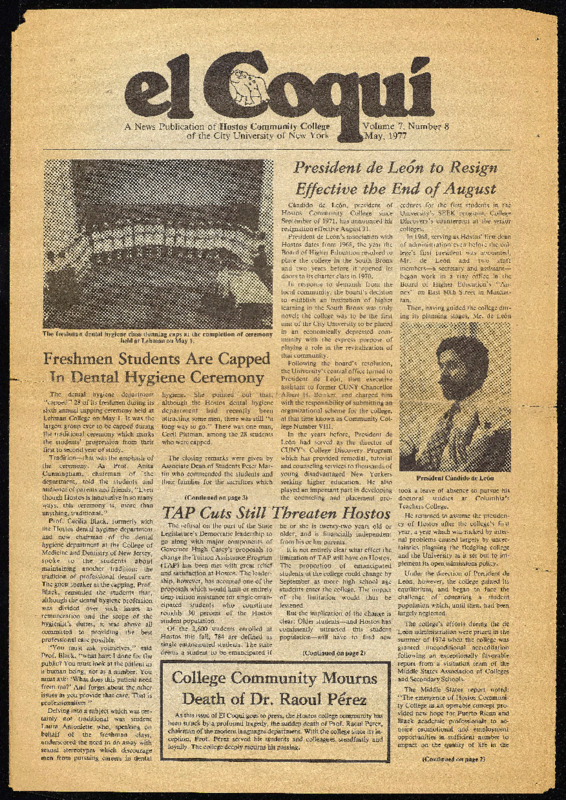
A News Publication of Hostos Community College
of the City University of New York
The freshman dental hygiene class donning caps at the completion of ceremony
held at Lehman on May 1.
Freshmen Students Are Capped
_ In Dental Hygiene Ceremony
The dental ues department
“capped” 28 of its freshmen during its
- sixth annual capping ceremony held at
Lehman College on May. 1. It was the
largest group ever to be capped during
the traditional ceremony which marks
the students’ progression from their
first to second year of study.
Tradition—that was the emphasis of
the ceremony. As Prof. Anita
Cunningham, chairman of the
department, told the students and
audience of parents and friends, ‘‘Even
though Hostos is innovative in so many
ways, this ceremony is, more than
anything, traditional.”’
Prof. Cecilia Black, formerly with
the Hostos dental hygiene department
and now chairman of the dental
hygiene department at the College of
Medicine and Dentistry of New Jersey,
spoke to the students about
maintaining another tradition: the
tradition of professional dental care.
The guest speaker at the capping, Prof.
Black, reminded the students that,
although the dental hygiene profession
was divided over such issues as
remuneration and the scope of the
hygienist’s duties, it was above all
committed to providing the best
professional care possible.
“You must ask yourselves,’’ said
Prof. Black, ‘‘what have I done for the
public? You must look at the patient as
a human being, not as a number. You
must ask: ‘What does this patient need
from me?’ And forget about the other
issues as you provide that care. That is
professionalism.”’
Delving into a subject which was cer-
tainly not traditional was student
Laura Antoniette who, speaking on
behalf of the freshman class,
underscored the need to do away with
sexual stereotypes which discourage
men from pursuing careers in dental
. cipated
hygiene. She pointed out’ that,
although the Hostos dental hygiene
department had recently been
attracting some men, there was still ‘‘a
long way to go.”’ There was one man,
Cecil Pittman, among the 26. students
who were capped.
The closing remarks were given by
Associate Dean of Students Peter Mar-
tin who commended the students and
their families for the sacrifices which
(Continued on page 3)
Volume 7, Number 8
May, 1977
President de Le6én to Resign
Effective the End of August
Candido de Leon, president of
Hostos Community College since
September of 1971, has announced his
resignation effective August 31.
President de Le6n’s association with
Hostos dates from 1968, the year the
Board of Higher Education resolved to
place the college in the South Bronx
and two years before it opened its
doors to its charter class in 1970.
In response to demands from the
local community, the board’s decision
to establish an institution of higher
learning in the South Bronx was truly
novel; the college was to be the first
unit of the City University to be placed
in an economically depressed com-
munity with the express purpose of
playing a role in the revitalization of
that community.
Following the board’s resolution,
the University’s central office turned to
President de Leon, then executive
_ assistant to former CUNY Chancellor
Albert H. Bowker, and charged him
with the responsibility of submitting an
organizational scheme for the college,
at that time known as Community Col-
lege Number VIII.
In the years before, President de
Leon had served as the director of
CUNY’s College Discovery Program
which has provided remedial, tutorial
and counseling services to thousands of
young disadvantaged New Yorkers
seeking higher education. He also
played an important part in developing
the counseling and placement pro-
TAP Cuts Still Threaten Hostos
The refusal on the part of the State
Legislature’s Democratic leadership to
go along with major components of
Governor Hugh Carey’s proposals to
change the Tuition Assistance Program
(TAP) has been met with great relief
and satisfaction at Hostos. The leader-
ship, however, has accepted one of the
proposals which would limit or entirely
deny tuition assistance for single eman-
students who constitute
roughly 30 percent of the Hostos
student population.
Of the 2,600 students enrolled at
Hostos this fall, 784 are defined as
single emancipated students. The state
deems a student to be emancipated if
he or she is twenty-two years old or
older, and is financially independent
from his or her parents.
It is not entirely clear what effect the
limitation of TAP will have on Hostos.
The proportion of emancipated
students at the college could change by
September as more high school age
students enter the college. The impact
of the limitation would thus be
lessened. :
But the implication of the change is
clear: Older students—and Hostos has
consistently attracted this student
population—will have to find new
(Continued on page 2)
College Community Mourns
Death of Dr.
Raoul Pérez
As this issue of El Coqui goes to press, the Hostos college community has
been struck by a profound tragedy, the sudden death of Prof. Raoul Pérez,
chairman of the modern languages department. With the college since its in-
ception, Prof. Pérez served his students and colleagues steadfastly and
loyally. The college deeply mourns his passing.
cedures for the first students in the
University’s SEEK program, College
Discovery’s counterpart at the senior
colleges. : =
In 1968, serving as Hostos’ first dean
of administration even before the col- —
lege’s first president was appointed,
Mr. de Leon and two _ staff
members—a secretary and assistant—
began work in a tiny office in the
Board of Higher Education’s ‘‘An-
nex’’ on East 80th Street in Manhat-
tan. :
Then, having guided the college dur-
ing its planning stages, Mr. de Leon
President Candido de Leon
took a leave of absence to pursue his
doctoral studies at Columbia’s
Teachers College. :
He returned to assume the presiden-
cy of Hostos after the college’s first
year, a year which was racked by inter-
nal problems caused largely by uncer-
tainties plaguing the fledgling college ~
and the University as it set out to im-
plement its open admissions policy.
Under the direction of President de
Leén, however, the college gained its
equilibrium, and began to face the
challenge of educating a student
population which, until then, had been
largely neglected.
The college’s efforts during the de
Leon administration were prized in the
summer of 1974 when the college was
granted unconditional accreditation
following an exceptionally favorable
report from a visitation team of the —
Middle States Association of Colleges
and Secondary Schools.
The Middle States report noted:
“‘The emergence of Hostos Communi-
ty College as an operable concept pro-
vided new hope for Puerto Rican and
Black academic professionals to ac-
quire promotional and employment
opportunities in sufficient number to
impact on the quality of life in the
(Continued on page 2)
EL COQUI
. May, 1977
A news. publication of Hostos Community
College of the City University of N.Y.
Vol. 7 No. 8
May, 1977
Published’ “monthly from October through
June by the Office of College Relations and
Development, Hostos Community College,
475 Grand Concourse, Bronx, New York
10451. El Coqui, named after a tree frog in-
digenous to Puerto Rico, is read by Hostos
faculty, staff, and students and the com-
munities which the college serves. For in-
formation and submission of news call: (212)
-960-1008,9.
On Going Home
The following contribution is from
Victor Vazquez, vice-president of the
Hostos Student Government
Organization.
I was off in a daydream thinking of
the sister I relate to and trying to
imagine the reaction of her family. (1
was going to meet them for the first
time.) Suddenly, I noticed people
looking out the windows. I looked
overhead and noticed that the ‘‘No
smoking”’ and “‘Fasten seatbelt” lights
were on. We were about to land. It was
then that I realized how close I was to
home.
Home? Funny, I was born and
raised in New York, the Big Apple,
but, no, this is really home! The home
of my father, my mother, his father,
his mother... .
I was on American Airlines flight
665 (coach, of course, not too many of
us Ricans fly first class!), and it was
about to land in San Juan. It had been
almost 14 years to the day since my
mother, my father, my brothers Ray
and Georgie, and my kid sisters, Cuchi
and Abby and I had left Puerto Rico.
“Isla del Encanto.” It’s always writ-
ten in the ads in the subway, El Diario,
Latin New York and others. Isla del
encanto for whom? Isla del Encanto
for all the unemployed (close to 40 per-
cent of the population, I understand)?
Isla del encanto for the unfortunate
ones who work at the petrochemical
and pharmaceutical plants exposed to
deadly chemicals that cause all kinds of
diseases? Isla del encanto for the poor
who. buy what little they can at the
local ‘‘tienda’’ with food stamps?
“So this is Puerto Rico!’’ I said to
myself as I looked out the plane’s win-
dow. And as I looked out on the land
of Betances, de Hostos, Albizu and the
rest, I thought to myself, ‘‘If you
remove all the palm trees, it would -
look. just like Queens.’
Americanization it’s called. Puerto
Ricans are fit into a mold and told:
“Repeat after me, ‘I pledge allegiance
fowthewlates 02s
The cultural shock wasn’t as great as
_ it might’ve been. I had prepared myself
psychologically by talking to friends
who had been to the island many times.
Some were born and raised there like
my compafiera. Oh yes, I was prepared
to see the usual Burger Kings,
Woolworth’s, J.C. Penneys and good
ole Rockefeller banks. After all, it
wasn’t the first time I had seen a
colony. The last time was in Vietnam
(class of ’71) except that then the Viet-
namese people were in the midst of a
struggle called National
Liberation—the first step in self deter-
mination which is preceded by a good
knowledge of self as a people.
But this wasn’t Vietnam! It was
Puerto Rico in April, 1977, and-we’re
still struggling to acquire the
knowledge of self, that secure feeling
of being a people. Yes, we’re still
struggling but we will succeed because
history says we will.
My compajfieros took me around the
island. I saw more of Puerto Rico, |
think, than anyone can see -in the
eleven days I was there. And, you
know, that itty-bitty, 100-by-38-mile
island (as it was described in school)
was not so itty-bitty after all. Puerto
Rico is a beautiful island, once you get
out of the San Juan metropolitan area
which at any time of day resembles
34th Street and 8th Avenue. It’s
beautiful: From the — beaches
Guamica (where the American soldiers
first invaded the island) to the moun-
tains of Aibonito, from the northern
coast towns of Arecibo and Bar-
celoneta to the east coast of Fajardo.
Beautiful, yes, but I couldn’t help
thinking that somehow a mysterious
sandman was sprinkling a deep sleep
on the Puerto Rican people. Waking
them up will be-a struggle, but, once
awake, they will dare to imagine.
On my return trip, I thought to
myself that I know I am only one in-
dividual, but I will do what I can to
steal the sandman’s bag and wake up
as many of my countremen as ] can!
(Continued from page 1)
ways of financing their educations.
In the meantime, the City Univer-
sity’s central office has developed
plans to lobby for a number of items
on the state’s supplemental budget.
According to Prof. T. David Fox-
worthy, special assistant to the
president for legislative affairs, the
items are as follows:
. A change in the University’s
funding formula which would insure
full funding for CUNY’s community
colleges. At present,/the state’s share
of the community college budget is $58
million. Of this amount, about $3.5
million are matching funds dependent
on the city not reducing its share. The
city however, has said that it is
reducing its share of the funding of the
community college budget. The change
in the funding formula would guaran-
tee full funding regardless of what the
city’s contribution finally is.
... An additional $2.8 million to
annualize the new contract with the
Professional Staff Congress to the
months of July and August.
. .. An additional $500,000 to in-
stitute the university-wide ‘‘sophomore
exam.”
. .. An additional $1 million to im-
plement a new computerized central
accounting system.
. .. An additional $500,000 to con-
tinue remedial programs carried out in
conjunction with local high schools.
Lobbying for the supplemental
budget was expected to have begun in
late April. It will probably continue
well into June.
of °
President Candido de Leén addresses audience of students, faculty and staff
during secretarial science seminar.
Secretarial Science Department
Holds Secretary Week Seminar
Increasingly popular during the last
few semesters: (registration and ap-
plications have been steadily increas-
ing), the secretarial science department
also showed during its National
Secretarial Week Seminar on April 27
that it was proud of its achievements
and victories. ?
The seminar was an occasion for
congratulations, advice
employers in the working world, and
awards for outstanding students.
Commenting on the floral ar-
rangements which decorated the stu-~
dent lounge on 15Ist Street where the
seminar was held, Prof. Patricia Par-
zych, chairman of the department,
said: ‘‘The best bouquet of flowers are
the students who started as seeds and
are now blooming’”’ as they approach
graduation.
Greeting the students was President
Candido de Leon who recalled the im-
portance of a single secretary in the
beginning of Hostos Community Col-
lege. He recalled that in 1968-69, when
plans were being made for the opening
of Hostos for the fall of 1970, the en-
tire staff of the college consisted of
President de Leon, who at that time
was the Dean of Administration, an
assistant and an all-important
secretary. President de Leon said that,
without the skills and abilities of that
secretary, without her ability to chan-
nel information and organize ad-
ministrative procedures for the fledg-
ling administration, the college could
not have begun to develop.
Addressing the students during the
seminar were Mrs. Alfreda Williams,
an administrator at Mount Sinai
Hospital, and Mr. Samuel B. Granirer,
director of the Catholic Career Coun-
cil. Both have been loyal, veteran
members of the secretarial science
department’s advisory committee.
Mrs. Williams informed the students
on the requirements which Mount
Sinai and other medical institutions
make of their prospective secretaries
and office managers. And Mr. Samuel
B. Granirer, spoke of the qualities
which private industries require of pro-
spective members of their office staff.
Mrs. Williams pointed out that more
from:
and more Hostos graduates have been
placed in secretarial positions at
prestigious Mount Sinai. She at-
tributed their success at Mouni Sinai to
the quality of instruction which they
receive at Hostos.
Mr. Granirer also mentioned that, as
the director of a major placement ser-
vice for the New York Archdiocese, he = _-—
had seen many an Hostos graduate
find excellent positions in the working”
~~ ‘world. (Mr. Granirer neglected to men-
tion that they had found those posi-
tions through his office.)
The National Secretarial Week
Seminar was also an occasion for
recognizing the achievements of
students. Students Phyllis Jackson and
Rosemary Santiago received awards as
the most outstanding freshman and
senior students respectively. Receiving
an award for being the most improved
student was Evangeline Lynch, and
receiving special awards for contribu-
tions and service to the secretarial
science department were Petra Alvarez
and Diane Casanova. A special ‘‘ap-
preciation award’’ was given to the
department’s secretary, Margie
Walker, whom Prof. Parzych referred
to as “‘the best secretary at the col-
lege.”’
The mistress of ceremonies at the
seminar was Prof. Lucille Pruit; Prof.
Faye Carson presented the awards.
Dean of Faculty Evangleos Gizis
closed the ceremony by congratulating
the department’s senior students and
wishing them many future successes.
de Leon...
(Continued from page 1)
Community... The president. . . isa
man of enormous intellectual capacity
[with] a precise understanding of the
societal dynamics that influence the
educational process and outcomes of
the institution.”
President de Le6én submitted his
resignation to Chancellor Robert J.
Kibbee in April. He is in the pro-
cess of formulating plans for the
future.
May, 1977
EL COQUI
President, Chairmen Tentatively
Adopt Letter Grading System
The Council of Chairpersons and
Directors and President Candido de
Leén have in principle approved the
implementation of a letter grading
system, the latest development in the
process began last fall of revising the
Hostos curriculum. ;
The grading system was approved by
President de Leon and the Council at
its April 14 meeting. Their approval,
however, was made contingent upon a
number of widespread changes in the
Hostos curriculum, changes which
have been the subject of intensive
discussion during the .Council’s
meetings throughout the present
academic year. :
The adoption of the grading system
was also made contingent upon precise
_ delineation by the faculty of what level
of performance each letter grade in-
dicates. ‘
At the heart of the curricular
changes is the establishment of
English, Spanish and, if appropriate,
mathematics prerequisites for all con-
tent courses offered at the college. Ac-
cording to Dean of Faculty Evangelos
Gizis, who presides over the meetings
of the Council, it was reasoned that the
establishment of these prerequisites
was necessary to insure that there be a
homogeneity of students in terms of
_ skills preparation. A course instructor
would thus be able to proceed with the .
course material as outlined in a course
_ syllabus and performance. objectives
_ without having to accommodate
students of varying language and/or
_ mathematics abilities in the same-class.
. In order to implement this fun-
damental change in the curriculum,
"every course instructor has, during the
“present academic year, drawn up
syllabi as well as performance ob-
jectives for each class. The syllabi are,
in effect, general statements of the
material which each of the courses is to
cover. And, as Dean Gizis explains,
they will also be ‘‘the instrument of
communication with departments in
the college and in CUNY.” They will
thus facilitate articulation between
Hostos and the City University’s senior
colleges.
The typical syllabus includes the
following:
. . Prerequisites in
courses. eS
. .. Prerequisites in terms of basic
skills.
. . . Types of examinations.
... Types of writing and reading
assignments.
The performance objectives for each
course will continue to serve as a kind
of check list which will tell the student
exactly what he or she is expected to ac-
complish.
Other changes in the Hostos cur-
riculum approved by the Council of
Chairpersons and Directors and Presi-
dent de Leon are:
... That the English, mathematics,
and modern languages departments
will publish the exit criteria for all
courses offered in their departments.
... That the English, mathematics
and modern languages departments
will administer departmental examina-
tions and cross-read. these examina-
tions in order to insure that the exit
criteria are adhered to.
... That all faculty will organize
their courses in accordance with the
English, Spanish, and mathematics
terms of
_prerequisites so that the requirements
made of students are consistent with
their skills. -
. . . That the class size of courses of-—
fered in the English department be
decreased to 27 students per section.
. . . That, to insure that students do
not register for courses which are not
commensurate with their language or
computational skills, students be re-
quired to register in courses in the
following order: English, Spanish,
mathematics, sciences, all other
courses.
. . . That the liberal arts faculty will
offer academic advisement to liberal
arts students.
That all departments
establish exit criteria for all courses.
... That each course will have a
syllabus and a set of performance ob-
jectives. The syllabus and the per-
will
(Continued on page 4)
AC RERETING THE ‘NEW SONG’: The ‘Grupo Cultural Faena,” a group
eared inican Students, presents a concert during a week-long program spon-
Sored in April by the South American Student Union. The group’s repertoire in-
cludes songs of social protest with the use of traditional instruments.
LEARNING ABOUT HEREDITY: Prof. Victor de Leon of the biology depart-
ment lectures future biologists on the mechianics of heredity during a lecture
sponsored in April by the Hostos Biology Club. Prof. de Leon has conducted ex-
tensive research at Cornell Medical College on how mothers contribute to the
genetic makeup of their children. the Biology Club lecture was coordinated by
Prof. Silvia Greer, the club’s advisor.
Rise in High School Applicants
For Admission Next Semester
After two months of intensive
recruiting at local city high schools, the
Hostos Admissions Office has ac-
cepted the applications of 288 prospec-
tive freshmen. i
The figure represents the total
number of high school seniors who
have applied to the college after the
completion of what the University Ap-
plication Processing Center refers to as
“Phase II’’ in the annual admissions
process. Each phase encompasses a
month of the recruiting effort; Phase IT
ran through the month of March. The
recruiting and admissions process will .
continue until Labor Day weekend.
According to the Office of Admis-
sions Services (OAS), approximately
4,100 students were processed for all
CUNY units during Phase II. On the
basis of this figure, OAS estimates that
the fall freshman class for the Universi-
ty will be over 37,000 students.
OAS administrators emphasized that
Capping...
(Continued from page 1)
they had to endure to succeed in the
rigorous and demanding dental
hygiene program. He said that it was
fitting for the students to celebrate
their accomplishments with the cap-
ping ceremony.
The capping ceremony was itself
solemn and beautiful. The students
received caps bearing two half-stripes,
one blue, marking the Hostos colors,
and one lavender, symbolizing the pro-
fession of dentistry. The caps will be
worn by the students during a challeng-
ing 1,000-hour clinical practicum
which will stretch throughout this sum-
mer and the following academic year.
The licensed dental hygienist wears a
cap with two full stripes.
One by one, the freshman students
received caps from Prof. Selena James
and a candle from Mrs. Ernestine
Leach of the dental hygiene staff. Once
there are still seats available in most
CUNY colleges and in the SEEK and
College Discovery programs. Members
of the local community interested in at-
tending Hostos or participating in the
College Discovery program, which
provides special financial and
academic services for disadvantaged
students, should contact Prof. Virginia
Paris, director of admissions at Hostos
(telephone: 960-1114).
Following are the total Phase I and
II allocations of freshmen to the
Hostos career programs: =
Total
Program Requested
Den Hyg 34 25
Acctg 17 180
Secretarial ip 90
Child Care 42 100
X-Ray 33 20
Civ Admin 4 60
Med Lab 5 87
Total 288 772
they had assembled at the rear of th
stage at Lehman’s Gilette Auditorium,
Prof. James and Mrs. Leach lighted
each of the candles, representing the
students’ initiation to the dental
hygiene profession. The lights in the
auditorium were then turned off to
climax the ceremony.
The students receiving caps were:
Ana Alejandro, Laura Antoniette,
Margaret Balsamello, Laura Berkey,
Evelyn Calderon, Lori Cirvello, Celia
de Jesus, Kathleen Dorfman, Ingrid
Doyle, Geraldine Giglio, Marie Gison-
di, Diane Green, Kathleen Higgins,
Nursadies Jarrett, Janis Kirk, Clara
McNeill, Silvia Mirthes, Diane Natole,
Milagros Pabellon, Arelis Pefia, Hilda
Quiles, Beth Rubin, Joel Russ, Chery,
Sobel, Roseann Tavolacci, Mabel
~Thomason, Nancy Witzman and Cecil
Pittman, the one gentleman in the
freshman class. :
The ceremony was followed by a
reception for students, their parents
and spouses, faculty and guests.
EL COQUI
News Briefs
Mr. Carlos Velazquez of the admis-
sions office was a member of a delega-
tion which received a proclamation on
April 21 from Bronx Borough Presi-
dent Robert Abrams declaring that day
as Spanish Language Day in the Bronx.
The other members of the delegation
were: Mr. Federico Pérez, president of
the Crusade in Defense of the Spanish
Language, an organization which cam-
paigned for Spanish Language Day;
State Senator Israel Ruiz; and Prof.
Luis Pinto of Bronx Community Col-
_ lege who coordinated a program of ac-
tivities at his college in observance of
the day. Z
Prof. Joseph Y. Peary of the biology
department has been appointed to the
board of directors of the Feiga Gory:
Remetier Memorial Foundation, an af-
filiate of the Gardiner Clinical
Laboratories of Forest Hills, Queens.
The foundation supports medical
technology training and research pro-
jects at C.W. Post College. Prof.
Peary is also a consultant to the Ocean
Resources Utilization Program at
Inter-American University in Hato
Rey, Puerto Rico which he helped to
establish in 1971. In addition, he is a
trustee of the Ocean Living Institute of
Kearney, New Jersey which sponsors
marine-related community activities.
Mr. Nicolas Arroyo, a student in the
real estate program of the Hostos divi-
sion of community and continuing
education, was recently honored by
WNJU-TV as one of the station’s
_ Merit of the Week recipients. The
honor goes every week to a distin-
guished member of the Hispanic com-
munity in the metropolitan area. Mr.
Arroyo received the award largely for
his service as the project director of the
Silvia Chee Memorial Scholarship Pro-
gram which awards college scholar-
ships to youths in the South Bronx
community. The program is funded by
the Model Cities Administration, and
is administered by the City University
Research Foundation. Mr. Arroyo is
also an officer with Organizaciones
Unidas del Bronx and he is president of
Cabo Rojefios Ausentes, a civic
hometown club. ;
_ e
DENTAL HYGIENE AND SECRETARIAL ACTIVITIES: During April and
early May, dental hygiene and secretarial science departments held capping
ceremony and annual seminar. From left, above, Ms. Ernestine Leach and Prof.
Selena James ‘cap’ student; dental hygiene freshmen await beginning of capping
ceremony; Prof. Faye Carson presents award to Rosemary Santiago, ‘‘out-
standing”’ secretarial student; and Rosa Coldn of college relations staff sports
corsage given to all secretaries by secretarial department on the occasion of
Secretarial Day.
Hostos graduate José Mota (’75) has
compiled and translated a community
handbook for Community School
Board 3 in Manhattan. Mr. Mota has
been an administrator with the School
Board since he graduated from Hostos.
The board’s jurisdiction covers one of
the largest Hispanic communities of
the city. Many of the schools in the
district offer model bilingual education
programs.
Prof. Judith Nowinski of the modern
languages department gave the latest
seminar in the Social Sciences Seminar
Series on April 14. The topic of her
seminar was ‘‘Joan of Arc: Liberated
Woman?”’
Prof. Gerlad Meyer of the social
sciences department was a guest lec-
turer recently at the New York State
School of Industrial and Labor Rela-
tions at Cornell. Prof. Meyer spoke,
first, on the late Congressman Vito
Marcantonio (the subject of his doc-
toral dissertation) and then on methods
and theories of trade union administra-
tion. Currently, the chairman of the
Hostos chapter of the Professional
Staff Congress, Prof. Meyer has had a
long career in the trade union move-
ment at the university as well as the
public school level.
Prof. Clara Velasquez, director of the
English-as-a-second-language _ pro-
gram, has been appointed to the Board
of Education’s City-Wide Advisory
Commission on Bilingual Education.
Prof. Velasquez is one of two Hostos
faculty members serving on the com-
mission which advises the chancellor of
the Board of Education on matters per-
taining to bilingual instruction in the
public schools. The other member of
the advisory committee from Hostos is
Prof. Edward Maynard, chairman of _
the Africana studies department.
Prof. Velasquez also gave a presen-
tation on teacher training according to
the prescriptions of federal law at the
National Convention of Teachers of
English to Speakers of Other
Languages (TESOL) which was held in
Miami, Florida, in late April. Prof.
Velasquez based her presentation on
the prescriptions laid down by the Lau
case, a landmark federal court case
which requires school districts across
the country to provide bilingual educa-
tion to children in communities which
are not predominantly English-
speaking.
Student Marta Elena Muiiiz has
published some of her work in the
College Poetry Review, a publication
which appears twice a year and
presents the work of students across
the country. Ms. Mufiiz has published
her poetry in other student publica-
tions, including Eco/Echo, the Hostos
student newspaper. Among her works
are several sonnets which require ex-
ceptional technical ability and
discipline.
Prof. Linda Hirsch of the English
department conducted a seminar on
remedial writing in early April for the
staff of City College’s writing center.
The seminar focused on the special
iproblems faced by Spanish-speaking
students as they learn to write English.
Prof, Hirsch is the coordinator of the
Hostos writing laboratory.
Prof. Louis Wheaton of the Africana
studies department was a participant in
a panel discussion on the role of the
legal system in protecting the minority
presence in higher education which was
part of the program of a conference
presented by The Black Council on
Higher Education, Inc. on the minority
presence in higher education. Held in
New York on May 7, the conference
was also sponsored by the Office of
Minority Affairs of the College En-
trance Examination Board and the
Educational Testing Service. Prof.
Wheaton was one of the coordinators
of the conference. Also participating in
the conference was Chancellor Robert
J. Kibbee who was a panelist during a
discussion on the institutional commit-
ment to the minority presence in higher
education.
Hostos Community College
475 Grand Concourse
Bronx, N.Y. 10451
Letter Grading...
(Continued from page 3)
formance objectives will be distributed
to students at the first class meeting.
And a college-wide performance objec-
tives committee will review all per-
formance objectives. :
Essentially the decision to tentatively
adopt the letter grading system was
based on evidence that Hostos
graduates were encountering dif-
ficulties transferring from a pass-fail
grading system to the more traditional
system which prevails at senior col-
leges. ae
If ultimately adopted, the letter
grading system will be reviewed an
monitored by a Committee on Gradin;
Practices which will be appointed by
_ the president and the college-wide Per-
sonnel and Budget Committee.
If next year’s budget allows, an addi-
tional curricular change will be in-
stituted in. the science departments.
The change calls for the hiring of
special tutors to help students develop
language and computational skills. If
the experiment proves successful, the
tutorial system may be adopted for
other courses and programs.
The changes in the Hostos cur-
riculum are geared to implement what
Dean Gizis refers to as a “‘ladder of
progression”’ which students will
follow to be sure that they do not enter
courses and programs for which they
are not prepared, and their transition
from Hostos to senior college is as easy
and natural as possible.
Ultimate adoption of the April 14
resolution of the Council of Chairper-
sons and Directors depends on the
establishment of course exit criteria,
prerequisites, and course performance
objectives.
NON-PROFIT ORG.
U. S. POSTAGE
Paid
BRONX, N. Y.
PERMIT NO. 227
Prof, Gerald Meyer
Social Sciences
of the City University of New York
The freshman dental hygiene class donning caps at the completion of ceremony
held at Lehman on May 1.
Freshmen Students Are Capped
_ In Dental Hygiene Ceremony
The dental ues department
“capped” 28 of its freshmen during its
- sixth annual capping ceremony held at
Lehman College on May. 1. It was the
largest group ever to be capped during
the traditional ceremony which marks
the students’ progression from their
first to second year of study.
Tradition—that was the emphasis of
the ceremony. As Prof. Anita
Cunningham, chairman of the
department, told the students and
audience of parents and friends, ‘‘Even
though Hostos is innovative in so many
ways, this ceremony is, more than
anything, traditional.”’
Prof. Cecilia Black, formerly with
the Hostos dental hygiene department
and now chairman of the dental
hygiene department at the College of
Medicine and Dentistry of New Jersey,
spoke to the students about
maintaining another tradition: the
tradition of professional dental care.
The guest speaker at the capping, Prof.
Black, reminded the students that,
although the dental hygiene profession
was divided over such issues as
remuneration and the scope of the
hygienist’s duties, it was above all
committed to providing the best
professional care possible.
“You must ask yourselves,’’ said
Prof. Black, ‘‘what have I done for the
public? You must look at the patient as
a human being, not as a number. You
must ask: ‘What does this patient need
from me?’ And forget about the other
issues as you provide that care. That is
professionalism.”’
Delving into a subject which was cer-
tainly not traditional was student
Laura Antoniette who, speaking on
behalf of the freshman class,
underscored the need to do away with
sexual stereotypes which discourage
men from pursuing careers in dental
. cipated
hygiene. She pointed out’ that,
although the Hostos dental hygiene
department had recently been
attracting some men, there was still ‘‘a
long way to go.”’ There was one man,
Cecil Pittman, among the 26. students
who were capped.
The closing remarks were given by
Associate Dean of Students Peter Mar-
tin who commended the students and
their families for the sacrifices which
(Continued on page 3)
Volume 7, Number 8
May, 1977
President de Le6én to Resign
Effective the End of August
Candido de Leon, president of
Hostos Community College since
September of 1971, has announced his
resignation effective August 31.
President de Le6n’s association with
Hostos dates from 1968, the year the
Board of Higher Education resolved to
place the college in the South Bronx
and two years before it opened its
doors to its charter class in 1970.
In response to demands from the
local community, the board’s decision
to establish an institution of higher
learning in the South Bronx was truly
novel; the college was to be the first
unit of the City University to be placed
in an economically depressed com-
munity with the express purpose of
playing a role in the revitalization of
that community.
Following the board’s resolution,
the University’s central office turned to
President de Leon, then executive
_ assistant to former CUNY Chancellor
Albert H. Bowker, and charged him
with the responsibility of submitting an
organizational scheme for the college,
at that time known as Community Col-
lege Number VIII.
In the years before, President de
Leon had served as the director of
CUNY’s College Discovery Program
which has provided remedial, tutorial
and counseling services to thousands of
young disadvantaged New Yorkers
seeking higher education. He also
played an important part in developing
the counseling and placement pro-
TAP Cuts Still Threaten Hostos
The refusal on the part of the State
Legislature’s Democratic leadership to
go along with major components of
Governor Hugh Carey’s proposals to
change the Tuition Assistance Program
(TAP) has been met with great relief
and satisfaction at Hostos. The leader-
ship, however, has accepted one of the
proposals which would limit or entirely
deny tuition assistance for single eman-
students who constitute
roughly 30 percent of the Hostos
student population.
Of the 2,600 students enrolled at
Hostos this fall, 784 are defined as
single emancipated students. The state
deems a student to be emancipated if
he or she is twenty-two years old or
older, and is financially independent
from his or her parents.
It is not entirely clear what effect the
limitation of TAP will have on Hostos.
The proportion of emancipated
students at the college could change by
September as more high school age
students enter the college. The impact
of the limitation would thus be
lessened. :
But the implication of the change is
clear: Older students—and Hostos has
consistently attracted this student
population—will have to find new
(Continued on page 2)
College Community Mourns
Death of Dr.
Raoul Pérez
As this issue of El Coqui goes to press, the Hostos college community has
been struck by a profound tragedy, the sudden death of Prof. Raoul Pérez,
chairman of the modern languages department. With the college since its in-
ception, Prof. Pérez served his students and colleagues steadfastly and
loyally. The college deeply mourns his passing.
cedures for the first students in the
University’s SEEK program, College
Discovery’s counterpart at the senior
colleges. : =
In 1968, serving as Hostos’ first dean
of administration even before the col- —
lege’s first president was appointed,
Mr. de Leon and two _ staff
members—a secretary and assistant—
began work in a tiny office in the
Board of Higher Education’s ‘‘An-
nex’’ on East 80th Street in Manhat-
tan. :
Then, having guided the college dur-
ing its planning stages, Mr. de Leon
President Candido de Leon
took a leave of absence to pursue his
doctoral studies at Columbia’s
Teachers College. :
He returned to assume the presiden-
cy of Hostos after the college’s first
year, a year which was racked by inter-
nal problems caused largely by uncer-
tainties plaguing the fledgling college ~
and the University as it set out to im-
plement its open admissions policy.
Under the direction of President de
Leén, however, the college gained its
equilibrium, and began to face the
challenge of educating a student
population which, until then, had been
largely neglected.
The college’s efforts during the de
Leon administration were prized in the
summer of 1974 when the college was
granted unconditional accreditation
following an exceptionally favorable
report from a visitation team of the —
Middle States Association of Colleges
and Secondary Schools.
The Middle States report noted:
“‘The emergence of Hostos Communi-
ty College as an operable concept pro-
vided new hope for Puerto Rican and
Black academic professionals to ac-
quire promotional and employment
opportunities in sufficient number to
impact on the quality of life in the
(Continued on page 2)
EL COQUI
. May, 1977
A news. publication of Hostos Community
College of the City University of N.Y.
Vol. 7 No. 8
May, 1977
Published’ “monthly from October through
June by the Office of College Relations and
Development, Hostos Community College,
475 Grand Concourse, Bronx, New York
10451. El Coqui, named after a tree frog in-
digenous to Puerto Rico, is read by Hostos
faculty, staff, and students and the com-
munities which the college serves. For in-
formation and submission of news call: (212)
-960-1008,9.
On Going Home
The following contribution is from
Victor Vazquez, vice-president of the
Hostos Student Government
Organization.
I was off in a daydream thinking of
the sister I relate to and trying to
imagine the reaction of her family. (1
was going to meet them for the first
time.) Suddenly, I noticed people
looking out the windows. I looked
overhead and noticed that the ‘‘No
smoking”’ and “‘Fasten seatbelt” lights
were on. We were about to land. It was
then that I realized how close I was to
home.
Home? Funny, I was born and
raised in New York, the Big Apple,
but, no, this is really home! The home
of my father, my mother, his father,
his mother... .
I was on American Airlines flight
665 (coach, of course, not too many of
us Ricans fly first class!), and it was
about to land in San Juan. It had been
almost 14 years to the day since my
mother, my father, my brothers Ray
and Georgie, and my kid sisters, Cuchi
and Abby and I had left Puerto Rico.
“Isla del Encanto.” It’s always writ-
ten in the ads in the subway, El Diario,
Latin New York and others. Isla del
encanto for whom? Isla del Encanto
for all the unemployed (close to 40 per-
cent of the population, I understand)?
Isla del encanto for the unfortunate
ones who work at the petrochemical
and pharmaceutical plants exposed to
deadly chemicals that cause all kinds of
diseases? Isla del encanto for the poor
who. buy what little they can at the
local ‘‘tienda’’ with food stamps?
“So this is Puerto Rico!’’ I said to
myself as I looked out the plane’s win-
dow. And as I looked out on the land
of Betances, de Hostos, Albizu and the
rest, I thought to myself, ‘‘If you
remove all the palm trees, it would -
look. just like Queens.’
Americanization it’s called. Puerto
Ricans are fit into a mold and told:
“Repeat after me, ‘I pledge allegiance
fowthewlates 02s
The cultural shock wasn’t as great as
_ it might’ve been. I had prepared myself
psychologically by talking to friends
who had been to the island many times.
Some were born and raised there like
my compafiera. Oh yes, I was prepared
to see the usual Burger Kings,
Woolworth’s, J.C. Penneys and good
ole Rockefeller banks. After all, it
wasn’t the first time I had seen a
colony. The last time was in Vietnam
(class of ’71) except that then the Viet-
namese people were in the midst of a
struggle called National
Liberation—the first step in self deter-
mination which is preceded by a good
knowledge of self as a people.
But this wasn’t Vietnam! It was
Puerto Rico in April, 1977, and-we’re
still struggling to acquire the
knowledge of self, that secure feeling
of being a people. Yes, we’re still
struggling but we will succeed because
history says we will.
My compajfieros took me around the
island. I saw more of Puerto Rico, |
think, than anyone can see -in the
eleven days I was there. And, you
know, that itty-bitty, 100-by-38-mile
island (as it was described in school)
was not so itty-bitty after all. Puerto
Rico is a beautiful island, once you get
out of the San Juan metropolitan area
which at any time of day resembles
34th Street and 8th Avenue. It’s
beautiful: From the — beaches
Guamica (where the American soldiers
first invaded the island) to the moun-
tains of Aibonito, from the northern
coast towns of Arecibo and Bar-
celoneta to the east coast of Fajardo.
Beautiful, yes, but I couldn’t help
thinking that somehow a mysterious
sandman was sprinkling a deep sleep
on the Puerto Rican people. Waking
them up will be-a struggle, but, once
awake, they will dare to imagine.
On my return trip, I thought to
myself that I know I am only one in-
dividual, but I will do what I can to
steal the sandman’s bag and wake up
as many of my countremen as ] can!
(Continued from page 1)
ways of financing their educations.
In the meantime, the City Univer-
sity’s central office has developed
plans to lobby for a number of items
on the state’s supplemental budget.
According to Prof. T. David Fox-
worthy, special assistant to the
president for legislative affairs, the
items are as follows:
. A change in the University’s
funding formula which would insure
full funding for CUNY’s community
colleges. At present,/the state’s share
of the community college budget is $58
million. Of this amount, about $3.5
million are matching funds dependent
on the city not reducing its share. The
city however, has said that it is
reducing its share of the funding of the
community college budget. The change
in the funding formula would guaran-
tee full funding regardless of what the
city’s contribution finally is.
... An additional $2.8 million to
annualize the new contract with the
Professional Staff Congress to the
months of July and August.
. .. An additional $500,000 to in-
stitute the university-wide ‘‘sophomore
exam.”
. .. An additional $1 million to im-
plement a new computerized central
accounting system.
. .. An additional $500,000 to con-
tinue remedial programs carried out in
conjunction with local high schools.
Lobbying for the supplemental
budget was expected to have begun in
late April. It will probably continue
well into June.
of °
President Candido de Leén addresses audience of students, faculty and staff
during secretarial science seminar.
Secretarial Science Department
Holds Secretary Week Seminar
Increasingly popular during the last
few semesters: (registration and ap-
plications have been steadily increas-
ing), the secretarial science department
also showed during its National
Secretarial Week Seminar on April 27
that it was proud of its achievements
and victories. ?
The seminar was an occasion for
congratulations, advice
employers in the working world, and
awards for outstanding students.
Commenting on the floral ar-
rangements which decorated the stu-~
dent lounge on 15Ist Street where the
seminar was held, Prof. Patricia Par-
zych, chairman of the department,
said: ‘‘The best bouquet of flowers are
the students who started as seeds and
are now blooming’”’ as they approach
graduation.
Greeting the students was President
Candido de Leon who recalled the im-
portance of a single secretary in the
beginning of Hostos Community Col-
lege. He recalled that in 1968-69, when
plans were being made for the opening
of Hostos for the fall of 1970, the en-
tire staff of the college consisted of
President de Leon, who at that time
was the Dean of Administration, an
assistant and an all-important
secretary. President de Leon said that,
without the skills and abilities of that
secretary, without her ability to chan-
nel information and organize ad-
ministrative procedures for the fledg-
ling administration, the college could
not have begun to develop.
Addressing the students during the
seminar were Mrs. Alfreda Williams,
an administrator at Mount Sinai
Hospital, and Mr. Samuel B. Granirer,
director of the Catholic Career Coun-
cil. Both have been loyal, veteran
members of the secretarial science
department’s advisory committee.
Mrs. Williams informed the students
on the requirements which Mount
Sinai and other medical institutions
make of their prospective secretaries
and office managers. And Mr. Samuel
B. Granirer, spoke of the qualities
which private industries require of pro-
spective members of their office staff.
Mrs. Williams pointed out that more
from:
and more Hostos graduates have been
placed in secretarial positions at
prestigious Mount Sinai. She at-
tributed their success at Mouni Sinai to
the quality of instruction which they
receive at Hostos.
Mr. Granirer also mentioned that, as
the director of a major placement ser-
vice for the New York Archdiocese, he = _-—
had seen many an Hostos graduate
find excellent positions in the working”
~~ ‘world. (Mr. Granirer neglected to men-
tion that they had found those posi-
tions through his office.)
The National Secretarial Week
Seminar was also an occasion for
recognizing the achievements of
students. Students Phyllis Jackson and
Rosemary Santiago received awards as
the most outstanding freshman and
senior students respectively. Receiving
an award for being the most improved
student was Evangeline Lynch, and
receiving special awards for contribu-
tions and service to the secretarial
science department were Petra Alvarez
and Diane Casanova. A special ‘‘ap-
preciation award’’ was given to the
department’s secretary, Margie
Walker, whom Prof. Parzych referred
to as “‘the best secretary at the col-
lege.”’
The mistress of ceremonies at the
seminar was Prof. Lucille Pruit; Prof.
Faye Carson presented the awards.
Dean of Faculty Evangleos Gizis
closed the ceremony by congratulating
the department’s senior students and
wishing them many future successes.
de Leon...
(Continued from page 1)
Community... The president. . . isa
man of enormous intellectual capacity
[with] a precise understanding of the
societal dynamics that influence the
educational process and outcomes of
the institution.”
President de Le6én submitted his
resignation to Chancellor Robert J.
Kibbee in April. He is in the pro-
cess of formulating plans for the
future.
May, 1977
EL COQUI
President, Chairmen Tentatively
Adopt Letter Grading System
The Council of Chairpersons and
Directors and President Candido de
Leén have in principle approved the
implementation of a letter grading
system, the latest development in the
process began last fall of revising the
Hostos curriculum. ;
The grading system was approved by
President de Leon and the Council at
its April 14 meeting. Their approval,
however, was made contingent upon a
number of widespread changes in the
Hostos curriculum, changes which
have been the subject of intensive
discussion during the .Council’s
meetings throughout the present
academic year. :
The adoption of the grading system
was also made contingent upon precise
_ delineation by the faculty of what level
of performance each letter grade in-
dicates. ‘
At the heart of the curricular
changes is the establishment of
English, Spanish and, if appropriate,
mathematics prerequisites for all con-
tent courses offered at the college. Ac-
cording to Dean of Faculty Evangelos
Gizis, who presides over the meetings
of the Council, it was reasoned that the
establishment of these prerequisites
was necessary to insure that there be a
homogeneity of students in terms of
_ skills preparation. A course instructor
would thus be able to proceed with the .
course material as outlined in a course
_ syllabus and performance. objectives
_ without having to accommodate
students of varying language and/or
_ mathematics abilities in the same-class.
. In order to implement this fun-
damental change in the curriculum,
"every course instructor has, during the
“present academic year, drawn up
syllabi as well as performance ob-
jectives for each class. The syllabi are,
in effect, general statements of the
material which each of the courses is to
cover. And, as Dean Gizis explains,
they will also be ‘‘the instrument of
communication with departments in
the college and in CUNY.” They will
thus facilitate articulation between
Hostos and the City University’s senior
colleges.
The typical syllabus includes the
following:
. . Prerequisites in
courses. eS
. .. Prerequisites in terms of basic
skills.
. . . Types of examinations.
... Types of writing and reading
assignments.
The performance objectives for each
course will continue to serve as a kind
of check list which will tell the student
exactly what he or she is expected to ac-
complish.
Other changes in the Hostos cur-
riculum approved by the Council of
Chairpersons and Directors and Presi-
dent de Leon are:
... That the English, mathematics,
and modern languages departments
will publish the exit criteria for all
courses offered in their departments.
... That the English, mathematics
and modern languages departments
will administer departmental examina-
tions and cross-read. these examina-
tions in order to insure that the exit
criteria are adhered to.
... That all faculty will organize
their courses in accordance with the
English, Spanish, and mathematics
terms of
_prerequisites so that the requirements
made of students are consistent with
their skills. -
. . . That the class size of courses of-—
fered in the English department be
decreased to 27 students per section.
. . . That, to insure that students do
not register for courses which are not
commensurate with their language or
computational skills, students be re-
quired to register in courses in the
following order: English, Spanish,
mathematics, sciences, all other
courses.
. . . That the liberal arts faculty will
offer academic advisement to liberal
arts students.
That all departments
establish exit criteria for all courses.
... That each course will have a
syllabus and a set of performance ob-
jectives. The syllabus and the per-
will
(Continued on page 4)
AC RERETING THE ‘NEW SONG’: The ‘Grupo Cultural Faena,” a group
eared inican Students, presents a concert during a week-long program spon-
Sored in April by the South American Student Union. The group’s repertoire in-
cludes songs of social protest with the use of traditional instruments.
LEARNING ABOUT HEREDITY: Prof. Victor de Leon of the biology depart-
ment lectures future biologists on the mechianics of heredity during a lecture
sponsored in April by the Hostos Biology Club. Prof. de Leon has conducted ex-
tensive research at Cornell Medical College on how mothers contribute to the
genetic makeup of their children. the Biology Club lecture was coordinated by
Prof. Silvia Greer, the club’s advisor.
Rise in High School Applicants
For Admission Next Semester
After two months of intensive
recruiting at local city high schools, the
Hostos Admissions Office has ac-
cepted the applications of 288 prospec-
tive freshmen. i
The figure represents the total
number of high school seniors who
have applied to the college after the
completion of what the University Ap-
plication Processing Center refers to as
“Phase II’’ in the annual admissions
process. Each phase encompasses a
month of the recruiting effort; Phase IT
ran through the month of March. The
recruiting and admissions process will .
continue until Labor Day weekend.
According to the Office of Admis-
sions Services (OAS), approximately
4,100 students were processed for all
CUNY units during Phase II. On the
basis of this figure, OAS estimates that
the fall freshman class for the Universi-
ty will be over 37,000 students.
OAS administrators emphasized that
Capping...
(Continued from page 1)
they had to endure to succeed in the
rigorous and demanding dental
hygiene program. He said that it was
fitting for the students to celebrate
their accomplishments with the cap-
ping ceremony.
The capping ceremony was itself
solemn and beautiful. The students
received caps bearing two half-stripes,
one blue, marking the Hostos colors,
and one lavender, symbolizing the pro-
fession of dentistry. The caps will be
worn by the students during a challeng-
ing 1,000-hour clinical practicum
which will stretch throughout this sum-
mer and the following academic year.
The licensed dental hygienist wears a
cap with two full stripes.
One by one, the freshman students
received caps from Prof. Selena James
and a candle from Mrs. Ernestine
Leach of the dental hygiene staff. Once
there are still seats available in most
CUNY colleges and in the SEEK and
College Discovery programs. Members
of the local community interested in at-
tending Hostos or participating in the
College Discovery program, which
provides special financial and
academic services for disadvantaged
students, should contact Prof. Virginia
Paris, director of admissions at Hostos
(telephone: 960-1114).
Following are the total Phase I and
II allocations of freshmen to the
Hostos career programs: =
Total
Program Requested
Den Hyg 34 25
Acctg 17 180
Secretarial ip 90
Child Care 42 100
X-Ray 33 20
Civ Admin 4 60
Med Lab 5 87
Total 288 772
they had assembled at the rear of th
stage at Lehman’s Gilette Auditorium,
Prof. James and Mrs. Leach lighted
each of the candles, representing the
students’ initiation to the dental
hygiene profession. The lights in the
auditorium were then turned off to
climax the ceremony.
The students receiving caps were:
Ana Alejandro, Laura Antoniette,
Margaret Balsamello, Laura Berkey,
Evelyn Calderon, Lori Cirvello, Celia
de Jesus, Kathleen Dorfman, Ingrid
Doyle, Geraldine Giglio, Marie Gison-
di, Diane Green, Kathleen Higgins,
Nursadies Jarrett, Janis Kirk, Clara
McNeill, Silvia Mirthes, Diane Natole,
Milagros Pabellon, Arelis Pefia, Hilda
Quiles, Beth Rubin, Joel Russ, Chery,
Sobel, Roseann Tavolacci, Mabel
~Thomason, Nancy Witzman and Cecil
Pittman, the one gentleman in the
freshman class. :
The ceremony was followed by a
reception for students, their parents
and spouses, faculty and guests.
EL COQUI
News Briefs
Mr. Carlos Velazquez of the admis-
sions office was a member of a delega-
tion which received a proclamation on
April 21 from Bronx Borough Presi-
dent Robert Abrams declaring that day
as Spanish Language Day in the Bronx.
The other members of the delegation
were: Mr. Federico Pérez, president of
the Crusade in Defense of the Spanish
Language, an organization which cam-
paigned for Spanish Language Day;
State Senator Israel Ruiz; and Prof.
Luis Pinto of Bronx Community Col-
_ lege who coordinated a program of ac-
tivities at his college in observance of
the day. Z
Prof. Joseph Y. Peary of the biology
department has been appointed to the
board of directors of the Feiga Gory:
Remetier Memorial Foundation, an af-
filiate of the Gardiner Clinical
Laboratories of Forest Hills, Queens.
The foundation supports medical
technology training and research pro-
jects at C.W. Post College. Prof.
Peary is also a consultant to the Ocean
Resources Utilization Program at
Inter-American University in Hato
Rey, Puerto Rico which he helped to
establish in 1971. In addition, he is a
trustee of the Ocean Living Institute of
Kearney, New Jersey which sponsors
marine-related community activities.
Mr. Nicolas Arroyo, a student in the
real estate program of the Hostos divi-
sion of community and continuing
education, was recently honored by
WNJU-TV as one of the station’s
_ Merit of the Week recipients. The
honor goes every week to a distin-
guished member of the Hispanic com-
munity in the metropolitan area. Mr.
Arroyo received the award largely for
his service as the project director of the
Silvia Chee Memorial Scholarship Pro-
gram which awards college scholar-
ships to youths in the South Bronx
community. The program is funded by
the Model Cities Administration, and
is administered by the City University
Research Foundation. Mr. Arroyo is
also an officer with Organizaciones
Unidas del Bronx and he is president of
Cabo Rojefios Ausentes, a civic
hometown club. ;
_ e
DENTAL HYGIENE AND SECRETARIAL ACTIVITIES: During April and
early May, dental hygiene and secretarial science departments held capping
ceremony and annual seminar. From left, above, Ms. Ernestine Leach and Prof.
Selena James ‘cap’ student; dental hygiene freshmen await beginning of capping
ceremony; Prof. Faye Carson presents award to Rosemary Santiago, ‘‘out-
standing”’ secretarial student; and Rosa Coldn of college relations staff sports
corsage given to all secretaries by secretarial department on the occasion of
Secretarial Day.
Hostos graduate José Mota (’75) has
compiled and translated a community
handbook for Community School
Board 3 in Manhattan. Mr. Mota has
been an administrator with the School
Board since he graduated from Hostos.
The board’s jurisdiction covers one of
the largest Hispanic communities of
the city. Many of the schools in the
district offer model bilingual education
programs.
Prof. Judith Nowinski of the modern
languages department gave the latest
seminar in the Social Sciences Seminar
Series on April 14. The topic of her
seminar was ‘‘Joan of Arc: Liberated
Woman?”’
Prof. Gerlad Meyer of the social
sciences department was a guest lec-
turer recently at the New York State
School of Industrial and Labor Rela-
tions at Cornell. Prof. Meyer spoke,
first, on the late Congressman Vito
Marcantonio (the subject of his doc-
toral dissertation) and then on methods
and theories of trade union administra-
tion. Currently, the chairman of the
Hostos chapter of the Professional
Staff Congress, Prof. Meyer has had a
long career in the trade union move-
ment at the university as well as the
public school level.
Prof. Clara Velasquez, director of the
English-as-a-second-language _ pro-
gram, has been appointed to the Board
of Education’s City-Wide Advisory
Commission on Bilingual Education.
Prof. Velasquez is one of two Hostos
faculty members serving on the com-
mission which advises the chancellor of
the Board of Education on matters per-
taining to bilingual instruction in the
public schools. The other member of
the advisory committee from Hostos is
Prof. Edward Maynard, chairman of _
the Africana studies department.
Prof. Velasquez also gave a presen-
tation on teacher training according to
the prescriptions of federal law at the
National Convention of Teachers of
English to Speakers of Other
Languages (TESOL) which was held in
Miami, Florida, in late April. Prof.
Velasquez based her presentation on
the prescriptions laid down by the Lau
case, a landmark federal court case
which requires school districts across
the country to provide bilingual educa-
tion to children in communities which
are not predominantly English-
speaking.
Student Marta Elena Muiiiz has
published some of her work in the
College Poetry Review, a publication
which appears twice a year and
presents the work of students across
the country. Ms. Mufiiz has published
her poetry in other student publica-
tions, including Eco/Echo, the Hostos
student newspaper. Among her works
are several sonnets which require ex-
ceptional technical ability and
discipline.
Prof. Linda Hirsch of the English
department conducted a seminar on
remedial writing in early April for the
staff of City College’s writing center.
The seminar focused on the special
iproblems faced by Spanish-speaking
students as they learn to write English.
Prof, Hirsch is the coordinator of the
Hostos writing laboratory.
Prof. Louis Wheaton of the Africana
studies department was a participant in
a panel discussion on the role of the
legal system in protecting the minority
presence in higher education which was
part of the program of a conference
presented by The Black Council on
Higher Education, Inc. on the minority
presence in higher education. Held in
New York on May 7, the conference
was also sponsored by the Office of
Minority Affairs of the College En-
trance Examination Board and the
Educational Testing Service. Prof.
Wheaton was one of the coordinators
of the conference. Also participating in
the conference was Chancellor Robert
J. Kibbee who was a panelist during a
discussion on the institutional commit-
ment to the minority presence in higher
education.
Hostos Community College
475 Grand Concourse
Bronx, N.Y. 10451
Letter Grading...
(Continued from page 3)
formance objectives will be distributed
to students at the first class meeting.
And a college-wide performance objec-
tives committee will review all per-
formance objectives. :
Essentially the decision to tentatively
adopt the letter grading system was
based on evidence that Hostos
graduates were encountering dif-
ficulties transferring from a pass-fail
grading system to the more traditional
system which prevails at senior col-
leges. ae
If ultimately adopted, the letter
grading system will be reviewed an
monitored by a Committee on Gradin;
Practices which will be appointed by
_ the president and the college-wide Per-
sonnel and Budget Committee.
If next year’s budget allows, an addi-
tional curricular change will be in-
stituted in. the science departments.
The change calls for the hiring of
special tutors to help students develop
language and computational skills. If
the experiment proves successful, the
tutorial system may be adopted for
other courses and programs.
The changes in the Hostos cur-
riculum are geared to implement what
Dean Gizis refers to as a “‘ladder of
progression”’ which students will
follow to be sure that they do not enter
courses and programs for which they
are not prepared, and their transition
from Hostos to senior college is as easy
and natural as possible.
Ultimate adoption of the April 14
resolution of the Council of Chairper-
sons and Directors depends on the
establishment of course exit criteria,
prerequisites, and course performance
objectives.
NON-PROFIT ORG.
U. S. POSTAGE
Paid
BRONX, N. Y.
PERMIT NO. 227
Prof, Gerald Meyer
Social Sciences
Title
El Coquí, Volume 7, Number 8, May 1977
Description
El Coquí was a college newspaper published monthly by the Office of College Relations and Development at Hostos Community College. This 1977 issue features a story announcing the resignation of Candido Antonio de Leon from his post as President of the college. Having been with the college since its inception, and having played a frequently controversial role in the various campaigns at Hostos, de Leon’s resignation marked an important historical moment for the school.
Contributor
Meyer, Gerald
Creator
El Coquí, a News Publication of Hostos Community College of the City University of New York
Date
May 1977
Language
English
Publisher
El Coquí, a News Publication of Hostos Community College of the City University of New York
Rights
Obtained from Contributor - Copyright Unknown
Source
Hostos Community College Archives
Original Format
Newspaper / Magazine / Journal
El Coquí, a News Publication of Hostos Community College of the City University of New York. Letter. 2000. “El Coquí, Volume 7, Number 8, May 1977”, 2000, CUNY DIGITAL HISTORY ARCHIVE, accessed September 6, 2026, https://stephenz.tailc22a4b.ts.net/s/cdha/item/672