El Coquí, Volume 8, Number 1, October 1977
Item
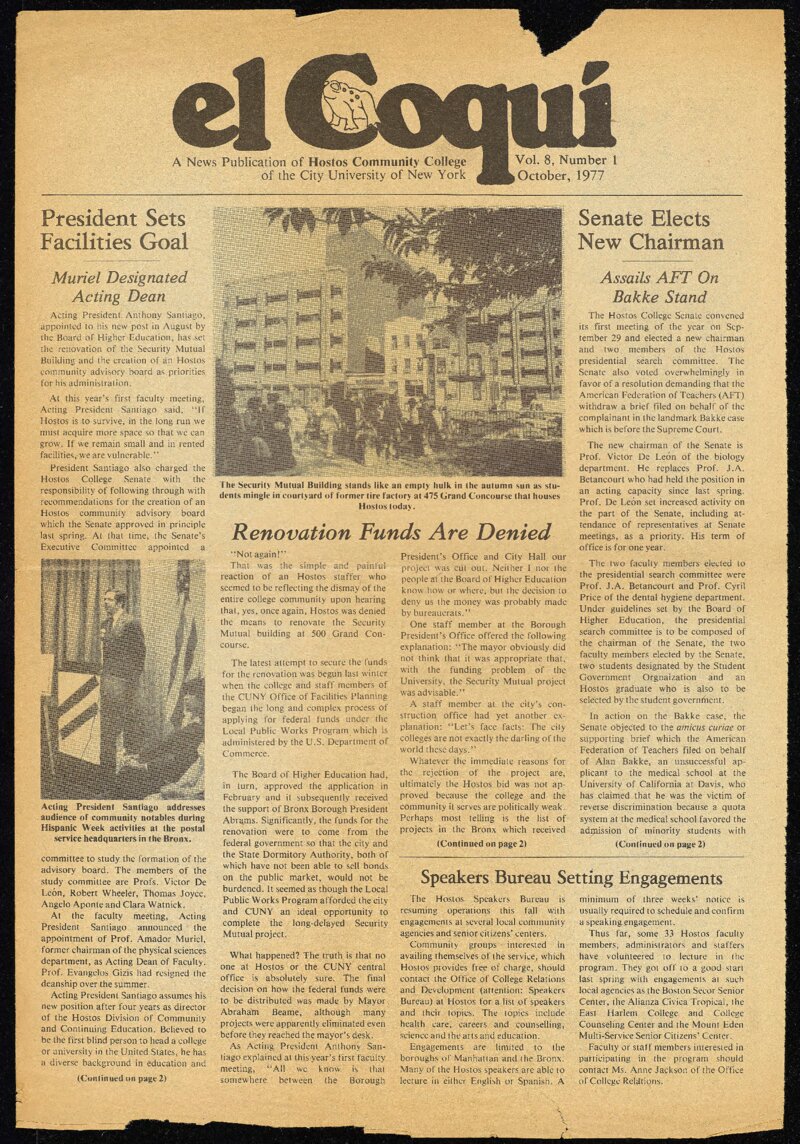
A News Publication of Hostos Community College
of the City University of New York
President Sets
Facilities Goal
Muriel Designated
Acting Dean
Acting President Anthony Santiago,
appointed to his new post in August by
the Board of Higher-Education, has set
the renovation of the Security Mutual
Building and the creation of an Hostos
community advisory board as priorities
for his administration.
At this year’s first faculty: meeting,
Acting President Santiago said, ‘‘If
Hostos is to survive, in the long run we
must acquire more space so that we can
grow. If we remain small and in rented |
facilities, we are vulnerable.”’
President Santiago also charged the
Hostos College Senate with the
responsibility of following through with
recommendations for the creation of an
Hostos community advisory board
which the Senate approved in principle
last spring. At that time, the Senate’s
Executive Committee appointed a
Acting President Santiago addresses
audience of community notables during
Hispanic Week activities at the postal
service headquarters in the Bronx.
committee to study the formation of the
advisory board. The members of the
study committee are Profs. Victor De
Leon, Robert Wheeler, Thomas Joyce,
Angelo Aponte and Clara Watnick.
At the faculty meeting, Acting
President Santiago announced the
appointment of Prof. Amador Muriel,
former chairman of the physical sciences
department, as Acting Dean of Faculty.
Prof. Evangelos Gizis had resigned the
deanship over the summer.
Acting President Santiago assumes his
new position after four years as director
of the Hostos Division of Community
and Continuing Education. Believed to
be the first blind person to head a college
or university in the United States, he has
a diverse background in education and
(Continued on page 2)
The Security Mutual Building stands like an empty hulk in the autumn sun as stu-
dents mingle in courtyard of former tire factory at 475 Grand Concourse that houses
Hostos today.
Renovation Funds Are Denied
“Not again!”
That was the simple and~ painful
reaction of an Hostos staffer who
seemed to be reflecting the dismay of the
entire college community upon hearing
that, yes, once again, Hostos was denied
the means to renovate the Security
Mutual building at 500 Grand Con-
course.
The latest attempt to secure the funds
for the renovation was begun last winter
when the college and staff members of
the CUNY Office of Facilities Planning
began the long and complex process of
applying for federal funds under the
Local Public Works Program which is
administered by the U.S. Department of
Commerce.
The Board of Higher Education had,
in turn, approved the application in
February and it subsequently received
the support of Bronx Borough President
Abrams. Significantly, the funds for the
renovation were to come from the
federal government so that the city and
the State Dormitory Authority, both of
which have not been able to sell bonds
on the public market, would not be
burdened. It seemed as though the Local
Public Works Program afforded the city
and CUNY an ideal opportunity to
complete the long-delayed Security
Mutual project.
What happened? The truth is that no
one at Hostos or the CUNY central
office is absolutely sure. The final
decision on how the federal funds were
to be distributed was made by Mayor.
Abraham Beame, although many
projects were apparently eliminated even
before they reached the mayor’s desk.
As Acting President Anthony San-
tiago explained at this year’s first faculty
meeting, ‘‘All we know is that
somewhere’ between the
~ with
' University, the Security Mutual project
President’s Office and City Hall our
project was cut out. Neither I nor the
people at the Board of Higher Education
know how or where, but the decision to
deny us the money was probably made
by bureaucrats.”
One staff member at the Borough
President’s Office offered the following
explanation: ““The mayor obviously did
not think that it was appropriate that,
the funding problem of the
was advisable.”
A staff member at the city’s con-
struction office had yet another ex-
planation: ‘‘Let’s face facts: The city
colleges are not exactly the darling of the
world these days.””
Whatever the immediate reasons for
the rejection of the project are,
ultimately the Hostos bid was not ap-
proved because the college and the
community it serves are politically weak.
Perhaps most telling is the list of
projects in the Bronx which received
(Continued on page 2)
Vol. 8, Number 1
y October, 1977
Senate Elects
New Chairman
Assails AFT On
Bakke Stand
The Hostos College Senate convened
its first meeting of the year on Sep-
tember 29 and elected a new chairman
and two members of the. Hostos
presidential search committee. The
Senate also voted overwhelmingly in
favor of a resolution demanding that the
American Federation of Teachers (AFT)
withdraw a brief filed on behalf of the
complainant in the landmark Bakke case
which is before the Supreme Court.
The new chairman of the Senate is
Prof. Victor De Leon of the. biology
department. He replaces Prof. J.A.
Betancourt who had held the position in
an acting capacity since last spring.
Prof. De Leon set increased activity on
the part of the Senate, including at-
tendance of representatives at Senate
meetings, as a priority. His term of
office is for one year.
- The two faculty. members elected to
the presidential search committee were
Prof. J.A. Betancourt and Prof. Cyril
Price of the dental hygiene department.
Under guidelines set by the Board of
Higher Education, the presidential
search committee is to be composed of
the chairman of the Senate, the two
faculty members elected by the Senate,
two students designated by the Student
Government Orgnaization and an
Hostos graduate who is also to be
selected by the student government.
In action on the Bakke case, the
Senate objected to the amicus curiae or
supporting brief which the American
Federation of Teachers filed on behalf
of Alan Bakke, an unsuccessful ap-
plicant to the medical school at the
University of California at Davis, who
has claimed that he was the victim of
reverse discrimination because a quota
system at the medical school favored the
admission of minority students with
(Continued on page 2)
Borough
Speakers Bureau Setting Engagements
The
resuming operations
engagements at several local community
agencies and senior citizens’ centers.
Bureau is
fall with
Hostos. Speakers
this
Community groups ~ interested in
availing themselves of the service, which
Hostos provides free of charge, should
contact the Office of College Relations
and Development (attention: Speakers
Bureau) at Hostos for a list of speakers
and their topics. The topics include
health care, careers and counselling,
science and the arts and education.
Engagements are limited to the
boroughs of Manhattan and the Bronx.
Many of the Hostos speakers are able to
lecture in either English or Spanish. A
yt
minimum of three weeks’ notice is
usually required to schedule and confirm
a speaking engagement.
Thus far, some 33 Hostos faculty
members, administrators and_ staffers
have volunteered to lecture in the
program. They got off to a good start
last spring with engagements at such
local agencies as the Boston Secor Senior
Center, the Alianza Civica Tropical, the
East Harlem College and College
Counseling Center and the Mount Eden
Multi-Service Senior Citizens’ Center.
Faculty or staff members interested in
participating in the program should
contact Ms. Anne Jackson of the Office
of College Reldtions.
EL COQUI
October, 1977
Anews publication of Hostos Community
College of the City University of N.Y.
Vol. 8 No.1 October, 1977
Published monthly from October through
June by the Office of College Relations and
Development, Hostos Community College, |
475 Grand Concourse, Bronx, New York
10451, El Coqui, named after a tree frog in-
digenous to Puerto Rico, is read by Hostos
faculty, staff, and students and the com-
munities which the college. serves. For in-
formation and submission of news call: (212)
960-1008,9.
President...
(Continued from page 1)
social work. He holds a bachelor’s
degree from City College and a master’s
degree from Hunter College’s School of
Social Work. After working in the early
sixties as a case worker at the Industrial
Home for the Blind, he became one of
the first directors of the Mobilization for
Youth’s first neighborhood — services
center in New York. In 1967, he was
appointed the director of the Brooklyn
Center of ASPIRA, and by 1970 he
became the Assistant Executive Director
of ASPIRA of New York. From that
position, he helped lead a court
challenge of the Board ‘of Education for
‘its failure to provide equal educational —
opportunities to Spanish-speaking
children.
Acting Dean of Faculty Amador Muriel
confers with Priscilla Talbot, assistant
to the dean.
In 1970, the Board of Education
named him director of recruitment and
training of Spanish-speaking teachers.
~ While still with the Board, he supervised
the publication of the Jenkins Report, a
study which led to the expansion and
- improvement of bilingual education in
the city school system. In addition, Mr.
Santiago served the Board of Higher
Education as a member of the Com-
mission on. Open Admissions. As a
member of a local school board on
Manhattan’s West Side, he played an
important part in the school decen-
tralization movement.
Acting President Santiago is married
to the former Elizabeth Anne Sheehan,
and he is the father of three children
ranging in age from eleven to six.
Dean Muriel is a native of the
Philippines where he graduated from a
high school program in livestock and
poultry raising (he once said he was
“trained to raise pigs and chickens’’)
and the University of the Philippines
from which he received a bachelor’s
degree. He subsequently moved to New
York, and earned a master’s degree and
a Ph.D. in physics from the State
University of New York at Stony Brook.
Since then, he has taught at the
University of the Philippines, Towson
State College, Stony Brook, the CUNY
Graduate Center, anne he is a doctoral
advisor, and Hostos.
Dean Muriel has also conducted
research at the Brookhaven National
Laboratory and NASA’s Institute for
Space Studies. In addition, he has taken
controversial stands on the role of
science and the scientist in society,
maintaining that technology and the
applied sciences should take precedence
in underdeveloped societies.
Dean Muriel’s wife, Gloria, is a
practicing pediatrician. They have two
daughters, aged ten and eight.
Students, Bank
Help Recruit
The mid-summer Hostos student
recruitment drive was a resounding
success thanks in great part to the
students, faculty and. administrators
who volunteered their. time for the ef-
fort.
Special thanks also go the
management of the local branch of
Bankers Trust which permitted Hostos
recruiters to set up a table at the bank
near the Hub section at 149th Street and
Third Avenue. Bankers Trust has of-
fered additional help to the college
through the office of Mr. Dan DiMuro,
assistant vice-president of the bank.
That help has come in the form of direct
grants to the office of college relations
and development to cover miscellaneous
expenses in the office’s grants effort; the
-bank has also donated the funds for all
the photography appearing in this year’s
~ volume of El Coqui.
“Our special thanks go to Bankers
Trust for all their help,’’ said Mr. Carlos
Velazquez, assistant director of ad-
_ missions who deployed the Hostos
recruiters. ‘“‘We were very well received
there and received everyone’s
cooperation.’’
If there was a
the Hostos family is a recruiter.”
Among the faculty volunteers were:
Profs. Anita Cunningham, Magda
Vasillov, Isaias de Jesus, Judith
Nowinski, Louis Browne, John Scarry
and Rosalina Vélez. Representing the
English department was staff member
Miriam Soto. The student volunteers
were: Evelyn Santiago, Evelyn Monge,
Lourdes Lopez, Lawyer Anderson,
Nancy Cruz, Beverly Simons and
graduate Benny Diaz. Noe Mercado, a
staff member of Eco/Echo, the student
newspaper, contributed by writing an
article on the recruitment drive which
was included in an issue of Spanish-
speaking daily E/ Mundo.
According to Mr. Velazquez, the
recruiters met with considerable success
as the college met its goals for the fall
semester. He said, however, that many
high school students who had originally
expressed an interest in Hostos, decided
in the end to go elsewhere. After sur-
veying these prospective students, he
concluded that, by and large, they
decided against Hostos because the
college did not have the physical
facilities — especially the athletic
facilities — available at other colleges.
full -
l slogan for the -
recruitment drive it was: “Everybody in -
A crew from WABC-TV’s People, Places and Things, a weekly half-hour program,
films the vast expanses of the interior of the Security Mutual Building. The area
shown above is but one wing of the building’s third floor; it is roughly twice the size
of the Concourse Building’s Combo Room. Acquisition of the building would
permit an enrollment of over 5,000 at Hostos’ present rate of occupancy.
Renovation...
(Continued from page 1)
Local Public Works funding. ous
them are:
Over $2 million for the continuation
of the new gateway and orientation
facility at the Botanical Gardens.
Nearly $3.9 million for reconstruction
of the City Island Bridge.
Over $2 million for a Yankee Stadium
parking lot. =
Nearly $3.25 million for three schools
in the Parkchester section of the Bronx.
Over $1.5 million for sewer and street
reconstruction at the Albert Einstein
peripheral.
Nearly $4.7 million for buildings at
the Bronx Zoo, including a primate
- building, or in other words, a monkey
house.
Indeed, there is something out of
kilter in a city which passes over a much
needed project at a struggling college in
favor of a parking lot at a ball park and
a monkey house at the zoo. And there is
an obvious lack of vision among the city
leadership when, in the face of warnings
from several federal agencies that the
needs of Spanish-speaking peoples are
being neglected, it chooses to undermine
the viability of the only bilingual in-
stitution of higher learning in the eastern
United States.
Recently, for example, a Justice
Department official pointed out that the
nation and the New York metropolitan
area were experiencing a sizable influx
of Hispanic-American immigrants with
special social, economic and educational
needs. He added that the single highest
concentration of the nation’s Hispanic
population was in New York City.
The upshot is that Hostos continues to
hold ESL and basic composition classes
in rooms intended for 20 students that
are brimming with as many as 35 and 40
students while the Security ‘Mutual
Building rests like a vacant hulk across
“the Grand Concourse from the former
tire factory that houses Hostos today.
Having set the renovation of Security
Mutual as ‘‘the highest priority” of his
administration, Acting President
Santiago has begun to explore ways to
obtain funding either through the city’ s
capital construction budget or through a
bond sale by the Dormitory Authority.
Lehman College, for example, was able —
to persuade a consortium of savings —
banks to buy Dormitory Authori
bonds to fund construction of sev
buildings on its campus. :
Figuring heavily in President Sai
tiago’s strategy is the creation of the
Hostos community advisory board —
which was approved this year by the —
college Senate and which it is hoped will :
be composed of individuals who would
be able to influence decision makers to —
complete the Hostos project. oe
“Whatever we do,’ President
Santiago said at the College Senate’s
first meeting of the year, ‘“‘we’ve got to
make sure that we follow the Security
Mutual project from one bureaucrat’s
desk to the other so that, we don’t get
passed over again.”’ ,
Senate...
(Continued from page 1)
lesser qualifications.
'The case has been the center of
considerable controversy as scores of
organizations and prominent individuals
have supported both sides in the debate,
although no
learning has filed on behalf of com-
plainant Bakke.
Clearly, the feeling of those
representatives at the Senate meeting
who argued in favor of the resolution
condemning the AFT brief was that a
decision in favor of Bakke would
seriously undermine most of the hard-
won gains in the civil rights movement.
As Acting President Anthony San-
institution of higher |
tiago put it, ‘‘All constitutional issues
aside, what all this comes down to is
discrimination and racism. It would be a
great setback to all that’s been ac-
complished.”” ee
‘What counts here,” said Prof.
Edward Maynard, who introduced the
resolution condemning the AFT, “‘is not _
the fine arguments of law. What counts
is the effect that a decision for Bakke
would have on society in general and our
goals for equality.”
The resolution, which will be sent to
AFT headquarters via ieee reads as _
follows:
“The College Senate of Hostos
Community College demands that you
withdraw the amicus curiae brief in
support of Alan Bakke vs. the Regents
of the University of California.”’
October, 1977
EL COQUI
Hostos Receives Diverse Grants
Hostos has received at least $262,193
in competitive grants for the 1977-78
academic year, according to Ms. Anne
Grosso, director of the Office of College
Relations and Development. :
The total does not include a
Vocational Education act grand ad-
ministered by The New York State
Education Department, which has been
approved for the medical laboratory
technology program as the award has
not yet been set. The total also excludes
a grant of $103,270 from the National
Science Foundation which is to be spent
over a period of three years. (The grant
is now in its second year.)
Following is a description of the
grants received thus far:
. . . English Department: A three-year
grant of $195,911 from The Fund for the
-Improvement of Postsecondary
Education (Department of Health,
Education and Welfare) to be shared
with Lehman College and Queen-
sborough Community. College over a
period of three years to develop a model
of writing development among non-
traditional students; $72,403 for-the first
year; Prof. Sondra Perl project director.
... Library: A grant of $3,855 from
the U.S. Office of Education for library
acquisitions; Prof. A.J. Betancourt
project director.
, . Physical Sciences Department: A
grant of $103,270 over three years from
the National Science Foundation for the
creation of a science resources center
and the improvement of the’ physical
sciences curriculum; Prof. Amador
Muriel project director.
., Dental Hygiene Department: A
"+ $10,368 grant under the Vocational
Education Act (VEA) for supplies.
audiovisual materials and other
equipment for the ‘‘expanded func-
tions’? aspect of the dental hygiene
curriculum; Prof. Anita Cunningham
project director.
Business and Accounting: A
$32,000 VEA grant for the creation of
an accounting laboratory in which
students will gain practical experience of
accounting procedures on accounting
machines; Prof. Fred Soussa project
director. =
Early Childhood Education
Department: A $4,570 VEA grant to
prepare audiovisual learning packages
for the department’s curriculum; Prof.
Paula Zajan project director. (The grant
was technically awarded for 1976-77,
but was not received until early summer
1977.)
-.. Community and Continuing
Education: A grant of $30,915 from the
Bureau of Occupational and Adult
Education (HEW) for a community
consumer education program for low-
income consumers of limited English-
speaking ability; Mr Anthony Santiago
project director; Ms. Alida- Pastonza
coordinator.
... Community and Continuing
Education: A $33,961 VEA grant for the
Minority Small Business Rescue Project;
Mr. Miguel Mendonez project director. .
Several of the grants are for projects
which are considerably innovative.
Articles on these grants will appear in
future issues of E/ Coqui.
Ms. Grosso will be joining forces with
Mr. Pepe Barron, Vice-President for
Program’ Development, to present a
grants seminar this fall for faculty who
are interested in writing’ grants
proposals, an activity which can be
extremely rewarding. They are. also
scheduling a number of visits by officials ©
from government granting agencies and
foundations. Faculty members will be
notified in advance of these activities.
| Development Officer Is Appointed
American Association of Community
and Junior Colleges; oe
Pepe Barron, a leading figure in
bilingual-bicultural education and the
community college movement, has been
appointed vice-president. for program
development at Hostos.
Mr. Barron will be responsible for
conducting research of public and
private funding sources on a nation-wide
basis; for exploring Hostos program
_ needs with officers of federal programs
and private foundations and. -cor-
porations; and for providing the
necessary persona! follow-up on grant
applications submitted by the college to
the various federal programs and private
agencies. In addition, Mr. Barron will be
chief development advisor and strategist
to Hostos’ president, Anthony Santiago.
The 40-year-old educator’s
distinguished professional career, which
has focused on the educational needs of
the nation’s Spanish speaking, has
particular relevance for. Hostos. As
Executive Director of el Congreso
Nacional (The National Congress for
College Affairs), Mr. Barréon was
responsible for modeling an
organization which develops and
promotes postsecondary educational
programs, especially at the community
college level, for Spanish-speaking
commmunities across the nation.
Previously, Mr. Barron served in a
similar capacity as the director of the
Spanish-Speaking - Fomento © at
At Pima Community College in
Tucson, Arizona, Mr. Barron was co-
director of the bilingual program and
served as chairman of the college’s
Intercultural Committee which was
responsible for providing faculty
training in intercultural curriculum and
teaching methodologies. He has also
served as an educational consultant for a
number of countries, including Costa
Rica, Guatemala, Mexico, and Peru,
and has helped organize and_- par-
ticipated in several White House con-—
ferences on education and Spanish-
speaking Americans. In addition, Mr.
Barron has conducted
research studies in the area of com-
munity college
sciences, Spanish, and ethnic studies at
the undergraduate, high school, and ~
elementary school levels.
Mr. Barron, who is married and the
father of three children, holds an
associate degree from Los Angeles City
College and bachelor’s and master’s
degrees from the University of Arizona.
He is a doctoral candidate in higher
education administration at the
University of Southern California.
numerous —
bilingual-bicultural -
education and has taught the social.
Mr. Jorge Rodriguez, systems analyst (left), and Mr. Julio Sanchez, computer
operator in the new computer center on the sixth floor of the Concourse building.
Computer Moved to Concourse
Over the summer, the Hostos com-
puter center changed location and
hands. In a move to save on rental
expenses, Hostos gave up the space at
the Melrose Building on 161st Street,
which the college had occupied since its
inception, and. moved the computer to
the sixth floor of the Concourse
Building.
The computer is now under the
purview of Acting Dean of Faculty
Amador Muriel who last year had begun
exploring ways with faculty from the
physical sciences and biology depart-
ments of implementing computer-
assisted instruction (CAI), Dean Muriel
says that the computer will now be called
“upon
to perform the usual ad-
ministrative tasks as well as to provide
some modules, especially drill exercises,
‘in. computer-assisted instruction. His
hope is that the proximity of the
computer will encourage faculty to.
experiment with this medium of in-
struction.
- Says Dean Muriel, ‘‘Now there is no
distance between faculty and the
computer.’” :
Several faculty members are taking
advantage of that proximity. Prof. Julio
Gallardo of the physical — sciences
department is continuing the work in
CAI which he began last year when the
computer was being used in the science
resources center. And Prof. Linda
Hirsch of the English department is
beginning to have some basic English
skills exercises programmed into. the
computer. : :
Made by the
Digital Computer
Company and referred to as a ‘“‘PDP-
11/40,”’ the college computer is a good
one. Although it is a ‘‘mini-computer’’
(as compared to some of the IBM
behemoths), it nevertheless: has ex-
traordinary powers. A total of 15 ter-
minals can operate on the computer at
once, and it can be used to solve arcane
problems in astro-physics or just print
the mailing labels for this newspaper.
The day-to-day operation of the
“computer is in the hands of Mr. Jorge
Rodriguez who, as a systems analyst and
programmer, determines the needs of
individual users and writes the programs
which instruct the computer to perform
many and varied tasks. Assisting Mr.
Rodriguez is Mr. Julio Sanchez, a
computer operator who has been with
- Hostos for several years and is ‘‘very
familiar’’ with the computer.
‘Mr. Rodriguez is now working on a
number of projects including the
computerization of the registration
process. He indicates that the computer
has “‘tremendous potential’? for the
college community, and that various
offices and departments throughout the
college are using terminals regularly.
Among those are the radiological
technology department and the Office of
College Relations and Development
which has computerized a 3,500-entry
mailing list. The English department will
soon have its own terminal.
Similar to typewriters, the terminals
can be used from: any office in the
college. They are linked to the computer
by telephone, and, because they are on
“casters, they are very mobile.
Democrats Value Hispanic Vote
A report by the national committee of .
the Democratic party released over the
summer has revealed that Hispanic
voters across the country contributed
significantly to Jimmy Carter’s victory
last November.
The report pointed out that, whereas
it has been generally acknowledged that
the overwhelming support of Black
voters for Jimmy Carter was crucial to
the Democratic presidential candidate —
especially in the South — the Hispanic
vote was equally important to Carter in
two key states, Texas and Ohio.
And in New York City, which in
effect carried the state for Carter, the
’ Democrat received an unusually high
vote of confidence from Latinos.
As the report put it, ‘‘Carter did best
in New York, with its [large] Puerto
Rican community, collecting 89 percent
of the Hispanic vote.””
“Carter,’’ said one Hostos staffer,
‘felt compelled to call up Beame on the
night of the election to thank him for
(Continued on page 4)
EL COQUI
October, 1977
SS
WHAT IS, WHAT COULD BE: Staff members in the office of the Dean of Stu-
dents are hard at work in cramped conditions during recent telephone recruitment
campaign. Conditions such as these prevail at the Concourse building while across
News Briefs
Prof. Victor De Leon of the biology
department has collaborated on an
article entitled ‘“‘Stored and Polysomal
Ribosomes of Mouse Ova’’ which
appeared in a _ recent issue of
Developmental Biology. The article is
related to extensive research on em-
bryonic development which Prof. De
Leon has conducted at the Cornell
University Medical College.
Prof. Carlos Quiroga of the English
department published two articles —
“Etnocentrismo _linguistico: — actitud
negativa bilateral dentro de la educacion
bilingue’’ and ‘‘Situacion del educando
hispano hablante en los Estados
Unidos”’ — in the spring edition of El
Condor Literary Review which is
published in Puerto Rico by the Ana G.
Mendez Educational Foundation.. The
articles deal with what Prof. Quiroga
terms ‘‘the negative attitudes taken by
college ESL teachers during the ...
presentation and imposition of ‘the
second language.’ ”’
Prof. Quiroga is presently finishing a
follow-up article with the cooperation of
Prof. Bowman Wiley, also of the
English department. The article delves
into the roots of ethnocentric attitudes
in the ESL classroom.
Hostos graduate Alcides Torres (’72) has
returned to New York City after serving
for three years as a counselor in the
department of corrections in Puerto
Rico. Mr. Torres was a member of the
charter class of Hostos Community
College. He went on for a bachelor’s
degree in sociology at Lehman College
and a master’s degree, also in sociology,
at City College. Two of Mr. Torres’
sons, Jay and Amos, are also graduates
of Hostos, and have served the college as
employees and loyal friends through the
years. During his three years in Puerto
Rico, Mr. Torres, senior, was the pastor
of a church in San Jose, Rio Piedras.
Hostos graduate Emilia Torres
graduated summa cum laude from City
College last June.
Prof. Pablo Cabrera, chairman of the
Puerto Rican studies department, was
the stage director for the world premiere
performance of Macias, the oldest
known Puerto Rican opera, which was
presented at the Opera de San Juan over
the summer. The opera was written in
the mid-nineteenth century by Felipe
Gutierrez y Espinosa, a Puerto Rican
composer whose talents had not been
recognized until lately. Gutierrez had
originally dedicated the opera to king
Alfonso XII of Spain, but it was never
performed and it soon fell into oblivion.
The opera was rediscovered recently in
the Royal Archives in Madrid by Puerto
Rican historian Lidio Cruz Monclova.
The Opera de San Juan’s production of
Macias was appropriately dedicated to
Spain’s present king, Juan Carlos. It
was the cause of considerable com-
motion in the operatic world, not only
because of the work’s superior quality,
but also because it is the oldest opera
from the Caribbean area. Says Prof.
Cabrera, ‘Macias changes almost
completely the panorama of Puerto
Rican music.”’
The costumes and scenery used in the
premiere. of Macias were largely the
result of efforts by Prof. Carmen Marin
of the Puerto Rican studies department
who was called in to research the period
and place—13th century Spain—of the
opera. Prof. Marin’s assignment was
particularly challenging because the 13th
century remains a relatively obscure era
in Spanish history.
Prof. Cabrera alsonarrated one of the
recent segments of Realidades, a
national bilingual Latino series shown
from time to time on public broad-
casting stations. Entitled ‘‘Who’s Afraid
of Bilingual Education,’’ the segment
reviews bilingual programs at several
schools across the nation.
Also appearing in a segment of
Realidades entitled ‘“‘Your Vote is
Powerful’ were the Hon. Jack John
Olivero, a member of the Board of
Higher Education, and former chairman
of the Puerto Rican Legal Defense
Fund, Congressman Herman Badillo
and Raquel Creitoff of the Office of the
Commonwealth of Puerto Rico who was
among the community leaders who
campaigned for the creation of Hostos
Community College.
Prof. Leroy Sparks, chairman of the
radiologic technology department, has
collaborated with Dr. A. Brent Garber,
a nationally known figure in health
the street une Security Mutual Building remains unused. The Hostos staffers are
(from left) Louise Merced, Carmen Clemente, Virginia Maldonado and Josie
Garcia.
education, to produce a modularly
designed medical terminology program
entitled . Learn-a-Term. Published by
Aspen Systems Corporation, the
program is designed for
paraprofessional health care personnel
who use medical terms, but may not
know what they mean. Prof. Sparks and
Dr. Garber have based the Learn-a-
Term program on teaching experiences
at Hostos. (Dr. Garber has lectured at
Hostos.) The program has been used
with great success at Harlem and
Roosevelt Hospitals.
Prof. Graciela Rivera of the visual and
performing arts department has been
included in the latest edition of the
International Who’s Who in Music and
Musicians Directory. The volume
outlines Prof. Rivera’s rich career which
began in 1952 with her debut in the title
role of Lucia di Lammermoor at New
York City’s Metropolitan Opera. Prof.
Rivera was the first Puerto Rican to sing
a title role at the vaunted Met. She has
since performed in opera houses in
major cities in Europe, the United States
and Latin America.
Acting Dean of Faculty Amador Muriel
has published a paper entitled
“TWlustrative Calculations Using
Projection Techniques”’ in the August
1977 issue of the American Journal of
Physics, The paper presents an ex-
planation of how physicists can predict
the interaction of two bodies in a
physical system. It is based on highly
theoretical research which Dean Muriel
began in graduate school and completed
while at Hostos. The American Journal
of Physics is a pedagogical journal
intended primarily for doctoral level
students and teachers.
Hostos Community College
475 Grand Concourse
Bronx, N.Y. 10451
Hostos graduate Heriberto Seda has
been elected chairman of the committee
on committees of the Lehman College
Senate. Mr. Seda is also the founder and
president of the Asociacion Estudiantil
de Educacion Bilingue-Bicultural, a
student/faculty organization at Lehman
which promotes bilingual, bicultural
education.
Democrats...
(Continued from page 3)
delivering New York. You’d think that
in some way he’d do the same for the
city’s Latins.””
Still in all, the Democratic National
Committee’s report emphasized that
Hispanics ‘‘came nowhere near
measuring up to their potential’ last
November. ‘‘For every two Hispanics
who voted,’’ the report claimed, “‘three
potential voters did not.”
A perfect example of this unrealized
potential was the meager turnout of
Hispanics, particularly Chicanos, in
California, the nation’s largest state and
a treasure chest of electoral votes. As the
report claimed, ‘‘if Texas and Ohio [and
New. York] show the difference the
Hispanic vote can make, California
shows the difference -it might have
made.”’ It concludes that, had Latino
voters turned out in California at the
same rate as they did nationally, the
state would have swung to Carter.
The lesson to be drawn from the last
national elections is clear: Hispanics are
a burgeoning power in the nation, and,
as the Justice Department, the Com-
mission on Civil Rights and the Bureau
of Labor Statistics have acknowledged,
they are growing in numbers. How
effectively Hispanics make their
presence know, will depend on how
effectively they wield their political
clout.
NON-PROFIT ORG.
U. S. POSTAGE
Paid
BRONX, N. Y.
PERMIT NO. 227
of the City University of New York
President Sets
Facilities Goal
Muriel Designated
Acting Dean
Acting President Anthony Santiago,
appointed to his new post in August by
the Board of Higher-Education, has set
the renovation of the Security Mutual
Building and the creation of an Hostos
community advisory board as priorities
for his administration.
At this year’s first faculty: meeting,
Acting President Santiago said, ‘‘If
Hostos is to survive, in the long run we
must acquire more space so that we can
grow. If we remain small and in rented |
facilities, we are vulnerable.”’
President Santiago also charged the
Hostos College Senate with the
responsibility of following through with
recommendations for the creation of an
Hostos community advisory board
which the Senate approved in principle
last spring. At that time, the Senate’s
Executive Committee appointed a
Acting President Santiago addresses
audience of community notables during
Hispanic Week activities at the postal
service headquarters in the Bronx.
committee to study the formation of the
advisory board. The members of the
study committee are Profs. Victor De
Leon, Robert Wheeler, Thomas Joyce,
Angelo Aponte and Clara Watnick.
At the faculty meeting, Acting
President Santiago announced the
appointment of Prof. Amador Muriel,
former chairman of the physical sciences
department, as Acting Dean of Faculty.
Prof. Evangelos Gizis had resigned the
deanship over the summer.
Acting President Santiago assumes his
new position after four years as director
of the Hostos Division of Community
and Continuing Education. Believed to
be the first blind person to head a college
or university in the United States, he has
a diverse background in education and
(Continued on page 2)
The Security Mutual Building stands like an empty hulk in the autumn sun as stu-
dents mingle in courtyard of former tire factory at 475 Grand Concourse that houses
Hostos today.
Renovation Funds Are Denied
“Not again!”
That was the simple and~ painful
reaction of an Hostos staffer who
seemed to be reflecting the dismay of the
entire college community upon hearing
that, yes, once again, Hostos was denied
the means to renovate the Security
Mutual building at 500 Grand Con-
course.
The latest attempt to secure the funds
for the renovation was begun last winter
when the college and staff members of
the CUNY Office of Facilities Planning
began the long and complex process of
applying for federal funds under the
Local Public Works Program which is
administered by the U.S. Department of
Commerce.
The Board of Higher Education had,
in turn, approved the application in
February and it subsequently received
the support of Bronx Borough President
Abrams. Significantly, the funds for the
renovation were to come from the
federal government so that the city and
the State Dormitory Authority, both of
which have not been able to sell bonds
on the public market, would not be
burdened. It seemed as though the Local
Public Works Program afforded the city
and CUNY an ideal opportunity to
complete the long-delayed Security
Mutual project.
What happened? The truth is that no
one at Hostos or the CUNY central
office is absolutely sure. The final
decision on how the federal funds were
to be distributed was made by Mayor.
Abraham Beame, although many
projects were apparently eliminated even
before they reached the mayor’s desk.
As Acting President Anthony San-
tiago explained at this year’s first faculty
meeting, ‘‘All we know is that
somewhere’ between the
~ with
' University, the Security Mutual project
President’s Office and City Hall our
project was cut out. Neither I nor the
people at the Board of Higher Education
know how or where, but the decision to
deny us the money was probably made
by bureaucrats.”
One staff member at the Borough
President’s Office offered the following
explanation: ““The mayor obviously did
not think that it was appropriate that,
the funding problem of the
was advisable.”
A staff member at the city’s con-
struction office had yet another ex-
planation: ‘‘Let’s face facts: The city
colleges are not exactly the darling of the
world these days.””
Whatever the immediate reasons for
the rejection of the project are,
ultimately the Hostos bid was not ap-
proved because the college and the
community it serves are politically weak.
Perhaps most telling is the list of
projects in the Bronx which received
(Continued on page 2)
Vol. 8, Number 1
y October, 1977
Senate Elects
New Chairman
Assails AFT On
Bakke Stand
The Hostos College Senate convened
its first meeting of the year on Sep-
tember 29 and elected a new chairman
and two members of the. Hostos
presidential search committee. The
Senate also voted overwhelmingly in
favor of a resolution demanding that the
American Federation of Teachers (AFT)
withdraw a brief filed on behalf of the
complainant in the landmark Bakke case
which is before the Supreme Court.
The new chairman of the Senate is
Prof. Victor De Leon of the. biology
department. He replaces Prof. J.A.
Betancourt who had held the position in
an acting capacity since last spring.
Prof. De Leon set increased activity on
the part of the Senate, including at-
tendance of representatives at Senate
meetings, as a priority. His term of
office is for one year.
- The two faculty. members elected to
the presidential search committee were
Prof. J.A. Betancourt and Prof. Cyril
Price of the dental hygiene department.
Under guidelines set by the Board of
Higher Education, the presidential
search committee is to be composed of
the chairman of the Senate, the two
faculty members elected by the Senate,
two students designated by the Student
Government Orgnaization and an
Hostos graduate who is also to be
selected by the student government.
In action on the Bakke case, the
Senate objected to the amicus curiae or
supporting brief which the American
Federation of Teachers filed on behalf
of Alan Bakke, an unsuccessful ap-
plicant to the medical school at the
University of California at Davis, who
has claimed that he was the victim of
reverse discrimination because a quota
system at the medical school favored the
admission of minority students with
(Continued on page 2)
Borough
Speakers Bureau Setting Engagements
The
resuming operations
engagements at several local community
agencies and senior citizens’ centers.
Bureau is
fall with
Hostos. Speakers
this
Community groups ~ interested in
availing themselves of the service, which
Hostos provides free of charge, should
contact the Office of College Relations
and Development (attention: Speakers
Bureau) at Hostos for a list of speakers
and their topics. The topics include
health care, careers and counselling,
science and the arts and education.
Engagements are limited to the
boroughs of Manhattan and the Bronx.
Many of the Hostos speakers are able to
lecture in either English or Spanish. A
yt
minimum of three weeks’ notice is
usually required to schedule and confirm
a speaking engagement.
Thus far, some 33 Hostos faculty
members, administrators and_ staffers
have volunteered to lecture in the
program. They got off to a good start
last spring with engagements at such
local agencies as the Boston Secor Senior
Center, the Alianza Civica Tropical, the
East Harlem College and College
Counseling Center and the Mount Eden
Multi-Service Senior Citizens’ Center.
Faculty or staff members interested in
participating in the program should
contact Ms. Anne Jackson of the Office
of College Reldtions.
EL COQUI
October, 1977
Anews publication of Hostos Community
College of the City University of N.Y.
Vol. 8 No.1 October, 1977
Published monthly from October through
June by the Office of College Relations and
Development, Hostos Community College, |
475 Grand Concourse, Bronx, New York
10451, El Coqui, named after a tree frog in-
digenous to Puerto Rico, is read by Hostos
faculty, staff, and students and the com-
munities which the college. serves. For in-
formation and submission of news call: (212)
960-1008,9.
President...
(Continued from page 1)
social work. He holds a bachelor’s
degree from City College and a master’s
degree from Hunter College’s School of
Social Work. After working in the early
sixties as a case worker at the Industrial
Home for the Blind, he became one of
the first directors of the Mobilization for
Youth’s first neighborhood — services
center in New York. In 1967, he was
appointed the director of the Brooklyn
Center of ASPIRA, and by 1970 he
became the Assistant Executive Director
of ASPIRA of New York. From that
position, he helped lead a court
challenge of the Board ‘of Education for
‘its failure to provide equal educational —
opportunities to Spanish-speaking
children.
Acting Dean of Faculty Amador Muriel
confers with Priscilla Talbot, assistant
to the dean.
In 1970, the Board of Education
named him director of recruitment and
training of Spanish-speaking teachers.
~ While still with the Board, he supervised
the publication of the Jenkins Report, a
study which led to the expansion and
- improvement of bilingual education in
the city school system. In addition, Mr.
Santiago served the Board of Higher
Education as a member of the Com-
mission on. Open Admissions. As a
member of a local school board on
Manhattan’s West Side, he played an
important part in the school decen-
tralization movement.
Acting President Santiago is married
to the former Elizabeth Anne Sheehan,
and he is the father of three children
ranging in age from eleven to six.
Dean Muriel is a native of the
Philippines where he graduated from a
high school program in livestock and
poultry raising (he once said he was
“trained to raise pigs and chickens’’)
and the University of the Philippines
from which he received a bachelor’s
degree. He subsequently moved to New
York, and earned a master’s degree and
a Ph.D. in physics from the State
University of New York at Stony Brook.
Since then, he has taught at the
University of the Philippines, Towson
State College, Stony Brook, the CUNY
Graduate Center, anne he is a doctoral
advisor, and Hostos.
Dean Muriel has also conducted
research at the Brookhaven National
Laboratory and NASA’s Institute for
Space Studies. In addition, he has taken
controversial stands on the role of
science and the scientist in society,
maintaining that technology and the
applied sciences should take precedence
in underdeveloped societies.
Dean Muriel’s wife, Gloria, is a
practicing pediatrician. They have two
daughters, aged ten and eight.
Students, Bank
Help Recruit
The mid-summer Hostos student
recruitment drive was a resounding
success thanks in great part to the
students, faculty and. administrators
who volunteered their. time for the ef-
fort.
Special thanks also go the
management of the local branch of
Bankers Trust which permitted Hostos
recruiters to set up a table at the bank
near the Hub section at 149th Street and
Third Avenue. Bankers Trust has of-
fered additional help to the college
through the office of Mr. Dan DiMuro,
assistant vice-president of the bank.
That help has come in the form of direct
grants to the office of college relations
and development to cover miscellaneous
expenses in the office’s grants effort; the
-bank has also donated the funds for all
the photography appearing in this year’s
~ volume of El Coqui.
“Our special thanks go to Bankers
Trust for all their help,’’ said Mr. Carlos
Velazquez, assistant director of ad-
_ missions who deployed the Hostos
recruiters. ‘“‘We were very well received
there and received everyone’s
cooperation.’’
If there was a
the Hostos family is a recruiter.”
Among the faculty volunteers were:
Profs. Anita Cunningham, Magda
Vasillov, Isaias de Jesus, Judith
Nowinski, Louis Browne, John Scarry
and Rosalina Vélez. Representing the
English department was staff member
Miriam Soto. The student volunteers
were: Evelyn Santiago, Evelyn Monge,
Lourdes Lopez, Lawyer Anderson,
Nancy Cruz, Beverly Simons and
graduate Benny Diaz. Noe Mercado, a
staff member of Eco/Echo, the student
newspaper, contributed by writing an
article on the recruitment drive which
was included in an issue of Spanish-
speaking daily E/ Mundo.
According to Mr. Velazquez, the
recruiters met with considerable success
as the college met its goals for the fall
semester. He said, however, that many
high school students who had originally
expressed an interest in Hostos, decided
in the end to go elsewhere. After sur-
veying these prospective students, he
concluded that, by and large, they
decided against Hostos because the
college did not have the physical
facilities — especially the athletic
facilities — available at other colleges.
full -
l slogan for the -
recruitment drive it was: “Everybody in -
A crew from WABC-TV’s People, Places and Things, a weekly half-hour program,
films the vast expanses of the interior of the Security Mutual Building. The area
shown above is but one wing of the building’s third floor; it is roughly twice the size
of the Concourse Building’s Combo Room. Acquisition of the building would
permit an enrollment of over 5,000 at Hostos’ present rate of occupancy.
Renovation...
(Continued from page 1)
Local Public Works funding. ous
them are:
Over $2 million for the continuation
of the new gateway and orientation
facility at the Botanical Gardens.
Nearly $3.9 million for reconstruction
of the City Island Bridge.
Over $2 million for a Yankee Stadium
parking lot. =
Nearly $3.25 million for three schools
in the Parkchester section of the Bronx.
Over $1.5 million for sewer and street
reconstruction at the Albert Einstein
peripheral.
Nearly $4.7 million for buildings at
the Bronx Zoo, including a primate
- building, or in other words, a monkey
house.
Indeed, there is something out of
kilter in a city which passes over a much
needed project at a struggling college in
favor of a parking lot at a ball park and
a monkey house at the zoo. And there is
an obvious lack of vision among the city
leadership when, in the face of warnings
from several federal agencies that the
needs of Spanish-speaking peoples are
being neglected, it chooses to undermine
the viability of the only bilingual in-
stitution of higher learning in the eastern
United States.
Recently, for example, a Justice
Department official pointed out that the
nation and the New York metropolitan
area were experiencing a sizable influx
of Hispanic-American immigrants with
special social, economic and educational
needs. He added that the single highest
concentration of the nation’s Hispanic
population was in New York City.
The upshot is that Hostos continues to
hold ESL and basic composition classes
in rooms intended for 20 students that
are brimming with as many as 35 and 40
students while the Security ‘Mutual
Building rests like a vacant hulk across
“the Grand Concourse from the former
tire factory that houses Hostos today.
Having set the renovation of Security
Mutual as ‘‘the highest priority” of his
administration, Acting President
Santiago has begun to explore ways to
obtain funding either through the city’ s
capital construction budget or through a
bond sale by the Dormitory Authority.
Lehman College, for example, was able —
to persuade a consortium of savings —
banks to buy Dormitory Authori
bonds to fund construction of sev
buildings on its campus. :
Figuring heavily in President Sai
tiago’s strategy is the creation of the
Hostos community advisory board —
which was approved this year by the —
college Senate and which it is hoped will :
be composed of individuals who would
be able to influence decision makers to —
complete the Hostos project. oe
“Whatever we do,’ President
Santiago said at the College Senate’s
first meeting of the year, ‘“‘we’ve got to
make sure that we follow the Security
Mutual project from one bureaucrat’s
desk to the other so that, we don’t get
passed over again.”’ ,
Senate...
(Continued from page 1)
lesser qualifications.
'The case has been the center of
considerable controversy as scores of
organizations and prominent individuals
have supported both sides in the debate,
although no
learning has filed on behalf of com-
plainant Bakke.
Clearly, the feeling of those
representatives at the Senate meeting
who argued in favor of the resolution
condemning the AFT brief was that a
decision in favor of Bakke would
seriously undermine most of the hard-
won gains in the civil rights movement.
As Acting President Anthony San-
institution of higher |
tiago put it, ‘‘All constitutional issues
aside, what all this comes down to is
discrimination and racism. It would be a
great setback to all that’s been ac-
complished.”” ee
‘What counts here,” said Prof.
Edward Maynard, who introduced the
resolution condemning the AFT, “‘is not _
the fine arguments of law. What counts
is the effect that a decision for Bakke
would have on society in general and our
goals for equality.”
The resolution, which will be sent to
AFT headquarters via ieee reads as _
follows:
“The College Senate of Hostos
Community College demands that you
withdraw the amicus curiae brief in
support of Alan Bakke vs. the Regents
of the University of California.”’
October, 1977
EL COQUI
Hostos Receives Diverse Grants
Hostos has received at least $262,193
in competitive grants for the 1977-78
academic year, according to Ms. Anne
Grosso, director of the Office of College
Relations and Development. :
The total does not include a
Vocational Education act grand ad-
ministered by The New York State
Education Department, which has been
approved for the medical laboratory
technology program as the award has
not yet been set. The total also excludes
a grant of $103,270 from the National
Science Foundation which is to be spent
over a period of three years. (The grant
is now in its second year.)
Following is a description of the
grants received thus far:
. . . English Department: A three-year
grant of $195,911 from The Fund for the
-Improvement of Postsecondary
Education (Department of Health,
Education and Welfare) to be shared
with Lehman College and Queen-
sborough Community. College over a
period of three years to develop a model
of writing development among non-
traditional students; $72,403 for-the first
year; Prof. Sondra Perl project director.
... Library: A grant of $3,855 from
the U.S. Office of Education for library
acquisitions; Prof. A.J. Betancourt
project director.
, . Physical Sciences Department: A
grant of $103,270 over three years from
the National Science Foundation for the
creation of a science resources center
and the improvement of the’ physical
sciences curriculum; Prof. Amador
Muriel project director.
., Dental Hygiene Department: A
"+ $10,368 grant under the Vocational
Education Act (VEA) for supplies.
audiovisual materials and other
equipment for the ‘‘expanded func-
tions’? aspect of the dental hygiene
curriculum; Prof. Anita Cunningham
project director.
Business and Accounting: A
$32,000 VEA grant for the creation of
an accounting laboratory in which
students will gain practical experience of
accounting procedures on accounting
machines; Prof. Fred Soussa project
director. =
Early Childhood Education
Department: A $4,570 VEA grant to
prepare audiovisual learning packages
for the department’s curriculum; Prof.
Paula Zajan project director. (The grant
was technically awarded for 1976-77,
but was not received until early summer
1977.)
-.. Community and Continuing
Education: A grant of $30,915 from the
Bureau of Occupational and Adult
Education (HEW) for a community
consumer education program for low-
income consumers of limited English-
speaking ability; Mr Anthony Santiago
project director; Ms. Alida- Pastonza
coordinator.
... Community and Continuing
Education: A $33,961 VEA grant for the
Minority Small Business Rescue Project;
Mr. Miguel Mendonez project director. .
Several of the grants are for projects
which are considerably innovative.
Articles on these grants will appear in
future issues of E/ Coqui.
Ms. Grosso will be joining forces with
Mr. Pepe Barron, Vice-President for
Program’ Development, to present a
grants seminar this fall for faculty who
are interested in writing’ grants
proposals, an activity which can be
extremely rewarding. They are. also
scheduling a number of visits by officials ©
from government granting agencies and
foundations. Faculty members will be
notified in advance of these activities.
| Development Officer Is Appointed
American Association of Community
and Junior Colleges; oe
Pepe Barron, a leading figure in
bilingual-bicultural education and the
community college movement, has been
appointed vice-president. for program
development at Hostos.
Mr. Barron will be responsible for
conducting research of public and
private funding sources on a nation-wide
basis; for exploring Hostos program
_ needs with officers of federal programs
and private foundations and. -cor-
porations; and for providing the
necessary persona! follow-up on grant
applications submitted by the college to
the various federal programs and private
agencies. In addition, Mr. Barron will be
chief development advisor and strategist
to Hostos’ president, Anthony Santiago.
The 40-year-old educator’s
distinguished professional career, which
has focused on the educational needs of
the nation’s Spanish speaking, has
particular relevance for. Hostos. As
Executive Director of el Congreso
Nacional (The National Congress for
College Affairs), Mr. Barréon was
responsible for modeling an
organization which develops and
promotes postsecondary educational
programs, especially at the community
college level, for Spanish-speaking
commmunities across the nation.
Previously, Mr. Barron served in a
similar capacity as the director of the
Spanish-Speaking - Fomento © at
At Pima Community College in
Tucson, Arizona, Mr. Barron was co-
director of the bilingual program and
served as chairman of the college’s
Intercultural Committee which was
responsible for providing faculty
training in intercultural curriculum and
teaching methodologies. He has also
served as an educational consultant for a
number of countries, including Costa
Rica, Guatemala, Mexico, and Peru,
and has helped organize and_- par-
ticipated in several White House con-—
ferences on education and Spanish-
speaking Americans. In addition, Mr.
Barron has conducted
research studies in the area of com-
munity college
sciences, Spanish, and ethnic studies at
the undergraduate, high school, and ~
elementary school levels.
Mr. Barron, who is married and the
father of three children, holds an
associate degree from Los Angeles City
College and bachelor’s and master’s
degrees from the University of Arizona.
He is a doctoral candidate in higher
education administration at the
University of Southern California.
numerous —
bilingual-bicultural -
education and has taught the social.
Mr. Jorge Rodriguez, systems analyst (left), and Mr. Julio Sanchez, computer
operator in the new computer center on the sixth floor of the Concourse building.
Computer Moved to Concourse
Over the summer, the Hostos com-
puter center changed location and
hands. In a move to save on rental
expenses, Hostos gave up the space at
the Melrose Building on 161st Street,
which the college had occupied since its
inception, and. moved the computer to
the sixth floor of the Concourse
Building.
The computer is now under the
purview of Acting Dean of Faculty
Amador Muriel who last year had begun
exploring ways with faculty from the
physical sciences and biology depart-
ments of implementing computer-
assisted instruction (CAI), Dean Muriel
says that the computer will now be called
“upon
to perform the usual ad-
ministrative tasks as well as to provide
some modules, especially drill exercises,
‘in. computer-assisted instruction. His
hope is that the proximity of the
computer will encourage faculty to.
experiment with this medium of in-
struction.
- Says Dean Muriel, ‘‘Now there is no
distance between faculty and the
computer.’” :
Several faculty members are taking
advantage of that proximity. Prof. Julio
Gallardo of the physical — sciences
department is continuing the work in
CAI which he began last year when the
computer was being used in the science
resources center. And Prof. Linda
Hirsch of the English department is
beginning to have some basic English
skills exercises programmed into. the
computer. : :
Made by the
Digital Computer
Company and referred to as a ‘“‘PDP-
11/40,”’ the college computer is a good
one. Although it is a ‘‘mini-computer’’
(as compared to some of the IBM
behemoths), it nevertheless: has ex-
traordinary powers. A total of 15 ter-
minals can operate on the computer at
once, and it can be used to solve arcane
problems in astro-physics or just print
the mailing labels for this newspaper.
The day-to-day operation of the
“computer is in the hands of Mr. Jorge
Rodriguez who, as a systems analyst and
programmer, determines the needs of
individual users and writes the programs
which instruct the computer to perform
many and varied tasks. Assisting Mr.
Rodriguez is Mr. Julio Sanchez, a
computer operator who has been with
- Hostos for several years and is ‘‘very
familiar’’ with the computer.
‘Mr. Rodriguez is now working on a
number of projects including the
computerization of the registration
process. He indicates that the computer
has “‘tremendous potential’? for the
college community, and that various
offices and departments throughout the
college are using terminals regularly.
Among those are the radiological
technology department and the Office of
College Relations and Development
which has computerized a 3,500-entry
mailing list. The English department will
soon have its own terminal.
Similar to typewriters, the terminals
can be used from: any office in the
college. They are linked to the computer
by telephone, and, because they are on
“casters, they are very mobile.
Democrats Value Hispanic Vote
A report by the national committee of .
the Democratic party released over the
summer has revealed that Hispanic
voters across the country contributed
significantly to Jimmy Carter’s victory
last November.
The report pointed out that, whereas
it has been generally acknowledged that
the overwhelming support of Black
voters for Jimmy Carter was crucial to
the Democratic presidential candidate —
especially in the South — the Hispanic
vote was equally important to Carter in
two key states, Texas and Ohio.
And in New York City, which in
effect carried the state for Carter, the
’ Democrat received an unusually high
vote of confidence from Latinos.
As the report put it, ‘‘Carter did best
in New York, with its [large] Puerto
Rican community, collecting 89 percent
of the Hispanic vote.””
“Carter,’’ said one Hostos staffer,
‘felt compelled to call up Beame on the
night of the election to thank him for
(Continued on page 4)
EL COQUI
October, 1977
SS
WHAT IS, WHAT COULD BE: Staff members in the office of the Dean of Stu-
dents are hard at work in cramped conditions during recent telephone recruitment
campaign. Conditions such as these prevail at the Concourse building while across
News Briefs
Prof. Victor De Leon of the biology
department has collaborated on an
article entitled ‘“‘Stored and Polysomal
Ribosomes of Mouse Ova’’ which
appeared in a _ recent issue of
Developmental Biology. The article is
related to extensive research on em-
bryonic development which Prof. De
Leon has conducted at the Cornell
University Medical College.
Prof. Carlos Quiroga of the English
department published two articles —
“Etnocentrismo _linguistico: — actitud
negativa bilateral dentro de la educacion
bilingue’’ and ‘‘Situacion del educando
hispano hablante en los Estados
Unidos”’ — in the spring edition of El
Condor Literary Review which is
published in Puerto Rico by the Ana G.
Mendez Educational Foundation.. The
articles deal with what Prof. Quiroga
terms ‘‘the negative attitudes taken by
college ESL teachers during the ...
presentation and imposition of ‘the
second language.’ ”’
Prof. Quiroga is presently finishing a
follow-up article with the cooperation of
Prof. Bowman Wiley, also of the
English department. The article delves
into the roots of ethnocentric attitudes
in the ESL classroom.
Hostos graduate Alcides Torres (’72) has
returned to New York City after serving
for three years as a counselor in the
department of corrections in Puerto
Rico. Mr. Torres was a member of the
charter class of Hostos Community
College. He went on for a bachelor’s
degree in sociology at Lehman College
and a master’s degree, also in sociology,
at City College. Two of Mr. Torres’
sons, Jay and Amos, are also graduates
of Hostos, and have served the college as
employees and loyal friends through the
years. During his three years in Puerto
Rico, Mr. Torres, senior, was the pastor
of a church in San Jose, Rio Piedras.
Hostos graduate Emilia Torres
graduated summa cum laude from City
College last June.
Prof. Pablo Cabrera, chairman of the
Puerto Rican studies department, was
the stage director for the world premiere
performance of Macias, the oldest
known Puerto Rican opera, which was
presented at the Opera de San Juan over
the summer. The opera was written in
the mid-nineteenth century by Felipe
Gutierrez y Espinosa, a Puerto Rican
composer whose talents had not been
recognized until lately. Gutierrez had
originally dedicated the opera to king
Alfonso XII of Spain, but it was never
performed and it soon fell into oblivion.
The opera was rediscovered recently in
the Royal Archives in Madrid by Puerto
Rican historian Lidio Cruz Monclova.
The Opera de San Juan’s production of
Macias was appropriately dedicated to
Spain’s present king, Juan Carlos. It
was the cause of considerable com-
motion in the operatic world, not only
because of the work’s superior quality,
but also because it is the oldest opera
from the Caribbean area. Says Prof.
Cabrera, ‘Macias changes almost
completely the panorama of Puerto
Rican music.”’
The costumes and scenery used in the
premiere. of Macias were largely the
result of efforts by Prof. Carmen Marin
of the Puerto Rican studies department
who was called in to research the period
and place—13th century Spain—of the
opera. Prof. Marin’s assignment was
particularly challenging because the 13th
century remains a relatively obscure era
in Spanish history.
Prof. Cabrera alsonarrated one of the
recent segments of Realidades, a
national bilingual Latino series shown
from time to time on public broad-
casting stations. Entitled ‘‘Who’s Afraid
of Bilingual Education,’’ the segment
reviews bilingual programs at several
schools across the nation.
Also appearing in a segment of
Realidades entitled ‘“‘Your Vote is
Powerful’ were the Hon. Jack John
Olivero, a member of the Board of
Higher Education, and former chairman
of the Puerto Rican Legal Defense
Fund, Congressman Herman Badillo
and Raquel Creitoff of the Office of the
Commonwealth of Puerto Rico who was
among the community leaders who
campaigned for the creation of Hostos
Community College.
Prof. Leroy Sparks, chairman of the
radiologic technology department, has
collaborated with Dr. A. Brent Garber,
a nationally known figure in health
the street une Security Mutual Building remains unused. The Hostos staffers are
(from left) Louise Merced, Carmen Clemente, Virginia Maldonado and Josie
Garcia.
education, to produce a modularly
designed medical terminology program
entitled . Learn-a-Term. Published by
Aspen Systems Corporation, the
program is designed for
paraprofessional health care personnel
who use medical terms, but may not
know what they mean. Prof. Sparks and
Dr. Garber have based the Learn-a-
Term program on teaching experiences
at Hostos. (Dr. Garber has lectured at
Hostos.) The program has been used
with great success at Harlem and
Roosevelt Hospitals.
Prof. Graciela Rivera of the visual and
performing arts department has been
included in the latest edition of the
International Who’s Who in Music and
Musicians Directory. The volume
outlines Prof. Rivera’s rich career which
began in 1952 with her debut in the title
role of Lucia di Lammermoor at New
York City’s Metropolitan Opera. Prof.
Rivera was the first Puerto Rican to sing
a title role at the vaunted Met. She has
since performed in opera houses in
major cities in Europe, the United States
and Latin America.
Acting Dean of Faculty Amador Muriel
has published a paper entitled
“TWlustrative Calculations Using
Projection Techniques”’ in the August
1977 issue of the American Journal of
Physics, The paper presents an ex-
planation of how physicists can predict
the interaction of two bodies in a
physical system. It is based on highly
theoretical research which Dean Muriel
began in graduate school and completed
while at Hostos. The American Journal
of Physics is a pedagogical journal
intended primarily for doctoral level
students and teachers.
Hostos Community College
475 Grand Concourse
Bronx, N.Y. 10451
Hostos graduate Heriberto Seda has
been elected chairman of the committee
on committees of the Lehman College
Senate. Mr. Seda is also the founder and
president of the Asociacion Estudiantil
de Educacion Bilingue-Bicultural, a
student/faculty organization at Lehman
which promotes bilingual, bicultural
education.
Democrats...
(Continued from page 3)
delivering New York. You’d think that
in some way he’d do the same for the
city’s Latins.””
Still in all, the Democratic National
Committee’s report emphasized that
Hispanics ‘‘came nowhere near
measuring up to their potential’ last
November. ‘‘For every two Hispanics
who voted,’’ the report claimed, “‘three
potential voters did not.”
A perfect example of this unrealized
potential was the meager turnout of
Hispanics, particularly Chicanos, in
California, the nation’s largest state and
a treasure chest of electoral votes. As the
report claimed, ‘‘if Texas and Ohio [and
New. York] show the difference the
Hispanic vote can make, California
shows the difference -it might have
made.”’ It concludes that, had Latino
voters turned out in California at the
same rate as they did nationally, the
state would have swung to Carter.
The lesson to be drawn from the last
national elections is clear: Hispanics are
a burgeoning power in the nation, and,
as the Justice Department, the Com-
mission on Civil Rights and the Bureau
of Labor Statistics have acknowledged,
they are growing in numbers. How
effectively Hispanics make their
presence know, will depend on how
effectively they wield their political
clout.
NON-PROFIT ORG.
U. S. POSTAGE
Paid
BRONX, N. Y.
PERMIT NO. 227
Title
El Coquí, Volume 8, Number 1, October 1977
Description
El Coquí was a college newspaper published monthly by the Office of College Relations and Development at Hostos Community College. This October 1977 issue featured stories on the new agenda of the incoming Acting President of the college Anthony Santiago, in the wake of Candido Antonio de Leon’s resignation. Additionally, this issue described the failure of the school to secure federal funds for the renovation of the 500 Grand Concourse building through the Local Public Works Program. The school had hoped that an application for federal assistance would bring the college needed funding to move forward on its expansion.
By 1977, the third part of the campaign to save Hostos Community College had picked up momentum. Having extremely poor facilities, the college had acquired a second building across the street from its original location that would allow Hostos to expand. However, the 500 Grand Concourse building needed renovations to be useable but the college had been denied the funds necessary to prepare and occupy their second building. A fresh wave of organizing by students and faculty drove efforts to enable Hostos to continue to be a hub of opportunity for residents of the South Bronx.
By 1977, the third part of the campaign to save Hostos Community College had picked up momentum. Having extremely poor facilities, the college had acquired a second building across the street from its original location that would allow Hostos to expand. However, the 500 Grand Concourse building needed renovations to be useable but the college had been denied the funds necessary to prepare and occupy their second building. A fresh wave of organizing by students and faculty drove efforts to enable Hostos to continue to be a hub of opportunity for residents of the South Bronx.
Contributor
Meyer, Gerald
Creator
El Coquí, a News Publication of Hostos Community College of the City University of New York
Date
October 1977
Language
English
Publisher
El Coquí, a News Publication of Hostos Community College of the City University of New York
Rights
Obtained from Contributor - Copyright Unknown
Source
Hostos Community College Archives
Original Format
Newspaper / Magazine / Journal
El Coquí, a News Publication of Hostos Community College of the City University of New York. Letter. “El Coquí, Volume 8, Number 1, October 1977.”, CUNY DIGITAL HISTORY ARCHIVE, accessed September 6, 2026, https://stephenz.tailc22a4b.ts.net/s/cdha/item/673