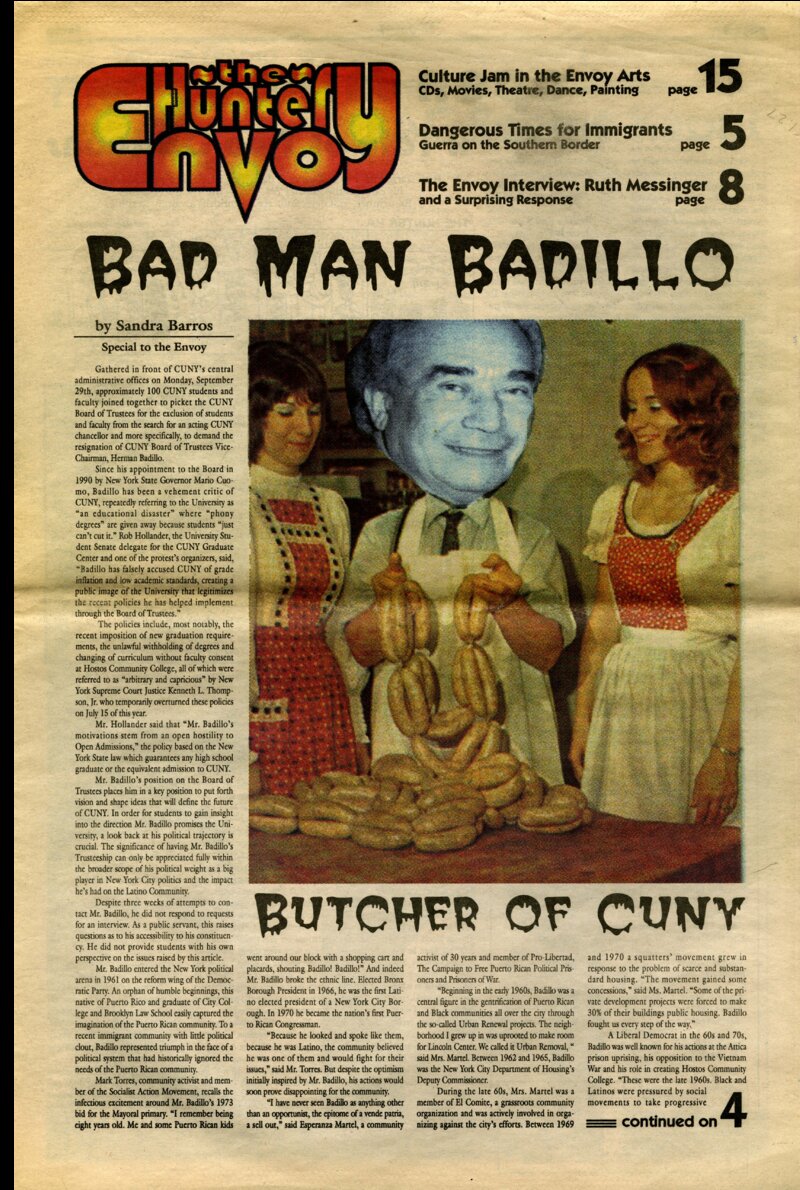
"Bad Man Badillo: Butcher of CUNY"
Item
Culture Jam in the Envoy Arts
CDs, Movies, Theatre, Dance, Painting
rose AD
Dangerous Times for Immigrants
Guerra on the Southern Border
page
The Envoy Interview: Ruth Messinger
and a Surprising Response
page
BARD MAN BAPILLO
by Sandra Barros
Special to the Envoy
Gathered in front of CUNY’s central
administrative offices on Monday, September
29th, approximately 100 CUNY students and
faculty joined together to picket the CUNY
Board of Trustees for the exclusion of students
and faculty from the search for an acting CUNY
chancellor and more specifically, to demand the
resignation of CUNY Board of Trustees Vice-
Chairman, Herman Badillo.
Since his appointment to the Board in
1990 by New York State Governor Mario Cuo-
mo, Badillo has been a vehement critic of
CUNY, repeatedly referring to the University as
“an educational disaster” where “phony
degrees” are given away because students “just
can’t cut it.” Rob Hollander, the University Stu-
dent Senate delegate for the CUNY Graduate
Center and one of the protest’s organizers, said,
“Badillo has falsely accused CUNY of grade
" public image of the University that legit
the recent policies he has helped implement
through the Board of Trustees.”
The policies include, most notably, the
recent imposition of new graduation require-
ments, the unlawful withholding of degrees and
changing of curriculum without faculty consent
at Hostos Community College, all of which were
referred to as “arbitrary and capricious” by New
York Supreme Court Justice Kenneth L, Thomp-
son, Jr. who temporarily overturned these policies
on July 15 of this year.
Mr. Hollander said that “Mr. Badillo’s
motivations stem from an open hostility to
Open Admissions,” the policy based on the New
York State law which guarantees any high school
graduate or the equivalent admission to CUNY.
Mr. Badillo’s position on the Board of
Trustees places him in a key position to put forth
vision and shape ideas that will define the future
of CUNY. In order for students to gain insight
into the direction Mr. Badillo promises the Uni-
versity, a look back at his political trajectory is
crucial. The significance of having Mr. Badillo’s
Trusteeship can only be appreciated fully within
the broader scope of his political weight as a big
player in New York City politics and the impact
he’s had on the Latino Community.
Despite three weeks of attempts to con-
tact Mr. Badillo, he did not respond to requests
for an interview. As a public servant, this raises
questions as to his accessibility to his constituen-
cy. He did not provide students with his own
perspective on the issues raised by this article.
Mr. Badillo entered the New York political
arena in 1961 on the reform wing of the Democ-
ratic Party. An orphan of humble beginnings, this
native of Puerto Rico and graduate of City Col-
lege and Brooklyn Law School easily captured the
imagination of the Puerto Rican community. To a
recent immigrant community with little political
clout, Badillo represented triumph in the face of a
political system that had historically ignored the
needs of the Puerto Rican community.
Mark Torres, community activist and mem-
ber of the Socialist Action Movement, recalls the
infectious excitement around Mr. Badillo’s 1973
bid for the Mayoral primary. “I remember being
went around our block with a shopping cart and
placards, shouting Badillo! Badillo!” And indeed
Mr. Badillo broke the ethnic line. Elected Bronx
Borough President in 1966, he was the first Lati-
no elected president of a New York City Bor-
ough. In 1970 he became the nation’s first Puer-
to Rican Congressman.
“Because he looked and spoke like them,
because he was Latino, the community believed
he was one of them and would fight for their
issues,” said Mr. Torres. But despite the optimism
initially inspired by Mr. Badillo, his actions would
soon prove disappointing for the community,
“J have never seen Badillo as anything other
than an opportunist, the epitome of a vende patria,
a sell out,” said Esperanza Martel, a community
BUTCHER OF CUNY
activist of 30 years and member of Pro-Libertad,
The Campaign to Free Puerto Rican Political Pris-
oners and Prisoners of War.
“Beginning in the early 1960s, Badillo was a
central figure in the gentrification of Puerto Rican
and Black communities all over the city through
the so-called Urban Renewal projects. The neigh-
borhood I grew up in was uprooted to make room
for Lincoln Center. We called it Urban Removal, “
said Mrs. Martel. Between 1962 and 1965, Badillo
was the New York City Department of Housing’s
Deputy Commissioner.
During the late 60s, Mrs. Martel was a
member of El Comite, a grassroots community
organization and was actively involved in orga-
nizing against the city’s efforts. Between 1969
and 1970 a squatters’ movement grew in
response to the problem of scarce and substan-
dard housing. “The movement gained some
concessions,” said Ms, Martel. “Some of the pri-
vate development projects were forced to make
30% of their buildings public housing. Badillo
fought us every step of the way.”
A Liberal Democrat in the 60s and 70s,
Badillo was well known for his actions at the Attica
prison uprising, his opposition to the Vietnam
War and his role in creating Hostos Community
College. “These were the late 1960s. Black and
Latinos were pressured by social
movements to take progressive
continued on
HUNTER
Little Kids Go To School With Mama
Childcare
by Sonia Robinson
Staff Writer
Although there is great demand
for child care, there are only fifty slots
open to the kids of students who show
up on registration day, January 3rd, at
the crack of dawn. Many people have
been known to spend the night just to
try to secure a place for their child. On
the issue of not having enough room to
accommodate every parent, the Direc-
tor of Childcare Zully Papa said that
she “would like to help everybody who
applies to the center, but the space we
have is limited.”
The center’s operating budget for
a year is estimated to be around
$385,000. This money comes from
Higher Education State funding, Fed-
eral Block Grants, student activity fees
and from user (parent) fees. Fees are
based on a sliding scale which range
from $15 to $132 per week for the
semester. Although the center hasn’t
been the recipient of any drastic cut-
backs, they haven’t had a budgetary
increase in ten years. Certified teachers
employed by the center have no bene-
fits packages. Papa says that the one
thing she would like to do for her
teaching staff is provide them with a
pension fund.
Unfortunately though, the bud-
get does not allow for that. She also
said “when one of my teachers get sick,
they don’t get paid. If there is a holi-
day, they don’t get paid.” She has had a
high turnover rate on teaching staff
because she is unable to accomodate
salary requests. Papa has realized that
the teachers on her staff have internal-
ized how important it is to establish a
good foundation for young children
and that is what keeps them here. Child
care workers are among the lowest paid
workers in the nation.
Many of the center’s parents are
dependent on Public Assistance, and
the number of who fall below the
poverty level is uncomfortably high.
The students the center has lost to the
work fare program have increased dra-
matically, Last semester 62% were on
PA, compared to this semester’s 32%.
“Welfare reform has scared people in
general and caused a lot of parents to
leave school. It’s a shame because these
students would have done really well
given the chance. Those who have
ES
Zully Papa and kids at the Childcare Center. They’re so cute.
at Hunter
remained are women who will be grad-
uating soon and just want to finish
their degree requirements,” Papa said.
The recent administrative decision
to bar children from entering the campus
of Baruch College has many worried that
the same policy will happen here at
Hunter College. Alizabeth Acevedo, a
Hunter sophomore, recently needed to
use Baruch’s library to do some research
for a class. Upon entering the library, she
was told by a security guard that she
could enter, but her 2 year old daughter
could not. She was appalled by this but
proceeded to enter the library to get
what she needed anyway, but then decid-
ed to leave because she “felt like a crimi-
nal trying to enter the place” with her
daughter. She said she didn’t know what
she would do if the same thing happened
here and also stated that she would not
be here at Hunter if she did not have her
daughter in the child care center.
Sylvia Fishman, the Dean of Stu-
dents said that there has been an
unwritten policy regarding children in
classrooms at Hunter, discretion is left
up to the professor. Fishman also said
that the issue has been raised once or
twice when a child has disrupted a class
but overall, the faculty and students
have been extremely reasonable. She
has always been very supportive of the
child care center. “It’s very dear to my
heart,” she said.
She also said that “the reports of
peace of mind the students feel having
their children in the center makes all the
difference.” There are nineteen child
care centers CUNY wide but Fishman
said that “we have a model center and
we’re viewed that way by CUNY.”
Child care is provided while par-
ents attend classes in the Spring and
Fall, summer sessions I and II, college
work study and during the winter inter-
cession while students make up grades
of incomplete or for internships. Time
is also provided for study time during
finals week and for various center relat-
ed fund raising purposes.
There are 3 classrooms with chil-
dren ranging in ages from 2 years and
nine months to 5 years of age. The child
to teacher ratio is 3:1 with occasional
College Work Study students and
interns adding to the teaching staff.
One very important detail that parents
need to tend to is that their child be
potty trained before they can attend.
Photos by Kai Mendez
28 Oct 97
Little one at the Center
Photo by Kai Mendez
raphics by Jed
Colette Draut, a sophomore and The-
ater and Film major, said “I think it’s a
great center with a good staff and it’s
very helpful to young students who are
also parents.” She also stated that with-
out the center’s help, she would not be
able to come to school. Jazzmen Var-
gas, an Education major in her junior
year, shared the sentiment. The service
has proven to be invaluable to those
who have used it,
The center provides parents with
workshops on stress and anger manage-
ment, discipline and various other top-
ics which are led by specialists. Papa
said that they often extend their help to
1 certain students who have no support
system. Ms. Papa wanted to try some-
thing new this semester and so she cre-
ated a wish list. The wish list contained
the names and phone numbers of peo-
ple who were on standby. As people
dropped classes, or failed to show up,
their names were crossed off and new
ones were added, Fortunately for many,
this semester, the wait list was exhaust-
ed and all who applied, were accepted
She also wanted to point out that she is
not running a baby-sitting service.
They are primarily an early learning
center. She stressed the fact that “We
are here to serve the students.”
Arts & Sciences Merger
Goes Before Board of Trustees
by Keith Mitchell
News Editor
After eleven months of debate,
President David Caputo has taken
unilateral action in proposing a reso-
lution before the CUNY Board of
Trustees that would merge the
schools of Arts and Science. If
approved by the Board, the merger
will take place on July 1, 1998.
Under the current plan, Hunter
College is divided into three academ-
ic divisions, the Division of Social
Sciences, of Humanities and Arts,
and of Sciences and Mathematics.
Each division has its own dean, who
is resposible to professors of that par-
ticular division. Under the new plan
there will be only one Dean who will
facilate over the entire School of Arts
and Sciences. According to the reso-
lution sent to the CUNY Board of
Trustee’s Commitee on Faculty,
Staff and Administration from the
president’s office, the new Dean of
the School of Arts and Sciences
“shall preside with voice, but with-
out vote” over the the Personnel
and Budget Committees. These
committees are responsible for the
funding of the different departments
and hiring of new faculty.
Many voiced concerns that the
President’s new plan will cripple the
automony of the various divisions, and
limit departmental access to the Dean.
As pointed out by a resoultion put on
the floor of the Hunter College Sen-
ate in September by Chemisty depart-
ment chair Professor Bill Sweeney and
Englsih department chair Professor
Richard Barickman, the only instu-
tions that use the president’s plan have
fewer than 2,000 students. And many
wonder how a single person can look
after the best interests of over 23
departments, 10 interdepartmental
and 350 faculty members.
The debate over the proposed
restructuring has led to major debates
in the Senate; during some meetings
the time limit had to be extended to
accomade the myriad of professors
and students who wanted to speak on
the plan, prompting Dean of Program
Studies Hugh Scott, to call the Presi-
dent’s process “too democratic.”
If the plan is approved by the
Board of Trustees, the president has
promised to conduct a national search
for a new Dean.
pag e"4 a Oct YT Envoy
ThE Roving PhocogGRAPhHER
ASKEO What's Your Favorite Part of Your Body?
Joe Giammona
“My hair,
junior, Liberal Arts
‘cause it’s perfect every time.”
The Roving Photographer is a
utierrez
joined entity of Mike
and the lovely Kai Mendez.
“My lips.
They’re so soft and full.”
Justin Mejia
freshman, undecided
“My legs. When I used
to play hockey they
got nice looking
except for the hair.
They got pretty hairy.”
Eleni Fotopoulus
senior, Communications
Yamilke Ferreira
junior, Psychology
“My eyes.
I’ve gotten a lot
of compliments.”
Bad Man Badillo, from page 1
stances. As times become more conser-
vative, you assimilate and follow the
mainstream. Now Badillo’s a Conserva-
tive Republican down with Giuliani, no
matter what that means to his people,”
said Mr. Torres.
The Reform Democrats of the
early 1960s were not concerned with
issues of housing, jobs, health care or
education, the main concerns of the
Puerto Rican community in New York
6 cr wher Open to US wena Enis must be ae ee
City. Mr. Badillo was acceptable to the
reformers because of his willingness to
cater to the city’s middle classes.
Though he received overwhelming
support from the Puerto Rican com-
munity, his early supporters were pre-
dominantly Jewish and included upper
class Protestants.
Mr. Torres and Ms. Martel both
pointed to Mr. Badillo’s support of fis-
cal exigency measures during the fiscal
crisis of the mid 1970s. A Congress-
man at the time, he supported slashing
social welfare programs and the first
implementation of tuition at CUNY.
“All this while supporting tax breaks
for the middle class,” said Mr. Torres.
From 1984 to 1986 Mr. Badillo
served as chairman of the New York
State Mortgage Agency. In 1986 he
joined the law firm now known as Fis-
chbein, Badillo, Wagner, Harding and
ideas on how
to make
condoms
really
cool. Ee?
You can win $10,000
in the Third Annual
~~ LifeStyles Condoms
_ Video Contest! -
: > Loses aed g on
eo anid show us how you'd put condoms:
the top of everyone's shopping list.
Toke your best shot—moke it funny,
__setious, or simply outrogeous. Just moke
it onfor
elope
PD hax 675, Monti, tj 07045-0675. Decors of the judges ae final. Yod where prohibited. Cores gonsved by Ase Incrpr rated, Per far
Prius Bison, Merithon Center 1, foo indstil Woy, Enlontown, Mj 7724. ©) 1997 Ansel, x
Because ¢ fes
igeticble—and you could win the
LifeStyles grand prize oa $18,000,
So, get ready fo start your engines!
Toonier our FREE contest, -
chock out the liteStyles Web site at
Www. com
ew ealsat
1-888-619-8890.
LifeStyles
CONDOMS «a=
A conta spertl
by 1988, he had completed four failed
attempts at the mayoralty.
Today Mr. Badillo is one of the
most influential people in New York
City. He is Mayor Giuliani’s special
advisor on education and liaison to
Hispanic groups, one of the Mayor’s
two unpaid personal advisors. Mr.
Badillo’s proximity to the Mayor has
been the topic of controversy in recent
months. Fischbein, Badillo, Wagner,
Harding has seen a prosperous increase
in its lobbying clientele since Mr.
Badillo was brought into the Giuliani
camp. His firm’s lobbying clients,
“whose executives acknowledge that
they hired... to try to gain an advan-
tage in winning contracts or favorable
ruling from the Giuliani administra-
tion,” according to the New York
Times, have increased from 3 to nearly
60 in the last four years.
US Servis, one of the companies
represented by the firm, has repeatedly
been accused of mismanaging a $16
million contract with the city’s Health
and Hospitals Corporation. Dr. Miche-
len, a former high ranking hospitals
agency official told the New York Times
that the agency hadn’t broken the con-
tract because Mr. Badillo told him Mr.
Giuliani would be angry if US Servis
lost the contract.
In another case, A.H.A. General
Construction, a company involved in a
1993 building collapse in Harlem that
injured 5 workers, received lighter
penalties than originally proposed
because Mr. Badillo’s firm lobbied on
their behalf.
In light of his political history
and his current status as liaison
between big business and the Mayor’s
office, what does CUNY’s future with
Badillo mean for students? “If high
schools aren’t preparing students,
CUNY has to do it. Slashing funds and
slandering CUNY isn’t going to pre-
pare anyone. Only investment in edu-
cation will prepare students. Mr. Badil-
lo isn’t taking leadership on that
because it won’t gain him favor with
Giuliani. His record speaks for itself.
Students have to be prepared to stand
up to Badillo,” said Mr. Torres.
Music used in is the prodiodion of Envoy | Vol. 53, #5
Sam Cooke, The Man and His Music; Duke
Ellington, Money Jungle; The Notorious
B.I.G., Ready to Die; Portishead;
Trainspotting; John Coltrane, A Love
Supreme; KC and the Sunshine Band, I’m
Your Boogie Man; Erykah Badu, Baduism;
Quad City DJ’s, Get On Up and Dance;
Miles Davis, Bitches Brew; Jimi Hendrix,
Live at the Isle of Wight; Sonny Rollins,
Way Out West; Ismael Lo, Iso; Jesus
Alemay’s Cubanismo; The Velvet
Underground & Nico; Nova Bossa, a Red
Hot & Blue Comp; Wyclef Jean, The
Carnival; Stevie Wonder, Innervisions; Tony
Toni Tone, House of Music; Bob Dylan,
Blonde on Blonde; Peter Gabriel, Passion;
Billie Holliday, The Verve Collection;
nyc
98 Oct 97
The Envoy Interview
Messinger Talks on CUNY and Stuff
by Danielle Drew
Contributing Writer
Q. What is the importance of CUNY
to New York City and why should
CUNY students vote for you?
RM. I think that CUNY is one of the
most important institutions in the City
of New York. It has been the route for
generations of New Yorkers to move
into higher education, and to acquire
the knowledge and skills they need to
get jobs in the work force. It’s more
important now than ever before
because many, many more of the jobs
in this city and country currently
require college education than was the
case pretty recently. I think the cam-
puses do a great job of meeting student
needs provided that they are adequately
funded to do that. I’m someone who
believes in the City University, has
taught at branches of the City Universi-
ty, is the granddaughter of a graduate
of City College in its earlier days, and
will work with the Board of the City
University to be sure that the branches
of the University are educating all stu-
dents for the demands of the 21st Cen-
tury. I will be a mayor who will work
with the students against tuition
increases and for an expansion of the
TAP program, and | think students
should vote for me because I think stu-
dents should exercise their franchise,
and I think they should exercise it in
their self-interest, and I’m much more
invested in their education than is the
incumbent mayor.
Q. About 18,000 students at CUNY
are on welfare, and they are currently
required by Giuliani to perform about
20 hours a week, who argues that work
fare prepares people for life in the real
world. How do you feel about this?
RM. I believe that federal requirements
for people on public assistance need to
be adhered to, but that where CUNY
students are involved, the argument that
students made to me about a year and a
ri
Ay
2
half ago, which is to slightly reduce the
required hours, and more important, to
make sure that their time is flexible and
that they’re allowed to do their work
fare assignments on campus in a great
many positions where the campus can
make use of their skills is the right argu-
ment, and I supported that position very
strongly in all of the branches of the City
University, just like I have in the past
supported the creation of daycare ser-
vices on every campus.
I’ve raised this issue of protecting
on-campus assignments for work fare
students with the President of the Unit-
ed States when he was here talking about
welfare reform at Riverside Church sev-
eral months ago. And I was a supporter
of the legislation which has now been
adopted in Albany, which mandates that
CUNY students on work fare be allowed
to do their work on campus.
Q. Relations between the police and
CUNY students haven’t always been
friendly, for example, several demon-
strators at Hunter College were arrested
around three years ago when they were
protesting budget cuts. As mayor, how
would you improve relations between
CUNY students and the police?
RM. Well, it works on both sides, it
seems to me. Students have to follow
the law, and the police department
occasionally needs to have free speech
and free assembly rights - to be sure
that they are respecting those rights.
They should not be harassing students
who are engaged in a legal protest.
Q. Do you think that the professors
at CUNY also need to have their stan-
dards raised?
RM. I don’t know much about that. I
think the biggest problem at City Uni-
versity is the huge number of faculty
that are teaching not on tenured lines,
and the large number of adjunct faculty
that are making up the faculty base on
some of the campuses, I think, almost in
violation of standards for college
accreditation. I think that’s bad for a
campus, but many of the faculty I know
at branches of the City University are
very dedicated to trying to find ways to
teach, and it’s just that they are also
being hampered by lack of tenure
opportunities, by overcrowding of class-
es, and by a fair amount of uncertainty
as to what the future holds on each and
every campus, both to the budget and
to other rules that they fear the Board
may make that harder for students.
Q. One of Giuliani’s main themes has
been quality of life. Obviously for you,
one main equality of life issue is educa-
tion; are there any other quality of life
issues he hasn’t addressed, that you
would address, as mayor?
RM. I guess you can call everything
quality of life. It seems to me, education
is a universe unto itself; another critical-
ly important area is the economy of the
city which I think needs to be stimulat-
ed, needs to grow and there needs to be
a great deal of attention to creating jobs
for New Yorkers. There’s a great deal
that City government can do to provide
additional help to smaller business peo-
ple, to require that businesses when
they get a city contract, are required
that some of the jobs go to New York-
ers, kind of a linkage agreement. And
it’s very possible to do this; other cities
have done it. I’ve done it in some small
ways with some businesses that have
done business here, and you just have to
be serious about job creation, and that
should be of tremendous importance to
City University students.
One of the things that I have pro-
posed that I would seek to create is a
program that allows students at the
City University who finish an accredit-
ed teacher education at the same time
that they get their degree, and then
agree to teach for five years, to teach in
the schools in the city that are not
doing so well, that those students
would have some college loan forgive-
ness provided to them. In exchange for
teaching in the schools, some of their
AND SPEAKING OF POLITICS
Messinger puts her spin on our lives.
Graphics by Kai Mendez and Jed Brandt
loans would be forgiven.
So it’s education, economic devel-
opment and job creation, much more
attention to the problem of police bru-
tality which you asked about before.
And when you talk to quality of life
that way, one thing I would add, I
think, is that the mayor talks a lot about
addressing community quality of life
problems, but it really turns out that a
great many of the quality of life prob-
lems that the mayor tries to address are
those that can be addressed by the
police. And that’s important. You
know, in some neighborhoods, car
theft is a serious problem, and in some
neighborhoods, drunkenness on a pub-
lic street is a problem, or other serious
problems. But there are lots of neigh-
borhoods where the quality of life
problems are different, where they have
to do with getting trees pruned so the
trees won’t fall over on school buses
and kill children; they have to do with
=== Cont on Next Page ==
Feel Like You’re Going Mad
Envoy Gives the Lowdown on Anxiety Attacks
by Richard Lambert
Contributing Writer
Panic disorders are a debilitating
condition, striking over fourteen mil-
lion Americans. According to the latest
survey, two to six percent of the popu-
lation suffers from some form of anxi-
ety or panic disorder. According to
research, anxiety and panic usually
strike during stressful life events such as
the death of a loved one, triggering the
onset of anxiety and panic. Research
has also shown that anxiety and panic
disorders seem to develop from a vari-
ety of psychological and physical fac-
tors. A panic attack is usually an alarm
reaction. When there is real danger, the
alarm is “true,” yet, for those who suf-
fer from these disorders, the alarm goes
off even when there is no danger.
“The biological root of panic
seems to be a misfiring of the brain’s
alarm center, which triggers the fight-or-
flight stress response. The brain signals
danger even though none exists,” said
Dr. Steven Dudvosky in the December
19, 1993 edition of Parade Magazine.
The term “panic attack” was offi-
cially recognized in 1980 by the Ameri-
can Psychiatric Association. The DSM-
TITR, which is the formal handbook of
psychiatric disorders, describes the dis-
order as “discrete periods of intense
fear or discomfort...often with feelings
of impending doom.”
The DSM-III R states that a per-
son suffering from panic or anxiety
exhibits at least four of the followings
symptoms, including and not limited
to: shortness of breath, dizziness, faint-
ness, palpitations, trembling or shak-
ing, choking, nausea, de-personaliza-
tion, numbness or tingling sensations,
flushes or chills, chest pain and feelings
of being out of control.
Those who suffer from anxiety
and panic disorders begin to avoid
places such as the movies, shopping
malls, grocery stores and crowded
places in fear that they will have no
escape from their perceived danger dur-
ing an attack. This begins the process of
agoraphobic avoidance and can lead to
a devastating reality of being locked up
at home twenty-four hours a day in fear
of re-experiencing the onset of anxiety
and panic. The onset of anxiety and
panic can lead to depression, which
many attempt to alleviate through the
use of drugs and alcohol.
Recent research has found that
over ninety percent of anxiety-disorder
sufferers who receive appropriate med-
ical care have an excellent prognosis.
One effective form of treatment is cog-
nitive behavioral therapy. Cognitive
behavior therapy, described briefly, is
1)Education, 2) Cognitive Restructur-
ing, 3)Breathing Training, 4) Situa-
tional Exposure, and 5)Interoceptive
Exposure. Each step is intended to help
alleviate panic attacks, agoraphobic
avoidance, chronic anxiety and depres-
sion associated with panic disorder.
In New York there are several clin-
ics and hospitals which specialize in anx-
iety disorders. One is the MonteFiore
Hospital’s Anxiety and Depression
Clinic, reachable at (718)920-2911.
from a judgement hall...
We want
no condescending
saviors to rule us
Messinger Continues Talking From Page 8
improving the level of sanitation ser-
vice on a neighborhood strip, and all of
those also are issues that desperately
need attention. It’s just that when the
attention comes from a difference to
the agency, the mayor hasn’t been so
quick to provide it.
Q. Hunter College students come
from all different ethnic backgrounds.
What would you do as mayor to
improve the racial divisiveness which is
in the city right now?
RM. Well, I think a mayor really does
that by example, by putting together an
administration which is very reflective of
the city, by being willing to speak all the
time to the importance of people in New
York City, valuing the diversity of the
city; and by being sure to be as on top as
possible on places in the city. And there
are a lot of places in the city, unfortu-
nately, where there seems to be some
degree of racial tension or unrest. Just by
trying to understand what the causes of
the problems are, and by trying to be
alert to those and get them addressed.
Q. Are there any areas of your cam-
paign you feel the press has not cov-
ered or missed the point of?
RM. 1 have often referred to education
as encompassing not only the public
schools but the need to expand daycare
and the need to pay attention to the situ-
ation at City University, and I don’t
think, by and large, that gets picked up. I
don’t think people really tend to talk
about that, and so I think it’s very
important that it be talked about. I think
frankly, there’s a great deal in the cam-
paign that I have talked about, from
improved access to health care to atten-
tion to some environmental issues, to
the importance of being sure that we
create affordable housing, which does
Not get picked up by the press. But since
I have a great deal of respect for the
CUNY system and since I have been
privileged to have taught at Queens Col-
lege and at Hunter, and to have done a
great deal of work with daycare on cam-
puses and a great deal of work providing
funding and support for various pro-
grams at all of the branches in the Uni-
versity in Manhattan - Borough of Man-
hattan Community College, City
College, Baruch, John Jay - I think I’ve a
pretty strong track record of being a
strong friend and supporter of City Uni-
versity. And it is not an exaggeration to
say that if every student was an eligible
voter and voted themselves and brought
their families to vote, it could turn the
election around. So, this is really in the
students’ hands in a much more dramat-
ic way than they realize. So they should
all get out and vote. They should bring
their families out to vote, and they
should really see this as having the possi-
bility of turning the election around.
Computer eye strain?
Try our SpectaClear lenses!
Introducing
_ Spectat Clear.
by Jed Brandt
Editor-in-Chief
Maybe in her mind, Ruth
Messinger is making a difference. But
after decades prowling the corridors of
New York municipal politics, most like-
ly she’s just following a bureaucratic
inertia that compels her kind to run for
higher office. She didn’t have the com-
monsense opportunism of Ferrer,
who’s waiting for Giulliani to get
dumped by term limits; or the dema-
gogic pizzazz of Sharpton who’s got to
keep busy somehow. No, Ruth
Messinger is the last liberal making her
last liberal stand.
And it is a last stand. Filled with
pathos and a certain pride, Messinger
is withering on a sickly vine with the
rest of the Democratic Party. All over
the country, liberals are getting
trounced. When the nightly news
claims a conservatising of the elec-
torate, they’re right. That doesn’t
mean everybody is getting more con-
servative, just the “electorate.” Who is
this? Chances are, not you.
More likely than not, you don’t
vote, won’t vote, can’t vote and ulti-
mately have no hope for the casting of
paper to transform your life in any
meaningful way. And, truth be told,
you’re right. The government doesn’t
work for us and it shows.
The Democratic Party has domi-
nated local and national politics since
Roosevelt. No matter how'much they
have played up their support for the
underdogs, they always hang with the
Why Messinger Will Lose
What It Means For the Future of New York City
big dogs when it comes time to put up
or shut up.
The Democrats, under Sheldon
Silver’s leadership, pass Pataki’s
CUNY-killing budgets upstate, are dis-
mantling the social safety net in Wash-
ington, glibly going along with an
imperial foreign policy and all the while
playing critic to the very policies they
invented.
Ruth Messinger’s not going to
lose because everybody loves Giuliani,
we don’t. Our hatred for him is grant-
ed. No, Messinger is getting creamed
because nobody believes her party’s
propaganda anymore, because the core
Democratic constituencies don’t turn
out to vote in substantial numbers, and
ultimately because we know on a gut
level that it’s not our government.
Dinkins was mayor and the ghet-
tos didn’t disappear, they got worse.
When he couldn’t put out the fires
burning from Washington to Crown
Heights, he got replaced. The system
traded a fireman for a cop. Giulliani
has served the role of local enforcer,
while nationally our living standards
are dropping and Wall Street is boom-
ing. The promise of this system ever
working for regular people is over and
we all know it.
What does this mean for the
future of New York? Time will tell, but
if you want good housing, decent
employment and a say in how your
community is run, it’s going to happen
in the streets, not in the ballot box. It'll
take a fight, not a prayer.
All power to the people.
Buy One
Footlong Sub...
Get One For
Any regular footiong
sub with purchase of a
21 ox. drink.
ae neietive Lenses
° Help reduce computer glare
¢ Cut headlight glare during night driving
* Reduce reflection so your eyes are more visible
° Help to relieve eye strain
Free Glasses! Contact Eenees |
exclusive SpectaClear” antlreflective lens-
FREE second pair!
es, and receive a
Haste ote taIbty: NS Si RE cg i econo. Some at sesctRtE
For The Way
aca mreareipenbrnyed mntators yt sri
vith als, ects np. Exes 1/15/97. whee ae a yes
L Sento me Serta coral
Et a a oe ee
795 Lexington Ave. 755-8927
Sterlin ng For The Way
i cobechoa, Mescrpton must be the soma for beth pes. Present coop ove of perchese. Mot ved eceiecg Offer vod for new
A registered trademark af Sterfing Vision. inc. A NASDAQ Company, ISEE
Optica’
141) 2nd Ave. (ard & 74th) NYC
= Live.
CDs, Movies, Theatre, Dance, Painting
rose AD
Dangerous Times for Immigrants
Guerra on the Southern Border
page
The Envoy Interview: Ruth Messinger
and a Surprising Response
page
BARD MAN BAPILLO
by Sandra Barros
Special to the Envoy
Gathered in front of CUNY’s central
administrative offices on Monday, September
29th, approximately 100 CUNY students and
faculty joined together to picket the CUNY
Board of Trustees for the exclusion of students
and faculty from the search for an acting CUNY
chancellor and more specifically, to demand the
resignation of CUNY Board of Trustees Vice-
Chairman, Herman Badillo.
Since his appointment to the Board in
1990 by New York State Governor Mario Cuo-
mo, Badillo has been a vehement critic of
CUNY, repeatedly referring to the University as
“an educational disaster” where “phony
degrees” are given away because students “just
can’t cut it.” Rob Hollander, the University Stu-
dent Senate delegate for the CUNY Graduate
Center and one of the protest’s organizers, said,
“Badillo has falsely accused CUNY of grade
" public image of the University that legit
the recent policies he has helped implement
through the Board of Trustees.”
The policies include, most notably, the
recent imposition of new graduation require-
ments, the unlawful withholding of degrees and
changing of curriculum without faculty consent
at Hostos Community College, all of which were
referred to as “arbitrary and capricious” by New
York Supreme Court Justice Kenneth L, Thomp-
son, Jr. who temporarily overturned these policies
on July 15 of this year.
Mr. Hollander said that “Mr. Badillo’s
motivations stem from an open hostility to
Open Admissions,” the policy based on the New
York State law which guarantees any high school
graduate or the equivalent admission to CUNY.
Mr. Badillo’s position on the Board of
Trustees places him in a key position to put forth
vision and shape ideas that will define the future
of CUNY. In order for students to gain insight
into the direction Mr. Badillo promises the Uni-
versity, a look back at his political trajectory is
crucial. The significance of having Mr. Badillo’s
Trusteeship can only be appreciated fully within
the broader scope of his political weight as a big
player in New York City politics and the impact
he’s had on the Latino Community.
Despite three weeks of attempts to con-
tact Mr. Badillo, he did not respond to requests
for an interview. As a public servant, this raises
questions as to his accessibility to his constituen-
cy. He did not provide students with his own
perspective on the issues raised by this article.
Mr. Badillo entered the New York political
arena in 1961 on the reform wing of the Democ-
ratic Party. An orphan of humble beginnings, this
native of Puerto Rico and graduate of City Col-
lege and Brooklyn Law School easily captured the
imagination of the Puerto Rican community. To a
recent immigrant community with little political
clout, Badillo represented triumph in the face of a
political system that had historically ignored the
needs of the Puerto Rican community.
Mark Torres, community activist and mem-
ber of the Socialist Action Movement, recalls the
infectious excitement around Mr. Badillo’s 1973
bid for the Mayoral primary. “I remember being
went around our block with a shopping cart and
placards, shouting Badillo! Badillo!” And indeed
Mr. Badillo broke the ethnic line. Elected Bronx
Borough President in 1966, he was the first Lati-
no elected president of a New York City Bor-
ough. In 1970 he became the nation’s first Puer-
to Rican Congressman.
“Because he looked and spoke like them,
because he was Latino, the community believed
he was one of them and would fight for their
issues,” said Mr. Torres. But despite the optimism
initially inspired by Mr. Badillo, his actions would
soon prove disappointing for the community,
“J have never seen Badillo as anything other
than an opportunist, the epitome of a vende patria,
a sell out,” said Esperanza Martel, a community
BUTCHER OF CUNY
activist of 30 years and member of Pro-Libertad,
The Campaign to Free Puerto Rican Political Pris-
oners and Prisoners of War.
“Beginning in the early 1960s, Badillo was a
central figure in the gentrification of Puerto Rican
and Black communities all over the city through
the so-called Urban Renewal projects. The neigh-
borhood I grew up in was uprooted to make room
for Lincoln Center. We called it Urban Removal, “
said Mrs. Martel. Between 1962 and 1965, Badillo
was the New York City Department of Housing’s
Deputy Commissioner.
During the late 60s, Mrs. Martel was a
member of El Comite, a grassroots community
organization and was actively involved in orga-
nizing against the city’s efforts. Between 1969
and 1970 a squatters’ movement grew in
response to the problem of scarce and substan-
dard housing. “The movement gained some
concessions,” said Ms, Martel. “Some of the pri-
vate development projects were forced to make
30% of their buildings public housing. Badillo
fought us every step of the way.”
A Liberal Democrat in the 60s and 70s,
Badillo was well known for his actions at the Attica
prison uprising, his opposition to the Vietnam
War and his role in creating Hostos Community
College. “These were the late 1960s. Black and
Latinos were pressured by social
movements to take progressive
continued on
HUNTER
Little Kids Go To School With Mama
Childcare
by Sonia Robinson
Staff Writer
Although there is great demand
for child care, there are only fifty slots
open to the kids of students who show
up on registration day, January 3rd, at
the crack of dawn. Many people have
been known to spend the night just to
try to secure a place for their child. On
the issue of not having enough room to
accommodate every parent, the Direc-
tor of Childcare Zully Papa said that
she “would like to help everybody who
applies to the center, but the space we
have is limited.”
The center’s operating budget for
a year is estimated to be around
$385,000. This money comes from
Higher Education State funding, Fed-
eral Block Grants, student activity fees
and from user (parent) fees. Fees are
based on a sliding scale which range
from $15 to $132 per week for the
semester. Although the center hasn’t
been the recipient of any drastic cut-
backs, they haven’t had a budgetary
increase in ten years. Certified teachers
employed by the center have no bene-
fits packages. Papa says that the one
thing she would like to do for her
teaching staff is provide them with a
pension fund.
Unfortunately though, the bud-
get does not allow for that. She also
said “when one of my teachers get sick,
they don’t get paid. If there is a holi-
day, they don’t get paid.” She has had a
high turnover rate on teaching staff
because she is unable to accomodate
salary requests. Papa has realized that
the teachers on her staff have internal-
ized how important it is to establish a
good foundation for young children
and that is what keeps them here. Child
care workers are among the lowest paid
workers in the nation.
Many of the center’s parents are
dependent on Public Assistance, and
the number of who fall below the
poverty level is uncomfortably high.
The students the center has lost to the
work fare program have increased dra-
matically, Last semester 62% were on
PA, compared to this semester’s 32%.
“Welfare reform has scared people in
general and caused a lot of parents to
leave school. It’s a shame because these
students would have done really well
given the chance. Those who have
ES
Zully Papa and kids at the Childcare Center. They’re so cute.
at Hunter
remained are women who will be grad-
uating soon and just want to finish
their degree requirements,” Papa said.
The recent administrative decision
to bar children from entering the campus
of Baruch College has many worried that
the same policy will happen here at
Hunter College. Alizabeth Acevedo, a
Hunter sophomore, recently needed to
use Baruch’s library to do some research
for a class. Upon entering the library, she
was told by a security guard that she
could enter, but her 2 year old daughter
could not. She was appalled by this but
proceeded to enter the library to get
what she needed anyway, but then decid-
ed to leave because she “felt like a crimi-
nal trying to enter the place” with her
daughter. She said she didn’t know what
she would do if the same thing happened
here and also stated that she would not
be here at Hunter if she did not have her
daughter in the child care center.
Sylvia Fishman, the Dean of Stu-
dents said that there has been an
unwritten policy regarding children in
classrooms at Hunter, discretion is left
up to the professor. Fishman also said
that the issue has been raised once or
twice when a child has disrupted a class
but overall, the faculty and students
have been extremely reasonable. She
has always been very supportive of the
child care center. “It’s very dear to my
heart,” she said.
She also said that “the reports of
peace of mind the students feel having
their children in the center makes all the
difference.” There are nineteen child
care centers CUNY wide but Fishman
said that “we have a model center and
we’re viewed that way by CUNY.”
Child care is provided while par-
ents attend classes in the Spring and
Fall, summer sessions I and II, college
work study and during the winter inter-
cession while students make up grades
of incomplete or for internships. Time
is also provided for study time during
finals week and for various center relat-
ed fund raising purposes.
There are 3 classrooms with chil-
dren ranging in ages from 2 years and
nine months to 5 years of age. The child
to teacher ratio is 3:1 with occasional
College Work Study students and
interns adding to the teaching staff.
One very important detail that parents
need to tend to is that their child be
potty trained before they can attend.
Photos by Kai Mendez
28 Oct 97
Little one at the Center
Photo by Kai Mendez
raphics by Jed
Colette Draut, a sophomore and The-
ater and Film major, said “I think it’s a
great center with a good staff and it’s
very helpful to young students who are
also parents.” She also stated that with-
out the center’s help, she would not be
able to come to school. Jazzmen Var-
gas, an Education major in her junior
year, shared the sentiment. The service
has proven to be invaluable to those
who have used it,
The center provides parents with
workshops on stress and anger manage-
ment, discipline and various other top-
ics which are led by specialists. Papa
said that they often extend their help to
1 certain students who have no support
system. Ms. Papa wanted to try some-
thing new this semester and so she cre-
ated a wish list. The wish list contained
the names and phone numbers of peo-
ple who were on standby. As people
dropped classes, or failed to show up,
their names were crossed off and new
ones were added, Fortunately for many,
this semester, the wait list was exhaust-
ed and all who applied, were accepted
She also wanted to point out that she is
not running a baby-sitting service.
They are primarily an early learning
center. She stressed the fact that “We
are here to serve the students.”
Arts & Sciences Merger
Goes Before Board of Trustees
by Keith Mitchell
News Editor
After eleven months of debate,
President David Caputo has taken
unilateral action in proposing a reso-
lution before the CUNY Board of
Trustees that would merge the
schools of Arts and Science. If
approved by the Board, the merger
will take place on July 1, 1998.
Under the current plan, Hunter
College is divided into three academ-
ic divisions, the Division of Social
Sciences, of Humanities and Arts,
and of Sciences and Mathematics.
Each division has its own dean, who
is resposible to professors of that par-
ticular division. Under the new plan
there will be only one Dean who will
facilate over the entire School of Arts
and Sciences. According to the reso-
lution sent to the CUNY Board of
Trustee’s Commitee on Faculty,
Staff and Administration from the
president’s office, the new Dean of
the School of Arts and Sciences
“shall preside with voice, but with-
out vote” over the the Personnel
and Budget Committees. These
committees are responsible for the
funding of the different departments
and hiring of new faculty.
Many voiced concerns that the
President’s new plan will cripple the
automony of the various divisions, and
limit departmental access to the Dean.
As pointed out by a resoultion put on
the floor of the Hunter College Sen-
ate in September by Chemisty depart-
ment chair Professor Bill Sweeney and
Englsih department chair Professor
Richard Barickman, the only instu-
tions that use the president’s plan have
fewer than 2,000 students. And many
wonder how a single person can look
after the best interests of over 23
departments, 10 interdepartmental
and 350 faculty members.
The debate over the proposed
restructuring has led to major debates
in the Senate; during some meetings
the time limit had to be extended to
accomade the myriad of professors
and students who wanted to speak on
the plan, prompting Dean of Program
Studies Hugh Scott, to call the Presi-
dent’s process “too democratic.”
If the plan is approved by the
Board of Trustees, the president has
promised to conduct a national search
for a new Dean.
pag e"4 a Oct YT Envoy
ThE Roving PhocogGRAPhHER
ASKEO What's Your Favorite Part of Your Body?
Joe Giammona
“My hair,
junior, Liberal Arts
‘cause it’s perfect every time.”
The Roving Photographer is a
utierrez
joined entity of Mike
and the lovely Kai Mendez.
“My lips.
They’re so soft and full.”
Justin Mejia
freshman, undecided
“My legs. When I used
to play hockey they
got nice looking
except for the hair.
They got pretty hairy.”
Eleni Fotopoulus
senior, Communications
Yamilke Ferreira
junior, Psychology
“My eyes.
I’ve gotten a lot
of compliments.”
Bad Man Badillo, from page 1
stances. As times become more conser-
vative, you assimilate and follow the
mainstream. Now Badillo’s a Conserva-
tive Republican down with Giuliani, no
matter what that means to his people,”
said Mr. Torres.
The Reform Democrats of the
early 1960s were not concerned with
issues of housing, jobs, health care or
education, the main concerns of the
Puerto Rican community in New York
6 cr wher Open to US wena Enis must be ae ee
City. Mr. Badillo was acceptable to the
reformers because of his willingness to
cater to the city’s middle classes.
Though he received overwhelming
support from the Puerto Rican com-
munity, his early supporters were pre-
dominantly Jewish and included upper
class Protestants.
Mr. Torres and Ms. Martel both
pointed to Mr. Badillo’s support of fis-
cal exigency measures during the fiscal
crisis of the mid 1970s. A Congress-
man at the time, he supported slashing
social welfare programs and the first
implementation of tuition at CUNY.
“All this while supporting tax breaks
for the middle class,” said Mr. Torres.
From 1984 to 1986 Mr. Badillo
served as chairman of the New York
State Mortgage Agency. In 1986 he
joined the law firm now known as Fis-
chbein, Badillo, Wagner, Harding and
ideas on how
to make
condoms
really
cool. Ee?
You can win $10,000
in the Third Annual
~~ LifeStyles Condoms
_ Video Contest! -
: > Loses aed g on
eo anid show us how you'd put condoms:
the top of everyone's shopping list.
Toke your best shot—moke it funny,
__setious, or simply outrogeous. Just moke
it onfor
elope
PD hax 675, Monti, tj 07045-0675. Decors of the judges ae final. Yod where prohibited. Cores gonsved by Ase Incrpr rated, Per far
Prius Bison, Merithon Center 1, foo indstil Woy, Enlontown, Mj 7724. ©) 1997 Ansel, x
Because ¢ fes
igeticble—and you could win the
LifeStyles grand prize oa $18,000,
So, get ready fo start your engines!
Toonier our FREE contest, -
chock out the liteStyles Web site at
Www. com
ew ealsat
1-888-619-8890.
LifeStyles
CONDOMS «a=
A conta spertl
by 1988, he had completed four failed
attempts at the mayoralty.
Today Mr. Badillo is one of the
most influential people in New York
City. He is Mayor Giuliani’s special
advisor on education and liaison to
Hispanic groups, one of the Mayor’s
two unpaid personal advisors. Mr.
Badillo’s proximity to the Mayor has
been the topic of controversy in recent
months. Fischbein, Badillo, Wagner,
Harding has seen a prosperous increase
in its lobbying clientele since Mr.
Badillo was brought into the Giuliani
camp. His firm’s lobbying clients,
“whose executives acknowledge that
they hired... to try to gain an advan-
tage in winning contracts or favorable
ruling from the Giuliani administra-
tion,” according to the New York
Times, have increased from 3 to nearly
60 in the last four years.
US Servis, one of the companies
represented by the firm, has repeatedly
been accused of mismanaging a $16
million contract with the city’s Health
and Hospitals Corporation. Dr. Miche-
len, a former high ranking hospitals
agency official told the New York Times
that the agency hadn’t broken the con-
tract because Mr. Badillo told him Mr.
Giuliani would be angry if US Servis
lost the contract.
In another case, A.H.A. General
Construction, a company involved in a
1993 building collapse in Harlem that
injured 5 workers, received lighter
penalties than originally proposed
because Mr. Badillo’s firm lobbied on
their behalf.
In light of his political history
and his current status as liaison
between big business and the Mayor’s
office, what does CUNY’s future with
Badillo mean for students? “If high
schools aren’t preparing students,
CUNY has to do it. Slashing funds and
slandering CUNY isn’t going to pre-
pare anyone. Only investment in edu-
cation will prepare students. Mr. Badil-
lo isn’t taking leadership on that
because it won’t gain him favor with
Giuliani. His record speaks for itself.
Students have to be prepared to stand
up to Badillo,” said Mr. Torres.
Music used in is the prodiodion of Envoy | Vol. 53, #5
Sam Cooke, The Man and His Music; Duke
Ellington, Money Jungle; The Notorious
B.I.G., Ready to Die; Portishead;
Trainspotting; John Coltrane, A Love
Supreme; KC and the Sunshine Band, I’m
Your Boogie Man; Erykah Badu, Baduism;
Quad City DJ’s, Get On Up and Dance;
Miles Davis, Bitches Brew; Jimi Hendrix,
Live at the Isle of Wight; Sonny Rollins,
Way Out West; Ismael Lo, Iso; Jesus
Alemay’s Cubanismo; The Velvet
Underground & Nico; Nova Bossa, a Red
Hot & Blue Comp; Wyclef Jean, The
Carnival; Stevie Wonder, Innervisions; Tony
Toni Tone, House of Music; Bob Dylan,
Blonde on Blonde; Peter Gabriel, Passion;
Billie Holliday, The Verve Collection;
nyc
98 Oct 97
The Envoy Interview
Messinger Talks on CUNY and Stuff
by Danielle Drew
Contributing Writer
Q. What is the importance of CUNY
to New York City and why should
CUNY students vote for you?
RM. I think that CUNY is one of the
most important institutions in the City
of New York. It has been the route for
generations of New Yorkers to move
into higher education, and to acquire
the knowledge and skills they need to
get jobs in the work force. It’s more
important now than ever before
because many, many more of the jobs
in this city and country currently
require college education than was the
case pretty recently. I think the cam-
puses do a great job of meeting student
needs provided that they are adequately
funded to do that. I’m someone who
believes in the City University, has
taught at branches of the City Universi-
ty, is the granddaughter of a graduate
of City College in its earlier days, and
will work with the Board of the City
University to be sure that the branches
of the University are educating all stu-
dents for the demands of the 21st Cen-
tury. I will be a mayor who will work
with the students against tuition
increases and for an expansion of the
TAP program, and | think students
should vote for me because I think stu-
dents should exercise their franchise,
and I think they should exercise it in
their self-interest, and I’m much more
invested in their education than is the
incumbent mayor.
Q. About 18,000 students at CUNY
are on welfare, and they are currently
required by Giuliani to perform about
20 hours a week, who argues that work
fare prepares people for life in the real
world. How do you feel about this?
RM. I believe that federal requirements
for people on public assistance need to
be adhered to, but that where CUNY
students are involved, the argument that
students made to me about a year and a
ri
Ay
2
half ago, which is to slightly reduce the
required hours, and more important, to
make sure that their time is flexible and
that they’re allowed to do their work
fare assignments on campus in a great
many positions where the campus can
make use of their skills is the right argu-
ment, and I supported that position very
strongly in all of the branches of the City
University, just like I have in the past
supported the creation of daycare ser-
vices on every campus.
I’ve raised this issue of protecting
on-campus assignments for work fare
students with the President of the Unit-
ed States when he was here talking about
welfare reform at Riverside Church sev-
eral months ago. And I was a supporter
of the legislation which has now been
adopted in Albany, which mandates that
CUNY students on work fare be allowed
to do their work on campus.
Q. Relations between the police and
CUNY students haven’t always been
friendly, for example, several demon-
strators at Hunter College were arrested
around three years ago when they were
protesting budget cuts. As mayor, how
would you improve relations between
CUNY students and the police?
RM. Well, it works on both sides, it
seems to me. Students have to follow
the law, and the police department
occasionally needs to have free speech
and free assembly rights - to be sure
that they are respecting those rights.
They should not be harassing students
who are engaged in a legal protest.
Q. Do you think that the professors
at CUNY also need to have their stan-
dards raised?
RM. I don’t know much about that. I
think the biggest problem at City Uni-
versity is the huge number of faculty
that are teaching not on tenured lines,
and the large number of adjunct faculty
that are making up the faculty base on
some of the campuses, I think, almost in
violation of standards for college
accreditation. I think that’s bad for a
campus, but many of the faculty I know
at branches of the City University are
very dedicated to trying to find ways to
teach, and it’s just that they are also
being hampered by lack of tenure
opportunities, by overcrowding of class-
es, and by a fair amount of uncertainty
as to what the future holds on each and
every campus, both to the budget and
to other rules that they fear the Board
may make that harder for students.
Q. One of Giuliani’s main themes has
been quality of life. Obviously for you,
one main equality of life issue is educa-
tion; are there any other quality of life
issues he hasn’t addressed, that you
would address, as mayor?
RM. I guess you can call everything
quality of life. It seems to me, education
is a universe unto itself; another critical-
ly important area is the economy of the
city which I think needs to be stimulat-
ed, needs to grow and there needs to be
a great deal of attention to creating jobs
for New Yorkers. There’s a great deal
that City government can do to provide
additional help to smaller business peo-
ple, to require that businesses when
they get a city contract, are required
that some of the jobs go to New York-
ers, kind of a linkage agreement. And
it’s very possible to do this; other cities
have done it. I’ve done it in some small
ways with some businesses that have
done business here, and you just have to
be serious about job creation, and that
should be of tremendous importance to
City University students.
One of the things that I have pro-
posed that I would seek to create is a
program that allows students at the
City University who finish an accredit-
ed teacher education at the same time
that they get their degree, and then
agree to teach for five years, to teach in
the schools in the city that are not
doing so well, that those students
would have some college loan forgive-
ness provided to them. In exchange for
teaching in the schools, some of their
AND SPEAKING OF POLITICS
Messinger puts her spin on our lives.
Graphics by Kai Mendez and Jed Brandt
loans would be forgiven.
So it’s education, economic devel-
opment and job creation, much more
attention to the problem of police bru-
tality which you asked about before.
And when you talk to quality of life
that way, one thing I would add, I
think, is that the mayor talks a lot about
addressing community quality of life
problems, but it really turns out that a
great many of the quality of life prob-
lems that the mayor tries to address are
those that can be addressed by the
police. And that’s important. You
know, in some neighborhoods, car
theft is a serious problem, and in some
neighborhoods, drunkenness on a pub-
lic street is a problem, or other serious
problems. But there are lots of neigh-
borhoods where the quality of life
problems are different, where they have
to do with getting trees pruned so the
trees won’t fall over on school buses
and kill children; they have to do with
=== Cont on Next Page ==
Feel Like You’re Going Mad
Envoy Gives the Lowdown on Anxiety Attacks
by Richard Lambert
Contributing Writer
Panic disorders are a debilitating
condition, striking over fourteen mil-
lion Americans. According to the latest
survey, two to six percent of the popu-
lation suffers from some form of anxi-
ety or panic disorder. According to
research, anxiety and panic usually
strike during stressful life events such as
the death of a loved one, triggering the
onset of anxiety and panic. Research
has also shown that anxiety and panic
disorders seem to develop from a vari-
ety of psychological and physical fac-
tors. A panic attack is usually an alarm
reaction. When there is real danger, the
alarm is “true,” yet, for those who suf-
fer from these disorders, the alarm goes
off even when there is no danger.
“The biological root of panic
seems to be a misfiring of the brain’s
alarm center, which triggers the fight-or-
flight stress response. The brain signals
danger even though none exists,” said
Dr. Steven Dudvosky in the December
19, 1993 edition of Parade Magazine.
The term “panic attack” was offi-
cially recognized in 1980 by the Ameri-
can Psychiatric Association. The DSM-
TITR, which is the formal handbook of
psychiatric disorders, describes the dis-
order as “discrete periods of intense
fear or discomfort...often with feelings
of impending doom.”
The DSM-III R states that a per-
son suffering from panic or anxiety
exhibits at least four of the followings
symptoms, including and not limited
to: shortness of breath, dizziness, faint-
ness, palpitations, trembling or shak-
ing, choking, nausea, de-personaliza-
tion, numbness or tingling sensations,
flushes or chills, chest pain and feelings
of being out of control.
Those who suffer from anxiety
and panic disorders begin to avoid
places such as the movies, shopping
malls, grocery stores and crowded
places in fear that they will have no
escape from their perceived danger dur-
ing an attack. This begins the process of
agoraphobic avoidance and can lead to
a devastating reality of being locked up
at home twenty-four hours a day in fear
of re-experiencing the onset of anxiety
and panic. The onset of anxiety and
panic can lead to depression, which
many attempt to alleviate through the
use of drugs and alcohol.
Recent research has found that
over ninety percent of anxiety-disorder
sufferers who receive appropriate med-
ical care have an excellent prognosis.
One effective form of treatment is cog-
nitive behavioral therapy. Cognitive
behavior therapy, described briefly, is
1)Education, 2) Cognitive Restructur-
ing, 3)Breathing Training, 4) Situa-
tional Exposure, and 5)Interoceptive
Exposure. Each step is intended to help
alleviate panic attacks, agoraphobic
avoidance, chronic anxiety and depres-
sion associated with panic disorder.
In New York there are several clin-
ics and hospitals which specialize in anx-
iety disorders. One is the MonteFiore
Hospital’s Anxiety and Depression
Clinic, reachable at (718)920-2911.
from a judgement hall...
We want
no condescending
saviors to rule us
Messinger Continues Talking From Page 8
improving the level of sanitation ser-
vice on a neighborhood strip, and all of
those also are issues that desperately
need attention. It’s just that when the
attention comes from a difference to
the agency, the mayor hasn’t been so
quick to provide it.
Q. Hunter College students come
from all different ethnic backgrounds.
What would you do as mayor to
improve the racial divisiveness which is
in the city right now?
RM. Well, I think a mayor really does
that by example, by putting together an
administration which is very reflective of
the city, by being willing to speak all the
time to the importance of people in New
York City, valuing the diversity of the
city; and by being sure to be as on top as
possible on places in the city. And there
are a lot of places in the city, unfortu-
nately, where there seems to be some
degree of racial tension or unrest. Just by
trying to understand what the causes of
the problems are, and by trying to be
alert to those and get them addressed.
Q. Are there any areas of your cam-
paign you feel the press has not cov-
ered or missed the point of?
RM. 1 have often referred to education
as encompassing not only the public
schools but the need to expand daycare
and the need to pay attention to the situ-
ation at City University, and I don’t
think, by and large, that gets picked up. I
don’t think people really tend to talk
about that, and so I think it’s very
important that it be talked about. I think
frankly, there’s a great deal in the cam-
paign that I have talked about, from
improved access to health care to atten-
tion to some environmental issues, to
the importance of being sure that we
create affordable housing, which does
Not get picked up by the press. But since
I have a great deal of respect for the
CUNY system and since I have been
privileged to have taught at Queens Col-
lege and at Hunter, and to have done a
great deal of work with daycare on cam-
puses and a great deal of work providing
funding and support for various pro-
grams at all of the branches in the Uni-
versity in Manhattan - Borough of Man-
hattan Community College, City
College, Baruch, John Jay - I think I’ve a
pretty strong track record of being a
strong friend and supporter of City Uni-
versity. And it is not an exaggeration to
say that if every student was an eligible
voter and voted themselves and brought
their families to vote, it could turn the
election around. So, this is really in the
students’ hands in a much more dramat-
ic way than they realize. So they should
all get out and vote. They should bring
their families out to vote, and they
should really see this as having the possi-
bility of turning the election around.
Computer eye strain?
Try our SpectaClear lenses!
Introducing
_ Spectat Clear.
by Jed Brandt
Editor-in-Chief
Maybe in her mind, Ruth
Messinger is making a difference. But
after decades prowling the corridors of
New York municipal politics, most like-
ly she’s just following a bureaucratic
inertia that compels her kind to run for
higher office. She didn’t have the com-
monsense opportunism of Ferrer,
who’s waiting for Giulliani to get
dumped by term limits; or the dema-
gogic pizzazz of Sharpton who’s got to
keep busy somehow. No, Ruth
Messinger is the last liberal making her
last liberal stand.
And it is a last stand. Filled with
pathos and a certain pride, Messinger
is withering on a sickly vine with the
rest of the Democratic Party. All over
the country, liberals are getting
trounced. When the nightly news
claims a conservatising of the elec-
torate, they’re right. That doesn’t
mean everybody is getting more con-
servative, just the “electorate.” Who is
this? Chances are, not you.
More likely than not, you don’t
vote, won’t vote, can’t vote and ulti-
mately have no hope for the casting of
paper to transform your life in any
meaningful way. And, truth be told,
you’re right. The government doesn’t
work for us and it shows.
The Democratic Party has domi-
nated local and national politics since
Roosevelt. No matter how'much they
have played up their support for the
underdogs, they always hang with the
Why Messinger Will Lose
What It Means For the Future of New York City
big dogs when it comes time to put up
or shut up.
The Democrats, under Sheldon
Silver’s leadership, pass Pataki’s
CUNY-killing budgets upstate, are dis-
mantling the social safety net in Wash-
ington, glibly going along with an
imperial foreign policy and all the while
playing critic to the very policies they
invented.
Ruth Messinger’s not going to
lose because everybody loves Giuliani,
we don’t. Our hatred for him is grant-
ed. No, Messinger is getting creamed
because nobody believes her party’s
propaganda anymore, because the core
Democratic constituencies don’t turn
out to vote in substantial numbers, and
ultimately because we know on a gut
level that it’s not our government.
Dinkins was mayor and the ghet-
tos didn’t disappear, they got worse.
When he couldn’t put out the fires
burning from Washington to Crown
Heights, he got replaced. The system
traded a fireman for a cop. Giulliani
has served the role of local enforcer,
while nationally our living standards
are dropping and Wall Street is boom-
ing. The promise of this system ever
working for regular people is over and
we all know it.
What does this mean for the
future of New York? Time will tell, but
if you want good housing, decent
employment and a say in how your
community is run, it’s going to happen
in the streets, not in the ballot box. It'll
take a fight, not a prayer.
All power to the people.
Buy One
Footlong Sub...
Get One For
Any regular footiong
sub with purchase of a
21 ox. drink.
ae neietive Lenses
° Help reduce computer glare
¢ Cut headlight glare during night driving
* Reduce reflection so your eyes are more visible
° Help to relieve eye strain
Free Glasses! Contact Eenees |
exclusive SpectaClear” antlreflective lens-
FREE second pair!
es, and receive a
Haste ote taIbty: NS Si RE cg i econo. Some at sesctRtE
For The Way
aca mreareipenbrnyed mntators yt sri
vith als, ects np. Exes 1/15/97. whee ae a yes
L Sento me Serta coral
Et a a oe ee
795 Lexington Ave. 755-8927
Sterlin ng For The Way
i cobechoa, Mescrpton must be the soma for beth pes. Present coop ove of perchese. Mot ved eceiecg Offer vod for new
A registered trademark af Sterfing Vision. inc. A NASDAQ Company, ISEE
Optica’
141) 2nd Ave. (ard & 74th) NYC
= Live.
Title
"Bad Man Badillo: Butcher of CUNY"
Description
This article by SLAM! member Sandra Barros for the Hunter Envoy investigates the role of CUNY Board of Trustees Vice Chair Herman Badillo in the plan to end open admissions at CUNY. This issue of the Envoy also includes an article about Hunter's childcare center, an interview with mayoral candidate Ruth Messinger, and an editorial about the mayoral election by SLAM! member Jed Brandt.
Contributor
Subways, Suzy
Creator
Hunter College Envoy
Date
October 28, 1997
Language
English
Publisher
Hunter College Envoy
Rights
Copyrighted
Source
Subways, Suzy
Original Format
Article / Essay
Hunter College Envoy. Letter. “‘Bad Man Badillo: Butcher of CUNY’.”, CUNY DIGITAL HISTORY ARCHIVE, accessed September 5, 2026, https://stephenz.tailc22a4b.ts.net/s/cdha/item/68