el Coquí, Volume 9, Number 2, November 1978
Item
A News Publication of Hostos Community College
of the City University of New York
Volume 9, Number 2
November, 1978
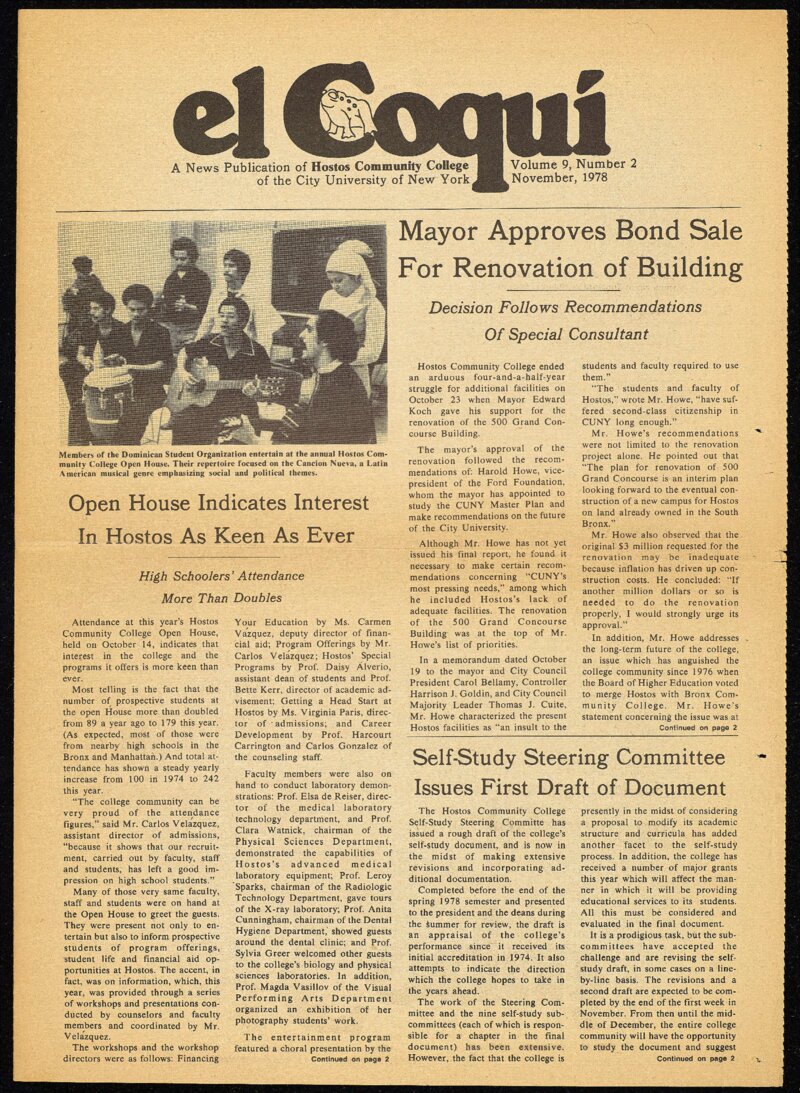
Members of the Dominican Student Organization entertain at the annual Hostos Com-
munity College Open House. Their repertoire focused on the Cancion Nueva, a Latin
American musical genre emphasizing social and political themes.
Open House Indicates Interest
In Hostos As Keen As Ever
High Schoolers’ Attendance
More Than Doubles
Attendance at this year’s Hostos
Community College Open House,
held on October 14, indicates that
interest in the college and the
programs it offers is more keen than
ever.
Most telling is the fact that the
number of prospective students at
the open House more than doubled
from 89 a year ago to 179 this year.
(As expected, most of those were
from nearby high schools in the
Bronx and Manhattan.) And total at-
tendance has shown a steady yearly
increase from 100 in 1974 to 242
this year.
“The college community can be
very proud of the attendance
figures,” said Mr. Carlos Velazquez,
assistant director of admissions,
“because it shows that our. recruit-
ment, carried out by faculty, staff
and students, has left a good im-
pression on high school students.”
Many of those very same faculty,
staff and students were on hand at
the Open House to greet the guests.
They were present not only to en-
tertain but also to inform prospective
students of program offerings,
‘student life and financial aid op-
portunities at Hostos. The accent, in
fact, was on information, which, this
year, was provided through a series
of workshops and presentations con-
ducted by counselors and faculty
members and coordinated by Mr.
Velazquez. :
The workshops and the workshop
directors were as follows: Financing
Your Education by Ms. Carmen
Vazquez, deputy director of finan-
cial aid; Program Offerings by Mr.
Carlos Velazquez; Hostos’ Special
Programs by Prof. Daisy Alverio,
assistant dean of students and Prof.
Bette Kerr, director of academic ad-
visement; Getting a Head Start at
Hostos by Ms. Virginia Paris, direc-
tor of -admissions; and Career
Development by Prof. Harcourt
Carrington and Carlos Gonzalez of
the counseling staff.
Faculty members were also on
hand to conduct laboratory demon-
strations: Prof. Elsa de Reiser, direc-
tor of the medical laboratory
technology department, and Prof.
Clara Watnick, chairman of the
Physical Sciences Department,
demonstrated the capabilities of
Hostos’s advanced medical
laboratory equipment; Prof. Leroy
“Sparks, chairman of the Radiologic
Technology Department, gave tours
of the X-ray laboratory; Prof. Anita
~Cunningham, chairman of the Dental
Hygiene Department, showed guests
around the dental clinic; and Prof.
Sylvia Greer welcomed other guests
to the college’s biology and physical
sciences laboratories. In addition,
Prof. Magda Vasillov of the Visual
Performing Arts Department
organized an exhibition of her
photography students’ work.
The entertainment program
featured a choral presentation by the
z Continued on page 2
Mayor Approves Bond Sale
For Renovation of Building
Decision Follows Recommendations
Of Special Consultant
Hostos Community College ended’
an arduous four-and-a-half-year
struggle for additional facilities on
October 23 when Mayor Edward
Koch gave his support for the
renovation of the 500 Grand Con-
course Building.
The mayor’s approval of the
renovation followed the recom-
mendations of: Harold Howe, vice-
president of the Ford Foundation,
whom the mayor has appointed to
study the CUNY Master Plan and
make recommendations on the future
of the City University.
Although Mr. Howe has not yet
issued his final report, he found it
necessary to make certain recom-
mendations concerning “CUNY’s
most pressing needs,” among which
he included Hostos’s lack of
adequate facilities. The renovation
of the 500 Grand Concourse
Building was at the top of Mr.
Howe’s list of priorities.
In a memorandum dated October
19 to the mayor and City Council
President Carol Bellamy, Controller
Harrison J. Goldin, and City Council
Majority Leader Thomas J. Cuite,
Mr. Howe characterized the present
Hostos facilities as “an insult to the
students and faculty required to use
them.” 5
“The students and faculty of
Hostos,” wrote Mr. Howe, “have suf-
fered second-class citizenship in
CUNY long enough.”
Mr. Howe’s recommendations
were not limited to the renovation
project alone. He pointed out that
“The plan for renovation of 500
Grand Concourse is an interim plan
looking forward to the eventual con-
struction of a new campus for Hostos
on land already owned in the South
Bronx.”
Mr. Howe also observed that the
original $3 million requested for the
renovation may be inadequate
because inflation has driven up con-.
struction costs. He concluded: “If
another million dollars or so is
needed to do the renovation
properly, I would strongly urge its
approval.”
In addition, Mr. Howe. addresses
the long-term future of the college,
an issue which has anguished the
college community since 1976 when
the Board of Higher Education voted
to merge Hostos with Bronx Com-
munity College. Mr. Howe’s
statement concerning the issue was at
Continued on page 2
Self-Study Steering Committee
Issues First Draft of Document
The Hostos Community College
Self-Study Steering Committe has
issued a rough draft of the college’s
self-study document, and is now in
the midst of making extensive
revisions and incorporating ad-
ditional documentation.
Completed before the end of the
spring 1978 semester and presented
to the president and the deans during
the summer for review, the draft is
an appraisal of the college’s
performance since it received its
initial accreditation in 1974. It also
attempts to indicate the direction
which the college hopes to take in
the years ahead.
The work of the Steering Com-
mittee and the nine self-study sub-
committees (each of which is respon-
sible for a chapter in the final
document) has been extensive.
However, the fact that the college is
presently in the midst of considering
a proposal to modify its academic
structure and curricula has added
another facet to the self-study
process. In addition, the college has
received a number of major grants
this year which will affect the man-
ner in which it will be providing
educational services to its students.
All this must be considered and
evaluated in the final document.
It is a prodigious task, but the sub-
committees have accepted the
challenge and are revising the self-
study draft, in some cases on a line-
by-line. basis. The revisions and a
second draft are expected to be com-
pleted by the end of the first week in
November. From then until the mid-
dle of December, the entire college
community will have the opportunity
to study the document and suggest
Continued on page 2
EL CoQgui
: November, ‘1978
Self-Study...
Continued from page 1
further. changes and ‘revisions. By
early December, the chairman of the
visitation committe from the Middle
States Association of Colleges and
Secondary Schools will visit the
college and determine whether it
is ready for the final visitation in the
spring.
The visitation, which will occur in
March, will last about four days, af-
ter which the visitation team will
issue an oral report to the president
and the self-study steering committe.
In addition to a chairman, the team
is made up of nine members, each of
whom ‘will be responsible for
evaluating the areas of concern
(curriculm, administration, student
services, etc.) covered by the self- |
study document. :
Shortly after the visitation, the
team will issue a written report to the
president of the college and the Mid-
dle States Association. The president
will respond in writting to the report,
furnishing additional documentation,
if necessary.
The Middle States Association
will then review all the reports in-
volved in the re-accreditation
process at its annual meeting in June.
It will then decide whether to
recommend re-accreditation to the
Commission on Higher Education,
the final accrediting agency. The
Commission will issue its decision by
mid- to late summer. :
Acting President Anthony Santiago
commented that “In view of the
faculty’s dedication and the work
that’s being done, and in view of the
plans which are“evolving for the
future of the college, we fully expect
the college to be re-accredited.”
Open House...
Continued from page 1
college chorus under the direction of
Prof. Graciela Rivera of the Visual
and Performing Arts Department
and a short concert of Caribbean
music and poetry by the Dominican
Student Association.
Among the distinguished guests
were State Senator Olga Méndez,
Councilman. Gilberto Gerena-
Valentin and Mr. Stuart Scheftel,
member of the Board of Higher
Education.
The Open House was planned and
~ coordinated by the Admissions Of-
fice and the Office of College
Relations and Development.
Students Show
Their Stuff at
X-Ray Seminar
The Radiologic Technology
Department held its Eighth Annual
Radiologic Seminar at Lincoln
Hospital on October 13. The seminar
was the latest in a series of such
events that have served as showcases
for the excellence of the Hostos
radiologic technology program.
The event is more a competition
than a scholarly seminar, although
scholarship and academic excellence
figure heavily in the outcome. The
seminar consists of presentations by
students representing each of the
hospitals with which Hostos has af-
filiations, and this year the winning
team was from Beekman Downtown
Hospital which has fielded several
winners since the seminars were
begun. The title of their presentation
was “The File Room, Integral Part of
Quality Assurance.” The students on
the team were Imogene Hooker,
Anilda Lopez and Ramon Salles.
All this is not to say that the other
teams did not make quality presen-
tations. If fact, their presentations in-
dicated that excellence and pride in
their work are qualities that the
Radiologic Technology Department
has inculcated in all its students.
Evidence of this is the fact that many
of the program’s graduates are now
supervisors at hospitals throughout
the city. :
The seminar itself was coordinated
by Prof. Cheryl Smith, advisor of the
Hostos X-Ray Club over the last few
years. Prof. Smith has accompanied
Hostos students to similar seminars
at national radiologic technology
conventions. The Hostos students
have traditionally done well on these
occasions.
Delivering the opening remarks at
the October 13 seminar was Mr.
Martin Hibel, president of the X-ray
Club. Prof. Leroy Sparks, chairman
of the department, welcomed the
students, their families and guests,
and Prof. Smith emceed the com-
petition. At the beginning of the
program, Prof. Beryl G. Henry, a
member of the radiologic technology
faculty, treated the audience to a ren-
dering of the national anthem.
Mayor Approves...
Continued from page 1
once terse and emphatic: “We have
reviewed the possibility that Hostos
might be combined with Bronx Com-
munity College, and I do not recom-
mend it.”
In the meantime, the college has
taken steps to alleviate its space
crunch while the renovation of 500
Grand Concourse is under way. Over
the summer, college administrators
and faculty began searching for tem-
porary space in the Grand Con-
course and 149th Street vicinity, and
in September the college received the
approval of the local school board to’
use classroom space at I.S. 151 on
156th Street. Final approval was
granted in October by the city’s
Board of Education.
A Parking Lot Becomes
A Volleyball Court —
Since the beginning of the fall 1978 semester, the Hostos parking lot has been
converted into a recreation area for students and faculty. In November, student
clubs took advantage of the new facility — and good weather — to hold a
volleyball tournament which the Dominican Student Association. won. Prof.
Carmen Nilver of the Physical Education Department (standing near the net) was
the referee; Prof. Dianne Penner coordinated the contest. The Physical Education
Department has purchased basketball hoops and other recreational equipment —
which will be installed in the parking lot. Use of the lot as a recreational facility
was proposed last year by Prof. Robert Taylor, chairman of the department.
Legal Defense Fund to Study
Hispanics and Labor Market |
As Hostos embarks on a process of
implementing curricular changes and
a series of major grant-supported
projects to keep in tune with the job
market, the Puerto Rican Legal De-
fense and Education Fund
(PRLDEF) is beginning to research
labor market problems affecting
Puerto Ricans and other Hispanic
Americans.
No one at Hostos can predict
exactly what the PRLDEF will find,
but it is more than likely that the
research will show that just as Puerto
Ricans are consistently un-
deremployed and unemployed, so
are they consistently undereducated.
It is almost a certainty that the
research will indicate that what is
being done at Hostos should figure
in the strategy to deal with em-
ployment problems affecting the
city’s Puerto Rican community. As
everyone in the Hostos college com-
munity instinctively knows,
educationa and training translate
into jobs.
The PRLDEF’s research project is
being funded by a grant of $90,000
from the United States Department
of Labor. PRLDEF in conjunction
with researchers from Columbia and
Princeton Universities, will carry out
a two-year analysis of the em-
ployment, wages and earnings of
Puerto Ricans and Hispanic persons
in the public and private sectors. It is
expected that the research project
will shed light on a subject which is
often dimly perceived.
As the PRLDEF explained in an
announcement of the research
project, “The research may also
refute the notion that the group
labeled ‘Hispanic’ in official data is
essentially homogeneous and that the
different groups comprised within
the term ‘Hispanic’ face essentially
similar lobor market situations. The _
1970 census suggests this assumption
is invalid. It reports that the in-
cidence of poverty is somewhat
lower and the mean family income is
somewhat higher for all Hispanics,
taken as a group, than for blacks;
however, Puerto Ricans and
Mexican-Americans are more likely
than blacks to be in poverty, and
Puerto Ricans are the most serverely
disadvantaged of any minority
group.”
The PRLDEF is a non-profit
corporation dedictated to protecting
the rights of Puerto Ricans and other
Hispanics on the U.S. mainland. In
the past, the Fund has successfully
challenged the discriminatory hiring
practices of New York uniformed
services, opening up jobs for hun-
dreds of Puerto Ricans in the fire,
police and sanitation departments.
The Fund upheld the rights . of
migrant fruit pickers in Southern
New Jersey to equitable working
conditions and wages. It recently
challenged discriminatory practices
against Puerto Rican garment
workers by unions and clothing
manufacturers.
The Fund’s president and general
counsel is Mr. Jorge Batista, former
deputy borough president of the
Bronx and a long-time friend of the
college. He is also a member of the
New York Board of Regents.
EL CoQui
College Community Reacts to
Curriculum Committee Report
The report of the Special
Curriculum Review Committee,
distributed among students, faculty
and staff in late September, has
_ Stimulated keen interest and
discussion among the college com-
munity.
In this respect, the Special
Curriculum Review Committee, ap-
pointed last spring by Acting President
Anthony Santiago, has served its in-
tended purpose.
“The report,” said President San-
tiago, “is a catalyst for action. It is a
starting point for the decision-making
bodies of the college, a guide to serve
us as we make decisions concerning
the trajectory of the college in the
years ahead.”
The college community was given
the opportunity to react to the report
during hearings held at the nearby
Savoy Manor Ballroom on October
19. It will be presented to the Hostos.
College Senate’s’ Curriculum Com-
mittee, and President Santiago will
soon name another committee, com-
posed of students, faculty and mem-
bers of the Senate-to continue the
work that has been started.
Certainly one of the issues which
commanded particular attention at the
college-wide hearing was the recom-
mendation to increase the career
programs at the college. The feeling
expressed by some students and
faculty was that, if the proposal were
implemented, the college might be
transformed into a vocational school.
Members of the Special Curriculum
Review Committee responded by
pointing out that there -was misun-
derstanding concerning the definitions
of vocational and career programs.
They indicated that the major dif-
ference between the two was that
career programs include Liberal Arts
components, thereby making them
legitimate higher educational
programs. All of Hostos’s
programs, they emphasized, would
retain many Liberal Arts course of-
ferings, even though they offered so-
called “terminal” Associate in Ap-
plied Science (A.A.S.) degrees.
The issue of “terminal” degrees, in
fact, was a principal focus of the
hearings. Some students and faculty
indicated that they feared that A.A.S.
degrees would track graduates into
“dead-end” jobs. Members of the com-
mittee emphasized- that, while the
A.A.S. degree programs prepare
students for work immediately after
graduation, they do not prevent
students from continuing their
educations at four-year colleges. They
added that the A.A.S. degree was, in
fact, an advantage in that it allows the
student to work in a given profession
while he or she continues studies in
that profession or in a related field.
An example of such a student would
be a graduate of the radiologic
technology program who works days
at a hospital while he or she goes on
for a four-year degree in radiologic
technology or even in health ad-
ministration.
There are many examples of
students who have done exactly that:
Sharon Hill, a™~graduate of the
secretarial science program, went on
to Lehman College where she ob-
tained a baccalaureate degree from the
Lehman Business Education Depart-
ment. (In the process, she was voted
the outstanding student teacher in
secondary education at Lehman.) Mr.
Sam Saunders, former president of the
Hostos: student government and a
graduate of the radiologic technology
Local Banks Make Donations
Chasing the federal and state grant
dollar, as Hostos did so successfully
last year, requires trips to
Washington and Albany and that, in
turn, requires. money...money the
college does not have.
Stepping in to solve the problem,
however, have been two local banks
which donated travel money so that
Hostos administrators can make the
required trips to the national and
state capitals this year. (The money
~ was also earmarked for general
development purposes.) The banks
are The Bankers Trust Company
(which donated money last year) and
the Dollar Savings Bank. The.college
community is most appreciative of
their generosity.
The total amount donated last year
was $1,300. This year Bankers Trust
donated $750 and Dollar Savings
donatd $500. In addition, Bankers
Trust donated $100 to cover part of
the photographic. budget for the
production of El Coqui.
Bankers trust, in fact, has come to
the aid of Hostos in other ways. Last
fall, the bank offered to buy a special
issue of State Dormitory Authority
bonds to fund the renovation of the
500 Grand Concourse Building
because the authority was not able to
sell bonds on the public market.
Reminder: Nutrition Center Open
Prof. Shirley Hinds, chairman of
the Urban Health Studies Depart-
ment, wishes to remind the college
community that her department has
opened a Nutrition Information Cen-
ter in Room 418 of the 475 Grand
Concourse Building.
Under the direction of Prof.
Carlos Hernandez, the center will
help students and faculty to: choose
judiciously among the many types of
‘foods available in local markets;
plan diets which will help them lose
or gain weight; know all about food
additives and “‘natural” foods; steer
themselves and their families away
from “junk” and “fast” foods; and
cook economical yet enticing meals.
Students and faculty who wish to
take advantage of the services
provided by the Nutrition In-
formation Center should stop by the
center or call Prof. Hernandez on ex-
tension 1087.
program, went on for a degree in ~
health administration at Stony Brook,
and is now director of several health
centers in the Bronx, Moreover, Dr.
Ursula Schwerin, president of New
York City Community College, is a
dental hygiene graduate of NYCC.
And Dr. Leon Goldstein, president of
Kingsborough Community College, is
a graduate of the hotel management
program at NYCC.
“The point is that no career
program is a dead end for our
graduates,” said Acting President San-
tiago. “In fact, there is no reason to
believe that a career program graduate
will have fewer options than a liberal
arts graduate. What we want is to
provide our students with as many op-
tions and choices as possible. That is
the business of a community college,
and Hostos is a community college.”
Indeed, one of the issues raised at
the hearings was the definition and
nature of a community college. In
comparison with community colleges
across the nation, Hostos is ex-
ceptional in that four out of every five
of its students are in the Liberal Arts
while the national norm is one out of
every three. If the Curriculum Review
Committee’s recommendation of
establishing a 50-50 distribution of
students between career programs and
the Liberal Arts were adopted, Hostos
would still be unique among com-
munity colleges. i
It is worth noting that, prior to the
retrenchment of the nursing depart-
ment and the curtailment of the
medical laboratory technology
program, roughly 40 percent of Hostos
students were in career programs.
And, when the college was founded in
1968, it was expected that as many as
Page 3
70 percent of Hostos’s students would ~~
-be in career programs.
“We should not lose sight of the fact
that career programs are the province
of the community college,” said Ac-
ting President Santiago. “And we
should not forget that, as a community
college, we are responsible for
meeting the many different
educational needs of the communities
we are obligated to serve.”
Ultimately, the college must .
respond to the educational demands of —
the residents of the South Bronx and
similar communities which it serves,
and the indication is that the demand
for career programs is not being
altogether met. According to the
Hostos ‘admissions office, more and
more prospective students have ex-
pressed interest in career programs,
especially in radiologic technology,
dental hygiene and bilingual
secretarial science. The curriculum
Review Committee’s report recom-
mends the expansion of these
programs, including business and ac-
counting and other programs which
will prepare students for the job
openings projected for the 1980's.
The issue of the combination or
reorganization of academic depart-
ments also received attention during
the hearings on the Curriculum
Review Committee’s report. Although
the City University has established no
criteria on just what constitutes an
academic department, the committee
felt that it did not make administrative
sense to maintain departments with
one or two faculty members. It ac-
cordingly recommended that
Africana studies, Civil and Public
Service and Physical Sciences be com-
bined with other departments.
A Hearty Welcome to _
Dental Hygiene Freshmen
The Hostos chapter of the Junior American Dental Hygiene Association
(JADHA) held its annual welcome party for the freshmen dental hygiene students
in October. This year, the freshmmen were assigned upperclass “big sisters” who —
will provide orientation and guidance to the freshmen throughout the year. On
hand to welcome the freshmen (above) .were, from left: Maryann Manieri; Prof.
Ernestine Leach, faculty advisor of JADH; Karen Roberts, party chairman;
Geraldine Perri, JADHA chapter president’ and daughter of Hostos dental
hygiene graduate Gilda Perri; Vera Banks, treasurer; and Roseann Tavolacci, class
representative. The party included welcome speeches by JADHA officers and
faculty members, followed by a buffet supper and dancing.
Page 4
EL COQUI
November 1978
Scenes of the Hostos Open House
Hostos held its best attended Open House on October 14.
Clockwise, from upper left, Prof. Edward Armas of the
Business and Accounting Department informs prospective
students of the career opportunities which are expected to
open up in business in the next decade; Ms. Ramonita
Maldonado of the Admissions Office explains admissions
procedures to prospective students; a group of youngsters
take their fill of the refreshments served at the Open
House; and State Senator Olga Mendez and Acting
President Anthony Santiago confer during a lull in the
program. ~
News Briefs
Prof. Clara Velazquez, director of
the English-as-a-second-language
program, presented a lecture on the
role of communities in the establish-
ment_of bilingual education
programs at a special conference on
bilingual education sponsored by the
New York State Department of State
at D’Jonvelle College in the Buffalo
area. The conference was one of a
series given throughut the state to
assist school districts in setting up
bilingual programs. Prof. Velazquez
has done similar work in Puerto
Rico recently. In October, she
journeyed to San Juan to do con-
sultant work. for the Department of
Education which is setting up
bilingual programs for Puerto Rican
children educated on the mainland
who have little or no proficiency in
Spanish. The effort is in response to
the recent phenomenon of “return
migration” in which Puerto Rican
families are returning to the island
because of unfavorable economic
and social conditions on the
mainland. Prof. Velazquez points
out that like cities and municipalities
in the U.S., the Commonwealth is
obligated by federal law to provide
bilingual educational opportunities
to its “linguisitc minority students”
who, ironically, are Puerto Ricans
with little knowledge of their mother
tongue. 5
Prof. Harcourt Carrington of the
counseling staff presented a
workshop on providing psycho-
therapeutic services on the college
campus at the Sixth Annual All-Day
Workshop of the Metropolitan
College Mental Health Association
which was held on November 11 in
New York City.
Prof. Leslie Ault of the Social Scien-
ces Department has completed a
book, The Official book of
Mastermind Puzzles, which will be
released in December. The work is a
sequel to another book, The Official
Mastermind Handbook, which ex-
plains the strategies involved in
Mastermind, a game sweeping the
country. Prof. Ault was the referee at
the recent City University
Mastermind Championships. He has
been on several radio talk shows, in-
cluding the Arlene Francis Show,
discussing the intricacies of the game
which calls upon the player to
decipher codes. Prof. Ault will be at-
tending the International
Mastermind Championships in Lon-
don in November where he will ad-
to the contestants to see if there are
any characteristics which set them
apart from the general populations.
(Prof. Ault has conducted extensive
research on psychological and skills-
testing procedures.)
Hostos graduate Radames Santos
was one of twenty Puerto Rican
artists who were invited to
participate in an exposition of New
York-based Puerto Rican artists
which was held last May in West
Germany. A selection of works from
that exposition is now on view at the
Galeria Oller-Campeche at 304 Park
Avenue in Manhattan. Also among
the artists participating in the West
German exposition was Miguel
Angel Guzman who, in- 1975;
donated a four-panel mural entitled
“History of Puerto Rico” to Hostos
Community College. The work is on
permanent display on the fifth floor
of the 475 Grand Concourse
Building. AL ss
Prof. Bette Kerr of the counseling
staff has been elected chairman of
the Barnard College Vocational Ad-
visory Board for a three-year term.
The board advises the president of
Barnard on the job market op-
portunities for college graduates and —~
the implications which these op-
portunities might have on the
curriculum. As chairman of the ad-
visory board, Prof. Kerr also plans
alumnae conferences on career
orientation and opportunities.
Hostos Community College
475 Grand Concourse
Bronx, N.Y. 10451
NON-PROFIT ORG.
U. S. POSTAGE
Paid
BRONX, N. Y.
PERMIT NO. 227
of the City University of New York
Volume 9, Number 2
November, 1978
Members of the Dominican Student Organization entertain at the annual Hostos Com-
munity College Open House. Their repertoire focused on the Cancion Nueva, a Latin
American musical genre emphasizing social and political themes.
Open House Indicates Interest
In Hostos As Keen As Ever
High Schoolers’ Attendance
More Than Doubles
Attendance at this year’s Hostos
Community College Open House,
held on October 14, indicates that
interest in the college and the
programs it offers is more keen than
ever.
Most telling is the fact that the
number of prospective students at
the open House more than doubled
from 89 a year ago to 179 this year.
(As expected, most of those were
from nearby high schools in the
Bronx and Manhattan.) And total at-
tendance has shown a steady yearly
increase from 100 in 1974 to 242
this year.
“The college community can be
very proud of the attendance
figures,” said Mr. Carlos Velazquez,
assistant director of admissions,
“because it shows that our. recruit-
ment, carried out by faculty, staff
and students, has left a good im-
pression on high school students.”
Many of those very same faculty,
staff and students were on hand at
the Open House to greet the guests.
They were present not only to en-
tertain but also to inform prospective
students of program offerings,
‘student life and financial aid op-
portunities at Hostos. The accent, in
fact, was on information, which, this
year, was provided through a series
of workshops and presentations con-
ducted by counselors and faculty
members and coordinated by Mr.
Velazquez. :
The workshops and the workshop
directors were as follows: Financing
Your Education by Ms. Carmen
Vazquez, deputy director of finan-
cial aid; Program Offerings by Mr.
Carlos Velazquez; Hostos’ Special
Programs by Prof. Daisy Alverio,
assistant dean of students and Prof.
Bette Kerr, director of academic ad-
visement; Getting a Head Start at
Hostos by Ms. Virginia Paris, direc-
tor of -admissions; and Career
Development by Prof. Harcourt
Carrington and Carlos Gonzalez of
the counseling staff.
Faculty members were also on
hand to conduct laboratory demon-
strations: Prof. Elsa de Reiser, direc-
tor of the medical laboratory
technology department, and Prof.
Clara Watnick, chairman of the
Physical Sciences Department,
demonstrated the capabilities of
Hostos’s advanced medical
laboratory equipment; Prof. Leroy
“Sparks, chairman of the Radiologic
Technology Department, gave tours
of the X-ray laboratory; Prof. Anita
~Cunningham, chairman of the Dental
Hygiene Department, showed guests
around the dental clinic; and Prof.
Sylvia Greer welcomed other guests
to the college’s biology and physical
sciences laboratories. In addition,
Prof. Magda Vasillov of the Visual
Performing Arts Department
organized an exhibition of her
photography students’ work.
The entertainment program
featured a choral presentation by the
z Continued on page 2
Mayor Approves Bond Sale
For Renovation of Building
Decision Follows Recommendations
Of Special Consultant
Hostos Community College ended’
an arduous four-and-a-half-year
struggle for additional facilities on
October 23 when Mayor Edward
Koch gave his support for the
renovation of the 500 Grand Con-
course Building.
The mayor’s approval of the
renovation followed the recom-
mendations of: Harold Howe, vice-
president of the Ford Foundation,
whom the mayor has appointed to
study the CUNY Master Plan and
make recommendations on the future
of the City University.
Although Mr. Howe has not yet
issued his final report, he found it
necessary to make certain recom-
mendations concerning “CUNY’s
most pressing needs,” among which
he included Hostos’s lack of
adequate facilities. The renovation
of the 500 Grand Concourse
Building was at the top of Mr.
Howe’s list of priorities.
In a memorandum dated October
19 to the mayor and City Council
President Carol Bellamy, Controller
Harrison J. Goldin, and City Council
Majority Leader Thomas J. Cuite,
Mr. Howe characterized the present
Hostos facilities as “an insult to the
students and faculty required to use
them.” 5
“The students and faculty of
Hostos,” wrote Mr. Howe, “have suf-
fered second-class citizenship in
CUNY long enough.”
Mr. Howe’s recommendations
were not limited to the renovation
project alone. He pointed out that
“The plan for renovation of 500
Grand Concourse is an interim plan
looking forward to the eventual con-
struction of a new campus for Hostos
on land already owned in the South
Bronx.”
Mr. Howe also observed that the
original $3 million requested for the
renovation may be inadequate
because inflation has driven up con-.
struction costs. He concluded: “If
another million dollars or so is
needed to do the renovation
properly, I would strongly urge its
approval.”
In addition, Mr. Howe. addresses
the long-term future of the college,
an issue which has anguished the
college community since 1976 when
the Board of Higher Education voted
to merge Hostos with Bronx Com-
munity College. Mr. Howe’s
statement concerning the issue was at
Continued on page 2
Self-Study Steering Committee
Issues First Draft of Document
The Hostos Community College
Self-Study Steering Committe has
issued a rough draft of the college’s
self-study document, and is now in
the midst of making extensive
revisions and incorporating ad-
ditional documentation.
Completed before the end of the
spring 1978 semester and presented
to the president and the deans during
the summer for review, the draft is
an appraisal of the college’s
performance since it received its
initial accreditation in 1974. It also
attempts to indicate the direction
which the college hopes to take in
the years ahead.
The work of the Steering Com-
mittee and the nine self-study sub-
committees (each of which is respon-
sible for a chapter in the final
document) has been extensive.
However, the fact that the college is
presently in the midst of considering
a proposal to modify its academic
structure and curricula has added
another facet to the self-study
process. In addition, the college has
received a number of major grants
this year which will affect the man-
ner in which it will be providing
educational services to its students.
All this must be considered and
evaluated in the final document.
It is a prodigious task, but the sub-
committees have accepted the
challenge and are revising the self-
study draft, in some cases on a line-
by-line. basis. The revisions and a
second draft are expected to be com-
pleted by the end of the first week in
November. From then until the mid-
dle of December, the entire college
community will have the opportunity
to study the document and suggest
Continued on page 2
EL CoQgui
: November, ‘1978
Self-Study...
Continued from page 1
further. changes and ‘revisions. By
early December, the chairman of the
visitation committe from the Middle
States Association of Colleges and
Secondary Schools will visit the
college and determine whether it
is ready for the final visitation in the
spring.
The visitation, which will occur in
March, will last about four days, af-
ter which the visitation team will
issue an oral report to the president
and the self-study steering committe.
In addition to a chairman, the team
is made up of nine members, each of
whom ‘will be responsible for
evaluating the areas of concern
(curriculm, administration, student
services, etc.) covered by the self- |
study document. :
Shortly after the visitation, the
team will issue a written report to the
president of the college and the Mid-
dle States Association. The president
will respond in writting to the report,
furnishing additional documentation,
if necessary.
The Middle States Association
will then review all the reports in-
volved in the re-accreditation
process at its annual meeting in June.
It will then decide whether to
recommend re-accreditation to the
Commission on Higher Education,
the final accrediting agency. The
Commission will issue its decision by
mid- to late summer. :
Acting President Anthony Santiago
commented that “In view of the
faculty’s dedication and the work
that’s being done, and in view of the
plans which are“evolving for the
future of the college, we fully expect
the college to be re-accredited.”
Open House...
Continued from page 1
college chorus under the direction of
Prof. Graciela Rivera of the Visual
and Performing Arts Department
and a short concert of Caribbean
music and poetry by the Dominican
Student Association.
Among the distinguished guests
were State Senator Olga Méndez,
Councilman. Gilberto Gerena-
Valentin and Mr. Stuart Scheftel,
member of the Board of Higher
Education.
The Open House was planned and
~ coordinated by the Admissions Of-
fice and the Office of College
Relations and Development.
Students Show
Their Stuff at
X-Ray Seminar
The Radiologic Technology
Department held its Eighth Annual
Radiologic Seminar at Lincoln
Hospital on October 13. The seminar
was the latest in a series of such
events that have served as showcases
for the excellence of the Hostos
radiologic technology program.
The event is more a competition
than a scholarly seminar, although
scholarship and academic excellence
figure heavily in the outcome. The
seminar consists of presentations by
students representing each of the
hospitals with which Hostos has af-
filiations, and this year the winning
team was from Beekman Downtown
Hospital which has fielded several
winners since the seminars were
begun. The title of their presentation
was “The File Room, Integral Part of
Quality Assurance.” The students on
the team were Imogene Hooker,
Anilda Lopez and Ramon Salles.
All this is not to say that the other
teams did not make quality presen-
tations. If fact, their presentations in-
dicated that excellence and pride in
their work are qualities that the
Radiologic Technology Department
has inculcated in all its students.
Evidence of this is the fact that many
of the program’s graduates are now
supervisors at hospitals throughout
the city. :
The seminar itself was coordinated
by Prof. Cheryl Smith, advisor of the
Hostos X-Ray Club over the last few
years. Prof. Smith has accompanied
Hostos students to similar seminars
at national radiologic technology
conventions. The Hostos students
have traditionally done well on these
occasions.
Delivering the opening remarks at
the October 13 seminar was Mr.
Martin Hibel, president of the X-ray
Club. Prof. Leroy Sparks, chairman
of the department, welcomed the
students, their families and guests,
and Prof. Smith emceed the com-
petition. At the beginning of the
program, Prof. Beryl G. Henry, a
member of the radiologic technology
faculty, treated the audience to a ren-
dering of the national anthem.
Mayor Approves...
Continued from page 1
once terse and emphatic: “We have
reviewed the possibility that Hostos
might be combined with Bronx Com-
munity College, and I do not recom-
mend it.”
In the meantime, the college has
taken steps to alleviate its space
crunch while the renovation of 500
Grand Concourse is under way. Over
the summer, college administrators
and faculty began searching for tem-
porary space in the Grand Con-
course and 149th Street vicinity, and
in September the college received the
approval of the local school board to’
use classroom space at I.S. 151 on
156th Street. Final approval was
granted in October by the city’s
Board of Education.
A Parking Lot Becomes
A Volleyball Court —
Since the beginning of the fall 1978 semester, the Hostos parking lot has been
converted into a recreation area for students and faculty. In November, student
clubs took advantage of the new facility — and good weather — to hold a
volleyball tournament which the Dominican Student Association. won. Prof.
Carmen Nilver of the Physical Education Department (standing near the net) was
the referee; Prof. Dianne Penner coordinated the contest. The Physical Education
Department has purchased basketball hoops and other recreational equipment —
which will be installed in the parking lot. Use of the lot as a recreational facility
was proposed last year by Prof. Robert Taylor, chairman of the department.
Legal Defense Fund to Study
Hispanics and Labor Market |
As Hostos embarks on a process of
implementing curricular changes and
a series of major grant-supported
projects to keep in tune with the job
market, the Puerto Rican Legal De-
fense and Education Fund
(PRLDEF) is beginning to research
labor market problems affecting
Puerto Ricans and other Hispanic
Americans.
No one at Hostos can predict
exactly what the PRLDEF will find,
but it is more than likely that the
research will show that just as Puerto
Ricans are consistently un-
deremployed and unemployed, so
are they consistently undereducated.
It is almost a certainty that the
research will indicate that what is
being done at Hostos should figure
in the strategy to deal with em-
ployment problems affecting the
city’s Puerto Rican community. As
everyone in the Hostos college com-
munity instinctively knows,
educationa and training translate
into jobs.
The PRLDEF’s research project is
being funded by a grant of $90,000
from the United States Department
of Labor. PRLDEF in conjunction
with researchers from Columbia and
Princeton Universities, will carry out
a two-year analysis of the em-
ployment, wages and earnings of
Puerto Ricans and Hispanic persons
in the public and private sectors. It is
expected that the research project
will shed light on a subject which is
often dimly perceived.
As the PRLDEF explained in an
announcement of the research
project, “The research may also
refute the notion that the group
labeled ‘Hispanic’ in official data is
essentially homogeneous and that the
different groups comprised within
the term ‘Hispanic’ face essentially
similar lobor market situations. The _
1970 census suggests this assumption
is invalid. It reports that the in-
cidence of poverty is somewhat
lower and the mean family income is
somewhat higher for all Hispanics,
taken as a group, than for blacks;
however, Puerto Ricans and
Mexican-Americans are more likely
than blacks to be in poverty, and
Puerto Ricans are the most serverely
disadvantaged of any minority
group.”
The PRLDEF is a non-profit
corporation dedictated to protecting
the rights of Puerto Ricans and other
Hispanics on the U.S. mainland. In
the past, the Fund has successfully
challenged the discriminatory hiring
practices of New York uniformed
services, opening up jobs for hun-
dreds of Puerto Ricans in the fire,
police and sanitation departments.
The Fund upheld the rights . of
migrant fruit pickers in Southern
New Jersey to equitable working
conditions and wages. It recently
challenged discriminatory practices
against Puerto Rican garment
workers by unions and clothing
manufacturers.
The Fund’s president and general
counsel is Mr. Jorge Batista, former
deputy borough president of the
Bronx and a long-time friend of the
college. He is also a member of the
New York Board of Regents.
EL CoQui
College Community Reacts to
Curriculum Committee Report
The report of the Special
Curriculum Review Committee,
distributed among students, faculty
and staff in late September, has
_ Stimulated keen interest and
discussion among the college com-
munity.
In this respect, the Special
Curriculum Review Committee, ap-
pointed last spring by Acting President
Anthony Santiago, has served its in-
tended purpose.
“The report,” said President San-
tiago, “is a catalyst for action. It is a
starting point for the decision-making
bodies of the college, a guide to serve
us as we make decisions concerning
the trajectory of the college in the
years ahead.”
The college community was given
the opportunity to react to the report
during hearings held at the nearby
Savoy Manor Ballroom on October
19. It will be presented to the Hostos.
College Senate’s’ Curriculum Com-
mittee, and President Santiago will
soon name another committee, com-
posed of students, faculty and mem-
bers of the Senate-to continue the
work that has been started.
Certainly one of the issues which
commanded particular attention at the
college-wide hearing was the recom-
mendation to increase the career
programs at the college. The feeling
expressed by some students and
faculty was that, if the proposal were
implemented, the college might be
transformed into a vocational school.
Members of the Special Curriculum
Review Committee responded by
pointing out that there -was misun-
derstanding concerning the definitions
of vocational and career programs.
They indicated that the major dif-
ference between the two was that
career programs include Liberal Arts
components, thereby making them
legitimate higher educational
programs. All of Hostos’s
programs, they emphasized, would
retain many Liberal Arts course of-
ferings, even though they offered so-
called “terminal” Associate in Ap-
plied Science (A.A.S.) degrees.
The issue of “terminal” degrees, in
fact, was a principal focus of the
hearings. Some students and faculty
indicated that they feared that A.A.S.
degrees would track graduates into
“dead-end” jobs. Members of the com-
mittee emphasized- that, while the
A.A.S. degree programs prepare
students for work immediately after
graduation, they do not prevent
students from continuing their
educations at four-year colleges. They
added that the A.A.S. degree was, in
fact, an advantage in that it allows the
student to work in a given profession
while he or she continues studies in
that profession or in a related field.
An example of such a student would
be a graduate of the radiologic
technology program who works days
at a hospital while he or she goes on
for a four-year degree in radiologic
technology or even in health ad-
ministration.
There are many examples of
students who have done exactly that:
Sharon Hill, a™~graduate of the
secretarial science program, went on
to Lehman College where she ob-
tained a baccalaureate degree from the
Lehman Business Education Depart-
ment. (In the process, she was voted
the outstanding student teacher in
secondary education at Lehman.) Mr.
Sam Saunders, former president of the
Hostos: student government and a
graduate of the radiologic technology
Local Banks Make Donations
Chasing the federal and state grant
dollar, as Hostos did so successfully
last year, requires trips to
Washington and Albany and that, in
turn, requires. money...money the
college does not have.
Stepping in to solve the problem,
however, have been two local banks
which donated travel money so that
Hostos administrators can make the
required trips to the national and
state capitals this year. (The money
~ was also earmarked for general
development purposes.) The banks
are The Bankers Trust Company
(which donated money last year) and
the Dollar Savings Bank. The.college
community is most appreciative of
their generosity.
The total amount donated last year
was $1,300. This year Bankers Trust
donated $750 and Dollar Savings
donatd $500. In addition, Bankers
Trust donated $100 to cover part of
the photographic. budget for the
production of El Coqui.
Bankers trust, in fact, has come to
the aid of Hostos in other ways. Last
fall, the bank offered to buy a special
issue of State Dormitory Authority
bonds to fund the renovation of the
500 Grand Concourse Building
because the authority was not able to
sell bonds on the public market.
Reminder: Nutrition Center Open
Prof. Shirley Hinds, chairman of
the Urban Health Studies Depart-
ment, wishes to remind the college
community that her department has
opened a Nutrition Information Cen-
ter in Room 418 of the 475 Grand
Concourse Building.
Under the direction of Prof.
Carlos Hernandez, the center will
help students and faculty to: choose
judiciously among the many types of
‘foods available in local markets;
plan diets which will help them lose
or gain weight; know all about food
additives and “‘natural” foods; steer
themselves and their families away
from “junk” and “fast” foods; and
cook economical yet enticing meals.
Students and faculty who wish to
take advantage of the services
provided by the Nutrition In-
formation Center should stop by the
center or call Prof. Hernandez on ex-
tension 1087.
program, went on for a degree in ~
health administration at Stony Brook,
and is now director of several health
centers in the Bronx, Moreover, Dr.
Ursula Schwerin, president of New
York City Community College, is a
dental hygiene graduate of NYCC.
And Dr. Leon Goldstein, president of
Kingsborough Community College, is
a graduate of the hotel management
program at NYCC.
“The point is that no career
program is a dead end for our
graduates,” said Acting President San-
tiago. “In fact, there is no reason to
believe that a career program graduate
will have fewer options than a liberal
arts graduate. What we want is to
provide our students with as many op-
tions and choices as possible. That is
the business of a community college,
and Hostos is a community college.”
Indeed, one of the issues raised at
the hearings was the definition and
nature of a community college. In
comparison with community colleges
across the nation, Hostos is ex-
ceptional in that four out of every five
of its students are in the Liberal Arts
while the national norm is one out of
every three. If the Curriculum Review
Committee’s recommendation of
establishing a 50-50 distribution of
students between career programs and
the Liberal Arts were adopted, Hostos
would still be unique among com-
munity colleges. i
It is worth noting that, prior to the
retrenchment of the nursing depart-
ment and the curtailment of the
medical laboratory technology
program, roughly 40 percent of Hostos
students were in career programs.
And, when the college was founded in
1968, it was expected that as many as
Page 3
70 percent of Hostos’s students would ~~
-be in career programs.
“We should not lose sight of the fact
that career programs are the province
of the community college,” said Ac-
ting President Santiago. “And we
should not forget that, as a community
college, we are responsible for
meeting the many different
educational needs of the communities
we are obligated to serve.”
Ultimately, the college must .
respond to the educational demands of —
the residents of the South Bronx and
similar communities which it serves,
and the indication is that the demand
for career programs is not being
altogether met. According to the
Hostos ‘admissions office, more and
more prospective students have ex-
pressed interest in career programs,
especially in radiologic technology,
dental hygiene and bilingual
secretarial science. The curriculum
Review Committee’s report recom-
mends the expansion of these
programs, including business and ac-
counting and other programs which
will prepare students for the job
openings projected for the 1980's.
The issue of the combination or
reorganization of academic depart-
ments also received attention during
the hearings on the Curriculum
Review Committee’s report. Although
the City University has established no
criteria on just what constitutes an
academic department, the committee
felt that it did not make administrative
sense to maintain departments with
one or two faculty members. It ac-
cordingly recommended that
Africana studies, Civil and Public
Service and Physical Sciences be com-
bined with other departments.
A Hearty Welcome to _
Dental Hygiene Freshmen
The Hostos chapter of the Junior American Dental Hygiene Association
(JADHA) held its annual welcome party for the freshmen dental hygiene students
in October. This year, the freshmmen were assigned upperclass “big sisters” who —
will provide orientation and guidance to the freshmen throughout the year. On
hand to welcome the freshmen (above) .were, from left: Maryann Manieri; Prof.
Ernestine Leach, faculty advisor of JADH; Karen Roberts, party chairman;
Geraldine Perri, JADHA chapter president’ and daughter of Hostos dental
hygiene graduate Gilda Perri; Vera Banks, treasurer; and Roseann Tavolacci, class
representative. The party included welcome speeches by JADHA officers and
faculty members, followed by a buffet supper and dancing.
Page 4
EL COQUI
November 1978
Scenes of the Hostos Open House
Hostos held its best attended Open House on October 14.
Clockwise, from upper left, Prof. Edward Armas of the
Business and Accounting Department informs prospective
students of the career opportunities which are expected to
open up in business in the next decade; Ms. Ramonita
Maldonado of the Admissions Office explains admissions
procedures to prospective students; a group of youngsters
take their fill of the refreshments served at the Open
House; and State Senator Olga Mendez and Acting
President Anthony Santiago confer during a lull in the
program. ~
News Briefs
Prof. Clara Velazquez, director of
the English-as-a-second-language
program, presented a lecture on the
role of communities in the establish-
ment_of bilingual education
programs at a special conference on
bilingual education sponsored by the
New York State Department of State
at D’Jonvelle College in the Buffalo
area. The conference was one of a
series given throughut the state to
assist school districts in setting up
bilingual programs. Prof. Velazquez
has done similar work in Puerto
Rico recently. In October, she
journeyed to San Juan to do con-
sultant work. for the Department of
Education which is setting up
bilingual programs for Puerto Rican
children educated on the mainland
who have little or no proficiency in
Spanish. The effort is in response to
the recent phenomenon of “return
migration” in which Puerto Rican
families are returning to the island
because of unfavorable economic
and social conditions on the
mainland. Prof. Velazquez points
out that like cities and municipalities
in the U.S., the Commonwealth is
obligated by federal law to provide
bilingual educational opportunities
to its “linguisitc minority students”
who, ironically, are Puerto Ricans
with little knowledge of their mother
tongue. 5
Prof. Harcourt Carrington of the
counseling staff presented a
workshop on providing psycho-
therapeutic services on the college
campus at the Sixth Annual All-Day
Workshop of the Metropolitan
College Mental Health Association
which was held on November 11 in
New York City.
Prof. Leslie Ault of the Social Scien-
ces Department has completed a
book, The Official book of
Mastermind Puzzles, which will be
released in December. The work is a
sequel to another book, The Official
Mastermind Handbook, which ex-
plains the strategies involved in
Mastermind, a game sweeping the
country. Prof. Ault was the referee at
the recent City University
Mastermind Championships. He has
been on several radio talk shows, in-
cluding the Arlene Francis Show,
discussing the intricacies of the game
which calls upon the player to
decipher codes. Prof. Ault will be at-
tending the International
Mastermind Championships in Lon-
don in November where he will ad-
to the contestants to see if there are
any characteristics which set them
apart from the general populations.
(Prof. Ault has conducted extensive
research on psychological and skills-
testing procedures.)
Hostos graduate Radames Santos
was one of twenty Puerto Rican
artists who were invited to
participate in an exposition of New
York-based Puerto Rican artists
which was held last May in West
Germany. A selection of works from
that exposition is now on view at the
Galeria Oller-Campeche at 304 Park
Avenue in Manhattan. Also among
the artists participating in the West
German exposition was Miguel
Angel Guzman who, in- 1975;
donated a four-panel mural entitled
“History of Puerto Rico” to Hostos
Community College. The work is on
permanent display on the fifth floor
of the 475 Grand Concourse
Building. AL ss
Prof. Bette Kerr of the counseling
staff has been elected chairman of
the Barnard College Vocational Ad-
visory Board for a three-year term.
The board advises the president of
Barnard on the job market op-
portunities for college graduates and —~
the implications which these op-
portunities might have on the
curriculum. As chairman of the ad-
visory board, Prof. Kerr also plans
alumnae conferences on career
orientation and opportunities.
Hostos Community College
475 Grand Concourse
Bronx, N.Y. 10451
NON-PROFIT ORG.
U. S. POSTAGE
Paid
BRONX, N. Y.
PERMIT NO. 227
Title
el Coquí, Volume 9, Number 2, November 1978
Description
El Coquí was a college newspaper published monthly by the Office of College Relations and Development at Hostos Community College. This November 1978 issue featured stories including an announcement that funding for the renovation of 500 Grand Concourse was finally approved, an article about how the interest in Hostos Community College dramatically increased amongst high school students, and a discussion about the reaction to debates regarding curriculum decisions.
By 1977, the third part of the campaign to save Hostos Community College had picked up momentum. Having extremely poor facilities, the college had acquired a second building across the street from its original location to allow for the expansion of Hostos. However, the 500 Grand Concourse building needed renovations to be useable and the college was denied the funds necessary to prepare and occupy this second building. A fresh wave of organizing by students and faculty drove efforts to enable Hostos to continue to be a hub of opportunity for residents in the South Bronx.
By 1977, the third part of the campaign to save Hostos Community College had picked up momentum. Having extremely poor facilities, the college had acquired a second building across the street from its original location to allow for the expansion of Hostos. However, the 500 Grand Concourse building needed renovations to be useable and the college was denied the funds necessary to prepare and occupy this second building. A fresh wave of organizing by students and faculty drove efforts to enable Hostos to continue to be a hub of opportunity for residents in the South Bronx.
Contributor
Meyer, Gerald
Creator
el Coquí, a News Publication of Hostos Community College of the City University of New York
Date
November 1978
Language
English
Publisher
Hostos Community College of the City University of New York
Rights
Obtained from Contributor - Copyright Unknown
Source
Hostos Community College Archives
Original Format
Newspaper / Magazine / Journal
el Coquí, a News Publication of Hostos Community College of the City University of New York. Letter. “El Coquí, Volume 9, Number 2, November 1978.”, CUNY DIGITAL HISTORY ARCHIVE, accessed September 5, 2026, https://stephenz.tailc22a4b.ts.net/s/cdha/item/685