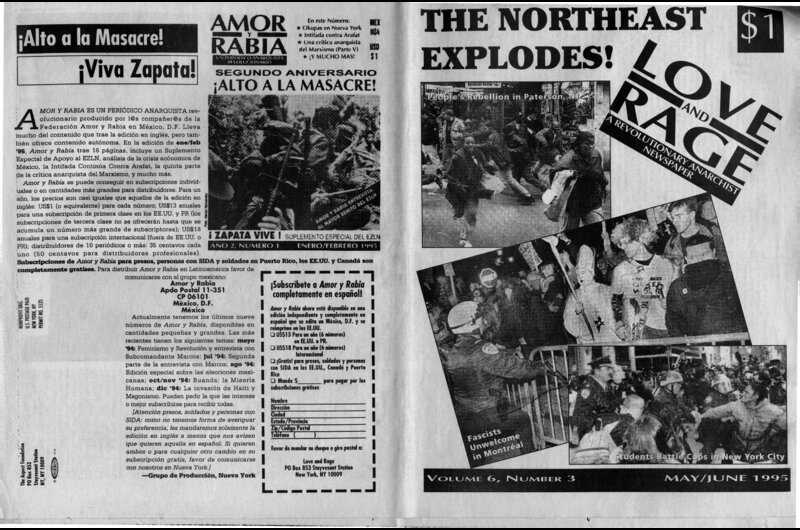
"New York Budget Cuts Spark Militant Mass Movement"
Item
A M R En este Numero: MEY
*& Okupas en Nueva York
ee Y Ge = « intifada contra Arafat NS4
*® Una critica anarquista
del Marxismo (Parte V} USB
* ;Y MUCHO MAS! $1
REVOLUCIONARIO
SEGUNDO ANIVERSARIO
;ALTO A LA MASACRE!
olucionario producido por 1@s compafier@s de la
Federaci6én Amor y Rabia en México, D.F. Lleva
mucho del contenido que trae la edicién en inglés, pero tam-
bién ofrece contenido auténoma. En la edicién de ene/feb
‘95, Amor y Rabia trae 16 paginas, incluye un Suplemento
Especial de Apoyo al EZLN, analisis de la crisis economica de
México, la Intifada Continua Contra Arafat, la quinta parte
de la critica anarquista del Marxismo, y mucho mas.
Amor y Rabia se puede conseguir en subscripciones individ-
uales o en cantidades mas grandes para distribuidores. Para un
afio, los precios son casi iguales que aquellos de la edicién en
inglés: US$1 (0 equivalente) para cada numero; US$13 anuales
para una subscripcién de primera clase en los EE.UU. y PR (los 3
subscripciones de tercera clase no se ofreceran hasta que se
acumula un nimero mas grande de subscriptores); US$18
anuales para una subscripci6n internacional (fuera de EE.UU. o
PR); distribuidores de 10 periddicos o mas: 35 centavos cada
uno (50 centavos para distribuidores profesionales).
Subscripciones de Amor y Rabia para presos, personas con SIDA y soldados en Puerto Rico, los EE.UU. y Canada son
completamente gratises. Para distribuir Amor y Rabia en Latinoamérica favor de
comunicarse con el grupo mexicano:
A MOR Y RABIA ES UN PERIODICO ANARQUISTA rev-
Amor y Rabia A 4 H
Apdo Postal 11:351 | jSubscribete a Amor y Rabia 1
ee Ik CP 06101 completamente en espaiiol!
= 2 = Pa age m I Amor y Rabia ahora esta disponible en una i
SSSe Actualmente tenemos los ultimos nueve l edicién independiente y completamente en ]
eu Fe nimeros de Amor y Rabia, disponibles en espafiol que is pg México, D.F. y se
cantidades pequefias y grandes. Las mas | CO USSTS Pera on aio (6 nemeres) I
recientes tienen los siguientes temas: mayo en EE.UU. o PR.
‘94: Feminismo y Revolucion y entrevista con ] OUSS18 Para un aiio (6 némeros) t
Subcomandante Marcos; jul ‘94: Segunda I eibrakl pang ue |
parte de la entrevista con Marcos; ago ‘94: ppt eg ee EEUU. Cassa eerie
Edicién especial sobre las elecciones mexi- ] Rico i i
canas; oct/nov ‘94: Ruanda: la Miseria O Mando $ para pagar por los
Humana; dic ‘94: La invasion de Haiti y ] subscribciones gratises |
Magonismo. Pueden pedir la que les interesa
© mejor subscribirse para recibir todas. ] Nombre l
[Atencién presos, soldados y personas con = ip sane RRS ee
SIDA: como no tenemos forma de averiguar I Estado /Provinca |
su preferencia, les mandaremos solamente la ] a — |
edicion en inglés a menos que nos avisen eletono
sg que quieren aquella en espanol. Si quieren ;
3 z 4 ambos o para cualquier otro cambio en su I Favor de mandar su cheque o giro postal a: :
2a $s f subscripcion gratis, favor de comunicarse ] Love and Rage :
38 5 = é) con nosotros en Nueva York.] PO Box 853 Stuyvesant Station
2352 v —Grnupo de Produccién, Nueva York ] New York, NY 10009 l
#2az *
i i A RO |
_ THE NORTHEAST
VOLUME 6, NUMBER 3
MAY/JUNE 1995
LOVE AND RAGE
A REVOLUTIONARY ANARCHIST NEWSPAPER
New York Budget Cuts Spark Militant Mass Movement
BY CHRISTOPHER DAY
n February 27, 8,000 students, main-
O: from the State University of New
York (SUNY) and the City University
of New York (CUNY), attended a rally orga-
nized by the New York Public Interest
Research Group (NYPIRG) at the New York
state capitol in Albany against dramatic
proposed cuts in the state budget for higher
education. The NYPIRG rally was organized
to coincide with a day of student lobbying
of state legislators. But many of the stu-
dents gathered in Albany were in no mood
to beg politicians for what they consider a
basic right. Growing impatient with an end-
less array of speakers emphasizing the
importance of registering to vote and writ-
ing to our legislators, groups of students
organized an impromptu march that man-
aged to capture the whole crowd. After
marching up and down a long mall the stu-
dents started to march past the state capitol
building which was guarded by no more
than a dozen cops on horseback. Students
waving the flag of the Dominican Republic
were the first up the stairs of the capitol
building. For a moment the crowd hesitated
and then proceeded up the stairs to the
doors of the capitol. The NYPIRG organizers
panicked and pleaded with the crowd to
return to the rally site. It was too late.
Several hundred students poured into the
lobby of the capitol building chanting,
among other things, “Revolution!
Revolution!” before the NYPIRG organizers,
working with the cops, managed to secure
the doors and prevent the rest of the stu-
dents from getting in. The rest of the crowd
Québecois
BY Nick PHEBUS
anuary 25 saw one of the biggest
Jesse mobilizations in the history
of Canada. More than 80,000 stu-
dents coast to coast have shown, in a
militant fashion, their opposition to the
Canadian government’s proposed reform
of social programs. All in all 80 campus-
es were on strike across Canada, the
Canadian Federation of Students (CFS)
estimates that more than 70,000 people
took to the streets that day and over
10,000 were on picket lines on different
campuses. In Montréal alone, more than
then marched several blocks to the admin-
istrative headquarters of SUNY where the
police were better prepared. After several
unsuccessful attempts the crowd managed
to push through the police and get into the
SUNY building, where they remained for
about twenty minutes. The demonstration
obtained only local Albany coverage in the
capitalist media.
While the students were not prepared to
transform these spontaneous actions into
effective occupations, their insurgent spirit
was an indicator that the movement against
the budget cuts was going to be militant.
This pattern was to repeat itself several
times, with the rank and file of the student
movement breaking through the boundaries
established by their self-appointed leaders.
OPENING MOVES
Several days later on March 1, 20,000 hos-
pital workers organized by 1199 (eleven-
ninety-nine), the hospital workers union,
marched from the Empire State Building to
Bellevue Hospital in opposition to proposed
cuts in Medicaid and hospital funding. Over
the next several weeks the movement
began to turn up the heat. When recently-
elected Governor George Pataki came to
speak in a New York City hotel his path
was blocked:by AIDS activists and students.
On March 15, speak-outs were organized by
faculty at many CUNY schools. At Hunter,
a CUNY college, a speak-out turned into a
confrontation with the police after theater
(Continued to page 4)
MAY/JUNE 1995
Ascene from March 23.
Left Fights Class War
12,000 people took to the streets in a
giant demonstration. This was the culmi-
nation of a mobilization of almost all
Canadian social forces against a govern-
ment that wants to deepen the poverty of
marginalized people.
The spark for this struggle was a series
of propositions to “reform” the social
“safety net” announced on Oct. 5, 1994,
by the Liberal federal government. They
want to make deep cuts in welfare,
unemployment insurance and post-sec-
ondary education. These proposals were
the culmination of a decade during which
both the Liberal Party, in power most of
that time at the federal level, and the
Tories, also in power during that time,
have adopted a neoliberal approach.
Slowly but surely, they have used propa-
ganda to put into the minds of the mass-
es the idea that the people benefiting
from social programs are parasites and
thieves. They also began to create a gen-
eral climate of panic about the national
debt and used this argument as an excuse
to attack the poor, who supposedly cost a
lot of money. They slowly dismantled
those programs.
For example, since 1992 the amount
paid by unemployment insurance has
been reduced from 60 to 55 percent of
the average paycheck. The number of
people eligible has been cut by 102,000,
and the duration of benefits has been
reduced. The government has also
attacked welfare recipients through a law
requiring those who are able to work to
accept any program the government
offers, or have their checks cut. At the
same time, the government gave more
and more money to the rich through sub-
sidies and tax deductions, not to mention
“under the table” rewards.
The response to these attacks was mini-
mal, in part because the once-militant
union movement has accepted the ideology
that the workers and the boss have the
same interests. Since the mid-1980s, union
militancy has been falling. In Québec, for
example, during the 1970s and 1980s, the
average number of strikes each year was
243. But in 1992 there were only 159, and.
in 1994 only 133.
These years of setbacks have been the
prelude to the general attack that we face
now, and to the social movement that
began a fight against the federal govern-
ment in October, 1994. My focus in this
article will be on Québec, so we should
know something about the left organiza-
tions here; especially in Montréal.
THE QUEBEC
STUDENT MOVEMENT
From 1975 to the early ‘90s, the student
left was dominated by one militant orga-
(Continued to page 3)
People’s Rebellion
in Paterson, New Jersey
By PAC
aterson made national news from
Piricsocas Feb. 22 until Sunday the
26th. The news began when a rookie
narcotics cop, Ronald Cohen, shot 16-year-
old Lawrence Meyers in the back of the head
on the evening of Monday, Feb. 20. Meyers
was under narcotics surveillance when he
was approached. He ran, and Cohen, with his
gun drawn, chased him to a fence.
Eyewitnesses state that when Cohen could
not get Meyers off the fence, he shot him in
the back of the head. Meyers was unarmed.
When the story broke in Tuesday's paper,
Meyers was listed in critical condition and
on life support. Officials reported on
Wednesday that Meyers had died. This
sparked a march to City Hall, almost entire-
ly composed of Black youth.
Several self-proclaimed Black leaders of
the city spoke, asking all to remain calm
and to wait for a police investigation. They
were all booed. The masses were out to get
their own justice.
Cops were initially held back, but even-
tually were let loose upon the crowd of
300-400. Street fighting followed, both
cops and demonstrators were knocked to
the ground, and the rebellion began.
Members of the angry crowd smashed store
windows and threw bottles at the police
and city hall. After several minutes, people
left the City Hall/downtown area and police
shut the streets to traffic.
During these events, members of the
Paterson Anarchist Collective (PAC) distrib-
uted hundreds of “No Police State” leaflets
and copies of Plain Words/Copwatch to a
crowd in search of direction. Later that
night, PAC members monitored police radio
to discover that cops around the city were
being attacked. Sniper fire, rocks, and bot-
tles were aimed at police throughout the
night. In the meantime, on Wednesday,
when television news reported the uprising
and that Meyers was “clinically” dead, the
Lower East Side Class War Organizer (LESC-
WO) had responded immediately to the cri-
sis situation and remained in Paterson
through the entire rebellion. PAC began to
organize literature to distribute the next
day. Late Wednesday night an emergency
one-page issue of Copwatch was produced
along with a flier urging Paterson to rise up
(Continued to page 3)
MAY/JUNE 1995 ¢ LOVE AND RAGE ¢ PAGE 1
Reflections on Kent State
BY MEG STARR
Te: May marks the: 25th anniversary of
the Kent State massacre, when four
white students were killed and six oth-
ers were wounded by the Ohio National
Guard during an anti-war demonstration at
Kent State University. During May 1970,
over one hundred people were killed and
wounded in US demonstrations—protesting
the invasion of Cambodia and issues of
domestic racism. In other murderous attacks,
two students were killed at Jackson State
(an all-Black college}, also rallying against
CUNY
(Continued from page 1)
students in a mock funeral procession were
followed by about 100 students into the
street where they were attacked without
warning by the police. Eight students were
brutally arrested. On March 16, about 3,000
students organized by the CUNY University
Student Senate (USS) marched from the
Borough of Manhattan Community College
(BMCC) to the World Trade Center.
STUDENT STRIKE
ROCKS NEW YORK
On March 23, 30,000 students turned out for
a demonstration organized by the CUNY
Coalition Against the Cuts with the explicit
aim to “Shut the City Down.” Only about
20,000 were able to get to the rally area
around City Hall. The rest were prevented
from getting to the rally by the police and
clogged the streets surrounding the rally.
The crowd included thousands of the 14,000
High School students who walked out of
classes that day. When the students at City
Hall attempted to get through the police
barricades and into the street in order to
march on Wall Street they were met with
horses, mace and billy-clubs. Seventy-five
students were arrested and many more were
maced or otherwise injured. Reporters and
photographers were also caught up in the
police riot. Eventually the repeated attacks
by the police broke down the determination
of the crowd, which gradually dispersed.
Several thousand students regrouped at
BMCC nearby and several hundred orga-
nized a march to 1 Police Plaza, police
headquarters, where the people arrested ear-
lier were being held. Later that evening
Police Commissioner Bratton attempted to
speak at a previously scheduled event at
Hunter College. Students disrupted the event
by shouting Bratton down with accusations
about police brutality at the demonstration.
After one of the students was thrown out of
the room a crowd of students gathered out-
side and chanted loudly throughout the
event. As Bratton left he was pursued by an
angry crowd of students chanting “Cops Off
Campus! Run Bratton Run!”
the war. Nine African-Americans were killed
in Augusta, Georgia, and 11 Chicano-
Mexicano students were attacked with bay-
onets at the University of New Mexico.
Kent State has gained its legendary impor-
tance because it marked the first time that the
white mass part of the student movement suf-
fered deliberate fatalities at the hands of the
white ruling class, It was preceded by years of
murderous attacks on both the civil rights
movement and the Black power movement.
Kent State University in Ohio was a large
state school with a high percentage of working
National guardsmen fire tear gas at Kent State University students on May 4, 1970.
The news blackout on the movement
against the budget cuts was finally broken.
The March 23 demonstration got front page
coverage in every English and Spanish lan-
guage daily in New York in addition to exten-
sive national and international coverage.
LIBERAL HUCKSTERS STIR
The March 23 demonstration seriously
shook the power structure by announcing
the existence of an autonomous working-
class student movement outside the control
of any of the traditional “progressive”
forces of New York City politics. The CUNY
Coalition refused to let any politicians
speak from the stage. Ruth Messinger, the
liberal Democratic Manhattan Borough
President, was told to get off the stage. The
response to the March 23 demonstration
was immediate. The “left-wing” of the
Democratic Party, in the form of the Rev.
Al Sharpton and 1199 President (and vice-
president of the New York State Democratic
Party) Denis Rivera, called for a march from
City Hall to Wall Street on April 4.
The April 4 demonstration had many
lessons to offer the new student move-
ment. Rivera and Sharpton promised the
CUNY Coalition that they would be “equal
partners” in organizing the demonstration.
They were everything but. About 5,000
people, mainly students, turned out for the
demonstration. 1199 did not mobilize its
own membership in anything like the sig-
nificant numbers they turned out for
March 1. 1199 overrode the CUNY
Coalition on several important issues from
who would get to speak to how the mar-
shals would respond to police provoca-
tions. At one point after several students
had made uncompromisingly radical
speeches, Denis Rivera took the micro-
phone and threatened not to participate in
the march if there were any more
“provocative speeches.” The crowd, includ-
ing many 1199 members, booed Rivera. Al
Sharpton had to intercede to save his and
Rivera’s political fortunes. In an expert
piece of demagoguery, Sharpton played
the firebrand, riling the crowd up with
chants of “No Justice, No Peace,” and then
turned around and announced that any
“provocateurs” would be “handed over to
the police.” Those who were familiar with
Sharpton’s past as an FBI informant didn’t
PAGE 4 ¢ LOVE AND RAGE ¢ MAY/JUNE 1995
class students. In 1965, the Kent State
Committee to End the War was started. By
1968, Kent had a very militant, anti-imperial-
ist chapter of Students for a Democratic
Society (SDS). In the fall of 1968, Kent SDS
joined the Black United Student Organization
in occupying the administration building, call-
ing for an end to police recruiting on campus.
In the aftermath. of that demonstration, when
the administration threatened to press charges
against the occupation organizers, all 500 of
the university's Black students walked off
campus and the charges were dropped.
doubt his willingness to collaborate with
the cops.
April 4 cost the movement some
momentum but it also taught some
important lessons about alliances with
“progressive” Democrats. After April 4 the
momentum returned to the individual
campuses. At SUNY Binghamton,
Governor Pataki’s car was stoned by stu-
dents as he attempted to visit his daugh-
ter who was participating in an event on
campus. On April 11 about 20 students at
the City College of New York (CCNY) in
Harlem initiated a hunger strike in a 24-
hour access building on campus. That
night CCNY president Yolanda Moses
called in the police to arrest the hunger
strikers and their supporters when they
refused to vacate the building at 11 p.m.
In 1969 CCNY was the site of an occupa-
tion that led to open admissions at CUNY.
Since then there has been a tradition of
not bringing the cops on campus. Moses’
decision to use mass arrests against a
hunger strike outraged not only other
CUNY students but also community
activists in Harlem and Washington
Heights. Only minor charges were brought
against the 47 arrestees, but they were
held in police custody overnight and the
hunger strikers were denied any fluids in
a blatant effort to break their resolve. The
next morning the hunger strikers returned
to CCNY, and by early evening they had
been joined by several hundred support-
ers from the community, from other
CUNY schools, and from Columbia and
other private schools. That evening a
decision was made to avoid arrests and to
leave the building when ordered to. The
crowd then marched in the rain for sever-
al hours in a spirited demonstration
through Harlem. Answering an offer of
sanctuary from Columbia students the
crowd attempted to gain access to
Columbia but were blocked at the main
gate by police. The crowd then rushed a
smaller gate and about half the people
got in before the cops were able to close
the gates and arrest three students. After
a brief occupation of the lobby of a
library the crowd decided to disperse. The
next evening Gov. Pataki ventured into
New York City, attempting to speak on
Staten Island. He was met by an angry
crowd of transit workers, school bus dri-
In 1968, the demonstrations at the
Democratic National Convention in Chicago
had a profound effect on the SDS chapter at
Kent State, just as they did around the
country. Due to confused politics about
participation in the electoral process,
national SDS had vacillated about protest-
ing at the convention. When Robert
Kennedy—the “peace candidate”—was killed,
SDS agreed to join the Yippies, the Poor
People’s Campaign, and the Black Stone
Rangers in the streets of Chicago. The bru-
tality of the Chicago Police Department and
Mayor Daly helped more white students
understand that US social and political
problems were systemic and not just about
one evil president or party.
By spring 1969, SDS chapters had mush-
roomed to 304 around the country. At Kent
State, 100 members religiously attended
SDS meetings. For the Spring ‘69 offensive,
in coalition with the Black United Student
Organization, SDS and the movement at
Kent had formulated four demands. Two
were focused on racism, one was to end the
war in Southeast Asia, and one was to get
ROTC and military recruiters off campus.
On April 4, when a demonstration took the
demands to Kent’s administration building,
the doors were locked and demonstrators
scuffled with police. The university charged
the students with “felony incitement to riot”
and the police department charged them
with attacking police officers. Eventually, a
deal was brokered in which only four stu-
dent leaders of SDS served time. They each
served six months.
In June 1969, as the early gay and wom-
en’s movements were gathering strength,
the Stonewall Rebellion erupted in New
York. As the movement grew, however,
National SDS broke up into several compet-
ing factions. Half of the students joined the
Progressive Labor Party, which argued that
the movement should focus on a traditional
Marxist analysis and concentrate on orga-
nizing the working class. They ignored the
Black Panther Party and other oppressed
nationalities within the US, who argued
that the US is a “prison house” of colonized
peoples, as well as an imperialist power
abroad. The other half of former SDS stu-
dents went into the Revolutionary Youth
Movement (RYM) faction. This group
believed in a strategy of reaching out to
white working class youth, trying to align
vers threatening to strike, and students
who successfully shouted him down.
BUDGET OF THE DAMNED
There are budget cuts and there are budget
cuts. The state budget proposed by Gov.
Pataki includes cuts so devastating in their
impact that they could do nothing but
spark massive resistance. The cuts include
dramatic reductions in the budgets for
AIDS, chemical dependency and other
health programs, Medicaid and other forms
of medical assistance, and particularly
sharp cuts in higher education. The effects
of the cuts on CUNY give a sense of the
general character of this budget. Pataki’s
proposed budget calls for a 25%, or $162
million, cut in funding for CUNY. To
absorb these cuts he has proposed a $1000
tuition increase. At the same time he is
slashing financial aid. The effects of the
cuts are already being felt. Staff and
adjuncts have already been laid off at some
schools, library hours have been reduced
and early registration has been canceled. It
is estimated that by the Fall 10% of CUNY
students will be unable to return to school
and 20% of classes will be cut as a result
of this budget.
CUNY has traditionally been the escape
from lives of poverty and misery for hun-
dreds of thousands of poor and working-
class New Yorkers. Until 1969, when open
admissions was won CUNY was almost all
white and tuition was free. By 1976 CUNY
was predominantly Black, Latino and Asian,
and for the first time tuition fees were
charged. Since then there has been an
almost unrelenting attack on CUNY. Each
budget proposal is accompanied by a
vicious campaign to demonize CUNY stu-
dents as undeserving of higher education.
Pataki’s budget proposal is in effect an
effort to destroy CUNY as a serious univer-
sity offering a broad liberal education to
working-class youth.
One of the astounding things about
Pataki’s budget, however, is that it is visit-
ing similar cuts on the more white and
middle class upstate SUNY schools.
Because of inequalities in how CUNY and
SUNY are funded, and because of the rela-
tively more privileged position of SUNY
students, SUNY will be able to absorb the
cuts more easily than CUNY. But the cuts
them with the Black liberation movement
and with other movements of oppressed
and colonized peoples around the world.
RYM believed in militant direct action.
By the Fall of 1969, RYM had further
divided and one RYM sub-group formed the
Weathermen. Student meetings with the
Vietnamese and student work with the
Black Panthers helped persuade
Weathermen and the other factions of RYM
that they should organize off-campus and
bring the revolutionary movement into
other sectors of society. During September
1969, the Chicago Eight were on trial for
the demonstrations at the Democratic
Convention. Weathermen called for a new
set of national actions in Chicago, later
known as the Days of Rage, to take place at
the beginning of the trial. Though only 500
people were involved, which was a big blow
to Weather, the tactics used in Chicago
were repeated by other groups in many
other activities later that spring. The
demonstrators fought the police with hel-
mets on, in organized affinity groups. There
was one day of women-only actions, which
marked a new stage in Weather’s develop-
ment of a position on “liberation through
participation” regarding women.
While none of the ex-SDS activists concen-
trated much attention on the campuses in the
fall, a new and somewhat spontaneous series
of organizers and groups continued the move-
ment that SDS had helped to generate. At Kent
State, ex-SDSers who were first-years and
sophomores (among them a student named
Allison Krause), organized for the Washington
Demonstration Against the War in November.
Over half-a-million people attended, making it
the largest anti-war demonstration of the
decade. Over four hundred people were arrest-
ed. Weathermen helped younger students
organize for the actions.
On December 4, 1969, Mark Clark and
Fred Hampton—two Black Panther organiz-
ers in their twenties—were murdered while
they slept by the FBI and the Chicago
police. At around that same time, part of
the Weathermen went underground. Their
decision was motivated by a desire to help
form a “second front” in support of the
Vietnamese and the Black Panther Party.
They planned to use the power and freedom
that comes with clandestinity to pursue
armed propaganda actions and radical
organizing. Black Liberation Army chapters
directed at SUNY and at Medicaid have
created a broad working- and middle-class
alliance against the cuts that has put the
cuts in serious jeopardy and Pataki on the
political defensive.
-OR DOES IT EXPLODE
For the majority of CUNY students, going
to college is an enormous struggle. Few
CUNY students can count on significant
financial support from their parents. The
vast majority of CUNY students hold down
at least one job. Many have children or
other family members to take care of.
Many are the first in their families to ever
attend college. For these students, for their
families, and for their communities, a
CUNY education represents their deepest
hopes and aspirations. The proposed budget
cuts are a direct assault on these dreams
and aspirations. For every one of the
200,000 students in CUNY there are at least
ten more people watching to see what will
happen. Every CUNY student forced out of
school by these budget cuts represents
younger sisters and brothers or friends on
the block who will give up hope and numb
their despair with drugs. The budget cuts
are quite simply a matter of life and death
for the communities affected.
THE NEW WORLD
ORDER COMES HOME
One of the main battles within the anti-
budget cut movement has been over where
the budget cuts are coming from. Liberal
groups ranging from NYPIRG to 1199 have
emphasized the mean-spiritedness of the
cuts and have focused their attacks on the
Republican politicians in Albany. Over and
over one hears from these quarters the
refrain that the politicians don’t know what
the cuts will do to the people who will be
affected by them and that the purpose of
the movement is to let them know. In con-
trast to this, the CUNY Coalition Against
the Cuts took a somewhat more explicitly
anti-capitalist position that the cuts are
part of the general process of capitalist
restructuring taking place around the world
and that the real power behind the budget
cuts is on Wall Street, not in Albany. But
even in the CUNY Coalition there is a lack
of clarity.
were already forming in many areas, as ex-
Black Panthers responded to repression and
to political escalation.
On April 29, 1970, Nixon announced his
intention to invade Cambodia. Suddenly,
the student movement, in its most sponta-
neous and mass form, erupted. Howie
Emmer, one of the SDS/Weathermen leaders
at Kent, later recalled that “it was as if
everything SDS had been saying for six
years—that the war wasn't just a mistake,
that it was part of ongoing US imperial-
ism—had finally clicked for people.”
Emmer was one of the four students who
had been jailed for the previous April's
actions, and coincidentally he was released
from jail later that same day. Along with
the other three released student leaders,
however, he was permanently banned from
Kent State’s campus.
The newly revitalized student movement
continued to grow in numbers and militan-
cy. On May 1, the Kent State ROTC building
was burned to the ground, becoming one of
30 ROTC centers throughout the country to
be burned down during the month of May
1970. There were two nights of organized
rioting in the town, during which only
banks and police cars were damaged. The
atmosphere in Ohio was very tense, and the
realities of state repression loomed. The
governor called out the National Guard,
placing them on the college campuses. He
announced that the four student leaders just
released from jail were communists and
criminals, and that they were the ones
behind all the trouble.
The typical FBI-devised rhetoric helped
isolate and criminalize the entire student
movement. The students on campus who
had planned a peaceful May 4 demonstra-
tion had their permit denied. But intransi-
gence was the tone of the times—from the
Vietnamese, quietly tunneling their way to
victory under American propped-up Saigon,
to the Black Panthers, providing breakfast
programs and self-defense patrols in their
own neighborhoods. The ad-hoc Kent
Demonstration Committee rallied without a
permit. When warned by the police, they
refused to move. The National Guard
opened fire on the unarmed demonstrators,
killing four.
Whether the Guard was trying to kill the
demonstration’s leaders or not isn’t clear.
With the exception of Allison Krause, who
Frequently, activists argue that the
budget cuts in higher education will be
bad for New York’s economy because
CUNY produces so many people who are
trained to work in high-paying skilled
professions, as if the ruling class has just
made a big blunder in calculating the
effects of the budget. In fact the budget
cuts are perfectly rational from the point
had been a member of SDS, the other stu-
dents who were killed had not been very
actively involved. The names of Jeffrey
Miller, Sandra Scheuer, and Bill Schroeder
may not have been significant to the move-
ment before May 4, 1970, but they live on
today as symbols of the possibility of white
resistance and the consequences of
rebelling against a repressive state.
Rage at the Jackson, Kent State, and
Augusta massacres intensified resistance
during May. At Hunter College in New York
City, a Third World Coalition blocked three
doors of the college on May 12 to protest
the college’s lack of response to the deaths
in Augusta. The Mississippi United Front for
Self-Defense, a coalition of African-
American student and anti-poverty groups,
called for armed self-defense. From coast to
coast, thousands of students blocked high-
ways and fought the police. Howie Emmer
remembered: “I was saddened by the deaths
at Kent State, because I'd been there and it
felt very close and personal. But I was
heartened by the enormous response of the
students around the country, who did not
back down.”
In the short run, the white movement did
become more militant. However, organizers
of that time also believe that Kent State
eventually became an obstacle for the
movement. Alan Berkman, a Weather
activist from Columbia University, suggest-
ed that “the state drew a line in the sand,
past which white supremacy wouldn’t pro-
tect activists. After that spring, for many
reasons—Kent State included, the movement
spiraled down.”
In the early 1970s, the white student
movement—along with all the other impor-
tant US-based movements—began to fall
apart. US involvement in the war in
Southeast Asia was “officially” over in
1973. For many white students, the war was
their major issue, and on-going change of
the society had played a secondary role. At
the same time, Nixon poured a huge
amount of money into local red squads and
the FBI Counter-Intelligence Program
(COINTELPRO) to destroy the movements
which tried to continue the struggle. The
FBI viciously attacked and killed Black
Power, American Indian Movement,
Mexican, and Puerto Rican leaders. Brain-
washing campaigns were directed at every
weakness in the movement's ideological
March 23
of view of the rich. In the new global
economy the high-paying jobs that sup-
ported the US’s large middle class are
being greatly reduced. At a time when the
pool of high-paying jobs traditionally
reserved for the white middle-class is
shrinking, CUNY is producing thousands
of Black, Latino and Asian competitors for
those jobs. This undermines the ability of
unity. FBI agents exploited the racism
which existed in the white student and
white women’s movements. They used the
sexism that existed among all male radicals,
as well as everyone's paranoia and sectari-
anism, to split groups and coalitions apart.
At the same time, “liberal” individuals
and programs sponsored by the ruling class
wooed the most conservative wing of the
movement towards electoral politics and
“enticing” reforms. This strategy, unsurpris-
ingly, worked best among the white middle
class sectors of the movement. A few white
revolutionaries of the 1970s, who grew out
of the Kent and student struggles, concen-
trated on developing new armed organiza-
tions. Though they were often arrogant, and
misunderstood the importance of mass
democratic work occurring simultaneously
with revolutionary activity, they were able
to build early underground groupings. By
the 1980s, a small number of white radicals
continued to experiment with more sophis-
ticated clandestine formations. They were
brutally repressed at an early stage of
development, during a particularly non-
revolutionary period of US history.
I think that—like the Zapatistas—we
should reject the errors of our radical
past: vanguardism, lack of democracy,
and arrogance. At the same time, we must
be able to unashamedly claim the experi-
ences and ideologies that can inspire and
inform our work today. Many of today’s
US political prisoners were revolutionary
participants in the student movements of
the 1960s. They are our primary resources
in creating, remembering, and critiquing
our own radical history that so many
would prefer we forget. We must hold on
to the history in which the murders of
Allison Krause, Jeffrey Miller, Sandra
Scheuer, and Bill Schroeder—along with
the martyrs of Jackson State and Augusta,
of the Panthers and all the others—are
mourned and remembered on the streets.
Only by remembering and honoring our
collective histories, and those who helped
to make them, will we stay true to oyr
continued resistance.*
Meg Starr is a member of Resistance in
Brooklyn (R ‘n B), a small, Brooklyn, NY-
based affinity group. She was a member of
the Free Puerto Rico Committee, and now
also works with Women’s Health Action
Mobilization (WHAM!).
the system to maintain a stable base of
support in the white middle class. It is
also producing raised expectations among
an enormous layer of well-educated
people of color that the system cannot
deliver on. From the point of view of the
rich, CUNY costs a lot of money and is
(Continued to page 9)
MAY/JUNE 1995 ¢ LOVE AND RAGE ¢ PAGE 5
Calendar
May 13 .
_ 10-year anniversary «
ing of the
(Continued from page 5)
contributing vital materials to future
social explosions. The budget cuts are, in
effect, long-term riot control.
WE DON’T NEED
NO STINKING PERMITS
The anti-budget cut movement is a very
broad one and there are enormous contra-
dictions between the various forces it has
brought together. Perhaps the sharpest con-
tradiction has arisen between the “left-
wing” of the Democratic Party as represent-
ed by 1199 and.the more autonomous
CUNY Coalition. While 1199 has a member-
ship of tens of thousands of working class
people who will be directly affected by the
cuts, the leadership of the union is in the
hands of people who will be affected in a
very different way, the cuts will undermine
their claim to institutionalized power. By
contrast, the CUNY Coalition, in spite of
many failings, is honestly led by students
who are not directly concerned with future
political careers. The March 23 demonstra-
tion was more than an attack on the budget
cuts. It was a challenge to the ability of the
Democrats to keep opposition to the budget
cuts within the bounds of protest-as-usual.
The Democrats and the rest of institutional-
ized progressivism (the unions, churches,
etc.) are in deep trouble. They have lost
much of their traditional support among
white workers to the right. Their one
remaining claim to viability is their ability
to rein in the unruly elements of the more
despised sections of society. It is clear that
on the whole the system is choosing to rely
more heavily on repression (cops and pris-
ons) than on the strategy of co-optation
represented by the progressive Democrats.
Demonstrations like the one on March 23
only reinforce the idea that the ungainly
bureaucracies of institutionalized progres-
june 2-4
Social poker and the Urban Alternative
deueabeou ccs
tute
New York City
Info: (718) 963-4839
(718) 832-3609
June 15-26
Food Not Bombs International Gatheri
and protest of the United Nations’ use
ie es ee ere
on the 50th anniversary of the —
sivism are as ineffective and irrelevant as
they are expensive.
The hastily organized April 4 demonstra-
tion was nothing more than a cynical
attempt by politicians and bureaucrats to
get out in front of a mass movement and
then bring it back under control. The failure
of the March 23 demonstration was our
failure to break through police lines and
march on Wall Street. The CUNY Coalition
had deliberately decided not to get a permit
for such a march in order to avoid working
with the police in blunting the power of our
own demonstration. Denis Rivera and Al
Sharpton sought to capitalize on this failure
by organizing a permitted march from City
Hall to Wall Street. They succeeded in mov-
ing 5,000 people from point A to point B,
but in so doing they sacrificed what made
March 23 powerful even in its failure, the
willingness of 30,000 people to show up to
a demonstration with the explicit intention
of shutting the city down to defeat the cuts.
THE CUNY COALITION
The CUNY Coalition was formally initiated
at the start of the Spring semester by the
president of student government at Bronx
Community College, but most of the work
to build the coalition appeared to be carried
out by the International Socialist
Organization (ISO), a Trotskyist group,
working with the student government at the
CUNY Graduate Center. While the ISO has.
large chapters at a number of private col-
leges in New York, the only CUNY campus
where they have a significant presence is
the CUNY Graduate Center. Initially, CUNY
Coalition meetings were supposed to rotate
from school to school, but because of the
superior facilities offered by the Graduate
Center the meetings became fixed there.
Both the ISO and the Graduate Center are
considerably whiter in composition than the
rest of CUNY. CUNY Coalition meetings have
a majority of white students while the move-
ments on the various campuses are over-
whelmingly made up of people of color. In
addition to the ISO and the Graduate Center a
March 23
number of other tiny Trotskyist groups repre-
senting almost no significant base on the
campuses decided to make CUNY Coalition
meetings a forum for airing their various
party lines at great length. The net effect of
all this was an atmosphere of distrust and
poor communications between the largely
white leadership of the Coalition and its
largely Black, Latino and Asian bases on the
campuses. This played itself out on March 23.
March 23 was the largest demonstration
by youth of color in New York history. While
the call for the demonstration emphasized
our intention to shut the city down, the
Trotskyists inflicted an interminable program
of speakers, including every vaguely progres-
sive union bureaucrat any of them had ever
met, on a crowd eager to get into the streets.
Security for the demonstration was organized
independently by each school with a coordi-
nating apparatus that never actually worked
with the consequence that there was no
effective stage security and everybody with a
buddy over 175 pounds could get on the
stage and demand a turn on the microphone
and many did. After almost two hours of
music, speeches and visible chaos on stage,
the announcement was made that we were
going to march to Wall Street. The problem,
of course, was that there were several thou-
sand cops gathered and ready to stop us. The
bigger problem was that there wasn’t the
coordination within the crowd to break
through the police lines. While some of the
failure of coordination can be blamed on
technical problems, the real failure was polit-
ical. The lines of trust and communication
between campuses had not been built up to
the point that they could overcome the pre-
dictable technical and logistical screw-ups.
In spite of these weaknesses March 23
also demonstrated the incredible power rep-
resented by the CUNY Coalition in the
fighting spirit displayed by thousands of
students over the course of the demonstra-
tion. March 23 announced the existence of
thousands of students, primarily students of
color, who are prepared to do whatever it
takes to defeat the budget cuts. If the CUNY
Coalition failed to turn this potentiality into
an effective action to actually shut down
the financial center of the world, it must be
credited with making that potentiality clear
to the students of CUNY and to the world.
THE BIRTH OF A MOVEMENT
For the past several years we have witnessed
the almost complete disintegration of any
sort of radical oppositional politics in the US.
The movement against the budget cuts in
New York is a significant reversal of this
trend. Also, events like the Los Angeles
rebellion have demonstrated the existence of
broad and deep contempt for the existing
order and a willingness to take to the streets
to challenge it. While it is still in its earliest
and most vulnerable stages, we are right
now witnessing the birth of a new move-
ment. The anti-budget-cut movement is not
a tired re-run of all the failed last stands of
the old left of the ‘80s. It has successfully
mobilized thousands of people who have
never participated in any sort of politics
before and their vitality is palpable. This
spirit was expressed clearly the day after
March 23 when students at Hunter College
gathered to sum up the demonstration and to
talk about where they wanted to go. While
the room was filled with pacifists, militants,
democratic socialists, anarchists, commu-
nists, nationalists, Christians, Muslims, and
independent radicals, there was a profound
feeling of unity. When it was suggested that
everybody take a minute to say what it was
that they stood for and wanted the group to
stand for that unity was made clear.
Although our commitment to defeating the
cuts and defending CUNY had brought us
together not one person mentioned either.
All but two people spoke specifically of rev-
olution. One Palestinian student said simply
“I believe in love” and was met with loud
applause. The right has overplayed its hand.
Pataki’s budget has given birth to a move-
ment that will not be going away soon. He
has compelled us to speak openly about our
desire for a new society and the love of the
people that motivates it. Nothing is more
dangerous to the powers that be.*
March 23
MAY/JUNE 1995 ¢ LOVE AND RAGE ¢ PAGE 9
AVIAN © JU GHIA BeOS @
Wr
*& Okupas en Nueva York
ee Y Ge = « intifada contra Arafat NS4
*® Una critica anarquista
del Marxismo (Parte V} USB
* ;Y MUCHO MAS! $1
REVOLUCIONARIO
SEGUNDO ANIVERSARIO
;ALTO A LA MASACRE!
olucionario producido por 1@s compafier@s de la
Federaci6én Amor y Rabia en México, D.F. Lleva
mucho del contenido que trae la edicién en inglés, pero tam-
bién ofrece contenido auténoma. En la edicién de ene/feb
‘95, Amor y Rabia trae 16 paginas, incluye un Suplemento
Especial de Apoyo al EZLN, analisis de la crisis economica de
México, la Intifada Continua Contra Arafat, la quinta parte
de la critica anarquista del Marxismo, y mucho mas.
Amor y Rabia se puede conseguir en subscripciones individ-
uales o en cantidades mas grandes para distribuidores. Para un
afio, los precios son casi iguales que aquellos de la edicién en
inglés: US$1 (0 equivalente) para cada numero; US$13 anuales
para una subscripcién de primera clase en los EE.UU. y PR (los 3
subscripciones de tercera clase no se ofreceran hasta que se
acumula un nimero mas grande de subscriptores); US$18
anuales para una subscripci6n internacional (fuera de EE.UU. o
PR); distribuidores de 10 periddicos o mas: 35 centavos cada
uno (50 centavos para distribuidores profesionales).
Subscripciones de Amor y Rabia para presos, personas con SIDA y soldados en Puerto Rico, los EE.UU. y Canada son
completamente gratises. Para distribuir Amor y Rabia en Latinoamérica favor de
comunicarse con el grupo mexicano:
A MOR Y RABIA ES UN PERIODICO ANARQUISTA rev-
Amor y Rabia A 4 H
Apdo Postal 11:351 | jSubscribete a Amor y Rabia 1
ee Ik CP 06101 completamente en espaiiol!
= 2 = Pa age m I Amor y Rabia ahora esta disponible en una i
SSSe Actualmente tenemos los ultimos nueve l edicién independiente y completamente en ]
eu Fe nimeros de Amor y Rabia, disponibles en espafiol que is pg México, D.F. y se
cantidades pequefias y grandes. Las mas | CO USSTS Pera on aio (6 nemeres) I
recientes tienen los siguientes temas: mayo en EE.UU. o PR.
‘94: Feminismo y Revolucion y entrevista con ] OUSS18 Para un aiio (6 némeros) t
Subcomandante Marcos; jul ‘94: Segunda I eibrakl pang ue |
parte de la entrevista con Marcos; ago ‘94: ppt eg ee EEUU. Cassa eerie
Edicién especial sobre las elecciones mexi- ] Rico i i
canas; oct/nov ‘94: Ruanda: la Miseria O Mando $ para pagar por los
Humana; dic ‘94: La invasion de Haiti y ] subscribciones gratises |
Magonismo. Pueden pedir la que les interesa
© mejor subscribirse para recibir todas. ] Nombre l
[Atencién presos, soldados y personas con = ip sane RRS ee
SIDA: como no tenemos forma de averiguar I Estado /Provinca |
su preferencia, les mandaremos solamente la ] a — |
edicion en inglés a menos que nos avisen eletono
sg que quieren aquella en espanol. Si quieren ;
3 z 4 ambos o para cualquier otro cambio en su I Favor de mandar su cheque o giro postal a: :
2a $s f subscripcion gratis, favor de comunicarse ] Love and Rage :
38 5 = é) con nosotros en Nueva York.] PO Box 853 Stuyvesant Station
2352 v —Grnupo de Produccién, Nueva York ] New York, NY 10009 l
#2az *
i i A RO |
_ THE NORTHEAST
VOLUME 6, NUMBER 3
MAY/JUNE 1995
LOVE AND RAGE
A REVOLUTIONARY ANARCHIST NEWSPAPER
New York Budget Cuts Spark Militant Mass Movement
BY CHRISTOPHER DAY
n February 27, 8,000 students, main-
O: from the State University of New
York (SUNY) and the City University
of New York (CUNY), attended a rally orga-
nized by the New York Public Interest
Research Group (NYPIRG) at the New York
state capitol in Albany against dramatic
proposed cuts in the state budget for higher
education. The NYPIRG rally was organized
to coincide with a day of student lobbying
of state legislators. But many of the stu-
dents gathered in Albany were in no mood
to beg politicians for what they consider a
basic right. Growing impatient with an end-
less array of speakers emphasizing the
importance of registering to vote and writ-
ing to our legislators, groups of students
organized an impromptu march that man-
aged to capture the whole crowd. After
marching up and down a long mall the stu-
dents started to march past the state capitol
building which was guarded by no more
than a dozen cops on horseback. Students
waving the flag of the Dominican Republic
were the first up the stairs of the capitol
building. For a moment the crowd hesitated
and then proceeded up the stairs to the
doors of the capitol. The NYPIRG organizers
panicked and pleaded with the crowd to
return to the rally site. It was too late.
Several hundred students poured into the
lobby of the capitol building chanting,
among other things, “Revolution!
Revolution!” before the NYPIRG organizers,
working with the cops, managed to secure
the doors and prevent the rest of the stu-
dents from getting in. The rest of the crowd
Québecois
BY Nick PHEBUS
anuary 25 saw one of the biggest
Jesse mobilizations in the history
of Canada. More than 80,000 stu-
dents coast to coast have shown, in a
militant fashion, their opposition to the
Canadian government’s proposed reform
of social programs. All in all 80 campus-
es were on strike across Canada, the
Canadian Federation of Students (CFS)
estimates that more than 70,000 people
took to the streets that day and over
10,000 were on picket lines on different
campuses. In Montréal alone, more than
then marched several blocks to the admin-
istrative headquarters of SUNY where the
police were better prepared. After several
unsuccessful attempts the crowd managed
to push through the police and get into the
SUNY building, where they remained for
about twenty minutes. The demonstration
obtained only local Albany coverage in the
capitalist media.
While the students were not prepared to
transform these spontaneous actions into
effective occupations, their insurgent spirit
was an indicator that the movement against
the budget cuts was going to be militant.
This pattern was to repeat itself several
times, with the rank and file of the student
movement breaking through the boundaries
established by their self-appointed leaders.
OPENING MOVES
Several days later on March 1, 20,000 hos-
pital workers organized by 1199 (eleven-
ninety-nine), the hospital workers union,
marched from the Empire State Building to
Bellevue Hospital in opposition to proposed
cuts in Medicaid and hospital funding. Over
the next several weeks the movement
began to turn up the heat. When recently-
elected Governor George Pataki came to
speak in a New York City hotel his path
was blocked:by AIDS activists and students.
On March 15, speak-outs were organized by
faculty at many CUNY schools. At Hunter,
a CUNY college, a speak-out turned into a
confrontation with the police after theater
(Continued to page 4)
MAY/JUNE 1995
Ascene from March 23.
Left Fights Class War
12,000 people took to the streets in a
giant demonstration. This was the culmi-
nation of a mobilization of almost all
Canadian social forces against a govern-
ment that wants to deepen the poverty of
marginalized people.
The spark for this struggle was a series
of propositions to “reform” the social
“safety net” announced on Oct. 5, 1994,
by the Liberal federal government. They
want to make deep cuts in welfare,
unemployment insurance and post-sec-
ondary education. These proposals were
the culmination of a decade during which
both the Liberal Party, in power most of
that time at the federal level, and the
Tories, also in power during that time,
have adopted a neoliberal approach.
Slowly but surely, they have used propa-
ganda to put into the minds of the mass-
es the idea that the people benefiting
from social programs are parasites and
thieves. They also began to create a gen-
eral climate of panic about the national
debt and used this argument as an excuse
to attack the poor, who supposedly cost a
lot of money. They slowly dismantled
those programs.
For example, since 1992 the amount
paid by unemployment insurance has
been reduced from 60 to 55 percent of
the average paycheck. The number of
people eligible has been cut by 102,000,
and the duration of benefits has been
reduced. The government has also
attacked welfare recipients through a law
requiring those who are able to work to
accept any program the government
offers, or have their checks cut. At the
same time, the government gave more
and more money to the rich through sub-
sidies and tax deductions, not to mention
“under the table” rewards.
The response to these attacks was mini-
mal, in part because the once-militant
union movement has accepted the ideology
that the workers and the boss have the
same interests. Since the mid-1980s, union
militancy has been falling. In Québec, for
example, during the 1970s and 1980s, the
average number of strikes each year was
243. But in 1992 there were only 159, and.
in 1994 only 133.
These years of setbacks have been the
prelude to the general attack that we face
now, and to the social movement that
began a fight against the federal govern-
ment in October, 1994. My focus in this
article will be on Québec, so we should
know something about the left organiza-
tions here; especially in Montréal.
THE QUEBEC
STUDENT MOVEMENT
From 1975 to the early ‘90s, the student
left was dominated by one militant orga-
(Continued to page 3)
People’s Rebellion
in Paterson, New Jersey
By PAC
aterson made national news from
Piricsocas Feb. 22 until Sunday the
26th. The news began when a rookie
narcotics cop, Ronald Cohen, shot 16-year-
old Lawrence Meyers in the back of the head
on the evening of Monday, Feb. 20. Meyers
was under narcotics surveillance when he
was approached. He ran, and Cohen, with his
gun drawn, chased him to a fence.
Eyewitnesses state that when Cohen could
not get Meyers off the fence, he shot him in
the back of the head. Meyers was unarmed.
When the story broke in Tuesday's paper,
Meyers was listed in critical condition and
on life support. Officials reported on
Wednesday that Meyers had died. This
sparked a march to City Hall, almost entire-
ly composed of Black youth.
Several self-proclaimed Black leaders of
the city spoke, asking all to remain calm
and to wait for a police investigation. They
were all booed. The masses were out to get
their own justice.
Cops were initially held back, but even-
tually were let loose upon the crowd of
300-400. Street fighting followed, both
cops and demonstrators were knocked to
the ground, and the rebellion began.
Members of the angry crowd smashed store
windows and threw bottles at the police
and city hall. After several minutes, people
left the City Hall/downtown area and police
shut the streets to traffic.
During these events, members of the
Paterson Anarchist Collective (PAC) distrib-
uted hundreds of “No Police State” leaflets
and copies of Plain Words/Copwatch to a
crowd in search of direction. Later that
night, PAC members monitored police radio
to discover that cops around the city were
being attacked. Sniper fire, rocks, and bot-
tles were aimed at police throughout the
night. In the meantime, on Wednesday,
when television news reported the uprising
and that Meyers was “clinically” dead, the
Lower East Side Class War Organizer (LESC-
WO) had responded immediately to the cri-
sis situation and remained in Paterson
through the entire rebellion. PAC began to
organize literature to distribute the next
day. Late Wednesday night an emergency
one-page issue of Copwatch was produced
along with a flier urging Paterson to rise up
(Continued to page 3)
MAY/JUNE 1995 ¢ LOVE AND RAGE ¢ PAGE 1
Reflections on Kent State
BY MEG STARR
Te: May marks the: 25th anniversary of
the Kent State massacre, when four
white students were killed and six oth-
ers were wounded by the Ohio National
Guard during an anti-war demonstration at
Kent State University. During May 1970,
over one hundred people were killed and
wounded in US demonstrations—protesting
the invasion of Cambodia and issues of
domestic racism. In other murderous attacks,
two students were killed at Jackson State
(an all-Black college}, also rallying against
CUNY
(Continued from page 1)
students in a mock funeral procession were
followed by about 100 students into the
street where they were attacked without
warning by the police. Eight students were
brutally arrested. On March 16, about 3,000
students organized by the CUNY University
Student Senate (USS) marched from the
Borough of Manhattan Community College
(BMCC) to the World Trade Center.
STUDENT STRIKE
ROCKS NEW YORK
On March 23, 30,000 students turned out for
a demonstration organized by the CUNY
Coalition Against the Cuts with the explicit
aim to “Shut the City Down.” Only about
20,000 were able to get to the rally area
around City Hall. The rest were prevented
from getting to the rally by the police and
clogged the streets surrounding the rally.
The crowd included thousands of the 14,000
High School students who walked out of
classes that day. When the students at City
Hall attempted to get through the police
barricades and into the street in order to
march on Wall Street they were met with
horses, mace and billy-clubs. Seventy-five
students were arrested and many more were
maced or otherwise injured. Reporters and
photographers were also caught up in the
police riot. Eventually the repeated attacks
by the police broke down the determination
of the crowd, which gradually dispersed.
Several thousand students regrouped at
BMCC nearby and several hundred orga-
nized a march to 1 Police Plaza, police
headquarters, where the people arrested ear-
lier were being held. Later that evening
Police Commissioner Bratton attempted to
speak at a previously scheduled event at
Hunter College. Students disrupted the event
by shouting Bratton down with accusations
about police brutality at the demonstration.
After one of the students was thrown out of
the room a crowd of students gathered out-
side and chanted loudly throughout the
event. As Bratton left he was pursued by an
angry crowd of students chanting “Cops Off
Campus! Run Bratton Run!”
the war. Nine African-Americans were killed
in Augusta, Georgia, and 11 Chicano-
Mexicano students were attacked with bay-
onets at the University of New Mexico.
Kent State has gained its legendary impor-
tance because it marked the first time that the
white mass part of the student movement suf-
fered deliberate fatalities at the hands of the
white ruling class, It was preceded by years of
murderous attacks on both the civil rights
movement and the Black power movement.
Kent State University in Ohio was a large
state school with a high percentage of working
National guardsmen fire tear gas at Kent State University students on May 4, 1970.
The news blackout on the movement
against the budget cuts was finally broken.
The March 23 demonstration got front page
coverage in every English and Spanish lan-
guage daily in New York in addition to exten-
sive national and international coverage.
LIBERAL HUCKSTERS STIR
The March 23 demonstration seriously
shook the power structure by announcing
the existence of an autonomous working-
class student movement outside the control
of any of the traditional “progressive”
forces of New York City politics. The CUNY
Coalition refused to let any politicians
speak from the stage. Ruth Messinger, the
liberal Democratic Manhattan Borough
President, was told to get off the stage. The
response to the March 23 demonstration
was immediate. The “left-wing” of the
Democratic Party, in the form of the Rev.
Al Sharpton and 1199 President (and vice-
president of the New York State Democratic
Party) Denis Rivera, called for a march from
City Hall to Wall Street on April 4.
The April 4 demonstration had many
lessons to offer the new student move-
ment. Rivera and Sharpton promised the
CUNY Coalition that they would be “equal
partners” in organizing the demonstration.
They were everything but. About 5,000
people, mainly students, turned out for the
demonstration. 1199 did not mobilize its
own membership in anything like the sig-
nificant numbers they turned out for
March 1. 1199 overrode the CUNY
Coalition on several important issues from
who would get to speak to how the mar-
shals would respond to police provoca-
tions. At one point after several students
had made uncompromisingly radical
speeches, Denis Rivera took the micro-
phone and threatened not to participate in
the march if there were any more
“provocative speeches.” The crowd, includ-
ing many 1199 members, booed Rivera. Al
Sharpton had to intercede to save his and
Rivera’s political fortunes. In an expert
piece of demagoguery, Sharpton played
the firebrand, riling the crowd up with
chants of “No Justice, No Peace,” and then
turned around and announced that any
“provocateurs” would be “handed over to
the police.” Those who were familiar with
Sharpton’s past as an FBI informant didn’t
PAGE 4 ¢ LOVE AND RAGE ¢ MAY/JUNE 1995
class students. In 1965, the Kent State
Committee to End the War was started. By
1968, Kent had a very militant, anti-imperial-
ist chapter of Students for a Democratic
Society (SDS). In the fall of 1968, Kent SDS
joined the Black United Student Organization
in occupying the administration building, call-
ing for an end to police recruiting on campus.
In the aftermath. of that demonstration, when
the administration threatened to press charges
against the occupation organizers, all 500 of
the university's Black students walked off
campus and the charges were dropped.
doubt his willingness to collaborate with
the cops.
April 4 cost the movement some
momentum but it also taught some
important lessons about alliances with
“progressive” Democrats. After April 4 the
momentum returned to the individual
campuses. At SUNY Binghamton,
Governor Pataki’s car was stoned by stu-
dents as he attempted to visit his daugh-
ter who was participating in an event on
campus. On April 11 about 20 students at
the City College of New York (CCNY) in
Harlem initiated a hunger strike in a 24-
hour access building on campus. That
night CCNY president Yolanda Moses
called in the police to arrest the hunger
strikers and their supporters when they
refused to vacate the building at 11 p.m.
In 1969 CCNY was the site of an occupa-
tion that led to open admissions at CUNY.
Since then there has been a tradition of
not bringing the cops on campus. Moses’
decision to use mass arrests against a
hunger strike outraged not only other
CUNY students but also community
activists in Harlem and Washington
Heights. Only minor charges were brought
against the 47 arrestees, but they were
held in police custody overnight and the
hunger strikers were denied any fluids in
a blatant effort to break their resolve. The
next morning the hunger strikers returned
to CCNY, and by early evening they had
been joined by several hundred support-
ers from the community, from other
CUNY schools, and from Columbia and
other private schools. That evening a
decision was made to avoid arrests and to
leave the building when ordered to. The
crowd then marched in the rain for sever-
al hours in a spirited demonstration
through Harlem. Answering an offer of
sanctuary from Columbia students the
crowd attempted to gain access to
Columbia but were blocked at the main
gate by police. The crowd then rushed a
smaller gate and about half the people
got in before the cops were able to close
the gates and arrest three students. After
a brief occupation of the lobby of a
library the crowd decided to disperse. The
next evening Gov. Pataki ventured into
New York City, attempting to speak on
Staten Island. He was met by an angry
crowd of transit workers, school bus dri-
In 1968, the demonstrations at the
Democratic National Convention in Chicago
had a profound effect on the SDS chapter at
Kent State, just as they did around the
country. Due to confused politics about
participation in the electoral process,
national SDS had vacillated about protest-
ing at the convention. When Robert
Kennedy—the “peace candidate”—was killed,
SDS agreed to join the Yippies, the Poor
People’s Campaign, and the Black Stone
Rangers in the streets of Chicago. The bru-
tality of the Chicago Police Department and
Mayor Daly helped more white students
understand that US social and political
problems were systemic and not just about
one evil president or party.
By spring 1969, SDS chapters had mush-
roomed to 304 around the country. At Kent
State, 100 members religiously attended
SDS meetings. For the Spring ‘69 offensive,
in coalition with the Black United Student
Organization, SDS and the movement at
Kent had formulated four demands. Two
were focused on racism, one was to end the
war in Southeast Asia, and one was to get
ROTC and military recruiters off campus.
On April 4, when a demonstration took the
demands to Kent’s administration building,
the doors were locked and demonstrators
scuffled with police. The university charged
the students with “felony incitement to riot”
and the police department charged them
with attacking police officers. Eventually, a
deal was brokered in which only four stu-
dent leaders of SDS served time. They each
served six months.
In June 1969, as the early gay and wom-
en’s movements were gathering strength,
the Stonewall Rebellion erupted in New
York. As the movement grew, however,
National SDS broke up into several compet-
ing factions. Half of the students joined the
Progressive Labor Party, which argued that
the movement should focus on a traditional
Marxist analysis and concentrate on orga-
nizing the working class. They ignored the
Black Panther Party and other oppressed
nationalities within the US, who argued
that the US is a “prison house” of colonized
peoples, as well as an imperialist power
abroad. The other half of former SDS stu-
dents went into the Revolutionary Youth
Movement (RYM) faction. This group
believed in a strategy of reaching out to
white working class youth, trying to align
vers threatening to strike, and students
who successfully shouted him down.
BUDGET OF THE DAMNED
There are budget cuts and there are budget
cuts. The state budget proposed by Gov.
Pataki includes cuts so devastating in their
impact that they could do nothing but
spark massive resistance. The cuts include
dramatic reductions in the budgets for
AIDS, chemical dependency and other
health programs, Medicaid and other forms
of medical assistance, and particularly
sharp cuts in higher education. The effects
of the cuts on CUNY give a sense of the
general character of this budget. Pataki’s
proposed budget calls for a 25%, or $162
million, cut in funding for CUNY. To
absorb these cuts he has proposed a $1000
tuition increase. At the same time he is
slashing financial aid. The effects of the
cuts are already being felt. Staff and
adjuncts have already been laid off at some
schools, library hours have been reduced
and early registration has been canceled. It
is estimated that by the Fall 10% of CUNY
students will be unable to return to school
and 20% of classes will be cut as a result
of this budget.
CUNY has traditionally been the escape
from lives of poverty and misery for hun-
dreds of thousands of poor and working-
class New Yorkers. Until 1969, when open
admissions was won CUNY was almost all
white and tuition was free. By 1976 CUNY
was predominantly Black, Latino and Asian,
and for the first time tuition fees were
charged. Since then there has been an
almost unrelenting attack on CUNY. Each
budget proposal is accompanied by a
vicious campaign to demonize CUNY stu-
dents as undeserving of higher education.
Pataki’s budget proposal is in effect an
effort to destroy CUNY as a serious univer-
sity offering a broad liberal education to
working-class youth.
One of the astounding things about
Pataki’s budget, however, is that it is visit-
ing similar cuts on the more white and
middle class upstate SUNY schools.
Because of inequalities in how CUNY and
SUNY are funded, and because of the rela-
tively more privileged position of SUNY
students, SUNY will be able to absorb the
cuts more easily than CUNY. But the cuts
them with the Black liberation movement
and with other movements of oppressed
and colonized peoples around the world.
RYM believed in militant direct action.
By the Fall of 1969, RYM had further
divided and one RYM sub-group formed the
Weathermen. Student meetings with the
Vietnamese and student work with the
Black Panthers helped persuade
Weathermen and the other factions of RYM
that they should organize off-campus and
bring the revolutionary movement into
other sectors of society. During September
1969, the Chicago Eight were on trial for
the demonstrations at the Democratic
Convention. Weathermen called for a new
set of national actions in Chicago, later
known as the Days of Rage, to take place at
the beginning of the trial. Though only 500
people were involved, which was a big blow
to Weather, the tactics used in Chicago
were repeated by other groups in many
other activities later that spring. The
demonstrators fought the police with hel-
mets on, in organized affinity groups. There
was one day of women-only actions, which
marked a new stage in Weather’s develop-
ment of a position on “liberation through
participation” regarding women.
While none of the ex-SDS activists concen-
trated much attention on the campuses in the
fall, a new and somewhat spontaneous series
of organizers and groups continued the move-
ment that SDS had helped to generate. At Kent
State, ex-SDSers who were first-years and
sophomores (among them a student named
Allison Krause), organized for the Washington
Demonstration Against the War in November.
Over half-a-million people attended, making it
the largest anti-war demonstration of the
decade. Over four hundred people were arrest-
ed. Weathermen helped younger students
organize for the actions.
On December 4, 1969, Mark Clark and
Fred Hampton—two Black Panther organiz-
ers in their twenties—were murdered while
they slept by the FBI and the Chicago
police. At around that same time, part of
the Weathermen went underground. Their
decision was motivated by a desire to help
form a “second front” in support of the
Vietnamese and the Black Panther Party.
They planned to use the power and freedom
that comes with clandestinity to pursue
armed propaganda actions and radical
organizing. Black Liberation Army chapters
directed at SUNY and at Medicaid have
created a broad working- and middle-class
alliance against the cuts that has put the
cuts in serious jeopardy and Pataki on the
political defensive.
-OR DOES IT EXPLODE
For the majority of CUNY students, going
to college is an enormous struggle. Few
CUNY students can count on significant
financial support from their parents. The
vast majority of CUNY students hold down
at least one job. Many have children or
other family members to take care of.
Many are the first in their families to ever
attend college. For these students, for their
families, and for their communities, a
CUNY education represents their deepest
hopes and aspirations. The proposed budget
cuts are a direct assault on these dreams
and aspirations. For every one of the
200,000 students in CUNY there are at least
ten more people watching to see what will
happen. Every CUNY student forced out of
school by these budget cuts represents
younger sisters and brothers or friends on
the block who will give up hope and numb
their despair with drugs. The budget cuts
are quite simply a matter of life and death
for the communities affected.
THE NEW WORLD
ORDER COMES HOME
One of the main battles within the anti-
budget cut movement has been over where
the budget cuts are coming from. Liberal
groups ranging from NYPIRG to 1199 have
emphasized the mean-spiritedness of the
cuts and have focused their attacks on the
Republican politicians in Albany. Over and
over one hears from these quarters the
refrain that the politicians don’t know what
the cuts will do to the people who will be
affected by them and that the purpose of
the movement is to let them know. In con-
trast to this, the CUNY Coalition Against
the Cuts took a somewhat more explicitly
anti-capitalist position that the cuts are
part of the general process of capitalist
restructuring taking place around the world
and that the real power behind the budget
cuts is on Wall Street, not in Albany. But
even in the CUNY Coalition there is a lack
of clarity.
were already forming in many areas, as ex-
Black Panthers responded to repression and
to political escalation.
On April 29, 1970, Nixon announced his
intention to invade Cambodia. Suddenly,
the student movement, in its most sponta-
neous and mass form, erupted. Howie
Emmer, one of the SDS/Weathermen leaders
at Kent, later recalled that “it was as if
everything SDS had been saying for six
years—that the war wasn't just a mistake,
that it was part of ongoing US imperial-
ism—had finally clicked for people.”
Emmer was one of the four students who
had been jailed for the previous April's
actions, and coincidentally he was released
from jail later that same day. Along with
the other three released student leaders,
however, he was permanently banned from
Kent State’s campus.
The newly revitalized student movement
continued to grow in numbers and militan-
cy. On May 1, the Kent State ROTC building
was burned to the ground, becoming one of
30 ROTC centers throughout the country to
be burned down during the month of May
1970. There were two nights of organized
rioting in the town, during which only
banks and police cars were damaged. The
atmosphere in Ohio was very tense, and the
realities of state repression loomed. The
governor called out the National Guard,
placing them on the college campuses. He
announced that the four student leaders just
released from jail were communists and
criminals, and that they were the ones
behind all the trouble.
The typical FBI-devised rhetoric helped
isolate and criminalize the entire student
movement. The students on campus who
had planned a peaceful May 4 demonstra-
tion had their permit denied. But intransi-
gence was the tone of the times—from the
Vietnamese, quietly tunneling their way to
victory under American propped-up Saigon,
to the Black Panthers, providing breakfast
programs and self-defense patrols in their
own neighborhoods. The ad-hoc Kent
Demonstration Committee rallied without a
permit. When warned by the police, they
refused to move. The National Guard
opened fire on the unarmed demonstrators,
killing four.
Whether the Guard was trying to kill the
demonstration’s leaders or not isn’t clear.
With the exception of Allison Krause, who
Frequently, activists argue that the
budget cuts in higher education will be
bad for New York’s economy because
CUNY produces so many people who are
trained to work in high-paying skilled
professions, as if the ruling class has just
made a big blunder in calculating the
effects of the budget. In fact the budget
cuts are perfectly rational from the point
had been a member of SDS, the other stu-
dents who were killed had not been very
actively involved. The names of Jeffrey
Miller, Sandra Scheuer, and Bill Schroeder
may not have been significant to the move-
ment before May 4, 1970, but they live on
today as symbols of the possibility of white
resistance and the consequences of
rebelling against a repressive state.
Rage at the Jackson, Kent State, and
Augusta massacres intensified resistance
during May. At Hunter College in New York
City, a Third World Coalition blocked three
doors of the college on May 12 to protest
the college’s lack of response to the deaths
in Augusta. The Mississippi United Front for
Self-Defense, a coalition of African-
American student and anti-poverty groups,
called for armed self-defense. From coast to
coast, thousands of students blocked high-
ways and fought the police. Howie Emmer
remembered: “I was saddened by the deaths
at Kent State, because I'd been there and it
felt very close and personal. But I was
heartened by the enormous response of the
students around the country, who did not
back down.”
In the short run, the white movement did
become more militant. However, organizers
of that time also believe that Kent State
eventually became an obstacle for the
movement. Alan Berkman, a Weather
activist from Columbia University, suggest-
ed that “the state drew a line in the sand,
past which white supremacy wouldn’t pro-
tect activists. After that spring, for many
reasons—Kent State included, the movement
spiraled down.”
In the early 1970s, the white student
movement—along with all the other impor-
tant US-based movements—began to fall
apart. US involvement in the war in
Southeast Asia was “officially” over in
1973. For many white students, the war was
their major issue, and on-going change of
the society had played a secondary role. At
the same time, Nixon poured a huge
amount of money into local red squads and
the FBI Counter-Intelligence Program
(COINTELPRO) to destroy the movements
which tried to continue the struggle. The
FBI viciously attacked and killed Black
Power, American Indian Movement,
Mexican, and Puerto Rican leaders. Brain-
washing campaigns were directed at every
weakness in the movement's ideological
March 23
of view of the rich. In the new global
economy the high-paying jobs that sup-
ported the US’s large middle class are
being greatly reduced. At a time when the
pool of high-paying jobs traditionally
reserved for the white middle-class is
shrinking, CUNY is producing thousands
of Black, Latino and Asian competitors for
those jobs. This undermines the ability of
unity. FBI agents exploited the racism
which existed in the white student and
white women’s movements. They used the
sexism that existed among all male radicals,
as well as everyone's paranoia and sectari-
anism, to split groups and coalitions apart.
At the same time, “liberal” individuals
and programs sponsored by the ruling class
wooed the most conservative wing of the
movement towards electoral politics and
“enticing” reforms. This strategy, unsurpris-
ingly, worked best among the white middle
class sectors of the movement. A few white
revolutionaries of the 1970s, who grew out
of the Kent and student struggles, concen-
trated on developing new armed organiza-
tions. Though they were often arrogant, and
misunderstood the importance of mass
democratic work occurring simultaneously
with revolutionary activity, they were able
to build early underground groupings. By
the 1980s, a small number of white radicals
continued to experiment with more sophis-
ticated clandestine formations. They were
brutally repressed at an early stage of
development, during a particularly non-
revolutionary period of US history.
I think that—like the Zapatistas—we
should reject the errors of our radical
past: vanguardism, lack of democracy,
and arrogance. At the same time, we must
be able to unashamedly claim the experi-
ences and ideologies that can inspire and
inform our work today. Many of today’s
US political prisoners were revolutionary
participants in the student movements of
the 1960s. They are our primary resources
in creating, remembering, and critiquing
our own radical history that so many
would prefer we forget. We must hold on
to the history in which the murders of
Allison Krause, Jeffrey Miller, Sandra
Scheuer, and Bill Schroeder—along with
the martyrs of Jackson State and Augusta,
of the Panthers and all the others—are
mourned and remembered on the streets.
Only by remembering and honoring our
collective histories, and those who helped
to make them, will we stay true to oyr
continued resistance.*
Meg Starr is a member of Resistance in
Brooklyn (R ‘n B), a small, Brooklyn, NY-
based affinity group. She was a member of
the Free Puerto Rico Committee, and now
also works with Women’s Health Action
Mobilization (WHAM!).
the system to maintain a stable base of
support in the white middle class. It is
also producing raised expectations among
an enormous layer of well-educated
people of color that the system cannot
deliver on. From the point of view of the
rich, CUNY costs a lot of money and is
(Continued to page 9)
MAY/JUNE 1995 ¢ LOVE AND RAGE ¢ PAGE 5
Calendar
May 13 .
_ 10-year anniversary «
ing of the
(Continued from page 5)
contributing vital materials to future
social explosions. The budget cuts are, in
effect, long-term riot control.
WE DON’T NEED
NO STINKING PERMITS
The anti-budget cut movement is a very
broad one and there are enormous contra-
dictions between the various forces it has
brought together. Perhaps the sharpest con-
tradiction has arisen between the “left-
wing” of the Democratic Party as represent-
ed by 1199 and.the more autonomous
CUNY Coalition. While 1199 has a member-
ship of tens of thousands of working class
people who will be directly affected by the
cuts, the leadership of the union is in the
hands of people who will be affected in a
very different way, the cuts will undermine
their claim to institutionalized power. By
contrast, the CUNY Coalition, in spite of
many failings, is honestly led by students
who are not directly concerned with future
political careers. The March 23 demonstra-
tion was more than an attack on the budget
cuts. It was a challenge to the ability of the
Democrats to keep opposition to the budget
cuts within the bounds of protest-as-usual.
The Democrats and the rest of institutional-
ized progressivism (the unions, churches,
etc.) are in deep trouble. They have lost
much of their traditional support among
white workers to the right. Their one
remaining claim to viability is their ability
to rein in the unruly elements of the more
despised sections of society. It is clear that
on the whole the system is choosing to rely
more heavily on repression (cops and pris-
ons) than on the strategy of co-optation
represented by the progressive Democrats.
Demonstrations like the one on March 23
only reinforce the idea that the ungainly
bureaucracies of institutionalized progres-
june 2-4
Social poker and the Urban Alternative
deueabeou ccs
tute
New York City
Info: (718) 963-4839
(718) 832-3609
June 15-26
Food Not Bombs International Gatheri
and protest of the United Nations’ use
ie es ee ere
on the 50th anniversary of the —
sivism are as ineffective and irrelevant as
they are expensive.
The hastily organized April 4 demonstra-
tion was nothing more than a cynical
attempt by politicians and bureaucrats to
get out in front of a mass movement and
then bring it back under control. The failure
of the March 23 demonstration was our
failure to break through police lines and
march on Wall Street. The CUNY Coalition
had deliberately decided not to get a permit
for such a march in order to avoid working
with the police in blunting the power of our
own demonstration. Denis Rivera and Al
Sharpton sought to capitalize on this failure
by organizing a permitted march from City
Hall to Wall Street. They succeeded in mov-
ing 5,000 people from point A to point B,
but in so doing they sacrificed what made
March 23 powerful even in its failure, the
willingness of 30,000 people to show up to
a demonstration with the explicit intention
of shutting the city down to defeat the cuts.
THE CUNY COALITION
The CUNY Coalition was formally initiated
at the start of the Spring semester by the
president of student government at Bronx
Community College, but most of the work
to build the coalition appeared to be carried
out by the International Socialist
Organization (ISO), a Trotskyist group,
working with the student government at the
CUNY Graduate Center. While the ISO has.
large chapters at a number of private col-
leges in New York, the only CUNY campus
where they have a significant presence is
the CUNY Graduate Center. Initially, CUNY
Coalition meetings were supposed to rotate
from school to school, but because of the
superior facilities offered by the Graduate
Center the meetings became fixed there.
Both the ISO and the Graduate Center are
considerably whiter in composition than the
rest of CUNY. CUNY Coalition meetings have
a majority of white students while the move-
ments on the various campuses are over-
whelmingly made up of people of color. In
addition to the ISO and the Graduate Center a
March 23
number of other tiny Trotskyist groups repre-
senting almost no significant base on the
campuses decided to make CUNY Coalition
meetings a forum for airing their various
party lines at great length. The net effect of
all this was an atmosphere of distrust and
poor communications between the largely
white leadership of the Coalition and its
largely Black, Latino and Asian bases on the
campuses. This played itself out on March 23.
March 23 was the largest demonstration
by youth of color in New York history. While
the call for the demonstration emphasized
our intention to shut the city down, the
Trotskyists inflicted an interminable program
of speakers, including every vaguely progres-
sive union bureaucrat any of them had ever
met, on a crowd eager to get into the streets.
Security for the demonstration was organized
independently by each school with a coordi-
nating apparatus that never actually worked
with the consequence that there was no
effective stage security and everybody with a
buddy over 175 pounds could get on the
stage and demand a turn on the microphone
and many did. After almost two hours of
music, speeches and visible chaos on stage,
the announcement was made that we were
going to march to Wall Street. The problem,
of course, was that there were several thou-
sand cops gathered and ready to stop us. The
bigger problem was that there wasn’t the
coordination within the crowd to break
through the police lines. While some of the
failure of coordination can be blamed on
technical problems, the real failure was polit-
ical. The lines of trust and communication
between campuses had not been built up to
the point that they could overcome the pre-
dictable technical and logistical screw-ups.
In spite of these weaknesses March 23
also demonstrated the incredible power rep-
resented by the CUNY Coalition in the
fighting spirit displayed by thousands of
students over the course of the demonstra-
tion. March 23 announced the existence of
thousands of students, primarily students of
color, who are prepared to do whatever it
takes to defeat the budget cuts. If the CUNY
Coalition failed to turn this potentiality into
an effective action to actually shut down
the financial center of the world, it must be
credited with making that potentiality clear
to the students of CUNY and to the world.
THE BIRTH OF A MOVEMENT
For the past several years we have witnessed
the almost complete disintegration of any
sort of radical oppositional politics in the US.
The movement against the budget cuts in
New York is a significant reversal of this
trend. Also, events like the Los Angeles
rebellion have demonstrated the existence of
broad and deep contempt for the existing
order and a willingness to take to the streets
to challenge it. While it is still in its earliest
and most vulnerable stages, we are right
now witnessing the birth of a new move-
ment. The anti-budget-cut movement is not
a tired re-run of all the failed last stands of
the old left of the ‘80s. It has successfully
mobilized thousands of people who have
never participated in any sort of politics
before and their vitality is palpable. This
spirit was expressed clearly the day after
March 23 when students at Hunter College
gathered to sum up the demonstration and to
talk about where they wanted to go. While
the room was filled with pacifists, militants,
democratic socialists, anarchists, commu-
nists, nationalists, Christians, Muslims, and
independent radicals, there was a profound
feeling of unity. When it was suggested that
everybody take a minute to say what it was
that they stood for and wanted the group to
stand for that unity was made clear.
Although our commitment to defeating the
cuts and defending CUNY had brought us
together not one person mentioned either.
All but two people spoke specifically of rev-
olution. One Palestinian student said simply
“I believe in love” and was met with loud
applause. The right has overplayed its hand.
Pataki’s budget has given birth to a move-
ment that will not be going away soon. He
has compelled us to speak openly about our
desire for a new society and the love of the
people that motivates it. Nothing is more
dangerous to the powers that be.*
March 23
MAY/JUNE 1995 ¢ LOVE AND RAGE ¢ PAGE 9
AVIAN © JU GHIA BeOS @
Wr
Title
"New York Budget Cuts Spark Militant Mass Movement"
Description
This May 1995 article in Love and Rage newspaper written by Christopher Day (Gunderson), a leader in the CUNY Coalition Against the Cuts, emphasizes the confrontational protest tactics that emerged from "rank-and-file" students, giving student activist leaders the choice of moving with this militancy or trying to subdue it.
Contributor
Subways, Suzy
Creator
Love and Rage Revolutionary Anarchist Federation
Date
May 1995 (Circa)
Language
English
Publisher
Love and Rage newspaper
Rights
Copyrighted
Source
Subways, Suzy
Original Format
Article / Essay
Love and Rage Revolutionary Anarchist Federation. Letter. 1995. “‘New York Budget Cuts Spark Militant Mass Movement’”, 1995, CUNY DIGITAL HISTORY ARCHIVE, accessed September 5, 2026, https://stephenz.tailc22a4b.ts.net/s/cdha/item/70