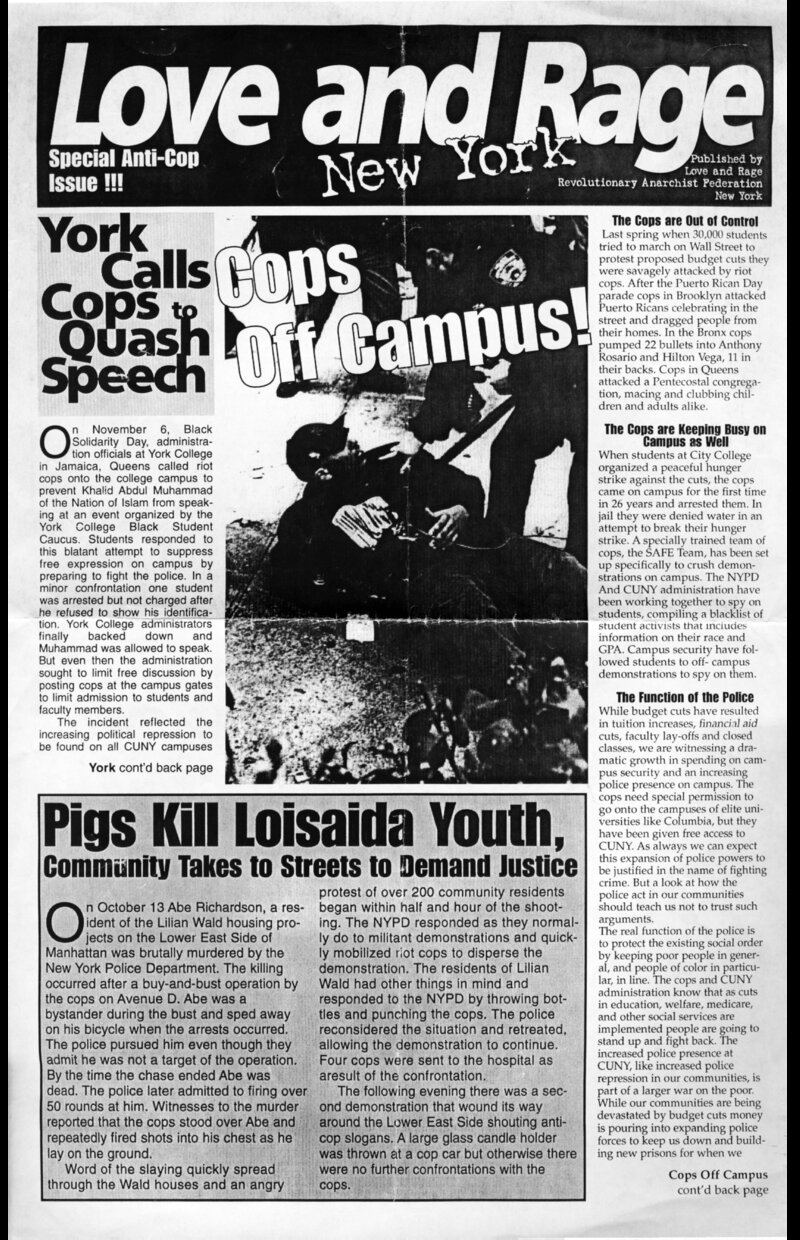
Love and Rage: Special Anti-Cop Issue
Item
n November 6, Black
O)xcaty Day, administra-
tion officials at York College
in Jamaica, Queens called riot
cops onto the college campus to
prevent Khalid Abdul Muhammad
of the Nation of Islam from speak-
ing at an event organized by the
York College Black Student
Caucus. Students responded to
this blatant attempt to suppress
free expression on campus by
preparing to fight the police. In a
minor confrontation one student
was arrested but not charged after
he refused to show his identifica-
tion. York College administrators
finally backed down and
Muhammad was allowed to speak.
But even then the administration
sought to limit free discussion by
posting cops at the campus gates
to limit admission to students and
faculty members.
The incident reflected the
increasing political repression to
be found on all CUNY campuses
York cont'd back page
n October 13 Abe Richardson, a res-
ident of the Lilian Wald housing pro-
jects on the Lower East Side of
Manhattan was brutally murdered by the
New York Police Department. The killing
occurred after a buy-and-bust operation by
the cops on Avenue D. Abe was a
bystander during the bust and sped away
on his bicycle when the arrests occurred.
The police pursued him even though they
admit he was not a target of the operation.
By the time the chase ended Abe was
dead. The police later admitted to firing over
lay on the ground.
Word of the slaying quickly spread
through the Wald houses and an angry
Pigs Kill Loisaida Youth,
Comminity Takes to Streets to Demand Justice
50 rounds at him. Witnesses to the murder —
reported that the cops stood over Abe and
repeatedly fired shots into his chest as he
iblished by
Love and Rage
Revolutionary Anarchist Federation
protest of over 200 community residents
began within half and hour of the shoot-
ing. The NYPD responded as they normal-
ly do to militant demonstrations and quick-
ly mobilized riot cops to disperse the
demonstration. The residents of Lilian
Wald had other things in mind and
responded to the NYPD by throwing bot-
tles and punching the cops. The police
reconsidered the situation and retreated,
allowing the demonstration to continue.
Four cops were sent to the hospital as
aresult of the confrontation.
The following evening there was a sec-
ond demonstration that wound its way
around the Lower East Side shouting anti-
cop slogans. A large glass candle holder
was thrown at a cop car but otherwise there
were no further confrontations with the
cops. -
New York
The Cops are Out of Control
Last spring when 30,000 students
tried to march on Wall Street to
protest proposed budget cuts they
were savagely attacked by riot
cops. After the Puerto Rican Day
parade cops in Brooklyn attacked
Puerto Ricans celebrating in the
street and dragged people from
their homes. In the Bronx cops
pumped 22 bullets into Anthony
Rosario and Hilton Vega, 11 in
their backs. Cops in Queens
attacked a Pentecostal congrega-
tion, macing and clubbing chil-
dren and adults alike.
The Cons are Keeping Busy on
Campus as Well
When students at City College
organized a peaceful hunger
strike against the cuts, the cops
came on campus for the first time
in 26 years and arrested them. In
jail they were denied water in an
attempt to break their hunger
strike. A specially trained team of
cops, the SAFE Team, has been set
up specifically to crush demon-
strations on campus. The NYPD
And CUNY administration have
been working together to spy on
students, compiling a blacklist of
student activists that inciudes
information on their race and
GPA. Campus security have fol-
lowed students to off- campus
demonstrations to spy on them.
The Function of the Police
While budget cuts have resulted
in tuition increases, financial aid
cuts, faculty lay-offs and closed
classes, we are witnessing a dra-
matic growth in spending on cam-
pus security and an increasing
police presence on campus. The
cops need special permission to
go onto the campuses of elite uni-
versities like Columbia, but they
have been given free access to
CUNY. As always we can expect
this expansion of police powers to
be justified in the name of fighting
crime. But a look at how the
police act in our communities
should teach us not to trust such
arguments.
The real function of the police is
to protect the existing social order
by keeping poor people in gener-
al, and people of color in particu-
lar, in line. The cops and CUNY
administration know that as cuts
in education, welfare, medicare,
and other social services are
implemented people are going to
stand up and fight back. The
increased police presence at
CUNY, like increased police
repression in our communities, is
part of a larger war on the poor.
While our communities are being
devastated by budget cuts money
is pouring into expanding police
forces to keep us down and build-
ing new prisons for when we
Cops Off Campus
cont'd back page
con
refuse to stay in our
place. We don’t have to put up
with this. We can fight for a better
way to live and an important part
of that fight must be to get the
cops out of our lives.
What We Want
Last spring a powerful and
vibrant movement was born at
CUNY. That movement will con-
tinue this year. But if it is to suc-
ceed we need to fight for some
basic democratic;rights. We need
the freedom to organize on cam-
pus free of police repression.
Accordingly, there are some things
this movement needs to fight for if
we are serious about changing our
situation:
* Campuses not Fortresses — We
want our campuses accessible to
all the people in our communities.
Because knowledge is power the
resources of the university should
be available to everybody.
¢ No Monitoring Student Activists
— We demand that student
records be kept confidential and
that the cops stop harassing stu-
dent activists.
¢ Cops Off Campus — The cops
have no place in a university. We
demand the abolition of the SAFE
Team.
¢ Student Run Security — We can
protect ourselves without relying
cops and security who are not
abo it protecting us anyway.
What Kind of Movement?
If we want to win these things we
need to build the kind of move-
ment that can get the job done. We
should have no illusions that we
will not be targeted by the very
authorities we are attacking. We
need to educate our fellow stu-
dents about what the cops are
really about and what they are
doing on our campuses. We need
to be prepared to take the kind of
direct action that forces the pow-
ers that be to take us seriously. We
need to build a movement that is
truly democratic. A democratic
movement that isn’t dominated by
a handful of people is our best
protec tion against repression —it
means they can’t arrest or expel a
few people and defeat us.
i'd from front pase
York
cont’d from front page
these days. This was the third
year that York administrators have
interfered with Black Solidarity
Day events. But it was the first
time they brought cops on campus
to keep a speaker out.
The incident also illustrates
why it is important that all CUNY
students unite to kick the cops off
campus. Khalid Abdul Muhhamad
is notorious for his homophobic
and anti-Semitic statements. The
politics he preaches are a dead
®
end that can only _ divide
oppressed peoples. But CUNY
students must have the freedom
to determine this for themselves.
By using the police to prevent
Muhammad from speaking York
administrators are craftily seeking
to divide students against each
other at a time when another
round of budget cuts looms over
us. Whatever we think of
Muhammad we should not allow
them to play us like that.
York College Acting President
Thomas K. Minter explained his
decision to allow Muhammad to
speak saying “I knew that the stu-
dents would never win if they went
up against the police.” But the
York College incident proves
exactly the opposite point. It was
precisely because York students
were willing to put their bodies on
the line and stand up to the cops
that they were able to force Minter
to back down.
How can ordinary citizens protect ourselves
from the violence of lawless police? What can we
do when the police act like just another street
gang, one with blue colors? In cities and neighbor-
hoods around the country, people have organized
Copwatch patrols. They follow police on their
beats, as they go about their “business,” and
record their behavior with cameras or video cam-
eras. They take notes. This is completely legal, so
long as the people do not physically “interfere with
police business.” Even that might be arguably
legal, when the police are engaged in criminal
behavior. But just by following and watching the
cops, people break down the blue wall of secrecy
which surrounds the police. It undermines the con-
fidence of the police that they can do whatever
they want with impunity. And it gives other people
the message that the police need to be watched. It
shows people that the cops’ authority can be ques-
tioned and encourages them to question it them-
selves.
We support the call for a city-
wide cops off campus campaign
e COPS OFF CAMPUS!
e STOP CUNY/NYPD SPYING
. ON STUDENTS!
e FOR STUDENT CONTROL OF
CAMPUS SECURITY!
Love jand Rage
P.O, Box 853, Stuyvesant Station
New York, NY 10009
tel. 718.834.9077
i}
For example, there is
a Copwatch project in
Minneapolis organized
by Anti-Racist Action
(ARA). They are
inspired by the tradi-
tion of the Black
Panther Party. which
organized people to
watch the cops. A
group has been going out every other Friday or
Saturday evening for almost a year now in downtown
Menneapolis. They talk to people and hand out in-
formation about ARA and what to do if arrested and,
of course, watch the police. During arrests and traffic
stops they are witnesses to police conduct ajid inter-
vene as much as possible. When they are loud
enough, the police sometimes let go the person they
were arresting and focus on the Copwatchers.
The Minneapolis Copwatchers are generally per-
ceived as a white group. While people of color also
do Copwatch, being seen as “white” has some
advantages. It gives them the privilege to take things
further with the police. They can sometimes get
away with things cops rarely tolerate from people of
color. They feel that it is important for white folks to
take a stand against the cops, to show that they are
not all loyal to this oppresive system.
A similar patrol has been organized in Boston.
Instead of concentrating on a single area the Boston
Copwatch uses a car, a police scanner and a cellular
phone to make sure that they are there when the cops
are taking action against people in the community.
The police force is one of the most oppressive
institutions in m people’ s lives, especially people
of color and wor' ing classi
any AtricaaAme
arrested, or€Ss
tion of whethe
times. Taki ist the police Ove
against & ki "and class oppre: that is
only slightly m uised-than nazi'sk d vio-
lence but is ake we afnciel era
police, aftera’ 3 Owes 13
state behind rhe A?
The mainway t Kal
jobs and)ajjust sodiety-On the read te
world it | bemecessary to do away 47 5 doa
paligé militar ) forces over and.above the rest.”
of ee ce thet ity
the i ot
top 2. w
Mo ngthe
onde oe a £ Sep n that
irection * om
O)xcaty Day, administra-
tion officials at York College
in Jamaica, Queens called riot
cops onto the college campus to
prevent Khalid Abdul Muhammad
of the Nation of Islam from speak-
ing at an event organized by the
York College Black Student
Caucus. Students responded to
this blatant attempt to suppress
free expression on campus by
preparing to fight the police. In a
minor confrontation one student
was arrested but not charged after
he refused to show his identifica-
tion. York College administrators
finally backed down and
Muhammad was allowed to speak.
But even then the administration
sought to limit free discussion by
posting cops at the campus gates
to limit admission to students and
faculty members.
The incident reflected the
increasing political repression to
be found on all CUNY campuses
York cont'd back page
n October 13 Abe Richardson, a res-
ident of the Lilian Wald housing pro-
jects on the Lower East Side of
Manhattan was brutally murdered by the
New York Police Department. The killing
occurred after a buy-and-bust operation by
the cops on Avenue D. Abe was a
bystander during the bust and sped away
on his bicycle when the arrests occurred.
The police pursued him even though they
admit he was not a target of the operation.
By the time the chase ended Abe was
dead. The police later admitted to firing over
lay on the ground.
Word of the slaying quickly spread
through the Wald houses and an angry
Pigs Kill Loisaida Youth,
Comminity Takes to Streets to Demand Justice
50 rounds at him. Witnesses to the murder —
reported that the cops stood over Abe and
repeatedly fired shots into his chest as he
iblished by
Love and Rage
Revolutionary Anarchist Federation
protest of over 200 community residents
began within half and hour of the shoot-
ing. The NYPD responded as they normal-
ly do to militant demonstrations and quick-
ly mobilized riot cops to disperse the
demonstration. The residents of Lilian
Wald had other things in mind and
responded to the NYPD by throwing bot-
tles and punching the cops. The police
reconsidered the situation and retreated,
allowing the demonstration to continue.
Four cops were sent to the hospital as
aresult of the confrontation.
The following evening there was a sec-
ond demonstration that wound its way
around the Lower East Side shouting anti-
cop slogans. A large glass candle holder
was thrown at a cop car but otherwise there
were no further confrontations with the
cops. -
New York
The Cops are Out of Control
Last spring when 30,000 students
tried to march on Wall Street to
protest proposed budget cuts they
were savagely attacked by riot
cops. After the Puerto Rican Day
parade cops in Brooklyn attacked
Puerto Ricans celebrating in the
street and dragged people from
their homes. In the Bronx cops
pumped 22 bullets into Anthony
Rosario and Hilton Vega, 11 in
their backs. Cops in Queens
attacked a Pentecostal congrega-
tion, macing and clubbing chil-
dren and adults alike.
The Cons are Keeping Busy on
Campus as Well
When students at City College
organized a peaceful hunger
strike against the cuts, the cops
came on campus for the first time
in 26 years and arrested them. In
jail they were denied water in an
attempt to break their hunger
strike. A specially trained team of
cops, the SAFE Team, has been set
up specifically to crush demon-
strations on campus. The NYPD
And CUNY administration have
been working together to spy on
students, compiling a blacklist of
student activists that inciudes
information on their race and
GPA. Campus security have fol-
lowed students to off- campus
demonstrations to spy on them.
The Function of the Police
While budget cuts have resulted
in tuition increases, financial aid
cuts, faculty lay-offs and closed
classes, we are witnessing a dra-
matic growth in spending on cam-
pus security and an increasing
police presence on campus. The
cops need special permission to
go onto the campuses of elite uni-
versities like Columbia, but they
have been given free access to
CUNY. As always we can expect
this expansion of police powers to
be justified in the name of fighting
crime. But a look at how the
police act in our communities
should teach us not to trust such
arguments.
The real function of the police is
to protect the existing social order
by keeping poor people in gener-
al, and people of color in particu-
lar, in line. The cops and CUNY
administration know that as cuts
in education, welfare, medicare,
and other social services are
implemented people are going to
stand up and fight back. The
increased police presence at
CUNY, like increased police
repression in our communities, is
part of a larger war on the poor.
While our communities are being
devastated by budget cuts money
is pouring into expanding police
forces to keep us down and build-
ing new prisons for when we
Cops Off Campus
cont'd back page
con
refuse to stay in our
place. We don’t have to put up
with this. We can fight for a better
way to live and an important part
of that fight must be to get the
cops out of our lives.
What We Want
Last spring a powerful and
vibrant movement was born at
CUNY. That movement will con-
tinue this year. But if it is to suc-
ceed we need to fight for some
basic democratic;rights. We need
the freedom to organize on cam-
pus free of police repression.
Accordingly, there are some things
this movement needs to fight for if
we are serious about changing our
situation:
* Campuses not Fortresses — We
want our campuses accessible to
all the people in our communities.
Because knowledge is power the
resources of the university should
be available to everybody.
¢ No Monitoring Student Activists
— We demand that student
records be kept confidential and
that the cops stop harassing stu-
dent activists.
¢ Cops Off Campus — The cops
have no place in a university. We
demand the abolition of the SAFE
Team.
¢ Student Run Security — We can
protect ourselves without relying
cops and security who are not
abo it protecting us anyway.
What Kind of Movement?
If we want to win these things we
need to build the kind of move-
ment that can get the job done. We
should have no illusions that we
will not be targeted by the very
authorities we are attacking. We
need to educate our fellow stu-
dents about what the cops are
really about and what they are
doing on our campuses. We need
to be prepared to take the kind of
direct action that forces the pow-
ers that be to take us seriously. We
need to build a movement that is
truly democratic. A democratic
movement that isn’t dominated by
a handful of people is our best
protec tion against repression —it
means they can’t arrest or expel a
few people and defeat us.
i'd from front pase
York
cont’d from front page
these days. This was the third
year that York administrators have
interfered with Black Solidarity
Day events. But it was the first
time they brought cops on campus
to keep a speaker out.
The incident also illustrates
why it is important that all CUNY
students unite to kick the cops off
campus. Khalid Abdul Muhhamad
is notorious for his homophobic
and anti-Semitic statements. The
politics he preaches are a dead
®
end that can only _ divide
oppressed peoples. But CUNY
students must have the freedom
to determine this for themselves.
By using the police to prevent
Muhammad from speaking York
administrators are craftily seeking
to divide students against each
other at a time when another
round of budget cuts looms over
us. Whatever we think of
Muhammad we should not allow
them to play us like that.
York College Acting President
Thomas K. Minter explained his
decision to allow Muhammad to
speak saying “I knew that the stu-
dents would never win if they went
up against the police.” But the
York College incident proves
exactly the opposite point. It was
precisely because York students
were willing to put their bodies on
the line and stand up to the cops
that they were able to force Minter
to back down.
How can ordinary citizens protect ourselves
from the violence of lawless police? What can we
do when the police act like just another street
gang, one with blue colors? In cities and neighbor-
hoods around the country, people have organized
Copwatch patrols. They follow police on their
beats, as they go about their “business,” and
record their behavior with cameras or video cam-
eras. They take notes. This is completely legal, so
long as the people do not physically “interfere with
police business.” Even that might be arguably
legal, when the police are engaged in criminal
behavior. But just by following and watching the
cops, people break down the blue wall of secrecy
which surrounds the police. It undermines the con-
fidence of the police that they can do whatever
they want with impunity. And it gives other people
the message that the police need to be watched. It
shows people that the cops’ authority can be ques-
tioned and encourages them to question it them-
selves.
We support the call for a city-
wide cops off campus campaign
e COPS OFF CAMPUS!
e STOP CUNY/NYPD SPYING
. ON STUDENTS!
e FOR STUDENT CONTROL OF
CAMPUS SECURITY!
Love jand Rage
P.O, Box 853, Stuyvesant Station
New York, NY 10009
tel. 718.834.9077
i}
For example, there is
a Copwatch project in
Minneapolis organized
by Anti-Racist Action
(ARA). They are
inspired by the tradi-
tion of the Black
Panther Party. which
organized people to
watch the cops. A
group has been going out every other Friday or
Saturday evening for almost a year now in downtown
Menneapolis. They talk to people and hand out in-
formation about ARA and what to do if arrested and,
of course, watch the police. During arrests and traffic
stops they are witnesses to police conduct ajid inter-
vene as much as possible. When they are loud
enough, the police sometimes let go the person they
were arresting and focus on the Copwatchers.
The Minneapolis Copwatchers are generally per-
ceived as a white group. While people of color also
do Copwatch, being seen as “white” has some
advantages. It gives them the privilege to take things
further with the police. They can sometimes get
away with things cops rarely tolerate from people of
color. They feel that it is important for white folks to
take a stand against the cops, to show that they are
not all loyal to this oppresive system.
A similar patrol has been organized in Boston.
Instead of concentrating on a single area the Boston
Copwatch uses a car, a police scanner and a cellular
phone to make sure that they are there when the cops
are taking action against people in the community.
The police force is one of the most oppressive
institutions in m people’ s lives, especially people
of color and wor' ing classi
any AtricaaAme
arrested, or€Ss
tion of whethe
times. Taki ist the police Ove
against & ki "and class oppre: that is
only slightly m uised-than nazi'sk d vio-
lence but is ake we afnciel era
police, aftera’ 3 Owes 13
state behind rhe A?
The mainway t Kal
jobs and)ajjust sodiety-On the read te
world it | bemecessary to do away 47 5 doa
paligé militar ) forces over and.above the rest.”
of ee ce thet ity
the i ot
top 2. w
Mo ngthe
onde oe a £ Sep n that
irection * om
Title
Love and Rage: Special Anti-Cop Issue
Description
This special issue of Love and Rage, written and published by anarchist CUNY students active in the CUNY Coalition Against the Cuts, covers police repression of student activism at CUNY and police brutality in New York City neighborhoods. One article focuses on an incident at York College on Nov. 6, 1995, in which riot police were called in to stop a Black Solidarity Day event. The back page calls for a campaign against police repression at CUNY and details how to start a Copwatch program.
Contributor
Subways, Suzy
Creator
Love and Rage
Date
December 1995 (Circa)
Language
English
Publisher
Love and Rage, New York
Rights
Copyrighted
Source
Subways, Suzy
Original Format
Newspaper / Magazine / Journal
Love and Rage. Letter. “Love and Rage: Special Anti-Cop Issue.”, CUNY DIGITAL HISTORY ARCHIVE, accessed September 5, 2026, https://stephenz.tailc22a4b.ts.net/s/cdha/item/71