Spirit Magazine, April 1975
Item
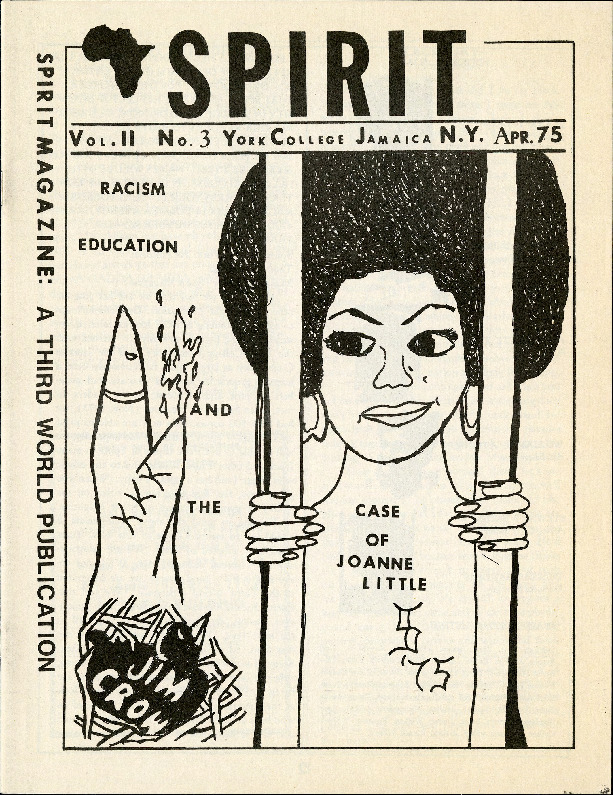
-INIZVOVW LIdlds
NOILVOITENd G1TYOM GHIHL V
SPIRIT
Vo..Il No.3 Yorx Cottece Jamaica N.Y. Apr.75
RACISM
EDUCATION
PAN AFRICAN SKILLS PROJECT
by Antoinette Byam
In an effort to unite the struggle and develop
ment of blacks in America with those in Africa,
The Pan African Skills Profect (PAS) has cre-
ated a project in which skilled Black Americans
can practice their trades in Africa.
The project which started in 1970, grew from
the fact that there was an abundance of skilled
Black men and women who could be of invaluable
service to their Motherland. Since 1970, the Pan
African Skills Project has been able to recruit over
three hundred Blacks to work primarily in Tan-
zania, a progressive East African nation. Although
Dar es Salaam (Tanaznia’s capital) is populated
with a good sum of Black workers from the PAS
program. It should be noted that workers are
placed in various areas of Africa as well.
Irving Davis, PAS Regional Director for
Africa, describes the program’s development, “The
concept of Black technical skills to Africa is not
new. Since 1967 I can recall the concerns being
voiced that not enough Africans in America saw
the vital role they could play in developing a strong
Africa.” The program, however, did not begin to
take form until 1969 when Davis became the non-
government organization representative for SNCC
(Student Non-Violent Coordinating Committee)
to the United Nations. The office now operates at
475 Riverside Drive in New York City and Ollis
Douglas is PAS Director for the United States.
The PAS recruitment process is a rigorous and
thorough one that prefers applicants who have had
some previous experience in the struggle for jus-
tice. The final decisions of acceptance rest in the
hands of the African nation and rejections have
mainly been the result of the decision that a per-
son’s skill area (eg. social work or physical educa-
tion teaching) was not in great demand. After
being accepted and just prior to departure, there
is a three day orientation program. Transporta-
tion cost is payed for by the host African nation
and after arrival, participants are given an inten-
sive three week program: with an emphasis on
learning Kiswhali, Tanzania’s official language.
Although PAS operates primarily in Tanzania
where an office has been established in Dar es Sa-
laam they hope to open offices in both Zambia and
Somalia with an eye towards establishing an en-
tire East coast network. PAS is also hoping to
establish an office in Washington, D.C. in order
to have more constant contact with African em-
bassies.
Information for the above article was taken
from IFCO News, Feb. 1972, Vol. IV
Issue 1.
JOIN THE NATIONAL FREEDOM MARCH ON BOSTON
SATURDAY, MAY 17
DESEGREGATE THE BOSTON SCHOOLS NOW
KEEP THE BUSES ROLLING
STOP RACIST ATTACKS ON BLACK STUDENTS
MAIL TO: NATIONAL STUDENT COALITION AGAINST RACISM
Columbia University, Room 306, Ferris Booth Hall
New York, New York 10027 / Telephone (212) 866-8830
— | want to help build the May 17 National Freedom March on Boston.
= Please send me information about buses leaving New Yerk.
= Enclosed is my contribution of §...
Address
SERENE tN ek la oo
School / Organization ...........
NATIONAL STUDENT COALITION: AGAINST RACISM
THE SEVEN-THIRTY-ONE
by S. Murray
On Wednesday, October thirteenth, nineteen
hundred seventy-four, I awoke and felt mean; and
it seemed as though the whole world felt mean too.
That feeling started after my mother had awakened
me while I was proposing to my girlfriend Ann;
I was dreaming. The feeling was intensifiied when
I got from under the covers and stepped onto the
floor of a very cold room. Somehow, I got on my
clothes and was on my way to school. I took the
“A” train to East New York and trotted up the
stairs to get the “J” train—the seven-thirty-one
from Manhattan. While doing that and hurrying
for school, I may add, I unintentionally bumped
into four male high school students. They were
walking as if they owned the stairway and were
practicing for a funeral procession. ‘Sorry” said
I, but they looked at me and said that they would
kick my a--s.’ They retorted “we ain’t meant you
no harm, black.” I got on the seven-thirty-one to
Jamaica, and there, two young Black junior high
school students were talking:
“You think you're mad, nigguh! I'll show
you,” said Sammy.
“No motherf -----, but no one is gonna walk
over me. You try it, dude-- if you don’t know
what's good for you,” said Butch.
As though they had reached the point of no
retreat, both boys sprung on each other and began
to fight as if the survival of the whole world de-
pended on each other’s victory. Thick, rich, red
blood gushed from the combatants’ faces while
other boys and girls and some wise adults shouted
these words of wisdom to each of the opponents - -
“Kill the nigguh!” While that was happening, we
the wiser adults, we Americans who like to in-
sure that justice prevail in every corner of the
world, sat pensive, and, as most New Yorkers
do, minded our own business. The two fighters,
who later on in their lives may become lawyers,
doctors, crooks, or presidents, were not our chil-
dren or brothers or relatives; so we let them pro-
cede to the point where they nearly had taken each
others own worthless lives.
I thought that I should have gone. and tried
to separate them and even try to show them that
they could sublimate that destructive energy into
something constructive. After I had watched them
(continued on page 17)
A QUESTION OF
DISCRIMINATION
by Howard Walters
In my investigation of the Human Rights
question on the York College Campus, I found
no new developments. It appears that the oppos
ing forces concerned (the administration and the
committee that brought charges of discriminating
practices at York) are awaiting the court's de-
cision. The Health, Education and Welfare De-
partment is anxious to come in to investigate but
the York Administration is employing delaying
tactics.
President Bassin refuses to accept Human Rights
Committee findings on racism and discrimination
at York College.
In order to trace the situation, we must start
with certain members of the York faculty who
informed the president of conditions and actions
in the school which they construed as being racist
and discriminatory. The answer that they received
was one that asked for further proof which would
enable him to take steps leading to the eradica-
tion of such practices. These instructors, who
were members of the Human Rights Committee
at. York College, then distributed a statement of
purposes, proceedings and a questionnaire to the
York College Community. The questionnaire spe-
cifically asked for information dealing with the re-
sult of any meeting held with the Dean of Faculty,
Dean Lewis J. Bodi. The results of this question-
naire, were not at all flattering to the dean. When
this information, which detailed a description of
the hiring practices of that department, was sub-
sequently brought before the President, he once
again refused to accept it as being conclusive.
(continued on page 18)
What Do You Want To Be...
REMEMBER...
CLIFFORD
GLOVER
1963-1973
...1f You Grow Up?
(continued from page 7) YORK COLLEGE INTERNATIONAL CLUB
The hiring of instructors by the office of the rae Sage aay
dean of faculty, is based on a tenure system. This
means that after five consecutive years of being
“rehired” by the school, the instructor is con-
tracted on a relatively permanent basis. It should
be realized that those who do get tenured, quite
often are those who best represent and express the
views of the administration.
In essence, I believe that the instructional
staff of this school is not performing adequately in
areas which contribute to smooth and productive
interaction with the Jamaica Community — the
Community of which this College was intended
to be a part. This lack of initiative to innovate
programs which involve, to a wider extend, the
local citizen, canot be blamed on the non-tenured
instructors, but on the hiring practices of the York
Administration. The effect of an dissatisfied teach
ing staff is often felt by students when they have
to deal with an instructor who because a need
for personal economic security, must work at other
jobs which may conflict with his area of instruc-
tion.
Once the faculty and administrative section
of the educational system begins to operate on a
just and effective basis, we can all expect to re-
ceive quality education. Until then however, I
believe that whatever is required to achieve that
goal should and will be done. In the case of York,
let’s hope that an understanding is reached be-
fore too long, perhaps before the new campus
is built.
Stop Complaining!!! i
Black Students
The Independent Black Organization
1.B.0.
dares you to come to a meeting
We are in Room 111 main Bldg.
Club Hrs. 11—1 p.m. If you have
so much to say that’s the place to do it.
NOILVOITENd G1TYOM GHIHL V
SPIRIT
Vo..Il No.3 Yorx Cottece Jamaica N.Y. Apr.75
RACISM
EDUCATION
PAN AFRICAN SKILLS PROJECT
by Antoinette Byam
In an effort to unite the struggle and develop
ment of blacks in America with those in Africa,
The Pan African Skills Profect (PAS) has cre-
ated a project in which skilled Black Americans
can practice their trades in Africa.
The project which started in 1970, grew from
the fact that there was an abundance of skilled
Black men and women who could be of invaluable
service to their Motherland. Since 1970, the Pan
African Skills Project has been able to recruit over
three hundred Blacks to work primarily in Tan-
zania, a progressive East African nation. Although
Dar es Salaam (Tanaznia’s capital) is populated
with a good sum of Black workers from the PAS
program. It should be noted that workers are
placed in various areas of Africa as well.
Irving Davis, PAS Regional Director for
Africa, describes the program’s development, “The
concept of Black technical skills to Africa is not
new. Since 1967 I can recall the concerns being
voiced that not enough Africans in America saw
the vital role they could play in developing a strong
Africa.” The program, however, did not begin to
take form until 1969 when Davis became the non-
government organization representative for SNCC
(Student Non-Violent Coordinating Committee)
to the United Nations. The office now operates at
475 Riverside Drive in New York City and Ollis
Douglas is PAS Director for the United States.
The PAS recruitment process is a rigorous and
thorough one that prefers applicants who have had
some previous experience in the struggle for jus-
tice. The final decisions of acceptance rest in the
hands of the African nation and rejections have
mainly been the result of the decision that a per-
son’s skill area (eg. social work or physical educa-
tion teaching) was not in great demand. After
being accepted and just prior to departure, there
is a three day orientation program. Transporta-
tion cost is payed for by the host African nation
and after arrival, participants are given an inten-
sive three week program: with an emphasis on
learning Kiswhali, Tanzania’s official language.
Although PAS operates primarily in Tanzania
where an office has been established in Dar es Sa-
laam they hope to open offices in both Zambia and
Somalia with an eye towards establishing an en-
tire East coast network. PAS is also hoping to
establish an office in Washington, D.C. in order
to have more constant contact with African em-
bassies.
Information for the above article was taken
from IFCO News, Feb. 1972, Vol. IV
Issue 1.
JOIN THE NATIONAL FREEDOM MARCH ON BOSTON
SATURDAY, MAY 17
DESEGREGATE THE BOSTON SCHOOLS NOW
KEEP THE BUSES ROLLING
STOP RACIST ATTACKS ON BLACK STUDENTS
MAIL TO: NATIONAL STUDENT COALITION AGAINST RACISM
Columbia University, Room 306, Ferris Booth Hall
New York, New York 10027 / Telephone (212) 866-8830
— | want to help build the May 17 National Freedom March on Boston.
= Please send me information about buses leaving New Yerk.
= Enclosed is my contribution of §...
Address
SERENE tN ek la oo
School / Organization ...........
NATIONAL STUDENT COALITION: AGAINST RACISM
THE SEVEN-THIRTY-ONE
by S. Murray
On Wednesday, October thirteenth, nineteen
hundred seventy-four, I awoke and felt mean; and
it seemed as though the whole world felt mean too.
That feeling started after my mother had awakened
me while I was proposing to my girlfriend Ann;
I was dreaming. The feeling was intensifiied when
I got from under the covers and stepped onto the
floor of a very cold room. Somehow, I got on my
clothes and was on my way to school. I took the
“A” train to East New York and trotted up the
stairs to get the “J” train—the seven-thirty-one
from Manhattan. While doing that and hurrying
for school, I may add, I unintentionally bumped
into four male high school students. They were
walking as if they owned the stairway and were
practicing for a funeral procession. ‘Sorry” said
I, but they looked at me and said that they would
kick my a--s.’ They retorted “we ain’t meant you
no harm, black.” I got on the seven-thirty-one to
Jamaica, and there, two young Black junior high
school students were talking:
“You think you're mad, nigguh! I'll show
you,” said Sammy.
“No motherf -----, but no one is gonna walk
over me. You try it, dude-- if you don’t know
what's good for you,” said Butch.
As though they had reached the point of no
retreat, both boys sprung on each other and began
to fight as if the survival of the whole world de-
pended on each other’s victory. Thick, rich, red
blood gushed from the combatants’ faces while
other boys and girls and some wise adults shouted
these words of wisdom to each of the opponents - -
“Kill the nigguh!” While that was happening, we
the wiser adults, we Americans who like to in-
sure that justice prevail in every corner of the
world, sat pensive, and, as most New Yorkers
do, minded our own business. The two fighters,
who later on in their lives may become lawyers,
doctors, crooks, or presidents, were not our chil-
dren or brothers or relatives; so we let them pro-
cede to the point where they nearly had taken each
others own worthless lives.
I thought that I should have gone. and tried
to separate them and even try to show them that
they could sublimate that destructive energy into
something constructive. After I had watched them
(continued on page 17)
A QUESTION OF
DISCRIMINATION
by Howard Walters
In my investigation of the Human Rights
question on the York College Campus, I found
no new developments. It appears that the oppos
ing forces concerned (the administration and the
committee that brought charges of discriminating
practices at York) are awaiting the court's de-
cision. The Health, Education and Welfare De-
partment is anxious to come in to investigate but
the York Administration is employing delaying
tactics.
President Bassin refuses to accept Human Rights
Committee findings on racism and discrimination
at York College.
In order to trace the situation, we must start
with certain members of the York faculty who
informed the president of conditions and actions
in the school which they construed as being racist
and discriminatory. The answer that they received
was one that asked for further proof which would
enable him to take steps leading to the eradica-
tion of such practices. These instructors, who
were members of the Human Rights Committee
at. York College, then distributed a statement of
purposes, proceedings and a questionnaire to the
York College Community. The questionnaire spe-
cifically asked for information dealing with the re-
sult of any meeting held with the Dean of Faculty,
Dean Lewis J. Bodi. The results of this question-
naire, were not at all flattering to the dean. When
this information, which detailed a description of
the hiring practices of that department, was sub-
sequently brought before the President, he once
again refused to accept it as being conclusive.
(continued on page 18)
What Do You Want To Be...
REMEMBER...
CLIFFORD
GLOVER
1963-1973
...1f You Grow Up?
(continued from page 7) YORK COLLEGE INTERNATIONAL CLUB
The hiring of instructors by the office of the rae Sage aay
dean of faculty, is based on a tenure system. This
means that after five consecutive years of being
“rehired” by the school, the instructor is con-
tracted on a relatively permanent basis. It should
be realized that those who do get tenured, quite
often are those who best represent and express the
views of the administration.
In essence, I believe that the instructional
staff of this school is not performing adequately in
areas which contribute to smooth and productive
interaction with the Jamaica Community — the
Community of which this College was intended
to be a part. This lack of initiative to innovate
programs which involve, to a wider extend, the
local citizen, canot be blamed on the non-tenured
instructors, but on the hiring practices of the York
Administration. The effect of an dissatisfied teach
ing staff is often felt by students when they have
to deal with an instructor who because a need
for personal economic security, must work at other
jobs which may conflict with his area of instruc-
tion.
Once the faculty and administrative section
of the educational system begins to operate on a
just and effective basis, we can all expect to re-
ceive quality education. Until then however, I
believe that whatever is required to achieve that
goal should and will be done. In the case of York,
let’s hope that an understanding is reached be-
fore too long, perhaps before the new campus
is built.
Stop Complaining!!! i
Black Students
The Independent Black Organization
1.B.0.
dares you to come to a meeting
We are in Room 111 main Bldg.
Club Hrs. 11—1 p.m. If you have
so much to say that’s the place to do it.
Title
Spirit Magazine, April 1975
Description
These selections are from the April 1975 issue of the York College student-run Spirit Magazine. The publication typically focused on the concerns and needs of the college's large black student population.The magazine's cover features Joanne Little, an African American woman charged with the murder of a white prison guard in a North Carolina jail in 1974. A lengthy article in this issue details the state's desire for the death penalty. Several months after the magazine's' printing, however, a jury found Little not guilty by way of self-defense. Among the other items included is an article detailing the Pan African Skills Project, an initiative created to bring skilled workers to places like Tanzania. The program's recruitment process and history are described in some detail. In another article, a York College student attempts to investigate claims of racism and discrimination on campus. Alleging, among other things, questionable hiring practices on the part of the college's administration, the article concludes that the present instructional staff, for several reasons, fails to contribute to the larger Jamaican community outside of the school.Finally, a memorial piece can be found for Clifford Glover, a 10-year old boy killed by a police officer in Jamaica, Queens in 1973. His death, which came as he was running away, the officer's later acquittal, and the riots that followed all remained in the neighborhood's collective memory in subsequent years.
Creator
Spirit Magazine
Date
April 1975
Language
English
Publisher
Spirit Magazine
Rights
Obtained from Contributor - Copyright Unknown
Original Format
Newspaper / Magazine / Journal
Spirit Magazine. Letter. 1975. “Spirit Magazine, April 1975”, 1975, CUNY DIGITAL HISTORY ARCHIVE, accessed September 5, 2026, https://stephenz.tailc22a4b.ts.net/s/cdha/item/783