Summer Institute Grant Proposal
Item
Brooklyn College of the City University of New York
Bedford Avenuc and ‘Avenue H ‘Brooklyn, New York 11210
Women’s Studies Program
780-5476/77
-February-8,-2980 ice. 3, (74°
Dear Sisters
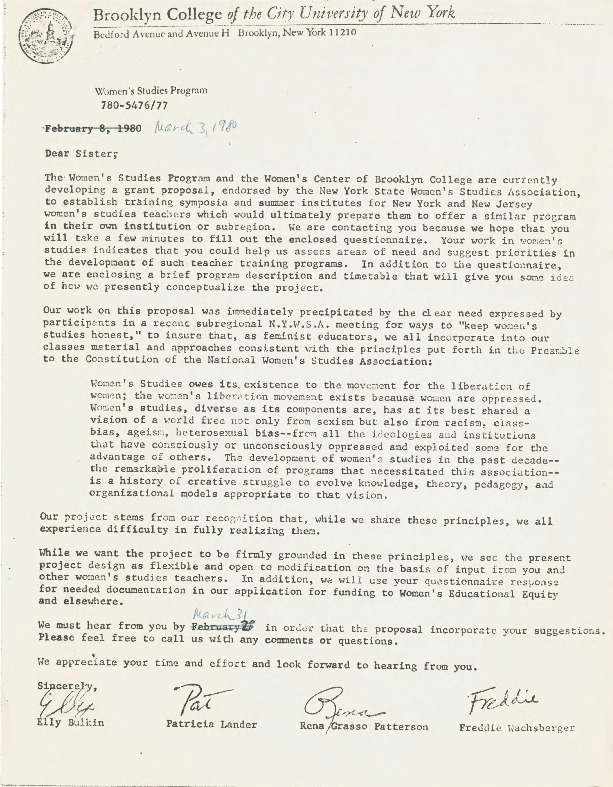
The Women's Studies Program and the Women's Center of Brooklyn College are currently
developing a grant proposal, endorsed by the New York State Women's Studics Association,
te establish training symposia and summer institutes for New York and New Jersey
women's studies teachers which would ultimately prepare them to offer a similar program
in their own institution or subregion. We are contacting you because we hope that you
will take a few minutes to fill out the enclosed questionnaire. Your work in women's
studies indicates that you could help us assess areas of need and suggest priorities in
the development of such teacher training programs. In addition to the questionnaire,
we are enclosing a brief program description and timetable that will give you some idea
of how we presently conceptualize the project.
Our work on this proposal was immediately precipitated by the cl ear need expressed by
participants in a recent subregional N.Y.W.S.A. meeting for ways to "keep women's
studies honest," to insure that, as feminist educators, we all incorporate into our
classes material and approaches consistent with the principles put forth in the Preamble
to the Constitution of the National Women's Studies Association:
Women's Studies owes its. existence to the movement for the liberation of
women; the women's liberation movement exists because women are oppressed.
Women's studies, diverse as its components are, has at its best shared a
vision of a world free not only from sexism but also from racism, class-
bias, ageism, heterosexual bias--from all the ideologies aud institutions
that have consciously or unconsciously oppressed and exploited some for the
advantage of others. The development of women's studies in the past decade--
the remarkable proliferation of programs that necessitated this associetion--
is a history of creative struggle to evolve knowledge, theory, pedagogy, aad
organizational models appropriate to that vision.
Our project stems from our recognition that, while we share these principles, we all
experience difficulty in fully realizing then.
While we want the project to be firmly grounded in these principles, we sec the present
project design as flexible and open to modification on the basis of input from you and
other women's studies teachers. In addition, we will use your questionnaire response
for needed documentation in our application for funding to Women's Educational Equity
and elsewhere.
Mavch?
We must hear from you by Leste in order that the proposal incorporate your suggestions.
Please feel free to call us with any comments or questions.
We appreciate your time and effort and look forward to hearing from you.
Elly Bulkin Patricia Lander Rena /Grasso Patterson Freddie Wachsberger
Brooklyn College of the City University of New York
Bedford Avenue and Avenue H_ Brooklyn, New York 11210
Women’s Studies Program
PROJECT DESCRIPTION
The first year will culminate in a month-long summer institute (July,
1981). During the spring, 1981 semester, we will pilot the summer in-
stitute through two sets of weekly symposia, one at Brooklyn College
for Brooklyn College faculty members, the other at the CUNY Graduate
Center (Midtown Manhattan) for both other CUNY faculty and non-CUNY
faculty living within commuting distance of N.Y.C. The summer insti-
tute will be designed to result in increased classroom effectiveness
for the teachers involved, After first examining women's studies within
the framework of the contemporary women's movement, we will focus on
overcoming barriers that prevent us from dealing as effectively as we
might in the classroom with women whose contributions have too often
been overlooked-=-Black women, Hispanic women, other Third World women,
lesbians, poor/working class women, older women. With each group (and
recognizing that there is considerable overlap), we will discuss cur-
riculum development, teaching methodology, and the biases (racism,
homophobia, classism, ageism) that prevent us from dealing fully and
constructively with the work of women whose lives might differ signi-
ficantly from our own,
The second year will culminate in a summer institute (July, 1982) that
will prepare women to return to their regions/institutions and do the
training themselves, Basically the first year will serve overall as a
pilot for the grant's second year, when the training, as well as a manual
and companion video material, will provide concrete resources for all
subregions in New York and New Jersey. Development of the summer insti-
tute, the manual, and the video material will be based on what we have
learned during the first year of the project and on what we learn through
a series of intensive modules (i.e. Third World women/racism, lesbians/
homophobia) offered during the second year in different areas of New York
and New Jersey. These modules will last 2-3 days and be done at the re-
quest of some group or institution in a given subregion. Participation
in these modules and/or in the first-year symposia/institute will pro-
vide a pool of possible participants for the 1982 summer institute.
The last 6 months (to winter, 1983) will involve finalizing for dissemination
the manual and the video material designed to go with it, as well as a
final evaluation of the project as a whole.
NEEDS ASSESSMENT QUESTIONNAIRE
Many of the following questions ask for multiple answers. Please check all that
apply. If you cannot answer a question, just leave it blank. If any question does not
fit your particular situation, please amend the question or add a comment. Also please
note that several groups or categories are not mutually exclusive and may total more or
less than 100%.
If you want to make extensive comments about any question or about the questionnaire
as a whole, submit your comments on separate pieces of paper. Please return the
questionnaire by February /8 to the Women's Studies Program, Brooklyn College, Bedford
Avenue and Avenue H, Brooklyn, New York 11210.
I. GENERAL INFORMATION
1. Name
2. Highest academic degree year subject area
3. Age
4. Racial/ethnic identity Language(s) spoken other than English
5. a. Are you a member of the National Women's Studies Association?
yes no
b. Are you a member of a regional Women's Studies Association?
yes __—sséntoo if yes, specify which one
c. If you are a member of the National or a Regional W.S.A., check any caucus(es)
to which you belong and indicate whether your membership is in a National
caucus (N) or a Regional one (R).
community college Third World
lesbian Student
pre K-12 Staff
d. Regardless of whether you are a National or Regional member of the W.S.A.,
have you in the past year attended any conference sponsored by it?
National
Regional
Subregional
Other
e. If you belong to any other professional, community-based, or political
women's groups or orgmizations, list them.
f. List any feminist journals and other feminist periodicals that you read
. regularly.
II. WOMEN'S STUDIES AND INSTITUTIONAL INFORMATION
6. Your relation to women's studies: Tenured Non-tenured
a. Full time faculty member Department
Adjunct faculty member Department Tareas
Student-teacher Undergraduate Graduate avepar tment,
Women's Center or special project staff engaged in feminist
education Specify project
Unemployed teacher
b. Are you presently teaching a women's studies course?
yes no If yes, title (s) of course(S)
ce. Have you taught a women's studies course in the past, but are not now
teaching one? yes no If yes, title(s) of course(s)
d. For how many semesters have you taught women's studiés courses
10.
1l.
12.
13.
14.
e. Have you never taught a women's studies course, but plan to do so in
the future? yes no
f. Are you a (past or present) coordinator of a women's studies program?
yes no
g- Are you a member (past or present) of the steering committee or other
governing body of a women's studies program ? yes no
a. Name of your instituion
b. Two-year Four year Community-based, non-degree
Granting Private Public
c. Urban Rural Suburban
d. Estimate the percentage of all students in your institution who fit into
the following groups (0-15%; 16-30%, 31-50%; 51-70%; 71-85%; over 85%).
Black Hispanic Native American
Asian American White Returning women students
e. Estimate the size of your institution:
under 2,000 5,000 to 10,000 15,001 to 20,000
2,000 to 5,000 10,000 to 15,000 20,000 to 30,000
over 30,000
a. Does your institution have a women's studies program? yes no
b. If so, when was it begun?
c. Does it offer: a major a minor a certificate
a graduate degree other,
d. Does your program have its own full-time faculty or a coordinator?
yes no
e. Are faculty and coordinator given released time from their own departments
to work in the women's studies program? yes no
£. Does your program cross-list courses about women offered by different
departments? yes no
g- Does your program have any ongoing working/liaison nalacioustiive with a
campus-based women's center community-based women's groups
Estimate the number of women's studies faculty (1979-80) who are full time
faculty members Adjunct faculty members
Black Hispanic . Native American Asian American
White Lesbian
Estimate the percentage (0-15%; 16-30%; 31-50%; 51-70%, 71-85%; over 85%) of
women's studies students who are
Black Hispanic Native American Asian American
White Returning women students men working class
a. How often do you become aware of which students in your classes are
Lesbians? rarely sometimes usually almost always
b._ How do you usually become aware of this?
during class discussion
through written papers
in private conference
through outside of class context
other
Does your program use any written guidelines in the development of curriculum
for women's studies courses? Yes No
If so, please include a copy. If you have informal guidelines (not written) that
you can describe in a paragraph, please do so on the last page.
How are women's studies classes evaluated?
written student evaluations
faculty observations
student observations
other (please specify)
If you use written evaluation forms, please include a copy.
a. Do you have any training, faculty development or other seminars related
to the teaching of women's studies courses? yes no
on a sai Seactbiaiaas SRE ial eat a sd Oe acl aS Canta TE a nS ed ee
oie
b. If so, what is the focus of these seminars/training sessions
curriculum development
methodology
problem solving
attitudinal barriers to teaching and learning
other (please specify)
c. Who conducts these seminars?
d. Is any released time given to participants? yes no
III. NEEDS IDENTIFICATION
15.
16.
17.
18.
19.
20.
21.
22.
On a scale of 1 to 5 (with 5 being "most needed") indicate the need you perceive
in the field of women's studies for more work to be done in the areas of:
Third World Women/Racism lesbians/homophobia
poor-working class women/classism older women/ageism
On a scale of 1 to 5 indicate the need you perceive for more work to be done
by women's studies faculty: Curriculum Development Methodology Consciousness
Raising
Third World Woman/Racism :
lesbians/homophobia
poor-working class women/classism
older women/ageism
Indicate on a scale of 1 to 5 the extent to which you feel you would benefit
from symposia dealing with curriculum development in the following areas:
Third World women/racism lesbians/homophobia
poor-working class women/classism older women/ageism
Indicate on a scale of 1 to 5 the extent to which you feel you would benefit
from symposia dealing with methodology (presentation of and facilitating discussion
of material; approaches to constructive criticism) in the following areas:
Third World women/racism lesbians/homophobia
poor-working class women/classism = older women/ageism
Indicate on a scale of 1 to 5 the extent to which you feel you would benefit
from symposia dealing with consciousness-raising (increasing awareness; developing
processes for exploring biased attitudes) in the following areas:
Third World women/racism lesbians/homophobia
poor-working class women/classism Older women/ageism
Indicate on a scale of 1 to 5 (with 5 being "most often") the extent to which
the women's studies courses you teach (or have taught) include reading and other
assignments (films, attendance at feminist events, fieldwork, etc.) related to
the following:
Third World women/racism lesbians/homophobia
poor-working class women/classism older women/ageism
Indicate on a scale of 1 to 5 the extent to which the women's studies courses
you teach (or have taught) include discussion of attitudes related to the
following:
Third World women/racism lesbians/homophobia
poor-working class women/classism older women/ageism
Indicate with a check the way(s) in which you usually approach the fol lowing
areas: Third World women/ lesbians/ poor and working older womer
racism homophobia class women/classism ageism
not usually part of
course assignments
and discussion
guest lecturer
22.
HAS
(continued) poor and working
Third World women/ lesbians/ class women/ older women/
racism homophobia classism ageism
a separate unit
within course
ongoing discussion
and reading
assignments
throughout course
Iv.
23.
24
25.
26.
Indicate on a scale of 1 to 5 (with 5 being "most interested") which areas
would interest you in learning to deal more effectively in the classrooms with
issues of race: curriculum development methodology
consciousness raising other
Indicate on a scale of 1 to 5 which areas would interest you in learning to
deal more effectively in the classroom with issues of lesbianism:
curriculum development methodology consciousness raising
other A
Indicate on a scale of 1 to 5 which areas would interest you in learning to
deal more effectively in the classroom with issues of class:
curriculum development methodology consciousness raising
other as
Indicate on a scale of 1 to 5 which areas would interest you in learning to
deal more effectively in the classroom with issues of age:
curriculum development methodology consciousness raising
other
PARTICIPATION
27. What are the barriers on your campus to devebping such training seminars?
28.
29.
disagreement over goals
lack of material resources specify
lack of resource people re
staff unwillingness to participate
administrative conservatism
time limitations
other
Would you consider participating in training sessions that dealt with
curriculum and material development
methodology
attitudinal barriers
other
Would you consider participating in a free semester-long sequence of weekly
or bi-weekly training sessions held at a downtown Manhattan location?
yes Yes, if
no
reason(s) time limitations
location
financial considerations
childcare problems
not needed
other
30.
31.
32.
BS
eS) a
Would you consider participating in a tuition-free month long summer training
institute in NYC during the summer of 1981?
yes
yes, if
no
reason(s)
money
accomodations
childcare
not a priority
work conflict
not needed
other
Would you considering participating in an intensive 2-3 day module offered in
your own geographic area on Third World women/racism?
yes
yes, if
no
reason(s)
money
accomodations
childcare
not a priority
work conflict
not needed
other
Would you consider participating in an intensive 2-3 day module offered in
your area on lesbians/homophobia?
yes,
yes, if
no
reason(s)
money
accomodations
childcare
not a priority
work conflict
not needed
other
Would you consider partici pating in an intensive 2-3 day module offered in your
area on poor-working class women/classism?
yes
yes, if
no
reason(s) ond
money
accomodations
childcare
not a priority
work conflict
not needed
other
34.
35.
36.
37.
38.
Pay
Would you consider participating in an intensive 2-3 day module offered in
your area on older women/ageism?
yes
yes, if
no
reason(s)
money
accomodations
childcare
not a priority
work conflict
not needed
other SEE RES Neen Se By
Would you consider participating in a month-long summer training institute
during July, 19817
yes, if
reason(s)
money
accomodations
childcare
not a priority
work conflict
not needed
other
Would you also consider participating in an institute (July 1982) to train
you to organize and facilitate a similar program in your own geographic
area or at your own institution?
yes
yes, if
no
reason(s)
money
accomodations
childcare
not a priority
work conflict
not needed
other
On a scale of 1 to 5 (with 5 being "most useful") indicate the potential
usefulness to you of a manual dealing with different areas:
Curriculum Consciousness raising
development Methodology techniques
Third World woman/racism
lesbians/homophobia
poor-working class women/classism
older women/ageism
On a scale of 1 to 5 indicate the potential usefulness to you of video material
to be used in conjunction with a manual:
Methodology Consciousness-raising
Third World woman/racism
lesbians/homophobia
poor-working class women/classism
older women/ageism
AoKe
If you would like to be a potential participant and/or resource person should we
receive the funding to carry out this project, give us your address and work and
home phone numbers.
If you have worked with people we might not have contacted but whom you think
would have valuable ideas for the development and implementation of this project,
please list their names, addresses and work and home phones.
We very much want to receive a completed questionnaire from you as soon as possible.
However, if locating course syllabi, evaluation forms, or general information about
your program will not delay its return, we would greatly appreciate receiving such
material.
Thank you.
Bedford Avenuc and ‘Avenue H ‘Brooklyn, New York 11210
Women’s Studies Program
780-5476/77
-February-8,-2980 ice. 3, (74°
Dear Sisters
The Women's Studies Program and the Women's Center of Brooklyn College are currently
developing a grant proposal, endorsed by the New York State Women's Studics Association,
te establish training symposia and summer institutes for New York and New Jersey
women's studies teachers which would ultimately prepare them to offer a similar program
in their own institution or subregion. We are contacting you because we hope that you
will take a few minutes to fill out the enclosed questionnaire. Your work in women's
studies indicates that you could help us assess areas of need and suggest priorities in
the development of such teacher training programs. In addition to the questionnaire,
we are enclosing a brief program description and timetable that will give you some idea
of how we presently conceptualize the project.
Our work on this proposal was immediately precipitated by the cl ear need expressed by
participants in a recent subregional N.Y.W.S.A. meeting for ways to "keep women's
studies honest," to insure that, as feminist educators, we all incorporate into our
classes material and approaches consistent with the principles put forth in the Preamble
to the Constitution of the National Women's Studies Association:
Women's Studies owes its. existence to the movement for the liberation of
women; the women's liberation movement exists because women are oppressed.
Women's studies, diverse as its components are, has at its best shared a
vision of a world free not only from sexism but also from racism, class-
bias, ageism, heterosexual bias--from all the ideologies aud institutions
that have consciously or unconsciously oppressed and exploited some for the
advantage of others. The development of women's studies in the past decade--
the remarkable proliferation of programs that necessitated this associetion--
is a history of creative struggle to evolve knowledge, theory, pedagogy, aad
organizational models appropriate to that vision.
Our project stems from our recognition that, while we share these principles, we all
experience difficulty in fully realizing then.
While we want the project to be firmly grounded in these principles, we sec the present
project design as flexible and open to modification on the basis of input from you and
other women's studies teachers. In addition, we will use your questionnaire response
for needed documentation in our application for funding to Women's Educational Equity
and elsewhere.
Mavch?
We must hear from you by Leste in order that the proposal incorporate your suggestions.
Please feel free to call us with any comments or questions.
We appreciate your time and effort and look forward to hearing from you.
Elly Bulkin Patricia Lander Rena /Grasso Patterson Freddie Wachsberger
Brooklyn College of the City University of New York
Bedford Avenue and Avenue H_ Brooklyn, New York 11210
Women’s Studies Program
PROJECT DESCRIPTION
The first year will culminate in a month-long summer institute (July,
1981). During the spring, 1981 semester, we will pilot the summer in-
stitute through two sets of weekly symposia, one at Brooklyn College
for Brooklyn College faculty members, the other at the CUNY Graduate
Center (Midtown Manhattan) for both other CUNY faculty and non-CUNY
faculty living within commuting distance of N.Y.C. The summer insti-
tute will be designed to result in increased classroom effectiveness
for the teachers involved, After first examining women's studies within
the framework of the contemporary women's movement, we will focus on
overcoming barriers that prevent us from dealing as effectively as we
might in the classroom with women whose contributions have too often
been overlooked-=-Black women, Hispanic women, other Third World women,
lesbians, poor/working class women, older women. With each group (and
recognizing that there is considerable overlap), we will discuss cur-
riculum development, teaching methodology, and the biases (racism,
homophobia, classism, ageism) that prevent us from dealing fully and
constructively with the work of women whose lives might differ signi-
ficantly from our own,
The second year will culminate in a summer institute (July, 1982) that
will prepare women to return to their regions/institutions and do the
training themselves, Basically the first year will serve overall as a
pilot for the grant's second year, when the training, as well as a manual
and companion video material, will provide concrete resources for all
subregions in New York and New Jersey. Development of the summer insti-
tute, the manual, and the video material will be based on what we have
learned during the first year of the project and on what we learn through
a series of intensive modules (i.e. Third World women/racism, lesbians/
homophobia) offered during the second year in different areas of New York
and New Jersey. These modules will last 2-3 days and be done at the re-
quest of some group or institution in a given subregion. Participation
in these modules and/or in the first-year symposia/institute will pro-
vide a pool of possible participants for the 1982 summer institute.
The last 6 months (to winter, 1983) will involve finalizing for dissemination
the manual and the video material designed to go with it, as well as a
final evaluation of the project as a whole.
NEEDS ASSESSMENT QUESTIONNAIRE
Many of the following questions ask for multiple answers. Please check all that
apply. If you cannot answer a question, just leave it blank. If any question does not
fit your particular situation, please amend the question or add a comment. Also please
note that several groups or categories are not mutually exclusive and may total more or
less than 100%.
If you want to make extensive comments about any question or about the questionnaire
as a whole, submit your comments on separate pieces of paper. Please return the
questionnaire by February /8 to the Women's Studies Program, Brooklyn College, Bedford
Avenue and Avenue H, Brooklyn, New York 11210.
I. GENERAL INFORMATION
1. Name
2. Highest academic degree year subject area
3. Age
4. Racial/ethnic identity Language(s) spoken other than English
5. a. Are you a member of the National Women's Studies Association?
yes no
b. Are you a member of a regional Women's Studies Association?
yes __—sséntoo if yes, specify which one
c. If you are a member of the National or a Regional W.S.A., check any caucus(es)
to which you belong and indicate whether your membership is in a National
caucus (N) or a Regional one (R).
community college Third World
lesbian Student
pre K-12 Staff
d. Regardless of whether you are a National or Regional member of the W.S.A.,
have you in the past year attended any conference sponsored by it?
National
Regional
Subregional
Other
e. If you belong to any other professional, community-based, or political
women's groups or orgmizations, list them.
f. List any feminist journals and other feminist periodicals that you read
. regularly.
II. WOMEN'S STUDIES AND INSTITUTIONAL INFORMATION
6. Your relation to women's studies: Tenured Non-tenured
a. Full time faculty member Department
Adjunct faculty member Department Tareas
Student-teacher Undergraduate Graduate avepar tment,
Women's Center or special project staff engaged in feminist
education Specify project
Unemployed teacher
b. Are you presently teaching a women's studies course?
yes no If yes, title (s) of course(S)
ce. Have you taught a women's studies course in the past, but are not now
teaching one? yes no If yes, title(s) of course(s)
d. For how many semesters have you taught women's studiés courses
10.
1l.
12.
13.
14.
e. Have you never taught a women's studies course, but plan to do so in
the future? yes no
f. Are you a (past or present) coordinator of a women's studies program?
yes no
g- Are you a member (past or present) of the steering committee or other
governing body of a women's studies program ? yes no
a. Name of your instituion
b. Two-year Four year Community-based, non-degree
Granting Private Public
c. Urban Rural Suburban
d. Estimate the percentage of all students in your institution who fit into
the following groups (0-15%; 16-30%, 31-50%; 51-70%; 71-85%; over 85%).
Black Hispanic Native American
Asian American White Returning women students
e. Estimate the size of your institution:
under 2,000 5,000 to 10,000 15,001 to 20,000
2,000 to 5,000 10,000 to 15,000 20,000 to 30,000
over 30,000
a. Does your institution have a women's studies program? yes no
b. If so, when was it begun?
c. Does it offer: a major a minor a certificate
a graduate degree other,
d. Does your program have its own full-time faculty or a coordinator?
yes no
e. Are faculty and coordinator given released time from their own departments
to work in the women's studies program? yes no
£. Does your program cross-list courses about women offered by different
departments? yes no
g- Does your program have any ongoing working/liaison nalacioustiive with a
campus-based women's center community-based women's groups
Estimate the number of women's studies faculty (1979-80) who are full time
faculty members Adjunct faculty members
Black Hispanic . Native American Asian American
White Lesbian
Estimate the percentage (0-15%; 16-30%; 31-50%; 51-70%, 71-85%; over 85%) of
women's studies students who are
Black Hispanic Native American Asian American
White Returning women students men working class
a. How often do you become aware of which students in your classes are
Lesbians? rarely sometimes usually almost always
b._ How do you usually become aware of this?
during class discussion
through written papers
in private conference
through outside of class context
other
Does your program use any written guidelines in the development of curriculum
for women's studies courses? Yes No
If so, please include a copy. If you have informal guidelines (not written) that
you can describe in a paragraph, please do so on the last page.
How are women's studies classes evaluated?
written student evaluations
faculty observations
student observations
other (please specify)
If you use written evaluation forms, please include a copy.
a. Do you have any training, faculty development or other seminars related
to the teaching of women's studies courses? yes no
on a sai Seactbiaiaas SRE ial eat a sd Oe acl aS Canta TE a nS ed ee
oie
b. If so, what is the focus of these seminars/training sessions
curriculum development
methodology
problem solving
attitudinal barriers to teaching and learning
other (please specify)
c. Who conducts these seminars?
d. Is any released time given to participants? yes no
III. NEEDS IDENTIFICATION
15.
16.
17.
18.
19.
20.
21.
22.
On a scale of 1 to 5 (with 5 being "most needed") indicate the need you perceive
in the field of women's studies for more work to be done in the areas of:
Third World Women/Racism lesbians/homophobia
poor-working class women/classism older women/ageism
On a scale of 1 to 5 indicate the need you perceive for more work to be done
by women's studies faculty: Curriculum Development Methodology Consciousness
Raising
Third World Woman/Racism :
lesbians/homophobia
poor-working class women/classism
older women/ageism
Indicate on a scale of 1 to 5 the extent to which you feel you would benefit
from symposia dealing with curriculum development in the following areas:
Third World women/racism lesbians/homophobia
poor-working class women/classism older women/ageism
Indicate on a scale of 1 to 5 the extent to which you feel you would benefit
from symposia dealing with methodology (presentation of and facilitating discussion
of material; approaches to constructive criticism) in the following areas:
Third World women/racism lesbians/homophobia
poor-working class women/classism = older women/ageism
Indicate on a scale of 1 to 5 the extent to which you feel you would benefit
from symposia dealing with consciousness-raising (increasing awareness; developing
processes for exploring biased attitudes) in the following areas:
Third World women/racism lesbians/homophobia
poor-working class women/classism Older women/ageism
Indicate on a scale of 1 to 5 (with 5 being "most often") the extent to which
the women's studies courses you teach (or have taught) include reading and other
assignments (films, attendance at feminist events, fieldwork, etc.) related to
the following:
Third World women/racism lesbians/homophobia
poor-working class women/classism older women/ageism
Indicate on a scale of 1 to 5 the extent to which the women's studies courses
you teach (or have taught) include discussion of attitudes related to the
following:
Third World women/racism lesbians/homophobia
poor-working class women/classism older women/ageism
Indicate with a check the way(s) in which you usually approach the fol lowing
areas: Third World women/ lesbians/ poor and working older womer
racism homophobia class women/classism ageism
not usually part of
course assignments
and discussion
guest lecturer
22.
HAS
(continued) poor and working
Third World women/ lesbians/ class women/ older women/
racism homophobia classism ageism
a separate unit
within course
ongoing discussion
and reading
assignments
throughout course
Iv.
23.
24
25.
26.
Indicate on a scale of 1 to 5 (with 5 being "most interested") which areas
would interest you in learning to deal more effectively in the classrooms with
issues of race: curriculum development methodology
consciousness raising other
Indicate on a scale of 1 to 5 which areas would interest you in learning to
deal more effectively in the classroom with issues of lesbianism:
curriculum development methodology consciousness raising
other A
Indicate on a scale of 1 to 5 which areas would interest you in learning to
deal more effectively in the classroom with issues of class:
curriculum development methodology consciousness raising
other as
Indicate on a scale of 1 to 5 which areas would interest you in learning to
deal more effectively in the classroom with issues of age:
curriculum development methodology consciousness raising
other
PARTICIPATION
27. What are the barriers on your campus to devebping such training seminars?
28.
29.
disagreement over goals
lack of material resources specify
lack of resource people re
staff unwillingness to participate
administrative conservatism
time limitations
other
Would you consider participating in training sessions that dealt with
curriculum and material development
methodology
attitudinal barriers
other
Would you consider participating in a free semester-long sequence of weekly
or bi-weekly training sessions held at a downtown Manhattan location?
yes Yes, if
no
reason(s) time limitations
location
financial considerations
childcare problems
not needed
other
30.
31.
32.
BS
eS) a
Would you consider participating in a tuition-free month long summer training
institute in NYC during the summer of 1981?
yes
yes, if
no
reason(s)
money
accomodations
childcare
not a priority
work conflict
not needed
other
Would you considering participating in an intensive 2-3 day module offered in
your own geographic area on Third World women/racism?
yes
yes, if
no
reason(s)
money
accomodations
childcare
not a priority
work conflict
not needed
other
Would you consider participating in an intensive 2-3 day module offered in
your area on lesbians/homophobia?
yes,
yes, if
no
reason(s)
money
accomodations
childcare
not a priority
work conflict
not needed
other
Would you consider partici pating in an intensive 2-3 day module offered in your
area on poor-working class women/classism?
yes
yes, if
no
reason(s) ond
money
accomodations
childcare
not a priority
work conflict
not needed
other
34.
35.
36.
37.
38.
Pay
Would you consider participating in an intensive 2-3 day module offered in
your area on older women/ageism?
yes
yes, if
no
reason(s)
money
accomodations
childcare
not a priority
work conflict
not needed
other SEE RES Neen Se By
Would you consider participating in a month-long summer training institute
during July, 19817
yes, if
reason(s)
money
accomodations
childcare
not a priority
work conflict
not needed
other
Would you also consider participating in an institute (July 1982) to train
you to organize and facilitate a similar program in your own geographic
area or at your own institution?
yes
yes, if
no
reason(s)
money
accomodations
childcare
not a priority
work conflict
not needed
other
On a scale of 1 to 5 (with 5 being "most useful") indicate the potential
usefulness to you of a manual dealing with different areas:
Curriculum Consciousness raising
development Methodology techniques
Third World woman/racism
lesbians/homophobia
poor-working class women/classism
older women/ageism
On a scale of 1 to 5 indicate the potential usefulness to you of video material
to be used in conjunction with a manual:
Methodology Consciousness-raising
Third World woman/racism
lesbians/homophobia
poor-working class women/classism
older women/ageism
AoKe
If you would like to be a potential participant and/or resource person should we
receive the funding to carry out this project, give us your address and work and
home phone numbers.
If you have worked with people we might not have contacted but whom you think
would have valuable ideas for the development and implementation of this project,
please list their names, addresses and work and home phones.
We very much want to receive a completed questionnaire from you as soon as possible.
However, if locating course syllabi, evaluation forms, or general information about
your program will not delay its return, we would greatly appreciate receiving such
material.
Thank you.
Title
Summer Institute Grant Proposal
Description
After establishing both a Women's Studies baccalaureate and a Women's Center at Brooklyn College, faculty organizers turned their attention to broadening the field. With support from the New York Women's Studies Association they prepared to submit a joint proposal to develop a summer teacher training program. The proposed institute would increase women's studies offerings across post-secondary educational institutions in New York and New Jersey. Using a feminist methodology of collaborative input for course development, the creators of this proposal solicited input from women's studies educators via this letter and questionnaire in order to gather information on the status of regional programs, and make sure that the training institute aligned with principles outlined in the constitution of the National Women's Studies Association (NWSA). Their collaborative outreach and detailed survey demonstrated that "while we share these principles, we all experience difficulty in fully realizing them."
Creator
Brooklyn College Women's Studies Program and Women's Center
Date
March 3, 1980
Language
English
Rights
Obtained from Contributor - Copyright Unknown
Source
Brooklyn College Library, Archives and Special Collections
Original Format
Diary / Correspondence
Brooklyn College Women’s Studies Program and Women’s Center. Letter. “Summer Institute Grant Proposal.”, CUNY DIGITAL HISTORY ARCHIVE, accessed September 5, 2026, https://stephenz.tailc22a4b.ts.net/s/cdha/item/871