Queens College Dean's Report
Item
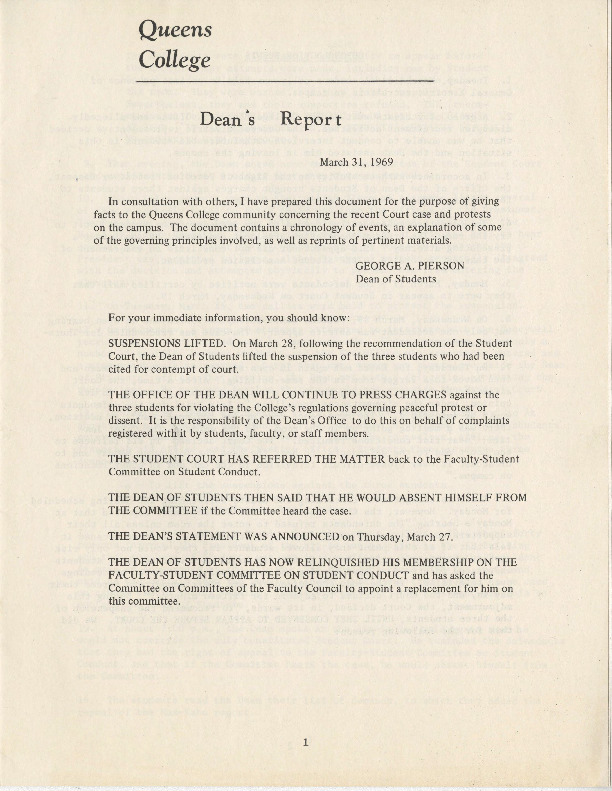
Queens
College
Dean s Report
March 31, 1969
In consultation with others, I have prepared this document for the purpose of giving
facts to the Queens College community concerning the recent Court case and protests
on the campus. The document contains a chronology of events, an explanation of some
of the governing principles involved, as well as reprints of pertinent materials.
GEORGE A. PIERSON
Dean of Students
For your immediate information, you should know:
SUSPENSIONS LIFTED. On March 28, following the recommendation of the Student
Court, the Dean of Students lifted the suspension of the three students who had been
cited for contempt of court.
THE OFFICE OF THE DEAN WILL CONTINUE TO PRESS CHARGES against the
three students for violating the College’s regulations governing peaceful protest or
dissent. It is the responsibility of the Dean’s Office to do this on behalf of complaints
registered with it by students, faculty, or staff members.
THE STUDENT COURT HAS REFERRED THE MATTER back to the Faculty-Student
Committee on Student Conduct.
THE DEAN OF STUDENTS THEN SAID THAT HE WOULD ABSENT HIMSELF FROM
THE COMMITTEE if the Committee heard the case.
THE DEAN’S STATEMENT WAS ANNOUNCED on Thursday, March 27.
THE DEAN OF STUDENTS HAS NOW RELINQUISHED HIS MEMBERSHIP ON THE
FACULTY-STUDENT COMMITTEE ON STUDENT CONDUCT and has asked the
Committee on Committees of the Faculty Council to appoint a replacement for him on
this committee.
CHRONOLOGY OF EVENTS
1. Tuesday, March 11 - A student rally was held to protest presence of
General Electric recruiters on campus.
2. A group of students went to the College Placement Office and allegedly
disrupted recruitment activities. The General Electric representative decided
that he was unable to conduct interviews with interested students in this
situation and the Dean assisted him in leaving the campus.
3. In accordance with the Policy on the Right of Peaceful Protest or Dissent,
the Office of the Dean of Students brought charges against three students to
the Faculty-Student Committee on Student Conduct.
4. The Committee subsequently acceded to the request of the Student Court to
try the case. The Student Association president cooperated by appointing a
prosecuting attorney. This appointment did not constitute an endorsement of
the charges, according to the Student Association president.
5.. Monday, March 17 - The defendants were notified by certified mail that
they were to appear in Student Court on Wednesday, March 19.
6. On Wednesday, March 19, Student Court attempted to convene an open hearing
but only one defendant was able to appear. The case was rescheduled for Thurs-
day, March 20.
7. On Thursday, the Court met again in open session in a room in Remsen and
then moved to a larger room in the same building. After a time, the Court
attempted to recess to $S128, the Dean's conference room, because, in its
opinion, under the circumstances prevailing "a fair trial for the defendants
would be impossible." The conference room proved too small, and, in addition,
there was a meeting going on in the room. In the words of the Chief Jus-
tice; "near riot conditions resulted." The Court decided "in all fairness to
the Court and to the defendants, to hear the case the following Monday and to
broadcast it over closed-circuit television in the CMC and in other locations
on campus."
8. There is disagreement concerning the events surrounding the hearing scheduled
for Monday. However, the Chief Justice of the Student Court reported that at
Monday's hearing "The defendants refused to enter the room unless all their
supporters were allowed to enter also. The Student Court refused because it
felt that if at this point they allowed students in, they would not only risk
another chaotic situation, but also that it would be unfair to those students
who wanted to attend an open hearing but had agreed to watch the proceedings
over television. In the end, the defendants and their supporters forced their
way in, and the Court decided to adjourn for fifteen minutes." During this
adjournment, the Court decided, in its words, "to recommend the suspension of
the three students, UNTIL THEY CONSENTED TO APPEAR BEFORE THE COURT. We did
this for the following reason:
The defendants were given ample opportunity to appear before
the court. Many attempts were made, including one by Student
Body President Glen Brunman, to convince them to come into
the room. They were warned that they risked suspension.
Nevertheless, they and their supporters refused. THE [recom-
mendation for] SUSPENSION HAD NOTHING TO DO WITH THE CHARGES
AT HAND. IT WAS BASED SOLELY ON THE STUDENTS’ COMPLETE REFUSAL
TO COOPERATE WITH THE COURT."
9. That evening, the Dean acted upon the recommendation of the Student Court
, and notified the three students that they were suspended.
10. About fifty persons went to the twelfth floor of Academic II and several
of them reportedly tried to force their way into the offices of the President.
The President came out into the hall on his way to attend a meeting of the
Board of Higher Education. The President was asked to stay in the hall to hear
demands and he did. After about twenty minutes, a vote was taken and the
President was permitted to leave, although several persons reportedly disagreed
with the decision and attempted physically to prevent him from entering the
elevator.
11. On Tuesday, March 25, two rallies were held to protest the suspension.
12. On Wednesday, a group of students attempted to interfere with the Honeywell
recruiters but were turned away by campus guards. There were then reportedly a
number of scuffles between students, and the SDS office was reportedly entered and
a mimeograph machine removed. Later that day, there was a sit-in outside the Dean
of Students' office. That evening, the Dean met with a delegation protesting the
suspensions. He repeated to them that he would not override the Student Court.
13. On Thursday, there was another rally. About 300 students then sat in at
about 2:00 p.m. outside the Dean's office. At about 4:00, some of these students
entered the Dean's office, the Conference Room, the counselors' offices, the
financial aid office, and the testing office. Students then presented three
demands to the Administration:
a - To lift the suspensions against the three students.
b - To drop all charges against the three students.
c - To re-hire Professor Sheila Delany.
14. At about 3:45, after a Faculty Council meeting in Remsen 101, about forty
persons informed the President of the sit-in taking place in the SS Building
and that the Dean of Students was not in his office. They urged the President
to make an appearance at the sit-in. The President spoke with the group and
said he was certain that the Dean of Students would see them as soon as he came
on campus the following morning. Shortly after that, the President was able to
contact the Dean of Students.
15. At about 7:00 p.m., the Dean spoke at the sit-in and said again that he
would not override the duly constituted Student Court. He reminded the defendants
that they had the right of appeal to the Faculty-Student Committee on Student
Conduct, and that if the Committee heard the case, he would absent himself from
the Committee.
16. The students read the Dean their list of demands, to which they added the
repeal of the Max-Kahn report.
17. The students stayed overnight.
18. -Friday, March 28. - At 9:30 a.m., the Student Association president said
that the Court had lifted the contempt citation. His statement follows.
STATEMENT BY STUDENT BODY PRESIDENT, GLEN BRUNMAN - 9:30 a.m. March 28, 1969
I have been asked by the Student Court to make the following announcement on their behalf:
1. The Court has decided to lift the contempt citation against
Richard Freeman, Bengt Sward, and Herbert Bleich.
2. The Court will recommend to Dean Pierson, with full expectation
of his acceptance, that the suspensions against the defendants be lifted.
3. The Court will hold an open, pre-trial hearing on Tuesday, April 1,
at 1 p.m. to determine, in fact, whether or not charges should indeed
be pressed against the three defendants. The question will be whether
or not the Court should even hear the case of Pierson vs. Freeman,
Sward, and Bleich. The issue of contention will be, among others,
whether the Court should hear and try a case based on regulations not
made by students. The hearing will be open to all members of the
academic community and will be held in a large room.
GLEN BRUNMAN
Student Body President
19. At 11:30, the Dean of Students made an announcement lifting the
suspension and stating that his Office would continue to press charges (see
full statement below).
March 28, 1969
STATEMENT FROM DEAN PIERSON
On March 24, the Student Court recommended to me
that I suspend three students for contempt of the court.
Today, the Court recommended that I lift these suspensions.
I again follow the recommendation of the Court and I lift
these suspensions immediately.
I must continue to press charges against these three
students for violating the College's regulations governing
peaceful protest. These charges were made by the Office of
the Dean of Students and presented to the Faculty-Student
Committee on Student Conduct. It was this committee which
referred the matter to the Student Court.
20. President McMurray issued a statement about Professor Delany and Ee
Max-Kahn report (see text of statement below).
March 28,1969
STATEMENT FROM PRESIDENT McMURRAY
I have been advised that Professor Sheila Delany has
appealed to the Queens College Committee of the Board of Higher
Education. I assume her case will be acted upon quickly.
The question of the Max-Kahn report is scheduled to
be discussed by the faculty at the next meeting of the Faculty
Council, April 17, at the recommendation of concerned faculty
members.
21. Students read these announcements at a rally at 1:00 p.m.; went to
Jefferson Hall, where they posted their demands on a door; and returned
to the Dean's office in the Social Sciences building.
22. Late in the afternoon, students announced that they would sit in
over the week-end.
23. The Dean of Students announced that he was resigning from the Faculty-
Student Committee on Student Conduct and would ask the Committee on Committees
of the Faculty Council to appoint a replacement for him on the committee.
WHAT IS THE COLLEGE'S JUDICIAL SYSTEM CONCERNING STUDENT AFFAIRS?
----The. Board of Higher Education Bylaws make the faculty responsible for
the regulation of student affairs.
----The Faculty Council is the representative body of the faculty.
----Faculty Council has delegated to the Faculty-Student Committee on Student
Activities and Services the responsibility for developing policies about
student affairs.
----Faculty Council has delegated responsibility to the Faculty-Student
Committee on Student Conduct to develop policies on student conduct and
also to judge cases brought before it. Usually, these are cases involving
just one individual, such as cases of cheating or plagiarism.
----The Committee on Student Conduct may refer cases to the Student Court.
Usually, cases referred to Student Court involve disputes between student
organizations or between an individual and an organization.
----A student may be represented by counsel or may defend himself.
----Both committees have equal numbers of voting students and faculty members.
----It is the responsibility of the Dean of Students to enforce policy, and
act on the decisions of the Student Court, on matters of conduct. It is the
responsibility of the Office of the Dean of Students to press charges on
behalf of complaints made by aggrieved students, staff, or faculty members.
----Any person, organization, or committee however, may bring any matter to
the attention of the Committee on Student Conduct or the Student Court.
----The Faculty-Student Committee on Student Conduct acts as a court of
appeals for defendents found guilty by the Student Court.
----Faculty Council action is subject to ratification only by the Board of
Higher Education and only on certain matters, such as curriculum.
----In matters in which student affairs are involved, the College's judicial
policies are to be administered by the Dean of Students and his staff. In
addition, as stated in the Board of Higher Education bylaws, the Dean has
such duties and responsibilities as may be assigned to him by the President
or referred to him by the faculty.
----The entire question of how the College is governed is currently being
looked into by the Faculty-Student Committee on Governance.
WHAT IS THE COMPOSITION OF THE FACULTY-STUDENT COMMITTEE ON STUDENT CONDUCT?
The Faculty-Student Committee on Student Conduct consists of 14 voting
members: 7 faculty members nominated by the Faculty Council's Committee on
Committees and approved by the Council and 7 student members appointed in
accordance with a procedure set up by the student government. Three students
are members of honor societies or departmental clubs selected by the President
of the Inter Club Council with the advice and consent of that Council. One
SGS student is selected by the SGS Council. The Chief Justice of the Student
Court is a member by virtue of his office. The other two members are selected
by the Student Association president with the advice and consent of the
Student Senate. The Dean of Students traditionally has been Chairman of the
Committee.
WHAT ARE THE COMPOSITION AND FUNCTIONS OF THE STUDENT COURT?
Students may apply for positions as justices of the Student Court. Those
who meet certain qualifications are interviewed and selected by a process
outlined in the Student Association constitution. The selection committee
consists of the President of the Student Association, the outgoing Chief
Justice, the Chief Officer of the Student Senate, the faculty adviser to
the Court, the Dean and Associate Dean of Students. (It is the practice
of the Dean of Students and the Associate Dean of Students to sit as non-
voting members of the selection committee.) There are seven justices,
elected for overlapping one-year terms: four in May for a year's term and
three in January for a year's term. The Chief Justice is elected by the
Court.
_ According to the Student Association Constitution:
"The following are among the powers of the court:
"a - to rule on the eligibility of candidates for office in
the Student Association
"b -— to summon members of the student body and the officers
of chartered organizations and to require the submission of pertinent
records
"co - to recommend the suspension of a student for cause
"qd - to assess monetary fines within established regulations
"e -— to recommend to the Senate the suspension or revocation
of the charter of a student organization."
The Court exercises the power of interpretation of the Student Association
Constitution and its by-laws. The Court has jurisdiction over regulations
governing student and student organization behavior.
Any person, organization, or committee may bring any matter to the attention
of the Court after informing the Chief Counsel. The Chief Counsel is a member
of the Student Association president's cabinet and is appointed by the Student
Association president with the advice and consent of the Senate.
POLICY ON RECRUITMENT
AT QUEENS COLLEGE MADE BY
FACULTY STUDENT COMMITTEE ON STUDENT ACTIVITIES AND SERVICES
ON FEBRUARY 2, 1968
Asi ME RENCUPLES?
1. That the current practice of inviting and allowing outside recruiters
on campus be continued.
2. That any recruiting agency or its representatives invited to the campus
be requested to engage in an open forum prior to recruitment if at least
ten members of the Queens College academic community or any chartered
student organization requests it by petition to the Placement Office,
or that the Placement Director may initiate such forums as he has done
in the past.
3. That the activities of those invited for recruiting purposes be restricted
to the College Placement Office or the rooms normally used by it, except
that in the case of open forums the Placement Office, like any other
College department, may use any other available room with a capacity
suitable to the number of those expected to attend. It is affirmed that
the above shall in no way affect the current practices of the Office of
Teacher Placement, a separate College agency, which arranges for campus
interviews on the part of school systems seeking teachers.
4. We affirm and guarantee the right of peaceful protest, and reaffirm the
right of any individual or group on the Queens College campus to voice
dissent so long as such dissent does not physically or in any other way
deny the rights of members of the Queens College academic community or
guests, or violate Federal, State, or local laws or the regulations of
the Board of Higher Education.
B. DEFINITIONS AND PROCEDURES:
1. An open forum is an open meeting, arranged as above in A, 2 and 3, at
which a representative of a recruiting agency will explain the nature
and purpose of such agency and be willing to engage in discussion or
answer questions about his organization put to him by those present for
the sake of clarification and information.
2. In order to give the opportunity to those wishing to request such forums
and to give sufficient time to arrange them, the Placement Director shall
give advance public notice of the date of arrival of recruiters at least
two weeks in advance, as has been customary.
3. Petitions for such open forums shall be submitted to the Placement Director
no later than one week before the scheduled arrival of a recruiter whose
agency is involved. The Placement Director, if he has not already done so
on his own, shall make the arrangements for the open forum andspublicize) it).
C. TRANSMISSION OF DECISIONS:
The decisions are to be reported to the Faculty Council and the Student
Senate for their information.
Samuel Lieberman
Chairman
Marvin Milich
Secretary
The policy was ratified by both the Faculty Council and the Student Senate.
Proposal of Faculty-Student Committee on Student Activities and Services,
February 25, 1969.
A new policy on recruitment, to be reviewed by Faculty Council at its
meeting of April 17, follows.
February 28, 1969
PROPOSAL REGARDING OUTSIDE RECRUITING AT QUEENS COLLEGE
"Made by Faculty Student Committee on Student Activities and Services
on February 25, 1969 with a request that this matter be placed on the
agenda for the next regular Faculty Council meeting, April 17, 1969.
“ At the request of several students, the Faculty Student Committee on
Student Activities and Services has reviewed the College's present policy
on recruitment.
"We reaffirm that the current practice of inviting and allowing outside
recruiters on campus be continued free from any conditions or restrictions
which in any way may limit the rights of an individual student to seek an
interview. Recruitment for job and career opportunities should take place
in the College Placement Office or the rooms normally used by it. The
Placement Bureau, like any other College department, may use any other
available room with a capacity suitable to the number or need of those
expected to attend those programs normally initiated by the Placement Bureau.
It is affirmed that the above shall in no way affect the current practices
of the Office of Teacher Placement, a separate College agency, which arranges
for campus interviews on the part of school systems seeking teachers.
"Attention is called to the present SPEAKER POLICY of the College
administered by the Student Activities Office under which organizations or
individual students may directly request that an individual or representative
from any organization speak on the campus through a mutually arranged format.
Information concerning recruitment activities on campus is available through
the Placement Bureau.
'"We affirm the right of peaceful protest, and reaffirm the right of any
individual or group on the Queens College campus to voice dissent so long
as such dissent does not physically or in any other way deny the rights of
members of the Queens College academic community or guests, or violate Federal,
State, or local laws or the regulations of the Board of Higher Education."
A modified version of this proposal was passed by the Student Senate
but vetoed by the Student Association president.
POLICY ON PEACEFUL PROTEST OR DISSENT
QUEENS COLLEGE
of the City University of New York
February 24, 1969
A statement on the right of peaceful protest or dissent was approved by
the Faculty Student Committee on Student Conduct on March!’ 552966.) (At
a special meeting of the Queens College Faculty Council on Wednesday
evening, February 19, 1969, this statement was reaffirmed and President
Joseph P. McMurray was asked to "publicize this statement and make clear
that its provisions will be enforced by all proper means."
Following are the text of the statement, and the text of the resolution
reaffirming the statement.
THE RIGHT OF PEACEFUL PROTEST OR DISSENT
A statement approved by the Faculty Student Committee on Student
Conduct on March 5, 1968.
In light of disorders that have occurred recently on some college
and university campuses, the Faculty Student Committee on Student Conduct
has restudied the nature of protest and dissent. The Committee now wishes
to reaffirm its belief in the right of all members of a college community
to protest peacefully, as part of the right of freedom of speech. But the
Committee also wishes to define peaceful protest and to describe the
sanctions that may be used against students who exceed the bounds of peace-
ful protest. The following statement was approved unanimously by the
Faculty Student Committee on Student Conduct.
DEFINITION OF PEACEFUL PROTEST
Freedom to assent or dissent depends upon mutual respect. For such
freedom to exist, every member of the academic community must respect the
freedom of his fellows to differ and to support or protest through legal
and appropriate means the issues they believe to be important.
No Queens College student will be permitted to violate the peace or
regulations of the College without being held responsible for such actions.
Any student who impedes, obstructs, or in any way interferes with any college
authorized activity, or with the rights and freedoms of others, will face
disciplinary action. This includes impeding, obstructing, or otherwise inter-
fering with free and safe movement into or out of, or in or upon the campus
or any campus building or facility.
ENFORCEMENT
If any person goes beyond peaceful protest as described above, he
should be asked to desist. If he fails to desist he should be asked to
identify himself. If the person is a student, he should be told that a
complaint will be made against him to the Faculty Student Committee on
Student Conduct. If the person is not a member of the college community,
10
he should be treated as a loiterer. It must be assumed that any person
who refuses to identify himself is a loiterer.
The above will be administered by the Dean of Students and his Staff.
The Faculty Student Committee on Student Conduct may itself act upon
charges against a student or refer a student to the Student Court. Disci-
plinary action may range from reprimand to suspension for a full semester
or a recommendation to Faculty Council, or to the President, that a student
be suspended for a longer period or that he be expelled from the College.
This policy was not formally acted upon by either the Student Senate or the
Faculty Council. However, at the meeting of Faculty Council on February 19,
1969, the following resolution was acted upon:
FACULTY COUNCIL RESOLUTION
Problems, difficulties and conflicts are, in great part, what a College
or University community is all about. But what distinguishes a College or
University--that which is its very reason for being--is the manner in which
it struggles with its problems, difficulties and conflicts. Rational discourse
and persuasion is, and must be, the characteristic activity of any college or
University. We are, of course, aware that this is an ideal and goal which
must continually be pursued by seeking better means, procedures and structures
whereby rational discourse will become a reality rather than simply an ideal.
At this very moment Queens College has a Student-Faculty committee charged
with reviewing our present structures and suggesting changes which will better
them.
Conflict and dissent, therefore, can and must be tolerated in any living,
developing community and especially in any College or University community.
What cannot be tolerated, however, is any attempt to settle conflicts by
violent disruption of college activities. On March 5, 1968, the Faculty
Student Committee on Student Conduct unanimously approved a statement defining
both the right and limitation of dissent on the campus. We urge the President
to publicize this statement and make clear that its provisions will be enforced
by all proper means.
President McMurray accepted the recommendation of Faculty Council to publicize
and enforce this policy.
HiBe
WHAT IS THE "MAX-KAHN REPORT''?
The Law Committee of the Board of Higher Education worked, over some
time, on a document that would establish standard personnel procedures with
regard to members of the faculty. This document was presented to the Board
of Higher Education about two years ago by the Law Committee chairman,
Mrs. Gladys Dorman ,and the procedures adopted. All colleges in the University
must follow these procedures.
The procedures closely follow the positions of the American Association
of University Professors in regard to such matters.
Under the procedures, reasons for failing to re-appoint non-tenured
members of the faculty on annual contract are not disclosed.
Two staff persons assisted the Legal Committee of the Board:
Mrs. Pearl Max, Coordinator of Institutional Research for the City University
and Mr. Arthur Kahn, General Counsel for the Board of Higher Education.
In referring to the Board's procedures, some students have come to
describe them as the 'Max-Kahn Report."
2
College
Dean s Report
March 31, 1969
In consultation with others, I have prepared this document for the purpose of giving
facts to the Queens College community concerning the recent Court case and protests
on the campus. The document contains a chronology of events, an explanation of some
of the governing principles involved, as well as reprints of pertinent materials.
GEORGE A. PIERSON
Dean of Students
For your immediate information, you should know:
SUSPENSIONS LIFTED. On March 28, following the recommendation of the Student
Court, the Dean of Students lifted the suspension of the three students who had been
cited for contempt of court.
THE OFFICE OF THE DEAN WILL CONTINUE TO PRESS CHARGES against the
three students for violating the College’s regulations governing peaceful protest or
dissent. It is the responsibility of the Dean’s Office to do this on behalf of complaints
registered with it by students, faculty, or staff members.
THE STUDENT COURT HAS REFERRED THE MATTER back to the Faculty-Student
Committee on Student Conduct.
THE DEAN OF STUDENTS THEN SAID THAT HE WOULD ABSENT HIMSELF FROM
THE COMMITTEE if the Committee heard the case.
THE DEAN’S STATEMENT WAS ANNOUNCED on Thursday, March 27.
THE DEAN OF STUDENTS HAS NOW RELINQUISHED HIS MEMBERSHIP ON THE
FACULTY-STUDENT COMMITTEE ON STUDENT CONDUCT and has asked the
Committee on Committees of the Faculty Council to appoint a replacement for him on
this committee.
CHRONOLOGY OF EVENTS
1. Tuesday, March 11 - A student rally was held to protest presence of
General Electric recruiters on campus.
2. A group of students went to the College Placement Office and allegedly
disrupted recruitment activities. The General Electric representative decided
that he was unable to conduct interviews with interested students in this
situation and the Dean assisted him in leaving the campus.
3. In accordance with the Policy on the Right of Peaceful Protest or Dissent,
the Office of the Dean of Students brought charges against three students to
the Faculty-Student Committee on Student Conduct.
4. The Committee subsequently acceded to the request of the Student Court to
try the case. The Student Association president cooperated by appointing a
prosecuting attorney. This appointment did not constitute an endorsement of
the charges, according to the Student Association president.
5.. Monday, March 17 - The defendants were notified by certified mail that
they were to appear in Student Court on Wednesday, March 19.
6. On Wednesday, March 19, Student Court attempted to convene an open hearing
but only one defendant was able to appear. The case was rescheduled for Thurs-
day, March 20.
7. On Thursday, the Court met again in open session in a room in Remsen and
then moved to a larger room in the same building. After a time, the Court
attempted to recess to $S128, the Dean's conference room, because, in its
opinion, under the circumstances prevailing "a fair trial for the defendants
would be impossible." The conference room proved too small, and, in addition,
there was a meeting going on in the room. In the words of the Chief Jus-
tice; "near riot conditions resulted." The Court decided "in all fairness to
the Court and to the defendants, to hear the case the following Monday and to
broadcast it over closed-circuit television in the CMC and in other locations
on campus."
8. There is disagreement concerning the events surrounding the hearing scheduled
for Monday. However, the Chief Justice of the Student Court reported that at
Monday's hearing "The defendants refused to enter the room unless all their
supporters were allowed to enter also. The Student Court refused because it
felt that if at this point they allowed students in, they would not only risk
another chaotic situation, but also that it would be unfair to those students
who wanted to attend an open hearing but had agreed to watch the proceedings
over television. In the end, the defendants and their supporters forced their
way in, and the Court decided to adjourn for fifteen minutes." During this
adjournment, the Court decided, in its words, "to recommend the suspension of
the three students, UNTIL THEY CONSENTED TO APPEAR BEFORE THE COURT. We did
this for the following reason:
The defendants were given ample opportunity to appear before
the court. Many attempts were made, including one by Student
Body President Glen Brunman, to convince them to come into
the room. They were warned that they risked suspension.
Nevertheless, they and their supporters refused. THE [recom-
mendation for] SUSPENSION HAD NOTHING TO DO WITH THE CHARGES
AT HAND. IT WAS BASED SOLELY ON THE STUDENTS’ COMPLETE REFUSAL
TO COOPERATE WITH THE COURT."
9. That evening, the Dean acted upon the recommendation of the Student Court
, and notified the three students that they were suspended.
10. About fifty persons went to the twelfth floor of Academic II and several
of them reportedly tried to force their way into the offices of the President.
The President came out into the hall on his way to attend a meeting of the
Board of Higher Education. The President was asked to stay in the hall to hear
demands and he did. After about twenty minutes, a vote was taken and the
President was permitted to leave, although several persons reportedly disagreed
with the decision and attempted physically to prevent him from entering the
elevator.
11. On Tuesday, March 25, two rallies were held to protest the suspension.
12. On Wednesday, a group of students attempted to interfere with the Honeywell
recruiters but were turned away by campus guards. There were then reportedly a
number of scuffles between students, and the SDS office was reportedly entered and
a mimeograph machine removed. Later that day, there was a sit-in outside the Dean
of Students' office. That evening, the Dean met with a delegation protesting the
suspensions. He repeated to them that he would not override the Student Court.
13. On Thursday, there was another rally. About 300 students then sat in at
about 2:00 p.m. outside the Dean's office. At about 4:00, some of these students
entered the Dean's office, the Conference Room, the counselors' offices, the
financial aid office, and the testing office. Students then presented three
demands to the Administration:
a - To lift the suspensions against the three students.
b - To drop all charges against the three students.
c - To re-hire Professor Sheila Delany.
14. At about 3:45, after a Faculty Council meeting in Remsen 101, about forty
persons informed the President of the sit-in taking place in the SS Building
and that the Dean of Students was not in his office. They urged the President
to make an appearance at the sit-in. The President spoke with the group and
said he was certain that the Dean of Students would see them as soon as he came
on campus the following morning. Shortly after that, the President was able to
contact the Dean of Students.
15. At about 7:00 p.m., the Dean spoke at the sit-in and said again that he
would not override the duly constituted Student Court. He reminded the defendants
that they had the right of appeal to the Faculty-Student Committee on Student
Conduct, and that if the Committee heard the case, he would absent himself from
the Committee.
16. The students read the Dean their list of demands, to which they added the
repeal of the Max-Kahn report.
17. The students stayed overnight.
18. -Friday, March 28. - At 9:30 a.m., the Student Association president said
that the Court had lifted the contempt citation. His statement follows.
STATEMENT BY STUDENT BODY PRESIDENT, GLEN BRUNMAN - 9:30 a.m. March 28, 1969
I have been asked by the Student Court to make the following announcement on their behalf:
1. The Court has decided to lift the contempt citation against
Richard Freeman, Bengt Sward, and Herbert Bleich.
2. The Court will recommend to Dean Pierson, with full expectation
of his acceptance, that the suspensions against the defendants be lifted.
3. The Court will hold an open, pre-trial hearing on Tuesday, April 1,
at 1 p.m. to determine, in fact, whether or not charges should indeed
be pressed against the three defendants. The question will be whether
or not the Court should even hear the case of Pierson vs. Freeman,
Sward, and Bleich. The issue of contention will be, among others,
whether the Court should hear and try a case based on regulations not
made by students. The hearing will be open to all members of the
academic community and will be held in a large room.
GLEN BRUNMAN
Student Body President
19. At 11:30, the Dean of Students made an announcement lifting the
suspension and stating that his Office would continue to press charges (see
full statement below).
March 28, 1969
STATEMENT FROM DEAN PIERSON
On March 24, the Student Court recommended to me
that I suspend three students for contempt of the court.
Today, the Court recommended that I lift these suspensions.
I again follow the recommendation of the Court and I lift
these suspensions immediately.
I must continue to press charges against these three
students for violating the College's regulations governing
peaceful protest. These charges were made by the Office of
the Dean of Students and presented to the Faculty-Student
Committee on Student Conduct. It was this committee which
referred the matter to the Student Court.
20. President McMurray issued a statement about Professor Delany and Ee
Max-Kahn report (see text of statement below).
March 28,1969
STATEMENT FROM PRESIDENT McMURRAY
I have been advised that Professor Sheila Delany has
appealed to the Queens College Committee of the Board of Higher
Education. I assume her case will be acted upon quickly.
The question of the Max-Kahn report is scheduled to
be discussed by the faculty at the next meeting of the Faculty
Council, April 17, at the recommendation of concerned faculty
members.
21. Students read these announcements at a rally at 1:00 p.m.; went to
Jefferson Hall, where they posted their demands on a door; and returned
to the Dean's office in the Social Sciences building.
22. Late in the afternoon, students announced that they would sit in
over the week-end.
23. The Dean of Students announced that he was resigning from the Faculty-
Student Committee on Student Conduct and would ask the Committee on Committees
of the Faculty Council to appoint a replacement for him on the committee.
WHAT IS THE COLLEGE'S JUDICIAL SYSTEM CONCERNING STUDENT AFFAIRS?
----The. Board of Higher Education Bylaws make the faculty responsible for
the regulation of student affairs.
----The Faculty Council is the representative body of the faculty.
----Faculty Council has delegated to the Faculty-Student Committee on Student
Activities and Services the responsibility for developing policies about
student affairs.
----Faculty Council has delegated responsibility to the Faculty-Student
Committee on Student Conduct to develop policies on student conduct and
also to judge cases brought before it. Usually, these are cases involving
just one individual, such as cases of cheating or plagiarism.
----The Committee on Student Conduct may refer cases to the Student Court.
Usually, cases referred to Student Court involve disputes between student
organizations or between an individual and an organization.
----A student may be represented by counsel or may defend himself.
----Both committees have equal numbers of voting students and faculty members.
----It is the responsibility of the Dean of Students to enforce policy, and
act on the decisions of the Student Court, on matters of conduct. It is the
responsibility of the Office of the Dean of Students to press charges on
behalf of complaints made by aggrieved students, staff, or faculty members.
----Any person, organization, or committee however, may bring any matter to
the attention of the Committee on Student Conduct or the Student Court.
----The Faculty-Student Committee on Student Conduct acts as a court of
appeals for defendents found guilty by the Student Court.
----Faculty Council action is subject to ratification only by the Board of
Higher Education and only on certain matters, such as curriculum.
----In matters in which student affairs are involved, the College's judicial
policies are to be administered by the Dean of Students and his staff. In
addition, as stated in the Board of Higher Education bylaws, the Dean has
such duties and responsibilities as may be assigned to him by the President
or referred to him by the faculty.
----The entire question of how the College is governed is currently being
looked into by the Faculty-Student Committee on Governance.
WHAT IS THE COMPOSITION OF THE FACULTY-STUDENT COMMITTEE ON STUDENT CONDUCT?
The Faculty-Student Committee on Student Conduct consists of 14 voting
members: 7 faculty members nominated by the Faculty Council's Committee on
Committees and approved by the Council and 7 student members appointed in
accordance with a procedure set up by the student government. Three students
are members of honor societies or departmental clubs selected by the President
of the Inter Club Council with the advice and consent of that Council. One
SGS student is selected by the SGS Council. The Chief Justice of the Student
Court is a member by virtue of his office. The other two members are selected
by the Student Association president with the advice and consent of the
Student Senate. The Dean of Students traditionally has been Chairman of the
Committee.
WHAT ARE THE COMPOSITION AND FUNCTIONS OF THE STUDENT COURT?
Students may apply for positions as justices of the Student Court. Those
who meet certain qualifications are interviewed and selected by a process
outlined in the Student Association constitution. The selection committee
consists of the President of the Student Association, the outgoing Chief
Justice, the Chief Officer of the Student Senate, the faculty adviser to
the Court, the Dean and Associate Dean of Students. (It is the practice
of the Dean of Students and the Associate Dean of Students to sit as non-
voting members of the selection committee.) There are seven justices,
elected for overlapping one-year terms: four in May for a year's term and
three in January for a year's term. The Chief Justice is elected by the
Court.
_ According to the Student Association Constitution:
"The following are among the powers of the court:
"a - to rule on the eligibility of candidates for office in
the Student Association
"b -— to summon members of the student body and the officers
of chartered organizations and to require the submission of pertinent
records
"co - to recommend the suspension of a student for cause
"qd - to assess monetary fines within established regulations
"e -— to recommend to the Senate the suspension or revocation
of the charter of a student organization."
The Court exercises the power of interpretation of the Student Association
Constitution and its by-laws. The Court has jurisdiction over regulations
governing student and student organization behavior.
Any person, organization, or committee may bring any matter to the attention
of the Court after informing the Chief Counsel. The Chief Counsel is a member
of the Student Association president's cabinet and is appointed by the Student
Association president with the advice and consent of the Senate.
POLICY ON RECRUITMENT
AT QUEENS COLLEGE MADE BY
FACULTY STUDENT COMMITTEE ON STUDENT ACTIVITIES AND SERVICES
ON FEBRUARY 2, 1968
Asi ME RENCUPLES?
1. That the current practice of inviting and allowing outside recruiters
on campus be continued.
2. That any recruiting agency or its representatives invited to the campus
be requested to engage in an open forum prior to recruitment if at least
ten members of the Queens College academic community or any chartered
student organization requests it by petition to the Placement Office,
or that the Placement Director may initiate such forums as he has done
in the past.
3. That the activities of those invited for recruiting purposes be restricted
to the College Placement Office or the rooms normally used by it, except
that in the case of open forums the Placement Office, like any other
College department, may use any other available room with a capacity
suitable to the number of those expected to attend. It is affirmed that
the above shall in no way affect the current practices of the Office of
Teacher Placement, a separate College agency, which arranges for campus
interviews on the part of school systems seeking teachers.
4. We affirm and guarantee the right of peaceful protest, and reaffirm the
right of any individual or group on the Queens College campus to voice
dissent so long as such dissent does not physically or in any other way
deny the rights of members of the Queens College academic community or
guests, or violate Federal, State, or local laws or the regulations of
the Board of Higher Education.
B. DEFINITIONS AND PROCEDURES:
1. An open forum is an open meeting, arranged as above in A, 2 and 3, at
which a representative of a recruiting agency will explain the nature
and purpose of such agency and be willing to engage in discussion or
answer questions about his organization put to him by those present for
the sake of clarification and information.
2. In order to give the opportunity to those wishing to request such forums
and to give sufficient time to arrange them, the Placement Director shall
give advance public notice of the date of arrival of recruiters at least
two weeks in advance, as has been customary.
3. Petitions for such open forums shall be submitted to the Placement Director
no later than one week before the scheduled arrival of a recruiter whose
agency is involved. The Placement Director, if he has not already done so
on his own, shall make the arrangements for the open forum andspublicize) it).
C. TRANSMISSION OF DECISIONS:
The decisions are to be reported to the Faculty Council and the Student
Senate for their information.
Samuel Lieberman
Chairman
Marvin Milich
Secretary
The policy was ratified by both the Faculty Council and the Student Senate.
Proposal of Faculty-Student Committee on Student Activities and Services,
February 25, 1969.
A new policy on recruitment, to be reviewed by Faculty Council at its
meeting of April 17, follows.
February 28, 1969
PROPOSAL REGARDING OUTSIDE RECRUITING AT QUEENS COLLEGE
"Made by Faculty Student Committee on Student Activities and Services
on February 25, 1969 with a request that this matter be placed on the
agenda for the next regular Faculty Council meeting, April 17, 1969.
“ At the request of several students, the Faculty Student Committee on
Student Activities and Services has reviewed the College's present policy
on recruitment.
"We reaffirm that the current practice of inviting and allowing outside
recruiters on campus be continued free from any conditions or restrictions
which in any way may limit the rights of an individual student to seek an
interview. Recruitment for job and career opportunities should take place
in the College Placement Office or the rooms normally used by it. The
Placement Bureau, like any other College department, may use any other
available room with a capacity suitable to the number or need of those
expected to attend those programs normally initiated by the Placement Bureau.
It is affirmed that the above shall in no way affect the current practices
of the Office of Teacher Placement, a separate College agency, which arranges
for campus interviews on the part of school systems seeking teachers.
"Attention is called to the present SPEAKER POLICY of the College
administered by the Student Activities Office under which organizations or
individual students may directly request that an individual or representative
from any organization speak on the campus through a mutually arranged format.
Information concerning recruitment activities on campus is available through
the Placement Bureau.
'"We affirm the right of peaceful protest, and reaffirm the right of any
individual or group on the Queens College campus to voice dissent so long
as such dissent does not physically or in any other way deny the rights of
members of the Queens College academic community or guests, or violate Federal,
State, or local laws or the regulations of the Board of Higher Education."
A modified version of this proposal was passed by the Student Senate
but vetoed by the Student Association president.
POLICY ON PEACEFUL PROTEST OR DISSENT
QUEENS COLLEGE
of the City University of New York
February 24, 1969
A statement on the right of peaceful protest or dissent was approved by
the Faculty Student Committee on Student Conduct on March!’ 552966.) (At
a special meeting of the Queens College Faculty Council on Wednesday
evening, February 19, 1969, this statement was reaffirmed and President
Joseph P. McMurray was asked to "publicize this statement and make clear
that its provisions will be enforced by all proper means."
Following are the text of the statement, and the text of the resolution
reaffirming the statement.
THE RIGHT OF PEACEFUL PROTEST OR DISSENT
A statement approved by the Faculty Student Committee on Student
Conduct on March 5, 1968.
In light of disorders that have occurred recently on some college
and university campuses, the Faculty Student Committee on Student Conduct
has restudied the nature of protest and dissent. The Committee now wishes
to reaffirm its belief in the right of all members of a college community
to protest peacefully, as part of the right of freedom of speech. But the
Committee also wishes to define peaceful protest and to describe the
sanctions that may be used against students who exceed the bounds of peace-
ful protest. The following statement was approved unanimously by the
Faculty Student Committee on Student Conduct.
DEFINITION OF PEACEFUL PROTEST
Freedom to assent or dissent depends upon mutual respect. For such
freedom to exist, every member of the academic community must respect the
freedom of his fellows to differ and to support or protest through legal
and appropriate means the issues they believe to be important.
No Queens College student will be permitted to violate the peace or
regulations of the College without being held responsible for such actions.
Any student who impedes, obstructs, or in any way interferes with any college
authorized activity, or with the rights and freedoms of others, will face
disciplinary action. This includes impeding, obstructing, or otherwise inter-
fering with free and safe movement into or out of, or in or upon the campus
or any campus building or facility.
ENFORCEMENT
If any person goes beyond peaceful protest as described above, he
should be asked to desist. If he fails to desist he should be asked to
identify himself. If the person is a student, he should be told that a
complaint will be made against him to the Faculty Student Committee on
Student Conduct. If the person is not a member of the college community,
10
he should be treated as a loiterer. It must be assumed that any person
who refuses to identify himself is a loiterer.
The above will be administered by the Dean of Students and his Staff.
The Faculty Student Committee on Student Conduct may itself act upon
charges against a student or refer a student to the Student Court. Disci-
plinary action may range from reprimand to suspension for a full semester
or a recommendation to Faculty Council, or to the President, that a student
be suspended for a longer period or that he be expelled from the College.
This policy was not formally acted upon by either the Student Senate or the
Faculty Council. However, at the meeting of Faculty Council on February 19,
1969, the following resolution was acted upon:
FACULTY COUNCIL RESOLUTION
Problems, difficulties and conflicts are, in great part, what a College
or University community is all about. But what distinguishes a College or
University--that which is its very reason for being--is the manner in which
it struggles with its problems, difficulties and conflicts. Rational discourse
and persuasion is, and must be, the characteristic activity of any college or
University. We are, of course, aware that this is an ideal and goal which
must continually be pursued by seeking better means, procedures and structures
whereby rational discourse will become a reality rather than simply an ideal.
At this very moment Queens College has a Student-Faculty committee charged
with reviewing our present structures and suggesting changes which will better
them.
Conflict and dissent, therefore, can and must be tolerated in any living,
developing community and especially in any College or University community.
What cannot be tolerated, however, is any attempt to settle conflicts by
violent disruption of college activities. On March 5, 1968, the Faculty
Student Committee on Student Conduct unanimously approved a statement defining
both the right and limitation of dissent on the campus. We urge the President
to publicize this statement and make clear that its provisions will be enforced
by all proper means.
President McMurray accepted the recommendation of Faculty Council to publicize
and enforce this policy.
HiBe
WHAT IS THE "MAX-KAHN REPORT''?
The Law Committee of the Board of Higher Education worked, over some
time, on a document that would establish standard personnel procedures with
regard to members of the faculty. This document was presented to the Board
of Higher Education about two years ago by the Law Committee chairman,
Mrs. Gladys Dorman ,and the procedures adopted. All colleges in the University
must follow these procedures.
The procedures closely follow the positions of the American Association
of University Professors in regard to such matters.
Under the procedures, reasons for failing to re-appoint non-tenured
members of the faculty on annual contract are not disclosed.
Two staff persons assisted the Legal Committee of the Board:
Mrs. Pearl Max, Coordinator of Institutional Research for the City University
and Mr. Arthur Kahn, General Counsel for the Board of Higher Education.
In referring to the Board's procedures, some students have come to
describe them as the 'Max-Kahn Report."
2
Title
Queens College Dean's Report
Description
Produced by the office of Queens College Dean George A. Pierson, this report summarizes campus events from March 1969 that resulted in student unrest and protest that would continue into May.
As the report describes, the initial cause of the protests—which would culminate in 39 arrests following the student takeover of the Social Sciences Building on April 1st—was student outrage over the suspension of three students charged with forcing a General Electric recruiter off campus on March 11th. While the college administration would eventually lift the suspensions, they refused to drop the criminal charges filed against the students. The result was continued protests on campus led by the student-led Ad Hoc Committee to End Political Suppression.
As the report describes, the initial cause of the protests—which would culminate in 39 arrests following the student takeover of the Social Sciences Building on April 1st—was student outrage over the suspension of three students charged with forcing a General Electric recruiter off campus on March 11th. While the college administration would eventually lift the suspensions, they refused to drop the criminal charges filed against the students. The result was continued protests on campus led by the student-led Ad Hoc Committee to End Political Suppression.
Creator
Pierson, George A.
Date
March 31, 1969
Language
English
Publisher
Queens College Department of Special Collections and Archives (New York, N.Y.)
Rights
Copyrighted
Source
Queens College Special Collections and Archives
Original Format
Report / Paper / Proposal
Pierson, George A. Letter. “Queens College Dean’s Report.”, CUNY DIGITAL HISTORY ARCHIVE, accessed September 5, 2026, https://stephenz.tailc22a4b.ts.net/s/cdha/item/982