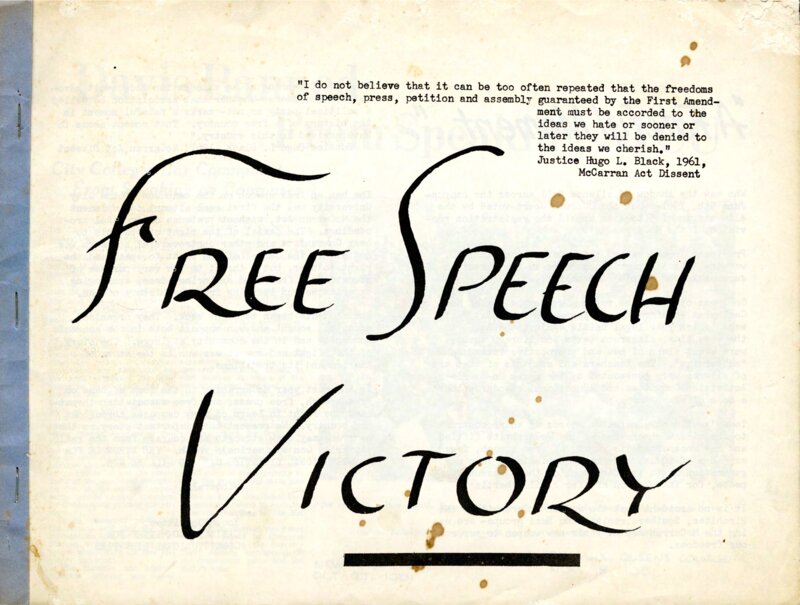
"Free Speech Victory"
Item
°
9
"I do not believe that it can be too often repeated that the freedoms
of speech, press, petition and assembly guaranteed by the First Amend-
ment must be accorded to the
ideas we hate or sooner or
later they will be denied to
the ideas we cherish,"
Justice Hugo L, Black, 1961,
McCarran Act Dissent
e
CTORY
A fateful Moment...”
Who saw the shadow silence 1 across the campus-
June 5th, 1961- when the Supreme Court voted by the
slim margin of 5 to 4 to uphold the registration pro-
vision of the McCarran Act,
President Truman vetoed the McCarran Act, in 1950,
warning that its provisions "move in the direction of
suppression of eo and belief..."
Congress overrode the veto, During the era of Mc-
Carthyism -conformity and fear- the Communist Party
waged » ten year legal battle against the Act, At
the same time, classroom texts and library shelves
were swept clean of new and provocative ideas labeled
"subversive", The teachers and students of that era
of silence were persecuted by the House Un-American
Activities Committee and educational standards took
a nose dive, ®
Today's student generation stands in sHarp contrast
to the silent generation of the McCarthyite fifties,
and has reasserted its rights of free speech, free
exchange of ideas, and free association, This new
generation is in the forefront of the movements for
peace, for integration and for civil liberties,
It is no accident that the modern MeCarthyites— the
Birchites, Southern racists and Nazi groups- are u
ing the McCarran Act as their new weapon to cupped
our freedoms,
"The first banning of an association because it advo-
cates hated ideas -whether that association be called
a political party or not- marks a fateful moment in
the history of a free country. That moment seems to
have arrived in this country,"
Justice Hugo L, Black, 1961, McCarran Act Dissent
The ban on free speech on the campuses of the City
University was the first real attempt to implement
the McCarran Act, without pretense of judicial pro-
ceedings, The deniel of the right of students to
hear Communists and other controversial speakers was
not simply the denial of the right to speak and the
right to hear, but a threat to the very purpose of
education -a free mind exploring ideas, exchanging
experiences end learning from the history of man.
The students began to fight back, They organized,
educeted, sought and won support both in the academic
community and in the community at large. The story
of that fight and how it was won is the story of
America and its traditions,
In the past year McCarranism in the form of bans on
free speech, free press, and free association threat-
ened the right to learn on many campuses throughout
our country, We present this important story so that
everyone may draw strength and courage from the real
victories won by America's youth, THE STRUGGLE FOR
CONSTITUTIONAL LIBERTIES CAN AND WILL BE WON,
Sincerely,
Youth Committee,
CITIZENS COMMITTEE FOR
CONSTITUTIONAL LIBERTIES
Davis Banned
From Speaking At
City Colleges Bar Communists
From Speaking on Campuses
By ROBERT H. TERTE
The Administrative Council of
the City University ruled yes-
terday that no known member
of the Communist party of the!
United States could be per-|
mitted to speak on any of its)
campuses
A seyenteen-page statement)
said the ruling was based “upon|
the best and most competent}
legal advice the council could!
obtain.” i
On the specific case referred
by Dr. Harold W. Stoke, pres-
ident of Queens College, the
council said its judgment was
“that the college educational)
authorities are prohibited by}
law from approving the invi-|
tation to speak which was is-
sued to Mr. Benjamin Davis,
Secretary of the Communist
party of the United States.”
Dr. Stoke had nullified the
invitation by a student group,
citing “recent decisions of the
Supreme Court.” He had also}
asked for a review of the pol-
icy on speakers by the Admin-
istrative Counc: vhich consists
of the chancellor and the presi-
dents of the municipal colleges.
On Oct. 10, the council tempo-
rarily banned campus speeches!
by Communists pending the re-|
view. |
In its statement - yesterday
the council said that the ad-
ministration of a university “is
charged with maintaining the
proper atmosphere for free in-
quiry.” It added:
“The faculties and admin-
istrative officers are also
charged with making certain
that the time of students is
properly spent in the examina-
tion of the various facets of|
human experience which can|
give the greatest educational |
value. |
“There can be no assumption}
that a commitment to free ex-
amination and discussion re-
lieves the professional staff of
its duty to discriminate and
choose among the welter of
S, positions, convictions,
facts and theories which repre-
sent themselves for considera-
tion.”
The council said that policies
regarding ‘the approval of
speakers “should be decided at
each campus in terms of the
best educational judgment avail-
able in each institution’s faculty
and admifistraion.”
It listed four criteria to
guide such decisions: the univer-
sity commitment to the inde-
pendent search for truth, the
preservation of an atmosphere
of free inquiry, the preserva-
tion of the university's intellec-
tual integrity and the necessity
of all parts of the university to
obey the laws of the state and
nation.
The council concluded that
Communists should be excluded
from the campuses on the last
count alone.
It said its decision was based
on laws passed by Congress
and affirmed by the Supreme
Court defining membership in
the Communist party and the
party’s aims.
CU
400 students gather outside Remsen Hall to protest alleged infringements of the freedom to listex:,
On the following day a permanent ban on Communists was proclaimed,
NEW VORK TIMES
OCT. 27, |g6I
PHOENIX, QUEENS COLLEGE
NOv. 18, 1Qdt /
1S IT
“seca” ¢
The Legal Answers
Weren’t Questioned
By Sue Solet
NOv. 9, 196! CITY COLLEGE
CAMPUS
ahi
The so-called legal basis for the
speaker ban is grounded on a totally
unjustified assumption -unjustified
by law, that is—and a ridiculous
interpretation of law. The assump-
tion is that a Communist and the
Communist Party are identical, and
that a Communist is always work-
ing for the illegal ends of his party.
The first part of the assumption is
a figment of the imagination of the
“legal expert”; the Supreme Court
has specifically ruled that a Com-
smunist and the Party ar.: not iden-
tical.
The “legal experts” attempt to
justify the second part of the as-
sumption psychologically. Since it
is so difficult to be a Communist in
this day and age withott being put
into jail, al) Communists must be
particularly hard-working and ded-
icated people. The conclusion: all
Communists are working day and
night to serve the illegal ends of the
Party.
To compound the absurdity, we
come upon an absolutely fantastic
interpretation of a clause of the
Smith Act. The clause, among
other things, makes it unlawful to
“help to organize’ a group to
overthrow the government by force
and violence, i.e., the Commuuist
Party. The “legal experts” say a
college president who lends his
facilities to one of those hard-work-
ing, dedicated Communists is clear-
ly helping to organize the Com-
munist Party. Or if that isn't defi-
nite enough, perhaps he is partici-
pating in a conspiracy to help to
organize the Communist Party.
Such is the convoluted reasoning
of the lawyers who advised the Ad-
ministrative Council.
But college presidents don’t ask
questions of lawyers. After all,
they’re not experts, are they? They
just set the educational policy of
their institutions. Their field is
academic. Why bother their heads
With all this stuff about laws and
the Constitution and the Supreme
Court?
Why indeed? Because if we can’t
expect that much from college pres-
what can we expect from
students? When a group of edu-
eated men is willing to disregard
the importance of intellectual in-
tegrit academic freedom and
ie standards in favor of a
snoddy argument by so-called “legal
experts,” what are we to expect
from uneducated men?
The Administrative Council's ban
is shameful, not so much because
it is unprincipled, but because it
was unthinking. The “legal ex-
perts"—fortunately for themselves
— remain anonymous. They have
certainly not served the cause of
law..But the Coureil will be remem-
bered for having failed the cause
of education.
as he New Hork Times.
Freedom and the City Colleges
Communists and conservatives are being
barred from speaking at two of the city’s public
colleges under circumstances that impair their
standing as citadels,for the free exchange of
id@éas. Queens College has nullified an invitation
by the student Marxist Discussion Club for a
campus speech by Benjamin J. Davis, the Com-
munist party’s national secretary. Hunter Col-
lege has refused to continue an old arrangement
for renting its assembly hall to The National
Review, a publication far off to the right.
At Queens College, where the audience would
have been undergraduates, the authorities have
shown too little faith in the good sense of their
students. Freedom to listen, to discuss and to
make sound judgments is the essence of learn-
ing. It was in this spirit that Dr, Buell G. Gal-
lagher, during his presidency at City College,
not only permitted a ranking Communist to
speak on the campus but publicly debated with
him.
The recent 5-to-4 decision of the Supreme
Court that the Communist party must
register as an agency controlled by a foreign
power does not suppress the party or strip it of
its right to speak.
NOV. 1%, IQOI
Tuesday, November 21, 1961
CAMPUS
THE
ACStill Quiet
On Rebuttals
Against BAN
By Vic Grossfeld
As of last night the Ad-
ministrative Council had not
moved toward reconsidera-
tion of its speaker ban. The
Council has received three
refutations of its legal argu-
ment within the last week.
Queens College President Harold
W. Stoke reported that he had
received no word from the chan-
céllor's office of a meeting to re-
consider the legal arguments.
Chancellor John R. Everett was
not available for comment yester-
day.
Dr. Stoke added that he had re-
ceived a copy of the legal brief
submitted by the American Civil
Liberties Union last Tuesday and
that he had “seen” the statement
issued by six constitutional law pro-
fessors of the City University which
challenges the Council's legal stand.
The Council also has in its pos-
session a letter, a statement and
a legal analysis prepared by Prof.
Samuel Hendel (Chmn. Political
Science).
Professor Barnard Bellush (His-
:torv), Chairman of the College's
chapter of the American Associa-
tion of University Professors, said
yesterday that “the AAUP will
submit an analysis of both the
statement and legal brief issued by
the Council before .the end of this
week.”
PROTEST
> YOUNG DEMS
PETITION FOR
A resolution asking that the
Administrative Council of the
City University present “its legal
case to an impartial panel of law-
yers” was issued by the Queens
College Young Democrats last
Thursday.
The group declared its opposi-
tion to the Council’s barring o
Communist speakers from “ap-
pearing on the City University
campuses as a violation of ... the
basic ideals of a free university in
a free society.”
The student governments of the
City Colleges were urged “to con-
tinue to lead the campaign to
establish an open speaker policy
for the City University.”
PHOENIX, Wednesday, November 8, 1961
| He said the analysis “competent-
ly refutes the contentions of the
Administrative Council,” adding
that ‘the Council's brief just does-
| n't hold water.”
LEGAL ACTION
BEGINS
e resolution emphasized that
the students of the City University
are capable of handling “the rights
of assembly, of selecting speakers
and discussing issues” of their
choice without the imposition of
restraints by college “authorities.”
It went on to say that the state-
ment by the Administrative Coun-
cil issued last October 26, expand-
ing the policy of “in loco parentis,”
takes these rights away from the
students,
The Young Democrats indicated
that any attempt to restrict the
students’ “freedom to listen and
learn” is “both detrimental to the
pursuit of truth and the expansion
of knowledge, and alien to the
ideals of a free university in a free
society.”
They feel that the Administrative
Council is “stretching” the recent
Supreme Court decision, requiring
the Communist Party to register
as an agency of a foreign power,
to imply that Communist speakers
should be banned from the City |
University campuses. They ask
that lawyers “review the relevan-|
cy of the present speaker policy
vis-a-vis the recent Supreme Court
dec
QUEENS COLLEGE
CITY COLLEGE
J
FRIDAY, OSTOBER 27, 1951
_ OBSERVATION _ POST CITY COLLEGE
Speaker Regulation—An Historical View
On March 12, 1957, Queens College Head Thomas B. |
Garvey rescinded an SG Public Affairs Forum invitation to |
John Gates asking him to participate in an Academic Free-|
dom Week program. <
Dr. Garvey's executive action
of banning the then Daily Work-
‘er Editor from the QC Campus
set off a five year chain of BHE
reversals of speaker policies.
They finally ground to a halt
yesterday with the Administra-
| tive Council of College Presi-
‘dents decision to bar all “known’
, Communists from the City Uni-
| versity.
The Administrative Council |
maneuver was effected by the
same tripleplay—Queens College
tto Council to BHE—that led to
| the imposition of the 1957 Smith
' Act Speaker restrictions.
The drive for the latest modi-
fication in policy began when
; Queens College President Harold }
)R. Stoke cancelled a speaking
| invitation to Benjamia Davis}
jfrom a QC Marxist Discussion |
| Club. Prres, Stoke followed ex-
jactly the procedure used by BR
|i
| Garvey.
‘Dr. Stoke then issued a state-
|ment calling upon the Adminis- |
| trative Council of College Presi; |
dents to review its speaker pol-
icy. Ditto for President Garvey. !
Declaring that State law re-}}
quires the College to employ
only teachers who support the
constitution of the National and
‘State government, Garvey main-
tained that this provision of the |
Feinberg law applied also to!
“those who teach at the College;
‘in a speaker capacity.”
A scheduled meeting of the |
Administrative Council of Col-
lege Presidents took place the
‘next day.
Presidents Shuster, Gideanse, |
Garvey, Willig and Gallagher’
| parti icipated in the council’s unan*
mous decision which stated that}
| ' “the practice of refusing the cour. |
| tesy of the campuses to persons
j under indictment for any reason
| or awaiting appeal from convic-
| tion will be extended to exclude |
‘persons convicted under the
| Smith Act.”
That rujing unlike the present
one did not prohibit communists
under the Smith
from speaking at the Col-
‘not convicted
| Act
lege.
This modus vivendi was the
, Suggestion of President Buel G. ;
| were daubed °
‘Gallagher who along with the
other four members of the body |
‘the fearful five by |
Gates.” :
Dr. Gallagher stated that he
had presented it as a compromise
resolutior to keep the BHE from
‘declaring a blanket ban on all
communists. “We had no choice.”
he said.
The first test of the boards ae -
cision occurred the folloy
term when the college’s Marx
Discussion Club invited Elizabe
Gurly Flynn, then a candi
of the Peoples Rights Party
a State Assembly seat. President
Gallagher barred Miss Flynn on
October 25 saying that the Coun-
cil ruling leaves no room for
discretionary power in the hands
of the individual President with
regard to speakers. Miss Flynn
|who was indicted under the
|-Smith Act had fulfilled all quali-
j fications for candidacy: in the
‘municipal election.
| In the next two years Robert
!Thompson and Benjamin Davis
| both members of the CPUSA na-
{tional council were barred from
ithe College.
Last April 11, the Smith Act
| ban was quietly, very quictly
;Temoved by the Council! of Co!-
lege Presidents. No announce-
| ment was made of its action un-
til two weeks later when the
j council issued a statement which
isaid that “the 1957 restrictive
| action which served a purpose
at that time is no longer neces-
sary.”
j cording to the statement the
!barring of Smith Act violators
“did not... and was not intend-
,ed to... bar known commuanisis
!who had not been convicted un
;der the Smith Act.
That was six months ago
Thursday, November 9, 1961 : THE CAMPUS
| The Ban Stand on View CANNED FREE SPEECH
GREAT DEBATE Ben Davis To Talk Here
Benjamin Davis and ‘Wil-
j pane ee ss
Ham Buckley, refugees fron BBC to Play Tape a
the city colleges, will publie- lor Davis Talk at 4 Via Tape Recorder
ly debate on Academic Free-
dom, Columbia University ,
has announced. | A tape recording of Communist The voice of Benjamin J. Davis, secretary of the Communist Party
The debate, to be staged Party Secretary Benjamin Davis’ of the United States, will be heard on the Queens College campus today
at the Columbia University speech at Columbia University two at 1 pm in Rea 23A. A tape recording featuring speeches by Davis, |
campus, was unanimously ap- weeks ago will be played today at State Assemblyman Mark Lane, and CCNY Professor John C. Thirwall,
proved by the Student Board ||| 4 in Lewisohn Lounge. will be presented by the Young Democrats, NAACP and Dissent. |
pert Ge ae YJ Mr. Davis addressed over 900 students at a protest rally at Colum- |
of the University last week, | bia University last Thursday on Academic Freedom and the Speaker’s |
Time, place, and date will | Bani
be announced.
CAMPUS, CITY COLLEGE
NOv. 15, 1961
PHOENIX, QUEENS COLLEGE PHOENIX, QUEENS COLLEGE, NOV. 18, IQ6I
Oct. M1, 1964
¢ Poll Shows 86% Oppose Ban «
Nearly four of every five students at the Col-
lege are opposed to the City University’s tempo-
rary ban on Communist speakers, a survey indi-
cated yesterday. If the ban is made permanent,
86 per cent would be opposed, the poll showed.
It appears that the Administrative Council, Acting |
President Rivlin, Chancellor ihe and even Stipes sees
cil have forsaken the principles of free inquiry, free speec!
CAMELS ocr. 24, | 96: and open discussion because of an insane fear of hearing a
Communist idea presented. The right to hear all forms of
ideas and beliefs is basic to the student’s search for truth
in the academic community. This is the peated at ern
this is the principle which all rational people must e]
CAMPUS, OCT. 18, !QO6! Ben Davis is not the issue, but merely the example.
J
More Groups
Ban Is Scored
By NSA Unit
' The City University Com-'
munist speaker ban was cited
as “an example of a current
problem in American educa-
tional policy” at a nation-wide |
conference of students and
| educators in Racine, Wiscon-
sin the past weekend.
“Opposition to the ban
very nearly unanimous,” according
;to Ted Brown, the College’s dele-
gate to the “Aims of Education” |
Conference attended by about sixty
campus representatives. The con-
ference was sponsored jointly by
the National Student Association
and the Johnson Foundation, a
non-profit midwestern educational |
group.
| The. ban was cited by
speaker as an example “of a veto
group in the community, which || The delegates also discussed the
places outside pressure on a pub-
‘ 7 Fe RA problem of how institutions of
lic or semi-public institution.” An- | higher learning could foster “in-
other called the ban a blow to|| volvement in contemporary so-
academic freedom, defined earlier ciety.” Paul Potter, an NSA of-
as)a jjthrusting for truth. ficer, urged that students not
Brown added that about twen-|| press for change only within the
ty-five student representatives || academic community, “but should
promised to bring requests for ac- || actively enter society and attempt
tion on the ban to their respective || to change the very context i
student councils. which the university exists.”
was
The conference, aimed at dis-
cussing the role of education, |
raised chiefly the question of cre-
ating an intellectual elite or edu-
cating as many members of so-
ciety as possible “by means of a
homogenous educational curricu-
lum.”
6,
Join Ban Fight
Support for student efforts |
to rescind the speaker ban has
been voiced by the Student |
Senate at the University of |
Connecticut and by the Na- |
tional Board of the Campus |
Division of the Americans for
Democratic Action (ADA).
In a resolution passed on Nov-
ember 29, the Student Senate sup-
ported the student councils of the
City University “in their effort to
assure themselves of a broad edu-
cation in an atmosphere of aca-
demic freedom by trying to re-
voke the decision of their ad-
ministration to forbid the appear-
ance of Benjamin Davis and Mal-
colm X.”
The Senate also stated that “it
is a most anti-intellectual and dan-
gerous principle for . . . an insti- |
tution [of higher learning] to ban |
speakers for reasons of law “a
spite opinions to the contrary of
competent attorneys.”
In a similar statement, the Cam-
pus Division of the ADA said that |
“each individual should be edu- |
cated to the point where he can!
discriminate between ideas. It is |
our conviction that only by per-
mitting controversy to be aired
can it be properly examined and
rejected if need be, |
“We call on the Administrative
Council to reconsider its position
in the light of these considera- |
tions and to rescind their order,” |
it stated. 5
OBSERVATION POST
DEC. 7, (901
OBSERVATION POST
CITY COLLEGE
DEMOCRAT HITS
STOKE BAN IN
PREEDOM TALK
New York emblyman Mark
|Lane severely criticized President
Stoke’s ban on Benjamin Davis,
‘national secretary of the Commu-
nist Party of the United States, as
a “blatant infringement of student
rights.” Assemblyman Lane’s inter-
pretation of academic freedom is
the right of the teacher to freely
teach and the right of the student
to freely learn.
. Addressing the campus last Wed-
nesday under the collective spon-
sorship of Dissent, NSA, the Young
Democrats, and NAACP, Mr. Lane
urged .Queens College students to
take definite action against the
President’s decision.
The assemblyman blasted the
administration’s rule regarding
College speakers and proposed that
a bill of rights be established for
the students at the city colleges.
PHOENIX, OCT. TAH, IQS
QUEENS COLLEGE
ALUMNI =
LETTERS
#
Graduate Grudge
The following is a ieiter sent to |
Dr. Stoke from the Queens College |
Alumni Association of Greater |
Boston. j
|
We were deeply distressed to
learn that the administration of
Queens College had prohibited
Benjamin Davis and Malcolm X
from speaking to the Queens
student body. These unwise actions
compel us to protest.
we
—+to the editor
a
a
sion of Communist speakers on the |
Queens College campus. Such an)
unwarranted extension of — the|
court’s opinion can only contribute
to a dangerous situation where
freedom is eroded and education
impaired. |
We were disturbed to learn that
local groups urged the banning of
Mr. Davis, and were particularly ‘
unhappy to learn that you allowed
these pressures to influence your
decision, There are times when
leaders must withstand popular
pressures. We believe that this
We can not agree with your|| was such a time.
statement defending the banning |
tof Mr. Davis; international ten-
| sion can not possibly justify your
| position, Indeed, we fail to see the}
relevance of this objection.
|
| The recent Supreme Court deci- |
| sion
that the Communist Party
imust register its members as
|members of an agency controlled
by a foreign power does not legal-
|ly deny them the right to speak or
|the students the right to hear
| them. We can not sanction an ex-
| tra-legal interpretation of that de-|
cision which requires the suppres- |
PHOENIX, Wednesday, November 8, 1961
QUEENS
| We look forward to that time in
| the near future when Mr. Davis, |
Maleolm X, and other invited
guests may once again speak at
Queens College.
Sincerely,
Mrs, Rhona Hartman,
Secretary
Queens College Alumni
Assoc. of Gr. Boston
The above letter was adopted by
‘the members of the Queens College |
Alumni Association of Greater!
Boston at their October 27, 1961
meeting.
COLLE GE
25 on Faculty
| Sign Letter
Text of Letter
We oppose the action of the Ad-
ministrative Council which last
week barred Communists from
| Speaking at the Municipal Coi-
jleges. Although the decision can
| he criticized on many grounds, it is
‘most deplorable for an academic
j community dedicated to free in-
quiry.
Freedom of thought is funda-
mental to a democracy, and insti-
| tutions of higher learning must be
{te most jealous protectors. There-
fore, we feel that the exclusion of
any ideology undermines the most
precious function of the College.
| Repression has never protected
intellectual liberty; even when it
is dircted against those who, like
the Communists, do not deem this
liberty indispensable.
Milten L. Barron, Chairman,
Sociology and Anthropology; Hill-
| man M. Bishop, Asst. Professor,
Political Science; Alfred A. Cave,
ee History; Sidney Di
zion, Ass’t, Professor, History:
Ivo Duchacek, Assoc. Professor,
Political Science; J. A. Elias, Lec-
turer, Philosophy; Stanley Fein-
gold, Lecturer, Political Science:
| Marvin E. Gettleman, Lecturer,
| Political Science; Samuel Hendel,
| Chairman, Political Science; Ken-
|nan Hourwich, Fellow, Political
| Science; K. D. Irani, Ass’t. Profes-
| sor, Philosophy; Frederic C. Jaher,
Instructor, History; Hans Kohn.
Professor, History; Michael Kraus,
Professor, History; Y. H. Kriko-
| tian, Professor, Philosophy ; Harry
| Lustig, Profe:
iM. Magid,
r, Physics; Henry
Phi-
FACULTY
SVEAK
uP
| losophy ; avid Newton, Ass’t.
_Professor, Student Life; Aaron
| Noland, Assoc. Professor, History;
|Gerald M. Pomper, Ass’t. Profe
|sor, Political Science; Henry Se-
Deng ty Chairman, Physics; John C.
|Thirwall, Professor, English;
| Philip P. Wiener, Chairman, Phi-
jlosophy; Irwin Yellowitz, Instruc-
| tor, History; Elliot Zupnick, Assoc.
| Professor, Economic.
OBSERVATION POST
te TUESDAY, OCTOBER 17, 1961
CITY COLLEGE
1.
The Time to Boyeott is NOW
THE CAMPUS
A Plea for Action:
|The BoycottU pheld
| By Vic Grossfeld
Why I will boycott classes
for two hours today ...or, a
plea in behalf of direct action.
Today students are boy-
cotting their classes for two
hours in an attempt to illus-
trate the intensity of their
feelings against the Adminis-
trative Council’s speaker ban.
Sober and meaningful objec-
tions raised by both students:
and faculty have served to
make the decision to stage
the boycott a responsible one.
Hours of debate have gone into
this decision. Hours spent poring
over the Council's legal brief aided
in this decision. Hours spent ex-
ploring the possible motives of the
Council in imposing the ban have
affected this decision. Hours spent
deciding the actual meaning of such
a form of action have resulted in
i this decision. The fact that a boy-
cott was organized after all this
of us who support it confidence
that it was right decision.
} It is to those who could not par-
ticipate in this debate and delibera-
tion that I direct this column.
deliberation has served to give those~
The strongest argument against
the boycott may be stated as fol-
lows: At present it is premature to
take direct action such as a boy-
cott. For not until a legal brief has
been submitted to the Administra-
| tiye Council can such action be
| taken in good faith. Since the ques-
tion is a legal one, we must, in a
democratic society, exhaust every
legal recourse before taking direct
action or we must demonstrate, by
submitting a legal brief and having
it rejected, that the Council is act-
ing in an irrational and non-legal
manner. A boycott of classes: is a
rather drastic form of direct action
and thus it cannot be utilized until
such other methods such as peti-
| tion, letter-writing campaigns, ete.
have been used.
On the face of it, this sounds
like a solid argument. Thus the
need for the many hours of careful
deliberation. It can, however, be
successfully refuted on several of
its basic points.
First, it is not premature to
stage a boycott at this time because
it has already been demonstrated
that the Council has acted non-
legalistically and irrationally, Yield-'
ing to pressure from the American
|mot
CITY COLLEGE , NOv.9, I9O6/
Legion and other civic groups 1s
certainly non-legalistic. Using mi-
nority opinions .and quoting com-
pletely out of context from judical
decisions is both irrational and
non-legalistic. Imposing a ban [the
temporary ban] before reviewing
an issue is similar to judging guilty
until proven innocent and thus is
legalistic. Not allowing the
courts to decide a legal issue is
non-legalistic,
The argument against the boy-}
cott also holds that jt is drastic’
action. A strike would be. This is'
not. It is similar to a rally. But it
is of greater import than a rally
Because it demonstrates that stu-
| dents are willing to give up two
class hours to illustrate their feel-
ings against the ban. It is symbolic
‘of the ban itself because students
, are showing that missing their
t<
like strike...
jfbt
| classroom education is virtually the
same as missing the opportunity to
hear alt ideas. The argument
against the boycott is erroneous
again, because it assumes that to-
_day’s action is solely against the
legal argument. This is not so. The
boycott also protests the arbitrary
power which has been given to each
and every City University president
to ban any speaker from his cam-
pus. The boycott is, overall, an
, illustration of the student body’s
‘intense desire for academic free-
dom.
This desire obligates me to boy-
cott classes for two hours today.
Anti- Ban
Boycott
Gains Momentum
STUDENTS TO
CUT CLASSES
By DON BROWNSTEIN A
An overwhelming majority of Senate, riding the crest
of the city-wide student protest wave. voted fora Thursday
| strike against the Administrative Council speaker ban, F ri-
| day. Over 100 students were present as the Student Associ-
}ation passed the boycott resolution 23-2. ; ? 5
The strike will be the latest in a series of student boy-
| cotts and rallies that have swept the municipal college cam-
since the ban was imposed. *
have already broken out at
- and on both Hunter Col-
lege campuses. The class boy<otts
came-as a result of the Adminis-
trative Council of the City Univer
sity’s decision to ban known Com-
munists and other speakers from
he CU campuses.
QUEENS COLLEGE
PHOENIX
Nov. it, 1O6t
opsenvation }4er
JAN.
9, 196
Student Protestors
Demonstrated Against Ban
CITY COUEGE, Nov, 30, 1961
Join The Line
The Board of Higher Education has shown no evident
signs of unrest over legal attempts being made to underming
their ludicrous speaker ban decision. The College’s Alumni
Associations, professors, and special lawyers hired by these
groups have worked scrupulously over legal briefs. But re-
plies from the other side have not been forthcoming.
No longer can students sit idly by while others fight
their battles for them. The student bodies of Hunter, Queens,
and Brooklyn Colleges are being urged to take their most
concerted action to date. We cannot over-emphasize our plea
to the students here to turn out in plentiful numbers to
picket BHE headquarters Saturday. It’s been said before, but
this time it holds more truth than in the past, that only
through a show of concern by the people most affected by
the recent decision — the students themselves — can the
true harm of the decision be brought home to the minds of
these belittlers of academic freedom.- Definite forthright ac-
tion at this time can no longer be requested or urged. It
must be taken.
9
10,
OBSERVATION POST
By ELLA EHRLICH
TUESDAY, OCTOBER 31, 1961
Rally To Protest Ban Set;
Others Hit Speaker Curb
A rally protesting the recently imposed ban on Communist speakers at the City
University will be held Thursday on the South Campus Lawn.
The call to protest was initiated at a meeting organized by Student Government
President Irwin Pronin, Fri-+
day. Various executives from
college groups attended the
meeting to discuss actions
that could-be taken to affect
a rescinding of the ban. CITY COLLEGE oBsERvATION der |
Action
We, the students at this College are being denied the}
privilege of complete, uninhibited exposure to all ideas, We
are going to be denied the right to think, for without a free
airing of all facts, thinking is a fruitless exercise.
There are times when petitions are effective, but that
is long past now, The only alternative left for the students
at the College is direct action, a mass rally, for example.
The campaign has to be a continuing one, for that is the
only way that our opinions will be heard.
Student and faculty opposition to the temporary ban
has been disregarded; there is no reason to believe that
petition drives against the new permanent ban will be any
more effective. There is a clear and present danger that
minority opinions will never again be heard at the College.
The time for ACTION IS NOW.
1000 AT RALLY OKAY STRIKE
—Photo by Sudakin
OBSERVATION POST FRIDAY, NOVEMBER 3, 1961 <> 401 Exec to Plan Boycott
e
_TIGITY SOLES GE. At Meeting Today
Our Protest — At a Glance | By Vic Grosefeld
@ About 1,000 students — and a féw faculty members — gathered The largest assemblage at a College
on the south campus lawn to protest the City University’s speaker ban. rally in fourteen years gave its approval yes-
They gave resounding approval to a student government suggestion terday to a two-hour boycott of classes to
that the College’s students hold a two-hour boycott of classes here | be held sometime next week.
next week — the details of which SG decides today. | At a rally on the south campus lawn against
@ SG members report that about 800 copies of its pamphlets on the Administrative Council’s speaker ban, an esti-
the ban were distributed during the rally. Also, it was reported that mated thousand students heard speeches voicing
about 750 “Ban the Ban!’ buttons have been sold. the legal, moral and academic arguments against
@ The American Civil Liberties Union, represented at the rally the ban. At the rally’s conclusion, they were asked
by Political Science Chairman Samuel Hendel, stated its opposition to whether they would support a “two-hour sym-
the Administrative Council’s legal arguments. “——— bolic boycott of academic classes
@ At the rally, a pre-recorded speech by Benjamin Davis, national next week.”
secretary of the Communist Party, was played. ‘The question asked by The proposal drew the largest
SG representatives was: would they ban the tape? i ovation of the day from the group
; = ee ‘of. students, faculty and alumni.
“te
QUEENS COLLEGE
Warner: “Do We Want Open Policy’’—
oo,
Xa)
oy
* 400 Freedom Rallyers Answer “YES”
A reedom Rallyers Answer
rw) ee “a : a
uw 5
a Lane, Lenz, Gittell Join Crowd
|
* In Al Fresco Attack On Ban
z i By STUART A. SHAW
g More than 400 students gave out with a lusty “yes” to SA President Ken Warner’s
f& query “Do we want an open speaker policy?” This question and answer rounded out a
mass rally in which the proposed speaker ban was blasted by faculty members Dr. -Harold
Lenz and Dr. Marilyn Gittell, NSA Academic Freedom Cordinator Neal Johnston, and
State Assemblyman Mark Lane. The rally was held last Wednesday on the steps of Rem-
sen.
QUEENS COLLEGE NOv. 8, 196!
THE ISSUE
The following statement by Ken
Warner, Student Association
President, describes the purpose of
the proposed student strike.
Mr. Warner stated that the issue
that has forced him to advocate a
strike by the student body of
Queens College is twofold:
(1) We are opposed to the
philosophy of education which un-
derlies the Student Speaker Policy
We, as students attending the City
University, have Leen reduced to
the position of children by this
policy. The policy denies us any
voice in the final decision to accept
or reject an invited speaker. Our
conception is one in which the
student is a participant in the
University community, taking s
meaningful part in decisions which
affect him directly.
(2) The legal opinion, which the
Council claims as justification for
their position, has been branded
specious and sophistic by the New
York Times. Competent lawyers
and respected faculty in the city
have condemned the opinions of
the Courcil on these same grounds,
WE CONCUR.
12,
Ban Lifted by Administrative
Council;
ep
THE CAMPUS
Ben Davis to Speak
TUESDAY, DECEMBER 19. 1961
Aaa meres meesin
CITY COLLEGE
The Administrative Council last Saturday reversed its
speaker ban on known Communists. The ruling was weleomed
enthusiastically at the College by students, faculty and alumni.
One reaction came in the*
form of an invitation yester-
day to Benjamin Davis, a
leading Communist, to speak
here Thursday at a meeting
of the Student Government
Public Affairs Forum. Mr.
Davis promptly accepted. No
objection was raised by the
administration.
The Admini.
cision to lift the ban, which was
imposed on October 26, was an-
rative Council's de-
nounced in the form of a_ three-
page statement. The Council re-
vealed that it had “requested the
help of the Association of the Bar
of the City of New York” in arriv-
ing at its decision.
The Council declared that “edu- |
cational authorities on each cam-
pus are legally free to approve or
disapprove invitations to Commu-
nists .. . as they were heretofore.”
A five-page report by the Bar
| Association's Bill of Rights Com-
mittee accompanied the Council
statement. The report concluded
' | that “a faculty or administration of
' the City University is legally en-
titled to permit known United
States Communist party members
to speak on their campuses.”
The report refuted the Council's!
original legal stand by stating that!
|
“under existing laws . . . a member
of the Communist Party who spoke
out at an open meeting to which
the student body and faculty were
invited would not commit a crim-
ina] act no matter how ardently he
might urge his party's objectives.”
The report also noted that the
Supreme Court “has held that ad-
vocacy of forceable overthrow as
an abstract doctrine is constitu-
tionally protected speech.”
The New Pork Cimes.
FEB. 18, 1961
A Victory for Free Speech
The Administrative Council of the City Uni-
versity of New York has wisely withdrawn the
ban against Communist speakers on its college
campuses. The council was wrong when it im-
posed the ban in October. Although it tried to
justify its action by reference to the opinions
of unidentified attorneys, there never was any
doubt that the edict was counter to the basic
principle of free speech.
The Committee on the Bill of Rights of the
Association of the Bar of the City of New York
has now given the council the “considered
opinion” that “a faculty or administration of the
City University is legally entitled to permit
known United States Communist party mem-
bers or officers to speak on their campuses.”
The bar association has performed a vital
service in getting the university administration
out of an absurd position. Much credit also goes
to others who have taken a strong stand in
demanding a reversal of the ban. In addition to
the Academic Freedom Committee of the Ameri-
can Ciyil Liberties Union, impressive numbers of
faculty members at the colleges have spoken out
fearlessly, both on the principles of freedom and
on the meaning of law and the Constitution.
The fact that the responsibility to approve or
disapprove campus invitations has been returned
to the individual colleges merely niakes it more
important than ever for the separate adminis-
trations to live up to the reputation of free in-
stitutions. The issue of Hunter College's refusal,
to rent its hall to The National Review, a Right-
Wing publication, still remains to be resolved.
Although under different circumstances, this
also involves the basic issue of free speech.
The lesson to be learned is that a university,
instead of seeking out legalisms to cover a re-
treat from principles, ought to stand firm on the
courage of its convictions and ideals.
LETTERS
ALL THE WAY
Dear Editor:
To you, to your fellow paper,
The Campus, to the Student Gov-
ernment, and to the hundreds of
students who actively supported
the movement to revoke the
Speaker Ban, go the fruits of vic-
j tory, the sweet rejoicing and ex-
ultation in your triumph and the
knowledge that once again we
students can pursue our academic
and intellectual yearnings in a,
free and unshackled manner.
Whatever part I have played by
buying a BAN THE BAN Button,
by attending the protest rally, and
by observing the boycott, I: am
proud of. But I am more proud of
my fellow students for their mass
determination and unflagging per-|
severance in fighting the BAN all
the way. It is indeed an honor to
attend an institution like City Col-
lege.
Steve Wasserman '65
OBSERVATION POST
CTY COLLEGE
DEC. 23, 1961
STUDENT VICTORY
Dear Editor: |
The recent demise of the speak-|
er ban is indeed a great victory
for freedom, a victory in which
the student body, the student |
newspapers, the faculty and alum-
ni all had a part and a victory
they all may rejoice in.
While we rejoice, however, let
; us not be unmindful of the more
subtle threats to our freedom
‘which still exist. While there is
no longer any speaker ban at the
Municipal Colleges, the Smith Act
and the Internal Security Act!
which jointly spawned the ban are
still very much the law of the!
land. The House Un-American Ac-|
tivities Committee, which, by the!
threat of repercussions, inhibits
free speech and the process of |
; learning, is not only still in exist-
/ ence bu, is flourishing. These spe-
| cific examples, coupled with the
less apparent but nonetheless real
wave of conformity that is sweep-'
jing the country, smashing all
| forms of dissent in its path, serve
| to relegate the freedoms embodied
‘in the Bill of Rights to an equivo-
cal statement of theory rather
than a respected rule of law.
Whatever may be our political
persuasions, “liberal” or “conserv-
ative,” “communist” or “birchite,”
we must strive to keep our free-
dom of dissent sacred and inviola-
ble. Michael Mezey '63
1
McCARRAN ACT FACTS
The McCarren Act (Internal Security Act of 1950)
applies terms like "traitor," "subversive," "for-
eign agent" (without prior proof or due legal
process) to organizations that it classifies as
Communist "Action," Communist "Front," or Commu-
nist "Infiltrated."
ORGANIZATIONS so designated are required to:
-REGISTER under these incriminating designations,
~LABEL their publicetions and all mailed printed
material,
INDIVIDUALS deemed to be members of these organi-
zations are denied:
-JOBS under conditions designated by the Attorney
General,
-PASSPORTS
PUNISHMENT - $10,000 fine and five years in jail
for each day of non-compliance,
FREE ASSOCIATION JEOPARDIZED (in trade union and
other organizations) under threat of being
termed Communist "Front" or Communist "Infil-
trated,"
THE McCARRAN ACT VIOLATES THE BILL OF RIGHTS
-lst Amendment ..Freedom of press, speech,assembly.
-5th Amendment .."no person ...shall be compelled
«..to be a witness against himself."
-6th Amendment ..Right to trial by jury.
-8th Amendment ..Cruel and unusuel punishment,
/b.
"The strength of the Constitution
lies in the determination of each
citizen to defend it,"
Dr. Albert Einstein, March 3, 1954
Many organizations opposed the McCarran Act, among them:
AFL:CIO, NAACP, American Civil Liberties Union, Ameri-
can Jewish Congress, Americans for Democratic Action,
National Farmers Union,
Many publications have expressed alarm at the Supreme
Court decision, among them: New York Times, Boston
Herald, Minneapolis Sunday Tribune, New York Post, St.
Louis Post Dispatch, the Nation, New Republic.
Many leading citizens have called for non-enforcement
and repeal of the McCarran Act, among them: Hon, Gren=
ville Clark, Prof, Thomas E, R, Goodenough, Bishop
Edgar Love, Judge Stanley Moffat, Dr. Linus Pauling,
Upton Sinclair, Dr. Willard Uphaus, Prof, Harold C.Urey.
In the spirit of Thomas Jefferson, who repudiated the
Alien and Sedition Acts, The President should be asked
to suspend enforcement of this Act and support action
for its repeal,
In the spirit of Peter Zenger, who fought for and won,
the right of Free Press, 1735, the Administration
should be asked to oppose censorship by LABEL on any
dissenting press,
In the spirit of the Bill of Rights, the Attorney Gen-
eral should be asked to defend, not undermine, the
right to free speech, political thought and association,
ACT NOW — THE FREEDOM YOU DEFEND IS YOUR OWN!
sae
The Citizens Committee For Constitutional Liberties is a committee
dedicated to nullification and repeal of the McCarran Act, The CCCL
functions on a national scale by educating the public to the meaning
and far-reaching effects of the McCarran Act, and by supporting all
activities that would lead to repeal of the McCarran Act.
If you are interested in learning more about the McCarran Act and what
you can do, send for a list of our material, Literature available
includes: Supreme Court Dissents in the McCarran Act case; reprints
of statements by national leaders and newspaper columnists; and our
monthly Bulletin with pertinent and up-to-date information,
Your contribution will help make the work of the CCCL possible,
Please send to:
CITIZENS COMMITTEE FOR CONSTITUTIONAL LIBERTIES
22 East 17th Street
New York 3, New York
25¢
9
"I do not believe that it can be too often repeated that the freedoms
of speech, press, petition and assembly guaranteed by the First Amend-
ment must be accorded to the
ideas we hate or sooner or
later they will be denied to
the ideas we cherish,"
Justice Hugo L, Black, 1961,
McCarran Act Dissent
e
CTORY
A fateful Moment...”
Who saw the shadow silence 1 across the campus-
June 5th, 1961- when the Supreme Court voted by the
slim margin of 5 to 4 to uphold the registration pro-
vision of the McCarran Act,
President Truman vetoed the McCarran Act, in 1950,
warning that its provisions "move in the direction of
suppression of eo and belief..."
Congress overrode the veto, During the era of Mc-
Carthyism -conformity and fear- the Communist Party
waged » ten year legal battle against the Act, At
the same time, classroom texts and library shelves
were swept clean of new and provocative ideas labeled
"subversive", The teachers and students of that era
of silence were persecuted by the House Un-American
Activities Committee and educational standards took
a nose dive, ®
Today's student generation stands in sHarp contrast
to the silent generation of the McCarthyite fifties,
and has reasserted its rights of free speech, free
exchange of ideas, and free association, This new
generation is in the forefront of the movements for
peace, for integration and for civil liberties,
It is no accident that the modern MeCarthyites— the
Birchites, Southern racists and Nazi groups- are u
ing the McCarran Act as their new weapon to cupped
our freedoms,
"The first banning of an association because it advo-
cates hated ideas -whether that association be called
a political party or not- marks a fateful moment in
the history of a free country. That moment seems to
have arrived in this country,"
Justice Hugo L, Black, 1961, McCarran Act Dissent
The ban on free speech on the campuses of the City
University was the first real attempt to implement
the McCarran Act, without pretense of judicial pro-
ceedings, The deniel of the right of students to
hear Communists and other controversial speakers was
not simply the denial of the right to speak and the
right to hear, but a threat to the very purpose of
education -a free mind exploring ideas, exchanging
experiences end learning from the history of man.
The students began to fight back, They organized,
educeted, sought and won support both in the academic
community and in the community at large. The story
of that fight and how it was won is the story of
America and its traditions,
In the past year McCarranism in the form of bans on
free speech, free press, and free association threat-
ened the right to learn on many campuses throughout
our country, We present this important story so that
everyone may draw strength and courage from the real
victories won by America's youth, THE STRUGGLE FOR
CONSTITUTIONAL LIBERTIES CAN AND WILL BE WON,
Sincerely,
Youth Committee,
CITIZENS COMMITTEE FOR
CONSTITUTIONAL LIBERTIES
Davis Banned
From Speaking At
City Colleges Bar Communists
From Speaking on Campuses
By ROBERT H. TERTE
The Administrative Council of
the City University ruled yes-
terday that no known member
of the Communist party of the!
United States could be per-|
mitted to speak on any of its)
campuses
A seyenteen-page statement)
said the ruling was based “upon|
the best and most competent}
legal advice the council could!
obtain.” i
On the specific case referred
by Dr. Harold W. Stoke, pres-
ident of Queens College, the
council said its judgment was
“that the college educational)
authorities are prohibited by}
law from approving the invi-|
tation to speak which was is-
sued to Mr. Benjamin Davis,
Secretary of the Communist
party of the United States.”
Dr. Stoke had nullified the
invitation by a student group,
citing “recent decisions of the
Supreme Court.” He had also}
asked for a review of the pol-
icy on speakers by the Admin-
istrative Counc: vhich consists
of the chancellor and the presi-
dents of the municipal colleges.
On Oct. 10, the council tempo-
rarily banned campus speeches!
by Communists pending the re-|
view. |
In its statement - yesterday
the council said that the ad-
ministration of a university “is
charged with maintaining the
proper atmosphere for free in-
quiry.” It added:
“The faculties and admin-
istrative officers are also
charged with making certain
that the time of students is
properly spent in the examina-
tion of the various facets of|
human experience which can|
give the greatest educational |
value. |
“There can be no assumption}
that a commitment to free ex-
amination and discussion re-
lieves the professional staff of
its duty to discriminate and
choose among the welter of
S, positions, convictions,
facts and theories which repre-
sent themselves for considera-
tion.”
The council said that policies
regarding ‘the approval of
speakers “should be decided at
each campus in terms of the
best educational judgment avail-
able in each institution’s faculty
and admifistraion.”
It listed four criteria to
guide such decisions: the univer-
sity commitment to the inde-
pendent search for truth, the
preservation of an atmosphere
of free inquiry, the preserva-
tion of the university's intellec-
tual integrity and the necessity
of all parts of the university to
obey the laws of the state and
nation.
The council concluded that
Communists should be excluded
from the campuses on the last
count alone.
It said its decision was based
on laws passed by Congress
and affirmed by the Supreme
Court defining membership in
the Communist party and the
party’s aims.
CU
400 students gather outside Remsen Hall to protest alleged infringements of the freedom to listex:,
On the following day a permanent ban on Communists was proclaimed,
NEW VORK TIMES
OCT. 27, |g6I
PHOENIX, QUEENS COLLEGE
NOv. 18, 1Qdt /
1S IT
“seca” ¢
The Legal Answers
Weren’t Questioned
By Sue Solet
NOv. 9, 196! CITY COLLEGE
CAMPUS
ahi
The so-called legal basis for the
speaker ban is grounded on a totally
unjustified assumption -unjustified
by law, that is—and a ridiculous
interpretation of law. The assump-
tion is that a Communist and the
Communist Party are identical, and
that a Communist is always work-
ing for the illegal ends of his party.
The first part of the assumption is
a figment of the imagination of the
“legal expert”; the Supreme Court
has specifically ruled that a Com-
smunist and the Party ar.: not iden-
tical.
The “legal experts” attempt to
justify the second part of the as-
sumption psychologically. Since it
is so difficult to be a Communist in
this day and age withott being put
into jail, al) Communists must be
particularly hard-working and ded-
icated people. The conclusion: all
Communists are working day and
night to serve the illegal ends of the
Party.
To compound the absurdity, we
come upon an absolutely fantastic
interpretation of a clause of the
Smith Act. The clause, among
other things, makes it unlawful to
“help to organize’ a group to
overthrow the government by force
and violence, i.e., the Commuuist
Party. The “legal experts” say a
college president who lends his
facilities to one of those hard-work-
ing, dedicated Communists is clear-
ly helping to organize the Com-
munist Party. Or if that isn't defi-
nite enough, perhaps he is partici-
pating in a conspiracy to help to
organize the Communist Party.
Such is the convoluted reasoning
of the lawyers who advised the Ad-
ministrative Council.
But college presidents don’t ask
questions of lawyers. After all,
they’re not experts, are they? They
just set the educational policy of
their institutions. Their field is
academic. Why bother their heads
With all this stuff about laws and
the Constitution and the Supreme
Court?
Why indeed? Because if we can’t
expect that much from college pres-
what can we expect from
students? When a group of edu-
eated men is willing to disregard
the importance of intellectual in-
tegrit academic freedom and
ie standards in favor of a
snoddy argument by so-called “legal
experts,” what are we to expect
from uneducated men?
The Administrative Council's ban
is shameful, not so much because
it is unprincipled, but because it
was unthinking. The “legal ex-
perts"—fortunately for themselves
— remain anonymous. They have
certainly not served the cause of
law..But the Coureil will be remem-
bered for having failed the cause
of education.
as he New Hork Times.
Freedom and the City Colleges
Communists and conservatives are being
barred from speaking at two of the city’s public
colleges under circumstances that impair their
standing as citadels,for the free exchange of
id@éas. Queens College has nullified an invitation
by the student Marxist Discussion Club for a
campus speech by Benjamin J. Davis, the Com-
munist party’s national secretary. Hunter Col-
lege has refused to continue an old arrangement
for renting its assembly hall to The National
Review, a publication far off to the right.
At Queens College, where the audience would
have been undergraduates, the authorities have
shown too little faith in the good sense of their
students. Freedom to listen, to discuss and to
make sound judgments is the essence of learn-
ing. It was in this spirit that Dr, Buell G. Gal-
lagher, during his presidency at City College,
not only permitted a ranking Communist to
speak on the campus but publicly debated with
him.
The recent 5-to-4 decision of the Supreme
Court that the Communist party must
register as an agency controlled by a foreign
power does not suppress the party or strip it of
its right to speak.
NOV. 1%, IQOI
Tuesday, November 21, 1961
CAMPUS
THE
ACStill Quiet
On Rebuttals
Against BAN
By Vic Grossfeld
As of last night the Ad-
ministrative Council had not
moved toward reconsidera-
tion of its speaker ban. The
Council has received three
refutations of its legal argu-
ment within the last week.
Queens College President Harold
W. Stoke reported that he had
received no word from the chan-
céllor's office of a meeting to re-
consider the legal arguments.
Chancellor John R. Everett was
not available for comment yester-
day.
Dr. Stoke added that he had re-
ceived a copy of the legal brief
submitted by the American Civil
Liberties Union last Tuesday and
that he had “seen” the statement
issued by six constitutional law pro-
fessors of the City University which
challenges the Council's legal stand.
The Council also has in its pos-
session a letter, a statement and
a legal analysis prepared by Prof.
Samuel Hendel (Chmn. Political
Science).
Professor Barnard Bellush (His-
:torv), Chairman of the College's
chapter of the American Associa-
tion of University Professors, said
yesterday that “the AAUP will
submit an analysis of both the
statement and legal brief issued by
the Council before .the end of this
week.”
PROTEST
> YOUNG DEMS
PETITION FOR
A resolution asking that the
Administrative Council of the
City University present “its legal
case to an impartial panel of law-
yers” was issued by the Queens
College Young Democrats last
Thursday.
The group declared its opposi-
tion to the Council’s barring o
Communist speakers from “ap-
pearing on the City University
campuses as a violation of ... the
basic ideals of a free university in
a free society.”
The student governments of the
City Colleges were urged “to con-
tinue to lead the campaign to
establish an open speaker policy
for the City University.”
PHOENIX, Wednesday, November 8, 1961
| He said the analysis “competent-
ly refutes the contentions of the
Administrative Council,” adding
that ‘the Council's brief just does-
| n't hold water.”
LEGAL ACTION
BEGINS
e resolution emphasized that
the students of the City University
are capable of handling “the rights
of assembly, of selecting speakers
and discussing issues” of their
choice without the imposition of
restraints by college “authorities.”
It went on to say that the state-
ment by the Administrative Coun-
cil issued last October 26, expand-
ing the policy of “in loco parentis,”
takes these rights away from the
students,
The Young Democrats indicated
that any attempt to restrict the
students’ “freedom to listen and
learn” is “both detrimental to the
pursuit of truth and the expansion
of knowledge, and alien to the
ideals of a free university in a free
society.”
They feel that the Administrative
Council is “stretching” the recent
Supreme Court decision, requiring
the Communist Party to register
as an agency of a foreign power,
to imply that Communist speakers
should be banned from the City |
University campuses. They ask
that lawyers “review the relevan-|
cy of the present speaker policy
vis-a-vis the recent Supreme Court
dec
QUEENS COLLEGE
CITY COLLEGE
J
FRIDAY, OSTOBER 27, 1951
_ OBSERVATION _ POST CITY COLLEGE
Speaker Regulation—An Historical View
On March 12, 1957, Queens College Head Thomas B. |
Garvey rescinded an SG Public Affairs Forum invitation to |
John Gates asking him to participate in an Academic Free-|
dom Week program. <
Dr. Garvey's executive action
of banning the then Daily Work-
‘er Editor from the QC Campus
set off a five year chain of BHE
reversals of speaker policies.
They finally ground to a halt
yesterday with the Administra-
| tive Council of College Presi-
‘dents decision to bar all “known’
, Communists from the City Uni-
| versity.
The Administrative Council |
maneuver was effected by the
same tripleplay—Queens College
tto Council to BHE—that led to
| the imposition of the 1957 Smith
' Act Speaker restrictions.
The drive for the latest modi-
fication in policy began when
; Queens College President Harold }
)R. Stoke cancelled a speaking
| invitation to Benjamia Davis}
jfrom a QC Marxist Discussion |
| Club. Prres, Stoke followed ex-
jactly the procedure used by BR
|i
| Garvey.
‘Dr. Stoke then issued a state-
|ment calling upon the Adminis- |
| trative Council of College Presi; |
dents to review its speaker pol-
icy. Ditto for President Garvey. !
Declaring that State law re-}}
quires the College to employ
only teachers who support the
constitution of the National and
‘State government, Garvey main-
tained that this provision of the |
Feinberg law applied also to!
“those who teach at the College;
‘in a speaker capacity.”
A scheduled meeting of the |
Administrative Council of Col-
lege Presidents took place the
‘next day.
Presidents Shuster, Gideanse, |
Garvey, Willig and Gallagher’
| parti icipated in the council’s unan*
mous decision which stated that}
| ' “the practice of refusing the cour. |
| tesy of the campuses to persons
j under indictment for any reason
| or awaiting appeal from convic-
| tion will be extended to exclude |
‘persons convicted under the
| Smith Act.”
That rujing unlike the present
one did not prohibit communists
under the Smith
from speaking at the Col-
‘not convicted
| Act
lege.
This modus vivendi was the
, Suggestion of President Buel G. ;
| were daubed °
‘Gallagher who along with the
other four members of the body |
‘the fearful five by |
Gates.” :
Dr. Gallagher stated that he
had presented it as a compromise
resolutior to keep the BHE from
‘declaring a blanket ban on all
communists. “We had no choice.”
he said.
The first test of the boards ae -
cision occurred the folloy
term when the college’s Marx
Discussion Club invited Elizabe
Gurly Flynn, then a candi
of the Peoples Rights Party
a State Assembly seat. President
Gallagher barred Miss Flynn on
October 25 saying that the Coun-
cil ruling leaves no room for
discretionary power in the hands
of the individual President with
regard to speakers. Miss Flynn
|who was indicted under the
|-Smith Act had fulfilled all quali-
j fications for candidacy: in the
‘municipal election.
| In the next two years Robert
!Thompson and Benjamin Davis
| both members of the CPUSA na-
{tional council were barred from
ithe College.
Last April 11, the Smith Act
| ban was quietly, very quictly
;Temoved by the Council! of Co!-
lege Presidents. No announce-
| ment was made of its action un-
til two weeks later when the
j council issued a statement which
isaid that “the 1957 restrictive
| action which served a purpose
at that time is no longer neces-
sary.”
j cording to the statement the
!barring of Smith Act violators
“did not... and was not intend-
,ed to... bar known commuanisis
!who had not been convicted un
;der the Smith Act.
That was six months ago
Thursday, November 9, 1961 : THE CAMPUS
| The Ban Stand on View CANNED FREE SPEECH
GREAT DEBATE Ben Davis To Talk Here
Benjamin Davis and ‘Wil-
j pane ee ss
Ham Buckley, refugees fron BBC to Play Tape a
the city colleges, will publie- lor Davis Talk at 4 Via Tape Recorder
ly debate on Academic Free-
dom, Columbia University ,
has announced. | A tape recording of Communist The voice of Benjamin J. Davis, secretary of the Communist Party
The debate, to be staged Party Secretary Benjamin Davis’ of the United States, will be heard on the Queens College campus today
at the Columbia University speech at Columbia University two at 1 pm in Rea 23A. A tape recording featuring speeches by Davis, |
campus, was unanimously ap- weeks ago will be played today at State Assemblyman Mark Lane, and CCNY Professor John C. Thirwall,
proved by the Student Board ||| 4 in Lewisohn Lounge. will be presented by the Young Democrats, NAACP and Dissent. |
pert Ge ae YJ Mr. Davis addressed over 900 students at a protest rally at Colum- |
of the University last week, | bia University last Thursday on Academic Freedom and the Speaker’s |
Time, place, and date will | Bani
be announced.
CAMPUS, CITY COLLEGE
NOv. 15, 1961
PHOENIX, QUEENS COLLEGE PHOENIX, QUEENS COLLEGE, NOV. 18, IQ6I
Oct. M1, 1964
¢ Poll Shows 86% Oppose Ban «
Nearly four of every five students at the Col-
lege are opposed to the City University’s tempo-
rary ban on Communist speakers, a survey indi-
cated yesterday. If the ban is made permanent,
86 per cent would be opposed, the poll showed.
It appears that the Administrative Council, Acting |
President Rivlin, Chancellor ihe and even Stipes sees
cil have forsaken the principles of free inquiry, free speec!
CAMELS ocr. 24, | 96: and open discussion because of an insane fear of hearing a
Communist idea presented. The right to hear all forms of
ideas and beliefs is basic to the student’s search for truth
in the academic community. This is the peated at ern
this is the principle which all rational people must e]
CAMPUS, OCT. 18, !QO6! Ben Davis is not the issue, but merely the example.
J
More Groups
Ban Is Scored
By NSA Unit
' The City University Com-'
munist speaker ban was cited
as “an example of a current
problem in American educa-
tional policy” at a nation-wide |
conference of students and
| educators in Racine, Wiscon-
sin the past weekend.
“Opposition to the ban
very nearly unanimous,” according
;to Ted Brown, the College’s dele-
gate to the “Aims of Education” |
Conference attended by about sixty
campus representatives. The con-
ference was sponsored jointly by
the National Student Association
and the Johnson Foundation, a
non-profit midwestern educational |
group.
| The. ban was cited by
speaker as an example “of a veto
group in the community, which || The delegates also discussed the
places outside pressure on a pub-
‘ 7 Fe RA problem of how institutions of
lic or semi-public institution.” An- | higher learning could foster “in-
other called the ban a blow to|| volvement in contemporary so-
academic freedom, defined earlier ciety.” Paul Potter, an NSA of-
as)a jjthrusting for truth. ficer, urged that students not
Brown added that about twen-|| press for change only within the
ty-five student representatives || academic community, “but should
promised to bring requests for ac- || actively enter society and attempt
tion on the ban to their respective || to change the very context i
student councils. which the university exists.”
was
The conference, aimed at dis-
cussing the role of education, |
raised chiefly the question of cre-
ating an intellectual elite or edu-
cating as many members of so-
ciety as possible “by means of a
homogenous educational curricu-
lum.”
6,
Join Ban Fight
Support for student efforts |
to rescind the speaker ban has
been voiced by the Student |
Senate at the University of |
Connecticut and by the Na- |
tional Board of the Campus |
Division of the Americans for
Democratic Action (ADA).
In a resolution passed on Nov-
ember 29, the Student Senate sup-
ported the student councils of the
City University “in their effort to
assure themselves of a broad edu-
cation in an atmosphere of aca-
demic freedom by trying to re-
voke the decision of their ad-
ministration to forbid the appear-
ance of Benjamin Davis and Mal-
colm X.”
The Senate also stated that “it
is a most anti-intellectual and dan-
gerous principle for . . . an insti- |
tution [of higher learning] to ban |
speakers for reasons of law “a
spite opinions to the contrary of
competent attorneys.”
In a similar statement, the Cam-
pus Division of the ADA said that |
“each individual should be edu- |
cated to the point where he can!
discriminate between ideas. It is |
our conviction that only by per-
mitting controversy to be aired
can it be properly examined and
rejected if need be, |
“We call on the Administrative
Council to reconsider its position
in the light of these considera- |
tions and to rescind their order,” |
it stated. 5
OBSERVATION POST
DEC. 7, (901
OBSERVATION POST
CITY COLLEGE
DEMOCRAT HITS
STOKE BAN IN
PREEDOM TALK
New York emblyman Mark
|Lane severely criticized President
Stoke’s ban on Benjamin Davis,
‘national secretary of the Commu-
nist Party of the United States, as
a “blatant infringement of student
rights.” Assemblyman Lane’s inter-
pretation of academic freedom is
the right of the teacher to freely
teach and the right of the student
to freely learn.
. Addressing the campus last Wed-
nesday under the collective spon-
sorship of Dissent, NSA, the Young
Democrats, and NAACP, Mr. Lane
urged .Queens College students to
take definite action against the
President’s decision.
The assemblyman blasted the
administration’s rule regarding
College speakers and proposed that
a bill of rights be established for
the students at the city colleges.
PHOENIX, OCT. TAH, IQS
QUEENS COLLEGE
ALUMNI =
LETTERS
#
Graduate Grudge
The following is a ieiter sent to |
Dr. Stoke from the Queens College |
Alumni Association of Greater |
Boston. j
|
We were deeply distressed to
learn that the administration of
Queens College had prohibited
Benjamin Davis and Malcolm X
from speaking to the Queens
student body. These unwise actions
compel us to protest.
we
—+to the editor
a
a
sion of Communist speakers on the |
Queens College campus. Such an)
unwarranted extension of — the|
court’s opinion can only contribute
to a dangerous situation where
freedom is eroded and education
impaired. |
We were disturbed to learn that
local groups urged the banning of
Mr. Davis, and were particularly ‘
unhappy to learn that you allowed
these pressures to influence your
decision, There are times when
leaders must withstand popular
pressures. We believe that this
We can not agree with your|| was such a time.
statement defending the banning |
tof Mr. Davis; international ten-
| sion can not possibly justify your
| position, Indeed, we fail to see the}
relevance of this objection.
|
| The recent Supreme Court deci- |
| sion
that the Communist Party
imust register its members as
|members of an agency controlled
by a foreign power does not legal-
|ly deny them the right to speak or
|the students the right to hear
| them. We can not sanction an ex-
| tra-legal interpretation of that de-|
cision which requires the suppres- |
PHOENIX, Wednesday, November 8, 1961
QUEENS
| We look forward to that time in
| the near future when Mr. Davis, |
Maleolm X, and other invited
guests may once again speak at
Queens College.
Sincerely,
Mrs, Rhona Hartman,
Secretary
Queens College Alumni
Assoc. of Gr. Boston
The above letter was adopted by
‘the members of the Queens College |
Alumni Association of Greater!
Boston at their October 27, 1961
meeting.
COLLE GE
25 on Faculty
| Sign Letter
Text of Letter
We oppose the action of the Ad-
ministrative Council which last
week barred Communists from
| Speaking at the Municipal Coi-
jleges. Although the decision can
| he criticized on many grounds, it is
‘most deplorable for an academic
j community dedicated to free in-
quiry.
Freedom of thought is funda-
mental to a democracy, and insti-
| tutions of higher learning must be
{te most jealous protectors. There-
fore, we feel that the exclusion of
any ideology undermines the most
precious function of the College.
| Repression has never protected
intellectual liberty; even when it
is dircted against those who, like
the Communists, do not deem this
liberty indispensable.
Milten L. Barron, Chairman,
Sociology and Anthropology; Hill-
| man M. Bishop, Asst. Professor,
Political Science; Alfred A. Cave,
ee History; Sidney Di
zion, Ass’t, Professor, History:
Ivo Duchacek, Assoc. Professor,
Political Science; J. A. Elias, Lec-
turer, Philosophy; Stanley Fein-
gold, Lecturer, Political Science:
| Marvin E. Gettleman, Lecturer,
| Political Science; Samuel Hendel,
| Chairman, Political Science; Ken-
|nan Hourwich, Fellow, Political
| Science; K. D. Irani, Ass’t. Profes-
| sor, Philosophy; Frederic C. Jaher,
Instructor, History; Hans Kohn.
Professor, History; Michael Kraus,
Professor, History; Y. H. Kriko-
| tian, Professor, Philosophy ; Harry
| Lustig, Profe:
iM. Magid,
r, Physics; Henry
Phi-
FACULTY
SVEAK
uP
| losophy ; avid Newton, Ass’t.
_Professor, Student Life; Aaron
| Noland, Assoc. Professor, History;
|Gerald M. Pomper, Ass’t. Profe
|sor, Political Science; Henry Se-
Deng ty Chairman, Physics; John C.
|Thirwall, Professor, English;
| Philip P. Wiener, Chairman, Phi-
jlosophy; Irwin Yellowitz, Instruc-
| tor, History; Elliot Zupnick, Assoc.
| Professor, Economic.
OBSERVATION POST
te TUESDAY, OCTOBER 17, 1961
CITY COLLEGE
1.
The Time to Boyeott is NOW
THE CAMPUS
A Plea for Action:
|The BoycottU pheld
| By Vic Grossfeld
Why I will boycott classes
for two hours today ...or, a
plea in behalf of direct action.
Today students are boy-
cotting their classes for two
hours in an attempt to illus-
trate the intensity of their
feelings against the Adminis-
trative Council’s speaker ban.
Sober and meaningful objec-
tions raised by both students:
and faculty have served to
make the decision to stage
the boycott a responsible one.
Hours of debate have gone into
this decision. Hours spent poring
over the Council's legal brief aided
in this decision. Hours spent ex-
ploring the possible motives of the
Council in imposing the ban have
affected this decision. Hours spent
deciding the actual meaning of such
a form of action have resulted in
i this decision. The fact that a boy-
cott was organized after all this
of us who support it confidence
that it was right decision.
} It is to those who could not par-
ticipate in this debate and delibera-
tion that I direct this column.
deliberation has served to give those~
The strongest argument against
the boycott may be stated as fol-
lows: At present it is premature to
take direct action such as a boy-
cott. For not until a legal brief has
been submitted to the Administra-
| tiye Council can such action be
| taken in good faith. Since the ques-
tion is a legal one, we must, in a
democratic society, exhaust every
legal recourse before taking direct
action or we must demonstrate, by
submitting a legal brief and having
it rejected, that the Council is act-
ing in an irrational and non-legal
manner. A boycott of classes: is a
rather drastic form of direct action
and thus it cannot be utilized until
such other methods such as peti-
| tion, letter-writing campaigns, ete.
have been used.
On the face of it, this sounds
like a solid argument. Thus the
need for the many hours of careful
deliberation. It can, however, be
successfully refuted on several of
its basic points.
First, it is not premature to
stage a boycott at this time because
it has already been demonstrated
that the Council has acted non-
legalistically and irrationally, Yield-'
ing to pressure from the American
|mot
CITY COLLEGE , NOv.9, I9O6/
Legion and other civic groups 1s
certainly non-legalistic. Using mi-
nority opinions .and quoting com-
pletely out of context from judical
decisions is both irrational and
non-legalistic. Imposing a ban [the
temporary ban] before reviewing
an issue is similar to judging guilty
until proven innocent and thus is
legalistic. Not allowing the
courts to decide a legal issue is
non-legalistic,
The argument against the boy-}
cott also holds that jt is drastic’
action. A strike would be. This is'
not. It is similar to a rally. But it
is of greater import than a rally
Because it demonstrates that stu-
| dents are willing to give up two
class hours to illustrate their feel-
ings against the ban. It is symbolic
‘of the ban itself because students
, are showing that missing their
t<
like strike...
jfbt
| classroom education is virtually the
same as missing the opportunity to
hear alt ideas. The argument
against the boycott is erroneous
again, because it assumes that to-
_day’s action is solely against the
legal argument. This is not so. The
boycott also protests the arbitrary
power which has been given to each
and every City University president
to ban any speaker from his cam-
pus. The boycott is, overall, an
, illustration of the student body’s
‘intense desire for academic free-
dom.
This desire obligates me to boy-
cott classes for two hours today.
Anti- Ban
Boycott
Gains Momentum
STUDENTS TO
CUT CLASSES
By DON BROWNSTEIN A
An overwhelming majority of Senate, riding the crest
of the city-wide student protest wave. voted fora Thursday
| strike against the Administrative Council speaker ban, F ri-
| day. Over 100 students were present as the Student Associ-
}ation passed the boycott resolution 23-2. ; ? 5
The strike will be the latest in a series of student boy-
| cotts and rallies that have swept the municipal college cam-
since the ban was imposed. *
have already broken out at
- and on both Hunter Col-
lege campuses. The class boy<otts
came-as a result of the Adminis-
trative Council of the City Univer
sity’s decision to ban known Com-
munists and other speakers from
he CU campuses.
QUEENS COLLEGE
PHOENIX
Nov. it, 1O6t
opsenvation }4er
JAN.
9, 196
Student Protestors
Demonstrated Against Ban
CITY COUEGE, Nov, 30, 1961
Join The Line
The Board of Higher Education has shown no evident
signs of unrest over legal attempts being made to underming
their ludicrous speaker ban decision. The College’s Alumni
Associations, professors, and special lawyers hired by these
groups have worked scrupulously over legal briefs. But re-
plies from the other side have not been forthcoming.
No longer can students sit idly by while others fight
their battles for them. The student bodies of Hunter, Queens,
and Brooklyn Colleges are being urged to take their most
concerted action to date. We cannot over-emphasize our plea
to the students here to turn out in plentiful numbers to
picket BHE headquarters Saturday. It’s been said before, but
this time it holds more truth than in the past, that only
through a show of concern by the people most affected by
the recent decision — the students themselves — can the
true harm of the decision be brought home to the minds of
these belittlers of academic freedom.- Definite forthright ac-
tion at this time can no longer be requested or urged. It
must be taken.
9
10,
OBSERVATION POST
By ELLA EHRLICH
TUESDAY, OCTOBER 31, 1961
Rally To Protest Ban Set;
Others Hit Speaker Curb
A rally protesting the recently imposed ban on Communist speakers at the City
University will be held Thursday on the South Campus Lawn.
The call to protest was initiated at a meeting organized by Student Government
President Irwin Pronin, Fri-+
day. Various executives from
college groups attended the
meeting to discuss actions
that could-be taken to affect
a rescinding of the ban. CITY COLLEGE oBsERvATION der |
Action
We, the students at this College are being denied the}
privilege of complete, uninhibited exposure to all ideas, We
are going to be denied the right to think, for without a free
airing of all facts, thinking is a fruitless exercise.
There are times when petitions are effective, but that
is long past now, The only alternative left for the students
at the College is direct action, a mass rally, for example.
The campaign has to be a continuing one, for that is the
only way that our opinions will be heard.
Student and faculty opposition to the temporary ban
has been disregarded; there is no reason to believe that
petition drives against the new permanent ban will be any
more effective. There is a clear and present danger that
minority opinions will never again be heard at the College.
The time for ACTION IS NOW.
1000 AT RALLY OKAY STRIKE
—Photo by Sudakin
OBSERVATION POST FRIDAY, NOVEMBER 3, 1961 <> 401 Exec to Plan Boycott
e
_TIGITY SOLES GE. At Meeting Today
Our Protest — At a Glance | By Vic Grosefeld
@ About 1,000 students — and a féw faculty members — gathered The largest assemblage at a College
on the south campus lawn to protest the City University’s speaker ban. rally in fourteen years gave its approval yes-
They gave resounding approval to a student government suggestion terday to a two-hour boycott of classes to
that the College’s students hold a two-hour boycott of classes here | be held sometime next week.
next week — the details of which SG decides today. | At a rally on the south campus lawn against
@ SG members report that about 800 copies of its pamphlets on the Administrative Council’s speaker ban, an esti-
the ban were distributed during the rally. Also, it was reported that mated thousand students heard speeches voicing
about 750 “Ban the Ban!’ buttons have been sold. the legal, moral and academic arguments against
@ The American Civil Liberties Union, represented at the rally the ban. At the rally’s conclusion, they were asked
by Political Science Chairman Samuel Hendel, stated its opposition to whether they would support a “two-hour sym-
the Administrative Council’s legal arguments. “——— bolic boycott of academic classes
@ At the rally, a pre-recorded speech by Benjamin Davis, national next week.”
secretary of the Communist Party, was played. ‘The question asked by The proposal drew the largest
SG representatives was: would they ban the tape? i ovation of the day from the group
; = ee ‘of. students, faculty and alumni.
“te
QUEENS COLLEGE
Warner: “Do We Want Open Policy’’—
oo,
Xa)
oy
* 400 Freedom Rallyers Answer “YES”
A reedom Rallyers Answer
rw) ee “a : a
uw 5
a Lane, Lenz, Gittell Join Crowd
|
* In Al Fresco Attack On Ban
z i By STUART A. SHAW
g More than 400 students gave out with a lusty “yes” to SA President Ken Warner’s
f& query “Do we want an open speaker policy?” This question and answer rounded out a
mass rally in which the proposed speaker ban was blasted by faculty members Dr. -Harold
Lenz and Dr. Marilyn Gittell, NSA Academic Freedom Cordinator Neal Johnston, and
State Assemblyman Mark Lane. The rally was held last Wednesday on the steps of Rem-
sen.
QUEENS COLLEGE NOv. 8, 196!
THE ISSUE
The following statement by Ken
Warner, Student Association
President, describes the purpose of
the proposed student strike.
Mr. Warner stated that the issue
that has forced him to advocate a
strike by the student body of
Queens College is twofold:
(1) We are opposed to the
philosophy of education which un-
derlies the Student Speaker Policy
We, as students attending the City
University, have Leen reduced to
the position of children by this
policy. The policy denies us any
voice in the final decision to accept
or reject an invited speaker. Our
conception is one in which the
student is a participant in the
University community, taking s
meaningful part in decisions which
affect him directly.
(2) The legal opinion, which the
Council claims as justification for
their position, has been branded
specious and sophistic by the New
York Times. Competent lawyers
and respected faculty in the city
have condemned the opinions of
the Courcil on these same grounds,
WE CONCUR.
12,
Ban Lifted by Administrative
Council;
ep
THE CAMPUS
Ben Davis to Speak
TUESDAY, DECEMBER 19. 1961
Aaa meres meesin
CITY COLLEGE
The Administrative Council last Saturday reversed its
speaker ban on known Communists. The ruling was weleomed
enthusiastically at the College by students, faculty and alumni.
One reaction came in the*
form of an invitation yester-
day to Benjamin Davis, a
leading Communist, to speak
here Thursday at a meeting
of the Student Government
Public Affairs Forum. Mr.
Davis promptly accepted. No
objection was raised by the
administration.
The Admini.
cision to lift the ban, which was
imposed on October 26, was an-
rative Council's de-
nounced in the form of a_ three-
page statement. The Council re-
vealed that it had “requested the
help of the Association of the Bar
of the City of New York” in arriv-
ing at its decision.
The Council declared that “edu- |
cational authorities on each cam-
pus are legally free to approve or
disapprove invitations to Commu-
nists .. . as they were heretofore.”
A five-page report by the Bar
| Association's Bill of Rights Com-
mittee accompanied the Council
statement. The report concluded
' | that “a faculty or administration of
' the City University is legally en-
titled to permit known United
States Communist party members
to speak on their campuses.”
The report refuted the Council's!
original legal stand by stating that!
|
“under existing laws . . . a member
of the Communist Party who spoke
out at an open meeting to which
the student body and faculty were
invited would not commit a crim-
ina] act no matter how ardently he
might urge his party's objectives.”
The report also noted that the
Supreme Court “has held that ad-
vocacy of forceable overthrow as
an abstract doctrine is constitu-
tionally protected speech.”
The New Pork Cimes.
FEB. 18, 1961
A Victory for Free Speech
The Administrative Council of the City Uni-
versity of New York has wisely withdrawn the
ban against Communist speakers on its college
campuses. The council was wrong when it im-
posed the ban in October. Although it tried to
justify its action by reference to the opinions
of unidentified attorneys, there never was any
doubt that the edict was counter to the basic
principle of free speech.
The Committee on the Bill of Rights of the
Association of the Bar of the City of New York
has now given the council the “considered
opinion” that “a faculty or administration of the
City University is legally entitled to permit
known United States Communist party mem-
bers or officers to speak on their campuses.”
The bar association has performed a vital
service in getting the university administration
out of an absurd position. Much credit also goes
to others who have taken a strong stand in
demanding a reversal of the ban. In addition to
the Academic Freedom Committee of the Ameri-
can Ciyil Liberties Union, impressive numbers of
faculty members at the colleges have spoken out
fearlessly, both on the principles of freedom and
on the meaning of law and the Constitution.
The fact that the responsibility to approve or
disapprove campus invitations has been returned
to the individual colleges merely niakes it more
important than ever for the separate adminis-
trations to live up to the reputation of free in-
stitutions. The issue of Hunter College's refusal,
to rent its hall to The National Review, a Right-
Wing publication, still remains to be resolved.
Although under different circumstances, this
also involves the basic issue of free speech.
The lesson to be learned is that a university,
instead of seeking out legalisms to cover a re-
treat from principles, ought to stand firm on the
courage of its convictions and ideals.
LETTERS
ALL THE WAY
Dear Editor:
To you, to your fellow paper,
The Campus, to the Student Gov-
ernment, and to the hundreds of
students who actively supported
the movement to revoke the
Speaker Ban, go the fruits of vic-
j tory, the sweet rejoicing and ex-
ultation in your triumph and the
knowledge that once again we
students can pursue our academic
and intellectual yearnings in a,
free and unshackled manner.
Whatever part I have played by
buying a BAN THE BAN Button,
by attending the protest rally, and
by observing the boycott, I: am
proud of. But I am more proud of
my fellow students for their mass
determination and unflagging per-|
severance in fighting the BAN all
the way. It is indeed an honor to
attend an institution like City Col-
lege.
Steve Wasserman '65
OBSERVATION POST
CTY COLLEGE
DEC. 23, 1961
STUDENT VICTORY
Dear Editor: |
The recent demise of the speak-|
er ban is indeed a great victory
for freedom, a victory in which
the student body, the student |
newspapers, the faculty and alum-
ni all had a part and a victory
they all may rejoice in.
While we rejoice, however, let
; us not be unmindful of the more
subtle threats to our freedom
‘which still exist. While there is
no longer any speaker ban at the
Municipal Colleges, the Smith Act
and the Internal Security Act!
which jointly spawned the ban are
still very much the law of the!
land. The House Un-American Ac-|
tivities Committee, which, by the!
threat of repercussions, inhibits
free speech and the process of |
; learning, is not only still in exist-
/ ence bu, is flourishing. These spe-
| cific examples, coupled with the
less apparent but nonetheless real
wave of conformity that is sweep-'
jing the country, smashing all
| forms of dissent in its path, serve
| to relegate the freedoms embodied
‘in the Bill of Rights to an equivo-
cal statement of theory rather
than a respected rule of law.
Whatever may be our political
persuasions, “liberal” or “conserv-
ative,” “communist” or “birchite,”
we must strive to keep our free-
dom of dissent sacred and inviola-
ble. Michael Mezey '63
1
McCARRAN ACT FACTS
The McCarren Act (Internal Security Act of 1950)
applies terms like "traitor," "subversive," "for-
eign agent" (without prior proof or due legal
process) to organizations that it classifies as
Communist "Action," Communist "Front," or Commu-
nist "Infiltrated."
ORGANIZATIONS so designated are required to:
-REGISTER under these incriminating designations,
~LABEL their publicetions and all mailed printed
material,
INDIVIDUALS deemed to be members of these organi-
zations are denied:
-JOBS under conditions designated by the Attorney
General,
-PASSPORTS
PUNISHMENT - $10,000 fine and five years in jail
for each day of non-compliance,
FREE ASSOCIATION JEOPARDIZED (in trade union and
other organizations) under threat of being
termed Communist "Front" or Communist "Infil-
trated,"
THE McCARRAN ACT VIOLATES THE BILL OF RIGHTS
-lst Amendment ..Freedom of press, speech,assembly.
-5th Amendment .."no person ...shall be compelled
«..to be a witness against himself."
-6th Amendment ..Right to trial by jury.
-8th Amendment ..Cruel and unusuel punishment,
/b.
"The strength of the Constitution
lies in the determination of each
citizen to defend it,"
Dr. Albert Einstein, March 3, 1954
Many organizations opposed the McCarran Act, among them:
AFL:CIO, NAACP, American Civil Liberties Union, Ameri-
can Jewish Congress, Americans for Democratic Action,
National Farmers Union,
Many publications have expressed alarm at the Supreme
Court decision, among them: New York Times, Boston
Herald, Minneapolis Sunday Tribune, New York Post, St.
Louis Post Dispatch, the Nation, New Republic.
Many leading citizens have called for non-enforcement
and repeal of the McCarran Act, among them: Hon, Gren=
ville Clark, Prof, Thomas E, R, Goodenough, Bishop
Edgar Love, Judge Stanley Moffat, Dr. Linus Pauling,
Upton Sinclair, Dr. Willard Uphaus, Prof, Harold C.Urey.
In the spirit of Thomas Jefferson, who repudiated the
Alien and Sedition Acts, The President should be asked
to suspend enforcement of this Act and support action
for its repeal,
In the spirit of Peter Zenger, who fought for and won,
the right of Free Press, 1735, the Administration
should be asked to oppose censorship by LABEL on any
dissenting press,
In the spirit of the Bill of Rights, the Attorney Gen-
eral should be asked to defend, not undermine, the
right to free speech, political thought and association,
ACT NOW — THE FREEDOM YOU DEFEND IS YOUR OWN!
sae
The Citizens Committee For Constitutional Liberties is a committee
dedicated to nullification and repeal of the McCarran Act, The CCCL
functions on a national scale by educating the public to the meaning
and far-reaching effects of the McCarran Act, and by supporting all
activities that would lead to repeal of the McCarran Act.
If you are interested in learning more about the McCarran Act and what
you can do, send for a list of our material, Literature available
includes: Supreme Court Dissents in the McCarran Act case; reprints
of statements by national leaders and newspaper columnists; and our
monthly Bulletin with pertinent and up-to-date information,
Your contribution will help make the work of the CCCL possible,
Please send to:
CITIZENS COMMITTEE FOR CONSTITUTIONAL LIBERTIES
22 East 17th Street
New York 3, New York
25¢
Title
"Free Speech Victory"
Description
Published by the "Citizens Committee for Constitutional Liberties," this is a collection of news clippings featuring articles relating to free speech issues on CUNY college campuses in 1961. The committee had formed in opposition to the McCarran Act, legislation passed in 1950 that sought to register and monitor "subversive" and communist American citizens.
Contributor
Smith, Carol
Creator
Citizens Committee for Constitutional Liberties
Date
1961 (Circa)
Language
English
Rights
Obtained from Contributor - Copyright Unknown
Source
Smith, Carol
Original Format
Article / Essay
Citizens Committee for Constitutional Liberties. Letter. 1961. “‘Free Speech Victory’”, 1961, CUNY DIGITAL HISTORY ARCHIVE, accessed September 5, 2026, https://stephenz.tailc22a4b.ts.net/s/cdha/item/1091