"What the Statistics Say...What the Adjuncts Say"
Item
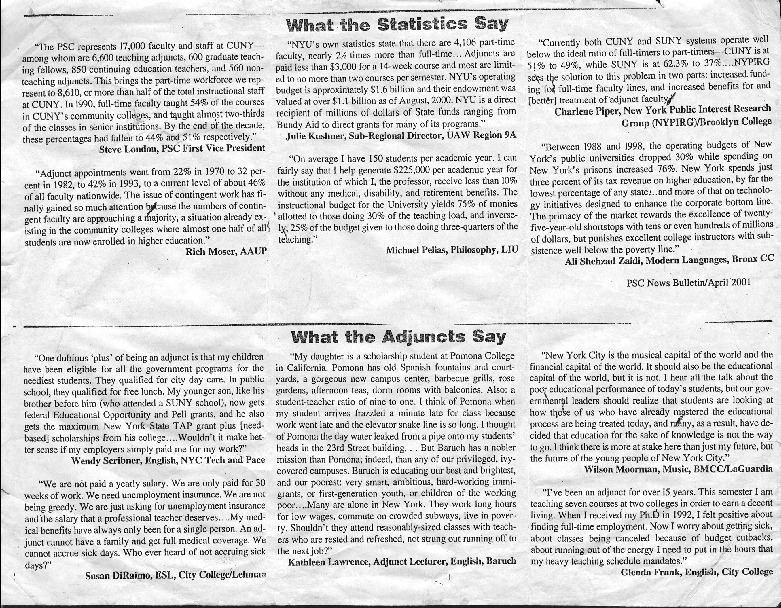
“The PSC represents 17,000 faculty and staff at CUNY—
among whom are 6,600 teaching adjuncts, 600 graduate teach-
ing fellows, 850 continuing education teachers, and 560 non-
teaching adjuncts. This brings the part-time workforce we rep-
resent to 8,610, or more than half of the total instructional staff
at CUNY. In 1990, full-time faculty taught 54% of the courses
in CUNY’s community colleges, and tqught almost two-thirds
of the classes in senior institutions. By the end of the decade,
these percentages had fallen to 44% and 51% respectively.”
Steve London, PSC First Vice President
“Adjunct appointments went from 22% in 1970 to 32 per-
cent in 1982, to 42% in 1993, to a current level of about 46%
of all faculty nationwide. The issue of contingent work has fi-
nally. gained so much attention batause the numbers of contin-
gent faculty are approaching a majority, a situation already ex-
What the Statistics Say
“NYU’s own statistics state that there are 4,106 part-time
faculty, nearly 24 times more than full-time....Adjuncts are
paid less than $3,000 for a 14-week course and most are limit-
ed to no more than two courses per semester. NYU’s operating
budget is approximately $1.6 billion and their endowment was
valued at over $1.1 billion as of August, 2000. NYU is a direct
recipient of millions of dollars. of State funds ranging from
Bundy Aid to direct grants for many of its programs.”
Julie Kushner, Sub-Regional Director, UAW Region 9A
“On average I have 150 students per academic year. I can
fairly say that I help generate $225,000 per academic year for
the institution of which I, the professor, receive less than 10%
without any medical, disability, and retirement benefits. The
instructional budget for the University yields 75% of monies
* allotted to those doing 30% of the teaching load, and inverse-
isting in the community colleges where almost one half of all’; mae of the budget given to those doing three-quarters of the
students are now enrolled in higher education.”
Rich Moser, AAUP
“One dubious ‘plus’ of being an adjunct is that my children
have been eligible for all the government programs for the
neediest students. They qualified for city day care. In public
school, they qualified for free lunch. My younger son, like his
brother before him (who attended a SUNY school), now gets
federal Educational Opportunity and Pell grants, and he also
gets the maximum New York State TAP grant plus [need-
based] scholarships from his college....Wouldn’t it make bet-
ter sense if my employers simply paid me for my work?”
Wendy Scribner, English, NYC Tech and Pace
“We are not paid a yearly salary. We are only paid for 30
weeks of work. We need unemployment insurance. We are not
being greedy. We are just asking for unemployment insurance
and the salary that a professional teacher deserves....My med-
ical benefits have always only been for a single person. An ad-
_ junct cannot have a family and get full medical coverage. We
- cannot accrue sick days. Who ever heard of not accruing sick
days?” = :
Susan DiRaimo, ESL, City College/Lehman
teaching.”
Michael Pelias, Philosophy, LIU
What the Adjuncts Say
“My daughter is a scholarship student at Pomona College
in California. Pomona has old Spanish fountains and court-
yards, a gorgeous new campus center, barbecue grills, rose
gardens, afternoon teas, dorm rooms with balconies, Also: a
student-teacher ratio of nine to one. I think of Pomona when
my student arrives frazzled a minute late for class because
work went late and the elevator snake line is so long. I thought
of Pomona the day water leaked from a pipe onto my students’
heads in the 23rd Street building, . . But Baruch has a nobler
mission than Pomona; indeed, than any of our privileged, ivy-
covered campuses. Baruch is educating our best and brightest,
and our poorest: very smart, ambitious, hard-working immi-
grants, or first-generation youth, or children of the working
poor....Many are alone in New York. They work long hours
for low wages, commute on crowded subways, live in pover-
ty. Shouldn’t they attend reasonably-sized classes with teach-
ers who are rested and refreshed, not strung out running off to
the next job?”
Kathleen Lawrence, Adjunct Lecturer, English, Baruch
x
“Currently both CUNY and SUNY systems operate well
below the ideal ratio of full-timers to part-timers—CUNY is at
51% to 49%, while SUNY is at 62.3% to 37%... NYPIRG
séxs the solution to this problem in two parts: increased. fund-
ing fof full-time faculty lines, and increased benefits for and
[bettér] treatment of adjunct faculty,
Charlene Piper, New York Public Interest Research
Group (NYPIRG)/Brooklyn College
“Between 1988 and 1998, the operating budgets of New
York’s public universities dropped 30% while spending on
New York’s prisons increased 76%. New York spends just
three percent of its tax revenue on higher education, by far the
lowest percentage of any state:..and more of that on technolo-
gy initiatives designed to enhance the corporate bottom line.
The primacy of the market rewards the excellence of twenty-
five-year-old shortstops with tens or even hundreds of millions
of dollars, but punishes excellent college instructors with sub-
sistence well below the poverty line.”
Ali Shehzad Zaidi, Modern Languages, Bronx CC
PSC News Bulletin/April 2001
“New York City is the musical capital of the world and the
financial. capital of the world. It should also be the educational
capital of the world, but it is not. I hear all the talk about the
Oe ae performance of today’s students, but our gov-
ernmentgl leaders should realize that students are looking at
how those of us who have already mastered the educational
process are being treated today, and nfany, as a result, have de-
cided that education for the sake of knowledge is not the way
to go. I think there is more at stake here than just my future, but
the future of the young people of New York City.”
Wilson Moorman, Music, BM@CC/LaGuardia
“I’ve been an adjunct for over 15 years. This semester I am
teaching seven courses at two colleges in order to earn a decent
living. When I received my Ph.D in 1992, I felt positive about —
-finding full-time employment. Now I worry about getting sick, -
about classes being canceled because of budget cutbacks,
about running out of the energy I need to put in the hours that
my heavy teaching schedule mandates.” :
Glenda Frank, English, City College
a SS eee | eS re as Ey a TS a ge Ee Caen
among whom are 6,600 teaching adjuncts, 600 graduate teach-
ing fellows, 850 continuing education teachers, and 560 non-
teaching adjuncts. This brings the part-time workforce we rep-
resent to 8,610, or more than half of the total instructional staff
at CUNY. In 1990, full-time faculty taught 54% of the courses
in CUNY’s community colleges, and tqught almost two-thirds
of the classes in senior institutions. By the end of the decade,
these percentages had fallen to 44% and 51% respectively.”
Steve London, PSC First Vice President
“Adjunct appointments went from 22% in 1970 to 32 per-
cent in 1982, to 42% in 1993, to a current level of about 46%
of all faculty nationwide. The issue of contingent work has fi-
nally. gained so much attention batause the numbers of contin-
gent faculty are approaching a majority, a situation already ex-
What the Statistics Say
“NYU’s own statistics state that there are 4,106 part-time
faculty, nearly 24 times more than full-time....Adjuncts are
paid less than $3,000 for a 14-week course and most are limit-
ed to no more than two courses per semester. NYU’s operating
budget is approximately $1.6 billion and their endowment was
valued at over $1.1 billion as of August, 2000. NYU is a direct
recipient of millions of dollars. of State funds ranging from
Bundy Aid to direct grants for many of its programs.”
Julie Kushner, Sub-Regional Director, UAW Region 9A
“On average I have 150 students per academic year. I can
fairly say that I help generate $225,000 per academic year for
the institution of which I, the professor, receive less than 10%
without any medical, disability, and retirement benefits. The
instructional budget for the University yields 75% of monies
* allotted to those doing 30% of the teaching load, and inverse-
isting in the community colleges where almost one half of all’; mae of the budget given to those doing three-quarters of the
students are now enrolled in higher education.”
Rich Moser, AAUP
“One dubious ‘plus’ of being an adjunct is that my children
have been eligible for all the government programs for the
neediest students. They qualified for city day care. In public
school, they qualified for free lunch. My younger son, like his
brother before him (who attended a SUNY school), now gets
federal Educational Opportunity and Pell grants, and he also
gets the maximum New York State TAP grant plus [need-
based] scholarships from his college....Wouldn’t it make bet-
ter sense if my employers simply paid me for my work?”
Wendy Scribner, English, NYC Tech and Pace
“We are not paid a yearly salary. We are only paid for 30
weeks of work. We need unemployment insurance. We are not
being greedy. We are just asking for unemployment insurance
and the salary that a professional teacher deserves....My med-
ical benefits have always only been for a single person. An ad-
_ junct cannot have a family and get full medical coverage. We
- cannot accrue sick days. Who ever heard of not accruing sick
days?” = :
Susan DiRaimo, ESL, City College/Lehman
teaching.”
Michael Pelias, Philosophy, LIU
What the Adjuncts Say
“My daughter is a scholarship student at Pomona College
in California. Pomona has old Spanish fountains and court-
yards, a gorgeous new campus center, barbecue grills, rose
gardens, afternoon teas, dorm rooms with balconies, Also: a
student-teacher ratio of nine to one. I think of Pomona when
my student arrives frazzled a minute late for class because
work went late and the elevator snake line is so long. I thought
of Pomona the day water leaked from a pipe onto my students’
heads in the 23rd Street building, . . But Baruch has a nobler
mission than Pomona; indeed, than any of our privileged, ivy-
covered campuses. Baruch is educating our best and brightest,
and our poorest: very smart, ambitious, hard-working immi-
grants, or first-generation youth, or children of the working
poor....Many are alone in New York. They work long hours
for low wages, commute on crowded subways, live in pover-
ty. Shouldn’t they attend reasonably-sized classes with teach-
ers who are rested and refreshed, not strung out running off to
the next job?”
Kathleen Lawrence, Adjunct Lecturer, English, Baruch
x
“Currently both CUNY and SUNY systems operate well
below the ideal ratio of full-timers to part-timers—CUNY is at
51% to 49%, while SUNY is at 62.3% to 37%... NYPIRG
séxs the solution to this problem in two parts: increased. fund-
ing fof full-time faculty lines, and increased benefits for and
[bettér] treatment of adjunct faculty,
Charlene Piper, New York Public Interest Research
Group (NYPIRG)/Brooklyn College
“Between 1988 and 1998, the operating budgets of New
York’s public universities dropped 30% while spending on
New York’s prisons increased 76%. New York spends just
three percent of its tax revenue on higher education, by far the
lowest percentage of any state:..and more of that on technolo-
gy initiatives designed to enhance the corporate bottom line.
The primacy of the market rewards the excellence of twenty-
five-year-old shortstops with tens or even hundreds of millions
of dollars, but punishes excellent college instructors with sub-
sistence well below the poverty line.”
Ali Shehzad Zaidi, Modern Languages, Bronx CC
PSC News Bulletin/April 2001
“New York City is the musical capital of the world and the
financial. capital of the world. It should also be the educational
capital of the world, but it is not. I hear all the talk about the
Oe ae performance of today’s students, but our gov-
ernmentgl leaders should realize that students are looking at
how those of us who have already mastered the educational
process are being treated today, and nfany, as a result, have de-
cided that education for the sake of knowledge is not the way
to go. I think there is more at stake here than just my future, but
the future of the young people of New York City.”
Wilson Moorman, Music, BM@CC/LaGuardia
“I’ve been an adjunct for over 15 years. This semester I am
teaching seven courses at two colleges in order to earn a decent
living. When I received my Ph.D in 1992, I felt positive about —
-finding full-time employment. Now I worry about getting sick, -
about classes being canceled because of budget cutbacks,
about running out of the energy I need to put in the hours that
my heavy teaching schedule mandates.” :
Glenda Frank, English, City College
a SS eee | eS re as Ey a TS a ge Ee Caen
Title
"What the Statistics Say...What the Adjuncts Say"
Description
This April 2001 piece from the Professional Staff Congress's (PSC) New Bulletin gave statistical accounts of the shortcomings in funding for CUNY colleges and the adjuncts who worked there in addition to personal stories that illustrated the consequences of austerity policies in higher education.
Contributor
Newfield, Marcia
Creator
PSC New Bulletin
Date
April 2001 (Circa)
Language
English
Rights
Public Domain
Source
Newfield, Marcia
Original Format
Article / Essay
PSC New Bulletin. Letter. 2001. “‘What the Statistics Say. What the Adjuncts Say’”, 2001, CUNY DIGITAL HISTORY ARCHIVE, accessed September 5, 2026, https://stephenz.tailc22a4b.ts.net/s/cdha/item/1495