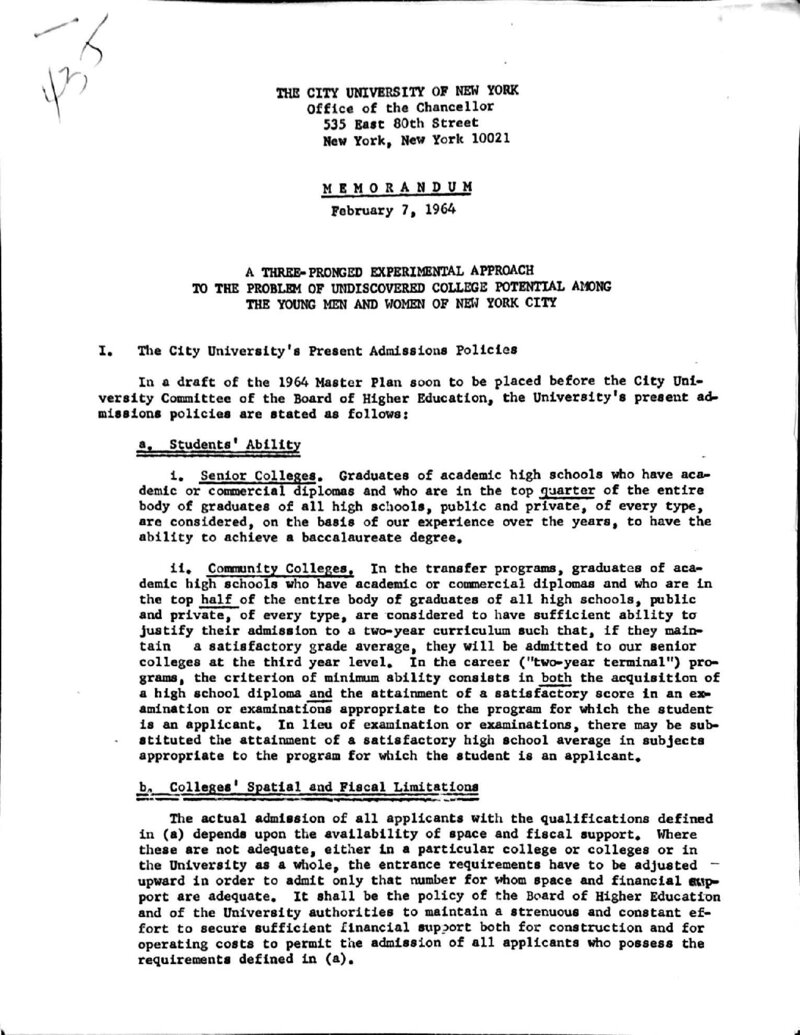
"A three-pronged experimental approach to the problem of undiscovered college potential among the young men and women of New York City"
Item
I.
THE CITY UNIVERSITY OF NEW YORK
Office of the Chancellor
535 East 80th Street
New York, New York 10021
MEMORANDUM
February 7, 1964
A THREE-PRONGED EXPERIMENTAL APPROACH
TO THE PROBLEM OF UNDISCOVERED COLLEGE POTENTIAL AMONG
THE YOUNG MEN AND WOMEN OF NEW YORK CITY
The City University's Present Admissions Policies
In a draft of the 1964 Master Plan soon to be placed before the City Uni-
versity Committee of the Board of Higher Education, the University's present ad-
missions policies are stated as follows:
Be Students" Ability
i, Senior Colleges, Graduates of academic high schools who have aca-
demic or commercial aT seas and who are in the top quarter of the entire
body of graduates of all high schools, public and private, of every type,
are considered, on the basis of our experience over the years, to have the
ability to achieve a baccalaureate degree,
ii. Community Colleges, In the transfer programs, graduates of aca-
demic high schools who have academic or commercial diplomas and who are in
the top half of the entire body of graduates of all high schools, public
and private, of every type, are considered to have sufficient ability to
justify their admission to a two-year curriculum such that, if they main-
tain a satisfactory grade average, they will be admitted to our senior
colleges at the third year level, In the career ("twoeyear terminal") pro=
grams, the criterion of minimum ability consists in both the acquisition of
a high school diploma and the attainment of a satisfactory score in an ex
amination or examinations appropriate to the program for which the student
is an applicant, In lieu of examination or examinations, there may be sub=
stituted the attainment of a satisfactory high school average in subjects
appropriate to the program for which the student is an applicant,
b,_ Colleges’ Spatial and Fiscal Limitations
—
The actual admission of all applicants with the qualifications defined
in (a) depends upon the availability of space and fiscal support, Where
these are not adequate, either in a particular college or colleges or in
the University as a whole, the entrance requirements have to be adjusted —
upward in order to admit only that number for whom space and financial eipe
port are adequate, It shall be the policy of the Board of Higher Education
and of the University authorities to maintain a strenuous and constant ef-
fort to secure sufficient financial sup2ort both for construction and for
operating costs to permit the admission of all applicants who possess the
requirements defined in (a).
The City University of New York, Office of the Chancellor, Memorandum, "'A
Three-Pronged Experimental Approach," February 7, 1964 Page 2
Se Special Programs
For the purpose of educational experimentation, or to encourage the
growth of new programs, a policy of admitting students with well-defined
qualifications which do not reach the standards set in (a) may be main-
tained for a limited period of time,
II, Implications of Our Admissions Policies for the Problem of Disadvantaged
Youth
Under the provisions of sections (a) and (b) set forth above, the Univer-
sity has no choice either legally or educationally but to start from the top of
the list of applicants for admission and to go down as far in the list of those
qualified as the available accommodations make possible, Here the list of stu-
dents admitted must form an uninterrupted series from most to least qualified,
without distinction of race, creed, color, or economic condition, This would
make the special selection of disadvantaged youth impracticable,
Under section (c), however, the University, as an institution of higher
education dedicated not only to teaching but to the investigation of educational
theories and the development of sound educational practices, has reserved ro
itself, as every great university doec, the right and duty of educational exper-
imentation, It is in the framework of such experimentation that the present
project is proposed,
III, A Three-Pronged Experiment
It is in the nature of experimentation to control the results of one pro-
cedure by comparison with those of one or more parallel procedures embodying
significant differences, The present experiment contemplates one main and two
subsidiary approaches, each of which will be used to check upon the results of
the others, The goal is to find out enough about the methods of selection and
education of culturally and economically disadvantaged young persons of high
native ability (‘'potential") to enable formulate policies which will place
the admission to college of such student firm non-discriminatory basis, This
might be used as long as our society continues to have any considerable body of
students to whom the term "culturally and economically disadvantaged" can prop=
erly be applied, We hopealso to learn a great deal about the teaching of stue
dents in general, Our great hope is, of course, that with improved methods of
education throughout the entire range of our schools--an improvement to which
it is expected che present experiment will contribute substantially--the need
for such special procedures will disappear, In the meantime, in addition to the
progress in educational theory and practice which our experimentation is intended
to foster, we shall have the practical gratification of having aided hundreds of
young men and women to gain a coilege education who would otherwise not have —
done so, But the main purpose and justification of our project is its experie
mental value,
The City University of New York, Office of the Chancellor, Memorandum, "A
Three-Pronged Experimental Approach," February 7, 1964 Page 3
A, The Four-Year Special College
1, 1964-65 Phase
It is proposed as a beginning to select 400 to 500 young men and
women from among those who have not been admitted to any college; these
would be chosen from among the June 1964 graduates of all New York City
high schools, public and private, who are to receive academic high school
diplomas, They would be chosen in mid-May, after all colleges will have
notified those whom they have decided to admit, A number equal to a fixed
percentage of the total enrollment of each school would be selected in such
a@ way as to provide a spectrum of the academic achievement-levels between
the minimum grade required by the New York City Board of Education and
the State Department of Education for graduation with an academic ("college
entrance") diploma and the highest grade in the school among those who
were not admitted to college, Students thus selected would be offered
the opportunity of enrolling in this program,
The 400 or 500 students thus selected would be offered the following
opportunity;
a An eight-week summer session in which basic skills of
reading comprehension, simple expository writing, and
the handling of number concepts would be brought to as
high a level as possible, and study techniques would be
improved, Students who perservered in this session and
reached a level of competence to be determined by those
in charge of the program would be admitted in the Fall
to the special college on which this program is centered,
b, Students admitted to the special college would be assured
that, if they maintained a satisfactory level of achievement,
they would receive, at the end of a four-year course, a
baccalaureate degiree from the " College
of the City University of New York," If, on the other hand,
they reached at any point in the four-year course a standard
of achievenent such that, in the opinion of their professors
and counsellors, and of a group of professors representing
our four senior’ colleges* they merited transfer to one of the
senior colleges, aad if they so desired themselves, they might
be transferred to one of the senior colleges where there was
room for them to complete their course and receive a degree
from that college,
c, The special college would be staffed by able and experienced
professors dvawn from our own college staffs and from outside
colleges, professors of such eminence that any thought that
these students were being asked to attend a second-class
"ghetto" college would be absurd, A number of professors
meriting the description have already informally expressed
their willingness to participate in the experiment,
*Insert here: “and employing in each case those criteria of academic achieve-
ment and aptitude which shall have been authorized by the fac-
ulty of the senior college concerned"
The City University of New York, Office of the Chancellor, Memorandum, "A
Three~Pronged Experimental Approach" February 7, 1964 Page 4
2, 1965-66 Phase
Next spring and summer, the procedure outlined above would be
followed for another 400-500 students, who would thus become the
special college's second freshman class, In addition, a new pro-
cedure would be followed, this time among the sixth-term students
(at end of third year of high school) in the "General Diploma"
group of the public academic high schools and in a comparable group
at the private schools, From among these, about 400 would be chosen
according to the best available criteria for native ability ("poten-
tiality"), These would be removed, if they accepted the invitation,
from their home schools, and given a special "advanced placement”
course covering the Summer of 1965, the academic year 1965-66, and
the Summer of 1966, At this point, those who qualified would receive
an academic high school diploma, and be invited to form part of the
special college's third freshman class, to which of course the 1966
component of the Phase 1 procedure would also be admitted, This
"General Diploma" operation, perhaps supplemented by a select group
from the vocational high schools, would be repeated in succeeding
years, as long as the program was deemed necessary,
B, “Higher Education for the Many" at a Community College
This prong of the experiment is a continuation of President
Meister's demonstration study at Bronx Community College in 1960-64
(reported to the Board of Higher Education on January 22, 1962; see
brochure attached),
The study, made possible by a grantfrom the Fund for the Advance-
ment of Education, led to a number of findings, of which the following
are most pertinent to the present proposal:
1, For students in the second 25% of the spectrum of academic
abilities, sometimes referred to as "the student in the middle,"
the established college admission tests are far from infallible
measures of potential for success in college education,
2. The motivation possessed by a student pursuing certain careers
is among the most potent factors leading to academic achievement
and eventual success in life,
3. The judgment of high school guidance counsellors and teachers
who are aware of these motivations is among the most valid
bases for admission to college.
4. The "Operation Second Chance" succeeded in that all students
enrolled in the program, who previously had failed to gain ad-
mission to the day session of any college, including community
colleges, experienced personal growth; two out of three succeeded
in being admitted to two-year or four-year colleges, including
many different institutions in and out of New York City, some
of them with scholarships. (A follow-up study is now in progress.)
The City University of New York, Office of the Chancellor, Memorandum, "A
Three-Pronged Experimental Approach February 7, 1964 Page 5
5.
A strong guidance program and a "speedededown" curriculum can
promote academic progress in higher education for "the student
in the middle,"
The results of "Operation Second Chance" would have been more
dramatic if the students had attended day session rather than
coming at night after employment, since the opportunity of mingling
with other college students is of prime importance.
It is proposed that President Meister be authorized to continue the
procedure outlined in his earlier study for about 200 students in 1964-65,
and for as many years aa the main project stands in need of a control group.
Specifically, the plan would include the following features:
The admission of a number of students from each interested
secondary school equal to a fixed percentage of the total enroll-
ment in the school's graduating class. These students would be
classified as “Special Matriculants,'
Admission would be based upon the nomination of admittees by the
school principal and his faculty, after conference with repre-
sentatives from the Faculty of Bronx Community College. No
further admissions tests would be administered.
All the Bronx Community College curricula, transfer and career,
would be open to the students admitted,
The admitted students would agree to come to the College sometime
in June for a series of placement tests.
In cases where important academic weakness appeared, the student
would agree to attend the Bronx Community College Summer Session
in the summer of 1964 for remedial work.
As with all other Bronx Community College students, it would be
understood that they might be given a so-called "limited program,"
in line with their demonstrated ability to progress in the curri-
culum selected,
No tuition fees would be charged, either in the regular or the
summer session,
The admission of "Special Matriculants" would in no way affect
the procedures for or the numbers of students admitted to the
Bronx Community College in the regular way.
Basic to the proposal is the concept that the students admitted
would have a full opportunity to climb the "ladder of opportunity"
toward their educational and career goals; through full counselling
service, they would be helped to reach the limits of their capa-
bilit ies without compromising excellence of performance,
The City University of New York, Office of the Chancellor, Memorandum, "A
Three-Pronged Experimental Approach February 7, 1964 Page 6
10, At the end of two, three, and four years after the admission of
each group of "Special Motriculants," the College would have
the opportunity of comparing their achievements with those of
the regular matriculants of the College.
C. A “College Potentiality Seorch" at an Existing Senior College
The third prongs of the experiment involves the use of the School of
General Studies at a senior college. The School of General Studies at
Brooklyn College, for instance, has historically provided an oppor-
tunity to enroll in baccalaureate programs of study to 4 limited
number of those who give evidence of potential ability. In this effort,
it has experimented with remedial courses, with varying entrance require-
ments, ond with increased professional guidance. A Basic Skills Center
for the improvement of reading, writing, and study skills is already in
operation there. The basic skills program includes diagnostic evalua-
tion, group lectures, personal instruction, and conferences, and fur-
nishes special counselling and individualized help as dominant features
of the program,
It is proposed to admit fifty students in September 1964 who meet
the following specifications:
“Students who are socially, economically, and/or educationally
disadvantaged; are residents of New York City; do not qualify
for admission to the College under existing requirements for
full matriculation; in the judgment of the high school principal,
counselors and teachers, are able to profit from college ecuca-
tion; are graduates with an academic diploma; give evidence of
potentialities in leadership, citizenship, and creativity, ‘
The process of identification would be the following:
1. Nominations to be made by high schools, There is to be no
limit on the number recoumended by an individual school,
2. Personal, social, and economic data would be required.
3. Qualitative and quantitative evaluation will relate to the
number of entrance units presented, the high school average,
and the entrance examination score.
4. An Advisory Board should be constituted, including representa-
tives of the College and the Board of Education, This Board
would identify applicants most worthy of consideration,
5. Final selection of candidates to be made by the College Director
of Acmissions,
The City University of New York, Office of the Chancellor. Memorandum, "A
Three-Pronged Experimental Approach," February 7, 1964 Page 7
The college program would involve the following features:
1. Students in this project group would be enrolled, after
careful screening, in the School of General Studies as
“Pre-Matriculants!'
The program of studies would be conducted on a highly individualized
and closely supervised basis. Students in need of remedial work
would be referred to the Basic Skills Center and assigned such
other courses as may be deemed necessary by the College autRori-
ties. In addition, they might be enrolled simultaneously in two
or three selected courses involving baccalaureate credit. Not
until the students clearly demonstrate a capacity to pursue
college-level work, will they be permitted to carry a full
schedule, Otherwise there is a danger that the "disadvantaged"
will be overwhelmed by challenges with which they are, at least
in the early stages, unable to cope. It may also be desirable
to stipulate that the students will engage in no outside em-
ployment during the course of this experiment,
3. A group tutorial, composed of a number of dedicated and ex-
perienced instructors, would work with these students in an
attempt to discover weaknesses and gaps in their educational
backgrounds and would employ their joint professional compe-
tence in raising the performance of these students to an
acceptable collegiate level, In addition, classroom teachers
would provide special tutorial assistance, wherever necessary,
to students of this group enrolled in their courses, Rather
than considering them as a group, it will be the policy, wher-
ever possible, to treat the students involved in this project
as persons, to be judged on their individual records, While
under the direct jurisdiction and control of the School of
General Studies, the students in this group may nevertheless
be permitted to schedule some classes in the daytime in the
College of Liberal Arts and Sciences depending upon their
individual records of academic achievement, In order for
these students to be integrated into the courses and life of
College they must be brought up by hard work (both on the
part of student and teacher) to a level where they will not
suffer new agonies of falling "below par",
4&. Special counseling and supportive services (guidance, psycholog-
ical counseling, and social work) should be available. Two
carefully selected faculty members (each assigned on a half-
time basis) would be detailed as special counselors to the
project group.
5.
Every effort will be made to aid these students in fulfilling
the qualitative requirements of the College. However, the re-
tention policies of the School of General Studies will be
strictly applied, It would be mistaken generosity to permit a
student to continue taking courses if he shows himself incapable
of completing college-level work satisfactorily.
The City University of New York, Office of the Chancellor, Memorandum, "A
Taree-Pronged Experimental Approach," February 7, 1964 Page 8
This proposal is based upon the assumption that application of
competence, energy and imagination on the part of a small group of instructors,
working with a relatively small group of highly motivated, but disadvantaged
students, will succeed in integrating them into the college conmunity--not as
the "poor relative" whose presence is tolerated, but rather with the full
dignity of belonging. The hope is expressed that the project group, afforded
the special incentives and facilities suggested here, might "make the grade”
after a two-year intensive effort, While offering direct educational assistance
for fifty "disadvantaged" candidates, the higher aim of this experiment is to
provide the City University of New York with a demonstration of the manner in
which the basic philosophy of the School of General Studies can be exploited
to meet this immediate challenge.
This prong of the program would be continued in succeeding years
if, in the judgment of those in charge, it was helping to fulfill the pur-
poses set forth in the preceding paragraph,
THE CITY UNIVERSITY OF NEW YORK
Office of the Chancellor
535 East 80th Street
New York, New York 10021
MEMORANDUM
February 7, 1964
A THREE-PRONGED EXPERIMENTAL APPROACH
TO THE PROBLEM OF UNDISCOVERED COLLEGE POTENTIAL AMONG
THE YOUNG MEN AND WOMEN OF NEW YORK CITY
The City University's Present Admissions Policies
In a draft of the 1964 Master Plan soon to be placed before the City Uni-
versity Committee of the Board of Higher Education, the University's present ad-
missions policies are stated as follows:
Be Students" Ability
i, Senior Colleges, Graduates of academic high schools who have aca-
demic or commercial aT seas and who are in the top quarter of the entire
body of graduates of all high schools, public and private, of every type,
are considered, on the basis of our experience over the years, to have the
ability to achieve a baccalaureate degree,
ii. Community Colleges, In the transfer programs, graduates of aca-
demic high schools who have academic or commercial diplomas and who are in
the top half of the entire body of graduates of all high schools, public
and private, of every type, are considered to have sufficient ability to
justify their admission to a two-year curriculum such that, if they main-
tain a satisfactory grade average, they will be admitted to our senior
colleges at the third year level, In the career ("twoeyear terminal") pro=
grams, the criterion of minimum ability consists in both the acquisition of
a high school diploma and the attainment of a satisfactory score in an ex
amination or examinations appropriate to the program for which the student
is an applicant, In lieu of examination or examinations, there may be sub=
stituted the attainment of a satisfactory high school average in subjects
appropriate to the program for which the student is an applicant,
b,_ Colleges’ Spatial and Fiscal Limitations
—
The actual admission of all applicants with the qualifications defined
in (a) depends upon the availability of space and fiscal support, Where
these are not adequate, either in a particular college or colleges or in
the University as a whole, the entrance requirements have to be adjusted —
upward in order to admit only that number for whom space and financial eipe
port are adequate, It shall be the policy of the Board of Higher Education
and of the University authorities to maintain a strenuous and constant ef-
fort to secure sufficient financial sup2ort both for construction and for
operating costs to permit the admission of all applicants who possess the
requirements defined in (a).
The City University of New York, Office of the Chancellor, Memorandum, "'A
Three-Pronged Experimental Approach," February 7, 1964 Page 2
Se Special Programs
For the purpose of educational experimentation, or to encourage the
growth of new programs, a policy of admitting students with well-defined
qualifications which do not reach the standards set in (a) may be main-
tained for a limited period of time,
II, Implications of Our Admissions Policies for the Problem of Disadvantaged
Youth
Under the provisions of sections (a) and (b) set forth above, the Univer-
sity has no choice either legally or educationally but to start from the top of
the list of applicants for admission and to go down as far in the list of those
qualified as the available accommodations make possible, Here the list of stu-
dents admitted must form an uninterrupted series from most to least qualified,
without distinction of race, creed, color, or economic condition, This would
make the special selection of disadvantaged youth impracticable,
Under section (c), however, the University, as an institution of higher
education dedicated not only to teaching but to the investigation of educational
theories and the development of sound educational practices, has reserved ro
itself, as every great university doec, the right and duty of educational exper-
imentation, It is in the framework of such experimentation that the present
project is proposed,
III, A Three-Pronged Experiment
It is in the nature of experimentation to control the results of one pro-
cedure by comparison with those of one or more parallel procedures embodying
significant differences, The present experiment contemplates one main and two
subsidiary approaches, each of which will be used to check upon the results of
the others, The goal is to find out enough about the methods of selection and
education of culturally and economically disadvantaged young persons of high
native ability (‘'potential") to enable formulate policies which will place
the admission to college of such student firm non-discriminatory basis, This
might be used as long as our society continues to have any considerable body of
students to whom the term "culturally and economically disadvantaged" can prop=
erly be applied, We hopealso to learn a great deal about the teaching of stue
dents in general, Our great hope is, of course, that with improved methods of
education throughout the entire range of our schools--an improvement to which
it is expected che present experiment will contribute substantially--the need
for such special procedures will disappear, In the meantime, in addition to the
progress in educational theory and practice which our experimentation is intended
to foster, we shall have the practical gratification of having aided hundreds of
young men and women to gain a coilege education who would otherwise not have —
done so, But the main purpose and justification of our project is its experie
mental value,
The City University of New York, Office of the Chancellor, Memorandum, "A
Three-Pronged Experimental Approach," February 7, 1964 Page 3
A, The Four-Year Special College
1, 1964-65 Phase
It is proposed as a beginning to select 400 to 500 young men and
women from among those who have not been admitted to any college; these
would be chosen from among the June 1964 graduates of all New York City
high schools, public and private, who are to receive academic high school
diplomas, They would be chosen in mid-May, after all colleges will have
notified those whom they have decided to admit, A number equal to a fixed
percentage of the total enrollment of each school would be selected in such
a@ way as to provide a spectrum of the academic achievement-levels between
the minimum grade required by the New York City Board of Education and
the State Department of Education for graduation with an academic ("college
entrance") diploma and the highest grade in the school among those who
were not admitted to college, Students thus selected would be offered
the opportunity of enrolling in this program,
The 400 or 500 students thus selected would be offered the following
opportunity;
a An eight-week summer session in which basic skills of
reading comprehension, simple expository writing, and
the handling of number concepts would be brought to as
high a level as possible, and study techniques would be
improved, Students who perservered in this session and
reached a level of competence to be determined by those
in charge of the program would be admitted in the Fall
to the special college on which this program is centered,
b, Students admitted to the special college would be assured
that, if they maintained a satisfactory level of achievement,
they would receive, at the end of a four-year course, a
baccalaureate degiree from the " College
of the City University of New York," If, on the other hand,
they reached at any point in the four-year course a standard
of achievenent such that, in the opinion of their professors
and counsellors, and of a group of professors representing
our four senior’ colleges* they merited transfer to one of the
senior colleges, aad if they so desired themselves, they might
be transferred to one of the senior colleges where there was
room for them to complete their course and receive a degree
from that college,
c, The special college would be staffed by able and experienced
professors dvawn from our own college staffs and from outside
colleges, professors of such eminence that any thought that
these students were being asked to attend a second-class
"ghetto" college would be absurd, A number of professors
meriting the description have already informally expressed
their willingness to participate in the experiment,
*Insert here: “and employing in each case those criteria of academic achieve-
ment and aptitude which shall have been authorized by the fac-
ulty of the senior college concerned"
The City University of New York, Office of the Chancellor, Memorandum, "A
Three~Pronged Experimental Approach" February 7, 1964 Page 4
2, 1965-66 Phase
Next spring and summer, the procedure outlined above would be
followed for another 400-500 students, who would thus become the
special college's second freshman class, In addition, a new pro-
cedure would be followed, this time among the sixth-term students
(at end of third year of high school) in the "General Diploma"
group of the public academic high schools and in a comparable group
at the private schools, From among these, about 400 would be chosen
according to the best available criteria for native ability ("poten-
tiality"), These would be removed, if they accepted the invitation,
from their home schools, and given a special "advanced placement”
course covering the Summer of 1965, the academic year 1965-66, and
the Summer of 1966, At this point, those who qualified would receive
an academic high school diploma, and be invited to form part of the
special college's third freshman class, to which of course the 1966
component of the Phase 1 procedure would also be admitted, This
"General Diploma" operation, perhaps supplemented by a select group
from the vocational high schools, would be repeated in succeeding
years, as long as the program was deemed necessary,
B, “Higher Education for the Many" at a Community College
This prong of the experiment is a continuation of President
Meister's demonstration study at Bronx Community College in 1960-64
(reported to the Board of Higher Education on January 22, 1962; see
brochure attached),
The study, made possible by a grantfrom the Fund for the Advance-
ment of Education, led to a number of findings, of which the following
are most pertinent to the present proposal:
1, For students in the second 25% of the spectrum of academic
abilities, sometimes referred to as "the student in the middle,"
the established college admission tests are far from infallible
measures of potential for success in college education,
2. The motivation possessed by a student pursuing certain careers
is among the most potent factors leading to academic achievement
and eventual success in life,
3. The judgment of high school guidance counsellors and teachers
who are aware of these motivations is among the most valid
bases for admission to college.
4. The "Operation Second Chance" succeeded in that all students
enrolled in the program, who previously had failed to gain ad-
mission to the day session of any college, including community
colleges, experienced personal growth; two out of three succeeded
in being admitted to two-year or four-year colleges, including
many different institutions in and out of New York City, some
of them with scholarships. (A follow-up study is now in progress.)
The City University of New York, Office of the Chancellor, Memorandum, "A
Three-Pronged Experimental Approach February 7, 1964 Page 5
5.
A strong guidance program and a "speedededown" curriculum can
promote academic progress in higher education for "the student
in the middle,"
The results of "Operation Second Chance" would have been more
dramatic if the students had attended day session rather than
coming at night after employment, since the opportunity of mingling
with other college students is of prime importance.
It is proposed that President Meister be authorized to continue the
procedure outlined in his earlier study for about 200 students in 1964-65,
and for as many years aa the main project stands in need of a control group.
Specifically, the plan would include the following features:
The admission of a number of students from each interested
secondary school equal to a fixed percentage of the total enroll-
ment in the school's graduating class. These students would be
classified as “Special Matriculants,'
Admission would be based upon the nomination of admittees by the
school principal and his faculty, after conference with repre-
sentatives from the Faculty of Bronx Community College. No
further admissions tests would be administered.
All the Bronx Community College curricula, transfer and career,
would be open to the students admitted,
The admitted students would agree to come to the College sometime
in June for a series of placement tests.
In cases where important academic weakness appeared, the student
would agree to attend the Bronx Community College Summer Session
in the summer of 1964 for remedial work.
As with all other Bronx Community College students, it would be
understood that they might be given a so-called "limited program,"
in line with their demonstrated ability to progress in the curri-
culum selected,
No tuition fees would be charged, either in the regular or the
summer session,
The admission of "Special Matriculants" would in no way affect
the procedures for or the numbers of students admitted to the
Bronx Community College in the regular way.
Basic to the proposal is the concept that the students admitted
would have a full opportunity to climb the "ladder of opportunity"
toward their educational and career goals; through full counselling
service, they would be helped to reach the limits of their capa-
bilit ies without compromising excellence of performance,
The City University of New York, Office of the Chancellor, Memorandum, "A
Three-Pronged Experimental Approach February 7, 1964 Page 6
10, At the end of two, three, and four years after the admission of
each group of "Special Motriculants," the College would have
the opportunity of comparing their achievements with those of
the regular matriculants of the College.
C. A “College Potentiality Seorch" at an Existing Senior College
The third prongs of the experiment involves the use of the School of
General Studies at a senior college. The School of General Studies at
Brooklyn College, for instance, has historically provided an oppor-
tunity to enroll in baccalaureate programs of study to 4 limited
number of those who give evidence of potential ability. In this effort,
it has experimented with remedial courses, with varying entrance require-
ments, ond with increased professional guidance. A Basic Skills Center
for the improvement of reading, writing, and study skills is already in
operation there. The basic skills program includes diagnostic evalua-
tion, group lectures, personal instruction, and conferences, and fur-
nishes special counselling and individualized help as dominant features
of the program,
It is proposed to admit fifty students in September 1964 who meet
the following specifications:
“Students who are socially, economically, and/or educationally
disadvantaged; are residents of New York City; do not qualify
for admission to the College under existing requirements for
full matriculation; in the judgment of the high school principal,
counselors and teachers, are able to profit from college ecuca-
tion; are graduates with an academic diploma; give evidence of
potentialities in leadership, citizenship, and creativity, ‘
The process of identification would be the following:
1. Nominations to be made by high schools, There is to be no
limit on the number recoumended by an individual school,
2. Personal, social, and economic data would be required.
3. Qualitative and quantitative evaluation will relate to the
number of entrance units presented, the high school average,
and the entrance examination score.
4. An Advisory Board should be constituted, including representa-
tives of the College and the Board of Education, This Board
would identify applicants most worthy of consideration,
5. Final selection of candidates to be made by the College Director
of Acmissions,
The City University of New York, Office of the Chancellor. Memorandum, "A
Three-Pronged Experimental Approach," February 7, 1964 Page 7
The college program would involve the following features:
1. Students in this project group would be enrolled, after
careful screening, in the School of General Studies as
“Pre-Matriculants!'
The program of studies would be conducted on a highly individualized
and closely supervised basis. Students in need of remedial work
would be referred to the Basic Skills Center and assigned such
other courses as may be deemed necessary by the College autRori-
ties. In addition, they might be enrolled simultaneously in two
or three selected courses involving baccalaureate credit. Not
until the students clearly demonstrate a capacity to pursue
college-level work, will they be permitted to carry a full
schedule, Otherwise there is a danger that the "disadvantaged"
will be overwhelmed by challenges with which they are, at least
in the early stages, unable to cope. It may also be desirable
to stipulate that the students will engage in no outside em-
ployment during the course of this experiment,
3. A group tutorial, composed of a number of dedicated and ex-
perienced instructors, would work with these students in an
attempt to discover weaknesses and gaps in their educational
backgrounds and would employ their joint professional compe-
tence in raising the performance of these students to an
acceptable collegiate level, In addition, classroom teachers
would provide special tutorial assistance, wherever necessary,
to students of this group enrolled in their courses, Rather
than considering them as a group, it will be the policy, wher-
ever possible, to treat the students involved in this project
as persons, to be judged on their individual records, While
under the direct jurisdiction and control of the School of
General Studies, the students in this group may nevertheless
be permitted to schedule some classes in the daytime in the
College of Liberal Arts and Sciences depending upon their
individual records of academic achievement, In order for
these students to be integrated into the courses and life of
College they must be brought up by hard work (both on the
part of student and teacher) to a level where they will not
suffer new agonies of falling "below par",
4&. Special counseling and supportive services (guidance, psycholog-
ical counseling, and social work) should be available. Two
carefully selected faculty members (each assigned on a half-
time basis) would be detailed as special counselors to the
project group.
5.
Every effort will be made to aid these students in fulfilling
the qualitative requirements of the College. However, the re-
tention policies of the School of General Studies will be
strictly applied, It would be mistaken generosity to permit a
student to continue taking courses if he shows himself incapable
of completing college-level work satisfactorily.
The City University of New York, Office of the Chancellor, Memorandum, "A
Taree-Pronged Experimental Approach," February 7, 1964 Page 8
This proposal is based upon the assumption that application of
competence, energy and imagination on the part of a small group of instructors,
working with a relatively small group of highly motivated, but disadvantaged
students, will succeed in integrating them into the college conmunity--not as
the "poor relative" whose presence is tolerated, but rather with the full
dignity of belonging. The hope is expressed that the project group, afforded
the special incentives and facilities suggested here, might "make the grade”
after a two-year intensive effort, While offering direct educational assistance
for fifty "disadvantaged" candidates, the higher aim of this experiment is to
provide the City University of New York with a demonstration of the manner in
which the basic philosophy of the School of General Studies can be exploited
to meet this immediate challenge.
This prong of the program would be continued in succeeding years
if, in the judgment of those in charge, it was helping to fulfill the pur-
poses set forth in the preceding paragraph,
Title
"A three-pronged experimental approach to the problem of undiscovered college potential among the young men and women of New York City"
Description
This memorandum from Chancellor Bowker’s office called for three new forms of CUNY desegregation programs (pp. 1-2). This “three-pronged experiment” would be excused from CUNY’s general obligation to admit only students with the highest grades and test scores. Its goal would be “to find out enough about the methods of selection and education of culturally disadvantaged persons of high native ability (‘potential’) to enable us to formulate policies which will place the admission to college of such students upon a firm non-discriminatory basis” (p. 2). The memo added that CUNY hoped “also to learn a great deal about the teaching of students in general” (p. 2).
The third prong of the Chancellor’s office’s proposal called on senior colleges to host a “College Potentiality Search” from within their Schools of General Studies, using an elaborate, multi-tiered, application process to provisionally admit groups of students into their schools of general studies as “Pre-Matriculants.” These desegregation programs would teach on a “highly individualized and closely supervised basis” (p. 7). The Chancellor’s office assumed these new students would be underprepared and would struggle to succeed. They would be assigned to zero-credit remedial courses or a mix of remedial and credit bearing courses “until [they] clearly demonstrate a capacity to pursue college-level work” (p.7). Group and individual tutorials would “discover weaknesses and gaps in their educational backgrounds” and raise student performance “to an acceptable collegiate level.”
Students would not be treated “as a group” but “as persons, to be judged on their individual records” (p.7). Although retention policies would not be altered in “mistaken generosity” to help any student who “shows himself incapable of completing college level work satisfactorily,” the goal was “for these students to be integrated into the courses and life of the College….by hard work (both on the part of the student and teacher) to a level where they will not suffer new agonies of falling “below par” (p. 7). Students would receive special “counseling and supportive services,” including faculty counseling, “psychological counseling [and] social work” (p. 7). The Chancellor’s office called for a 50-student program to begin in the fall of 1964 and suggested Brooklyn College as its location (p. 6).
The third prong of the Chancellor’s office’s proposal called on senior colleges to host a “College Potentiality Search” from within their Schools of General Studies, using an elaborate, multi-tiered, application process to provisionally admit groups of students into their schools of general studies as “Pre-Matriculants.” These desegregation programs would teach on a “highly individualized and closely supervised basis” (p. 7). The Chancellor’s office assumed these new students would be underprepared and would struggle to succeed. They would be assigned to zero-credit remedial courses or a mix of remedial and credit bearing courses “until [they] clearly demonstrate a capacity to pursue college-level work” (p.7). Group and individual tutorials would “discover weaknesses and gaps in their educational backgrounds” and raise student performance “to an acceptable collegiate level.”
Students would not be treated “as a group” but “as persons, to be judged on their individual records” (p.7). Although retention policies would not be altered in “mistaken generosity” to help any student who “shows himself incapable of completing college level work satisfactorily,” the goal was “for these students to be integrated into the courses and life of the College….by hard work (both on the part of the student and teacher) to a level where they will not suffer new agonies of falling “below par” (p. 7). Students would receive special “counseling and supportive services,” including faculty counseling, “psychological counseling [and] social work” (p. 7). The Chancellor’s office called for a 50-student program to begin in the fall of 1964 and suggested Brooklyn College as its location (p. 6).
Contributor
Molloy, Sean
Creator
Office of CUNY Chancellor Albert Bowker
Date
February 7, 1964
Language
English
Rights
Public Domain
Source
Berger Family Archives
Original Format
Report / Paper / Proposal
Office of CUNY Chancellor Albert Bowker. Letter. “‘A Three-Pronged Experimental Approach to the Problem of Undiscovered College Potential Among the Young Men and Women of New York City’.”, CUNY DIGITAL HISTORY ARCHIVE, accessed September 5, 2026, https://stephenz.tailc22a4b.ts.net/s/cdha/item/1103