Minutes from 4/8/1965 CCNY Faculty Council Meeting
Item
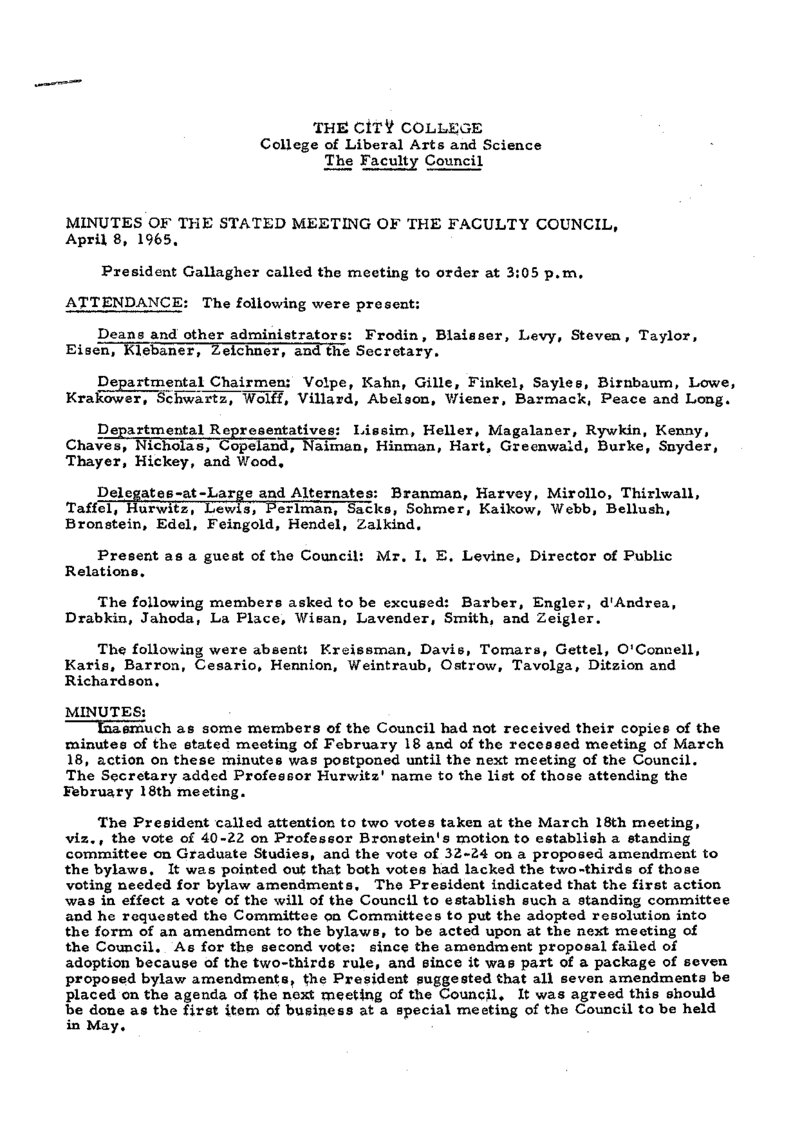
THE CiT¥ COLLEGE
College of Liberal Arts and Science
The Faculty Council
MINUTES OF THE STATED MEETING OF THE FACULTY COUNCIL,
April 8, 1965,
President Gallagher called the meeting to order at 3:05 p,m.
ATTENDANCE: The following were present:
Deans and other administrators: Frodin, Blaisser, Levy, Steven, Taylor,
Eisen, Klebaner, Zeichner, and the Secretary.
Departmental Chairmen: Volpe, Kahn, Gille, Finkel, Sayles, Birnbaum, Lowe,
Krakower, Schwartz, Wolff, Villard, Abelson, Wiener, Barmack, Peace and Long.
Departmental Representatives: Lissim, Heller, Magalaner, Rywkin, Kenny,
Chaves, Nicholas, Copeland, Naiman, Hinman, Hart, Greenwald, Burke, Snyder,
Thayer, Hickey, and Wood,
Delegates-at-Large and Alternates: Branman, Harvey, Mirollo, Thirlwall,
Taffel, Hurwitz, Lewis, Perlman, Sacks, Sohmer, Kaikow, Webb, Bellush,
Bronstein, Edel, Feingold, Hendel, Zalkind.
Present as a guest of the Council: Mr. I, E, Levine, Director of Public
Relations,
The following members asked to be excused: Barber, Engler, d'Andrea,
Drabkin, Jahoda, La Place, Wisan, Lavender, Smith, and Zeigler.
The following were absent: Kreissman, Davis, Tomars, Gettel, O'Connell,
Karis, Barron, Cesario, Hennion, Weintraub, Ostrow, Tavolga, Ditzion and
Richardson,
MINUTES; :
asmuch as some members of the Council had not received their copies of the
minutes of the stated meeting of February 18 and of the recessed meeting of March
18, action on these minutes was postponed until the next meeting of the Council.
The Secretary added Professor Hurwitz' name to the list of those attending the
February 18th meeting.
The President called attention to two votes taken at the March 18th meeting,
viz,, the vote of 40-22 on Professor Bronstein's motion to establish a standing
committee on Graduate Studies, and the vote of 32-24 on a proposed amendment to
the bylaws, It was pointed out that both votes had lacked the two-thirds of those
voting needed for bylaw amendments, The President indicated that the first action
was in effect a vote of the will of the Council to establish such a standing committee
and he requested the Committee on Committees to put the adopted resolution into
the form of an amendment to the bylaws, to be acted upon at the next meeting of
the Council. As for the second vote: since the amendment proposal failed of
adoption because of the two-thirds rule, and since it was part of a package of seven
proposed bylaw amendments, the President suggested that all seven amendments be
placed on the agenda of the next meeting of the Council, It was agreed this should
be done as the first item of business at a special meeting of the Council to be held
in May.
NUTES of The Faculty Council, April 8, 1965, -2-
Professor Harvey, Chairman of the Ad Hoc Committee on Enrollment Policy
presented an oral report for the Committee and indicated that it had not yet acted
upon the proposal of one of its members, Professor John A, Davis, who had re-
quested that his statement be circulated with the call of the meeting. He indicated
that the Committee was in accord with Professor Davis' feeling of urgency concern-
ing the problem of increasing the number of Negro and Puerto Rican students at the
College, He reported further that the Administrative Council plans to review the
question of admission standards, The Committee hopes that administrative and
faculty participation at all] levels of discussion and decision,
‘President Gallagher commented on the anticipated size of the freshman class to
enter in the fall of 1965. Chancellor Bowker has indicated that we are expected to
admit at that time the number of students we had planned to admit in the fall of 1964.
The President also reported two actions of the School of Education Faculty earlier
in the day: :
(1) an expression of their desire to do something by this fall for somé of
the disadvantaged New York City high school graduates who would not
be eligible for admission to the College but who might nevertheless be
judged as having the potential for successful college work, and
(2) the authorization of the Dean of the School of Education and of the
President to appoint a small committee with power to initiate
immediately a program for this fall with, it was hoped, the assistance
and cooperation of a similar committee representing the College of
Liberal Arts and Science,
President Gallagher outlined briefly aspects of the special program to be con-
sidered, as follows: (1) the program would be under the aegis of the School of
General Studies; (2) there would be room there for a group of such students because
of student openings arising from the phasing out of the two-year Associate in Arts
curriculum, brought about with the advent of the Community Colleges; (3) the
program would be individualized, with each student progressing at his own rate and
given credit when and to the extent it is earned; (4) students numbering between
50 and 100 would be drawn from several sources such as from those who applied for
admission to CCNY and did not meet our entrance requirements but did meet the
entrance requirements of one of the other senior colleges of the City University, or
from graduating New York high school students who did not apply to any college but
whose records indicate a likely aptitude for college work; (5) all the students in the
program would be classified as prematriculants; (6) since the chief problem of
most students in the program might be motivation, efforts would be made to enlist
the cooperation of business and industry in New York City to provide job opportuni-
ties on graduation; (7) the program would be evaluated and assessed from time to
time; (8) it would thus be on an experimental basis, perhaps initially as a five-year
plan, and would need to be financed from sources other than the New York City tax
structure; (9) the whole proposal might be baptized as an experimental college for
some of the disadvantaged graduates of New York City high schools. He urged the
Council to authorize the establishment of a committee to work with the School of
Education Committee on the proposed experiment.
Professor Harvey expressed the view that it might be better for the Council to
set up a committee to convey our ideas to the School of Education rather than simply
establish a committee to work with the School of Education Committee on its pro-
gram of already conceived ideas, He felt that our Ad Hoc Committee on Enrollment
Policy should be expected to be free to criticize the School of Education proposal.
Professor Burke of the Schoo] of Education indicated they were mainly con-
cerned with training more teachers for New York City schools,
MINUTES of The Faculty Council, April 8, 1965, -3-
Professor Villard moved the appointment of the committee requested by the |
President, with power to act, Seconded, Questions were raised about the com-
mittee's responsibility to the Faculty Council and the maximum number of students
envisaged for such a program. President Gallagher interpreted the motion to imply
that such a committee would report back to the Council but nevertheless would have
the power to go ahead in cooperation with the School of Education Committee and
try to obtain funds for the special program, with the maximum number of students
to be admitted set at 100,
Dean Abelson commented at length about the School of Education's concern with
the urgent need for more well-trained teachers for New York City schools. He
pointed out that the School of Education Faculty had rejected the idea of its school
going off on its own with such an experimental program and had urged that the
joint committee with the College of Liberal Arts and Science be established. He
indicated further that the School of Education would, however, go ahead on its own,
because of the great urgency, should the Council decide not to establish a coopera-
ting committee. He emphasized the importance of a viable, experimental program
for disadvantaged high school graduates, stressing the point that no one knows all
the best answers for the selection and education at the college level of presumably
potentially capable high school graduates who do not meet the orthodox requirements
for college admission,
Professor Bellush asked for a more explicit statement concerning the expected
functions of such a joint committee; whether it would be essentially a policy making
committee,
Professor Levy, Director of the School of General Studies, expressed the hope
that the Council would not lose sight of the main problem, viz,, to admit a group
of disadvantaged students into a special experimental program here at College not
later than this coming fall, He said there are about 300 part-time student spaces
currently unfilled as a result of the decline of enrollment in the A.A. program,
He emphasized his belief that the steps suggested for an experimental program are
reasonable and the results will be fruitful for at least some of the students involved.
Professor Hendel urged, in view of the need for something to be done as soon
as possible, that the special committee be approved in principle and that it report
back to the Council when feasible,
Professor Bellush expressed his doubts about some aspects of the proposal and
moved ag an amendment to Professor Villard's motion that the members of the
Committee be elected immediately by the Council, Seconded,
Professor Birnbaum suggested that the Ad Hoc Committee on Enrollment
Policy be a slate of nominees for the special committee but this proposal was re-
jected by Professor Harvey, Chairman of the Ad Hoc Committee, on the grounds
that his committee does not have the special competencies needed.
Thére being no objection, the President divided the question of Professor
Villard's motion and Professor Bellush's amendment, The establishment of the
special committee was approved by a voice vote with no dissent; that it should be
appointed by the President rather than elected by the Council was approved by a
vote of 39 to 11,
(Note: The President subsequently announced the appointment of
the following to the special committee; A. B. Ballard,
F, Castro, H. Hird, W, E, Miller, L. Plotkin, B. Sohmer,
A, Tiederaan, A, Waldhorn, and M. Weitzner.)
MINUTES of The Faculty Council, April 8, 1965, -4-
Professor Villard expressed concern about the increase in number of students
at the College without a corresponding increase in facilities and funds for teaching
them, President Gallagher replied that if the Budget Director continued to insist
on a ratio of teachers to students of 1 to 19: that he would then cut back our enroll-
ment to obtain a 1 to 15 ratio,
GRADUATE STUDIES COMMITTEE:
Dean Zeichner presented the report of the Graduate Studies Committee and, in
turn, moved the approval of the eight sets of curricular recommendations, includ-
ing an M.A. program in Geology, all of which were approved by voice vote with no
dissents, (Appended)
He then presented and moved approval of an amendment to the matriculation
requirements for the Masters programs; seconded and carried with one dissenting
vote, as follows:
Beginning in September 1965, the following requirement
with respect to grades is to be established:
"The student must present evidence of the ability to pursue graduate work
successfully. In general, the minimum requirement shail be an average index of
approximately B in the undergraduate field of concentration and an average of B-
in the undergraduate record as a shole,"
Dean Zeichner then presented and moved approval of the proposed change in
time limit for the Masters degree, seconded and carried with no dissent, {Appended)
Dean Zeichner then presented the recommendation reconstituting the Inter~-
departmental Graduate Committees, and moved its approval} seconded and carried
with no dissent, (Appended)
COMMITTEE ON CURRICULUM AND TEACHING,
Professor Finkel presented the four sets of recommendations from the
Committee on Curriculum and Teaching and, in turn, moved their approval;
seconded and carried with no dissents, (Appended)
ADJOURNMENT
Because of the lateness of the hour the President suggested that the reports of
the Committee on Course and Standing be carried over to the May meeting of the
Council, On motion, the meeting was thereupon adjourned,
JOHN G. PEATMAN
Secretary
College of Liberal Arts and Science
The Faculty Council
MINUTES OF THE STATED MEETING OF THE FACULTY COUNCIL,
April 8, 1965,
President Gallagher called the meeting to order at 3:05 p,m.
ATTENDANCE: The following were present:
Deans and other administrators: Frodin, Blaisser, Levy, Steven, Taylor,
Eisen, Klebaner, Zeichner, and the Secretary.
Departmental Chairmen: Volpe, Kahn, Gille, Finkel, Sayles, Birnbaum, Lowe,
Krakower, Schwartz, Wolff, Villard, Abelson, Wiener, Barmack, Peace and Long.
Departmental Representatives: Lissim, Heller, Magalaner, Rywkin, Kenny,
Chaves, Nicholas, Copeland, Naiman, Hinman, Hart, Greenwald, Burke, Snyder,
Thayer, Hickey, and Wood,
Delegates-at-Large and Alternates: Branman, Harvey, Mirollo, Thirlwall,
Taffel, Hurwitz, Lewis, Perlman, Sacks, Sohmer, Kaikow, Webb, Bellush,
Bronstein, Edel, Feingold, Hendel, Zalkind.
Present as a guest of the Council: Mr. I, E, Levine, Director of Public
Relations,
The following members asked to be excused: Barber, Engler, d'Andrea,
Drabkin, Jahoda, La Place, Wisan, Lavender, Smith, and Zeigler.
The following were absent: Kreissman, Davis, Tomars, Gettel, O'Connell,
Karis, Barron, Cesario, Hennion, Weintraub, Ostrow, Tavolga, Ditzion and
Richardson,
MINUTES; :
asmuch as some members of the Council had not received their copies of the
minutes of the stated meeting of February 18 and of the recessed meeting of March
18, action on these minutes was postponed until the next meeting of the Council.
The Secretary added Professor Hurwitz' name to the list of those attending the
February 18th meeting.
The President called attention to two votes taken at the March 18th meeting,
viz,, the vote of 40-22 on Professor Bronstein's motion to establish a standing
committee on Graduate Studies, and the vote of 32-24 on a proposed amendment to
the bylaws, It was pointed out that both votes had lacked the two-thirds of those
voting needed for bylaw amendments, The President indicated that the first action
was in effect a vote of the will of the Council to establish such a standing committee
and he requested the Committee on Committees to put the adopted resolution into
the form of an amendment to the bylaws, to be acted upon at the next meeting of
the Council. As for the second vote: since the amendment proposal failed of
adoption because of the two-thirds rule, and since it was part of a package of seven
proposed bylaw amendments, the President suggested that all seven amendments be
placed on the agenda of the next meeting of the Council, It was agreed this should
be done as the first item of business at a special meeting of the Council to be held
in May.
NUTES of The Faculty Council, April 8, 1965, -2-
Professor Harvey, Chairman of the Ad Hoc Committee on Enrollment Policy
presented an oral report for the Committee and indicated that it had not yet acted
upon the proposal of one of its members, Professor John A, Davis, who had re-
quested that his statement be circulated with the call of the meeting. He indicated
that the Committee was in accord with Professor Davis' feeling of urgency concern-
ing the problem of increasing the number of Negro and Puerto Rican students at the
College, He reported further that the Administrative Council plans to review the
question of admission standards, The Committee hopes that administrative and
faculty participation at all] levels of discussion and decision,
‘President Gallagher commented on the anticipated size of the freshman class to
enter in the fall of 1965. Chancellor Bowker has indicated that we are expected to
admit at that time the number of students we had planned to admit in the fall of 1964.
The President also reported two actions of the School of Education Faculty earlier
in the day: :
(1) an expression of their desire to do something by this fall for somé of
the disadvantaged New York City high school graduates who would not
be eligible for admission to the College but who might nevertheless be
judged as having the potential for successful college work, and
(2) the authorization of the Dean of the School of Education and of the
President to appoint a small committee with power to initiate
immediately a program for this fall with, it was hoped, the assistance
and cooperation of a similar committee representing the College of
Liberal Arts and Science,
President Gallagher outlined briefly aspects of the special program to be con-
sidered, as follows: (1) the program would be under the aegis of the School of
General Studies; (2) there would be room there for a group of such students because
of student openings arising from the phasing out of the two-year Associate in Arts
curriculum, brought about with the advent of the Community Colleges; (3) the
program would be individualized, with each student progressing at his own rate and
given credit when and to the extent it is earned; (4) students numbering between
50 and 100 would be drawn from several sources such as from those who applied for
admission to CCNY and did not meet our entrance requirements but did meet the
entrance requirements of one of the other senior colleges of the City University, or
from graduating New York high school students who did not apply to any college but
whose records indicate a likely aptitude for college work; (5) all the students in the
program would be classified as prematriculants; (6) since the chief problem of
most students in the program might be motivation, efforts would be made to enlist
the cooperation of business and industry in New York City to provide job opportuni-
ties on graduation; (7) the program would be evaluated and assessed from time to
time; (8) it would thus be on an experimental basis, perhaps initially as a five-year
plan, and would need to be financed from sources other than the New York City tax
structure; (9) the whole proposal might be baptized as an experimental college for
some of the disadvantaged graduates of New York City high schools. He urged the
Council to authorize the establishment of a committee to work with the School of
Education Committee on the proposed experiment.
Professor Harvey expressed the view that it might be better for the Council to
set up a committee to convey our ideas to the School of Education rather than simply
establish a committee to work with the School of Education Committee on its pro-
gram of already conceived ideas, He felt that our Ad Hoc Committee on Enrollment
Policy should be expected to be free to criticize the School of Education proposal.
Professor Burke of the Schoo] of Education indicated they were mainly con-
cerned with training more teachers for New York City schools,
MINUTES of The Faculty Council, April 8, 1965, -3-
Professor Villard moved the appointment of the committee requested by the |
President, with power to act, Seconded, Questions were raised about the com-
mittee's responsibility to the Faculty Council and the maximum number of students
envisaged for such a program. President Gallagher interpreted the motion to imply
that such a committee would report back to the Council but nevertheless would have
the power to go ahead in cooperation with the School of Education Committee and
try to obtain funds for the special program, with the maximum number of students
to be admitted set at 100,
Dean Abelson commented at length about the School of Education's concern with
the urgent need for more well-trained teachers for New York City schools. He
pointed out that the School of Education Faculty had rejected the idea of its school
going off on its own with such an experimental program and had urged that the
joint committee with the College of Liberal Arts and Science be established. He
indicated further that the School of Education would, however, go ahead on its own,
because of the great urgency, should the Council decide not to establish a coopera-
ting committee. He emphasized the importance of a viable, experimental program
for disadvantaged high school graduates, stressing the point that no one knows all
the best answers for the selection and education at the college level of presumably
potentially capable high school graduates who do not meet the orthodox requirements
for college admission,
Professor Bellush asked for a more explicit statement concerning the expected
functions of such a joint committee; whether it would be essentially a policy making
committee,
Professor Levy, Director of the School of General Studies, expressed the hope
that the Council would not lose sight of the main problem, viz,, to admit a group
of disadvantaged students into a special experimental program here at College not
later than this coming fall, He said there are about 300 part-time student spaces
currently unfilled as a result of the decline of enrollment in the A.A. program,
He emphasized his belief that the steps suggested for an experimental program are
reasonable and the results will be fruitful for at least some of the students involved.
Professor Hendel urged, in view of the need for something to be done as soon
as possible, that the special committee be approved in principle and that it report
back to the Council when feasible,
Professor Bellush expressed his doubts about some aspects of the proposal and
moved ag an amendment to Professor Villard's motion that the members of the
Committee be elected immediately by the Council, Seconded,
Professor Birnbaum suggested that the Ad Hoc Committee on Enrollment
Policy be a slate of nominees for the special committee but this proposal was re-
jected by Professor Harvey, Chairman of the Ad Hoc Committee, on the grounds
that his committee does not have the special competencies needed.
Thére being no objection, the President divided the question of Professor
Villard's motion and Professor Bellush's amendment, The establishment of the
special committee was approved by a voice vote with no dissent; that it should be
appointed by the President rather than elected by the Council was approved by a
vote of 39 to 11,
(Note: The President subsequently announced the appointment of
the following to the special committee; A. B. Ballard,
F, Castro, H. Hird, W, E, Miller, L. Plotkin, B. Sohmer,
A, Tiederaan, A, Waldhorn, and M. Weitzner.)
MINUTES of The Faculty Council, April 8, 1965, -4-
Professor Villard expressed concern about the increase in number of students
at the College without a corresponding increase in facilities and funds for teaching
them, President Gallagher replied that if the Budget Director continued to insist
on a ratio of teachers to students of 1 to 19: that he would then cut back our enroll-
ment to obtain a 1 to 15 ratio,
GRADUATE STUDIES COMMITTEE:
Dean Zeichner presented the report of the Graduate Studies Committee and, in
turn, moved the approval of the eight sets of curricular recommendations, includ-
ing an M.A. program in Geology, all of which were approved by voice vote with no
dissents, (Appended)
He then presented and moved approval of an amendment to the matriculation
requirements for the Masters programs; seconded and carried with one dissenting
vote, as follows:
Beginning in September 1965, the following requirement
with respect to grades is to be established:
"The student must present evidence of the ability to pursue graduate work
successfully. In general, the minimum requirement shail be an average index of
approximately B in the undergraduate field of concentration and an average of B-
in the undergraduate record as a shole,"
Dean Zeichner then presented and moved approval of the proposed change in
time limit for the Masters degree, seconded and carried with no dissent, {Appended)
Dean Zeichner then presented the recommendation reconstituting the Inter~-
departmental Graduate Committees, and moved its approval} seconded and carried
with no dissent, (Appended)
COMMITTEE ON CURRICULUM AND TEACHING,
Professor Finkel presented the four sets of recommendations from the
Committee on Curriculum and Teaching and, in turn, moved their approval;
seconded and carried with no dissents, (Appended)
ADJOURNMENT
Because of the lateness of the hour the President suggested that the reports of
the Committee on Course and Standing be carried over to the May meeting of the
Council, On motion, the meeting was thereupon adjourned,
JOHN G. PEATMAN
Secretary
Title
Minutes from 4/8/1965 CCNY Faculty Council Meeting
Description
In these notes from a liberal arts and sciences faculty council meeting at City College, CCNY President Gallagher describes a tentative plan to admit 100 “disadvantaged” students into an experimental program in fall 1965. After discussion, the faculty authorizes Chancellor Bowker to appoint a joint committee with the school of education to a plan and launch a CUNY-wide expansion of CCNY's experimental program that, in 1966, would become the SEEK program.
Contributor
Molloy, Sean
Creator
Peatman, John G.
Date
April 8, 1969
Language
English
Rights
Public Domain
Source
CCNY Archives & Special Collections
Original Format
Notes / Minutes
Peatman, John G. Letter. “Minutes from 4 8 1965 CCNY Faculty Council Meeting.”, CUNY DIGITAL HISTORY ARCHIVE, accessed September 5, 2026, https://stephenz.tailc22a4b.ts.net/s/cdha/item/1104