Statement of Professor John A. Davis
Item
STATEMENT OF PROFESSOR JOHN A. DAVIS IN BEHALF OF
THE COMMITTEE ON ENROLLMENT POLICY
FOR PRESENTATION TO THE FACULTY COUNCIL OF
THE CITY COLLEGE
Two years have passed since various units of City
College have been considering ways of increasing the presence
of Negro and Puerto Rican students in this college whose prepa-
ration in the New York school system and whose cultural depri-
vation have prevented them from meeting ¢he combined entrance
requirements of SAT scores and high school averages. While
the college has been able to do nothing, other distinguished
colleges in this system and in New England have been able to
move.
In assessing the situation, the Committee on Enrollment
has come to the conclusicn that each unit in the college has
reported on how some one else can best solve the problem.
The Committee on Enrollment has also been guilty of this kind
of action, It, therefore, now proposes:
/i°(1) That the basis for admission to City College be
reviewed to include factors other than high school scores and
SAT scores, Studies as old as those made by the Rockefeller
Foundation 15 years ago reveal that the correlation between
college boards and achievement in college is only .4 -- high
school averages are only slightly more reliable. However, the.
evaluation of reliable high school teachers and college -succasses
tte ee
indicates a correlation coefficient of 9. Thsere.are many
“26
intangibles involved such as motivation, social need and oppor- .
tunity, leadership capacities, personality factors and the like.
In all probability our selection of students in the great middle
and lowest groups is far from scientific and fair in no sense,
The school should address itself to this problem,
It would appear that at the combined averages which
the college setfor its cut-off point, it fell considerably
short of its quota of students last year and will undoubtedly
do the same thing this year. The reason is probably the compe-
tition cof private schools in New England and upstate New York
public and private schools utilizing New York scholarships.
Would it not, therefore, be to the interest of the College,
and also perfectly legal and fair to admit 50 students next
year on the basis of SAT scores or high school averages and
the recommendation of teachers of good reputation. Such an
experiment would certainly be in the best interests of the
College since the present method of admission is producing
neither the number nor, for some people, the quality of the
students desired. (The quality seems alright to me personally.)
(2) That the Department of Student Life and the Depart-
ment of Student Guidance and Counseling establish during the
coming summer programs designed to step up the achievement of
the culturally deprived juniors in high school and seniors
graduating from high school who, acvording to their teachers,
can profit from such work, and that they further establish
guidance and tutorial centers much like those that we have
for blind students, to guide and tutor such students during
their first two years of admission to City College. It goes 2
—
=3-
without saying that such programs will require the assistance
of specific subject matter departments in the college, In all
probability, the funds can be obtained from the Office of
Economic Opportunity.
(3) That the School of Education take advantage of
the funds available from the Office of Economic Opportunity
to play its part in improving the education of the culturally
deprived child in the elementary and secondary grades. This
ean be done by running institutes for teachers, by establishing
a model schoc] for the teaching of the deprived child, by
studying and examining the techniques and methods of those
teachers who have been successful with this type of student,
THE COMMITTEE ON ENROLLMENT POLICY
FOR PRESENTATION TO THE FACULTY COUNCIL OF
THE CITY COLLEGE
Two years have passed since various units of City
College have been considering ways of increasing the presence
of Negro and Puerto Rican students in this college whose prepa-
ration in the New York school system and whose cultural depri-
vation have prevented them from meeting ¢he combined entrance
requirements of SAT scores and high school averages. While
the college has been able to do nothing, other distinguished
colleges in this system and in New England have been able to
move.
In assessing the situation, the Committee on Enrollment
has come to the conclusicn that each unit in the college has
reported on how some one else can best solve the problem.
The Committee on Enrollment has also been guilty of this kind
of action, It, therefore, now proposes:
/i°(1) That the basis for admission to City College be
reviewed to include factors other than high school scores and
SAT scores, Studies as old as those made by the Rockefeller
Foundation 15 years ago reveal that the correlation between
college boards and achievement in college is only .4 -- high
school averages are only slightly more reliable. However, the.
evaluation of reliable high school teachers and college -succasses
tte ee
indicates a correlation coefficient of 9. Thsere.are many
“26
intangibles involved such as motivation, social need and oppor- .
tunity, leadership capacities, personality factors and the like.
In all probability our selection of students in the great middle
and lowest groups is far from scientific and fair in no sense,
The school should address itself to this problem,
It would appear that at the combined averages which
the college setfor its cut-off point, it fell considerably
short of its quota of students last year and will undoubtedly
do the same thing this year. The reason is probably the compe-
tition cof private schools in New England and upstate New York
public and private schools utilizing New York scholarships.
Would it not, therefore, be to the interest of the College,
and also perfectly legal and fair to admit 50 students next
year on the basis of SAT scores or high school averages and
the recommendation of teachers of good reputation. Such an
experiment would certainly be in the best interests of the
College since the present method of admission is producing
neither the number nor, for some people, the quality of the
students desired. (The quality seems alright to me personally.)
(2) That the Department of Student Life and the Depart-
ment of Student Guidance and Counseling establish during the
coming summer programs designed to step up the achievement of
the culturally deprived juniors in high school and seniors
graduating from high school who, acvording to their teachers,
can profit from such work, and that they further establish
guidance and tutorial centers much like those that we have
for blind students, to guide and tutor such students during
their first two years of admission to City College. It goes 2
—
=3-
without saying that such programs will require the assistance
of specific subject matter departments in the college, In all
probability, the funds can be obtained from the Office of
Economic Opportunity.
(3) That the School of Education take advantage of
the funds available from the Office of Economic Opportunity
to play its part in improving the education of the culturally
deprived child in the elementary and secondary grades. This
ean be done by running institutes for teachers, by establishing
a model schoc] for the teaching of the deprived child, by
studying and examining the techniques and methods of those
teachers who have been successful with this type of student,
Title
Statement of Professor John A. Davis
Description
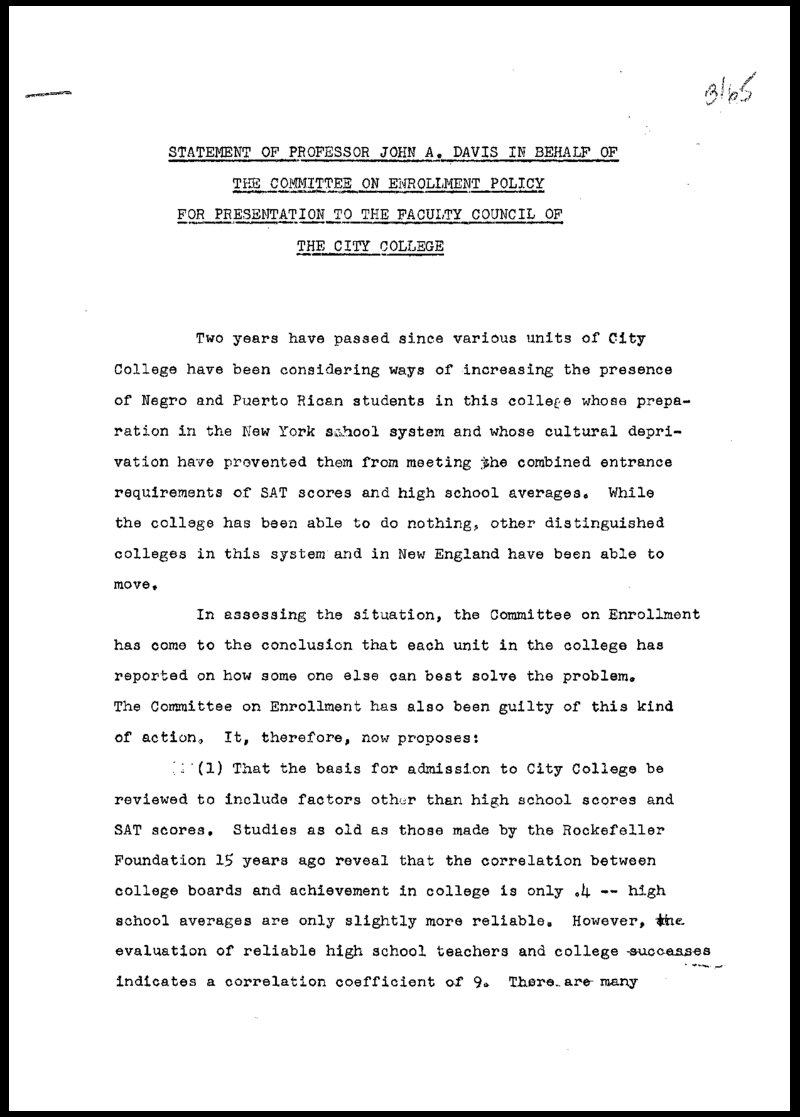
In this 1965 statement Professor John A. Davis demands that his colleagues at City College take action to increase minority representation at the school. He writes that two years had “passed since various units of City College have been considering ways of increasing the presence of Negro and Puerto Rican students in this college.” Yet, he complains, “the college has been able to do nothing” while other colleges have acted. As a result, Davis proposes: 1) a desegregation program to immediately admit fifty students based on teacher recommendations as well as GPA/SAT scores, 2) beginning summer programs for “culturally deprived” high school juniors and seniors and then admitting them to City College with the help of “guidance and tutorial centers,” and 3) helping to improve the public schools through City’s School of Education.
Davis grew up in Washington D.C. where, in the 1930s, he organized effective black boycotts of racist white businesses, setting off a legal fight that ended in a 1938 Supreme Court victory upholding the picketing rights of civil rights protesters, (New Negro Alliance v. Sanitary Grocery, Co., Inc.) Davis joined City College as a political science professor in 1953-- the same year he assisted the NAACP team in the Brown v. Board of Education case.
Davis grew up in Washington D.C. where, in the 1930s, he organized effective black boycotts of racist white businesses, setting off a legal fight that ended in a 1938 Supreme Court victory upholding the picketing rights of civil rights protesters, (New Negro Alliance v. Sanitary Grocery, Co., Inc.) Davis joined City College as a political science professor in 1953-- the same year he assisted the NAACP team in the Brown v. Board of Education case.
Contributor
Molloy, Sean
Creator
Davis, John A.
Date
March 1965
Language
English
Rights
Obtained from Contributor - Copyright Unknown
Source
CCNY Archives & Special Collections
Original Format
Report / Paper / Proposal
Davis, John A. Letter. 1965. “Statement of Professor John A. Davis”, 1965, CUNY DIGITAL HISTORY ARCHIVE, accessed September 5, 2026, https://stephenz.tailc22a4b.ts.net/s/cdha/item/1165