October 7, 1968, Proposal to Improve the Planning and Implementation of Community College 7
Item
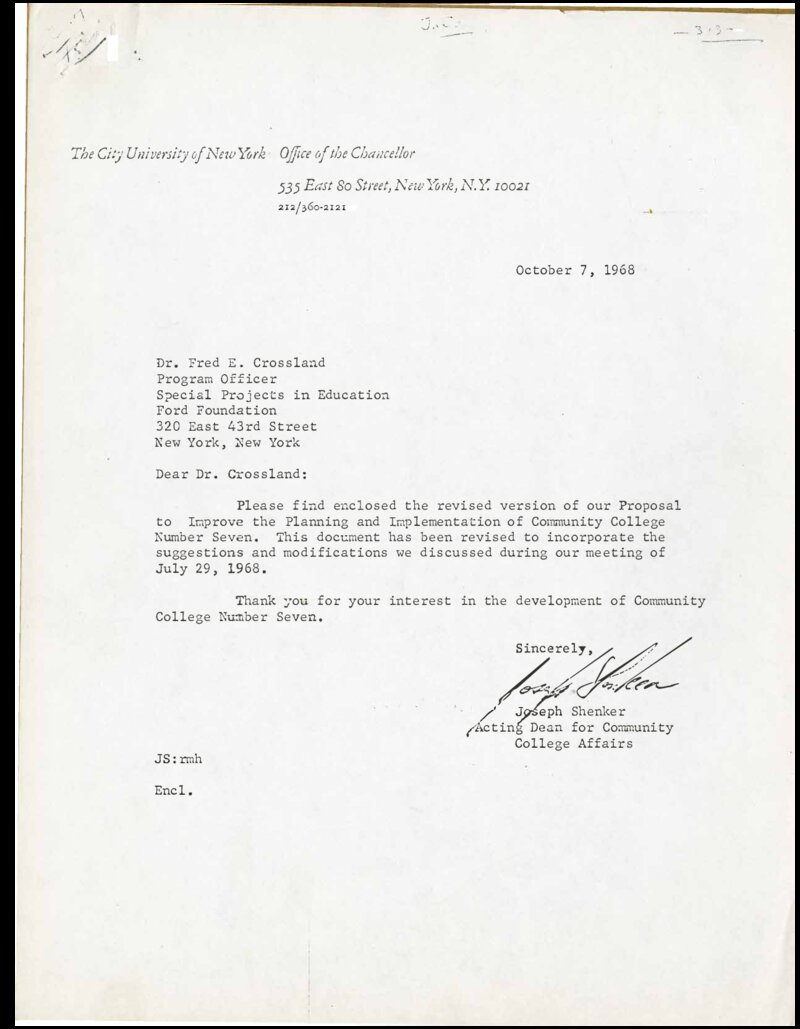
Tie City University of New York Office of the Chaucetlor
535 East 80 Street, New York, N.Y. 10021
212/360-2121
October 7, 1968
Dr. Fred E. Crossland
Program Officer
Special Projects in Education
Ford Foundation
320 East 43rd Street
New York, New York
Dear Dr. Crossland:
Please find enclosed the revised version of our Proposal
to Improve the Planning and Implementation of Community College
Number Seven. This document has been revised to incorporate the
suggestions and modifications we discussed during our meeting of
July 29, 1968.
Thank you for your interest in the development of Community
College Number Seven,
way
JgSeph Shenker
“Acting Dean for Community
College Affairs
JS: rmh
Encl.
DHE CLUYSUNEVERSITY (OF NEW YORK =
Office of the Dean for Community College Affairs
A Proposal to Improve the Planning and Implementation of
Community College Number 7
On Novenher 27, 1967, the Board of Higher Education adopted a
series of resolutions which created a new community college for
The City University oF New York, the institution presently known as
Community College Number Seven. (The proposal for the establishment
of Community College Number Seven is appended.) In so doing, the
- Board was responding to the continuing demands of New York City for
additional higher education opportunities; more specifically, the
Board was moving to correctthe existing situation where several
comnunities eit aoe York City receive a disproportionately small
share of the educational opportunities available to the City as a
whole.
The establishment of Community College Nunber Seven was not,
however, an isolated instance of University concern for, or response
to, the educational needs of those students who will not necessarily
continue their education to the baccalaureate degree. Since 1962,
when the University's four community colleges enrolled 14,682 students,
two additional community colleges have been established, and the
enrollments of existing institutions expanded, bringing the present
total community college enrollment to over 37,700 students. The
resolution of February 2, 1967, which called for the establishment
of Comnunity College Number Seven also authorized the establishnent
of three: additional community colleges (one already planned for the
South Bronx by 1969) before 1972. Thus, the City University
community colleges - and their related activities, such as College
Discovery, the federally supported Public Service Career Training
Program, and the two Urban Centers - continue their rapid growth and
expansion into areas of higher education unique to the modern urban
setting.
In addition to helping to fulfill the City University's overall
enrollment goals, Community College Number Seven will be a unique
educational institution, serving a population not previously reached
by higher education. It will be the first truly "neighborhood"
community college specifically designed to meet the needs of a shetto
population. As such, it will be a school where recognition of the
necessity for change and innovation must be built into its very
structure. Large amounts of time and resources must be devoted to
developing supplementary programs, methods of instruction, techniques
of guidance and counseling - all designed to meet the needs of this
new type of student body; extensive planning and research are needed to
develop and implement these programs which are necessary for the early
success of this college and its students.
A committee of community leaders made up of representatives of
the community organizations will participate in the Presidential
Search and also serve on the Selection Committee.
The basic purposes of the proposal discussed below are twofold:
(1) to assist the City University and the community in-meeting the
-3-
target date for the opening of the new college September, 1959 and
(2) to assist the City University and the community in developing a
“totally new type of college which will be able not only to serve the
' traditional functions of a community college, but meet the special
needs of the students and the community-at-large in a disadvantaged
area, The University is eee of the magnitude or types of problems
to be faced and solved, but due to both budgetary considerations and
staff limitations has been unable to make adequate provision for
providing answers and programs based on new information and/or
experimentation, The proposed innovations planned for Comnunity
College Number Seven fall into the following categories:
1) those totally new, innovative programs for which new
information and fact-finding are necessary, with
provision for implementation and evaluation;
2) those proewene not requiring extensive fact-finding
which are basically compensatory in nature, and will
provide a richer immediate environment for students
and/or faculty.
ihe. finest group of proposals would include projects to gather
and evaluate information for both the University and the conmunity
which will be necessary to informed decisions concerning a) new types
of admissions policies; b) means of providing a third and fourth year
of education to qualified graduates of the new college; ce) a common
first semester or "core semester;" and d) an oral-emphasis instructional
program, The ability to gather such information, even before a president
is selected, will be of primary importance if the new institution is
to meet its target date for opening in the fall of 1969,
a
The second group of proposals designed to supplement traditional
college prograns and facilities, both quantitatively and qualitatively,
would Peele: a) a study center and resource facility (or library) ;
b) prograns designed to provide better student faculty ratios and more
personalized instruction (such as ech internships for local
graduate students planning to teach in urban community colleges) ;
ec) prograns to provide more relevant student personnel work (such as
the use of student personnel assistants drawn from local residents
who are ponies college graduates); and d) programs to acquaint
both faculty and administrative personnel with the distinet educational
opportunities and responsibilities of the new institution through pre-
service and inservice.institutes, The president may desire changes in
the types of supplementary programs proposed and these would be spelled
out prior to their implementation date.
The timetable required for these projects - assuming fer the
fact finding will begin before a president is appointed, but that no
decisions will be made except by the president of the institution -
is shown below, Also Peeled is the funding commitment a of each
date and the required support available by fiscal quarters assuming
affirmative decisions in all cases.
TIMETABLE
November 1, 1968 Fact-finding begins; commitment through January 31, 1969.
February 1, 1969 President appointed; fact-finding continues;
commitment through June 30, 1969.
March 1, 1969 President's decision on adnission, core semester
and oral emph: sis; development begins.
which may be unique to this institution within he City University.
And, perhaps more basic, one may question on what basis students
should be admitted - if not their prior performance - and what
role the various interested groups (such as the community itself)
should play in the selection of these students.
Once new admissions standards are established, the staff for
this program will assist the president in developing and carrying
out the procedures required under the newly-established aagedtons
poliey.
2 ee
Closely related to the above question - and predicated upon
the assumption that the new admissions policies may result in.
students seseee karen for college differs from that of current
students - is the problem of insuring the opportunity for qualified
students to oon tae toward a baccalaureate degree. Although present
University policy mandates admission to the junior year of a four-
year institution for any student Spee ee ne completing a transfer
progran within a City University college, it may be anticipated that
the institution of new caseccions criteria might effect the senior
colleges’ willingness or responsibility to accept graduates of the
new eollege. The University must study the possible effects of a ~
homogeneous group which requires advanced education based on
significantly different admissions and curricular patterns; estimates
must be made as to the numbers and percentages of students who will
desire and qualify for a four-year education in each of the major
-areas of study. rinaliy. the University must develop the capacity
to provide the necessary and desired education to graduates of
Ponniniry College Number Seven, whether through modification
of existing programs or creation of new programs.
Several alternate possibilities will be Petts eat ul by the
fact-finding staff of this program. It may be desirable to
ereate an additional “upper divisional institution” similar to
the University's Richmond College, composed of only the junior
and senior years and drawing upon graduates of community colleges
for the majority of its students. Or, it may be desirable to
create a new institution, at the senior college level, which
provides specialized education in a given field, such as the
four-year teacher-training fee hee proposed for Harlem.
The staff of this program will callect information to assist the
President, the community, and the Board of Higher Education in
determining the best means of insuring a four-year education for
qualified graduates of pe ER College Number Seven.
3. Common Piret Semester ("Core Semester") ™ &jmce Dedue Opptch
“The planning document for the new institution (page iT)
proposes a comnon first semester of study for all students in that
"The proposed institution would admit students to the college rather
than to specific programs of study." Yet, several basic questions
eoncerning this common first semester remain. Since most City
University students are now admitted to a curriculum, the colleges
are able to gauge the space and staffing requirements which each
entering class will have. Institution of a common first semester -
with choice of curriculum coming at a later time - poses problems
for the institution which it otherwise might not face. Further,
oe: tik
the eriteria to be used in deciding which students will be
admitted tO whtels curricula have yet to be seemed: regardless
of the oriteria selected, the etiani aa for utilizing these
criteria within the limited time between the first and second
semesters must be developed.
Serious academic questions also remain. The idea of a
common first semester is aimed at three present problems: with
admission to curricula based on high school performance, most
students from disadvantaged background are unable to enter the
more demanding curricula; also, it has fee been felt that a
common core for all students might better prepare the students
for their later studies. In ace students from disadvantaged
backgrounds are often lacking in adequate high school guidance
which would enable them to make appropriate and informed curricular
choices before entering college. Yet, should the common core be
college-wide, or based upon the major curricular divisions within
each community college (transfer or liberal arts, business, health,
and technologies)? The answer to this question pall epeatie affect
any decision as to the criteria to be used for admitting students
to individual curricula after the first semester, as well as the
criteria for admissions to a major area if the cores are only
area-wide. Finally, decisions regarding ultimate curricular choice,
if they are based on performance ane the first semester, may
ereate undue pressure for grade-achievement during the common
semester of study.
he
The staff for this program must eee cute the appropriate
structure of a core progran so that loss of credit or delayed
graduation is avoided upon transfer to a senior or four-year
institution. Further, the staff must carefully review the purpose
and objectives of the core curricula (whether college-wide or area-
wide) with particular reference to the ultimate needs and objectives
of disadvantaged students. Alternate approaches to the common
first semester will be outlined and discussed with educators,
guidance personnel and former students from the See a
administrative implications of a core progran, including those
arising from the need for State Education Department approval,
will also be explored.
yy. Oral-Emphasis Program
The fourth project is also based upon the projected student
body which may be anticipated wnen the new admissions criteria are
adopted. Within the context of either a regular first semester or
a core semester, students at the new .community Pade eee be
expected to encounter difficulties based on poor reading or communi-
cation skills. Present University community college students with
sKills deficiencies enter the College Discovery Program, in which
they receive remediation and counseling and carry reduced course
loads.
Remediation, concurrent with traditional study, is not always
a eee since the student is expected to utilize those very skills
of reading and writing in which he is deficient in his regular
classes. Thus, the University wishes to investigate and develop a
ATs
core of first semester studies based on an oral-emphasis approach
which would provide the student with an opportunity to receive
remedial assistance while taking classes which did not require
college-level reading or communications skills, yet which would
( uaue i is ies ct =)
nonetheless provide college credit. ER ac mee
Various methods of teaching and testing would be planned,
implemented and evaluated. They would include a range of visual
presentations, verbal presentations, and programmed instruction.
Teachers would be trained to use instructional media such as tape
recorders and fisaiee der machines where deemed appropriate.
_ Students # sui remain in these specially developed courses
until able to assume a full program of traditional types of college
course worx. By the provision of these courses the college would
be helping to insure that students with skills deficiences could
achieve success, not failure, in their first contact with college
eredit ane thus helping them to develop ihe ‘steene comnitment
and Hornaiion necessary for the completion of ‘their college degree.
It is hope that new ways of presenting course material would result
in a minimum of delay in fulfilling degree requirements. if this
program with special courses in all the basic subject areas (English,
ec social studies, and physical eaeneee) proves effective,
it may be expanded for use not only at Community College Number
Seven, but wherever else such a program is appropriate to student
needs.
eo.
Budeet Bow Fagesiindine Puajents
During the planning year 1968-69 a director would be employed
_ who would be responsible for the development and planning of the
Admissions, Core Semester, and Oral-Emphasis prograns. He would
be Se Poe by three staff assistants, eae responsible for each
project. Consultants would be used as curriculum specialists
particularly in the Cone Semester and Oral-Emphasis projects where
they would help develop programs in each of the following areas:
social sciences, Pace eee physical sciences, English remediation,
and learning theory.
During 1969-70 the research director and one staff assistant
would be needed to begin the eco ee study, and carry out the
Qiplenentation of the Core Baeenen. Oral-Emphasis and Admissions
projects. They would evaluate each project at several stages during
the year, and present final evaluations of each project as well as an
overall evaluation of the entire esac effort.
1968-1969 (November 1, 1968 - June 30, 1969)
oe
Research Director S12, 000.6% oe
Staff Assistants (3) 28,000
Secretaries (3) 11,000
Fringe Benefits ‘7,990.
Consultants 20,000.
Space Rental ; 3,600
Supplies & Equipment 4,800
; $83,390
1969-70
Research Director ; $19,000
Staff Assistant 13,500
Secretaries (2) 11,000
Fringe Benefits 7,310
Space Rental 4,200
Supplies & Equipment 4509
$59,010
B.
eu
Compensatory Projects
i. A Study Center ang Resource Tacility
| Most new collezes suffer, donine their first several years,
from critical lack of library facilities and/or generally free
study areas. For example, most City University colleges develop
libraries slowly over a period of years in proportion to the
rate of srowth of student population, This approach will be
problematic at Community College Number Seven since it may be
expected that many students will lack adequate study facilities
or library, resources at home.’ Tt is therefore neotueed that a
resource facility/study center eae aber oe to the curriculum
offered at the new institution be rented and equipped for
Community Gol bae6 Huquee Seven to be ready to open as the college
opens (with 500 students in the fall of 1969). These facilities
will be utilized until such time as the permanent facilities of
the College are available, at which time the equipment and books
may be transferred to the regular college library. Staffing for
this facility will be provided through the college's regular
operating budget; the approximate budget for this project would
be as follows:
July 1, 1969 - September 15, 1969:
Rent and renovation of 5000 sq. ft. $20,000
Purchase of tables, shelving, chairs 6,900
Purchase of books or resource materials 50,000
Creation of study carrels 10,0090
$86,900
a as
In addition to the planning and facilities needs of the
new college, there exists a need for both faculty and guidance
counselors who are aware of the specific needs of their student
body and are able to respond to those needs. A variety of
proposals - all aimed at meeting these needs, both short-term
and long-term - is presented below.
The Weorunner ee a new community college, dedicated to
educational opportunity in urban ghetto areas, presents an
opportunity not only for those who will be students, but also for
those who would become teachers. Thus, one program with both an
immediate and a long-term effect on urban education would be an
internship program. for community college teachers to be established
in cooperation orks local graduate schools, Through provision of
the interns’ salaries and that of a program coordinator, a program
can be established which will (1) provide intern-teachers to aid
in and supplement the instruction given in the regular community
college curriculum, (2) provide the students with greater access
to those with expertise in the various subject areas (3) offer an
opportunity for graduate students ho hope to be teachers to both
earn and gain first-hand experience which will aid in their own
development, and (4) hopefully provide contacts and experience
which will draw the graduate students into similar teaching situa-
tions upon completion of their studies. The approximate budget for
Se
this proposal would be as follows:
September 1, 1969 - June 30, 1970: 4 yer
. {
Coordinator (% time) ("*" § 6,000 oe ee iti
-10 Interns (% time) yo. and = Ni
Fringe Benefits “ 10,120
$56,120
3. Student Personnel Assistants
Another opportunity for both short-term and long-term
benefits is presented through the use of local community college
graduates as student personnel assistants in the new institution.
Following a six-week summer program to introduce oye to the
purposes of the college and the sooner of student personnel
work, these local student community college graduates will be
erployed by the college to assist in student activities, carry
out interviews for financial aid, load orientation seminars for
students and for faculty, and ee a link to the community.
The student personnel assistants would alae be encouraged to
continue their own education toward the baccalaureate degree with
the hope that they would eventually return as qualified guidance
counselors or student personnel officers. The approximate budget
for this project is as follows:
July 1, 1969 - September Shale 1969:
Institute Director (part-time) $2,000
Secretary (part-time) 500
Fringe Benefits 559
Guest Speakers 2,000
Books and Materials ee
$5,300
-~16~
Aor
Cat
October 1, 1969 - June 30, 1970: Geet
Salaries for Ten S.P.A.'s $60,000-—-
Fringe Benefits 13 200
$73,200
a. Pre-Service and In-Service Institutes for Faculty
The City University plans to offer pre-service and in-service
training programs to all City University Community College personnel.
The bulk of these programs, such as an Institute on Afro-American ia
History, an institute on remediation for the classroom teachers, and
an institute on use of audio-visual materials, will be supported
through either federal or tax-levy funds. In addition, one special
workshop will, it is hoped, be supported under this application.
One week prior to the opening of the college, a specially-
oS pre-service orientation workshop for all faculty (estimated
at 30 maximun) will be ag Running over a period of three days,
the institute would be aimed at providing specific information
(1) about the community in which the college is located (2) about
the student body and its background (3) about the special services
offered within the college, such as remediation and counselling
(4) about the place Helthe college within the City University and
within the total educational structure of New York City. Speakers
would be drawn from the college staff, from community groups, and
from the central office of the University. The Souenete would be
designed to both inform and involve the participants so that their
teaching will reflect an understanding and awareness of the special
situation in which they will be operating.
eh?
During the course of the year, Saturday workshops will be
offered to interested faculty (not to exceed thirty members) on
specific academic topics of relevance to the educational outcome at
the college. One day workshops will present Popa elon and dis-
cussion on such topics as (1) Negro history and culture (2) Civil
rights and activism in the United States and in the local community
(3) the development of the welfare system in the United States and
the psychological ie ee of this system for community
residents (4) the historical development of legal and social con-
straints on Negro action and recent patterns of Negro-white
relationships (5) education in the ghetto, and (6) patterns of
ghetto life.
Each institute or Roneneg aan be independent of the others,
although all will form a logical series presenting historical,
sociological, and psychological background which will be of use
to professors of any subject fn weenie their courses more relevant
and understandable to their Bee ay student population. Outside
experts will be beoushie to the college where appropriate to lead
the individual workshops, which will be offered, on the average,
once a month.
The approximate budget for this project is as follows:
July 1, 1969 - September 30, 1969
Director (part-time) BS $2,000
Secretary (part-time) 500
Fringe Benefits aB0) 5 AL Kehr -
Speakers and Miscellaneous 1,000-»~~" 2
$4,050
-18-
October 1, 1969 - June 30, 1970:
Director (% time) S 6,000
Secretary (% time) 2,250
Fringe Benefits T5815
Speakers 3,000
Miscellaneous and Supplies 1,000
S14,065
Although each of the above projects has value in and of
itself, the impact of any one project is greatly increased through
the ability to offer all of the programs and to conduct all the
research, During the first year, the University will conduct
fact-finding in four areas of critical importance to both the
new institution ead any future institutions, as well as planning
for the use of student personnel assistants and for the pre-service
and in-service institutes. During the first year of the college's
operation, the effects of the fact-finding will be npbementen.
the institutes will be offered, and the students will have the
advantage of not any increasingly understanding faculty and
student personnel assistants, but the advantage of available
study and library facilities in which to carry out ete oe
At the same time, interns from local graduate institutions will
provide personalized instruction while themselves preparing for
teaching positions in similar institutions.
September 6, 1968
535 East 80 Street, New York, N.Y. 10021
212/360-2121
October 7, 1968
Dr. Fred E. Crossland
Program Officer
Special Projects in Education
Ford Foundation
320 East 43rd Street
New York, New York
Dear Dr. Crossland:
Please find enclosed the revised version of our Proposal
to Improve the Planning and Implementation of Community College
Number Seven. This document has been revised to incorporate the
suggestions and modifications we discussed during our meeting of
July 29, 1968.
Thank you for your interest in the development of Community
College Number Seven,
way
JgSeph Shenker
“Acting Dean for Community
College Affairs
JS: rmh
Encl.
DHE CLUYSUNEVERSITY (OF NEW YORK =
Office of the Dean for Community College Affairs
A Proposal to Improve the Planning and Implementation of
Community College Number 7
On Novenher 27, 1967, the Board of Higher Education adopted a
series of resolutions which created a new community college for
The City University oF New York, the institution presently known as
Community College Number Seven. (The proposal for the establishment
of Community College Number Seven is appended.) In so doing, the
- Board was responding to the continuing demands of New York City for
additional higher education opportunities; more specifically, the
Board was moving to correctthe existing situation where several
comnunities eit aoe York City receive a disproportionately small
share of the educational opportunities available to the City as a
whole.
The establishment of Community College Nunber Seven was not,
however, an isolated instance of University concern for, or response
to, the educational needs of those students who will not necessarily
continue their education to the baccalaureate degree. Since 1962,
when the University's four community colleges enrolled 14,682 students,
two additional community colleges have been established, and the
enrollments of existing institutions expanded, bringing the present
total community college enrollment to over 37,700 students. The
resolution of February 2, 1967, which called for the establishment
of Comnunity College Number Seven also authorized the establishnent
of three: additional community colleges (one already planned for the
South Bronx by 1969) before 1972. Thus, the City University
community colleges - and their related activities, such as College
Discovery, the federally supported Public Service Career Training
Program, and the two Urban Centers - continue their rapid growth and
expansion into areas of higher education unique to the modern urban
setting.
In addition to helping to fulfill the City University's overall
enrollment goals, Community College Number Seven will be a unique
educational institution, serving a population not previously reached
by higher education. It will be the first truly "neighborhood"
community college specifically designed to meet the needs of a shetto
population. As such, it will be a school where recognition of the
necessity for change and innovation must be built into its very
structure. Large amounts of time and resources must be devoted to
developing supplementary programs, methods of instruction, techniques
of guidance and counseling - all designed to meet the needs of this
new type of student body; extensive planning and research are needed to
develop and implement these programs which are necessary for the early
success of this college and its students.
A committee of community leaders made up of representatives of
the community organizations will participate in the Presidential
Search and also serve on the Selection Committee.
The basic purposes of the proposal discussed below are twofold:
(1) to assist the City University and the community in-meeting the
-3-
target date for the opening of the new college September, 1959 and
(2) to assist the City University and the community in developing a
“totally new type of college which will be able not only to serve the
' traditional functions of a community college, but meet the special
needs of the students and the community-at-large in a disadvantaged
area, The University is eee of the magnitude or types of problems
to be faced and solved, but due to both budgetary considerations and
staff limitations has been unable to make adequate provision for
providing answers and programs based on new information and/or
experimentation, The proposed innovations planned for Comnunity
College Number Seven fall into the following categories:
1) those totally new, innovative programs for which new
information and fact-finding are necessary, with
provision for implementation and evaluation;
2) those proewene not requiring extensive fact-finding
which are basically compensatory in nature, and will
provide a richer immediate environment for students
and/or faculty.
ihe. finest group of proposals would include projects to gather
and evaluate information for both the University and the conmunity
which will be necessary to informed decisions concerning a) new types
of admissions policies; b) means of providing a third and fourth year
of education to qualified graduates of the new college; ce) a common
first semester or "core semester;" and d) an oral-emphasis instructional
program, The ability to gather such information, even before a president
is selected, will be of primary importance if the new institution is
to meet its target date for opening in the fall of 1969,
a
The second group of proposals designed to supplement traditional
college prograns and facilities, both quantitatively and qualitatively,
would Peele: a) a study center and resource facility (or library) ;
b) prograns designed to provide better student faculty ratios and more
personalized instruction (such as ech internships for local
graduate students planning to teach in urban community colleges) ;
ec) prograns to provide more relevant student personnel work (such as
the use of student personnel assistants drawn from local residents
who are ponies college graduates); and d) programs to acquaint
both faculty and administrative personnel with the distinet educational
opportunities and responsibilities of the new institution through pre-
service and inservice.institutes, The president may desire changes in
the types of supplementary programs proposed and these would be spelled
out prior to their implementation date.
The timetable required for these projects - assuming fer the
fact finding will begin before a president is appointed, but that no
decisions will be made except by the president of the institution -
is shown below, Also Peeled is the funding commitment a of each
date and the required support available by fiscal quarters assuming
affirmative decisions in all cases.
TIMETABLE
November 1, 1968 Fact-finding begins; commitment through January 31, 1969.
February 1, 1969 President appointed; fact-finding continues;
commitment through June 30, 1969.
March 1, 1969 President's decision on adnission, core semester
and oral emph: sis; development begins.
which may be unique to this institution within he City University.
And, perhaps more basic, one may question on what basis students
should be admitted - if not their prior performance - and what
role the various interested groups (such as the community itself)
should play in the selection of these students.
Once new admissions standards are established, the staff for
this program will assist the president in developing and carrying
out the procedures required under the newly-established aagedtons
poliey.
2 ee
Closely related to the above question - and predicated upon
the assumption that the new admissions policies may result in.
students seseee karen for college differs from that of current
students - is the problem of insuring the opportunity for qualified
students to oon tae toward a baccalaureate degree. Although present
University policy mandates admission to the junior year of a four-
year institution for any student Spee ee ne completing a transfer
progran within a City University college, it may be anticipated that
the institution of new caseccions criteria might effect the senior
colleges’ willingness or responsibility to accept graduates of the
new eollege. The University must study the possible effects of a ~
homogeneous group which requires advanced education based on
significantly different admissions and curricular patterns; estimates
must be made as to the numbers and percentages of students who will
desire and qualify for a four-year education in each of the major
-areas of study. rinaliy. the University must develop the capacity
to provide the necessary and desired education to graduates of
Ponniniry College Number Seven, whether through modification
of existing programs or creation of new programs.
Several alternate possibilities will be Petts eat ul by the
fact-finding staff of this program. It may be desirable to
ereate an additional “upper divisional institution” similar to
the University's Richmond College, composed of only the junior
and senior years and drawing upon graduates of community colleges
for the majority of its students. Or, it may be desirable to
create a new institution, at the senior college level, which
provides specialized education in a given field, such as the
four-year teacher-training fee hee proposed for Harlem.
The staff of this program will callect information to assist the
President, the community, and the Board of Higher Education in
determining the best means of insuring a four-year education for
qualified graduates of pe ER College Number Seven.
3. Common Piret Semester ("Core Semester") ™ &jmce Dedue Opptch
“The planning document for the new institution (page iT)
proposes a comnon first semester of study for all students in that
"The proposed institution would admit students to the college rather
than to specific programs of study." Yet, several basic questions
eoncerning this common first semester remain. Since most City
University students are now admitted to a curriculum, the colleges
are able to gauge the space and staffing requirements which each
entering class will have. Institution of a common first semester -
with choice of curriculum coming at a later time - poses problems
for the institution which it otherwise might not face. Further,
oe: tik
the eriteria to be used in deciding which students will be
admitted tO whtels curricula have yet to be seemed: regardless
of the oriteria selected, the etiani aa for utilizing these
criteria within the limited time between the first and second
semesters must be developed.
Serious academic questions also remain. The idea of a
common first semester is aimed at three present problems: with
admission to curricula based on high school performance, most
students from disadvantaged background are unable to enter the
more demanding curricula; also, it has fee been felt that a
common core for all students might better prepare the students
for their later studies. In ace students from disadvantaged
backgrounds are often lacking in adequate high school guidance
which would enable them to make appropriate and informed curricular
choices before entering college. Yet, should the common core be
college-wide, or based upon the major curricular divisions within
each community college (transfer or liberal arts, business, health,
and technologies)? The answer to this question pall epeatie affect
any decision as to the criteria to be used for admitting students
to individual curricula after the first semester, as well as the
criteria for admissions to a major area if the cores are only
area-wide. Finally, decisions regarding ultimate curricular choice,
if they are based on performance ane the first semester, may
ereate undue pressure for grade-achievement during the common
semester of study.
he
The staff for this program must eee cute the appropriate
structure of a core progran so that loss of credit or delayed
graduation is avoided upon transfer to a senior or four-year
institution. Further, the staff must carefully review the purpose
and objectives of the core curricula (whether college-wide or area-
wide) with particular reference to the ultimate needs and objectives
of disadvantaged students. Alternate approaches to the common
first semester will be outlined and discussed with educators,
guidance personnel and former students from the See a
administrative implications of a core progran, including those
arising from the need for State Education Department approval,
will also be explored.
yy. Oral-Emphasis Program
The fourth project is also based upon the projected student
body which may be anticipated wnen the new admissions criteria are
adopted. Within the context of either a regular first semester or
a core semester, students at the new .community Pade eee be
expected to encounter difficulties based on poor reading or communi-
cation skills. Present University community college students with
sKills deficiencies enter the College Discovery Program, in which
they receive remediation and counseling and carry reduced course
loads.
Remediation, concurrent with traditional study, is not always
a eee since the student is expected to utilize those very skills
of reading and writing in which he is deficient in his regular
classes. Thus, the University wishes to investigate and develop a
ATs
core of first semester studies based on an oral-emphasis approach
which would provide the student with an opportunity to receive
remedial assistance while taking classes which did not require
college-level reading or communications skills, yet which would
( uaue i is ies ct =)
nonetheless provide college credit. ER ac mee
Various methods of teaching and testing would be planned,
implemented and evaluated. They would include a range of visual
presentations, verbal presentations, and programmed instruction.
Teachers would be trained to use instructional media such as tape
recorders and fisaiee der machines where deemed appropriate.
_ Students # sui remain in these specially developed courses
until able to assume a full program of traditional types of college
course worx. By the provision of these courses the college would
be helping to insure that students with skills deficiences could
achieve success, not failure, in their first contact with college
eredit ane thus helping them to develop ihe ‘steene comnitment
and Hornaiion necessary for the completion of ‘their college degree.
It is hope that new ways of presenting course material would result
in a minimum of delay in fulfilling degree requirements. if this
program with special courses in all the basic subject areas (English,
ec social studies, and physical eaeneee) proves effective,
it may be expanded for use not only at Community College Number
Seven, but wherever else such a program is appropriate to student
needs.
eo.
Budeet Bow Fagesiindine Puajents
During the planning year 1968-69 a director would be employed
_ who would be responsible for the development and planning of the
Admissions, Core Semester, and Oral-Emphasis prograns. He would
be Se Poe by three staff assistants, eae responsible for each
project. Consultants would be used as curriculum specialists
particularly in the Cone Semester and Oral-Emphasis projects where
they would help develop programs in each of the following areas:
social sciences, Pace eee physical sciences, English remediation,
and learning theory.
During 1969-70 the research director and one staff assistant
would be needed to begin the eco ee study, and carry out the
Qiplenentation of the Core Baeenen. Oral-Emphasis and Admissions
projects. They would evaluate each project at several stages during
the year, and present final evaluations of each project as well as an
overall evaluation of the entire esac effort.
1968-1969 (November 1, 1968 - June 30, 1969)
oe
Research Director S12, 000.6% oe
Staff Assistants (3) 28,000
Secretaries (3) 11,000
Fringe Benefits ‘7,990.
Consultants 20,000.
Space Rental ; 3,600
Supplies & Equipment 4,800
; $83,390
1969-70
Research Director ; $19,000
Staff Assistant 13,500
Secretaries (2) 11,000
Fringe Benefits 7,310
Space Rental 4,200
Supplies & Equipment 4509
$59,010
B.
eu
Compensatory Projects
i. A Study Center ang Resource Tacility
| Most new collezes suffer, donine their first several years,
from critical lack of library facilities and/or generally free
study areas. For example, most City University colleges develop
libraries slowly over a period of years in proportion to the
rate of srowth of student population, This approach will be
problematic at Community College Number Seven since it may be
expected that many students will lack adequate study facilities
or library, resources at home.’ Tt is therefore neotueed that a
resource facility/study center eae aber oe to the curriculum
offered at the new institution be rented and equipped for
Community Gol bae6 Huquee Seven to be ready to open as the college
opens (with 500 students in the fall of 1969). These facilities
will be utilized until such time as the permanent facilities of
the College are available, at which time the equipment and books
may be transferred to the regular college library. Staffing for
this facility will be provided through the college's regular
operating budget; the approximate budget for this project would
be as follows:
July 1, 1969 - September 15, 1969:
Rent and renovation of 5000 sq. ft. $20,000
Purchase of tables, shelving, chairs 6,900
Purchase of books or resource materials 50,000
Creation of study carrels 10,0090
$86,900
a as
In addition to the planning and facilities needs of the
new college, there exists a need for both faculty and guidance
counselors who are aware of the specific needs of their student
body and are able to respond to those needs. A variety of
proposals - all aimed at meeting these needs, both short-term
and long-term - is presented below.
The Weorunner ee a new community college, dedicated to
educational opportunity in urban ghetto areas, presents an
opportunity not only for those who will be students, but also for
those who would become teachers. Thus, one program with both an
immediate and a long-term effect on urban education would be an
internship program. for community college teachers to be established
in cooperation orks local graduate schools, Through provision of
the interns’ salaries and that of a program coordinator, a program
can be established which will (1) provide intern-teachers to aid
in and supplement the instruction given in the regular community
college curriculum, (2) provide the students with greater access
to those with expertise in the various subject areas (3) offer an
opportunity for graduate students ho hope to be teachers to both
earn and gain first-hand experience which will aid in their own
development, and (4) hopefully provide contacts and experience
which will draw the graduate students into similar teaching situa-
tions upon completion of their studies. The approximate budget for
Se
this proposal would be as follows:
September 1, 1969 - June 30, 1970: 4 yer
. {
Coordinator (% time) ("*" § 6,000 oe ee iti
-10 Interns (% time) yo. and = Ni
Fringe Benefits “ 10,120
$56,120
3. Student Personnel Assistants
Another opportunity for both short-term and long-term
benefits is presented through the use of local community college
graduates as student personnel assistants in the new institution.
Following a six-week summer program to introduce oye to the
purposes of the college and the sooner of student personnel
work, these local student community college graduates will be
erployed by the college to assist in student activities, carry
out interviews for financial aid, load orientation seminars for
students and for faculty, and ee a link to the community.
The student personnel assistants would alae be encouraged to
continue their own education toward the baccalaureate degree with
the hope that they would eventually return as qualified guidance
counselors or student personnel officers. The approximate budget
for this project is as follows:
July 1, 1969 - September Shale 1969:
Institute Director (part-time) $2,000
Secretary (part-time) 500
Fringe Benefits 559
Guest Speakers 2,000
Books and Materials ee
$5,300
-~16~
Aor
Cat
October 1, 1969 - June 30, 1970: Geet
Salaries for Ten S.P.A.'s $60,000-—-
Fringe Benefits 13 200
$73,200
a. Pre-Service and In-Service Institutes for Faculty
The City University plans to offer pre-service and in-service
training programs to all City University Community College personnel.
The bulk of these programs, such as an Institute on Afro-American ia
History, an institute on remediation for the classroom teachers, and
an institute on use of audio-visual materials, will be supported
through either federal or tax-levy funds. In addition, one special
workshop will, it is hoped, be supported under this application.
One week prior to the opening of the college, a specially-
oS pre-service orientation workshop for all faculty (estimated
at 30 maximun) will be ag Running over a period of three days,
the institute would be aimed at providing specific information
(1) about the community in which the college is located (2) about
the student body and its background (3) about the special services
offered within the college, such as remediation and counselling
(4) about the place Helthe college within the City University and
within the total educational structure of New York City. Speakers
would be drawn from the college staff, from community groups, and
from the central office of the University. The Souenete would be
designed to both inform and involve the participants so that their
teaching will reflect an understanding and awareness of the special
situation in which they will be operating.
eh?
During the course of the year, Saturday workshops will be
offered to interested faculty (not to exceed thirty members) on
specific academic topics of relevance to the educational outcome at
the college. One day workshops will present Popa elon and dis-
cussion on such topics as (1) Negro history and culture (2) Civil
rights and activism in the United States and in the local community
(3) the development of the welfare system in the United States and
the psychological ie ee of this system for community
residents (4) the historical development of legal and social con-
straints on Negro action and recent patterns of Negro-white
relationships (5) education in the ghetto, and (6) patterns of
ghetto life.
Each institute or Roneneg aan be independent of the others,
although all will form a logical series presenting historical,
sociological, and psychological background which will be of use
to professors of any subject fn weenie their courses more relevant
and understandable to their Bee ay student population. Outside
experts will be beoushie to the college where appropriate to lead
the individual workshops, which will be offered, on the average,
once a month.
The approximate budget for this project is as follows:
July 1, 1969 - September 30, 1969
Director (part-time) BS $2,000
Secretary (part-time) 500
Fringe Benefits aB0) 5 AL Kehr -
Speakers and Miscellaneous 1,000-»~~" 2
$4,050
-18-
October 1, 1969 - June 30, 1970:
Director (% time) S 6,000
Secretary (% time) 2,250
Fringe Benefits T5815
Speakers 3,000
Miscellaneous and Supplies 1,000
S14,065
Although each of the above projects has value in and of
itself, the impact of any one project is greatly increased through
the ability to offer all of the programs and to conduct all the
research, During the first year, the University will conduct
fact-finding in four areas of critical importance to both the
new institution ead any future institutions, as well as planning
for the use of student personnel assistants and for the pre-service
and in-service institutes. During the first year of the college's
operation, the effects of the fact-finding will be npbementen.
the institutes will be offered, and the students will have the
advantage of not any increasingly understanding faculty and
student personnel assistants, but the advantage of available
study and library facilities in which to carry out ete oe
At the same time, interns from local graduate institutions will
provide personalized instruction while themselves preparing for
teaching positions in similar institutions.
September 6, 1968
Title
October 7, 1968, Proposal to Improve the Planning and Implementation of Community College 7
Description
On October 7, 1968, Joseph Shenker, Acting Dean for Community College Affairs for the City University of New York, submitted a proposal to the Ford Foundation for a $440,000 grant “to Improve the Planning and Implementation of Community College 7.” The proposal included funds for key activities proposed by Bedford-Stuyvesant Coalition on Educational Needs and Services (B-SCENS)'s appointed “Negotiation Team,” representing the community’s demands for the new College. These demands included research to develop flexible admissions policies and degree pathways for educationally underserved Black youth. However, the Negotiation Team’s perception that they had been excluded from initial discussions about the proposal, and fact that the funds would be administered by CUNY, rather than by a community-based organization, fueled tensions between the two groups that would continue to escalate in the coming weeks.
In February 1968, the City University of New York (CUNY) announced plans to establish a new “Community College 7 in or near Bedford-Stuyvesant. . . oriented to the Bedford-Stuyvesant Community and operated in consultation with the community.” Representatives of a broad network of Central Brooklyn community organizations engaged in an 18 months-long negotiation with CUNY Board of Higher Education officials over CUNY’s plans for its newly announced “Community College 7,” including discussions about the proposed school’s curriculum, who would lead it, and what role the community would play in the school’s governance. The role of the Bedford-Stuyvesant community in planning and determining the leadership of the college remained a central point of controversy between Central Brooklyn’s educational and civil society leaders and CUNY officials in the negotiations that followed.
Contributor
Woodsworth, Michael
Creator
Shenker, Joseph
Date
October 7, 1968
Language
English
Source
Donald Watkins Collection (Brooklyn Public Library)
Original Format
Report / Paper / Proposal
Shenker, Joseph. Letter. “October 7, 1968, Proposal to Improve the Planning and Implementation of Community College 7.”, CUNY DIGITAL HISTORY ARCHIVE, accessed September 5, 2026, https://stephenz.tailc22a4b.ts.net/s/cdha/item/2021