Highlights from the Center for Occupational and Environmental Health (2000-2001)
Item
nfreuden@hunter.cuny.edu, 06:10 PM 4/16/01 +0000, CENTER Report for Administration
To: nfreuden@hunter.cuny.edu
From: david kotelchuck <dkotelch@hejira.hunter.cuny.edu>
Subject: CENTER Report for Administration
Cc: toutwate@hunter.cuny.edu
Bcc:
Attached:
Nick: As requested. Dave and Ted
April 15,
2001
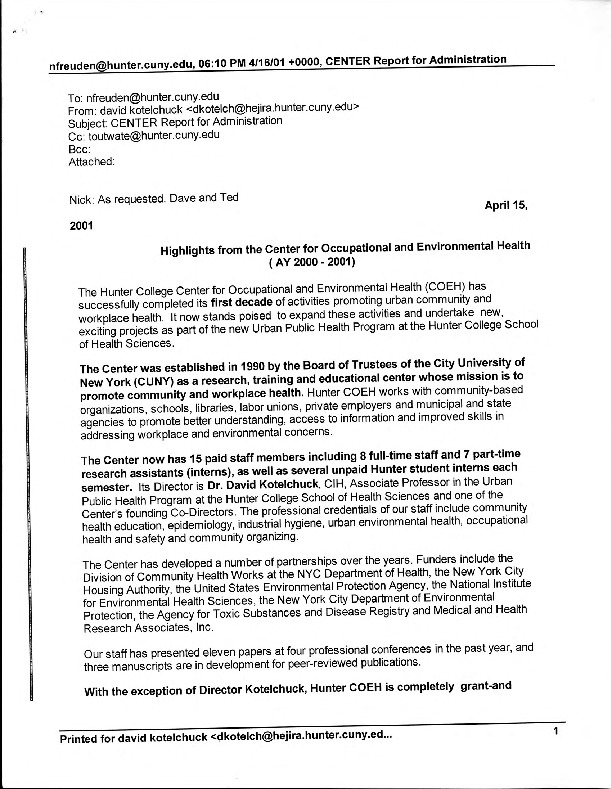
Highlights from the Center for Occupational and Environmental Health
( AY 2000 - 2001)
The Hunter College Center for Occupational and Environmental Health (COEH) has
successfully completed its first decade of activities promoting urban community and
workplace health. It now stands poised to expand these activities and undertake new,
exciting projects as part of the new Urban Public Health Program at the Hunter College School
of Health Sciences.
The Center was established in 1990 by the Board of Trustees of the City University of
New York (CUNY) as a research, training and educational center whose mission is to
promote community and workplace health. Hunter COEH works with community-based
organizations, schools, libraries, labor unions, private employers and municipal and state
agencies to promote better understanding, access to information and improved skills in
addressing workplace and environmental concerns.
The Center now has 15 paid staff members including 8 full-time staff and 7 part-time
research assistants (interns), as well as several unpaid Hunter student interns each
semester. Its Director is Dr. David Kotelchuck, CIH, Associate Professor in the Urban
Public Health Program at the Hunter College School of Health Sciences and one of the
Center's founding Co-Directors. The professional credentials of our staff include community
health education, epidemiology, industrial hygiene, urban environmental health, occupational
health and safety and community organizing.
The Center has developed a number of partnerships over the years. Funders include the
Division of Community Health Works at the NYC Department of Health, the New York City
Housing Authority, the United States Environmental Protection Agency, the National Institute
for Environmental Health Sciences, the New York City Department of Environmental
Protection, the Agency for Toxic Substances and Disease Registry and Medical and Health
Research Associates, Inc.
Our staff has presented eleven papers at four professional conferences in the past year, and
three manuscripts are in development for peer-reviewed publications.
With the exception of Director Kotelchuck, Hunter COEH is completely grant-and
Printed for david kotelchuck <dkotelch@hejira.hunter.cuny.ed...
nfreuden@hunter.cuny.edu, 06:10 PM 4/16/01 +0000, CENTER Report for Administration
contract-funded. In the past decade, it has been supported by federal, state and local
governments, private foundations, labor unions, and private and public employers.
In the past few years, Hunter COEH has conducted programs on:
- Urban revitalization and hazardous waste worker protection and job training with the
National Institute of Environmental Health Sciences;
- Asthma community education and technical assistance with the U.S. Environmental
Protection Agency, the New York City Council and the NYC Department of Health;
- Environmental hazard evaluation research, risk communication and community cancer
prevention with the NYC Department of Environmental Protection;
- Lead poisoning prevention with the Brooklyn and Manhattan Borough Presidents’ Offices;
and
- Occupational hazard assessment and worker training with the NYS Department of Labor.
Hunter COEH is affiliated with the the Hunter College Urban Public Health program, created in
1998 under the leadership of Professor Nicholas Freudenberg. Dr. Kotelchuck is a faculty
member in the Environmental and Occupational Health Sciences track of the UPH program,
and four full-time Center staff members are currently enrolled in or recent graduates of one of
the tracks of the UPH program. A faculty advisory committee is currently being organized by
Hunter College to advise and support the Center and help integrate its activities with the Urban
Public Health Program.
During the past year, Daniel Kass, MSPH, Executive Director and then Co-Director of the
Center during the past decade, has left Hunter College to become Director of Research and
Evaluation for the Childhood Asthma Initiative of the New York City Department of Health, and
to continue his doctoral research at New York University.
Part One: OCCUPATIONAL HEALTH AND SAFETY PROGRAM HIGHLIGHTS
4. Hazardous Materials & Emergency Response Training
Now in the first year of a four year grant funded by the National Institute of Environmental
Health Sciences, in cooperation with the U.S. Environmental Protection Agency, the goal of
this program is to educate personnel exposed to hazardous waste materials and responsible
for emergency response in the proper procedures and protocols required under the Hazwoper
Standard 1910.120 to enable them to protect their own and others' health and safety when
handling hazardous materials, and safely contain hazardous chemical spills and fires. The
Center received $98,000 this year for this activity.
2. New York City Housing Authority Environmental Worker Training Program (Year 2)
In partnership with the New York City Housing Authority (NYCHA), this 17-week program
consists of training for four groups of public housing residents, age 18 to 32, (total of 100
trainees) in asbestos remediation, lead-based paint remediation, hazardous waste materials
handling, and basic OSHA workplace protections, as well as basic math, reading and writing
skills, resume preparation, and job-readiness skills. The Center will receive up to $180,000 this
year for its role in organizing and adminstering the program.
3. Minority Worker Training Program
Printed for david kotelchuck <dkotelch@hejira.hunter.cuny.ed...
nfreuden@hunter.cuny.edu, 06:10 PM 4/16/01 +0000, CENTER Report for Administration
The goal of this small, ongoing program is to educate young people of color considering jobs
in trade unions and environmental firms about the environmental hazards they may encounter
and how to recognize, evaluate, and control exposure to those same hazards. To teach basic
life skills, literacy skills, and job skills that will enable these youth to compete in a changing
labor market. This year, ten (10) students participated in the 24-Hour Environmental
Monitoring Training Course held at the Carpenters’ Union in downtown Manhattan.
NEW PLANS AND IDEAS FOR OUR OCCUPATIONAL HEALTH AND SAFETY
PROGRAMS
1. Dr. Kotelchuck is currently engaged in assessing reporting of needlestick injuries among
dental students and hospital internes and residents. He has an $7,500 pilot training grant for
this project from the National Institute for Occupational Safety and Health, and based on these
results plans to submit a substantial research grant for continuation of the project at the
Center.
2. Dr. Kotelchuck and staff member Andrew Burgie are planning to extend their current
hazardous waste and emergency response
training efforts through cooperative training efforts with other CUNY schools, such as
Medgar Evers College and other
community and four-year colleges, to prpepare undergraduates for employment as
environmental technicians. There is currently
great demand for persons qualified at this level. Funding will be sought from the National
Science Foundation, among others.
PART TWO: ENVIRONMENTAL HEALTH PROGRAM HIGHLIGHTS
1. INTEGRATED PEST MANAGEMENT AND ASTHMA TRIGGER REDUCTION IN NEW
YORK CITY PUBLIC HOUSING DEVELOPMENTS
Based on our successful pilot study and intervention project at Lehman Village Houses in
East Harlem, the mission of the project is to decrease the prevalence of cockroaches and
rodents in public housing, and by doing so, reduce the need for pesticide use and the rate of
asthma morbidity. With three years of annual funding from the NY City Council through the
NYCDOH in the amount of approximately $180,000 per year, the Center will be responsible to
implementing the research components of the project, designing the specific interventions, and
supervising the implementation of project protocols. Over 2,000 apartments per year are
expected to be involved. The Center has played a central role in moving the largest public
housing aouthority in the country (over 600,000 residents )and one of the largest users of
pesticides in New York City to adopt the initial stages of an integrated pest management
approach to an environmental health problem.
2. Citywide Community Asthma Management Program
This program has received $280,000 ($130,000 this year) in funding from the New York City
Department of Health (NYCDOH). In partnership with the NYCDOH Citywide Childhood
Printed for david kotelchuck <dkotelch@hejira.hunter.cuny.ed...
nfreuden@hunter.cuny.edu, 06:10 PM 4/16/01 +0000, CENTER Report for Administration
Asthma Initiative, it aims to reduce the burden of asthma on communities at-risk by taking a
public health approach to reduce mortality and morbidity associated with childhood asthma.
We support community-based organizations funded by the NYCDOH Citywide Childhood
Asthma Initiative by providing assistance in needs assessment, program development, health
education, staff development, technical assistance and performance evaluation to community-
based efforts.
3. Lead Poisoning Prevention Program
Funded by the Brooklyn Borough President through the NYCDOH Office of Lead Poisoning
Prevention, the goal of this program is to provide community trainings on lead poisoning
prevention and Local Law 38 to the health districts of Brooklyn with the highest incidence of
lead poisoning, including Bedford-Stuyvesant, Fort Greene, Flatbush and Bushwick. This is an
on-going program that receives approximately $35,000 annually.
At this time, the Center is working on the 2000-2001 Lead Poisoning Prevention Project,
whose main goal is to provide 25 trainings on lead poisoning prevention to the same Brooklyn
health districts as last year. This time, the program will make special efforts to reach out to
recent immigrant communities, especially the Latino communities, which are at a high risk for
lead poisoning. To assist in achieving this goal, the Seminars to Train Outreach Leaders to
Prevent Lead Poisoning (S.T.O.P) Training Manual issued by the Department of Health, which
trains outreach leaders in lead prevention, will be translated into Spanish by the COEH staff.
NEW PLANS AND IDEAS FOR OUR ENVIRONMENTAL HEALTH PROGRAMS
4 Healthy Homes Initiative
In support of the new Healthy Homes Initiative project run by Dr. Susan Klitzman and Dr.
Jack Carravanos, faculty members Urban Public Health Program at the Hunter College
School of Health Sciences, the Center provides curriculum development and training for staff
and intervention teams in the areas of asthma trigger reduction, integrated pest management,
childhood lead poisoning prevention, fire prevention, home safety, and poisoning prevention.
Funding for this year is expected to be approximately $30,000.
2. Community Health Worker Training Project
This is a major new initiative for the Center. With an advisory committee consisting of Dean
Sherwen, Dr. Freudenberg, Dr. Kotelchuck, Louise Cohen (Director, NYCDOH Childhood
Asthma Initiative, and staff members Elena Schwolsky, Sergio Matos, and Ted Outwater, the
Center is proposing a 3-year project that will develop and support the important role of
Community Health Workers (CHWs) in the New York City health care system by developing
a Community Health Worker Project linked to the research and educational resources of the
City University of New York (CUNY).
The Community Health Worker Project at Hunter College proposes to:
* Develop a CHW research agenda in New York City by analyzing CHW roles in various
settings including managed care organizations, public health agencies and community-based
Printed for david kotelchuck <dkotelch@hejira.hunter.cuny.ed...
nfreuden@hunter.cuny.edu, 06:10 PM 4/16/01 +0000, CENTER Report for Administration
organizations; and conducting a labor market survey to determine existing and potential
employment opportunities for CHWs in New York City.
* Develop a New York City CHW Education Program utilizing the resources of the City
University of New York, which would provide comprehensive training, career development,
linkages to academic credit and seamless transition to higher education.
* Develop CHW advocacy in New York City by bringing CHWs together and providing a
forum for networking, mutual support, policy discussion and leadership development.
The Center is seeking first year funding of approximately $187,000 for this project. The
United Hospital Fund has expressed an interest in discussing possible funding for this
project.
Printed for david kotelchuck <dkotelch@hejira.hunter.cuny.ed...
To: nfreuden@hunter.cuny.edu
From: david kotelchuck <dkotelch@hejira.hunter.cuny.edu>
Subject: CENTER Report for Administration
Cc: toutwate@hunter.cuny.edu
Bcc:
Attached:
Nick: As requested. Dave and Ted
April 15,
2001
Highlights from the Center for Occupational and Environmental Health
( AY 2000 - 2001)
The Hunter College Center for Occupational and Environmental Health (COEH) has
successfully completed its first decade of activities promoting urban community and
workplace health. It now stands poised to expand these activities and undertake new,
exciting projects as part of the new Urban Public Health Program at the Hunter College School
of Health Sciences.
The Center was established in 1990 by the Board of Trustees of the City University of
New York (CUNY) as a research, training and educational center whose mission is to
promote community and workplace health. Hunter COEH works with community-based
organizations, schools, libraries, labor unions, private employers and municipal and state
agencies to promote better understanding, access to information and improved skills in
addressing workplace and environmental concerns.
The Center now has 15 paid staff members including 8 full-time staff and 7 part-time
research assistants (interns), as well as several unpaid Hunter student interns each
semester. Its Director is Dr. David Kotelchuck, CIH, Associate Professor in the Urban
Public Health Program at the Hunter College School of Health Sciences and one of the
Center's founding Co-Directors. The professional credentials of our staff include community
health education, epidemiology, industrial hygiene, urban environmental health, occupational
health and safety and community organizing.
The Center has developed a number of partnerships over the years. Funders include the
Division of Community Health Works at the NYC Department of Health, the New York City
Housing Authority, the United States Environmental Protection Agency, the National Institute
for Environmental Health Sciences, the New York City Department of Environmental
Protection, the Agency for Toxic Substances and Disease Registry and Medical and Health
Research Associates, Inc.
Our staff has presented eleven papers at four professional conferences in the past year, and
three manuscripts are in development for peer-reviewed publications.
With the exception of Director Kotelchuck, Hunter COEH is completely grant-and
Printed for david kotelchuck <dkotelch@hejira.hunter.cuny.ed...
nfreuden@hunter.cuny.edu, 06:10 PM 4/16/01 +0000, CENTER Report for Administration
contract-funded. In the past decade, it has been supported by federal, state and local
governments, private foundations, labor unions, and private and public employers.
In the past few years, Hunter COEH has conducted programs on:
- Urban revitalization and hazardous waste worker protection and job training with the
National Institute of Environmental Health Sciences;
- Asthma community education and technical assistance with the U.S. Environmental
Protection Agency, the New York City Council and the NYC Department of Health;
- Environmental hazard evaluation research, risk communication and community cancer
prevention with the NYC Department of Environmental Protection;
- Lead poisoning prevention with the Brooklyn and Manhattan Borough Presidents’ Offices;
and
- Occupational hazard assessment and worker training with the NYS Department of Labor.
Hunter COEH is affiliated with the the Hunter College Urban Public Health program, created in
1998 under the leadership of Professor Nicholas Freudenberg. Dr. Kotelchuck is a faculty
member in the Environmental and Occupational Health Sciences track of the UPH program,
and four full-time Center staff members are currently enrolled in or recent graduates of one of
the tracks of the UPH program. A faculty advisory committee is currently being organized by
Hunter College to advise and support the Center and help integrate its activities with the Urban
Public Health Program.
During the past year, Daniel Kass, MSPH, Executive Director and then Co-Director of the
Center during the past decade, has left Hunter College to become Director of Research and
Evaluation for the Childhood Asthma Initiative of the New York City Department of Health, and
to continue his doctoral research at New York University.
Part One: OCCUPATIONAL HEALTH AND SAFETY PROGRAM HIGHLIGHTS
4. Hazardous Materials & Emergency Response Training
Now in the first year of a four year grant funded by the National Institute of Environmental
Health Sciences, in cooperation with the U.S. Environmental Protection Agency, the goal of
this program is to educate personnel exposed to hazardous waste materials and responsible
for emergency response in the proper procedures and protocols required under the Hazwoper
Standard 1910.120 to enable them to protect their own and others' health and safety when
handling hazardous materials, and safely contain hazardous chemical spills and fires. The
Center received $98,000 this year for this activity.
2. New York City Housing Authority Environmental Worker Training Program (Year 2)
In partnership with the New York City Housing Authority (NYCHA), this 17-week program
consists of training for four groups of public housing residents, age 18 to 32, (total of 100
trainees) in asbestos remediation, lead-based paint remediation, hazardous waste materials
handling, and basic OSHA workplace protections, as well as basic math, reading and writing
skills, resume preparation, and job-readiness skills. The Center will receive up to $180,000 this
year for its role in organizing and adminstering the program.
3. Minority Worker Training Program
Printed for david kotelchuck <dkotelch@hejira.hunter.cuny.ed...
nfreuden@hunter.cuny.edu, 06:10 PM 4/16/01 +0000, CENTER Report for Administration
The goal of this small, ongoing program is to educate young people of color considering jobs
in trade unions and environmental firms about the environmental hazards they may encounter
and how to recognize, evaluate, and control exposure to those same hazards. To teach basic
life skills, literacy skills, and job skills that will enable these youth to compete in a changing
labor market. This year, ten (10) students participated in the 24-Hour Environmental
Monitoring Training Course held at the Carpenters’ Union in downtown Manhattan.
NEW PLANS AND IDEAS FOR OUR OCCUPATIONAL HEALTH AND SAFETY
PROGRAMS
1. Dr. Kotelchuck is currently engaged in assessing reporting of needlestick injuries among
dental students and hospital internes and residents. He has an $7,500 pilot training grant for
this project from the National Institute for Occupational Safety and Health, and based on these
results plans to submit a substantial research grant for continuation of the project at the
Center.
2. Dr. Kotelchuck and staff member Andrew Burgie are planning to extend their current
hazardous waste and emergency response
training efforts through cooperative training efforts with other CUNY schools, such as
Medgar Evers College and other
community and four-year colleges, to prpepare undergraduates for employment as
environmental technicians. There is currently
great demand for persons qualified at this level. Funding will be sought from the National
Science Foundation, among others.
PART TWO: ENVIRONMENTAL HEALTH PROGRAM HIGHLIGHTS
1. INTEGRATED PEST MANAGEMENT AND ASTHMA TRIGGER REDUCTION IN NEW
YORK CITY PUBLIC HOUSING DEVELOPMENTS
Based on our successful pilot study and intervention project at Lehman Village Houses in
East Harlem, the mission of the project is to decrease the prevalence of cockroaches and
rodents in public housing, and by doing so, reduce the need for pesticide use and the rate of
asthma morbidity. With three years of annual funding from the NY City Council through the
NYCDOH in the amount of approximately $180,000 per year, the Center will be responsible to
implementing the research components of the project, designing the specific interventions, and
supervising the implementation of project protocols. Over 2,000 apartments per year are
expected to be involved. The Center has played a central role in moving the largest public
housing aouthority in the country (over 600,000 residents )and one of the largest users of
pesticides in New York City to adopt the initial stages of an integrated pest management
approach to an environmental health problem.
2. Citywide Community Asthma Management Program
This program has received $280,000 ($130,000 this year) in funding from the New York City
Department of Health (NYCDOH). In partnership with the NYCDOH Citywide Childhood
Printed for david kotelchuck <dkotelch@hejira.hunter.cuny.ed...
nfreuden@hunter.cuny.edu, 06:10 PM 4/16/01 +0000, CENTER Report for Administration
Asthma Initiative, it aims to reduce the burden of asthma on communities at-risk by taking a
public health approach to reduce mortality and morbidity associated with childhood asthma.
We support community-based organizations funded by the NYCDOH Citywide Childhood
Asthma Initiative by providing assistance in needs assessment, program development, health
education, staff development, technical assistance and performance evaluation to community-
based efforts.
3. Lead Poisoning Prevention Program
Funded by the Brooklyn Borough President through the NYCDOH Office of Lead Poisoning
Prevention, the goal of this program is to provide community trainings on lead poisoning
prevention and Local Law 38 to the health districts of Brooklyn with the highest incidence of
lead poisoning, including Bedford-Stuyvesant, Fort Greene, Flatbush and Bushwick. This is an
on-going program that receives approximately $35,000 annually.
At this time, the Center is working on the 2000-2001 Lead Poisoning Prevention Project,
whose main goal is to provide 25 trainings on lead poisoning prevention to the same Brooklyn
health districts as last year. This time, the program will make special efforts to reach out to
recent immigrant communities, especially the Latino communities, which are at a high risk for
lead poisoning. To assist in achieving this goal, the Seminars to Train Outreach Leaders to
Prevent Lead Poisoning (S.T.O.P) Training Manual issued by the Department of Health, which
trains outreach leaders in lead prevention, will be translated into Spanish by the COEH staff.
NEW PLANS AND IDEAS FOR OUR ENVIRONMENTAL HEALTH PROGRAMS
4 Healthy Homes Initiative
In support of the new Healthy Homes Initiative project run by Dr. Susan Klitzman and Dr.
Jack Carravanos, faculty members Urban Public Health Program at the Hunter College
School of Health Sciences, the Center provides curriculum development and training for staff
and intervention teams in the areas of asthma trigger reduction, integrated pest management,
childhood lead poisoning prevention, fire prevention, home safety, and poisoning prevention.
Funding for this year is expected to be approximately $30,000.
2. Community Health Worker Training Project
This is a major new initiative for the Center. With an advisory committee consisting of Dean
Sherwen, Dr. Freudenberg, Dr. Kotelchuck, Louise Cohen (Director, NYCDOH Childhood
Asthma Initiative, and staff members Elena Schwolsky, Sergio Matos, and Ted Outwater, the
Center is proposing a 3-year project that will develop and support the important role of
Community Health Workers (CHWs) in the New York City health care system by developing
a Community Health Worker Project linked to the research and educational resources of the
City University of New York (CUNY).
The Community Health Worker Project at Hunter College proposes to:
* Develop a CHW research agenda in New York City by analyzing CHW roles in various
settings including managed care organizations, public health agencies and community-based
Printed for david kotelchuck <dkotelch@hejira.hunter.cuny.ed...
nfreuden@hunter.cuny.edu, 06:10 PM 4/16/01 +0000, CENTER Report for Administration
organizations; and conducting a labor market survey to determine existing and potential
employment opportunities for CHWs in New York City.
* Develop a New York City CHW Education Program utilizing the resources of the City
University of New York, which would provide comprehensive training, career development,
linkages to academic credit and seamless transition to higher education.
* Develop CHW advocacy in New York City by bringing CHWs together and providing a
forum for networking, mutual support, policy discussion and leadership development.
The Center is seeking first year funding of approximately $187,000 for this project. The
United Hospital Fund has expressed an interest in discussing possible funding for this
project.
Printed for david kotelchuck <dkotelch@hejira.hunter.cuny.ed...
Title
Highlights from the Center for Occupational and Environmental Health (2000-2001)
Description
After a decade of successfully implementing activities promoting urban community and workplace health, David Kotelchuck compiled the highlights of the center’s achievements and outlined future plans. This memo addressed to Nick Freudenberg, in addition to stating the mission, enumerates the qualified staff and lists a roster of high profile partners, which include but are not limited to the New York City Housing Authority and the United States Environmental Protection Agency. COEH worked with public housing residents on asbestos, lead-based paint remediation, hazardous waste materials handling as well as trainings in basic skills such as math and reading. They trained personnel to protect their own and others' health and safety when handling hazardous materials and how to safely contain hazardous chemical spills and fires. Future plans included an integrated pest management plan to address asthma and environmental health problems, a needle stick training program for medical students, and a lead poisoning prevention program.
Officially founded in 1990, the COEH spent decades dedicating itself to promoting community and workplace health throughout the New York area. It did so by offering courses on topics ranging from asthma to ergonomics for unions, neighborhood groups, public employees, and more.
Officially founded in 1990, the COEH spent decades dedicating itself to promoting community and workplace health throughout the New York area. It did so by offering courses on topics ranging from asthma to ergonomics for unions, neighborhood groups, public employees, and more.
Contributor
Kottelchuck, David
Creator
Kotelchuck, David
Date
April 15, 2001
Language
English
Rights
Creative Commons CDHA
Source
Center for Environmental and Occupational Health at Hunter College
Original Format
Correspondence
Kotelchuck, David. Letter. “Highlights from the Center for Occupational and Environmental Health (2000-2001).”, CUNY DIGITAL HISTORY ARCHIVE, accessed September 5, 2026, https://stephenz.tailc22a4b.ts.net/s/cdha/item/1174