Black Nations/Queer Nations? Proposal
Item
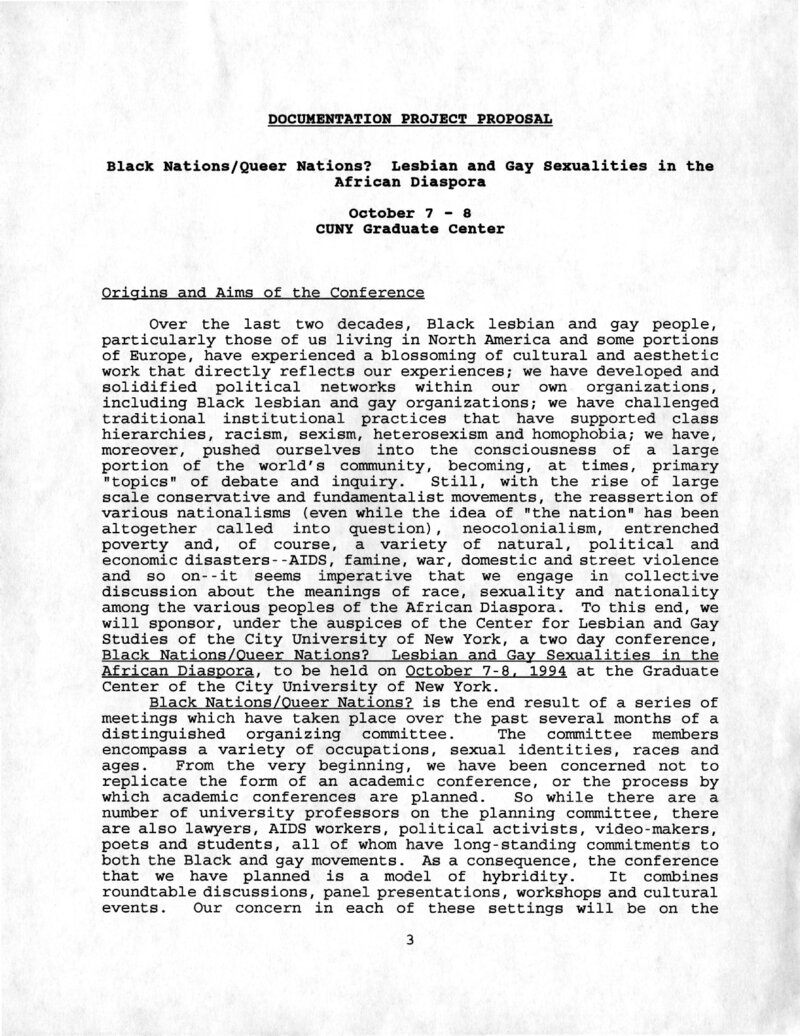
DOCUMENTATION PROJECT PROPOSAL
Black Nations/Queer Nations? Lesbian and Gay Sexualities in the
African Diaspora
October 7 - 8
CUNY Graduate Center
Origins and Aims of the Conference
Over the last two decades, Black lesbian and gay people,
particularly those of us living in North America and some portions
of Europe, have experienced a blossoming of cultural and aesthetic
work that directly reflects our experiences; we have developed and
solidified political networks within our own organizations,
including Black lesbian and gay organizations; we have challenged
traditional institutional practices that have supported class
hierarchies, racism, sexism, heterosexism and homophobia; we have,
moreover, pushed ourselves into the consciousness of a large
portion of the world’s community, becoming, at times, primary
"topics" of debate and inquiry. Still, with the rise of large
scale conservative and fundamentalist movements, the reassertion of
various nationalisms (even while the idea of "the nation" has been
altogether called into question), neocolonialism, entrenched
poverty and, of course, a variety of natural, political and
economic disasters--AIDS, famine, war, domestic and street violence
and so on--it seems imperative that we engage in collective
discussion about the meanings of race, sexuality and nationality
among the various peoples of the African Diaspora. To this end, we
will sponsor, under the auspices of the Center for Lesbian and Gay
Studies of the City University of New York, a two day conference,
Black Nations/Queer Nations? Lesbian and Gay Sexualities in the
African Diaspora, to be held on October 7-8, 1994 at the Graduate
Center of the City University of New York.
Black Nations/Queer Nations? is the end result of a series of
meetings which have taken place over the past several months of a
distinguished organizing committee. The committee members
encompass a variety of occupations, sexual identities, races and
ages. From the very beginning, we have been concerned not to
replicate the form of an academic conference, or the process by
which academic conferences are planned. So while there are a
number of university professors on the planning committee, there
are also lawyers, AIDS workers, political activists, video-makers,
poets and students, all of whom have long-standing commitments to
both the Black and gay movements. As a consequence, the conference
that we have planned is a model of hybridity. It combines
roundtable discussions, panel presentations, workshops and cultural
events. Our concern in each of these settings will be on the
a
without lesbianism or lesbianism without Blackness reflect long-
standing beliefs about the one-dimensional nature of "marginal" or
"Subaltern" subjectivities. One might ask, for example, why almost
all of the recent work produces in the last two decades that
addresses the topic of the lesbian and gay past, including the
ancient past, looks exclusively to the West for answers. Why do
"gay" and "white" continue to be conflated in the imaginations of
so many persons, Black, white, straight, gay and otherwise? Still,
it is certainly not the case that these issues remain static
thoughout our society. On the contrary, they are addressed
continuously by a variety of "cultural workers" and others. We are
particularly interested in investigating the fundamental challenge
this work poses to regnant understandings of sexual and racial
identities.
3. How are these questions regarding racial and sexual identities
articulated in cultural and aesthetic work? In political debate
and decisionmaking? In intellectual discourse? In daily life?
Once again the focus is not simply on the post-Stonewall era,
but on the long history of the Black engagement with Western modes
of rationalism, particularly canonical Black literature and art.
Moreover, the question of how "Blacks" and "Sexual minorities" were
constructed by--and in relation to--scientific ideologies figures
centrally here. Indeed, once one recognizes that many of the
structures by which "Black" subjects are produced--and policed--it
becomes necessary to ask how, if at all, the various struggles to
resist these apparatuses connect, or overlap.
4. What is the relationship between anti-racist, anti-sexist,
anti-colonialist and anti-heterosexist political struggles?
We ask this question precisely because we hope the Black
Nations/Queer Nations? Conference will foster dialogue across a
range of identities, ideologies, and political concerns. We do
not, however, offer any prescriptions for coalition, or even a
narrative that would suggest that there has always been cross-
fertilization, or a sort, between whites and Blacks, heterosexuals
and homosexuals, men and women. Instead we simply offer this asa
goal, one to which the conference will contribute. And yet we
realize that there are other "progressive" tendencies, both within
and without the African diasporic community that might not, perhaps
rightfully so, be so sanguine about the prospect of integration or
coalition.
5. What has been the impact of cultural nationalism on the
formations of lesbian and gay identities?
For the first time, we are asking a variety of scholars,
activists and educators to come together to address the manner in
which homosexuality figures in the production of a variety of
cultural nationalisms: Afrocentrism, Negritude, the Black
5
Aesthetic movement and so forth. In this way, we hope to
recognize, on the one hand, the great good that cultural
nationalism has done for a variety of Black communities, while
encouraging critique of the anti-homosexual, anti-woman, anti-sex
ideas sometimes articulated by prominent cultural nationalists.
This is all by way of our asking what Black gay and lesbian
political and cultural activity can and should be.
6. Is a global political movement among lesbians and gay men in
the African Diaspora possible or desirable?
The seeming straightforwardness of this query ought not hide
its centrality. To our minds, it raises one of the most pressing
issues with which the participants of the conference will be
confronted. By the end of Black Nations/Queer Nations?, conference
participants will have spent two days interrogating and unsettling
received notions of Black gay and lesbian identity, history and
culture. This collective project will remain incomplete, however,
unless we challenge our conferees to address a difficult, but
decisive question, namely, "Where do we go from here?" In posing
and seeking answers to this question, we underscore our belief that
meaningful reflection on the lives of gay and lesbian people within
the. African Diaspora can and should lead to concrete organization
and action.
Rationales and Strategies for Documenting the Conference
The organizers of Black Nations/Queer Nations? are altogether
aware of the exceptional nature of our endeavor. Nothing like it
has ever been attempted before. Indeed, we are persuaded that this
two day gathering may well shape the direction of debates around
race, gender, sexuality and sexual practice for some time to come.
Given the undoubted significance of this conference, we hope
both to videotape the proceedings and publish them in an edited
volume. In order to capture the texture of the event, the
documentation project will proceed in four discrete, but related
parts.
(a) The first component of the documentation project will
entail taping the meetings of the Organizing Committee and its sub-
committees during the final eight weeks leading up to the
conference. Our goal here is to give viewers and readers of the
documented conference proceedings a sense of the collaborative
spirit which has marked this project from its inception. In the
many months that we have worked together, the members of the
Organizing Committee have found that the collaboration across
diversity which has characterized the planning of this conference
has led us to new and deeper understandings of ourselves, both as
individuals and as a community. Indeed, in taking concrete
decisions about the shape and substance of the conference, the
Organizing Committee has sought to make what we have learned about
forms and styles of collective work in the planning stages of this
6
conference a model for, and object of the conference itself.
(b) The second and most ambitious component of the
documentation project will entail the production of video and audio
recordings of the conference proceedings themselves. In order to
avoid a monochromatic picture of the conference sessions, we shall
be work with at least two (if not more) video cameras, the tapes
from which will be edited later to produce the final master copy.
By having more than one camera available to us, we shall also be
able to generate videotape recordings of the conference workshops.
The smaller and less formal workshops will be closely linked to the
roundtables, panels and cultural events, and provide an opportunity
for extended conversation among conferees of the issues addressed
in our various plenary sessions. In our view, the workshop
discussions are an integral part of the conference as a whole, from
which we expect to glean important insights.
(c) The third component of our proposed documentation project
will be a series of videotaped interviews throughout’ the
proceedings--some formal, many less so--with conferees and
conference presenters. Again, our desire here is gather recorded
materials for use in the master tape which will convey the passion
and dynamism of the conference. We will deploy our videocameras as
"roving eyes" to record fresh impressions of the roundtable
discussions and readings, snatches of excited conversation near the
elevators between workshops, impromptu caucuses over coffee in
conference rooms and the like. Our aim in gathering this material
is to record the spontaneous moments that make up the "daily life"
of a gathering such as this, which cannot be capture through more
formal documentary methods. We expect, too, that these videotaped
interviews will serve as a helpful supplement to the written
responses to the conference that will be included in the
registration packets and collected for later use.
(d) The fourth and final component of our proposed
documentation project will be the publication in book form of
selected papers, and the transcription and publication of all the
conference roundtables, together with excerpts from the workshop
discussions, cultural events and interviews and still photographs
from the videotaped materials. The publication will reach an
audience which reflects the diversity of the conference organizers,
presenters and expected conferees. We expect that the book will
not only appeal to individual readers, but will also be of interest
in larger settings such as study groups and college and university
classes, in such fields as women’s studies, African-American
studies, cultural studies and gay/lesbian studies. The projected
length of the book is between 300 and 400 pages, and—wtit—be>
Coca Tact 4 dk lited—4 ; Rtinein ts matly o ‘
The conference organizers believe that these materials will
provide a rich resource for future consultation, study and use. We
are confident that a record of Black Nations/Queer Nations? will
act as a catalyst for ongoing investigation of the character and
Signficance of gay and lesbian sexualities within the African
Diaspora. To that end, we are pursuing Qiuseemembeexrs.’ contacts at a
number of film/video distribution and publishing companies , that
fblack community centers. ame , affiliated. ,organizations, mk
Spokes ) A
Bie na Oa OO Oe
PWIA 4
CONFERENCE ORGANIZING COMMITTEE
M. Jacqui Alexander, Hamilton College
Kenn Ashley, Activist
Cheryl Clarke, Poet, Rutgers University
Cathy Cohen, Yale University
Martin Duberman, The Graduate Center, City University of New York
and Director of the Center for Lesbian and Gay Studies
Cheryl Dunye, Filmmaker
Shari Friloh, Filmmaker
El Gates, Yeshiva University, Benjamin N. Cardozo School of Law
Jackie Goldsby, Yale University
Peter Kwan, Columbia University
Wahneema Lubiano, Princeton University
Kagendo Murungi, Rutgers University
Charles Nero, Bates College
Robert Reid-Pharr, City College of New York
Colin Robinson, Gay Men of African Descent
Kendall Thomas, Columbia University
Dr. Sacha Vington
Anthony Williams, The Graduate Center, City University of New York
Black Nations/Queer Nations? Lesbian and Gay Sexualities in the
African Diaspora
October 7 - 8
CUNY Graduate Center
Origins and Aims of the Conference
Over the last two decades, Black lesbian and gay people,
particularly those of us living in North America and some portions
of Europe, have experienced a blossoming of cultural and aesthetic
work that directly reflects our experiences; we have developed and
solidified political networks within our own organizations,
including Black lesbian and gay organizations; we have challenged
traditional institutional practices that have supported class
hierarchies, racism, sexism, heterosexism and homophobia; we have,
moreover, pushed ourselves into the consciousness of a large
portion of the world’s community, becoming, at times, primary
"topics" of debate and inquiry. Still, with the rise of large
scale conservative and fundamentalist movements, the reassertion of
various nationalisms (even while the idea of "the nation" has been
altogether called into question), neocolonialism, entrenched
poverty and, of course, a variety of natural, political and
economic disasters--AIDS, famine, war, domestic and street violence
and so on--it seems imperative that we engage in collective
discussion about the meanings of race, sexuality and nationality
among the various peoples of the African Diaspora. To this end, we
will sponsor, under the auspices of the Center for Lesbian and Gay
Studies of the City University of New York, a two day conference,
Black Nations/Queer Nations? Lesbian and Gay Sexualities in the
African Diaspora, to be held on October 7-8, 1994 at the Graduate
Center of the City University of New York.
Black Nations/Queer Nations? is the end result of a series of
meetings which have taken place over the past several months of a
distinguished organizing committee. The committee members
encompass a variety of occupations, sexual identities, races and
ages. From the very beginning, we have been concerned not to
replicate the form of an academic conference, or the process by
which academic conferences are planned. So while there are a
number of university professors on the planning committee, there
are also lawyers, AIDS workers, political activists, video-makers,
poets and students, all of whom have long-standing commitments to
both the Black and gay movements. As a consequence, the conference
that we have planned is a model of hybridity. It combines
roundtable discussions, panel presentations, workshops and cultural
events. Our concern in each of these settings will be on the
a
without lesbianism or lesbianism without Blackness reflect long-
standing beliefs about the one-dimensional nature of "marginal" or
"Subaltern" subjectivities. One might ask, for example, why almost
all of the recent work produces in the last two decades that
addresses the topic of the lesbian and gay past, including the
ancient past, looks exclusively to the West for answers. Why do
"gay" and "white" continue to be conflated in the imaginations of
so many persons, Black, white, straight, gay and otherwise? Still,
it is certainly not the case that these issues remain static
thoughout our society. On the contrary, they are addressed
continuously by a variety of "cultural workers" and others. We are
particularly interested in investigating the fundamental challenge
this work poses to regnant understandings of sexual and racial
identities.
3. How are these questions regarding racial and sexual identities
articulated in cultural and aesthetic work? In political debate
and decisionmaking? In intellectual discourse? In daily life?
Once again the focus is not simply on the post-Stonewall era,
but on the long history of the Black engagement with Western modes
of rationalism, particularly canonical Black literature and art.
Moreover, the question of how "Blacks" and "Sexual minorities" were
constructed by--and in relation to--scientific ideologies figures
centrally here. Indeed, once one recognizes that many of the
structures by which "Black" subjects are produced--and policed--it
becomes necessary to ask how, if at all, the various struggles to
resist these apparatuses connect, or overlap.
4. What is the relationship between anti-racist, anti-sexist,
anti-colonialist and anti-heterosexist political struggles?
We ask this question precisely because we hope the Black
Nations/Queer Nations? Conference will foster dialogue across a
range of identities, ideologies, and political concerns. We do
not, however, offer any prescriptions for coalition, or even a
narrative that would suggest that there has always been cross-
fertilization, or a sort, between whites and Blacks, heterosexuals
and homosexuals, men and women. Instead we simply offer this asa
goal, one to which the conference will contribute. And yet we
realize that there are other "progressive" tendencies, both within
and without the African diasporic community that might not, perhaps
rightfully so, be so sanguine about the prospect of integration or
coalition.
5. What has been the impact of cultural nationalism on the
formations of lesbian and gay identities?
For the first time, we are asking a variety of scholars,
activists and educators to come together to address the manner in
which homosexuality figures in the production of a variety of
cultural nationalisms: Afrocentrism, Negritude, the Black
5
Aesthetic movement and so forth. In this way, we hope to
recognize, on the one hand, the great good that cultural
nationalism has done for a variety of Black communities, while
encouraging critique of the anti-homosexual, anti-woman, anti-sex
ideas sometimes articulated by prominent cultural nationalists.
This is all by way of our asking what Black gay and lesbian
political and cultural activity can and should be.
6. Is a global political movement among lesbians and gay men in
the African Diaspora possible or desirable?
The seeming straightforwardness of this query ought not hide
its centrality. To our minds, it raises one of the most pressing
issues with which the participants of the conference will be
confronted. By the end of Black Nations/Queer Nations?, conference
participants will have spent two days interrogating and unsettling
received notions of Black gay and lesbian identity, history and
culture. This collective project will remain incomplete, however,
unless we challenge our conferees to address a difficult, but
decisive question, namely, "Where do we go from here?" In posing
and seeking answers to this question, we underscore our belief that
meaningful reflection on the lives of gay and lesbian people within
the. African Diaspora can and should lead to concrete organization
and action.
Rationales and Strategies for Documenting the Conference
The organizers of Black Nations/Queer Nations? are altogether
aware of the exceptional nature of our endeavor. Nothing like it
has ever been attempted before. Indeed, we are persuaded that this
two day gathering may well shape the direction of debates around
race, gender, sexuality and sexual practice for some time to come.
Given the undoubted significance of this conference, we hope
both to videotape the proceedings and publish them in an edited
volume. In order to capture the texture of the event, the
documentation project will proceed in four discrete, but related
parts.
(a) The first component of the documentation project will
entail taping the meetings of the Organizing Committee and its sub-
committees during the final eight weeks leading up to the
conference. Our goal here is to give viewers and readers of the
documented conference proceedings a sense of the collaborative
spirit which has marked this project from its inception. In the
many months that we have worked together, the members of the
Organizing Committee have found that the collaboration across
diversity which has characterized the planning of this conference
has led us to new and deeper understandings of ourselves, both as
individuals and as a community. Indeed, in taking concrete
decisions about the shape and substance of the conference, the
Organizing Committee has sought to make what we have learned about
forms and styles of collective work in the planning stages of this
6
conference a model for, and object of the conference itself.
(b) The second and most ambitious component of the
documentation project will entail the production of video and audio
recordings of the conference proceedings themselves. In order to
avoid a monochromatic picture of the conference sessions, we shall
be work with at least two (if not more) video cameras, the tapes
from which will be edited later to produce the final master copy.
By having more than one camera available to us, we shall also be
able to generate videotape recordings of the conference workshops.
The smaller and less formal workshops will be closely linked to the
roundtables, panels and cultural events, and provide an opportunity
for extended conversation among conferees of the issues addressed
in our various plenary sessions. In our view, the workshop
discussions are an integral part of the conference as a whole, from
which we expect to glean important insights.
(c) The third component of our proposed documentation project
will be a series of videotaped interviews throughout’ the
proceedings--some formal, many less so--with conferees and
conference presenters. Again, our desire here is gather recorded
materials for use in the master tape which will convey the passion
and dynamism of the conference. We will deploy our videocameras as
"roving eyes" to record fresh impressions of the roundtable
discussions and readings, snatches of excited conversation near the
elevators between workshops, impromptu caucuses over coffee in
conference rooms and the like. Our aim in gathering this material
is to record the spontaneous moments that make up the "daily life"
of a gathering such as this, which cannot be capture through more
formal documentary methods. We expect, too, that these videotaped
interviews will serve as a helpful supplement to the written
responses to the conference that will be included in the
registration packets and collected for later use.
(d) The fourth and final component of our proposed
documentation project will be the publication in book form of
selected papers, and the transcription and publication of all the
conference roundtables, together with excerpts from the workshop
discussions, cultural events and interviews and still photographs
from the videotaped materials. The publication will reach an
audience which reflects the diversity of the conference organizers,
presenters and expected conferees. We expect that the book will
not only appeal to individual readers, but will also be of interest
in larger settings such as study groups and college and university
classes, in such fields as women’s studies, African-American
studies, cultural studies and gay/lesbian studies. The projected
length of the book is between 300 and 400 pages, and—wtit—be>
Coca Tact 4 dk lited—4 ; Rtinein ts matly o ‘
The conference organizers believe that these materials will
provide a rich resource for future consultation, study and use. We
are confident that a record of Black Nations/Queer Nations? will
act as a catalyst for ongoing investigation of the character and
Signficance of gay and lesbian sexualities within the African
Diaspora. To that end, we are pursuing Qiuseemembeexrs.’ contacts at a
number of film/video distribution and publishing companies , that
fblack community centers. ame , affiliated. ,organizations, mk
Spokes ) A
Bie na Oa OO Oe
PWIA 4
CONFERENCE ORGANIZING COMMITTEE
M. Jacqui Alexander, Hamilton College
Kenn Ashley, Activist
Cheryl Clarke, Poet, Rutgers University
Cathy Cohen, Yale University
Martin Duberman, The Graduate Center, City University of New York
and Director of the Center for Lesbian and Gay Studies
Cheryl Dunye, Filmmaker
Shari Friloh, Filmmaker
El Gates, Yeshiva University, Benjamin N. Cardozo School of Law
Jackie Goldsby, Yale University
Peter Kwan, Columbia University
Wahneema Lubiano, Princeton University
Kagendo Murungi, Rutgers University
Charles Nero, Bates College
Robert Reid-Pharr, City College of New York
Colin Robinson, Gay Men of African Descent
Kendall Thomas, Columbia University
Dr. Sacha Vington
Anthony Williams, The Graduate Center, City University of New York
Title
Black Nations/Queer Nations? Proposal
Description
This draft of a proposal for the Black Nations/Queer Nations? (BNQN) conference highlights the importance of having such a conference as well as the way that the event was conceived of early on. According to the proposal, BNQN was the result of several meetings of an organizing committee comprised of individuals of various backgrounds, resulting in a highly diverse conference. Leading the committee was M. Jacqui Alexander, one of the leading scholars of transnational feminism. As stated in the proposal, the aims of the conference were to propose questions such as “What is the relationship between anti-racist, anti-sexist, anti-colonialist and anti-heterosexist political struggles?” and “Is a global political movement among lesbian and gay men in the African Diaspora possible or desirable?” While the conference was originally planned for October 1994, due to unforeseen complications, it was not held until March of the following year.
Although formally instituted at the CUNY Graduate Center in 1991, CLAGS: The Center for LGBTQ Studies was first conceived 5 years earlier by Martin, Duberman, one of the first historians to embrace the, then infantile, field of Queer Studies. Duberman sensed the need for a formal center devoted to queer research. As the first university-based center for LGBTQ research, CLAGS continues to demonstrate its dedication to advancing Queer Studies, by hosting public events showcasing queer research and sponsoring fellowships to support queer scholars. Among its many notable contributions, CLAGS annually puts on at least one major conference and holds the Kessler Award Lecture every fall to celebrate a queer scholar who has made a notable contribution to the field of queer studies.
Although formally instituted at the CUNY Graduate Center in 1991, CLAGS: The Center for LGBTQ Studies was first conceived 5 years earlier by Martin, Duberman, one of the first historians to embrace the, then infantile, field of Queer Studies. Duberman sensed the need for a formal center devoted to queer research. As the first university-based center for LGBTQ research, CLAGS continues to demonstrate its dedication to advancing Queer Studies, by hosting public events showcasing queer research and sponsoring fellowships to support queer scholars. Among its many notable contributions, CLAGS annually puts on at least one major conference and holds the Kessler Award Lecture every fall to celebrate a queer scholar who has made a notable contribution to the field of queer studies.
Contributor
CLAGS Center for LGBTQ Studies archive
Creator
CLAGS
Date
1994 (Circa)
Language
English
Relation
7752
8362
8342
Rights
Copyrighted
Source
CLAGS Archive
Original Format
Report / Paper / Proposal
CLAGS. Letter. 1994. “Black Nations Queer Nations? Proposal”. 7752, 1994, CUNY DIGITAL HISTORY ARCHIVE, accessed July 8, 2026, https://stephenz.tailc22a4b.ts.net/s/cdha/item/1290