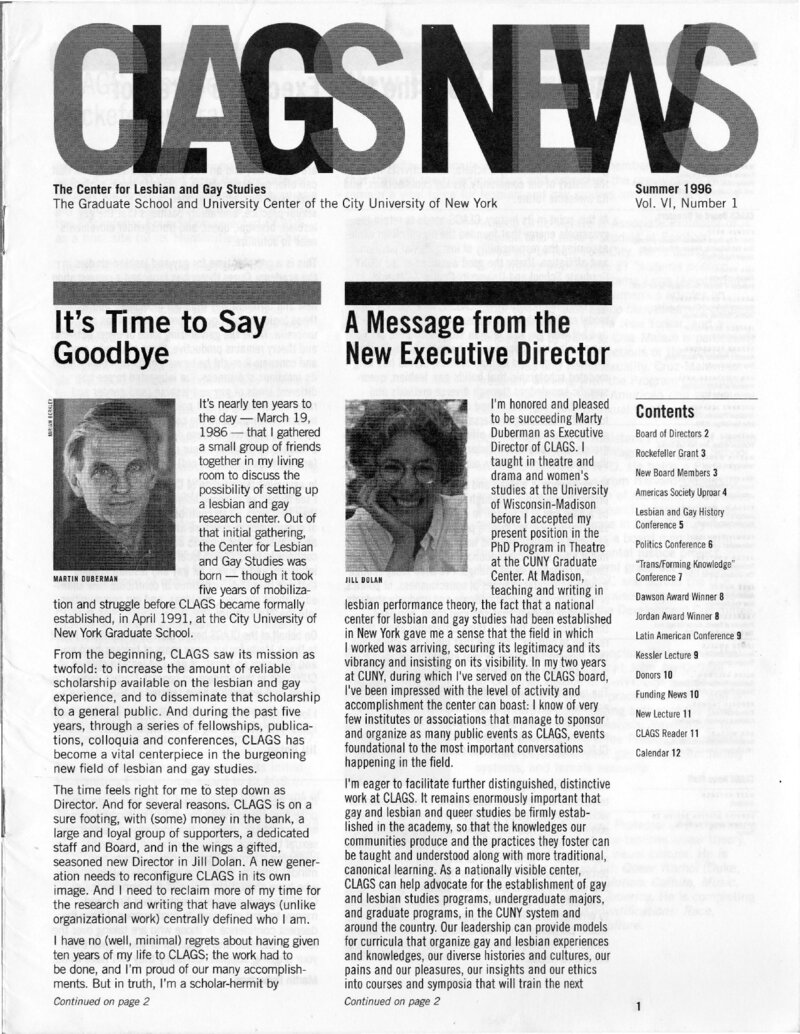
CLAGS NEWS
Item
MIRIAM BERKLEY
GAGS NAS
Summer 1996
Vol. VI, Number 1
The Center for Lesbian and Gay Studies
The Graduate School and University Center of the City University of New York
ee ee Saree
It’s Time to Say
Goodbye
It’s nearly ten years to
the day — March 19,
1986 — that | gathered
a a small group of friends
—— together in my living
Ve. room to discuss the
_ possibility of setting up
a lesbian and gay
research center. Out of
that initial gathering,
the Center for Lesbian
and Gay Studies was
born — though it took
five years of mobiliza-
tion and struggle before CLAGS became formally
established, in April 1991, at the City University of
New York Graduate School.
MARTIN DUBERMAN
From the beginning, CLAGS saw its mission as
twofold: to increase the amount of reliable
scholarship available on the lesbian and gay
experience, and to disseminate that scholarship
to a general public. And during the past five
years, through a series of fellowships, publica-
tions, colloquia and conferences, CLAGS has
become a vital centerpiece in the burgeoning
new field of lesbian and gay studies.
The time feels right for me to step down as
Director. And for several reasons. CLAGS is on a
sure footing, with (some) money in the bank, a
large and loyal group of supporters, a dedicated
staff and Board, and in the wings a gifted,
seasoned new Director in Jill Dolan. A new gener-
ation needs to reconfigure CLAGS in its own
image. And | need to reclaim more of my time for
the research and writing that have always (unlike
organizational work) centrally defined who | am.
| have no (well, minimal) regrets about having given
ten years of my life to CLAGS; the work had to
be done, and I’m proud of our many accomplish-
ments. But in truth, I’m a scholar-hermit by
Continued on page 2
ee ee ee
A Message from the
New Executive Director
we |'m honored and pleased
to be succeeding Marty
Duberman as Executive
Director of CLAGS. |
taught in theatre and
drama and women's
studies at the University
of Wisconsin-Madison
before | accepted my
present position in the
PhD Program in Theatre
at the CUNY Graduate
Center. At Madison,
teaching and writing in
lesbian performance theory, the fact that a national
center for lesbian and gay studies had been established
in New York gave me a sense that the field in which
| worked was arriving, securing its legitimacy and its
vibrancy and insisting on its visibility. In my two years
at CUNY, during which I've served on the CLAGS board,
I've been impressed with the level of activity and
accomplishment the center can boast: | know of very
few institutes or associations that manage to sponsor
and organize as many public events as CLAGS, events
foundational to the most important conversations
happening in the field.
JILL DOLAN
I'm eager to facilitate further distinguished, distinctive
work at CLAGS. It remains enormously important that
gay and lesbian and queer studies be firmly estab-
lished in the academy, so that the knowledges our
communities produce and the practices they foster can
be taught and understood along with more traditional,
canonical learning. As a nationally visible center,
CLAGS can help advocate for the establishment of gay
and lesbian studies programs, undergraduate majors,
and graduate programs, in the CUNY system and
around the country. Our leadership can provide models
for curricula that organize gay and lesbian experiences
and knowledges, our diverse histories and cultures, our
pains and our pleasures, our insights and our ethics
into courses and symposia that will train the next
Continued on page 2
Contents
Board of Directors 2
Rockefeller Grant 3
New Board Members 3
Americas Society Uproar 4
Lesbian and Gay History
Conference 5
Politics Conference 6
“Trans/Forming Knowledge”
Conference 7
Dawson Award Winner 8
Jordan Award Winner 8
Latin American Conference 9
Kessler Lecture 9
Donors 10
Funding News 10
New Lecture 11
CLAGS Reader 11
Calendar 12
MARTIN DUBERMAN
Founder and Director Emeritus,
Distinguished Professor of History, Lehman College
and The Graduate School, CUNY
CLAGS Board of Directors
ESTHER KATZ
Chair of the Board, Associate Professor of History,
New York University, Director of the Margaret
Sanger Papers Project
JILL DOLAN
Executive Director
Professor of Theater, The Graduate School, CUNY
ARNALDO CRUZ-MALAVE
Associate Professor of Spanish and Literary
Studies, Fordham University
JEFFREY ESCOFFIER
Editor and Writer
GERARD FERGERSON
Assistant Professor of Health Policy,
New York University
ANN POLLINGER HAAS
Professor of Health Sciences,
Lehman College, CUNY
SUZANNE IASENZA
Associate Professor, Counseling Department,
John Jay College, CUNY
ARTHUR S. LEONARD
Professor of Law, New York Law School
MARTIN MANALANSAN
Independent Scholar
HARRIET MALINOWITZ
Assistant Professor of English,
Long Island University
ELENA M. MARTINEZ
Assistant Professor of Spanish,
Baruch College, CUNY
FRAMJI MINWALLA
Independent Scholar
OSCAR MONTERO
Professor of Spanish, Lehman College and
The Graduate School, CUNY
JOSE MUNOZ
Assistant Professor of Performance Studies,
New York University
FRANCESCA CANADE SAUTMAN
Professor of French, Hunter College and
The Graduate School, CUNY
JAMES SMALLS
Assistant Professor of Art History,
Rutgers University
ALISA SOLOMON
Associate Professor of English,
Baruch College, CUNY
KENDALL THOMAS
Professor of Law,
Columbia University Law School
ARA WILSON
Doctoral Candidate in Anthropology,
The Graduate School, CUNY
CLAGS News Staff
MATT ROTTNEK
Assistant
SERVICE STATION DESIGN TO
INFORM AND PROMOTE
Design
Ee
A Message from the New Executive Director
Dolan, from page 1
generation of thinkers, teachers, and activists to know
the history of our community, its key contributions, and
its awesome future.
At this point in its history, CLAGS needs to retain the
grassroots energy that founded the organization while
assuming the responsibility of institutional position
and affiliation. Under the good auspices of the CUNY
Graduate School and University Center — thanks, in
particular, to the support of President Frances Horowitz
and Dean Alan Gartner — CLAGS is in a position to
model coalition-building across academic disciplines,
and between gay and lesbian studies and the activist
community. Interdisciplinarity has always been the
hallmark of gay and lesbian studies; CLAGS has long
modeled scholarship that builds gay, lesbian, queer-
specific knowledges through diverse methods and
across multiple identity and community bases. | look
forward to fostering conversations among disciplines
and communities, and to offering CLAGS's resources to
groups and speakers, scholars and activists who can
illuminate our multiplicity, our great collective potential.
My experience in lesbian and feminist politics has been
primarily academic, although | consider the academy to
be a vital site of activism. In my teaching, my scholar-
ship, my writing, my theatre productions, | have always
assumed (idealistically and hopefully) that my work
might have some consequence in a gradual movement
toward profound social change. I've been lucky enough
to witness regular changes of consciousness, of politics,
of affiliation in my undergraduate and graduate students,
as a result of ideas that seduced them, provoked
them, compelled them to think differently about their
relation to culture. | believe that ideas are efficacious,
that thought has a direct, real effect (teachers, |
suppose, take this on faith).
The real effect of ideas, of conversations, of workshops
and town meetings, of publications, monographs, the
CLAGS NYU series, position papers, of arguments and
even loud and contentious public fights, is where
CLAGS can make its greatest contribution. | believe we
are an activist and an academic organization, one that
can offer our communities a place to think, a place to
build coalitions across gender, racial, ethnic, class,
sexual practice, and ability positions that the gay,
lesbian, bisexual, queer, and transgender movements
need to actualize.
This is a complex time for gay and lesbian studies in
the academy. Queer theory has launched a conversation
about language, about identity, about coalition, in a
new and different way than our movement addressed
these topics before "queer" provided itself as an
umbrella. While the galvanizing force of queer activism
and theory remains productive, those of us who produce
and consume it might be be wary of its commodification,
its insidious stylishness. I'm interested to see how
different kinds of gay and lesbian (and gender and
race) epistemologies and political programs will
reassert themselves in the coming years. CLAGS will
be deeply invested in these debates, and will take
a leadership position as our communities come to new
(and perhaps reembrace old) terms.
In assuming the position of CLAGS's Executive Director,
| see myself as someone adept at enabling others to do
their best work. | can contribute to CLAGS a clear sense
of organizational structure and efficient functioning;
an enthusiasm for projects and programs that will
continue to bring CLAGS local and national visibility and
influence; and a vision for gay and lesbian studies
that will help CLAGS continue to contribute new knowl-
edge about our lives, our ideas, and our communities
into the 21st century.
On behalf of the CLAGS board, staff, and members, | want
to thank Marty for his many years of tireless hard work
and advocacy on behalf of gay and lesbian studies at
CUNY and in the academy in general. Marty's dedication,
fervor, and leadership have secured CLAGS's future.
| look forward to working with all of you; your work, your
ideas, your lives are the stuff of which CLAGS is made.
Jill Dolan
Duberman, from page 1
temperament, and the daily grind of organizational
work has never been entirely congenial to me. And,
sometimes, it has been downright unpleasant, par-
ticularly during those periods — inevitable in move-
ment work — when internal factionalism develops,
tempers fray and accusations fly. Yet such periods of
self-scrutiny and criticism are, however painful,
essential; they allow for new voices and agendas
to emerge, they keep our organizations true to their
stated purposes, and they ensure that those purpos-
es will constantly be refined to meet shifting condi-
tions and needs.
It has been a great privilege to be part of an enter-
prise that has done so much to challenge outmod-
ed, stereotypic views of nonconforming gender and
sexual behavior — and thereby, ultimately, to
changing statutes, legal opinions, hearts and
minds. | deeply thank the many thousands of you
who have shared our sense of the importance of
CLAGS’s work and have contributed time and
money toward ensuring its continuance. | have the
deepest confidence in those who are taking over the
reins at CLAGS, and | urge all of you to give them
your ongoing support. Certainly they will have mine.
Martin Duberman
Ce
CLAGS Wins Second
Rockefeller Grant!
In April 1996, CLAGS received word that it
won a $250,000 grant from the Rockefeller
Foundation to support scholars in lesbian and
gay studies. For the second time since 1992,
the Rockefeller Foundation selected CLAGS
as a host site for its Humanities Fellowships.
The $250,000 grant is the Rockefeller
Foundation’s only award to a non-AIDS lesbian
and gay institution. The award then, is an
especially sweet victory for CLAGS: it is
a tremendous vote of confidence in the work
that we do.
The grant will enable CLAGS to provide
six $30,000 resident fellowships to scholars
in the next four years. CLAGS’s winning
proposal, entitled “Citizenship and
Sexualities: Transcultural Constructions,”
examines diverse cultural constructions of
identity, affiliation, and sexuality and how
these constructions impact community building
within lesbian and gay institutions and
communities in the United States. Written
by CLAGS board member Harriet Malinowitz,
the proposal investigates why problems
of community-building and coalition-building
continue to exist in our organizations and
communities, despite a broad awareness of
the importance of organizing multiculturally.
After a year publicizing the fellowships,
CLAGS will invite submissions of scholarly
work that explore the “citizenship” and
“sexualities” theme in three different settings:
in lesbian and gay organizations and institu-
tions; in queer families and communities;
and nationally. The first deadline for applications
from potential Humanities Fellows will be
in February 1997, and the first two Fellows
will begin their tenure in September of 1997.
The Rockefeller Foundation made its initial
Humanities Fellowships award to CLAGS in
1992. The earlier grant, also in the amount of
$250,000, supported the work of six Fellows
working in lesbian and gay studies from 1993
to 1996. CLAGS'’s six previous Rockefeller
Fellows in the Humanities were: Charles Nero;
Carra Leah Hood; Allan Berube; Janice Irvine;
Nan Alamilla Boyd; Jeffrey Edwards.
oe
New Board Members
CLAGS enthusiastically welcomes these new members and hopes
that through their participation and expertise, the organization will
remain a vital force for lesbian and gay studies into the 21st century:
Arnaldo Cruz-Malavé is Associate Professor of
Spanish and Literary Studies at Fordham
University in New York City. He is author of
EI primitivo implorante: El “sistema poético
del mundo” de José Lezama Lima (Amsterdam:
Rodopi, 1994) and of numerous articles on
Caribbean and U.S. Latino literatures and cultures.
As a Puerto Rican and a New Yorker, and a
Caribbeanist by training, Cruz-Malavé is particularly
interested in the intersections of the diasporic
experience and homosexuality. Cruz-Malavé is
presently working with the Program Committee
on the upcoming Latin American and Latino
Lesbian, Gay, and Bisexual Conference.
$ Hes.
Gerard Fergerson is Assistant Professor of Health
Policy in the Robert F. Wagner Graduate School
of Public Service at NYU. He holds a Ph.D. in
the history of science from Harvard University
and is a social historian of medicine and public
health. His primary research interests include
race, poverty, and disease in 20th-Century America.
Fergerson has served as a board member with
the NAACP’s environmental justice project
and is active with several grassroot health and
education efforts in NYC and across the U.S.
He also has some fundraising experience and
will work closely with the Development Committee.
Suzanne lasenza is Associate Professor in the
Counseling Department at John Jay College
of Criminal Justice at CUNY. She is also a
psychologist in private practice in NYC. She is
co-editor and contributing author of the book
Lesbians and Psychoanalysis: Revolutions in
Theory and Practice (Free Press). Her interests
include psychoanalysis, gay and lesbian family
systems, and female sexuality.
José Mufioz is Assistant Professor of Performance
Studies at NYU where he teaches queer theory,
critical race theory and visual culture. He is
the co-editor of Pop/Out: Queer Warhol (Duke,
1996) and Politics in Motion: Culture, Music,
and Dance in Latina/o America. He is completing
the manuscript (Dis)/dentifications: Race,
Sexuality, and Visual Culture.
CUNY Graduate
School Courses
with Lesbian/Gay
Content, Fall 1996
English
“Race, Class, and Gender in 19th
Century American Literature”
“Composing the Oppositional
Self: Gender, Race, and Class
in Rhetorics of Resistance”
“Black Feminist Thought”
History
“American Autobiography:
The Construction of Women’s
and Men’s Historical Memory in
the United States”
Sociology
“Women, Men, and the Workplace:
Power, Culture, and Sexuality”
Spanish
“Contemporary Feminist
Narrative in the Hispanic World”
Women’s Studies
“Major Feminist Texts”
“Hybrid Identities:
Race and Gender in Ethnic
Literatures”
Uproar at Americas Society Conference
Two weeks before the Margin/Center Conference,
held at Americas Society on March 21-22,
the directors of the Society first threatened
to cancel the Conference, then decided to
redesign the program in order to exclude the
Center for Lesbian and Gay Studies as a
cosponsor of the event.
The directors of the Americas Society shelved
the original program and hastily printed a
censored version. Their homophobic gesture
gave particular urgency to an event whose
goal had been to deal precisely with issues of
power, marginalization and strategies of
representation.
The Conference, whose subtitle was “emer-
gent discourses in Latin American and Latino
literature and culture,” included three panels:
Afro-Caribbean Literature, Womens Writing,
and Gay and Lesbian Literature and Culture.
Planning for the Conference began in the Fall
of 1994, when Dan Shapiro, Head of Literature
at Americas Society, invited CLAGS to
cosponsor the Conference. For the next eighteen
months, Elena Martinez and Oscar Montero
planned the Conference along with Mr.
Shapiro. CLAGS also contributed $2,000.
toward the event. By late February 1996, the
final program was printed.
Several letters between CLAGS and the
Americas Society state that the program must
include all three cosponsors on its cover:
CLAGS, Americas Society and the Instituto
Cervantes. The original program reflected this
agreement. However, less than three weeks
before the Conference, Mr. Shapiro called
the Conference organizers to tell them that
the Conference could not be held at Americas
Society because of CLAGS’s participation.
In a compromise of his own making, Mr.
Shapiro ultimately printed and mailed a
program that completely omitted the cospon-
sorship of CLAGS. As Mr. Shapiro later
admitted, Elizabeth Beim, director of cultural
affairs at Americas Society and Everett Briggs,
the Society's president, had forbidden him
from discussing the changes with CLAGS.
When questioned by members of the press,
who had by now been alerted of the situation,
the directors of Americas Society falsely
claimed that each sponsoring organization
had done its own program — a mendacious
attempt to cover up its homophobia.
During the second day of the Conference, the
censoring of the program was discussed by
the participants. Oscar Montero presented a
chronology of events that led to the censorship,
and Elena Martinez chaired the discussion.
It was a charged, often tense discussion.
A town meeting on homosexual panic was not
what CLAGS had envisioned when it decided
to participate in this project. However, the
discussion gave added resonance to many of
the issues of oppression and representation
that had been raised in the panels.
Panelists and participants offered ways at the
Conference to counteract Americas Society's
homophobia. Some of the suggestions were
included in a letter asking Americas Society
for an explanation and an apology. A copy
of the letter, along with a chronology of
events and a petition signed by over thirty
Conference participants was sent to Americas
Society, all Conference participants, the
MLA and LASA lesbian and gay caucuses, the
Rockefeller Foundation, backers of Americas
Society, the Gay and Lesbian Alliance Against
Defamation and CLAGS board members.
Americas Society's actions only served to
highlight the importance of CLAGS. In the
genteel setting of Americas Society, homophobia,
with its attendant gestures of silencing,
erasure and oppression, is alive and well.
CLAGS refused to allow a business-as-usual
cover-up of these events.
We urge those supportive of CLAGS to express
their disapproval of the censorship by writing
Mr. Everett Briggs, Americas Society, 680
Park Avenue, New York, NY 10021, or by
calling Mr. Dan Shapiro, Ms. Elizabeth Beim
or Mr. Briggs at 212-249-8950, or fax
212-249-5868.
Lesbian and Gay History:
Defining a Field
DAVID NASSAW, CHAIR OF THE
HISTORY PHD PROGRAM AT
THE CUNY GRADUATE SCHOOL,
WELCOMES THE CONFEREES
LILIAN FADERMAN, CARROLL SMITH-ROSENBERG AND BLANCHE WIESEN COOK ON THE “ROMANTIC FRIENDSHIP” PANEL
On October 6-7, the CUNY Graduate School PhD Program in History
and CLAGS co-hosted a wide-ranging conference on “Lesbian and Gay
History: Defining a Field.” The two day event brought together more
than 40 panel discussants, and an audience exceeding 300 people,
to explore new directions and continuing debates in the field of gay
and lesbian history. Among the panel topics discussed were the
“classic” debates surrounding the historiography of “Romantic
Friendship” and “Gender and the Homosexual Role.” Discussants
included Blanche Wiesen Cook, Lillian Faderman, Carroll Smith-
Rosenberg, Randolph Trumbach, George Chauncey, Ramon Gutierrez,
Martin Manalansan, Will Roscoe and Martha Vicinus.
MIMI BOWLING OF THE NEW YORK
PUBLIC LIBRARY
There were additional panels on the writing of biography, the ongoing
efforts of archivists to preserve and make available the material record
of bisexual, transgendered, gay and lesbian lives, the challenges of
teaching lesbian and gay history both in and out of the university
setting, and the work-in-progress of graduate students and independent
scholars. Among the panelists were Jonathan Ned Katz, Lisa Duggan,
Larry Gross, Vivien Ng, Angela Bowen, John D’Emilio, Alice Echols,
James Miller and Jeff Nunokawa.
In addition, the film “Outrage 69” was shown on the first evening of
the conference, followed by a roundtable discussion that included
the film’s director Arthur Wong. The discussion was free-wheeling and
sometimes contentious, involving basic questions about the ways in
which lesbian and gay politics and history are represented in the media.
The Rockefeller Foundation and the New York Council for the
Humanities were sponsors of the conference.
*
=
Graduate Student
Committee
Recently the CLAGS Board formed
a Graduate Student Committee
with a three part mission:
a close involvement with the
planning of the Seventh Annual
National Queer Graduate Studies
Conference, entitled “Forms
of Desire,” to be held at the
Graduate Center in April of 1997;
increasing awareness and
opening lines of communication
between CLAGS and various
university queer student groups;
and becoming involved with
CLAGS On-line. As academic
communities rapidly move
towards increased involvement
with the internet, the Graduate
Student Committee hopes to
utilize this expansive resource
to connect to and share
information with other area
(and global) queer academic
groups.
Politics Conference
MARTIN MANALASAN AND DENNIS ALTMAN
PAUL HAGLAND, SHANE PHELAN, CATHY COHEN
MARK BLASIUS MAKING CLOSING
REMARKS
On February 8-9, CLAGS held its first
conference organized by political scientists,
“Identity/Space/Power: Lesbian, Gay, Bisexual,
and Transgender Politics.” The conference
steering committee, chaired by Mark Blasius
and Paisley Currah of CUNY, included
community-based activists, faculty, and
graduate students from the metropolitan area.
The conference began with a panel “Concep-
tualizing the Political, Creating an Agenda”
that included a paper by Hector Carrillo on his
fieldwork studying AIDS activism in Mexico,
Cathy Cohen’s critique of queer theory’s
absence of class- and race-based analysis,
Paul Hagland’s overview of international and
human rights theory’s contribution to LGBT
politics, Amanda Udis-Kessler
on bisexuality’s destabilization of tradition
political claims of lesbian and gay identity, and
Riki Anne Wilchin’s transgendered “performative-
analysis” of gender revolution as a basis for
rethinking what LGBT politics is about.
A second panel addressed an overflow crowd
about “Constituencies, Organizing, and
Political Formations.” Participants included
Urvashi Vaid, Larry Kramer, David Rayside,
Ellen Andersen and Donald Suggs.
The second day of the conference, even more
than the first, brought together academic
analysts, elected officials, policy makers, and
community activists. A panel entitled “Sexual
Identity and Political Space” applied the
topics of the first day onto neighborhood,
national, hemispheric, and transitional levels
of analysis. Participants included Jacqui
Alexander, Martin Manalansan, Robert Bailey,
Juanita Ramos Diaz and Dennis Altman.
A three-hour Town Meeting took place on
Friday afternoon. The format brought in, following
CLAGS’s mandate, diverse components of
the LGBT community. Workshops and their
leadership highlights included: LGBT Health
Issues (Terry McGovern of the HIV Law Project
and Javid Syed of Asian and Pacific Islander
Coalition of HIV/AIDS; learning from our
defeats (Karen Burstein); the Left and LGBT
politics (Melanie Kay/Kantrowitz); candidacy
development (Eileen Rakower, judicial candi-
date); youth and education issues (school
board and Hetrick-Martin representatives); and
responses to all workshops by elected officials
Tom Duane and Deborah Glick.
A final panel on “Strategies” included a report
from the Beijing Women’s Conference by Jean
Grossholtz, a comparison of judicial, legisla-
tive, and electoral strategies by Rebecca Mae
Salokar, a discussion of the utility of “think
tanks” for LGBT politics by Lee Badgett, and
an assessment of Republican and Democratic
party politics on the eve of the presidential
campaign season by Rich Tafel. The confer-
ence was concluded with remarks by Mark
Blasius, who summarized its overall themes.
Lastly, as a political event of both thought and
practice, the conference participants (led by
CLAGS board member Kendall Thomas) raised
almost $1,000 to support the work of South
Africa’s National Coalition for Gay and Lesbian
Equality to keep LGBT protections in that
country’s draft constitution, the first in the
world to do so.
RECENT CLAGS CONFERENCES
Trans/Forming Knowledge: Street Smarts,
Social Activism, and the Power of Expertise
On Thursday, May 2 CLAGS presented a one
day conference which staged a series of
conversations exploring the relationship
between vernacular knowledge created during
the course of community organizing, and
expert knowledge generated by professionals,
academics, and bureaucrats. “Trans/Forming
Knowledge” explored the dynamics of these
different forms of knowledge and especially
their significance for HIV transmission and
prevention, transgender narrative and political
organizing.
The conference opened with opening remarks
by Martin Duberman, Director of CLAGS,
Carmen Vazquez, Director of Policy at the
Lesbian and Gay Community Services Center,
New York, and Jeffrey Escoffier, NYC Office of
Gay and Lesbian Health.
Each session was structured to allow for
extensive discussion between panelists and
members of the audience. The first conversa-
tion, entitled “HIV/AIDS: Transmission,
Activism and Expertise,” explored the dynamics
between street smarts and expert knowledge
dealing with the controversies around oral sex
and lesbians with HIV. Panelists included
Amber Hollibaugh, Director of Lesbian AIDS
Project, GMHC; Ki Namaste, Transgender HIV
activist, Montreal, Quebec; Ana Olivera,
Director of Clinical Programs, Samaritan
Village; Colin Robinson, Director of HIV
Prevention, GMHC; and David Roman,
University of Southern California. The moder-
ators were George Bellinger, Gay Men of
African Descent, and Marj Plumb, NYC Office
of Gay and Lesbian Health.
The second conversation, entitled “Narrative
Trans/Formations,” included writer, activist,
and founder of FTM International James
Green; Karen Nakamura, Yale University; Ben
Singer, Rutgers University; Kiki Whitlock,
Transgender Task Force of the San Francisco
Human Rights Commission, and transgender
activist Jessica Meredith Xavier. The modera-
tors were Nan Alamilla Boyd, 1995-1996
Rockefeller Fellow at CLAGS, and Henry
Rubin of Harvard University.
KAREN NAKAMURA, JAMES GREEN, JESSICA MEREDITH XAVIER, KIKI WHITLOCK, BEN SINGER
KI NAMASTE, DAVID ROMAN, ANA OLIVIERA, COLIN ROBINSON, AMBER HOLLIBAUGH
The third session, entitled “Community
Matters: Knowledge in Progress,” consisted
of a series of work groups about the production
of knowledge and provided feedback on
projects undertaken by community and pro-
fessional groups.
Sandy Stone of the Advanced Communications
Technology Laboratory, University of Texas at
Austin and the author of The Empire Strikes
Back: The Posttranssexual Manifesto and The
War of Desire and Technology at the Close of
the Mechanical Age concluded the conference
with a performance piece.
CLAGS is
Collecting Syllabi
CLAGS is collecting syllabi used/
proposed for graduate and
undergraduate courses in both
Lesbian and Gay Studies and
other disciplines that treat
lesbian and gay themes. We
hope to compile the syllabi and
publish them in some form, and
keep them on file to circulate
among scholars and professors.
Please send syllabi, along with
a statement of permission to
publish them, to: The Curriculum
Committee, CLAGS/CUNY, 33
West 42 Street, New York, NY
10036-8099.
ee
Ken Dawson Award
James N. Green, a
doctoral candidate
in Latin American
History at UCLA .
was chosen as this
years recipient of the
$5,000. Ken Dawson
Award. His work,
Bichas, Bofes, and
Gays: Masculinity
and Homosexuality
in Rio de Janeiro
and Sao Paulo,
Brazil, 1930-1990 explores the intersection
of gender, class, race and sexuality in Brazil.
Focusing on the cities of Rio de Janeiro
and Sao Paulo, Mr. Green documents the
social and cultural lives of homosexual/gay
men as they confront and subvert the policing
powers of racial ideology and sexual/gender
systems.
JAMES N. GREEN
This year, the number of entries for the
Dawson Award were the largest since its
inception four years ago. There were several
outstanding proposals. In addition to Mr.
Green, the finalists included Steven Maynard
who was first runner up with his work,
Saturday Night at the Bunkhouse: Working-
Class Gay History in Rural and Northern
Ontario, 1890-1930, and Ruth Vanita and
Saleem Kidwai who were second runner up
with their proposal, Homosexuality in India:
A Reader.
Previous Dawson Winners:
1993-94: Marc Robert Stein
1994-95: Jonathan Ned Katz
1995-96: Kitty Tsui
Core ee
Constance Jordan
Award
Gay Wachman, a
doctoral candidate in
the English Program
at the CUNY Graduate
School, has won the
second Constance
Jordan $4,000
dissertation award.
Wachman emigrated
to the U.S. from
England in 1977;
she has taught high
school and college English in both countries
and she is currently an Instructor at SUNY
College, Old Westbury. Wachman has been
politically active in various causes, most
recently with ACT UP/NY’s Needle Exchange
Program. Her dissertation examines the
converging discourses of perverse desire,
primitivism, class, and war in some 1920s
narratives by British women writers.
GAY WACHMAN
The Constance Jordan Fellowships will be
awarded each year through 1997-98, with the
possibility of renewal thereafter. Constance
Jordan, the donor, is herself a Professor of
English at the Claremont (California) Graduate
School, and a literary scholar of distinction.
Her books include Renaissance Feminism:
Literary Texts and Political Models and Pulci’s
Morgante: Poetry and History in Fifteenth-
Century Florence. Jordan has established the
fellowships in order to encourage gay and les-
bian literary studies with historical content at
The CUNY Graduate School.
CUNY Student Paper
Awards
1st Prize ($250): James H. Sweet,
“Male Homosexuality and Spiritism in the
African Diaspora”
2nd Prize ($150): Renate Reimann,
“Fighting for Family Integrity: How Lesbian
Couples With Children Counter Social and
Legal Discrimination”
COMING THIS FALL
Crossing National and Sexual Borders:
A Latina/o and Latin American Lesbian,
Gay, Bisexual and Transgender Conference
On October 3-5, 1996, “Crossing National
and Sexual Borders” will bring together, for
the first time, lesbian, gay, bisexual, and
transgender writers, artists, community leaders,
cultural critics, and performers from Latin
America and the United States to engage in
an open dialogue and exchange of ideas.
In panels, workshops, plenaries, performances
and informal discussions, participants will
address issues critical to our communities:
AIDS, sexual taboos, classism, racism, and
religious oppression. “Crossing National and
Sexual Borders” aims to overcome invisibility,
to examine cultural representations that
stereotype us and to challenge homophobia
and racism, the main components of our
oppression both in Latin America and the
United States.
A coalition of lesbian, gay, bisexual, and
transgender Latinas/os in the United States
and their counterparts in Latin America would
be a powerful, unprecedented step toward
visibility and the affirmation of our rights.
“Crossing National and Sexual Borders” will
be the forum for such an historic, ground-
breaking event — a landmark in our emerging
histories and identities.
Possible speakers include: Cherrie Moraga,
Carlos Monsivais, Carlos Jauregui, Carmen
Vazquez, and Frances Negrities.
Organizing committee: Oscar Montero
(Lehman College/CUNY), Arnaldo Cruz-Malavé
(Fordham University), Licia Fiol-Matta
(Barnard College), Robert Irwin (New York
University), Carmen Vazquez (Lesbian and Gay
Community Services Center), Kelley Ready
(Hunter College/CUNY), Carlos Rodriguez
(Seton Hall), Elena M. Martinez (Baruch
College/CUNY)
The Performance subcommittee of the
Conference Planning Committee organized a
very successful fundraising event at WOW,
entitled “An Evening of Mariconerias and
Marimachismos,” with the participation of
Carmelita Tropicana and Maureen Angelos, as
hosts, and Lilly Montero (singer), Tepito
Danz’aca (modern dance group), Dolores Prida
(playwright), and performers Sussana Cook,
Jessica Chalmers, Gerry Gdmez Pearlberg, and
Dan Bacalzo. The evening drew a full house
and $1,000. was raised. The members of the
performance subcommittee who organized this
event are Robert Irwin, Carmelita Tropicana
Camilla Fojas.
ee ee ee
Monique Wittig
Gives Kessler Lecture
Distinguished lesbian
writer and theorist
Monique Wittig gave the
Fourth Annual David R.
Kessler Lecture on Friday,
December 1, 1995, at the
CUNY Graduate Center.
Wittig, who is currently a
Professor of French at
the University of Arizona,
is a foundational thinker
in contemporary lesbian
theory. Her articles —
in particular “The Straight Mind,” “One is Not Born
a Woman,” and “The Point of View: Universal or
Particular?” — have been vital to current writing in
lesbian and queer theory that takes a materialist
perspective on social relations.
MONIQUE WITTIG
In addition to her theoretical writing, Wittig is an
important novelist, whose books Les Guerilleres, Le
Corps Lesbien (The Lesbian Body), and Lesbian
Peoples: Material for a Dictionary (with Sande Zeig),
have captured the imaginations and shifted the
politics of generations of readers committed to rethinking
social structures.
The Kessler lecture event always provides moving
tributes prior to the honoree’s presentation by people
who know or have been influenced by the person being
honored. This year, Erika Ostrovsky, Professor Emerita
of French at New York University, and Namascar Shaktini,
Associate Professor of French and Comparative
Literature at Florida Atlantic University, presented
papers on Wittig’s writing. Unfortunately, rather than
evoking the spirit of Wittig’s work, their papers were
formal presentations that lasted far too long.
Judith Butler's tribute, “Bodies in Parts” (which was
read by Ann Pelligrini, since Butler was unable to
attend), was more appropriate to the evening’s intent.
With humor, grace and, of course, intelligence,
Butler demonstrated the influence of Wittig’s work on
succeeding generations of lesbian and queer thinkers.
In the too brief time remaining, Wittig read excerpts
from her most recent work, The Girl. Reading in French,
with a simultaneous English translation provided by
Barbara Page, Professor of English at Vassar, following
each brief selection, Wittig’s charismatic presence
delighted the crowd. The reception that followed cele-
brated the vision, creativity, and revolutionary impact
of Monique Wittig’s continuing contribution to interna-
tional lesbian and gay studies.
June 2 Benefit
On Sunday, June 2, 1996,
The Palladium hosted a dance
party and talk to benefit the
Center for Lesbian and Gay
Studies. “Sex Talk: The Next
Generation of Queer Writers Talk
About Sex” brought together
some of the brightest lights
on the gay and lesbian literary
landscape to talk about sex
and writing.
Moderated by performer
Mo Angelos of The Five Lesbian
Brothers, “Sex Talk” featured
Scott Heim (Mysterious Skin),
John Keene (Annotations),
Heather Lewis (House Rules),
Dale Peck (The Law of
Enclosures), and Jacqueline
Woodson (Autobiography of a
Family Photo).
The event raised about $4,000
for CLAGS.
THE CLAGS OFFICE:
STEPHANIE GRANT, MATT ROTTNEK,
KELLEY READY
Call for
Volunteers
From time to time, CLAGS needs
volunteers to help out with
mailings (like this newsletter)
and data entry (mailing list
update, donor information
input). Because we have a very
small staff, we rely on your help
to get these jobs done. If you can
spare any time, please sign up
on the CLAGS Volunteer List.
Call 212-642-2924.
Wish List
CLAG is in need of a photocopier
that can handle a large to
medium volume of copies and a
medium to high speed IBM
compatible laser printer.
Please contact the CLAGS office
at 212-642-3924 for details.
10
2 eee
september 1995-
April 1996 Donors
CONTRIBUTIONS $10,000 OR MORE
The New York City Lesbian and Gay Funding Collaborative
The Paul Rapoport Foundation
The Rockefeller Foundation
$2,500 TO $9,999
Martin Duberman
The Funding Exchange/OUT Fund
Colleen May
The Office of Assembly Member Deborah Glick
The Office of Council Member Tom Duane
Ellen M. Violett
$1,000 TO $2,499
Julie Brecher
Fred Eychaner
David M. Kahn
James Pepper, Stonewall Community Foundation
Jeff Soref
Eddie Tawil
Dr. William Wedin
$500 TO $999
Matthew Bank
Raymond Brown
Gerard Fergerson
Carol Bernstein Ferry
James C. Hormel
Richard Isay
David R. Kessler
Richard C. Mathews
Benedict Munistieri
Charlotte Sheedy
Jonathan Sheffer
Daniel Soba, Trustee, The Grace R. and Alan D. Marcus Foundation
Randolph Trumbach
Jim Zebroski
$250 TO $499
Androgyny Books, Inc., A Different Light
Alvin Baum
David Becker
Ken Corbett and Michael Cunningham
Ron Corwin and Beth Blumenthal
Lucile Duberman
Sally Faison
Ken Forbes, Jr.
Jim Fouratt
Stephen Gendin
William Hibsher
Arthur S. Leonard
Robert Loper
Lawrence D. Mass & Arnie Kantrowitz
Maury Newburger
Toni Oliviero
Nancy and Peter Rabinowitz
Shepherd Raimi
Herbert Spiers
Babara Starrett
Catherine R. Stimpson and Elizabeth Wood
IN HONOR OF:
William Plumley in honor of Dr. Julie Woods
Shiela Gracia Stowell in honor of Cathy Cohen
IN MEMORY OF:
Erica Kaplan and Jim Kellerman in memory of Bradley A. Ball
David L. Kirp in memory of Pasquale Calabrese
Lawrence M. Wexler, PhD. & Walter Brown in memory of Terry Morton
Robert L. Fink in memory of Tom Yannetta
H.W. Lutrin in memory of Reinhart Kussat
Judith Lorber in memory of Barbara Rosenblum
Michael Rubinovitz in memory of John Martin
aie Bae Ae
Funding News
As our national political discourse moves farther
to the right, both public and private dollars
become more scarce. Federal, state, and local
governments provide fewer entitlements and
direct service programs, thereby increasing
the demands on private foundations and
individuals. Flooded with requests from formerly
government-supported programs and initiatives,
private foundations focus their giving on
essential (and deserving) direct service programs.
Individuals, too, receive greater demands
through direct mail campaigns and phone
solicitations.
The lesbian and gay community finds itself
particularly strapped during these difficult
economic times. We are virtually alone in
supporting programs that address the special
needs of our community: AIDS-related services,
programs for lesbian and gay youth and
seniors, anti-violence education, alcohol and
drug intervention programs, and gay- and
lesbian-affirmative mental health services.
Despite the tightening of private and public
purses across the nation, CLAGS continues to
attract support from foundations and individual
donors. In fact, of the four foundations that
made grants this year, three specifically funded
our organizational development.
The Rockefeller Foundation awarded CLAGS
$12,000. toward board development. The
money will be spent over the course of the
next year providing training to board members
in organizational development and fundraising.
The Paul Rapoport Foundation made a match-
ing grant of $10,000. to develop our major
donor program. A special fundraising appeal
brought CLAGS many new and increased major
donors as a direct result of this matching gift.
The New York City Lesbian and Gay Funding
Collaborative awarded CLAGS $10,000. for
capacity building. These funds will support
the development of a five-year strategic plan
and increased fundraising activities.
The Funding Exchange/OUT Fund made a
$6,000. grant toward the CLAGS conference:
“Trans/Forming Knowledge: Street Smarts,
Social Activism, and the Power of Expertise.”
a ee eee
CLAGS to Co-Sponsor
New Lecture
CLAGS is proud to co-sponsor the inaugural
lecture of the Dr. John Patten Memorial
Lecture Series with the Ackerman Institute
for the Family. The event, which will explore
issues concerning gays, lesbians, bisexuals
and the contemporary American family, will
be held on the evening of November 14th,
1996 at the Auditorium of the Hunter College
School of Social Work, 129 East 79th Street.
The panelists include: Kath Weston, Associate
Professor of Anthropology at Arizona State
University and author of Families We Choose:
Lesbians, Gays, and Kinship; José Mufioz,
Assistant Professor of Performance Studies
at New York University; Gwen Turner, writer,
actress, filmmaker, and creator of the film
Go Fish; and Thomas Allen Harris, Assistant
Professor in the Visual Arts Department at
the University of California at San Diego and
director of the film Vintage: Families of Values
which looks at African American gay and
lesbian sibling relationships. The panel will
be moderated by family therapist, Stanley
Siegel, MSW.
Dr. John Patten was a faculty member of the
Ackerman Institute for Family Therapy, Medical
Director of the Institute’s AIDS Project, and
co-founder and co-director of the Gay and
Lesbian Family Studies Project. He was senior
editor and co-founder of /n the Family, a
therapy-oriented magazine about the concerns
of gay, lesbian and bisexual families. Dr.
Patten died of AIDS on October 4, 1995.
CLAGS is grateful for the opportunity to honor
his life and work. A reception will precede
the lecture. For more information, call 212-
879-4900, ext. 149.
Two Volume CLAGS
Reader to be Published
Last Spring CLAGS and
the New York University
Press announced that
they would publish a series
of books in lesbian and
gay studies. The first two
volumes in that series
have recently gone to press.
Both have been edited
by Martin Duberman,
the founder and outgoing
Director of CLAGS, and consist of selected material
presented at various CLAGS conferences, colloquia and
lectures from 1988 to 1995.
CO-EDITOR ESTHER KATZ
The first volume, A Queer World: The Center for Lesbian
and Gay Studies Reader, will be published in February
of 1997, to be followed two months later by Queer
Representations: Reading Lives, Reading Cultures.
Sections in A Queer World include: “Mapping Identities:
Gender and Sexuality,” “The Terrains of History: New
Stories, New Methodologies,” “Mind/Body Relations:
Science and Psychology,” “Laws and Markets,” and
“Sexual Politics.” Among the more than fifty contributors
to the volume are: Alan Bray, William Byne, Douglas
Crimp, Jewelle Gomez, Gilbert Herdt, Gregory Herek,
Janice Irvine, Jonathan Ned Katz, Elizabeth Kennedy,
Suzanne Kessler, Vivien Ng, Walt Odets, Cindy Patton,
Ruthann Robson, Judith Roof, Will Roscoe, Randolph
Trumbach and Sharon Thompson.
The second volume, Queer Representations, has section
headings that include: “Ancient Genealogies,” “Visualizing
Homosexuality,” “The Lives of Texts and People,”
“Assays in Autobiography,” and “Creating Queer Culture.”
Among the volume’s many contributors are: Dorothy
Allison, Blanche McCrary Boyd, Dennis Cooper, David
Feinberg, Essex Hemphill, Allen Ginsberg, Jill Johnston,
Michael Moon, Oscar Montero, Joan Nestle, Dale Peck,
Felice Picano, Assotto Saint, and Edmund White.
Four additional volumes in the CLAGS/NYU series are
already under contract, and the series will, in the
future, be open to any full-length, scholarly manuscripts
relating to lesbian and gay studies.
The co-editors of the series are Jeffrey Escoffier and
Esther Katz. Escoffier is a CLAGS board member and
co-founder of OUT/LOOK magazine. Katz is an adjunct
Associate Professor of American History at NYU and
Director/Editor of the Margaret Sanger Papers Project.
She has recently published 7he Margaret Sanger
Papers Microfilm Edition and is now preparing a four-
volume book edition of Sanger’s selected letters for
Indiana University Press. Katz has been on the CLAGS
Board of Directors since 1992 and has served as its
Chair from 1993-1996.
CLAGS
Fundraisers
Like most lesbian and gay
institutions, CLAGS relies heavily
on the support of individual
donors from our community.
If you haven’t joined CLAGS,
please do so today. If you are a
loyal member, mark your calendar
with the dates listed below.
“In Other Words,” A Reading to
Benefit “Crossing National and
Sexual Borders: A Latina/o and
Latin American Lesbian, Gay,
Bisexual and Transgender
Conference,” Sponsored by
CLAGS and NYU's Albert
Schweitzer Program for the
Humanities.
Featuring: Maya Islas; Jaime
Manrique; Frances Negron
Muntaner; Alberto Sandoval.
Hosted by Dolores Prida.
Tuesday, July 2, 1996 at Dixon
Place, 258 Bowery, between
Houston & Prince. Doors Open:
7:00pm; Program starts:
7:30pm. Admission: $15,
Students: $10
Dance to Benefit “Crossing
National and Sexual Borders”
jVenga a Bailar! Everyone is
invited to a dance and drag
show to benefit “Crossing
National and Sexual Borders:
A Latina/o and Latin American
Lesbian, Gay, Bisexual, and
Transgender Conference”
sponsored by CLAGS and NYU’s
Albert Schweitzer Program for
the Humanities.
Saturday, August 31, 1996 at
The Lesbian and Gay Community
Services Center, 208 West 13
Street, 9:00 to 1:00 (Drag show
at 11:00) Admission: $15,
Students: $10.
Contact Suzanne Kaebnick,
718-562-7905.
New
CLAGS
Directory
Work will begin this
summer on a new
edition of The
CLAGS Directory of
Lesbian and Gay
Studies. |f you were
listed in the first
edition (1994), be
Sure your entry is
updated. If you were
not listed, and
wish to be, call the
CLAGS office
(212-642-2924)
for a form.
Mark Your Calendars!
October 2-5, 1996
“Crossing National and Sexual Borders: A Latina/o and Latin American Lesbian, Gay, Bisexual,
and Transgender Conference”
November 14, 1996
John Patten Memorial Lecture
December 6, 1996
The Fifth Annual David R. Kessler Lecture in Lesbian and Gay Studies:
Esther Newton. Proshansky Auditorium, The Graduate School, City University of New York
May 2-3, 1997
Conference on Lesbian, Gay, Bisexual, and Transgender Families
The Graduate School and 33 West 42 Street Non-Profit Organization
University Center Room 404N U. S. Postage PAID
of the City University New York, New York New York, NY
of New York 10036-8099 Permit Number 2057
GAGS NAS
Summer 1996
Vol. VI, Number 1
The Center for Lesbian and Gay Studies
The Graduate School and University Center of the City University of New York
ee ee Saree
It’s Time to Say
Goodbye
It’s nearly ten years to
the day — March 19,
1986 — that | gathered
a a small group of friends
—— together in my living
Ve. room to discuss the
_ possibility of setting up
a lesbian and gay
research center. Out of
that initial gathering,
the Center for Lesbian
and Gay Studies was
born — though it took
five years of mobiliza-
tion and struggle before CLAGS became formally
established, in April 1991, at the City University of
New York Graduate School.
MARTIN DUBERMAN
From the beginning, CLAGS saw its mission as
twofold: to increase the amount of reliable
scholarship available on the lesbian and gay
experience, and to disseminate that scholarship
to a general public. And during the past five
years, through a series of fellowships, publica-
tions, colloquia and conferences, CLAGS has
become a vital centerpiece in the burgeoning
new field of lesbian and gay studies.
The time feels right for me to step down as
Director. And for several reasons. CLAGS is on a
sure footing, with (some) money in the bank, a
large and loyal group of supporters, a dedicated
staff and Board, and in the wings a gifted,
seasoned new Director in Jill Dolan. A new gener-
ation needs to reconfigure CLAGS in its own
image. And | need to reclaim more of my time for
the research and writing that have always (unlike
organizational work) centrally defined who | am.
| have no (well, minimal) regrets about having given
ten years of my life to CLAGS; the work had to
be done, and I’m proud of our many accomplish-
ments. But in truth, I’m a scholar-hermit by
Continued on page 2
ee ee ee
A Message from the
New Executive Director
we |'m honored and pleased
to be succeeding Marty
Duberman as Executive
Director of CLAGS. |
taught in theatre and
drama and women's
studies at the University
of Wisconsin-Madison
before | accepted my
present position in the
PhD Program in Theatre
at the CUNY Graduate
Center. At Madison,
teaching and writing in
lesbian performance theory, the fact that a national
center for lesbian and gay studies had been established
in New York gave me a sense that the field in which
| worked was arriving, securing its legitimacy and its
vibrancy and insisting on its visibility. In my two years
at CUNY, during which I've served on the CLAGS board,
I've been impressed with the level of activity and
accomplishment the center can boast: | know of very
few institutes or associations that manage to sponsor
and organize as many public events as CLAGS, events
foundational to the most important conversations
happening in the field.
JILL DOLAN
I'm eager to facilitate further distinguished, distinctive
work at CLAGS. It remains enormously important that
gay and lesbian and queer studies be firmly estab-
lished in the academy, so that the knowledges our
communities produce and the practices they foster can
be taught and understood along with more traditional,
canonical learning. As a nationally visible center,
CLAGS can help advocate for the establishment of gay
and lesbian studies programs, undergraduate majors,
and graduate programs, in the CUNY system and
around the country. Our leadership can provide models
for curricula that organize gay and lesbian experiences
and knowledges, our diverse histories and cultures, our
pains and our pleasures, our insights and our ethics
into courses and symposia that will train the next
Continued on page 2
Contents
Board of Directors 2
Rockefeller Grant 3
New Board Members 3
Americas Society Uproar 4
Lesbian and Gay History
Conference 5
Politics Conference 6
“Trans/Forming Knowledge”
Conference 7
Dawson Award Winner 8
Jordan Award Winner 8
Latin American Conference 9
Kessler Lecture 9
Donors 10
Funding News 10
New Lecture 11
CLAGS Reader 11
Calendar 12
MARTIN DUBERMAN
Founder and Director Emeritus,
Distinguished Professor of History, Lehman College
and The Graduate School, CUNY
CLAGS Board of Directors
ESTHER KATZ
Chair of the Board, Associate Professor of History,
New York University, Director of the Margaret
Sanger Papers Project
JILL DOLAN
Executive Director
Professor of Theater, The Graduate School, CUNY
ARNALDO CRUZ-MALAVE
Associate Professor of Spanish and Literary
Studies, Fordham University
JEFFREY ESCOFFIER
Editor and Writer
GERARD FERGERSON
Assistant Professor of Health Policy,
New York University
ANN POLLINGER HAAS
Professor of Health Sciences,
Lehman College, CUNY
SUZANNE IASENZA
Associate Professor, Counseling Department,
John Jay College, CUNY
ARTHUR S. LEONARD
Professor of Law, New York Law School
MARTIN MANALANSAN
Independent Scholar
HARRIET MALINOWITZ
Assistant Professor of English,
Long Island University
ELENA M. MARTINEZ
Assistant Professor of Spanish,
Baruch College, CUNY
FRAMJI MINWALLA
Independent Scholar
OSCAR MONTERO
Professor of Spanish, Lehman College and
The Graduate School, CUNY
JOSE MUNOZ
Assistant Professor of Performance Studies,
New York University
FRANCESCA CANADE SAUTMAN
Professor of French, Hunter College and
The Graduate School, CUNY
JAMES SMALLS
Assistant Professor of Art History,
Rutgers University
ALISA SOLOMON
Associate Professor of English,
Baruch College, CUNY
KENDALL THOMAS
Professor of Law,
Columbia University Law School
ARA WILSON
Doctoral Candidate in Anthropology,
The Graduate School, CUNY
CLAGS News Staff
MATT ROTTNEK
Assistant
SERVICE STATION DESIGN TO
INFORM AND PROMOTE
Design
Ee
A Message from the New Executive Director
Dolan, from page 1
generation of thinkers, teachers, and activists to know
the history of our community, its key contributions, and
its awesome future.
At this point in its history, CLAGS needs to retain the
grassroots energy that founded the organization while
assuming the responsibility of institutional position
and affiliation. Under the good auspices of the CUNY
Graduate School and University Center — thanks, in
particular, to the support of President Frances Horowitz
and Dean Alan Gartner — CLAGS is in a position to
model coalition-building across academic disciplines,
and between gay and lesbian studies and the activist
community. Interdisciplinarity has always been the
hallmark of gay and lesbian studies; CLAGS has long
modeled scholarship that builds gay, lesbian, queer-
specific knowledges through diverse methods and
across multiple identity and community bases. | look
forward to fostering conversations among disciplines
and communities, and to offering CLAGS's resources to
groups and speakers, scholars and activists who can
illuminate our multiplicity, our great collective potential.
My experience in lesbian and feminist politics has been
primarily academic, although | consider the academy to
be a vital site of activism. In my teaching, my scholar-
ship, my writing, my theatre productions, | have always
assumed (idealistically and hopefully) that my work
might have some consequence in a gradual movement
toward profound social change. I've been lucky enough
to witness regular changes of consciousness, of politics,
of affiliation in my undergraduate and graduate students,
as a result of ideas that seduced them, provoked
them, compelled them to think differently about their
relation to culture. | believe that ideas are efficacious,
that thought has a direct, real effect (teachers, |
suppose, take this on faith).
The real effect of ideas, of conversations, of workshops
and town meetings, of publications, monographs, the
CLAGS NYU series, position papers, of arguments and
even loud and contentious public fights, is where
CLAGS can make its greatest contribution. | believe we
are an activist and an academic organization, one that
can offer our communities a place to think, a place to
build coalitions across gender, racial, ethnic, class,
sexual practice, and ability positions that the gay,
lesbian, bisexual, queer, and transgender movements
need to actualize.
This is a complex time for gay and lesbian studies in
the academy. Queer theory has launched a conversation
about language, about identity, about coalition, in a
new and different way than our movement addressed
these topics before "queer" provided itself as an
umbrella. While the galvanizing force of queer activism
and theory remains productive, those of us who produce
and consume it might be be wary of its commodification,
its insidious stylishness. I'm interested to see how
different kinds of gay and lesbian (and gender and
race) epistemologies and political programs will
reassert themselves in the coming years. CLAGS will
be deeply invested in these debates, and will take
a leadership position as our communities come to new
(and perhaps reembrace old) terms.
In assuming the position of CLAGS's Executive Director,
| see myself as someone adept at enabling others to do
their best work. | can contribute to CLAGS a clear sense
of organizational structure and efficient functioning;
an enthusiasm for projects and programs that will
continue to bring CLAGS local and national visibility and
influence; and a vision for gay and lesbian studies
that will help CLAGS continue to contribute new knowl-
edge about our lives, our ideas, and our communities
into the 21st century.
On behalf of the CLAGS board, staff, and members, | want
to thank Marty for his many years of tireless hard work
and advocacy on behalf of gay and lesbian studies at
CUNY and in the academy in general. Marty's dedication,
fervor, and leadership have secured CLAGS's future.
| look forward to working with all of you; your work, your
ideas, your lives are the stuff of which CLAGS is made.
Jill Dolan
Duberman, from page 1
temperament, and the daily grind of organizational
work has never been entirely congenial to me. And,
sometimes, it has been downright unpleasant, par-
ticularly during those periods — inevitable in move-
ment work — when internal factionalism develops,
tempers fray and accusations fly. Yet such periods of
self-scrutiny and criticism are, however painful,
essential; they allow for new voices and agendas
to emerge, they keep our organizations true to their
stated purposes, and they ensure that those purpos-
es will constantly be refined to meet shifting condi-
tions and needs.
It has been a great privilege to be part of an enter-
prise that has done so much to challenge outmod-
ed, stereotypic views of nonconforming gender and
sexual behavior — and thereby, ultimately, to
changing statutes, legal opinions, hearts and
minds. | deeply thank the many thousands of you
who have shared our sense of the importance of
CLAGS’s work and have contributed time and
money toward ensuring its continuance. | have the
deepest confidence in those who are taking over the
reins at CLAGS, and | urge all of you to give them
your ongoing support. Certainly they will have mine.
Martin Duberman
Ce
CLAGS Wins Second
Rockefeller Grant!
In April 1996, CLAGS received word that it
won a $250,000 grant from the Rockefeller
Foundation to support scholars in lesbian and
gay studies. For the second time since 1992,
the Rockefeller Foundation selected CLAGS
as a host site for its Humanities Fellowships.
The $250,000 grant is the Rockefeller
Foundation’s only award to a non-AIDS lesbian
and gay institution. The award then, is an
especially sweet victory for CLAGS: it is
a tremendous vote of confidence in the work
that we do.
The grant will enable CLAGS to provide
six $30,000 resident fellowships to scholars
in the next four years. CLAGS’s winning
proposal, entitled “Citizenship and
Sexualities: Transcultural Constructions,”
examines diverse cultural constructions of
identity, affiliation, and sexuality and how
these constructions impact community building
within lesbian and gay institutions and
communities in the United States. Written
by CLAGS board member Harriet Malinowitz,
the proposal investigates why problems
of community-building and coalition-building
continue to exist in our organizations and
communities, despite a broad awareness of
the importance of organizing multiculturally.
After a year publicizing the fellowships,
CLAGS will invite submissions of scholarly
work that explore the “citizenship” and
“sexualities” theme in three different settings:
in lesbian and gay organizations and institu-
tions; in queer families and communities;
and nationally. The first deadline for applications
from potential Humanities Fellows will be
in February 1997, and the first two Fellows
will begin their tenure in September of 1997.
The Rockefeller Foundation made its initial
Humanities Fellowships award to CLAGS in
1992. The earlier grant, also in the amount of
$250,000, supported the work of six Fellows
working in lesbian and gay studies from 1993
to 1996. CLAGS'’s six previous Rockefeller
Fellows in the Humanities were: Charles Nero;
Carra Leah Hood; Allan Berube; Janice Irvine;
Nan Alamilla Boyd; Jeffrey Edwards.
oe
New Board Members
CLAGS enthusiastically welcomes these new members and hopes
that through their participation and expertise, the organization will
remain a vital force for lesbian and gay studies into the 21st century:
Arnaldo Cruz-Malavé is Associate Professor of
Spanish and Literary Studies at Fordham
University in New York City. He is author of
EI primitivo implorante: El “sistema poético
del mundo” de José Lezama Lima (Amsterdam:
Rodopi, 1994) and of numerous articles on
Caribbean and U.S. Latino literatures and cultures.
As a Puerto Rican and a New Yorker, and a
Caribbeanist by training, Cruz-Malavé is particularly
interested in the intersections of the diasporic
experience and homosexuality. Cruz-Malavé is
presently working with the Program Committee
on the upcoming Latin American and Latino
Lesbian, Gay, and Bisexual Conference.
$ Hes.
Gerard Fergerson is Assistant Professor of Health
Policy in the Robert F. Wagner Graduate School
of Public Service at NYU. He holds a Ph.D. in
the history of science from Harvard University
and is a social historian of medicine and public
health. His primary research interests include
race, poverty, and disease in 20th-Century America.
Fergerson has served as a board member with
the NAACP’s environmental justice project
and is active with several grassroot health and
education efforts in NYC and across the U.S.
He also has some fundraising experience and
will work closely with the Development Committee.
Suzanne lasenza is Associate Professor in the
Counseling Department at John Jay College
of Criminal Justice at CUNY. She is also a
psychologist in private practice in NYC. She is
co-editor and contributing author of the book
Lesbians and Psychoanalysis: Revolutions in
Theory and Practice (Free Press). Her interests
include psychoanalysis, gay and lesbian family
systems, and female sexuality.
José Mufioz is Assistant Professor of Performance
Studies at NYU where he teaches queer theory,
critical race theory and visual culture. He is
the co-editor of Pop/Out: Queer Warhol (Duke,
1996) and Politics in Motion: Culture, Music,
and Dance in Latina/o America. He is completing
the manuscript (Dis)/dentifications: Race,
Sexuality, and Visual Culture.
CUNY Graduate
School Courses
with Lesbian/Gay
Content, Fall 1996
English
“Race, Class, and Gender in 19th
Century American Literature”
“Composing the Oppositional
Self: Gender, Race, and Class
in Rhetorics of Resistance”
“Black Feminist Thought”
History
“American Autobiography:
The Construction of Women’s
and Men’s Historical Memory in
the United States”
Sociology
“Women, Men, and the Workplace:
Power, Culture, and Sexuality”
Spanish
“Contemporary Feminist
Narrative in the Hispanic World”
Women’s Studies
“Major Feminist Texts”
“Hybrid Identities:
Race and Gender in Ethnic
Literatures”
Uproar at Americas Society Conference
Two weeks before the Margin/Center Conference,
held at Americas Society on March 21-22,
the directors of the Society first threatened
to cancel the Conference, then decided to
redesign the program in order to exclude the
Center for Lesbian and Gay Studies as a
cosponsor of the event.
The directors of the Americas Society shelved
the original program and hastily printed a
censored version. Their homophobic gesture
gave particular urgency to an event whose
goal had been to deal precisely with issues of
power, marginalization and strategies of
representation.
The Conference, whose subtitle was “emer-
gent discourses in Latin American and Latino
literature and culture,” included three panels:
Afro-Caribbean Literature, Womens Writing,
and Gay and Lesbian Literature and Culture.
Planning for the Conference began in the Fall
of 1994, when Dan Shapiro, Head of Literature
at Americas Society, invited CLAGS to
cosponsor the Conference. For the next eighteen
months, Elena Martinez and Oscar Montero
planned the Conference along with Mr.
Shapiro. CLAGS also contributed $2,000.
toward the event. By late February 1996, the
final program was printed.
Several letters between CLAGS and the
Americas Society state that the program must
include all three cosponsors on its cover:
CLAGS, Americas Society and the Instituto
Cervantes. The original program reflected this
agreement. However, less than three weeks
before the Conference, Mr. Shapiro called
the Conference organizers to tell them that
the Conference could not be held at Americas
Society because of CLAGS’s participation.
In a compromise of his own making, Mr.
Shapiro ultimately printed and mailed a
program that completely omitted the cospon-
sorship of CLAGS. As Mr. Shapiro later
admitted, Elizabeth Beim, director of cultural
affairs at Americas Society and Everett Briggs,
the Society's president, had forbidden him
from discussing the changes with CLAGS.
When questioned by members of the press,
who had by now been alerted of the situation,
the directors of Americas Society falsely
claimed that each sponsoring organization
had done its own program — a mendacious
attempt to cover up its homophobia.
During the second day of the Conference, the
censoring of the program was discussed by
the participants. Oscar Montero presented a
chronology of events that led to the censorship,
and Elena Martinez chaired the discussion.
It was a charged, often tense discussion.
A town meeting on homosexual panic was not
what CLAGS had envisioned when it decided
to participate in this project. However, the
discussion gave added resonance to many of
the issues of oppression and representation
that had been raised in the panels.
Panelists and participants offered ways at the
Conference to counteract Americas Society's
homophobia. Some of the suggestions were
included in a letter asking Americas Society
for an explanation and an apology. A copy
of the letter, along with a chronology of
events and a petition signed by over thirty
Conference participants was sent to Americas
Society, all Conference participants, the
MLA and LASA lesbian and gay caucuses, the
Rockefeller Foundation, backers of Americas
Society, the Gay and Lesbian Alliance Against
Defamation and CLAGS board members.
Americas Society's actions only served to
highlight the importance of CLAGS. In the
genteel setting of Americas Society, homophobia,
with its attendant gestures of silencing,
erasure and oppression, is alive and well.
CLAGS refused to allow a business-as-usual
cover-up of these events.
We urge those supportive of CLAGS to express
their disapproval of the censorship by writing
Mr. Everett Briggs, Americas Society, 680
Park Avenue, New York, NY 10021, or by
calling Mr. Dan Shapiro, Ms. Elizabeth Beim
or Mr. Briggs at 212-249-8950, or fax
212-249-5868.
Lesbian and Gay History:
Defining a Field
DAVID NASSAW, CHAIR OF THE
HISTORY PHD PROGRAM AT
THE CUNY GRADUATE SCHOOL,
WELCOMES THE CONFEREES
LILIAN FADERMAN, CARROLL SMITH-ROSENBERG AND BLANCHE WIESEN COOK ON THE “ROMANTIC FRIENDSHIP” PANEL
On October 6-7, the CUNY Graduate School PhD Program in History
and CLAGS co-hosted a wide-ranging conference on “Lesbian and Gay
History: Defining a Field.” The two day event brought together more
than 40 panel discussants, and an audience exceeding 300 people,
to explore new directions and continuing debates in the field of gay
and lesbian history. Among the panel topics discussed were the
“classic” debates surrounding the historiography of “Romantic
Friendship” and “Gender and the Homosexual Role.” Discussants
included Blanche Wiesen Cook, Lillian Faderman, Carroll Smith-
Rosenberg, Randolph Trumbach, George Chauncey, Ramon Gutierrez,
Martin Manalansan, Will Roscoe and Martha Vicinus.
MIMI BOWLING OF THE NEW YORK
PUBLIC LIBRARY
There were additional panels on the writing of biography, the ongoing
efforts of archivists to preserve and make available the material record
of bisexual, transgendered, gay and lesbian lives, the challenges of
teaching lesbian and gay history both in and out of the university
setting, and the work-in-progress of graduate students and independent
scholars. Among the panelists were Jonathan Ned Katz, Lisa Duggan,
Larry Gross, Vivien Ng, Angela Bowen, John D’Emilio, Alice Echols,
James Miller and Jeff Nunokawa.
In addition, the film “Outrage 69” was shown on the first evening of
the conference, followed by a roundtable discussion that included
the film’s director Arthur Wong. The discussion was free-wheeling and
sometimes contentious, involving basic questions about the ways in
which lesbian and gay politics and history are represented in the media.
The Rockefeller Foundation and the New York Council for the
Humanities were sponsors of the conference.
*
=
Graduate Student
Committee
Recently the CLAGS Board formed
a Graduate Student Committee
with a three part mission:
a close involvement with the
planning of the Seventh Annual
National Queer Graduate Studies
Conference, entitled “Forms
of Desire,” to be held at the
Graduate Center in April of 1997;
increasing awareness and
opening lines of communication
between CLAGS and various
university queer student groups;
and becoming involved with
CLAGS On-line. As academic
communities rapidly move
towards increased involvement
with the internet, the Graduate
Student Committee hopes to
utilize this expansive resource
to connect to and share
information with other area
(and global) queer academic
groups.
Politics Conference
MARTIN MANALASAN AND DENNIS ALTMAN
PAUL HAGLAND, SHANE PHELAN, CATHY COHEN
MARK BLASIUS MAKING CLOSING
REMARKS
On February 8-9, CLAGS held its first
conference organized by political scientists,
“Identity/Space/Power: Lesbian, Gay, Bisexual,
and Transgender Politics.” The conference
steering committee, chaired by Mark Blasius
and Paisley Currah of CUNY, included
community-based activists, faculty, and
graduate students from the metropolitan area.
The conference began with a panel “Concep-
tualizing the Political, Creating an Agenda”
that included a paper by Hector Carrillo on his
fieldwork studying AIDS activism in Mexico,
Cathy Cohen’s critique of queer theory’s
absence of class- and race-based analysis,
Paul Hagland’s overview of international and
human rights theory’s contribution to LGBT
politics, Amanda Udis-Kessler
on bisexuality’s destabilization of tradition
political claims of lesbian and gay identity, and
Riki Anne Wilchin’s transgendered “performative-
analysis” of gender revolution as a basis for
rethinking what LGBT politics is about.
A second panel addressed an overflow crowd
about “Constituencies, Organizing, and
Political Formations.” Participants included
Urvashi Vaid, Larry Kramer, David Rayside,
Ellen Andersen and Donald Suggs.
The second day of the conference, even more
than the first, brought together academic
analysts, elected officials, policy makers, and
community activists. A panel entitled “Sexual
Identity and Political Space” applied the
topics of the first day onto neighborhood,
national, hemispheric, and transitional levels
of analysis. Participants included Jacqui
Alexander, Martin Manalansan, Robert Bailey,
Juanita Ramos Diaz and Dennis Altman.
A three-hour Town Meeting took place on
Friday afternoon. The format brought in, following
CLAGS’s mandate, diverse components of
the LGBT community. Workshops and their
leadership highlights included: LGBT Health
Issues (Terry McGovern of the HIV Law Project
and Javid Syed of Asian and Pacific Islander
Coalition of HIV/AIDS; learning from our
defeats (Karen Burstein); the Left and LGBT
politics (Melanie Kay/Kantrowitz); candidacy
development (Eileen Rakower, judicial candi-
date); youth and education issues (school
board and Hetrick-Martin representatives); and
responses to all workshops by elected officials
Tom Duane and Deborah Glick.
A final panel on “Strategies” included a report
from the Beijing Women’s Conference by Jean
Grossholtz, a comparison of judicial, legisla-
tive, and electoral strategies by Rebecca Mae
Salokar, a discussion of the utility of “think
tanks” for LGBT politics by Lee Badgett, and
an assessment of Republican and Democratic
party politics on the eve of the presidential
campaign season by Rich Tafel. The confer-
ence was concluded with remarks by Mark
Blasius, who summarized its overall themes.
Lastly, as a political event of both thought and
practice, the conference participants (led by
CLAGS board member Kendall Thomas) raised
almost $1,000 to support the work of South
Africa’s National Coalition for Gay and Lesbian
Equality to keep LGBT protections in that
country’s draft constitution, the first in the
world to do so.
RECENT CLAGS CONFERENCES
Trans/Forming Knowledge: Street Smarts,
Social Activism, and the Power of Expertise
On Thursday, May 2 CLAGS presented a one
day conference which staged a series of
conversations exploring the relationship
between vernacular knowledge created during
the course of community organizing, and
expert knowledge generated by professionals,
academics, and bureaucrats. “Trans/Forming
Knowledge” explored the dynamics of these
different forms of knowledge and especially
their significance for HIV transmission and
prevention, transgender narrative and political
organizing.
The conference opened with opening remarks
by Martin Duberman, Director of CLAGS,
Carmen Vazquez, Director of Policy at the
Lesbian and Gay Community Services Center,
New York, and Jeffrey Escoffier, NYC Office of
Gay and Lesbian Health.
Each session was structured to allow for
extensive discussion between panelists and
members of the audience. The first conversa-
tion, entitled “HIV/AIDS: Transmission,
Activism and Expertise,” explored the dynamics
between street smarts and expert knowledge
dealing with the controversies around oral sex
and lesbians with HIV. Panelists included
Amber Hollibaugh, Director of Lesbian AIDS
Project, GMHC; Ki Namaste, Transgender HIV
activist, Montreal, Quebec; Ana Olivera,
Director of Clinical Programs, Samaritan
Village; Colin Robinson, Director of HIV
Prevention, GMHC; and David Roman,
University of Southern California. The moder-
ators were George Bellinger, Gay Men of
African Descent, and Marj Plumb, NYC Office
of Gay and Lesbian Health.
The second conversation, entitled “Narrative
Trans/Formations,” included writer, activist,
and founder of FTM International James
Green; Karen Nakamura, Yale University; Ben
Singer, Rutgers University; Kiki Whitlock,
Transgender Task Force of the San Francisco
Human Rights Commission, and transgender
activist Jessica Meredith Xavier. The modera-
tors were Nan Alamilla Boyd, 1995-1996
Rockefeller Fellow at CLAGS, and Henry
Rubin of Harvard University.
KAREN NAKAMURA, JAMES GREEN, JESSICA MEREDITH XAVIER, KIKI WHITLOCK, BEN SINGER
KI NAMASTE, DAVID ROMAN, ANA OLIVIERA, COLIN ROBINSON, AMBER HOLLIBAUGH
The third session, entitled “Community
Matters: Knowledge in Progress,” consisted
of a series of work groups about the production
of knowledge and provided feedback on
projects undertaken by community and pro-
fessional groups.
Sandy Stone of the Advanced Communications
Technology Laboratory, University of Texas at
Austin and the author of The Empire Strikes
Back: The Posttranssexual Manifesto and The
War of Desire and Technology at the Close of
the Mechanical Age concluded the conference
with a performance piece.
CLAGS is
Collecting Syllabi
CLAGS is collecting syllabi used/
proposed for graduate and
undergraduate courses in both
Lesbian and Gay Studies and
other disciplines that treat
lesbian and gay themes. We
hope to compile the syllabi and
publish them in some form, and
keep them on file to circulate
among scholars and professors.
Please send syllabi, along with
a statement of permission to
publish them, to: The Curriculum
Committee, CLAGS/CUNY, 33
West 42 Street, New York, NY
10036-8099.
ee
Ken Dawson Award
James N. Green, a
doctoral candidate
in Latin American
History at UCLA .
was chosen as this
years recipient of the
$5,000. Ken Dawson
Award. His work,
Bichas, Bofes, and
Gays: Masculinity
and Homosexuality
in Rio de Janeiro
and Sao Paulo,
Brazil, 1930-1990 explores the intersection
of gender, class, race and sexuality in Brazil.
Focusing on the cities of Rio de Janeiro
and Sao Paulo, Mr. Green documents the
social and cultural lives of homosexual/gay
men as they confront and subvert the policing
powers of racial ideology and sexual/gender
systems.
JAMES N. GREEN
This year, the number of entries for the
Dawson Award were the largest since its
inception four years ago. There were several
outstanding proposals. In addition to Mr.
Green, the finalists included Steven Maynard
who was first runner up with his work,
Saturday Night at the Bunkhouse: Working-
Class Gay History in Rural and Northern
Ontario, 1890-1930, and Ruth Vanita and
Saleem Kidwai who were second runner up
with their proposal, Homosexuality in India:
A Reader.
Previous Dawson Winners:
1993-94: Marc Robert Stein
1994-95: Jonathan Ned Katz
1995-96: Kitty Tsui
Core ee
Constance Jordan
Award
Gay Wachman, a
doctoral candidate in
the English Program
at the CUNY Graduate
School, has won the
second Constance
Jordan $4,000
dissertation award.
Wachman emigrated
to the U.S. from
England in 1977;
she has taught high
school and college English in both countries
and she is currently an Instructor at SUNY
College, Old Westbury. Wachman has been
politically active in various causes, most
recently with ACT UP/NY’s Needle Exchange
Program. Her dissertation examines the
converging discourses of perverse desire,
primitivism, class, and war in some 1920s
narratives by British women writers.
GAY WACHMAN
The Constance Jordan Fellowships will be
awarded each year through 1997-98, with the
possibility of renewal thereafter. Constance
Jordan, the donor, is herself a Professor of
English at the Claremont (California) Graduate
School, and a literary scholar of distinction.
Her books include Renaissance Feminism:
Literary Texts and Political Models and Pulci’s
Morgante: Poetry and History in Fifteenth-
Century Florence. Jordan has established the
fellowships in order to encourage gay and les-
bian literary studies with historical content at
The CUNY Graduate School.
CUNY Student Paper
Awards
1st Prize ($250): James H. Sweet,
“Male Homosexuality and Spiritism in the
African Diaspora”
2nd Prize ($150): Renate Reimann,
“Fighting for Family Integrity: How Lesbian
Couples With Children Counter Social and
Legal Discrimination”
COMING THIS FALL
Crossing National and Sexual Borders:
A Latina/o and Latin American Lesbian,
Gay, Bisexual and Transgender Conference
On October 3-5, 1996, “Crossing National
and Sexual Borders” will bring together, for
the first time, lesbian, gay, bisexual, and
transgender writers, artists, community leaders,
cultural critics, and performers from Latin
America and the United States to engage in
an open dialogue and exchange of ideas.
In panels, workshops, plenaries, performances
and informal discussions, participants will
address issues critical to our communities:
AIDS, sexual taboos, classism, racism, and
religious oppression. “Crossing National and
Sexual Borders” aims to overcome invisibility,
to examine cultural representations that
stereotype us and to challenge homophobia
and racism, the main components of our
oppression both in Latin America and the
United States.
A coalition of lesbian, gay, bisexual, and
transgender Latinas/os in the United States
and their counterparts in Latin America would
be a powerful, unprecedented step toward
visibility and the affirmation of our rights.
“Crossing National and Sexual Borders” will
be the forum for such an historic, ground-
breaking event — a landmark in our emerging
histories and identities.
Possible speakers include: Cherrie Moraga,
Carlos Monsivais, Carlos Jauregui, Carmen
Vazquez, and Frances Negrities.
Organizing committee: Oscar Montero
(Lehman College/CUNY), Arnaldo Cruz-Malavé
(Fordham University), Licia Fiol-Matta
(Barnard College), Robert Irwin (New York
University), Carmen Vazquez (Lesbian and Gay
Community Services Center), Kelley Ready
(Hunter College/CUNY), Carlos Rodriguez
(Seton Hall), Elena M. Martinez (Baruch
College/CUNY)
The Performance subcommittee of the
Conference Planning Committee organized a
very successful fundraising event at WOW,
entitled “An Evening of Mariconerias and
Marimachismos,” with the participation of
Carmelita Tropicana and Maureen Angelos, as
hosts, and Lilly Montero (singer), Tepito
Danz’aca (modern dance group), Dolores Prida
(playwright), and performers Sussana Cook,
Jessica Chalmers, Gerry Gdmez Pearlberg, and
Dan Bacalzo. The evening drew a full house
and $1,000. was raised. The members of the
performance subcommittee who organized this
event are Robert Irwin, Carmelita Tropicana
Camilla Fojas.
ee ee ee
Monique Wittig
Gives Kessler Lecture
Distinguished lesbian
writer and theorist
Monique Wittig gave the
Fourth Annual David R.
Kessler Lecture on Friday,
December 1, 1995, at the
CUNY Graduate Center.
Wittig, who is currently a
Professor of French at
the University of Arizona,
is a foundational thinker
in contemporary lesbian
theory. Her articles —
in particular “The Straight Mind,” “One is Not Born
a Woman,” and “The Point of View: Universal or
Particular?” — have been vital to current writing in
lesbian and queer theory that takes a materialist
perspective on social relations.
MONIQUE WITTIG
In addition to her theoretical writing, Wittig is an
important novelist, whose books Les Guerilleres, Le
Corps Lesbien (The Lesbian Body), and Lesbian
Peoples: Material for a Dictionary (with Sande Zeig),
have captured the imaginations and shifted the
politics of generations of readers committed to rethinking
social structures.
The Kessler lecture event always provides moving
tributes prior to the honoree’s presentation by people
who know or have been influenced by the person being
honored. This year, Erika Ostrovsky, Professor Emerita
of French at New York University, and Namascar Shaktini,
Associate Professor of French and Comparative
Literature at Florida Atlantic University, presented
papers on Wittig’s writing. Unfortunately, rather than
evoking the spirit of Wittig’s work, their papers were
formal presentations that lasted far too long.
Judith Butler's tribute, “Bodies in Parts” (which was
read by Ann Pelligrini, since Butler was unable to
attend), was more appropriate to the evening’s intent.
With humor, grace and, of course, intelligence,
Butler demonstrated the influence of Wittig’s work on
succeeding generations of lesbian and queer thinkers.
In the too brief time remaining, Wittig read excerpts
from her most recent work, The Girl. Reading in French,
with a simultaneous English translation provided by
Barbara Page, Professor of English at Vassar, following
each brief selection, Wittig’s charismatic presence
delighted the crowd. The reception that followed cele-
brated the vision, creativity, and revolutionary impact
of Monique Wittig’s continuing contribution to interna-
tional lesbian and gay studies.
June 2 Benefit
On Sunday, June 2, 1996,
The Palladium hosted a dance
party and talk to benefit the
Center for Lesbian and Gay
Studies. “Sex Talk: The Next
Generation of Queer Writers Talk
About Sex” brought together
some of the brightest lights
on the gay and lesbian literary
landscape to talk about sex
and writing.
Moderated by performer
Mo Angelos of The Five Lesbian
Brothers, “Sex Talk” featured
Scott Heim (Mysterious Skin),
John Keene (Annotations),
Heather Lewis (House Rules),
Dale Peck (The Law of
Enclosures), and Jacqueline
Woodson (Autobiography of a
Family Photo).
The event raised about $4,000
for CLAGS.
THE CLAGS OFFICE:
STEPHANIE GRANT, MATT ROTTNEK,
KELLEY READY
Call for
Volunteers
From time to time, CLAGS needs
volunteers to help out with
mailings (like this newsletter)
and data entry (mailing list
update, donor information
input). Because we have a very
small staff, we rely on your help
to get these jobs done. If you can
spare any time, please sign up
on the CLAGS Volunteer List.
Call 212-642-2924.
Wish List
CLAG is in need of a photocopier
that can handle a large to
medium volume of copies and a
medium to high speed IBM
compatible laser printer.
Please contact the CLAGS office
at 212-642-3924 for details.
10
2 eee
september 1995-
April 1996 Donors
CONTRIBUTIONS $10,000 OR MORE
The New York City Lesbian and Gay Funding Collaborative
The Paul Rapoport Foundation
The Rockefeller Foundation
$2,500 TO $9,999
Martin Duberman
The Funding Exchange/OUT Fund
Colleen May
The Office of Assembly Member Deborah Glick
The Office of Council Member Tom Duane
Ellen M. Violett
$1,000 TO $2,499
Julie Brecher
Fred Eychaner
David M. Kahn
James Pepper, Stonewall Community Foundation
Jeff Soref
Eddie Tawil
Dr. William Wedin
$500 TO $999
Matthew Bank
Raymond Brown
Gerard Fergerson
Carol Bernstein Ferry
James C. Hormel
Richard Isay
David R. Kessler
Richard C. Mathews
Benedict Munistieri
Charlotte Sheedy
Jonathan Sheffer
Daniel Soba, Trustee, The Grace R. and Alan D. Marcus Foundation
Randolph Trumbach
Jim Zebroski
$250 TO $499
Androgyny Books, Inc., A Different Light
Alvin Baum
David Becker
Ken Corbett and Michael Cunningham
Ron Corwin and Beth Blumenthal
Lucile Duberman
Sally Faison
Ken Forbes, Jr.
Jim Fouratt
Stephen Gendin
William Hibsher
Arthur S. Leonard
Robert Loper
Lawrence D. Mass & Arnie Kantrowitz
Maury Newburger
Toni Oliviero
Nancy and Peter Rabinowitz
Shepherd Raimi
Herbert Spiers
Babara Starrett
Catherine R. Stimpson and Elizabeth Wood
IN HONOR OF:
William Plumley in honor of Dr. Julie Woods
Shiela Gracia Stowell in honor of Cathy Cohen
IN MEMORY OF:
Erica Kaplan and Jim Kellerman in memory of Bradley A. Ball
David L. Kirp in memory of Pasquale Calabrese
Lawrence M. Wexler, PhD. & Walter Brown in memory of Terry Morton
Robert L. Fink in memory of Tom Yannetta
H.W. Lutrin in memory of Reinhart Kussat
Judith Lorber in memory of Barbara Rosenblum
Michael Rubinovitz in memory of John Martin
aie Bae Ae
Funding News
As our national political discourse moves farther
to the right, both public and private dollars
become more scarce. Federal, state, and local
governments provide fewer entitlements and
direct service programs, thereby increasing
the demands on private foundations and
individuals. Flooded with requests from formerly
government-supported programs and initiatives,
private foundations focus their giving on
essential (and deserving) direct service programs.
Individuals, too, receive greater demands
through direct mail campaigns and phone
solicitations.
The lesbian and gay community finds itself
particularly strapped during these difficult
economic times. We are virtually alone in
supporting programs that address the special
needs of our community: AIDS-related services,
programs for lesbian and gay youth and
seniors, anti-violence education, alcohol and
drug intervention programs, and gay- and
lesbian-affirmative mental health services.
Despite the tightening of private and public
purses across the nation, CLAGS continues to
attract support from foundations and individual
donors. In fact, of the four foundations that
made grants this year, three specifically funded
our organizational development.
The Rockefeller Foundation awarded CLAGS
$12,000. toward board development. The
money will be spent over the course of the
next year providing training to board members
in organizational development and fundraising.
The Paul Rapoport Foundation made a match-
ing grant of $10,000. to develop our major
donor program. A special fundraising appeal
brought CLAGS many new and increased major
donors as a direct result of this matching gift.
The New York City Lesbian and Gay Funding
Collaborative awarded CLAGS $10,000. for
capacity building. These funds will support
the development of a five-year strategic plan
and increased fundraising activities.
The Funding Exchange/OUT Fund made a
$6,000. grant toward the CLAGS conference:
“Trans/Forming Knowledge: Street Smarts,
Social Activism, and the Power of Expertise.”
a ee eee
CLAGS to Co-Sponsor
New Lecture
CLAGS is proud to co-sponsor the inaugural
lecture of the Dr. John Patten Memorial
Lecture Series with the Ackerman Institute
for the Family. The event, which will explore
issues concerning gays, lesbians, bisexuals
and the contemporary American family, will
be held on the evening of November 14th,
1996 at the Auditorium of the Hunter College
School of Social Work, 129 East 79th Street.
The panelists include: Kath Weston, Associate
Professor of Anthropology at Arizona State
University and author of Families We Choose:
Lesbians, Gays, and Kinship; José Mufioz,
Assistant Professor of Performance Studies
at New York University; Gwen Turner, writer,
actress, filmmaker, and creator of the film
Go Fish; and Thomas Allen Harris, Assistant
Professor in the Visual Arts Department at
the University of California at San Diego and
director of the film Vintage: Families of Values
which looks at African American gay and
lesbian sibling relationships. The panel will
be moderated by family therapist, Stanley
Siegel, MSW.
Dr. John Patten was a faculty member of the
Ackerman Institute for Family Therapy, Medical
Director of the Institute’s AIDS Project, and
co-founder and co-director of the Gay and
Lesbian Family Studies Project. He was senior
editor and co-founder of /n the Family, a
therapy-oriented magazine about the concerns
of gay, lesbian and bisexual families. Dr.
Patten died of AIDS on October 4, 1995.
CLAGS is grateful for the opportunity to honor
his life and work. A reception will precede
the lecture. For more information, call 212-
879-4900, ext. 149.
Two Volume CLAGS
Reader to be Published
Last Spring CLAGS and
the New York University
Press announced that
they would publish a series
of books in lesbian and
gay studies. The first two
volumes in that series
have recently gone to press.
Both have been edited
by Martin Duberman,
the founder and outgoing
Director of CLAGS, and consist of selected material
presented at various CLAGS conferences, colloquia and
lectures from 1988 to 1995.
CO-EDITOR ESTHER KATZ
The first volume, A Queer World: The Center for Lesbian
and Gay Studies Reader, will be published in February
of 1997, to be followed two months later by Queer
Representations: Reading Lives, Reading Cultures.
Sections in A Queer World include: “Mapping Identities:
Gender and Sexuality,” “The Terrains of History: New
Stories, New Methodologies,” “Mind/Body Relations:
Science and Psychology,” “Laws and Markets,” and
“Sexual Politics.” Among the more than fifty contributors
to the volume are: Alan Bray, William Byne, Douglas
Crimp, Jewelle Gomez, Gilbert Herdt, Gregory Herek,
Janice Irvine, Jonathan Ned Katz, Elizabeth Kennedy,
Suzanne Kessler, Vivien Ng, Walt Odets, Cindy Patton,
Ruthann Robson, Judith Roof, Will Roscoe, Randolph
Trumbach and Sharon Thompson.
The second volume, Queer Representations, has section
headings that include: “Ancient Genealogies,” “Visualizing
Homosexuality,” “The Lives of Texts and People,”
“Assays in Autobiography,” and “Creating Queer Culture.”
Among the volume’s many contributors are: Dorothy
Allison, Blanche McCrary Boyd, Dennis Cooper, David
Feinberg, Essex Hemphill, Allen Ginsberg, Jill Johnston,
Michael Moon, Oscar Montero, Joan Nestle, Dale Peck,
Felice Picano, Assotto Saint, and Edmund White.
Four additional volumes in the CLAGS/NYU series are
already under contract, and the series will, in the
future, be open to any full-length, scholarly manuscripts
relating to lesbian and gay studies.
The co-editors of the series are Jeffrey Escoffier and
Esther Katz. Escoffier is a CLAGS board member and
co-founder of OUT/LOOK magazine. Katz is an adjunct
Associate Professor of American History at NYU and
Director/Editor of the Margaret Sanger Papers Project.
She has recently published 7he Margaret Sanger
Papers Microfilm Edition and is now preparing a four-
volume book edition of Sanger’s selected letters for
Indiana University Press. Katz has been on the CLAGS
Board of Directors since 1992 and has served as its
Chair from 1993-1996.
CLAGS
Fundraisers
Like most lesbian and gay
institutions, CLAGS relies heavily
on the support of individual
donors from our community.
If you haven’t joined CLAGS,
please do so today. If you are a
loyal member, mark your calendar
with the dates listed below.
“In Other Words,” A Reading to
Benefit “Crossing National and
Sexual Borders: A Latina/o and
Latin American Lesbian, Gay,
Bisexual and Transgender
Conference,” Sponsored by
CLAGS and NYU's Albert
Schweitzer Program for the
Humanities.
Featuring: Maya Islas; Jaime
Manrique; Frances Negron
Muntaner; Alberto Sandoval.
Hosted by Dolores Prida.
Tuesday, July 2, 1996 at Dixon
Place, 258 Bowery, between
Houston & Prince. Doors Open:
7:00pm; Program starts:
7:30pm. Admission: $15,
Students: $10
Dance to Benefit “Crossing
National and Sexual Borders”
jVenga a Bailar! Everyone is
invited to a dance and drag
show to benefit “Crossing
National and Sexual Borders:
A Latina/o and Latin American
Lesbian, Gay, Bisexual, and
Transgender Conference”
sponsored by CLAGS and NYU’s
Albert Schweitzer Program for
the Humanities.
Saturday, August 31, 1996 at
The Lesbian and Gay Community
Services Center, 208 West 13
Street, 9:00 to 1:00 (Drag show
at 11:00) Admission: $15,
Students: $10.
Contact Suzanne Kaebnick,
718-562-7905.
New
CLAGS
Directory
Work will begin this
summer on a new
edition of The
CLAGS Directory of
Lesbian and Gay
Studies. |f you were
listed in the first
edition (1994), be
Sure your entry is
updated. If you were
not listed, and
wish to be, call the
CLAGS office
(212-642-2924)
for a form.
Mark Your Calendars!
October 2-5, 1996
“Crossing National and Sexual Borders: A Latina/o and Latin American Lesbian, Gay, Bisexual,
and Transgender Conference”
November 14, 1996
John Patten Memorial Lecture
December 6, 1996
The Fifth Annual David R. Kessler Lecture in Lesbian and Gay Studies:
Esther Newton. Proshansky Auditorium, The Graduate School, City University of New York
May 2-3, 1997
Conference on Lesbian, Gay, Bisexual, and Transgender Families
The Graduate School and 33 West 42 Street Non-Profit Organization
University Center Room 404N U. S. Postage PAID
of the City University New York, New York New York, NY
of New York 10036-8099 Permit Number 2057
Title
CLAGS NEWS
Description
This newsletter, dated Summer 1996, was sent to the members of CLAGS to keep them abreast of information regarding the center, including changes to the board, current news, and upcoming events. This particular issue of the newsletter is significant for two reasons. First, it contains the farewell address of CLAGS’ founder and original executive director Martin Duberman, the driving force of CLAGS from the center’s inception. A second notable article, “Uproar at Americas Society Conference,” highlights the homophobia that CLAGS was facing at the time. While CLAGS had initially helped in the planning of the Margin/Center Conference that was held at Americas Society on March 21st and 22nd 1996, the Americas Society decided to censor CLAGS’ involvement and remove the center as a co-sponsor. This issue of censorship ultimately became a focal discussion at the conference itself, but this did little to convince the Americas Society to apologize for their homophobic sleight.
Although formally instituted at the CUNY Graduate Center in 1991, CLAGS: The Center for LGBTQ Studies was first conceived 5 years earlier by Martin, Duberman, one of the first historians to embrace the, then infantile, field of Queer Studies. Duberman sensed the need for a formal center devoted to queer research. As the first university-based center for LGBTQ research, CLAGS continues to demonstrate its dedication to advancing Queer Studies, by hosting public events showcasing queer research and sponsoring fellowships to support queer scholars. Among its many notable contributions, CLAGS annually puts on at least one major conference and holds the Kessler Award Lecture every fall to celebrate a queer scholar who has made a notable contribution to the field of queer studies.
Although formally instituted at the CUNY Graduate Center in 1991, CLAGS: The Center for LGBTQ Studies was first conceived 5 years earlier by Martin, Duberman, one of the first historians to embrace the, then infantile, field of Queer Studies. Duberman sensed the need for a formal center devoted to queer research. As the first university-based center for LGBTQ research, CLAGS continues to demonstrate its dedication to advancing Queer Studies, by hosting public events showcasing queer research and sponsoring fellowships to support queer scholars. Among its many notable contributions, CLAGS annually puts on at least one major conference and holds the Kessler Award Lecture every fall to celebrate a queer scholar who has made a notable contribution to the field of queer studies.
Contributor
CLAGS
Creator
CLAGS
Date
1996 (Circa)
Language
English
Rights
Copyrighted
Source
CLAGS Archive
Original Format
Newspaper / Magazine / Journal
CLAGS. Letter. 1996. “CLAGS NEWS”, 1996, CUNY DIGITAL HISTORY ARCHIVE, accessed September 5, 2026, https://stephenz.tailc22a4b.ts.net/s/cdha/item/1293