Queer Middle Ages Conference Proposal
Item
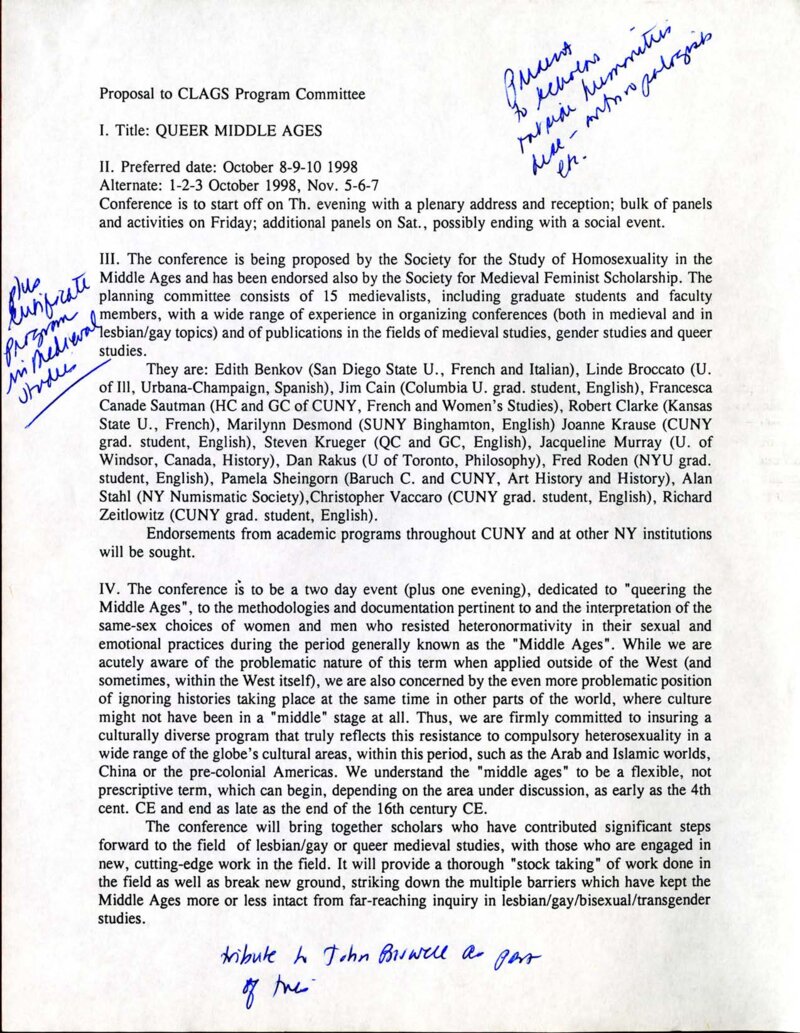
Proposal to CLAGS Program Committee wir
if
I. Title: QUEER MIDDLE AGES
Il. Preferred date: October 8-9-10 1998 pie :
Alternate: 1-2-3 October 1998, Nov. 5-6-7
Conference is to start off on Th. evening with a plenary address and reception; bulk of panels
and activities on Friday; additional panels on Sat., possibly ending with a social event.
III. The conference is being proposed by the Society for the Study of Homosexuality in the
Wa yh Middle Ages and has been endorsed also by the Society for Medieval Feminist Scholarship. The
iy planning committee consists of 15 medievalists, including graduate students and faculty
members, with a wide range of experience in organizing conferences (both in medieval and in
Al esianlesy topics) and of publications in the fields of medieval studies, gender studies and queer
studies.
atte They are: Edith Benkov (San Diego State U., French and Italian), Linde Broccato (U.
—s
of Ill, Urbana-Champaign, Spanish), Jim Cain (Columbia U. grad. student, English), Francesca
Canade Sautman (HC and GC of CUNY, French and Women’s Studies), Robert Clarke (Kansas
State U., French), Marilynn Desmond (SUNY Binghamton, English) Joanne Krause (CUNY
grad. student, English), Steven Krueger (QC and GC, English), Jacqueline Murray (U. of
Windsor, Canada, History), Dan Rakus (U of Toronto, Philosophy), Fred Roden (NYU grad.
student, English), Pamela Sheingorn (Baruch C. and CUNY, Art History and History), Alan
Stahl (NY Numismatic Society),Christopher Vaccaro (CUNY grad. student, English), Richard
Zeitlowitz (CUNY grad. student, English).
Endorsements from academic programs throughout CUNY and at other NY institutions
will be sought.
es
IV. The conference is to be a two day event (plus one evening), dedicated to "queering the
Middle Ages", to the methodologies and documentation pertinent to and the interpretation of the
same-sex choices of women and men who resisted heteronormativity in their sexual and
emotional practices during the period generally known as the "Middle Ages". While we are
acutely aware of the problematic nature of this term when applied outside of the West (and
sometimes, within the West itself), we are also concerned by the even more problematic position
of ignoring histories taking place at the same time in other parts of the world, where culture
might not have been in a "middle" stage at all. Thus, we are firmly committed to insuring a
culturally diverse program that truly reflects this resistance to compulsory heterosexuality in a
wide range of the globe’s cultural areas, within this period, such as the Arab and Islamic worlds,
China or the pre-colonial Americas. We understand the "middle ages" to be a flexible, not
prescriptive term, which can begin, depending on the area under discussion, as early as the 4th
cent. CE and end as late as the end of the 16th century CE.
The conference will bring together scholars who have contributed significant steps
forward to the field of lesbian/gay or queer medieval studies, with those who are engaged in
new, cutting-edge work in the field. It will provide a thorough "stock taking" of work done in
the field as well as break new ground, striking down the multiple barriers which have kept the
Middle Ages more or less intact from far-reaching inquiry in lesbian/gay/bisexual/transgender
studies.
wMbule A Tchr Biiwenl a- (er
eae
V. To date, there has been no conference of this amplitude dedicated specifically to the Middle
Ages. Queer studies have made significant inroads in the early modern period, but the Middle
Ages have only sporadically been the object of “queering" and of documenting lesbian,
homosexual, and bisexual lives, in the context of other more general conferences, such as the
International Congress on Medieval Studies which meets every year at WMI, Kalamazoo. Over
a number of years, special panels and sessions have gained credence and increased visibility at
that conference at others in which medieval topics are discussed. However, no conference of
national and international scope has yet taken place in which the Middle Ages are the focus.
Such a major event has not been planned yet in NYC and it seems particularly fitting that CUNY
and CLAGS be the host of such a pathbreaking event.
Furthermore, the Middle Ages play a potentially critical role, too long ignored, in current
debates over the historical parameters of the construction of homosexuality, offering a much
needed counterpoint to rigid theories which deny any possibility of its existence before the
modern age. The particularities of same-sex non-heteronormative behaviors in the Middle Ages
also provide an enormously rich material for a better understanding of many aspects of gendered
identities.
VI. The conference should appeal to a wide body of medievalists and early modern scholars,
regardless of their previous experience in the fields of lesbian/gay studies or queer studies; as
well, it is directed at a large audience from queer and gender theorists; thirdly, it should appeal
to a larger body within the educated New York area public with an interest in things medieval
and queer. It should move discussions over the above mentioned intellectual questions greatly
forward. It will insure that the study of the Middle Ages, at least in this continent, will no
longer be able to ignore queer studies.
VII. The conference organizers intend to publish the proceedings of the conference, or at least,
its best papers. This publication would be the first of its nature, a truly ground-breaking work
in the field of medieval queer/lesbian-gay studies, preceded to date, only by a shorter volume
consisting of papers in a special issue of GLQL. A volume (or possibly set of volumes) of this
amplitude, remarkable not only by the novelty of subject matter but also by the breadth and
diversity of its contents, is sure to be the object of instant interest on the part of several
publishers. We would plan to contract ahead of time for such a volume.
We do not feel that a video of the conference on the other hand, is of much relevance
or utility.
VIII. We want to organize the conference along two lines: a)invitations to a small group of 4
plenary speakers, as well as a few more well-known scholars who would be asked to lead
Lures
workshops or roundtables on specific subjects b) with a broad-based, inclusive call for papers, 2:
which would insure that some of the current work, especially by isolated scholars, that has not
yet been brought to light, would find a suitable forum.
We foresee the need to cover two broad categories of panels: a) Approaching the Middle
Ages through theoretically and methodologically oriented sessions, including, but not limited to,
the relation of queer theory to feminist theory, the impact of cultural studies, the role of the
disciplines on queering the Middle Ages (religious studies, art history, sociology etc), the
relation of lesbian studies to the study of homosexuality, pedagogy, teaching queerly, archival
resources and methods of inquiry.
b) sessions dedicated to discrete points of scholarly investigation as well as central questions in
the field of medieval studies for which queer interpretations are being proposed, including, but
not limited to, devotional material, queer Chaucer, Issues of Representation, Visual Cultures,
Lesbian Lives, Identities, queerness and subjectivity, nationhood and homophobia, misogyny and
female sexuality, western constructions of eastern sexuality as queer, pre-colonial America,
“passions of the Cut Sleeve". The call would be formulated in such a way as to encourage
submission of totally original work that fits no pre-determined category.
A number of names have been advanced as possible plenary speakers. Some have
pioneered work in lesbian/gay/queer medieval studies; others have offered particularly
enlightening theoretical approaches which have greatly influenced the queering of the Middle
Ages. Among these, four plenary speakers and possibly as many discussion leaders would be
asked to participate, on the premise that these scholars may be willing to speak for the rather
modest fee we are budgeting. We have indeed decided to eschew "star honoraria" that are
unrealistic for our budget, would inflate our needs, and distort the concept of the conference
with an excessively unequal valuation of scholars’ work. The scholars approached to fulfill a
plenary or discussant role include: Carolyn Dinshaw, E. Ann Matter, Judith Brown, Karma
Lochrie, Jacqueline Murray, Allen Frantzen, Larry Scanlon, Judith Bennett, Kathleen Biddick,
Michael Goodich, Valerie Traub, Jonathan Goldberg, Jonathan Dollimore, James Brundage,
Carla Freccero, Louise Fradenburg, Michael Camille.
IX.
The Planning Committee is applying for endorsement and financial support from CLAGS, with
the understanding that we would also seek additional funds elsewhere to meet all our expenses.
These revenues include: donations from academic programs at the colleges and the Graduate
School; registration fees and donations at the door; advertisement from local gay and gay-
supportive businesses in the final program.
Conference budget:
a. Space: in-kind contribution from GC, HC and NYU
b. Supplies: printing of annoucements, posters and programs: 1500
c. mailing: 700
d. travel and honoraria for 4 plenary speakers 2800 =< Fo
e. discussion/workshop leaders 800 = 200 Jur KY
f. thursday reception 700
g. 2 morning coffee services 800
otal: 6200
=
if
I. Title: QUEER MIDDLE AGES
Il. Preferred date: October 8-9-10 1998 pie :
Alternate: 1-2-3 October 1998, Nov. 5-6-7
Conference is to start off on Th. evening with a plenary address and reception; bulk of panels
and activities on Friday; additional panels on Sat., possibly ending with a social event.
III. The conference is being proposed by the Society for the Study of Homosexuality in the
Wa yh Middle Ages and has been endorsed also by the Society for Medieval Feminist Scholarship. The
iy planning committee consists of 15 medievalists, including graduate students and faculty
members, with a wide range of experience in organizing conferences (both in medieval and in
Al esianlesy topics) and of publications in the fields of medieval studies, gender studies and queer
studies.
atte They are: Edith Benkov (San Diego State U., French and Italian), Linde Broccato (U.
—s
of Ill, Urbana-Champaign, Spanish), Jim Cain (Columbia U. grad. student, English), Francesca
Canade Sautman (HC and GC of CUNY, French and Women’s Studies), Robert Clarke (Kansas
State U., French), Marilynn Desmond (SUNY Binghamton, English) Joanne Krause (CUNY
grad. student, English), Steven Krueger (QC and GC, English), Jacqueline Murray (U. of
Windsor, Canada, History), Dan Rakus (U of Toronto, Philosophy), Fred Roden (NYU grad.
student, English), Pamela Sheingorn (Baruch C. and CUNY, Art History and History), Alan
Stahl (NY Numismatic Society),Christopher Vaccaro (CUNY grad. student, English), Richard
Zeitlowitz (CUNY grad. student, English).
Endorsements from academic programs throughout CUNY and at other NY institutions
will be sought.
es
IV. The conference is to be a two day event (plus one evening), dedicated to "queering the
Middle Ages", to the methodologies and documentation pertinent to and the interpretation of the
same-sex choices of women and men who resisted heteronormativity in their sexual and
emotional practices during the period generally known as the "Middle Ages". While we are
acutely aware of the problematic nature of this term when applied outside of the West (and
sometimes, within the West itself), we are also concerned by the even more problematic position
of ignoring histories taking place at the same time in other parts of the world, where culture
might not have been in a "middle" stage at all. Thus, we are firmly committed to insuring a
culturally diverse program that truly reflects this resistance to compulsory heterosexuality in a
wide range of the globe’s cultural areas, within this period, such as the Arab and Islamic worlds,
China or the pre-colonial Americas. We understand the "middle ages" to be a flexible, not
prescriptive term, which can begin, depending on the area under discussion, as early as the 4th
cent. CE and end as late as the end of the 16th century CE.
The conference will bring together scholars who have contributed significant steps
forward to the field of lesbian/gay or queer medieval studies, with those who are engaged in
new, cutting-edge work in the field. It will provide a thorough "stock taking" of work done in
the field as well as break new ground, striking down the multiple barriers which have kept the
Middle Ages more or less intact from far-reaching inquiry in lesbian/gay/bisexual/transgender
studies.
wMbule A Tchr Biiwenl a- (er
eae
V. To date, there has been no conference of this amplitude dedicated specifically to the Middle
Ages. Queer studies have made significant inroads in the early modern period, but the Middle
Ages have only sporadically been the object of “queering" and of documenting lesbian,
homosexual, and bisexual lives, in the context of other more general conferences, such as the
International Congress on Medieval Studies which meets every year at WMI, Kalamazoo. Over
a number of years, special panels and sessions have gained credence and increased visibility at
that conference at others in which medieval topics are discussed. However, no conference of
national and international scope has yet taken place in which the Middle Ages are the focus.
Such a major event has not been planned yet in NYC and it seems particularly fitting that CUNY
and CLAGS be the host of such a pathbreaking event.
Furthermore, the Middle Ages play a potentially critical role, too long ignored, in current
debates over the historical parameters of the construction of homosexuality, offering a much
needed counterpoint to rigid theories which deny any possibility of its existence before the
modern age. The particularities of same-sex non-heteronormative behaviors in the Middle Ages
also provide an enormously rich material for a better understanding of many aspects of gendered
identities.
VI. The conference should appeal to a wide body of medievalists and early modern scholars,
regardless of their previous experience in the fields of lesbian/gay studies or queer studies; as
well, it is directed at a large audience from queer and gender theorists; thirdly, it should appeal
to a larger body within the educated New York area public with an interest in things medieval
and queer. It should move discussions over the above mentioned intellectual questions greatly
forward. It will insure that the study of the Middle Ages, at least in this continent, will no
longer be able to ignore queer studies.
VII. The conference organizers intend to publish the proceedings of the conference, or at least,
its best papers. This publication would be the first of its nature, a truly ground-breaking work
in the field of medieval queer/lesbian-gay studies, preceded to date, only by a shorter volume
consisting of papers in a special issue of GLQL. A volume (or possibly set of volumes) of this
amplitude, remarkable not only by the novelty of subject matter but also by the breadth and
diversity of its contents, is sure to be the object of instant interest on the part of several
publishers. We would plan to contract ahead of time for such a volume.
We do not feel that a video of the conference on the other hand, is of much relevance
or utility.
VIII. We want to organize the conference along two lines: a)invitations to a small group of 4
plenary speakers, as well as a few more well-known scholars who would be asked to lead
Lures
workshops or roundtables on specific subjects b) with a broad-based, inclusive call for papers, 2:
which would insure that some of the current work, especially by isolated scholars, that has not
yet been brought to light, would find a suitable forum.
We foresee the need to cover two broad categories of panels: a) Approaching the Middle
Ages through theoretically and methodologically oriented sessions, including, but not limited to,
the relation of queer theory to feminist theory, the impact of cultural studies, the role of the
disciplines on queering the Middle Ages (religious studies, art history, sociology etc), the
relation of lesbian studies to the study of homosexuality, pedagogy, teaching queerly, archival
resources and methods of inquiry.
b) sessions dedicated to discrete points of scholarly investigation as well as central questions in
the field of medieval studies for which queer interpretations are being proposed, including, but
not limited to, devotional material, queer Chaucer, Issues of Representation, Visual Cultures,
Lesbian Lives, Identities, queerness and subjectivity, nationhood and homophobia, misogyny and
female sexuality, western constructions of eastern sexuality as queer, pre-colonial America,
“passions of the Cut Sleeve". The call would be formulated in such a way as to encourage
submission of totally original work that fits no pre-determined category.
A number of names have been advanced as possible plenary speakers. Some have
pioneered work in lesbian/gay/queer medieval studies; others have offered particularly
enlightening theoretical approaches which have greatly influenced the queering of the Middle
Ages. Among these, four plenary speakers and possibly as many discussion leaders would be
asked to participate, on the premise that these scholars may be willing to speak for the rather
modest fee we are budgeting. We have indeed decided to eschew "star honoraria" that are
unrealistic for our budget, would inflate our needs, and distort the concept of the conference
with an excessively unequal valuation of scholars’ work. The scholars approached to fulfill a
plenary or discussant role include: Carolyn Dinshaw, E. Ann Matter, Judith Brown, Karma
Lochrie, Jacqueline Murray, Allen Frantzen, Larry Scanlon, Judith Bennett, Kathleen Biddick,
Michael Goodich, Valerie Traub, Jonathan Goldberg, Jonathan Dollimore, James Brundage,
Carla Freccero, Louise Fradenburg, Michael Camille.
IX.
The Planning Committee is applying for endorsement and financial support from CLAGS, with
the understanding that we would also seek additional funds elsewhere to meet all our expenses.
These revenues include: donations from academic programs at the colleges and the Graduate
School; registration fees and donations at the door; advertisement from local gay and gay-
supportive businesses in the final program.
Conference budget:
a. Space: in-kind contribution from GC, HC and NYU
b. Supplies: printing of annoucements, posters and programs: 1500
c. mailing: 700
d. travel and honoraria for 4 plenary speakers 2800 =< Fo
e. discussion/workshop leaders 800 = 200 Jur KY
f. thursday reception 700
g. 2 morning coffee services 800
otal: 6200
=
Title
Queer Middle Ages Conference Proposal
Description
This proposal was written in advance of CLAGS’ Queer Middle Ages conference that was held on November 5-7, 1998. The conference was created by a panel of 15 graduate students and faculty. Perhaps the most notable of whom was Steven Kreuger, a leading Queer Medievalist who teaches in the English Department at Queens College as well as the Graduate Center. This hugely successful conference, held in co-sponsorship with New York University, was the first large-scale conference to focus on the growing academic field of queering the Middle Ages.
Although formally instituted at the CUNY Graduate Center in 1991, CLAGS: The Center for LGBTQ Studies was first conceived 5 years earlier by Martin, Duberman, one of the first historians to embrace the, then infantile, field of Queer Studies. Duberman sensed the need for a formal center devoted to queer research. As the first university-based center for LGBTQ research, CLAGS continues to demonstrate its dedication to advancing Queer Studies, by hosting public events showcasing queer research and providing fellowships to support queer scholars. Among its many notable contributions, CLAGS annually puts on at least one major conference and holds the Kessler Award Lecture every fall to celebrate a queer scholar who has made a notable contribution to the field of queer studies.
Although formally instituted at the CUNY Graduate Center in 1991, CLAGS: The Center for LGBTQ Studies was first conceived 5 years earlier by Martin, Duberman, one of the first historians to embrace the, then infantile, field of Queer Studies. Duberman sensed the need for a formal center devoted to queer research. As the first university-based center for LGBTQ research, CLAGS continues to demonstrate its dedication to advancing Queer Studies, by hosting public events showcasing queer research and providing fellowships to support queer scholars. Among its many notable contributions, CLAGS annually puts on at least one major conference and holds the Kessler Award Lecture every fall to celebrate a queer scholar who has made a notable contribution to the field of queer studies.
Contributor
CLAGS
Creator
CLAGS
Date
November 1998 (Circa)
Language
English
Relation
7812
Rights
Copyrighted
Source
CLAGS Archive
Original Format
Report / Paper / Proposal
CLAGS. Letter. “Queer Middle Ages Conference Proposal”. 7812, CUNY DIGITAL HISTORY ARCHIVE, accessed September 5, 2026, https://stephenz.tailc22a4b.ts.net/s/cdha/item/1296