Letter from the "Adjunct and Part-time Faculty Caucus"
Item
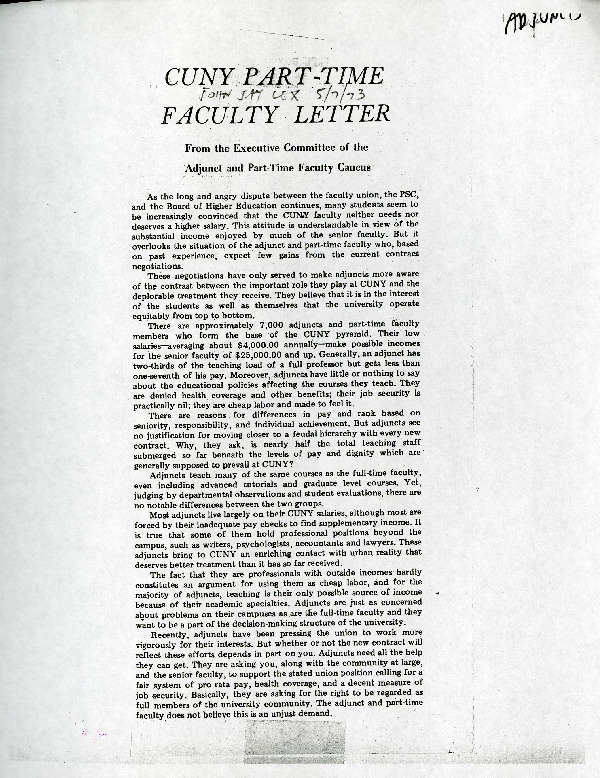
CUNY PART-TIME
forw TH EX = S/9/93
FACULTY LETTER
From the Executive Committee of the
- Adjunct and Part-‘l'ime Faculty Caucus
As the long and angry dispute. between the faculty union, the PSC,’
and the Board of Higher Education continues, many students seem to
be increasingly convinced that the CUNY faculty neither needs nor
deserves a higher salary. This attitude is understandable in view of the
substantial income enjoyed by much of the senior faculty. But it
overlooks the situation of the adjunct and part-time faculty who, based
on past experience, expect few gains from the current contract
negotiations. 5 a
These negotiations have only served to make adjuncts more aware
of the contrast between the important role they play at CUNY and the
deplorable treatment they receive. They believe that it is in the interest
of the students as well as themselves that the university operate
equitably from top to bottom. ~
There are approximately 7,000 adjuncts and part-time faculty
members who form the base of the CUNY pyramid. Their low
salaries—averaging about $4,000.00 annually—make possible incomes
for the senior faculty of $25,000.00 and up. Generally, an adjunct has
two-thirds of the teaching load of a full professor but gets less than
one-seventh of his pay. Moreover, adjuncts have little or nothing to say
about the educational policies affecting the courses they teach. They
are denied health coverage and other benefits; their job security is
practically nil; they are cheap labor and made to feel it.
There are reasons. for differences in pay and rank based on.
seniority, responsibility, and individual achievement. But adjuncts see
no justification for moving closer to a feudal hierarchy with every new
contract. Why, they ask, is nearly half the total teaching staff
submerged so far beneath the levels of pay and dignity which. are’
generally supposed to prevail at CUNY?
Adjuncts teach many of the same courses as the full-time faculty,
even including advanced tutorials and graduate level courses. Yet,
judging by departmental observations and student evaluations, there are
no notable differences between the two groups. j
Most adjuncts live largely on their CUNY salaries, although most are
forced by their inadequate pay checks to find supplementary income. It
is true that some of them hold professional positions beyond the
campus, such as writers, psychologists, accountants and lawyers. These
adjuncts bring to CUNY an enriching contact with urban reality that
deserves better treatment than it has so far received.
The fact that they are professionals with outside incomes hardly
constitutes an argument for using them as cheap labor, and for the
majority of adjuncts, teaching is their only possible source of income
because of their academic specialties. Adjuncts are just as concerned
about. problems on their campuses as are the full-time faculty and they
want to be a part of the decision-making structure of the university.
Recently, adjuncts have been pressing the union to work more
vigorously for their interests. But whether or not the new contract will
reflect these efforts depends in part on you. Adjuncts need all the help
they can get. They are asking you, along with the community at large,
and the senior faculty, to support the stated union position calling fora
fair system of pro rata pay, health coverage, and a decent measure of
job security. Basically, they are asking for the right to be regarded as
full members of the university community. The adjunct and part-time
faculty does not believe this is an unjust demand.
(Apes
forw TH EX = S/9/93
FACULTY LETTER
From the Executive Committee of the
- Adjunct and Part-‘l'ime Faculty Caucus
As the long and angry dispute. between the faculty union, the PSC,’
and the Board of Higher Education continues, many students seem to
be increasingly convinced that the CUNY faculty neither needs nor
deserves a higher salary. This attitude is understandable in view of the
substantial income enjoyed by much of the senior faculty. But it
overlooks the situation of the adjunct and part-time faculty who, based
on past experience, expect few gains from the current contract
negotiations. 5 a
These negotiations have only served to make adjuncts more aware
of the contrast between the important role they play at CUNY and the
deplorable treatment they receive. They believe that it is in the interest
of the students as well as themselves that the university operate
equitably from top to bottom. ~
There are approximately 7,000 adjuncts and part-time faculty
members who form the base of the CUNY pyramid. Their low
salaries—averaging about $4,000.00 annually—make possible incomes
for the senior faculty of $25,000.00 and up. Generally, an adjunct has
two-thirds of the teaching load of a full professor but gets less than
one-seventh of his pay. Moreover, adjuncts have little or nothing to say
about the educational policies affecting the courses they teach. They
are denied health coverage and other benefits; their job security is
practically nil; they are cheap labor and made to feel it.
There are reasons. for differences in pay and rank based on.
seniority, responsibility, and individual achievement. But adjuncts see
no justification for moving closer to a feudal hierarchy with every new
contract. Why, they ask, is nearly half the total teaching staff
submerged so far beneath the levels of pay and dignity which. are’
generally supposed to prevail at CUNY?
Adjuncts teach many of the same courses as the full-time faculty,
even including advanced tutorials and graduate level courses. Yet,
judging by departmental observations and student evaluations, there are
no notable differences between the two groups. j
Most adjuncts live largely on their CUNY salaries, although most are
forced by their inadequate pay checks to find supplementary income. It
is true that some of them hold professional positions beyond the
campus, such as writers, psychologists, accountants and lawyers. These
adjuncts bring to CUNY an enriching contact with urban reality that
deserves better treatment than it has so far received.
The fact that they are professionals with outside incomes hardly
constitutes an argument for using them as cheap labor, and for the
majority of adjuncts, teaching is their only possible source of income
because of their academic specialties. Adjuncts are just as concerned
about. problems on their campuses as are the full-time faculty and they
want to be a part of the decision-making structure of the university.
Recently, adjuncts have been pressing the union to work more
vigorously for their interests. But whether or not the new contract will
reflect these efforts depends in part on you. Adjuncts need all the help
they can get. They are asking you, along with the community at large,
and the senior faculty, to support the stated union position calling fora
fair system of pro rata pay, health coverage, and a decent measure of
job security. Basically, they are asking for the right to be regarded as
full members of the university community. The adjunct and part-time
faculty does not believe this is an unjust demand.
(Apes
Title
Letter from the "Adjunct and Part-time Faculty Caucus"
Description
Posted on the walls of John Jay College in 1973, this letter from the Executive Committee of the "Adjunct and Part-time Faculty Caucus" called for broader support from the CUNY community for the dignity and rights of adjunct faculty. In addition to highlighting pay and fringe benefit disparities, it discussed the fact that adjuncts had been pressing the union to work more vigorously for their interests, which included pro-rata pay, health coverage, and increased job security. The "Adjunct and Part-time Faculty Caucus" was a group formed in 1973. Chaired by David Allen, the group published and circulated challenges to the contract the PSC had negotiated, which it alleged had failed to advocate sufficiently for the rights of adjunct faculty.
Contributor
Professional Staff Congress
Creator
Adjunct and Part-time Faculty Caucus
Date
May 7, 1973
Language
English
Rights
Copyrighted
Source
The Tamiment Institute Library and Robert F. Wagner Labor Archives
Original Format
Memorandum
Adjunct and Part-time Faculty Caucus. Letter. “Letter from the ‘Adjunct and Part-Time Faculty Caucus’.”, CUNY DIGITAL HISTORY ARCHIVE, accessed September 5, 2026, https://stephenz.tailc22a4b.ts.net/s/cdha/item/1379