Adjunct Faculty Association Newsletter (v. 1. n. 1)
Item
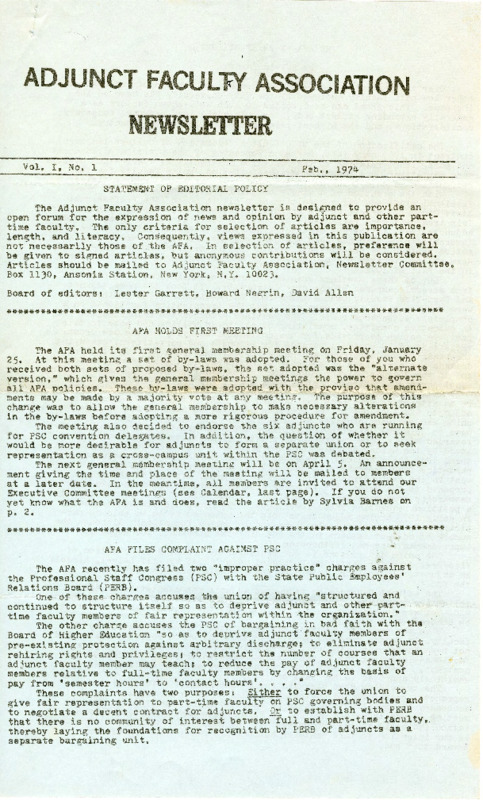
ADJUNCT FACULFY ASSOCIATION
NEWSLETTER
Vol. dp NOe iE ; Fed., 1974
eee CO EE RN CRE NOC OCL ON A A LES O NON AOA ENET 9 CORRE EEN BTCC LOND Nee NN
STATEMENT OF EDITORIAL POLICY
The Adjunct Faculty Association newsletter is designed to provide an
open forum for the expression of news and opinion by adjunct and other part-
time faculty. The only criteria for selection of articles are importance,
length, and literacy. Consequently, views expressed in this publication are
not necessarily those of the AFA. In selection of articles, preference will
be given to signed articles, but anonymous contributions will be considered.
Articles should be mailed to Adjunct Faculty Association, Newsletter Committee,
Box 1130, Ansonia Station, New York, N.Y. 10023.
Board of editors: Lester Garrett, Howard Negrin, David Allen
HEI HEHEHE RRA EAE ERE RH EEE SHEER EEE EERE EER GEE EEE E ERE HRERRHREREE EERE EEE ER EE
AFA HOLDS FIRST MEETING
The AFA held its first general membership meeting on Friday, January
25. At this meeting a set of by-laws was adopted, For those of you who
received both sets of proposed by-laws, the set adopted was the “alternate
version,” which gives the general membership meetings the power to govern
all AFA policies. These by-laws were adopted with the proviso that amend~
ments may be made by a majority vote at any meeting. The purpose of this
change was to allow the general membership to make necessary alterations
in the by-laws before adopting a more rigorous procedure for amendment.
The meeting also decided to endorse the six adjuncts who are running
for PSC convention delegates. In addition, the question of whether it
would be more desirable for adjuncts te form a separate union or to seek
representation as a cross-campus unit within the PSC was debated.
The next general membership meeting will be on April 5. An announce-
ment giving the time and place of the meeting will be mailed to members
at a later date. In the meantime, all members are invited to attend our
Executive Committee meetings (see Calendar, last page). If you do not
yet know what the AFA is and does, read the article by Sylvia Barnes on
Pe 26
HH EEE HAE EE HE TEE HEHE EEE EERE AEE ERED R EEA EER REE EG REE ERH EERE REM
*
AFA FILES COMPLAINT AGAINST PSC . = co .
-
The AFA recently has filed two “improper practice” charges against
the Professional Staff Congress (PSC) with the State Public Employees'
Relations Board (PERB).
One of these charges accuses the union of having “structured and
continued to structure itself so as to deprive adjunct and other part-
time faculty members of fair representation within the organization.“
The other charge accuses the PSC of bargaining in bad faith with the
Board of Higher Education “so as to deprive adjunct faculty members of
pre-existing protection against arbitrary discharge; to eliminate adjunct
rehiring rights and privileges; to restrict the number of courses that an.
adjunct faculty member may teach; to reduce the pay of adjunct faculty
members relative to full-time faculty members by changing the basis of
pay from ‘semester hours’ to ‘contact hours’. ..."
These complaints have two purposes: Either to force the union to
give fair representation to part-time faculty on PSC governing bodies and
to negotiate a decent contract for adjuncts. Or to establish with PERS
that there is no community of interest between full and part-time faculty,
thereby laying the foundations for recognition by PERB of adjuncts as a.
separate bargaining unit.
‘HE AFA--A BRIEF HISTORY
By Sylvia Barnes
Over the past five years, the number and proportion of adjuncts. and
other low paid faculty employed by the City University has been on the
increase. This trend can be credited to such well-known factors as a
generally expanding student body, the open admissions program, budgetary
considerations, and the highest-paid senior faculty in the country.
The ratification of the UFTC (United #®ederation of College Teachers )
contract in 1969 many felt, marked a worsening of the position of adjuncts
and part-timers relative to the full-time instructional staff--this despite
many part-timers had fought alongside full-time junzor faculty for the
recognition of this union as their collective bargaining repreentative.
With the creation of a single bargaining unit for the entire pro-
fessional staff and the recognition of a single union (the Professional
Staff Congress) as collective bargaining representative in 1972, hopes for
fair treatment were rekindled. At the same time, it became clear to some
adjuncts that, if the new contract (then under negotiation) was to be more
favorable to us than had been the previous one, we would have to take an
active part in the negotiations. With this in mind, a number of meetings
were called, independent of the PSC, by and for adjuncts and part-timers
im: the Vall of 1972.
Out of these meetings grew an informal organization, with members
from several campuses of the City University. It took the name Adjunct
and Part-Time Faculty Caucus (sometimes Association). Some participants
were union members, some were not. But the organization funetioned on a
completely autonomous basis. The meetings produced two main results: 19
An executive committee, consisting of all those willing and able to take
part, wa set up to provide for the continuous activity of the new group;
(2) a list of 19 contract demands for adjuncts and part-timers, embodying
the basis of our agreement and mutual hopes, was drawn up. The list of
demands was circulated on a number of campuses, to the union negotiators
and to the Board of Higher Education. Essentially, the group was demanding
equal pay and benefits for equal work done.
After much discussion the sroup decided that the best policy would
be to attempt to work with and through the Psc. It had been argued that
adjuncts had lost out on the previous contract because so few of them were
union members when compared to full-timers. If, therefore, more adjuncts
were to join the union their influence would be greater and they would be
rewarded with a more favorable contract. If adjuncts and part-timers
stood by the union, and exerted some pressure, the union would stand by
them. For these reasons, the group decided to encourage all adjuncts and
part-time faculty members to join the PSC in order to ensure better treat-
ment in the new contract. With :. this in mind, members of the group
proposed to the union that it. lower adjunct dues, in order to make such
membership more feasible financially. In the fall of 1972 we circulated
a petition requesting these lower dues. The gpoup distributed a leaflet
in early 1973 urging adjuncts to join the union $0 as to be able to par-
ticipate in the imminent elections and in policy formation. Although the
number of adjunct members in the PSC did rise somewhat, the hoped-for
improvements were not forthcoming.
The union did respond to our pressures by creating the position of
Vice-President for Part-Time Personnel, now filled by Bill Leicht, himself
an adjunct. An advisory committee and a newsletter were also set up by
the PSC.
The adjunct Caucus also requested adjunct representation in the
collective bargaining sessions then in progress between the BH# and the
PSC, but was turned down on the grounds that the request came too late to
be honored,
When the proposed contract was circulated for consideration by the
faculty, it became more and more clear that the union representatives had
not been bargaining with our interests in mind. A number of groups and
factions--including the Adjunct Caucus--opposed the ratification of this
contract. Despite its many shortcomings, however, the contract was over-
whelmingly approved in the Fall of 1973.
The tremendous step backward for adjuncts which this contract
represets, has convinced us that more than an informal pressure group is
necessary if our situation is to be improved significantly. At an open
meeting it was therefore decided to form a dues-paying membership assoc-
sation dedicated to the improvement of the position of all part-timers. It
4s our intention to take whatever actions are possible and necessary
toward that end.
THS BHE LOOKS OUT FOR OUK FUTURE: ADJUNCTS AND SOCIAL SiCUHITY
By David Allen
vost adjuncts are now aware that we are no longer eligible for Social
Security coverage. There is, however, considerable confusion as to why
adjuncts lost this coverage, and concerning the possible benefits and pay-
ments to which we are still entitled. This confusion is understandable in
view of the failure of the Board of Higher Education to publicize these
matters. After an extensive investigation, we believe we have come up
with most of the answers to the questions adjuncts have been asking about
Social Security.
Until January 1, 1973, all adjuncts were covered by Social Security.
This meant that a sum of money-averaging about »~25 per paycheck- was
deducted from the salary of adjuncts, and that the University contributed
an equal amount to the Social Security fund on a matching basis. This
money was to be used to provide adjuncts with the standard Social Security
retirement, accident, disability, and life insurance benefits.
Unfortunately, the University, in one of its many economy moves at
the expense of adjuncts, managed to persuade the social Security Administra-
tion that adjuncts should no longer be covered by social security. we
have been told that this was done by redefining adjuncts as "consultants,"
who do not have to be paid Social Security. This means, incidentally,
that adjuncts are now entitled to the tax benefits of consultants, which .
include deductions for travel expenses to and from work.
The ruling of the Social Security Administration was that any adjunct
hired prior to January 1, 1971, should remain on Social Security. Any
adjunct hired after that date was to be removed from the Social security
system effective January, 1973.
This ruling was a great windfall for the Board of Higher Education.
It means that for all practical purposes the BHE no longer has to contri-
pute to a retirement fund for adjuncts. . In a memorandum dated January Zs
1973, Vice Chancellor Newton urged Business Managers to enforce the new
ruling, "inasmuch as there are considerable financial costs to be incurred
by the University if Social Security coverage is inadvertantly given to
ineligible employees." It is true that since January 1, 1971, adjuncts
have been eligible for membership in the Teachers’ hetirement System (TxS).
However, few adjuncts have opted to join the system which is not mandatory
like Social Security; and the fact that adjuncts are eligible has not been
publicized by the University.
It appears there is not much that can be done to change these rulings.
However, it should be realized that because of the confusion surrounding
the cutoff, many adjuncts are eligible for payments or benefits of which
they are not aware.
First, any adjunct who had Social Security deducted from his pay after
January 1, 1973, is entitled to have that money returned to him. This can
be arranged by filling out the appropriate form at the Bursar's office on
your local campus. ’
In addition, any adjunct who was hired prior to January 1, 1971, is
still eligible: for Social Security. On a number of campuses thése adjuncts
were removed from Social security by the local business office. These oS
adjuncts can, if they wish, request to be reinstated. If they are not
reinstated they have grounds for filing a grievance.
At present adjuncts are not eligible to apply for the return of money
deducted from their 1971 and 1972 paychecks. This money is still ‘in the
Social Security fund and it is still matched by equal payments from the
University. If the University should receive back its matching payments,
then adjuncts will be eligible to have their share returned also. If the
University. then refuses to return this money, we Will ask the union to
file a grievance.
Finally, it should be noted that adjuncts who were graduate students
during 1971 and 1972 are, for a reason unrelated to the University's
cutoff, entitled to request the retroactive repayment of whatever money
was deducted from their pay for Social Security. In order to obtain this
money you should request the appropriate forms from your local Bursar's
office. aS : yee
oa oe a KO a a OS ee ee ee
WHAT A DIFFERENCE A WORD MAKES: ADJUNCTS SCHEDULED FOR PAY CUT
By Observer
The contract which the oC signed with the BHE this fall states that
adjunct faculty shall be paid for "contact hours" rather than "semester
hours", as had previously been the case.
The meaning of this provision is that adjunct salaries will no longer
be calculated by assuming a semester to be 15 weeks long, and then multi-
plying the number of hours taught each week by 15 to obtain the total
number of hours for which an instructor is paid during the semester.
Instead, days on which classes do not meet - for example holidays such as
Washington's Birthday - will be subtracted from the total of adjunct
teaching hours. Thus, depending upon the calendar followed on each indi-
vidual campus, the number of class days each semester will be between one
week and one and a half weeks less than the full 15 weeks. This ruling will
enable the City University tc pay adjunct. faculty about 9% less than they
would have been paid on the besis of “semester hours". The ground for
this change was prepared by the BHi's degradation of the status of adjuncts
by re-defining them as "consultants" (see article on Social Security).
The BHE has stated that this new policy will be enforced starting at
the beginning of this semester (see the BHE's “Guidelines and Procedures,
5
Instructional Staff for the CUNY Contract Administration", October 1973,
p. 4). Several campuses had already instituted the new procedures last
semester. Some of these campuses have adopted the practice of allowing
adjuncts to "make-up" classes lost because of holidays. This places the
-adjunct in the embarrassing position of trying to explain to his students
why other instructors i.e. full-time instructors are not requiring that
hours lost because of holidays be made up. Is the adjunct expected to de-
vise some fanciful story; or is he to frankly admit that this "make-up"
is being done not because of its presumed educational value, but because
he needs the money? The situation is quite ludicrous, de would be inter-
ested in learning the practices followed on the various individual campuses.
Write to the Adjunct Faculty Association, Box 1130, Ansonia Station, New
Wore, We vs LU0L)s
The new redefinition of the status of adjuncts could also prepare the
way for further reductions in salary. One such reduction could result from
paying adjuncts only for the 50 minutes in which they are actually in the
classroom rather than the full hour for which they are now paid. while
Vice-Chancellor David Wewton, in a meeting with several members of the AFA,
specifically denied any intention of carrying the new policy that har, the
PSC newsletter Clarion, in its edition of December 12, 1973, stated that
such a practice would be instituted. It is gratifying to learn that the
PSC leadership now considers this interpretation of the term "contact hours"
unwarranted, and urges any adjunct who discovers that he is being paid at
five-sixths of the hourly rate, that is for 50 minutes, to contact the
union. ‘je would urge those so affected to also write to the regal Committee
of the AFA at the above address.
The PSC has claimed that the substitution of “contact hours" for
"semester hours" was slipped into the contract by the BHE without the knowl-
edge or. consent. of the union. Cne wonders now this could have been possible
since the PSC.went over the contract repeatedly with a tean of labor
lawyers. At best, if it is an illustration of the neglect of adjunct
interests which characterizes the union.
5
The PSC has now filed a Step < grievance against this provision. Wwe
have talked with several lawyers, and have concluded that legal action
would be appropriate if the grievance is lost. Even if the substitution of
"contact hours"
it is probable that adjuncts would have a legal right to retroactive pay
for their office hours last fall, for under this new system adjuncts could
not be asked to assume such an additional burden without compensation.
We are watching closely to see how the PSC handles this important
issue. It will be interesting to see 4f the union's new professions of
goodwill for adjuncts extends so far as to motivate them to undertake an
expensive legal action on our behalf. If the FSC fails to take legal
action soon, we may file suit ourselves, although this would necessitate
extensive fund raising among adjuncts.
D2. dt. Ba BE OL SE BE SE BE SA SE SEE SE. 34 4% Me Me 3h
SEAS IE IESE SESE ETE HE IEE HE To Ge SOS
see MOE DEY Pes ear a en ee A ae ge Be PREETI PY PINE SPIRO COR DYN VY
FETE SESE SESE SE EEE TEESE TEE TEE TE ES MILE SESE FE ME ESE TE TEE TEE EH MAGE GENE SESE SESE TG GE GE EE ee ON
DEPARTMENT Of LABOR EXAMINES SALARIES OF PART-TIMSRS
The Wage and Hour Division of the Department of Labor which enforces
the provisions of the Equal Pay Act is reconsidering its policy of com-
paring the salaries of part-time workers only to those of other part-
time workers, and of comparing the wages of full-time workers only to
those of other full-time workers. If a change is to be made in this
policy, it could have important imphications for adjuncts, since it could
bring federal pressure to bear to end the disproportion between the salaries
of full and part-time faculty. ;
The Department of Labor is inviting comment on this proposed change.
We believe it is important that as many adjuncts as possible write to
the Department advocating proportional pay for part-timers. Letters
should emphasize especially that the disproportionate salaries é paid to
full and part-time teachers contributes to discrimination against women
and minority members. Letters should be addressed to: Morag Simchak,
Employment Standards Administration, Department of Labor, Washington, D.C.
20210
for "semester hours" holds up in court - which 1s unitkety—-_..
AFA INVESTIGATES PSC HANDLING OF GRIBVANCES
As a part of the legal cese which she APA is attempting to establish
against the union before PERB (see story on p. 1}, wo are conducting an —
inquiry into the PSC°s handling of adjunet grievances. If you have or have
had a grievance which you believo has not been properly handled by the
PSC--especially if 1% involves deliberate inaction or suppression of
evidence by the unicne-please let us knew, Replics will be kept completely
confidential, if you wish. Write, giving as many relevant details as ee
possible, to: Adjunct Faculty Association, Legal Comittee, Box 1130,
- Ansonia Station, Now York, N.Y. 10023
HERES LO LG Lhe Sho LPT ED LEAS LO CHAE LLP DCAM Le Ch ga LED EPA ESD ADEN SP CHES ECDL Ch LESS Sh gb SO AE a Shab Ge CO aS OE AEE Aaa a Ob aE OP aE aE dE BOE ae ae
CALENDAR OF EVENTS
Fri., Feb. 8, % p.m .--EXECUTIVE COMMITENS. Koon 1625 Graduate Center (33
ee 7. 2nd St.}. All invited :
Sate, Fed. 23, 2-5 pom. Mooting of the SECRETARIAL COMMITTEE. Come one
and all ver a jolly afternoon of addressing envelopes, A
rare opportunity to spoak en oan’ informal basis with your
exalted Leadership. The loeatien: Howard Negrin, 14 Washington
Place, #3F
Fri., March 1, 4% p.m,--EXECUTIVE COMMITTES. 1625 Graduate Center
Fri., March 22 (ove. )--PARTY, Free for mombers, non-members $3.00. A
jollivication with free foed and drink. A chance to meet
adjuncts from the far-flung reaches of CUNY,
Fri., March 29, 4% DeMo--EXHCUTIVE COMMITTEE. 1625 Graduate Center.
Pri., April 5, 4 p.m, [tentative ]--GENERAL MEMBERSHIP MEETING
*We have so far been unable to obtein a room for these events.
Members will receive notifieation of oxact time and place as soon as
possible. Both will prebably be held in the Graduate Center...
ORR RINE TAROT AN IR EE MN EN IN oe A
The AFA needs both MONEY and MEMBERS. Without sizeable donations we
cannot continue to put out literature, pay for railings, and pay legal
fees, Our strength is directly proportional to the number of our menbers--
and especially activo members, Therefore, JOIN NOY and GIVE GENEROUSLY.
For further information econcernir.g the. AFA centact: David Allen
(Chairman), 310 Riverside Drive, #1002, New York, N.Y. 10025. Phone:
864-1700, ext. 1002 (eves, between 5-12 p.m best).
OP AD ER ED ED SD OD ED HD SEH GH ED OD AY HD A CE EH KD EY GE CM ETD AP AD Ce aD CaP OD aD ED Oe a> 4B Ce a th Gd OR GP OP EP Om GY ED TP OD CD CP GY GD UO GD MP GD OD Ue C1 CD OD OD UD GD GR UE ON On Hn OD aD OD
Adjunct Faculty Association
Box 1130 2
Ansonia Station
New York, N.Y. 10023
I enclose $3.00 om more for one year’s membership. (Make checks
payable to “Adjunct Paculty Association, “*)
Name College
Address Dent.
Home phone_
pa
Check one or more of the following if you would be willing to:
( )Attend meetings { )Distribute literature
( )Perform clerical work ( )Perform research
)Solicit menvers ( jOther (please specify)
)Work on newsletter
NEWSLETTER
Vol. dp NOe iE ; Fed., 1974
eee CO EE RN CRE NOC OCL ON A A LES O NON AOA ENET 9 CORRE EEN BTCC LOND Nee NN
STATEMENT OF EDITORIAL POLICY
The Adjunct Faculty Association newsletter is designed to provide an
open forum for the expression of news and opinion by adjunct and other part-
time faculty. The only criteria for selection of articles are importance,
length, and literacy. Consequently, views expressed in this publication are
not necessarily those of the AFA. In selection of articles, preference will
be given to signed articles, but anonymous contributions will be considered.
Articles should be mailed to Adjunct Faculty Association, Newsletter Committee,
Box 1130, Ansonia Station, New York, N.Y. 10023.
Board of editors: Lester Garrett, Howard Negrin, David Allen
HEI HEHEHE RRA EAE ERE RH EEE SHEER EEE EERE EER GEE EEE E ERE HRERRHREREE EERE EEE ER EE
AFA HOLDS FIRST MEETING
The AFA held its first general membership meeting on Friday, January
25. At this meeting a set of by-laws was adopted, For those of you who
received both sets of proposed by-laws, the set adopted was the “alternate
version,” which gives the general membership meetings the power to govern
all AFA policies. These by-laws were adopted with the proviso that amend~
ments may be made by a majority vote at any meeting. The purpose of this
change was to allow the general membership to make necessary alterations
in the by-laws before adopting a more rigorous procedure for amendment.
The meeting also decided to endorse the six adjuncts who are running
for PSC convention delegates. In addition, the question of whether it
would be more desirable for adjuncts te form a separate union or to seek
representation as a cross-campus unit within the PSC was debated.
The next general membership meeting will be on April 5. An announce-
ment giving the time and place of the meeting will be mailed to members
at a later date. In the meantime, all members are invited to attend our
Executive Committee meetings (see Calendar, last page). If you do not
yet know what the AFA is and does, read the article by Sylvia Barnes on
Pe 26
HH EEE HAE EE HE TEE HEHE EEE EERE AEE ERED R EEA EER REE EG REE ERH EERE REM
*
AFA FILES COMPLAINT AGAINST PSC . = co .
-
The AFA recently has filed two “improper practice” charges against
the Professional Staff Congress (PSC) with the State Public Employees'
Relations Board (PERB).
One of these charges accuses the union of having “structured and
continued to structure itself so as to deprive adjunct and other part-
time faculty members of fair representation within the organization.“
The other charge accuses the PSC of bargaining in bad faith with the
Board of Higher Education “so as to deprive adjunct faculty members of
pre-existing protection against arbitrary discharge; to eliminate adjunct
rehiring rights and privileges; to restrict the number of courses that an.
adjunct faculty member may teach; to reduce the pay of adjunct faculty
members relative to full-time faculty members by changing the basis of
pay from ‘semester hours’ to ‘contact hours’. ..."
These complaints have two purposes: Either to force the union to
give fair representation to part-time faculty on PSC governing bodies and
to negotiate a decent contract for adjuncts. Or to establish with PERS
that there is no community of interest between full and part-time faculty,
thereby laying the foundations for recognition by PERB of adjuncts as a.
separate bargaining unit.
‘HE AFA--A BRIEF HISTORY
By Sylvia Barnes
Over the past five years, the number and proportion of adjuncts. and
other low paid faculty employed by the City University has been on the
increase. This trend can be credited to such well-known factors as a
generally expanding student body, the open admissions program, budgetary
considerations, and the highest-paid senior faculty in the country.
The ratification of the UFTC (United #®ederation of College Teachers )
contract in 1969 many felt, marked a worsening of the position of adjuncts
and part-timers relative to the full-time instructional staff--this despite
many part-timers had fought alongside full-time junzor faculty for the
recognition of this union as their collective bargaining repreentative.
With the creation of a single bargaining unit for the entire pro-
fessional staff and the recognition of a single union (the Professional
Staff Congress) as collective bargaining representative in 1972, hopes for
fair treatment were rekindled. At the same time, it became clear to some
adjuncts that, if the new contract (then under negotiation) was to be more
favorable to us than had been the previous one, we would have to take an
active part in the negotiations. With this in mind, a number of meetings
were called, independent of the PSC, by and for adjuncts and part-timers
im: the Vall of 1972.
Out of these meetings grew an informal organization, with members
from several campuses of the City University. It took the name Adjunct
and Part-Time Faculty Caucus (sometimes Association). Some participants
were union members, some were not. But the organization funetioned on a
completely autonomous basis. The meetings produced two main results: 19
An executive committee, consisting of all those willing and able to take
part, wa set up to provide for the continuous activity of the new group;
(2) a list of 19 contract demands for adjuncts and part-timers, embodying
the basis of our agreement and mutual hopes, was drawn up. The list of
demands was circulated on a number of campuses, to the union negotiators
and to the Board of Higher Education. Essentially, the group was demanding
equal pay and benefits for equal work done.
After much discussion the sroup decided that the best policy would
be to attempt to work with and through the Psc. It had been argued that
adjuncts had lost out on the previous contract because so few of them were
union members when compared to full-timers. If, therefore, more adjuncts
were to join the union their influence would be greater and they would be
rewarded with a more favorable contract. If adjuncts and part-timers
stood by the union, and exerted some pressure, the union would stand by
them. For these reasons, the group decided to encourage all adjuncts and
part-time faculty members to join the PSC in order to ensure better treat-
ment in the new contract. With :. this in mind, members of the group
proposed to the union that it. lower adjunct dues, in order to make such
membership more feasible financially. In the fall of 1972 we circulated
a petition requesting these lower dues. The gpoup distributed a leaflet
in early 1973 urging adjuncts to join the union $0 as to be able to par-
ticipate in the imminent elections and in policy formation. Although the
number of adjunct members in the PSC did rise somewhat, the hoped-for
improvements were not forthcoming.
The union did respond to our pressures by creating the position of
Vice-President for Part-Time Personnel, now filled by Bill Leicht, himself
an adjunct. An advisory committee and a newsletter were also set up by
the PSC.
The adjunct Caucus also requested adjunct representation in the
collective bargaining sessions then in progress between the BH# and the
PSC, but was turned down on the grounds that the request came too late to
be honored,
When the proposed contract was circulated for consideration by the
faculty, it became more and more clear that the union representatives had
not been bargaining with our interests in mind. A number of groups and
factions--including the Adjunct Caucus--opposed the ratification of this
contract. Despite its many shortcomings, however, the contract was over-
whelmingly approved in the Fall of 1973.
The tremendous step backward for adjuncts which this contract
represets, has convinced us that more than an informal pressure group is
necessary if our situation is to be improved significantly. At an open
meeting it was therefore decided to form a dues-paying membership assoc-
sation dedicated to the improvement of the position of all part-timers. It
4s our intention to take whatever actions are possible and necessary
toward that end.
THS BHE LOOKS OUT FOR OUK FUTURE: ADJUNCTS AND SOCIAL SiCUHITY
By David Allen
vost adjuncts are now aware that we are no longer eligible for Social
Security coverage. There is, however, considerable confusion as to why
adjuncts lost this coverage, and concerning the possible benefits and pay-
ments to which we are still entitled. This confusion is understandable in
view of the failure of the Board of Higher Education to publicize these
matters. After an extensive investigation, we believe we have come up
with most of the answers to the questions adjuncts have been asking about
Social Security.
Until January 1, 1973, all adjuncts were covered by Social Security.
This meant that a sum of money-averaging about »~25 per paycheck- was
deducted from the salary of adjuncts, and that the University contributed
an equal amount to the Social Security fund on a matching basis. This
money was to be used to provide adjuncts with the standard Social Security
retirement, accident, disability, and life insurance benefits.
Unfortunately, the University, in one of its many economy moves at
the expense of adjuncts, managed to persuade the social Security Administra-
tion that adjuncts should no longer be covered by social security. we
have been told that this was done by redefining adjuncts as "consultants,"
who do not have to be paid Social Security. This means, incidentally,
that adjuncts are now entitled to the tax benefits of consultants, which .
include deductions for travel expenses to and from work.
The ruling of the Social Security Administration was that any adjunct
hired prior to January 1, 1971, should remain on Social Security. Any
adjunct hired after that date was to be removed from the Social security
system effective January, 1973.
This ruling was a great windfall for the Board of Higher Education.
It means that for all practical purposes the BHE no longer has to contri-
pute to a retirement fund for adjuncts. . In a memorandum dated January Zs
1973, Vice Chancellor Newton urged Business Managers to enforce the new
ruling, "inasmuch as there are considerable financial costs to be incurred
by the University if Social Security coverage is inadvertantly given to
ineligible employees." It is true that since January 1, 1971, adjuncts
have been eligible for membership in the Teachers’ hetirement System (TxS).
However, few adjuncts have opted to join the system which is not mandatory
like Social Security; and the fact that adjuncts are eligible has not been
publicized by the University.
It appears there is not much that can be done to change these rulings.
However, it should be realized that because of the confusion surrounding
the cutoff, many adjuncts are eligible for payments or benefits of which
they are not aware.
First, any adjunct who had Social Security deducted from his pay after
January 1, 1973, is entitled to have that money returned to him. This can
be arranged by filling out the appropriate form at the Bursar's office on
your local campus. ’
In addition, any adjunct who was hired prior to January 1, 1971, is
still eligible: for Social Security. On a number of campuses thése adjuncts
were removed from Social security by the local business office. These oS
adjuncts can, if they wish, request to be reinstated. If they are not
reinstated they have grounds for filing a grievance.
At present adjuncts are not eligible to apply for the return of money
deducted from their 1971 and 1972 paychecks. This money is still ‘in the
Social Security fund and it is still matched by equal payments from the
University. If the University should receive back its matching payments,
then adjuncts will be eligible to have their share returned also. If the
University. then refuses to return this money, we Will ask the union to
file a grievance.
Finally, it should be noted that adjuncts who were graduate students
during 1971 and 1972 are, for a reason unrelated to the University's
cutoff, entitled to request the retroactive repayment of whatever money
was deducted from their pay for Social Security. In order to obtain this
money you should request the appropriate forms from your local Bursar's
office. aS : yee
oa oe a KO a a OS ee ee ee
WHAT A DIFFERENCE A WORD MAKES: ADJUNCTS SCHEDULED FOR PAY CUT
By Observer
The contract which the oC signed with the BHE this fall states that
adjunct faculty shall be paid for "contact hours" rather than "semester
hours", as had previously been the case.
The meaning of this provision is that adjunct salaries will no longer
be calculated by assuming a semester to be 15 weeks long, and then multi-
plying the number of hours taught each week by 15 to obtain the total
number of hours for which an instructor is paid during the semester.
Instead, days on which classes do not meet - for example holidays such as
Washington's Birthday - will be subtracted from the total of adjunct
teaching hours. Thus, depending upon the calendar followed on each indi-
vidual campus, the number of class days each semester will be between one
week and one and a half weeks less than the full 15 weeks. This ruling will
enable the City University tc pay adjunct. faculty about 9% less than they
would have been paid on the besis of “semester hours". The ground for
this change was prepared by the BHi's degradation of the status of adjuncts
by re-defining them as "consultants" (see article on Social Security).
The BHE has stated that this new policy will be enforced starting at
the beginning of this semester (see the BHE's “Guidelines and Procedures,
5
Instructional Staff for the CUNY Contract Administration", October 1973,
p. 4). Several campuses had already instituted the new procedures last
semester. Some of these campuses have adopted the practice of allowing
adjuncts to "make-up" classes lost because of holidays. This places the
-adjunct in the embarrassing position of trying to explain to his students
why other instructors i.e. full-time instructors are not requiring that
hours lost because of holidays be made up. Is the adjunct expected to de-
vise some fanciful story; or is he to frankly admit that this "make-up"
is being done not because of its presumed educational value, but because
he needs the money? The situation is quite ludicrous, de would be inter-
ested in learning the practices followed on the various individual campuses.
Write to the Adjunct Faculty Association, Box 1130, Ansonia Station, New
Wore, We vs LU0L)s
The new redefinition of the status of adjuncts could also prepare the
way for further reductions in salary. One such reduction could result from
paying adjuncts only for the 50 minutes in which they are actually in the
classroom rather than the full hour for which they are now paid. while
Vice-Chancellor David Wewton, in a meeting with several members of the AFA,
specifically denied any intention of carrying the new policy that har, the
PSC newsletter Clarion, in its edition of December 12, 1973, stated that
such a practice would be instituted. It is gratifying to learn that the
PSC leadership now considers this interpretation of the term "contact hours"
unwarranted, and urges any adjunct who discovers that he is being paid at
five-sixths of the hourly rate, that is for 50 minutes, to contact the
union. ‘je would urge those so affected to also write to the regal Committee
of the AFA at the above address.
The PSC has claimed that the substitution of “contact hours" for
"semester hours" was slipped into the contract by the BHE without the knowl-
edge or. consent. of the union. Cne wonders now this could have been possible
since the PSC.went over the contract repeatedly with a tean of labor
lawyers. At best, if it is an illustration of the neglect of adjunct
interests which characterizes the union.
5
The PSC has now filed a Step < grievance against this provision. Wwe
have talked with several lawyers, and have concluded that legal action
would be appropriate if the grievance is lost. Even if the substitution of
"contact hours"
it is probable that adjuncts would have a legal right to retroactive pay
for their office hours last fall, for under this new system adjuncts could
not be asked to assume such an additional burden without compensation.
We are watching closely to see how the PSC handles this important
issue. It will be interesting to see 4f the union's new professions of
goodwill for adjuncts extends so far as to motivate them to undertake an
expensive legal action on our behalf. If the FSC fails to take legal
action soon, we may file suit ourselves, although this would necessitate
extensive fund raising among adjuncts.
D2. dt. Ba BE OL SE BE SE BE SA SE SEE SE. 34 4% Me Me 3h
SEAS IE IESE SESE ETE HE IEE HE To Ge SOS
see MOE DEY Pes ear a en ee A ae ge Be PREETI PY PINE SPIRO COR DYN VY
FETE SESE SESE SE EEE TEESE TEE TEE TE ES MILE SESE FE ME ESE TE TEE TEE EH MAGE GENE SESE SESE TG GE GE EE ee ON
DEPARTMENT Of LABOR EXAMINES SALARIES OF PART-TIMSRS
The Wage and Hour Division of the Department of Labor which enforces
the provisions of the Equal Pay Act is reconsidering its policy of com-
paring the salaries of part-time workers only to those of other part-
time workers, and of comparing the wages of full-time workers only to
those of other full-time workers. If a change is to be made in this
policy, it could have important imphications for adjuncts, since it could
bring federal pressure to bear to end the disproportion between the salaries
of full and part-time faculty. ;
The Department of Labor is inviting comment on this proposed change.
We believe it is important that as many adjuncts as possible write to
the Department advocating proportional pay for part-timers. Letters
should emphasize especially that the disproportionate salaries é paid to
full and part-time teachers contributes to discrimination against women
and minority members. Letters should be addressed to: Morag Simchak,
Employment Standards Administration, Department of Labor, Washington, D.C.
20210
for "semester hours" holds up in court - which 1s unitkety—-_..
AFA INVESTIGATES PSC HANDLING OF GRIBVANCES
As a part of the legal cese which she APA is attempting to establish
against the union before PERB (see story on p. 1}, wo are conducting an —
inquiry into the PSC°s handling of adjunet grievances. If you have or have
had a grievance which you believo has not been properly handled by the
PSC--especially if 1% involves deliberate inaction or suppression of
evidence by the unicne-please let us knew, Replics will be kept completely
confidential, if you wish. Write, giving as many relevant details as ee
possible, to: Adjunct Faculty Association, Legal Comittee, Box 1130,
- Ansonia Station, Now York, N.Y. 10023
HERES LO LG Lhe Sho LPT ED LEAS LO CHAE LLP DCAM Le Ch ga LED EPA ESD ADEN SP CHES ECDL Ch LESS Sh gb SO AE a Shab Ge CO aS OE AEE Aaa a Ob aE OP aE aE dE BOE ae ae
CALENDAR OF EVENTS
Fri., Feb. 8, % p.m .--EXECUTIVE COMMITENS. Koon 1625 Graduate Center (33
ee 7. 2nd St.}. All invited :
Sate, Fed. 23, 2-5 pom. Mooting of the SECRETARIAL COMMITTEE. Come one
and all ver a jolly afternoon of addressing envelopes, A
rare opportunity to spoak en oan’ informal basis with your
exalted Leadership. The loeatien: Howard Negrin, 14 Washington
Place, #3F
Fri., March 1, 4% p.m,--EXECUTIVE COMMITTES. 1625 Graduate Center
Fri., March 22 (ove. )--PARTY, Free for mombers, non-members $3.00. A
jollivication with free foed and drink. A chance to meet
adjuncts from the far-flung reaches of CUNY,
Fri., March 29, 4% DeMo--EXHCUTIVE COMMITTEE. 1625 Graduate Center.
Pri., April 5, 4 p.m, [tentative ]--GENERAL MEMBERSHIP MEETING
*We have so far been unable to obtein a room for these events.
Members will receive notifieation of oxact time and place as soon as
possible. Both will prebably be held in the Graduate Center...
ORR RINE TAROT AN IR EE MN EN IN oe A
The AFA needs both MONEY and MEMBERS. Without sizeable donations we
cannot continue to put out literature, pay for railings, and pay legal
fees, Our strength is directly proportional to the number of our menbers--
and especially activo members, Therefore, JOIN NOY and GIVE GENEROUSLY.
For further information econcernir.g the. AFA centact: David Allen
(Chairman), 310 Riverside Drive, #1002, New York, N.Y. 10025. Phone:
864-1700, ext. 1002 (eves, between 5-12 p.m best).
OP AD ER ED ED SD OD ED HD SEH GH ED OD AY HD A CE EH KD EY GE CM ETD AP AD Ce aD CaP OD aD ED Oe a> 4B Ce a th Gd OR GP OP EP Om GY ED TP OD CD CP GY GD UO GD MP GD OD Ue C1 CD OD OD UD GD GR UE ON On Hn OD aD OD
Adjunct Faculty Association
Box 1130 2
Ansonia Station
New York, N.Y. 10023
I enclose $3.00 om more for one year’s membership. (Make checks
payable to “Adjunct Paculty Association, “*)
Name College
Address Dent.
Home phone_
pa
Check one or more of the following if you would be willing to:
( )Attend meetings { )Distribute literature
( )Perform clerical work ( )Perform research
)Solicit menvers ( jOther (please specify)
)Work on newsletter
Title
Adjunct Faculty Association Newsletter (v. 1. n. 1)
Description
This February 1974 Adjunct Faculty Association newsletter included an announcement of the formation of the Adjunct Faculty Association (AFA), the new organization's formal complaint filed against the Professional Staff Congress (PSC), several longer-form pieces on adjunct labor, and a calendar of events. The newsletter argued that the formal complaint would either force the Professional Staff Congress (PSC) to give fair representation to part-time faculty or allw AFA to establish a claim to PERB that there was no community of interest between full- and part-time faculty, which would establish the foundation for a separate bargaining unit. The newsletter also included "The AFA: a Brief History" by Sylvia Barnes, which claimed that after much discussion the organization ultimately decided that the best policy would be "to attempt to work with and through the PSC" for a contract that would "ensure better treatment of adjuncts."
Contributor
Professional Staff Congress
Creator
Adjunct Faculty Association
Date
February 1974
Language
English
Rights
Copyrighted
Source
The Tamiment Institute Library and Robert F. Wagner Labor Archives
Original Format
Newspaper / Magazine / Journal
Adjunct Faculty Association. Letter. “Adjunct Faculty Association Newsletter (v. 1. N. 1).”, CUNY DIGITAL HISTORY ARCHIVE, accessed September 5, 2026, https://stephenz.tailc22a4b.ts.net/s/cdha/item/1384