Letter: Economic Disparity
Item
Doctoral Students' Council, Rms. 201/8
The Graduate School and University Center
of the City University of New York
Graduate Center: 33 West 42 Street, New York, N.Y. 10036
18 August 1982
Dr. Irwin Polishook, President
Professional Staff Congress
25 West 43rd Street
New York City, N.Y. 10036
Dear Dr. Polishook,
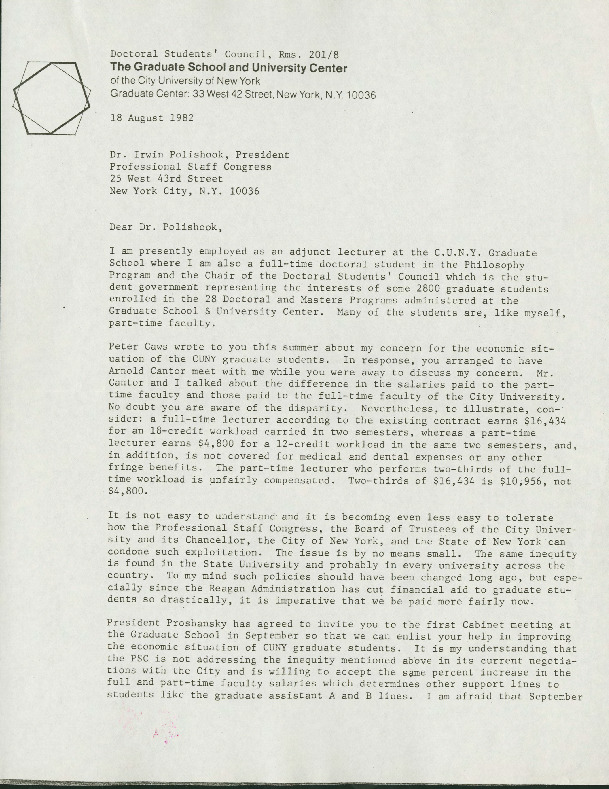
I am presently employed as an adjunct lecturer at the C.U.N.Y. Graduate
School where I am also a full-time doctoral student in the Philosophy
Program and the Chair of the Doctoral Students' Council which is the stu-
dent government representing the interests of some 2800 graduate students
enrolled in the 28 Doctoral and Masters Programs administered at the
Graduate School & University Center. Many of the students are, like myself,
part-time faculty.
Peter Caws wrote to you this summer about my concern for the economic sit-
uation of the CUNY graduate students. In response, you arranged to have
Arnold Cantor meet with me while you were away to discuss my concern. Mr.
Cantor and I talked about the difference in the salaries paid to the part-
time faculty and those paid to the full-time faculty of the City University.
No doubt you are aware of the disparity. Nevertheless, to illustrate, con-
sider: a full-time lecturer according to the existing contract earns $16,434
for an 18-credit workload carried in two semesters, whereas a part-time
lecturer earns $4,800 for a 12-credit workload in the same two semesters, and,
in addition, is not covered for medical and dental expenses or any other
fringe benefits. The part-time lecturer who performs two-thirds of the full-
time workload is unfairly compensated. Two-thirds of $16,434 is $10,956, not
$4,800.
It is not easy to understand and it is becoming even less easy to tolerate
how the Professional Staff Congress, the Board of Trustees of the City Univer-
sity and its Chancellor, the City of New York, and the State of New York can
condone such exploitation. The issue is by no means small. The same inequity
is found in the State University and probably in every university across the
country. To my mind such policies should have been changed long ago, but espe-
cially since the Reagan Administration has cut financial aid to graduate stu-
dents so drastically, it is imperative that we be paid more fairly now.
President Proshansky has agreed to invite you to the first Cabinet meeting at
the Graduate School in September so that we can enlist your help in improving
the economic situation of CUNY graduate students. It is my understanding that
the PSC is not addressing the inequity mentioned above in its current negotia-
tions with the City and is willing to accept the same percent increase in the
full and part-time faculty salaries which determines other support lines to
students like the graduate assistant A and B lines. I am afraid that September
Page 2
Dr. Polishook
18 August 1982
may be too late.
Perhaps past strategies have been such as to fight primarily for the
interests of full-time faculty. -Any approach which assumes that the
economic pie is only so big and if one group gets a bigger share, it
means less remains for dividing among the others, is hopeless. It is
not my intention to deprive full-time faculty of anything. I hope we
can cooperate and together assert the value of higher education. One
way of doing that is to improve the part-time faculty salaries. Mr.
Cantor said now is not the time to attempt this. To wait is not accept-
able. Waiting only permits the escalation of military and defense
Spending by the federal government. We must challenge the lack of
foresight the Reagan Administration has shown and work to establish edu-
cation as a priority. Without education we are hopelessly lost. I
trust you share the same vision I am alluding to.
I should appreciate meeting with you soon to discuss my concern.
Sincerely you
rs.
Jonathan Lang
Chair
The Graduate School and University Center
of the City University of New York
Graduate Center: 33 West 42 Street, New York, N.Y. 10036
18 August 1982
Dr. Irwin Polishook, President
Professional Staff Congress
25 West 43rd Street
New York City, N.Y. 10036
Dear Dr. Polishook,
I am presently employed as an adjunct lecturer at the C.U.N.Y. Graduate
School where I am also a full-time doctoral student in the Philosophy
Program and the Chair of the Doctoral Students' Council which is the stu-
dent government representing the interests of some 2800 graduate students
enrolled in the 28 Doctoral and Masters Programs administered at the
Graduate School & University Center. Many of the students are, like myself,
part-time faculty.
Peter Caws wrote to you this summer about my concern for the economic sit-
uation of the CUNY graduate students. In response, you arranged to have
Arnold Cantor meet with me while you were away to discuss my concern. Mr.
Cantor and I talked about the difference in the salaries paid to the part-
time faculty and those paid to the full-time faculty of the City University.
No doubt you are aware of the disparity. Nevertheless, to illustrate, con-
sider: a full-time lecturer according to the existing contract earns $16,434
for an 18-credit workload carried in two semesters, whereas a part-time
lecturer earns $4,800 for a 12-credit workload in the same two semesters, and,
in addition, is not covered for medical and dental expenses or any other
fringe benefits. The part-time lecturer who performs two-thirds of the full-
time workload is unfairly compensated. Two-thirds of $16,434 is $10,956, not
$4,800.
It is not easy to understand and it is becoming even less easy to tolerate
how the Professional Staff Congress, the Board of Trustees of the City Univer-
sity and its Chancellor, the City of New York, and the State of New York can
condone such exploitation. The issue is by no means small. The same inequity
is found in the State University and probably in every university across the
country. To my mind such policies should have been changed long ago, but espe-
cially since the Reagan Administration has cut financial aid to graduate stu-
dents so drastically, it is imperative that we be paid more fairly now.
President Proshansky has agreed to invite you to the first Cabinet meeting at
the Graduate School in September so that we can enlist your help in improving
the economic situation of CUNY graduate students. It is my understanding that
the PSC is not addressing the inequity mentioned above in its current negotia-
tions with the City and is willing to accept the same percent increase in the
full and part-time faculty salaries which determines other support lines to
students like the graduate assistant A and B lines. I am afraid that September
Page 2
Dr. Polishook
18 August 1982
may be too late.
Perhaps past strategies have been such as to fight primarily for the
interests of full-time faculty. -Any approach which assumes that the
economic pie is only so big and if one group gets a bigger share, it
means less remains for dividing among the others, is hopeless. It is
not my intention to deprive full-time faculty of anything. I hope we
can cooperate and together assert the value of higher education. One
way of doing that is to improve the part-time faculty salaries. Mr.
Cantor said now is not the time to attempt this. To wait is not accept-
able. Waiting only permits the escalation of military and defense
Spending by the federal government. We must challenge the lack of
foresight the Reagan Administration has shown and work to establish edu-
cation as a priority. Without education we are hopelessly lost. I
trust you share the same vision I am alluding to.
I should appreciate meeting with you soon to discuss my concern.
Sincerely you
rs.
Jonathan Lang
Chair
Title
Letter: Economic Disparity
Description
In this letter addressed to President Irwin Polishook of the Professional Staff Congress (PSC), Jonathan Lang, Chair of the Doctoral Students’ Council (DSC), outlined the differences in salaries between adjunct and full-time faculty and expressed disappointment in the union’s unwillingness to confront this exploitation and inequity. The letter also stressed that the Reagan administration’s drastic cuts to graduate student financial aid made it imperative to address these inequities.
The Doctoral Students’ Council, a student organization at the CUNY Graduate Center that actively addressed Adjunct issues, would later launch the Adjunct Project.
The Doctoral Students’ Council, a student organization at the CUNY Graduate Center that actively addressed Adjunct issues, would later launch the Adjunct Project.
Contributor
Professional Staff Congress
Creator
Lang, Jonathan
Date
August 18, 1982
Language
English
Rights
Copyrighted
Source
The Tamiment Institute Library and Robert F. Wagner Labor Archives
Original Format
Correspondence
Lang, Jonathan. Letter. “Letter: Economic Disparity.”, CUNY DIGITAL HISTORY ARCHIVE, accessed September 5, 2026, https://stephenz.tailc22a4b.ts.net/s/cdha/item/1403