Form Letter Reviewing Provisions of 1983 Contract Agreement
Item
ApyuM7
Ps Ce ry | Fe Professional Staff Congress/City University of New York
ay 25 West 43rd Street New York, New York 10036 212/354-1252
April 8, 1983
Dear Colleague:
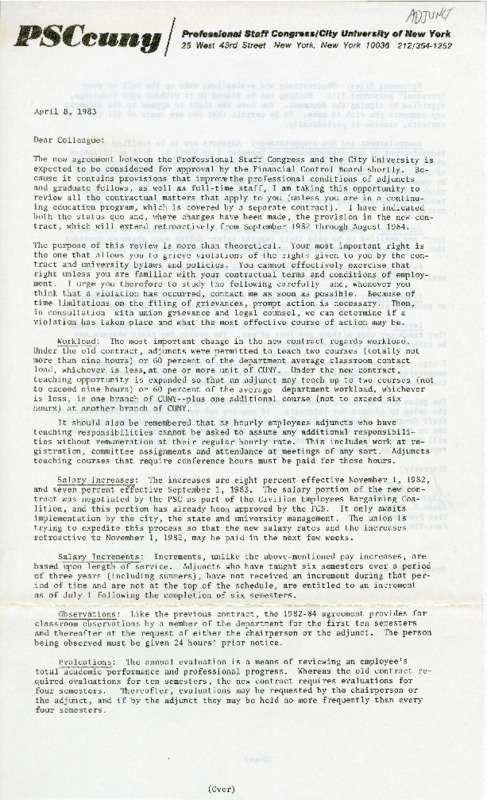
The new agreement between the Professional Staff Congress and the City University is
expected to be considered for approval by the Financial Control Board shortly. Be-
cause it contains provisions that improvethe professional conditions of adjuncts
and graduate fellows, as well as full-time staff, I am taking this opportunity to
review all the contractual matters that apply to you (unless you are in a continu-
ing education program, which is covered by a separate contract). I have indicated
both the status quo and, where changes have been made, the provision in the new con-
tract, which will extend retroactively from September 1982 through August 1984.
The purpose of this review is more than theoretical. Your most important right is
the one that allows you to grieve violations of the rights given to you by the con-
tract and university bylaws and policies. You cannot effectively exercise that
right unless you are familiar with your contractual terms and conditions of employ-
ment. I urge you therefore to study the following carefully and, whenever you
think that a violation has occurred, contact me as soon as possible. Because of
time limitations on the filing of grievances, prompt action is necessary. Then,
in consultation with union grievance and legal counsel, we can determine if a
violation has taken place and what the most effective course of action may be.
Workload: The most important change in the new contract regards workload.
Under the old contract, adjuncts were permitted to teach two courses (totally not
more than nine hours) or 60 percent of the department average classroom contact
load, whichever is less, at one or more unit of CUNY. Under the new contract,
teaching opportunity is expanded so that an adjunct may teach up to two courses (not
to exceed nine hours) or 60 percent of the average department workload, whichever
is less, in one branch of CUNY--plus one additional course (not to exceed six
hours) at another branch of CUNY.
It should also be remembered that as hourly employees adjuncts who have
teaching responsibilities cannot be asked to assume any additional responsibili-
ties without remuneration at their regular hourly rate. This includes work at re-
gistration, committee assignments and attendance at meetings of any sort. Adjuncts
teaching courses that require conference hours must be paid for those hours.
Salary Increases: The increases are eight percent effective November 1, 1982,
and seven percent effective September 1, 1983. The salary portion of the new con-
tract was negotiated by the PSC as part of the Civilian Employees Bargaining Coa-
lition, and this portion has already been approved by the FCB. It only awaits
implementation by the city, the state and university management. The union is
trying to expedite this process so that the new salary rates and the increases
retroactive to November 1, 1982, may be paid in the next few weeks.
Salary Increments: Increments, unlike the above-mentioned pay increases, are
based upon length of service. Adjuncts who have taught six semesters over a period
of three years (including summers), have not received an increment during that per-
iod of time and are not at the top of the schedule, are entitled to an increment
as of July 1 following the completion of six semesters.
Observations: Like the previous contract, the 1982-84 agreement provides for
classroom observations by a member of the department for the first ten semesters
and thereafter at the request of either the chairperson or the adjunct. The person
being observed must be given 24 hours' prior notice.
Evaluations: The annual evaluation is a means of reviewing an employee's
total academic performance and professional progress. Whereas the old contract re-
quired evaluations for ten semesters, the new contract requires evaluations for
four semesters. Thereafter, evaluations may be requested by the chairperson or
the adjunct, and if by the adjunct they may be held no more frequently than every
four semesters.
(Over)
Personnel files: Observations and evaluations make up the bulk of your
"personal" personnel file. Nothing can be placed in it without your knowledge,
Signified by signing the document. You have the right to append to the document
any comments you wish to make. To be certain that you are aware of all the file's
contents, examine it periodically.
Reappointment and Non-reappointment: Adjuncts are to be notified of
reappointment or non-reappointment by December 1 or April 1. Such notification
shall be subject to budgetary conditions, changes in curriculum and sufficiency
of enrollment. Changes in any of these which impact upon your employment must
be communicated to you as soon as the college is aware of the situation. A
recent arbitration establishes as a "benchmark" the first day that the adjunct
teaches for determining the date beyond which the offer to teach cannot be
rescinded.
Jury Duty: Members of the bargaining unit who "are required to serve on a
jury" are entitled to be paid their regular salary during such absences provided
that they give to the university any compensation they receive for jury duty.
Promotions: Adjuncts are entitled to be considered for promotion on the
basis of the same criteria that are applied to full-time staff.
Travel funds: Adjuncts are eligible for travel allowances for attendance
at professional meetings and conferences on the same basis as full-time faculty.
Leaves: Adjuncts are entitled to miss one hour per semester for each hour
they teach per week without any loss of pay. The reason for their absence may
be either illness or personal emergency.
I urge you to report to me as soon as possible any violations of the rights
enumerated here--especially in a nonreappointment matter--and to contact me any
time that you have questions regarding your employment at CUNY.
The gains made by adjuncts in the latest contract reflect continued efforts by
the union to advance our interests. If you are not yet a member of the Professional
Staff Congress, I urge you to get an application form by checking the appropriate
box on the enclosed letter and sending in the coupon. Membership in your union
will give you a voice in setting union policy and will help strengthen the
representation of adjuncts in universitywide affairs.
Sincerely,
Susan B. Prager
Vice President
Part-Time Personnel
Opeiu #153/rcf
(Over)
Ps Ce ry | Fe Professional Staff Congress/City University of New York
ay 25 West 43rd Street New York, New York 10036 212/354-1252
April 8, 1983
Dear Colleague:
The new agreement between the Professional Staff Congress and the City University is
expected to be considered for approval by the Financial Control Board shortly. Be-
cause it contains provisions that improvethe professional conditions of adjuncts
and graduate fellows, as well as full-time staff, I am taking this opportunity to
review all the contractual matters that apply to you (unless you are in a continu-
ing education program, which is covered by a separate contract). I have indicated
both the status quo and, where changes have been made, the provision in the new con-
tract, which will extend retroactively from September 1982 through August 1984.
The purpose of this review is more than theoretical. Your most important right is
the one that allows you to grieve violations of the rights given to you by the con-
tract and university bylaws and policies. You cannot effectively exercise that
right unless you are familiar with your contractual terms and conditions of employ-
ment. I urge you therefore to study the following carefully and, whenever you
think that a violation has occurred, contact me as soon as possible. Because of
time limitations on the filing of grievances, prompt action is necessary. Then,
in consultation with union grievance and legal counsel, we can determine if a
violation has taken place and what the most effective course of action may be.
Workload: The most important change in the new contract regards workload.
Under the old contract, adjuncts were permitted to teach two courses (totally not
more than nine hours) or 60 percent of the department average classroom contact
load, whichever is less, at one or more unit of CUNY. Under the new contract,
teaching opportunity is expanded so that an adjunct may teach up to two courses (not
to exceed nine hours) or 60 percent of the average department workload, whichever
is less, in one branch of CUNY--plus one additional course (not to exceed six
hours) at another branch of CUNY.
It should also be remembered that as hourly employees adjuncts who have
teaching responsibilities cannot be asked to assume any additional responsibili-
ties without remuneration at their regular hourly rate. This includes work at re-
gistration, committee assignments and attendance at meetings of any sort. Adjuncts
teaching courses that require conference hours must be paid for those hours.
Salary Increases: The increases are eight percent effective November 1, 1982,
and seven percent effective September 1, 1983. The salary portion of the new con-
tract was negotiated by the PSC as part of the Civilian Employees Bargaining Coa-
lition, and this portion has already been approved by the FCB. It only awaits
implementation by the city, the state and university management. The union is
trying to expedite this process so that the new salary rates and the increases
retroactive to November 1, 1982, may be paid in the next few weeks.
Salary Increments: Increments, unlike the above-mentioned pay increases, are
based upon length of service. Adjuncts who have taught six semesters over a period
of three years (including summers), have not received an increment during that per-
iod of time and are not at the top of the schedule, are entitled to an increment
as of July 1 following the completion of six semesters.
Observations: Like the previous contract, the 1982-84 agreement provides for
classroom observations by a member of the department for the first ten semesters
and thereafter at the request of either the chairperson or the adjunct. The person
being observed must be given 24 hours' prior notice.
Evaluations: The annual evaluation is a means of reviewing an employee's
total academic performance and professional progress. Whereas the old contract re-
quired evaluations for ten semesters, the new contract requires evaluations for
four semesters. Thereafter, evaluations may be requested by the chairperson or
the adjunct, and if by the adjunct they may be held no more frequently than every
four semesters.
(Over)
Personnel files: Observations and evaluations make up the bulk of your
"personal" personnel file. Nothing can be placed in it without your knowledge,
Signified by signing the document. You have the right to append to the document
any comments you wish to make. To be certain that you are aware of all the file's
contents, examine it periodically.
Reappointment and Non-reappointment: Adjuncts are to be notified of
reappointment or non-reappointment by December 1 or April 1. Such notification
shall be subject to budgetary conditions, changes in curriculum and sufficiency
of enrollment. Changes in any of these which impact upon your employment must
be communicated to you as soon as the college is aware of the situation. A
recent arbitration establishes as a "benchmark" the first day that the adjunct
teaches for determining the date beyond which the offer to teach cannot be
rescinded.
Jury Duty: Members of the bargaining unit who "are required to serve on a
jury" are entitled to be paid their regular salary during such absences provided
that they give to the university any compensation they receive for jury duty.
Promotions: Adjuncts are entitled to be considered for promotion on the
basis of the same criteria that are applied to full-time staff.
Travel funds: Adjuncts are eligible for travel allowances for attendance
at professional meetings and conferences on the same basis as full-time faculty.
Leaves: Adjuncts are entitled to miss one hour per semester for each hour
they teach per week without any loss of pay. The reason for their absence may
be either illness or personal emergency.
I urge you to report to me as soon as possible any violations of the rights
enumerated here--especially in a nonreappointment matter--and to contact me any
time that you have questions regarding your employment at CUNY.
The gains made by adjuncts in the latest contract reflect continued efforts by
the union to advance our interests. If you are not yet a member of the Professional
Staff Congress, I urge you to get an application form by checking the appropriate
box on the enclosed letter and sending in the coupon. Membership in your union
will give you a voice in setting union policy and will help strengthen the
representation of adjuncts in universitywide affairs.
Sincerely,
Susan B. Prager
Vice President
Part-Time Personnel
Opeiu #153/rcf
(Over)
Title
Form Letter Reviewing Provisions of 1983 Contract Agreement
Description
Written by Susan Prager, the PSC's Vice President for Part-Time Personnel, this April 1983 letter was distributed to adjunct professors. The letter, intended to inform adjuncts of the terms of the new CUNY agreement which extended retroactively from September 1982 through August 1984, briefly touched on a range of topics including workload, salary, evaluations, and reappointment. Prager closed by encouraging those not yet in the union to join, and for all to report any violations of the rights enumerated in the letter.
Contributor
Professional Staff Congress
Creator
Prager, Susan B.
Date
April 8, 1983
Language
English
Rights
Copyrighted
Source
The Tamiment Institute Library and Robert F. Wagner Labor Archives
Original Format
Correspondence
Prager, Susan B. Letter. “Form Letter Reviewing Provisions of 1983 Contract Agreement.”, CUNY DIGITAL HISTORY ARCHIVE, accessed September 5, 2026, https://stephenz.tailc22a4b.ts.net/s/cdha/item/1407