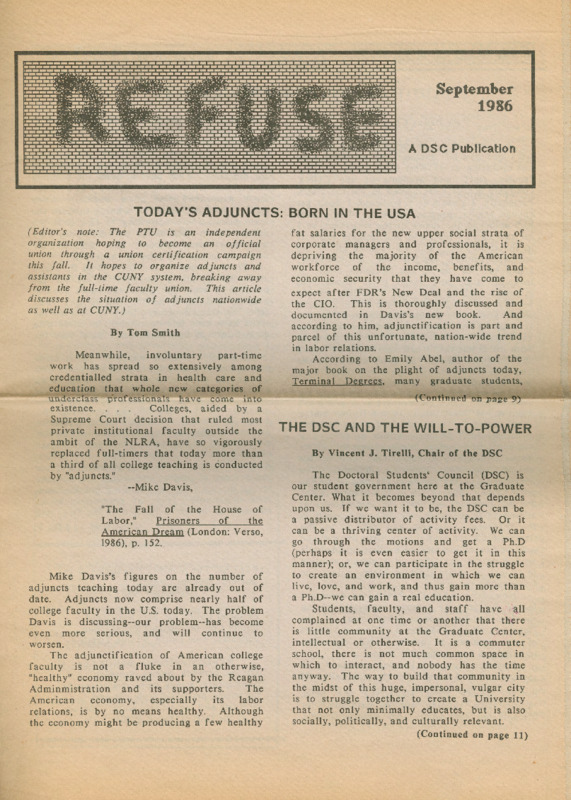
REFUSE: The DSC and the Will to Power
Item
Sa 7 MS
SES 3S 6S Gee ES EE io Sr a Oe
(Va oe
september
1986
A DSC Publication
TODAY’S ADJUNCTS: BORN IN THE USA
_(Editor’s note: The PTU is an _ independent
organization hoping to become an official
union through a union certification campaign
this fall. It hopes to organize adjuncts and
assistants in the CUNY system, breaking away
from the full-time faculty union. This article
discusses the situation of adjuncts nationwide
as well as at CUNY.)
By Tom Smith
Meanwhile, involuntary part-time
work has spread so extensively among
credentialled strata in health care and
m underciass professionals have come into
existence. Colleges, aided by a
Supreme Court decision that ruled most
private institutional faculty outside the
ambit of the NLRA, have so vigorously
replaced full-timers that today more than
a third of all college teaching is conducted
by "adjuncts."
--Mike Davis,
“Lhe-< Fall of —the- House. of
Labor," Prisoners of the
American Dream (London: Verso,
1986), p. 152.
Mike Davis’s figures on the number of
adjuncts teaching today are already out of
date. Adjuncts now comprise nearly half of
college faculty in the U.S. today. The problem
Davis is discussing--our problem--has become
even more serious, and will continue to
- worsen.
The adjunctification of American college
faculty is not a fluke in an _ otherwise,
"healthy" economy raved about by the Reagan
Adminmistration and its supporters. The
American economy, especially its labor
relations, is by no means healthy. Although
the economy might be producing a few healthy
See =
fat salaries for the new upper social strata of
corporate managers and professionals, it is
depriving the majority of the American
workforce of the income, benefits, and
economic security that they have come to
expect after FDR’s New Deal and the rise of
the CIO. This is thoroughly discussed and
documented in Davis’s new _ book. And
according to him, adjunctification is part and
parcel of this unfortunate, nation-wide trend
in labor relations.
According to Emily Abel, author of the
major book on the plight of adjuncts today,
Terminal Degrees,
$ uCU OF par
THE DSC AND THE WILL-TO-POWER
By Vincent J. Tirelli, Chair of the DSC
The Doctoral Students‘ Council (DSC) is
our student government here at the Graduate
Center. What it becomes beyond that depends
upon us. If we want it to be, the DSC can be
a passive distributor of activity fees. Or it
can be a thriving center of activity. We can
go through the motions and get a Ph.D
(perhaps it is even easier to get it in this
manner); or, we can participate in the struggle
to create an environment in which we can
live, love, and work, and thus gain more than
a Ph.D--we can gain a real education.
Students, faculty, and staff have all
complained at one time or another that there
is little community at the Graduate Center,
intellectual or otherwise. It is a commuter
school, there is not much common space in
which to interact, and nobody has the time
anyway. The way to build that community in
the midst of this huge, impersonal, vulgar city
is to struggle together to create a University
that not only minimally educates, but is also
socially, politically, and culturally relevant.
(Continued on page 11)
many graduate students,
...will to power continued from page 1
An important part of our education comes
from meeting students and faculty from every
other discipline in the University. The
physical structure of the Graduate Center and
the organizational structure of the programs
do not often encourage _ interdisciplinary
activity. It must be created. Personally, I
began to feel that I was exerting some control
over my environment when I became involved
with active University groups--the CUNY
Committe Against U.S. Intervention in Latin
America, the DSC, the Graduate Students’
Union(GSU), and the adjuncts union, known as
the Part-Time Research and Instructional Staff
Union(PTU). It is in groups such as these
that we can learn about our University, our
city, and the politics behind the scenes.
The educational value--good and bad--of
the City University is that it is a microcosm
of the "real" world--it either teaches us to
struggle or it beats us into apathy and
cynicism--just like the real world. Today, our
situation in the university is pretty gritty. In
our c ia, students do not get food that is
the same time healthy, tasty, varied, and
aS
_We need i imag
we get bureaucracy.”
affordable. There is no abundance of financial
support for our students. We’ve got to get
"real" jobs to survive our school years--but
don’t get any incompletes. Daycare--where? A
health plan?--if you’re over 28, just don’t get
sick.
The problems of this school are _ the
problems of this city, state, and nation. We
need imagination and creativity and we get
bureaucracy. In order to survive in this
society, the university system is increasingly
run as "“efficiently" as possible. But the
question looms large--for whom? Thorstein
Veblen calls such obsession with efficiency the
"machine logic" of capitalism: it transforms
everything in its path into an image of itself--
but to what ends? Who controls it?+ Does
anyone?
What kind of world do we want to live in?
Let’s face it, we live in an age where the
president of our nation can get away with
saying that we should not interfere with the
internal affairs of the sovereign nation of
South Africa, while in the same _ breath
claiming that the Sandinistas have betrayed
this city, state, and nation.
ination and creativity and
September 1986
their revolution and must be held accountable.
We live in an age where sexual preference is
increasingly becoming a matter of state
regulation; where nuclear testing continues
despite the Soviet Union’s _ self-imposed
moratorium; where subways are dirtier and
more frustrating than ever; where the streets,
our streets, have never seen so many homeless
people; where our streets have never seen so
many drug dealers and addicts. I have
personally experienced the problems this new
poverty creates: At 6:30PM on October 23,
1985, a woman received wounds from bullets
fired in a fight in Bryant Park between
members of this new American underclass. She
died--fifty yards away from our little ivory
tower, and twenty-five feet behind me. Where
does our world begin and end; and where do
we Start taking control of our own world?
We can only begin to take control of our
lives where we live and work, by taking part
in the decisions that affect our lives. For this
Page 1i
is where our immediate concerns lie, and thus
this is where we can begin to organize most
effectively.
local problems together,
simultaneously
problems are
But by dealing with our own,
we can and must
deal with bigger issues. Our
— simply the fault of this
atine across the seminar table
from us: our problems are endemic to our
society. It is in the university that there is
the brightest potential for attacking these
problems. It may not seem that way, but
things can turn around very quickly. If
students do not initiate that change, it will
not happen. As graduate students we can play
a special role. We are mature enough to
organize and make decisions about the things
that affect our lives, decisions that are now
often made for us.
One of the most important issues we need
to address is health care. While the Graduate
School may offer the best of what is available
at these prices in health insurance, the fact is
that the best of what is available at these
prices in our society is inadequate and
insulting. We have a right to decent health
Care, not simply as graduate students but as
human beings living in the twentieth century.
How can we address a seemingly monumental
problem as inadequate health care? We can
begin by meeting and talking about it. We can
learn about it and develop a plan of action.
If we keep at it long enough, the issue (or a
whole range of issues) may become politicized
so that it becomes an issue that our society
can no longer ignore. In the meantime, we
(Continued on page 12)
A
aculty member, or the __
...will to power continued from page 11
can offer suggestions for improvements for the
short-term. Simply by coming together, we
might convince an insurance agency out there
that a good group health insurance plan for
Graduate Center students might attract enough
clients to be profitable.
Together, we must explore ways of
affecting the quality of our lives. The DSC
would like to invite you to participate. The
Summer Steering Committee has drafted a new
Constitution for the Doctoral and Graduate
Students’ Organization (DSO). The present
Constitution hinders participation and action;
the new _ proposal encourages both (see
Constitution article). Another major goal for
the DSC is to get a real student newspaper off
the ground (see Fee Increase article), We
need articles: and we need volunteers.
September 1986 _— Page 12
We need a good newspaper, because we
have many issues to discuss. If the student
body is to be active and effective it must have
a genuinely open avenue of communication.
We need to discuss health and safety, eating
and living conditions, asbestos, student and
faculty input into decision-making,
discrimination, copy machines that don’t work,
Ronald Reagan, Nicaragua, cinema, language,
subways, how to cope. What is the role of
the DSC, what is the role of the Graduate
Council, what is the Graduate Council, what is
the purpose of life, why does it seem that
there is no purpose to life today? We need a
forum.
So please: Support this student newspaper,
and get involved in the issues that affect our
lives as students of this university and citizens
of this world. Participate!
a gaara teeticemenaehseeteesemmseesencsesenssiensmnesenmeensirmnnineeenisinans susisalenctuosaceumananmutedusunsammecnite aaa
LATIN AMERICAN FILM SERIES
The CUNY Latin American Study Group invites you to join us in an effort to increase
general understanding and awareness of past and present developments in Central and Latin
America. Films and discussions will be held throughout the 1986-87 school year. The first films
of the series will be shown SEPTEMBER 26TH @ 5:30 PM and will examine the relationship
ot g
~ between State, Religion and economic develop
ment in Brazil. The films to be shown are.
The Journey: From Faith to Action in Brazil
People of No Interest
CUNY Graduate Center Auditorium
33 West 42nd Street
September 26th @ 5:30 PM - $2 donation
Time and Place regarding subsequent films will be annouced on the 26th.
cotton harvest are forming now.
Join a brigade or help
us organize! Call:
(212)865-5904
Piedge your resistance to U.S. intervention in Nicaragua!
Brigades to work in Nicaragua’s coffee and ;
Promesa a la
resistencia de la
intervencion norteamericana
en Nicaragua! Las brigadas para trabajar
en la cosecha de cafe y algodon en Nicaragua
se estan formando ahora. Unase o ayudenos a
organizarla. Para informaciones llame: (212)865-5904
SES 3S 6S Gee ES EE io Sr a Oe
(Va oe
september
1986
A DSC Publication
TODAY’S ADJUNCTS: BORN IN THE USA
_(Editor’s note: The PTU is an _ independent
organization hoping to become an official
union through a union certification campaign
this fall. It hopes to organize adjuncts and
assistants in the CUNY system, breaking away
from the full-time faculty union. This article
discusses the situation of adjuncts nationwide
as well as at CUNY.)
By Tom Smith
Meanwhile, involuntary part-time
work has spread so extensively among
credentialled strata in health care and
m underciass professionals have come into
existence. Colleges, aided by a
Supreme Court decision that ruled most
private institutional faculty outside the
ambit of the NLRA, have so vigorously
replaced full-timers that today more than
a third of all college teaching is conducted
by "adjuncts."
--Mike Davis,
“Lhe-< Fall of —the- House. of
Labor," Prisoners of the
American Dream (London: Verso,
1986), p. 152.
Mike Davis’s figures on the number of
adjuncts teaching today are already out of
date. Adjuncts now comprise nearly half of
college faculty in the U.S. today. The problem
Davis is discussing--our problem--has become
even more serious, and will continue to
- worsen.
The adjunctification of American college
faculty is not a fluke in an _ otherwise,
"healthy" economy raved about by the Reagan
Adminmistration and its supporters. The
American economy, especially its labor
relations, is by no means healthy. Although
the economy might be producing a few healthy
See =
fat salaries for the new upper social strata of
corporate managers and professionals, it is
depriving the majority of the American
workforce of the income, benefits, and
economic security that they have come to
expect after FDR’s New Deal and the rise of
the CIO. This is thoroughly discussed and
documented in Davis’s new _ book. And
according to him, adjunctification is part and
parcel of this unfortunate, nation-wide trend
in labor relations.
According to Emily Abel, author of the
major book on the plight of adjuncts today,
Terminal Degrees,
$ uCU OF par
THE DSC AND THE WILL-TO-POWER
By Vincent J. Tirelli, Chair of the DSC
The Doctoral Students‘ Council (DSC) is
our student government here at the Graduate
Center. What it becomes beyond that depends
upon us. If we want it to be, the DSC can be
a passive distributor of activity fees. Or it
can be a thriving center of activity. We can
go through the motions and get a Ph.D
(perhaps it is even easier to get it in this
manner); or, we can participate in the struggle
to create an environment in which we can
live, love, and work, and thus gain more than
a Ph.D--we can gain a real education.
Students, faculty, and staff have all
complained at one time or another that there
is little community at the Graduate Center,
intellectual or otherwise. It is a commuter
school, there is not much common space in
which to interact, and nobody has the time
anyway. The way to build that community in
the midst of this huge, impersonal, vulgar city
is to struggle together to create a University
that not only minimally educates, but is also
socially, politically, and culturally relevant.
(Continued on page 11)
many graduate students,
...will to power continued from page 1
An important part of our education comes
from meeting students and faculty from every
other discipline in the University. The
physical structure of the Graduate Center and
the organizational structure of the programs
do not often encourage _ interdisciplinary
activity. It must be created. Personally, I
began to feel that I was exerting some control
over my environment when I became involved
with active University groups--the CUNY
Committe Against U.S. Intervention in Latin
America, the DSC, the Graduate Students’
Union(GSU), and the adjuncts union, known as
the Part-Time Research and Instructional Staff
Union(PTU). It is in groups such as these
that we can learn about our University, our
city, and the politics behind the scenes.
The educational value--good and bad--of
the City University is that it is a microcosm
of the "real" world--it either teaches us to
struggle or it beats us into apathy and
cynicism--just like the real world. Today, our
situation in the university is pretty gritty. In
our c ia, students do not get food that is
the same time healthy, tasty, varied, and
aS
_We need i imag
we get bureaucracy.”
affordable. There is no abundance of financial
support for our students. We’ve got to get
"real" jobs to survive our school years--but
don’t get any incompletes. Daycare--where? A
health plan?--if you’re over 28, just don’t get
sick.
The problems of this school are _ the
problems of this city, state, and nation. We
need imagination and creativity and we get
bureaucracy. In order to survive in this
society, the university system is increasingly
run as "“efficiently" as possible. But the
question looms large--for whom? Thorstein
Veblen calls such obsession with efficiency the
"machine logic" of capitalism: it transforms
everything in its path into an image of itself--
but to what ends? Who controls it?+ Does
anyone?
What kind of world do we want to live in?
Let’s face it, we live in an age where the
president of our nation can get away with
saying that we should not interfere with the
internal affairs of the sovereign nation of
South Africa, while in the same _ breath
claiming that the Sandinistas have betrayed
this city, state, and nation.
ination and creativity and
September 1986
their revolution and must be held accountable.
We live in an age where sexual preference is
increasingly becoming a matter of state
regulation; where nuclear testing continues
despite the Soviet Union’s _ self-imposed
moratorium; where subways are dirtier and
more frustrating than ever; where the streets,
our streets, have never seen so many homeless
people; where our streets have never seen so
many drug dealers and addicts. I have
personally experienced the problems this new
poverty creates: At 6:30PM on October 23,
1985, a woman received wounds from bullets
fired in a fight in Bryant Park between
members of this new American underclass. She
died--fifty yards away from our little ivory
tower, and twenty-five feet behind me. Where
does our world begin and end; and where do
we Start taking control of our own world?
We can only begin to take control of our
lives where we live and work, by taking part
in the decisions that affect our lives. For this
Page 1i
is where our immediate concerns lie, and thus
this is where we can begin to organize most
effectively.
local problems together,
simultaneously
problems are
But by dealing with our own,
we can and must
deal with bigger issues. Our
— simply the fault of this
atine across the seminar table
from us: our problems are endemic to our
society. It is in the university that there is
the brightest potential for attacking these
problems. It may not seem that way, but
things can turn around very quickly. If
students do not initiate that change, it will
not happen. As graduate students we can play
a special role. We are mature enough to
organize and make decisions about the things
that affect our lives, decisions that are now
often made for us.
One of the most important issues we need
to address is health care. While the Graduate
School may offer the best of what is available
at these prices in health insurance, the fact is
that the best of what is available at these
prices in our society is inadequate and
insulting. We have a right to decent health
Care, not simply as graduate students but as
human beings living in the twentieth century.
How can we address a seemingly monumental
problem as inadequate health care? We can
begin by meeting and talking about it. We can
learn about it and develop a plan of action.
If we keep at it long enough, the issue (or a
whole range of issues) may become politicized
so that it becomes an issue that our society
can no longer ignore. In the meantime, we
(Continued on page 12)
A
aculty member, or the __
...will to power continued from page 11
can offer suggestions for improvements for the
short-term. Simply by coming together, we
might convince an insurance agency out there
that a good group health insurance plan for
Graduate Center students might attract enough
clients to be profitable.
Together, we must explore ways of
affecting the quality of our lives. The DSC
would like to invite you to participate. The
Summer Steering Committee has drafted a new
Constitution for the Doctoral and Graduate
Students’ Organization (DSO). The present
Constitution hinders participation and action;
the new _ proposal encourages both (see
Constitution article). Another major goal for
the DSC is to get a real student newspaper off
the ground (see Fee Increase article), We
need articles: and we need volunteers.
September 1986 _— Page 12
We need a good newspaper, because we
have many issues to discuss. If the student
body is to be active and effective it must have
a genuinely open avenue of communication.
We need to discuss health and safety, eating
and living conditions, asbestos, student and
faculty input into decision-making,
discrimination, copy machines that don’t work,
Ronald Reagan, Nicaragua, cinema, language,
subways, how to cope. What is the role of
the DSC, what is the role of the Graduate
Council, what is the Graduate Council, what is
the purpose of life, why does it seem that
there is no purpose to life today? We need a
forum.
So please: Support this student newspaper,
and get involved in the issues that affect our
lives as students of this university and citizens
of this world. Participate!
a gaara teeticemenaehseeteesemmseesencsesenssiensmnesenmeensirmnnineeenisinans susisalenctuosaceumananmutedusunsammecnite aaa
LATIN AMERICAN FILM SERIES
The CUNY Latin American Study Group invites you to join us in an effort to increase
general understanding and awareness of past and present developments in Central and Latin
America. Films and discussions will be held throughout the 1986-87 school year. The first films
of the series will be shown SEPTEMBER 26TH @ 5:30 PM and will examine the relationship
ot g
~ between State, Religion and economic develop
ment in Brazil. The films to be shown are.
The Journey: From Faith to Action in Brazil
People of No Interest
CUNY Graduate Center Auditorium
33 West 42nd Street
September 26th @ 5:30 PM - $2 donation
Time and Place regarding subsequent films will be annouced on the 26th.
cotton harvest are forming now.
Join a brigade or help
us organize! Call:
(212)865-5904
Piedge your resistance to U.S. intervention in Nicaragua!
Brigades to work in Nicaragua’s coffee and ;
Promesa a la
resistencia de la
intervencion norteamericana
en Nicaragua! Las brigadas para trabajar
en la cosecha de cafe y algodon en Nicaragua
se estan formando ahora. Unase o ayudenos a
organizarla. Para informaciones llame: (212)865-5904
Title
REFUSE: The DSC and the Will to Power
Description
"The DSC and the Will to Power," published in the Refuse – a Doctoral Student Council (DSC) publication, was drafted in the fall of 1986 by Vincent Tirelli, Chair of the DSC. The article made the case for creating space for "interdisciplinary activity" as an integral part of receiving a doctoral education. Drawing parallels to the fiscal problems of NYC, Tirelli maintained that student agency and involvement is critical to the health of the institution.
Contributor
Professional Staff Congress
Creator
Tirelli, Vincent
Date
September 1986
Language
English
Publisher
The Refues
Rights
Obtained from Contributor - Copyright Unknown
Source
The Tamiment Institute Library and Robert F. Wagner Labor Archives
Original Format
Newspaper / Magazine / Journal
Tirelli, Vincent. Letter. “REFUSE: The DSC and the Will to Power.”, CUNY DIGITAL HISTORY ARCHIVE, accessed September 5, 2026, https://stephenz.tailc22a4b.ts.net/s/cdha/item/1470