"How CUUC/Unity Created the Adjunct Problem"
Item
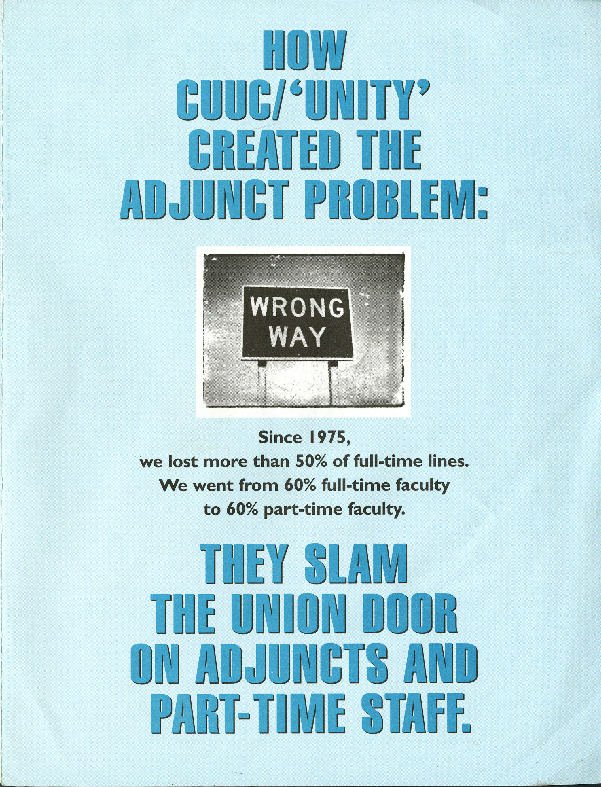
HOw
CUUC/ UNITY’
CREATED THE
ADJUNGT PROBLEM:
Since 1975,
we lost more than 50% of full-time lines.
We went from 60% full-time faculty
to 60% part-time faculty.
THEY SLAM
THE UNION DOOR
ON ADJUNCTS AND
PART-TIME STAFF.
he PSC has a legal responsibility to represent
ALL members of the bargaining unit; in
its eagerness to disenfranchise adjuncts,
CUUC/Unity has placed our union and
university in jeopardy:
° By allowing the percentage of classes taught by full-
time faculty to drop below accreditation levels;
* By allowing the CUNY administration to hire and
exploit cheap, part-time labor and to undermine full-time
lines and salaries;
* By dividing the faculty within the bargaining unit
and disempowering us all.
e How does a 60% part-time instructional
workforce at CUNY affect full-timers?
BAe More part-timers means a heavier workload for
full-timers, e.g., advisement and registration of students,
committees, evaluations, curriculum and governance. An
instructional staff that is mostly part-timers not only allows
the CUNY administration to exploit them but depresses
everyone's salaries and increases everyone’s workloads.
Inadequate part-time wages decrease the administration’s
incentive to hire new full-time faculty, thus depriving us
of security and permanent colleagues. A majority part-time
instructional staff undermines the rationale for a tenured
professoriate and for academic freedom.
Qe Do other university unions charge “agency fee”
to everyone in the bargaining unit — automatically
charging all members, part-time and full-time, union
dues or their equivalent? If so, what are the results?
A. United University Professionals (UUP) of SUNY,
our sister union, has been applying agency fee for all faculty
and staff, full-time and part-time, since it became New York
State law. The interests of full-timers haven't been
compromised in any way.
Qa. Why is CUUC/Unity against applying agency fee
(which is already a feature in our contract) to part-time
instructional staff?
A. Because bringing more part-timers into the union
will threaten the CUUC/Unity “established order,” which
has done virtually nothing for adjuncts. CUUC/Unity’s
disdain for adjuncts has been a hallmark of their leadership
for the last 15 years. As the percentage of adjuncts
increased, CUUC/Unity turned its back on them and
consequently created a work force split in two: unionized
full-timers and part-timers actively discouraged from
joining.
@ Is it realistic for the PSC to expect to get more for
part-timers?
A. Yes! Across the nation, part-time academic
employees are organizing for, and getting, increases in pay
for teaching and office hours, seniority and benefits. At the
Universities of Massachusetts and California (to cite two
examples), adjuncts have significantly improved their lot
and moved toward parity pay with full-timers through
union action.
Qe when part-timers get pay increases, do full-timers
get less?
BAe No. At the University of Massachusetts and the
University of California, as part-time salaries increased, so
did full-time salaries. Closer to home, at the Fashion
Institute of Technology part-timers are paid more than at
CUNY and full-timers’ average salaries in 1998 were higher
than those at CUNY.
Qe Can we havea high quality university with so
many underpaid adjuncts?
BYe No. The CUNY Board of Trustees says it wants
excellence, but refuses to pay for it. We cannot offer
excellent education to our students if more than half of the
instructional staff is hired semester-by-semester, is
underpaid, is not paid for office hours, is constantly looking
: ‘for more work to make ends meet and cannot take part in
curriculum and governance decisions. Most adjuncts are
highly qualified; many would make excellent candidates for
full-time positions if only more were available. Because of
their economic and participatory marginality, adjuncts are
less able to fully serve students and the university.
@. cuuc Unity claims that the adjuncts are robbing
the welfare fund. Is that true?
BAe That's not true. CUUC/ Unity failed to obtain
adequate funding for the welfare fund from management.
Now its leaders try to conceal their own failure by blaming
adjuncts for an underfunded fund.
ERIC MARSHALL
for VP for Part-Timers
A full-time fighter for
CUNY part-timers
ERIC MARSHALL, the New Caucus
candidate for Vice President for Part-Time
Employees, has been a CUNY Adjunct Lecturer
since 1991, first at Kingsborough Community
College and now at Queens College. A founding
member of CUNY Adjuncts Unite, the CUNY
Doctoral Students, Adjunct Project and the
international Coalition of Contingent Academic
Labor, he is now serving his second term as co-
coordinator of the New Caucus. He has served
as PSC delegate from Queens College for the last. Eric Marshall
four years and has been elected to the University
Faculty Senate. He has devoted much of the past decade to speaking
with adjuncts, hearing their concerns and attempting to address them
— while teaching three courses per term and (like many adjuncts)
working a part-time job.
BARBARA
BOWEN
for President
STEVE
LONDON
for Vice
President
CECELIA
McCALL
for Secretary
JOHN
HYLAND
for Treasurer
In comparison, his opponent, Arnold Cantor, recently retired with
a very large pension settlement (the result of a lawsuit against the
union) after 25 years as PSC executive director. He recently began to
teach on an adjunct basis. For a quarter century, he never set foot in a
classroom or met with a CUNY student. On his watch, CUNY’s full-
time faculty diminished by half, while part-timers became the majority
of teaching faculty. As chief contract negotiator, he allowed CUNY’s
salaries to plummet; presided over the underfunding of the Welfare
Fund for adjunct health benefits, and permitted the recruitment of
new union members to become a non-priority. Does this sound like
someone who is in touch with adjuncts, concerns?
Steve London
For
UNIVERSITY-
WIDE OFFICERS: :
STANLEY
ARONOWITZ
BLANCHE
WIESEN COOK
FRANK DEALE
Cecelia McCall
> Improve health insurance benefits and ease eligibility
requirements.
» Free tuition for all graduate fellows. SUSAN
> Organize all adjuncts into the union. O’MALLEY
The treatment of CUNY adjuncts is unfair and inequitable. SHELDON
As long as CUUC/Unity remains in control, the CUNY
administration will continue replacing full-timers with part- i John Hyland WEINBAUM
timers, allowing the pay scale of full-timers to erode, as well.
For more information, contact www.newcaucus.org
NEW CAUCUS NEW LEADERSHIP NEW VISION
PRESIDENT
Barbara Bowen, Associate
Professor of English at
Queens College and the
Graduate Center. Both a
scholar and an organizer,
she is in her second term
as Chapter Chair at Queens. :
: VICE PRESIDENT
: Steve London, Associate
- Professor of Political
: Science; third term as PSC
: Chair at Brooklyn College.
17 years of experience in
higher education unionism.
: SECRETARY
: Professor of English at
: Baruch chapter of the
: Leader of the Universi
: than a decade.
: Cecelia McCall, Associate
Baruch College; chaired the
: Faculty Senate for more
: TREASURER
: John Hyland, Professor
: of Sociology at LaGuardia
: Community College and
PSC. : Secretary of its PSC chapter.
ity : PSC chapter chair and
: delegate for six years and
: a Department Chairperson.
EXECUTIVE OFFICERS
UNIVERSITY-WIDE
Stanley Aronowitz, Distinguished
Professor of Sociology at the
Graduate Center; PSC Delegate.
Blanche Wiesen Cook,
Distinguished Professor of History
at John Jay and the Graduate Center;
internationally known biographer.
Frank Deale, Associate Professor
of Law at the CUNY Law School;
labor rights and employment
discrimination expert.
Susan O’Malley, Professor of
English at Kingsborough Community
College and the Graduate Center;
former PSC Chapter Chairperson;
Secretary, University Faculty Senate.
Sheldon Weinbaum, Distinguished
Professor of Mechanical Engineering
at City College; PSC delegate.
SENIOR COLLEGES
Vice President for Senior Colleges —
Michael Fabricant, Professor of
Community Organizing and Public
Policy at the Hunter College School
of Social Work; Vice-Chair and
Delegate, Hunter PSC.
SENIOR COLLEGE OFFICERS:
Bob Cermele, Associate Professor
of Mathematics at New York City
Technical College; Senator, University
Faculty Senate.
‘ Peter Ranis, Professor of Political
: Science at York College and the
Graduate Center; PSC Delegate.
Nancy Romer, Professor of
: Psychology at Brooklyn College;
.* 4. PSC Delegate.
COMMUNITY COLLEGES
Vice-President for Community
Colleges — Anne Friedman,
Professor of Developmental Skills
at the Borough of Manhattan
Community College; Executive ;
Committee, University Faculty Senate. :
COMMUNITY COLLEGE OFFICERS:
Lou Alpert, Professor of
Mathematics and Computer Science
at Bronx Community College; PSC
Executive Committee.
Samuel E. Farrell, Il, Lecturer
in Adult Continuing Education at
LaGuardia Community College;
PSC chapter Vice-Chair.
Ingrid Hughes, Adjunct Lecturer
in ESL and English at BMCC and
City College Center for Worker
Education.
PART-TIME
Vice-President for Part-Timers —
Eric Marshall, Adjunct Lecturer
in English at Queens College; leader,
CUNY Adjuncts Unite; PSC Delegate;
Senator, University Faculty Senate.
CROSS-CAMPUS
Vice-President for Cross-Campus
Chapters — Steve Leberstein,
HEO and Executive Director of the
City College Center for Worker
Education; organizer of the first
CUNY Central Office PSC chapter.
CROSS-CAMPUS OFFICERS:
Sandra Watson, HEO and Director
of the Family Institute in the Adult
& Continuing Education Divisions
of LaGuardia Community College;
PSC Welfare Fund representative.
Marc Ward, HEO and Director
of English as a Second Language
and Language Transition Programs
at Lehman College.
For more information, contact www.newcaucus.org
New Caucus campaign materials are clearly identified and should not be confused with other anti-CUUC literature, such as The Patriot Returns, that may be circulating during this campaign.
NEW CAUCUS NEW LEADERSHIP NEW VISION
NEW CAUCUS OF THE PSC/CUNY © P.O. BOX 150088 » VAN BRUNT STATION * BROOKLYN, NY 11215-0088
S V AHERN
MANHATTAN COMMUNITY
ENG LAN/LT
COLLEGE
CUUC/ UNITY’
CREATED THE
ADJUNGT PROBLEM:
Since 1975,
we lost more than 50% of full-time lines.
We went from 60% full-time faculty
to 60% part-time faculty.
THEY SLAM
THE UNION DOOR
ON ADJUNCTS AND
PART-TIME STAFF.
he PSC has a legal responsibility to represent
ALL members of the bargaining unit; in
its eagerness to disenfranchise adjuncts,
CUUC/Unity has placed our union and
university in jeopardy:
° By allowing the percentage of classes taught by full-
time faculty to drop below accreditation levels;
* By allowing the CUNY administration to hire and
exploit cheap, part-time labor and to undermine full-time
lines and salaries;
* By dividing the faculty within the bargaining unit
and disempowering us all.
e How does a 60% part-time instructional
workforce at CUNY affect full-timers?
BAe More part-timers means a heavier workload for
full-timers, e.g., advisement and registration of students,
committees, evaluations, curriculum and governance. An
instructional staff that is mostly part-timers not only allows
the CUNY administration to exploit them but depresses
everyone's salaries and increases everyone’s workloads.
Inadequate part-time wages decrease the administration’s
incentive to hire new full-time faculty, thus depriving us
of security and permanent colleagues. A majority part-time
instructional staff undermines the rationale for a tenured
professoriate and for academic freedom.
Qe Do other university unions charge “agency fee”
to everyone in the bargaining unit — automatically
charging all members, part-time and full-time, union
dues or their equivalent? If so, what are the results?
A. United University Professionals (UUP) of SUNY,
our sister union, has been applying agency fee for all faculty
and staff, full-time and part-time, since it became New York
State law. The interests of full-timers haven't been
compromised in any way.
Qa. Why is CUUC/Unity against applying agency fee
(which is already a feature in our contract) to part-time
instructional staff?
A. Because bringing more part-timers into the union
will threaten the CUUC/Unity “established order,” which
has done virtually nothing for adjuncts. CUUC/Unity’s
disdain for adjuncts has been a hallmark of their leadership
for the last 15 years. As the percentage of adjuncts
increased, CUUC/Unity turned its back on them and
consequently created a work force split in two: unionized
full-timers and part-timers actively discouraged from
joining.
@ Is it realistic for the PSC to expect to get more for
part-timers?
A. Yes! Across the nation, part-time academic
employees are organizing for, and getting, increases in pay
for teaching and office hours, seniority and benefits. At the
Universities of Massachusetts and California (to cite two
examples), adjuncts have significantly improved their lot
and moved toward parity pay with full-timers through
union action.
Qe when part-timers get pay increases, do full-timers
get less?
BAe No. At the University of Massachusetts and the
University of California, as part-time salaries increased, so
did full-time salaries. Closer to home, at the Fashion
Institute of Technology part-timers are paid more than at
CUNY and full-timers’ average salaries in 1998 were higher
than those at CUNY.
Qe Can we havea high quality university with so
many underpaid adjuncts?
BYe No. The CUNY Board of Trustees says it wants
excellence, but refuses to pay for it. We cannot offer
excellent education to our students if more than half of the
instructional staff is hired semester-by-semester, is
underpaid, is not paid for office hours, is constantly looking
: ‘for more work to make ends meet and cannot take part in
curriculum and governance decisions. Most adjuncts are
highly qualified; many would make excellent candidates for
full-time positions if only more were available. Because of
their economic and participatory marginality, adjuncts are
less able to fully serve students and the university.
@. cuuc Unity claims that the adjuncts are robbing
the welfare fund. Is that true?
BAe That's not true. CUUC/ Unity failed to obtain
adequate funding for the welfare fund from management.
Now its leaders try to conceal their own failure by blaming
adjuncts for an underfunded fund.
ERIC MARSHALL
for VP for Part-Timers
A full-time fighter for
CUNY part-timers
ERIC MARSHALL, the New Caucus
candidate for Vice President for Part-Time
Employees, has been a CUNY Adjunct Lecturer
since 1991, first at Kingsborough Community
College and now at Queens College. A founding
member of CUNY Adjuncts Unite, the CUNY
Doctoral Students, Adjunct Project and the
international Coalition of Contingent Academic
Labor, he is now serving his second term as co-
coordinator of the New Caucus. He has served
as PSC delegate from Queens College for the last. Eric Marshall
four years and has been elected to the University
Faculty Senate. He has devoted much of the past decade to speaking
with adjuncts, hearing their concerns and attempting to address them
— while teaching three courses per term and (like many adjuncts)
working a part-time job.
BARBARA
BOWEN
for President
STEVE
LONDON
for Vice
President
CECELIA
McCALL
for Secretary
JOHN
HYLAND
for Treasurer
In comparison, his opponent, Arnold Cantor, recently retired with
a very large pension settlement (the result of a lawsuit against the
union) after 25 years as PSC executive director. He recently began to
teach on an adjunct basis. For a quarter century, he never set foot in a
classroom or met with a CUNY student. On his watch, CUNY’s full-
time faculty diminished by half, while part-timers became the majority
of teaching faculty. As chief contract negotiator, he allowed CUNY’s
salaries to plummet; presided over the underfunding of the Welfare
Fund for adjunct health benefits, and permitted the recruitment of
new union members to become a non-priority. Does this sound like
someone who is in touch with adjuncts, concerns?
Steve London
For
UNIVERSITY-
WIDE OFFICERS: :
STANLEY
ARONOWITZ
BLANCHE
WIESEN COOK
FRANK DEALE
Cecelia McCall
> Improve health insurance benefits and ease eligibility
requirements.
» Free tuition for all graduate fellows. SUSAN
> Organize all adjuncts into the union. O’MALLEY
The treatment of CUNY adjuncts is unfair and inequitable. SHELDON
As long as CUUC/Unity remains in control, the CUNY
administration will continue replacing full-timers with part- i John Hyland WEINBAUM
timers, allowing the pay scale of full-timers to erode, as well.
For more information, contact www.newcaucus.org
NEW CAUCUS NEW LEADERSHIP NEW VISION
PRESIDENT
Barbara Bowen, Associate
Professor of English at
Queens College and the
Graduate Center. Both a
scholar and an organizer,
she is in her second term
as Chapter Chair at Queens. :
: VICE PRESIDENT
: Steve London, Associate
- Professor of Political
: Science; third term as PSC
: Chair at Brooklyn College.
17 years of experience in
higher education unionism.
: SECRETARY
: Professor of English at
: Baruch chapter of the
: Leader of the Universi
: than a decade.
: Cecelia McCall, Associate
Baruch College; chaired the
: Faculty Senate for more
: TREASURER
: John Hyland, Professor
: of Sociology at LaGuardia
: Community College and
PSC. : Secretary of its PSC chapter.
ity : PSC chapter chair and
: delegate for six years and
: a Department Chairperson.
EXECUTIVE OFFICERS
UNIVERSITY-WIDE
Stanley Aronowitz, Distinguished
Professor of Sociology at the
Graduate Center; PSC Delegate.
Blanche Wiesen Cook,
Distinguished Professor of History
at John Jay and the Graduate Center;
internationally known biographer.
Frank Deale, Associate Professor
of Law at the CUNY Law School;
labor rights and employment
discrimination expert.
Susan O’Malley, Professor of
English at Kingsborough Community
College and the Graduate Center;
former PSC Chapter Chairperson;
Secretary, University Faculty Senate.
Sheldon Weinbaum, Distinguished
Professor of Mechanical Engineering
at City College; PSC delegate.
SENIOR COLLEGES
Vice President for Senior Colleges —
Michael Fabricant, Professor of
Community Organizing and Public
Policy at the Hunter College School
of Social Work; Vice-Chair and
Delegate, Hunter PSC.
SENIOR COLLEGE OFFICERS:
Bob Cermele, Associate Professor
of Mathematics at New York City
Technical College; Senator, University
Faculty Senate.
‘ Peter Ranis, Professor of Political
: Science at York College and the
Graduate Center; PSC Delegate.
Nancy Romer, Professor of
: Psychology at Brooklyn College;
.* 4. PSC Delegate.
COMMUNITY COLLEGES
Vice-President for Community
Colleges — Anne Friedman,
Professor of Developmental Skills
at the Borough of Manhattan
Community College; Executive ;
Committee, University Faculty Senate. :
COMMUNITY COLLEGE OFFICERS:
Lou Alpert, Professor of
Mathematics and Computer Science
at Bronx Community College; PSC
Executive Committee.
Samuel E. Farrell, Il, Lecturer
in Adult Continuing Education at
LaGuardia Community College;
PSC chapter Vice-Chair.
Ingrid Hughes, Adjunct Lecturer
in ESL and English at BMCC and
City College Center for Worker
Education.
PART-TIME
Vice-President for Part-Timers —
Eric Marshall, Adjunct Lecturer
in English at Queens College; leader,
CUNY Adjuncts Unite; PSC Delegate;
Senator, University Faculty Senate.
CROSS-CAMPUS
Vice-President for Cross-Campus
Chapters — Steve Leberstein,
HEO and Executive Director of the
City College Center for Worker
Education; organizer of the first
CUNY Central Office PSC chapter.
CROSS-CAMPUS OFFICERS:
Sandra Watson, HEO and Director
of the Family Institute in the Adult
& Continuing Education Divisions
of LaGuardia Community College;
PSC Welfare Fund representative.
Marc Ward, HEO and Director
of English as a Second Language
and Language Transition Programs
at Lehman College.
For more information, contact www.newcaucus.org
New Caucus campaign materials are clearly identified and should not be confused with other anti-CUUC literature, such as The Patriot Returns, that may be circulating during this campaign.
NEW CAUCUS NEW LEADERSHIP NEW VISION
NEW CAUCUS OF THE PSC/CUNY © P.O. BOX 150088 » VAN BRUNT STATION * BROOKLYN, NY 11215-0088
S V AHERN
MANHATTAN COMMUNITY
ENG LAN/LT
COLLEGE
Title
"How CUUC/Unity Created the Adjunct Problem"
Description
This flyer, produced by the New Caucus and entitled "How the CUUC/Unity Created the Adjunct Problem," highlighted the New Caucus's commitment to part-time adjunct faculty. The flyer claimed that the City University Unity Caucus (CUUC/Unity) slate, the group that had controlled the PSC for a quarter century, had divided the faculty within the bargaining unit. Structured as an FAQ, the flyer explained how adjunct labor affected full-time faculty negatively and clarified frequent misconceptions. Furthermore, the flyer featured biographies and photographs of the New Caucus officers who were running for election.
Contributor
Newfield, Marcia
Creator
New Caucus
Date
2000 (Circa)
Language
English
Rights
Public Domain
Source
Newfield, Marcia
Original Format
Poster / Flier / Leaflet
New Caucus. Letter. 2000. “‘How CUUC Unity Created the Adjunct Problem’”, 2000, CUNY DIGITAL HISTORY ARCHIVE, accessed September 5, 2026, https://stephenz.tailc22a4b.ts.net/s/cdha/item/1494