First Community Advisory Board Meeting Minutes
Item
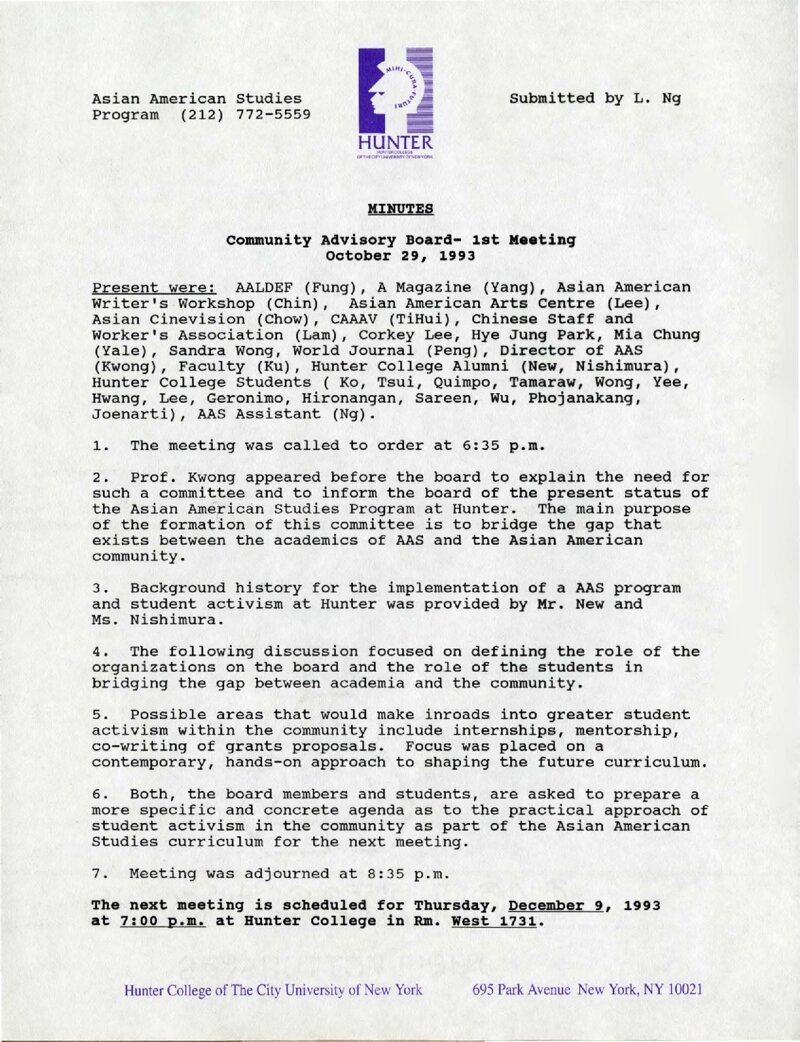
Asian American Studies Submitted by L. Ng
Program (212) 772-5559
MINUTES
Community Advisory Board- 1st Meeting
October 29, 1993
Present were: AALDEF (Fung), A Magazine (Yang), Asian American
Writer's Workshop (Chin), Asian American Arts Centre (Lee),
Asian Cinevision (Chow), CAAAV (TiHui), Chinese Staff and
Worker's Association (Lam), Corkey Lee, Hye Jung Park, Mia Chung
(Yale), Sandra Wong, World Journal (Peng), Director of AAS
(Kwong), Faculty (Ku), Hunter College Alumni (New, Nishimura),
Hunter College Students ( Ko, Tsui, Quimpo, Tamaraw, Wong, Yee,
Hwang, Lee, Geronimo, Hironangan, Sareen, Wu, Phojanakang,
Joenarti), AAS Assistant (Ng).
1. The meeting was called to order at 6:35 p.m.
2. Prof. Kwong appeared before the board to explain the need for
such a committee and to inform the board of the present status of
the Asian American Studies Program at Hunter. The main purpose
of the formation of this committee is to bridge the gap that
exists between the academics of AAS and the Asian American
community.
3. Background history for the implementation of a AAS program
and student activism at Hunter was provided by Mr. New and
Ms. Nishimura.
4. The following discussion focused on defining the role of the
organizations on the board and the role of the students in
bridging the gap between academia and the community.
5. Possible areas that would make inroads into greater student
activism within the community include internships, mentorship,
co-writing of grants proposals. Focus was placed on a
contemporary, hands-on approach to shaping the future curriculum.
6. Both, the board members and students, are asked to prepare a
more specific and concrete agenda as to the practical approach of
student activism in the community as part of the Asian American
Studies curriculum for the next meeting.
7. Meeting was adjourned at 8:35 p.m.
The next meeting is scheduled for Thursday, December 9, 1993
at 7:00 p.m. at Hunter College in Rm. West 1731.
Hunter College of The City University of New York 695 Park Avenue New York, NY 10021
Synopsis of First Community Advisory Board Meeting
The history of Asian American Studies at Hunter College grew out
of the Civil Rights struggles in the 1970's when the ethnic
students organized a strike that basically shut down the school.
The promises of the Administration to form an area of Ethnic
Studies led to the creation of Black and Puerto Rican Studies.
For the Asian American student body, however, there was still a
need for greater activism toward getting recognition of Asian
American Studies as a legitimate (a need for
institutionalization) curriculum in the eyes of the Academics.
Asian American student activists, in their search for a support
group brought the East Coast Asian Student Union to Hunter
College in the late 1980's. In 1989 the system wide strike acted
as a platform on which the students made their demands to have
an Asian American Studies Program at Hunter College. Le Clerc's
parallel agenda of increasing the multi-cultural aspects of the
curriculum and Shirley Hune's (Assistant Provost at the time)
spear heading, the students' demands where met.
But now that the Program is in place it is imperative to keep the
activism of the students in the community strong.
The initial meeting opened avenues by which the gap between
academia and the community can be bridged. Many strong points
where made by participating community and student
representatives. All avenues stress a hands-on approach.
The general inroads by which students can become an active part
of their community include:
1) Internships- in field work, research, and writing that
takes the student through the process by which the
organization goes through to help the community. In turn
the students offer a great resource of manpower that the
community organizations can tap.
2) Generation of continuous flow of student-community
activity (to avoid burnout).
3) Stress on the "here and now" so that the students do not
loose touch with the constantly evolving needs of the
community. Students need to keep a finger on the pulse
of the community that they are a product of in order to use
their potential to shape the educational process. This
process includes critical thinking in regards to pass
failures-what can be taken from those failures to shape the
"here and now" and the future.
4) Development of a "realistic perception of who we are" as
Asian Americans and what roles there are for the student
activist after graduation (MENTORSHIP)
5) Development of grants proposals that would fund the
community-student activities and projects.
Program (212) 772-5559
MINUTES
Community Advisory Board- 1st Meeting
October 29, 1993
Present were: AALDEF (Fung), A Magazine (Yang), Asian American
Writer's Workshop (Chin), Asian American Arts Centre (Lee),
Asian Cinevision (Chow), CAAAV (TiHui), Chinese Staff and
Worker's Association (Lam), Corkey Lee, Hye Jung Park, Mia Chung
(Yale), Sandra Wong, World Journal (Peng), Director of AAS
(Kwong), Faculty (Ku), Hunter College Alumni (New, Nishimura),
Hunter College Students ( Ko, Tsui, Quimpo, Tamaraw, Wong, Yee,
Hwang, Lee, Geronimo, Hironangan, Sareen, Wu, Phojanakang,
Joenarti), AAS Assistant (Ng).
1. The meeting was called to order at 6:35 p.m.
2. Prof. Kwong appeared before the board to explain the need for
such a committee and to inform the board of the present status of
the Asian American Studies Program at Hunter. The main purpose
of the formation of this committee is to bridge the gap that
exists between the academics of AAS and the Asian American
community.
3. Background history for the implementation of a AAS program
and student activism at Hunter was provided by Mr. New and
Ms. Nishimura.
4. The following discussion focused on defining the role of the
organizations on the board and the role of the students in
bridging the gap between academia and the community.
5. Possible areas that would make inroads into greater student
activism within the community include internships, mentorship,
co-writing of grants proposals. Focus was placed on a
contemporary, hands-on approach to shaping the future curriculum.
6. Both, the board members and students, are asked to prepare a
more specific and concrete agenda as to the practical approach of
student activism in the community as part of the Asian American
Studies curriculum for the next meeting.
7. Meeting was adjourned at 8:35 p.m.
The next meeting is scheduled for Thursday, December 9, 1993
at 7:00 p.m. at Hunter College in Rm. West 1731.
Hunter College of The City University of New York 695 Park Avenue New York, NY 10021
Synopsis of First Community Advisory Board Meeting
The history of Asian American Studies at Hunter College grew out
of the Civil Rights struggles in the 1970's when the ethnic
students organized a strike that basically shut down the school.
The promises of the Administration to form an area of Ethnic
Studies led to the creation of Black and Puerto Rican Studies.
For the Asian American student body, however, there was still a
need for greater activism toward getting recognition of Asian
American Studies as a legitimate (a need for
institutionalization) curriculum in the eyes of the Academics.
Asian American student activists, in their search for a support
group brought the East Coast Asian Student Union to Hunter
College in the late 1980's. In 1989 the system wide strike acted
as a platform on which the students made their demands to have
an Asian American Studies Program at Hunter College. Le Clerc's
parallel agenda of increasing the multi-cultural aspects of the
curriculum and Shirley Hune's (Assistant Provost at the time)
spear heading, the students' demands where met.
But now that the Program is in place it is imperative to keep the
activism of the students in the community strong.
The initial meeting opened avenues by which the gap between
academia and the community can be bridged. Many strong points
where made by participating community and student
representatives. All avenues stress a hands-on approach.
The general inroads by which students can become an active part
of their community include:
1) Internships- in field work, research, and writing that
takes the student through the process by which the
organization goes through to help the community. In turn
the students offer a great resource of manpower that the
community organizations can tap.
2) Generation of continuous flow of student-community
activity (to avoid burnout).
3) Stress on the "here and now" so that the students do not
loose touch with the constantly evolving needs of the
community. Students need to keep a finger on the pulse
of the community that they are a product of in order to use
their potential to shape the educational process. This
process includes critical thinking in regards to pass
failures-what can be taken from those failures to shape the
"here and now" and the future.
4) Development of a "realistic perception of who we are" as
Asian Americans and what roles there are for the student
activist after graduation (MENTORSHIP)
5) Development of grants proposals that would fund the
community-student activities and projects.
Title
First Community Advisory Board Meeting Minutes
Description
These minutes document the Hunter Asian American Studies Program (AASP)'s first Community Advisory Board meeting which took place on October 29th, 1993. In attendance included representatives from prominent community organizations including The Asian American Legal Defense and Education Fund (AALDEF), A Magazine, Asian American Writers' Workshop, Asian American Arts Centre, Cinevision, Committee Against Anti-Asian Violence (CAAAV), and Chinese Staff and Workers' Association. During the meeting, students Woei-Ming New and Kelly Nishimura shared background history on the implementation of the AASP and student activism. There was also a discussion about how Hunter students could engage in activism in the broader New York City Asian American community.
The purpose of the Community Advisory Board was to advise the AASP on how to best serve the needs and interests of the Asian American community in New York City as well as to bridge the gap between scholars of Asian American studies and the community.
The Hunter College Asian American Studies Program (AASP) was established in 1993. As the only academic program in Asian American studies in the CUNY system, the AASP offers a minor in Asian American Studies and other resources and programming. The AASP supports scholars, artists, and activists advancing scholarship in the fields of Asian American studies and critical ethnic studies and serves as a resource for New York City's Asian American communities. In 2006, the program was at risk of being cut due to a lack of funding. Students formed the Coalition for the Revitalization of Asian American Studies at Hunter (CRAASH) and saved the program within a year. CRAASH is now a student-run club that continues to advocate for the AASP.
The purpose of the Community Advisory Board was to advise the AASP on how to best serve the needs and interests of the Asian American community in New York City as well as to bridge the gap between scholars of Asian American studies and the community.
The Hunter College Asian American Studies Program (AASP) was established in 1993. As the only academic program in Asian American studies in the CUNY system, the AASP offers a minor in Asian American Studies and other resources and programming. The AASP supports scholars, artists, and activists advancing scholarship in the fields of Asian American studies and critical ethnic studies and serves as a resource for New York City's Asian American communities. In 2006, the program was at risk of being cut due to a lack of funding. Students formed the Coalition for the Revitalization of Asian American Studies at Hunter (CRAASH) and saved the program within a year. CRAASH is now a student-run club that continues to advocate for the AASP.
Contributor
Hunter College Asian American Studies Program
Creator
Ng, Lily
Date
October 29, 1993
Language
English
Relation
10162
10192
Rights
Obtained from Contributor - Copyright Unknown
Source
Hunter College Asian American Studies Program
Original Format
Notes / Minutes
Ng, Lily. Letter. “First Community Advisory Board Meeting Minutes”. 10162, CUNY DIGITAL HISTORY ARCHIVE, accessed September 5, 2026, https://stephenz.tailc22a4b.ts.net/s/cdha/item/1505