Asian American Women and Feminism
Item
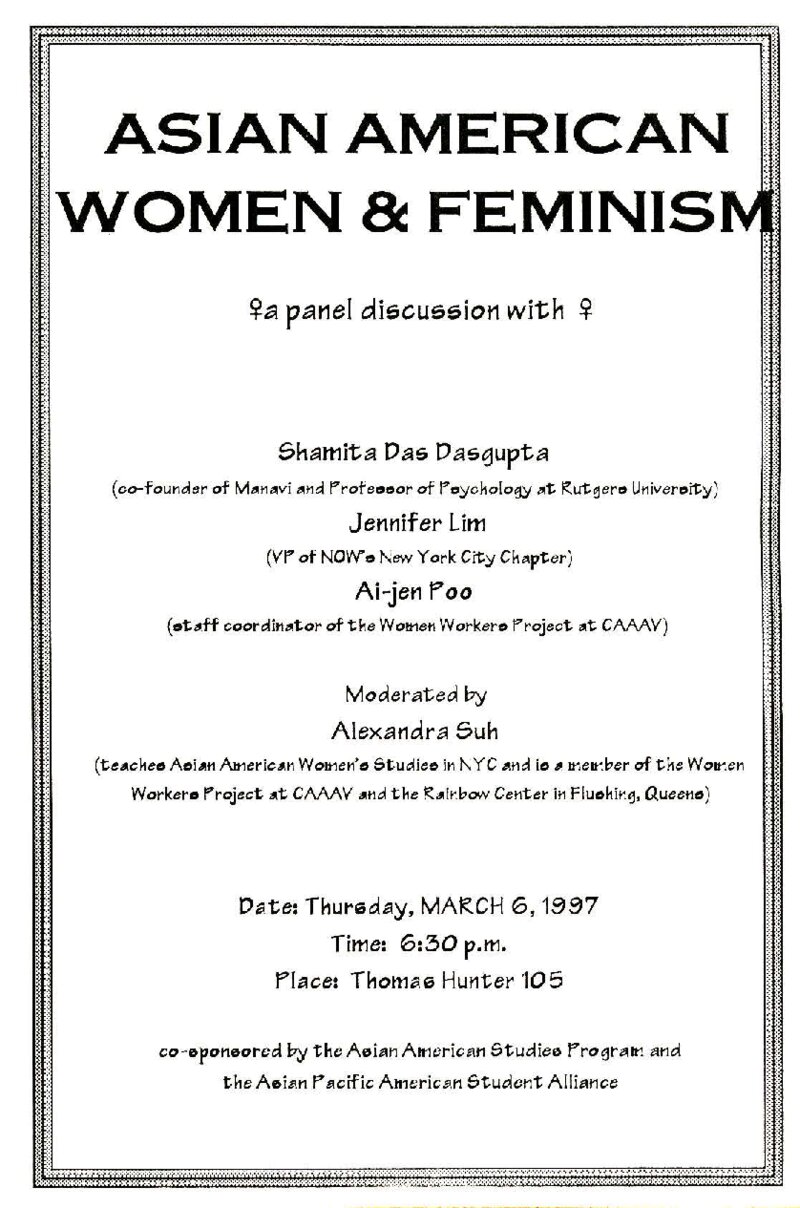
ASIAN AMERICAN
WOMEN & FEMINIS
9a panel discussion with ?
Shamita Das Dasgupta
(co-founder of Manavi and Profeseor of Poychology at Rutgere Univeroity)
Jennifer Lim
(VP of NOW’ New York City Chapter)
Ai-jen Poo
(otaff coordinator of the Women Workere Project at CAAAY)
Moderated by
Alexandra Suh
(teachee Avian American Women’s Studies in NYC and io a meinber of the Woinen
Workere Project at CAAAY and the Rainbow Center in Fluehing, Queene)
Date: Thureday, MARCH 6, 1997
Time: 6:30 p-m.
Place: Thomas Hunter 105
co-eponeored by the Asian American Studies Program and
the Aeian Pacific American Student Alliance
‘Asian American Women and Feminism’ Panel
History
1. Is there an Asian American Women’s movement, if so when and
where was it formed?
2. Would you say that the AA women’s movement was an offshoot of
the mainstream movement?
3. Is the development of AA feminism parallel with the development of
mainstream feminism?
4, Where does the development of the Asian American Movement fit
into the development of the AA Women’ movement? (If applicable)
Transition
5. Given the panel members’ backgrounds, what are their individual
perspectives in dealing with the mainstream women’s movement
and/or community issues as Asian American Women
activists/femminists?
6. What were specific reasons for their actions and the direction that
they took?
Closure
7. If indeed there are issues that cross cultural boundaries, is there
possibility for more inter-community development of an AA Women’s
movement? Example: CAAAV’s women worker’s project, etc.
8. The question of activist and feminist, with the issues that have been
dealt with, is there is a separation of these labels?
Q & A session
Moderator
Alexandra Suh is a Ph.D. candidate at Columbia University. She has taught Asian
American Literature at Hunter College and Asian American Women’s Studies at Barnard.
She is a member of the Committee Against Anti-Asian Violence and a founding member of
CAAAV’s Women Workers Project. She has also served on the board of the Rainbow
Center, a Korean women’s center based in Flushing, Queens.
Panelists
Shamita Das Dasgupta is a full-time faculty member with the Psychology department
at Rutgers University-Newark. She co-founded Manavi in 1985, a pioneering organization
that addresses issues of domestic violence, sexual assault, as well as other forms of
victimization of South Asian women in the U.S. She is on the advisory boards of the
National Clearinghouse for the Defense for Battered Women and the Battered Women’s
Justice Project. Ms. Das Dasgupta is well recognized for her work in the area of domestic
violence and cultural diversity. Her work has attracted attention of various national and
international media such as The New York Times, India Today, Ms. Magazine, The
Progressive, The Times of India, The Hindu, India Abroad, India Worldwide, and Manus hi.
She has lectured extensively at various universities, women’s organizations, and
corporations on such diverse array of topics as violence against women, cultural diversity,
Asian women’s leadership, and South-Asian immigrant experiences. She is a recipient of
the Asian American Legal Defense and Education Fund’s ‘Justice in Action’ award, as well
as Children’s Hope award for 1995. Ms. Das Dasgupta has published several research
papers on gender issues and a book entitled The Demon Slayers and Other Stories, Bengali
Folk Tales. Currently she is editing a book on South Asian American women in America
with Rutgers University Press.
Jennifer Lim, a graduate of New York Law School, has been a member of the New
York bar since 1987. She has maintained a strong commitment to a broad range of
community and public interest activities. These include the fight to expand opportunities for
women; the provision of services for senior citizens, advocacy of tenant and immigrant
rights (pro bono.) From 1987 to 1993 Ms. Lim was a partner in the progressive downtown
law firm of Donovan & Lim. She successfully fought for bilingual ballots so that American
citizens who aren’t proficient in English would no longer be excluded from the election
process. She is the former Chairperson of the Committee on Women in the Workplace of
the New York City National Organization of Women and currently serves as Vice President
of its N.Y.C. chapter. During 1996, she served as a Policy Aide to Mark Green, the Public
Advocate for the City of New York.
Ai-jen Poo has been a volunteer at the New York Asian Women’s Center for about four
years. She started volunteering at CAAAV on April 1995 during the citywide civil
disobedience against policy brutality and the CUNY cuts. Since then, she has been a
member of CAAAV’s Women Workers Project committee. She is currently the part-time
program coordinator for the project. She graduated from Columbia University in 1996 in
Women and Gender Studies. In her final year, she became involved in the student struggle
for Ethnic Studies, which marked a critical time of development, both personally and
politically. Another current project that she is involved with is PYRAMID, an urban youth
project for young Asian women based in Flushing, Queens.
QOO
More information about the Asian American Studies Program
and the Asian Pacific American Student Association
is available in W 1708 and W 1733.
WOMEN & FEMINIS
9a panel discussion with ?
Shamita Das Dasgupta
(co-founder of Manavi and Profeseor of Poychology at Rutgere Univeroity)
Jennifer Lim
(VP of NOW’ New York City Chapter)
Ai-jen Poo
(otaff coordinator of the Women Workere Project at CAAAY)
Moderated by
Alexandra Suh
(teachee Avian American Women’s Studies in NYC and io a meinber of the Woinen
Workere Project at CAAAY and the Rainbow Center in Fluehing, Queene)
Date: Thureday, MARCH 6, 1997
Time: 6:30 p-m.
Place: Thomas Hunter 105
co-eponeored by the Asian American Studies Program and
the Aeian Pacific American Student Alliance
‘Asian American Women and Feminism’ Panel
History
1. Is there an Asian American Women’s movement, if so when and
where was it formed?
2. Would you say that the AA women’s movement was an offshoot of
the mainstream movement?
3. Is the development of AA feminism parallel with the development of
mainstream feminism?
4, Where does the development of the Asian American Movement fit
into the development of the AA Women’ movement? (If applicable)
Transition
5. Given the panel members’ backgrounds, what are their individual
perspectives in dealing with the mainstream women’s movement
and/or community issues as Asian American Women
activists/femminists?
6. What were specific reasons for their actions and the direction that
they took?
Closure
7. If indeed there are issues that cross cultural boundaries, is there
possibility for more inter-community development of an AA Women’s
movement? Example: CAAAV’s women worker’s project, etc.
8. The question of activist and feminist, with the issues that have been
dealt with, is there is a separation of these labels?
Q & A session
Moderator
Alexandra Suh is a Ph.D. candidate at Columbia University. She has taught Asian
American Literature at Hunter College and Asian American Women’s Studies at Barnard.
She is a member of the Committee Against Anti-Asian Violence and a founding member of
CAAAV’s Women Workers Project. She has also served on the board of the Rainbow
Center, a Korean women’s center based in Flushing, Queens.
Panelists
Shamita Das Dasgupta is a full-time faculty member with the Psychology department
at Rutgers University-Newark. She co-founded Manavi in 1985, a pioneering organization
that addresses issues of domestic violence, sexual assault, as well as other forms of
victimization of South Asian women in the U.S. She is on the advisory boards of the
National Clearinghouse for the Defense for Battered Women and the Battered Women’s
Justice Project. Ms. Das Dasgupta is well recognized for her work in the area of domestic
violence and cultural diversity. Her work has attracted attention of various national and
international media such as The New York Times, India Today, Ms. Magazine, The
Progressive, The Times of India, The Hindu, India Abroad, India Worldwide, and Manus hi.
She has lectured extensively at various universities, women’s organizations, and
corporations on such diverse array of topics as violence against women, cultural diversity,
Asian women’s leadership, and South-Asian immigrant experiences. She is a recipient of
the Asian American Legal Defense and Education Fund’s ‘Justice in Action’ award, as well
as Children’s Hope award for 1995. Ms. Das Dasgupta has published several research
papers on gender issues and a book entitled The Demon Slayers and Other Stories, Bengali
Folk Tales. Currently she is editing a book on South Asian American women in America
with Rutgers University Press.
Jennifer Lim, a graduate of New York Law School, has been a member of the New
York bar since 1987. She has maintained a strong commitment to a broad range of
community and public interest activities. These include the fight to expand opportunities for
women; the provision of services for senior citizens, advocacy of tenant and immigrant
rights (pro bono.) From 1987 to 1993 Ms. Lim was a partner in the progressive downtown
law firm of Donovan & Lim. She successfully fought for bilingual ballots so that American
citizens who aren’t proficient in English would no longer be excluded from the election
process. She is the former Chairperson of the Committee on Women in the Workplace of
the New York City National Organization of Women and currently serves as Vice President
of its N.Y.C. chapter. During 1996, she served as a Policy Aide to Mark Green, the Public
Advocate for the City of New York.
Ai-jen Poo has been a volunteer at the New York Asian Women’s Center for about four
years. She started volunteering at CAAAV on April 1995 during the citywide civil
disobedience against policy brutality and the CUNY cuts. Since then, she has been a
member of CAAAV’s Women Workers Project committee. She is currently the part-time
program coordinator for the project. She graduated from Columbia University in 1996 in
Women and Gender Studies. In her final year, she became involved in the student struggle
for Ethnic Studies, which marked a critical time of development, both personally and
politically. Another current project that she is involved with is PYRAMID, an urban youth
project for young Asian women based in Flushing, Queens.
QOO
More information about the Asian American Studies Program
and the Asian Pacific American Student Association
is available in W 1708 and W 1733.
Title
Asian American Women and Feminism
Description
This program is for a panel event titled "Asian American Women and Feminism," which took place on March 6, 1997. The event was sponsored by the Hunter Asian American Studies Program and the Asian Pacific American Student Association. The panel featured Shamita Das Dasgupta, Jennifer Lim, Ai-Jen Poo, and Alexandra Suh. The panelists discussed the existence, lineages, and directions of a burgeoning Asian American women's movement and Asian American feminism, speaking from their experiences working with CAAAV's Women Workers Project, Manavi, and the National Organization of Women. Poo, went on to win a MacArthur Fellowship in 2014 for her work as director of the National Domestic Workers Alliance and her long history of community organizing, which began with organizing domestic workers at CAAAV in 1996.
The Hunter College Asian American Studies Program (AASP) was established in 1993. As the only academic program in Asian American studies in the CUNY system, the AASP offers a minor in Asian American Studies and other resources and programming. The AASP supports scholars, artists, and activists advancing scholarship in the fields of Asian American studies and critical ethnic studies and serves as a resource for New York City's Asian American communities. In 2006, the program was at risk of being cut due to a lack of funding. Students formed the Coalition for the Revitalization of Asian American Studies at Hunter (CRAASH) and saved the program within a year. CRAASH is now a student-run club that continues to advocate for the AASP.
The Hunter College Asian American Studies Program (AASP) was established in 1993. As the only academic program in Asian American studies in the CUNY system, the AASP offers a minor in Asian American Studies and other resources and programming. The AASP supports scholars, artists, and activists advancing scholarship in the fields of Asian American studies and critical ethnic studies and serves as a resource for New York City's Asian American communities. In 2006, the program was at risk of being cut due to a lack of funding. Students formed the Coalition for the Revitalization of Asian American Studies at Hunter (CRAASH) and saved the program within a year. CRAASH is now a student-run club that continues to advocate for the AASP.
Contributor
Hunter College Asian American Studies Program
Date
March 6, 1997
Language
English
Rights
Obtained from Contributor - Copyright Unknown
Source
Hunter College Asian American Studies Program
Original Format
Poster / Flier / Leaflet
“Asian American Women and Feminism”. Letter, CUNY DIGITAL HISTORY ARCHIVE, accessed September 5, 2026, https://stephenz.tailc22a4b.ts.net/s/cdha/item/1510