"Student Voices Breaking the Silence: The Asian and Pacific American Experience"
Item
wo summers ago, an ener-
getic young reporter from
Time asked to interview me
for a cover story on Asian
American ‘‘super achievers.”’
I asked her why Time
wanted to publish such a
narrow, possibly harmful
piece. In all of my years as an educator,
I explained, I had never run across a
myth or stereotype (positive or negative)
that had contributed much to life in
America. She responded, ‘‘ Time thinks
the topic is hot. Asian ‘super achievers’
are what Time readers want to read
about.”’
To illustrate the potential effect, of
Time’s almost 25 million readers, there
were approximately 4.3 million sub-
scribers who received the issue. Of
these, 11 percent, or approximately
506,610, were in the education field,
with 9 percent, or approximately
390,000, educators.
PAULA Y. BAGASAO is the director of
AAHE’s National Project in Support of Aca-
demic Alliances and co-chair of AAHE’s
Asian Caucus. A graduate of UCLA, she is a
member of the Filipino-American Educators
Association of California.
28
Cy -
STUDENT
WOGta
BREAKING THE SILENCE
THE ASIAN AND PACIFIC AMERICAN EXPERIENCE
ee ee ee ee
It was clear that my reservations
didn’t fit the story. It ran in the August
31, 1987 issue with the title, ‘“Those
Asian American WHIZ KIDS: Bright
Asian American Students Are the Mar-
vel of U.S. Classrooms.”’
That Time article typifies much of the
media’s coverage of Asian and Pacific
American students in higher education.
The stock picture is of bright-eyed
‘‘whiz kids,’’ the ‘‘best and the bright-
est,’? math and science majors, students
who pass through our toughest univer-
sities with ease.
I’m struck that the few real facts pre-
sented about these students are limited
to the point of college entry—their test
scores, admission rates, and the fields
of study they choose—and to the exit
point, as measured by graduation rates,
acceptances to graduate and profes-
sional schools, or by honors garnered.
These few facts, too, tend to be limited
to data about the ‘‘cream of the crop’”’
in selective colleges.
But even with the highest achievers,
the media leaves untold what happens
to these students during their under-
graduate years. Nor will reporters leave
off the successes at Cal Tech for the
BY PAULA Y. BAGASAD
more mundane story of the much larger
number of Asian American students at
the community college down the road.
Early this fall, I interviewed by phone
a variety of students and their advisors
on campuses across the nation, includ-
ing seven undergraduates and three
spring 1989 graduates. The 10 came
from various Asian and Pacific Amer-
ican backgrounds (Chinese, Vietnam-
ese, Japanese, Filipino, Indian); six
were American born and raised, the
others immigrated to this country in
their teens. Their academic careers var-
ied, as did their experience of ‘‘Asian
American.’
Change November/December 1989
Each student had a lively and pointed
story to tell. All were willing to share
their stories with Change readers. Why?
“It would be a chance to break the si-
lence,” one told me, and, as several re-
marked, a chance to speak to college
and university decisionmakers. As Chris-
topher Ing of Penn put it, ‘‘It’s impossi-
ble to change things without the help of
administrators. They barely know we’re
out there, let alone what we need.”’
Given the mix of the students inter-
viewed, I wasn’t all that surprised by the
very different personal experiences they
reported. Certain themes emerged across
their stories—themes that in some cases
Change November/December 1989
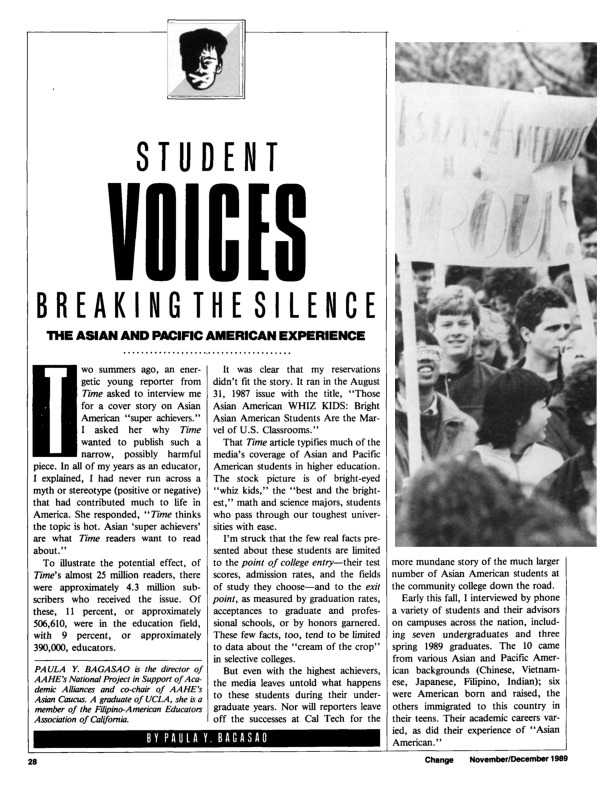
Campus-based Asian and
Pacific American student
groups are voicing their
protests not only on campuses
across the country, above and
right, but to their representa-
tives in Congress, left.
(Photo above by John
Carriveau/Oberlin
College)
Don’t Fix Anything That Isn’t Broken
Christopher Ing
University of Pennsylvania
Senior
Asian Studies/Biology
Career Plans
Community Medicine
D: Bagasao, | phoned
you fast April on behalf
of Penn’s Chinese Students
Association for help in dis-
seminating a job description
for a senior administrative
post to Asian American pro-
fessionals across the coun-
try. I’m glad AAHE’s Asian
Caucus could help. We’ve
got our fingers crossed
now; they’re interviewing
the finalists.
BAGASAO: Tell me about the
Chinese Students Associa-
tion.
ING: It’s one of six Asian
groups here: the South Asia
Society (Asian Indians);
Penn Philippine Associa-
tion; Korean Cultural So-
ciety; Japanese Cultural So-
ciety; Penn Vietnamese
Club; and us. Most are
small groups and usually in-
clude foreign and American
students. Most clubs are
not too political. There are
a few individuals from each
of the groups, like me, who
are fairly political, who will
run for student body posi-
tions and lobby the ad-
ministration.
BAGASAO: What sorts of
issues do Penn Asian
American students push?
ING: There are very few
Asian professors in most
departments, even in Orien-
tal studies. As of spring
1988, of 1,838 faculty at
Penn, 76 were Asian
American—just 40 of them
tenured. They’re mostly in
the traditional Asian fields,
like science. We need them
in the humanities and social
sciences.
The situation is worse in
administration. According
to my spring 1989 figures,
among the top 25 officers
here, none are Asian
American or Pacific Is-
lander. | don’t know of any
counselors. | only know of
one dean.
When we noticed that
there were no Asians in
‘thigh level, visible’ jobs,
some of us decided to work
to increase the numbers.
First, we decided to de-
mand more representation.
Then we decided to take re-
sponsibility to get the word
out, to pass out the job
description. That’s why |
called for help. | got hold of
the job description and
wrote a letter to the admin-
istration and other Asian
groups saying it would help
our community if an Asian
were hired for the position.
We’re the largest minority
group on campus. The
number of Asian American
students is increasing, but
the number of faculty and
administrators is seriously
low. Even if students don’t
say anything, something
should be done. It’s like if
colleges feel there’s no
problem, they aren’t going
to do anything. The slogan
here is, ‘‘Don’t Fix Anything
That Isn’t Broken.’’ The
situation isn’t very promis-
ing; we feel that the admin-
istrators won't fix things on
their own, and the students
are too busy studying.
BAGASAO: In student eyes,
what’s not working at
Penn?
ING: There’s the Justice De-
partment’s investigation
into admissions quotas in
the Ivy League schools.
Penn was mentioned, so
we’re looking into the sta-
tistics here, which currently
show some bias.
We're also asking for
Asian American studies
courses. Right now there’s
only one course, taught by
a Caucasian professor
whose specialty is the Pa-
cific Islands. We think that
an outside person, an Asian
American, should be
brought in to teach a
course, but they seem to
worry about finding a
qualified person. They want
to know what Penn’s peer
institutions are doing.
If there was an Asian
American administrator
here, he or she could help
us see alternative ways to
achieve our objectives.
Black students are more
vocal on this campus. There
is an Afro-American Studies
Program and black adminis-
trators and faculty at Penn,
and they support the stu-
dents. When issues come
up in the black community,
the administration deals
with them. When we talk to
administrators, they find it
hard to understand us. The
words of students are never
as credible as those of an
administrator.
BAGASAO: How are relations
between Asian Americans
and other students at Penn?
ING: Last fall there was an
anti-Asian racial incident on
campus, in the Wharton
School of Business. Some-
one placed an anti-Asian
statement on the tickertape
machine, ‘‘Fuck You
Asians, Get Out of
Wharton.” | understand it
had to have been well
planned; it takes time to get
a message on the tickertape
system. Anyway, it was a
major event that brought us
(students) together. We
wrote a letter to the admin-
istration. The administration
published a letter in the stu-
dent newspaper saying that
the act was wrong and that
this would not be tolerated.
They never caught anyone.
BAGASAO: Do the various
Asian student groups that
you described interact with
each other?
ING: | personally get con-
cerned about racial tension
at Penn, nothing overt. Peo-
ple, especially minorities,
don’t tend to mix. There’s
voluntary segregation.
Asian students, too, don’t
feel totally comfortable with
other Asian groups, or
other minorities. When we
have parties, people move
in cliques. There is some
inter-racial dating, mostly
white males and Asian
women. Rarely is it the
other way around. Some of
my friends complain that
you have to choose be-
tween Asian and Caucasian
friends.
BAGASAO: What are your
plans for after graduation?
ING: When | first came to
Penn, | wanted to be a doc-
tor. | still do, but my ex-
periences here have helped
me narrow my interest in
medicine. Rather than be a
researcher, | think I’m need-
ed in the community. I'd
like to work in an urban set-
ting, in a community clinic
in New York City, Boston,
or San Francisco. =
30
Change November/December 1989
yal cherishes the opportunity she has in
this country to read German literature
and watch Swedish films.
August Espiritu and Kelly Nishimura
are U.S. born and raised. Claire
Kinsley, born of American parents, was
raised in Canada. Each chose a non-sci-
ence major right from the start with pa-
rental support and has enjoyed his or
her studies. Their anxieties are those of
many college students. Kinsley doesn’t
know exactly where her double major in
history and Latin American studies will
lead. Espiritu knows he want to be a
history professor, but doesn’t know
very many Pilipino, or for that matter,
Asian American professors; he worries
about ever getting tenure. Nishimura is
off to a good start in the New York City
publications world, with internships at
Mature Health and the Ms. Founda-
tion, but does plan to return to Hawaii
after she graduates. What job will she
find there?
For these American-born students, a
felt freedom not to study science or en-
gineering has led them to genuine aca-
demic interests and new worries about
those interests in the world of work.
The Whiz Kid Myth
The ‘‘whiz kid’’ myth disturbs Ober-’
lin’s Claire Kinsley. ‘‘Apart from the ac-
tual distorted images that it portrays,”
she says, ‘‘it is potentially dangerous.”
Claire and other students I interviewed
feel that the myth is used to divide people
of color. The message sent to Afro-
American and Hispanic students is,
‘‘Why aren’t you like the Asians? If they
can make it, why can’t you?”’
As UCLA’s Augusto Espiritu states,
‘‘Admissions quotas are used to pit
Asian American students against blacks
and other nationalities.’’ At the same
time, he notes, the quota phenomenon
suggests to other minorities that there is
an “‘upper limit for success’? among stu-
dents from ethnic backgrounds.
The Asian students I interviewed do
not distinguish themselves from blacks
and Hispanics in terms of ‘‘minority
status.’ Most students, in fact, work
actively for minority rights and affirma-
tive action. They worry about what
seems to be voluntary segregation among
the minority groups and between minori-
ties and whites. They’ve joined, and been
joined, by other minority students to
Change § November/December 1989 31
ton. After taking a sociology class,
‘*Asian Americans in the U.S.,”’ from
lecturer Peter Kiang, she discovered
course content that she could connect
with. She now studies sociology and
plans to work in Boston’s Vietnamese
community when she graduates.
By connecting with the experiences of
Japanese American author John Okada
in his book, NO-NO Boy, Dario Ng of
Oberlin (initially a chemistry major)
overcame his fear of writing and devel-
oped the confidence to pursue an eco-
nomics major.
Fred Alfonso of San Francisco State
just didn’t like pre-med, even though
his mother did. So he tried what he calls
“the other Asian major—business,”’
where he was disconcerted by the com-
petition, compulsion, isolation, and the
stereotyping that characterize business
majors. Finally he discovered a calling
~—broadcasting. In the School for Crea-
tive Arts, ‘‘people don’t see you as just
an Asian,’’ and ‘‘everything is a team
effort.’? This helped him make friends,
“feel a sense of belonging.”’
Alfonso is a pioneer in his family: the
first to graduate from college outside a
science field.
Elmer Almachar, Oberlin, wanted to
be different from his high school
friends, who chose to study physics at
Harvard and Princeton. Elmer chose in-
stead to study physics in the ‘‘liberal es-
tablishment”’ of Oberlin. After discov-
ering government his first semester, he
switched. He now serves on Oberlin’s
Educational Planning and Policy Com-
mittee.
Among the other students, math and
science are still revered. While Ming
New and Bevayani Nautiyal are not
studying math or science at Hunter,
they are clear about the status and pres-
tige of these fields in their respective
home countries, Malaysia and India.
Ming fell behind and ‘“‘lost out’’ on
mathematics preparation when he
dropped out of school in Malaysia. For
him, an economics major is the com-
promise. Unlike her Indian friends who
do study science, Bevayani Nautiyal
studies economics at Hunter. ‘‘In India,
she reports, ‘‘people don’t take you se-
riously if you study the humanities. In
fact, most Third-World countries don’t
have liberal arts programs. Everything
is geared towards the technical.’’ Nauti-
are common to students in general; in
others, tied to being of an Asian or Pa-
cific American background. In the pro-
files that accompany this article, the stor-
ies of several of these students are pre-
sented more fully, largely in their own
words; in the present article, looking for
themes, I again want to bring forward
student voices.
Be willing to listen to what students have
to say. Take them seriously, even if it
goes against what you’ve seen in Time
magazine or ideas you came to campus
with. Give up the stereotypes and appre-
ciate our diversity. As individuals, we are
different. Our needs vary from campus to
campus. But, some of our experiences are
parallel. Listen.
Claire Kinsley, Oberlin College
If you want to serve all students, if you
want to understand us, ask us.
Woei-Ming New, Hunter College
Major Stories
College majors are a major story in
the undergraduate experience of Asian
and Pacific American students. One
doesn’t have to look far to learn about
the Asian stereotype majors: math, sci-
ence, engineering, and computer sci-
ence. The students I spoke with added
to that list classical music and business.
They know the stereotypes well and un-
derstand the forces that lead counter-
parts into these fields. Only now are
they learning the ins and outs of explor-
ing other options.
Math and science are indeed popular
majors among Asian and Pacific Amer-
ican students, and remain honored
fields of study among the students I in-
terviewed. Half of these 10 started col-
lege in a science field. The males’
choices were physics and pre-med; for
Kim-Dung Nguyen of U-Mass, Boston,
the plan was to be a nurse. By this fall,
however, only one of the five, Christo-
pher Ing of Penn, remains in a science
profession. Even for him there has been
a shift, from medical research to com-
munity medicine.
What happened? Like students in
general, these students ‘‘tested out’’
their first-choice majors, then moved on
to a “‘better fit.’’ Being Asian or Pacific
American played some role in their ini-
tial choices, and it explains in part why
and how they got to their next choices.
Nguyen didn’t feel welcomed at all in
the nursing department at U-Mass, Bos-
Overcoming the Fear of Writing
Dario Ng
Oberlin College
Junior
Economics
Career Plans
International business
oth of my parents are
Chinese. My father left
China when he was 14, and
my mother when she was
18. They moved to the
Dominican Republic to work
in my grandfather’s
business, and | was born
there. We left in 1976 for a
better life, and moved to
the Bronx. | went to public
school and graduated from
the new high school for the
arts, Fiorello LaGuardia.
BAGASAO: How was it that
you chose an arts school?
nG: | had a great teacher at
1S-137, junior high, who in-
spired me. There were a
few other Asians at La-
Guardia, but mostly in the
stereotype areas, violin and
piano. | was in the creative
field—studio art, drawing,
BAGASAO: What led you to
Oberlin?
NG: Friends from the year
before me went there. My
black friends at Oberlin con-
vinced me it was a good
place to go. It took my
parents a while to see it my
way. I’m the oldest, and my
mother didn’t want me to
go that far away. | was glad
to get a good financial
package so | could go.
BAGASAO: What are you ma-
joring in?
NG: Economics. At first |
wanted to be a typical pre-
med major, so | started in
chemistry. Then | tried com-
puter science. Now I’m
thinking about a career in
finance and business. In
high school | was afraid of
economics. | had this fear
about writing papers. But at
Oberlin, | decided to try it
again (taking an economics
class) and was lucky
enough to get a good prof
who inspired me. So now
i'm an economics major.
BAGASAO: Talk about your
fear of writing.
NG: I’ve had a fear of writing
in English since | came to
this country, when | was 9.
Then | only spoke Spanish
and Cantonese. In New
York, | had to take my
classes in both Spanish and
English . . . they call it bi-
lingual education. | think |
would have been better off
in regular classes, where
you had to write. | stayed in
art and science, where you
didn’t have to write.
BAGASAO: And at Oberlin?
NG: I’ve overcome my fear
of writing, and it has
changed my life. Last year |
took an English and history
course at the same time.
Both required writing. The
English class had writing
every day. My teacher
pushed me, and this in-
spired me to ‘‘tackle
writing.’’ My English
teacher said that | really im-
proved. | was so inspired!
Another thing helped,
too. Tommy Woon (assis-
tant dean student support
services), talked to me
about writer’s block. He
gave me lots of advice and
told me it was ok to write
papers over and over again.
He also said it was impor-
tant to talk them over with
people, even professors.
It was really my history
class, ‘‘Modern Japan,”’
where things happened.
The readings were interest-
ing, and the professor let
students pick a book and
write about it. One of my
Asian friends told me about
a book called No-No Boy,
by John Okada, about post-
World War II from a Japa-
nese American perspective.
| was inspired because |
could relate to the ex-
periences he wrote about. It
made me want to write and
give it my all. | spent days
with the dictionary and
thesaurus. Plenty of people
looked at my paper and
gave me suggestions. My
grade on the paper was an
A minus.
BAGASAO: I take it the sub-
ject matter of the book
helped you?
NG: Yes. If the subject had
not been interesting to me,
1 would not have spent that
much time. Something like
this happened in my sociol-
ogy class, too. | did my
paper on ‘‘Leadership in the
Asian American Communi-
ty.”’ At first my paper had
too much information. After
talking to my professor, |
was able to focus it more
and get it right. It was a
breakthrough for me.
BAGASAO: What did it mean
for you?
NG: | feel different, more
comfortable. | can get into
courses that require reading
and heavier writing. Now
I’m thinking about grad
school, an MBA. | could go
to Hong Kong or Singapore
and work for an interna-
tional firm. | speak Can-
tonese, Mandarin, Spanish,
and now English.
BAGASAO: Any other campus
experiences related to your
Asian heritage?
NG: Back in 1988, the Asian
American students here or-
ganized a big conference.
Lots of students from other
colleges came. It was called
‘‘Making Waves, Breaking
the Silence.’’ We networked
a lot and discussed the
stereotypes. Students can
learn a lot by describing
themselves.
BAGASAO: Your Oberlin edu-
cation has meant a lot.
What message do you have
for readers?
NG: It’s important for them
to see that | made it. |
didn’t quit; minorities can
make it. And | want to say
to students, explore what
you really want to be in col-
lege. Sometimes Asian stu-
dents say, ‘‘My parents
want me to do this.’’ But
they should find what’s best
for them, not just what their
parents want. And a college
should help them do that. []
| Photography.
ing out that their attrition rate is nearly
50 percent.
For Dario Ng, separating out ‘‘mi-
nority’’ from his personal identity is im-
possible. He was born in the Dominican
Republic, of Chinese parents, who later
moved to the U.S. He considers himself
Latino by birth, Chinese by race, and
American by citizenship. ‘I’m a combi-
seek graduate fellowship opportunities
for Asian Americans in the humanities.
(Melion Foundation Minority Under-
graduate Fellowships for the study of
the humanities target black and His-
panic students only.)
Espiritu worries about Pilipino stu-
dents being dropped from the Affirma-
tive Action Program at UCLA, point-
protest racist acts on campus.
Given this, these students express great
concern over their exclusion from their
preferred identification with ‘‘minor-
ity.’”” At Hunter College, Kelly Nishi-
mura argues that Asians should be put
back in the ‘‘minority’? category. Ming
New, as Hunter’s student body pres-
ident, challenges the administration to
_J
November/December 1989
32 Change
Do the Right Thing!
August Espiritu
UCLA
Senior
History
Career Pians
History professor
y parents and | chose
UCLA. We thought it
was one of the best schools
in the country, a top-ten
ranked university. Nobody
told us the ranking came
from graduate programs.
The undergraduate pro-
grams were weaker. But my
sister went to UCLA. For
her, getting involved with
the Samahang Pilipino club
was an attraction. For me,
UCLA promised a variety of
experiences. Besides, it
was close to home.
BAGASAO: UCLA is a good
place for exploring. Tell me
about your first years there.
Espiritu: | didn’t do much as
a freshman, tried to check
out different things—
Samahang, Asian Coalition.
| studied a lot, starting in
philosophy, my major. |
changed to history my sec-
ond year. The philosophy
department here doesn’t
teach anything related to
social issues. | got tired of
discussing ‘‘How do you
know if you are not now
dreaming?”
| felt disparities between
what was taught and what’s
going on in the world. The
huge classes don’t provide
an intellectual climate for
the students. The first year
is alienating; there’s not
much of a multicultural cli-
mate in the dorms yet.
Undergraduate education
should be tied to concrete,
practical work. Research
should contribute to com-
munity needs, like the work
of Tanya Azores (UCLA re-
searcher), which opened a
can of worms about Pilipino
student attrition.
BAGASAO: Did you consider
dropping out?
ESPIRITU: | hung in there. But
there’s a 55 percent attri-
tion rate among Pilipino stu-
dents at UCLA, the same as
at Berkeley. In 1982, it was
worse—an 86 percent drop-
out rate. There are a lot of
reasons—alienation, under-
preparation, lack of coun-
seling. Then we Asians hear
we’re ‘‘over-represented.’’
One Pilipino female student
was told by a white woman,
‘The reason UCLA is losing
(the football game) is be-
cause of all you Orientals.’’
BAGASAO: But you’ve made
it. Tell me how you did it.
ESPIRITU: I took six years. It
was a combination of par-
ental and family encourage-
ment and the activities | got
involved in. My sense of
what | had to do to change
the environment to make it
more sensitive to people of
color kept me going. |
learned a lot as president of
Samahang Pilipino.
After graduation, I'll take
a year off, then work for a
Ph.D. in history. | want to
teach at LA Community Col-
lege. There are not that
many Pilipinos who are pro-
fessors, but there are a lot
of Pilipino students at
LACC. I’m inspired to teach,
but | worry that | won’t get
tenure.
BAGASOA: Why worry about
tenure at this point?
ESPIRITU: | saw what hap-
pened to Don Nakanishi
(professor, UCLA School of
Education); it took years of
struggle for him to get ten-
ure. To me it was institu-
tional racism, and the ex-
ample of it helped Asian
students get organized
here. We held a candlelight
vigil on June 25, 1987,
launched a letter-writing
campaign, lobbied legista-
tors in Sacramento, and or-
ganized two rallies. Last
year the Asian students
played a real role in student
government elections. Of
the 7,500 UCLA undergrad-
uates who voted, about
3,000 were Asian Ameri-
cans, and our demand was
that student government
take up Don’s issue.
As it happened, Don’s
case was settled before the
student elections; he finally
got tenure. But the Chinese,
Japanese, Vietnamese,
Pilipinos, and other Asian
American students had
played a key role in the
elections. They were not
just voting, they were
leveraging issues. This is
progress.
BAGASAO: What else would
you share with readers?
ESPIRITU: The ‘‘model minor-
ity’’ thing shows Asians as
having no needs. We have
to fight for services and
classes that talk about us.
For example, | heard about
a Stanford professor who
said, ‘‘Asians haven't been
here long enough (in the
U.S.) to have an Asian
American Studies Center.’’
Vm most passionate
about my recent awareness
that Asian Americans are
not really respected in this
country. | think some peo-
ple fear our political power,
especially in California. |
also get upset when people
pit us against blacks as well
as other nationalities.
There’re a lot of misper-
ceptions about us out there.
Think about Spike Lee’s
new movie, ‘‘Do The Right
Thing!”’ In it, he highlights
various minority stereo-
types. He used the Korean
grocer to illustrate the wide-
spread perception of Asian
success. While there are a
lot of these untrue por-
trayals in society right now,
it’s not an accurate picture
of us.
Lots of Asian American
students are angry. They
are showing it by strength-
ening their organizations
and continuing the
debates. QO
nation,’’ he chuckles. ‘‘At Oberlin, peo-
ple know me as a Latino-Chinese Amer-
ican.”’
Most of these students, too, report
being touched in some way by campus
anti-Asian hostility. In 1988 at Oberlin,
following an Asian American student
conference in the Midwest, Ng and his
friends found their conference poster
November/December 1989
Change
—‘ALL ASIANS ARE WELCOMED”’
—defaced. It read instead, ‘‘KILL ALL
ASIANS.”? Many of these students
have traveled to intercollegiate Asian
and Pacific American student confer-
ences and learned of incidents else-
where. Last year’s big story (which in-
terviewees reminded me about) was of
the six Chinese American students at the
University of Connecticut who were spit
upon by football players as they sang,
We All Live in a Yellow Submarine.
Students told me of other racial state-
ments and incidents. Some report ten-
sions on campus, and feeling like they
don’t belong and aren’t wanted. Some
students have protested campus racism;
others have decided to remain silent.
S De. 4h
Kelly Nishimura
Hunter College
Senior
Art and Women's Studies
Career Plans
Writer on Women's Issues
was born and raised in
Hawaii. Until two years
ago, | attended the Univer-
sity of Hawaii. A big change
seemed important, so |
packed up, moved to New
York City, and enrolled at
Hunter. I’m a senior now.
BAGASAO: That was a big
change. What are you ma-
joring in?
NISHIMURA: I like to write,
and am an arts and
women’s studies major. I’m
studying these fields purely
out of interest, not because
of a job. Hunter has a great
in-service learning center.
Right now, I’m interning at
Mature Health magazine.
I’ve gotten great assign-
ments, and it feels like a
From Honolulu to New York City
real job. Next, I’1! work for
the Ms. Foundation and get
three class credits.
BAGASAO: What do your par-
ents think of this?
NISHIMURA: My parents are
patient and supportive. My
mother encourages me to
study art and my father
likes the idea of the media.
I’m lucky—they’re liberal
parents.
BAGASAO: Describe your first
semesters at Hunter.
NISHIMURA: It was a hard ad-
justment, going from a real
campus in beautiful Hawaii
to a college in the middle of
New York. | had never gone
to class on the 16th floor! |
felt that people here weren’t
friendly, which happens at a
commuter school. Things
changed when | got in-
volved in the Asian Pacific
Student Alliance. The Alli-
ance members do more
things than just school and
work. | was looking for that,
and a chance to learn about
Asian American issues.
BAGASAO: Tell me more
about the differences be-
tween Hawaii and New York
City.
NISHIMURA: In Hawaii, you
don’t have to explain that
you speak English. At Hunt-
er you do—not only with
white students but also with
foreign students. The inter-
national students don’t
understand the concept of
‘Asian American.’’ They
think all Asians are from
other countries, that they
are all alike.
The Hunter student body
is very international. | have
more contact here with
Third-World students from
Latin America and the
Caribbean. | enjoy that.
Third-World students are
very aware of the politics in
their countries, and they
have taught me to be more
aware of important interna-
tional issues. The scholars
they bring from Latin Amer-
ica talk about their own per-
sonal struggles. This is a
wonderful experience.
One big difference is that,
in Hawaii, people are re-
laxed. Here, people are al-
ways running around. Since
I like to relax, | plan to re-
turn to Hawaii.
BAGASAO: How has your un-
derstanding of ‘‘Asian
American’ changed?
NISHIMURA: In Hawaii, we
never talked much to differ-
ent Asian students. Most of
my friends were ‘‘locals.”’
At Hunter, you can meet
first-generation students
from Hong Kong and main-
land China. Most of these
students are from working-
class families. At first | was
surprised that, even though
our backgrounds are dif-
ferent, we share a lot of
common ground. | also
understand better what
these first-generation
students have experienced.
BAGASAO: What kinds of
problems do immigrant
students face at Hunter?
NISHIMURA: They have to take
remedial English. It’s an
issue to them because they
don’t get class credit, but
they have to take it and pay
tuition for the class. Then,
they still have to pass
English I to graduate. The
immigrant students try
hard. One of my friends
took the class four times.
She was demoralized. We
certainly take English for
granted. People think that
the students don’t try hard
enough. Instructors work
with the students three
times a week, but still
nothing happens. We don’t
know, but someone needs
to figure out what’s going
on. Some students major in
computer science to avoid
writing.
BAGASAO: What about paren-
tal expectations?
NISHIMURA: The first-
generation students don’t
have the same kind of free-
dom | have. They can't stay
out late at all. Their parents
are very protective. The stu-
dents don’t get angry, they
accept it. Most of the stu-
dents live in Chinatown
near Allen Street, or in
Queens, and they work.
BAGASAO: Given your experi-
ence at Hunter, what are
you concerned about as a
student?
NISHIMURA: I’d like to fight to
put Asian Americans back
in the category of ‘“‘minor-
ity.’’ Ugh, that word! !
worry about the immigrant
students and rumors of
budget cuts here. They
would really hurt these and
all working-class
students. O
Many expressed a hope that campus ad-
ministrators would declare racism intol-
erable and punish its perpetrators.
he ‘‘whiz kid’? myth harms stu-
dents, I was told. ‘‘It imposes a
burden on these students to per-
form at the highest levels, to be ‘whiz
kids’ themselves,’’ reports Kinsley of
Oberlin. Who holds these expectations?
Parents, teachers, counselors, adminis-
trators, friends, and the students them-
selves. ‘‘Oberlin,’’? Claire admits, ‘‘was
L
quite stressful. I couldn’t separate the
academic from the other parts of my
life. 1 put a lot of stress on myself that
wasn’t healthy, and got bad eating and
sleeping habits. I pulled a lot of all-
nighters. When things got really tough,
I’d remember that there’s a payoff. My
GPA was 3.78.’ Good grades, she told
me, ‘‘suck you back into it.”
Many Asian American students have
definitely not ‘“‘whizzed’’ through col-
lege. Dario Ng had to take a year off,
then return to Oberlin. He wants to
graduate no matter what, ‘‘to show that
minorities can make it,’’ to show that he
can make it.
On Being Asian American
Their undergraduate experience
helped these students learn the wider
story of Asian Americans in this coun-
try and to formulate their own personal
sense of being Asian American. At
UCLA, the Asian American Studies
Center became the avenue for growth;
at Oberlin, students benefit from the
34
Change November/December 1989
Learning English, Learning in English
Jenny Le (Phuong Thuy Nhu Le)
Pasadena City College, CA
Major
Special Education
Career Plans
Teach handicapped children
came to this country from
Vietnam with my parents
in 1981. | live with them
now, and, according to my
culture, | will live with them
until | get married. | have
six brothers and sisters. We
receive welfare. To help the
family, my older brother
and sister work, and | work
part-time. This is my fifth
semester here. {t is hard to
work and go to school at
the same time. At least with
a work-study job, you have
flexible hours. This is better
than what some students
do. When there is a lot of
homework or a test, | can
stay home and then work
different hours.
BAGASAO: | was a counselor
at Pcc in 1979. at that
>) time, learning to speak,
write, and read English was
a big problem for many
| students.
Le: | have found it very hard
to learn to speak the
English language. | didn’t
speak English at all when |
came to the United States.
I'm luckier than some of my
friends. | am learning to
speak by speaking with my
ESL teacher. She helps me
with my pronunciation. !
also have a neighbor friend,
who helps me when | am at
home. She is a native
speaker. Other Vietnamese
students don’t have native-
speaking friends. This can
make a difference.
But still, | have a problem
with studying, with reading.
The subjects that are most
difficult for my friends and
me are biology and psychol-
ogy. These courses have a
hard vocabulary. | have to
spend a lot of time study-
ing. It takes me about four
to six hours to read one
chapter in biology. ! have to
look in the Vietnamese dic-
tionary to find out what
things mean. So | study first
in Vietnamese, then in
English. It takes a long
time.
BAGASAO: How do your
friends study?
LE: They have to help each
other. They read and trans-
late for each other. If some-
one can’t read, the other
students explain everything
in Vietnamese. When it
comes to writing, they read
guidance and mentorship of Tommy
studies—a center, a course, a lecture—
each other’s papers, point-
ing out what’s wrong. Or
they write papers together.
This is a problem for some
of the teachers. Vietnamese
students have to take ESL.
They have lots of problems.
1 help them out, especially
with writing a good essay.
Most students don’t think
that English is a good sub-
ject. They don’t care about
writing, only speaking. They
feel they can get a good job
with only speaking.
BAGASAO: Lots of people
believe that all Asians like
math and are good at it.
What is your opinion on
this?
LE: Vietnamese students
know math and are good in
it. My older brother was
good in math and always
helped me when | was a lit-
tle girl. | have two math
classes, and | find them in-
teresting. You know, my
math background is good.
In Vietnam, the main sub-
ject is math. We study high
math in third and fourth
grade. We are experienced
in competing in math.
BAGASAO: Will the next gen-
eration of Vietnamese
American students be good
in math?
LE: I think it depends on the
family. If the older kids are
good in math and teach the
younger ones, then Viet-
namese will have high math
education. But if the young
ones are living in a house
without math experience,
they will learn like other
American children—that
math is difficult. This will
scare them away from it.
BAGASAO: What do you and
your friends plan to do after
leaving PCC?
Le: Most students transfer
from PCC to a four-year col-
lege. Some stop after two
years because of family
problems or money. We like
to go to colleges nearby or
where our sisters and
brothers have gone, so |
will go to Cal Poly-
Pomona. Then {| want to go
to UC-Irvine. They have a
good teacher credential pro-
gram.
BAGASAO: Do you have any
messages for colleges that
enroll Vietnamese students?
LE: | have one suggestion. |
have seen some teachers
who discriminate against
the students. They always
point to the students who
can't speak English and try
to pressure students to
drop the class. But it is
their job as professors to
help us. | just talked to a
student who was pressured
because she couldn't speak
the language well. She
cried. | told her to stand up
and say, ‘‘That’s not right!”’
But Vietnamese students
always keep it inside. They
think if they stand up for
themselves, they will get a
bad grade and not pass the
class.
quotas. Most
importantly,
like the
Woon, assistant dean, Student Support
Services.
Asian American studies were the
chief means for students to learn about
the history and literature of Asian
Americans. On some campuses, that
implies a center; at others, a course with
an outside lecturer; at still others, merely
an occasional lecture given by an Asian
American scholar at the behest of a stu-
dent organization. A// the students | in-
terviewed agreed that Asian American
make a difference in their education.
Students at Penn, Oberlin, U-Mass,
Boston, and Hunter have petitioned for
Asian American studies programs.
The number of Asian student organi-
zations is on the rise, and their strength
increases. These student associations
serve to bridge the college with the stu-
dents, and both with the Asian Amer-
ican communities. Student organiza-
tions fight tenure battles, push affirma-
tive action, and investigate admissions
November/December 1989
Change
Asian American studies centers, these
organizations provide individual stu-
dents with a place to make human con-
tact with the college.
‘*Being Asian American is so per-
sonal,’’ a student told me. For immi-
grant students like Ming New and Kim-
Dung Nguyen, the first year at college
meant being treated as an Asian while
learning to be American. It was by be-
coming active in Asian student activities
at Hunter that New made the connec-
36
The Education of a Leader
/
AR Nw
Woei-Ming New (Ming)
Hunter College
Senior
Economics
Career Plans
International Economics
here should | start?
It’s a long story, not
typical. It can’t be, since
they say I'm the first Asian
American student body
president in the CUNY sys-
tem.
How did | get to Hunter?
By accident! Back in ’85, |
worked in a restaurant five
blocks from here. On the
way to the subway, I'd see
these two bridges over the
street connecting buildings
and wonder what was in-
side. One day | just walked
in. It was a college! |
wanted to go. I’d see these
businessmen in expensive
suits at the restaurant, talk-
ing about current affairs,
signing big deals, and | was
inspired to get an educa-
tion.
BAGASAO: How did you get
in?
NEW: Well, they had open
admissions, so all ! had to
do was pass this GED test. |
P
did, barely. | felt good
because | was a dropout in
Malaysia in the seventh
grade, and | came here only
eight years ago. Still, | had
to ‘‘prove myself’ so |
could become a regular stu-
dent. For two years | went
to school full-time—then |
was part-time, worked, and
didn’t get involved in
anything else.
BAGASAO: What were your
first two years like?
NEw: | was nervous. | only
knew about college from
the movies and TV. Now |
was in one. | didn’t know
how to act. Should | speak
my mind? At first | felt in-
ferior to the American kids.
My self-confidence grew
when I got involved later in
extracurricular activities.
Hunter is a commuter
school in an urban area.
There’s no campus life, but
you hang out. I’m a city kid,
so it felt ok after a while.
That first year they signed
me up for German and polit-
ical science. No one ex-
plained to me what a liberal
arts school is or why | took
these courses. A semester
later an older student told
me I could meet the lan-
PHHOTEE BY ANNH TAN
guage requirement by tak-
ing a test, which | took and
passed. | speak Malaysian,
Mandarin, Cantonese, Fujia-
nese, and now English. As
for my English, it was poor
then. I sat through ESL 005
and got two credits, but |
still couldn't write essays. |
had a hard time expressing
myself; my vocabulary was
low.
BAGASAO: But those years
are obviously behind you.
What turned things around
for you?
NEw: Around that time, |
looked for other Asian
Americans, a support
group. It took a while be-
cause they didn’t have of-
fice space like the other
groups. But when | found it,
it was great. Then IJ started
doing things with the East
Coast Asian Student Union.
| went to an Asian American
conference, and for the first
time came into contact with
American-born Asian Ivy
League students. At first |
was careful. They have a
reputation for being ag-
gressive and snobbish. But
they made me feel positive.
Gradually [| gained confi-
dence and started talking
with everyone. My course-
work and writing improved,
and | got into an economics
major.
BAGASAO: How did you get
into student politics at
Hunter?
NEw: In my third year | be-
came a student senator. |
felt Asian American
students were neglected,
they didn’t have the funding
or office space the others
did. But then | learned how
things function. The next
year, | became activities
commissioner. A coalition
among Asian groups was
formed and has become a
swing vote in the elections.
We became a political
force. People told me |
should be student body
president, and, moreover, |
wanted to change the stu-
dent apathy. So the Asians,
blacks, Latinos, and special
interest groups, like the gay
and lesbian groups, formed
a Coalition. We won by
about a 2-to-1 margin.
Now I’ve been in office
two weeks. It’s a lot of
headaches, I| can tell. But a
main reason I ran was to
break away from the ster-
eotypes. We are not just
here to study. Our goals are |
those of all students. This
year in student government
our issues will be day care,
tuition increases, the cost
of books and meals, and
environmental safety on
campus.
BAGASAO: Even so, | know
Asian American issues are
close to your heart.
NEw: | have a message for
college leaders and admin-
istrators: Don’t let the
‘‘model minority’’ myth de-
ceive you. The problem for
us is bigger than you think.
There are Asian Americans
showing up in the middle
class, but more of the
population is in the lower
ranks. | worked in China-
town for two years. | regis-
tered the Chinese garment
workers and senior citizens
and listened to their experi-
ences. We have to vote and
therefore empower our-
selves to make a point. Lots
of kids drop out of school in
Chinatown, you know;
many become gang
members.
I think college leaders
feel Asians are well pre-
pared and represented in
higher education. That’s de-
batable even in the Ivy
League, which has gotten
visibility. But not in the
Hunter-type college. We are
regular students here, many
of us immigrants. What you
read about in the papers
isn’t the student body here.
A final point to college
presidents is that if you
want to educate ail the stu-
dent populations, you have
to know them. Read our
journals. Talk to us so you
have an accurate per-
spective. [
Change
i
‘
November/December 1989
tion between Asian and American. The
same happened for Nguyen when she
took her first Asian American studies
course at U-Mass, Boston. For Jenny
Le at Pasadena City College, that con-
nection remains harder; she’s a com-
muter there, and is still Vietnamese at
home. Beviyani Nautiyal of Hunter still
experiences Indian and American every
day.
Kelly Nishimura experienced ‘‘Asian
American’’ differently in Hawaii than
she does in New York City. The con-
trast: her definition now encompasses
immigrants from a wider variety of
Asian and Pacific countries. Within just
the Chinese American community in
Chinatown she sees a wider range of
generations.
Claire Kinsley is Eurasian. Her expe-
rience at Oberlin in the Asian American
student organization added new light to
her self-image. Students there welcomed
her inter-racial background; she now
understands herself as Asian American.
Making it Better
Interested educators need to better
understand the ‘‘real’? Asian and Pa-
cific American students. The fact that
most of them don’t whiz through easily,
and that many have unmet educational
and counseling needs, shouldn’t be a
surprise. The college administrators and
counselors interviewed for this article
confirm the voices of the students. They
join with me in making these recom-
mendations.
e The variability within the Asian
and Pacific American population mili-
tates against generalizing about it in the
aggregate. As a check on generalization,
we need inter alia systematic data on the
particular ethnic populations (Japanese,
Vietnamese, Chinese, Pilipino, Guaman-
ian, etc.) and especially on these peoples
in higher education, so that we can iden-
tify and understand more particular
needs.
©@ The doors labeled ‘‘minority op-
portunities’’ are closed to Asian and Pa-
cific American students, despite their
minority status and some very real
needs. Retention services, for example,
should be provided to all students from
‘‘high risk’? backgrounds, perhaps as
identified on a campus-by-campus
basis. Universities should ensure that
Asian and Pacific American students
Change November/December 1989
have access to appropriate grant and fel-
lowship opportunities, especially ones in
the humanities and social sciences—
fields in which they are under-repre-
sented. (This message is specifically di-
rected to the major governmental and
private foundations that support minor-
ity programs.)
e Exposure to the broader world of
college majors and careers would be of
great benefit to Asian and Pacific Amer-
ican students, especially immigrant stu-
dents. This can be accomplished by pre-
paring students with a full set of skills—
including good communications skills—
by introducing students to the humani-
ties and social sciences, often through
Asian American studies, and by provid-
ing counseling and advising services that
avoid ‘‘stereotyping.’’
e Appropriate services are needed for
immigrant students, whose experiences
differ greatly from those of fourth-gene-
ration students. Ray Lou, in this issue
(‘Model Minority: Getting Behind the
Veil’’), suggests specific student and
campus activities toward this end. We
would add that it is important to avoid
blaming immigrant students for the in-
evitably slow process of learning English
and learning in English.
© Often, immigrant students are made
to repeat ESL classes, for which they
pay, but for which they do not receive
credit toward graduation. In such cases,
both the class and the tests should be in-
vestigated for effectiveness and validity.
e All college curricula should be
“Asian American sensitive.’? This can be
accomplished through Asian American
studies course offerings and by the inte-
gration of such content into regular
coursework,
© Like black, Hispanic, and all other
students, Asian and Pacific American
students are greatly served by the pres-
ence on campus of role models. Affirma-
tive action in the areas of faculty, coun-
selor, and administrator recruitment,
hiring, tenure, and promotion is neces-
sary.
e Asian and Pacific American stu-
dents themselves are a ready source of in-
formation about student needs. Their
student organizations should be viewed
as a campus resource.
e Anti-Asian hostility seems to be on
the rise. Campus racism should not be
tolerated. O
The Student Voices
am deeply grateful to the following
students for their willingness to put
voice to their experiences for this arti-
cle. They have faced the challenge of
being Asian and Pacific American stu-
dents and they inspire me.
~— Paula Bagasao
Eimer Almachar
Senior Oberlin College
Dario Ng
Junior, Oberlin College
Claire Kinsley
Senior, Oberlin College
Woei-Ming New
Senior, Hunter College
Kelly Nishimura
Senior, Hunter College (1987 - 89)
University of Hawaii (1983-87)
Bevayant-Nautilyal
Senior Hunter College
Kim-Dung Nguyen
Junior, U-Mass, Boston
Fred Alfonso
Senior, San Francisco State University
Christopher Ing
Senior, University of Pennsylvania
August Espiritu
Senior UCLA
Phuong Thuy Nhu Le
Pasadena City College (CA)
Those Who Helped
any thanks, too, to the following
individuals for their observations
about their experiences of Asian Amer-
ican and Pacific Islander students. As |
found, their students are thankful to
them, too.
— Paula Bagasao
Tommy Woon
Assistant Dean
Student Support Services
Oberlin College
Margaret Chin
IBM
New York, NY
Peter Kiang
Lecturer
Sociology and American Studies
U-Mass, Boston
Paul Bok
Professor
University of Connecticut
Diana Wong
Executive Assistant to Director for
Enrollment Services
San Francisco State University
Joe Virata
Assistant Coordinator
Student Communities Project Unit
Asian American Studies Center
UCLA
Madhdulika Shankar
Asian American Research Center
Queens College, CUNY
Ernestine Moore
Vice President
Student Affairs
Pasadena City College
37
38
The Asian American admissions debate represents a
serious Challenge to a number of long-standing goals of
American higher education, such as socially engineering
a “diverse” or “balanced” student body or seeking the
meritocratic ideal of choosing the best of the brightest.
{Photos by John Foraste’ Brown University)
Change November/December 1989
getic young reporter from
Time asked to interview me
for a cover story on Asian
American ‘‘super achievers.”’
I asked her why Time
wanted to publish such a
narrow, possibly harmful
piece. In all of my years as an educator,
I explained, I had never run across a
myth or stereotype (positive or negative)
that had contributed much to life in
America. She responded, ‘‘ Time thinks
the topic is hot. Asian ‘super achievers’
are what Time readers want to read
about.”’
To illustrate the potential effect, of
Time’s almost 25 million readers, there
were approximately 4.3 million sub-
scribers who received the issue. Of
these, 11 percent, or approximately
506,610, were in the education field,
with 9 percent, or approximately
390,000, educators.
PAULA Y. BAGASAO is the director of
AAHE’s National Project in Support of Aca-
demic Alliances and co-chair of AAHE’s
Asian Caucus. A graduate of UCLA, she is a
member of the Filipino-American Educators
Association of California.
28
Cy -
STUDENT
WOGta
BREAKING THE SILENCE
THE ASIAN AND PACIFIC AMERICAN EXPERIENCE
ee ee ee ee
It was clear that my reservations
didn’t fit the story. It ran in the August
31, 1987 issue with the title, ‘“Those
Asian American WHIZ KIDS: Bright
Asian American Students Are the Mar-
vel of U.S. Classrooms.”’
That Time article typifies much of the
media’s coverage of Asian and Pacific
American students in higher education.
The stock picture is of bright-eyed
‘‘whiz kids,’’ the ‘‘best and the bright-
est,’? math and science majors, students
who pass through our toughest univer-
sities with ease.
I’m struck that the few real facts pre-
sented about these students are limited
to the point of college entry—their test
scores, admission rates, and the fields
of study they choose—and to the exit
point, as measured by graduation rates,
acceptances to graduate and profes-
sional schools, or by honors garnered.
These few facts, too, tend to be limited
to data about the ‘‘cream of the crop’”’
in selective colleges.
But even with the highest achievers,
the media leaves untold what happens
to these students during their under-
graduate years. Nor will reporters leave
off the successes at Cal Tech for the
BY PAULA Y. BAGASAD
more mundane story of the much larger
number of Asian American students at
the community college down the road.
Early this fall, I interviewed by phone
a variety of students and their advisors
on campuses across the nation, includ-
ing seven undergraduates and three
spring 1989 graduates. The 10 came
from various Asian and Pacific Amer-
ican backgrounds (Chinese, Vietnam-
ese, Japanese, Filipino, Indian); six
were American born and raised, the
others immigrated to this country in
their teens. Their academic careers var-
ied, as did their experience of ‘‘Asian
American.’
Change November/December 1989
Each student had a lively and pointed
story to tell. All were willing to share
their stories with Change readers. Why?
“It would be a chance to break the si-
lence,” one told me, and, as several re-
marked, a chance to speak to college
and university decisionmakers. As Chris-
topher Ing of Penn put it, ‘‘It’s impossi-
ble to change things without the help of
administrators. They barely know we’re
out there, let alone what we need.”’
Given the mix of the students inter-
viewed, I wasn’t all that surprised by the
very different personal experiences they
reported. Certain themes emerged across
their stories—themes that in some cases
Change November/December 1989
Campus-based Asian and
Pacific American student
groups are voicing their
protests not only on campuses
across the country, above and
right, but to their representa-
tives in Congress, left.
(Photo above by John
Carriveau/Oberlin
College)
Don’t Fix Anything That Isn’t Broken
Christopher Ing
University of Pennsylvania
Senior
Asian Studies/Biology
Career Plans
Community Medicine
D: Bagasao, | phoned
you fast April on behalf
of Penn’s Chinese Students
Association for help in dis-
seminating a job description
for a senior administrative
post to Asian American pro-
fessionals across the coun-
try. I’m glad AAHE’s Asian
Caucus could help. We’ve
got our fingers crossed
now; they’re interviewing
the finalists.
BAGASAO: Tell me about the
Chinese Students Associa-
tion.
ING: It’s one of six Asian
groups here: the South Asia
Society (Asian Indians);
Penn Philippine Associa-
tion; Korean Cultural So-
ciety; Japanese Cultural So-
ciety; Penn Vietnamese
Club; and us. Most are
small groups and usually in-
clude foreign and American
students. Most clubs are
not too political. There are
a few individuals from each
of the groups, like me, who
are fairly political, who will
run for student body posi-
tions and lobby the ad-
ministration.
BAGASAO: What sorts of
issues do Penn Asian
American students push?
ING: There are very few
Asian professors in most
departments, even in Orien-
tal studies. As of spring
1988, of 1,838 faculty at
Penn, 76 were Asian
American—just 40 of them
tenured. They’re mostly in
the traditional Asian fields,
like science. We need them
in the humanities and social
sciences.
The situation is worse in
administration. According
to my spring 1989 figures,
among the top 25 officers
here, none are Asian
American or Pacific Is-
lander. | don’t know of any
counselors. | only know of
one dean.
When we noticed that
there were no Asians in
‘thigh level, visible’ jobs,
some of us decided to work
to increase the numbers.
First, we decided to de-
mand more representation.
Then we decided to take re-
sponsibility to get the word
out, to pass out the job
description. That’s why |
called for help. | got hold of
the job description and
wrote a letter to the admin-
istration and other Asian
groups saying it would help
our community if an Asian
were hired for the position.
We’re the largest minority
group on campus. The
number of Asian American
students is increasing, but
the number of faculty and
administrators is seriously
low. Even if students don’t
say anything, something
should be done. It’s like if
colleges feel there’s no
problem, they aren’t going
to do anything. The slogan
here is, ‘‘Don’t Fix Anything
That Isn’t Broken.’’ The
situation isn’t very promis-
ing; we feel that the admin-
istrators won't fix things on
their own, and the students
are too busy studying.
BAGASAO: In student eyes,
what’s not working at
Penn?
ING: There’s the Justice De-
partment’s investigation
into admissions quotas in
the Ivy League schools.
Penn was mentioned, so
we’re looking into the sta-
tistics here, which currently
show some bias.
We're also asking for
Asian American studies
courses. Right now there’s
only one course, taught by
a Caucasian professor
whose specialty is the Pa-
cific Islands. We think that
an outside person, an Asian
American, should be
brought in to teach a
course, but they seem to
worry about finding a
qualified person. They want
to know what Penn’s peer
institutions are doing.
If there was an Asian
American administrator
here, he or she could help
us see alternative ways to
achieve our objectives.
Black students are more
vocal on this campus. There
is an Afro-American Studies
Program and black adminis-
trators and faculty at Penn,
and they support the stu-
dents. When issues come
up in the black community,
the administration deals
with them. When we talk to
administrators, they find it
hard to understand us. The
words of students are never
as credible as those of an
administrator.
BAGASAO: How are relations
between Asian Americans
and other students at Penn?
ING: Last fall there was an
anti-Asian racial incident on
campus, in the Wharton
School of Business. Some-
one placed an anti-Asian
statement on the tickertape
machine, ‘‘Fuck You
Asians, Get Out of
Wharton.” | understand it
had to have been well
planned; it takes time to get
a message on the tickertape
system. Anyway, it was a
major event that brought us
(students) together. We
wrote a letter to the admin-
istration. The administration
published a letter in the stu-
dent newspaper saying that
the act was wrong and that
this would not be tolerated.
They never caught anyone.
BAGASAO: Do the various
Asian student groups that
you described interact with
each other?
ING: | personally get con-
cerned about racial tension
at Penn, nothing overt. Peo-
ple, especially minorities,
don’t tend to mix. There’s
voluntary segregation.
Asian students, too, don’t
feel totally comfortable with
other Asian groups, or
other minorities. When we
have parties, people move
in cliques. There is some
inter-racial dating, mostly
white males and Asian
women. Rarely is it the
other way around. Some of
my friends complain that
you have to choose be-
tween Asian and Caucasian
friends.
BAGASAO: What are your
plans for after graduation?
ING: When | first came to
Penn, | wanted to be a doc-
tor. | still do, but my ex-
periences here have helped
me narrow my interest in
medicine. Rather than be a
researcher, | think I’m need-
ed in the community. I'd
like to work in an urban set-
ting, in a community clinic
in New York City, Boston,
or San Francisco. =
30
Change November/December 1989
yal cherishes the opportunity she has in
this country to read German literature
and watch Swedish films.
August Espiritu and Kelly Nishimura
are U.S. born and raised. Claire
Kinsley, born of American parents, was
raised in Canada. Each chose a non-sci-
ence major right from the start with pa-
rental support and has enjoyed his or
her studies. Their anxieties are those of
many college students. Kinsley doesn’t
know exactly where her double major in
history and Latin American studies will
lead. Espiritu knows he want to be a
history professor, but doesn’t know
very many Pilipino, or for that matter,
Asian American professors; he worries
about ever getting tenure. Nishimura is
off to a good start in the New York City
publications world, with internships at
Mature Health and the Ms. Founda-
tion, but does plan to return to Hawaii
after she graduates. What job will she
find there?
For these American-born students, a
felt freedom not to study science or en-
gineering has led them to genuine aca-
demic interests and new worries about
those interests in the world of work.
The Whiz Kid Myth
The ‘‘whiz kid’’ myth disturbs Ober-’
lin’s Claire Kinsley. ‘‘Apart from the ac-
tual distorted images that it portrays,”
she says, ‘‘it is potentially dangerous.”
Claire and other students I interviewed
feel that the myth is used to divide people
of color. The message sent to Afro-
American and Hispanic students is,
‘‘Why aren’t you like the Asians? If they
can make it, why can’t you?”’
As UCLA’s Augusto Espiritu states,
‘‘Admissions quotas are used to pit
Asian American students against blacks
and other nationalities.’’ At the same
time, he notes, the quota phenomenon
suggests to other minorities that there is
an “‘upper limit for success’? among stu-
dents from ethnic backgrounds.
The Asian students I interviewed do
not distinguish themselves from blacks
and Hispanics in terms of ‘‘minority
status.’ Most students, in fact, work
actively for minority rights and affirma-
tive action. They worry about what
seems to be voluntary segregation among
the minority groups and between minori-
ties and whites. They’ve joined, and been
joined, by other minority students to
Change § November/December 1989 31
ton. After taking a sociology class,
‘*Asian Americans in the U.S.,”’ from
lecturer Peter Kiang, she discovered
course content that she could connect
with. She now studies sociology and
plans to work in Boston’s Vietnamese
community when she graduates.
By connecting with the experiences of
Japanese American author John Okada
in his book, NO-NO Boy, Dario Ng of
Oberlin (initially a chemistry major)
overcame his fear of writing and devel-
oped the confidence to pursue an eco-
nomics major.
Fred Alfonso of San Francisco State
just didn’t like pre-med, even though
his mother did. So he tried what he calls
“the other Asian major—business,”’
where he was disconcerted by the com-
petition, compulsion, isolation, and the
stereotyping that characterize business
majors. Finally he discovered a calling
~—broadcasting. In the School for Crea-
tive Arts, ‘‘people don’t see you as just
an Asian,’’ and ‘‘everything is a team
effort.’? This helped him make friends,
“feel a sense of belonging.”’
Alfonso is a pioneer in his family: the
first to graduate from college outside a
science field.
Elmer Almachar, Oberlin, wanted to
be different from his high school
friends, who chose to study physics at
Harvard and Princeton. Elmer chose in-
stead to study physics in the ‘‘liberal es-
tablishment”’ of Oberlin. After discov-
ering government his first semester, he
switched. He now serves on Oberlin’s
Educational Planning and Policy Com-
mittee.
Among the other students, math and
science are still revered. While Ming
New and Bevayani Nautiyal are not
studying math or science at Hunter,
they are clear about the status and pres-
tige of these fields in their respective
home countries, Malaysia and India.
Ming fell behind and ‘“‘lost out’’ on
mathematics preparation when he
dropped out of school in Malaysia. For
him, an economics major is the com-
promise. Unlike her Indian friends who
do study science, Bevayani Nautiyal
studies economics at Hunter. ‘‘In India,
she reports, ‘‘people don’t take you se-
riously if you study the humanities. In
fact, most Third-World countries don’t
have liberal arts programs. Everything
is geared towards the technical.’’ Nauti-
are common to students in general; in
others, tied to being of an Asian or Pa-
cific American background. In the pro-
files that accompany this article, the stor-
ies of several of these students are pre-
sented more fully, largely in their own
words; in the present article, looking for
themes, I again want to bring forward
student voices.
Be willing to listen to what students have
to say. Take them seriously, even if it
goes against what you’ve seen in Time
magazine or ideas you came to campus
with. Give up the stereotypes and appre-
ciate our diversity. As individuals, we are
different. Our needs vary from campus to
campus. But, some of our experiences are
parallel. Listen.
Claire Kinsley, Oberlin College
If you want to serve all students, if you
want to understand us, ask us.
Woei-Ming New, Hunter College
Major Stories
College majors are a major story in
the undergraduate experience of Asian
and Pacific American students. One
doesn’t have to look far to learn about
the Asian stereotype majors: math, sci-
ence, engineering, and computer sci-
ence. The students I spoke with added
to that list classical music and business.
They know the stereotypes well and un-
derstand the forces that lead counter-
parts into these fields. Only now are
they learning the ins and outs of explor-
ing other options.
Math and science are indeed popular
majors among Asian and Pacific Amer-
ican students, and remain honored
fields of study among the students I in-
terviewed. Half of these 10 started col-
lege in a science field. The males’
choices were physics and pre-med; for
Kim-Dung Nguyen of U-Mass, Boston,
the plan was to be a nurse. By this fall,
however, only one of the five, Christo-
pher Ing of Penn, remains in a science
profession. Even for him there has been
a shift, from medical research to com-
munity medicine.
What happened? Like students in
general, these students ‘‘tested out’’
their first-choice majors, then moved on
to a “‘better fit.’’ Being Asian or Pacific
American played some role in their ini-
tial choices, and it explains in part why
and how they got to their next choices.
Nguyen didn’t feel welcomed at all in
the nursing department at U-Mass, Bos-
Overcoming the Fear of Writing
Dario Ng
Oberlin College
Junior
Economics
Career Plans
International business
oth of my parents are
Chinese. My father left
China when he was 14, and
my mother when she was
18. They moved to the
Dominican Republic to work
in my grandfather’s
business, and | was born
there. We left in 1976 for a
better life, and moved to
the Bronx. | went to public
school and graduated from
the new high school for the
arts, Fiorello LaGuardia.
BAGASAO: How was it that
you chose an arts school?
nG: | had a great teacher at
1S-137, junior high, who in-
spired me. There were a
few other Asians at La-
Guardia, but mostly in the
stereotype areas, violin and
piano. | was in the creative
field—studio art, drawing,
BAGASAO: What led you to
Oberlin?
NG: Friends from the year
before me went there. My
black friends at Oberlin con-
vinced me it was a good
place to go. It took my
parents a while to see it my
way. I’m the oldest, and my
mother didn’t want me to
go that far away. | was glad
to get a good financial
package so | could go.
BAGASAO: What are you ma-
joring in?
NG: Economics. At first |
wanted to be a typical pre-
med major, so | started in
chemistry. Then | tried com-
puter science. Now I’m
thinking about a career in
finance and business. In
high school | was afraid of
economics. | had this fear
about writing papers. But at
Oberlin, | decided to try it
again (taking an economics
class) and was lucky
enough to get a good prof
who inspired me. So now
i'm an economics major.
BAGASAO: Talk about your
fear of writing.
NG: I’ve had a fear of writing
in English since | came to
this country, when | was 9.
Then | only spoke Spanish
and Cantonese. In New
York, | had to take my
classes in both Spanish and
English . . . they call it bi-
lingual education. | think |
would have been better off
in regular classes, where
you had to write. | stayed in
art and science, where you
didn’t have to write.
BAGASAO: And at Oberlin?
NG: I’ve overcome my fear
of writing, and it has
changed my life. Last year |
took an English and history
course at the same time.
Both required writing. The
English class had writing
every day. My teacher
pushed me, and this in-
spired me to ‘‘tackle
writing.’’ My English
teacher said that | really im-
proved. | was so inspired!
Another thing helped,
too. Tommy Woon (assis-
tant dean student support
services), talked to me
about writer’s block. He
gave me lots of advice and
told me it was ok to write
papers over and over again.
He also said it was impor-
tant to talk them over with
people, even professors.
It was really my history
class, ‘‘Modern Japan,”’
where things happened.
The readings were interest-
ing, and the professor let
students pick a book and
write about it. One of my
Asian friends told me about
a book called No-No Boy,
by John Okada, about post-
World War II from a Japa-
nese American perspective.
| was inspired because |
could relate to the ex-
periences he wrote about. It
made me want to write and
give it my all. | spent days
with the dictionary and
thesaurus. Plenty of people
looked at my paper and
gave me suggestions. My
grade on the paper was an
A minus.
BAGASAO: I take it the sub-
ject matter of the book
helped you?
NG: Yes. If the subject had
not been interesting to me,
1 would not have spent that
much time. Something like
this happened in my sociol-
ogy class, too. | did my
paper on ‘‘Leadership in the
Asian American Communi-
ty.”’ At first my paper had
too much information. After
talking to my professor, |
was able to focus it more
and get it right. It was a
breakthrough for me.
BAGASAO: What did it mean
for you?
NG: | feel different, more
comfortable. | can get into
courses that require reading
and heavier writing. Now
I’m thinking about grad
school, an MBA. | could go
to Hong Kong or Singapore
and work for an interna-
tional firm. | speak Can-
tonese, Mandarin, Spanish,
and now English.
BAGASAO: Any other campus
experiences related to your
Asian heritage?
NG: Back in 1988, the Asian
American students here or-
ganized a big conference.
Lots of students from other
colleges came. It was called
‘‘Making Waves, Breaking
the Silence.’’ We networked
a lot and discussed the
stereotypes. Students can
learn a lot by describing
themselves.
BAGASAO: Your Oberlin edu-
cation has meant a lot.
What message do you have
for readers?
NG: It’s important for them
to see that | made it. |
didn’t quit; minorities can
make it. And | want to say
to students, explore what
you really want to be in col-
lege. Sometimes Asian stu-
dents say, ‘‘My parents
want me to do this.’’ But
they should find what’s best
for them, not just what their
parents want. And a college
should help them do that. []
| Photography.
ing out that their attrition rate is nearly
50 percent.
For Dario Ng, separating out ‘‘mi-
nority’’ from his personal identity is im-
possible. He was born in the Dominican
Republic, of Chinese parents, who later
moved to the U.S. He considers himself
Latino by birth, Chinese by race, and
American by citizenship. ‘I’m a combi-
seek graduate fellowship opportunities
for Asian Americans in the humanities.
(Melion Foundation Minority Under-
graduate Fellowships for the study of
the humanities target black and His-
panic students only.)
Espiritu worries about Pilipino stu-
dents being dropped from the Affirma-
tive Action Program at UCLA, point-
protest racist acts on campus.
Given this, these students express great
concern over their exclusion from their
preferred identification with ‘‘minor-
ity.’”” At Hunter College, Kelly Nishi-
mura argues that Asians should be put
back in the ‘‘minority’? category. Ming
New, as Hunter’s student body pres-
ident, challenges the administration to
_J
November/December 1989
32 Change
Do the Right Thing!
August Espiritu
UCLA
Senior
History
Career Pians
History professor
y parents and | chose
UCLA. We thought it
was one of the best schools
in the country, a top-ten
ranked university. Nobody
told us the ranking came
from graduate programs.
The undergraduate pro-
grams were weaker. But my
sister went to UCLA. For
her, getting involved with
the Samahang Pilipino club
was an attraction. For me,
UCLA promised a variety of
experiences. Besides, it
was close to home.
BAGASAO: UCLA is a good
place for exploring. Tell me
about your first years there.
Espiritu: | didn’t do much as
a freshman, tried to check
out different things—
Samahang, Asian Coalition.
| studied a lot, starting in
philosophy, my major. |
changed to history my sec-
ond year. The philosophy
department here doesn’t
teach anything related to
social issues. | got tired of
discussing ‘‘How do you
know if you are not now
dreaming?”
| felt disparities between
what was taught and what’s
going on in the world. The
huge classes don’t provide
an intellectual climate for
the students. The first year
is alienating; there’s not
much of a multicultural cli-
mate in the dorms yet.
Undergraduate education
should be tied to concrete,
practical work. Research
should contribute to com-
munity needs, like the work
of Tanya Azores (UCLA re-
searcher), which opened a
can of worms about Pilipino
student attrition.
BAGASAO: Did you consider
dropping out?
ESPIRITU: | hung in there. But
there’s a 55 percent attri-
tion rate among Pilipino stu-
dents at UCLA, the same as
at Berkeley. In 1982, it was
worse—an 86 percent drop-
out rate. There are a lot of
reasons—alienation, under-
preparation, lack of coun-
seling. Then we Asians hear
we’re ‘‘over-represented.’’
One Pilipino female student
was told by a white woman,
‘The reason UCLA is losing
(the football game) is be-
cause of all you Orientals.’’
BAGASAO: But you’ve made
it. Tell me how you did it.
ESPIRITU: I took six years. It
was a combination of par-
ental and family encourage-
ment and the activities | got
involved in. My sense of
what | had to do to change
the environment to make it
more sensitive to people of
color kept me going. |
learned a lot as president of
Samahang Pilipino.
After graduation, I'll take
a year off, then work for a
Ph.D. in history. | want to
teach at LA Community Col-
lege. There are not that
many Pilipinos who are pro-
fessors, but there are a lot
of Pilipino students at
LACC. I’m inspired to teach,
but | worry that | won’t get
tenure.
BAGASOA: Why worry about
tenure at this point?
ESPIRITU: | saw what hap-
pened to Don Nakanishi
(professor, UCLA School of
Education); it took years of
struggle for him to get ten-
ure. To me it was institu-
tional racism, and the ex-
ample of it helped Asian
students get organized
here. We held a candlelight
vigil on June 25, 1987,
launched a letter-writing
campaign, lobbied legista-
tors in Sacramento, and or-
ganized two rallies. Last
year the Asian students
played a real role in student
government elections. Of
the 7,500 UCLA undergrad-
uates who voted, about
3,000 were Asian Ameri-
cans, and our demand was
that student government
take up Don’s issue.
As it happened, Don’s
case was settled before the
student elections; he finally
got tenure. But the Chinese,
Japanese, Vietnamese,
Pilipinos, and other Asian
American students had
played a key role in the
elections. They were not
just voting, they were
leveraging issues. This is
progress.
BAGASAO: What else would
you share with readers?
ESPIRITU: The ‘‘model minor-
ity’’ thing shows Asians as
having no needs. We have
to fight for services and
classes that talk about us.
For example, | heard about
a Stanford professor who
said, ‘‘Asians haven't been
here long enough (in the
U.S.) to have an Asian
American Studies Center.’’
Vm most passionate
about my recent awareness
that Asian Americans are
not really respected in this
country. | think some peo-
ple fear our political power,
especially in California. |
also get upset when people
pit us against blacks as well
as other nationalities.
There’re a lot of misper-
ceptions about us out there.
Think about Spike Lee’s
new movie, ‘‘Do The Right
Thing!”’ In it, he highlights
various minority stereo-
types. He used the Korean
grocer to illustrate the wide-
spread perception of Asian
success. While there are a
lot of these untrue por-
trayals in society right now,
it’s not an accurate picture
of us.
Lots of Asian American
students are angry. They
are showing it by strength-
ening their organizations
and continuing the
debates. QO
nation,’’ he chuckles. ‘‘At Oberlin, peo-
ple know me as a Latino-Chinese Amer-
ican.”’
Most of these students, too, report
being touched in some way by campus
anti-Asian hostility. In 1988 at Oberlin,
following an Asian American student
conference in the Midwest, Ng and his
friends found their conference poster
November/December 1989
Change
—‘ALL ASIANS ARE WELCOMED”’
—defaced. It read instead, ‘‘KILL ALL
ASIANS.”? Many of these students
have traveled to intercollegiate Asian
and Pacific American student confer-
ences and learned of incidents else-
where. Last year’s big story (which in-
terviewees reminded me about) was of
the six Chinese American students at the
University of Connecticut who were spit
upon by football players as they sang,
We All Live in a Yellow Submarine.
Students told me of other racial state-
ments and incidents. Some report ten-
sions on campus, and feeling like they
don’t belong and aren’t wanted. Some
students have protested campus racism;
others have decided to remain silent.
S De. 4h
Kelly Nishimura
Hunter College
Senior
Art and Women's Studies
Career Plans
Writer on Women's Issues
was born and raised in
Hawaii. Until two years
ago, | attended the Univer-
sity of Hawaii. A big change
seemed important, so |
packed up, moved to New
York City, and enrolled at
Hunter. I’m a senior now.
BAGASAO: That was a big
change. What are you ma-
joring in?
NISHIMURA: I like to write,
and am an arts and
women’s studies major. I’m
studying these fields purely
out of interest, not because
of a job. Hunter has a great
in-service learning center.
Right now, I’m interning at
Mature Health magazine.
I’ve gotten great assign-
ments, and it feels like a
From Honolulu to New York City
real job. Next, I’1! work for
the Ms. Foundation and get
three class credits.
BAGASAO: What do your par-
ents think of this?
NISHIMURA: My parents are
patient and supportive. My
mother encourages me to
study art and my father
likes the idea of the media.
I’m lucky—they’re liberal
parents.
BAGASAO: Describe your first
semesters at Hunter.
NISHIMURA: It was a hard ad-
justment, going from a real
campus in beautiful Hawaii
to a college in the middle of
New York. | had never gone
to class on the 16th floor! |
felt that people here weren’t
friendly, which happens at a
commuter school. Things
changed when | got in-
volved in the Asian Pacific
Student Alliance. The Alli-
ance members do more
things than just school and
work. | was looking for that,
and a chance to learn about
Asian American issues.
BAGASAO: Tell me more
about the differences be-
tween Hawaii and New York
City.
NISHIMURA: In Hawaii, you
don’t have to explain that
you speak English. At Hunt-
er you do—not only with
white students but also with
foreign students. The inter-
national students don’t
understand the concept of
‘Asian American.’’ They
think all Asians are from
other countries, that they
are all alike.
The Hunter student body
is very international. | have
more contact here with
Third-World students from
Latin America and the
Caribbean. | enjoy that.
Third-World students are
very aware of the politics in
their countries, and they
have taught me to be more
aware of important interna-
tional issues. The scholars
they bring from Latin Amer-
ica talk about their own per-
sonal struggles. This is a
wonderful experience.
One big difference is that,
in Hawaii, people are re-
laxed. Here, people are al-
ways running around. Since
I like to relax, | plan to re-
turn to Hawaii.
BAGASAO: How has your un-
derstanding of ‘‘Asian
American’ changed?
NISHIMURA: In Hawaii, we
never talked much to differ-
ent Asian students. Most of
my friends were ‘‘locals.”’
At Hunter, you can meet
first-generation students
from Hong Kong and main-
land China. Most of these
students are from working-
class families. At first | was
surprised that, even though
our backgrounds are dif-
ferent, we share a lot of
common ground. | also
understand better what
these first-generation
students have experienced.
BAGASAO: What kinds of
problems do immigrant
students face at Hunter?
NISHIMURA: They have to take
remedial English. It’s an
issue to them because they
don’t get class credit, but
they have to take it and pay
tuition for the class. Then,
they still have to pass
English I to graduate. The
immigrant students try
hard. One of my friends
took the class four times.
She was demoralized. We
certainly take English for
granted. People think that
the students don’t try hard
enough. Instructors work
with the students three
times a week, but still
nothing happens. We don’t
know, but someone needs
to figure out what’s going
on. Some students major in
computer science to avoid
writing.
BAGASAO: What about paren-
tal expectations?
NISHIMURA: The first-
generation students don’t
have the same kind of free-
dom | have. They can't stay
out late at all. Their parents
are very protective. The stu-
dents don’t get angry, they
accept it. Most of the stu-
dents live in Chinatown
near Allen Street, or in
Queens, and they work.
BAGASAO: Given your experi-
ence at Hunter, what are
you concerned about as a
student?
NISHIMURA: I’d like to fight to
put Asian Americans back
in the category of ‘“‘minor-
ity.’’ Ugh, that word! !
worry about the immigrant
students and rumors of
budget cuts here. They
would really hurt these and
all working-class
students. O
Many expressed a hope that campus ad-
ministrators would declare racism intol-
erable and punish its perpetrators.
he ‘‘whiz kid’? myth harms stu-
dents, I was told. ‘‘It imposes a
burden on these students to per-
form at the highest levels, to be ‘whiz
kids’ themselves,’’ reports Kinsley of
Oberlin. Who holds these expectations?
Parents, teachers, counselors, adminis-
trators, friends, and the students them-
selves. ‘‘Oberlin,’’? Claire admits, ‘‘was
L
quite stressful. I couldn’t separate the
academic from the other parts of my
life. 1 put a lot of stress on myself that
wasn’t healthy, and got bad eating and
sleeping habits. I pulled a lot of all-
nighters. When things got really tough,
I’d remember that there’s a payoff. My
GPA was 3.78.’ Good grades, she told
me, ‘‘suck you back into it.”
Many Asian American students have
definitely not ‘“‘whizzed’’ through col-
lege. Dario Ng had to take a year off,
then return to Oberlin. He wants to
graduate no matter what, ‘‘to show that
minorities can make it,’’ to show that he
can make it.
On Being Asian American
Their undergraduate experience
helped these students learn the wider
story of Asian Americans in this coun-
try and to formulate their own personal
sense of being Asian American. At
UCLA, the Asian American Studies
Center became the avenue for growth;
at Oberlin, students benefit from the
34
Change November/December 1989
Learning English, Learning in English
Jenny Le (Phuong Thuy Nhu Le)
Pasadena City College, CA
Major
Special Education
Career Plans
Teach handicapped children
came to this country from
Vietnam with my parents
in 1981. | live with them
now, and, according to my
culture, | will live with them
until | get married. | have
six brothers and sisters. We
receive welfare. To help the
family, my older brother
and sister work, and | work
part-time. This is my fifth
semester here. {t is hard to
work and go to school at
the same time. At least with
a work-study job, you have
flexible hours. This is better
than what some students
do. When there is a lot of
homework or a test, | can
stay home and then work
different hours.
BAGASAO: | was a counselor
at Pcc in 1979. at that
>) time, learning to speak,
write, and read English was
a big problem for many
| students.
Le: | have found it very hard
to learn to speak the
English language. | didn’t
speak English at all when |
came to the United States.
I'm luckier than some of my
friends. | am learning to
speak by speaking with my
ESL teacher. She helps me
with my pronunciation. !
also have a neighbor friend,
who helps me when | am at
home. She is a native
speaker. Other Vietnamese
students don’t have native-
speaking friends. This can
make a difference.
But still, | have a problem
with studying, with reading.
The subjects that are most
difficult for my friends and
me are biology and psychol-
ogy. These courses have a
hard vocabulary. | have to
spend a lot of time study-
ing. It takes me about four
to six hours to read one
chapter in biology. ! have to
look in the Vietnamese dic-
tionary to find out what
things mean. So | study first
in Vietnamese, then in
English. It takes a long
time.
BAGASAO: How do your
friends study?
LE: They have to help each
other. They read and trans-
late for each other. If some-
one can’t read, the other
students explain everything
in Vietnamese. When it
comes to writing, they read
guidance and mentorship of Tommy
studies—a center, a course, a lecture—
each other’s papers, point-
ing out what’s wrong. Or
they write papers together.
This is a problem for some
of the teachers. Vietnamese
students have to take ESL.
They have lots of problems.
1 help them out, especially
with writing a good essay.
Most students don’t think
that English is a good sub-
ject. They don’t care about
writing, only speaking. They
feel they can get a good job
with only speaking.
BAGASAO: Lots of people
believe that all Asians like
math and are good at it.
What is your opinion on
this?
LE: Vietnamese students
know math and are good in
it. My older brother was
good in math and always
helped me when | was a lit-
tle girl. | have two math
classes, and | find them in-
teresting. You know, my
math background is good.
In Vietnam, the main sub-
ject is math. We study high
math in third and fourth
grade. We are experienced
in competing in math.
BAGASAO: Will the next gen-
eration of Vietnamese
American students be good
in math?
LE: I think it depends on the
family. If the older kids are
good in math and teach the
younger ones, then Viet-
namese will have high math
education. But if the young
ones are living in a house
without math experience,
they will learn like other
American children—that
math is difficult. This will
scare them away from it.
BAGASAO: What do you and
your friends plan to do after
leaving PCC?
Le: Most students transfer
from PCC to a four-year col-
lege. Some stop after two
years because of family
problems or money. We like
to go to colleges nearby or
where our sisters and
brothers have gone, so |
will go to Cal Poly-
Pomona. Then {| want to go
to UC-Irvine. They have a
good teacher credential pro-
gram.
BAGASAO: Do you have any
messages for colleges that
enroll Vietnamese students?
LE: | have one suggestion. |
have seen some teachers
who discriminate against
the students. They always
point to the students who
can't speak English and try
to pressure students to
drop the class. But it is
their job as professors to
help us. | just talked to a
student who was pressured
because she couldn't speak
the language well. She
cried. | told her to stand up
and say, ‘‘That’s not right!”’
But Vietnamese students
always keep it inside. They
think if they stand up for
themselves, they will get a
bad grade and not pass the
class.
quotas. Most
importantly,
like the
Woon, assistant dean, Student Support
Services.
Asian American studies were the
chief means for students to learn about
the history and literature of Asian
Americans. On some campuses, that
implies a center; at others, a course with
an outside lecturer; at still others, merely
an occasional lecture given by an Asian
American scholar at the behest of a stu-
dent organization. A// the students | in-
terviewed agreed that Asian American
make a difference in their education.
Students at Penn, Oberlin, U-Mass,
Boston, and Hunter have petitioned for
Asian American studies programs.
The number of Asian student organi-
zations is on the rise, and their strength
increases. These student associations
serve to bridge the college with the stu-
dents, and both with the Asian Amer-
ican communities. Student organiza-
tions fight tenure battles, push affirma-
tive action, and investigate admissions
November/December 1989
Change
Asian American studies centers, these
organizations provide individual stu-
dents with a place to make human con-
tact with the college.
‘*Being Asian American is so per-
sonal,’’ a student told me. For immi-
grant students like Ming New and Kim-
Dung Nguyen, the first year at college
meant being treated as an Asian while
learning to be American. It was by be-
coming active in Asian student activities
at Hunter that New made the connec-
36
The Education of a Leader
/
AR Nw
Woei-Ming New (Ming)
Hunter College
Senior
Economics
Career Plans
International Economics
here should | start?
It’s a long story, not
typical. It can’t be, since
they say I'm the first Asian
American student body
president in the CUNY sys-
tem.
How did | get to Hunter?
By accident! Back in ’85, |
worked in a restaurant five
blocks from here. On the
way to the subway, I'd see
these two bridges over the
street connecting buildings
and wonder what was in-
side. One day | just walked
in. It was a college! |
wanted to go. I’d see these
businessmen in expensive
suits at the restaurant, talk-
ing about current affairs,
signing big deals, and | was
inspired to get an educa-
tion.
BAGASAO: How did you get
in?
NEW: Well, they had open
admissions, so all ! had to
do was pass this GED test. |
P
did, barely. | felt good
because | was a dropout in
Malaysia in the seventh
grade, and | came here only
eight years ago. Still, | had
to ‘‘prove myself’ so |
could become a regular stu-
dent. For two years | went
to school full-time—then |
was part-time, worked, and
didn’t get involved in
anything else.
BAGASAO: What were your
first two years like?
NEw: | was nervous. | only
knew about college from
the movies and TV. Now |
was in one. | didn’t know
how to act. Should | speak
my mind? At first | felt in-
ferior to the American kids.
My self-confidence grew
when I got involved later in
extracurricular activities.
Hunter is a commuter
school in an urban area.
There’s no campus life, but
you hang out. I’m a city kid,
so it felt ok after a while.
That first year they signed
me up for German and polit-
ical science. No one ex-
plained to me what a liberal
arts school is or why | took
these courses. A semester
later an older student told
me I could meet the lan-
PHHOTEE BY ANNH TAN
guage requirement by tak-
ing a test, which | took and
passed. | speak Malaysian,
Mandarin, Cantonese, Fujia-
nese, and now English. As
for my English, it was poor
then. I sat through ESL 005
and got two credits, but |
still couldn't write essays. |
had a hard time expressing
myself; my vocabulary was
low.
BAGASAO: But those years
are obviously behind you.
What turned things around
for you?
NEw: Around that time, |
looked for other Asian
Americans, a support
group. It took a while be-
cause they didn’t have of-
fice space like the other
groups. But when | found it,
it was great. Then IJ started
doing things with the East
Coast Asian Student Union.
| went to an Asian American
conference, and for the first
time came into contact with
American-born Asian Ivy
League students. At first |
was careful. They have a
reputation for being ag-
gressive and snobbish. But
they made me feel positive.
Gradually [| gained confi-
dence and started talking
with everyone. My course-
work and writing improved,
and | got into an economics
major.
BAGASAO: How did you get
into student politics at
Hunter?
NEw: In my third year | be-
came a student senator. |
felt Asian American
students were neglected,
they didn’t have the funding
or office space the others
did. But then | learned how
things function. The next
year, | became activities
commissioner. A coalition
among Asian groups was
formed and has become a
swing vote in the elections.
We became a political
force. People told me |
should be student body
president, and, moreover, |
wanted to change the stu-
dent apathy. So the Asians,
blacks, Latinos, and special
interest groups, like the gay
and lesbian groups, formed
a Coalition. We won by
about a 2-to-1 margin.
Now I’ve been in office
two weeks. It’s a lot of
headaches, I| can tell. But a
main reason I ran was to
break away from the ster-
eotypes. We are not just
here to study. Our goals are |
those of all students. This
year in student government
our issues will be day care,
tuition increases, the cost
of books and meals, and
environmental safety on
campus.
BAGASAO: Even so, | know
Asian American issues are
close to your heart.
NEw: | have a message for
college leaders and admin-
istrators: Don’t let the
‘‘model minority’’ myth de-
ceive you. The problem for
us is bigger than you think.
There are Asian Americans
showing up in the middle
class, but more of the
population is in the lower
ranks. | worked in China-
town for two years. | regis-
tered the Chinese garment
workers and senior citizens
and listened to their experi-
ences. We have to vote and
therefore empower our-
selves to make a point. Lots
of kids drop out of school in
Chinatown, you know;
many become gang
members.
I think college leaders
feel Asians are well pre-
pared and represented in
higher education. That’s de-
batable even in the Ivy
League, which has gotten
visibility. But not in the
Hunter-type college. We are
regular students here, many
of us immigrants. What you
read about in the papers
isn’t the student body here.
A final point to college
presidents is that if you
want to educate ail the stu-
dent populations, you have
to know them. Read our
journals. Talk to us so you
have an accurate per-
spective. [
Change
i
‘
November/December 1989
tion between Asian and American. The
same happened for Nguyen when she
took her first Asian American studies
course at U-Mass, Boston. For Jenny
Le at Pasadena City College, that con-
nection remains harder; she’s a com-
muter there, and is still Vietnamese at
home. Beviyani Nautiyal of Hunter still
experiences Indian and American every
day.
Kelly Nishimura experienced ‘‘Asian
American’’ differently in Hawaii than
she does in New York City. The con-
trast: her definition now encompasses
immigrants from a wider variety of
Asian and Pacific countries. Within just
the Chinese American community in
Chinatown she sees a wider range of
generations.
Claire Kinsley is Eurasian. Her expe-
rience at Oberlin in the Asian American
student organization added new light to
her self-image. Students there welcomed
her inter-racial background; she now
understands herself as Asian American.
Making it Better
Interested educators need to better
understand the ‘‘real’? Asian and Pa-
cific American students. The fact that
most of them don’t whiz through easily,
and that many have unmet educational
and counseling needs, shouldn’t be a
surprise. The college administrators and
counselors interviewed for this article
confirm the voices of the students. They
join with me in making these recom-
mendations.
e The variability within the Asian
and Pacific American population mili-
tates against generalizing about it in the
aggregate. As a check on generalization,
we need inter alia systematic data on the
particular ethnic populations (Japanese,
Vietnamese, Chinese, Pilipino, Guaman-
ian, etc.) and especially on these peoples
in higher education, so that we can iden-
tify and understand more particular
needs.
©@ The doors labeled ‘‘minority op-
portunities’’ are closed to Asian and Pa-
cific American students, despite their
minority status and some very real
needs. Retention services, for example,
should be provided to all students from
‘‘high risk’? backgrounds, perhaps as
identified on a campus-by-campus
basis. Universities should ensure that
Asian and Pacific American students
Change November/December 1989
have access to appropriate grant and fel-
lowship opportunities, especially ones in
the humanities and social sciences—
fields in which they are under-repre-
sented. (This message is specifically di-
rected to the major governmental and
private foundations that support minor-
ity programs.)
e Exposure to the broader world of
college majors and careers would be of
great benefit to Asian and Pacific Amer-
ican students, especially immigrant stu-
dents. This can be accomplished by pre-
paring students with a full set of skills—
including good communications skills—
by introducing students to the humani-
ties and social sciences, often through
Asian American studies, and by provid-
ing counseling and advising services that
avoid ‘‘stereotyping.’’
e Appropriate services are needed for
immigrant students, whose experiences
differ greatly from those of fourth-gene-
ration students. Ray Lou, in this issue
(‘Model Minority: Getting Behind the
Veil’’), suggests specific student and
campus activities toward this end. We
would add that it is important to avoid
blaming immigrant students for the in-
evitably slow process of learning English
and learning in English.
© Often, immigrant students are made
to repeat ESL classes, for which they
pay, but for which they do not receive
credit toward graduation. In such cases,
both the class and the tests should be in-
vestigated for effectiveness and validity.
e All college curricula should be
“Asian American sensitive.’? This can be
accomplished through Asian American
studies course offerings and by the inte-
gration of such content into regular
coursework,
© Like black, Hispanic, and all other
students, Asian and Pacific American
students are greatly served by the pres-
ence on campus of role models. Affirma-
tive action in the areas of faculty, coun-
selor, and administrator recruitment,
hiring, tenure, and promotion is neces-
sary.
e Asian and Pacific American stu-
dents themselves are a ready source of in-
formation about student needs. Their
student organizations should be viewed
as a campus resource.
e Anti-Asian hostility seems to be on
the rise. Campus racism should not be
tolerated. O
The Student Voices
am deeply grateful to the following
students for their willingness to put
voice to their experiences for this arti-
cle. They have faced the challenge of
being Asian and Pacific American stu-
dents and they inspire me.
~— Paula Bagasao
Eimer Almachar
Senior Oberlin College
Dario Ng
Junior, Oberlin College
Claire Kinsley
Senior, Oberlin College
Woei-Ming New
Senior, Hunter College
Kelly Nishimura
Senior, Hunter College (1987 - 89)
University of Hawaii (1983-87)
Bevayant-Nautilyal
Senior Hunter College
Kim-Dung Nguyen
Junior, U-Mass, Boston
Fred Alfonso
Senior, San Francisco State University
Christopher Ing
Senior, University of Pennsylvania
August Espiritu
Senior UCLA
Phuong Thuy Nhu Le
Pasadena City College (CA)
Those Who Helped
any thanks, too, to the following
individuals for their observations
about their experiences of Asian Amer-
ican and Pacific Islander students. As |
found, their students are thankful to
them, too.
— Paula Bagasao
Tommy Woon
Assistant Dean
Student Support Services
Oberlin College
Margaret Chin
IBM
New York, NY
Peter Kiang
Lecturer
Sociology and American Studies
U-Mass, Boston
Paul Bok
Professor
University of Connecticut
Diana Wong
Executive Assistant to Director for
Enrollment Services
San Francisco State University
Joe Virata
Assistant Coordinator
Student Communities Project Unit
Asian American Studies Center
UCLA
Madhdulika Shankar
Asian American Research Center
Queens College, CUNY
Ernestine Moore
Vice President
Student Affairs
Pasadena City College
37
38
The Asian American admissions debate represents a
serious Challenge to a number of long-standing goals of
American higher education, such as socially engineering
a “diverse” or “balanced” student body or seeking the
meritocratic ideal of choosing the best of the brightest.
{Photos by John Foraste’ Brown University)
Change November/December 1989
Title
"Student Voices Breaking the Silence: The Asian and Pacific American Experience"
Description
This article was written by Paula Y. Bagasao for the November/December 1989 issue of Change: The Magazine of Higher Learning features the narratives of 10 Asian and Pacific American student voices from across the country, including those of three Hunter students—Woei-Ming New, Kelly Nishimura, and Bevayani Nautiyal. The article was written as a counter piece to the now infamous 1987 Time Magazine cover story on Asian American "whiz kids," for which Bagasao was interviewed. This article aims to portray the heterogeneity and reality of Asian American student experiences. Nishimura describes how her experience in the Asian Pacific Student Alliance at Hunter changed her relationship to it as a commuter school as well as how the largely first-generation, working class, and Third World student body shaped her consciousness. New was a restaurant worker and beneficiary of CUNY's Open Admissions policy and went on to be reportedly the first Asian American student body president in the CUNY system.
The Hunter College Asian American Studies Program (AASP) was established in 1993. As the only academic program in Asian American studies in the CUNY system, the AASP offers a minor in Asian American Studies and other resources and programming. The AASP supports scholars, artists, and activists advancing scholarship in the fields of Asian American studies and critical ethnic studies and serves as a resource for New York City's Asian American communities. In 2006, the program was at risk of being cut due to a lack of funding. Students formed the Coalition for the Revitalization of Asian American Studies at Hunter (CRAASH) and saved the program within a year. CRAASH is now a student-run club that continues to advocate for the AASP.
The Hunter College Asian American Studies Program (AASP) was established in 1993. As the only academic program in Asian American studies in the CUNY system, the AASP offers a minor in Asian American Studies and other resources and programming. The AASP supports scholars, artists, and activists advancing scholarship in the fields of Asian American studies and critical ethnic studies and serves as a resource for New York City's Asian American communities. In 2006, the program was at risk of being cut due to a lack of funding. Students formed the Coalition for the Revitalization of Asian American Studies at Hunter (CRAASH) and saved the program within a year. CRAASH is now a student-run club that continues to advocate for the AASP.
Contributor
Hunter Asian American Studies Program
Creator
Bagasao, Paula Y.
Date
November 1989 - December 1989
Language
English
Publisher
Change: The Magazine of Higher Learning
Rights
Copyrighted
Original Format
Newspaper / Magazine / Journal
Bagasao, Paula Y. Letter. “‘Student Voices Breaking the Silence: The Asian and Pacific American Experience’.”, CUNY DIGITAL HISTORY ARCHIVE, accessed September 5, 2026, https://stephenz.tailc22a4b.ts.net/s/cdha/item/1575